SECTION I - CLASS DEFINITION
(A) Compositions of matter, having
or not having structure, physical form or heterogeneous
arrangement of components and for which there is no provision elsewhere.
(B) Packages of such compositions, or
other articles which include such compositions for which there is
no provision elsewhere.
(C) Processes of making, or peculiar
to making, such compositions and for which there is no
provision elsewhere.
(D) Apparatus for use in or peculiar to
such processes and for which there is no provision elsewhere.
| | (1)
Note. In this class each composition, the processes
that are peculiar to making the same, and apparatus that
is peculiar to such processes, are classified on the whole
composition and its complete, or primary, function
or quality, and such processes and apparatus are classified
on or with the corresponding composition, unless otherwise indicated. |
| | (2)
Note. Elements other than C and H and compounds
which contain such other elements are not considered to be significant in
this class when they originate in and form a part of petroleum, or
fractions thereof, unless such elements or compounds are
separately recited in the claims. |
| | (3)
Note. The term "metal" as used
in this class includes As, Sb, Bi, but
not B, Si, Se, or Te. The terms "carboxyl" and "carboxylic", as
used in this class, refer to the radical - COO-. |
SECTION II - LINES WITH OTHER CLASSES AND WITHIN THIS CLASS
A. LINE BETWEEN THIS CLASS, SUBCLASSES 380+ AND
THE COMPOUND, ETC., CLASSES
Compositions that recite a chemical compound or element in
combination with an agent or agents whose sole purpose is to prevent
chemical or physical change (e.g., caking) in
the compound or element, or to prevent corrosion by the
compound or element, are classified with the compound or
element. Processes of preparing such compositions, and
processes of thus preserving the compound or element or preventing
corrosion by the compound or element are also classified with said compound
or element.
Class 252, subclasses 380+ take (1) old
compounds limited to use as preserving agents, and (2) the
combination of a preserving agent with a substance preserved wherein
said substance preserved is so broadly claimed as not to afford
a basis of classification, e.g., "an
organic substance."
B. COMPOSITION CLASS SUPERIORITY
The rules for determining class placement of the original
reference (OR) for claimed chemical compositions are
as follows.
When all claims are in the same main class (i.e., a
class and the classes that are an integral part therein are a single
main class), placement of the OR is determined
by the first occurrence in that main class schedule.
Placement of the OR when claims are classified in different
main classes is controlled by the most comprehensive claim.
When there are two or more claims that are equally most comprehensive
and said claims are classified in different main classes, class
placement of the OR is determined among said claims by first occurrence
in the hierarchy set forth below in the ORDER OF SUPERIORITY FOR
COMPOSITION CLASSES. Class 252, subclass 1, MISCELLANEOUS, is
the residual placement subclass for claimed compositions whether
or not of any special use, property, or function, not
provided for elsewhere in the US Patent Classification System.
For purposes of determining class placement of the OR, a
composition claim is either (1) classifiable per
se, i.e., recites in the claim
a special use, property, or function which is
provided for by the title and definition of a class or subclass; or (2)
not classifiable without recourse to the specification, i.e., does
not recite in the claim a special use, property, or
function provided for by the title and definition of a class or
subclass.
If one or more composition claims are classifiable without
said recourse to the specificaiton, such claim or claims
will control OR placement according to the first occurrence in the
hierarchy set forth below in the ORDER OF SUPERIORITY FOR COMPOSITION CLASSES.
Any claims for which said recourse is necessary will be placed as
cross-references on the basis of the classification determined
by recourse to the specification. The exception to this
placement rule is that, if the definition of a class or
subclass explicitly provides for "solely disclosed" subject
matter (usually a special use) of that class or
subclass, class placement of the OR is that class or subclass
if there is "solely disclosed" class or subclass
subject matter. Examples of classes which provide for "solely
disclosed" subject matter include Classes 424, 426, 508
and 510.
Examples of classes and subclasses which provide for compositions
without a special use basis include Classes 106, 208, 252/363.5, 252/367.1, 252/372+, 252/378, 420, 501, 516, 520, 530, and
585. In the case of one or more composition claims classifiable
in such a class or subclass, class placement of the OR
is determined by first occurrence in the hierarchy set forth below
in the ORDER OF SUPERIORITY FOR COMPOSITION CLASSES for claims classifiable
without recourse to the specification for disclosed special use/s.
If ALL composition claims are not classifiable without said
recourse to the specification, then each unclaimed disclosed
special use, property, or function will be treated
as though recited in a separate claim and Class placement of the
OR is determined by first occurrence in the hierarchy set forth
below in the ORDER OF SUPERIORITY FOR COMPOSITION CLASSES.
Any explicit statement of a class line or relationship between
classes, set forth in a class (or subclass) definition
or note, will be followed even if in conflict with the hierarchy
set forth below in the ORDER OF SUPERIORITY FOR COMPOSITION CLASSES.
ORDER OF SUPERIORITY FOR COMPOSITION CLASSES
504, Plant Protecting and Regulating Compositions.
424, Drug, Bio-Affecting and Body
Treating Compositions.
514, Drug, Bio-Affecting and Body
Treating Compositions (integral part of Class 424).
426, Food or Edible Material: Processes, Compositions, and
Products.
71, Chemistry: Fertilizers.
435, Chemistry: Molecular Biology and
Microbiology.
436, Chemistry: Analytical and Immunological
Testing, subclasses 500 through 548, in the schedule
order.
505, Superconductor Technology: Apparatus, Material, Process, subclasses
100+.
149, Explosive and Thermic Compositions or Charges.
430, Radiation Imagery Chemistry: Process, Composition, or
Product Thereof.
508, Solid Antifriction Devices, Materials
Therefor, Lubricant and Separant Compositions for Moving
Solid Surfaces, and Miscellaneous Mineral Oil Compositions (integral
part of Class 252).
44, Fuel and Related Compositions.
148, Metal Treatment, subclasses 22+.
252, Compositions, subclasses 2 through
611, in the schedule order.
507, Earth Boring, Well Treating, and
Oil Field Chemistry (integral part of Class 252).
252, Compositions, subclasses 8.57
through 88.2, in the schedule order.
510, Cleaning Compositions for Solid Surfaces, Auxiliary
Compositions Therefor, or Processes of Preparing the Compositions (integral
part of Class 252).
252, Compositions, subclasses 175 through
194, in the schedule order.
502, Catalyst, Solid Sorbent, or
Support Therefor: Product or Process of Making (integral
part of Class 252).
252, Compositions, subclass 478 through
407, in the schedule order.
436, Chemistry: Analytical and Immunological
Testing, subclasses 1 through 183, in the schedule
order.
252, Compositions, subclass 408.1
through the end of the schedule (except Class 516, or
subclasses 363.5, 367.1, 372+, or
378, for which see below).
8, Bleaching and Dyeing; Fluid Treatment
and Chemical Modification of Textiles and Fibers.
429, Chemistry: Electrical Current Producing
Apparatus, Product and Process.
205, Electrolysis: Processes, Compositions
Used therein, and Methods of Preparing the Compositions (integral
part of Class 204).
204, Chemistry: Electrical and Wave Energy.
106, Compositions: Coating or Plastic, subclasses
1.05 through 38.9, in the schedule order.
501, Compositions: Ceramic.
106, Compositions: Coating or Plastic, subclasses
600 through 316, in the schedule order.
51, Abrasive Tool Making Process, Material, or
Composition.
75, Specialized Metallurgical Processes, Compositions for
Use Therein, Consolidated Metal Powder Compositions, and
Loose Metal Particulate Mixtures, subclasses 300+.
420, Alloys or Metallic Composition.
148, Metal Treatment, subclasses 400+.
520, Synthetic Resins or Natural Rubbers,
530, Chemistry: Natural Resins or Derivatives; Peptides or
Proteins; Lignins or Reaction Products Thereof, subclasses
200+ and 500+.
208, Mineral Oils: Processes and Products.
512, Perfume Compositions.
516, Colloid Systems and Wetting Agents; Subcombinations
Thereof; Processes of Making, Stabilizing, Breaking, or
Inhibiting (integral part of Class 252).
252, Compositions, subclasses 363.5, 367.1, 372+, and 378.
423, Chemistry of Inorganic Compounds, subclasses 265+.
585, Chemistry of Hydrocarbon Compounds (see
the mixture subclasses).
252, Compositions, subclass 1 residual
location for unprovided compositions.
This superiority list is not necessarily a complete list and
will be amended as the relationship between other Classes containing
compositions and the above listed Classes is determined.
C. LINES FOR PARTICULAR CLASS 252 SUBCLASS AREAS.
1. Lines Pertinent to Subclasses 62.51+
a. Lines With Class 148, Metal Treatment:
Subclasses 62.51+ take processes of preparing
magnetic compositions and the compositions resulting therefrom, as
well as such processes followed by a magnetizing and/or
broad molding step. Subclasses 62.51+ also
take any combination of the aforementioned steps with a heat-treating
operation, except where the heat treatment modifies a magnetic
property of a metallic component which is intentionally present
in the composition, ion which case the process is classified
in Class 148.
Class 148, subclasses 100 through 122 take processes fro
altering the magnetic properties of materials having at least one
component which is a free metal or alloy, except as indicated
in the (2) Note in Class 148, subclass 100.
Subclasses 300+ in Class 148 provide for stock resulting
from such processes.
Dust cores made from a Class 252 component, but containing
an intentionally included metallic component, whose magnetic
properties have been modified by heat treatment, are provided
for in one of said subclasses 300+.
b. Lines With Classes 29, Metal Working
and 264, Plastic and Nonmetallic Article Shaping or Treating:
Processes:
Class 29 provides for making magnets or cores for electromagnets
from comminuted materials, including from mixtures of nonmetallic
plastic materials and comminuted metals or magnetic nonmetals.
Subclasses 602.1+ of Class 29 provide for methods
of manufacturing magnets from nonmetallic materials which recite
some step in addition to one or more of the following: making
the composition, molding, heat treatment, and
magnetizing. Processes restricted to any or all of the
four named operations are classified in this subclass, 62.51+, of Class
252, except if significant molding steps are recited.
If significant molding steps are recited, the process
is classified in appropriate subclasses of Class 264, particularly
subclasses 61, 104+, and 272.
Class 264 provides for working, shaping, or molding
of plastic materials which may be disclosed to be a magnetic compositions. See
the Class Definition of Class 264 for the general lines between
Class 264 and the composition classes.
c. Lines with Class 210, Liquid Purification
or Separation:
Class 210 is the locus for the separating or purification of
a liquid, generally claimed and for the separation, purification, or
treatment of water, specifically. Class 252 in
the locus for the resolution of colloids and will take the separation
of liquids, generally claimed, by breaking an
emulsion and including ancillary steps as decanting or passing through
a separatory funnel, etc. Class 210 will take (a) a
step of emulsion breaking of liquids generally claimed, combined
with the separation of a diverse component (unless also
by emulsion breaking), or (b) a
step of emulsion breaking, per se, for the purpose
of obtaining water. The water may be intended for use
of for disposal.
d. Lines with Classes 106, Compositions: Coating
or Plastic and 520, Synthetic Resins or Natural Rubbers:
Thus a composition which would otherwise be classified in
Class 106, or in the Class 520 series would be classified
herein if it is claimed as being electrically conductive or emissive
or is so disclosed and the claims are generic as to the composition.
As to methods of preparing the composition or device, this
and indented subclasses will take those methods ordinarily classified
in Class 106 within the limits set forth in section IV and (4) Note
of the class definition of Class 106. The same limitations
apply as between these subclasses and Class 260.
e. Lines with Class 250, Radiant Energy :
The line between Class 250 and this and indented subclasses
is that Class 250 takes radioactive compositions combined with apparatus (structure); whereas
Class 252, subclasses 625+ are limited to compositions, per se, or
devices (structure) defined only in terms of their composition.
The line between Class 250 and Class 252, subclasses 625+, is
that Class 250 takes radioactive compositions combined with apparatus (structure); Class
252, subclasses 625+, on the other hand, is
limited to compositions, per se, or devices (structure) defined
only in terms of their compositions.
SECTION III - SUBCLASS REFERENCES TO THE CURRENT CLASS
SEE OR SEARCH THIS CLASS, SUBCLASS:
| 61, | 175, 179, 193, 319, 410, and
427 for Search Class references to Liquid Purification or Separation, for
separation processes and apparatus there provided for. |
SECTION IV - REFERENCES TO OTHER CLASSES
SEE OR SEARCH CLASS:
| 8, | Bleaching and Dyeing; Fluid Treatment
and Chemical Modification of Textiles and Fibers, see the main class definition for the compositions
classified therein. |
| 15, | Brushing, Scrubbing, and General
Cleaning, for dust cloths, mops or other cleaning
devices which include detergents. |
| 44, | Fuel and Related Compositions, appropriate subclasses for a solid or gelled composition
to be used either as a fuel or as a carbonaceous reductant in a
metallurgical process,
subclass 643 for a match scratcher composition or structure, subclasses
640, 641 or 642 for a composition which, when
present with a burning solid fuel retards or removes wall deposits, improve the
combustion properties of the fuel or colors the flames, respectively, and
subclasses 300+ for liquid fuel. |
| 48, | Gas: Heating and Illuminating, for gaseous compositions for heating or illuminating
by combustion. |
| 51, | Abrasive Tool Making Process, Material, or Composition, for a composition for grinding, polishing, or
abrading. |
| 60, | Power Plants, see class definition, search note to this
class for the line between Class 60 and this class. |
| 62, | Refrigeration, see class definition, search note to Class
252, Compositions, for the line. |
| 71, | Chemistry: Fertilizers, for a plant fertilizing composition. |
| 75, | Specialized Metallurgical Processes, Compositions
for Use Therein, Consolidated Metal Powder Compositions, and
Loose Metal Particulate Mixtures, for processes of obtaining free metals from metal
compounds, ores, or mixtures, or preparing
materials for such processes, or compositions for use in
such processes, and for alloys and other compositions having
a continuous phase of free metal, e.g., made
from metal powder. |
| 99, | Foods and Beverages: Apparatus, for apparatus for making food compositions. |
| 106, | Compositions: Coating or Plastic, for coating or plastic compositions and materials
or ingredients used in the making of coating or plastic compositions
which are not elsewhere classified. See References To
Other Classes in Class 106 for coating or plastic compositions classified
in classes other than those in Class 106. In particular, see
the reference to Class 252 for the line between Classes 106 and
252. |
| 117, | Single-Crystal, Oriented-Crystal, and
Epitaxy Growth Processes; Non-Coating Apparatus Therefor, for processes and non-coating apparatus
for growing therein-defined single-crystal of
all types of materials, including inorganic or organic. |
| 127, | Sugar, Starch, and Carbohydrates, for processes and apparatus for refining and manufacturing
sugar, starch and carbohydrates and for the products produced. |
| 131, | Tobacco, for tobacco compositions and tobacco substitute
compositions. |
| 134, | Cleaning and Liquid Contact With Solids, for washing or cleaning processes, which
include use of detergents, or apparatus therefor or for contacting
liquids with solids. |
| 148, | Metal Treatment, for soldering or other fluxing compositions, compositions
for use in tempering or otherwise modifying solid metal. |
| 149, | Explosive and Thermic Compositions or Charges, for explosive and thermic compositions where the
latter are used to produce usable heat or flame and by-products
resulting from the use of such compositions. |
| 156, | Adhesive Bonding and Miscellaneous Chemical Manufacture, Class 252 provides for etching agents, per se, and
for single crystal compositions within the class definitions, especially
subclass 62.3 for barrier layer compositions. |
| 162, | Paper Making and Fiber Liberation, appropriate subclasses, for chemical processes
of liberating cellulose and other fibers from fibrous materials, for
processes of making paper by depositing fibers from a liquid suspension
and for compositions employed in such processes. |
| 166, | Wells,
subclasses 244.1+ for processes of treating or operating a well.
See the Notes and Search Class references therein. |
| 169, | Fire Extinguishers, for fire extinguishing processes. |
| 184, | Lubrication, for lubricating devices and processes. |
| 201, | Distillation: Processes, Thermolytic, appropriate subclasses, for a carbonizing process
and
subclasses 20 , 21+ and 25 for special carbonaceous
compositions used in thermolytic distillation. |
| 202, | Distillation: Apparatus, appropriate subclasses for apparatus for making
or reactivating solid carbonaceous sorbents. |
| 203, | Distillation: Processes, Separatory, appropriate subclasses for a distillation process
not otherwise provided for. |
| 204, | Chemistry: Electrical and Wave Energy, for processes involving electrolysis, producing chemical
changes by use of electrical or wave energy, involving
electrophoresis or electro-osmosis, or electrical
separation or purification of liquids including emulsion breaking
and resolving other colloid systems. Compositions which
are the result of a wave energy process are classified with the
art use of said composition. |
| 208, | Mineral Oils: Processes and Products, for processes of cracking, distilling, purifying
or otherwise treating mineral oils or tars or the products of such
processes including lubricants, heat-exchange
hydraulic and dielectric or electrical resistance compositions that
are purely mineral oil or tar products, or mixtures thereof
without any added specifically recited chemical compound or element. |
| 216, | Etching a Substrate: Processes, for etching processes. |
| 239, | Fluid Sprinkling, Spraying, and
Diffusing, for processes or apparatus for dispersing liquid gases, especially
subclasses 8 , 9, 337+, and 398+. |
| 260, | Chemistry of Carbon Compounds, for compositions containing a natural rubber and
for an organic compound, or a composition of an organic
compound and an agent for inhibiting caking of, corrosion
by chemical decomposition of, or other chemical changes
of, the carbon compound, or processes of so preserving such
compounds. |
| 366, | Agitating, and the notes thereto for processes and apparatus
for mixing materials by agitation. Manipulative mixing
processes for compounding a composition from a plurality of ingredients
are properly classifiable in Class 366 only if the ingredients are
not sufficiently identified to form a basis of classification in this
class (252) or other appropriate composition classes. |
| 376, | Induced Nuclear Reactions: Processes, Systems, and
Elements, appropriate subclasses especially
subclasses 156+ for the production and/or utilization
of radioactive substances and compositions. |
| 401, | Coating Implements With Material Supply,
subclass 49 for a piece of self-sustaining coating
material having a shaped end for rubbing contact with a workpiece. |
| 404, | Road Structure, Process, or
Apparatus, appropriate subclasses, for (1) highway, pathway
or walkway structure, per se; and (2) process
and apparatus for making, installing, repairing
or maintaining such structure-where such structure, process
or apparatus is not otherwise classifiable as either (a) specifically
provided for in other loci or (b) of such general
utility as to be provided for on that basis (See Subclass
References to the Current Class and References to Other Classes
in the Class 404 Class Definition for known collections of such
nature and the particular lines of demarcation). |
| 420, | Alloys or Metallic Composition, appropriate subclasses for alloys, intermetallic
compounds and metallic compositions. See Class 420, Lines
With Other Classes and Within This Class, for an elaboration
of the line between Class 420 and this class (252). |
| 422, | Chemical Apparatus and Process Disinfecting, Deodorizing, Preserving, or
Sterilizing,
subclasses 400 through 429for litmus and other test papers and analogous
devices; also appropriate subclasses for apparatus employing catalysis. |
| 423, | Chemistry of Inorganic Compounds, appropriate subclasses for inorganic compounds and nonmetallic
elements, including processes for their manufacture, and
note especially
subclasses 265+ for inorganic compounds and nonmetallic elements
which include an additive whose sole function is to preserve the
compound or element. For a further statement of the lines
between this class and Class 423 see the notes in 423. |
| 424, | and 514, Drug, Bio-Affecting
and Body Treating Compositions, appropriate subclasses for: compositions (A) for
preventing, alleviating, treating or curing abnormal
and pathological conditions of the living body, for maintaining, increasing, decreasing
limiting or destroying a physiologic body function, for
diagnosing a physiological condition or state by an in vivo test, for
controlling or protecting an environment or living body by attracting, disabling, inhibiting, killing, modifying, repelling, or retarding
an animal or micro-organism, (B) for deodorizing, protecting, adorning, or
grooming a body, (C) for fermentates
and extracts for use in A or B and not elsewhere provided for, and (D) such
compositions defined in terms of specific structure; methods
of making the above compositions; methods of using the
class defined compositions for purposes in A and B; and
methods of using compounds, per se, for purposes
in A and B. |
| 426, | Food or Edible Material: Processes, Compositions, and
Products, for food products, compositions and processes
of treating same. |
| 427, | Coating Processes, for coating processes in general and see the class
definition of Class 427 for the general line between Class 427 and the
composition classes. |
| 428, | Stock Material or Miscellaneous Articles, main Class Definition, Lines With Other Classes
and Within This Class, Compounds and Compositions, for
the distinction between a composition and a stock material, and
also
subclasses 544+ for a stock material which is all metal or has
adjacent metal components, particularly subclasses 546+ for
composite stock having a particulate metal component. |
| 430, | Radiation Imagery Chemistry: Process, Composition, or
Product Thereof,
subclasses 105-111.41 for developing composition
or products for electric or magnetic imagery and subclass 137.22
for processes of making the developing compositions. |
| 435, | Chemistry: Molecular Biology and Microbiology, for processes of making chemical compounds which
include fermentation or ferments or other compositions for use in
such processes or processes of making them. |
| 436, | Chemistry: Analytical and Immunological Testing, for chemical testing compositions including test
standards. |
| 504, | Plant Protecting and Regulating Compositions, for a plant stimulating or eradicating composition and
especially
subclasses 150+ for an algicidal composition. |
| 505, | Superconductor Technology: Apparatus, Material, Process,
subclasses 100+ for high temperature (Tc
30 K) superconducting materials, per se, or
subclasses 300+ for processes of producing same. |
| 520, | Synthetic Resins or Natural Rubbers, for synthetic resins, per se, and
for resin containing compositions, the use or utility of
which is not specifically provided for elsewhere. See
Lines With Other Classes and Within This Class in the Class Definition
of this class (252) above. Class 520
is the residual class for solid resin containing subject matter. |
| 585, | Chemistry of Hydrocarbon Compounds,
subclasses 1+ for a composition consisting of only hydrocarbons, at
least one component of which is a nonmineral oil hydrocarbon, or
a composition of a hydrocarbon with an agent for improving the general
properties of such hydrocarbon. See Lines With Other Classes and
Within This Class in the Class Definition of this class (252) above. |
SUBCLASSES
![[List of Patents for class 252 subclass 1]](../ps.gif) 1 1 | MISCELLANEOUS (E.G., ARTIFICIAL SNOW): |
| | This subclass is indented under the class definition. Compositions for which there is no provision elsewhere in
this class (e.g., artificial snow). |
| | |
| 2 | FIRE-EXTINGUISHING: |
| | This subclass is indented under the class definition. Compositions specialized and designed for or peculiar to
use in extinguishing fires or processes of making them.
SEE OR SEARCH THIS CLASS, SUBCLASS:
| 381+, | for compositions for forming protective coatings,
layers, or zones for excluding air or other substances. |
SEE OR SEARCH CLASS:
| 75, | Specialized Metallurgical Processes, Compositions
for Use Therein, Consolidated Metal Powder Compositions, and Loose
Metal Particulate Mixtures,
subclass 96 for compositions for forming protective coatings, layers,
or zones for protecting molten metal from oxidation. |
| 169, | Fire Extinguishers, for fire extinguishing processes or apparatus. |
|
| | |
| 3 | Foam or gas phase containing: |
| | This subclass is indented under subclass 2. Compositions which are, or contain, foams or gas phases
or processes of making the same.
SEE OR SEARCH THIS CLASS, SUBCLASS:
| 6+, | and 7, for fire extinguishive compositions containing
components for producing foams. |
| 8, | for gas-charged liquids or processes of making them
for extinguishing fires. |
| 61, | for compositions for producing foams for froth flotation. |
SEE OR SEARCH CLASS:
| 516, | Colloid Systems and Wetting Agents; Subcombinations
Thereof; Processes of Making, Stabilizing, Breaking, or Inhibiting,
subclasses 10+ for foam colloid systems or agents for such systems
or making or stabilizing such systems or agents, when generically claimed
or when there is no hierarchically superior provision in the USPC for
the specifically claimed art. |
|
| | |
| 4 | Gas generative, chemically: |
| | This subclass is indented under subclass 2. Compositions which contain components for generating gas
by chemical reactions, substances peculiar thereto or processes
which include such reactions. |
| | |
| 5 | Dry, combustion type: |
| | This subclass is indented under subclass 4. Compositions which contain components for generating gas
by combustion of such components, substances peculiar thereto, or
processes which include such combustion. |
| | |
| 6 | Low temperature chemically interreactive: |
| | This subclass is indented under subclass 4. Compositions which contain components for generating gas
by chemical interreaction of such components, substances peculiar
thereto, or processes which include such interaction.
| | (1)
Note. Claims which are drawn to compositions which are chemically
decomposable by heat to form a fire extinguishive gas, but do not
contain individually components which are adapted to chemically
interreact to produce a gas are not classified in this subclass. |
SEE OR SEARCH THIS CLASS, SUBCLASS:
| 3, | for fire extinguishive foams. |
| 61, | for compositions for making foam for froth flotation. |
SEE OR SEARCH CLASS:
| 516, | Colloid Systems and Wetting Agents; Subcombinations
Thereof; Processes of Making, Stabilizing, Breaking, or Inhibiting,
subclasses 10+ for foam colloid systems or agents for such systems
or making or stabilizing such systems or agents, when generically claimed
or when there is no hierarchically superior provision in the USPC for
the specifically claimed art. |
|
| | |
| 6.5 | Foam-stabilizant or colloid-stabilizant containing: |
| | This subclass is indented under subclass 6. Compositions which contain agents for stabilizing foams
or other colloid systems and processes of making them.
SEE OR SEARCH THIS CLASS, SUBCLASS:
| 3, | 8.05 and 61, for other compositions containing foam
stabilizing agents. |
SEE OR SEARCH CLASS:
| 516, | Colloid Systems and Wetting Agents; Subcombinations
Thereof; Processes of Making, Stabilizing, Breaking, or Inhibiting,
subclasses 10+ for foam colloid systems or agents for such systems
or making or stabilizing such systems or agents, when generically claimed
or when there is no hierarchically superior provision in the USPC for
the specifically claimed art. |
|
| | |
| 7 | Carbonates or ammonium salts containing or pyrolytic: |
| | This subclass is indented under subclass 4. Compositions which contain carbonates, ammonium compounds,
or other substances which are adapted to generate gas by heat-decomposition
thereof, substances peculiar thereto or processes which include
such heat-decomposition. |
| | |
| 8 | Carbonates or ammonium salts containing or pyrolytic: |
| | This subclass is indented under subclass 2. Compositions which contain volatile noninflammable liquids
(other than water) or liquids charged with gases, the gases being
dissolved or liquefied, or processes of making the same.
SEE OR SEARCH THIS CLASS, SUBCLASS:
| 3, | for fire extinguishive compositions which contain
foams or gas phases. |
SEE OR SEARCH CLASS:
| 516, | Colloid Systems and Wetting Agents; Subcombinations
Thereof; Processes of Making, Stabilizing, Breaking, or Inhibiting,
subclasses 10+ for foam colloid systems or agents for such systems
or making or stabilizing such systems or agents, when generically claimed
or when there is no hierarchically superior provision in the USPC for
the specifically claimed art. |
|
| | |
| 8.05 | Foam-stabilizant or colloid-stabilizant containing: |
| | This subclass is indented under subclass 2. Compositions which contain agents for stabilizing foams
or other colloid systems, and processes of making them.
SEE OR SEARCH THIS CLASS, SUBCLASS:
| 3, | 6.5, and 61, for other compositions containing foam
stabilizing agents. |
SEE OR SEARCH CLASS:
| 516, | Colloid Systems and Wetting Agents; Subcombinations
Thereof; Processes of Making, Stabilizing, Breaking, or Inhibiting,
subclasses 10+ for foam colloid systems or agents for such systems
or making or stabilizing such systems or agents, when generically claimed
or when there is no hierarchically superior provision in the USPC for
the specifically claimed art. |
|
| | |
| 8.57 | LEATHER OR FUR TREATING (OTHER THAN CLEANING COMPOSITIONS
OR AUXILIARY COMPOSITIONS FOR CLEANING): |
| | This subclass is indented under the class definition. Compositions for treating leather or fur not more specifically
provided for elsewhere.
| | (1)
Note. Patents which claim a composition falling within this
subclass and also claim (a) processes involving no more than the
mere application of a composition to leather or fur and/or
(b) a leather or fur product characterized essentially by the application
of the composition are classified herein. |
SEE OR SEARCH THIS CLASS, SUBCLASS:
| 8.61, | through 8.91, for textile treating compositions. |
| 601+, | for compositions for fireproofing leather or hide. |
SEE OR SEARCH CLASS:
| 8, | Bleaching and Dyeing; Fluid Treatment and Chemical
Modification of Textiles and Fibers,
subclasses 404+ for leather or fur dyeing compositions, and subclasses
94.1+ for (1) tanning compositions, (2) compositions which
chemically react with a hide, skin, or fur, and (3) compositions
for treating untanned hides or skins and are not more specifically provided
for elsewhere. |
| 106, | Compositions: Coating or Plastic, for leather coating compositions. |
| 424, | Drug, Bio-Affecting and Body Treating Compositions, for a composition for destroying or repelling a
pest and which may be used to coat or saturate leather or fur. |
| 510, | Cleaning Compositions for Solid Surfaces, Auxiliary
Compositions Therefor, or Processes of Preparing the Compositions, particularly
subclass 275 for cleaning compositions for leather or fur. |
| 516, | Colloid Systems and Wetting Agents; Subcombinations
Thereof; Processes of Making, Stabilizing, Breaking, or Inhibiting, appropriate subclasses for subject matter relating
to: colloid systems (such as sols*, emulsions, dispersions,
foams, aerosols, smokes, gels, or pastes) or wetting agents (such
as leveling, penetrating, or spreading); subcombination compositions
of colloid systems containing at least an agent specialized and designed
for or peculiar to use in making or stabilizing colloid systems; compositions
and subcombination compositions specialized and designed for or
peculiar to use in breaking (resolving) or inhibiting colloid systems;
processes of making the compositions or systems of the class; processes
of breaking (resolving) or inhibiting colloid systems; in each instance,
when generically claimed or when there is no hierarchically superior
provision in the USPC for the specifically claimed art. |
|
| | |
| 8.61 | DURABLE FINISHES FOR TEXTILE MATERIALS, OR PROCESSES OF
PREPARING (E.G., CREASE RESISTANT, MOISTURE ABSORBENT, ANTISTATIC,
ETC., FINISHES): |
| | This subclass is indented under the class definition. Compositions specialized or designed for forming a lasting,
nonfugitive finish on a textile substrate, such as fabric, yarn,
or fiber, or processes of preparing the compositions.
| | (1)
Note. Formation of these durable finishes (e.g., permanent-press,
etc.) usually requires an additional step, such as application of
heat, in order to "set" the coating after application. |
| | (2)
Note. Processes involving the mere use of a claimed composition
are included in this and indented subclasses. If no composition
is claimed or significant process steps are involved in addition
to such mere use, the patent is classifiable in other appropriate
classes. |
| | (3)
Note. As used herein, the term "textile materials" includes
fabrics (woven, knitted, etc.), yarn, filaments, and fibers. |
| | (4)
Note. Patents including claims to both a composition and
a textile material treated with the composition are classified in
the class providing for the treated material and cross-referenced
to this or indented subclasses. |
SEE OR SEARCH CLASS:
| 8, | Bleaching and Dyeing; Fluid Treatment and Chemical
Modification of Textiles and Fibers,
subclass 112 for carroting compositions and subclasses 125+ for
mercerizing baths. |
| 427, | Coating Processes, appropriate subclasses for processes of producing durable
finishes on textile materials. |
| 428, | Stock Material or Miscellaneous Articles, appropriate subclasses, particularly
subclasses 224+ and 357+, for textile materials carrying
durable finishes. |
| 510, | Cleaning Compositions for Solid Surfaces, Auxiliary
Compositions Therefor, or Processes of Preparing the Compositions,
subclasses 515+ for nondurable antistatic compositions used in
the course of a laundering operation or in a finishing step, such as
rinsing or drying, accompanying laundering. |
| 516, | Colloid Systems and Wetting Agents; Subcombinations
Thereof; Processes of Making, Stabilizing, Breaking, or Inhibiting, appropriate subclasses for subject matter relating
to: colloid systems (such as sols*, emulsions, dispersions,
foams, aerosols, smokes, gels, or pastes) or wetting agents (such
as leveling, penetrating, or spreading); subcombination compositions
of colloid systems containing at least an agent specialized and designed
for or peculiar to use in making or stabilizing colloid systems; compositions
and subcombination compositions specialized and designed for or
peculiar to use in breaking (resolving) or inhibiting colloid systems;
processes of making the compositions or systems of the class; processes
of breaking (resolving) or inhibiting colloid systems; in each instance,
when generically claimed or when there is no hierarchically superior
provision in the USPC for the specifically claimed art. |
|
| | |
| 8.63 | Textile softening: |
| | This subclass is indented under subclass 8.61. Compositions adapted to impart a soft feel or hand to the
substrate treated therewith, other than laundry-use products.
SEE OR SEARCH CLASS:
| 510, | Cleaning Compositions for Solid Surfaces, Auxiliary
Compositions Therefor, or Processes of Preparing the Compositions,
subclasses 276+ for cleaning compositions for textile materials
and subclasses 515+ for nondurable textile softening compositions
used in the course of a laundering operation or in a finishing step, such
as rinsing or drying, accompanying laundering. |
|
| | |
| 8.81 | TEXTILE PROCESSING AID COMPOSITIONS, OR PROCESSES OF PREPARING
(E.G., LUBRICANTS OR ANTISTATIC AGENTS FOR FIBER, YARN, FABRIC,
ETC.): |
| | This subclass is indented under the class definition. Compositions specialized and designed to facilitate the
processing of textile materials, such as the conversion of fibers,
filaments, yarns, or fabrics into the finished product (such as
thread or yarn; knitted, woven, or nonwoven fabric; or garment,
carpet, blanket, etc.) whereupon the finish may be removed by such
means as washing or scouring.
| | (1)
Note. Such finishes are applied to staple fiber or continuous-filament
yarns in order to reduce the tendency toward breakage of the individual
fibers or filaments making up the yarn when subjected to mechanical
processing, such as spinning, twisting, winding, texturizing by
crimping or false twisting, etc. |
| | (2)
Note. Processes involving the mere use of a claimed composition
are included in this and indented subclasses. If no composition
is claimed or significant process steps are involved in addition
to such mere use, the patent is classifiable in other appropriate
classes. |
| | (3)
Note. Patents including claims to both a composition and
a textile material treated with the composition are classified in
the class providing for the treated material and cross-referenced
to this or indented subclasses. |
SEE OR SEARCH CLASS:
| 427, | Coating Processes, appropriate subclasses, for processes of applying
processing aid compositions to textile materials. |
| 428, | Stock Material or Miscellaneous Articles, appropriate subclasses, particularly
subclasses 224+ and 357+, for textile materials carrying
processing aid compositions. |
| 508, | Solid Antifriction Devices, Materials Therefor,
Lubricant or Separant Compositions for Moving Solid Surfaces, and
Miscellaneous Mineral Oil Compositions, for nontextile lubricant compositions |
| 516, | Colloid Systems and Wetting Agents; Subcombinations
Thereof; Processes of Making, Stabilizing, Breaking, or Inhibiting, appropriate subclasses for subject matter relating
to: colloid systems (such as sols*, emulsions, dispersions,
foams, aerosols, smokes, gels, or pastes) or wetting agents (such
as leveling, penetrating, or spreading); subcombination compositions
of colloid systems containing at least an agent specialized and designed
for or peculiar to use in making or stabilizing colloid systems; compositions
and subcombination compositions specialized and designed for or
peculiar to use in breaking (resolving) or inhibiting colloid systems;
processes of making the compositions or systems of the class; processes
of breaking (resolving) or inhibiting colloid systems; in each instance,
when generically claimed or when there is no hierarchically superior
provision in the USPC for the specifically claimed art. |
|
| | |
| 8.83 | Sizing agents (e.g., for weaving yarn, etc.): |
| | This subclass is indented under subclass 8.81. Compositions specialized for maintaining the integrity of
fibers or filaments making up a thread or yarn while it is being
converted into a fabric, such as by knitting or weaving, or of threads
or yarn making up a fabric which is being converted into a finished
article by sewing or other means. |
| | |
| 8.84 | For textile materials consisting wholly or in part of noncellulosic
synthetic fibers (e.g., spin finish for nylon, polyester, acrylic,
etc., fibers; lubricants for blends thereof with diverse fibers,
etc.): |
| | This subclass is indented under subclass 8.81. Compositions wherein the textile material includes or consists
of polymeric fibers which are synthesized from starting materials
other than cellulose or its derivatives and are sometimes referred
to as man-made fibers.
| | (1)
Note. A spin finish, which is generally applied immediately
after extrusion of the polymeric filament and prior to drawing,
comprises a combination of a lubricant/antistatic agent
system. The finish facilitates subsequent processing of the filaments
into yarn at very high speeds, involving the generation of electrostatic
charges and friction, by preventing breakage of or damage to the filaments. |
| | (2)
Note. Included in this subclass are blends of two or more
synthetic fibers and blends of a synthetic fiber with animal hair,
silk, or cellulosic fiber. | |
| | |
| 8.86 | For textile materials consisting wholly or in part of silk
or cellulose-based fibers (e.g., cotton; artificial silk, such as
rayon, cellulose acetate, etc., or blends thereof; silk soaking
compositions; etc.): |
| | This subclass is indented under subclass 8.81. Compositions wherein the textile material includes or consists
of silk fibers or fibers of cellulose or its derivatives.
| | (1)
Note. Fibers made of regenerated cellulose (e.g., rayon)
or of cellulose esters or ethers, such as cellulose acetate, are sometimes
referred to as semisynthetic fibers or artificial silk. |
| | (2)
Note. Included in this subclass are blends of any one or
more fibers with any other fiber under the subclass definition,
such as linen, jute, hemp, etc.). |
| | (3)
Note. Many compositions in this subclass facilitate processing
by softening (making more flexible) the above fibers or materials
made therefrom. | |
| | |
| 8.91 | COMPOSITIONS FOR ENHANCING THE APPEARANCE OF CONSUMER TEXTILE
GOODS (OTHER THAN CLEANING COMPOSITIONS OR AUXILIARY COMPOSITIONS
FOR CLEANING), OR PROCESSES OF PREPARING (E.G., ANTISTATIC OR WRINKLE-REMOVING
SPRAY FOR GARMENTS, ETC.): |
| | This subclass is indented under the class definition. Compositions specialized or designed for increasing the
positive visual impact of textile goods being used by a consumer,
such as by reducing static cling or eliminating wrinkling by relaxing
the fibers of an article of apparel, or processes of preparing the
compositions.
| | (1)
Note. Processes involving the mere use of a claimed composition
are included in this and indented subclasses. If no composition
is claimed or significant process steps are involved in addition
to such mere use, the patent is classifiable in other appropriate
classes. |
SEE OR SEARCH CLASS:
| 510, | Cleaning Compositions for Solid Surfaces, Auxiliary
Compositions Therefor, or Processes of Preparing the Compositions,
subclasses 276+ , for cleaning compositions for textile materials;
subclasses 515+ for textile softening or antistatic compositions used
in the course of a laundering operation or in a finishing step,
such as rinsing or drying, accompanying laundering. |
| 516, | Colloid Systems and Wetting Agents; Subcombinations
Thereof; Processes of Making, Stabilizing, Breaking, or Inhibiting, appropriate subclasses for subject matter relating
to: colloid systems (such as sols*, emulsions, dispersions,
foams, aerosols, smokes, gels, or pastes) or wetting agents (such
as leveling, penetrating, or spreading); subcombination compositions
of colloid systems containing at least an agent specialized and designed
for or peculiar to use in making or stabilizing colloid systems; compositions
and subcombination compositions specialized and designed for or
peculiar to use in breaking (resolving) or inhibiting colloid systems;
processes of making the compositions or systems of the class; processes
of breaking (resolving) or inhibiting colloid systems; in each instance,
when generically claimed or when there is no hierarchically superior
provision in the USPC for the specifically claimed art. |
|
| | |
| 60 | PHYSICAL SEPARATION AGENTS: |
| | This subclass is indented under the class definition. Compositions specialized and designed for, or peculiar to,
use in physically separating from each other, by froth-flotation
or difference in specific gravity or rate of subsidence, two or
more components of a mixture which differ from each other at least
physically, or processes of making them.
SEE OR SEARCH THIS CLASS, SUBCLASS:
| 181.1+, | for getter and gas or vapor generating compositions
for electric lamps, electric space discharge devices and other evacuated
or gas or vapor filled containers. |
SEE OR SEARCH CLASS:
| 209, | Classifying, Separating, and Assorting Solids, for processes or apparatus for using such compositions. |
|
| | |
| 61 | Froth-flotation or differential adherence: |
| | This subclass is indented under subclass 60. Compositions for use in separating components of mixtures
by froth-flotations or in each case by selective or differential
adherence of the composition, or agent containing the same, with
respect to two or more of the components of the mixture.
SEE OR SEARCH THIS CLASS, SUBCLASS:
| 3, | 6.5, 7, and 8.05, for foams, foamable liquids, and
foam stabilizing or producing agents. |
| 88, | for selective or differential particle-adherent
compositions. |
SEE OR SEARCH CLASS:
| 209, | Classifying, Separating, and Assorting Solids,
subclasses 5 , 45+, and 163+ for processes
or apparatus employing such agents. |
| 210, | Liquid Purification or Separation,
subclasses 703+ for processes of precipitation involving flotation,
and subclasses 198.1+ particularly subclasses 220+ for
separators having means to add a treating material. |
| 516, | Colloid Systems and Wetting Agents; Subcombinations
Thereof; Processes of Making, Stabilizing, Breaking, or Inhibiting,
subclasses 10+ for foam colloid systems or agents for such systems
or making or stabilizing such systems or agents, when generically claimed
or when there is no hierarchically superior provision in the USPC for
the specifically claimed art. |
|
| | |
| 62 | HEAT OR SOUND INSULATING: |
| | This subclass is indented under the class definition. Compositions specialized and designed for use as heat or
sound insulating or deadening materials, substances peculiar to
such compositions, or processes of making the same.
SEE OR SEARCH CLASS:
| 106, | Compositions: Coating or Plastic, appropriate subclasses, particularly
subclasses 122 , 601+ and 672+ for porous coating
or plastic compositions. |
| 181, | Acoustics,
subclasses 284+ for a panel, web or sheet product with particular
internal or external structure disclosed as being provided for the purpose
of muffling sound. |
| 428, | Stock Material or Miscellaneous Articles, appropriate subclasses for a stock material product in
the form of a single or plural layer web or sheet which may inherently
possess sound deadening or heat insulating properties; note especially
subclasses 131+ for such a product including apertures, subclasses
297+ for such a product including a component containing
structurally defined fibers, subclasses 304.4+ for such
a product including a component which is porous or cellular, subclasses
323+ for such a product having a component containing structurally
defined particles, subclasses 357+ for a mass or layer
of a structurally defined or coated element (e.g., flake, particle, rod,
strand or fiber); and subclass 920 (a cross-reference art collection)
for a product having heat insulating properties. |
| 501, | Compositions: Ceramic,
subclasses 39 and 80+ for pore-forming ceramic compositions. |
|
| | |
| 62.2 | ELECTROLYTES FOR ELECTRICAL DEVICES (E.G., RECTIFIER, CONDENSER): |
| | This subclass is indented under the class definition. Compositions specialized and designed for use as an electrolyte
for an electrolytic cell of the type which is used merely as an
electrical circuit component.
SEE OR SEARCH CLASS:
| 205, | Electrolysis: Processes, Compositions Used Therein,
and Methods of Preparing the Compositions, for electrolytic processes and the electrolyte compositions
used therein. |
| 361, | Electricity: Electrical Systems and Devices,
subclasses 500+ for electrolytic devices, e.g., capacitors, rectifiers,
not elsewhere classifiable, the electrolytes for which generally
are found in this subclass (62.2). |
| 429, | Chemistry: Electrical Current Producing Apparatus,
Product and Process,
subclasses 188+ for battery electrolytes. |
|
| | |
| 62.3 | BARRIER LAYER DEVICE COMPOSITIONS: |
| | This subclass is indented under the class definition. Compositions specialized and designed for use as one member
of two members whose interface exhibits barrier layer properties.
| | (1)
Note. A barrier layer device is defined for the purpose of
classification as an electrical component consisting of two conductors
placed either in contact with each other or separated by an interface layer,
to which contacts or terminals have been secured which component
has a nonlinear resistance characteristic. The nonlinear resistance
characteristic may be such that the device will pass current in
one direction when the voltage is applied in one direction but will
not pass any appreciable current when the voltage is applied in
the other direction (e.g., rectifiers, electrolytic condensers),
or will pass a proportionately different amount of current at different
values of applied voltage. In the latter case, where the device
passes a disapportionate amount of current, to be considered a barrier layer
device the nonlinearity must arise as a result of the electrical
action of the interface between the two conductors rather than from
the characteristics of the conductors. For example, an electrical component
having a resistance material which varies its resistance due to
inherent changes in temperature with change in applied voltage is
not a barrier layer device. Among the types of devices which may
have a barrier layer are rectifiers, condensers, transistors and
lightning arresters. |
SEE OR SEARCH CLASS:
| 75, | Specialized Metallurgical Processes, Compositions
for Use Therein, Consolidated Metal Powder Compositions, and Loose
Metal Particulate Mixtures,
subclass .5 for single metals including those containing a
nonmetallic constituent, subclass 236 for a composition having a
continuous phase of free metal made by consolidating metal particles
and containing carbide, and subclass 245 for such composition having
a transition metal base. |
| 117, | Single-Crystal, Oriented-Crystal, and Epitaxy
Growth Processes; Non-Coating Apparatus Therefor, for processes and non-coating apparatus for growing
therein-defined single-crystal of all types of materials, including those
which may be suitable as or to produce a barrier layer device.
Class 118, Coating Apparatus, generally provides for coating apparatus, including
single-crystal (e.g., epitaxy) coating means. |
| 136, | Batteries: Thermoelectric and Photoelectric,
subclasses 236+ for thermoelectric batteries having a particular composition
and at least two elements of the battery, particularly subclasses 238
and 239 for semiconductive type. |
| 148, | Metal Treatment,
subclasses 33+ for layered stock material made from compositions
of this subclass and for superlattice compositions. |
| 257, | Active Solid-State Devices (e.g., Transistors,
Solid-State Diodes), for devices which operate based on a barrier region
or layer. |
| 361, | Electricity: Electrical Systems and Devices,
subclasses 212+ for discharging or preventing accumulation of electric
charge, and subclasses 500+ for electrolytic devices such
as electrolytic condensers and rectifiers. |
| 420, | Alloys or Metallic Compositions, appropriate subclasses for single metals and alloys or
metallic compositions and
subclass 903 for a cross reference collection of alloys which
are semiconductors. |
| 428, | Stock Material or Miscellaneous Articles,
subclass 620 for metallic stock material having a semiconductor
component. |
| 438, | Semiconductor Device Manufacturing: Process, for processes of making semiconductor devices utilizing compositions
of this subclass. |
|
| | |
| 62.51 | MAGNETIC: |
| | This subclass is indented under the class definition. Compositions disclosed to be useful for magnetic purposes
as well as compositions and processes for making same.
| | (1)
Note. This subclass takes processes of preparing magnetic
compositions and the compositions resulting therefrom, as well as
such processes followed by a magnetizing and/or broad molding
step. It also takes any combination of these steps with a heat
treating operation except where the heat treatment modifies a magnetic
property of a metallic component which is intentionally present
in the composition. |
| | (2)
Note. This subclass includes magnetic articles claimed in
terms of the composition from which it is made, when said articles
do not contain sufficient structural limitations to classify them
elsewhere. |
| | (3)
Note. In some instances it is difficult to tell whether a
fused mixture of oxides (e.g., ferrites) is a compound or a composition.
If a claim of this type is restricted to atoms combined in definite, whole
number ratios, the product is considered a compound. However, a
patent not so limited; e.g., if the ratios of the elements are variable
or "impurities" are intentionally present, is
considered to be drawn to a composition classifiable in this or
indented subclasses. |
| | (4)
Note. See section II, B, LINES WITH OTHER CLASSES AND WITHIN THIS
CLASS in the Class Definition for this class (252), for a discussion
of the lines between this subclass area and other classes. |
SEE OR SEARCH CLASS:
| 75, | Specialized Metallurgical Processes, Compositions
for Use Therein, Consolidated Metal Powder Compositions, and Loose
Metal Particulate Mixtures, appropriate subclasses for loose metal powder compositions
and consolidated compositions having a random mixture of ingredients
and a continuous phase of free metal, even when claimed as magnetic
and/or nominally claimed as a rod, wire, strand, etc.,
especially
subclasses 255+ for a composition of loose metal particles. |
| 106, | Compositions: Coating or Plastic, for strands, filaments and compositions distinguished
solely by being made of plastic compositions (e.g., mixtures of metal
powders and a plastic or coating composition). Such compositions
are classified for the most part, in Class 106 in the subclasses
entitled "With filler, dye or pigment". All magnetic compositions
which would otherwise be classified in Class 106 are provided for
in this subclass (62.51+) and its indents. |
| 335, | Electricity: Magnetically Operated Switches, Magnets,
and Electromagnets,
subclasses 209+ for magnets and subclasses 296+ for magnet
structure, per se. See subclass 284 for magnetizing and demagnetizing
apparatus. |
| 360, | Dynamic Magnetic Information Storage or Retrieval,
subclasses 131+ for magnetic records claimed in terms of significant
structure. Note that merely claiming the record as a wire, filament,
rod, ribbon, strand or record, or no more structure than one or
more coatings on a base is not significant structure under the definition
of 360-131+. |
| 419, | Powder Metallurgy Processes, appropriate subclasses, especially
subclasses 61+ for processes for making articles, which may be
magnetic, from metal containing powders using pressure but no heat;
and subclasses 1+ for similar process involving use of
heat. |
| 420, | Alloys or Metallic Compositions, appropriate subclasses for a single elemental metal
and for an alloy or metallic composition defined only as "magnetic", "magnetized" or "permanent
magnet" or alloys or metallic composition claimed, per
se, which are inherently magnetic. |
| 423, | Chemistry of Inorganic Compounds, for magnetic inorganic compounds, per se. |
| 427, | Coating Processes,
subclasses 127+ for coating processes, per se, including a magnetic
base or coating. |
| 428, | Stock Material or Miscellaneous Articles,
subclasses 544+ for stock material which is all metal or has adjacent metal
components, even though claimed as being formed of magnetic material,
particularly subclasses 548+ for sintered composite metal
stock, subclass 611 for stock material having its magnetic properties
coordinated with its shape, subclasses 681+ for a metallic
composite which has an iron-base component, and subclass 928 for metallic
stock distinguished by magnetic properties. See the main Class Definition
of Class 428, Lines With Other Classes, "Compounds and Compositions" for
the distinction between a composition and a stock material. |
| 520, | Synthetic Resins or Natural Rubbers, for compositions containing a synthetic resin or
natural rubbers and comminuted metal. All magnetic compositions
which would be classified in the Class 520 area are provided for
by this subclass (62.51+). |
| 523, | Synthetic Resins or Natural Rubbers,
subclass 181 for a composition devoid of a magnetic material
but which is designed to contain same. |
|
| | |
| 62.52 | Flaw detection or magnetic clutch: |
| | This subclass is indented under subclass 62.51. Compositions intended for use in processes of testing articles
for flaws, e.g., "Magnaflux," or for use in magnetic
clutches.
SEE OR SEARCH CLASS:
| 192, | Clutches and Power-Stop Control,
subclass 21.5 for clutches employing a medium having frictional
characteristics which are augmented or altered in response to a
magnetic field. |
| 324, | Electricity: Measuring and Testing,
subclass 216 for methods and apparatus for magnetic flaw detection. |
|
| | |
| 62.53 | With wax, bitumen, resin, or gum: |
| | This subclass is indented under subclass 62.51. Compositions which contain a resin, wax, gum, or bitumenous
material or modified forms thereof. The term gum includes, e.g.,
natural rubber and balatta. Many of the patents in this subclass
are drawn to particles of magnetic material in a resin wax or gum
binder for use as magnetic coatings or to be molded into magnetic
articles (e.g., tapes).
| | (1)
Note. This subclass includes, e.g., cellulose ethers and
esters, drying oils, shellac, varnish, gum tragacanth, and modified
natural resins. |
SEE OR SEARCH THIS CLASS, SUBCLASS:
| 62.51, | the definition thereof, for search information relative
to related coating or molding materials in other classes. |
|
| | |
| 62.54 | Synthetic resin: |
| | This subclass is indented under subclass 62.53. Compositions containing a synthetic resin or materials disclosed
to be polymerizable or resinifiable to produce a synthetic resin.
| | (1)
Note. A synthetic resin for purposes of this subclass is
a solid film forming or moldable polymeric material having physical
properties akin to natural resins, the polymer chains of said synthetic
resins having been prepared by the reaction of nonresinous compounds.
This subclass also includes compositions containing nonresinous
compounds which are recited as resinifiable to produce a synthetic
resin as defined above and composition containing a catalyst to effect
such resinification. |
| | (2)
Note. Specifically excluded from this subclass are natural
drying oils and the dried compositions therefrom and cellulose or
its derivatives. | |
| | |
| 62.55 | Free metal or alloy containing: |
| | This subclass is indented under subclass 62.51. Compositions containing a free metal or an alloy thereof.
| | (1)
Note. Arsenic is considered to be a metal for purposes of
this subclass. |
| | (2)
Note. Intermetallic compounds are considered alloys under
this subclass definition, e.g., CoPt, GdOs2. | |
| | |
| 62.56 | Iron-oxygen compound containing: |
| | This subclass is indented under subclass 62.51. Compositions which contain compounds of iron and oxygen.
| | (1)
Note. Most of the patents in this and indented subclasses
are drawn to so called "ferrites," namely complex
oxides of iron and other elements. The term ferrite is used in
the art both to denote definite compounds of iron with other metals and
oxygen, and to generically cover compositions of fused mixed oxides
of varying composition classifiable in this class. |
| | (2)
Note. In some instances it is difficult to tell whether a
fused mixture of oxides (e.g., ferrites) is a compound or a composition.
If a claim of this type is restricted to atoms combined in definite, whole
number ratios, the product is considered a compound. However, a
patent not so limited; e.g., if the ratios of the elements are variable
or "impurities" are intentionally present, is
considered to be drawn to a composition classifiable in this or
indented subclasses. |
SEE OR SEARCH THIS CLASS, SUBCLASS:
| 62.55, | for compositions containing both an iron-oxygen
compound and a free metal. |
SEE OR SEARCH CLASS:
| 423, | Chemistry of Inorganic Compounds, for definite compounds of iron with other metals
and oxygen. |
|
| | |
| 62.57 | With scandium, yttrium, gallium, rare earth, or actinide: |
| | This subclass is indented under subclass 62.56. Compositions containing scandium, yttrium, gallium or an
element from the rare earth or actinide series in chemically combined
form.
| | (1)
Note. Rare earth includes an element of the Lanthanum series,
atomic numbers 57-71 inclusive. |
| | (2)
Note. Actinides includes the elements of atomic numbers 89-103. | |
| | |
| 62.6 | With Group I metal: |
| | This subclass is indented under subclass 62.56. Composition containing a group I metal in chemically combined
form. This subclass and its indent encompasses both subgroups IA
and IB and specifically includes lithium (see subclass 62.61), sodium,
potassium, rubidium, cesium, francium, copper, silver and gold. |
| | |
| 62.62 | With Group II metal or lead: |
| | This subclass is indented under subclass 62.56. Compositions containing a group II metal or lead in combined
form. Group II metal as used in this and indented subclasses encompasses subgroups
IIA and IIB and specifically includes beryllium, magnesium, calcium, strontium,
barium, radium, zinc, cadmium and mercury. |
| | |
| 62.9 | PIEZOELECTRIC: |
| | This subclass is indented under the class definition. Compositions specialized and designed for use as piezoelectric
materials and processes of making said compositions.
| | (1)
Note. A piezoelectric material, for the purpose of this definition,
is defined as a material which exhibits an electrostatic polarization
when subjected to mechanical stress or which exhibits a mechanical stress,
tending to produce a deflection when subjected to electric stress. |
| | (2)
Note. Compositions, per se, are classified in this subclass
when, by either disclosure or claim, the composition is piezoelectric. |
SEE OR SEARCH THIS CLASS, SUBCLASS:
| 567, | and 570+, for miscellaneous dielectric compositions,
which should be considered as a field of search because some dielectrics,
such as those used in electrets (the electrostatic analogue of the
permanent magnet) which exhibit permanent polarization are believed
to inherently possess piezoelectric properties. |
SEE OR SEARCH CLASS:
| 23, | Chemistry: Physical Processes,
subclasses 295+ for processes of crystallizing inorganic polycrystalline
chemical compounds; the products of these processes, and the seed
crystals used in the processes, are classified as chemical compounds.
Processes of detwinning crystals are classified in the crystallizing
subclasses. Method of preventing decomposition of crystals by enclosing
the crystals in an environment rich in the decomposition products
so that the equilibrium tendency is against decomposition (as when
an ammonium salt is surrounded with ammonia gas) are classified
with the crystals. Also see subclass 273 for seed crystals combined
with supports, which combination is classified as crystallizing apparatus. |
| 29, | Metal Working,
subclass 25.35 for methods of and apparatus for manufacturing
piezoelectric devices. |
| 117, | Single-Crystal, Oriented-Crystal, and Epitaxy
Growth Processes; Non-Coating Apparatus Therefor, for processes and non-coating apparatus (including seed
crystal combined with support) for growing thereindefined single-crystal
of all types of materials, including inorganic or organic. The products
of these processes, and the seed crystals used in the processes, are
classified as chemical compounds. Processes of detwinning crystals
are classified in the crystallizing subclasses. Method of preventing decomposition
of crystals by enclosing the crystals in an environment rich in
the decomposition products so that the equilibrium tendency is against decomposition
(as when an ammonium salt is surrounded with ammonia gas) are classified
with the crystals. Apparatus for detwinning crystals are classified
with the crystallizing apparatus as appropriate; for example, Class
117,
subclasses 200+ for non-coating apparatus which forms a therein-defined
single-crystal. |
| 118, | Coating Apparatus, generally provides for coating apparatus, including single-crystal
(e.g., epitaxy) coating means, especially
subclasses 400+ , 500+, or 715+. |
| 156, | Adhesive Bonding and Miscellaneous Chemical Manufacture,
subclass 17 for treating piezoelectric materials with an etching
composition. |
| 260, | Chemistry of Carbon Compounds, appropriate subclasses, for processes of crystallizing
organic compounds, the process being classified with its product.
The products of these processes, and also the seed crystals used in
the process, are classified as chemical compounds. Organic compounds, per
se, are classified in Class 260, even though claimed or disclosed
as being piezoelectric, when the compound is not claimed as being
shaped with respect to the piezoelectric property and where it is
uncombined with piezoelectric structure. |
| 310, | Electrical Generator or Motor Structure,
subclasses 311+ (e.g., 357+) for piezoelectric organic
or inorganic compositions of particular shape where there is a disclosure
that the shape is significant to the piezoelectric property; subclass
323.11, for a piezoelectric element forming a resonant structure
used in a traveling wave motor constructed of a specific substance
or compound. |
| 422, | Chemical Apparatus and Process Disinfecting, Deodorizing,
Preserving, or Sterilizing,
subclasses 129+ where a chemical reaction means is provided and
subclasses 245.1+ where a physical reaction means is provided.
See Class 422, subclasses 129+ or 245.1+ for
crystallizing apparatus not provided for elsewhere. |
| 423, | Chemistry of Inorganic Compounds, for inorganic compounds, per se, even though disclosed
or claimed as being piezoelectric, where the compound is not claimed
as being shaped with respect to the piezoelectric property and where
it is not combined with piezoelectric structure. |
| 501, | Compositions: Ceramic, appropriate subclasses for ceramic compositions and
ceramic dielectrics, such as those containing titanate compounds,
glass, procelain, or steatite. A disclosure of or claim to piezoelectric
properties results in classification in this subclass without a
cross-reference to Class 501. |
| 562, | Organic Compounds,
subclass 580 for processes of crystallizing Rochelle salt. |
|
| | |
| 67 | VAPORIZATION, OR EXPANSION, REFRIGERATION OR HEAT OR ENERGY
EXCHANGE: |
| | This subclass is indented under the class definition. Compositions specialized and designed for, or peculiar to,
use in producing refrigeration, or heat or energy exchange, by operations that
include vaporization, or expansion or compression, of a substance
or of materials containing the same.
| | (1)
Note. This subclass provides, inter alia, for (1) claiming
admixtures of ingredients, or claims to an old compound limited
to use as a heat exchange agent, (2) processes of heat exchange
comprising known heat exchange steps broadly recited and distinguished
solely by the composition or compound used, and (3) apparatus with
the composition or compound therein, where characteristics of apparatus
structure are not claimed. The preceding are placed in this class
even though freezing or boiling points or temparatures of use are
specified. |
SEE OR SEARCH CLASS:
| 165, | Heat Exchange,
subclasses 104.11+ for a heat exchange device with an intermediate
fluent material receiving and discharging heat. |
|
| | |
| 68 | With lubricants, or warning, stabilizing or anti-corrosion
agents or persistent gases: |
| | This subclass is indented under subclass 67. Compositions which contain agents for lubrication, inhibiting
corrosion or chemical decomposition, indicating or inhibiting leakage,
or an auxiliary substance for persisting as a gas, without liquefaction,
solution, or absorption thereof in any significant amount.
SEE OR SEARCH THIS CLASS, SUBCLASS:
SEE OR SEARCH CLASS:
| 48, | Gas: Heating and Illuminating,
subclass 195 for charging a combustible gas with warning agents. |
| 106, | Compositions: Coating or Plastic,
subclass 33 for leak stopping composition. |
|
| | |
| 69 | With low-volatile solvent or absorbent: |
| | This subclass is indented under subclass 67. Compositions which contain substances of relatively low
volatility as solvents or absorbents for gases or for substances
of relatively high volatility.
SEE OR SEARCH CLASS:
| 502, | Catalyst, Solid Sorbent, or Support Therefor:
Product or Process of Making, for solid absorbents, per se, or processes of making
them. |
|
| | |
| 70 | FROST-PREVENTING, ICE-THAWING, THERMOSTATIC, THERMOPHORIC, OR
CRYOGENIC: |
| | This subclass is indented under the class definition. Compositions specialized and designed for, or peculiar to,
use in preventing frost, thawing ice, maintaining temperatures within narrow
ranges, supplying or absorbing heat, or producing low temperatures,
by changes in phases insubstances (e.g., solidification and liquefaction)
or other changes in substances other than mere temperature change,
but excluding combustion and irreversible chemical reactions.
SEE OR SEARCH THIS CLASS, SUBCLASS:
| 67+, | for compositions for refrigeration by vaporization
or expansion, or processes of making such compositions. |
SEE OR SEARCH CLASS:
| 44, | Fuel and Related Compositions, for liquid or solid compositions for producing heat by
combustion, especially
subclasses 250+ for a composition which produces heat by a flameless
or glowless chemical reaction which is not readily reversible. |
| 48, | Gas: Heating and Illuminating, for gaseous fuels. |
| 106, | Compositions: Coating or Plastic,
subclass 13 for coating or plastic composition for preventing
fog, frost or ice on a surface. |
| 126, | Stoves and Furnaces,
subclasses 263.01+ for chemical heaters. |
| 138, | Pipes and Tubular Conduits,
subclass 34 for pipes with means to introduce an antifreeze
substance. |
| 523, | Synthetic Resins or Natural Rubbers, appropriate subclasses, particularly
subclass 169 for a composition containing a synthetic resin
or natural rubbers having utility to preserve visibility through
a windshield or other optical device by preventing the buildup of
fog or rendering the surface hydrophobic thereby causing the surface
to repel water or to processes of preparing said composition. |
|
| | |
| 71 | HEAT-EXCHANGE, LOW-FREEZING OR POUR POINT, OR HIGH BOILING COMPOSITIONS: |
| | This subclass is indented under the class definition. Compositions specialized and designed for, or peculiar to,
use in heat exchanges or which are low-freezing or high-boiling,
or which are adapted to form mixtures having a lower pour-point
or freezing point when mixed with other substances.
| | (1)
Note. Elements other than C and H and compounds which contain
such other elements are not considered to be significant in this
class, when they originate in and form a part of petroleum or fractions thereof,
unless such elements or compounds are recited separately in the claims. |
| | (2)
Note. This subclass provides, inter alia, for (1) claiming
admixtures of ingredients, or claims to an old compound limited
to use as a heat exchange agent, (2) processes of heat exchange
comprising known heat exchange steps broadly recited and distinguished
solely by the composition or compound used, and (3) apparatus with
the composition or compound therein, where characteristics of apparatus
structure are not claimed. The preceding are placed in this class
even though freezing or boiling points or temparatures of use are
specified. |
SEE OR SEARCH THIS CLASS, SUBCLASS:
| 67+, | for fluids for use in expansible-fluid engines. |
| 70, | for low temperature eutectic compositions. |
| 570+, | for fluent dielectric Compositions ("insulating
oils") which contain a hydrocarbon and a nonhydrocarbon. |
SEE OR SEARCH CLASS:
| 122, | Liquid Heaters and Vaporizers, for processes of heating liquids, etc., which may
involve the use of compositions classified in this subclass (71) and
its indents. |
| 148, | Metal Treatment,
subclasses 27+ for metal treating compositions having a heat-transfer
function. |
| 165, | Heat Exchange,
subclasses 104.11+ for a heat exchange device with an intermediate
fluent material receiving and discharging heat. |
| 203, | Distillation: Processes, Separatory, for processes of heating liquids, etc., which may
involve the use of compositions classified in this subclass and its
indents. |
| 208, | Mineral Oils: Processes and Products, for processes of heating liquids, etc., which may
involve the use of compositions classified in this subclass and
its indents. |
| 508, | Solid Antifriction Devices, Materials Therefor,
Lubricant and Separant Compositions for Moving Solid Surfaces, and
Miscellaneous Mineral Oil Compositions, for compositions similar to those of this subclass
when such compositions are specialized for use as lubricants. |
|
| | |
| 72 | With leak-stopping agents: |
| | This subclass is indented under subclass 71. Compositions which contain agents for stopping or reducing
leaks in containers.
SEE OR SEARCH CLASS:
| 106, | Compositions: Coating or Plastic,
subclass 33 for leak stopping compositions, per se. |
|
| | |
| 79.1 | ETCHING OR BRIGHTENING COMPOSITIONS: |
| | This subclass is indented under the class definition. Compositions specialized and designed for the treatment
of mineral substances (including metal) by surface removal with
chemical agents.
| | (1)
Note. This and indented subclasses also provide for patents
which in addition to a composition claim also contain a claim to
a nominal process of treating material therewith (e.g., etching,
contacting, etc.) even though the composition of the material treated
is recited. |
| | (2)
Note. Compositions for "bright polishing" involving
the production of a shiny, mirror-like or specular finish on metals are
considered to involve surface removal for this and indented subclasses. |
SEE OR SEARCH CLASS:
| 8, | Bleaching and Dyeing; Fluid Treatment and Chemical
Modification of Textiles and Fibers, for compositions used in dyeing fabrics for the
chemical modification of the fiber or fabric to produce ornamental
effects. |
| 134, | Cleaning and Liquid Contact With Solids,
subclasses 2 , 27, 28, 41, and 42 for processes for cleaning
or pickling metals using an acid or alkali. |
| 148, | Metal Treatment,
subclasses 6+ for forming of a coating on a metal surface by
chemical reaction. |
| 166, | Wells,
subclass 307 and the subclasses there noted for well treating methods
which include materials which etch the formation. |
| 205, | Electrolysis: Processes, Compositions Used Therein,
and Methods of Preparing the Compositions,
subclasses 210+ , 221, and 223 for etching processes combined with
electrolytic coating and subclasses 640+ and 687+ for
electrolytic etching processes without formation of an electrolytic coating. |
| 216, | Etching a Substrate: Processes, for etching processes. Any detail of a treating
step, e.g., dipping, spraying, etc., is sufficient to render an
etching process more than nominal, and to place the patent in Class
216. |
| 510, | Cleaning Compositions for Solid Surfaces, Auxiliary
Compositions Therefor, or Processes of Preparing the Compositions, for compositions used to clean a solid surface by removal
of foreign matter and not involving the removal of the surface,
per se, especially
subclasses 245+ for bare metal surface cleaning compositions. |
|
| | |
| 88.1 | DUST SUPPRESSANTS FOR BULK MATERIALS, OR PROCESSES OF PREPARING
(E.G., FOR CONSOLIDATING DUST IN COAL MINES, CONTROLLING SOIL EROSION,
ETC.): |
| | This subclass is indented under the class definition. Compositions specialized or designed for suppressing dust
(e.g., by binding, consolidating, etc.) from materials stored in
large bulk, usually in open outdoor spaces, or processes of preparing
the compositions.
| | (1)
Note. Processes involving the mere use of a claimed composition
are included in this subclass. If no composition is claimed or
significant process steps are involved in addition to such mere
use, the patent is classifiable in other appropriate classes. |
SEE OR SEARCH THIS CLASS, SUBCLASS:
| 88.2, | for compositions intended to be applied to a substrate
for collecting fine particles. |
SEE OR SEARCH CLASS:
| 299, | Mining or In Situ Disintegration of Hard Material,
subclass 12 for processes of assuring mine safety. |
| 404, | Road Structure, Process, or Apparatus,
subclass 76 for processes of dust fixation or soil stabilization. |
|
| | |
| 88.2 | COMPOSITIONS FOR COATING OR IMPREGNATING A SUBSTRATE USED FOR
COLLECTING FINE PARTICLES BY ADHERENCE, OR PROCESSES OF PREPARING
(E.G., FOR IMPREGNATING DUSTING CLOTHS, DUST FILTERS, ETC.): |
| | This subclass is indented under the class definition. Compositions specialized or designed for collection of fine
particles, such as dust, by adherence to a substrate coated or impregnated with
the composition, such as furnace filters, or processes of preparing
the compositions.
| | (1)
Note. Processes involving the mere use of a claimed composition
are included in this subclass. If no composition is claimed or
significant process steps are involved in addition to such mere
use, the patent is classifiable in other appropriate classes. |
SEE OR SEARCH CLASS:
| 15, | Brushing, Scrubbing, and General Cleaning, for dust cloths. |
| 95, | Gas Separation: Processes, particularly
subclasses 273+ for processes of separating solid particles from
gas which may include use of a particle adherent composition. |
| 149, | Explosive and Thermic Compositions or Charges,
subclass 108.4 for waste containing explosives and methods of removing
their residues. |
|
| | |
| 175 | WATER-SOFTENING OR PURIFYING OR SCALE-INHIBITING AGENTS: |
| | This subclass is indented under the class definition. Compositions specialized and designed for, or peculiar to,
use in treating water to soften or purify it, to precipitate impurities
in it, or to inhibit formation of scale or incrustation in steam
boilers or other water containers, or processes of making such compositions.
SEE OR SEARCH THIS CLASS, SUBCLASS:
| 387+, | for corrosion inhibiting agents. |
SEE OR SEARCH CLASS:
| 210, | Liquid Purification or Separation,
subclasses 660+ for processes of separation involving ion exchange
or sorption, and subclasses 702+ for separating processes
involving precipitation. |
| 423, | Chemistry of Inorganic Compounds,
subclasses 324+ for inorganic silicates. |
| 424, | Drug, Bio-Affecting and Body Treating Compositions, appropriate subclass for a biocidal composition
which is intended to sterilize water. |
| 510, | Cleaning Compositions for Solid Surfaces, Auxiliary
Compositions Therefor, or Processes of Preparing the Compositions,
subclasses 247+ for water scale removing compositions. |
| 516, | Colloid Systems and Wetting Agents; Subcombinations
Thereof; Processes of Making, Stabilizing, Breaking, or Inhibiting,
subclasses 113+ for compositions for or subcombination compositions
for or breaking of or inhibiting of colloid systems (e.g., foam
breaking, emulsion breaking, dispersion inhibiting, suspension settling,
gel breaking, smoke suppressing, coagulating, flocculating), when generically
claimed or when there is no hierarchically superior provision in the
USPC for the specifically claimed art. |
|
| | |
| 176 | Packages or heterogeneous arrangements: |
| | This subclass is indented under subclass 175. Compositions in the form of packages or which contain, in
each case, a particular heterogeneous arrangement of two or more
components, other than mixed granules, which differ from each other
chemically or physically. |
| | |
| 178 | Deoxidant or free-metal containing: |
| | This subclass is indented under subclass 175. Compositions which contain deoxidants or free metals.
SEE OR SEARCH CLASS:
| 510, | Cleaning Compositions for Solid Surfaces, Auxiliary
Compositions Therefor, or Processes of Preparing the Compositions,
subclass 248 for descaling agents including a free element component
(e.g., metal). |
|
| | |
| 179 | Water-insoluble base-exchange agent containing: |
| | This subclass is indented under subclass 175. Compositions which contain substantially water-insoluble
materials which are adapted to bind or take up bases or cations
in exchange for other bases or cations.
SEE OR SEARCH THIS CLASS, SUBCLASS:
| 193, | for compositions for chemically binding ammonia,
alkali or other bases. |
SEE OR SEARCH CLASS:
| 210, | Liquid Purification or Separation,
subclasses 660+ for processes of separation involving ion exchange
or sorption. |
| 423, | Chemistry of Inorganic Compounds,
subclasses 700+ for zeolites and appropriate subclasses for aluminosilicate
compounds having base-exchange capabilities. |
|
| | |
| 181.1 | GETTERS OR GAS OR VAPOR GENERATING MATERIALS FOR ELECTRIC LAMPS,
ELECTRIC SPACE DISCHARGE DEVICES, AND SIMILAR DEVICES: |
| | This subclass is indented under the class definition. Compositions which are (1) designed for use as a getter
for an electric lamp, an electric space discharge device, or other
container which is either evacuated or contains a confined atmosphere
of gas or vapor, and (2) designed for use in generating a gas or
vapor within the container of an electric lamp, and electric space
discharge device or similar container.
| | (1)
Note. Getters are materials which, when used in closed containers,
reduce the gas or vapor content of the container. A getter may
react with the gas or vapor in the container to form a solid nonvaporizable material,
or to adsorb or absorb the gas or vapor, or may reduce the amount
of the gas or vapor in the container in any other way. The material
may be a getter for one gas or vapor and may not have any effect
upon another gas or vapor. |
| | (2)
Note. These subclasses provide for all materials which are
limited by the claims to use as a getter. Where the patent claims
a material broadly as well as claiming a getter made of the material, the
patent will be classified with the appropriate material where the
material is classified in a class other than Class 252 and cross-referenced
here. These subclasses provide for all materials broadly or specifically
claimed which are not otherwise classified which are disclosed for
use as getters. |
| | (3)
Note. These subclasses provide for patents which claim merely
a container or device which contains a particular getter material
where no structure of the container or device is set forth. Where
the device is claimed by name only, as an electric lamp, or where
details of the device are claimed, the patent is classified with
the device. |
| | (4)
Note. Where the patent claims a process of gettering and
also contains claims to the gettering material, the patent is classified
with the art which provides for the process and is cross-referenced
to these subclasses. |
SEE OR SEARCH THIS CLASS, SUBCLASS:
| 4+, | for compositions for use in extinguishing fires
which contain components for generating gas by chemical reactions. |
| 182+, | for compositions for use as agents or materials
for absorbing or binding extraneous compounds or elements, or for
use in causing or carrying out other changes by chemical reactions. |
| 194, | for compositions for use in absorbing, binding,
removing or retaining water. |
| 364, | for compositions for use as solvents, including
such compositions as are solvents for gases. |
| 372+, | for compositions which are gaseous, and the processes
of making them. |
| 500+, | for materials for filaments, electrodes and shields
for electric lamps and electric space discharge devices. Such a
material when also adapted to act as getter or a gas or vapor generating
material is classified in subclasses 181.1+, and cross-referenced
into subclasses 500+. |
SEE OR SEARCH CLASS:
| 75, | Specialized Metallurgical Processes, Compositions
for Use Therein, Consolidated Metal Powder Compositions, and Loose
Metal Particulate Mixtures,
subclasses 228+ for a composition having a continuous phase of free
metal made by consolidating metal particles, and subclasses 255+ for
a loose metal particle composition. |
| 95, | Gas Separation: Processes, for processes involving steps resulting in separation of
a gas from a fluid mixture comprising (a) a gas and solid or liquid
particles entrained therein, (b) a liquid and gas entrained therein,
or (c) a plurality of gases. See particularly
subclasses 90+ for processes of gas separation using a solid sorbent. |
| 96, | Gas Separation: Apparatus, for apparatus used in separation of a gas from a fluid
mixture comprising (a) a gas and solid or liquid particles entrained therein,
(b) a liquid and gas entrained therein, or (c) a plurality of gases.
See particularly
subclasses 108+ for solid sorbent apparatus for gas separation. |
| 313, | Electric Lamp and Discharge Devices,
subclasses 545, 546, and 547 for electric lamps and electric space
discharge devices which are provided with a getter or gas or vapor generating
material within the envelope of the device. |
| 417, | Pumps,
subclasses 48+ for electrical or getter type devices, which are
more than merely the material, including significant claimed containers
holding getter material for disposition in a chamber to be evacuated. |
| 423, | Chemistry of Inorganic Compounds,
subclasses 210+ for purifying or separating gaseous components
by a chemical reaction. |
| 428, | Stock Material or Miscellaneous Articles,
subclasses 546+ for metallic stock comprising metal particles. |
| 445, | Electric Lamp or Space Discharge Component or
Device Manufacturing, particularly
subclass 41 for gettering processes. |
| 502, | Catalyst, Solid Sorbent, or Support Therefor:
Product or Process of Making, for a composition comprising a catalyst or support
therefor or sorbent of general utility. |
| 510, | Cleaning Compositions for Solid Surfaces, Auxiliary
Compositions Therefor, or Processes of Preparing the Compositions, for cleaning compositions of general or specific utility,
particularly
subclasses 367+ for those compositions which are adapted to bleach
or oxidize by chemical reaction. |
|
| | |
| 181.2 | Plural getter and/or gas or vapor generating materials: |
| | This subclass is indented under subclass 181.1. Materials which contain either (1) a plurality of getter
substances, (2) a plurality of materials capable of generating two
or more different gases or vapors, or (3) a material capable of generating
a gas or vapor and a different material capable of acting as a getter.
| | (2)
Note. As many getter and gas or vapor generating materials
contain two or more ingredients, classification in this subclass
depends principally upon the disclosure of the patent. |
SEE OR SEARCH THIS CLASS, SUBCLASS:
| 181.1+, | for the case where there is only a single gas or
vapor generated and such gas or vapor is capable of acting as a getter
as well as being capable of supplying a gas or vapor. |
|
| | |
| 181.3 | Reactive compositions: |
| | This subclass is indented under subclass 181.1. Materials which contain a plurality of substances not in
chemical combination with each other, at least two of the substances
being capable of chemically reacting with each other to produce
the getter or gas or vapor generating material.
SEE OR SEARCH THIS CLASS, SUBCLASS:
| 182+, | for compositions for use as agents or materials
in causing or carrying out changes by chemical reactions. |
|
| | |
| 181.5 | Gaseous getters: |
| | This subclass is indented under subclass 181.1. Getters where the getter material is normally gaseous.
| | (1)
Note. This subclass does not include materials which are
rendered gaseous or vaporous by treating a substance which is normally
nongaseous or vaporous. |
SEE OR SEARCH THIS CLASS, SUBCLASS:
| 372+, | for gaseous compositions. |
|
| | |
| 181.6 | Metal or metal compound containing: |
| | This subclass is indented under subclass 181.1. Materials which contain a metal or metal compound.
SEE OR SEARCH THIS CLASS, SUBCLASS:
| 181.1, | see (2) Note, for the line between this subclass
and the classes which provide for metals, alloys, and metal compounds. |
SEE OR SEARCH CLASS:
| 75, | Specialized Metallurgical Processes, Compositions
for Use Therein, Consolidated Metal Powder Compositions, and Loose
Metal Particulate Mixtures, appropriate subclasses for processes of making metals,
and
subclasses 228+ for consolidated and 255+ for loose metal
particle compositions. |
| 420, | Alloys or Metallic Compositions, appropriate subclasses for alloys or metallic compositions,
per se. |
| 423, | Chemistry of Inorganic Compounds, appropriate subclasses for metal containing inorganic
compounds, per se. |
| 556, | Organic Compounds, appropriate subclasses for carbon compounds which contain
a metal, see
subclasses 1+ where the compound contains a heavy metal and subclasses
170+ where the compound contains aluminum. |
|
| | |
| 181.7 | Magnesium, alkali-metal, or alkaline-earth metal: |
| | This subclass is indented under subclass 181.6. Materials which contain magnesium, an alkali metal, an alkaline
earth metal, or a compound thereof.
SEE OR SEARCH THIS CLASS, SUBCLASS:
| 181.4, | for this subject material where the getter or gas
or vapor material is generated from a reactive composition. |
SEE OR SEARCH CLASS:
| 75, | Specialized Metallurgical Processes, Compositions
for Use Therein, Consolidated Metal Powder Compositions, and Loose
Metal Particulate Mixtures,
subclasses 255+ for loose mixtures of metal or alloy powder. |
| 420, | Alloys or Metallic Compositions, appropriate subclasses for a single alloy or metallic
composition in the form of a powder. |
|
| | |
| 182.1 | HAVING UTILITY AS A REACTIVE MATERIAL IN AN ELECTROCHEMICAL
CELL; E.G., BATTERY, ETC.: |
| | This subclass is indented under the class definition. Compositions which are chemically reactive and have utility
in electro-chemical cell, e.g., battery, etc.
SEE OR SEARCH THIS CLASS, SUBCLASS:
| 425.3, | for process of making a catalytic electrode. |
SEE OR SEARCH CLASS:
| 429, | Chemistry: Electrical Current Producing Apparatus,
Product and Process, appropriate subclasses for materials of this subclass
combined with battery structure, e.g., electrolyte, electrode, etc. |
|
| | |
| 182.11 | COMPOSITIONS CONTAINING A SINGLE CHEMICAL REACTANT OR PLURAL
NONINTERACTIVE CHEMICAL REACTANTS; I.E., NOT VIS-A-VIS: |
| | This subclass is indented under the class definition. Composition s containing a single reactant or plural reactants
under the class definition specialized or designed for use in subsequent
reactions with other materials, but not with each other.
| | (1)
Note. The addition of a material which serves a dual purpose,
i.e., reactant plus diluent, solvent, plasticizer, etc., will be classified
as a reactant; if the patent is silent as to its function than it
will be classified as a nonreactive material. |
| | (2)
Note. The relationship between a subclass and subclasses indented
thereunder is such that reference is always to the same reactant,
unless the indented subclass begins with "With or Contains" in which
case they may refer to any reactant. |
| | (3)
Note. A composition containing a reactant metal, element
or compound stabilized with a specified material, or a process of
making such a composition, is nonetheless classified accordingly with
the metal, element or compound classes. |
| | (4)
Note. Whenever possible, full recognition should be given
to the term "catalyst" in describing a given substance even
though from prior art the substance is known to behave as a reactant.
Thus, triethanolamine can react with polyisocyanates to form polyurethanes;
however, if it stated that triethanolamine functions as a catalyst
in aiding the condensation of polyols with polyisocyanate, then
it is classified in the catalyst class and not as a reactant. Similarly,
a composition specified to function as an accelerating agent will
be classified in the catalyst class. Vulcanizing a curing compositions
are considered proper herein unless it is clear that their function
is strictly catalytic. Peroxide compositions, per se, will be considered
as catalysts, and therefore, proper for the catalyst class. |
| | (5)
Note. To be classified in this or the indented subclasses
a patent must not recite a claim drawn to a composition containing
a solid synthetic polymer. Where a patent sets forth claims which are
drawn to species that may or may not be synthetic polymers as per
disclosure, or where a patent contains only generic claims and the
disclosure, or where a patent contains only generic claims and the
disclosure sets forth species which are appropriate as synthetic
polymers and species which are appropriate as synthetic polymers
and species which are not, the patent is placed here as an original
with the species which are appropriate as synthetic polymers and species
which are nonresinous and cross-referenced to the appropriate polymer classes.
Polymers are limited to synthetic organic polymers and excludes inorganic
polymer, natural polymers, e.g., starch, cellulose, collegen, wool, etc. |
| | (6)
Note. A composition which contains (1) potentially reactable
ingredients to be polymerized and (2) all or the necessary reactants
to form a desired synthetic resin or (3) those reactants which are potentially
reactable at room temperature or that require merely heat and/or pressure
or moisture when reactant contains Si-C, Si-H, -N=C=X,
(X is chalcogen) or is a liquid polysulfide is classified in appropriate
polymer classes. |
| | (7)
Note. See Lines With Other Classes and Within This Class,
in the main class definition of this class (252) for a hierarchical
listing of composition classes. |
SEE OR SEARCH THIS CLASS, SUBCLASS:
| 2+, | for gas generating compositions for extinguishing
fires. |
| 60+, | for gas generating compositions specialized for
use in forthfloation separation processes. |
| 181.1+, | for getter and gas or vapor generating compositions
for electric lamps, electric space discharge devices and other evacuated
or gas or vapor filled containers. |
| 183.11, | for the additon of a stabilizer or inhibitor to
a composition to prevent the interaction between two or more reactants,
such that the reactants can interact on removal of the stablizer
or inhibitor. |
SEE OR SEARCH CLASS:
| 149, | Explosive and Thermic Compositions or Charges, appropriate subclasses for gas generating compositions
which undergo a chemical change at a very rapid rate, or rate approaching
instantaneous reaction, resulting in the production of usable force
as in blasting, fire arms, jet propulsion, filling automotive passenger
gas-bags, etc. |
| 502, | Catalyst, Solid Sorbent, or Support Therefor:
Product or Process of Making, for catalysts and reaction accelerating agents,
per se. |
| 516, | Colloid Systems and Wetting Agents; Subcombinations
Thereof; Processes of Making, Stabilizing, Breaking, or Inhibiting, appropriate subclasses for subject matter relating
to: colloid systems (such as sols*, emulsions, dispersions,
foams, aerosols, smokes, gels, or pastes) or wetting agents (such
as leveling, penetrating, or spreading); subcombination compositions
of colloid systems containing at least an agent specialized and designed
for or peculiar to use in making or stabilizing colloid systems; compositions
and subcombination compositions specialized and designed for or
peculiar to use in breaking (resolving) or inhibiting colloid systems;
processes of making the compositions or systems of the class; processes
of breaking (resolving) or inhibiting colloid systems; in each instance,
when generically claimed or when there is no hierarchically superior
provision in the USPC for the specifically claimed art; including those
instances when a composition would otherwise be proper for this subclass
(182.11) and its indented subclasses. |
| 521, | Synthetic Resins or Natural Rubbers,
subclasses 50+ for compositions containing all the required reactants
or polymer derived thereof plus a foam generating composition (blowing agent). |
|
| | |
| 182.12 | Organic reactant: |
| | This subclass is indented under subclass 182.11. Subject matter wherein the composition contains a single
reactant or plural noninteractive chemical reactants at least one
of which is organic in nature.
| | (1)
Note. The term organic denotes the reactant as one which
has carbon therein the which is further characterized by the presence
of (a) a C-C bond, or (b) C-H bond, or (c) (C-halogen bond, or (d)
C-N or C=N bond, with the proviso that hydrocyanic acid,
cyanogen, isocyanic acid, cyanamide, cyanogen halide, isothiocyanic
acid, and metal carbides are excluded as being organic in nature. | |
| | |
| 182.13 | For subsequent solid polymer treatment or preparation;
e.g., crosslinking, grafting, curing, hardening, vulcanizing, etc.: |
| | This subclass is indented under subclass 182.12. Subject matter designed for subsequent use in polymerization
processes and other polymer treating processes, e.g., crosslinking,
grafting, blocking, curing, hardening, vulcanizing, etc.
| | (1)
Note. The term "subsequent" means that the
claimed composition will be used in one of the above stated processes directly,
immediately or in the very near future, and not remotely. Thus,
for example, a composition which contains a glycol which is to be
subsequently transformed into a liquid polyester is not classified
in this subclass. The subsequent esterification will not lead to
a solid polymer but merely the preparation of a compound by definition.
So, too, a composition designed for subsequent preparation of cyclic
trimmers for tetrameres, etc, which, by disclosure are compounds, are
also excluded from this subclass. |
SEE OR SEARCH THIS CLASS, SUBCLASS:
| 182.12, | for a composition containing a glycol which is to
be subsequenly transformed into a liquid polyester. |
|
| | |
| 182.14 | Reactant contains element other than C, H, O, or N: |
| | This subclass is indented under subclass 182.13. Subject matter wherein a reactant contains an element other
than C, H, O, or N, e.g., an isocyanate compound containing silicon,
or a phosphorous-containing polyol both used for preparing polyurethanes,
etc. |
| | |
| 182.22 | Urethane (-N-C(=O)-O-C-) group: |
| | This subclass is indented under subclass 182.21. Subject matter wherein the isocyanate compound in addition
contains either a blocked isocyanate or urethane group.
| | (1)
Note. Found here typically is a polyisocyanate treated with
a polyol yielding an isocyanate terminated polyurethane. | |
| | |
| 182.28 | Reactant contains carboxylic acid group or derivative thereof: |
| | This subclass is indented under subclass 182.23. Subject matter wherein the oxygen containing organic reactant
is a carboxylic acid or derivative thereof.
| | (1)
Note. A carboxylic acid derivative denotes: nitrile, ester,
anhydride, salt, amide, imide, lactam, lactone, and acyl halide.
The metal salt and acyl halide are not classified herein. |
SEE OR SEARCH THIS CLASS, SUBCLASS:
| 182.14, | for the metal salt and acyl halide. |
|
| | |
| 182.29 | With stabilizer or inhibitor: |
| | This subclass is indented under subclass 182.12. Subject matter wherein the composition contains material
whose sole function is to impart stability to one or more compounds
for the purpose of delaying or retarding a chemical change in one
or more of these compounds, until such time when one or more of
these compounds may under so a subsequent reaction.
| | (1)
Note. This stabilization or inhibition process may occur
in any number of ways too numerous, if not impossible to elaborate
here. However, some processes may be: coating, encapsulation, impregnation,
complexation, or other altered chemicals forms, e.g., salting, hydrogen,
bonding, tautomerizing, clathration, etc. It is imperative to point
out that the stabilization or inhibition is related to only a chemical
change and not to any physical change. Thus, a surfactant added
to a composition to form a stable emulsion of a given reactant is
not classified in this subclass, whereas the stabilization of a
solution of a reactant wherein said reactant is unstable in the presence
of the solvent is properly classified here, etc. |
SEE OR SEARCH THIS CLASS, SUBCLASS:
| 380+, | for stabilizing or inhibiting compositions. |
| 186.24, | for the addition of (1) a metal salt to stablize
H2O2 against decomposition and
(2) a third substance e.g. a dye to indicate possible peroxide decomposition
by way of a color change. |
SEE OR SEARCH CLASS:
| 260, | Chemistry of Carbon Compounds, main class definitions, fourth full paragraph for
a similar discussion as related to organic compounds. |
| 423, | Chemistry of Inorganic Compounds,
subclass 265 for a detailed discussion on the use of additives
to an inorganic compound wherein the resultant composition is properly
classified herein. For example, the addition of a metal salt to
stabilize hydrogen peroxide against decomposition would be classified
in Class 423, subclass 273. |
|
| | |
| 182.3 | Reactant contains phosphorous, silicon, or sulfur atom,
or contains metal-to-carbon bond: |
| | This subclass is indented under subclass 182.11. Subject matter wherein the organic reactant contains a phosphorous,
silicon or sulfur atom or contains a metal-to carbon bond, e.g.,
mixture of phosphite compounds to scavenge aldehydes and ketones,
etc.
SEE OR SEARCH THIS CLASS, SUBCLASS:
| 2+, | for gas generating compositions for extinguishing
fires. |
| 60+, | for generating compositions specialized for use
in frothfloatation separation processes. |
| 181.1, | for getter and gas or vapor generating composition
for electric lamps, electric space discharge devices and other evacuated
or gas or vapor filled containers. |
SEE OR SEARCH CLASS:
| 149, | Explosive and Thermic Compositions or Changes, appropriate subclasses for gas generating composition
which under go a chemical change at a very rapid rate, or a rate
approaching instantaneous reaction, resulting in the production
of usable force as in blasting, fire arms, jet propulsion, filling
automotive passenger restraining gas-bags, etc. |
| 516, | Colloid Systems and Wetting Agents; Subcombinations
Thereof; Processes of Making, Stabilizing, Breaking, or Inhibiting, appropriate subclasses for subject matter relating
to: colloid systems (such as sols*, emulsions, dispersions,
foams, aerosols, smokes, gels, or pastes) or wetting agents (such
as leveling, penetrating, or spreading); subcombination compositions
of colloid systems containing at least an agent specialized and designed
for or peculiar to use in making or stabilizing colloid systems; compositions
and subcombination compositions specialized and designed for or
peculiar to use in breaking (resolving) or inhibiting colloid systems;
processes of making the compositions or systems of the class; processes
of breaking (resolving) or inhibiting colloid systems; in each instance,
when generically claimed or when there is no hierarchically superior
provision in the USPC for the specifically claimed art; including those
instances when a composition would otherwise be proper for this subclass
(182.11) and its indented subclasses. |
| 521, | Synthetic Resins or Natural Rubbers,
subclasses 50+ for compositions containing all the required reactant
or polymer derived thereof plus foam generating composition (blowing agent). |
|
| | |
| 182.31 | Reactant contains phenolic, phenolic ether, or inorganic
phenolate group: |
| | This subclass is indented under subclass 182.12. Subject matter wherein the organic reactant is a phenolic,
phenolic ether or inorganic phenolate compound, e.g., phenol, bisphenol
A, the diglycidyl ether or bisphenol A, sodium pentachlorophenolate,
etc.
SEE OR SEARCH CLASS:
| 520, | Synthetic Resins or Natural Rubbers, the Class Definition glossary for a detailed definition
of a phenol, phenol ether and inorganic phenolate; this is encompassed
under the heading "phenolic reactant." |
|
| | |
| 183.11 | CHEMICALLY INTERACTIVE REACTANTS (VIS-A-VIS): |
| | This subclass is indented under the class definition. Compositions which contains a mixture or association of
two or more reactants chosen for subsequent and not immediate chemical interaction
thereof, i.e., vis-a-vis, substances peculiar thereto, and processes
of making the same.
| | (1)
Note. This subclass provides for the addition of a stabilizer
or inhibitor to a composition to prevent the interaction between
two or more reactants such that the reactants con interact subsequently upon
removal or interruption of the stabilizer or inhibitor or otherwise
render them reactive. |
| | (2)
Note. This subclass does not take solid synthetic polymers
as part of a composition. |
| | (3)
Note. A composition containing potentially reactable ingredients
which are to be polymerized and which contains all of the necessary
reactants to form the desired solid synthetic resin; or contains those
reactants which are potentially reactable at room temperature or
requiring merely the addition of heat, pressure, or moisture when
said reactants contain a Si-C, Si-H bond or -N=C=X
group (wherein x is a chalcogen atom); or contains a liquid polysulfide
is classified in appropriate polymer classes. |
SEE OR SEARCH CLASS:
| 428, | Stock Material or Miscellaneous Articles,
subclasses 402+ , for solid polymer reactants A and B microencapsulated
within a given microcapsule or a sphere or specified dimensions,
and wherein the two are stabilized for subsequent reaction. |
| 516, | Colloid Systems and Wetting Agents; Subcombinations
Thereof; Processes of Making, Stabilizing, Breaking, or Inhibiting, appropriate subclasses for subject matter relating
to: colloid systems (such as sols*, emulsions, dispersions,
foams, aerosols, smokes, gels, or pastes) or wetting agents (such
as leveling, penetrating, or spreading); subcombination compositions
of colloid systems containing at least an agent specialized and designed
for or peculiar to use in making or stabilizing colloid systems; compositions
and subcombination compositions specialized and designed for or
peculiar to use in breaking (resolving) or inhibiting colloid systems;
processes of making the compositions or systems of the class; processes
of breaking (resolving) or inhibiting colloid systems; in each instance,
when generically claimed or when there is no hierarchically superior
provision in the USPC for the specifically claimed art; including those
instances when a composition would otherwise be proper for this subclass
(183.11) and its indented subclasses. |
| 520, | Synthetic Resins or Natural Rubbers, appropriate subclasses for a composition containing
a solid polymer admixed with a reactant, which may be an additional
solid polymer. |
|
| | |
| 183.12 | With stabilizer or inhibitor: |
| | This subclass is indented under subclass 183.11. Subject matter wherein the composition contains a material
whose sole function is to impart stability or inhabitation to one
or more components in order to delay or retard a chemical reaction
from occurring.
SEE OR SEARCH THIS CLASS, SUBCLASS:
| 182.29, | for a more detailed discussion or this subject matter. |
|
| | |
| 183.14 | Inorganic reactants only: |
| | This subclass is indented under subclass 183.11. Subject matter wherein the composition contains only inorganic
reactants, e.g., a heat producing composition containing magnesium
sulfate and iron oxide, etc. |
| | |
| 183.15 | Calcium carbide precursors: |
| | This subclass is indented under subclass 183.14. Subject matter wherein the inorganic reactants are considered
calcium carbide precursors, i.e., which when reacted, will produce calcium
carbide, e.g., calcium oxide and coke, etc. |
| | |
| 183.16 | Contains carbonate or bicarbonate: |
| | Subject matter under search class 183.14 wherein the composition
contains an inorganic carbonate or bicarbonate, e.g., a buffering
composition containing a mixture of aluminum hydroxide and ammonium
bicarbonate, etc. |
| | |
| 184 | (E.G, EXPLOSIVE DOOR HINGE, TOOL EXPLOSIVELY ACTUATED,
BAND RELEASE, EXPANSION OF TUBE, CABLE CUTTER, EXPLOSIVELY OPERATED
SPLITTING WEDGES): |
| | This subclass is indented under subclass 182. Compositions in each case specialized and designed for,
or peculiar to, use in both absorbing or binding an extraneous substance,
physically or chemically, and yielding by chemical reaction a chemically-free
third substance which does not contain the substance which is absorbed
or bound, or in making substances for such use; such as ion exchange
compositions.
SEE OR SEARCH CLASS:
| 521, | Synthetic Resins or Natural Rubbers,
subclasses 25 through 39for synthetic ion exchange resins. |
|
| | |
| 185 | PLUMBIFEROUS SULPHUR BINDANT OR MODIFIANT CONTAINING: |
| | This subclass is indented under the class definition. Compositions which contain substances which contain lead
or a lead compound for, or peculiar to, use in treating petroleum
to "sweeten" it, or eliminate therefrom or modify sulfur
or sulfur compounds therein, or chemically binding extraneous sulfur
or chemically modifying extraneous sulfur compounds, or in making
substances for such use.
SEE OR SEARCH CLASS:
| 208, | Mineral Oils: Processes and Products,
subclasses 197+ for processes of sweetening mineral oils using
lead compounds. |
|
| | |
| 186.1 | OXIDATIVE BLEACHANT, OXIDANT CONTAINING, OR GENERATIVE: |
| | This subclass is indented under the class definition. Compositions which contain substances for, or peculiar to,
use in bleaching by oxidation, or in other oxidation of extraneous
substances, or in generating oxygen, or in making substances for
such use, or processes of making such compositions or mere method
of using such compositions.
| | (1)
Note. A material qualifies as an oxidizing agent either if
it is so claimed, disclosed, or if it is generally art recognized as
such. |
SEE OR SEARCH THIS CLASS, SUBCLASS:
| 184, | for such compositions which are also chemically
yielding. |
| 372+, | for gaseous compositions containing an oxidant. |
SEE OR SEARCH CLASS:
| 8, | Bleaching and Dyeing; Fluid Treatment and Chemical
Modification of Textiles and Fibers,
subclasses 101+ for processes of bleaching or decoloring textiles
and which are other than the mere application of a novel oxidizing
bleach composition. |
| 149, | Explosive and Thermic Compositions or Charges,
subclasses 1 and 119 for a collection of organic and inorganic compounds
having oxidative uses in compositions of that class. |
| 210, | Liquid Purification or Separation,
subclasses 749+ for processes of chemically treating a liquid for
the purpose of purifying the liquid using an oxidizing composition,
e.g., a method to reduce the bacteria count in water using sodium
hypochlorite would be classified in Classes 210, subclass 756. |
| 260, | Chemistry of Carbon Compounds, appropriate subclasses for organic compounds, per
se, which may be oxidative and admixture of such compounds with
agents designed to improve the stability of such compounds. |
| 423, | Chemistry of Inorganic Compounds,
subclasses 265+ for an inorganic compound, which may be oxidative, admixed
with an agent designed to improve the stability of such a compound. |
| 424, | Drug, Bio-Affecting and Body Treating Compositions,
subclass 62 for compositions under the class definition which
bleach or remove color from live skin or hair and which are applied
topically. |
| 502, | Catalyst, Solid Sorbent, or Support Therefor:
Product or Process of Making, for compositions containing an oxidant claimed or
solely disclosed as a catalyst. |
| 510, | Cleaning Compositions for Solid Surfaces, Auxiliary
Compositions Therefor, or Processes of Preparing the Compositions, especially
subclasses 302+ and 367+ for cleaning compositions including
an oxidant or chemical bleach component. |
| 516, | Colloid Systems and Wetting Agents; Subcombinations
Thereof; Processes of Making, Stabilizing, Breaking, or Inhibiting,
subclasses 10+ for foam colloid systems or agents for such systems
or making or stabilizing such systems or agents, subclasses 31+ for colloid
systems of colloid-sized solid or semisolid phase dispersed in primarily
organic continuous liquid phase, subclasses 77+ for colloid
systems of colloid-sized solid phase dispersed in aqueous continuous
liquid phase; or agents for such systems or making or stabilizing
such systems or agents; in each instance, when generically claimed
or when there is no hierarchically superior provision in the USPC for
the specifically claimed art. |
| 520, | Synthetic Resins or Natural Rubbers, appropriate subclasses for treating a resin with
an oxidizing agent or generative. |
|
| | |
| 186.21 | Plural oxidants: |
| | This subclass is indented under subclass 186.1. Compositions which contains two or more oxidizing agents,
e.g., a liquified mixture of chlorine and chlorine dioxide, sodium
chlorate and sodium peroxide, etc. |
| | |
| 186.24 | Contains elemental material devoid of water: |
| | This subclass is indented under subclass 186.1. Compositions which contains an elemental material and which
composition is further devoid of water, e.g., graphite, charcoal,
metal alloys, oxygen, ozone, etc.
SEE OR SEARCH THIS CLASS, SUBCLASS:
| 186.33, | 186.36 and 187.1+, for compositions containing
elemental material in admixture with water. |
| 372+, | for gaseous compositions containing elemental gases,
e.g., hydrogen and carbon monoxide, hydrogen and nitrogen, etc. |
|
| | |
| 186.25 | Composition containing a stabilizer or a product in the
form of a surface-modified, impregnated, encapsulated, or surface-coated
article; or process of producing said composition: |
| | This subclass is indented under subclass 186.1. Compositions containing a stabilizer wherein the stabilizer
is accompanied by additional materials properly classifying the
composition herein, e.g., a composition comprised of an oxidant,
stabilizer, plasticizer and densifying agent, etc.; a composition
containing a product therein which is a surface coated, impregnated, encapsulated,
or surface modified material, e.g., fiber, sheet, particle, or web,
etc.
| | (1)
Note. This subclass does not require that the product admixed
be in the same physical or chemical state after achieving the final
composition, e.g., the composition or product, per se, may be comminuted,
chemically treated, transitory, etc. |
SEE OR SEARCH CLASS:
| 149, | Explosive and Thermic Compositions or Charges,
subclass 3 for a coated component. |
| 423, | Chemistry of Inorganic Compounds, for a Class 423 product admixed with a stabilizer
and the admixture is neither disclosed nor claimed as having any
utility. |
| 428, | Stock Material or Miscellaneous Articles,
subclasses 221+ for web or sheet containing structurally defined
element or component; and subclasses 357+ for coated or
structurally defined flake, particle, cell, strand, strand-portion,
rod, filament, macroscopic fiber, or mass thereof. |
| 520, | Synthetic Resin or Natural Rubbers, appropriate subclasses for a material impregnated,
encapsulated, surface modified or surface coated in a solid polymer. |
|
| | |
| 186.26 | Organic peroxide: |
| | This subclass is indented under subclass 186.25. Compositions which contains an organic peroxide, e.g., a
composition containing sodium peroxy carbonate coated with a stabilizing
quantity of fatty alkanol-amides, etc. |
| | |
| 186.27 | Inorganic peroxide: |
| | This subclass is indented under subclass 186.25. Compositions which contains an inorganic peroxide, e.g.,
a stabilized composition containing sodium peroxide, magnesium acetate,
and alkali metal silicate, etc. |
| | |
| 186.28 | Contains hydrogen peroxide: |
| | This subclass is indented under subclass 186.27. Compositions wherein the inorganic peroxide is hydrogen
peroxide, e.g., a composition comprised of hydrogen peroxide stabilized with
sodium stannate and aluminum acetate, etc. |
| | |
| 186.29 | With organic material: |
| | This subclass is indented under subclass 186.28. Composition which contains an organic material, e.g., a
composition comprised of hydrogen peroxide admixed with a stabilizing
amount of 1-hydroxy ethylidene-1, 1-diphosphonic acid, etc.
| | (1)
Note. The presence of the organic material need not be attributed
exclusively to either a stabilizing agent or a material used to
coat, impregnate, encapsulate, or surface modify a particle, but
may function in other capacities, e.g., filler, plasticizer, solvent,
etc. | |
| | |
| 186.3 | Contains perborate: |
| | This subclass is indented under subclass 186.27. Compositions which contains inorganic perborate salts, e.g.,
a composition comprised of sodium perborate stabilized with particle
coating of sodium carbonate, etc. |
| | |
| 186.31 | With organic material: |
| | This subclass is indented under subclass 186.3. Composition which contains an organic material, e.g., a
bleaching composition comprised of sodium perborate and benzoic
anhydride coated onto expanded perlite particles, etc.
| | (1)
Note. The presence of the organic material need not be attributed
exclusively to either a stabilizing agent or a material used to
coat, encapsulate, impregnate, or surface modify a particle, but
may function in other capacities, e.g., a filler, plasticizer, solvent,
etc. | |
| | |
| 186.33 | Contains Group VIIB or Group VIII metal or compound thereof: |
| | This subclass is indented under subclass 186.25. Composition which contains a Group VIIB metal (Mn, Tc, Re)
or Group VIII metal (Fe, Co, Ni, Ru, Rh, Pd, Os, Ir, Pt) or compound
thereof, e.g., a composition comprised of zinc oxide particles coated
with silver permanganate, etc. |
| | |
| 186.35 | Chloroisocyanurate: |
| | This subclass is indented under subclass 186.34. Composition which contains chloroisocyanurates as the organohalogen-type
oxidant, e.g., a composition comprised of trichloroisocyanuric acid
stabilized with magnesium sulfate, etc. |
| | |
| 186.36 | Contains free halogen or oxy-halogen acid type: |
| | This subclass is indented under subclass 186.25. Composition which contains an oxy-halogen acid compound,
an anhydride thereof, free halogen, or a compound which yields such a
halogen body when treated with water, basic material, nonhalogen
acid, or heat, e.g., a composition comprised of aqueous sodium hypochlorite
stabilized against trace amounts of iron impurities with calcium
chloride and sodium carbonate, etc. |
| | |
| 186.37 | Contains alkaline earth metal: |
| | This subclass is indented under subclass 186.36. Composition which contains a Group IIA metal (Be, Mg, Ca,
Sr, Ba), e.g., a composition comprised of calcium hypochlorite core coated
with a mixture of calcium hypochlorite dihydrate and sodium chloride,
etc.
SEE OR SEARCH THIS CLASS, SUBCLASS:
| 625+, | radioactive compositions which contains radium in
admixture with materials normally classified in this subclass. |
|
| | |
| 186.38 | Contains activator admixed with inorganic peroxide: |
| | This subclass is indented under subclass 186.1. Composition which contains an activator admixed with an
inorganic peroxide, i.e., a material which enhances or assists in
the decomposition of the peroxide, e.g., a bleaching composition
comprised of an aqueous solution of hydrogen peroxide admixed with
a carboxylic acid anhydride, etc. |
| | |
| 186.4 | Oxygen heterocycle: |
| | This subclass is indented under subclass 186.39. Composition which contains an oxygen heterocycle, e.g.,
a composition comprised of sodium perborate and beta-propiolactone, etc. |
| | |
| 186.41 | Hydrogen peroxide: |
| | This subclass is indented under subclass 186.38. Composition which contains hydrogen peroxide admixed with
an activator, e.g., a composition comprised of hydrogen peroxide and
sodamide, etc. |
| | |
| 186.43 | Contains inorganic peroxide: |
| | This subclass is indented under subclass 186.1. Composition which contains an inorganic peroxide, e.g.,
a composition comprised of hydrogen peroxide and a fabric discoloration inhibitor,
3-Salicyloylamido benzimidazole, etc. |
| | |
| 187.1 | Free halogen or oxy-halogen acid type: |
| | This subclass is indented under subclass 186.1. Composition which contains an oxy-halogen acid compound,
an anhydride thereof, free halogen, or a compound which yields such
a halogen body when treated with water, basic material, nonhologen
acid, or heat, e.g., a bleaching composition comprised of perchloric acid
and polyvinylpyrrolidone, etc. |
| | |
| 187.23 | Chlorite: |
| | This subclass is indented under subclass 187.1. Composition which contains a chlorite salt, e.g., a composition
comprised of sodium hypochlorite admixed with sodium chloride, etc. |
| | |
| 187.24 | Hypochlorite: |
| | This subclass is indented under subclass 187.23. Composition which contains a hypochlorite salt, e.g., a
composition comprised of sodium hypochlorite admixed with magnesium
oxide, etc. |
| | |
| 187.25 | Alkali metal hypochlorite: |
| | This subclass is indented under subclass 187.24. Composition which contains a Group IA metal hypochlorite
salt (Li, Na, K, Rb, Cs), e.g., a dustless bleaching composition
comprised of lithium hypochlorite, sodium chloride, and chlorinated
biphenyl, etc.
SEE OR SEARCH THIS CLASS, SUBCLASS:
| 625+, | radioactive compositions which contains francium
in admixture with materials normally classified in this subclass. |
|
| | |
| 187.26 | Sodium: |
| | This subclass is indented under subclass 187.25. Composition which contains the hypochlorite in the form
of its sodium salt, e.g., a composition comprised of sodium hypochlorite
and magnesium silicate, etc. |
| | |
| 187.27 | Alkaline earth metal hypochlorite: |
| | This subclass is indented under subclass 187.24. Composition which contains a Group IIA metal hypochlorite
(Be, Mg, Ca, Sr, Ba), e.g., a composition comprised of magnesium hypochlorite
and citric or tartaric acid as solubilizing agent, etc.
SEE OR SEARCH THIS CLASS, SUBCLASS:
| 625+, | radioactive compositions for compositions which
contain radium in admixture with materials normally classified in
this subclass. |
|
| | |
| 187.28 | Calcium: |
| | This subclass is indented under subclass 187.27. Composition which contains a hypochlorite in the form of
its calcium salt, e.g., a composition comprised of calcium hypochlorite
and sodium chloride filler, etc. |
| | |
| 187.29 | With alkali metal compound: |
| | This subclass is indented under subclass 187.28. Composition which contains in addition to calcium hypochlorite
a Group I A metal compound (Li, Na, K, Rb, Cs), e.g., a composition
comprised of calcium hypochlorite, calcium oxide and sodium carbonate,
etc. |
| | |
| 187.3 | With alkaline earth metal compound: |
| | This subclass is indented under subclass 187.28. Composition which contains in addition to the calcium hypochlorite
a Group IIA metal compound (Be, Mg, Ca, Ba, Sr), e.g., a composition
comprised of calcium hypochlorite and sodium stearate as lubricant,
etc. |
| | |
| 187.31 | Chlorate or perchlorate: |
| | This subclass is indented under subclass 187.1. Composition which contains a chlorate or perchlorate salt
as an oxidizing agent, e.g., a composition comprised of sodium chlorate
and sodium chloride, etc. |
| | |
| 187.32 | Hypochlorous acid: |
| | This subclass is indented under subclass 187.1. Composition which contains hypochlorous acid, e.g., a solution
of hypochlorous acid in methyl ethyl ketone, etc.
| | (1)
Note. Hypochlorous acid compositions claimed in terms of
their precursors are classified on the latter whenever possible. | |
| | |
| 187.33 | Oxidant contains N-C1 bond: |
| | This subclass is indented under subclass 187.1. Composition which contains a compound containing a nitrogen-to-chlorine
bond, as a hypochlorite precursor, e.g., a bleaching composition
comprised of 1, 3 - di-chloro - 5, 5 - dimethylhydantoin and tetrasodium
pyrophosphate buffer, etc. |
| | |
| 187.34 | Chloroisocyanurate: |
| | This subclass is indented under subclass 187.33. Composition which contains chloroisocyanurates, e.g., a
composition comprised of dichlorisocyanurate and a carrier, sodium sulfate,
etc. |
| | |
| 188.1 | REDUCTIVE BLEACHANT, DEOXIDANT, REDUCTANT, OR GENERATIVE: |
| | This subclass is indented under the class definition. Composition which contains substances for use in bleaching
by chemical reduction, in deoxygenation, or in other chemical reductions of
extraneous substances or in generating hydrogen, or in making substances
for such use, or in processes of making such compositions or mere
method of using such compositions.
| | (1)
Note. A material qualifies as a reducing agent either if
it is so claimed, disclosed or otherwise art-recognized as such. |
| | (2)
Note. This subclass and its indents take compositions which
are claimed as detergents, but which recite only a reductant and
do not recite detergent-type ingredients. |
SEE OR SEARCH THIS CLASS, SUBCLASS:
| 70, | for a reversible, heat generating composition containing
a reductant or deoxygenating material. |
| 178, | for water softening or purifying or scale inhibiting
agent containing a deoxidant. |
| 184, | for compositions which are also chemically yielding. |
| 372+, | for gaseous compositions containing a reductant
(e.g., H2 + CO). |
| 410+, | for compositions containing a reductant and claimed
or solely disclosed as a catalyst. Included herein are oxygen scavenging
or deoxidant compositions which function by physical adsorption or
absorption; where the absorptive or adsorptive process in unclear
or unspecified as being either physical or chemical, the assumption
will be made that the process is physical. |
SEE OR SEARCH CLASS:
| 8, | Bleaching and Dyeing: Fluid Treatment and Chemical
Modification of Textiles and Fibers,
subclasses 101+ for processes of bleaching or decolorizing textiles
and which are other than the mere application of a novel reducing
bleach composition. |
| 44, | Fuel and Related Compositions, appropriate subclasses for those reducing agents
which can be considered fuels. |
| 75, | Specialized Metallurgical Processes, Compositions
for Use Therein, Consolidated Metal Powder Compositions, and Loose
Particulate Mixtures, appropriate subclasses for loose mixtures of metal
powders. |
| 149, | Explosive and Thermic Compositions or Charges, appropriate subclasses for fuel intended for blasting,
firearms, jet propulsion of rockets, vehicles, rapidly filling automotive
passenger restraining gas bags, chemical lasers, etc. Included
in this class are propellants which, upon initiation, are capable
of undergoing a chemical change at a relatively high rate of speed.
The class also provides for compositions which utilize a reducing
agent to produce usable heat in an irreversible or nonregenerating
manner. |
| 210, | Liquid Purification or Separation,
subclasses 749+ for processes of chemically treating a liquid for
the purpose of purifying the liquid using a deoxygenating or reducing
composition; subclass 750 for a method of removing dissolved oxygen
from water using alkylhydrazines. |
| 260, | Chemistry of Carbon Compounds, appropriate subclasses for organic compounds, per
se, which may be reductive and admixtures of such compounds with
agents designed to improve the stability of such a compound. |
| 420, | Alloys or Metallic Compositions, appropriate subclasses for powder of a single metal
and for powder of an alloy or metallic composition. |
| 423, | Chemistry of Inorganic Compounds,
subclasses 265+ for an inorganic compound, which may be reductive, admixed
with an agent designed to improve the stability of such a compound. |
| 510, | Cleaning Compositions for Solid Surfaces, Auxiliary
Compositions Therefor, or Processes of Preparing the Compositions, for cleaning compositions, particularly
subclasses 247+ for deoxidant containing descaling agents and subclasses
302+ and 367+ for compositions including a chemical bleach
component which is a reducing agent. |
| 520, | Synthetic Resins or Natural Rubber, appropriate subclasses for treating a resin with
a reducing agent. |
|
| | |
| 188.21 | Sulfite: |
| | This subclass is indented under subclass 188.2. Composition which contains a sulfite, e.g., a dye-reducing
aqueous composition comprised of sodium borohydride and sodium sulfite,
etc. |
| | |
| 188.22 | Hydrosulfite (dithionite): |
| | This subclass is indented under subclass 188.21. Composition which contains the specific hydrosulfite (dithionite)
salt, i.e., (S2 04)-2, e.g., an oxygen consuming composition comprised
of sodium dithionite (Na2 S2 04) and sodium sulfate, etc. |
| | |
| 188.23 | With organic additive: |
| | This subclass is indented under subclass 188.22. Composition which contains an organic additive e.g., a reducing
composition comprised of sodium dithionite and zinc hydroxymethanesulfinate,
etc. |
| | |
| 188.24 | Contains nitrogen: |
| | This subclass is indented under subclass 188.23. Composition which contains either an organic or inorganic
nitrogen containing additive, e.g., a reducing composition which
contains an aqueous dispersion of sodium dithionite (also known
as hydrosulfites or hyposulfites) and ammonium chloride as a solubility
suppressant, etc. |
| | |
| 188.25 | Hydrogen generating: |
| | This subclass is indented under subclass 188.1. Composition which generates hydrogen, i.e., one which either
contains or is designed to supply through chemical action hydrogen,
e.g., a hydrogen generating composition consisting essentially of
lithium hydride particles suspended in a liquid mixture of pyridine
and benzene, etc.
| | (1)
Note. For patents to be placed here there must be a positive
recitation that the composition generates hydrogen. |
| | (2)
Note. The ionization of hydrogen containing materials is
not considered as a hydrogen generating process and therefore not
classified here. |
SEE OR SEARCH THIS CLASS, SUBCLASS:
| 188.26, | for a reducing composition of Li H particles suspended
in a mixture of benzene and pyridine for which mixture there is
no positive recitation of hydrogen generation. |
|
| | |
| 188.26 | Hydride containing: |
| | This subclass is indented under subclass 188.1. Composition which contains a hydride, i.e., a more positive
element which contains the H - anion, e.g.,Li H, CaH2,
Li AlH4, etc. |
| | |
| 188.27 | Contains Al to H bond: |
| | This subclass is indented under subclass 188.26. Composition which contains a compound with an aluminum-to-hydrogen
bond, e.g., a reducing composition comprising, a solution of Na
Al H2 (O CH2 CH2 - N(CH3)2)2)
in tetra-hydrofuran, etc. |
| | |
| 188.28 | Deoxidant or oxygen scavenging: |
| | This subclass is indented under subclass 188.1. Composition which functions to remove oxygen by chemical
means, e.g., an oxygen scavenger composition which consists of metallic iron,
silicic acid, soduim bromide, and calcium sulfate filler, etc. |
| | |
| 189 | CO, S, NEGATIVE ELEMENT, OR ACID, BINDANT CONTAINING: |
| | This subclass is indented under the class definition. Compositions which contain substances for, or peculiar to,
use in chemically absorbing or binding extraneous CO, S, negative
elements, acids, or acid-anhydrides (includes salts of weak acids).
SEE OR SEARCH CLASS:
| 510, | Cleaning Compositions for Solid Surfaces, Auxiliary
Compositions Therefor, or Processes of Preparing the Compositions, appropriate subclasses, particularly 220+,
272+, 339+, 435, etc., for cleaning compositions
containing an alkaline component. |
|
| | |
| 192 | Alkali-metal or alkali-metal compound containing: |
| | This subclass is indented under subclass 189. Compositions which contain significant amounts of an alkali-metal
or a compound thereof.
SEE OR SEARCH CLASS:
| 8, | Bleaching and Dyeing; Fluid Treatment and Chemical
Modification of Textiles and Fibers, for mercerizing compositions. |
|
| | |
| 193 | AMMONIA, ALKALI OR BASE, BINDANT CONTAINING: |
| | This subclass is indented under the class definition. Compositions which contain substances for, or peculiar to,
use in chemically absorbing or binding extraneous metals, ammonia,
alkalis, or other extraneous bases, or in making substances for
such use.
SEE OR SEARCH THIS CLASS, SUBCLASS:
| 179, | for base exchange compositions for water softening
or scale inhibiting. |
SEE OR SEARCH CLASS:
| 210, | Liquid Purification or Separation,
subclasses 696+ for liquid treating processes which prevent, decrease
or delay precipitation. |
| 264, | Plastic and Nonmetallic Article Shaping or Treating:
Processes, appropriate subclasses for setting bath compositions disclosed
to be solely for the purpose of precipitation or formation of articles,
e.g., filaments from a spinning or article forming composition extruded
or spun thereinto, for example, see
subclasses 183+ . |
| 423, | Chemistry of Inorganic Compounds,
subclasses 700+ for zeolites and appropriate subclasses for aluminosilicate
compounds having base-exchange capabilities. |
| 510, | Cleaning Compositions for Solid Surfaces, Auxiliary
Compositions Therefor, or Processes of Preparing the Compositions, appropriate subclasses, particularly
subclasses 253 , 255, 257, 258+, 269+, etc.,
for cleaning compositions containing an acid component. |
| 521, | Synthetic Resins or Natural Rubbers,
subclasses 25+ for solid polymeric ion-exchange materials, processes
of preparing or regenerating them. |
|
| | |
| 194 | HUMIDOSTATIC, WATER REMOVIVE, BINDIVE, OR EMISSIVE: |
| | This subclass is indented under the class definition. Compositions specialized and designed for, or peculiar to,
use in absorbing, binding, removing, retaining, or emitting water,
or maintaining water concentrations within certain ranges, excepting
mere adsorbents and mere analytical, testing, or indicating compositions.
SEE OR SEARCH THIS CLASS, SUBCLASS:
| 181.1, | for getters for electric lamps, electric space discharge
devices, and other evacuated or gas or vapor filled containers
which are designed to absorb, bind, remove, or retain water vapor from
the atmosphere in the container. |
| 408, | for analytical, testing, or indicating compositions. |
SEE OR SEARCH CLASS:
| 502, | Catalyst, Solid Sorbent, or Support Therefor:
Product or Process of Making, for a composition comprising a catalyst which may
be used in or as an incandescent mantle composition. |
| 516, | Colloid Systems and Wetting Agents; Subcombinations
Thereof; Processes of Making, Stabilizing, Breaking, or Inhibiting,
subclasses 98+ for colloid systems of continuous or semicontinuous
solid phase with discontinuous liquid phase (gels, pastes, flocs,
coagulates) or agents for such systems or making or stabilizing
such systems or agents, when generically claimed or when there is
no hierarchically superior provision in the USPC for the specifically
claimed art. |
|
| | |
| 299.01 | LIQUID CRYSTAL COMPOSITIONS: |
| | This subclass is indented under the class definition. Compositions containing a mesormorphic state of matter which
is intermediate between a crystalline solid and a normal isotropic
liquid; they resemble liquids mechanically (as to viscosity) but
crystals optically (light scattering and reflection).
| | (1)
Note. The combination of a liquid crystal composition and
structure is classified with the class providing for the structure. |
SEE OR SEARCH CLASS:
| 40, | Card, Picture, or Sign Exhibiting,
subclass 448 for display devices using liquid crystals. |
| 250, | Radiant Energy,
subclass 331 for nonchemical infrared imaging including liquid
crystal detector. |
| 345, | Computer Graphics Processing and Selective Visual
Display Systems,
subclasses 38 , 50+, and 87+ for selective electrical
control of liquid crystal display devices. |
| 349, | Liquid Crystal Cells, Elements and Systems,
subclasses 1+ and 182+, respectively wherein a particular
liquid crystal composition is used. |
| 360, | Dynamic Magnetic Information Storage or Retrieval, for liquid crystal used to store or retrieve dynamic information
stored magnetically. |
| 365, | Static Information Storage and Retrieval,
subclass 108 for liquid crystal used to store or retrieve static information. |
| 368, | Horology: Time Measuring Systems or Devices,
subclasses 30 , 84, and 242 for timepieces using liquid crystal compositions. |
| 428, | Stock Material or Miscellaneous Articles,
subclass 1 for liquid crystal stock material, i.e., a composition having
structure provided for by the class. |
| 430, | Radiation Imagery Chemistry: Process, Composition,
or Product Thereof, appropriate subclasses for radiation imagery chemistry
involving a process, product, or composition using a liquid crystal. |
| 436, | Chemistry: Analytical and Immunological Testing,
subclasses 1+ for analytical and analytical control processes
employing liquid crystals. |
| 552, | Organic Compounds, particularly
subclasses 502+ for organic compounds having liquid crystal properties. |
|
| | |
| 299.6 | Containing nonsteryl liquid crystalline compound of specified
structure: |
| | This subclass is indented under subclass 299.01. Compositions containing a liquid crystal compound of specified
chemical structure for which a definite structural formula can be
drawn and which does not contain the cyclopentanophenanthren neucleus,
i.e.,
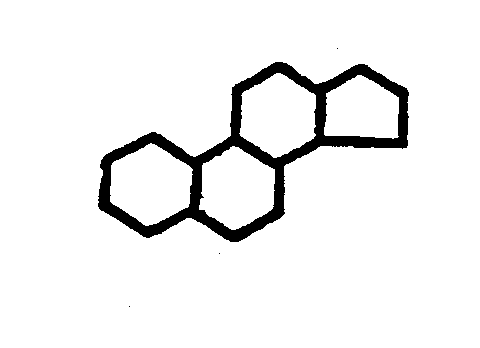
| | (1)
Note. A polymer which is not of a single molecular species
and is identifiable as an average of various molecular species is
excluded herefrom. A polymer which is a single molecular species,
e.g., dimer, etc., is included hereunder. The recitation "polymer" will
be presumed to be material of no single molecular species in the
absence of specific contrary disclosure. | |
| | |
| 299.61 | Including heterocyclic ring: |
| | This subclass is indented under subclass 299.6. Compositions wherein the liquid crystal compound has a ring
of three or more members, at least one of which is carbon and one
or more members selected from nitrogen or chalcogen. |
| | |
| 299.64 | Aryl ester of aryl acid having three benzene rings: |
| | This subclass is indented under subclass 299.6. Compositions wherein the liquid crystal compound has an
acid containing a benzene ring which is attached through its acid
function to the radical derived by the removal of -OH from an alcohol
containing a benzene ring. The compound must also contain three
or more benzene rings. |
| | |
| 301.16 | ORGANIC LUMINESCENT MATERIAL CONTAINING COMPOSITIONS: |
| | This subclass is indented under the class definition. Compositions which contain an organic substance having the
property of emitting light or analogous rays as a result of irradiation
by wave energy radiated by some other source.
| | (1)
Note. In this subclass are placed patents directed to compositions
which contain ingredients which require excitation to become fluorescent
or phosphorescent. |
SEE OR SEARCH THIS CLASS, SUBCLASS:
| 62.51+, | for luminescent magnetic compositions. |
| 301.1, | for luminescent compositions containing substances
which are spontaneously radioactive. |
| 700, | for chemiluminescent compositions. |
SEE OR SEARCH CLASS:
| 250, | Radiant Energy,
subclass 302 for radiation tracer methods including fluorescent
and phosphorescent tracer materials, subclasses 361+ for
invisible radiant energy responsive signalling devices which include
a fluorescent or phosphorescent detector responsive to the invisible
radiation, subclass 458.1 for methods and apparatus to irradiate
fluorescent and phosphorescent devices, and subclass 483.1 for fluorescent
and phosphorescent devices. |
| 260, | Chemistry of Carbon Compounds, appropriate subclasses for luminescent organic compounds,
per se. |
| 313, | Electric Lamp and Discharge Devices,
subclass 92 for cathode ray tubes having a fluorescent or phosphorescent
screen or target, and subclasses 483+ for electric lamps
and space discharge devices which include a fluorescent or phosphorescent
substance as a part thereof. |
| 362, | Illumination,
subclass 84 for illuminating devices in combination with fluorescent
or phosphorescent material. |
| 427, | Coating Processes,
subclasses 157+ for processes of making a luminescent coating. |
| 430, | Radiation Imagery Chemistry: Process, Composition,
or Product Thereof,
subclass 139 for luminescent imagery. |
| 508, | Solid Antifriction Devices, Materials Therefor,
Lubricant and Separant Compositions for Moving Solid Surfaces, and
Miscellaneous Mineral Oil Compositions, particularly
subclasses 110+ , for lubricating oils containing fluorescent ingredients. |
| 520, | Synthetic Resins or Natural Rubbers, appropriate subclasses, particularly Class 523,
subclass 161 for a composition containing a synthetic resin
or natural rubber having utility as an invisible, ballpoint, or
typewriter ink or to processes of preparing said composition. |
|
| | |
| 301.17 | Scintillating or lasing compositions: |
| | This subclass is indented under subclass 301.16. Compositions in which the luminescent material either (1)
can be stimulated to emit coherent light or other electromagnetic radiation,
i.e., optical maser, or (2) luminesces under exposure to ionizing
radiation, i.e., radio-photoluminescent.
SEE OR SEARCH CLASS:
| 117, | Single-Crystal, Oriented-Crystal, and Epitaxy
Growth Processes; Non-Coating Apparatus Therefor, for processes and non-coating apparatus for growing
therein-defined single-crystal of all types of materials, including those
which may be suitable as or to produce a lasing or scintillating
composition. Class 118 generally provides for coating apparatus,
including single-crystal (e.g., epitaxy) coating means. |
| 372, | Coherent Light Generators, appropriate subclasses for lasers. |
|
| | |
| 301.23 | Triazines: |
| | This subclass is indented under subclass 301.22. Compositions in which the compound contains a six-membered
ring consisting of three ring carbons and three ring nitrogens. |
| | |
| 301.24 | Thiazoles or oxazoles: |
| | This subclass is indented under subclass 301.22. Compositions in which the compound contains a five-membered
ring having at least two hetero atoms of which one is nitrogen and the
other is either oxygen or sulfur. |
| | |
| 301.25 | Azine containing: |
| | This subclass is indented under subclass 301.21. Compositions which contain a heterocyclic compound having
a six-membered ring with at least two hetero atoms, at least one
of which is nitrogen.
SEE OR SEARCH CLASS:
| 544, | Organic Compounds, for compounds, per se, having a six-membered ring consisting
of four ring carbons and two ring hetero atoms, at least one of which
is nitrogen. |
|
| | |
| 301.26 | Six-membered ring having one hetero-N-atom: |
| | This subclass is indented under subclass 301.21. Compositions which contain a heterocyclic compound having
a hexatomic ring made up of five carbon atoms and one nitrogen atom.
SEE OR SEARCH CLASS:
| 546, | Organic Compounds,
subclasses 1+ for compounds, per se, having a six-membered ring
consisting of five ring carbons and one ring nitrogen. |
|
| | |
| 301.27 | Azole containing: |
| | This subclass is indented under subclass 301.21. Compositions which contain a heterocyclic compound having
a five-membered ring having at least two hetero atoms, at least
one of which is a nitrogen atom.
SEE OR SEARCH CLASS:
| 548, | Organic Compounds,
subclasses 100+ for azole compounds, per se. |
|
| | |
| 301.28 | Thiazoles or oxazoles: |
| | This subclass is indented under subclass 301.27. Compositions in which the ring also contains sulfur or oxygen.
SEE OR SEARCH CLASS:
| 548, | Organic Compounds, appropriate subclasses for thiazole and oxazole
compounds, per se. |
|
| | |
| 301.29 | Tri- or tetrazoles: |
| | This subclass is indented under subclass 301.27. Compositions in which the ring contains three or four nitrogen
atoms.
SEE OR SEARCH CLASS:
| 548, | Organic Compounds,
subclasses 250 through 269.4for tri- or tetrazole compounds, per se. |
|
| | |
| 301.32 | Hetero-S-atom or hetero-O-atom containing: |
| | This subclass is indented under subclass 301.21. Compositions which contain a heterocyclic compound which
contains either oxygen or sulfur as a hetero atom.
SEE OR SEARCH CLASS:
| 549, | Organic Compounds,
subclasses 1+ for sulfur containing hetero rings and subclasses
200+ for hetero-O-atom compounds, per se. |
|
| | |
| 301.34 | Natural resin, cellulose, or derivatives containing: |
| | This subclass is indented under subclass 301.16. Compositions which includes (1) a film forming material
which occurs in nature (2) "cellulose" which is
a carbohydrate material derived from the structural matter of plant life
including lignocellulose, cotton and modified forms such a cellophane
and rayon or (3) cellulosic derivatives such as cellulose esters
or ethers. |
| | |
| 301.35 | Synthetic resin containing: |
| | This subclass is indented under subclass 301.16. Compositions which include a synthetic resin.
SEE OR SEARCH CLASS:
| 520, | Synthetic Resins or Natural Rubbers, the Class Definition for a discussion of "synthetic
resin." |
| 523, | Synthetic Resins or Natural Rubbers,
subclass 136 for a composition containing a synthetic resin
or natural rubber which is resistant to, yet does not absorb, radioactive
materials or cathode rays or to processes of preparing said composition. |
|
| | |
| 301.36 | INORGANIC LUMINESCENT COMPOSITIONS WITH ORGANIC NONLUMINESCENT
MATERIAL: |
| | This subclass is indented under the class definition. Compositions which contain an inorganic material having
the property of emitting light or analogous rays as a result of
irradiation by wave energy radiated by some other source, and an
organic material which does not have such a property.
SEE OR SEARCH THIS CLASS, SUBCLASS:
| 301.4+, | and 301.16+, for organic and other inorganic
luminescent compositions respectively, and see the search notes therein
for itemization of other possible pertinent fields of search. |
|
| | |
| 301.4 | INORGANIC LUMINESCENT COMPOSITIONS: |
| | This subclass is indented under the class definition. Compositions which are constituted entirely of inorganic
material and contain a component having the property of emitting light
or analogous rays as a result of irradiation by wave energy radiated
by some other source.
| | (1)
Note. This and the indented subclasses also include compositions
in the preparation of which a temporary organic vehicle, binder
or adjuvant is employed and which is removed or destroyed in the course
thereof. |
SEE OR SEARCH THIS CLASS, SUBCLASS:
| 301.16, | and 301.36, for luminescent compositions containing
organic material which may include inorganic luminescent material;
and see the search notes therein for itemization of other possibly
pertinent fields of search. |
SEE OR SEARCH CLASS:
| 423, | Chemistry of Inorganic Compounds, appropriate subclasses, for inorganic luminescent
compounds, per se. |
|
| | |
| 301.5 | Tungsten containing: |
| | This subclass is indented under subclass 301.4. Compositions which contain tungsten in combined or elemental
form.
SEE OR SEARCH CLASS:
| 75, | Specialized Metallurgical Processes, Compositions
for Use Therein, Consolidated Metal Powder Compositions, and Loose
Metal Particulate Mixtures,
subclass 248 for a consolidated metal powder composition having
a noble metal or copper base. |
|
| | |
| 363.5 | SOLIDS WITH SOLUTION OR DISPERSION AIDS: |
| | This subclass is indented under the class definition. Compositions in which each contains a main substance present
as a solid phase and a second substance incorporated or associated therewith
for accelerating the rate of solution or dispersion of the main
substance in a fluid, and processes of making the same.
| | (1)
Note. For compositions containing substances in a granular
state and agents associated therewith for inhibiting caking of the
granules, search where the substances are classifiable respectively. |
SEE OR SEARCH CLASS:
| 516, | Colloid Systems and Wetting Agents; Subcombinations
Thereof; Processes of Making, Stabilizing, Breaking, or Inhibiting, for compositions each of which contains a main solid
substance and a second substance associated therewith for stabilizing
or accelerating colloidal dispersion of the main substance. |
|
| | |
| 364 | SOLVENTS: |
| | This subclass is indented under the class definition. Compositions specialized and designed for, or peculiar to
use as solvents.
SEE OR SEARCH THIS CLASS, SUBCLASS:
| 69, | for solvents for volatile refrigerants. |
SEE OR SEARCH CLASS:
| 106, | Compositions: Coating or Plastic,
subclass 311 for vehicles or solvents for use in the production
of coating or plastic compositions. |
| 510, | Cleaning Compositions for Solid Surfaces, Auxiliary
Compositions Therefor, or Processes of Preparing the Compositions, appropriate subclasses, particularly
subclasses 118 , 177+, 201+, and 405+,
for cleaning compositions which include solvents. |
| 516, | Colloid Systems and Wetting Agents; Subcombinations
Thereof; Processes of Making, Stabilizing, Breaking, or Inhibiting, appropriate subclasses for subject matter relating
to: colloid systems (such as sols*, emulsions, dispersions,
foams, aerosols, smokes, gels, or pastes) or wetting agents (such
as leveling, penetrating, or spreading); subcombination compositions
of colloid systems containing at least an agent specialized and designed
for or peculiar to use in making or stabilizing colloid systems; compositions
and subcombination compositions specialized and designed for or
peculiar to use in breaking (resolving) or inhibiting colloid systems;
processes of making the compositions or systems of the class; processes
of breaking (resolving) or inhibiting colloid systems; in each instance,
when generically claimed or when there is no hierarchically superior
provision in the USPC for the specifically claimed art; including those
instances when a composition would otherwise be proper for this subclass
(364). |
|
| | |
| 365 | ANTI-INGESTIBLE OR DENATURED: |
| | This subclass is indented under the class definition. Compositions which in each case contain a substance as a
base and another substance (denaturant) for preventing or hindering
use of the base substance as a beverage or ingestion thereof, materials
(denaturants) for use as such other substances, or processes of
making such compositions or materials.
SEE OR SEARCH CLASS:
| 516, | Colloid Systems and Wetting Agents; Subcombinations
Thereof; Processes of Making, Stabilizing, Breaking, or Inhibiting, appropriate subclasses for subject matter relating
to: colloid systems (such as sols*, emulsions, dispersions,
foams, aerosols, smokes, gels, or pastes) or wetting agents (such
as leveling, penetrating, or spreading); subcombination compositions
of colloid systems containing at least an agent specialized and designed
for or peculiar to use in making or stabilizing colloid systems; compositions
and subcombination compositions specialized and designed for or
peculiar to use in breaking (resolving) or inhibiting colloid systems;
processes of making the compositions or systems of the class; processes
of breaking (resolving) or inhibiting colloid systems; in each instance,
when generically claimed or when there is no hierarchically superior
provision in the USPC for the specifically claimed art; including those
instances when a composition would otherwise be proper for this subclass
(365) and its indented subclasses. |
|
| | |
| 366 | Alcohol type: |
| | This subclass is indented under subclass 365. Compositions in which in each case the base substance contains
an alcohol.
SEE OR SEARCH CLASS:
| 44, | Fuel and Related Compositions,
subclasses 266+ for solidified alkanol, and subclasses 402, 411,
438, 446, and 451+ for liquid fuels containing alkanol. |
|
| | |
| 367.1 | SOAPS (I.E., ALKALI-METAL SALTS OF WATER-INSOLUBLE FATTY
ACIDS OR OF ROSIN ACIDS): |
| | This subclass is indented under the class definition. Compositions which include an alkali-metal (i.e., Li, Na,
K, Rb, or Cs) salt of an unsubstituted or hydroxy-substituted, saturated
or unsaturated, higher fatty acid, or of rosin (abietic) acid, which
are of general utility and lack any shape or structure to adapt
them for use as cleaning agents; or processes of preparing such
compositions.
| | (1)
Note. A higher fatty acid is a water-insoluble monocarboxylic
acid having an acyclic chain of at least seven carbons attached
directly to the carboxyl group by nonionic bonding. |
| | (2)
Note. The compositions in this class frequently include salts
of mixtures of fatty acids derived from different natural sources,
such as two or more vegetable or fish oils, animal fats, etc. |
| | (3)
Note. The compositions included herein are, for example,
used in well-drilling fluids, used in lubricant compositions, combined
with other components, or refined for use as detergents and the
like. |
SEE OR SEARCH CLASS:
| 510, | Cleaning Compositions for Solid Surfaces, Auxiliary
Compositions Therefor, or Processes of Preparing the Compositions, appropriate subclasses, particularly
subclasses 152+ , 447+, 481+, etc., for soap-containing cleaning
compositions. |
| 516, | Colloid Systems and Wetting Agents; Subcombinations
Thereof; Processes of Making, Stabilizing, Breaking, or Inhibiting, appropriate subclasses for subject matter relating
to: colloid systems (such as sols*, emulsions, dispersions,
foams, aerosols, smokes, gels, or pastes) or wetting agents (such
as leveling, penetrating, or spreading); subcombination compositions
of colloid systems containing at least an agent specialized and designed
for or peculiar to use in making or stabilizing colloid systems; compositions
and subcombination compositions specialized and designed for or
peculiar to use in breaking (resolving) or inhibiting colloid systems;
processes of making the compositions or systems of the class; processes
of breaking (resolving) or inhibiting colloid systems; in each instance,
when generically claimed or when there is no hierarchically superior
provision in the USPC for the specifically claimed art; including those
instances when a composition would otherwise be proper for this subclass
(367.1). |
| 554, | Organic Compounds, appropriate subclasses, for higher fatty acid salts,
per se. |
|
| | |
| 372 | GASEOUS COMPOSITIONS: |
| | This subclass is indented under the class definition. Compositions which are gaseous, or processes of making them.
SEE OR SEARCH THIS CLASS, SUBCLASS:
| 181.5, | for gaseous getters for electric lamps, electric
space discharge devices and other evacuted or gas or vapor filled containers. |
SEE OR SEARCH CLASS:
| 48, | Gas: Heating and Illuminating, for processes of, and apparatus for, making producer
gas, water-gas or other fuel gases. |
| 75, | Specialized Metallurgical Processes, Compositions
for Use Therein, Consolidated Metal Powder Compositions, and Loose
Metal Particulate Mixtures,
subclasses 300+ for gaseous compositions used in metallurgical
processes. |
| 313, | Electric Lamp and Discharge Devices,
subclasses 567+ for electric lamps and electric space discharge devices
(e.g., radio tubes) which have an envelope containing a gas and/or vapor
composition. |
| 424, | Drug, Bio-Affecting and Body Treating Compositions, appropriate subclass for a gaseous anesthetic composition
classified on the basis of the anesthetically active compound. |
| 514, | Drug, Bio-Affecting and Body Treating Compositions, appropriate subclasses for a gaseous anesthetic composition
classified on the basis of the anesthetically active compound;
subclass 789 for a life-supporting gaseous composition, e.g.,
deep-sea breathing gases, etc. |
| 516, | Colloid Systems and Wetting Agents; Subcombinations
Thereof; Processes of Making, Stabilizing, Breaking, or Inhibiting,
subclasses 1+ for continuous gas or vapor phase colloid system (e.g.,
smoke, fog, aerosol, cloud, mist) or agents for such systems or
making or stabilizing such systems or agents, when generically claimed
or when there is no hierarchically superior provision in the USPC
for the specifically claimed art; including those instances when
a composition would otherwise be proper for this subclass (372)
and its indented subclasses. |
|
| | |
| 373 | Carbon-oxide and hydrogen containing: |
| | This subclass is indented under subclass 372. Compositions which contain significant amounts of both carbon
monoxide, or carbon-dioxide, and hydrogen, or processes of making such
compositions.
SEE OR SEARCH CLASS:
| 48, | Gas: Heating and Illuminating, especially
subclass 198.1 , for process claims deriving the gaseous mixture from
a hydrocarbon gas, and no product claim is present. |
| 518, | Chemistry: Fischer-Tropsch Processes; or Purification
or Recovery of Products Thereof, for processes of reacting carbon oxides with hydrogen and
the products thereof. |
|
| | |
| 377 | From elementary nitrogen and hydrogen only or purification: |
| | This subclass is indented under subclass 374. Compositions in which the direct sources of the nitrogen
and hydrogen are elementary nitrogen and hydrogen only, processes
of making such compositions, or processes of purifying compositions
which individually contain both elementary nitrogen and elementary
hydrogen. |
| | |
| 378 | EXFOLIATED OR INTUMESCED: |
| | This subclass is indented under the class definition. Processes of exfoliating or intumescing vermiculite, other
micaceous substances, or other materials, or the products of such
processes.
SEE OR SEARCH CLASS:
| 99, | Foods and Beverages: Apparatus,
subclass 323.4 for apparatus for puffing or intumescing cereal
foods. |
| 106, | Compositions: Coating or Plastic, appropriate subclasses particularly
subclasses 122 , 601+ and 672+ for coating or
plastic compositions containing expanded materials, and subclasses
417+ for micaceous pigments or fillers. |
| 125, | Stone Working,
subclasses 23.01+ for processes of or apparatus for splitting mica
or other materials. |
| 241, | Solid Material Comminution or Disintegration,
subclass 4 for processes of comminuting micaceous substances. |
| 426, | Food or Edible Material: Processes, Compositions,
and Products, appropriate subclasses for puffing or intumescing
food grain. |
| 516, | Colloid Systems and Wetting Agents; Subcombinations
Thereof; Processes of Making, Stabilizing, Breaking, or Inhibiting, appropriate subclasses for subject matter relating
to: colloid systems (such as sols*, emulsions, dispersions,
foams, aerosols, smokes, gels, or pastes) or wetting agents (such
as leveling, penetrating, or spreading); subcombination compositions
of colloid systems containing at least an agent specialized and designed
for or peculiar to use in making or stabilizing colloid systems; compositions
and subcombination compositions specialized and designed for or
peculiar to use in breaking (resolving) or inhibiting colloid systems;
processes of making the compositions or systems of the class; processes
of breaking (resolving) or inhibiting colloid systems; in each instance,
when generically claimed or when there is no hierarchically superior
provision in the USPC for the specifically claimed art; including those
instances when a composition would otherwise be proper for this subclass
(378). |
|
| | |
| 380 | PRESERVATIVE AGENTS: |
| | This subclass is indented under the class definition. Compositions specialized and designed for, or peculiar to,
use as or in agents or materials for preventing, inhibiting or reducing
chemical or physical changes in other substances or bodies when
incorporated or associated therewith, and processes of making the
same, excepting compositions and processes of making them which
are primarily for use as analytical, testing, or indicating compositions.
| | (1)
Note. This subclass and indented subclasses take old compounds
limited to use as preserving agents and also the combination of
a preserving agent with the substance preserved where such substance
is so broadly claimed as not to afford a basis of classification,
e.g., "an organic substance." |
| | (2)
Note. For compositions, or processes of making them, each
of which contains a main substance and an agent for inhibiting caking
of granules of, chemical decomposition of, or other chemical or physical
change of, the main substance, search where the main substance is
classifiable. |
SEE OR SEARCH THIS CLASS, SUBCLASS:
| 71, | for compositions specialized and designed for, or
peculiar to, use in heat exchanges or which are low-freezing (freezing
point depressing) or high-boiling (boiling point elevating), or
which are adapted to form mixtures having a lower pour-point or freezing
point when mixed with other substances. |
| 601+, | for fire-proofing compositions. |
SEE OR SEARCH CLASS:
| 106, | Compositions: Coating or Plastic, for protective coating or impregnating compositions. |
| 422, | Chemical Apparatus and Process Disinfecting, Deodorizing,
Preserving, or Sterilizing, appropriate subclasses for processes for disinfecting,
deodorizing, preserving, or sterilizing. |
| 424, | Drug, Bio-Affecting and Body Treating Compositions, for a composition for repelling, inhibiting or destroying a
pest such as bacteria, fungus, etc. |
| 516, | Colloid Systems and Wetting Agents; Subcombinations
Thereof; Processes of Making, Stabilizing, Breaking, or Inhibiting, appropriate subclasses for subject matter relating
to: colloid systems (such as sols*, emulsions, dispersions,
foams, aerosols, smokes, gels, or pastes) or wetting agents (such
as leveling, penetrating, or spreading); subcombination compositions
of colloid systems containing at least an agent specialized and designed
for or peculiar to use in making or stabilizing colloid systems; compositions
and subcombination compositions specialized and designed for or
peculiar to use in breaking (resolving) or inhibiting colloid systems;
processes of making the compositions or systems of the class; processes
of breaking (resolving) or inhibiting colloid systems; in each instance,
when generically claimed or when there is no hierarchically superior
provision in the USPC for the specifically claimed art; including those
instances when a composition would otherwise be proper for this subclass
(380) and its indented subclasses. |
|
| | |
| 381 | Anti-caking, separative or protective coatings or zones: |
| | This subclass is indented under subclass 380. Compositions specialized and designed for or peculiar to
use as or in agents for preventing, inhibiting or reducing caking
of granular material, or use in the form of distinct coating blankets,
layers or zones with respect to the materials with which they are
associated respectively.
| | (1)
Note. For compositions each of which contains a main substance
and an agent for inhibiting caking of granules of the main substance,
search where the main substance is classifiable. |
SEE OR SEARCH THIS CLASS, SUBCLASS:
| 2+, | for fire extinguishing. |
| 601+, | for fire-retarding agents. |
SEE OR SEARCH CLASS:
| 75, | Specialized Metallurgical Processes, Compositions
for Use Therein, Consolidated Metal Powder Compositions, and Loose
Metal Particulate Mixtures,
subclasses 303+ for solid treating compositions for molten metal
and subclass 709 for processes of covering the surface of molten metal
with a material to prevent contact with the ambient atmosphere. |
| 106, | Compositions: Coating or Plastic, for coating compositions. |
| 422, | Chemical Apparatus and Process Disinfecting, Deodorizing,
Preserving, or Sterilizing,
subclasses 40+ for process of storage or protection using a protective
layer over the material being stored or protected. |
|
| | |
| 382 | Foams, liquids, or fluids: |
| | This subclass is indented under subclass 381. Compositions which are essentially foams, liquids, or other
fluids.
SEE OR SEARCH THIS CLASS, SUBCLASS:
| 3, | for fire extinguishing foams. |
| 8.1, | for fire preventing foams. |
| 62, | for heat-insulating compositions. |
|
| | |
| 387 | Anti-corrosion: |
| | This subclass is indented under subclass 380. Compositions specialized and designed for, or peculiar to,
use as or in agents for preventing, inhibiting, or reducing, corrosion
or chemical attack of solid metals, or other solid materials, of
receptacles or apparatus.
| | (1)
Note. For compositions each of which contains a main substance
and an agent for inhibiting corrosion by the main substance, search
where the main substance is classifiable. |
SEE OR SEARCH THIS CLASS, SUBCLASS:
| 381+, | for anti-caking, separative, or protective coatings
or zones. |
| 397+, | for agents which inhibit corrosion by inhibiting
formation of corrosive products of chemical change. |
SEE OR SEARCH CLASS:
| 106, | Compositions: Coating or Plastic, particularly
subclass 14.05 , for corrosion-inhibiting coating compositions. |
| 422, | Chemical Apparatus and Process Disinfecting, Deodorizing,
Preserving, or Sterilizing,
subclasses 7+ for process of maintaining an environment nondestructive
to metal. |
| 510, | Cleaning Compositions for Solid Surfaces, Auxiliary
Compositions Therefor, or Processes of Preparing the Compositions,
subclasses 255 , 258+, 335+, 401+, etc.,
for cleaning compositions that include anticorrosion agents. |
|
| | |
| 389.1 | Component inorganic or organic comprising element other
than C,H,O,N,S, and halogen: |
| | This subclass is indented under subclass 388. Compositions comprising either an inorganic compound or
an organic compound which includes an element other than carbon,
hydrogen, oxygen, nitrogen, sulfur or a halogen (i.e.,fluorine,
chlorine, bromine, iodine and astatine). |
| | |
| 389.2 | Phosphorus containing: |
| | This subclass is indented under subclass 389.1. Compositions which includes a compound containing an atom
of the element phosphorus.
| | (1)
Note. This subclass is the location for phosphoric and polyphosphoric
acids and esters and other derivatives thereof. | |
| | |
| 389.22 | Pentavalent P, except H(n + 2) PnO(3n + 1): |
| | This subclass is indented under subclass 389.21. Compositions in which the Phosphorus containing compound
includes pentavalent Phosphorus, such as phospho and phosphono compounds,
while excluding compounds of the formula H (n+2)P nO (3n+1)
(i.e., the phosphoric and polyphosphoric acids). |
| | |
| 389.23 | Pentavalent P, except H (n+2)P nO (3n+1): |
| | This subclass is indented under subclass 389.2. Compositions in which the Phosphorus containing compound
includes pentavalent Phosphorus, such as phospho and phosphono compounds,
while excluding compounds of the formula H (n+2)P nO (3n+1)
(i.e., the phosphoric and polyphosphoric acids). |
| | |
| 389.31 | Organo silicon: |
| | This subclass is indented under subclass 389.3. Compositions in which the silicon containing compound is
an organic compound.
SEE OR SEARCH CLASS:
| 260, | Chemistry of Carbon Compounds, the main class definition for the definition of
Organic Compounds. |
|
| | |
| 389.41 | Organo boron: |
| | This subclass is indented under subclass 389.4. Compositions wherein the boron containing compound is an
organic compound.
SEE OR SEARCH CLASS:
| 260, | Chemistry of Carbon Compounds, the main class definition for the definition of
Organic Compounds. |
|
| | |
| 389.53 | Nickel, iron, cobalt, copper, maganese, mercury, or cadmium
containing: |
| | This subclass is indented under subclass 389.1. Compositions which include a compound containing an atom
of any of the elements nickel, iron, cobalt, copper, manganese,
mercury or cadmium. |
| | |
| 389.54 | Molybdenum, arsenic, antimony, vanadium, bismuth, tungsten,
selenium, or tellurium containing: |
| | This subclass is indented under subclass 389.1. Compositions which include a compound containing an atom
of any of the elements molybdenum, arsenic, antimony, vanadium,
bismuth, tungsten, selenium or tellurium. |
| | |
| 393 | Phenol or quinone radical containing: |
| | This subclass is indented under subclass 388. Compositions which contain organic compounds which contain
a phenol or quinone radical (oxygen bonded directly to carbon of
a benzene or naphthalene ring or other aromatic nucleus). |
| | |
| 397 | Anti-oxidants or chemical change inhibitants: |
| | This subclass is indented under subclass 380. Compositions specialized and designed for, or peculiar to,
use or in anti-oxidants or agents for preventing, inhibiting, or
reducing oxidation, chemical decomposition, or other chemical change.
| | (1)
Note. For compositions each of which contains a main substance
and an agent for inhibiting chemcial decomposition or other chemical
change of the main substance, search where the main substance is
classifiable. |
SEE OR SEARCH THIS CLASS, SUBCLASS:
| 381+, | for protective layers. |
| 386, | for agents for inhibiting knock or explosions. |
| 387+, | for anticorrosion agents. |
|
| | |
| 400.1 | Component inorganic or organic comprising element other
than C,H,O,N,S, and halogen: |
| | This subclass is indented under subclass 399. Compositions comprising either an inorganic compound or
an organic compound which includes an element other than carbon,
hydrogen, oxygen, nitrogen, sulfur or a halogen (i.e., fluorine,
chlorine, bromine, iodine and astatine). |
| | |
| 400.2 | Phosphorus containing: |
| | This subclass is indented under subclass 400.1. Compositions which includes a compound containing an atom
of the element phosphorus.
| | (1)
Note. This subclass is the location for phosphoric and polyphosphoric
acids and ester and other derivatives thereof. | |
| | |
| 400.31 | Organo silicon: |
| | This subclass is indented under subclass 400.3. Compositions in which the silicon containing compound is
an organic compound.
SEE OR SEARCH CLASS:
| 260, | Chemistry of Carbon Compounds, the main class definition for the definition of
Organic Compounds. |
|
| | |
| 400.41 | Organo boron: |
| | This subclass is indented under subclass 400.4. Compositions wherein the boron containing compound is an
organic compound.
SEE OR SEARCH CLASS:
| 260, | Chemistry of Carbon Compounds, the main class definition for the definition of
Organic Compounds. |
|
| | |
| 400.53 | Nickel, iron, cobalt, copper, maganese, mercury, or cadmium
containing: |
| | This subclass is indented under subclass 400.1. Compositions which include a compound containing an atom
of any of the elements nickel, iron, cobalt, copper, manganese,
mercury or cadmium. |
| | |
| 400.54 | Molybdenum, arsenic, antimony, vanadium, bismuth, tungsten,
selenium or tellurium containing: |
| | This subclass is indented under subclass 400.1. Compositions which include a compound containing an atom
of any of the elements molybdenum, arsenic, antimony, vanadium,
bismuth, tungsten, selenium or tellurium. |
| | |
| 404 | Phenol or quinone radical containing: |
| | This subclass is indented under subclass 399. Compositions which contain organic compounds which contain
a phenol or quinone radical (oxygen bonded directly to carbon of
a benzene or naphthalene nucleus or other aromatic nucleus). |
| | |
| 408.1 | NONREACTIVE ANALYTICAL, TESTING, OR INDICATING COMPOSITIONS: |
| | This subclass is indented under the class definition. Compositions specialized and designed for, or peculiar to,
use in physical analysis, testing or indicating, or as warning agents which
do not chemically react in use.
SEE OR SEARCH THIS CLASS, SUBCLASS:
| 68, | for refrigerants containing warning agents. |
| 301.16, | for compositions containing fluorescent or phosphorescent
substances as analytical, testing, or identification agents. |
SEE OR SEARCH CLASS:
| 48, | Gas: Heating and Illuminating,
subclass 195 for fuel gases containing warning agents. |
| 73, | Measuring and Testing, for testing processes and apparatus not otherwise classified. |
| 424, | Drug, Bio-affecting and Body Treating Compositions,
subclasses 9.1+ for a composition adapted to diagnose a body condition
or for a method of determining the potency of a composition of that
class (424) by a test in a living body. |
| 436, | Chemistry: Analytical and Immunological Testing, for compositions useful as standards or as materials
used in a process of analysis involving a chemical reaction. |
| 516, | Colloid Systems and Wetting Agents; Subcombinations
Thereof; Processes of Making, Stabilizing, Breaking, or Inhibiting, appropriate subclasses for subject matter relating
to: colloid systems (such as sols*, emulsions, dispersions,
foams, aerosols, smokes, gels, or pastes) or wetting agents (such
as leveling, penetrating, or spreading); subcombination compositions
of colloid systems containing at least an agent specialized and designed
for or peculiar to use in making or stabilizing colloid systems; compositions
and subcombination compositions specialized and designed for or
peculiar to use in breaking (resolving) or inhibiting colloid systems;
processes of making the compositions or systems of the class; processes
of breaking (resolving) or inhibiting colloid systems; in each instance,
when generically claimed or when there is no hierarchically superior
provision in the USPC for the specifically claimed art; including those
instances when a composition would otherwise be proper for this subclass
(408.1). |
|
| | |
| 478 | X-RAY OR NEUTRON SHIELD: |
| | This subclass is indented under the class definition. Compositions specialized and designed to prevent the passage
of X-radiation or other wave energy, outside the visible spectrum, such
as is released in nuclear transformation.
SEE OR SEARCH THIS CLASS, SUBCLASS:
| 300, | for compositions specialized for use as optical
filter compositions including those which filter ray energy outside
the visible spectrum. |
SEE OR SEARCH CLASS:
| 250, | Radiant Energy,
subclasses 515.1+ for radiation shields including X-ray shields. |
| 378, | X-Ray or Gamma Ray Systems or Devices,
subclasses 145+ for beam control devices. |
| 420, | Alloys or Metallic Compositions,
subclasses 122.1+ for alloys which are opaque to X-radiation or neutrons. |
| 424, | Drug, Bio-Affecting and Body Treating Compositions,
subclasses 4+ for an X- ray contrast composition to be used in
an animal body and subclasses 59+ for a sun or radiation
screening composition to be applied to a living body, e.g., sun
tanning lotion, etc. |
| 520, | Synthetic Resins or Natural Rubbers, appropriate subclasses, particularly Class 523,
subclass 136 for a composition containing a synthetic resin
or natural rubber which is resistant to, yet does not absorb, radioactive
materials or cathode rays or to processes of preparing said composition. |
|
| | |
| 492 | INCANDESCENT MANTLE COMPOSITIONS: |
| | This subclass is indented under the class definition. Composition specialized for use in preparing, coating or
regenerating incandescent mantles, and mantles defined solely in
terms of the composition of which they are composed.
| | (1)
Note. The term "mantle" is intended to include
all devices which are designed to give off light by being heated
to incandescence by a combustion flame. |
| | (2)
Note. Included herein are also processes of making mantles
which involve no more than preparing or regenerating the composition
of which the mantle is composed. For example, this subclass includes
processes wherein a textile base is coated or impregnated with a
composition classifiable in this subclass and the textile base is
then burned off. |
SEE OR SEARCH THIS CLASS, SUBCLASS:
| 479+, | for similar compositions which are claimed as electrodes,
filaments and shields for electric lamps and electric space discharge
devices. |
SEE OR SEARCH CLASS:
| 427, | Coating Processes,
subclass 159 for coating processes wherein the product is an
incandescent mantle. |
| 431, | Combustion,
subclasses 100+ for a burner using a mantle, or for mantle structure. |
| 502, | Catalyst, Solid Sorbent, or Support Therefor:
Product or Process of Making, for a composition comprising a catalyst which may
be used in or as an incandescent mantle composition. |
|
| | |
| 500 | ELECTRICALLY CONDUCTIVE OR EMISSIVE COMPOSITIONS: |
| | This subclass is indented under the class definition. Compositions which either conduct or emit electrons not
provided for above.
| | (1)
Note. This is the residual home for all conductive and emissive
compositions and all electrical devices defined solely in terms
of their composition with no claimed significant device structure.
By way of example only, these devices are electrodes, filaments
or shields for electric lamps and electric space discharge devices,
welding electrodes, contacts, switches, brushes, and resistances. |
| | (2)
Note. Where the device is claimed in terms of the composition
of which it is composed and also in terms of significant device
structure, it is classified in the appropriate class providing for
such art devices. See the search notes below for such art classes. |
| | (3)
Note. Where a patent contains claims to the electrical device
defined only by its composition classified in this or indented subclasses
and also claims to a method of preparing such device provided for
in another class, the patent is classified in this class (252) and
cross-referenced to such other class. See the search notes below
for other classes which provide for methods of making electrical devices. |
| | (4)
Note. This and indented subclasses are superior to other
composition classes as to coating or plastic compositions useful in
making or coating electrical devices. See Lines With Other Classes
and Within This Class, Lines For Particular Class 252 Subclass Areas,
for a discussion of the lines between this area and other classes. |
| | (5)
Note. Where the claimed electrically conductive or emissive
device is defined in terms of only a single material, it is classified
in the appropriate class providing for such material. |
SEE OR SEARCH THIS CLASS, SUBCLASS:
| 62.2, | for electrolytes for electrical devices such as
rectifiers and condensers. |
| 62.3, | for barrier layer device compositions. |
| 62.5, | for magnetic compositions. |
| 62.9, | for piezoelectric compositions. |
| 181.1+, | for compositions specialized for use as getters
for electric lamps and electric space discharge devices and for materials
and compositions specialized for use in generating a gas or vapor
within the container of an electric lamp or electric space discharge device.
Where the composition has utility as a getter or gas or vapor generating
material within the envelope of an electric lamp or electric space discharge
device, and also as an electrode or filament useful for purposes other
than gettering or generating a gas or vapor (e.g., emitting electrons), it
is classified in subclasses 181.1+ and cross-referenced
to subclasses 500+. |
| 301.1, | for radio-active compositions and materials. |
| 301.16, | through 301.6, for fluorescent and phosphorescent
compositions and materials. |
| 502+, | for electrically conductive or emissive compositions
comprising carbon. |
| 570+, | for fluent dielectric compositions ("insulating
oils") which contain a hydrocarbon and a nonhydrocarbon. |
SEE OR SEARCH CLASS:
| 75, | Specialized Metallurgical Processes, Compositions
for Use Therein, Consolidated Metal Powder Compositions, and Loose
Metal Particulate Mixtures,
subclasses 228+ for products with a continuous phase of metal made
by consolidating metal particles which are electrically conductive
or emissive. |
| 96, | Gas Separation: Apparatus,
subclasses 95 and 98 for electrode stock material or composite
which has been specifically altered, configured, or constructed
for use in electric or electrostatic field separation apparatus
for gas separation. |
| 106, | Compositions: Coating or Plastic, appropriate subclasses for miscellaneous coating,
impregnating and plastic compositions including electrical insulating
compositions. See the (2) Note of the class definition of Class 106,
and the reference to this class (252) therein. |
| 148, | Metal Treatment,
subclasses 240+ for processes of treating solid metal with a reactive
material to form a coating thereon. |
| 200, | Electricity: Circuit Makers and Breakers,
subclass 166 for contacts and switches wherein there is significant
structure of the device claimed whether or not the device is also defined
in terms of the composition of which it is composed. |
| 204, | Chemistry: Electrical and Wave Energy,
subclasses 280+ for electrodes and electrode compositions specialized
for use in electrolytic apparatus adapted to carry out processes
within the scope of Class 204. |
| 219, | Electric Heating,
subclasses 50+ for arc welding and heating of metal. Note particularly
indented subclasses 146.1+ for welding electrodes. |
| 264, | Plastic and Nonmetallic Article Shaping or Treating:
Processes, appropriate subclasses for processes within the class definition,
for production of articles which may be disclosed to be electrodes
for electrical devices or electrical conductors. In particular, see
subclasses 61+ and 104+. Subclasses 165+ pertains
to forming of continuous or indefinite length articles, e.g., filamentary
products. See subclass 30 for furnace lining formation or repair
and see the notes thereto. |
| 310, | Electrical Generator or Motor Structure,
subclasses 252+ for electric current conducting brushes wherein
there is significant brush structure whether or not the composition
of which the brushes are composed is recited. |
| 313, | Electric Lamp and Discharge Devices,
subclass 311 and the subclasses specified in the Notes thereto for
discharge devices which have an electrode defined by the composition or
material of which it is composed, and subclasses 326+ for
filaments, electrodes and shields for electric lamps and electric
space discharge devices which are defined by significant structure
of the device, whether or not the composition of the device is recited. |
| 337, | Electricity: Electrothermally or Thermally Actuated
Switches, appropriate subclasses for electrothermal and thermally
actuated switches with contacts of a particular material or composition
of material especially
subclasses 270+ and 416+ for particular fusible material. |
| 338, | Electrical Resistors, appropriate subclasses, for electrical resistors wherein
there is significant resistance structure of the device claimed, whether
or not the device is also defined in terms of the composition of the
element or terminals. |
| 373, | Industrial Electric Heating Furnaces,
subclasses 88+ and 71+ for furnace electrodes and furnace
linings, respectively, of specific composition where combined with
furnace structure or when defined in terms of significant electrode
or lining structure. |
| 381, | Electrical Audio Signal Processing Systems and
Devices,
subclasses 179+ for resistance element used in the transmission
of sound by means of electricity recited in terms of significant
resistant structure. |
| 419, | Powder Metallurgy Processes,
subclass 4 for powder metallurgical methods for producing
filaments or fibers. |
| 420, | Alloys or Metallic Compositions, for single metals and for alloys and metallic compositions. |
| 427, | Coating Processes,
subclasses 58+ for processes of coating, per se, wherein the product
is an electrical article. |
| 428, | Stock Material or Miscellaneous Articles, appropriate subclasses, especially
subclasses 375+ , 408, 411+, 539.5, 545, 553+,
and 615+ for a mere impregnated or coated base which may
exhibit electrically conductive and emissive properties. Such coated bases
include electrodes, filaments and shields for electric lamps and
discharge devices, welding electrodes, resistances, brushes, contacts,
wires and electrodes in general which are not specifically provided
for elsewhere, or do not include sufficient structure to indicate
classification elsewhere. |
| 429, | Chemistry: Electrical Current Producing Apparatus,
Product and Process,
subclasses 209+ for battery electrodes. |
| 445, | Electric Lamp or Space Discharge Component or
Device Manufacturing, and the classes specified in the notes thereto for
process and apparatus for the manufacture of electrical conductors
or emitters such as electrodes or emitters such as electrodes or
shields for electric space discharge devices. |
| 505, | Superconductor Technology: Apparatus, Material,
Process,
subclasses 100+ for high temperature (Tc
30 K) superconducting materials, per se, or subclasses 300+ for
processes of producing same. |
|
| | |
| 501.1 | Light sensitive: |
| | This subclass is indented under subclass 500. Compositions wherein the electrical conductivity or emissivity
varies with the intensity of the light to which it is exposed.
SEE OR SEARCH CLASS:
| 250, | Radiant Energy, the definitions of
subclass 200 under (7) Note, for the various classifications
of photcells, per se. These generally embody photosensitive compositions
or layers. |
| 430, | Radiation Imagery Chemistry: Process, Composition,
or Product Thereof,
subclasses 32+ for compositions of this type limited to use in radiation
imagery. |
|
| | |
| 502 | Elemental carbon containing: |
| | This subclass is indented under subclass 500. Compositions which contain as an ingredient elemental carbon.
| | (1)
Note. Where the composition or device is composed of carbon
obtained from either plural sources or from natural fibers, the
patent is classified in this and indented subclasses. |
SEE OR SEARCH THIS CLASS, SUBCLASS:
| 510+, | for compositions wherein an organic component is
present in addition to the elemental carbon, even if the organic
component is to be subsequently carbonized in whole or in part. |
SEE OR SEARCH CLASS:
| 201, | Distillation: Processes, Thermolytic, appropriate subclasses for a process of carbonizing
carbonaceous material. |
| 423, | Chemistry of Inorganic Compounds,
subclasses 445+ for carbon, per se, including manufacturing processes involving
a chemical reaction. |
| 501, | Compositions: Ceramic,
subclasses 99+ for refractory composition containing elemental
carbon. |
| 516, | Colloid Systems and Wetting Agents; Subcombinations
Thereof; Processes of Making, Stabilizing, Breaking, or Inhibiting,
subclass 901 for a collection of art under the Class definition which
discloses subject matter relating to a colloid system comprising substantially
pure elemental Carbon in one of its various forms such as graphite,
lamp black, carbon black, fullerenes. |
|
| | |
| 504 | With carbide: |
| | This subclass is indented under subclass 502. Compositions which contain a carbide in addition to the
elemental carbon.
SEE OR SEARCH THIS CLASS, SUBCLASS:
| 516, | for other conductive or emissive compositions which
contain carbides. |
|
| | |
| 505 | With radioactive material: |
| | This subclass is indented under subclass 502. Compositions which contain a radio-active material in addition
to the elemental carbon.
| | (1)
Note. Compounds of radium, uranium and thorium, for example,
are included in this subclass. |
SEE OR SEARCH THIS CLASS, SUBCLASS:
| 301.1, | for miscellaneous compositions containing radio-active
materials. |
| 517, | for other conductive or emissive compositions which
contain a radio-active material. |
SEE OR SEARCH CLASS:
| 427, | Coating Processes,
subclass 5 for coating processes, per se, wherein the base
or coating is radioactive. |
|
| | |
| 507 | Titanium or zirconium compound: |
| | This subclass is indented under subclass 506. Compositions which contain a titanium or zirconium compound
in addition to the elemental carbon.
SEE OR SEARCH THIS CLASS, SUBCLASS:
| 519.12, | and 520.2+, for other conductive or emissive
compositions which contain titanium or zirconium compounds. |
|
| | |
| 510 | With organic component: |
| | This subclass is indented under subclass 502. Compositions which contain an organic component in addition
to the elemental carbon.
| | (1)
Note. Even if the organic component is to be subsequently
carbonized, wholly or in part, the composition is classified herein. | |
| | |
| 511 | Resin, rubber, or derivative thereof containing: |
| | This subclass is indented under subclass 510. Compositions wherein the organic component is a resin (natural
or synthetic), a natural rubber or a derivative thereof.
SEE OR SEARCH CLASS:
| 106, | Compositions: Coating or Plastic, appropriate subclass for plastic or coating compositions
which contain a natural resin and elemental carbon, particularly
subclass 241 . |
| 520, | Synthetic Resins or Natural Rubbers, appropriate subclasses for synthetic resins or natural
rubber and compositions thereof. |
|
| | |
| 512 | Free metal containing: |
| | This subclass is indented under subclass 500. Compositions which contain free metals.
SEE OR SEARCH THIS CLASS, SUBCLASS:
| 503, | for conductive or emissive compositions containing
free metal and elemental carbon. |
|
| | |
| 513 | Iron group metal (iron, cobalt, nickel): |
| | This subclass is indented under subclass 512. Compositions wherein the free metal is a metal from the
iron group.
| | (1)
Note. The iron group comprises iron, nickel and cobalt. |
SEE OR SEARCH CLASS:
| 75, | Specialized Metallurgical Processes, Compositions
for Use Therein, Consolidated Metal Powder Compositions, and Loose
Metal Particulate Mixtures,
subclasses 246+ for a consolidatd metal particle composition having
a base of an Iron group, Copper (Cu), or Noble metal. |
|
| | |
| 514 | Noble metal (gold, silver, ruthenium, rhodium, palladium,
osmium, iridium, platinum): |
| | This subclass is indented under subclass 512. Compositions wherein the free metal is a noble metal.
| | (1)
Note. The noble metals as herein provided for are gold, silver,
ruthenium, rhodium, palladium, osmium, iridium and platinum. |
SEE OR SEARCH CLASS:
| 75, | Specialized Metallurgical Processes, Compositions
for Use Therein, Consolidated Metal Powder Compositions, and Loose
Metal Particulate Mixtures,
subclasses 246+ for a consolidated metal particle composition having
a base of an Iron group, Copper (Cu), or Nobel metal. |
|
| | |
| 515 | Tungsten: |
| | This subclass is indented under subclass 512. Compositions wherein the free metal is tungsten.
SEE OR SEARCH CLASS:
| 75, | Specialized Metallurgical Processes, Compositions
for Use Therein, Consolidated Metal Powder Compositions, and Loose
Metal Particulate Mixtures,
subclass 248 for a consolidated metal particle composition having
a tungsten base. |
|
| | |
| 516 | Carbide containing: |
| | This subclass is indented under subclass 500. Compositions which contain a carbide.
SEE OR SEARCH THIS CLASS, SUBCLASS:
| 504, | for conductive or emissive compositions containing
a carbide and elemental carbon. |
SEE OR SEARCH CLASS:
| 75, | Specialized Metallurgical Processes, Compositions
for Use Therein, Consolidated Metal Powder Compositions, and Loose
Metal Particulate Mixtures,
subclass 236 for a consolidated metal particle composition containing
carbide. |
|
| | |
| 517 | Radioactive material containing: |
| | This subclass is indented under subclass 500. Compositions which contain a radio-active material.
| | (1)
Note. Compounds of radium, uranium and thorium, for example,
are included in this subclass. |
SEE OR SEARCH THIS CLASS, SUBCLASS:
| 505, | for conductive or emissive compositions containing
elemental carbon and a radio-active material. |
|
| | |
| 518.1 | Metal compound containing: |
| | This subclass is indented under subclass 500. Compositions which contain a metal compound not provided
for above.
SEE OR SEARCH THIS CLASS, SUBCLASS:
| 506+, | for conductive or emissive compositions containing
a metal compound and elemental carbon. |
|
| | |
| 519.1 | Compound viewed as composition (i.e., wherein atoms or
molecules in a chemical formula are not present as whole small integer
values or cannot be multiplied by a single-digit factor to yield
integer values): |
| | This subclass is indented under subclass 518.1. Compositions which contain a compound wherein atoms or molecules
in a chemical formula are not present as whole small integer values
or cannot be multiplied by a factor in the single digit to yield
integer values. Such a compound is considered a composition for
purposes of this subclass and its indents.
| | (1)
Note. The electrically conductive compounds provided for
herein are regarded as compositions according to the Class 423 class
definition (i.e., see Note (13) of Class 423). A mixture of such
a compound proper for this subclass with a separate and distinct
component is also proper for this subclass. |
| | (2)
Note. Class 505 is superior to Class 423 or Class 252. |
SEE OR SEARCH CLASS:
| 423, | Chemistry of Inorganic Compounds, for an inorganic compound wherein plural elements
are present in specifically defined whole integer values. |
| 505, | Superconductor Technology: Apparatus, Material,
Process, for electrically conducting superconducting compounds
or compositions operative above 30 K. |
|
| | |
| 519.14 | Sulfur, tellurium, selenium, nitrogen, phosphorus, or boron
containing: |
| | This subclass is indented under subclass 519.1. Compositions wherein the chemical formula has sulfur, tellurium,
selenium, nitrogen, phosphorus, or boron therein. |
| | |
| 519.2 | Organometallic (e.g., soap, complex, etc.): |
| | This subclass is indented under subclass 518.1. Compositions wherein the metal compound is an organic compound.
| | (1)
Note. The expression "organic compound" in
this and indented subclasses corresponds to the Class 260 class
definition (i.e., compounds containing carbon, which are further
characterized by the presence in a molecule thereof of (a) two
carbon atoms bonded together, (b) one atom of carbon bonded to at
least one atom of hydrogen or halogen, or (c) one atom of carbon
bonded to at least one atom of nitrogen by a single or double bond,
with the proviso that HCN, CN-CN, HNCO, HNCS, cyanamide, cyanogen
halides, fulminic acid, metal carbides, and graphite are excluded
from being organic compounds). | |
| | |
| 519.21 | With additional organic compound: |
| | This subclass is indented under subclass 519.2. Compositions which contain, in addition to the organometallic
compound, an additional organic compound which may itself be organometallic.
SEE OR SEARCH THIS CLASS, SUBCLASS:
| 510+, | for conductive or emissive compositions containing
an organic compound and elemental carbon. |
|
| | |
| 519.3 | With organic compound: |
| | This subclass is indented under subclass 518.1. Compositions which contain an organic compound in addition
to the metal compound.
SEE OR SEARCH THIS CLASS, SUBCLASS:
| 510+, | for conductive or emissive compositions containing
an organic compound and elemental carbon. |
|
| | |
| 519.32 | The organic compound is a natural resin, protein, lignin,
carbohydrate, or derivative thereof: |
| | This subclass is indented under subclass 519.3. Compositions wherein the organic compound is a natural resin,
protein, lignin, carbohydrate, or derivative thereof.
| | (1)
Note. Natural resins include but are not limited to shellac,
copals from various sources (e.g., congo, manila, etc.), amber,
dammar, dead dammar, gum rosin, japan, japan varnish, rosin (colophony),
tall oil (liquid rosin), wood rosin, burgundy pitch, gurjun balsam, canada
balsam, sandrac, mastic, accroides, benzoin, elemi, gamboge, gum
thus, venice turpentine, bordeaux turpentine, abietic acid, pimaric
acid, etc. |
| | (2)
Note. Examples of derivatives of natural resins included
herein are hydrogenated, esterified, polymerized, or sulfurized natural
resins, or salts thereof. |
| | (3)
Note. Protein is a naturally occurring polypeptide (polyamide)
of more than 100 a-amino acid residues or of molecular weight greater
than 10,000. |
| | (4)
Note. Lignin is a noncarbohydrate, polymeric substance found
in wood and woody plants which functions as a natural plastic binder
for the cellulose fibers. It is isolated directly from wood or
wood products or from the treatment of wood (e.g., waste sulfite
liquor or black liquor). The structure of the lignin monomer is
not completely known. |
| | (5)
Note. The term "carbohydrate or derivative" in
this subclass corresponds to the Class 536, subclass 1.1 definition
(i.e., a carbohydrate is a saccharide whose monomeric units are
polyhydroxy monoaldehydes or polyhydroxy monoketones, having the
formula Cn(H2O)n
(wherein n is five or six), or the corresponding cyclic hemiacetals thereof,
or the reaction derivatives thereof in which the product is of indeterminate
structure or the carbon skeleton and the carbonyl function or hemi-acetal
function of the saccharide unit are not destroyed). | |
| | |
| 519.33 | The organic compound is a polymer: |
| | This subclass is indented under subclass 519.3. Compositions wherein the organic compound is a large molecule
of many repeating units; both liquid and solid polymers are encompassed
herein, as are both homopolymeric and copolymeric substances.
| | (1)
Note. Examples of polymers provided for herein are polyacetylene,
polypropylene, epoxy resin, poly(xylylidene), polyester, poly(oxyalkylene),
and polyacrylonitrile. |
SEE OR SEARCH THIS CLASS, SUBCLASS:
| 511, | for conductive or emissive compositions containing
a resin, rubber, or derivative thereof and elemental carbon. |
|
| | |
| 519.34 | The metal compound contains halogen, sulfur, selenium,
phosphorus, arsenic, boron, or nitrogen: |
| | This subclass is indented under subclass 519.33. Compositions wherein nitrogen, boron, arsenic, phosphorus,
selenium, sulfur, or halogen is present in the metal compound. |
| | |
| 520.2 | Titanium or zirconium compound: |
| | This subclass is indented under subclass 518.1. Compositions wherein the metal compound is a titanium compound
or a zirconium compound.
SEE OR SEARCH THIS CLASS, SUBCLASS:
| 507, | for conductive or emissive compositions containing
a titanium or zirconium compound and elemental carbon. |
|
| | |
| 520.22 | Boron, silicon, phosphorus, nitrogen, hydrogen, carbon,
or halogen containing: |
| | This subclass is indented under subclass 520.2. Compositions wherein boron, silicon, phosphorus, nitrogen,
hydrogen, carbon, or halogen is present in the titanium compound
or in the zirconium compound. |
| | |
| 521.1 | Rare earth metal compound: |
| | This subclass is indented under subclass 518.1. Compositions wherein the metal compound is a rare earth
metal compound.
| | (1)
Note. The rare earth metals are lanthanum (La), cerium (Ce),
praseodymium (Pr), neodymium (Nd), promethium (Pm), samarium (Sm),
europium (Eu), gadolinium (Gd), terbium (Tb), dysprosium (Dy), holmium
(Ho), erbium (Er), thulium (Tm), ytterbium (Yb), and lutetium (Lu). |
SEE OR SEARCH THIS CLASS, SUBCLASS:
| 509, | for conductive or emissive compositions containing
a rare earth metal compound and elemental carbon. |
|
| | |
| 567 | DEFINED LIQUID DIELECTRIC DISPERSED IN DEFINED WEB OR SHEET: |
| | This subclass is indented under the class definition. Subject matter wherein a self-sustaining web or sheet, defined
in terms of its composition, has distributed therein a material,
liquid at ambient temperatures, which also is claimed in terms of
its composition and which has indicated electric insulating properties.
| | (1)
Note. According to current PTO practice, a single-layer web
or sheet uniformly impregnated or swelled with another material
is considered to be a composition, rather than a stock material. |
| | (2)
Note. The composition of the web or sheet itself must be
claimed in terms which indicate the presence of at least one periodic-table
group or atom other than carbon. Such terms as "cellulosic", "silicic", "halogen",
etc., are sufficiently definite as to composition of the web or
sheet to be classified in this subclass (567). When the web or sheet
is identified only in broad, functional, or property terms such
as "substrate", "fibrous", "plastic", "porous", "organic", "metallic", "dielectric",
etc., and the liquid component is described in terms of its composition
and is either claimed or disclosed as having such property as its
sole utility, classification is not proper herein. |
SEE OR SEARCH THIS CLASS, SUBCLASS:
| 570+, | for a fluent dielectric composition, per se, and
for situations wherein the web or sheet is identified only in broad, functional,
or property terms such as "substrate", "fibrous", "plastic", "porous", "organic", "metallic", "dielectric",
etc., and the liquid composition is described in terms of its composition
and is either claimed or disclosed as having such property as its
sole utility, see the notes thereto for the location of other electrically insulating
compositions. |
SEE OR SEARCH CLASS:
| 106, | Compositions: Coating and Plastic, appropriate subclasses for nonresinous plastic web
or sheet impregnated with a solid dielectric or liquid dielectric
impregnant which is not claimed in terms of its composition or which
is not claimed or solely disclosed as a dielectric. |
| 162, | Paper Making and Fiber Liberation,
subclasses 103+ and 123+ for multilayer materials, including
a layer of paper, which may be impregnated with another material;
subclasses 135+ for a single layer of paper which may contain
a solid dielectric impregnant or a liquid dielectric impregnant which
is not claimed in terms of its composition or which is not claimed or
solely disclosed as a dielectric; and subclass 138 for a paper layer
having an electrical characteristic. |
| 427, | Coating Processes, appropriate subclasses for a method of impregnating. |
| 428, | Stock Material or Miscellaneous Articles,
subclasses 260+ for fabric impregnated with a solid dielectric
or a liquid dielectric impregnant which is not claimed in terms
of its composition or which is not claimed or solely disclosed as
a dielectric; and subclasses 411+ for a multilayer material which
may have electric insulating properties. |
| 521, | Synthetic Resins or Natural Rubbers,
subclasses 53+ for a preformed porous or cellular synthetic resin impregnated
with a solid dielectric or a liquid dielectric impregnant which
is not claimed in terms of its composition or which is not claimed
or solely disclosed as a dielectric. |
|
| | |
| 570 | FLUENT DIELECTRIC: |
| | This subclass is indented under the class definition. Nonsolid claimed as a nonconductor of electricity.
| | (1)
Note. A nonsolid is a material which, at ambient temperatures,
does not hold its shape without confinement. Most solid nonmetal
compositions ordinarily are electrical insulators and classification
of such construction mateials on the basis of electrical properties
has been found impractical; therefore, another way of defining "fluent" in
this context is as any composition which cannot be accommodated
in Class 106 or the Class 520 series. A mass of particulate solids
is not considered fluent for purposes of this subclass, but a "slumpable" nonparticulate
material, e.g., a grease, etc., is considered fluent. |
| | (2)
Note. Where a patent claims an electrical device containing
a dielectric, the patent is classified with the device, no matter
how nominal the recitation of the device may be. |
SEE OR SEARCH THIS CLASS, SUBCLASS:
| 71+, | for heat exchange, low-freezing or low-pour-point
or hihg-boiling-point compositions, which compositions may have
electrical insulating properties. |
| 500+, | for nonmetal compositions which, under some or all
circumstances, conduct electricity, including electric "resistance" elements
having a defined conductivity, even though the conductivity is small. |
SEE OR SEARCH CLASS:
| 106, | Compositions: Coating or Plastic, for normally solid inorganic, organic nonresinous,
and organic natural-resin solid materials, or materials which solidify
upon "setting", whether described and/or
claimed as electric insulators or not. |
| 174, | Electricity: Conductors and Insulators,
subclasses 8+ for such subject matter which includes a fluid;
subclasses 110+ for an insulated conductor, even when the
conductor is only nominally claimed; and subclasses 137+ for
a shaped insulator. |
| 208, | Mineral Oils, Processes and Products,
subclass 14 for electrically insulating compositions, consisting
entirely of mineral oil components. |
| 218, | High-Voltage Switches With Arc Preventing and
Extinguishing Devices,
subclasses 89+ for such subject matter having an interposed nonconductor. |
| 219, | Electric Heating,
subclasses 538+ for an insulated electric heating element. |
| 264, | Plastic and Nonmetallic Article Shaping or Treating:
Processes, especially
subclasses 56+ and 109+ for methods of making articles
by uniting randomly associated particles. |
| 313, | Electric Lamp and Discharge Devices, appropriate subclasses for such devices containing
an insulating material. |
| 336, | Inductor Devices, for electric voltage transformers of this type, especially
subclass 94 for such a device having fluid insulation. |
| 338, | Electrical Resistors, appropriate subclasses for such subject matter including
a dielectric material. |
| 361, | Electricity: Electrical Systems and Devices,
subclasses 301.1+ for a fixed capacitor (condenser) which may include
a named dielectric. |
| 501, | Compositions: Ceramic, appropriate subclasses for ceramic compositions capable
of functioning as an electrical insulator. |
| 508, | Solid Antifriction Devices, Materials Therefor,
Lubricant and Separant Compositions for Moving Solid Surfaces, and
Miscellaneous Mineral Oil Compositions, particularly
subclasses 110+ , for lubricants and miscellaneous compositions
containing a mineral oil and a nonhydrocarbon additive, including
compositions claimed as having both lubricating and electric insulating
properties. |
| 520, | Synthetic Resins or Natural Rubbers, appropriate subclasses for a nonfluent composition
containing a synthetic resin or natural rubber which composition
has the property of insulating objects electrically from each other. |
| 523, | Synthetic Resins or Natural Rubbers,
subclass 173 for a synthetic resin or natural rubber composition
having utility as a filling or flooding composition for cables or
to processes of preparation thereof. |
| 585, | Chemistry of Hydrocarbon Compounds,
subclasses 6.3+ for an "insulating oil" composition
consisting only of hydrocarbons where at least one of the components
is not a mineral oil. |
|
| | |
| 571 | Gaseous or gas-containing: |
| | This subclass is indented under subclass 570. Subject matter wherein the composition is one which has
a volume the size of the container which holds it or is a liquid
containing a defined gaseous component.
SEE OR SEARCH THIS CLASS, SUBCLASS:
| 372, | for miscellaneous gaseous compositions. |
SEE OR SEARCH CLASS:
| 48, | Gas: Heating and Illuminating, appropriate subclasses for gaseous compositions
set forth for such uses. |
| 585, | Chemistry of Hydrocarbon Compounds,
subclass 6 for gaseous compositions comprising hydrocarbons only. |
|
| | |
| 573 | Si-containing: |
| | This subclass is indented under subclass 570. Subject matter wherein the fluent material contains silicon
in elemental or combined form. |
| | |
| 576 | O in N compound: |
| | This subclass is indented under subclass 575. Subject matter in which a single discrete compound contains
both oxygen and nitrogen.
| | (1)
Note. Where a component is described as the "reaction
product" of an oxygen-containing material and a nitrogen-containing
material it is assumed that the reaction product is or contains
a compound having both N and O. | |
| | |
| 579 | Carboxylic acid ester: |
| | This subclass is indented under subclass 578. Subject matter having the group, as illustrated below, characteristic
of the reaction product of a carboxylic acid and an alcohol. R--O-R"
| | (1)
Note. The ester, e.g., a vegetable oil, may be the major
component of the composition. | |
| | |
| 580 | Halogen-containing: |
| | This subclass is indented under subclass 578. Subject matter in which a component of the composition contains
fluorine, chlorine, bromine or iodine.
SEE OR SEARCH THIS CLASS, SUBCLASS:
| 570, | and 581, for an electrically insulating fluid which
contains halogen, but not oxygen. |
|
| | |
| 582 | LIGHT TRANSMISSION MODIFYING COMPOSITIONS: |
| | This subclass is indented under the class definition. Compositions used usually in various optical applications
which change light and visible solar radiations (including infrared
and ultraviolet) transmittance properties when exposed to energy,
usually visible radiation.
| | (1)
Note. This subclass includes compositions specialized for
use as optical filters or as coatings which have optical filtering
or as coatings which have optical filtering properties, as well
as optical filters defined solely in terms of their composition
with no claimed significant filter structure. |
| | (2)
Note. Where the filter is claimed in terms of the composition
of which it is composed and also in terms of significant filter
structure, it is classified in the appropriate class providing for
such structure and cross-referenced to this subclass (582). See
the search notes below. |
| | (3)
Note. Where the claimed filter is defined in terms of only
a single material and no significant filter structure is recited,
it is classified in the appropriate class providing for such material. |
SEE OR SEARCH CLASS:
| 106, | Compositions: Coating or Plastic,
subclasses 47+ for glass compositions which have optical filtering properties. |
| 204, | Chemistry: Electrical and Wave Energy, especially
subclasses 157.15+ for processes making photochromic material (other
than coating) involving chemical reaction brought about by wave
energy. |
| 359, | Optics: Systems (Including Communication) and
Elements,
subclasses 350+ , 885+, and the classes specified in the
notes thereto, for devices which include as part thereof an optical
filter and for optical filters, per se, which are claimed in terms
of significant filter structure. |
| 424, | Drug, Bio-Affecting and Body Treating Compositions,
subclass 59 for cosmetic compositions performing a filtering
function, e.g., suntan lotions. |
|
| | |
| 600 | RADIATION SENSITIVE: |
| | This subclass is indented under the class definition. Compositions which are designed to be responsive to radiation.
SEE OR SEARCH THIS CLASS, SUBCLASS:
| 62.3+, | for barrier device compositions. |
| 62.5+, | for magnetic compositions. |
| 299, | for liquid crystal compositions. |
| 301.1+, | for radioactive compositions. |
| 301.36, | for inorganic luminescent compositions with organic
nonluminescent material. |
| 301.4+, | for inorganic luminescent compositions. |
| 500+, | for electrically conductive or emissive compositions. |
SEE OR SEARCH CLASS:
| 430, | Radiation Imagery Chemistry: Process, Composition,
or Product Thereof, appropriate subclasses for radiation sensitive compositions
limited to radiation imagery. |
| 501, | Compositions: Ceramic,
subclass 13 for glass compositions which are photochromic and
for processes of making such compositions. |
| 516, | Colloid Systems and Wetting Agents; Subcombinations
Thereof; Processes of Making, Stabilizing, Breaking, or Inhibiting, appropriate subclasses for subject matter relating
to: colloid systems (such as sols*, emulsions, dispersions,
foams, aerosols, smokes, gels, or pastes) or wetting agents (such
as leveling, penetrating, or spreading); subcombination compositions
of colloid systems containing at least an agent specialized and designed
for or peculiar to use in making or stabilizing colloid systems; compositions
and subcombination compositions specialized and designed for or
peculiar to use in breaking (resolving) or inhibiting colloid systems;
processes of making the compositions or systems of the class; processes
of breaking (resolving) or inhibiting colloid systems; in each instance,
when generically claimed or when there is no hierarchically superior
provision in the USPC for the specifically claimed art; including those
instances when a composition would otherwise be proper for this subclass
(600). |
| 520, | Synthetic Resins or Natural Rubbers, appropriate subclasses for a composition containing
a synthetic resin or natural rubber which is radiation sensitive
and which utility is not provided for in any other class or in any
special use or function area in Class 252. |
|
| | |
| 601 | FIRE RETARDING: |
| | This subclass is indented under the class definition. Compositions specialized and designed for use in treating
materials to make them less combustible or more resistant to fire.
SEE OR SEARCH THIS CLASS, SUBCLASS:
| 380+, | for preservative agents in general. |
SEE OR SEARCH CLASS:
| 8, | Bleaching and Dyeing; Fluid Treatment and Chemical
Modification of Textiles and Fibers,
subclasses 115.5+ for use of a fire-retarding composition to chemically
modify a textile or fiber. |
| 106, | Compositions: Coating or Plastic, particularly
subclasses 15.05+ for compositions, e.g., paints or varnishes which
when applied to surfaces, set or harden to form hard tenacious films, even
if such compositions include a fireproofing agent or are inherently fireproofing. |
| 162, | Paper Making and Fiber Liberation,
subclass 159 for fireproofing agent used in the process or product
of the class. |
| 169, | Fire Extinguishers,
subclass 45 for process of preventing fire by use of a fire-retarding
composition. |
| 424, | Drug, Bio-Affecting and Body Treating Compositions, appropriate subclasses for a biocidal composition which
may also be fireproofing. |
| 427, | Coating Processes, appropriate subclasses for coating a fire-retarding composition
and treating the same. |
| 428, | Stock Material or Miscellaneous Articles, appropriate subclasses for a stock material product in
the form of a single or plural layer web or sheet; see especially
subclasses 276+ for such a product embodying mechanically interengaged
strands or strand portions of a cellulosic material, impregnated
with a phosphorus compound and having fire resistant or retardant features;
and subclass 921 (a cross-reference art collection) for a product having
fire or flame proof features. |
| 520, | Synthetic Resins or Natural Rubbers, appropriate areas for compositions containing synthetic
resin or natural rubber which, when applied to surfaces, set or
harden to form hard tenacious adherent films, even if such compositions
include a fireproofing agent or are inherently fireproofing. See
Lines With Other Classes and Within This Class, for a general outline
of subject matter of the Class 520 series. |
|
| | |
| 606 | Intumescent: |
| | This subclass is indented under subclass 601. Compositions which swell under heat or direct flame to produce
a puffed-up, nonglowing insulating cellular mass which insulates
the substrate from the heat source and at the same time excludes
oxygen. |
| | |
| 610 | For dispersion or colloidal system: |
| | This subclass is indented under subclass 601. Compositions comprising systems of minute particles distinct
and separate from one another and suspended in a medium.
SEE OR SEARCH CLASS:
| 516, | Colloid Systems and Wetting Agents; Subcombinations
Thereof; Processes of Making, Stabilizing, Breaking, or Inhibiting, appropriate subclasses for subject matter relating
to: colloid systems (such as sols*, emulsions, dispersions,
foams, aerosols, smokes, gels, or pastes) or wetting agents (such
as leveling, penetrating, or spreading); subcombination compositions
of colloid systems containing at least an agent specialized and designed
for or peculiar to use in making or stabilizing colloid systems; compositions
and subcombination compositions specialized and designed for or
peculiar to use in breaking (resolving) or inhibiting colloid systems;
processes of making the compositions or systems of the class; processes
of breaking (resolving) or inhibiting colloid systems; in each instance,
when generically claimed or when there is no hierarchically superior
provision in the USPC for the specifically claimed art. |
|
| | |
| 611 | For dispersion or colloidal system: |
| | This subclass is indented under subclass 610. Compositions designed to be incorporated into a dispersion
or collodial system.
SEE OR SEARCH CLASS:
| 516, | Colloid Systems and Wetting Agents; Subcombinations
Thereof; Processes of Making, Stabilizing, Breaking, or Inhibiting, appropriate subclasses for subject matter relating
to: colloid systems (such as sols*, emulsions, dispersions,
foams, aerosols, smokes, gels, or pastes) or wetting agents (such
as leveling, penetrating, or spreading); subcombination compositions
of colloid systems containing at least an agent specialized and designed
for or peculiar to use in making or stabilizing colloid systems; compositions
and subcombination compositions specialized and designed for or
peculiar to use in breaking (resolving) or inhibiting colloid systems;
processes of making the compositions or systems of the class; processes
of breaking (resolving) or inhibiting colloid systems; in each instance,
when generically claimed or when there is no hierarchically superior
provision in the USPC for the specifically claimed art. |
|
| | |
| 625 | RADIOACTIVE COMPOSITIONS: |
| | This subclass is indented under the class definition. Compositions which contain a substance which is spontaneously
radioactive and processes pertaining to same.
SEE OR SEARCH THIS CLASS, SUBCLASS:
| 505, | and 517, for conductive or emissive compositions
containing radioactive matter and electrical devices defined only
in terms of their composition. |
SEE OR SEARCH CLASS:
| 75, | Specialized Metallurgical Processes, Compositions
for Use Therein, Consolidated Metal Powder Compositions, and Loose
Metal Particulate Mixtures,
subclasses 84+ for processes of preparing radioactive and actinide
series metals; subclass 235 for a composition having a continuous phase
of free metal made by consolidating metal particles and having an oxide
of aluminum, a Group IIA, IIIB or Group IVB metal; and subclass 84.1
for such composition having a base of a transition metal. |
| 148, | Metal Treatment,
subclass 560 for processes of significant heating of solid or
semi-solid actinide or trans-actinide metal to modify or maintain the
internal physical structure (i.e., microstructure) or chemical property of
the metal. |
| 164, | Metal Founding,
subclass 450.2 for a metal casting apparatus having control means
influenced by a radioactive sensor and which may include a radioactive
source. |
| 250, | Radiant Energy,
subclasses 303+ for radioactive tracer processes; subclass 308
for the inspection of solids or liquids by radioactive charged particles; subclass
379 for electric signalling devices including a radioactive gas
or gas-borne radioactive particles or a radioactive source; subclass
384 for gas discharge signalling devices responsive to radiation
from radioactive sources; subclasses 462.1+ for self-luminous
articles; and subclasses 493.1+ for radiant energy generation and
sources, including subclasses 496.1+ for contained radioactive sources. |
| 313, | Electric Lamp and Discharge Devices,
subclass 54 for electrical lamps and electric space discharge devices
(e.g., radio tubes) which include a radioactive substance as a part
thereof. |
| 376, | Induced Nuclear Reactions: Processes, Systems,
and Elements, appropriate subclasses for the production of radioactive
compositions by irradiation. |
| 422, | Chemical Apparatus and Process Disinfecting, Deodorizing,
Preserving, or Sterilizing,
subclass 159 for apparatus for radioactive reactant or product. |
| 423, | Chemistry of Inorganic Compounds,
subclasses 2+ and 249+ for radioactive compounds, per
se, including manufacturing processes involving a chemical reaction. |
| 424, | Drug, Bio-Affecting and Body Treating Compositions,
subclasses 1.11+ for class defined compositions and methods comprising
a radionuclide or intended radionuclide (e.g., in vivo testing). |
| 427, | Coating Processes,
subclass 5 and 6 for coated articles containing a radioactive
material. |
| 428, | Stock Material or Miscellaneous Articles,
subclasses 411+ for composite web or sheet characterized merely
by composition, one of which layers may contain radioactive material. |
| 976, | Nuclear Technology,
subclasses D277+ , Dig. 375+, and Dig. 403+, for an
alternative search based on a modification of the European Patent
Office Classification. |
|
| | |
| 634 | In form of sol solution or gel: |
| | This subclass is indented under subclass 625. Subject matter comprising an aqueous or organic liquid containing
dissolved or dispersed radioactive matter.
SEE OR SEARCH THIS CLASS, SUBCLASS:
| 302+, | for nonradioactive colloids. |
| 637+, | particularly 640, for nuclear reactor fuel material
dissolved or dispersed in a nonaqueous, nonorganic liquid, i.e., liquid
metal. |
SEE OR SEARCH CLASS:
| 516, | Colloid Systems and Wetting Agents; Subcombinations
Thereof; Processes of Making, Stabilizing, Breaking, or Inhibiting, appropriate subclasses for subject matter relating
to: colloid systems (such as sols*, emulsions, dispersions,
foams, aerosols, smokes, gels, or pastes) or wetting agents (such
as leveling, penetrating, or spreading); subcombination compositions
of colloid systems containing at least an agent specialized and designed
for or peculiar to use in making or stabilizing colloid systems; compositions
and subcombination compositions specialized and designed for or
peculiar to use in breaking (resolving) or inhibiting colloid systems;
processes of making the compositions or systems of the class; processes
of breaking (resolving) or inhibiting colloid systems; in each instance,
when generically claimed or when there is no hierarchically superior
provision in the USPC for the specifically claimed art. |
|
| | |
| 635 | Including production of solid particles by chemical reaction: |
| | This subclass is indented under subclass 634. Subject matter wherein the liquid is treated by a process
which includes a chemical reaction, other than simple precipitation,
to produce a solid particle.
SEE OR SEARCH CLASS:
| 264, | Plastic and Nonmetallic Article Shaping or Treating:
Processes,
subclass 0.5 for forming radioactive materials by physical processes. |
|
| | |
| 636 | Nuclear reactor fuel: |
| | This subclass is indented under subclass 625. Subject matter used as a fuel for a nuclear reactor including
thermonuclear (fusion) reactors.
SEE OR SEARCH THIS CLASS, SUBCLASS:
| 634, | for aqueous or organic sols or solutions suitable
for use as a nuclear reactor fuel. |
SEE OR SEARCH CLASS:
| 75, | Specialized Metallurgical Processes, Compositions
for Use Therein, Consolidated Metal Powder Compositions, and Loose
Metal Particulate Mixtures,
subclasses 84.1+ for pyrometallurgy of actinide and transactinide
elements. |
| 264, | Plastic and Nonmetallic Article Shaping or Treating:
Processes, for methods of shaping or nonchemical reactive treating
of radioactive material. |
| 376, | Induced Nuclear Reactions: Processes, Systems,
and Elements, for nuclear reactor fuel defined by structure. |
| 423, | Chemistry of Inorgainc Compounds,
subclasses 249+ for actinide compounds useful as a nuclear reactor fuel. |
| 427, | Coating Processes,
subclass 6 for coating nuclear fuel elements. |
|
| | |
| 637 | Actinide having nonactinide component: |
| | This subclass is indented under subclass 636. Compositions containing an actinide containing component
and a nonactinide component.
| | (1)
Note. In this and indented subclasses, burnable poisons are
classified by the form in which they appear in the final product. |
SEE OR SEARCH THIS CLASS, SUBCLASS:
| 638, | for boron oxide. |
| 640, | for metal borides. |
|
| | |
| 638 | Oxide component: |
| | Compositions under subclss 637 wherein the nonactinide containing
component is an inorganic oxide.
SEE OR SEARCH THIS CLASS, SUBCLASS:
| 639, | for nuclear reactor fuel composition containing
an actinide component and an organic oxygen containing compound. |
|
| | |
| 639 | Carbon containing component: |
| | This subclass is indented under subclass 637. Compositions wherein the nonactinide element containing
component contains carbon, including elemental carbon, inorganic
carbides, and organic compounds. |
| | |
| 640 | Free metal or metal compound component: |
| | This subclass is indented under subclass 637. Compositions wherein the nonactinide element containing
component is a free metal or a metal compound.
SEE OR SEARCH THIS CLASS, SUBCLASS:
| 638, | for nuclear reactor fuel having metallic oxide including
ceramic material. |
| 639, | for nuclear reactor fuel having a metallic carbide. |
SEE OR SEARCH CLASS:
| 75, | Specialized Metallurgical Processes, Compositions
for Use Therein, Consolidated Metal Powder Compositions, and Loose
Metal Particulate Mixtures,
subclasses 201+ for cermet nuclear reactor fuels. |
|
| | |
| 641 | Actinide nitrides only: |
| | This subclass is indented under subclass 636. Compositions in which the nuclear fuel contains only nitrides
of plural actinide elements.
SEE OR SEARCH THIS CLASS, SUBCLASS:
| 637, | for nuclear reactor fuels containing actinide oxynitrides
or carbonitrides. |
SEE OR SEARCH CLASS:
| 423, | Chemistry of Inorgainc Compounds,
subclasses 249+ for actinide nitrides, per se. |
|
| | |
| 642 | Actinide carbides only: |
| | This subclass is indented under subclass 636. Compositions wherein the nuclear reactor fuel contains only
carbides of plural actinide elements.
SEE OR SEARCH THIS CLASS, SUBCLASS:
| 637, | for nuclear reactor fuels containing actinide oxycarbides
or carbonitrides. |
SEE OR SEARCH CLASS:
| 423, | Chemistry of Inorganic Compounds,
subclasses 249+ for actinide carbides, per se. |
|
| | |
| 643 | Actinide oxides only: |
| | This subclass is indented under subclass 636. Compositions wherein the nuclear fuel consists only of oxides
of plural actinide elements.
SEE OR SEARCH THIS CLASS, SUBCLASS:
| 637, | for nuclear fuels containing actinides oxycarbides
or oxynitrides. |
SEE OR SEARCH CLASS:
| 423, | Chemistry of Inorganic Compounds,
subclasses 260+ for uranium oxides. |
|
| | |
| 644 | As a source of radiation or heat: |
| | This subclass is indented under subclass 625. Compositions undre ... which are used as a source of alpha,
beta, or gamma rays, and neutron or electron beams, all of which
may be used for the heat generated by the same.
SEE OR SEARCH CLASS:
| 250, | Radiant Energy,
subclasses 492+ for radiation sources with definite claimed structure,
and see the search notes thereunder. |
|
| | |
| 645 | For tracing, tagging, or testing: |
| | This subclass is indented under subclass 644. Compositions adapted to mark, label, etc., that to which
it is added, in such a manner that the radioactive component may
be (a) detected over a period of time or through a system, and (b)
used as means of performing a measurement, indication, etc., and
the marked or labelled composition.
SEE OR SEARCH CLASS:
| 250, | Radiant Energy,
subclasses 253+ for geological testing or irradiation; subclasses
302+ for radiation trace methods; subclass 308 for inspection
of solids or liquids by charged radioactive materials; and subclass
432 for parent daughter isotopes. |
| 423, | Chemistry of Inorganic Compounds,
subclass 230 for analytical and analytical control processes
involving measurements of radioactivity or isotope distribution. |
| 424, | Drug, Bio-Affecting and Body Treating Compositions,
subclasses 1.11+ for class defined compositions and methods comprising
a radionuclide or intended radionuclide (e.g., in vivo testing). |
| 600, | Surgery,
subclasses 407+ for diagnostic testing involving detection of nuclear
radiation. |
|
| | |
| 646 | Luminescent: |
| | This subclass is indented under subclass 625. Subject matter containing matter having the property of
emitting light or analogous rays as a result of irradiation by wave
energy radiated by some other source.
SEE OR SEARCH THIS CLASS, SUBCLASS:
| 301.16+, | 301.36 and 301.4+, for fluorescent or phophorescent
compositions. |
| 644, | for compositions which emit nonvisible or high energy
rays. |
|
| | |
| 647 | Laser: |
| | This subclass is indented under subclass 646. Subject matter used in a laser apparatus or process. |
| | |
| 700 | CHEMILUMINESCENT: |
| | Compositions which contain a mixture or association of two
or more substances chosen for eventual chemical interaction thereof
to produce chemiluminescence, substances peculiar thereto, and processes
of making the same. |
| | |
CROSS-REFERENCE ART COLLECTIONS
| 950 | DOPING AGENT SOURCE MATERIAL: |
| | This subclass is indented under the class definition. Cross-reference collection directed to materials which supply
a foreign substance for incorporation, in very minor, "impurity" amounts,
in an element, compound or composition to impart a desired property
thereto.
SEE OR SEARCH THIS CLASS, SUBCLASS:
| 62.3, | for barrier layer device compositions and processes
for making them, which processes usually include doping. |
SEE OR SEARCH CLASS:
| 206, | Special Receptacle or Package,
subclasses 524+ for a package containing a chemical. |
| 420, | Alloys or Metallic Compositions,
subclass 590 for general processes of preparing alloys. |
| 438, | Semiconductor Device Manufacturing: Process,
subclasses 542+ for processes of diffusing a conductivity modifying
dopant into a semiconductor region. |
|
| | |
| 951 | For vapor transport |
| | This subclass is indented under subclass 950. Materials designed for conveying the foreign substance as
a gas or vapor or entrained in a gas vapor.
SEE OR SEARCH THIS CLASS, SUBCLASS:
| 181.1+, | for getters or gas vapor generating materials for
electric lamps, electric space discharge devices and similar devices. |
|
| | |
| 960 | SURFACE FLAW DETECTING COMPOSITIONS: |
| | Art collection related to compositions used for detecting
surface cracks or roughness. |
| | |
| 961 | STRESS OR CONTACT INDICATORS: |
| | Art collection relating to compositions for indicating physical
stress or physical contact. |
| | |
| 962 | TEMPERATURE OR THERMAL HISTORY: |
| | Art collection relating to compositions for indicating temperature
or thermal history. |
| | |
| 963 | HUMIDITY OR MOISTURE INDICATORS: |
| | Art collection relating to compositions indicating water. |
| | |
| 964 | LEAK DETECTION: |
| | Art collection of material related to physical indication
of leaks. |
| | |
| 965 | RETROSPECTIVE PRODUCT IDENTIFICATION (E.G., TAGS AND TRACERS, ETC.): |
| | This subclass is indented under the class definition. Art collection providing information about the source or
the ... drawn to rheo-casting. |
| | |
FOREIGN ART COLLECTIONS
The definitions for FOR 100-FOR 104, FOR 113, and FOR
247-FOR 250 below correspond to the definitions for only the following
abolished subclasses under Class 252 from which these collections
were formed: 8.6, 8.7, 8.75, 8.8, 8.9, 88, and 367-370. See the
Foreign Art Collection schedule for specific correspondences. [Note:
The titles and definitions for indented art
collections include all the details of the one(s) that are hierarchically
superior.] |
| FOR 100 | TEXTILE TREATING (252/8.6): |
| | Foreign Art Collections including compositions for
treating textile materials not more specifically provided for elsewhere,
such as, for example, compositions for oiling or lubricating, rendering
antistatic, softening, and silk-soaking, excepting detergent, bleaching
and mere wetting compositions. |
| | |
| FOR 101 | Organic sulphoxy compound containing (252/8.7): |
| | Foreign Art Collections including compositions which
comprise organic compounds containing a sulfoxy group, i.e., a radical containing
sulfur bonded to at least one oxygen. |
| | |
| FOR 102 | Organic amine or amide containing (252/8.75): |
| | Foreign Art Collections including compositions which
also contain an amine or amide group. |
| | |
| FOR 103 | Organic amine or amide containing (252/8.8): |
| | Foreign Art Collections including compositions which
comprise organic compounds containing an amine or amide group. |
| | |
| FOR 104 | Ether group containing (252/8.9): |
| | Foreign Art Collections including compositions which
comprise organic compounds containing an ether group, i.e., having
the type formula R-O-R. |
| | |
| FOR 113 | SWEEPING OR DUST OR PARTICLE ADHERENT (252/88): |
| | Foreign Art Collections including compositions specialized
and designed for, or peculiar to, use in sweeping, or which are adapted
to take up, lay or collect dust or other particulate matter by adherence. |
| | |
| FOR 247 | SOAPS (ALKALI-METAL SALTS OF WATER-INSOLUBLE FATTY OR ROSIN
ACIDS) (252/367): |
| | Foreign Art Collections including compositions which
contain alkali-metal salts of water-insoluble fatty or rosin (abietic)
acids or processes of making such salts. |
| | |
| FOR 248 | Products (252/368): |
| | Foreign Art Collections including products under
this hierarchy. |
| | |
| FOR 249 | Including saponification (252/369): |
| | Foreign Art Collections including processes which
include saponification. |
| | |
| FOR 250 | With subsequent operations: |
| | Foreign Art Collections including processes which
include operations subsequent to the termination of the saponifications. |
| | |
| FOR 251 | Metal compound containing: |
| | Foreign Art Collections including compositions which
contain a metal compound not provided for above. |
| | |
| FOR 252 | Iron group compound: |
| | Foreign Art Collections including compositions wherein
the metal compound is a compound of the iron group metals.
| | (1)
Note. The iron group metals comprise iron, nickel, and cobalt. | |
| | |
| FOR 253 | Titanium or zirconium compound: |
| | Foreign Art Collections including compositions which
contain a titanium or zirconium compound. |
| | |
| FOR 254 | Magnesium, aklaline earth metal, or rare earth metal compound: |
| | Foreign Art Collections including compositions which
contain a magnesium, alkaline earth metal, or rare earth metal compound. |
| | |
![[Search a list of Patent Appplications for class 252]](../as.gif) CLASS 252,
CLASS 252,