![[Search a list of Patent Appplications for class 96]](../as.gif) CLASS 96, CLASS 96, | GAS SEPARATION: APPARATUS |
| Click here for a printable version of this file | |
SECTION I - CLASS DEFINITION
This class provides for apparatus used in separation of a gas from a fluid mixture comprising (i) a gas and solid or liquid particles entrained therein, (ii) a liquid and gas entrained therein, or (iii) a plurality of gases. As a general rule for this class, there must be a relationship of apparatus parts embracing: (a) an inlet for the fluid mixture to be treated, (b) a means effective to cause separation into constituent parts, and (c) an outlet for at least one constituent separate and distinct from an outlet for another constituent, which may be for removal of the separating media itself, or a single outlet used at different times to remove the separated constituents. The gas separation apparatus for this class does not include means in which the separation is caused by a chemical reaction.
The basic subject matter of this class is of a subcombination nature and may include only such ancillary apparatus (e.g., fluid handling means, etc.) as is necessary to perfect the gas separating function. Significant inclusion in a claim of features beyond merely perfecting the gas separating function indicates classification in a more comprehensive class. Generally, however, the mere naming of an art device in a claim to a gas separator does not affect classification. Thus, a claim to an air filter combined with a nominally included motor vehicle is proper for this class.
SECTION II - NOTES TO THE CLASS DEFINITION
| (1) Note. The gas separation apparatus for this class generally involves means to use a magnetic field, to use an electrical field, to diffuse selectively, to sorb on a solid sorbent, to degasify a liquid, to contact a gas with a liquid, to filter, or to deflect, or involves other mechanical means. See Lines With Other Classes, below, for the line concerning the means in which the gas separation is caused by a chemical reaction. |
| (2) Note. This class also provides for the subcombination of the separating media, per se, when disclosed for gas separating. However, see Lines with other Classes, and References to Other Classes, below, for solid sorbents and liquid sorbents. |
| (3) Note. Devices which may inherently perform a gas separating function but are not found in this class include grids, gratings, grilles, woven fabrics, screens, and the like. They will be found in a stock material class, for which see Lines With Other Classes, Below. However, devices of these types when positively stated as being for gas separation will be found in Class 96. |
| (4) Note. This class also provides for apparatus in which the fluid mixture is treated to change its make-up, but no real separation occurs, provided no other suitable classification exists. Accordingly, in this class are found "spark arresters," which merely change the size of particles entrained in a gas. (See References To Other Classes for the line concerning spark arresters when used on furnaces.) These devices are usually deflectors or screens and are included in this class because of their similarity to apparatus which actually separate the fluid mixture into constituent parts. Similarly, agglomerators which by themselves may not separate constituents of a fluid mixture, but cause small particles therein to join together or coalesce to form larger particles, are in this class unless basis for other classification exists. |
SECTION III - LINES WITH OTHER CLASSES AND WITHIN THIS CLASS
See the class search note for Class 422, Chemical Apparatus and Process Disinfecting, Deodorizing, Preserving, or Sterilizing, for the line concerning the means in which the gas separation is caused by a chemical reaction.
Solid sorbants are found in Class 502, Catalyst, Solid Sorbent, or Support Therefor: Product or Process of Making, and liquid sorbents are found in Class 252, Compositions. (Also see the search class notes below.)
Devices which may inherently perform a gas separating function but are not found in this class include grids, gratings, grilles, woven fabrics, screens, and the like. They will be found in a stock material class (e.g., Class 428, Stock Material or Miscellaneous Articles, etc.).
SECTION IV - REFERENCES TO OTHER CLASSES
SEE OR SEARCH CLASS:
| 15, | Brushing, Scrubbing, and General Cleaning, appropriate subclasses for gas separation devices claimed in combination with a work contacting tool (e.g., a vacuum cleaner comprising a device contacting the work to be cleaned and an air filter, etc.) and subclasses 301+ for gas separating means associated with fixed position or installed cleaners. For classification in Class 15, subclasses 301+, it is not necessary to claim the work contacting tool; it is sufficient to claim a building modification to accommodate the system parts or some special modification of the apparatus for its intended use, such modification going beyond mere ground support means. | ||||
| 34, | Drying and Gas or Vapor Contact With Solids, appropriate subclasses for generic apparatus for separating liquids from solids (i.e., drying) and the contacting of solids with either gases or vapors. Class 96 takes the apparatus for the separation of a gas from a fluid mixture in combination with means to regenerate the separating media by drying or by gas or vapor contact. | ||||
| 47, | Plant Husbandry, appropriate subclasses for apparatus for separation of a gas from a fluid mixture by use of a plant of higher order. | ||||
| 48, | Gas: Heating and Illuminating, appropriate subclasses for apparatus for the manufacture of heating and illuminating gases and means for the purification, distribution, and storage thereof. | ||||
| 60, | Power Plants, subclasses 272+ for a power plant of the internal combustion engine type with treatment or handling of exhaust gas. | ||||
| 62, | Refrigeration, appropriate subclasses for apparatus peculiar to removing heat from a substance, usually by a change of phase of a coolant or refrigerant, and for apparatus involving subject matter for Class 96 combined with significant refrigeration apparatus. Examples of significant refrigeration are: (i) expansion of a gas through an orifice whereby cooling is effected to condense any of the constituents of the gas by such temperature reduction; (ii) a significant physical relationship or arrangement between elements of a refrigeration circuit (e.g., two related refrigeration coils, detailed description of the circuit, etc.); (iii) change of phase of a coolant or refrigerant (i.e., evaporation, melting, or sublimation) whereby cooling is effected to condense any of the constituents of the gas by such temperature reduction. Some examples of what may be found in Class 62 are: (a) separation of a constituent from a plurality of gases by a significantly claimed refrigeration step or apparatus; (b) condensation of moisture from the atmosphere as a result of a refrigeration operation; (c) gas drying by sorption followed by contacting the dried gas with a liquid to produce cooling by evaporation; (d) a refrigerated enclosure combined with sorption means; (e) refrigeration producing processes and apparatus combined with steps or means for drying the refrigerant; and (f) extracting a constituent from a plurality of gases by liquefaction and separation (e.g., fractionation or distillation, etc.). | ||||
| 73, | Measuring and Testing, subclasses 23.2+ for apparatus for gas analysis, per se, and also the combination of gas separation apparatus and significant gas analysis means. The combination of gas separation apparatus and nominal means for "analyzing" or "detecting" without further detail of the analysis or detection means is insufficient to cause a patent to be placed in Class 73; that patent will be placed in Class 96. Also, if there is feedback means from the analytical apparatus to control or effect a change in the gas separation, then classification is in Class 96. For volume or rate of flow meters combined with gas-liquid separators, see Class 73, subclass 200. | ||||
| 95, | Gas Separation: Processes, for the corresponding processes to the apparatus of Class 96. When a patent has a claim or claims to a Class 95 process and a claim or claims to a Class 96 apparatus, the patent will be placed as an original in Class 95, even though there may be an apparatus claim that is more comprehensive than a process claim. | ||||
| 110, | Furnaces, subclasses 119+ for significant furnace apparatus including a spark arrester. | ||||
| 118, | Coating Apparatus, subclasses 715+ for coating apparatus in which the coating material used is either gaseous or vaporous. The apparatus may have gas separation means for removing foreign or undesirable components from the coating material. | ||||
| 122, | Liquid Heaters and Vaporizers, subclass 492 for devices located in the steam dome of a boiler for separating water from steam. | ||||
| 123, | Internal-Combustion Engines, subclasses 518+ for internal-combustion engines including a charge-forming device having a fuel vapor recovery and storage system. | ||||
| 128, | Surgery, subclasses 200.24+ for apparatus for supplying a breathable gas to, or exhausting such gas from, a living body. Subclass 200.24 and the subclasses mentioned below require that the apparatus be adapted for use on or in the living body and also include diagnostic or therapeutic apparatus when the only disclosed utility is for diagnosis or treatment of a living body. See especially subclass 200.25 for an artificial gill or means for separating entrained air from a liquid stream; subclass 201.25 for a respiratory device including body or head supported means covering user"s scalp and means for removing a substance from respiratory gas; subclass 204.16 for removal of a substance from respiratory gas by cooling; subclass 205.12 for means for supplying respiratory gas under positive pressure including means for removing a substance from the respiratory gas; and subclass 205.27 for a respiratory device including means for removing a substance from a respiratory gas. | ||||
| 131, | Tobacco, subclasses 331+ for means for removing or separating a constituent material from tobacco smoke combined with tobacco products or disclosed for use with a tobacco user"s appliance or article where the disclosure or claim is directed solely to such use. A copy of a patent so limited as above should be placed as a cross-reference in Class 96 if general utility for gas separation is recognized. | ||||
| 137, | Fluid Handling, appropriate subclasses for combinations of fluid handling apparatus and gas separation apparatus involving more than mere flow control (e.g., valving, etc.) to or from the gas separating apparatus. (i) For classification in either Class 137 or Class 96 where both the fluid handling apparatus and gas separation apparatus are included in the combination, classification will be based upon the ultimate purpose of the subject matter and not on the ancillary or subordinate feature of the combination consistent with the objects and aims therefor (e.g., it is not intended that the inclusion of a fabric filter no matter how specifically defined will be sufficient to carry a "gas field storage and distribution system" to Class 96, whether the filter protects the operating parts of the system or is the most downstream element thereof). The fluid handling for Class 96 should be no more than that necessary to convey or conduct the fluid mixture to, at, or away from the point of separation. (ii) However, where (a) the Class 137 feature is a simple valve (e.g., a check valve, a mere stop and go valve, or a mere flow control valve as distinct from a multiway valve or a pressure regulator), (b) the gas separation apparatus and valve are in an intimate flow relationship within a gas conduit, and (c) the gas separation apparatus is claimed by more than name only, classification is in Class 96, regardless of the ultimate purpose of the subject matter and irrespective of the details of the valve recited in the claim. (iii) Class 137 also takes separation of gases from gases, liquids, or solids by gravitational means only (i.e., where no specific means is claimed for effecting the separation). A single expansion chamber alone which separates a fluid mixture is not regarded as a specific separating means. However, two such chambers (in series or parallel) are considered to be specific. If there is a baffle or other impingement surface claimed, other than the wall of the chamber itself, such apparatus is to be placed in Class 96. | ||||
| 141, | Fluent Material Handling, With Receiver or Receiver Coacting Means, appropriate subclasses for apparatus for transferring fluent material through a flow confining system, the source and receiver parts of which are normally separable. | ||||
| 156, | Adhesive Bonding and Miscellaneous Chemical Manufacture, appropriate subclasses for apparatus there classified for adhesively bonding and otherwise manufacturing filters. | ||||
| 160, | Flexible or Portable Closure, Partition, or Panel, appropriate subclasses for flexible fabric panel units and subclasses 382+ for fabric fastening means. Class 160 is the generic class for panel units having flexible fabric and takes flexible fabric panel units having several different named purposes, one of which may be gas separation. Class 96 takes a panel unit having flexible fabric when used only for gas separation. | ||||
| 165, | Heat Exchange, appropriate subclasses for apparatus where only indirect heat exchange is involved and subclasses 58+ for a heating and cooling system with an ancillary separator. However, cold wall-hot wall thermal diffusion apparatus will be found in Class 96, subclass 221. | ||||
| 166, | Wells, for shafts or deep borings in the earth for the extraction of fluids from the earth. Gas separation apparatus including a nominal recitation of a well is proper for Class 96. For classification in Class 166, some details specific to wells should be recited for the combination of gas separation apparatus and a well. However, in the situation in which one of the constituents separated is inserted into an input well, a mere broad recitation of such well is sufficient for classification in Class 166. | ||||
| 180, | Motor Vehicles, subclass 68.3 for modified vehicle structure such as hood modifications and other air inlets (e.g., body grille, etc.) with conduits or connections to or for carburetor intake and including filter means. | ||||
| 181, | Acoustics, subclass 231 for a muffler with a solid particle separator (e.g., spark arrester, vacuum cleaner, etc.). See Class 96, subclasses 380+ for gas separation apparatus with sound damping means. | ||||
| 196, | Mineral Oils: Apparatus, for apparatus for treating, refining, or recovering mineral oils such as petroleum, coal, tar, pitch, asphalt, or related products. Class 196 takes apparatus having means for gas separation combined with significant means to treat, refine, or recover mineral oils. | ||||
| 202, | Distillation: Apparatus, appropriate subclasses for apparatus for the volatilization of a substance from either solids or liquids for the purpose of recovering material from the vapor produced by condensation or absorption. Other means for the physical treatment of the vapor may be included (e.g., filter, deflector, dephlegmator, etc.). | ||||
| 204, | Chemistry: Electrical and Wave Energy, subclasses 193+ for apparatus in which a chemical change is brought about by the application of an electric current to material being treated wherein more than the mere thermal effect of the current is involved, and subclasses 660+ for apparatus for the separation or purification of liquids by the physical or physical-chemical action of an electrical stress. | ||||
| 209, | Classifying, Separating, and Assorting Solids, subclasses indented under subclasses 21 and 133 that include "deposition" in their titles for apparatus for the separating and segregating into grades components of solid mixtures employing a gaseous suspending medium which is separated from the solids. | ||||
| 210, | Liquid Purification or Separation, appropriate subclasses for apparatus for the separation of a constituent from a flowable liquid mixture; except for apparatus for the separation of a gas initially present in a liquid mixture. Class 210 is superior to Class 96 and takes separating apparatus, per se, generically disclosed or claimed for use in fluid separation or if the disclosure or a claim is restricted to liquid separation apparatus. Class 210 also takes apparatus which removes or vents gas formed incidentally to the handling of the fluid mixture or as a result of a Class 210 treatment (see particularly subclasses 120 , 180, 188, 218, 406, and 436). However, Class 96 takes apparatus operating to remove gas initially present in an inflowing liquid mixture, with or without liquid separation. Apparatus for the removal of a volatile organic compound (e.g., ethanol (C2H5OH), gasoline, etc.) from a liquid is not taken to be apparatus for the degasification of a liquid for Class 96 when the volatile organic compound is initially present as a liquid mixed with another liquid. Apparatus for the removal of a volatile organic compound from a liquid may be found in Class 210 for liquid purification or separation or Class 202 for separatory distillation. Class 96 will also take apparatus including a liquid separation means in a Class 96 gas separation apparatus (e.g., means to regenerate a scrubbing liquid in a gas scrubbing apparatus, etc.). | ||||
| 215, | Bottles and Jars, subclass 308 for closures for bottles and jars with the receptacle interior communicable with the exterior through a filter when the closure is in the applied position. | ||||
| 220, | Receptacles, subclasses 366 and 367+ for vents for closures for receptacles combined with gas separating means wherein the gas separator is recited by name only, or the claim includes details of the receptacle (e.g., splash plate in the receptacle or vent, etc.) or of the closure (e.g., configuration or means for attaching to the receptacle, etc.). | ||||
| 236, | Automatic Temperature and Humidity Regulation, subclasses 53 through 60for steam traps with thermostatically controlled valves. | ||||
| 239, | Fluid Sprinkling, Spraying, and Diffusing, subclasses 34+ for slow diffusers, which are devices used to disperse or spread material into the ambient air without the use of draft producing means. With a disclosure of gas separation or humidity control (air conditioning), Class 239 will take, as a slow diffuser, a pad, filter, or fibrous mass that is saturated or maintained saturated with a diffusible liquid (water or volatile solvents) unless any of the following are included: (i) gas contacting means within the meaning of Class 261 (e.g., special flow arrangements through conduits or the like, etc.), or (ii) gas movement effecting means (e.g., pump, fan, etc.). Class 261 will take patents having the qualifications in (i) or (ii) if the filter, pad, or mass is: (a) continuously supplied with liquid, (b) cyclically or periodically moved through a liquid reservoir, (c) maintained wet by liquid applying means, or (d) moistened by maintaining some part of a continuous wick type member immersed in liquid. Class 96 will take patents having the qualifications in (i) or (ii) if the liquid supply means described in (a) through (d) is not included. An absorbent mass with oil or viscous fluid therein or supplied thereto disclosed for gas separation, or a solid or nonabsorbent sheet disclosed in a gas separating environment is not classified in Class 239, but is classifiable in either Class 96 or Class 261, depending on the nature of the liquid source. (See also the search class note to Class 261 in this section). | ||||
| 241, | Solid Material Comminution or Disintegration, subclasses 68+ for apparatus for combinations of comminution and separation of solids from a gas. Class 241 is superior to the material separation classes and, therefore, provides for apparatus in which comminution is combined with means to separate the material into classes according to the physical characteristics of its components before, during, or after the comminuting operation. Class 96 takes apparatus, such as deflectors or the like, that may act to comminute material as a secondary or incidental function of what is basically a holding back or separating procedure (e.g., disintegration or attrition of ignited particles in spark arresters, etc.). Such apparatus are classified on the basis of their essential function in Class 96. | ||||
| 242, | Winding, Tensioning, or Guiding, subclasses 550+ for unwinding an elongated material, and subclasses 570+ for a coil holder of general use. | ||||
| 250, | Radiant Energy, subclasses 281+ for apparatus for the ionic separation of materials utilizing the charge-to-mass ratios of particles. See particularly subclasses 294+ for apparatus to subject the ionized particles to the effects of an electric or magnetic field, which causes the particles to travel through a curved trajectory, the particles of a certain charge-to-mass ratio having a trajectory different from those particles having other charge-to-mass ratios. | ||||
| 252, | Compositions, subclasses 189+ for substances (e.g., liquid sorbent compositions, etc.) for use in absorbing or binding carbon monoxide (CO), sulfur (S), negative elements, or acids; subclass 193 for substances (e.g., liquid sorbent compositions, etc.) for use in absorbing or binding ammonia, alkalis, or other bases; and subclass 194 for substances (e.g., liquid sorbent compositions, etc.) for use in absorbing or binding water. | ||||
| 261, | Gas and Liquid Contact Apparatus, appropriate subclasses, for apparatus for degasifying liquid
(e.g., deaerating feed water heater, etc.) wherein the liquid is
merely contacted with a gas in a chamber or space for deaeration thereof;
for apparatus wherein a gaseous fluid mixture is contacted with
a liquid spray, sheet, stream, or bath to precipitate dust or to
sorb a constituent from the gaseous fluid mixture; for apparatus
comprising a nonabsorbent element on which a gaseous fluid mixture
is contacted with a liquid if the element is continuously supplied
with a liquid or is continuously moved into and out of a liquid
bath or supply; and for apparatus comprising an absorbent porous sheet
or mass on which a gaseous fluid mixture is contacted with a liquid
if the sheet or mass is: (a) continuously supplied with liquid,
(b) cyclically or periodically moved through a liquid reservoir,
(c) maintained wet by liquid applying means, or (d) moistened by
maintaining some part of a continuous wick type member immersed
in liquid, by following the law of the machine, or during normal
operation of a gas contacting function. Note that under the provisions
of (a) and (b) there must be no affirmative means to dry the sheet
or mass, nor means to assure a dry condition of the sheet or mass
before gas flow is resumed or the sheet or mass is returned to the
gas contacting position. If apparatus for degasifying liquid by
contact with a gas has other means to cause gas separation of the
liquid with gas entrained therein, of the separated gas, or of the
separated liquid, then the apparatus is classified in Class 96.
If apparatus in which a gaseous fluid mixture is contacted with
a liquid to precipitate dust or to sorb a constituent from the gaseous
fluid mixture has other means to cause gas separation or has means
to treat the contact liquid, then the apparatus is classified in
Class 96.
| ||||
| 266, | Metallurgical Apparatus, subclasses 144+ for metallurgical apparatus combined with gas separating means and subclasses 200+ for apparatus for treating liquefied metal. See particularly subclasses 208+ for apparatus for treating liquefied metal by application of vacuum that may include degasification of the liquefied metal. | ||||
| 296, | Land Vehicles: Bodies and Tops, subclasses 77.1+ for storm-front shields, aprons, or robes used to protect the occupants of vehicles from storm or wind coming from the direction in which the vehicle is moving. | ||||
| 323, | Electricity: Power Supply or Regulation Systems, subclasses 220 through 354for voltage magnitude control means not restricted to electrostatic precipitator systems. | ||||
| 363, | Electric Power Conversion Systems, appropriate subclasses, especially subclasses 59+ , 74+, and 100 for current rectification systems not restricted to electrostatic precipitator systems. | ||||
| 376, | Induced Nuclear Reactions: Processes, Systems, and Elements, for apparatus for induced nuclear reactions combined with means for reaction product treatment. See particularly subclasses 146+ , 189, 195, 198, and 201. See subclasses 308+ for apparatus including fission reactor material treatment and subclasses 370+ for reactor structures with means for separation of a vapor. | ||||
| 383, | Flexible Bags, subclasses 42+ for bag closures and appropriate subclasses for bags not used as filter bags for gas separation. | ||||
| 406, | Conveyors: Fluid Current, subclasses 154+ for apparatus to convey solid material in a fluid current with means to separate the solids from the fluid at the conveyor outlet. | ||||
| 415, | Rotary Kinetic Fluid Motors or Pumps, subclass 121.2 for a pump or motor combined with means to separate solids from a gaseous working fluid and subclasses 169.2+ for a pump or motor combined with means to separate moisture vapor or liquid from a gaseous working fluid. | ||||
| 417, | Pumps, appropriate subclasses for pumps combined with upstream
filtering or separating means specifically disclosed as protecting
the pump and also for pumps combined with separators if any of the
separated constituents are fed back or applied to the pump. This
includes, for example, lubricant, coolant, or an impelling fluid
which is separated from an impelled fluid, as in a jet pump. Class
417 takes jet pumps for flues combined with a spark arrester, because the
combination of a jet pump and a spark arrester is considered to
be a perfecting feature of the pump. See Class 417,
subclass 156 .
| ||||
| 418, | Rotary Expansible Chamber Devices, for rotary expansible chamber type pumps. The line between Class 96 and Class 418 is the same as set forth above for Class 417. | ||||
| 422, | Chemical Apparatus and Process Disinfecting, Deodorizing, Preserving, or Sterilizing, for apparatus for (a) carrying out chemical reactions, (b) preparing or treating chemical compounds or compositions, even though only a physical reaction is discernible, and (c) performing an analysis which involves either a chemical reaction or a physical reaction not elsewhere provided for. See subclasses 88+ for apparatus for quantitative or qualitative chemical analysis of a gas sample including means for absorbing or adsorbing the gas sample or that portion to be tested into or onto liquid or solid media. See subclasses 120+ for apparatus for (a) taking the odor out of or masking the odor of or (b) chemical purification of a life-sustaining environmental gas (for breathing apparatus) or the chemical generation of the same. See subclasses 168+ for apparatus for the modification of a waste gas, prior to its discharge into the atmosphere, by chemical reaction to reduce the pollutant content thereof. Class 96 takes the combination of preserving, disinfecting, or sterilizing means and gas separation means of the type that meets the requirements for gas separation apparatus in the definition for Class 96. The gas separating means may be claimed by name only, provided such named device is disclosed as being more than a mere supporting or treating means for a preserving, disinfecting, or sterilizing substance (see, e.g., Class 96, subclasses 223+). | ||||
| 428, | Stock Material or Miscellaneous Articles, for stock material which may inherently perform a gas separating function (e.g., a structurally defined web or sheet including apertures, etc.). However, stock material when positively stated as being for gas separation will be found in Class 96 (see Class 55, subclasses 522+ ). | ||||
| 435, | Chemistry: Molecular Biology and Microbiology, subclasses 283.1+ for apparatus claimed or solely disclosed for using a microorganism or enzyme to synthesize a chemical product or for treating a material with a microorganism or enzyme to separate, liberate, or purify a preexisting substance. | ||||
| 451, | Abrading, subclass 453 for an accessory usable with abrading means for collecting particles coming from a grinding wheel or work during operation of the grinding wheel. | ||||
| 454, | Ventilation, appropriate subclasses for ventilated structures, per se, or combined with a gas separating operation. Class 454 includes devices such as screens or gridlike members (e.g., bird screens, etc.), chimney caps, diffusion type air registers, hoods, offtakes, louvers, and pipe caps which function to control rather than to separate gas. | ||||
| 493, | Manufacturing Container or Tube From Paper; or Other Manufacturing From a Sheet or Web, subclasses 39+ for cigarette filter making methods or apparatus; see especially subclasses 47+ for methods or apparatus to assemble dissimilar filter materials (e.g., fiber and powdered charcoal, etc.) and subclass 941 for a cross-reference art collection for operations involving the construction of a filter. | ||||
| 494, | Imperforate Bowl: Centrifugal Separators, for apparatus for the breaking up or subdividing of material, which material comprises a mixture of fluids or fluent substances, into two or more components by utilizing a rotatable, receptaclelike member having a generally solid wall, and commonly termed a bowl, for subjecting the material to centrifugal force. Thus, gas separation apparatus that is an imperforate bowl, centrifugal separator is proper for Class 494. | ||||
| 502, | Catalyst, Solid Sorbent, or Support Therefor: Product or Process of Making, subclasses 60+ for zeolite compositions, per se, and for processes of making zeolite compositions, and subclasses 400+ for other solid sorbent compositions, per se, and for processes of making solid sorbent compositions. Class 502 will take zeolite or other solid sorbent compositions having details of the physical characteristics of the composition itself (e.g., porosity, particle size, etc.). Class 502 will also take zeolite or other solid sorbent compositions that are layered, laminated, or otherwise affixed to another zeolite or other solid sorbent composition or to a support material. Class 96 takes apparatus having (a) an inlet for the fluid mixture to be treated, (b) a means effective to cause separation into constituent parts, and (c) an outlet for at least one constituent separate and distinct from an outlet for another constituent or a single outlet used at different times to remove the separated constituents. The means effective to cause separation into constituent parts confines the zeolite or other solid sorbent composition inside an enclosure that contains the fluid mixture being separated. Class 96 also takes filter elements having zeolite or other solid sorbent compositions held in an open structure or rim that encases, holds, or borders the zeolite or other solid sorbent composition or held on a skeletal structure. |
SECTION V - GLOSSARY
CHARGE GAS, GAS, OR SYSTEM FLUID
(Terms used in Class 55 subclass titles and definitions). These terms are used synonymously and mean the inlet mixture of gas carrying therein solids or fluids, the mixture during separation, or a gaseous constituent after separation.
DETECT
The term "detect," which is used in many of the control subclasses, is used in both a quantitative and a qualitative sense. This means that a definite measurement of a process variable is made (e.g., temperature, pressure, concentration, etc.) or that the presence of a particular event is determined (e.g., presence of sparking, change in liquid level determined by position of float, etc.).
FILTER
An article or mass of material made of closely spaced or intimately arranged intermeshed or unconnected fibers, elements, strands, or particles that collectively act as a barrier to physically retain at least one constituent of a fluid mixture on its surfaces or in the spaces between the fibers, elements, strands, or particles while permitting passage of the remaining constituents.
A filter has no "chemical" affinity for a constituent of a fluid mixture. The retention of the constituent by the filter depends upon a mechanical entrapment of solid or liquid particles because of their relatively large size compared with the interstices or spaces between individual fibers, elements, strands, or particles. The retained particles can be removed by brushing, wiping, shaking, or similar mechanical action.
FLUID MIXTURE
The phrase "fluid mixture" is used throughout the definitions to mean (a) a gas and solid or liquid particles entrained therein, (b) a liquid and gas entrained therein, or (c) a plurality of gases.
GAS
Matter of very low density and viscosity, relatively great expansion and contraction, with changes in pressure and temperature, that is readily diffusive, with a tendency to expand indefinitely, with molecules in free movement. The term "gas" includes "vapor" (q.v.).
GASEOUS FLUID MIXTURE
The phrase "gaseous fluid mixture" is used throughout the definitions to mean (a) a gas and solid or liquid particles entrained therein or (b) a plurality of gases.
LIQUID SORBENT
A liquid capable of retaining part of a fluid mixture with which it is contacted. The action in most cases is that of selective retention (i.e., the sorbent removes only that part of the fluid mixture for which it has the greatest affinity).
REGENERATION
Restoration of the separatory material to the condition it was in before the separatory process.
SEPARATING APPARATUS
The entire gas separating means, which consists of all of the apparatus parts related to gas separation and includes apparatus parts that are in addition to the separator.
SEPARATING MEDIUM (MEDIA)
Liquid sorbent or means that effects the separation into constituent parts (e.g., deflector, filter, molecular sieve, sorber, etc.). (Media has been used in the singular and in the plural.)
SEPARATOR
The portion of the apparatus that consists of a separating medium and the structure supporting, retaining, or substantially confining the separating medium.
SOLID SORBENT
A solid sorbent is a solid material which separates a constituent (e.g., a gas, vapor, etc.) from a fluid mixture containing such constituents in a "quasi-chemical" manner. The action in most instances is that of selective retention (i.e., the sorbent removes only the part of the fluid mixture for which it has the greatest affinity). The retained constituent cannot be removed by shaking, brushing, or similar mechanical action, but generally can be removed by heating, pressure reduction, or use of a stripping or denuding fluid.
TREATMENT
(a) With respect to the class subject matter, the term is restricted to reversible and nonchemical changes in physical characteristics of the fluid mixture or a separated constituent (e.g., heating, cooling, humidity control, agitating, pressure regulation, etc.). (b) With respect to the media used to perform the gas separation or to a material used to condition the fluid mixture for separation, the term may include chemical preparation, reconditioning, or reaction.
VAPOR
The gaseous state of matter that is liquid or solid under a temperature of 0°C and pressure of 760 mm Hg.
SUBCLASSES
![[List of Patents for class 96 subclass 1]](../ps.gif) 1 1 | MAGNETIC SEPARATING MEANS: | ||||||||
This subclass is indented under the class definition. Apparatus having means to produce magnetic lines of force
in order to separate a constituent or to aid the separation of a
constituent from a fluid mixture.
SEE OR SEARCH CLASS:
| |||||||||
| 2 | Electromagnet: |
| This subclass is indented under subclass 1. Apparatus in which the magnetic lines of force are produced by an electric current. | |
| 3 | And electric field separation apparatus: |
| This subclass is indented under subclass 1. Apparatus in which means to form an electric field is also used. | |
| 4 | APPARATUS FOR SELECTIVE DIFFUSION OF GASES (E.G., SEMIPERMEABLE MEMBRANE, ETC): | ||||||
| This subclass is indented under the class definition. Apparatus comprising a solid, liquid, or gaseous
barrier which is permeable to one or more gases of a fluid mixture, where
the permeation of such gases occurs at differing rates for different
gases.
SEE OR SEARCH CLASS:
| |||||||
| 5 | Immobilized liquid membrane: | ||
| This subclass is indented under subclass 4. Apparatus in which the barrier to gas diffusion is a liquid
that is supported or immobilized in or on a porous medium.
SEE OR SEARCH CLASS:
| |||
| 6 | Membrane to degasify liquid: | ||||
| This subclass is indented under subclass 4. Apparatus which is used to separate gas entrained in a liquid (e.g., by
selectively allowing the gas to pass through a barrier, such
as a membrane, etc.).
SEE OR SEARCH THIS CLASS, SUBCLASS:
SEE OR SEARCH CLASS:
| |||||
| 7 | Plural separate barriers: |
| This subclass is indented under subclass 4. Apparatus comprising two or more distinctly separate barriers (e.g., membrane stack, etc.). | |
| 8 | Parallel hollow fibers or cylinders (e.g., bundled, etc.): | ||
| This subclass is indented under subclass 7. Apparatus comprising a plurality of hollow fibers or cylinders, where
the hollow fibers or cylinders are usually small-diameter
tubes bundled for parallel gas flow.
SEE OR SEARCH CLASS:
| |||
| 9 | Barriers connected in series: |
| This subclass is indented under subclass 7. Apparatus in which at least two separate barriers are arranged in series for sequential gas diffusion or separation. | |
| 10 | Hollow fiber or cylinder: | ||
| This subclass is indented under subclass 4. Apparatus in which the gas is diffused through the wall
of a hollow fiber or cylinder (e.g., tube, etc.).
SEE OR SEARCH CLASS:
| |||
| 11 | Plural layers (e.g., laminated barrier, etc.): | ||||
This subclass is indented under subclass 4. Apparatus in which the barrier for gas diffusion comprises
two or more distinguishable layers.
| |||||
| 12 | Organic compound containing layer: | ||
| This subclass is indented under subclass 11. Apparatus in which at least one of the distinguishable layers
contains an organic compound.
SEE OR SEARCH CLASS:
| |||
| 13 | Ring containing organic compound: | ||||
| This subclass is indented under subclass 12. Apparatus in which at least one of the distinguishable layers
contains an organic compound that is cyclic.
SEE OR SEARCH THIS CLASS, SUBCLASS:
SEE OR SEARCH CLASS:
| |||||
| 14 | Membrane having ring containing organic compound: | ||||
| This subclass is indented under subclass 4. Apparatus in which the barrier has at least one cyclic or
ring containing organic compound.
SEE OR SEARCH THIS CLASS, SUBCLASS:
SEE OR SEARCH CLASS:
| |||||
| 15 | ELECTRIC FIELD SEPARATION APPARATUS (E.G., ELECTRICAL PRECIPITATOR, ELECTROSTATIC TYPE, ETC.): | ||||||||||||||||||||||||||||||||
This subclass is indented under the class definition. Apparatus in which a constituent of the fluid mixture is
separated or precipitated by an electric field or discharge means
and includes an electrode arranged to emit, collect, or
control movement of charged particles (e.g., electrical
or Cottrell precipitators, electrostatic type, etc.); and
subcombinations thereof (e.g., electrodes
for such apparatus, etc.).
SEE OR SEARCH THIS CLASS, SUBCLASS:
SEE OR SEARCH CLASS:
| |||||||||||||||||||||||||||||||||
| 16 | And radioactive or ultraviolet light ionizer: | ||
| This subclass is indented under subclass 15. Apparatus having means to ionize a gaseous fluid mixture
either by radioactive or ultraviolet light means.
SEE OR SEARCH THIS CLASS, SUBCLASS:
| |||
| 17 | Electric charge produced by friction (e.g., by gas flow, etc.): | ||||||||||
This subclass is indented under subclass 15. Apparatus in which electrification of a separator part is
accomplished by friction between two solid bodies or by flow of
gas across or through a solid.
SEE OR SEARCH THIS CLASS, SUBCLASS:
SEE OR SEARCH CLASS:
| |||||||||||
| 18 | With control means responsive to sensed condition: | ||||||||||||||||||||||
This subclass is indented under subclass 15. Apparatus in which means are provided to detect an apparatus
or a process characteristic or change therein and to control or
regulate operation of the apparatus or process based on the detected
characteristic or change therein.
SEE OR SEARCH THIS CLASS, SUBCLASS:
SEE OR SEARCH CLASS:
| |||||||||||||||||||||||
| 19 | Concentration or temperature sensing means: | ||||||
| This subclass is indented under subclass 18. Apparatus in which means are provided to detect the amount
of a constituent present (e.g., dust, humidity, etc.) or
a change therein in the fluid mixture or the temperature or a change therein
of the fluid mixture under treatment and to control or regulate
the operation of the apparatus based on the detected characteristic
or change therein.
SEE OR SEARCH THIS CLASS, SUBCLASS:
SEE OR SEARCH CLASS:
| |||||||
| 20 | Arc, spark, or flashover sensing means: | ||||
This subclass is indented under subclass 18. Apparatus in which means are provided to detect the presence
or frequency of sparking discharge in the gaseous fluid mixture (e.g., arc or
flashover of current bursts between differently charged parts, such
as between discharge and collector electrodes, etc.) and
to control or regulate the apparatus based on the detected sparking.
SEE OR SEARCH CLASS:
| |||||
| 21 | Current sensing means: | ||
| This subclass is indented under subclass 20. Apparatus in which means are provided to detect electrical
current or a change therein and to control or regulate the operation
of the apparatus based on the detected electrical current or change
therein.
SEE OR SEARCH THIS CLASS, SUBCLASS:
| |||
| 22 | Current sensing means: | ||||
| This subclass is indented under subclass 18. Apparatus in which means are provided to detect electrical
current or a change therein and to control or regulate the operation
of the apparatus based on the detected electrical current or change
therein.
SEE OR SEARCH THIS CLASS, SUBCLASS:
SEE OR SEARCH CLASS:
| |||||
| 23 | And voltage sensing means: | ||||
| This subclass is indented under subclass 22. Apparatus in which means are provided to detect voltage
or a change therein and to control or regulate the operation of
the apparatus based on the detected voltage or change therein.
SEE OR SEARCH THIS CLASS, SUBCLASS:
SEE OR SEARCH CLASS:
| |||||
| 24 | Voltage sensing means: | ||||
| This subclass is indented under subclass 18. Apparatus in which means are provided to detect electrode
voltage or a change therein and to control or regulate the apparatus
based on the detected voltage or change therein.
SEE OR SEARCH THIS CLASS, SUBCLASS:
SEE OR SEARCH CLASS:
| |||||
| 25 | With programmed, cyclic, or time responsive control means: | ||||||||||||||||||
This subclass is indented under subclass 15. Apparatus which is provided with control means not directly
responsive to a sensed condition for (a) storing
coded instructions or other data necessary to regulate operation
of the treating apparatus, (b) repetitively
regulating a sequence of operational steps performed in or by the
treating apparatus, or (c) causing various system
operations to occur according to preset timing sequences or to last
for predetermined durations (e.g., timer
switches, etc.).
SEE OR SEARCH THIS CLASS, SUBCLASS:
SEE OR SEARCH CLASS:
| |||||||||||||||||||
| 26 | With indicating, signal, or alarm means: | ||||||||||||||||
| This subclass is indented under subclass 15. Apparatus which is provided with means to indicate a characteristic
or change therein (e.g., of
the fluid mixture, a separated constituent, or the
apparatus, etc.); or means to
signal or alert the status of such a characteristic.
SEE OR SEARCH THIS CLASS, SUBCLASS:
SEE OR SEARCH CLASS:
| |||||||||||||||||
| 27 | With means to add charged solid or liquid particles to gaseous fluid mixture: | ||||||||||
This subclass is indented under subclass 15. Apparatus which has means for commingling a solid or liquid
agent carrying an electrical charge with the gaseous fluid mixture
being separated, where the solid or liquid agent ionizes, agglomerates, or
collects constituents of the mixture or otherwise electrically treats
the gaseous fluid mixture.
SEE OR SEARCH THIS CLASS, SUBCLASS:
SEE OR SEARCH CLASS:
| |||||||||||
| 28 | Electrode cleaner, apparatus part flusher, discharger, or wet collector (e.g., wet film electrode, etc.): | ||||||||||||||||
This subclass is indented under subclass 15. Apparatus which has (a) means to remove
the constituent gathered on an electrode, (b) means to
remove the separated constituent by air draft, suction, liquid, or
positively acting discharging means from parts other than electrodes
of the apparatus, or (c) means to provide a
bath type collector or a moving liquid film for the surface of a
collecting electrode.
SEE OR SEARCH THIS CLASS, SUBCLASS:
SEE OR SEARCH CLASS:
| |||||||||||||||||
| 29 | Electrode or part thereof moved on or against another: |
| This subclass is indented under subclass 28. Apparatus arranged so that electrodes (discharge or collector) or parts thereof, in the case of sectionalized members, can move on or rub against each other or contact each other (e.g., by scraping or knocking against one another, etc.). | |
| 30 | With shutdown or voltage adjustment means interrelated with cleaning (e.g., cutting off flow of gaseous fluid mixture or electrical current, etc.): | ||
| This subclass is indented under subclass 28. Apparatus having an interlock, electrical control, or
blocking means (a) preventing normal operation
of the apparatus or section thereof, as by cutting off
or diverting the flow of gaseous fluid mixture or (b) disconnecting
or effectively changing the voltage in an electrical circuit to
the apparatus or section thereof, while the electrode cleaner
is operating.
SEE OR SEARCH THIS CLASS, SUBCLASS:
| |||
| 31 | Sequential operation: | ||
| This subclass is indented under subclass 30. Apparatus having means for cleaning the apparatus in sequence
with shutdown or voltage adjustment.
SEE OR SEARCH THIS CLASS, SUBCLASS:
| |||
| 32 | Vibrating, jarring, or rapping means: | ||||
| This subclass is indented under subclass 28. Apparatus having means to shake, jar, or
set into a motion of small amplitude and relatively high frequency
the electrode itself or its supporting means.
SEE OR SEARCH CLASS:
| |||||
| 33 | Mounted on rotatable shaft (e.g., swinging arm or hammer, etc.): |
| This subclass is indented under subclass 32. Apparatus in which the vibrating, jarring, or rapping means is attached to a rotatable shaft (e.g., swinging arm or hammer, etc.) and is used to strike the electrode or its support or in some other way transfer impact so that collected constituents are dislodged from the electrode. | |
| 34 | Having reciprocating rod or piston type activating or rapping means: | ||
| This subclass is indented under subclass 33. Apparatus in which a rod or piston is activated by or used
to activate a rotatable means to accomplish transfer of an impact
so that collected constituents are dislodged from the electrode.
SEE OR SEARCH THIS CLASS, SUBCLASS:
| |||
| 35 | Activated by second swinging or rotatable means: |
| This subclass is indented under subclass 33. Apparatus in which a shaft-mounted swinging or rotating means is caused to transfer vibration or impact to the electrode by motion of a second swinging or rotating means. | |
| 36 | Magnet or solenoid activating means: | ||
| This subclass is indented under subclass 32. Apparatus in which a magnetic or electromagnetic means is
used to induce vibration of the electrode or cause a second means
to jar or rap the electrode or its support means, so that
a collected constituent is removed.
SEE OR SEARCH CLASS:
| |||
| 37 | Reciprocating rod or piston type activating or rapping means: | ||
| This subclass is indented under subclass 32. Apparatus in which a rod or piston is moved in an axial
direction to strike the electrode or to activate a second means
to rap the electrode, so that a collected constituent is
removed.
SEE OR SEARCH THIS CLASS, SUBCLASS:
| |||
| 38 | Horizontal striking means: |
| This subclass is indented under subclass 32. Apparatus in which means are provided to strike the electrode or its support means horizontally, in order to dislodge a collected constituent. | |
| 39 | Movably mounted electrode: | ||||||||
This subclass is indented under subclass 28. Apparatus wherein the electrode is supported for movement
relative to the apparatus either to effect or perfect cleaning of
the apparatus.
SEE OR SEARCH THIS CLASS, SUBCLASS:
SEE OR SEARCH CLASS:
| |||||||||
| 40 | Nonliquid contact cleaning means: |
| This subclass is indented under subclass 39. Apparatus in which the cleaning is accomplished by contact of the electrode with either a solid or gaseous agent. | |
| 41 | Liquid bath for immersion of electrode: | ||
| This subclass is indented under subclass 39. Apparatus in which the movable electrode is dipped or partially
dipped into a reservoir or body of liquid.
SEE OR SEARCH THIS CLASS, SUBCLASS:
| |||
| 42 | Endless belt carried or belt type electrode: |
| This subclass is indented under subclass 41. Apparatus in which the movable electrode comprises (a) an electrode means affixed to a continuous running length member or (b) a running length (e.g., web, etc.) or belt type electrode. | |
| 43 | Fluid contacting means (e.g., suction means, etc.): | ||||
This subclass is indented under subclass 28. Apparatus in which cleaning is accomplished by causing a
nonsolid agent to contact the electrode or an apparatus part (e.g., by
vacuum means, etc.) to remove a collected
constituent.
SEE OR SEARCH THIS CLASS, SUBCLASS:
| |||||
| 44 | Liquid applying means for electrode (e.g., projection type, etc.): | ||||||
| This subclass is indented under subclass 43. Apparatus in which a liquid is brought into contact with
electrode means to move thereon, whereby cleaning is effected.
SEE OR SEARCH THIS CLASS, SUBCLASS:
SEE OR SEARCH CLASS:
| |||||||
| 45 | Weir or overflow wet film type: | ||
This subclass is indented under subclass 44. Apparatus having means to apply liquid to the electrode
by permitting a supply of liquid to run over the retaining walls
therefor and down over the electrode in overflowing fashion (as contrasted, for
example, with immersion or projection spraying).
| |||
| 46 | Having movable spraying means for liquid: | ||
| This subclass is indented under subclass 44. Apparatus in which spray nozzles or other movable means
are mounted for movement to distribute liquid across the electrode.
SEE OR SEARCH THIS CLASS, SUBCLASS:
| |||
| 47 | Including means to recirculate liquid: |
| This subclass is indented under subclass 44. Apparatus in which a flow path is provided to recycle at least a portion of the liquid used to wash the electrode. | |
| 48 | Including baffle for directing gas flow: | ||||||||
This subclass is indented under subclass 44. Apparatus in which a baffle or deflector is arranged to
funnel or redirect gas flow.
SEE OR SEARCH THIS CLASS, SUBCLASS:
SEE OR SEARCH CLASS:
| |||||||||
| 49 | Cylindrical electrode: |
| This subclass is indented under subclass 44. Apparatus in which at least one electrode is formed in the shape of a cylinder. | |
| 50 | Apparatus purging or flushing means using gas or liquid: | ||||
This subclass is indented under subclass 43. Apparatus in which gas or liquid is brought into contact
with an apparatus part other than the electrodes (e.g., as
in wet bottom precipitators, etc.) in
order to effect cleaning.
SEE OR SEARCH THIS CLASS, SUBCLASS:
| |||||
| 51 | Electrode scraping, brushing, or wiping means: | ||||
| This subclass is indented under subclass 28. Apparatus having a solid agent for contacting the electrode
to remove encrustation or residue.
SEE OR SEARCH THIS CLASS, SUBCLASS:
SEE OR SEARCH CLASS:
| |||||
| 52 | With means for vapor or liquid contact (e.g., for gas separation, cooling, conditioning, etc.): | ||||||||
This subclass is indented under subclass 15. Apparatus having means to treat a gaseous fluid mixture
or a separated constituent by contact with a liquid or vapor (e.g., for
separation, heating, cooling, or conditioning, etc.).
SEE OR SEARCH THIS CLASS, SUBCLASS:
SEE OR SEARCH CLASS:
| |||||||||
| 53 | Liquid spray means: |
| This subclass is indented under subclass 52. Apparatus in which means are provided to distribute or spray liquid in the gaseous fluid mixture to be treated. | |
| 54 | Having alternating electrostatic field: | ||||
This subclass is indented under subclass 15. Apparatus in which a constituent of the fluid mixture is
treated or separated by passage of the fluid mixture through or
along an alternating electrostatic field established between two electrode
members by an alternating current.
SEE OR SEARCH CLASS:
| |||||
| 55 | And serially arranged nonelectrical separator: | ||||||||||||||
This subclass is indented under subclass 15. Apparatus having a separator other than an electric field
separation apparatus arranged in the line of fluid flow.
SEE OR SEARCH THIS CLASS, SUBCLASS:
SEE OR SEARCH CLASS:
| |||||||||||||||
| 56 | Bypass or modification of flow of gaseous fluid mixture to second stage: | ||
| This subclass is indented under subclass 55. Apparatus including means for (a) directing
at least a portion of the gaseous fluid mixture to pass around the
first separator or (b) modifying the quantity
or quality of gaseous fluid mixture flowing from the first separator
to the second.
SEE OR SEARCH CLASS:
| |||
| 57 | Precedent nonelectrical separator: |
| This subclass is indented under subclass 55. Apparatus in which electric field separation apparatus follows downstream of the nonelectrical separator. | |
| 58 | Separator is single porous filter: |
| This subclass is indented under subclass 57. Apparatus in which the nonelectrical separator is a single foraminous, porous, or perforated filter. | |
| 59 | Total flow of gaseous fluid mixture through porous collector electrode: | ||
| This subclass is indented under subclass 55. Apparatus in which all of the gaseous fluid mixture to be
treated flows through openings in a porous collector electrode.
SEE OR SEARCH THIS CLASS, SUBCLASS:
| |||
| 60 | Including gas flow distribution means: | ||||
This subclass is indented under subclass 15. Apparatus having means or arrangements to direct, guide, or
limit (including stopping or redirecting) gas
flow within the apparatus.
| |||||
| 61 | Spiralling inflow, centrifugal, or whirl generating surface means: | ||||
| This subclass is indented under subclass 60. Apparatus having inlet means or means within the apparatus
intimately associated with electrical elements to impart a centrifugal, vortical, or
cyclonic flow pattern to the gas flow.
SEE OR SEARCH THIS CLASS, SUBCLASS:
SEE OR SEARCH CLASS:
| |||||
| 62 | For contact with ionizing electrode or uniform flow in treating zone: |
| This subclass is indented under subclass 60. Apparatus in which the means guide or direct gas flow (a) into close proximity to a discharging electrode for more complete ionization or (b) for obtaining a less turbulent or more uniform distribution of flow through the apparatus. | |
| 63 | Having means for driving gas flow (e.g., fan, blower, etc.): | ||
| This subclass is indented under subclass 62. Apparatus which includes a fan, blower, or other
means to push or pull gas through the apparatus.
SEE OR SEARCH CLASS:
| |||
| 64 | Perforated baffle or gas diffuser: | ||||||
| This subclass is indented under subclass 62. Apparatus which contains at least one baffle penetrated
by holes for gas flow or other means to distribute or restrict the
flow of gas.
SEE OR SEARCH THIS CLASS, SUBCLASS:
SEE OR SEARCH CLASS:
| |||||||
| 65 | Collecting electrode modifies gas flow: | ||||
This subclass is indented under subclass 60. Apparatus in which the distribution means comprises one
or more collecting electrodes shaped (e.g., as
with a flow guide or directing means, etc.) or
positioned to modify the flow of gas.
SEE OR SEARCH THIS CLASS, SUBCLASS:
| |||||
| 66 | Total flow of gaseous fluid mixture through interstitial or porous collector: | ||||||||
This subclass is indented under subclass 65. Apparatus in which the collecting electrode or electrodes
are arranged and fashioned in such manner as to require all of the
gaseous fluid mixture to flow through apertures, pores, or spaces
of such electrode(s).
SEE OR SEARCH THIS CLASS, SUBCLASS:
| |||||||||
| 67 | Zigzag running length: | ||||
This subclass is indented under subclass 66. Apparatus in which the collecting electrode is shaped or
positioned to provide a substantially uninterrupted surface of zigzag
configuration.
SEE OR SEARCH CLASS:
| |||||
| 68 | Particle type collector: |
| This subclass is indented under subclass 66. Apparatus in which the gaseous fluid mixture passes through the apertures, pores, or spaces of a particle type collector. | |
| 69 | Layered, laminated, or coated: | ||
This subclass is indented under subclass 65. Apparatus in which the collecting electrode is composed
of plural layers.
| |||
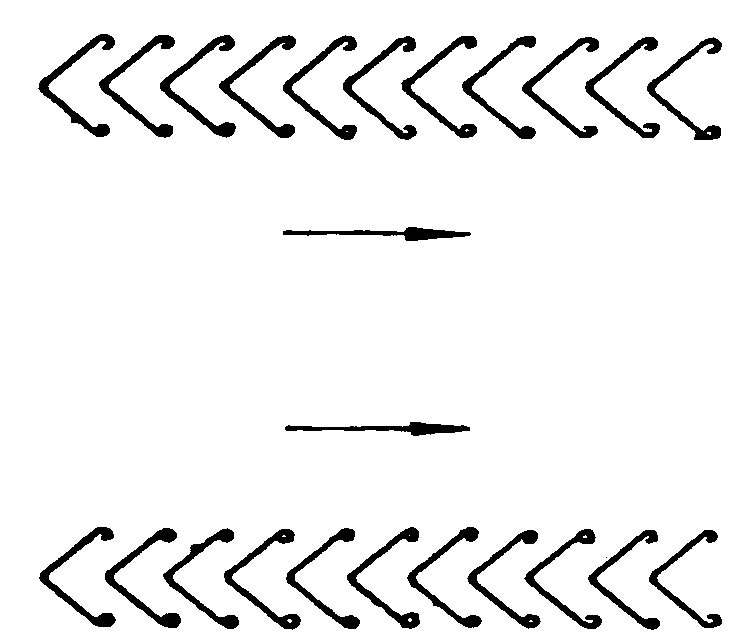
| 70 | Plural separate electrode members aligned in direction of gas flow: | ||||
| This subclass is indented under subclass 65. Apparatus in which a plurality of separate and distinct
collecting electrode members are arranged in a serial fashion along
the direction of gas flow (e.g., as
in Figure 1 below, etc.).
Figure 1
SEE OR SEARCH THIS CLASS, SUBCLASS:
| |||||
| 71 | Segmented electrode: | ||
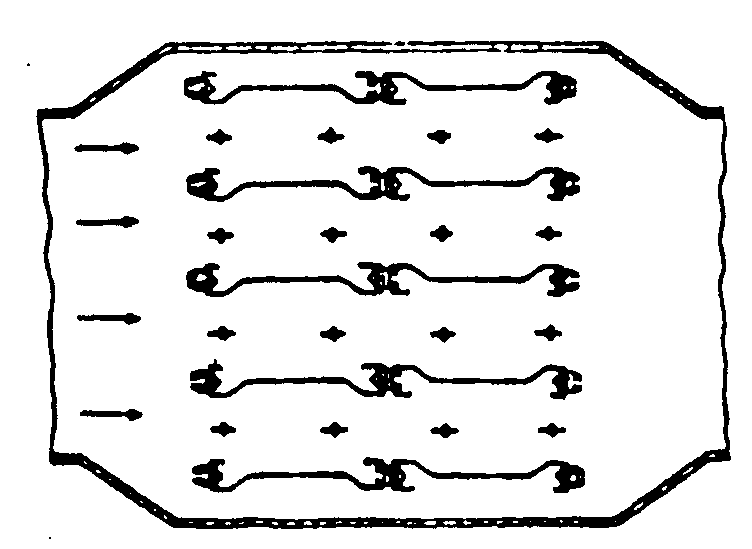
| This subclass is indented under subclass 65. Apparatus in which the collecting electrode is composed
of plural attached segments, abutted or overlapped, to
form a single combined element (e.g., as
in Figure 2 below, etc.).
Figure 2 SEE OR SEARCH THIS CLASS, SUBCLASS:
| |||
| 72 | Continuous electrode with integral or attached projections: | ||||
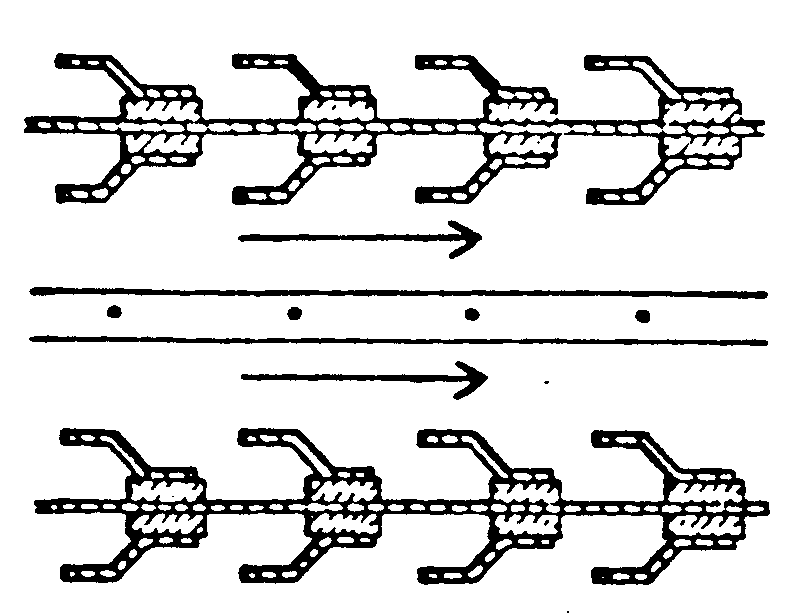
| This subclass is indented under subclass 65. Apparatus in which the collecting electrode is composed
of a continuous member with raised sections or connectedprojecting
elements extending from its sides or edges (e.g., as
in Figure 3 below, etc.).
Figure 3 SEE OR SEARCH THIS CLASS, SUBCLASS:
| |||||
| 73 | Flow distribution means for parallel sections: |
| This subclass is indented under subclass 60. Apparatus in which the flow distribution means is effective to restrict or distribute gas flow to or through plural electrode sections arranged to provide parallel flow paths. | |
| 74 | With nonelectrical gas treating or conditioning means: | ||||||||||
| This subclass is indented under subclass 15. Apparatus which has nonelectrical means to alter a characteristic
of the gaseous fluid mixture either before or during electric field
separation or to alter a characteristic of the separated gas.
SEE OR SEARCH THIS CLASS, SUBCLASS:
SEE OR SEARCH CLASS:
| |||||||||||
| 75 | Plural diverse electric fields: | ||||||||||
This subclass is indented under subclass 15. Apparatus in which there are provided separate electric
fields for separation or treatment of the gaseous fluid mixture (a) by
different voltages, currents, or electrode arrangements, or (b) by plural
electric field separation units to provide effectively different
electric fields arranged in the direction of flow of the gaseous
fluid mixture.
SEE OR SEARCH THIS CLASS, SUBCLASS:
| |||||||||||
| 76 | One or more electrodes common to plural fields: |
| This subclass is indented under subclass 75. Apparatus in which the electric fields are provided by means including arrangements of electrodes such that one electrode or a group or array of similar electrodes is common to the separate electric fields. | |
| 77 | Serially arranged ionizing and collecting or agglomerating fields: | ||||
| This subclass is indented under subclass 75. Apparatus in which the electrode arrangement defines two
electric fields, one downstream of the other in the direction
of flow of the gaseous fluid mixture, the upstream field
serving primarily to electrically charge particles in the gaseous
fluid mixture and the downstream field serving primarily to collect
or coalesce the charged particles.
SEE OR SEARCH THIS CLASS, SUBCLASS:
| |||||
| 78 | Adjacent parallel collector electrodes are differently charged: | ||
This subclass is indented under subclass 77. Apparatus in which alternating collecting electrodes are
charged to one potential (voltage) and the remaining
plates to a second potential.
| |||
| 79 | Collecting electrodes are flat plates: | ||
| This subclass is indented under subclass 78. Apparatus in which the electrodes are in the form of flat
plates.
SEE OR SEARCH THIS CLASS, SUBCLASS:
| |||
| 80 | With details of voltage supply means or circuitry: | ||||||||
| This subclass is indented under subclass 15. Apparatus in which there is more than a nominal recitation
of a circuit for voltage supply, power pack, or
some other feature of electric conduction to an electrode.
SEE OR SEARCH THIS CLASS, SUBCLASS:
SEE OR SEARCH CLASS:
| |||||||||
| 81 | Closure interlock or removable section: | ||
This subclass is indented under subclass 80. Apparatus in which means are provided to make or break contact
between a power source and an electrode by placement or removal
of a movable member or section.
| |||
| 82 | Circuit portions: | ||||
This subclass is indented under subclass 80. Apparatus which includes specific power source components
connected in the form of a circuit.
SEE OR SEARCH CLASS:
| |||||
| 83 | Electrode retaining or supporting means: | ||||
This subclass is indented under subclass 15. Apparatus having means to sustain one or more electrodes
against gravity in an operative position in the apparatus.
| |||||
| 84 | Plural electrode unit assembly type (e.g., unitized, etc.): |
| This subclass is indented under subclass 83. Apparatus in which plural electrodes are maintained in a spaced relationship and are retained as a unit assembly to thereby permit simultaneous movement into or out of operative position within the apparatus. | |
| 85 | Disposable (e.g., collapsible or foldable cardboard, etc.): |
| This subclass is indented under subclass 84. Apparatus in which the unit assembly (e.g., collapsible or foldable cardboard, etc.) is not cleaned for reuse, but is disposed of and replaced by a new unit. | |
| 86 | Parallel disk or plate collector unit: | ||||||||
This subclass is indented under subclass 84. Apparatus in which individual means for attracting or gathering
ionized particles are of flat or planar configuration and have comparatively
large surface area, and in which each such means is held
parallel to the others.
SEE OR SEARCH THIS CLASS, SUBCLASS:
| |||||||||
| 87 | Parallel disk or plate collector: | ||
| This subclass is indented under subclass 83. Apparatus in which individual means for attracting or gathering
ionized particles are of flat or planar configuration and have comparatively
large surface area, and in which each such means is held
parallel to the others.
SEE OR SEARCH THIS CLASS, SUBCLASS:
| |||
| 88 | With insulation feature: | ||||||
This subclass is indented under subclass 83. Apparatus in which the electrode retaining or supporting
arrangement has electrical nonconductor means.
SEE OR SEARCH THIS CLASS, SUBCLASS:
SEE OR SEARCH CLASS:
| |||||||
| 89 | Tensioning means: |
| This subclass is indented under subclass 83. Apparatus in which means are provided for maintaining an electrode under tension, with the tension being due to more than the weight of the electrode. | |
| 90 | Spring or expansible bellows: |
| This subclass is indented under subclass 89. Apparatus in which the tension is maintained by the use of spring means or bellows which may be expanded by stretching, with the spring means or bellows connected to the electrode in such a way as to maintain tension therein. | |
| 91 | Hanging weight: |
| This subclass is indented under subclass 89. Apparatus in which the tension is provided by a hanging weight. | |
| 92 | Suspensory means: |
| This subclass is indented under subclass 83. Apparatus in which the sustaining means is such as to afford support by making contact above the bottommost surface or face of the electrode in its normal operating position (e.g., electrode is held at the top, middle, etc.). | |
| 93 | Nonrigid support (e.g., hanging electrode, etc.): | ||
This subclass is indented under subclass 92. Apparatus in which the electrode is supported in such a
way as to allow swinging movement about the point of support.
| |||
| 94 | Movably supported during use or for orientation: | ||||
| This subclass is indented under subclass 83. Apparatus in which electrode means is sustained against
gravity in such a manner as to afford movement thereof (a) while
it is operative as an electrode or (b) for adjustment
or orientation without disassembly.
SEE OR SEARCH THIS CLASS, SUBCLASS:
SEE OR SEARCH CLASS:
| |||||
| 95 | Ionizing electrode details (e.g., coil, mat, corona suppression, etc.): | ||||||||||
This subclass is indented under subclass 15. Apparatus in which an ionizing electrode stock material
or composite has been specially altered, configured, or
constructed (e.g., coil, mat, corona
suppression, etc.).
SEE OR SEARCH CLASS:
| |||||||||||
| 96 | Filamentary or filar form: | ||
This subclass is indented under subclass 95. Apparatus in which the electrode material is comprised of
fine wire.
| |||
| 97 | Sharpened point, serrated, or tip discharge: |
| This subclass is indented under subclass 95. Apparatus in which the ionizing electrode is provided with a projecting point or finely dimensioned projection, as compared with the remainder or body of the ionizing electrode, or a tip to provide for concentrated discharge of electrons. | |
| 98 | Collecting electrode details (e.g., sheet type, running length web, etc.): | ||||||
| This subclass is indented under subclass 15. Apparatus in which a collecting electrode stock material
or composite has been specifically altered, configured, or
constructed (e.g., sheet type, running
length web, etc.).
SEE OR SEARCH THIS CLASS, SUBCLASS:
SEE OR SEARCH CLASS:
| |||||||
| 99 | Dielectric material containing or covering: |
| This subclass is indented under subclass 98. Apparatus in which the collecting electrode is a composite element containing or being coated with a nonconducting (insulating) material or with substances having relatively high resistance to the flow of electricity. | |
| 100 | Multiple similar elements or sections (e.g., built up, etc.): |
| This subclass is indented under subclass 98. Apparatus in which the collecting electrode is comprised of multiple units or items all of the same kind placed or secured together to thereby define a composite member (e.g., built up, etc.). | |
| 101 | CHROMATOGRAPHY TYPE APPARATUS: | ||||||||||||||||||
This subclass is indented under the class definition. Apparatus comprising a column containing (a) a
liquid, known as the "stationary liquid phase," supported
by a base of solid material to successively sorb therein the different
gases in a plurality of gases or (b) a solid sorbent
to successively sorb thereon the different gases in a plurality
of gases with or without subsequently successively eluting or displacing
the sorbed gases with a gas which is inert with respect to the sorbed
gases and sorbent.
SEE OR SEARCH THIS CLASS, SUBCLASS:
SEE OR SEARCH CLASS:
| |||||||||||||||||||
| 102 | With control means responsive to sensed condition: | ||||||||||||||||
This subclass is indented under subclass 101. Apparatus in which means are provided to detect an apparatus
or process characteristic or a change therein and to control or
regulate operation of the apparatus or process based upon the detected
characteristic or change therein.
SEE OR SEARCH THIS CLASS, SUBCLASS:
SEE OR SEARCH CLASS:
| |||||||||||||||||
| 103 | With programmed, cyclic, or time responsive control means: | ||||||||||
This subclass is indented under subclass 101. Apparatus which is provided with control means not directly
responsive to a sensed condition for (a) storing
coded instructions or other data necessary to regulate operation
of the apparatus, (b) repetitively regulating
a sequence of operational steps performed in or by the apparatus, or (c) causing
various operations to occur according to preset timing sequences
or to last for predetermined durations (e.g., timer
switches, etc.).
SEE OR SEARCH THIS CLASS, SUBCLASS:
SEE OR SEARCH CLASS:
| |||||||||||
| 104 | Plural separate and distinct stages: | ||||||||
| This subclass is indented under subclass 101. Apparatus which has two or more separate and distinct stages
or zones for chromatos:graphic treatment of the plurality
of gases where these stages may either be contained within the same column
or housed in separate columns.
SEE OR SEARCH THIS CLASS, SUBCLASS:
SEE OR SEARCH CLASS:
| |||||||||
| 105 | Including injection system or inlet fluid distributor: | ||||
| This subclass is indented under subclass 101. Apparatus which includes means specifically structured and
disposed at the chromatography column inlet to inject or distribute
the plurality of gases or a liquid for treatment therein.
SEE OR SEARCH CLASS:
| |||||
| 106 | Having system connector or coupling: | ||||||
This subclass is indented under subclass 101. Apparatus which is provided with a flow connector or coupling
in tubing between different sections of a chromatography system.
SEE OR SEARCH THIS CLASS, SUBCLASS:
SEE OR SEARCH CLASS:
| |||||||
| 107 | Having imbedded baffle or flow distributor: | ||||||
| This subclass is indented under subclass 101. Apparatus which has been constructed with (a) a
static solid surface member (e.g., deflector, etc.) or (b) other
static layer of solid material (e.g., nonsorbent
particles, etc.) inside the column in
order to redirect or channel gas flow.
SEE OR SEARCH THIS CLASS, SUBCLASS:
SEE OR SEARCH CLASS:
| |||||||
| 108 | SOLID SORBENT APPARATUS: | ||||||||||||||||||||||||||||||||||||
This subclass is indented under the class definition. Apparatus in which a solid sorbent (e.g., particulate
or fibrous mass of solids, etc.) is used
to retain on its internal or external surfaces a constituent of
the fluid mixture passing in contact therewith.
SEE OR SEARCH THIS CLASS, SUBCLASS:
SEE OR SEARCH CLASS:
| |||||||||||||||||||||||||||||||||||||
| 109 | With control means responsive to sensed condition: | ||||||||||||||||
This subclass is indented under subclass 108. Apparatus in which means are provided to detect an apparatus
or process characteristic or a change therein and to control or
regulate operation of the apparatus or process based upon the detected
characteristic or change therein.
SEE OR SEARCH THIS CLASS, SUBCLASS:
SEE OR SEARCH CLASS:
| |||||||||||||||||
| 110 | Fluid flow sensing means: | ||
| This subclass is indented under subclass 109. Apparatus which is provided with means to detect fluid flow
or a change therein and to control operation of the apparatus based
upon the detected fluid flow or change therein.
SEE OR SEARCH CLASS:
| |||
| 111 | Concentration sensing means: | ||||||||
| This subclass is indented under subclass 109. Apparatus which is provided with means to detect concentration
of a constituent present in a fluid stream (e.g., humidity, etc.) or
a change therein and to control operation of the apparatus based
upon the detected concentration or change therein.
SEE OR SEARCH THIS CLASS, SUBCLASS:
SEE OR SEARCH CLASS:
| |||||||||
| 112 | Temperature sensing means: | ||||||||||
| This subclass is indented under subclass 109. Apparatus which is provided with means to detect temperature
or a change therein and to control operation of the apparatus based
upon the detected temperature or change therein.
SEE OR SEARCH THIS CLASS, SUBCLASS:
SEE OR SEARCH CLASS:
| |||||||||||
| 113 | Pressure sensing means: | ||||||
| This subclass is indented under subclass 109. Apparatus which is provided with means to detect pressure
or a change therein and to control operation of the apparatus based
upon the detected pressure or change therein.
SEE OR SEARCH THIS CLASS, SUBCLASS:
SEE OR SEARCH CLASS:
| |||||||
| 114 | And programmed, cyclic, or time responsive control means: | ||||||||||||
This subclass is indented under subclass 113. Apparatus which is also provided with control means not
directly responsive to a sensed condition for (a) storing
coded instructions or other data necessary to regulate operation
of the apparatus, (b) repetitively regulating
a sequence of operational steps performed in or by the apparatus, or (c) causing
various operations to occur according to preset timing sequences
or to last for predetermined durations (e.g., timer
switches, etc.).
SEE OR SEARCH THIS CLASS, SUBCLASS:
SEE OR SEARCH CLASS:
| |||||||||||||
| 115 | With programmed, cyclic, or time responsive control means: | ||||||||||||||||
This subclass is indented under subclass 108. Apparatus which is provided with control means not directly
responsive to a sensed condition for (a) storing
coded instructions or other data necessary to regulate operation
of the apparatus, (b) repetitively regulating
a sequence of operational steps performed in or by the apparatus, or (c) causing
various operations to occur according to preset timing sequences
or to last for predetermined durations (e.g., timer
switches, etc.).
SEE OR SEARCH THIS CLASS, SUBCLASS:
SEE OR SEARCH CLASS:
| |||||||||||||||||
| 116 | Regulating or metering means: |
| This subclass is indented under subclass 115. Apparatus which is also provided with means to maintain or adjust an apparatus or process characteristic using regulator or meter type components (e.g., programmed pressure regulator, metering valve, flow restrictor, etc.). | |
| 117 | Indicating, signal, or alarm means: | ||||||||||
| This subclass is indented under subclass 115. Apparatus which is also provided with means to indicate
or signal an apparatus or process characteristic or change therein (e.g., to
indicate the extent of solid sorbent saturation, etc.), or
with means to alert the condition of such a characteristic.
SEE OR SEARCH THIS CLASS, SUBCLASS:
SEE OR SEARCH CLASS:
| |||||||||||
| 117.5 | With indicating means (e.g., color change indicator, etc.): | ||
This subclass is indented under subclass 108. Apparatus having information giving means of an audible
or visual nature that give information about an apparatus or process
characteristic or change therein.
| |||
| 118 | Soluble or deliquescent type (e.g., calcium chloride, etc.): | ||||||
This subclass is indented under subclass 108. Apparatus in which the solid sorbent dissolves in the constituent
retained or sorbed therein or thereon.
SEE OR SEARCH CLASS:
| |||||||
| 119 | Supported by holder with drip openings: |
| This subclass is indented under subclass 118. Apparatus which comprises a support or holder with one or more drip openings to allow drainage of the dissolved solid sorbent. | |
| 120 | Including liquid contacting means: |
| This subclass is indented under subclass 119. Apparatus which is provided with means to allow the entering fluid mixture to contact the dissolved solid sorbent as it drains through the holder drip openings. | |
| 121 | Plural solid sorbent beds: | ||||||||
This subclass is indented under subclass 108. Apparatus which comprises two or more masses of solid sorbent
which may be either combined within a single housing or distributed
into separate units.
SEE OR SEARCH THIS CLASS, SUBCLASS:
| |||||||||
| 122 | With recovery or separation means for desorbing fluid: | ||||||
| This subclass is indented under subclass 121. Apparatus which includes a recovery or separation means
for a fluid used to regenerate the solid sorbent.
SEE OR SEARCH THIS CLASS, SUBCLASS:
SEE OR SEARCH CLASS:
| |||||||
| 123 | Movable solid sorbent bed (e.g., fluidized bed, etc.): | ||||||||||||||
| This subclass is indented under subclass 122. Apparatus in which (a) at least one of
the solid sorbent beds is arranged for movement, either by
physically moving a housing containing the solid sorbent or by causing
the solid sorbent alone to move from one place to another, or (b) the
solid sorbent is caused to be moved about or fluidized by a gas.
SEE OR SEARCH THIS CLASS, SUBCLASS:
SEE OR SEARCH CLASS:
| |||||||||||||||
| 124 | With rotating gas distributor: | ||||
| This subclass is indented under subclass 121. Apparatus in which a rotating means is positioned to distribute
the fluid mixture to be treated over one or more of the solid sorbent beds.
SEE OR SEARCH THIS CLASS, SUBCLASS:
SEE OR SEARCH CLASS:
| |||||
| 125 | Rotating solid sorbent bed: | ||||||
| This subclass is indented under subclass 121. Apparatus in which one or more of the solid sorbent beds
is rotated about one or more axes.
SEE OR SEARCH THIS CLASS, SUBCLASS:
SEE OR SEARCH CLASS:
| |||||||
| 126 | With heat exchange means: | ||||||
This subclass is indented under subclass 121. Apparatus which is provided with means to heat or to cool
the solid sorbent, the fluid mixture, a separated
constituent, or a gas stream.
SEE OR SEARCH THIS CLASS, SUBCLASS:
SEE OR SEARCH CLASS:
| |||||||
| 127 | And means for driving gas flow (e.g., pump, blower, compressor, etc.): | ||||
| This subclass is indented under subclass 126. Apparatus which is also provided with means for driving
or effecting gas flow (e.g., pump, blower, compressor, etc.).
SEE OR SEARCH CLASS:
| |||||
| 128 | Compressor: | ||
| This subclass is indented under subclass 127. Apparatus in which the means for driving gas flow is a device
used to pressurize gas (e.g., reciprocating
piston type, bellows, rotary type, etc.).
SEE OR SEARCH CLASS:
| |||
| 129 | Zigzag arrangement of flat solid sorbent beds for parallel flow: |
| This subclass is indented under subclass 121. Apparatus in which flat rectangular solid sorbent beds are arranged and secured in a holder device in a zigzag fashion such that gas flow is directed through only one layer of sorbent before leaving the apparatus. | |
| 130 | With means for regenerating solid sorbent: | ||||||
| This subclass is indented under subclass 121. Apparatus which is provided with means to remove a sorbed
constituent from the solid sorbent, thus regenerating the
solid sorbent for further use.
SEE OR SEARCH THIS CLASS, SUBCLASS:
SEE OR SEARCH CLASS:
| |||||||
| 131 | Serial: |
| This subclass is indented under subclass 121. Apparatus in which the plural solid sorbent beds are arranged for sequential gas flow. | |
| 132 | Diverse type: | ||||
This subclass is indented under subclass 131. Apparatus in which the serial solid sorbent beds are of
different types (e.g., material
composition, particulate vs. sheet form, etc.).
SEE OR SEARCH THIS CLASS, SUBCLASS:
| |||||
| 133 | Plural canisters: | ||
| This subclass is indented under subclass 121. Apparatus in which two or more containers are used to hold
the solid sorbent beds.
SEE OR SEARCH THIS CLASS, SUBCLASS:
| |||
| 134 | Plural diverse separating means: | ||||
| This subclass is indented under subclass 108. Apparatus which comprises two or more different types of
gas separating means, at least one of which must be a solid
sorbent (e.g., solid sorbent
and mechanical filtering means, etc.).
SEE OR SEARCH THIS CLASS, SUBCLASS:
SEE OR SEARCH CLASS:
| |||||
| 135 | At least one a dispersed or impregnated solid sorbent bed: | ||
| This subclass is indented under subclass 134. Apparatus which includes at least one bed of solid sorbent (a) dispersed
in a second sorbing or nonsorbing medium (e.g., sorbent
particles bonded in a matrix or set in a mass of filler material, etc.) or (b) impregnated
with a second nonsorbing material.
SEE OR SEARCH THIS CLASS, SUBCLASS:
| |||
| 136 | Plural housings or casings for separating components: | ||||
| This subclass is indented under subclass 134. Apparatus which is provided with plural, usually
separate, containers for different separating components
or means.
SEE OR SEARCH THIS CLASS, SUBCLASS:
| |||||
| 137 | With means to compress or compact solid sorbent bed: | ||
| This subclass is indented under subclass 134. Apparatus in which a spring or other compacting means is
provided to exert continual physical force on a solid sorbent bed
to maintain close packing of individual solid particles.
SEE OR SEARCH THIS CLASS, SUBCLASS:
| |||
| 138 | Including means to access or replace solid sorbent: | ||
| This subclass is indented under subclass 134. Apparatus which is provided with a removable solid sorbent
cartridge, opening to access solid sorbent, or
other means to allow replacement of spent or used solid sorbent
with new or regenerated solid sorbent.
SEE OR SEARCH THIS CLASS, SUBCLASS:
| |||
| 139 | Including baffle for modifying gas flow (e.g., flow vanes, diffuser, etc.): | ||||||
| This subclass is indented under subclass 134. Apparatus in which a static solid surface member (e.g., deflector, etc.) is
provided to modify or distribute a gas flowing in contact therewith (e.g., flow
vanes, gas diffuser, etc.).
SEE OR SEARCH THIS CLASS, SUBCLASS:
SEE OR SEARCH CLASS:
| |||||||
| 140 | And means for driving gas flow: | ||||||
| This subclass is indented under subclass 139. Apparatus which is also provided with means for driving
or effecting gas flow.
SEE OR SEARCH THIS CLASS, SUBCLASS:
SEE OR SEARCH CLASS:
| |||||||
| 141 | And means regenerating solid sorbent: | ||||||||
| This subclass is indented under subclass 139. Apparatus which is also provided with means to desorb a
retained constituent from the solid sorbent.
SEE OR SEARCH THIS CLASS, SUBCLASS:
SEE OR SEARCH CLASS:
| |||||||||
| 142 | With means for driving gas flow: | ||||
| This subclass is indented under subclass 134. Apparatus which is provided with means for driving or effecting
gas flow.
SEE OR SEARCH THIS CLASS, SUBCLASS:
SEE OR SEARCH CLASS:
| |||||
| 143 | With means regenerating solid sorbent: | ||||||
| This subclass is indented under subclass 108. Apparatus which is provided with means to desorb the retained
constituent from the solid sorbent.
SEE OR SEARCH THIS CLASS, SUBCLASS:
SEE OR SEARCH CLASS:
| |||||||
| 144 | Gas contacting means: | ||
| This subclass is indented under subclass 143. Apparatus in which the solid sorbent is regenerated by a
means contacting gas therewith.
SEE OR SEARCH CLASS:
| |||
| 145 | Means applies steam to solid sorbent: |
| This subclass is indented under subclass 144. Apparatus in which the contacting means is provided to apply steam to the solid sorbent to effect regeneration thereof. | |
| 146 | Heat exchanger to regenerate: | ||||
| This subclass is indented under subclass 143. Apparatus in which the solid sorbent is regenerated by heating
or cooling means.
SEE OR SEARCH THIS CLASS, SUBCLASS:
SEE OR SEARCH CLASS:
| |||||
| 147 | Having mountable casing: | ||
| This subclass is indented under subclass 108. Apparatus which is provided with means to support or attach
a container for the solid sorbent.
SEE OR SEARCH CLASS:
| |||
| 148 | Storage or food receptacle: | ||||
| This subclass is indented under subclass 147. Apparatus which is attached to or utilized in connection
with a storage or food container.
SEE OR SEARCH CLASS:
| |||||
| 149 | With means to compress or compact solid sorbent bed: | ||
| This subclass is indented under subclass 108. Apparatus in which a spring or other compacting means is
provided to exert a continual physical force on a solid sorbent
bed to maintain close packing of individual solid sorbent particles.
SEE OR SEARCH THIS CLASS, SUBCLASS:
| |||
| 150 | Movable solid sorbent bed (e.g., fluidized bed, etc.): | ||||||||||||||
| This subclass is indented under subclass 108. Apparatus in which (a) the solid sorbent
is arranged for movement, either by physically moving the
housing containing the solid sorbent or by causing the solid sorbent
alone to move from one place to another or (b) the
solid sorbent is moved about or fluidized by a gas.
SEE OR SEARCH THIS CLASS, SUBCLASS:
SEE OR SEARCH CLASS:
| |||||||||||||||
| 151 | Including means to access or replace solid sorbent: | ||
| This subclass is indented under subclass 108. Apparatus which is provided with a removable solid sorbent
cartridge, opening to access solid sorbent, or
other means to allow replacement of spent or used solid sorbent
with new or regenerated solid sorbent.
SEE OR SEARCH THIS CLASS, SUBCLASS:
| |||
| 152 | Including baffle for modifying gas flow (e.g., imbedded in solid sorbent, etc.): | ||||||||
| This subclass is indented under subclass 108. Apparatus in which a static solid surface member (e.g., deflector, etc.) is
provided to modify or distribute gas flowing in contact therewith, such
as might be imbedded in a solid sorbent bed.
SEE OR SEARCH THIS CLASS, SUBCLASS:
SEE OR SEARCH CLASS:
| |||||||||
| 153 | Dispersed or impregnated solid sorbent bed: | ||||
| This subclass is indented under subclass 108. Apparatus in which the solid sorbent is (a) dispersed
in a second sorbing or nonsorbing medium (e.g., sorbent
particles bonded in a matrix or set in a mass of filler material, etc.) or (b) impregnated
with a second nonsorbing material.
SEE OR SEARCH THIS CLASS, SUBCLASS:
SEE OR SEARCH CLASS:
| |||||
| 154 | Layered or laminated (e.g., solid sorbent on support material, etc.): | ||
| This subclass is indented under subclass 108. Apparatus in which the solid sorbent is distributed as a
distinct layer on or between laminates of a second solid sorbent
or nonsorbent support material.
SEE OR SEARCH CLASS:
| |||
| 155 | DEGASIFYING MEANS FOR LIQUID: | ||||||||||||||||||
This subclass is indented under the class definition. Apparatus which is provided with means to eliminate or drive
out a gas from a liquid.
SEE OR SEARCH THIS CLASS, SUBCLASS:
SEE OR SEARCH CLASS:
| |||||||||||||||||||
| 156 | With control means responsive to sensed condition: | ||||||||||||||
This subclass is indented under subclass 155. Apparatus in which means are provided to detect an apparatus
or process characteristic or a change therein and to control or
regulate operation of the apparatus or process based upon the detected
characteristic or change therein.
SEE OR SEARCH THIS CLASS, SUBCLASS:
SEE OR SEARCH CLASS:
| |||||||||||||||
| 157 | With liquid level sensing means: | ||
| This subclass is indented under subclass 156. Apparatus which is provided with means to detect the height
of a liquid level or a change therein and to control operation of
the apparatus based upon the detected level or change therein.
SEE OR SEARCH CLASS:
| |||
| 158 | Separator inlet or outlet valve responsive to float level: | ||
| This subclass is indented under subclass 157. Apparatus in which a flow control member is positioned at
a fluid inlet or outlet and is actuated as a result of change in
position of a liquid level float.
SEE OR SEARCH CLASS:
| |||
| 159 | Plural floats: |
| This subclass is indented under subclass 158. Apparatus which has more than one float for sensing liquid level. | |
| 160 | And temperature sensing means: | ||||||||||
| This subclass is indented under subclass 159. Apparatus which is also equipped with means to detect temperature
or a change therein and to control operation of the apparatus based
upon the detected temperature or change therein.
SEE OR SEARCH THIS CLASS, SUBCLASS:
SEE OR SEARCH CLASS:
| |||||||||||
| 161 | And pressure sensing means: | ||||||
| This subclass is indented under subclass 159. Apparatus which is also equipped with means to detect pressure
or a change therein and to control operation of the apparatus based
upon the detected pressure or change therein.
SEE OR SEARCH THIS CLASS, SUBCLASS:
SEE OR SEARCH CLASS:
| |||||||
| 162 | Plural float-controlled valves: |
| This subclass is indented under subclass 158. Apparatus which has more than one valve actuated by a float detecting liquid level. | |
| 163 | At least one is gas outlet valve: | ||
| This subclass is indented under subclass 162. Apparatus in which at least one of the valves is used to
release gas removed from the liquid under treatment.
SEE OR SEARCH THIS CLASS, SUBCLASS:
| |||
| 164 | And pressure sensing means: | ||||||
| This subclass is indented under subclass 163. Apparatus which is also equipped with means to detect pressure
or a change therein and to control operation of the apparatus based
upon the detected pressure or change therein.
SEE OR SEARCH THIS CLASS, SUBCLASS:
SEE OR SEARCH CLASS:
| |||||||
| 165 | Gas outlet valve responsive to float level: | ||
| This subclass is indented under subclass 158. Apparatus in which a gas removed from the liquid under treatment
is released through a valve controlled in response to the position
of a liquid level float.
SEE OR SEARCH THIS CLASS, SUBCLASS:
| |||
| 166 | And pressure sensing means: | ||||||
| This subclass is indented under subclass 165. Apparatus which is also equipped with means to detect pressure
or a change therein and to control operation of the apparatus based
upon the detected pressure or change therein.
SEE OR SEARCH THIS CLASS, SUBCLASS:
SEE OR SEARCH CLASS:
| |||||||
| 167 | Centrifugal separating means: | ||||||||||||
| This subclass is indented under subclass 165. Apparatus in which means are provided to separate entrained
gas (e.g., bubbles, etc.) from
the liquid under treatment by centrifugal force, causing
the gas and liquid to rotate as by tangential flow about a central
axis which forces the degasified liquid to move away from the axis
and the separated gas to move toward the axis of rotation.
SEE OR SEARCH THIS CLASS, SUBCLASS:
SEE OR SEARCH CLASS:
| |||||||||||||
| 168 | Liquid outlet valve responsive to float level: |
| This subclass is indented under subclass 158. Apparatus in which degasified liquid is released through a valve controlled in response to the level of a liquid level float. | |
| 169 | And pressure sensing means: | ||||||
| This subclass is indented under subclass 168. Apparatus which is also equipped with means to detect pressure
or a change therein and to control operation of the apparatus based
upon the detected pressure or change therein.
SEE OR SEARCH THIS CLASS, SUBCLASS:
SEE OR SEARCH CLASS:
| |||||||
| 170 | And recycle means (e.g., for degasified liquid, etc.): | ||||
This subclass is indented under subclass 168. Apparatus which is also provided with means to recirculate
fluid outside the means for degasifying liquid and return it to
the same for secondary processing (e.g., recycling
degasified liquid back to the apparatus inlet for further treatment, etc.).
SEE OR SEARCH CLASS:
| |||||
| 171 | And tangential flow or centrifugal separating means: | ||||||||||||
| This subclass is indented under subclass 168. Apparatus (a) which is also provided with means
for tangential fluid flow (e.g., having
an inlet or outlet arranged for directing fluid flow about a central
axis, etc.) or (b) in
which means are provided to separate entrained gas from the liquid
under treatment by centrifugal force, causing the gas and
liquid to rotate about a central axis which forces degasified liquid
to move away from the axis and separated gas to move toward the
axis of rotation.
SEE OR SEARCH THIS CLASS, SUBCLASS:
SEE OR SEARCH CLASS:
| |||||||||||||
| 172 | With pressure sensing means: | ||||||
| This subclass is indented under subclass 158. Apparatus which is equipped with means to detect pressure
or a change therein and to control operation of the apparatus based
upon the detected pressure or change therein.
SEE OR SEARCH THIS CLASS, SUBCLASS:
SEE OR SEARCH CLASS:
| |||||||
| 173 | With temperature sensing means: | ||||||||||
| This subclass is indented under subclass 156. Apparatus which is provided with means to detect temperature
or a change therein and to control operation of the apparatus based
upon the detected temperature or change therein.
SEE OR SEARCH THIS CLASS, SUBCLASS:
SEE OR SEARCH CLASS:
| |||||||||||
| 174 | With pressure sensing means: | ||||||||
| This subclass is indented under subclass 156. Apparatus which is provided with means to detect pressure
or a change therein and to control operation of the apparatus based
upon the detected pressure or change therein.
SEE OR SEARCH THIS CLASS, SUBCLASS:
SEE OR SEARCH CLASS:
| |||||||||
| 175 | Sonic means (i.e., using sound waves): | ||||||||
This subclass is indented under subclass 155. Apparatus in which the separation is effected or enhanced
by the energy of compressional vibratory waves in a fluid medium, the
waves being below, within, or above the audible
spectrum.
SEE OR SEARCH THIS CLASS, SUBCLASS:
SEE OR SEARCH CLASS:
| |||||||||
| 176 | Defoaming means: | ||||||
This subclass is indented under subclass 155. Apparatus in which means are provided to remove a substantially
stable aggregation of dispersed gas or vapor bubbles (e.g., froth
or foam, etc.) from a liquid.
SEE OR SEARCH THIS CLASS, SUBCLASS:
SEE OR SEARCH CLASS:
| |||||||
| 177 | Centrifugal or rotating separator: | ||||||||||||
| This subclass is indented under subclass 176. Apparatus in which means are provided to separate entrained
gas (e.g., bubbles, etc.) from
the liquid under treatment (a) by centrifugal
force, causing the gas or liquid to rotate as by tangential
flow about a central axis which forces degasified liquid to move
away from the axis and separated gas to move toward the axis of rotation
or (b) by a rotating separator, causing the
liquid to be agitated, breaking a liquid film surrounding
the gas (i.e., foam) and
liberating the entrained gas.
SEE OR SEARCH THIS CLASS, SUBCLASS:
SEE OR SEARCH CLASS:
| |||||||||||||
| 178 | Having flow-through foam restrictor or eliminator (e.g., screen, etc.): | ||
| This subclass is indented under subclass 177. Apparatus which is also equipped with a porous screen or
filter to remove foam (i.e., entrained
gas bubbles) from the liquid passing therethrough by (a) physically
excluding the foam or (b) breaking a liquid film
surrounding entrained gas (i.e., foam) and
liberating the entrained gas.
SEE OR SEARCH THIS CLASS, SUBCLASS:
| |||
| 179 | Having flow-through foam restrictor or eliminator (e.g., screen, etc.): | ||
| This subclass is indented under subclass 176. Apparatus which is equipped with a porous screen or filter
to remove foam (i.e., entrained gas
bubbles) from the liquid passing therethrough by (a) physically
excluding the foam or (b) breaking a liquid film
surrounding entrained gas (i.e., foam) and
liberating the entrained gas.
SEE OR SEARCH THIS CLASS, SUBCLASS:
| |||
| 180 | Having recycle means (e.g., for foam or separated liquid, etc.): | ||
| This subclass is indented under subclass 176. Apparatus which is provided with means to redirect a fluid
flowing from a separation stage back through an apparatus inlet
for secondary processing, as in the recycle of collected
foam or the corresponding separated liquid back to an apparatus
inlet for further treatment.
SEE OR SEARCH CLASS:
| |||
| 181 | And liquid contact means: | ||||||||||||
This subclass is indented under subclass 155. Apparatus in which means are provided to contact a gaseous
fluid mixture with a liquid in order to remove a gas from the gaseous
fluid mixture and means are provided to remove the gas from the
liquid.
SEE OR SEARCH THIS CLASS, SUBCLASS:
SEE OR SEARCH CLASS:
| |||||||||||||
| 182 | With separator for multiple liquids: | ||||||||||||
This subclass is indented under subclass 155. Apparatus which includes means to separate a mixture of
two or more liquids.
SEE OR SEARCH CLASS:
| |||||||||||||
| 183 | Reservoir with three or more outlets, each for different fluid: |
| This subclass is indented under subclass 182. Apparatus which is constructed with a container or compartment having at least three discharge conduits, each conduit passing a fluid which differs in state or nature from each other fluid passing in other conduits. | |
| 184 | Horizontal reservoir: |
| This subclass is indented under subclass 183. Apparatus in which the longest axis of the reservoir is in a horizontal plane. | |
| 185 | With heat exchange means: | ||||||
| This subclass is indented under subclass 183. Apparatus which includes a means to heat or cool a system
fluid.
SEE OR SEARCH THIS CLASS, SUBCLASS:
SEE OR SEARCH CLASS:
| |||||||
| 186 | And internal filter or screen (e.g., coalescer, etc.): |
| This subclass is indented under subclass 185. Apparatus which also includes a filter or screen, such as a coalescer device, inside the reservoir. | |
| 187 | Tank or tank part movably mounted on support (e.g., for deaerating aircraft lubricating oil, etc.): | ||
This subclass is indented under subclass 155. Apparatus in which degasification occurs in a reservoir, the
whole or any part (e.g., inlet
or outlet pipe, inner casing, etc.) of
which is arranged for movement relative to a fixed support.
| |||
| 188 | Including means to remove mist entrained in gas: | ||||
| This subclass is indented under subclass 155. Apparatus which is provided with a member or members in
a gas outlet flow path acting to remove entrained liquid droplets
from a gas.
SEE OR SEARCH CLASS:
| |||||
| 189 | Baffle, filter, or screen: | ||||||
| This subclass is indented under subclass 188. Apparatus which comprises (a) a static
solid surface interposed in the gas flow path on which the gas impinges, or (b) a
mass or member through which the gas passes and which retains the
liquid droplets.
SEE OR SEARCH THIS CLASS, SUBCLASS:
SEE OR SEARCH CLASS:
| |||||||
| 190 | Plural, serially arranged: |
| This subclass is indented under subclass 189. Apparatus which comprises at least two similar or dissimilar baffles, filters, or screens, with one arranged downstream from the other in the gas flow path. | |
| 191 | Concentric tubular members: | ||
| This subclass is indented under subclass 190. Apparatus in which the baffles, filters, or screens
are in the form of tubes of different diameters, all having
a common axis.
SEE OR SEARCH CLASS:
| |||
| 192 | Alternate central and peripheral gas paths: |
| This subclass is indented under subclass 190. Apparatus in which the baffles, filters, or screens comprise two or more members arranged to direct the gas flow through the center of one member and around the outside of the next adjacent downstream member to provide a gas flow path that is alternately central and peripheral to the members placed in series. | |
| 193 | Pressure reducing means: | ||
| This subclass is indented under subclass 155. Apparatus which decreases pressure acting on the liquid
to cause or facilitate degasification of the liquid.
SEE OR SEARCH CLASS:
| |||
| 194 | And liquid flow modifier: | ||||
| This subclass is indented under subclass 193. Apparatus which is also provided with a means to change
or alter the liquid flow path within the apparatus.
SEE OR SEARCH THIS CLASS, SUBCLASS:
SEE OR SEARCH CLASS:
| |||||
| 195 | Centrifugal type: | ||||
| This subclass is indented under subclass 194. Apparatus which (a) separates a fluid
mixture by centrifugal force causing the fluid mixture to spin or
whirl as by tangential flow about a central axis, forcing
denser fluids away from the axis and remaining fluids closer to
the axis of rotation, or (b) rotates
or causes the fluid mixture to spin or whirl as by tangential flow about
a central axis.
SEE OR SEARCH THIS CLASS, SUBCLASS:
SEE OR SEARCH CLASS:
| |||||
| 196 | Rotating means: | ||||
| This subclass is indented under subclass 195. Apparatus which is provided with a helical screw, impeller, or
other means on a rotating shaft.
SEE OR SEARCH THIS CLASS, SUBCLASS:
SEE OR SEARCH CLASS:
| |||||
| 197 | Baffle: | ||||
| This subclass is indented under subclass 194. Apparatus in which the means to alter the liquid flow path
is a static solid surface member (e.g., deflector, etc.).
SEE OR SEARCH THIS CLASS, SUBCLASS:
SEE OR SEARCH CLASS:
| |||||
| 198 | Plural baffles in series: | ||
| This subclass is indented under subclass 197. Apparatus which comprises a plurality of such static solid
surface members arranged with each member downstream from the previous member
in the liquid flow path.
SEE OR SEARCH CLASS:
| |||
| 199 | With heat exchange means: | ||||
| This subclass is indented under subclass 198. Apparatus which is provided with means to heat or cool a
constituent of the fluid mixture.
SEE OR SEARCH THIS CLASS, SUBCLASS:
| |||||
| 200 | Spray nozzle: | ||||
This subclass is indented under subclass 194. Apparatus which has a nozzle to disperse the liquid under
treatment into smaller particles.
SEE OR SEARCH CLASS:
| |||||
| 201 | With heat exchange means: | ||||
| This subclass is indented under subclass 193. Apparatus which is also provided with means to heat or cool
a constituent of the fluid mixture.
SEE OR SEARCH THIS CLASS, SUBCLASS:
| |||||
| 202 | With gas contacting means: | ||||||
This subclass is indented under subclass 155. Apparatus which is also provided with means to pass a gas
through or in contact with the liquid.
SEE OR SEARCH CLASS:
| |||||||
| 203 | Spray nozzle: |
| This subclass is indented under subclass 202. Apparatus which has a nozzle to disperse the liquid under treatment into smaller particles. | |
| 204 | Liquid flow slinger, spreader, deflector, disperser, or rotation modifier: | ||||||
| This subclass is indented under subclass 155. Apparatus which is a liquid flow modifier comprising (a) a
moving member used to throw the liquid in the form of drops or spray, (b) a
member which causes the liquid to flow in a thin, laminar
stream, (c) a solid member on which the
liquid impinges and is deflected, (d) a member
which causes the liquid to assume a spray or mistlike form, or (e) a
member which causes a spinning or whirling motion to be imparted
to or removed from the flowing liquid.
SEE OR SEARCH THIS CLASS, SUBCLASS:
SEE OR SEARCH CLASS:
| |||||||
| 205 | And preliminary heat exchange means: | ||||
| This subclass is indented under subclass 204. Apparatus in which a means to heat or cool a constituent
of the fluid mixture is positioned in the apparatus to precede the
flow slinger, spreader, deflector, disperser, or
rotation modifier.
SEE OR SEARCH THIS CLASS, SUBCLASS:
| |||||
| 206 | At inlet to separator: |
| This subclass is indented under subclass 204. Apparatus in which the liquid flow modifier is positioned within, at, or around the discharge end of an inlet conduit to the apparatus. | |
| 207 | Plural, serially arranged: | ||||||
| This subclass is indented under subclass 206. Apparatus in which two or more flow modifying means are
arranged downstream of one another.
SEE OR SEARCH THIS CLASS, SUBCLASS:
SEE OR SEARCH CLASS:
| |||||||
| 208 | Centrifugal type: | ||||
| This subclass is indented under subclass 206. Apparatus which (a) separates a fluid
mixture by centrifugal force causing the fluid mixture to spin or
whirl as by tangential flow about a central axis, forcing
denser fluids away from the axis and remaining fluids closer to
the axis of rotation, or (b) rotates
or causes a fluid mixture to spin or whirl as by tangential flow
about a central axis.
SEE OR SEARCH THIS CLASS, SUBCLASS:
SEE OR SEARCH CLASS:
| |||||
| 209 | Tangential inlet: |
| This subclass is indented under subclass 208. Apparatus in which an inlet is arranged to direct inflow along a path other than one which intersects or is parallel to the longitudinal axis of the apparatus casing. | |
| 210 | Including tangential outlet: |
| This subclass is indented under subclass 209. Apparatus in which an outlet fluid flow conduit is also tangential to the apparatus casing. | |
| 211 | Split or plural inlets: |
| This subclass is indented under subclass 209. Apparatus in which (a) the inlet is split or divided at its discharge end or (b) more than one inlet is provided, at least one of which is tangential to the apparatus casing. | |
| 212 | Including inner and outer casings or plural compartments: |
| This subclass is indented under subclass 209. Apparatus which is provided with (a) two or more casings, at least one being completely enclosed within the other, or (b) two or more separate compartments within a single casing. | |
| 213 | Tangential outlet: | ||
| This subclass is indented under subclass 208. Apparatus in which an outlet is arranged with an axis in
a direction other than one which intersects or is parallel to the
longitudinal axis of the casing.
SEE OR SEARCH THIS CLASS, SUBCLASS:
| |||
| 214 | Rotating means: | ||||
| This subclass is indented under subclass 208. Apparatus which is provided with a helical screw, impeller, or
other means on a rotating shaft.
SEE OR SEARCH THIS CLASS, SUBCLASS:
SEE OR SEARCH CLASS:
| |||||
| 215 | Plural, serially arranged: | ||||
| This subclass is indented under subclass 204. Apparatus in which two or more liquid flow modifiers are
arranged downstream of one another.
SEE OR SEARCH THIS CLASS, SUBCLASS:
SEE OR SEARCH CLASS:
| |||||
| 216 | Centrifugal type: | ||||
| This subclass is indented under subclass 204. Apparatus which (a) separates a fluid
mixture by centrifugal force causing the fluid mixture to spin or
whirl as by tangential flow about a central axis, forcing
denser fluids away from the axis and remaining fluids closer to
the axis of rotation, or (b) rotates
or causes a fluid mixture to spin or whirl as by tangential flow
about a central axis.
SEE OR SEARCH THIS CLASS, SUBCLASS:
SEE OR SEARCH CLASS:
| |||||
| 217 | Impeller or screw on rotating shaft: | ||
| This subclass is indented under subclass 216. Apparatus which is provided with a helical screw or impeller
on a rotating shaft.
SEE OR SEARCH CLASS:
| |||
| 218 | Heat exchanger to degasify: | ||
| This subclass is indented under subclass 155. Apparatus which is provided with a heat exchanger to liberate
gas from the liquid under treatment.
SEE OR SEARCH THIS CLASS, SUBCLASS:
| |||
| 219 | And fluid filter: | ||||||
| This subclass is indented under subclass 155. Apparatus which is provided with a fluid filter for either
the liquid under treatment or a gas separated therefrom.
SEE OR SEARCH THIS CLASS, SUBCLASS:
SEE OR SEARCH CLASS:
| |||||||
| 220 | Including baffle: | ||||
| This subclass is indented under subclass 155. Apparatus which is provided with a static solid surface
member to direct the flow of liquid under treatment or a gas separated
therefrom.
SEE OR SEARCH THIS CLASS, SUBCLASS:
SEE OR SEARCH CLASS:
| |||||
| 221 | COLD WALL - HOT WALL THERMAL DIFFUSION-TYPE SEPARATOR: | ||||||
This subclass is indented under the class definition. Apparatus having surfaces of different temperatures between
which a gaseous fluid mixture passes, with the different
temperatures of the surfaces causing separation of constituents
of the gaseous fluid mixture by migration of the constituents to
one surface or another.
SEE OR SEARCH CLASS:
| |||||||
| 222 | WITH MEANS TO ADD FRAGRANCE OR SCENT: | ||
This subclass is indented under the class definition. Apparatus having means to add a chemical having a pleasant
odor to a gaseous fluid mixture or separated constituent.
| |||
| 223 | WITH STERILIZING MEANS: | ||||||
| This subclass is indented under the class definition. Apparatus having means acting to render apparatus parts
or a gaseous fluid mixture or its constituent parts passing through
or being delivered from the apparatus in a condition free from bacteria
or other microorganisms.
SEE OR SEARCH THIS CLASS, SUBCLASS:
SEE OR SEARCH CLASS:
| |||||||
| 224 | Germicidal lamp (e.g., ultraviolet light, etc.): |
| This subclass is indented under subclass 223. Apparatus in which the sterilizing means is a light whose radiation kills bacteria or other microorganisms. | |
| 225 | Heater (e.g., electrical, steam, etc.): |
| This subclass is indented under subclass 223. Apparatus in which the sterilizing means causes an increase in the temperature of the apparatus parts or the gaseous fluid mixture or its constituent parts in order to kill bacteria or other microorganisms. | |
| 226 | Means uses chemical antimicrobial agent: |
| This subclass is indented under subclass 223. Apparatus in which the sterilizing means uses a chemical substance that kills bacteria or other microorganisms on the apparatus parts or in the gaseous fluid mixture or its constituent parts. | |
| 227 | Liquid agent: |
| This subclass is indented under subclass 226. Apparatus in which the antimicrobial agent is a liquid. | |
| 228 | WITH MEANS USING LIQUID TO CLEAN SEPARATING APPARATUS: | ||||||
This subclass is indented under the class definition. Apparatus in which means are provided to apply a liquid (e.g., by
sprinkling, projecting, washing down, submerging
in a bath, etc.) to a separating apparatus
in order to remove a separated constituent from the separating apparatus.
SEE OR SEARCH CLASS:
| |||||||
| 229 | Movably mounted cleaning liquid distributor: |
| This subclass is indented under subclass 228. Apparatus having a continuously or intermittently moving discharging or applying means to apply the cleaning liquid along a surface of the separating apparatus. | |
| 230 | Movable separating media: |
| This subclass is indented under subclass 228. Apparatus in which the separating apparatus includes a separating media that has means to change its position. | |
| 231 | Immersion cleaning: |
| This subclass is indented under subclass 230. Apparatus in which the movable separating media has a means for dipping or submerging the separating media in a liquid bath. | |
| 232 | Parallel vanes or baffles: | ||
| This subclass is indented under subclass 228. Apparatus in which the separating apparatus includes a separating
media that is formed either of at least two slanted plates that
are an equal distance apart at every point between which a gaseous
fluid mixture flows (e.g., louver, etc.) that
are constructed to provide substantially constant area for flow
of the gaseous fluid mixture or of at least two plates that are an
equal distance apart at every point between which a gaseous fluid
mixture flows in a tortuous or sinuous path, the plates
being bent, deformed, or provided with projections, and arranged
relatively one to the other so that a bend, deformation, or
projection of one plate is spaced from the corresponding bend, deformation, or
projection of the other, so as to provide substantially
constant area for the flow of the gaseous fluid mixture.
SEE OR SEARCH CLASS:
| |||
| 233 | Filter: | ||
| This subclass is indented under subclass 228. Apparatus in which the separating apparatus includes a separating
media that is a foraminous or porous mass which separates solid
or liquid particles from the gaseous fluid mixture by entrapment
and retention while permitting gaseous or vaporous constituents
to pass through.
SEE OR SEARCH CLASS:
| |||
| 234 | GAS AND LIQUID CONTACT APPARATUS FOR GAS SEPARATION INCLUDING MEANS TO REGENERATE, PURIFY, OR SEPARATE CONTACT LIQUID: | ||||||
This subclass is indented under the class definition. Apparatus having means in which a gaseous fluid mixture
is contacted with a liquid in order to remove a constituent from
the gaseous fluid mixture and includes means to restore the contact
liquid to its original condition, to cleanse the contact
liquid in order to rid the contact liquid of the constituent that
was removed from the gaseous fluid mixture, or to remove
from the contact liquid the constituent that was removed from the
gaseous fluid mixture.
SEE OR SEARCH CLASS:
| |||||||
| 235 | Means to add conditioning agent to contact liquid: | ||
| This subclass is indented under subclass 234. Apparatus in which the means to regenerate, purify, or
separate the contact liquid consists of a means for adding an agent
to the contact liquid that causes or aids the contact liquid to
be modified (e.g., cleaned, etc.).
SEE OR SEARCH CLASS:
| |||
| 236 | Gravitational separator for contact liquid: | ||
| This subclass is indented under subclass 234. Apparatus in which the means to regenerate, purify, or
separate the contact liquid consists of means in which the contact
liquid and the constituent removed from the gaseous fluid mixture
are separated from one another by forming component layers in accordance
with their respective specific gravities.
SEE OR SEARCH CLASS:
| |||
| 237 | With heavier component mechanical mover, trap, chamber, or recess in gravitational separator: | ||
| This subclass is indented under subclass 236. Apparatus in which the gravitational separator includes
a means to provide a change in position, produced by a
part of the apparatus, of the component having the higher
density or a receptacle, compartment, or small
hollow for collecting the component having the higher density.
SEE OR SEARCH CLASS:
| |||
| 238 | With lighter component removal means in gravitational separator: | ||
| This subclass is indented under subclass 236. Apparatus in which the gravitational separator includes
a discharge opening or a separate physical element for removing
the component having the lower density.
SEE OR SEARCH CLASS:
| |||
| 239 | With baffle, plate, or weir within gravitational separator to aid contact liquid regeneration, purification, or separation: | ||
| This subclass is indented under subclass 236. Apparatus in which the gravitational separator includes
a surface in the contact liquid flow path to be contacted by the
contact liquid for redirecting or altering the contact liquid flow path
within the gravitational separator to facilitate gravitational separation
or to facilitate other contact liquid regeneration or purification.
SEE OR SEARCH CLASS:
| |||
| 240 | Filter for contact liquid: | ||
| This subclass is indented under subclass 234. Apparatus in which the means to regenerate, purify, or
separate the contact liquid is a foraminous or porous mass which
separates the constituent from the contact liquid by entrapment
and retention while permitting the contact liquid to pass through.
SEE OR SEARCH CLASS:
| |||
| 241 | Including filter adjusting or removal means: | ||
| This subclass is indented under subclass 240. Apparatus including means to change the position or porosity
of the filter or to remove the filter (e.g., for
cleaning, substitution, or disposal).
SEE OR SEARCH CLASS:
| |||
| 242 | Heating or cooling means: | ||
| This subclass is indented under subclass 234. Apparatus in which the means for regeneration, purification, or
separation of the contact liquid includes means for raising or lowering
the temperature of the contact liquid.
SEE OR SEARCH CLASS:
| |||
| 243 | WITH GAS AND LIQUID CONTACT APPARATUS: | ||||||||
This subclass is indented under the class definition. Apparatus having means to cause separation of a gaseous
fluid mixture combined with means to bring the gaseous fluid mixture
or a separated gaseous constituent into (1) intimate confluent, countercurrent, or
generally mingling relationship with a contact liquid or (2) into
contact with the surface of a reservoir or supply tank of a contact
liquid.
SEE OR SEARCH CLASS:
| |||||||||
| 244 | With control means responsive to sensed condition: | ||||||||||||
This subclass is indented under subclass 243. Apparatus in which means are provided to detect an apparatus
or a process characteristic or a change therein and to control or
regulate operation of the apparatus or process based upon the detected
characteristic or change therein.
SEE OR SEARCH THIS CLASS, SUBCLASS:
SEE OR SEARCH CLASS:
| |||||||||||||
| 245 | Contact liquid level sensing means: | ||||
| This subclass is indented under subclass 244. Apparatus which is provided with means to detect height
of the contact liquid or a change therein and to control operation
of the apparatus or process based upon the detected height or change
therein.
SEE OR SEARCH THIS CLASS, SUBCLASS:
SEE OR SEARCH CLASS:
| |||||
| 246 | By pressure sensing means: | ||||||||
| This subclass is indented under subclass 245. Apparatus having means which senses pressure created by
the height of the contact liquid or senses a change in pressure
created by a change in the height of the contact liquid in order
to detect the height of the contact liquid or a change therein.
SEE OR SEARCH THIS CLASS, SUBCLASS:
SEE OR SEARCH CLASS:
| |||||||||
| 247 | Valve responsive to float level: | ||
| This subclass is indented under subclass 245. Apparatus having a valve, controlled in response
to position of a liquid level float, through which the
gaseous fluid mixture, a separated constituent, or
the contact liquid is released.
SEE OR SEARCH THIS CLASS, SUBCLASS:
| |||
| 248 | Plural floats: | ||
| This subclass is indented under subclass 247. Apparatus which has more than one float for sensing liquid
level.
SEE OR SEARCH THIS CLASS, SUBCLASS:
| |||
| 249 | Contact liquid inlet valve responsive to float level: |
| This subclass is indented under subclass 247. Apparatus in which the float controls addition of the contact liquid through a liquid inlet valve. | |
| 250 | Contact liquid outlet valve responsive to float level: | ||
| This subclass is indented under subclass 247. Apparatus in which the float controls discharge of the contact
liquid through a liquid outlet valve.
SEE OR SEARCH THIS CLASS, SUBCLASS:
| |||
| 251 | Temperature sensing means: | ||||
| This subclass is indented under subclass 244. Apparatus which is provided with means to detect temperature
or a change therein and to control operation of the apparatus or
process based upon the detected temperature or change therein.
SEE OR SEARCH THIS CLASS, SUBCLASS:
| |||||
| 252 | Gas flow rate sensing means: | ||
This subclass is indented under subclass 244. Apparatus which is provided with means to detect flow rate
of the gaseous fluid mixture or the separated gaseous constituent
or a change therein and to control operation of the apparatus or
process based upon the detected flow rate of the gaseous fluid mixture
or the separated gaseous constituent or change therein.
| |||
| 253 | Pressure sensing means: | ||||||||
| This subclass is indented under subclass 244. Apparatus which is provided with means to detect pressure
or a change therein and to control operation of the apparatus or
process based upon the detected pressure or change therein.
SEE OR SEARCH THIS CLASS, SUBCLASS:
SEE OR SEARCH CLASS:
| |||||||||
| 254 | Pressure sensitive diaphragm: | ||
| This subclass is indented under subclass 253. Apparatus in which the pressure sensing means is a reciprocating
member in the form of a flat or cup-shaped member of relatively
thin deformable material secured at its periphery to its housing.
SEE OR SEARCH CLASS:
| |||
| 255 | With programmed, cyclic, or time responsive control means: | ||||||||
This subclass is indented under subclass 243. Apparatus which is provided with control means for (a) storing
coded instructions or other data necessary to regulate operation
of the apparatus, (b) repetitively regulating
a sequence of operational steps performed in or by the apparatus, or (c) causing
various operations to occur according to preset timing sequences
or to last for predetermined durations (e.g., timer
switches, etc.).
SEE OR SEARCH THIS CLASS, SUBCLASS:
| |||||||||
| 256 | Contact liquid movement by flowing gas force: |
| This subclass is indented under subclass 243. Apparatus having means in which the movement of contact liquid to, from, or within the apparatus is effected by the velocity or pressure of flow of the gaseous fluid mixture or the separated gaseous constituent (e.g., a venturi through which the gaseous fluid mixture passes and which educes the contact liquid, etc.). | |
| 257 | Including means varying gas flow to control saturation or dispersion: |
| This subclass is indented under subclass 243. Apparatus which is provided with direct response or other nonautomatic control means for the gaseous fluid mixture or the separated gaseous constituent to alter or determine the amount of contact liquid carried or retained by the gaseous fluid mixture or the separated gaseous constituent by changing flow rate of the gaseous fluid mixture or the separated gaseous constituent through or from the apparatus. | |
| 258 | Pivotal means: |
| This subclass is indented under subclass 257. Apparatus in which the varying means is an apparatus part having a rod or shaft about which the part rotates or swings in order to vary size of a space between the apparatus part having the rod or shaft and other parts of the apparatus to change flow rate of the gaseous fluid mixture or the separated gaseous constituent through the apparatus. | |
| 259 | About an end: |
| This subclass is indented under subclass 258. Apparatus in which the rod or shaft about which the part rotates or swings is at an outside edge of the part. | |
| 260 | Axially moveable means: |
| This subclass is indented under subclass 257. Apparatus in which the varying means moves in a direction parallel to the flow of the gaseous fluid mixture or the separated gaseous constituent to various positions in order to vary the size of a space between apparatus parts to change flow rate of the gaseous fluid mixture or the separated gaseous constituent through the apparatus. | |
| 261 | Conically or frustoconically shaped: |
| This subclass is indented under subclass 260. Apparatus in which the axially moveable means is shaped like a cone (i.e., a means having a surface that has circular cross sections of increasing diameter) or a part of a cone formed by two parallel planes cutting a cone (e.g., the section between the base and a plane parallel to the base, etc.). | |
| 262 | Having contact liquid level maintaining means (e.g., weir, wall openings, tubes, gates, etc.): |
| This subclass is indented under subclass 243. Apparatus which is provided with nonautomatic means to maintain the level of the contact liquid at a specified height, without being directly responsive to a sensed condition (e.g., weir, wall openings, tubes, gates, etc.). | |
| 263 | For portion of total gas flow: |
| This subclass is indented under subclass 243. Apparatus which is provided with means for dividing the gaseous fluid mixture or the separated gaseous constituent into two or more flowing streams, so that less than all of the divided streams are brought into direct contact with the contact liquid in at least one phase of the separating operation. | |
| 264 | Utilizing a valve: | ||
| This subclass is indented under subclass 263. Apparatus in which the means for dividing the gaseous fluid
mixture or the separated gaseous constituent is a device which regulates
the flow of the gaseous fluid mixture by opening, closing, or
obstructing ports or passageways through which the gaseous fluid
mixture flows.
SEE OR SEARCH CLASS:
| |||
| 265 | Including means to control contact liquid return flow to supply or sump: | ||
This subclass is indented under subclass 243. Apparatus having (1) manual or power operated
means (e.g., pump, etc.) located
at some point in a contact liquid recirculation system for recirculating
at least a portion of the contact liquid back to the point of initial
use, or (2) means to drain, control
the flow of, or send back the contact liquid to a liquid
bath or reservoir spaced apart from the contact zone.
| |||
| 266 | With heat exchange means: |
| This subclass is indented under subclass 265. Apparatus including means to allow heat transfer between the gaseous fluid mixture or the separated gaseous constituent and the contact liquid or the gaseous fluid mixture or the separated gaseous constituent and some other fluid. | |
| 267 | Diverse means for adding liquid for gas and liquid contact: |
| This subclass is indented under subclass 243. Apparatus having two or more unlike means which effect liquid contact with the gaseous fluid mixture or the separated gaseous constituent. | |
| 268 | Moving apparatus part for liquid contact: |
| This subclass is indented under subclass 267. Apparatus in which one of the liquid contacting means is an apparatus part which moves to effect the contacting. | |
| 269 | And liquid bath or reservoir for contact: | ||
| This subclass is indented under subclass 268. Apparatus in which one of the liquid contacting means is
a container or receptacle holding a contact liquid having a liquid
surface providing contact with the gaseous fluid mixture or the separated
gaseous constituent either on top of or under the contact liquid
surface.
SEE OR SEARCH CLASS:
| |||
| 270 | And contact liquid sprayer: | ||
| This subclass is indented under subclass 268. Apparatus in which one of the liquid contacting means provides
contact liquid in a moving mass of dispersed droplets.
SEE OR SEARCH CLASS:
| |||
| 271 | Means forming free-falling contact liquid curtain: |
| This subclass is indented under subclass 267. Apparatus in which one of the liquid contacting means creates a moving liquid sheet that is extremely thin in relation to its length and breadth and that is not in contact with any surface during at least part of its travel in contact with the gaseous fluid mixture or the separated gaseous constituent. | |
| 272 | Means forming flowing contact liquid film on apparatus surface: | ||
| This subclass is indented under subclass 267. Apparatus in which one of the liquid contacting means creates
a moving liquid sheet that is extremely thin in relation to its
length and breadth and that is in contact with a surface or wall
in the apparatus during its travel in contact with the gaseous fluid
mixture or the separated gaseous constituent.
SEE OR SEARCH CLASS:
| |||
| 273 | And contact liquid sprayer: |
| This subclass is indented under subclass 272. Apparatus in which one of the liquid contacting means provides contact liquid in a moving mass of dispersed droplets. | |
| 274 | Means to apply contact liquid to solid or porous sheet or tube: | ||
| This subclass is indented under subclass 267. Apparatus in which one of the liquid contacting means directs
contact liquid on or against a solid or porous sheet or tube (e.g., the
means either aids in liquid distribution or increases the gas and
liquid contact surface area).
SEE OR SEARCH CLASS:
| |||
| 275 | Venturi passage: |
| This subclass is indented under subclass 274. Apparatus in which the tube has an inlet channel having a converging inlet portion terminating in a reduced throat portion and a diverging outlet portion extending from the throat. | |
| 276 | And liquid bath or reservoir for contact: |
| This subclass is indented under subclass 274. Apparatus in which one of the liquid contacting means is a container or receptacle holding a liquid having a liquid surface providing contact with the gaseous fluid mixture or the separated gaseous constituent either on top of or under the liquid surface. | |
| 277 | And contact liquid sprayer: |
| This subclass is indented under subclass 274. Apparatus in which one of the liquid contacting means provides contact liquid in a moving mass of dispersed droplets. | |
| 278 | Liquid bath or reservoir for contact: |
| This subclass is indented under subclass 267. Apparatus in which one of the liquid contacting means is a container or receptacle holding a contact liquid having a liquid surface providing contact with the gaseous fluid mixture or the separated gaseous constituent either on top of or under the contact liquid surface. | |
| 279 | Submerged inlet for subsurface contact: |
| This subclass is indented under subclass 278. Apparatus having an inlet for the gaseous fluid mixture or the separated gaseous constituent which extends below the surface of the liquid to effect subsurface contact of the gaseous fluid mixture or the separated gaseous constituent and the liquid. | |
| 280 | And contact liquid sprayer: |
| This subclass is indented under subclass 278. Apparatus in which one of the liquid contacting or applying means provides contact liquid in a moving mass of dispersed droplets. | |
| 281 | Movably mounted contact liquid distributor: | ||
| This subclass is indented under subclass 243. Apparatus having a continuously or intermittently moving
liquid discharging means to cause the contact liquid to be put into
the gaseous fluid mixture or the separated gaseous constituent.
SEE OR SEARCH THIS CLASS, SUBCLASS:
| |||
| 282 | Rotatable solid disc or surface: |
| This subclass is indented under subclass 281. Apparatus in which the movably mounted liquid distributor is an imperforate, thin, flat plate or outer layer of a three-dimensional object that spins about an axis. | |
| 283 | Partially immersed within contact liquid: |
| This subclass is indented under subclass 282. Apparatus in which the rotatable solid disc or surface is submerged, but not completely, in the contact liquid. | |
| 284 | Rotation causes contact liquid to be drawn from liquid reservoir (e.g., suction, etc.): |
| This subclass is indented under subclass 282. Apparatus which has means by which movement of the movably mounted liquid distributor causes the contact liquid to be removed (e.g., pulled, sucked, etc.) from a liquid supply and contacted with the gaseous fluid mixture or the separated gaseous constituent. | |
| 285 | Rotation caused by flowing contact liquid or gas: |
| This subclass is indented under subclass 282. Apparatus which has means for causing flowing contact liquid or flowing gaseous fluid mixture or flowing separated gaseous constituent to rotate the movably mounted liquid distributor. | |
| 286 | Rotatable porous disc or surface: |
| This subclass is indented under subclass 281. Apparatus in which the movably mounted liquid distributor is a perforate, thin, flat plate or outer surface layer of a three-dimensional object that spins about an axis. | |
| 287 | Partially immersed within contact liquid: |
| This subclass is indented under subclass 286. Apparatus in which the rotatable porous disc or surface is submerged, but not completely, in the contact liquid. | |
| 288 | Belt type: |
| This subclass is indented under subclass 287. Apparatus in which the rotatable porous surface is a continuous band or endless surface. | |
| 289 | Drum type: |
| This subclass is indented under subclass 287. Apparatus in which the rotatable porous surface has a cylindrical shape. | |
| 290 | Particulate media, shaped packing elements (e.g., Raschig rings, Berl saddles, etc.), or porous media for gas and liquid contact: | ||||||
| This subclass is indented under subclass 243. Apparatus having means to apply the contact liquid to a
contact means comprised of (a) a plurality of
small, discrete solids permitting flow of the gaseous fluid
mixture or the separated gaseous constituent through interstices formed
between the solids (e.g., particulate bed, etc.), (b) a
mass of randomly oriented or positioned elements which may be molded, machined, or
formed, that possess specific advantages of surface availability
for contacting the contact liquid and the gaseous fluid mixture
or the separated gaseous constituent (e.g., Raschig
rings, Berl saddles, Intalox saddles, Pall
rings, etc.), or (c) a
mass having pores therein providing interstices and thereby surface
extending paths therein for liquid contact with the gaseous fluid
mixture or the separated gaseous constituent passing therethrough.
SEE OR SEARCH THIS CLASS, SUBCLASS:
SEE OR SEARCH CLASS:
| |||||||
| 291 | Moving: |
| This subclass is indented under subclass 290. Apparatus having means to put the contact means in motion during use or wherein the contact means is moved about by a fluid. | |
| 292 | In engine air inlet: |
| This subclass is indented under subclass 290. Apparatus wherein the contact means is located in the air supply line for an engine. | |
| 293 | In fuel dispersal means (e.g., in carburetor, etc.): |
| This subclass is indented under subclass 290. Apparatus wherein the contact means is located in or consists of means to mix fuel into an air stream. | |
| 294 | Humidifier or evaporative cooler: |
| This subclass is indented under subclass 290. Apparatus wherein the contact means distributes water into the gaseous fluid mixture or the separated gaseous constituent to increase the amount of water or water vapor in the gaseous fluid mixture or the separated gaseous constituent or to lower the temperature of the gaseous fluid mixture or the separated gaseous constituent. | |
| 295 | Gas dehydrator (e.g., glycol type, etc.): |
| This subclass is indented under subclass 290. Apparatus wherein the contact means causes gas and liquid contact whereby the contact liquid absorbs water from the gaseous fluid mixture or the separated gaseous constituent. | |
| 296 | Mesh or fabric screen, fibrous or filamentary pad, or perforated plate: |
| This subclass is indented under subclass 290. Apparatus wherein the contact means consists of a filter with an open network of interlacing threads or wires; a porous mass made of slender, elongated material or of fine or thinly spun threads or wires; or a flat, thin, inflexible body of uniform thickness having holes therethrough. | |
| 297 | By sprayer: |
| This subclass is indented under subclass 296. Apparatus wherein a moving mass of dispersed droplets is applied to the contact means. | |
| 298 | Foam: |
| This subclass is indented under subclass 290. Apparatus wherein the contact means has a rigid or semi-rigid cellular structure (e.g., sponge rubber, etc.). | |
| 299 | Parallel plate, sheet, or member: |
| This subclass is indented under subclass 290. Apparatus wherein the contact means comprises elements spaced an equal distance apart. | |
| 300 | Downstream gas separation means (e.g., mist eliminator, etc.): |
| This subclass is indented under subclass 290. Apparatus in which a gas separation means is located after the gas and liquid contact apparatus. | |
| 301 | Fixed gas whirler or rotator for gas separation: | ||||
| This subclass is indented under subclass 243. Apparatus comprising a chamber or static flow guide for
causing the gaseous fluid mixture to spin about an axis in order
to cause gas separation.
SEE OR SEARCH CLASS:
| |||||
| 302 | Having conical baffle with apex facing upstream: | ||
| This subclass is indented under subclass 301. Apparatus in which the static flow guide has circular cross
sections of increasing diameter with the smallest diameter section
facing upstream.
SEE OR SEARCH CLASS:
| |||
| 303 | Contact liquid applied in central gaseous flow path of concentric gaseous flow paths: |
| This subclass is indented under subclass 301. Apparatus having means defining gaseous flow paths arranged so that a path flows about or surrounds an innermost axial path and having means to distribute contact liquid in the innermost flow path. | |
| 304 | Baffle, vane, or plate in outer gaseous flow path: |
| This subclass is indented under subclass 303. Apparatus having a surface positioned in a surrounding gaseous flow path to redirect the direction of or to alter the velocity of the flow path. | |
| 305 | Baffle, vane, or plate in central gaseous flow path: |
| This subclass is indented under subclass 303. Apparatus having a surface positioned in the innermost axial gaseous flow path to redirect the direction of or to alter the velocity of the flow path. | |
| 306 | Liquid contact preceding whirler or rotator: |
| This subclass is indented under subclass 301. Apparatus having liquid distributing means arranged to supply contact liquid upstream of the whirler or rotator. | |
| 307 | Means forming free-falling contact liquid curtain: | ||
| This subclass is indented under subclass 306. Apparatus in which the liquid distributing means creates
a moving liquid sheet that is extremely thin in relation to its
length and breadth and that is not in contact with any surface during
at least part of its travel in contact with the gaseous fluid mixture.
SEE OR SEARCH THIS CLASS, SUBCLASS:
| |||
| 308 | Means forming flowing contact liquid film on apparatus surface: | ||||
| This subclass is indented under subclass 306. Apparatus in which the liquid distributing means creates
a moving liquid sheet that is extremely thin in relation to its
length and breadth and that is in contact with a surface or wall
in the apparatus during its travel in contact with the gaseous fluid
mixture.
SEE OR SEARCH THIS CLASS, SUBCLASS:
SEE OR SEARCH CLASS:
| |||||
| 309 | Liquid bath or reservoir for contact: | ||||
| This subclass is indented under subclass 306. Apparatus in which the liquid distributing means is a container
or receptacle holding a contact liquid having a liquid surface providing contact
with the gaseous fluid mixture either on top of or under the contact
liquid surface.
SEE OR SEARCH THIS CLASS, SUBCLASS:
SEE OR SEARCH CLASS:
| |||||
| 310 | And downstream filter: |
| This subclass is indented under subclass 309. Apparatus having a foraminous or porous mass which separates solid or liquid particles from the gaseous fluid mixture or the separated gaseous constituent by entrapment and retention while permitting gaseous or vaporous constituents to pass through located after the liquid bath or reservoir. | |
| 311 | Contact liquid spray: | ||
| This subclass is indented under subclass 306. Apparatus in which the liquid distributing means provides
contact liquid in a moving mass of dispersed droplets.
SEE OR SEARCH CLASS:
| |||
| 312 | Within a venturi passage: |
| This subclass is indented under subclass 311. Apparatus in which the contact liquid spray is provided in an area having an inlet channel having a converging inlet portion terminating in a reduced throat portion and a diverging outlet portion extending from the throat by means of which liquid and gas are drawn through the area. | |
| 313 | Tangential gas inlet into whirler or rotator: |
| This subclass is indented under subclass 311. Apparatus having an inflow gas conductor which directs the gaseous fluid mixture or the separated gaseous constituent into the chamber containing the whirler or rotator in a path other than one which intersects or is parallel to the longitudinal axis of the chamber. | |
| 314 | Liquid contact within whirler or rotator: |
| This subclass is indented under subclass 301. Apparatus having liquid distributing means arranged to supply contact liquid within the whirler or rotator. | |
| 315 | Means forming free-falling contact liquid curtain: | ||
| This subclass is indented under subclass 314. Apparatus in which the liquid distributing means creates
a moving liquid sheet that is extremely thin in relation to its
length and breadth and that is not in contact with any surface during
at least part of its travel in contact with the gaseous fluid mixture
or the separated gaseous constituent.
SEE OR SEARCH THIS CLASS, SUBCLASS:
| |||
| 316 | Means forming flowing contact liquid film on apparatus surface: | ||||
| This subclass is indented under subclass 314. Apparatus in which the liquid distributing means creates
a moving liquid sheet that is extremely thin in relation to its
length and breadth and that is in contact with a surface or wall
in the apparatus during its travel in contact with the gaseous fluid
mixture or the separated gaseous constituent.
SEE OR SEARCH THIS CLASS, SUBCLASS:
SEE OR SEARCH CLASS:
| |||||
| 317 | Liquid bath or reservoir for contact: | ||||
| This subclass is indented under subclass 314. Apparatus in which the liquid distributing means is a container
or receptacle holding a contact liquid having a liquid surface providing contact
with the gaseous fluid mixture or the separated gaseous constituent
either on top of or under the contact liquid surface.
SEE OR SEARCH THIS CLASS, SUBCLASS:
SEE OR SEARCH CLASS:
| |||||
| 318 | And downstream filter: |
| This subclass is indented under subclass 317. Apparatus having a foraminous or porous mass which separates solid or liquid particles from the gaseous fluid mixture or the separated gaseous constituent by entrapment and retention while permitting gaseous or vaporous constituents to pass through located after the liquid bath or reservoir. | |
| 319 | Contact liquid spray: |
| This subclass is indented under subclass 314. Apparatus in which the liquid distributing means provides contact liquid in a moving mass of dispersed droplets. | |
| 320 | Baffle means for producing or aiding contact liquid spray formation: |
| This subclass is indented under subclass 319. Apparatus in which a surface is provided in a contact liquid flow path to be contacted by the contact liquid for redirecting or altering the contact liquid flow path to create or further assist liquid spray creation. | |
| 321 | Having tangential gaseous fluid mixture inlet: |
| This subclass is indented under subclass 301. Apparatus in which the gaseous fluid mixture enters the chamber containing the whirler or rotator through an inflow gas conductor which directs the gaseous fluid mixture into the chamber in a path other than one which intersects or is parallel to the longitudinal axis of the chamber. | |
| 322 | Means forming flowing contact liquid film on apparatus surface or free-falling contact liquid curtain for gas and liquid contact: | ||||||
| This subclass is indented under subclass 243. Apparatus in which the gas and liquid contact means creates
a moving liquid sheet that is extremely thin in relation to its
length and breadth and that is in contact with a surface or wall
in the apparatus during its travel in contact with the gaseous fluid
mixture or the separated gaseous constituent or the gas and liquid
contact means creates a moving liquid sheet that is extremely thin
in relation to its length and breadth and that is not in contact
with any surface during at least part of its travel in contact with
the gaseous fluid mixture or the separated gaseous constituent.
SEE OR SEARCH CLASS:
| |||||||
| 323 | Venturi type: |
| This subclass is indented under subclass 322. Apparatus wherein the moving liquid sheet is located in an inlet channel having a converging inlet portion terminating in a reduced throat portion and a diverging outlet portion extending from the throat. | |
| 324 | Curved impingement surface: |
| This subclass is indented under subclass 322. Apparatus having a rounded surface on which the moving liquid sheet flows and against which the gaseous fluid mixture or the separated gaseous constituent flows. | |
| 325 | Impingement baffle or pan: |
| This subclass is indented under subclass 322. Apparatus having a surface on which the liquid sheet flows and that redirects or alters the flow of a fluid or having a shallow reservoir in which the liquid sheet flows and against which the gaseous fluid mixture or the separated gaseous constituent flows. | |
| 326 | Liquid flow surface perforated for gas flow therethrough: |
| This subclass is indented under subclass 322. Apparatus which has a surface, on which the liquid sheet flows, that has holes through which the gaseous fluid mixture or the separated gaseous constituent passes. | |
| 327 | Imperforate film supporting surface: |
| This subclass is indented under subclass 322. Apparatus which has a solid surface that does not have any holes therethrough on which the liquid sheet flows. | |
| 328 | Inclined: |
| This subclass is indented under subclass 327. Apparatus wherein the solid surface is mounted in a nonhorizontal, nonvertical position. | |
| 329 | Liquid bath or reservoir for contact: | ||
| This subclass is indented under subclass 243. Apparatus in which the gas and liquid contact means is a
container or receptacle holding a contact liquid having a liquid
surface providing contact with the gaseous fluid mixture or the separated
gaseous constituent either on top of or under the contact liquid
surface.
SEE OR SEARCH CLASS:
| |||
| 330 | Having back pressure relief or liquid blowback trap or separator: |
| This subclass is indented under subclass 329. Apparatus having a gas escape means so arranged as to relieve excessive outlet pressure or to prevent gas reverse flow in the direction of the reservoir; or a supplemental liquid chamber or a liquid separating, directing, or retaining means to separate, accept, or channel liquid displaced from the reservoir by reverse flow of the outgoing gas. | |
| 331 | Having antisplash means or means for retaining contact liquid during upset or tilt: |
| This subclass is indented under subclass 329. Apparatus having means for maintaining the contact liquid at or near the surface of the bath in a relatively quiescent state or having means which prevent the contact liquid of the bath from escaping during other than normal attitudes of the apparatus. | |
| 332 | With movable agitator in bath or reservoir for commingling gas and liquid: | ||||
| This subclass is indented under subclass 329. Apparatus having means retained or mounted for movement
in the bath or reservoir, the movement of which increases
the contact relationship of the gaseous fluid mixture or the separated
gaseous constituent with the liquid in the bath or reservoir.
SEE OR SEARCH THIS CLASS, SUBCLASS:
SEE OR SEARCH CLASS:
| |||||
| 333 | Nonliquid gas separator positioned above liquid bath or reservoir: | ||
| This subclass is indented under subclass 329. Apparatus having a gas separator of nonliquid form arranged
over the bath or reservoir in a normal use attitude.
SEE OR SEARCH THIS CLASS, SUBCLASS:
| |||
| 334 | Having means for forming contact liquid into spray or heap: | ||
| This subclass is indented under subclass 333. Apparatus having gas conducting means arranged to cause
distortion of the surface of the bath or reservoir into a moving
mass of dispersed droplets or a lifting up of the surface of the
bath or reservoir.
SEE OR SEARCH CLASS:
| |||
| 335 | Central downward gas inlet: |
| This subclass is indented under subclass 334. Apparatus having a gas inlet in a middle location in which the gaseous fluid mixture or the separated gaseous constituent flows from a higher to a lower level. | |
| 336 | Gas flows tangentially to liquid surface: |
| This subclass is indented under subclass 334. Apparatus wherein the gas conducting means causes the gaseous fluid mixture or the separated gaseous constituent to flow tangentially to the contact liquid surface to effect contact with the liquid. | |
| 337 | Superposed filter: |
| This subclass is indented under subclass 333. Apparatus wherein the separator positioned above the liquid bath is a foraminous or porous mass which separates solid or liquid particles from the gaseous fluid mixture or the separated gaseous constituent by entrapment and retention while permitting gaseous or vaporous constituents to pass through. | |
| 338 | Having flow guide preventing entire filter face contact by gas flow: | ||
This subclass is indented under subclass 337. Apparatus having a gas flow directing or blocking means
adjacent a portion of the upstream face of the filter to thereby
restrict or limit the area of the filter face exposed to the flow
of the gaseous fluid mixture or the separated gaseous constituent.
| |||
| 339 | Surrounding gas flow path: |
| This subclass is indented under subclass 337. Apparatus in which the filter is of annular configuration and is coaxial with a gas passage at its center. | |
| 340 | Submerged inlet for subsurface contact: | ||||
| This subclass is indented under subclass 339. Apparatus having an inlet for the gaseous fluid mixture
or the separated gaseous constituent which extends below the surface
of the contact liquid to effect subsurface contact of the gaseous
fluid mixture or the separated gaseous constituent and the contact
liquid.
SEE OR SEARCH THIS CLASS, SUBCLASS:
SEE OR SEARCH CLASS:
| |||||
| 341 | And separable liquid sump: |
| This subclass is indented under subclass 340. Apparatus comprising a removable liquid retaining receptacle situated to receive gravity flow of the liquid from the filter. | |
| 342 | Submerged inlet for subsurface contact: | ||||
| This subclass is indented under subclass 337. Apparatus having an inlet for the gaseous fluid mixture
or the separated gaseous constituent which extends below the surface
of the contact liquid to effect subsurface contact of the gaseous
fluid mixture or the separated gaseous constituent and the contact
liquid.
SEE OR SEARCH THIS CLASS, SUBCLASS:
SEE OR SEARCH CLASS:
| |||||
| 343 | Multiple outlet orifices in submerged inlet: | ||||
| This subclass is indented under subclass 342. Apparatus wherein the inlet has a plurality of outlet holes
through which the gaseous fluid mixture or the separated gaseous
constituent enters below the contact liquid surface.
SEE OR SEARCH THIS CLASS, SUBCLASS:
SEE OR SEARCH CLASS:
| |||||
| 344 | Perforated pipe: | ||
| This subclass is indented under subclass 343. Apparatus wherein the inlet is a submerged hollow cylinder
having holes through which the gaseous fluid mixture or the separated
gaseous constituent enters.
SEE OR SEARCH THIS CLASS, SUBCLASS:
| |||
| 345 | Perforated plate: | ||
| This subclass is indented under subclass 343. Apparatus wherein the inlet is a submerged flat, thin, inflexible
body of uniform thickness having holes through which the gaseous
fluid mixture or the separated gaseous constituent enters.
SEE OR SEARCH THIS CLASS, SUBCLASS:
| |||
| 346 | Submerged baffle: | ||
| This subclass is indented under subclass 342. Apparatus having a submerged surface against which the gaseous
fluid mixture or the separated gaseous constituent flows in order
to redirect or alter the gaseous fluid mixture or the separated
gaseous constituent flow path to effect mixing with the contact
liquid.
SEE OR SEARCH CLASS:
| |||
| 347 | Gas flows tangentially to liquid surface: | ||
| This subclass is indented under subclass 337. Apparatus wherein a gas-conducting means causes
the gaseous fluid mixture or the separated gaseous constituent to
flow tangentially to the contact liquid surface to effect contact with
the liquid.
SEE OR SEARCH CLASS:
| |||
| 348 | Superposed stationary deflector: |
| This subclass is indented under subclass 333. Apparatus wherein the separator positioned above the liquid bath is a nonmoving surface which effects a change in direction of flow of the gaseous fluid mixture or the separated gaseous constituent or guides the flow of the gaseous fluid mixture or the separated gaseous constituent causing the heavier constituents therein to drop out while the lighter constituents flow on. | |
| 349 | Flow reversal: |
| This subclass is indented under subclass 348. Apparatus wherein the stationary deflector turns the direction of flow of the gaseous fluid mixture or the separated gaseous constituent in the opposite direction. | |
| 350 | Tortuous path: |
| This subclass is indented under subclass 348. Apparatus wherein the stationary deflector forms a path for the gaseous fluid mixture or the separated gaseous constituent that is repeatedly turned or bent. | |
| 351 | Submerged inlet for subsurface contact: | ||||
| This subclass is indented under subclass 329. Apparatus having an inlet for the gaseous fluid mixture
or the separated gaseous constituent which extends below the surface
of the contact liquid to effect subsurface contact of the gaseous
fluid mixture or the separated gaseous constituent and the contact
liquid.
SEE OR SEARCH THIS CLASS, SUBCLASS:
SEE OR SEARCH CLASS:
| |||||
| 352 | Multiple outlet orifices in submerged inlet: | ||||
| This subclass is indented under subclass 351. Apparatus wherein the inlet has a plurality of outlet holes
through which the gaseous fluid mixture or the separated gaseous
constituent enters below the contact liquid surface.
SEE OR SEARCH THIS CLASS, SUBCLASS:
SEE OR SEARCH CLASS:
| |||||
| 353 | Perforated pipe: | ||
| This subclass is indented under subclass 352. Apparatus wherein the inlet is a submerged hollow cylinder
having holes through which the gaseous fluid mixture or the separated
gaseous constituent enters.
SEE OR SEARCH THIS CLASS, SUBCLASS:
| |||
| 354 | Perforated plate: | ||
| This subclass is indented under subclass 352. Apparatus wherein the inlet is a submerged flat, thin, inflexible
body of uniform thickness having holes through which the gaseous
fluid mixture or the separated gaseous constituent enters.
SEE OR SEARCH THIS CLASS, SUBCLASS:
| |||
| 355 | Nonliquid gas separating means downstream of liquid contact means: |
| This subclass is indented under subclass 243. Apparatus having nonliquid means to separate the gaseous fluid mixture or a separated gaseous constituent located beyond the liquid contact means in the direction of gas flow. | |
| 356 | Parallel vanes or baffles: |
| This subclass is indented under subclass 355. Apparatus in which the nonliquid means is formed either of at least two slanted plates that are an equal distance apart at every point between which the gaseous fluid mixture or the separated gaseous constituent flows (e.g., louver, etc.) that are constructed to provide substantially constant area for flow of the gaseous fluid mixture or the separated gaseous constituent or of at least two plates that are an equal distance apart at every point between which the gaseous fluid mixture or the separated gaseous constituent flows in a tortuous or sinuous path, the plates being bent, deformed, or provided with projections, and arranged relatively one to the other so that a bend, deformation, or projection of one plate is spaced from the corresponding bend, deformation, or projection of the other, so as to provide substantially constant area for the flow of the gaseous fluid mixture or the separated gaseous constituent. | |
| 357 | And diverse separating means: |
| This subclass is indented under subclass 356. Apparatus which includes other nonliquid means to separate the gaseous fluid mixture or the separated gaseous constituent (e.g., filters, centrifugal separator, etc.). | |
| 358 | Overlapping vanes or baffles: |
| This subclass is indented under subclass 355. Apparatus in which the nonliquid means comprises a plurality of surfaces which effect an abrupt change in direction of the gaseous fluid mixture or the separated gaseous constituent flow or guides the flow to cause the heavier constituents therein to drop out and remain behind, while lighter constituents (e.g., clean gas, etc.) flow on, with at least a portion of each surface being superposed with respect to the next adjacent surface in the direction of gaseous fluid mixture or the separated gaseous constituent flow. | |
| 359 | Moving centrifugal separator: |
| This subclass is indented under subclass 355. Apparatus in which the nonliquid means comprises a nonstatic member designed to cause the gaseous fluid mixture or the separated gaseous constituent to rotate or spin around an axis. | |
| 360 | Impact vane, baffle, or wall: |
| This subclass is indented under subclass 355. Apparatus in which the nonliquid means comprises a surface in the flow path of the gaseous fluid mixture or the separated gaseous constituent to be impinged upon by the gaseous fluid mixture or the separated gaseous constituent for redirecting or altering the flow path for separation of nongaseous constituents therefrom. | |
| 361 | Filter: |
| This subclass is indented under subclass 355. Apparatus in which the nonliquid means comprises a foraminous or porous mass in which a gas and solid or liquid particles entrained therein are passed through the foraminous or porous mass which separates the solid or liquid particles from the gas by entrapment and retention while permitting the gaseous or vaporous constituents to pass through. | |
| 362 | Perforated plate: |
| This subclass is indented under subclass 361. Apparatus in which the filter is a flat, thin, inflexible body of uniform thickness having holes therethrough and is positioned transverse to the flow path of the gaseous fluid mixture or the separated gaseous constituent. | |
| 363 | Mesh or fabric screen: |
| This subclass is indented under subclass 361. Apparatus in which the filter is an open network of interlacing threads or wires and is positioned transverse to the flow path of the gaseous fluid mixture or the separated gaseous constituent. | |
| 364 | Fibrous or filamentary pad: |
| This subclass is indented under subclass 361. Apparatus in which the filter is a porous mass of slender, elongated material of fine or thinly spun threads or wires. | |
| 365 | And preliminary separating means: |
| This subclass is indented under subclass 355. Apparatus which has a nonliquid gas separating means arranged before the liquid contacting means. | |
| 366 | Deflector upstream of liquid contact means: | ||
| This subclass is indented under subclass 243. Apparatus having a surface located before the liquid contact
means which effects a change in direction of the gaseous fluid mixture
or guides the gaseous fluid mixture causing the heavier constituents
therein to drop out while the lighter constituents flow on.
SEE OR SEARCH CLASS:
| |||
| 367 | Imperforate, impermeable baffle: |
| This subclass is indented under subclass 366. Apparatus in which the deflector is a solid surface that does not have any holes therethrough. | |
| 368 | Conical: |
| This subclass is indented under subclass 367. Apparatus in which the baffle has circular cross sections of increasing diameter. | |
| 369 | Ribbed or corrugated: |
| This subclass is indented under subclass 367. Apparatus in which the baffle has raised ridges or parallel and alternating ridges and grooves on or in its surface. | |
| 370 | Angled or inclined: |
| This subclass is indented under subclass 367. Apparatus in which the baffle is mounted in a nonhorizontal, nonvertical position. | |
| 371 | Filter upstream of liquid contact means: |
| This subclass is indented under subclass 243. Apparatus having means before the liquid contact means in which a gas and solid or liquid particles entrained therein are passed through a foraminous or porous mass which separates the solid or liquid particles from the gas by entrapment and retention while permitting the gaseous or vaporous constituents to pass through. | |
| 372 | INCLUDING INLET MEANS FOR DIVERSE GAS OR SOLID FOR GAS TREATMENT: | ||||
This subclass is indented under the class definition. Apparatus providing inflow means for a nonliquid material
other than a gaseous fluid mixture that is to be separated, the
nonliquid material commingling or mixing with and effecting a change
of the gaseous fluid mixture, but not including inflow
of ambient air for purposes of pressure relief or addition of air
for mere flow induction of the gaseous fluid mixture.
| |||||
| 373 | Solid or vaporized solid: | ||
This subclass is indented under subclass 372. Apparatus in which a solid or a gas derived from a normally
solid source is the nonliquid material introduced into the gaseous
fluid mixture.
| |||
| 374 | Steam is diverse gas: | ||
| This subclass is indented under subclass 372. Apparatus using vaporized water as the nonliquid material.
SEE OR SEARCH CLASS:
| |||
| 375 | Added into combustion products: |
| This subclass is indented under subclass 374. Apparatus wherein the steam is introduced into a gaseous fluid mixture that was produced by a process of burning. | |
| 376 | To effect particle removal (e.g., dust removal, etc.): |
| This subclass is indented under subclass 374. Apparatus wherein the steam is introduced to take away very small solids from the gaseous fluid mixture. | |
| 377 | And outlet for condensed vapors: |
| This subclass is indented under subclass 372. Apparatus provided with a discharge port for liquids or solids formed by temperature reduction resulting from the mixing of the gaseous fluid mixture and the nonliquid material. | |
| 378 | Downstream of separator: |
| This subclass is indented under subclass 372. Apparatus in which the inflow means is positioned to add the nonliquid material to a separated gaseous constituent after the gaseous fluid mixture has been separated in at least one stage. | |
| 379 | And gas regulation for each inflowing gas: |
| This subclass is indented under subclass 372. Apparatus in which the nonliquid material is a gas and may enter through an inflow line for the gaseous fluid mixture or through a distinct inflow line, and in which (1) there is a single flow controller located in the common inflow line to regulate the proportion or mixture of the diverse gases or (2) controllers individual to each inflow line are provided for the regulation. | |
| 380 | WITH SOUND DAMPING MEANS (I.E., NOISE ATTENUATION): | ||
| This subclass is indented under the class definition. Apparatus having means other than mere flow channels or
conducting means for a gaseous fluid mixture for silencing flow
of the gaseous fluid mixture as by sound traps or barriers, flow
path configuration, or by selection of materials for the
apparatus or flow conducting means having sound absorbing properties.
SEE OR SEARCH CLASS:
| |||
| 381 | Sound absorbing material: |
| This subclass is indented under subclass 380. Apparatus having sound damping means or flow channel surfaces made with material having noise attenuation properties in order to reduce noise. | |
| 382 | For vacuum cleaner: |
| This subclass is indented under subclass 381. Apparatus having sound damping means for a cleaning device through which the gaseous fluid mixture passes under reduced pressure. | |
| 383 | For internal combustion engine: |
| This subclass is indented under subclass 381. Apparatus having sound damping means for an internal combustion engine in which the gaseous fluid mixture is used for ignition of fuel. | |
| 384 | Sound attenuating gas flow path: |
| This subclass is indented under subclass 380. Apparatus having means to change direction of the gaseous fluid mixture in order to achieve silencing of the flow of the gaseous fluid mixture. | |
| 385 | Baffle in flow path: |
| This subclass is indented under subclass 384. Apparatus in which a surface in the flow path of the gaseous fluid mixture redirects or alters the flow path of the gaseous fluid mixture in order to achieve noise suppression. | |
| 386 | For internal combustion engine: |
| This subclass is indented under subclass 385. Apparatus having sound damping means for an internal combustion engine in which the gaseous fluid mixture is used for ignition of fuel. | |
| 387 | Perforated surface: |
| This subclass is indented under subclass 384. Apparatus having means for passage of the gaseous fluid mixture through holes in a wall along the gaseous fluid mixture flow path in order to achieve silencing of the flow of the gaseous fluid mixture. | |
| 388 | Expansion chamber: |
| This subclass is indented under subclass 384. Apparatus in which the gaseous fluid mixture flow path contains an enlargement of cross-sectional flow area. | |
| 389 | SONIC MEANS (I.E., USING SOUND WAVES): | ||||||||
This subclass is indented under the class definition. Apparatus having means for producing compressional vibratory
wave energy in a gaseous fluid mixture to effect or enhance separation, the
waves being below, within, or beyond the audible
spectrum.
SEE OR SEARCH THIS CLASS, SUBCLASS:
SEE OR SEARCH CLASS:
| |||||||||
| 390 | SHELF OR EDGE TYPE: | ||||||
This subclass is indented under the class definition. Apparatus having (1) particle separating flow
passages resulting from closely spaced parallel (or almost
parallel) or concentrically arranged members along the
faces of which a gas and solid or liquid particles entrained therein
is constrained to pass without reliance upon change of direction
for separation but which provide either (a) a
screen or grid-like pattern at the inflow end of the arrangement
or (b) surfaces on which solid or liquid particles may
settle or drop; or (2) a surface with
somewhat exaggerated nap-like or pile-like covering along
which a gas and solid or liquid particles entrained therein moves
such that in effect the particles are swept out of the gas.
SEE OR SEARCH CLASS:
| |||||||
| 391 | Helical or spiral wound strip: |
| This subclass is indented under subclass 390. Apparatus in which the member is a flat strip coiled about a central core in such a manner as to generate turns about the axis of the central core with each turn spaced along the axis from the previous turn and so that the flat faces of the member are perpendicular to the axis of the core. | |
| 392 | Parallel plates or discs: |
| This subclass is indented under subclass 390. Apparatus in which the members are at least two flat, thin, rigid bodies of uniform thickness that are an equal distance apart at every point. | |
| 393 | Grooved or slotted: |
| This subclass is indented under subclass 392. Apparatus in which surfaces of the parallel plates or discs have long, narrow furrows or channels. | |
| 394 | Having fibrous filter material or porous structure: |
| This subclass is indented under subclass 392. Apparatus in which the parallel plates or discs have a porous mass made of slender, elongated material or a mass having pores therein providing interstices in order to trap the particles from the gas flowing over the surface of the plates or discs. | |
| 395 | Nap-like or pile-like material: |
| This subclass is indented under subclass 390. Apparatus in which the surface is fuzzy or has cut or uncut loops of twisted threads. | |
| 396 | WITH DRIP OR ESCAPING MATERIAL, OTHER THAN SEPARATED CONSTITUENT, COLLECTOR: | ||||||
This subclass is indented under the class definition. Apparatus having means to catch or otherwise dispose of
material separated from a gaseous fluid mixture that drips, leaks, or
otherwise is lost through parts of the apparatus other than the
discharge outlets specifically provided for the constituents of
the gaseous fluid mixture.
SEE OR SEARCH THIS CLASS, SUBCLASS:
| |||||||
| 397 | WITH CONTROL MEANS RESPONSIVE TO SENSED CONDITION FOR CONTROL OF GAS FLOW OR NONGASEOUS CONSTITUENT DISCHARGE: | ||||||||||||||
This subclass is indented under the class definition. Apparatus having means to sense a condition which may or
may not occur, or a change in such condition or a lack
of such a condition or the result of such a condition, the
sensing means causing or permitting operation of a separate means
for controlling, without the intervention of a human attendant, means
to (1) regulate (e.g., divert, halt, or
commence, etc.) the flow of a gaseous
fluid mixture through the apparatus or part thereof or (2) regulate
the movement from the apparatus of an accumulated separated constituent
exclusive of that which may be retained in or on the separating media
itself.
SEE OR SEARCH THIS CLASS, SUBCLASS:
SEE OR SEARCH CLASS:
| |||||||||||||||
| 398 | Ejection of residue container or separating unit (e.g., filter or bag, etc.): | ||
| This subclass is indented under subclass 397. Apparatus including means to move the separated constituent (residue) collecting
means or the media which effects separation wholly or partially
from its normal operating position in the apparatus and to a position
apart and operatively disconnected from other media or collecting
means remaining, if any, to thereby permit disposal
thereof without direct effect upon the other media or collecting
means.
SEE OR SEARCH CLASS:
| |||
| 399 | Gas cutoff or diversion: |
| This subclass is indented under subclass 397. Apparatus having means in which the gaseous fluid mixture is prevented from passing through the apparatus by diverting its flow, blocking it by some stop means, or by causing cessation of a flow effecting means. | |
| 400 | Gas pressure responsive means: | ||||
| This subclass is indented under subclass 399. Apparatus in which the flow regulating means is actuated
by a separate sensing means responsive to a pressure exerted thereon
by the gaseous fluid mixture or a separated gaseous constituent.
SEE OR SEARCH CLASS:
| |||||
| 401 | And temperature responsive means: |
| This subclass is indented under subclass 400. Apparatus which is provided with means to detect temperature or a change therein and to control operation of the apparatus based upon the detected temperature or change therein. | |
| 402 | Plural gas pressure responsive means: |
| This subclass is indented under subclass 400. Apparatus which has more than one gas pressure responsive means. | |
| 403 | For vacuum producing means (e.g., vacuum cleaner, etc.): |
| This subclass is indented under subclass 400. Apparatus in which there is a means to produce a reduced pressure (e.g., vacuum cleaner, etc.). | |
| 404 | Collecting bag presence responsive means: |
| This subclass is indented under subclass 399. Apparatus in which the sensing means detects presence of a collecting bag for the separated constituent in order to actuate the flow regulating means for the gaseous fluid mixture. | |
| 405 | By response to accumulated separated liquids or solids: |
| This subclass is indented under subclass 399. Apparatus in which the flow regulating means is actuated by amount of liquids or solids separated and retained by the apparatus. | |
| 406 | By float: |
| This subclass is indented under subclass 405. Apparatus in which a buoyant body supported on accumulated liquid actuates the flow regulating means. | |
| 407 | Temperature or humidity responsive: | ||||
| This subclass is indented under subclass 399. Apparatus in which the flow regulating means is actuated
in response to a temperature or humidity variance sensing means.
SEE OR SEARCH THIS CLASS, SUBCLASS:
SEE OR SEARCH CLASS:
| |||||
| 408 | Regulation of separated constituent discharge: | ||
| This subclass is indented under subclass 397. Apparatus wherein removal from the apparatus of a constituent
which has been separated from the gaseous fluid mixture and accumulated
is automatically controlled in response to a sensed condition.
SEE OR SEARCH CLASS:
| |||
| 409 | By liquid accumulation responsive float: | ||
| This subclass is indented under subclass 408. Apparatus in which the sensing means comprises a buoyant
body supported on accumulated liquid which has been separated from
the gaseous fluid mixture and retained by the apparatus, the
buoyant body actuating the liquid removal regulating means in response
to the amount of liquid accumulation.
SEE OR SEARCH THIS CLASS, SUBCLASS:
| |||
| 410 | Side discharge from reservoir: |
| This subclass is indented under subclass 409. Apparatus wherein the removal from the apparatus of the accumulated liquid is through a surface joining the top and bottom of a container or receptacle holding the liquid. | |
| 411 | Control valve in line external to reservoir: |
| This subclass is indented under subclass 410. Apparatus in which the liquid flow regulating means is a control valve located in a pipe outside of the reservoir. | |
| 412 | Control valve in external bottom discharge line from reservoir: |
| This subclass is indented under subclass 409. Apparatus in which the liquid flow regulating means is a control valve located in a pipe exiting the underside of a container or receptacle holding the liquid. | |
| 413 | WITH SAMPLING MEANS: | ||
| This subclass is indented under the class definition. Apparatus having means to remove a portion of a gaseous
fluid mixture or a constituent thereof from the gas separation apparatus for
purposes of analysis.
SEE OR SEARCH CLASS:
| |||
| 414 | WITH INSPECTION MEANS: |
| This subclass is indented under the class definition. Apparatus having means to permit viewing or examination of the condition of the apparatus or of gaseous fluid mixture or a constituent thereof inside the apparatus. | |
| 415 | Translucent: |
| This subclass is indented under subclass 414. Apparatus in which the means is a material that transmits and diffuses light so that objects behind the material are not clearly perceived. | |
| 416 | Transparent: |
| This subclass is indented under subclass 414. Apparatus in which the means is a material that transmits light so that objects behind the material are clearly perceived. | |
| 417 | WITH SIGNALS, INDICATORS, MEASURING, OR TESTING MEANS: | ||||
| This subclass is indented under the class definition. Apparatus having information giving means of an audible
or visual nature (other than fixed exhibitors, such
as signs, etc.) that give information
about an apparatus or process characteristic or change therein or
having means to detect an apparatus or process characteristic or
change therein.
SEE OR SEARCH CLASS:
| |||||
| 418 | Light signal: |
| This subclass is indented under subclass 417. Apparatus in which the information giving means is a device that generates electromagnetic radiation that may be perceived by the unaided human eye. | |
| 419 | Sound signal: |
| This subclass is indented under subclass 417. Apparatus in which the information giving means is a device that generates a vibratory disturbance in the pressure and density of a fluid that may be perceived by the unaided human ear. | |
| 420 | Temperature measuring means: |
| This subclass is indented under subclass 417. Apparatus having means in which temperature or a change therein is detected. | |
| 421 | Pressure measuring means: |
| This subclass is indented under subclass 417. Apparatus having means in which pressure or a change therein is detected. | |
| 422 | Gas flow rate measuring means: |
| This subclass is indented under subclass 417. Apparatus having means in which gas flow rate or a change therein is detected. | |
| 423 | Position measuring means: |
| This subclass is indented under subclass 417. Apparatus having means in which the location of an apparatus part or a change in the location of an apparatus part is detected. | |
| 424 | WITH TIMING OR CHANGEABLE PROGRAMMING MEANS: | ||
This subclass is indented under the class definition. Apparatus which is provided with control means for storing
coded instructions or other data necessary to regulate operation
of the separation apparatus or causing various operations to occur
according to preset timing sequences or to last for predetermined
durations (e.g., timer switches, etc.).
| |||
| 425 | Of cleaning mechanism for separating media: |
| This subclass is indented under subclass 424. Apparatus in which the timing or changeable programming means is for the control of a mechanism that removes separated constituents or residue from a separating media. | |
| 426 | Sequential cleaning of plural separating media: |
| This subclass is indented under subclass 425. Apparatus having two or more separating media from which residue or separated constituents are removed one after another. | |
| 427 | Multiple bag-type filters in chamber: |
| This subclass is indented under subclass 426. Apparatus having a plurality of separating media comprised of nonrigid cohesive material of essentially globular, tubular, or cylindrical container configuration which encloses a space and has at least one opening for passing gas into or out of the separating media, the separating media comprised in part or entirely of gas permeable filter material. | |
| 428 | For control of pneumatic reverse flushing: |
| This subclass is indented under subclass 425. Apparatus in which the control is of the means providing a cleaning gas into contact with the separating media in a direction opposite that of the gaseous fluid mixture during its separation. | |
| 429 | For advancing filter media: |
| This subclass is indented under subclass 424. Apparatus in which the timing or changeable programming means is for the control of movement of a foraminous or porous mass, which separates solid or liquid particles from the gaseous fluid mixture by entrapment and retention while permitting gaseous or vaporous constituents to pass through, through the apparatus. | |
The definitions for FOR 100-FOR 176 below correspond to the definitions of the abolished subclasses under Class 55 from which these collections were formed. See the Foreign Art Collection schedule for specific correspondences. [Note: The titles and definitions for indented art collections include all the details of the one(s) that are hierarchically superior.] | |
| FOR 101 | WITH AUTOMATIC CONTROL MEANS FOR GAS OR NONGASEOUS CONSTITUENT DISCHARGE (55/210): |
| Foreign art collection including apparatus comprising means to sense a condition which may or may not occur, or a change in such condition or a lack or such a condition or the result of such a condition, the sensing means causing or permitting operation of a separate means for controlling, without the intervention of a human attendant, means to (1) regulate (e.g., divert, halt or commence) the flow of system fluid through the apparatus or part thereof or (2) regulate the movement from the apparatus of accumulated separated constituent exclusive of that which may be retained in or on the separating media itself. | |
| FOR 102 | Ejection of residue container or separating unit (e.g., filter or bag) (55/211): |
| Foreign art collection including apparatus having means to move the separated material (residue) collecting means or the media which effects separation wholly or partially from its normal operating position in the apparatus and to a position apart and operatively disconnected from other media or collecting means remaining, if any, to thereby permit disposal thereof without direct effect upon the said others. | |
| FOR 103 | Gas cutoff or diversion (55/212): |
| Foreign art collection including apparatus in which the system fluid is prevented from passing through the apparatus by diverting its flow, blocking it by some stop means, or by causing cessation of the flow effecting means. | |
| FOR 104 | Gas pressure responsive separate reactor surface means (552/13): |
| Foreign art collection including apparatus in which the flow control means is actuated by a separate sensing means responsive to a pressure exerted thereon by the system fluid. | |
| FOR 105 | Bag presence responsive means (55/214): |
| Foreign art collection including apparatus in which the sensing means senses the presence of a container for separated material to cause or permit actuation of a control means for system fluid. | |
| FOR 106 | By response to accumulated separated liquids (55/215): |
| Foreign art collection including apparatus in which the flow control function is initiated by the amount of constituent material separated and retained by the apparatus. | |
| FOR 107 | By float (55/216): |
| Foreign art collection including apparatus in which a buoyant body supported on accumulated liquid initiates the flow control function. | |
| FOR 108 | Temperature or humidity responsive (55/217): |
| Foreign art collection including apparatus in which the means for controlling the system fluid flow is actuated in response to a temperature or humidity variance sensing means. | |
| FOR 109 | Regulation of separated constituent discharge (55/218): |
| Foreign art collection including apparatus wherein the discharge from the apparatus of a constituent which has been separated from the system fluid and accumulated is automatically controlled in response to a sensed condition. | |
| FOR 110 | By liquid accumulation responsive float (55/219): |
| Foreign art collection including apparatus in which the sensing means comprises a buoyant body supported on accumulated liquid which has been separated from the system fluid and retained by the apparatus, the buoyant body initiating the control function in response to the amount of liquid accumulation. | |
| FOR 111 | WITH LIQUID CONTACTING MEANS (E.G., GAS OR MEDIA CLEANING) (55/220): |
| Foreign art collection including apparatus having (A) means to bring the system fluid into (1) intimate confluent, counter current or generally mingling relationship with a liquid furnished from a separate supply for such liquid or (2) contact with the surface of a reservoir or supply tank of liquid or (B) liquid distributing means for an apparatus part for cleaning thereof or the like. | |
| FOR 112 | With indirect heat exchange means for gas (55/222): |
| Foreign art collection including apparatus provided with a conduit or flow conductor for passing a nonsystem fluid relative to but not in direct contact with at least a portion of a bounded system fluid stream to effect heat exchange therebetween, said nonsystem fluid being separate and distinct from the system fluid. | |
| FOR 113 | Diverse means for contacting or applying liquid (55/223): |
| Foreign art collection including apparatus having two or more unlike means which effect liquid contact with the system fluid or liquid distribution to an apparatus part. | |
| FOR 114 | For portion of total gas flow (55/224): |
| Foreign art collection including apparatus having means for dividing system fluid into two or more flowing streams so that less than all of said divided streams are brought into direct contact with a liquid (e.g. bath, sheet or spray) in at least one phase of the separating operation. | |
| FOR 115 | Liquid control responsive to flowing gas force (55/225): |
| Foreign art collection including apparatus in which means responsive to or actuated by velocity or pressure of the flowing system fluid affects movement of treating liquid to, from, or within the apparatus. | |
| FOR 116 | With means varying gas flow to control saturation or dispersion (55/226): |
| Foreign art collection including apparatus having direct responsive or other nonautomatic control means for the system fluid to alter or determine the amount of liquid carried or retained by the said controlled fluid. | |
| FOR 117 | With treating liquid automatic control or level maintaining means (55/227): |
| Foreign art collection including apparatus having means (1) to control the inflow of treating liquid to the apparatus by means responsive to a condition of the said liquid, the system fluid or the apparatus, or (2) to prevent more than a desired quantity of liquid to be retained by the apparatus in accordance with some predetermined liquid level requirement. | |
| FOR 118 | With treating liquid conditioning or separating means (55/225): |
| Foreign art collection including apparatus having means to (1) remove contaminants or foreign matter from the liquid (2) add agents (e.g. anti-foamers or wetting agent) to said liquid, (3) strip sorbents or remove a diluting fluid from the liquid and make the liquid sufficiently strong to further treat the system fluid (i.e. reconcentrate) or (4) change the temperature or other physical characteristics (e.g. density, viscosity) of the liquid. | |
| FOR 119 | With means to control liquid return flow to supply or sump (55/229): |
| Foreign art collection including apparatus having (1) manual or power operated means (e.g. pump) located at some point in a liquid recirculation system for recirculating at least a portion of the liquid back to the point of initial use, or (2) means to drain, control the flow of, or return a treating liquid to a liquid bath or reservoir spaced apart from the contact zone. | |
| FOR 120 | Movably mounted liquid distributor (e.g., moving nozzle) (55/230): |
| Foreign art collection including apparatus having a continuously or intermittently moving liquid discharging or applying means to effect contact of the said liquid with the system fluid or with an apparatus part. | |
| FOR 121 | Distributor is gas contacting means (e.g., wet pad) (55/231): |
| Foreign art collection including apparatus in which the liquid discharging or applying means (e.g. sorbent filter pad) is directly contacted by the gaseous system fluid to effect gas-liquid contact. | |
| FOR 122 | With distributor immersing means (55/232): |
| Foreign art collection including apparatus in which there are means for moving the liquid discharging or applying means or some part thereof between a submerged position in a liquid bath and a position for contact by the system fluid. | |
| FOR 123 | Liquid applied to particulate or porous media for gas contact (55/233): |
| Foreign art collection including apparatus having means to apply liquid to a member comprised of (1) a plurality of discrete solids or (2) wick-like or fibrous massed material, said member providing interstices and thereby surface extending paths for liquid contact of the system fluid passing therethrough. | |
| FOR 124 | Media extends into bath (55/234): |
| Foreign art collection including apparatus in which the member has one of its extremities submerged in a liquid supply tank or reservoir. | |
| FOR 125 | With fixed gas whirler or rotator means for gas separation (55/235): |
| Foreign art collection including apparatus comprising a chamber or static flow guide means designed to cause the system fluid to spin about an axis. | |
| FOR 126 | Liquid applied in central of concentric flow paths (55/236): |
| Foreign art collection including apparatus having means defining system fluid flow paths arranged so that one path flows about or surrounds a center or inner axial path and having means to distribute liquid in the centermost of the paths. | |
| FOR 127 | Liquid contact preceding or within whirler or rotator means (55/237): |
| Foreign art collection including apparatus under subclass 235 having liquid distributing means arranged coincident with or upstream of the whirler or rotator means. | |
| FOR 128 | Spray or film contact (55/238): |
| Foreign art collection including apparatus comprising means projecting, sprinkling or distributing the liquid in drop, mist or sheet form. | |
| FOR 129 | Reversal of gas flow by surface of body of liquid (55/239): |
| Foreign art collection including apparatus having a bath of treating liquid and system fluid flow conducting means arranged to direct the system fluid to the region of the bath to make contact therewith, to thereby generally reverse the direction of system fluid flow. | |
| FOR 130 | With means forming flowing liquid film or sheet for gas contact (55/240): |
| Foreign art collection including apparatus in which the system fluid is impinged against or passed through a moving liquid mass or cascade as distinguished from spray drops or mist, said mass being extremely thin in relation to its length and breadth, said mass being caused to flow by means other than system fluid contact or disturbance of a liquid supply bath or reservoir. | |
| FOR 131 | On impervious backing (e.g., corrugated plates) (55/241): |
| Foreign art collection including apparatus in which the system fluid is impinged against a liquid as the liquid is flowing across and in contact with an impermeable surface. | |
| FOR 132 | With liquid cleaning or flushing means for media (55/242): |
| Foreign art collection including apparatus under subclass 220 comprising means to apply a cleaning liquid to the separating media as by sprinkling, projecting, washing down or submerging in a bath. | |
| FOR 133 | Immersion cleaning (55/243): |
| Foreign art collection including apparatus wherein the means for cleaning an apparatus part comprises a means for dipping or submerging such part in a bath. | |
| FOR 134 | Gas flow contacts liquid bath (55/244): |
| Foreign art collection including apparatus having a reservoir of treating liquid and a system fluid flow conducting means whereby the system fluid is brought into contact with said liquid. | |
| FOR 135 | With back pressure relief or auxiliary liquid trap or baffle (55/245): |
| Foreign art collection including apparatus having (1) a gas escape means so arranged as to prevent system fluid blow back in the direction of the reservoir or (2) a supplemental liquid chamber or a liquid directing or retaining means to accept or channel liquid displaced from the reservoir by blow back. | |
| FOR 136 | With antisplash means or means for retaining liquid during upset or tilt (55/246): |
| Foreign art collection including apparatus having means for maintaining the liquid at or near the surface of the bath in a relatively quiescent state or having means which prevents the liquid of the bath from escaping during other than normal attitudes of the apparatus. | |
| FOR 137 | With movable means in bath for commingling gas and liquid (55/247): |
| Foreign art collection including apparatus having means retained or mounted for movement in the reservoir, the movement of which increases the contact relationship of the system with the liquid in said reservoir. | |
| FOR 138 | Separator positioned above liquid bath (55/245): |
| Foreign art collection including apparatus having a gas separating media of non-liquid form arranged vertically above the reservoir in the normal use attitude. | |
| FOR 139 | With means for forming liquid into a spray or heap (55/249): |
| Foreign art collection including apparatus having system fluid conducting means arranged to cause distortion of the surface of the bath into a jet-like spray or a lifting up of the surface of the bath. | |
| FOR 140 | Superposed filter (55/250): |
| Foreign art collection including apparatus wherein the separating media is of the filter type (i.e. solids or vapor removal is effected by blockage or coalescence by fine openings or interstices). | |
| FOR 141 | With flow guid preventing entire leading surface contact (55/251): |
| Foreign art collection including apparatus having a system fluid flow directing or blocking means adjacent the upstream face of the media to thereby restrict or limit the area of said media face exposed to the system fluid flow. | |
| FOR 142 | Surrounding gas flow path (55/252): |
| Foreign art collection including apparatus in which the media is of annular configuration and is coaxial with a gas passage at its center. | |
| FOR 143 | With separable liquid sump (55/253): |
| Foreign art collection including apparatus comprising a removable liquid retaining receptacle situated for gravity flow of the liquid from the filter medium to the said receptacle. | |
| FOR 144 | With anticreep means (55/254): |
| Foreign art collection including apparatus having means to prevent or discourage the egress of liquid from the media by gas flow action or capillarity, usually at the downstream boundary of said media. | |
| FOR 145 | Submerged inlet for subsurface contact of liquid (55/255): |
| Foreign art collection including apparatus having an inlet conductor for the system fluid which extends below the surface of the liquid to effect subsurface contact of the system fluid and liquid. | |
| FOR 146 | Submerged inlet for subsurface contact (55/256): |
| Foreign art collection including apparatus having an inlet conductor for the system fluid which extends below the surface of the liquid to effect subsurface contact of the system fluid and liquid. | |
| FOR 147 | Gas separating means downstream of contacting means: |
| Foreign art collection including apparatus having nonliquid means to separate constituents from the system fluid located beyond the liquid contacting means in the direction of flow. | |
| FOR 148 | Parallel vanes: |
| Foreign art collection including apparatus in which the nonliquid means comprises at least two plates between which the gas flows in a tortuous or sinuous path, said plates being bent, deformed or provided with projections, and arranged relatively one to the other so that a bend, deformation or projection of one plate is spaced from the corresponding bend, etc. of the other, so as to provide substantially constant area for the gas flow. | |
| FOR 149 | Overlapping vanes: |
| Foreign art collection including apparatus in which the nonliquid means comprises a plurality of surface means which effects an abrupt change in direction of the system fluid gas flow or guides said gas flow to cause the heavier constituents thereof to dropout and remain behind, while the lighter constituents (e.g., clean gas) flow on, at least a portion of each surface means being superposed with respect to the next adjacent in the direction of gas flow. | |
| FOR 150 | Centrifugal: |
| Foreign art collection including apparatus in which the nonliquid means comprises a nonstatic member designed to cause the system fluid to rotate or spin around an axis. | |
| FOR 151 | Impact plate: |
| Foreign art collection including apparatus in which the nonliquid means comprises a surface the flow path of the system fluid to be impinged upon by the fluid for redirecting or altering the flow path for separation of nongaseous constituents therefrom. | |
| FOR 152 | Perforated plate: |
| Foreign art collection including apparatus in which the nonliquid means comprises a plate having at least one opening and being positioned transverse to the flow path of the system fluid. | |
| FOR 153 | Heat exchange: |
| Foreign art collection including apparatus in which the nonliquid means comprises a means for cooling the temperature of the system fluid to condense and separate. | |
| FOR 154 | With preliminary separating means (55/258): |
| Foreign art collection including apparatus having a nonliquid separating means arranged upstream of the liquid contacting means. | |
| FOR 155 | Filter type separating means (55/259): |
| Foreign art collection including apparatus in which the nonliquid means for separating the system fluid is of the filter type (i.e., foraminated plates or closely or intimately arranged elements or members which collectively act as a barrier to physically hold back or retain at least one constituent of a mixture while permitting passage of the remainder). | |
| FOR 156 | With deflecting means preliminary to liquid contact (55/260): |
| Foreign art collection including apparatus having system fluid separating means arranged upstream of the liquid contact means, said separating means comprising a surface means which effects an abrupt change in direction of the system fluid gas flow, or guides said gas flow, to cause the heavier constituents thereof to drop out while the lighter constituent (e.g., clean gas) flows on. | |
| FOR 157 | WITH INLET MEANS FOR DIVERSE FLUID OR SOLID FOR GAS TREATMENT (55/261): |
| Foreign art collection including apparatus providing in-flow means for a nonliquid material other than the system fluid, said material commingling with and effecting a change of said system fluid, but not including inflow of ambient air for purposes of pressure relief or addition of air for mere flow induction of system fluid. | |
| FOR 158 | Solid or vaporized solid (55/262): |
| Foreign art collection including apparatus in which a solid, or a gas derived from a normally solid source, is the material introduced into the system fluid. | |
| FOR 159 | Steam (55/263): |
| Foreign art collection including apparatus comprising steam as the material. | |
| FOR 160 | With outlet for condensed vapors (55/264): |
| Foreign art collection including apparatus provided with a discharge port for liquids or solids formed by temperature reduction resulting from the mixing of the system fluid and the material. | |
| FOR 161 | Downstream of separator (55/265): |
| Foreign art collection including apparatus in which the in-flow means is positioned to add the material to the system fluid after the system fluid has been separated at least in one stage. | |
| FOR 162 | With flow control for each inflow gas (55/266): |
| Foreign art collection including apparatus in which the material is a gas and may enter through the inflow for the system fluid or through a distinct inflow path, and in which (1) there is a single flow controller located in the common inflow line to regulate the proportion or mixture of the diverse gases or (2) controllers individual to each inflow path are provided for the regulation. | |
| FOR 163 | WITH HEATING OR COOLING MEANS FOR GAS, OR WITH INSULATION (55/267): |
| Foreign art collection including apparatus provided with means for affecting the temperature of the system fluid, or to prevent heat exchange between the system fluid and the surrounding atmosphere. | |
| FOR 164 | Two confined fluids in indirect contact (55/268): |
| Foreign art collection including apparatus provided with a conduit or flow conductor for passing a nonsystem fluid relative to but not in direct contact with at least a portion of a bounded system fluid stream to effect heat exchange therebetween, said nonsystem fluid being separate and distinct from the system fluid. | |
| FOR 165 | Heat exchanger is part of separator or is contiguous therewith (55/269): |
| Foreign art collection including apparatus in which the nonsystem fluid conduit or conductor is structurally associated with the confined system fluid stream at or proximate the locus of separation so that the temperature of the system fluid is affected at the separator. | |
| FOR 166 | WITH SAMPLING WEIGHTING, TESTING, OR METERING MEANS (55/270): |
| Foreign art collection including apparatus having (1) means to indicate or predetermine the rate or amount of system fluid flow passing through the apparatus, (2) means to remove a portion of constituent material from the system fluid for purposes of analysis, or (3) means to determine some physical characteristic (e.g. weight, temperature) of the system fluid. | |
| FOR 167 | WITH TIMING OR CHANGEABLE PROGRAMMING MEANS (55/271): |
| Foreign art collection including apparatus having horological means or selectively changeable cyclical control means for (1) limiting the duration of operation or (2) determining the interval or period between operations of the apparatus or some part thereof. | |
| FOR 168 | Of cleaning mechanism for media (55/272): |
| Foreign art collection including apparatus in which the period or cycle is for the control of or is related to the mechanism which removes constituent material or residue from the separating media. | |
| FOR 169 | Sequential cleaning of plural units (55/273): |
| Foreign art collection including apparatus having two or more separating members or elements from which residue or separated constituents is removed one after another. | |
| FOR 170 | WITH SIGNALS AND INDICATORS (E.G., INSPECTION MEANS) (55/274): |
| Foreign art collection including apparatus having information giving means of an audible or visual nature (other than fixed exhibitors e.g., signs) which give information about or permit viewing of a condition of the apparatus or extent of motion or movement of some apparatus part. | |
| FOR 171 | Moisture sensitive (55/275): |
| Foreign art collection including apparatus in which the information is caused to be given by a chemical or electrical change depending on the presence or absence of water or water vapor. | |
| FOR 172 | WITH SOUND DAMPING OR ACOUSTICAL MEANS (I.E., NOISE ATTENUATION) (55/276): |
| Foreign art collection including apparatus having means other than mere flow channels or conducting means for the system fluid for silencing the flow of said fluid through the apparatus as by sound traps or barriers, or as by fabricating surfaces of the separator from material having sound absorbing properties. | |
| FOR 173 | SONIC TYPE (55/277): |
| Foreign art collection including apparatus having means for producing compressional vibratory wave energy in a fluid medium to effect or enhance separation, said waves being below, within, or beyond the audible spectrum. | |
| FOR 174 | SHELF OR EDGE TYPE (55/278): |
| Foreign art collection including apparatus having (1) material separating flow passages resulting from closely spaced parallel or concentrically arranged members along the faces of which system fluid is constrained to pass without reliance upon change of direction for separation but which provide either (a) a screen or grid-like pattern at the inflow end of the arrangement or (b) surfaces on which constituent material may settle or drop; or (2) surface member(s) with somewhat exaggerated nap-like or pile-like covering along which the system fluid moves such that in effect the constituent material is swept out of the fluid stream. | |
| FOR 175 | WITH STERILIZING MEANS (55/279): |
| Foreign art collection including apparatus having means acting to render the apparatus parts or constituent materials passing through or being delivered from the apparatus in a sterile condition. | |
| FOR 176 | WITH DRIP OR ESCAPING MATERIAL COLLECTOR (NOT OF SEPARATED CONSTITUENT AS SUCH) (55/280): |
| Foreign art collection including apparatus having means to catch or otherwise dispose of material, exclusive of concentrate or residue, per se, separated from the system fluid, said material dripping, leaking, or otherwise being lost through other than the discharge outlets especially provided for the constituents of the system fluid. | |