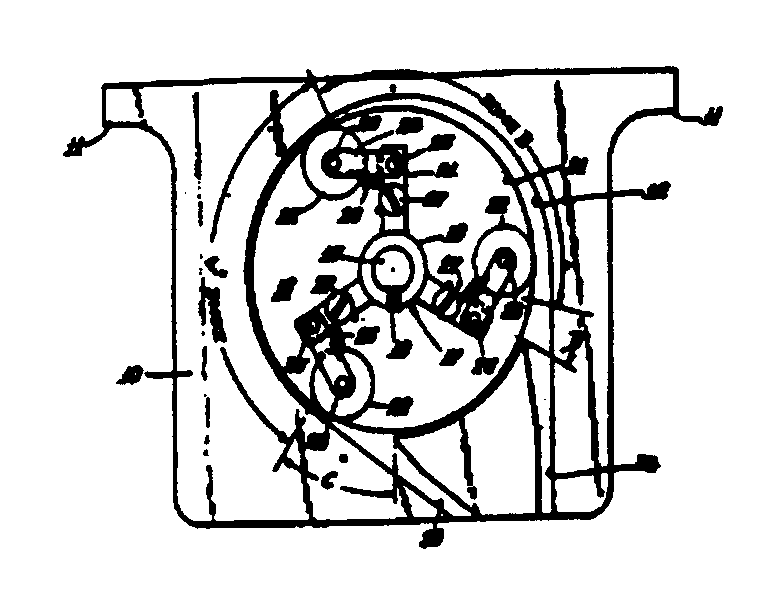
SECTION I - CLASS DEFINITION
This is the general class for the pumping of fluids, and includes
the pumping of slurries, fluent material and the like if handled
in a manner not inconsistent with the handling of fluids. With
the exception of "gettering pumps" as discussed
in Lines With Other Classes and Within This Class, below, a pump
is defined as means to move a fluid by taking it from one place
or location and moving it to another place or location different
from whence it came, the pump, therefore having an inlet and an
outlet for the pumped fluid which are separate and distinct.
The pumping of the fluid is generally accomplished by action
thereon of a mechanical member (e.g., piston) or by contact or entrainment
with another fluid (e.g. jet pumps). Also, the pumping may be accomplished
by the direct action on the pumped fluid of an electric or magnetic
force (e.g., electromagnetic pumps). However, for the line with
respect to "ion pumps", see Lines With Ohter Classes
and Within This Class and Subclass References to the Current Class,
below.
VACUUM FORMATION BY GETTERING
This class is the residual home for the formation of a vacuum
in an enclosed space by a gettering action; a getter being a material
which when placed in an enclosed space reduces the gas or vapor
content of the space either by a chemical or physical action. Also, included
are those devices and processes in which the fluid is ionized to
permit or enhance the gettering action. These devices are often
termed "getter-ion pumps". See the notes and
search notes in subclasses 48 and 49 for a statement of the lines.
SECTION II - LINES WITH OTHER CLASSES AND WITHIN THIS CLASS
LINE WITH CLASS 313 AND CLASS 315
For the line with Classes 313, Electric Lamp and Discharge
Devices and 315, Electric Lamp and Discharge Devices: Systems,
with respect to "ion pumps", see Subclass References
to the Current Class, below.
RELATIONSHIP TO CLASS 91, MOTORS: EXPANSIBLE CHAMBER TYPE
Refer to Lines With Other Classes and Within This Class in
the class definition of Class 91 for a statement of the line between
Classes 91 and 417.
RELATIONSHIP TO CLASS 92, EXPANSIBLE CHAMBER DEVICES
Class 92 is directed to expansible chamber devices, per se,
and with respect to nonrotary expansible chamber pumps is related
to Class 417 as a subcombination thereof. Class 92 is limited to
expansible chamber devices in which the working member has an oscillating or
reciprocating motion to expand and contract the chamber. Thus,
Class 92 cannot take the subcombination of any rotary expansible
chamber pump. See the note below regarding the relationship of
this class (417) and Class 418, Rotary Expansible Chamber Devices,
for the disposition of this art.
Set forth below are the lines between Class 92 and Class 417
as they relate to nonrotary expansible chamber pumps:
A. With Drive Means
1. Motor Driven
Class 92 excludes motor driven expansible chamber devices
when the motor is significantly claimed. See (2) Note in Class
417 subclass 321 for a statement of what constitutes a significantly
claimed motor.
2. Operated By Art Device
Class 92 excludes an expansible chamber pump mounted upon
or adjacent to an art device to be operated thereby. See Class
417 subclasses 229+ for this subject matter and for a definition
of an art device.
3. Other Drive Mechanism
Other specific means to drive an expansible chamber pump such
as gearing, linkage, etc., including disconnectable drives are not
excluded from Class 92.
B. Valving
1. Pump Fluid
Class 92 excludes any expansible chamber pump which includes
control of the pump fluid by a valving action. Thus, any claimed
valving of pump fluid of an expansible chamber pump is sufficient
to preclude classification in Class 92 even though the valving claimed
may not be all of the valving necessary to cause the pump to operate in
the intended manner.
2. Nonpump Fluid
Class 92 does not exclude valving of nonpump fluid as, for
example, valving for lubricant, coolant, sealant, etc.
C. With Diverse Pump
An expansible chamber pump in combination with another pump
of a different type (i.e., which, per se, would not be classified
in Class 92) is excluded from Class 92 unless the pump of a different
type is a mere auxiliary of the expansible chamber pump (i.e., lubricant
or coolant pump, etc.).
Relationship to Class 137, Fluid Handling. The line between
Classes 137 and 417 is generally that of combination and subcombination.
Class 137 generally provides for fluid handling systems and Class
417 generally provides for motor driven pumps and pumps, per se. There
are certain areas of subject matter which are considered to be peculiar
to pumps and their operation and are considered as exceptions to
the general rule stated above. These exceptions and other detailed
lines will be set out below.
D. Pump-Tank Relationship
The combination of a pump and a tank generally will be classified
in Class 137. However, a single nominally recited tank, reservoir,
chamber, pump or other similar fluid holding means will be considered
as merely a flow line or conduit and will be classified in Class
417. See (9) Note in the Class Definition of Class 222, Dispensing,
regarding other pump-tank relationships.
E. Pump-Accumulator Relationship
An accumulator or surge dampening device is usually a device
having a single fluid opening and is connected to a pump inlet or
outlet for the purpose of maintaining a smooth flow to or from the
pump. Such devices when disclosed for the purpose of surge dampening
or insuring smooth flow and claimed in combination with a pump are
classified in Class 417.
F. Pump-Liquid Accumulation Control Relationship
1. A pump claimed in combination with a liquid accumulation
controlled valve is classified in Class 137 with the following exceptions
which are classifiable in Class 417:
a. When the liquid accumulation responsive valve controls
a liquid flow to the pump or a gas relief from the pump is for the
specifically disclosed purpose of priming the pump, see Class 417,
subclasses 200 and 435.
b. When the liquid accumulation responsive valve functions
as a pump valve in a fluid displacement-type pump, see Class 417,
subclass 65 in general and subclasses 126+ and 138 in particular.
c. When the liquid accumulation responsive valve is the distributor
of an expansible chamber-type pump, see Class 417, subclass 297.5.
2. A Jet pump claimed in combination with liquid level responsive
regulating means therefor is classified in Class 417, subclass 182.5.
3. A pump claimed in combination with liquid accumulation-controlled
drive transmission therefor is classified in Class 417, subclass
211.5.
4. A pump claimed in combination with a liquid accumulation
controlled-drive motor therefor is classified in Class 417, subclasses
36+.
G. Pump-Plural Serial Valve Relationship
A pump claimed in combination with plural serial valves in
either or both an inlet or an outlet flow path and without any branched
flow paths is classifiable in Class 417. The rule for serial valves
applies even though one or more of the valves is manually operated or
condition responsive, see Class 417 for serial pump distributors,
for a manually operated valve in serial relationship with a pump
distributor, and for a condition responsive valve in combination
with a pump. (See Subclass References to the Current Class, below.)
H. Pump-Main Flow Path and Branched Flow Path Relationship
Generally a branched flow system having a main flow path and
a branched flow path, whether including a pump or not, is classifiable
in Class 137. However, there are a number of exceptions which usually
depend upon the disclosure in the particular patent as set forth below.
1. A pump having plural branched flow paths, whether valved
or not, communicating with a single source or receiver is classifiable
in Class 417. Where there is no specific disclosure of the source
or receiver for the flow paths, the disclosure will be considered
as if there were a single source or receiver and will be classified
in Class 417.
2. A pump having a main flow path and a branched flow path,
each communicating with separate sources or receivers is classifiable
in Class 417 if:
a. the source or receiver for the main flow path is unclaimed
or nominally claimed and
b. the branched flow path is specifically disclosed as a relief
inlet or outlet for the pump, a priming inlet to the pump, a bypass
around the pump, or a vent, waste or drain outlet from the pump,
and either(1) the main flow path is uncontrolled or (2) the main
flow path is controlled and the branched flow line is (a) uncontrolled, (b)
manually controlled or (c) controlled by a condition responsive
valve responding to a condition in the main flow path which is sensed
between the pump and the main flow path controller.
I. Condition Responsive Control of Pump Drive Motor
A motor driven pump having a condition responsive control
for controlling the operation of the motor is classifiable in Class
417. The combination of a pump and a disconnectable drive, clutch
or variable transmission having a condition responsive control is
classifiable in Class 417. (See Subclass References to the Current Class,
below.)
J. Direct Response Valve-Pump Cylinder Relationship
The combination of one or more direct response valves of the
type classifiable in Class 137, subclasses 511+ and a nominally
recited cylinder is classifiable in Class 137. The specific recitation
of a cylinder head is not considered to be a specific recitation
of the cylinder.
RELATIONSHIP TO CLASS 415, ROTARY KINETIC FLUID MOTORS OR
PUMPS
Class 415 takes rotary, nonexpansible chamber-type pumps.
However, Class 417 provides for rotary, nonexpansible chamber-type
pumps in certain combinations as enumerated below. Unless specifically
excluded below, a patent to a rotary nonexpansible chamber-type pump,
as defined in the class definition of Class 415, will be classified
as an original in Class 415 as opposed to Class 417.
1. With Drive Means
a. Motor Driven
Class 415 excludes motor driven rotary nonexpansible chamber-type
pumps when the motor-pump combination is significantly claimed.
For a detailed explanation of what constitutes a significantly
claimed motor-pump combination see Subclass References to the Current Class
in this class and Lines With Other Classes and Within This Class,
General Relationship With Other Classes, paragraph A in the Class
415 definition.
b. Operated By Art Device
A rotary, nonexpansible chamber- type pump operated by an
art device is excluded from Class 415. See Class 417 for this subject
matter and the definition of an art device. (See Subclass References
to the Current Class, below.)
c. Other Drive Mechanism
Other specific means to drive a rotary, nonexpansible chamber
pump such as gearing, linkage, etc., including disconnectable drives
(e.g., clutch) are not excluded from Class 415.
2. With Diverse Pump
The combination of a rotary, nonexpansible chamber-type
pump with another pump of a different type (e.g., recipro- cating,
rotary expansible chamber, etc.), is excluded from Class 415 and
is classified in Class 417 unless the different type pump is a mere
auxiliary of the rotary, nonexpansible chamber-type pump (e.g.,
lubricating or coolant pump). In the latter case, classification in
Class 415 is proper.
Relationship to Class 418, Rotary Expansible Chamber Devices
Class 418 takes rotary expansible chamber pumps even though
the disclosure and claims may be restricted to pump use. In some
ways Class 418 may be considered to be less comprehensive than Class
417 and rotary expansible chamber-type pumps in certain combinations enumerated
below will be classified in Class 417 rather than Class 418. Unless
specifically excluded below a patent to a rotary expansible chamber
type as defined in the Class Definition of Class 418 will be classified
as an original in Class 418 as opposed to Class 417:
3. With Drive Means
a. With Motor
Class 418 excludes motor driven rotary expansible chamber
devices when the motor is significantly claimed even if the motor
is of the rotary expansible chamber type. For a detailed explanation
of what constitutes a significantly claimed motor; see Subclass
References to the Current Class, below.
b. Operated By Art Device
A rotary expansible chamber pump mounted upon or adjacent
an art device to be operated thereby is excluded from Class 418.
See this class (417) for this subject matter and the definition
of an art device. (See Subclass References to the Current, Class,
below.)
c. Other Drive Mechanism
Other specific means to drive the pump such as gearing, linkage,
etc., including disconnectible drives (e.g., clutch) are not excluded
from Class 418 even if the drive is not reversible.
4. Valving
a. Cyclic or Position Responsive
Class 418 will take rotary expansible chamber pumps combined
with valves for the pumped fluid which have a repetitive pattern
or cycle of operation which is related to the rotation of the pump.
These may be termed cyclic or position responsive valving and include
the opening and closing of inlet or exhaust ports by the movement
of the rotor past same. The adjustment of this type valving so
as to provide, for example, early cutoff of supply is also included
in Class 418. The inclusion, however, of means to cutoff operation
of the pump after a predetermined number of revolutions is excluded
from Class 418, this being considered to be a dispensing feature
for Class 222, Dispensing.
b. In-Line
An in-line valve is defined as one situated in the normal line
of pumped fluid flow which acts in some way to control the flow
in that line, but not by diverting the fluid to a second or subsidiary
flow line (e.g., bypass). Class 418 will take all in-line valves
combined with a rotary expansible chamber pump which are controlled by
some means other than a condition of the pumped fluid (e.g., manual
throttle) and will also take those which are actuated directly by
the application of the pumped fluid thereto (i.e., direct response
valves). Those devices including in-line valves which are controlled
by a pumped fluid condition (e.g., pressure, flow) and in which
said valves are not of the direct response type are excluded from
Class 418 and will be classified in Class 417 if otherwise appropriate.
c. Branched Flow or By-pass
i. Separate Valve Means
Those rotary expansible chamber devices which include a separate
valve means (as opposed to a movable chamber part as discussed in
paragraph (2) immediately below) to divert or bypass all or a portion
of the pumped fluid from its normal or first course of flow to a
second or waste path are excluded from Class 418 regardless of whether
the valve is manually or otherwise controlled unless the diverted
fluid is used merely for a pump perfecting function such as lubricating,
cooling, vane bias, etc.
ii. Movable Chamber Part
Many rotary expansible chamber pumps have expansible chamber
parts which are in running contact with other chamber parts and
which move from a "normal" or contacting position
to a noncontacting position and in so moving allow passage or bypass
of pumped fluid thereby. Exemplary of such parts are vanes, abutments, end
plates, etc., and such parts are usually biased into contacting
position by means such as a spring, pressure fluid conducted from
the expansible chamber or the like. Such devices are not excluded
from Class 418 even though the yielding of the part may be considered
to be performing a bypassing function. However, if pumped fluid
is conducted to the part for such a biasing function (e.g., behind
end plate) and there is a controlled application of fluid to or
release of the fluid from the bias area for the disclosed purpose
of bypassing said fluid or conducting it to another point of use
such devices are excluded from Class 418 and are classified in Class
417 if otherwise appropriate. Also Class 418 excludes a pump having
a movable chamber part whose movement is controlled in response
to the pressure or flow of the pumped fluid of a second rotary expansible
chamber device.
d. Reversible or Unidirectional Flow
Some rotary expansible pumps are provided with adjustable
or self-acting means by which for a given direction of rotation
of the pump the flow may be reversed in the line in which the fluid
is being pumped, or upon reversal of the direction of rotation of
the pump the flow will continue in the same direction in the pumped
fluid flow line. This, per se, will not serve to preclude classification
in Class 418.
5. With Diverse Pump
The combination of a rotary expansible chamber pump with another
pump of a different type (centrifugal, reciprocation, etc.), is
excluded from Class 418 and is classified in Class 417 unless the
different type pump is a mere auxiliary of the rotary expansible
chamber pump as, for example, a lubricating or cooling fluid pump,
etc. In the latter case classification in Class 418 is proper.
SECTION III - SUBCLASS REFERENCES TO THE CURRENT CLASS
SEE OR SEARCH THIS CLASS, SUBCLASS:
| 1+, | for a motor driven pump having a condition responsive
control for controlling the operation of the motor. |
| 48, | and 49, for a statement of the lines see the notes
and search notes in these subclasses. |
| 49, | for ion pumps. |
| 50, | in which pumping may be accomplished by the direct
action on the pumped fluid of an electric or magnetic force (e.g.,
electromagnetic pumps). |
| 212+, | for the combination of a pump and a disconnectable
drive, clutch or variable transmission having a condition responsive
control. |
| 229+, | for a rotary, nonexpansible chamber-type pump operated
by an art device. |
| 229+, | for a rotary expansible chamber pump mounted upon
or adjacent an art device to be operated thereby. |
| 279+, | for a condition responsive valve in combination
with a pump, subclass 441 for a manually operated valve in serial
relationship with a pump distributor, and subclass 456 for serial pump
distributors. |
| 321, | for a detailed explanation of what constitutes a significantly
claimed motor-pump combination see the (2) Note in this subclass. |
SECTION IV - REFERENCES TO OTHER CLASSES
SEE OR SEARCH CLASS:
| 62, | Refrigeration,
subclass 55.5 for cold traps including those in which the sole
disclosure is to act as a "pump" and for cold
traps combined with a nominally claimed mechanical or roughing pump.
Class 417, however, takes the combination of a cold trap and a significantly claimed
device of this class (pump). |
| 73, | Measuring and Testing,
subclass 168 for means to test blowers and pumps. |
| 119, | Animal Husbandry,
subclasses 72+ for animal watering devices including animal operated pumps
combined with a trough for receiving the pumped water. |
| 166, | Wells, appropriate subclasses for pumps combined with well processes
or features especially,
subclasses 369+ for well production processes including pumping
steps, subclasses 53+ for automatic wells including control
of a pump in response to a well condition, subclass 54.1 for wells
with means for separately pumping from plural sources in a well,
subclasses 61 and 62 for heating, refrigerating or insulating means
with an eduction pump or plunger in the well, subclasses 68+ for
above and below ground structure including an eduction pump or plunger
in the well, subclasses 105+ for a well with an eduction
pump or plunger in the well, subclass 176 well brushing, scraping,
cutting or punching-type cleaners on a pump sucker rod, subclasses
316+ for valves including well pump or tubing drain valves. |
| 406, | Conveyors: Fluid Current, appropriate subclasses for systems which transport solids
by means of a fluid current, and which include a pump for generating
the fluid current. See particularly
subclasses 10+ for control circuits for pump drives, which are
responsive to a sensed condition, and subclasses 45 and 46+ for
subject matter relating to the pumping and transportation of slurries. |
| 415, | Rotary Kinetic Fluid Motors or Pumps, for rotary fluid kinetic energy devices disclosed
as a pump or a motor. Class 415 will also take a plurality of such
devices in which each is a pump or each is a motor. Class 417 will
take a rotary fluid kinetic energy motor driving a rotary fluid
kinetic energy pump if a claim sets out that one is a motor and
one is a pump. However, Class 415 will take this disclosed motor
driven pump relation if a claim does not reflect that one is a motor
and the other a pump. |
| 416, | Fluid Reaction Surfaces (i.e., Impellers), appropriate subclasses for motor driven fluid reaction
surfaces (i.e., impellers) in which there is no claimed fluid confining
or deflecting means, upstream or downstream of or encompassing the
impeller. |
| 418, | Rotary Expansible Chamber Devices, for rotary expansible chamber devices disclosed
as a pump or a motor. Class 418 will also take a plurality of such
devices in which each is a pump or each is a motor. Class 418 will
not take a rotary expansible chamber-type motor driving a rotary
expansible chamber-type pump if a claim recites one as a motor and
one as a pump. However, Class 418 will take this disclosed motor
driven pump relationship if a claim does not reflect that one is
a motor and the other a pump. |
| 505, | Superconductor Technology: Apparatus, Material,
Process,
subclasses 150+ for high temperature (Tc
30 K) superconducting devices, and particularly subclass 165 for pumps
utilizing a suspension of superconducting particulate material,
and cross-reference art collection 910 for pumps utilizing superconducting
materials. |
| 623, | Prosthesis (i.e., Artificial Body Members), Parts
Thereof, or Aids and Accessories Therefor,
subclass 3 for pumps solely disclosed as artificial hearts. |
SUBCLASSES
![[List of Patents for class 417 subclass 1]](../ps.gif) 1 1 | CONDITION RESPONSIVE CONTROL OF PUMP DRIVE MOTOR |
| | This subclass is indented under the class definition. Subject matter in which the pump is provided with (1) a
motor to drive the fluid moving element thereof, (2) control means
to control the motor in some manner and (3) a separate sensing means
which is responsive to the occurrence of a condition or a change
in condition of either the pump or the fluid being pumped and which
causes operation of the control means to alter the operation of
the motor.
| | (1)
Note. Sensing of the speed of a motor which is mechanically
connected to the pump for driving same is considered as sensing
a condition of the pump and is included under this definition. |
SEE OR SEARCH THIS CLASS, SUBCLASS:
| 187+, | for regulation of a jet pump by motive fluid control,
jet pumps not being considered as motor driven. |
| 196+, | for diverse pumps having condition responsive control
of a drive motor for one pump which is a mere priming pump for another. |
| 212+, | for condition responsive control of a pump drive
transmission. |
| 321+, | for pumps which are cyclically driven by a cyclically
operable motor and in which the control of the motor is caused to
operate cyclically by a cyclically changing condition of the pump
or pump fluid such that this change of condition and its control
of the motor are the normal manner of operation. |
|
| | |
| 2 | Plural pumps having separate drive motors, supply sources, or delivery destinations |
| | This subclass is indented under subclass 1. Subject matter comprising at least two pumps which are either
(1) independently driven by separate drive motors, (2) adapted to
be supplied from separate sources, or (3) adapted to deliver to
separate destinations.
| | (1)
Note. For purposes of this definition, a single cylinder
having a pumping member (e.g., piston) which serves to divide the
cylinder into two pumping chambers is considered to comprise plural
pumps if the pump chambers are adapted to deliver fluid to separate
destinations or receive fluid from separate sources. |
| | (2)
Note. To be included under this definition, the plural pumps
must supply fluid for external use (i.e., one may not be a mere
auxiliary of another such as a lubricant, coolant, or priming pump). |
| | (3)
Note. An entrainment-type pump (e.g., jet pump) has not been
construed as motor driven and consequently the combination of a
condition responsive motor driven pump and jet pump is not included
under part (1) of the above definition and such combination would
be classified here only if the motor driven pump and jet pump respectively
deliver to separate destinations or receive fluid from separate
sources. | |
| | |
| 3 | Pumps in parallel flow paths with common inflow or outflow |
| | This subclass is indented under subclass 2. Subject matter in which each of said plural pumps has its
respective inlet or outlet connected to a single flow line so that
fluid will flow either to or from said pumps through said flow line.
| | (1)
Note. For purposes of this definition, a common inflow or
outflow line is defined as a conduit or tank in that portion of
the system which handles fluid flow to or from two or more pumps.
Patents disclosing parallel flow paths in which a pressure condition
is sensed in one path only, but for the disclosed purpose of indicating
the common flow line pressure condition, have been placed in subclass
2, above, and appropriately cross-referenced into this subclass
or those indented hereunder. | |
| | |
| 5 | With control of plural pump drive motors |
| | This subclass is indented under subclass 4. Subject matter in which each of said plural pumps is driven
by separate drive motor and the control means is operative to simultaneously
or relatively control the operation of each of said plural drive
motors. |
| | |
| 6 | With additional means sensing condition of one pump or path |
| | This subclass is indented under subclass 5. Subject matter in which there is an additional sensing means
to sense a condition or change in condition in either (1) a fluid
flow line which is peculiar to a single pump, or (2) a pump which
is peculiar to a single flow line, said additional sensing means
serving to effect operation of the same or different control means. |
| | |
| 7 | Sequential starting or stopping of pumps |
| | This subclass is indented under subclass 5. Subject matter in which the control means for the pumps
comprise a start and stop device for the motor of each pump and
which are related to one another in such a manner that the pumps will
either be started or stopped in a certain order in response to changes
in conditions sensed by the sensing means. |
| | |
| 8 | Alternating sequences |
| | This subclass is indented under subclass 7. Subject matter having means related to the control means
for cyclically changing the order of starting or stopping the pump
drive motors. |
| | |
| 9 | By stopping pump in response to leakage into or from system |
| | This subclass is indented under subclass 1. Subject matter in which there is means provided for accumulating
or detecting leakage of pump fluid from the pump or system or leakage of
an extraneous fluid into the pump or system and the control means
acts in response to such leakage to stop operation of the pump motor.
| | (1)
Note. There must be a specific disclosure that the fluid
which causes operation of the control means has leaked from the
device. The mere possibility of detecting leakage by some conventional means,
such as a pressure responsive device, is not sufficient for classification in
this subclass. | |
| | |
| 10 | By controlling starter motor for internal combustion engine |
| | This subclass is indented under subclass 1. Subject matter in which the drive motor comprises an engine
in which fuel is burned in a chamber from which power is directly
derived and the control means is operative to either (1) control
actuation of a secondary motor which is utilized for initiating
operation of the fuel burning engine or (2) control operation of
the pump to cause same to be operated as a motor for initiating
operation of the fuel burning engine. |
| | |
| 11 | By controlling free piston internal combustion engine |
| | This subclass is indented under subclass 1. Subject matter in which the drive motor is of the reciprocating
expansible chamber type and derives its power by the burning of
fuel in the chamber and in which the piston or working member of
the motor is free of any mechanical linkage or gearing which limits
its movement to a fixed stroke during its cycle of operation. |
| | |
| 12 | Having timer or delay means |
| | This subclass is indented under subclass 1. Subject matter having means related to the sensing means
for either (1) causing the state of operation of the drive motor
to be maintained for a specified period of time after a condition or
change in condition is detected by the sensing means before allowing
the state of operation to be changed in accordance with the sensed
condition, (2) allowing the state of operation of the drive motor
to be changed in response to a sensed condition and then causing
said changed state of operation to be maintained for a specified
period of time regardless of further condition changes, (3) causing
the control means or sensing means to be ineffective for a specified
period of time during motor start up, or (4) altering the effectiveness
of the control means for a specified period of time after the sensing
means has detected a change in condition.
| | (1)
Note. A fluid dashpot or damper utilizing fluid independent
of the pump fluid and which serves only to attenuate the effect
of periodic condition fluctuations of short duration is not considered
to be a delay or timing means under this definition. | |
| | |
| 13 | Responsive to pump lubricant, sealant, or coolant condition |
| | This subclass is indented under subclass 1. Subject matter including a means to supply lubricating,
sealing, or cooling fluid to the pump and the sensing means senses
a condition or change of condition of said lubricating, sealing,
or cooling means and operates the motor control means in response
thereto. |
| | |
| 14 | Having ambient condition responsive means |
| | This subclass is indented under subclass 1. Subject matter including an additional sensing means operatively
connected to the control means, said additional sensing means being responsive
to a condition or change of condition (e.g., ambient condition)
of the surrounding environment. |
| | |
| 15 | With control of pump drive transmission |
| | This subclass is indented under subclass 1. Subject matter in which there is additionally provided means
for transmitting motion from the motor to the pump and control means
for either (1) interrupting motion of the pump (e.g., clutch, lock,
etc.), (2) varying the rate of motion of the pump (e.g., brake,
adjustable gearing, etc.) or (3) changing the swept volume of pumping
member or motor working member displacement of an expansible chamber-type pump
or motor (e.g., stroke control). |
| | |
| 16 | With plural separate drive motors for single pump unit |
| | This subclass is indented under subclass 1. Subject matter in which the pump is driven by two or more
individual motors, each of said motors having a motor working member
for driving the same fluid moving element of the pump and in which
at least one of the motors is controlled by the controlling means.
SEE OR SEARCH THIS CLASS, SUBCLASS:
| 10, | for condition responsive control of a starter motor
for an internal combustion engine. The starter motor, even though
it may incidentally drive the pump while cranking the combustion engine,
is not considered to be a separate pump drive motor for this subclass. |
|
| | |
| 17 | With plural separate drive motor controlling elements |
| | This subclass is indented under subclass 1. Subject matter in which the control means comprises two
or more controlling elements which are capable of being separately
actuated in response to the same or different conditions to separately
control the drive motor.
SEE OR SEARCH THIS CLASS, SUBCLASS:
| 10, | for condition responsive control of a starter motor
for an internal combustion engine, such apparatus usually incorporating
a separate control means for terminating operation of the internal
combustion engine. |
|
| | |
| 18 | Single motor control element responsive to means sensing diverse conditions |
| | This subclass is indented under subclass 1. Subject matter comprising a single drive motor controlling
element which is caused to be operated in response to means sensing
plural conditions which are (1) different in kind, e.g., pressure
and flow rate, or (2) if of the same kind, different by the part
of the system characterized by the condition, e.g., inlet and discharge
pressures of the pump.
| | (1)
Note. The diverse condition may be a condition external of
the pump or pump fluid system, e.g., a drive motor condition. | |
| | |
| 19 | Sensing both inlet and outlet conditions |
| | This subclass is indented under subclass 18. Subject matter in which the sensing means responds to a
condition or change of condition on the fluid inlet or intake side
of the pump and a condition or change of condition on the fluid outlet
or discharge side of the pump. |
| | |
| 21 | One is motive fluid condition of fluid drive motor |
| | This subclass is indented under subclass 18. Subject matter in which the drive motor is of the type which
is motivated by a fluid and one of the plural conditions to which
the sensing means responds is a condition or change in condition
of the motor driving fluid. |
| | |
| 22 | One condition is speed of pump |
| | This subclass is indented under subclass 18. Subject matter in which one of the plural conditions to
which the sensing means responds for causing operations of the single
drive motor control element is the rate of speed at which the pump
is driven. |
| | |
| 23 | With common element sensing diverse condition to control motor and pump fluid valve |
| | This subclass is indented under subclass 22. Subject matter having valve means for varying the flow of
fluid being pumped, there being additionally provided a sensing
means having a single sensing part for detecting a condition other
than the rate of speed at which the pump is driven, the single sensing
means causing operation of both the pump fluid valve means and the
single drive motor control element. |
| | |
| 24 | Speed sensor comprises auxiliary pump or electric generator |
| | This subclass is indented under subclass 22. Subject matter in which the means sensing the rate of speed
at which the pump is driven comprises either a secondary pump or
an electric generator which is mechanically driven by the pump drive
motor for producing a fluid or electric signal, respectively, indicative
of the rate of speed at which the pump is driven. |
| | |
| 26 | With condition responsive control of pump fluid valve |
| | This subclass is indented under subclass 1. Subject matter including valve means for varying the flow
of fluid being pumped, which valve means is operated by sensing
the occurrence of a condition or change of condition in the fluid
being pumped.
| | (1)
Note. This definition is not intended to include those devices
in which there is a single sensing means operating a valve whose
sole function is to divert a portion of the pumped fluid to cause
operation of the drive motor control means, such devices have been
considered to be merely pilot valves for the drive control means. |
| | (2)
Note. A direct acting valve, e.g., a check valve which is
responsive only to the direction of flow in a line is not included.
However, a valve which diverts flow from one line to another, in
a branched system, even though dependent only on the direction of
flow in the lines is included. |
| | (3)
Note. For purposes of this definition, pump fluid includes
any fluid which is caused to be moved by the pump. Therefore, a
gas vent valve for spoiling a liquid pump by allowing gas to enter
the pump is included under this definition. Also, a discriminating
valve for allowing gas, but not liquid, to be vented from a liquid
pumping system is included. |
SEE OR SEARCH THIS CLASS, SUBCLASS:
| 10, | for condition responsive control of pump fluid which
is utilized as motive fluid for starting an internal combustion
engine drive motor. |
|
| | |
| 27 | Having independent means for delaying valve actuation |
| | This subclass is indented under subclass 26. Subject matter in which means are provided for retarding
or delaying actuation of the valve means for the purpose of preventing
increase of pressure in the pump until a period of time after the
drive motor control means has been adjusted to cause such increase,
said valve actuation delaying or retarding means being separate
and isolated from the motor control means and having no retarding
or delaying effect thereon.
| | (1)
Note. Devices in which the pump fluid valve is caused to
be operated in response to the motor control element having been
adjusted to a predetermined motor controlling position are not included
under this definition in the absence of a separate retarding or
delaying means for the valve control means. | |
| | |
| 28 | Fluid and motor controls have common sensing element |
| | This subclass is indented under subclass 26. Subject matter in which the valve means and the control
means for the drive motor are both caused to be actuated by a sensing
means having a single sensing part for detecting the occurrence
of a condition or change of condition.
SEE OR SEARCH THIS CLASS, SUBCLASS:
| 23, | for a common condition sensing element which causes
operation of both a pump drive motor control element and a pump
fluid control valve. |
|
| | |
| 29 | Fluid and motor controls separately responsive to diverse conditions |
| | This subclass is indented under subclass 26. Subject matter in which the valve means is controlled in
response to one condition of the system and the control means for
the motor is responsive to a second condition which (1) differs
in kind from the first, e.g., pressure and flow rate, or (2) if
of the same kind, differs by the part of the system characterized
by the condition, e.g., inlet and discharge pressures of the pump.
SEE OR SEARCH THIS CLASS, SUBCLASS:
| 23, | for a sensing means responsive to pump speed for
causing operation of a pump drive motor control element and a sensing
means responsive to a condition other than pump speed for causing
operation of a pump fluid control valve. |
|
| | |
| 33 | Pump stop control means requiring manual reset |
| | This subclass is indented under subclass 1. Subject matter in which the control means acts to stop operation
of the pump by stopping the drive motor in response to a change
of condition but will not again start the pump when the condition
returns to normal; the control means requiring the intervention
of a human operator to restore the pump to a running condition. |
| | |
| 34 | By controlling internal combustion drive engine |
| | This subclass is indented under subclass 1. Subject matter in which the drive motor comprises an engine
in which fuel is burned in a chamber from which the power is directly derived
and the control means includes means which acts on the engine to
change some operating characteristic thereof.
SEE OR SEARCH THIS CLASS, SUBCLASS:
| 10, | for system condition responsive control of a starter
motor for an internal combustion engine driving a pump. |
| 11, | for system condition responsive control of a free
piston-type internal combustion drive engine. |
|
| | |
| 35 | By controlling wind motor in response to liquid accumulation |
| | This subclass is indented under subclass 1. Subject matter in which the drive motor is of the type which
is driven directly by wind, (e.g., a windmill), and a receptacle
is provided for receiving liquid which is to be pumped or which
has been pumped by the pump and the sensing means is responsive
to the quantity of liquid collected in the receptacle. |
| | |
| 36 | Responsive to accumulation of pumped liquid in receiver |
| | This subclass is indented under subclass 1. Subject matter in which there is provided a receptacle for
receiving liquid which is to be pumped or which has been pumped
by the pump and the sensing means is responsive to the quantity
of liquid in the receptacle.
SEE OR SEARCH THIS CLASS, SUBCLASS:
| 35, | for control of a wind motor in response to liquid
accumulation. |
| 182.5, | for means for controlling an entrainment-type pump
(e.g., jet pump) in response to the level of pumped liquid, subclass
211.5 for means controlling a pump drive transmission (e.g., clutch,
cam, etc.) in response to the level of pumped liquid and subclass 297.5
for liquid level control which modifies the operation of an expansible
chamber pump distributor. |
|
| | |
| 37 | By movable liquid receptacle |
| | This subclass is indented under subclass 36. Subject matter in which the sensing means is responsive
to movement of the liquid receptacle or an auxiliary liquid receptacle
in communication therewith, said movement being caused by the weight
of the liquid collected therein. |
| | |
| 38 | By liquid pressure sensor |
| | This subclass is indented under subclass 36. Subject matter in which the sensing means comprises a device
which responds to liquid pressure changes and is either in fluid
communication with or mounted within the receptacle in a manner
such that the liquid must either reach a predetermined level before
it may pass to the pressure sensing device or exert sufficient pressure
on the sensing device to cause actuation thereof.
| | (1)
Note. A movable receptacle is not considered a pressure sensor
under this definition, such devices being classified in subclass
37 above. |
| | (2)
Note. The liquid pressure may be transmitted to the sensing
means via another liquid (e.g., mercury column). | |
| | |
| 40 | By float |
| | This subclass is indented under subclass 36. Subject matter in which the sensing means comprises a buoyant
element which floats on the surface of the liquid collected in the
receptacle. |
| | |
| 42 | In response to pump speed |
| | This subclass is indented under subclass 1. Subject matter in which the sensing means senses the rate
of speed at which the pump is driven.
SEE OR SEARCH THIS CLASS, SUBCLASS:
| 22+, | for a single motor control element which is operated
in response to means sensing diverse conditions, one of said diverse
conditions being the speed of the pump. |
|
| | |
| 44.1 | By control of electric or magnetic drive motor: |
| | This subclass is indented under subclass 1. Subject matter in which the motor is of the type having
a working member (e.g., armature) which is motivated by electricity
or a magnetic field.
| | (1)
Note. Collected in this subclass are patents directed to
system condition responsive control of drive motors of the type commonly
referred to as magnetic or electromagnetic clutches. | |
| | |
| 44.2 | Responsive to pump fluid pressure: |
| | This subclass is indented under subclass 44.1. Apparatus having a sensing means responsive to variation
in pressure present in the fluid flowing to or out from the pump
and which causes operation of the control means to alter the operation
of the motor.
| | (1)
Note. The fluid pressure may be transmitted to the sensing
means via another liquid (e.g., mercury column). | |
| | |
| 44.4 | Low pressure stops motor from turning on pump: |
| | This subclass is indented under subclass 44.2. Apparatus wherein the motor comprises an electrical contact
having an opened position and a closed position and the contact
remains in the opened position as long as the sensed pressure of
the fluid remains below a predetermined value. |
| | |
| 44.5 | Mercury switch: |
| | This subclass is indented under subclass 44.2. Apparatus wherein the motor comprises an electrical circuit
and the sensing means includes a device which contains mercury which
is motivated by the variations in the fluid pressure; the said motivation
triggers the electrical circuit of the motor to close or open. |
| | |
| 44.6 | Dial-type sensor: |
| | This subclass is indented under subclass 44.2. Apparatus wherein the motor comprises an electrical circuit
and the sensing means includes a dial indicator which has a rotary movement
responsive to the fluid pressure and a manually adjustable set point
which causes the electrical circuit to open or close when the positions
of the indicator and manual set point are properly aligned. |
| | |
| 44.7 | Bellow-type sensor: |
| | This subclass is indented under subclass 44.2. Apparatus wherein the motor comprises an electrical circuit
and the sensing means includes a flexible structure which is capable
of expanding to increase the volumetric capacity thereof, said structure
comprising (a) a tube of flexible material having a circumferentially corrugated
or pleated wall, (b) at least four plates, each plate having a central
opening therein defining an edge inwardly of the outer peripheral
edge thereof, said plates being arranged in superposed relation
with adjacent plates secured along their inner and outer edges alternately,
or (c) a pair of rigid platelike members pivoted together along
a portion of their peripheral edges, the remaining peripheral edge
portion of said plates being joined together by a flexible member
which is pleated in some position of relative pivotal movement of
the platelike members. |
| | |
| 44.8 | Piston-type sensor: |
| | This subclass is indented under subclass 44.2. Apparatus wherein the motor comprises an electrical circuit
and the sensing means includes a plunger or a solid disk which fits snugly
into a cylinder and wherein the plunger or the disk moves when subjected
to the fluid pressure variation in the cylinder causing the electrical
circuit of the motor to close or open. |
| | |
| 44.9 | Diaphragm: |
| | This subclass is indented under subclass 44.2. Apparatus wherein the motor comprises an electrical circuit
and the sensing means includes a relatively thin membranelike member
having a peripheral edge portion, said member being adapted to be
associated with a surrounding or encompassing tubular rigid structure
to extend transversely thereof to form a closing wall for said tubular
structure, the outer peripheral edge of said membrane being in sealing
relationship with the encompassing wall of said tubular structure;
said member moves in response to the fluid pressure variation causing
the electrical circuit of the motor to close or open.
| | (1)
Note. The membranelike member need not span the entire space
within the encompassing wall of the tubular member, but may be in
the form of a ring or frustum having the inner peripheral edge thereof
in sealing engagement with a rigid element movable relative to and coaxial
with the encompassing tubular member. | |
| | |
| 45 | By changing electrical characteristic of motor or motor circuit |
| | Subject matter under subclasses 44.1+ in which the
motor is electrically operated and the motor or electric supply
circuit therefor includes an electrical component (e.g., resistance
element, starting winding, etc.) which is either (1) adjustable
to change its electrical value or characteristic or (2) capable
of being included in or shunted out of the main motor circuit; and
in which the control means acts to control the adjustment or shunting
of the component in response to the sensed condition. |
| | |
| 46 | By controlling drive motor motive fluid |
| | This subclass is indented under subclass 1. Subject matter in which the motor drive means for the pump
is of the type which includes a movable working member which is
motivated by a fluid and the control means comprises means for controlling
the flow of motive fluid to or from the motor in response to the
sensing means.
SEE OR SEARCH THIS CLASS, SUBCLASS:
| 21, | for a single fluid motor control element which is
operated in response to means sensing diverse conditions, one of
said diverse conditions being a motive fluid condition. |
| 34, | for means for system condition responsive control
of an internal combustion-type drive engine. |
| 41, | for means for controlling motive fluid to drive
motor in response to float means which senses accumulation of pumped
liquid in a receiver. |
|
| | |
| 48 | ELECTRICAL OR GETTER TYPE |
| | This subclass is indented under the class definition. Subject matter in which (1) the fluid is pumped by or the
pumping effect relies upon the direct action thereon of electrical
means or a magnetic field, or (2) the fluid is "pumped" or
trapped by means of a getter.
| | (1)
Note. This is the residual home for the creation of a vacuum
in an enclosed space by means of a gettering action as defined in
(2) Note below. This and indented subclasses include the combination
of the chamber to be evacuated and the gettering means. It also
includes significant claimed containers holding getter material
for disposition in a chamber to be evacuated. |
| | (2)
Note. A getter is a material which, when placed in an enclosed
space, reduces the gas or vapor content of the space either by a
chemical or physical action. |
SEE OR SEARCH THIS CLASS, SUBCLASS:
| 322, | for pumps having a chamber which is expanded and
contracted by an electrical or magnetostrictive action on the walls
thereof. |
SEE OR SEARCH CLASS:
| 75, | Specialized Metallurgical Processes, Compositions
for Use Therein, Consolidated Metal Powder Compositions, and Loose
Metal Particulate Mixtures,
subclasses 255+ for a loose metal particle composition. |
| 96, | Gas Separation: Apparatus,
subclasses 108+ for solid sorbent apparatus for separating vaporous
or gaseous constituents. The subject matter classified in Class
96 may be intended to create a vacuum in an enclosed space, but
must selectively separate one constituent from another. Thus, Class
96 does not take solid sorbent apparatus or any other means intended
to sorb all of the gas or vapor constituents in a chamber. |
| 204, | Chemistry: Electrical and Wave Energy,
subclasses 192.1+ for processes for coating or forming an article
by cathode sputtering and subclass 298.01 for cathode sputtering
apparatus to coat or form an article. |
| 252, | Compositions,
subclasses 181.1+ for getters and gas or vapor generating materials,
per se, and also for such materials claimed as being in a container,
but where no structure of the container is claimed. |
| 313, | Electric Lamp and Discharge Devices,
subclasses 545 through 566for electric lamps and space discharge devices
which include a getter or gas or vapor generating material as a
part thereof. |
| 406, | Conveyors: Fluid Current, appropriate subclasses for systems which transport solids
by means of a fluid current, and which include a pump for generating
the fluid current. See particularly
subclasses 10+ for control circuits for pump drives, which are responsive
to a sensed condition, and subclasses 45 and 46+ for subject matter
relating to the pumping and transportation of slurries. |
| 445, | Electric Lamp or Space Discharge Component or
Device Manufacturing,
subclasses 38+ , 53+ and 73 for methods and apparatus
for evacuating electric lamp and space discharge devices and including
some step or means limited to the manufacture or repair of electric
lamp or space discharge device. |
|
| | |
| 49 | Ionic with gettering |
| | This subclass is indented under subclass 48. Subject matter in which the pumping action is effected by
or relies upon the ionization of the pumped fluid by the action
of electrical means and including a getter material for the ionized fluid
or an additional pump of a different type (e.g., mechanical, diffusion,
etc.).
| | (1)
Note. The line between this Class 417 and Classes 313, Electric
Lamp and Discharge Devices and 315, Electric Lamp and Discharge
Devices: Systems, in the field of ionic pumps generally falls into two
categories as follows: (a) SPACE DISCHARGE AND GETTERING - The distinction
between Class 417 and Classes 313 and 315 in the field of creation
of a high vacuum involving electrical space discharge with gettering
is one of art. Thus, a patent to a space discharge device combined
with gettering means (the getter may be an electrode of the space
discharge device) in which the sole disclosure is to act as a vacuum pump
(i.e., the only disclosed use of the space discharge device is to
ionize fluid to be trapped by the getter); or one in which all of
the claims are limited to a pumping or vacuum creating function will
be classified as an original in Class 417. Conversely, those in
which the disclosure is not limited to a vacuum pump function and
having a claim not limited to pumping will be classified in Class 313
or Class 315 if otherwise appropriate; (b) SPACE DISCHARGE WITHOUT
GETTERING - Those devices in which a fluid or fluid stream is ionized by
a space discharge device and do not include gettering of the ionized
fluid will generally be classified in Class 313 or 315 even though
the sole disclosure relates to pumping or vacuum formation. However,
if in addition to the ionization means an additional pump of the
nonionization type is claimed the patent will be classified in Class
417. |
SEE OR SEARCH CLASS:
| 313, | Electric Lamp and Discharge Devices, appropriate subclasses and see particularly
subclasses 231.01+ , 359.1+ and 545 to 566. See (1) Note
above. |
| 315, | Electric Lamp and Discharge Devices: Systems, appropriate subclasses and see particularly
subclasses 111.01+ See (1) Note above. |
|
| | |
| 50 | Electromagnetic |
| | This subclass is indented under subclass 48. Subject matter in which the pumped fluid is electrically
conductive, a current being caused to flow in the fluid while being
subjected to a magnetic field, the result being a pumping action
on the fluid.
SEE OR SEARCH THIS CLASS, SUBCLASS:
| 49, | for the "pumping" of fluid or
formation of a vacuum by ionizing the fluid to be pumped and subjecting
the ionized fluid to a magnetic field and see the notes thereto
for similar art classified elsewhere. |
SEE OR SEARCH CLASS:
| 310, | Electrical Generator or Motor Structure,
subclass 11 for dynamoelectric apparatus utilizing a conducting
fluid. |
|
| | |
| 51 | Getter heating, vaporizing, or regeneration |
| | This subclass is indented under subclass 48. Subject matter provided with getter means and in which means
are provided to elevate the temperature of the getter, to change
the state of the getter from a solid to a vapor or to renew the
getter to perform its gettering function after having already operated
as a getter. |
| | |
| 52 | EXPANSION AND CONTRACTION OF PUMP FLUID |
| | This subclass is indented under the class definition. Subject matter in which the fluid to be pumped is isolated
in a chamber, heated to expel a portion thereof from the chamber,
this expelled portion constituting the pumped fluid, and the fluid
remaining in the chamber then cooled so as to contract and establish
a reduced pressure in the chamber to draw in a new charge of fluid. |
| | |
| 53 | PROCESSES |
| | This subclass is indented under the class definition. Processes of pumping .
SEE OR SEARCH CLASS:
| 166, | Wells,
subclasses 369+ for a process of producing a well including a significant
manipulative step in addition to pumping. |
|
| | |
| 55 | Specific motive fluid |
| | This subclass is indented under subclass 54. Processes in which the composition of the motive fluid is
specified in a claim.
| | (1)
Note. The following are excluded under this definition as
specific motive fluid: water, air, steam, mercury. Oil is also excluded
under this definition unless the composition is more specifically
recited than mere "oil". | |
| | |
| 56 | DRILLED WELL FREE PISTON-TYPE PUMP |
| | This subclass is indented under the class definition. Apparatus in which the pump has a piston which reciprocates
within an elongated cylinder of uniform cross-sectional dimensions which
is adapted to be positioned within a drilled well, said piston serving
to separate the cylinder into respective motor and pump chambers,
means providing either a restricted or a controlled flow path which
provides communication between the pump and motor chambers (i.e.,
between opposite sides of the piston), the induction of at least
a portion of the fluid to be pumped flowing serially through the
motor chamber, said restricted or controlled flow path, and thence
into said pump chamber; motive fluid being subsequently applied
to said motor chamber to drive said piston on an eduction stroke.
| | (1)
Note. The motive fluid under this definition may be derived
either from the well itself or from an external source. |
| | (2)
Note. This subclass and those indented hereunder are intended
to include the subcombination of a valved or radially expansible
piston for performing a valving function which is disclosed as having utility
in the apparatus defined herein. | |
| | |
| 57 | Having condition or position responsive control of pump discharge flow path |
| | This subclass is indented under subclass 56. Apparatus in which there is provided means for controlling
the flow of liquid from the pump chamber, said flow controlling
means being operated in response to either (1) the sensing of a
condition or change in condition or (2) the arrival of the piston
at a predetermined position in the cylinder.
| | (1)
Note. For purposes of this definition, a mere check valve
in the eduction flow conduit which opens in the direction of pump
fluid eduction is not considered to be condition responsive control.
Also, the mere passing of the eduction port by the free piston is
not considered to be position responsive control of the type herein
provided for. | |
| | |
| 58 | Having condition or position responsive control of motive fluid supply |
| | This subclass is indented under subclass 56. Apparatus in which there is provided valve means for controlling
the inlet of motive fluid to the motor chamber, said valve means
comprising mechanical elements which are relatively moved in response
to either (1) the sensing of a condition or change in condition
or (2) the arrival of the piston at a predetermined position in
the cylinder.
| | (1)
Note. For purposes of this definition, a mere check valve
positioned within the motive fluid supply line which opens in the
direction of motive fluid supply to the motor chamber is not considered
to be condition responsive control. |
| | (2)
Note. Supply of motive fluid which is controlled by well
liquid level in which the well liquid serves to directly cover or uncover
motor chamber supply ports is excluded under this definition. However,
a piston controlled cylinder port which is subsequently opened to
allow the supply additional motive fluid is included hereunder. | |
| | |
| 59 | Radially expansible piston portion controls pump and motor chamber intercommunication |
| | This subclass is indented under subclass 56. Apparatus in which at least a portion of the piston is capable
of expansion and contraction in a direction perpendicular to its
axis of reciprocation to thereby provide a valving action with the
chamber in which it reciprocates to allow or interrupt fluid communication
between the pump and motor chambers.
SEE OR SEARCH THIS CLASS, SUBCLASS:
| 555.1+, | and see the search notes therein, for other fields
of search for radially expansible and contractible pistons. |
|
| | |
| 60 | Mechanically actuated valve carried by piston |
| | This subclass is indented under subclass 56. Apparatus in which the piston has a fluid flow passage formed
therein which extends to opposite ends of said piston and valve
means carried by the piston for controlling said passage, said valve
means being positively mechanically moved by engagement of said
valve (or an element associated therewith) with a stationary chamber
portion. |
| | |
| 61 | BUOYANTLY SUPPORTED |
| | This subclass is indented under the class definition. Apparatus in which the pump unit or the intake or discharge
line thereof is buoyant or buoyantly supported so as to be capable
of floating on a body of liquid, the pump not being operated by
the rise and fall or flow of the liquid on which it or its intake
or discharge line floats.
SEE OR SEARCH CLASS:
| 415, | Rotary Kinetic Fluid Motors or Pumps,
subclass 7 , for a float supported or buoyant runner. |
|
| | |
| 62 | ALTERNATE SERIES OR PARALLEL OPERATION OF PLURAL PUMPS |
| | This subclass is indented under the class definition. Apparatus comprising two pumping members or units, and means
being provided by which the pumped fluid is successively acted upon
by said members or units, and alternatively the members or units
are arranged in separate or branched flow lines so as to take from
a common or separate sources and deliver to a common or separate
outlets. |
| | |
| 63 | WITH SIGNAL, INDICATOR, OR INSPECTION MEANS |
| | This subclass is indented under the class definition. Apparatus having (1) signals, indicators, registers, recorders,
or gauges for indicating a condition of the pump or pumped fluid
or the position of a pump part such as a piston, control member,
valve, etc., such devices comprising relatively movable, changeable
or audible information giving parts, or (2) transparent viewing
means whereby the pump operation or the condition of some part thereof
may be observed.
| | (1)
Note. For classification under part (1) of this definition
there must be either an indicia or an audible or visual signal or
a means whose sole purpose is to indicate a condition of the device.
Relative to indicia there must be graduations or markings disclosed.
Where it is indicated that the mere position of a pump part is
indicative of a condition of the pump (e.g., valve handle position
indicated direction of fluid flow) classification under the definition
does not result unless some cooperating indicia are included. | |
| | |
| 64 | GAS PRESSURE EXCHANGE USING ROTARY CELLULAR CONVEYOR |
| | This subclass is indented under the class definition. Apparatus having a cellular member rotatable about an axis
with means to isolate therein and from its source a volume of gas
to be pumped, transfer said volume to a position where a gaseous
motive fluid may be admitted into said cellular member for the purpose
of increasing the pressure of said volume while an interface is
maintained between the two gases, and then permit the pumped gas
and the motive gas to be exited from said cellular member each into
a separate flow path. |
| | |
| 65 | ONE FLUID PUMPED BY CONTACT OR ENTRAINMENT WITH ANOTHER |
| | This subclass is indented under the class definition. Apparatus in which one fluid is pumped or motivated by direct
contact or entrainment with another fluid, the motive fluid before
contact or entrainment being separate from the pump fluid.
| | (1)
Note. This definition does not include mere pulsation dampeners
or accumulators, i.e., a trapped, confined compressible fluid which
directly receives energy from another fluid and returns the energy to
the other fluid from which it was received. |
SEE OR SEARCH THIS CLASS, SUBCLASS:
| 64, | for gas pressure exchange devices using a rotary
cellular member to transfer a gas to be pumped to a position where
its pressure may be increased by being contacted directly by a gaseous
motive fluid. |
|
| | |
| 66 | Contact or entrainment within rotary impeller |
| | This subclass is indented under subclass 65. Apparatus in which a driven element is provided to continuously
and unidirectionally move the motive fluid either as slugs or a
complete ring about an axis at a relatively high rate of speed,
said motive fluid directly contacting and imparting energy to the
fluid being pumped while in said movement about an axis. |
| | |
| 67 | Passage in impeller shaft for pumped or motive fluid |
| | This subclass is indented under subclass 66. Apparatus in which the driven element is provided with a
passage passing through the axis of rotation of the element at the
point where it is supported for rotation and said passage is described
as conveying motive fluid or fluid being pumped. |
| | |
| 68 | Liquid ring |
| | This subclass is indented under subclass 66. Apparatus in which the motive fluid is rotated by the driven
member at such a speed and in such a manner as to form a peripheral
ring around the driven member within a surrounding casing. |
| | |
| 69 | With diverse pump |
| | This subclass is indented under subclass 68. Apparatus including a second pump which is of a different
basic type from the liquid ring pump.
| | (1)
Note. The liquid ring pump may be merely a priming pump for
the second pump. | |
| | |
| 70 | Peripheral motive fluid inlet |
| | This subclass is indented under subclass 66. Apparatus in which a passage to supply motive fluid to be
rotated by the driven element is provided, said passage being closely
related to the axially remote portion of the rotary element. |
| | |
| 71 | Axial inlet for pumped fluid |
| | This subclass is indented under subclass 66. Apparatus in which a passage is provided to bring fluid
to be pumped into contact with motive fluid being moved about an
axis, said passage being closely related to axis of the driven element. |
| | |
| 72 | Peripheral pumped fluid outlet |
| | This subclass is indented under subclass 71. Apparatus in which an outlet passage for pumped fluid is
provided, said passage being closely related to the axially remote
portion of the rotary element. |
| | |
| 73 | By ignition of motive fluid |
| | This subclass is indented under subclass 65. Apparatus comprising a pumping chamber into which pump fluid
is alternately introduced and expelled, the pumping being effected
by burning of motive fluid and application of the products of combustion
to the chamber. |
| | |
| 75 | With fluid momentum utilizing means |
| | This subclass is indented under subclass 73. Apparatus including means to return a portion of the pump
fluid to the pump chamber and utilize the momentum thereof to effect
expulsion of a previously burned charge of motive fluid, and compress
the next incoming charge of motive fluid. |
| | |
| 76 | Jet pump with motive fluid generating pump |
| | This subclass is indented under subclass 65. Apparatus including a jet pump and an additional pump which
includes a mechanical impelling member (e.g., piston, rotor, etc.)
to generate the motive fluid supplied to the jet pump.
| | (1)
Note. For the definition of a jet pump see this class subclass
151. |
| | (2)
Note. The jet pump may have the sole disclosed use of priming
the motive fluid generating pump. | |
| | |
| 77 | Recirculation of separated motive fluid |
| | This subclass is indented under subclass 76. Apparatus in which the motive fluid and the pumped fluid
are of different states (i.e., liquid and gas) and after entrainment
the two are separated and the motive fluid fed back to the entrainment
area as recirculated motive fluid.
| | (1)
Note. This definition excludes a jet pump which primes the
other pump of air but then acts to pump liquid when the other pump
is primed. | |
| | |
| 78 | Entrainment at exit of impeller |
| | This subclass is indented under subclass 76. Apparatus provided with a rotary impeller which acts to
project motive fluid therefrom, the exit of the impeller acting
as the motive fluid nozzle and being disposed in the area of entrainment.
| | (1)
Note. This definition excludes an impeller whose discharge
is confined by a passage which acts as the motive fluid nozzle.
See subclass 84. |
SEE OR SEARCH THIS CLASS, SUBCLASS:
| 66+, | for pumping one fluid by contact or entrainment
with another wherein the contact or entrainment occurs within a rotary
impeller. |
|
| | |
| 81 | Multiple-stage rotary pump |
| | This subclass is indented under subclass 80. Apparatus in which the rotary nonexpansible chamber-type
pump includes a plurality of rotary pumping members at least a portion
of the pumped fluid passing successively from one pumping member
to the next. |
| | |
| 82 | Changeable jet location (e.g., deep or shallow well) |
| | This subclass is indented under subclass 80. Apparatus in which the jet pump may be selectively placed
in different positions with respect to the rotary pump, usually
for adapting the apparatus to operate with a shallow well with the
jet proximate the rotary pumping member or with a deep well with
the jet positioned in the well remote from the rotary pumping member. |
| | |
| 83 | Jet within rotary pump casing |
| | This subclass is indented under subclass 80. Apparatus in which the jet pump is located in close physical
proximity to the rotary pumping member of the diverse pump and is
contained within the housing structure (including inlet and outlet
connections) thereof.
SEE OR SEARCH THIS CLASS, SUBCLASS:
| 82, | for combined jet and rotary nonexpansible chamber-type
pumps in which the jet may be selectively located in the rotary
pump casing or remote therefrom. |
|
| | |
| 85 | Diverse pumps |
| | This subclass is indented under subclass 65. Apparatus comprising a plurality of discrete pumps of different
basic types.
| | (1)
Note. This definition does not include a plurality of pumps
of different basic types if one is a mere auxiliary or ancillary
of the other (e.g., lubricant or cooling pump for main pump). However,
a pump whose sole disclosed function may be to prime the other pump
is not considered a mere auxiliary and this combination is included
in this definition. |
| | (2)
Note. This definition includes as different basic-type pumps
which may both be of the fluid contact or entrainment types such
as, for example, jet pump and aerated column, pneumatic displacement and
jet, etc. |
SEE OR SEARCH THIS CLASS, SUBCLASS:
| 69, | for diverse pumps one of which is the liquid ring
type. |
|
| | |
| 86 | Including pneumatic displacement |
| | This subclass is indented under subclass 85. Apparatus in which one of the pumps is of the type having
a chamber or container in which liquid to be pumped is collected
and means to apply gas pressure from an external source to the surface
of the liquid in said chamber or container to expel the liquid therefrom.
| | (1)
Note. The gas pressure may be merely atmospheric air admitted
to the chamber which has been filled by applying vacuum thereto. | |
| | |
| 87 | Including jet pump |
| | This subclass is indented under subclass 85. Apparatus in which one of the pumps comprises a jet pump.
| | (1)
Note. For the definition of a jet pump see this class subclass
151. |
SEE OR SEARCH THIS CLASS, SUBCLASS:
| 76, | for a jet pump with a motive fluid generating pump. |
|
| | |
| 88 | Diverse pump motor exhaust is jet motive fluid |
| | This subclass is indented under subclass 87. Apparatus in which the diverse pump is driven by an internal
combustion engine or fluid motor and the exhaust motive fluid or
combustion products from the motor are directed to the fluid jet
producing means of the jet pump to act as the motive fluid therefor.
SEE OR SEARCH THIS CLASS, SUBCLASS:
| 91, | for an aerated column pump and a diverse pump which
is driven by an internal combustion engine or fluid motor the exhaust
of which provides the aeration fluid. |
|
| | |
| 89 | With rotary nonexpansible chamber type |
| | This subclass is indented under subclass 87. Apparatus in which another of the pumps comprises a pumping
member which has unidirectional rotary motion about a fixed axis
and acts to pump fluid by centrifugal, centripetal or screw effect.
SEE OR SEARCH THIS CLASS, SUBCLASS:
| 80, | for a jet pump with a rotary nonexpansible chamber-type
pump which generates the motive fluid for the jet. |
|
| | |
| 90 | Including aerated column |
| | This subclass is indented under subclass 85. Apparatus in which one of the pumps is of the aerated column
type.
| | (1)
Note. For the definition of an aerated column pump see this
class subclass 108. | |
| | |
| 91 | Diverse pump motor exhaust is aeration fluid |
| | This subclass is indented under subclass 90. Apparatus in which the diverse pump is driven by an internal
combustion engine or fluid motor, the exhaust motive fluid or combustion products
from the motor constituting the gas which is injected into the liquid
column.
SEE OR SEARCH THIS CLASS, SUBCLASS:
| 88, | for a jet pump in which the jet motive fluid is
the exhaust from an internal combustion engine or fluid motor which
drives a pump different from the jet pump. |
|
| | |
| 92 | Liquid piston |
| | This subclass is indented under subclass 65. Apparatus in which a fluid may be pumped by the direct action
thereon of a compressing chamber or container and a liquid forming
part of said compressing chamber or container, the body of liquid
in effect constituting a piston in said container whereby relative
movement between said liquid and said container varies the volume
of a space in said chamber or container to pump the fluid. |
| | |
| 93 | Moving contracting chamber |
| | This subclass is indented under subclass 92. Apparatus in which at least one wall of said chamber means
is moved relative to a surface of said body of liquid to change
the volume of said chamber and thus pressurize the fluid confined
therein. |
| | |
| 94 | Helical chamber |
| | This subclass is indented under subclass 93. Apparatus in which said chamber has a wall means having
a spiral configuration which extends along an axis, and upon rotation
about said axis said wall means is caused to move relative to said
liquid surface, move said fluid axially and change the pressure
of said fluid to be pumped which is confined in said chamber. |
| | |
| 100 | Tide or wave |
| | This subclass is indented under subclass 92. Apparatus in which the body of liquid is moved by the natural
tide or wave action of a large body of water in its natural situation. |
| | |
| 102 | Plural chambers |
| | This subclass is indented under subclass 101. Apparatus in which a plurality of interrelated variable
volume compressing chambers are provided. |
| | |
| 104 | Momentum piston |
| | This subclass is indented under subclass 92. Apparatus in which the body of liquid is set in motion and
the inertia of the body of liquid (i.e., the tendency to remain
in motion or at rest) being effective to produce the pumping action. |
| | |
| 105 | By condensation of motive fluid |
| | This subclass is indented under subclass 65. Apparatus in which gaseous pumping fluid is reduced to the
liquid state with a resultant pressure change, which change causes
the pumped fluid to be motivated. |
| | |
| 106 | Plural alternating pumps |
| | This subclass is indented under subclass 105. Apparatus comprising plural pumping chambers which are so
interrelated as to produce alternate or successive pumping from
the chambers. |
| | |
| 108 | Aerated column |
| | This subclass is indented under subclass 65. Apparatus comprising a vertical column into which the liquid
to be pumped enters, with means to inject a gaseous motive fluid
below the level of the liquid accumulated therein which effects
a mixed mass of reduced specific gravity to elevate said liquid
with said gas.
SEE OR SEARCH THIS CLASS, SUBCLASS:
| 85+, | for means for pumping a fluid which employs a means
to aerate the fluid to reduce its specific gravity in combination
with another kind of pump means (e.g., jet, etc.). |
| 151+, | for jet pumps which employ a motive fluid moving
at a greater velocity than the fluid to be pumped thereby creating
a vacuum or reduced pressure area to motivate the pumped fluid and wherein
the motive fluid may subsequently become entrained with the pumped
fluid. |
|
| | |
| 109 | Valved gas inlet |
| | This subclass is indented under subclass 108. Apparatus wherein said injection means comprises valve means
which opens and closes to control the gaseous motive fluid injected. |
| | |
| 111 | Plural serially actuated valves |
| | This subclass is indented under subclass 109. Apparatus wherein said valve means comprises plural valves
mounted at vertically spaced levels along said vertical column,
and having common mechanical or electrical actuating means to actuate
or permit the actuation of the valves in a particular sequence. |
| | |
| 113 | Sensing element controls pilot valve |
| | This subclass is indented under subclass 112. Apparatus wherein said valve means comprises a pilot valve
and a main valve, said pilot valve controlling actuating fluid to
the main valve to control actuation thereof, and said sensing element
controlling the actuation of said pilot valve. |
| | |
| 114 | With pilot valve |
| | This subclass is indented under subclass 109. Apparatus wherein said valve means comprises a pilot valve
and a main valve, said main valve controlling the gaseous motive
fluid injection and said pilot valve controlling actuating fluid to
the main valve to control actuation thereof. |
| | |
| 115 | Valve member actuated responsive to absolute gaseous motive fluid pressure or flow rate |
| | This subclass is indented under subclass 109. Apparatus wherein said valve means is actuated in response
to the attainment of an absolute rate of flow, pressure or other
absolute condition of the motive fluid to control the flow of motive
fluid injected into the pumped fluid.
SEE OR SEARCH THIS CLASS, SUBCLASS:
| 109, | for devices having unbiased check valves in the
gaseous motive fluid line which merely acts to prevent the flow of
the liquid to be pumped back into the motive fluid line and which,
by their nature, permit flow of motive fluid to flow therethrough
whenever the pressure of the motive fluid exceeds that of the pumped
fluid. |
| 110, | for those devices having motive fluid injection
control valves which are controlled in response to the flow of the
pumped fluid and which may also be influenced by a motive fluid
condition. |
| 117, | for those devices having motive fluid injection
control valves which are actuated to permit the flow of motive fluid
into the pumped fluid in response to a static head build up of pumped
fluid. |
|
| | |
| 117 | Valve biased open by static pressure of pumped fluid |
| | This subclass is indented under subclass 109. Apparatus wherein said valve means comprises a valve member,
said valve member being biased closed by weight, spring, or other means,
and having means exposed to the accumulation of liquid within said
vertical column, which means, in response to the pressure of the accumulated
liquid, opens or tends to open said valve member. |
| | |
| 118 | Liquid pumped by supplying or exhausting gaseous motive fluid to or from pumping chamber |
| | This subclass is indented under subclass 65. Apparatus in which the fluid which is to be pumped is a
liquid, and the motive fluid is a gas, comprising a pumping chamber,
a liquid inlet and a liquid outlet through which the liquid is pumped
into and out of said chamber, means for supplying and exhausting
the gas to effect the pumping of said liquid, and further having
(1) pump means to supply or exhaust the gas or (2), liquid level
float means to effect control of the gas or liquid entering or leaving said
chamber or (3) means to effect repetitive or cyclic pumping into
and from said chamber upon initiation of the pumping action.
| | (1)
Note. The pumps disclosed in the patents contained herein
operate on a differential pressure principle, i.e., by withdrawing
the gaseous motive fluid which is in contact with a portion of a confined
liquid to be pumped, a higher pressure, e.g., atmospheric, acting
upon another portion of said confined liquid effects movement and
thus pumping thereof. |
| | (2)
Note. Devices are included under this definition wherein
the pumping chamber is provided with a single means by which both
the liquid and the gas are exhausted. |
| | (3)
Note. Devices are classified under this definition which
have pumping chambers which are submerged in the liquid to be pumped
whereby the liquid is introduced into the chamber by gravity. | |
| | |
| 119 | Motive fluid pumped by contact with a liquid |
| | This subclass is indented under subclass 118. Apparatus having a pump means to supply or exhaust the gas,
said pump means comprising means to utilize a body of liquid, which
body of liquid is in contact with the gas, to compress or expand
said gas. |
| | |
| 124 | Responsive to weight of pumped fluid |
| | This subclass is indented under subclass 123. Apparatus wherein the condition is the weight of the fluid
which is pumped which has accumulated in the first chamber.
SEE OR SEARCH THIS CLASS, SUBCLASS:
| 140, | for devices having a movably mounted means adapted
to receive the fluid which is pumped and adapted to be moved in
response to a quantity of fluid received to control the pumping operation. |
|
| | |
| 126 | With float actuated control means |
| | This subclass is indented under subclass 118. Apparatus having means buoyed by the fluid which is pumped
and responsive to change in level thereof to control flow of the
fluid which is pumped or of the motive fluid into or from the pumping
chamber. |
| | |
| 128 | With intermediate pilot valve |
| | This subclass is indented under subclass 126. Apparatus wherein the flow of the fluid which is pumped
or the flow of the motive fluid is controlled by a valve means which
is controlled by the buoyed means through a pilot valve means. |
| | |
| 130 | Control of motive fluid inlet (e.g., atmosphere, etc.) |
| | This subclass is indented under subclass 126. Apparatus wherein the admission of the motive fluid to the
pumping chamber is controlled by the buoyed means.
| | (1)
Note. Apparatus having means to control the admission of
atmospheric air to a pumping chamber adapted to be placed under
a vacuum are classified in this and indented subclasses. | |
| | |
| 131 | With control of motive fluid outlet |
| | This subclass is indented under subclass 130. Apparatus wherein said buoyed means also controls the exhausting
of the motive fluid from the pumping chamber.
| | (1)
Note. Apparatus having means to control the flow of working
fluid from the pumping chamber to a vacuum source are classified
in this and indented subclasses. | |
| | |
| 133 | With overcenter valve actuator means |
| | This subclass is indented under subclass 131. Apparatus wherein the float means initiates the operation
of an over center (e.g., spring, weight, etc.) valve actuator to
control the flow of motive fluid to and from the pumping chamber. |
| | |
| 134 | Control of motive fluid outlet |
| | This subclass is indented under subclass 126. Apparatus wherein the flow of motive fluid from the pumping
chamber is controlled by the buoyant means.
| | (1)
Note. Devices having means to control the flow of motive
fluid from the pumping chamber to the vacuum source are classified
in this and indented subclasses. | |
| | |
| 137 | Cyclic pumping |
| | This subclass is indented under subclass 118. Apparatus wherein the pumping chamber alternately admits
and ejects a fluid which is pumped by controlling flow of the pumped fluid
or motive fluid by a mechanism motivated (1) in response to an ambient
or external pumped fluid or motive fluid condition or (2) by the
pumped fluid, motive fluid or other means. |
| | |
| 138 | Control by liquid level sensing means |
| | This subclass is indented under subclass 137. Apparatus wherein said means for admitting or ejecting the
fluid which is pumped to and from the pumping chamber comprises
liquid level sensing means at predetermined liquid level(s). |
| | |
| 139 | Control by condition of pumped fluid |
| | This subclass is indented under subclass 137. Apparatus wherein the mechanism, by which the fluid which
is pumped is admitted to or ejected from the pump chamber, is motivated in
response to a condition of the pumped fluid. |
| | |
| 140 | Movable pumping chamber |
| | This subclass is indented under subclass 139. Apparatus having a movably mounted means adapted to receive
the fluid which is pumped and adapted to move in response to a quantity of
fluid received to control the mechanism by which the fluid which
is pumped is admitted to or ejected from the pump chamber.
| | (1)
Note. The pump chamber may be the movably mounted means. |
SEE OR SEARCH THIS CLASS, SUBCLASS:
| 124, | for devices having plural interrelated pumping chambers
which include a means to sense the weight received of fluid which
is pumped to control the pumping operation of the chambers. |
|
| | |
| 141 | Responsive to flow of pumped fluid |
| | This subclass is indented under subclass 139. Apparatus wherein the mechanism, by which the fluid which
is pumped is admitted to or ejected from the pumping chamber, is
controlled in response to the rate of flow of the fluid which is
pumped. |
| | |
| 142 | Responsive to pumped fluid pressure |
| | This subclass is indented under subclass 139. Apparatus wherein the mechanism, by which the fluid which
is pumped is admitted to or ejected from the pumping chamber, is
controlled in response to the pressure of the fluid which is pumped.
| | (1)
Note. This subclass includes those devices which have means
which are described as sensing the "weight" of
the pumped fluid but which, in fact, sense pumped fluid pressure
at a given point in the pump chamber. However, a device which includes
a container into which pumped fluid is placed and which measures
a predetermined weight of fluid therein to control the pumping operation is
classified in subclass 139. |
SEE OR SEARCH THIS CLASS, SUBCLASS:
| 143, | for devices wherein repetitive pumping is effected
in response to a sensed motive fluid pressure or pressure differential. |
|
| | |
| 143 | Motive fluid supply or exhaust valve responsive to motive fluid pressure |
| | This subclass is indented under subclass 137. Apparatus wherein the alternate admission and ejection of
the fluid which is pumped into and from the pump chamber results
from the alternate admission and withdrawal of the motive fluid
to or from the pump chamber said motive fluid being controlled by
valve means responsive to the motive fluid pressure.
| | (1)
Note. The pressure responsive means does not include a mere
pressure responsive check valve in the motive fluid inlet or outlet
of the pumping chamber. | |
| | |
| 144 | Correlated motive fluid valve and pressure or vacuum generating means |
| | This subclass is indented under subclass 137. Apparatus in which said means for effecting the admission
and ejection of the pumped fluid from the pump chamber is a valve
means for supplying or exhausting the gaseous pumping fluid to said
chamber and having additional means correlating control of said
valve means with the operation of a means generating said motive
fluid. |
| | |
| 148 | With vacuum generator |
| | This subclass is indented under subclass 118. Apparatus having the pump means, (i.e., vacuum generator),
to withdraw the gaseous motive fluid from the pumping chamber.
SEE OR SEARCH THIS CLASS, SUBCLASS:
| 119, | for a device having a vacuum generator comprising
a liquid the surface of which communicates with the motive fluid. |
|
| | |
| 150 | Gravity flow motive fluid |
| | This subclass is indented under subclass 65. Apparatus comprising a vertically disposed tube through
which motive fluid drops freely under the influence of gravity,
contact with or entrainment of the pumped fluid being made in the
tube. |
| | |
| 151 | Jet |
| | This subclass is indented under subclass 65. Apparatus in which motive and pumped fluids are brought
into intimate contact in an enclosed flow path, the motive fluid
having a higher velocity than the pumped fluid and imparting energy
to the pumped fluid by the action of entrainment and frictional
contact.
SEE OR SEARCH THIS CLASS, SUBCLASS:
| 76+, | for jet pumps having a motive fluid generating pump. |
| 87+, | for diverse pumps one of which is a jet pump. |
SEE OR SEARCH CLASS:
| 137, | Fluid Handling,
subclasses 888+ for systems having multiple inlets and a single
outlet with means to promote mixing or combining of plural diverse fluids
and subclass 842, for a "turbulence amplifier" having
similar structure. If the system is disclosed as one of the fluids
acting to pump the other classification is in this class (417). |
| 261, | Gas and Liquid Contact Apparatus,
subclasses 76+ for injector-type gas and liquid contact apparatus
where there is a mutual exchange of properties between the fluids. |
|
| | |
| 152 | Vapor condensation vacuum diffusion type |
| | This subclass is indented under subclass 151. Apparatus in which the pump is adapted to be connected to
or enclosed within a space which is to be evacuated to a high vacuum,
the motive fluid being in the form of a vapor which acts to remove
fluid diffusing out of said space, the motive fluid acting to remove
the fluid by entrainment and condensation.
| | (1)
Note. The vapor is generally oil or mercury which is generated
in a boiler. | |
| | |
| 153 | With cooling or heat insulation means |
| | This subclass is indented under subclass 152. Apparatus in which means are provided to cool the pump,
usually the outer walls or nozzle thereof or heat insulation means
are provided to prevent heat transfer from the motive fluid to the
zone being evacuated. |
| | |
| 154 | Vertical stack from generator with reverse flow nozzle |
| | This subclass is indented under subclass 152. Apparatus in which there is a vertically disposed conduit
which the motive fluid vapor flows upwardly from a vapor generator
(i.e., boiler) the motive fluid being reversed and directed transversely
and downwardly from the conduit into the entrainment area, the motive fluid
upon condensation flowing back to the generator. |
| | |
| 155 | Flue type |
| | This subclass is indented under subclass 151. Apparatus in which the combining tube of the jet pump is
a flue or stack of a furnace and the jet acts to increase the draft
effect of the flue or stack.
| | (1)
Note. Where the operation of the device necessarily involves
a treatment of the flue gases, such as the entrainment of air or
air and steam to effect combustion of unconsumed particles of fuel,
or where any treatment of the fuel gases not merely a pumping effect
is involved, or where the combination embraces elements of a furnace
mechanism of greater scope than herein defined, the device is classified
in appropriate subclasses of Class 110, Furnaces; see especially
subclasses 150, 160, and indented subclass. Compare Class 261,
Gas and Liquid Contact Apparatus, subclass 24, and indented subclasses. | |
| | |
| 156 | With spark arrester |
| | This subclass is indented under subclass 155. Apparatus in which the pumped fluid contains sparks or cinders
and means are provided to separate out or reduce the size of the
sparks or cinders prior to discharge from the pump.
SEE OR SEARCH CLASS:
| 96, | Gas Separation: Apparatus, appropriate subclasses, for spark arresters, per se.
When a spark arrester is combined with a jet pump it is considered
to be a perfecting feature of the pump and is classified in Class
417. |
|
| | |
| 157 | Regulation |
| | This subclass is indented under subclass 155. Apparatus including means for controlling the operation
of the jet pump or the flow of motive or pumped fluid to or from
the jet pump by means of a valve or throttling action. |
| | |
| 158 | With motive fluid generator |
| | This subclass is indented under subclass 151. Apparatus including means to energize or motivate the motive
fluid of the jet pump.
SEE OR SEARCH THIS CLASS, SUBCLASS:
| 76+, | for a jet pump with a motive fluid generating pump. |
| 152+, | for vapor condensation vacuum diffusion-type pumps
with motive fluid generating means. |
|
| | |
| 159 | Internal-combustion engine motive fluid source |
| | This subclass is indented under subclass 158. Apparatus in which the means to energize or motivate the
motive fluid is an internal combustion engine.
| | (1)
Note. The motive fluid may be fluid exhausted by the engine
or drawn into the intake manifold or otherwise energized by the
engine. | |
| | |
| 160 | Cleaning by separate fluid or diverted motive fluid |
| | This subclass is indented under subclass 151. Apparatus provided with means to remove accumulated foreign
material from the jet pump or its connected flow lines by means
of applying motive fluid to the pump by a route other than its normal
flow path to the entrainment area or by means of a fluid other than
the motive or pumped fluid which is applied to the pump. |
| | |
| 161 | Radial disc-type motive fluid jet |
| | This subclass is indented under subclass 151. Apparatus in which the pumped fluid flows toward the entrainment
area along a given path and motive fluid is projected radially of
the given path in the form of a disc-like sheet, the pumped fluid
being entrained by the disc-like sheet and during entrainment flowing
outwardly from the given path.
SEE OR SEARCH THIS CLASS, SUBCLASS:
| 78, | for radial disc-type jet pumps in which the entrainment
is at the exit of a centrifugal impeller. |
|
| | |
| 162 | Interrelated overflow and motive fluid valves |
| | This subclass is indented under subclass 151. Apparatus having a valved waste passage to conduct pumped
fluid which has been entrained away from the device and is also
provided with a valve to control flow of motive fluid to the jet,
there being means provided which upon actuation of one of the valves causes
or prevents actuation of the other. |
| | |
| 163 | Successive introduction of motive fluid |
| | This subclass is indented under subclass 151. Apparatus in which a first stream of motive fluid acts to
entrain pumped fluid and then a second stream of motive fluid from
the same or different sources as the first acts to entrain the combined
motive and pumped fluid from the first entrainment. |
| | |
| 164 | With interstage cooling |
| | This subclass is indented under subclass 163. Apparatus in which heat exchange apparatus is provided to
remove heat from the combined motive and pumped fluid from the first
entrainment before said fluid is acted upon by the second motive
fluid stream. |
| | |
| 165 | Individually controlled motive fluid flows |
| | This subclass is indented under subclass 163. Apparatus in which both the first and second streams of
motive fluid are provided with separate and distinct valves to individually
control the flow thereof.
| | (1)
Note. The separate and distinct valves may be unitary with
one another so long as there are distinct valve portions which control
each of the motive fluid flow paths. | |
| | |
| 166 | Sequential |
| | This subclass is indented under subclass 165. Apparatus in which the separate and distinct valves are
so related that upon actuation first one valve controls its motive
fluid flow path and then the other controls its motive fluid flow path
in sequence. |
| | |
| 167 | Central and peripheral motive fluid supply |
| | This subclass is indented under subclass 163. Apparatus in which one of the motive fluid streams is projected
centrally so as to entrain an annular stream of pumped fluid outwardly thereof
and another motive fluid stream is in the form of an annulus so
as to entrain a stream of pumped fluid in the center of the annulus. |
| | |
| 168 | One motive fluid flow surrounds nozzle tube of another |
| | This subclass is indented under subclass 163. Apparatus in which one of the motive fluid streams is confined
to a conduit terminating in a nozzle and the other motive fluid
stream is directed around the circumference of the conduit at the
point at which it entrains pumped fluid.
SEE OR SEARCH THIS CLASS, SUBCLASS:
| 154, | for vapor condensation vacuum diffusion-type pumps
with reverse flow jets from a vertical stack rising from a motive
fluid generator. |
|
| | |
| 170 | In-line motive fluid flows |
| | This subclass is indented under subclass 163. Apparatus in which the first and second motive fluid flows
at the points of entrainment are substantially in line with one
another.
| | (1)
Note. The motive fluid streams may be of annular form with
the annuli having a common central axis. |
SEE OR SEARCH THIS CLASS, SUBCLASS:
| 154, | for vapor condensation vacuum diffusion-type pumps
with plural reverse flow jets from a vertical stack rising from
a motive fluid generator. |
|
| | |
| 172 | Concentric reverse flow motive fluid and discharge conduits |
| | This subclass is indented under subclass 151. Apparatus provided with a conduit for supplying motive fluid
to the entrainment area and a conduit for conducting motive and
pumped fluid from the entrainment area, one conduit being concentrically
disposed within the other. The direction of flow of the motive fluid
being opposite to the direction of flow of the combined motive and
pumped fluid. |
| | |
| 173 | With cooling |
| | This subclass is indented under subclass 151. Apparatus combined with heat exchange means to reduce the
temperature of the motive fluid or the pumped fluid or both other
than by a mere direct interchange of heat between the motive and
pumped fluids.
| | (1)
Note. This definition excludes the injection of one fluid
into another fluid even though for the sole disclosed purpose of cooling
if the injected fluid has a pumping effect on the other fluid by
a jet or entrainment action (i.e., transfer or velocity energy). |
SEE OR SEARCH THIS CLASS, SUBCLASS:
| 153, | for vapor condensation vacuum diffusion-type pumps
with cooling means. |
| 164, | for successive introduction of motive fluid into
the pumped fluid with cooling means between the stages of pumping. |
|
| | |
| 174 | Successive entrainment of pumped fluid |
| | This subclass is indented under subclass 151. Apparatus in which motive fluid acts to entrain pumped fluid
and then the combined motive and pumped fluid stream acts to further
entrain additional fluid to be pumped at a point downstream of the
first entrainment. |
| | |
| 175 | With priming or overflow removal jet |
| | This subclass is indented under subclass 151. Apparatus in which an additional jet device is provided
with discharges to waste and is so connected as to draw the pumped
fluid into the first jet pump to prime same or to remove pumped
fluid from an overflow or waste chamber of the first jet. |
| | |
| 176 | Parallel entrainments with separate combining tubes |
| | This subclass is indented under subclass 151. Apparatus having a plurality of motive fluid nozzles, the
motive fluid from each acting to entrain pumped fluid, the combined
motive and pumped fluid from each entrainment traveling in a separate
downstream conduit or combining tube, the entrainments being in
parallel with one another; i.e., each motive fluid stream is separate
from the others and acts to entrain separate flows of pump fluid.
| | (1)
Note. The pumped fluid may originate in a common pipe or
conduit and the outputs from the downstream conduits may combine
into a single flow. |
SEE OR SEARCH THIS CLASS, SUBCLASS:
| 163, | for the successive introduction of motive fluid
to a single pumped fluid stream. |
| 174, | for a single motive fluid stream which successively
entrains pumped fluid. |
| 179, | for plural motive fluid jets for a single entrainment,
i.e., with a single combining tube. |
|
| | |
| 179 | Plural motive fluid jets or sources for single entrainment |
| | This subclass is indented under subclass 151. Apparatus in which in a single zone of entrainment of pumped
fluid (i.e., single inflow of pumped fluid and single outflow of
combined pumped and motive fluid) there is provided means to project
a plurality of separate motive fluid streams or different sources
of motive fluid are provided for delivery through the same motive
fluid projecting means.
| | (1)
Note. The separate motive fluid streams or sources may be
used simultaneously or alternately. |
SEE OR SEARCH THIS CLASS, SUBCLASS:
| 163, | for successive introduction of motive fluid into
the pumped fluid along the path of flow of the pumped fluid. |
| 174, | for successive entrainment of pumped fluid by a
single motive fluid flow. |
| 176, | for plural motive fluid jets having separate combining
tubes from the jets. |
|
| | |
| 181 | Faucet or flexible hose attached |
| | This subclass is indented under subclass 151. Apparatus in which the jet pump unit is adapted to be connected
by a readily detachable means to a spigot or a flexible tube from which
motive fluid for the jet is supplied. |
| | |
| 182 | Regulation |
| | This subclass is indented under subclass 151. Apparatus including means for controlling the operation
of the jet pump or the flow of motive or pumped fluid to or from
the jet pump by means of a valve or throttling action.
SEE OR SEARCH THIS CLASS, SUBCLASS:
| 118+, | for successive introduction of motive fluid into
the pumped fluid with individually controlled motive fluid flows. |
| 157, | for jet pumps with regulation in which the combining
tube is the flue or stack of a furnace for interrelated overflow and
motive fluid valves. |
| 162, | for interrelated overflow and motive fluid valves. |
| 179, | for plural motive fluid jets or sources for a single
entrainment with individual or relative control of the jets or sources. |
|
| | |
| 184 | Pressure controlled |
| | This subclass is indented under subclass 183. Apparatus in which the change in the relative axial positions
of the nozzle and conduit is in response to variation in fluid pressure
caused by the operation of the jet pump. |
| | |
| 185 | With main line downstream control |
| | This subclass is indented under subclass 182. Apparatus in which the controlling means is located in the
output flow line downstream from the entrainment area.
| | (1)
Note. The controlling means is in the main outflow line from
the pumps and does not merely control a passage to waste. |
SEE OR SEARCH THIS CLASS, SUBCLASS:
| 192, | for a pressure controlled overflow line downstream
of the entrainment area. |
|
| | |
| 186 | By bypassing motive fluid from nozzle |
| | This subclass is indented under subclass 182. Apparatus in which the motive fluid is directed into the
entrainment area by a nozzle and valve means are provided which
when actuated cause all or a portion of the motive fluid to be diverted
from the nozzle.
| | (1)
Note. The diversion of the motive fluid may be merely around
the nozzle to reenter the pump downstream of the normal entrainment
area or the diversion may be away from the pump as, for example,
into the normal pumped fluid inlet line. |
SEE OR SEARCH THIS CLASS, SUBCLASS:
| 185, | for main line control downstream of the entrainment
area which may cause an increase in motive fluid pressure so as
to by-pass. |
|
| | |
| 187 | By controlling motive fluid |
| | This subclass is indented under subclass 182. Apparatus in which the controlling means is positioned in
the motive fluid inlet line upstream of the entrainment area or
at the point of discharge into the entrainment area.
SEE OR SEARCH THIS CLASS, SUBCLASS:
| 162, | for interrelated motive fluid and overflow valves. |
| 165+, | for successive introduction of motive fluid into
the pumped fluid with individually controlled motive fluid flows. |
| 179, | for plural motive fluid jets or sources for a single
entrainment with individual or relative control of the jets or sources. |
| 186, | for controlling means to by-pass motive fluid from
the entrainment nozzle. |
|
| | |
| 188 | Interrelated with pumped fluid control |
| | This subclass is indented under subclass 187. Apparatus including controlling means in the pumped fluid
inlet line upstream of the entrainment area, means being provided
which interrelates the motive fluid and pumped fluid controlling
means such that when one is actuated the other is necessarily controlled. |
| | |
| 189 | Pressure controlled |
| | This subclass is indented under subclass 187. Apparatus in which the motive fluid controlling means acts
in response to variation of fluid pressure which is incident to
the operation of the jet pump. |
| | |
| 190 | Pumped fluid inlet valve |
| | This subclass is indented under subclass 182. Apparatus in which the controlling means is positioned in
the pumped fluid inlet line upstream of the entrainment area.
SEE OR SEARCH THIS CLASS, SUBCLASS:
| 188, | for interrelated motive fluid and pumped fluid controls. |
|
| | |
| 191 | Pressure controlled |
| | This subclass is indented under subclass 190. Apparatus in which the pumped fluid controlling means acts
in response to variation of fluid pressure which is caused by the
operation of the jet pump. |
| | |
| 192 | Pressure controlled overflow |
| | This subclass is indented under subclass 182. Apparatus in which the controlling means controls the flow
to waste of the combined motive and pumped fluid downstream of the
entrainment area, said controlling means acting in response to variation
of fluid pressure caused by the operation of the jet pump. |
| | |
| 193 | By movable conduit or conduit wall (e.g., combining tube) |
| | This subclass is indented under subclass 192. Apparatus in which the controlling means comprises an axially
movable section of the flow conduit or a movable wall portion of
the conduit downstream of the entrainment area.
SEE OR SEARCH THIS CLASS, SUBCLASS:
| 184, | for a movable combining tube which shifts in response
to fluid flow and in shifting varies the axial relationship between
the motive fluid nozzle and the entrance to the combining tube. |
|
| | |
| 195 | Specific material |
| | This subclass is indented under subclass 151. Apparatus in which a claim includes a recitation of the
material of which the jet pump or a part thereof is made.
SEE OR SEARCH THIS CLASS, SUBCLASS:
| 55, | for processes of pumping by contact or entrainment
utilizing a specific motive fluid. |
|
| | |
| 196 | Expressed mathematically or dimensionally |
| | This subclass is indented under subclass 151. Apparatus in which some portion of the flow confining means
of the jet pump is represented in a claim by a mathematical formula
or equation or some specific proportions or dimensions of the parts
are set forth. |
| | |
| 197 | Peripheral motive fluid supply |
| | This subclass is indented under subclass 151. Apparatus in which the motive fluid is supplied as an annular
stream which entrains the pumped fluid centrally thereof.
SEE OR SEARCH THIS CLASS, SUBCLASS:
| 167, | for successive introduction of motive fluid to act
on the pumped fluid, one of the motive fluid streams being peripherally
supplied. |
| 177, | for an annular motive fluid stream which entrains
pumped fluid both exterior and interior of the annulus. |
|
| | |
| 198 | Specific motive fluid nozzle |
| | This subclass is indented under subclass 151. Apparatus in which a claim includes details of the construction
or shape of the nozzle from which motive fluid is projected into
the entrainment area.
| | (1)
Note. This subclass includes specific nozzle shapes to provide
a particular shape or pattern of motive fluid projection. |
SEE OR SEARCH THIS CLASS, SUBCLASS:
| 179+, | for plural motive fluid jets into a single entrainment
area including a nozzle which is subdivided to provide a plurality
of distinct flow paths. |
SEE OR SEARCH CLASS:
| 239, | Fluid Sprinkling, Spraying, and Diffusing, appropriate subclasses for nozzle, per se. |
|
| | |
| 199.1 | DIVERSE PUMPS: |
| | This subclass is indented under the class definition. Apparatus comprising a plurality of discrete pumps of different
basic types.
| | (1)
Note. This definition does not include a plurality of pumps
of different basic types if one is a mere auxiliary or ancillary
of the other (e.g., lubricant or cooling water or condensate removal
pump for main pump). |
| | (2)
Note. This definition includes diverse pumps wherein one
of the pumps is disclosed merely as priming another, the priming
pump in this instance not being considered merely ancillary to the
other pump. |
| | (3)
Note. Mere difference in size or shape, etc., of the same
basic type of pump is not included under this definition. |
| | (4)
Note. The following are exemplary of different basic types
of pumps: (a) Rotary expansible chamber; (b) Rotary nonexpansible
chamber; (c) Reciprocating working member (piston or cylinder);
(d) Collapsible chamber (e.g., diaphragm, bellows); and (e) Hydraulic ram. |
| | (5)
Note. A patent will be classified as an original in this
or indented subclasses if the pumps are disclosed as diverse, but
a claim recites only one of the pumps specifically. On the other
hand a plurality of pumps which are disclosed as diverse but are
claimed broadly will not be classified as an original under the
definition. |
SEE OR SEARCH THIS CLASS, SUBCLASS:
| 69, | for diverse pumps one of which is of the liquid
ring type. |
| 76+, | for jet pumps with motive fluid generating pumps. |
| 85+, | for diverse pumps at least one of which is of the
type in which fluid is pumped by contact or entrainment with another. |
SEE OR SEARCH CLASS:
| 418, | Rotary Expansible Chamber Devices,
subclass 3 for diverse rotary expansible chamber-type pumps. |
|
| | |
| 199.2 | Priming and venting: |
| | This subclass is indented under subclass 199.1. Apparatus wherein one of the pumps supplies fluid to the
pumping chamber of the main pump which is supplied with a valve
to exhaust the fluid from the pumping chamber. |
| | |
| 200 | Priming with liquid level responsive control |
| | This subclass is indented under subclass 199.1. Apparatus in which one of the pumps is priming or maintaining
the other pump primed and including means responsive to the level
of pump fluid in some part of the system to control the pump fluid
or modify the operation of at least one of the pumps.
| | (1)
Note. The operation of the pump is considered to be modified,
for example, if the drive means is controlled, the capacity is varied,
or a valve is operated to bypass the discharge, to draw from a different
source, to deliver to a different place or vary the inlet or outlet. | |
| | |
| 201 | Including rotary nonexpansible chamber type |
| | This subclass is indented under subclass 199.1. Apparatus in which one of the diverse pumps comprises a
pumping member which has unidirectional rotary motion about a fixed
axis and acts to pump fluid by a centrifugal, centripetal or screw
effect.
SEE OR SEARCH THIS CLASS, SUBCLASS:
| 200, | for the combination of a centrifugal pump and a
diverse pump for priming the centrifugal pump with liquid level responsive
control of one of the pumps or the pump fluid. |
|
| | |
| 202 | Diverse pump controlled by rotary pump condition |
| | This subclass is indented under subclass 201. Apparatus having means to modify the operation of another
of the pumps in response to a condition of the rotary nonexpansible
chamber-type pump.
| | (1)
Note. The operation of the pump is considered to be modified,
for example, if the drive means is controlled, the capacity is varied,
or a valve is operated to bypass the discharge, to draw from a different
source, to deliver to a different place or vary the inlet or outlet. |
| | (2)
Note. The condition of the pump to which the control responds
may be, for example, pressure, flow, loss of prime, etc. | |
| | |
| 203 | Preceding diverse pump |
| | This subclass is indented under subclass 201. Apparatus in which the diverse pumps are arranged such that
the entire or a substantial portion of the output of one is directed
to the second so as to be serially acted upon thereby, the rotary
nonexpansible chamber-type pump being upstream of the diverse pump
so as to feed fluid thereto with the diverse pump acting as a second
stage. |
| | |
| 204 | Moving partition or cylinder of rotary pump forms or actuates reciprocating pump |
| | This subclass is indented under subclass 199.1. Apparatus in which one of the pumps is of the rotary expansible
chamber type having a partition (i.e., vane or abutment) or cylinder
which moves incident to rotation of the pump, the partition or cylinder
constituting or being directly connected to a piston which reciprocates
upon movement of the partition or cylinder, the piston operating
within a chamber and forming therewith a reciprocating expansible chamber
pump. |
| | |
| 205 | Series |
| | This subclass is indented under subclass 199.1. Apparatus in which the diverse pumps are arranged such that
the output of one is directed to the inlet of the second so as to
be serially acted upon thereby.
SEE OR SEARCH THIS CLASS, SUBCLASS:
| 203, | for a centrifugal pump delivering fluid to a diverse
pump in series therewith. |
|
| | |
| 206 | Rotary expansible chamber type precedes reciprocating |
| | This subclass is indented under subclass 205. Apparatus in which the fluid is acted upon by a rotary expansible
chamber- type pump and then by an expansible chamber- type pump having
a pumping member which performs its pumping function by a reciprocating
(including oscillating) motion.
| | (1)
Note. A rotary expansible chamber- type pump under this definition
is as defined in Class 418. |
| | (2)
Note. Flexible wall pumping members (e.g., diaphragm, bellows)
are not considered to have reciprocating motion under this definition. | |
| | |
| 207 | BY HEATING OF PUMPED FLUID |
| | This subclass is indented under the class definition. Apparatus in which a pumping action is obtained by the direct
application of heat to the fluid to be pumped. |
| | |
| 208 | Vapor generator type |
| | This subclass is indented under subclass 207. Apparatus in which the fluid to be pumped is a liquid, the
application of heat to the liquid causing at least a portion thereof
to vaporize, the vapor pressure then impelling the liquid through
an outlet. |
| | |
| 209 | With inlet valve |
| | This subclass is indented under subclass 208. Apparatus which includes valve means which controls flow
of the fluid which is pumped into a chamber means in which said
fluid is vaporized, said valve means being closed by a buildup in
pressure during vaporization of said fluid and opened by a decrease
in pressure after the vapor or fluid has been expelled from said chamber. |
| | |
| 210 | PUMP FLUID BIASED OVERCENTER LOAD EQUALIZER |
| | This subclass is indented under the class definition. Apparatus in which there is provided biasing means movable
relative to a reciprocating-type pumping member, said biasing means receiving
energy from the pump fluid and serving to bias the pumping member
in opposite directions over different portions of pumping member
movement in one reciprocatory stroke direction. |
| | |
| 211 | INERTIA-TYPE PUMPING MEMBER OR DRIVE MEANS |
| | This subclass is indented under the class definition. Apparatus in which the pump is adapted to be mounted upon
or attached to a device which is subject to or adapted to produce motion
or vibration, the pump having a relatively movable pumping member,
the relative movement of which is caused by the inertia thereof
and the motion or vibration of the device or by the inertia of a
separate member which is connected to or operatively associated with
the pumping member.
| | (1)
Note. The device is usually a vehicle. | |
| | |
| 211.5 | LIQUID LEVEL RESPONSIVE CONTROL OF DISPLACEMENT, VOLUMETRIC CAPACITY, OR DRIVE TRANSMISSION |
| | This subclass is indented under the class definition. Apparatus in which the pump or means for transmitting motion
to the pump from a source of power is provided with control means for
either (1) interrupting motion of the pump (e.g., clutch, lock,
etc.), (2) varying the rate of motion of the pump (e.g., brake,
dashpot, adjustable gearing, etc.), (3) changing the swept volume
of displacement of an expansible chamber-type pump, or (4) changing
the volumetric capacity of an expansible chamber- type pump (e.g.,
clearance control); said control means being operable in response
to the level of pump fluid. |
| | |
| 212 | CONDITION RESPONSIVE CONTROL OF DRIVE TRANSMISSION OR PUMP DISPLACEMENT |
| | This subclass is indented under the class definition. Apparatus in which the pump or means for transmitting motion
to the pump from a source of power is provided with control means for
either (1) interrupting motion of the pump (e.g., clutch, lock,
etc.), (2) varying the rate of motion of the pump (e.g., brake,
dashpot, adjustable gearing, etc.), or (3) changing the swept volume
of the pumping member of an expansible chamber-type pump (e.g.,
stroke control); said control means being operable in response to
a sensed condition of the pump or pumped fluid.
SEE OR SEARCH THIS CLASS, SUBCLASS:
| 211.5, | for liquid level responsive control of pump displacement,
volumetric capacity or drive transmission. |
| 274, | for means for varying the volumetric capacity of
an expansible chamber-type pump in response to a sensed condition,
the capacity varying means not affecting pumping member displacement
(e.g., clearance control). |
|
| | |
| 213 | Having condition responsive pumped fluid control |
| | This subclass is indented under subclass 212. Apparatus combined with fluid flow control means for varying
the flow of pumped fluid to or from the pump or pump chamber, or
controlling a relief or bypass which means is also operated by sensing
the occurrence of a condition or a change in condition.
| | (1)
Note. See the definition and notes under subclass 279, which
notes are also applicable to this subclass. | |
| | |
| 215 | By changing phasing of plural pistons in single chamber |
| | This subclass is indented under subclass 212. Apparatus in which the pump comprises an expansible chamber-type
pump having a plurality of relatively movable pumping elements working
in a single pump chamber and relatively movable driving elements
are connected to the pumping elements so that they may be driven
into the pumping chamber together, e.g., in phase, or at different
times, e.g., out of phase, to vary the volume of fluid pumped; the control
means acting to change the relationship, e.g., phasing, between
the driving elements to vary the output of the pump. |
| | |
| 217 | Reversible flow pump |
| | This subclass is indented under subclass 212. Apparatus in which the pump has a mechanical pumping member
(e.g., rotor or piston) driven from a rotary driving element and
an inlet and an outlet; means being provided to change the flow
of the pumped fluid without altering the direction of rotation of
the driving element, i.e., the inlet under one condition of operation becomes
the outlet under the other condition of operation and vice versa;
the control means acting on the reversing means to cause its operation. |
| | |
| 218 | Adjustable cam or linkage |
| | This subclass is indented under subclass 212. Apparatus in which the pump is of the expansible chamber-type,
i.e., having a relatively movable pumping member and chamber, and including
a mechanical movement having relatively movable parts in which the
driving relationship is varied by an adjustable element (e.g., cam,
eccentric, link, etc.,) which is moved relative to another part. |
| | |
| 219 | Radially adjustable stator |
| | This subclass is indented under subclass 218. Apparatus wherein the relatively movable pumping member
and chamber comprise a rotor and an encompassing movable stator
in which movement of the stator causes the pumping member to move
radially of the axis of rotation of the rotor resulting in a change
in the stroke of the pumping member or a change in displacement
of the pump. |
| | |
| 220 | Rotary expansible chamber pump |
| | This subclass is indented under subclass 219. Apparatus in which the pump is a rotary pump of the expansible
chamber type.
SEE OR SEARCH CLASS:
| 418, | Rotary Expansible Chamber Devices,
subclasses 24+ , for rotary expansible chamber motors or pumps
in which the capacity is varied by a movable member (e.g., stator,
etc.), the member being moved by the direct application of working
fluid thereto, there being no condition responsive valving controlling
the application or release of fluid to or from the member. |
|
| | |
| 221 | Radial cam or eccentric |
| | This subclass is indented under subclass 218. Apparatus wherein the cam or eccentric forms a part of a
rotary drive in which a cooperating cam follower or eccentric strap
moves radially of the shaft on which the cam or eccentric is mounted
or carried.
| | (1)
Note. A crankshaft having an adjustable throw on which a
working member, a pitman, or member connected to the working member
is mounted is included under this definition as the equivalent of an
eccentric and strap. | |
| | |
| 222.1 | Axial cam |
| | This subclass is indented under subclass 218. Apparatus in which the adjustable element is a cam which
forms part of a rotary drive means and the camming face of the cam
extends transversely of the axis of rotation of the rotary drive
means so that the cam follower moves parallel to such axis. |
| | |
| 225 | INTENSIFIER |
| | This subclass is indented under the class definition. Apparatus in which there is a source of fluid having an
initial pressure or velocity head, and means are provided which
utilize the energy of said source fluid to boost the head of a first
portion thereof to a higher value, by reducing the head of a second
portion of said source fluid.
| | (1)
Note. This definition does not include motor driven pumps
which pump from an unconfined body of fluid in which the motor is
driven by energy derived from the unconfined body of fluid (e.g.,
fluid current, tide and wave motor, etc.). |
SEE OR SEARCH THIS CLASS, SUBCLASS:
| 330+, | for tide and wave motor driven pumps. |
| 334+, | for fluid current motor drive pumps. |
|
| | |
| 226 | Ram type |
| | This subclass is indented under subclass 225. Apparatus in which the source fluid has an initial velocity
head, said means including plural fluid outlets, one of said outlets
being a valve controlled waste outlet, whereupon the sudden closing
of said valve effects discharge or a first portion of said source
liquid through the other of said outlets at a higher head, while
a second portion has passed to waste at a lower head. |
| | |
| 227 | Multiple drive pipe |
| | This subclass is indented under subclass 226. Apparatus including two or more valve controlled waste outlets,
the source fluid flowing to each waste outlet through a separate
conduit. |
| | |
| 228 | WITH CONDITION RESPONSIVE CONTROL OF COOLANT OR LUBRICANT |
| | This subclass is indented under the class definition. Apparatus in which the pump or some part thereof (e.g.,
cylinder, bearing, drive motor) is cooled or lubricated by the feed
or circulation of a separate fluid (i.e., not the pumped fluid),
and means to control the flow of or modify a condition of said separate
fluid (e.g., temperature), said means being operated by a separate
sensing means which is responsive to a condition or a change of
condition other than a manual control. |
| | |
| 229 | OPERATED BY ART DEVICE |
| | This subclass is indented under the class definition. Apparatus in which the pump is mounted on or proximate to
an object and is powered by the relative motion of movable parts
of the object or by motion of the object as a whole, the object
being of special construction or adaptation to perform a particular
function other than (1) a supporting function, or (2) the pumping
which forms the basic subject matter of this class.
| | (1)
Note. This definition includes a pump operator in the form
of a treadle, rail section, etc., which is actuated by the passing
of a vehicle thereover. | |
| | |
| 230 | Chair |
| | This subclass is indented under subclass 229. Apparatus in which the object is a device for supporting
the weight of a person in a seated position, wherein the pumped
fluid is directed to elsewhere other than toward a body part of
a seated occupant.
SEE OR SEARCH CLASS:
| 297, | Chairs and Seats,
subclass 180.16 for chairs combined with pumps in which the pumped
fluid is directed toward a body part of the occupant of the chair. |
|
| | |
| 231 | Vehicle mounted or attached |
| | This subclass is indented under subclass 229. Apparatus in which the pump is mounted on or attached to
a vehicle and is driven incident to movement of the vehicle or the
relative motion of vehicle parts.
| | (1)
Note. The pump may be attached to the vehicle only when it
is desired to operate the pump. For example, this definition includes
those devices in which a vehicle drive wheel is elevated and a pump attached
thereto. |
| | (2)
Note. The pump is considered to be combined with vehicle
under this definition if it is driven by some part of the vehicle
other than directly by the vehicle motor. For example, this definition includes
those devices in which the pump is driven by a vehicle wheel or axle,
transmission, fly-wheel or tractor power take-off shaft. |
SEE OR SEARCH THIS CLASS, SUBCLASS:
| 211, | for vehicle mounted pumps in which the pump has
an inertia-type pumping member operated by the vibration or relative
movement of parts of the vehicle. |
| 234, | for pumps supported on wheels or a wheeled frame
for portability. |
| 364, | for pumps which are driven by internal combustion
engines. |
|
| | |
| 232 | Scoop type |
| | This subclass is indented under subclass 231. Apparatus in which the vehicle has attached thereto a scoop
adapted to be immersed in a body of liquid located outside the vehicle,
liquid being induced to flow through the scoop due to motion of
the vehicle and the inertia of the body of liquid. |
| | |
| 233 | Wheel or axle |
| | This subclass is indented under subclass 231. Apparatus in which the pump is driven by the rotating motion
of a wheel or axle of the vehicle.
| | (1)
Note. This definition does not include those devices in which
a ground engaging wheel is provided solely to drive the pump and
has no support function for the vehicle. | |
| | |
| 234 | AMBULANT, BODY SUPPORTED, OR WITH CARRYING HANDLE |
| | This subclass is indented under the class definition. Apparatus having (1) wheels, skids or other special means
to facilitate moving the pump over the surface on which it rests,
(2) means which specifically adapts the pump to be supported on
some part of a human body or animal, or (3) a handle by which the
pump may be carried.
| | (1)
Note. To fall within part (1) of this definition the wheels,
skids or the bike must be merely to make the pump ambulant or portable
and may not be a vehicle or the like intended primarily for some
other function with a pump incidentally mounted thereon (e.g., bicycle
and tire pump thereon). |
SEE OR SEARCH THIS CLASS, SUBCLASS:
| 231+, | for a vehicle mounted or attached pump in which
the pump is operated by some part of the vehicle (e.g., wheel or
axle) and in which the vehicle serves some function other than mounting
and driving the pump (e.g., automobile). |
|
| | |
| 235 | Pump driven by traverse movement |
| | This subclass is indented under subclass 234. Apparatus in which the pump is driven to perform its pumping
function as a result of being moved over the surface on which it
is supported on the wheels, skids or the like.
SEE OR SEARCH THIS CLASS, SUBCLASS:
| 231+, | for a vehicle mounted or attached pump in which
the pump is operated by some part of the vehicle (e.g., wheel or
axle) and in which the vehicle serves some function other than mounting
and driving the pump (e.g., automobile). |
SEE OR SEARCH CLASS:
| 239, | Fluid Sprinkling, Spraying, and Diffusing,
subclasses 155+ for sprayers with mobile tank-type supply means in
which the sprayer operating means is interconnected with the ground traverse
means. |
|
| | |
| 236 | CONVERTIBLE TO APPARATUS OF A DIFFERENT CLASS |
| | This subclass is indented under the class definition. Apparatus which by adjustment or relative rearrangement
of its parts or by the addition or omission of a part is so changed
as to become basic subject matter of another class. |
| | |
| 237 | Motor and pump |
| | This subclass is indented under subclass 236. Apparatus in which a device is operable under one condition
as a pump and as a result of the adjustment, rearrangement of parts
or addition or omission of a part is operable as a motor.
SEE OR SEARCH THIS CLASS, SUBCLASS:
| 364, | for a pump mechanically driven by an internal combustion
engine including a pump mounted on an engine cylinder or head and
mechanically driven by the piston of the engine. |
| 380, | for a pump having a motor driven by the products
of combustion (or a component thereof) of an internal combustion
engine including a pump mounted on an engine cylinder and operated
by the pressure fluctuations in the cylinder. |
SEE OR SEARCH CLASS:
| 60, | Power Plants,
subclass 408 and 629, for a convertible motor and pump with
means for storing the fluid energized by the pump mechanism and utilizing
such fluid as the motive fluid for the converted motor. |
| 123, | Internal-Combustion Engines,
subclasses 319+ for internal combustion engines whose cycles are
modified to produce a braking action by displacement of fluid and
not being disclosed as capable of delivering fluid for a useful
external purpose. |
|
| | |
| 238 | CHANGEABLE BY ASSEMBLY OR DISASSEMBLY |
| | This subclass is indented under the class definition. Apparatus which by relative rearrangement of its parts or
by the addition or omission of a part is so changed as to operate
in a different way or change its function or enhance its operation
in some way.
SEE OR SEARCH THIS CLASS, SUBCLASS:
| 82, | for the combination of a rotary nonexpansible chamber-type
pump and a jet pump in which the location of the jet pump is changeable
by assembly or disassembly. |
| 236, | for pumps convertible to basic subject matter of
another class. |
|
| | |
| 239 | For reverse drive or flow |
| | This subclass is indented under subclass 238. Apparatus in which the rearrangement of parts or addition
or omission of a part is accomplished in order to permit or accommodate
the operation of the pump in a reverse direction of rotation or
a reverse direction of flow of pump fluid through the pump. |
| | |
| 240 | INERTIA LIQUID PISTON (E.G., MOMENTUM, ETC.) |
| | This subclass is indented under the class definition. Apparatus in which the pumping is effected by a body of
liquid which is at least partially confined and forms a liquid piston
to act as a pumping member, either the liquid piston or the means
confining the liquid or both being set into motion, the inertia
of the liquid piston (i.e., the tendency to remain in motion or at
rest) or the momentum thereof being effective to produce the pumping
action.
| | (1)
Note. For a patent to be classified under this definition
the pump must rely upon the inertia or momentum of the liquid for its
operation. In many pumps such as a reciprocating piston, expansible
chamber type the momentum of liquid being expelled from a chamber
might incidentally also produce additional pumping action over that
produced by the expansible chamber effect. However, such pumps
are not included under this definition. |
SEE OR SEARCH THIS CLASS, SUBCLASS:
| 104, | for a momentum liquid piston used as a pumping means
to pump a different fluid. |
|
| | |
| 242 | POSITION RESPONSIVE BYPASS BETWEEN PLURAL PUMP CHAMBERS |
| | This subclass is indented under the class definition. Apparatus comprising two or more pump chambers there being
provided means for separately controlling the inlet of fluid to
each chamber and each chamber being provided with a relatively movable
wall portion (e.g., piston) for changing the chamber volume; there being
additionally provided a flow path for establishing intercommunication
between said chambers which is distinct from the normal pump fluid
inlet flow paths, said flow path being controlled as a result of
the wall portion reaching a predetermined position in one of said
pumping chambers.
| | (1)
Note. For purposes of this definition, the plural pumping
chambers may be formed by a single cylinder having a single piston
therein providing oppositely facing pumping faces for dividing the cylinder
into plural chambers. | |
| | |
| 243 | WITH INTERCOOLER |
| | This subclass is indented under the class definition. Apparatus in which the pumped fluid is first acted upon
by one pump or pumping member and subsequently acted upon by a second
pump or pumping member and provided with heat exchange apparatus
interposed between the pumps or pumping members to dissipate heat
from the pump fluid generated by the pumping operation.
| | (1)
Note. To be classified under this definition there must be
claimed some structure peculiarly adapted to cooling or heat exchange
such as fins, cooling fan, etc., or a specific structural relationship
of the intercooler to the pump. A mere conduit between stages in
which cooling might incidentally occur would be excluded. The mere
claiming of an "intercooler" or "cooler" is
not sufficient to cause classification under this definition. |
SEE OR SEARCH THIS CLASS, SUBCLASS:
| 164, | for successive stage pumps of the jet type with
cooling means between the jet stages. |
SEE OR SEARCH CLASS:
| 165, | Heat Exchange, for heat exchange, per se, and see particularly
subclasses 120+ for heat exchangers with a pump or impeller for
moving the exchanger material. |
|
| | |
| 244 | SUCCESSIVE STAGES |
| | This subclass is indented under the class definition. Apparatus in which the pumped fluid is serially acted upon
by a plurality of pumping units.
| | (1)
Note. This definition includes those expansible chamber pumps
in which the fluid is pumped by being successively acted upon by
opposed faces of a unitary pumping member provided valving is present
in all three of the following locations; inlet valve means to the
first chamber, valve means to control the flow from one face to
the other (e.g., valved piston) and outlet valve means from the
second chamber. It is not necessary that all of such valving be
claimed, but all must be disclosed. In the absence of the disclosure
of any of said valving in combination with the unitary pumping member
the patent is excluded from this definition. See subclasses 437+.
However, this definition does include those pumps in which the fluid
is successively acted upon by different faces of a unitary pumping
member if the faces move in the same direction to effect the pumping action.
In this case the valving for the three locations above noted is
not required. |
| | (2)
Note. This definition excludes those pumps having a unitary
pumping member which includes a plurality of spaced serially arranged
self-acting valves which simultaneously control the pumped fluid
to or from a common expansible chamber; this not being considered
to be a plurality of pumping units. See subclass 459. |
| | (3)
Note. Multi-stage rotary pumps of the expansible or nonexpansible
chamber type are generally classified in Classes 415 and 418. However,
said pumps are included in this class in certain combinations such
as when driven by a significantly claimed motor. Such rotary pumps
will be included under this definition only if they include a plurality
of rotors or runners which have or are capable of relative movement
during operation. |
| | (4)
Note. Apparatus in which the pump fluid successively flows
from a pump chamber and then through a motor working chamber to
be expelled therefrom with exhausted motive fluid is excluded under
this definition as constituting successive stages. See subclasses
377+. |
| | (5)
Note. Relatively movable pumping members which successively
act upon the pumped fluid are included under this definition and
do not require the disclosure of valves in the three locations as set
forth in (1) Note above. | |
| | |
| 246 | Stages driven by relatively movable motor working members |
| | This subclass is indented under subclass 244. Apparatus in which the serial pumping units are provided
with pumping members which are capable of or constrained to move
relative to each other, said pumping members being driven by two
or more working members which are capable of or constrained to move relative
to each other. |
| | |
| 247 | Rotary |
| | This subclass is indented under subclass 246. Apparatus in which the pumping members and motor working
members partake of a continuous, unidirectional, rotary movement
about an axis. |
| | |
| 248 | Parallel stages to or from single stage |
| | This subclass is indented under subclass 244. Apparatus including a plurality of individual pumping members
or units each of which handles a portion only of the total fluid
pumped (i.e., operate in parallel flow paths) and a further single
pumping unit or member which acts upon the total fluid handled by
said plurality of pumping members or units, the single pumping unit
or member acting upon the fluid either prior or subsequent to its
being acted upon by said plurality of pumping members or units.
| | (1)
Note. A plurality of pumping members acting in a single expansible
chamber are not considered to be parallel stages under this definition.
However, a double acting pumping member is considered to be parallel
stages under this definition. | |
| | |
| 249 | Prior stage delivers to atmospheric chamber |
| | This subclass is indented under subclass 244. Apparatus in which there is a chamber or reservoir intermediate
said stages which is continually open to atmosphere, the prior stage delivering
the pumped fluid to said chamber or reservoir and the subsequent
stage removing the pumped fluid therefrom. |
| | |
| 250 | With interstage intake or additional inlet to latter stage |
| | This subclass is indented under subclass 244. Apparatus in which in addition to the pump fluid intake
to the prior stage and discharge from the subsequent stage there
is provided (1) means in the fluid flow path intermediate the stages
whereby fluid may be introduced to be acted upon by the subsequent
stage which was not acted upon by the prior stage or (2) means to
take additional pump fluid directly into the subsequent stage which
was not acted upon by the prior stage.
SEE OR SEARCH THIS CLASS, SUBCLASS:
| 242, | for a controlled bypass between plural pump chambers
which is in addition to the normal inlet flow paths to the chambers. |
|
| | |
| 251 | With interstage discharge or additional discharge from former stage |
| | This subclass is indented under subclass 244. Apparatus in which in addition to the pump fluid intake
to the prior stage and discharge from the subsequent stage there
is provided (1) means in the fluid flow path intermediate the stages
whereby pump fluid which was acted upon by the prior stage may be
discharged without being acted upon by the subsequent stage or (2)
means to permit discharge of pump fluid directly from the prior
stage without being acted upon by the subsequent stage.
SEE OR SEARCH THIS CLASS, SUBCLASS:
| 242, | for a controlled bypass between plural pump chambers
which is in addition to the normal inlet flow paths to the chambers. |
|
| | |
| 252 | Pressure responsive interstage discharge |
| | This subclass is indented under subclass 251. Apparatus in which the discharge is between the stages and
operates to discharge some or all of the fluid from the prior stage
in response to the pressure of the pumped fluid at some point in
the system.
| | (1)
Note. The discharge is considered to be between the stages
if it is intermediate the discharge control means for the prior stage
and the intake control means for the subsequent stage (e.g., check
valves, etc.). | |
| | |
| 253 | Condition responsive control of fluid |
| | This subclass is indented under subclass 244. Apparatus in which the pumped fluid is controlled prior
to, during or after being acted upon by the pumping units, the control
operating in response to the occurrence of a condition or a change
in condition.
| | (1)
Note. The fluid may be controlled by controlling an inlet
or discharge valve (e.g., by holding an inlet or discharge valve
open), a bypass valve or a clearance space. |
| | (2)
Note. This definition includes direct acting relief valves
and the like, but excludes a mere cyclic distributor valve (e.g.,
inlet or discharge check valve) of an expansible chamber pump. |
SEE OR SEARCH THIS CLASS, SUBCLASS:
| 252, | for multistage pumps with an interstage pressure
responsive discharge for pumped fluid. |
|
| | |
| 254 | Reciprocating rigid stages |
| | This subclass is indented under subclass 244. Apparatus in which the successive pumping units each include
a rigid pumping member which partakes of a to-and- fro movement
to perform the pumping function.
| | (1)
Note. The stages may be formed by the opposite faces of a
unitary pumping member. |
| | (2)
Note. This definition excludes pumping members of the flexible
wall type. | |
| | |
| 255 | Crankcase forms stage or interstage flow path |
| | This subclass is indented under subclass 254. Apparatus in which the successive reciprocating pumping
members are driven by a rotary shaft having crank means or the like
thereon connected to the pumping members, a housing (i.e., crankcase)
in which the shaft operates and (1) the housing together with a
pumping member constituting one of the pumping units or (2) at least
a portion of the fluid acted upon by a prior stage passing into
the housing before being acted upon by a subsequent stage. |
| | |
| 257 | Aligned |
| | This subclass is indented under subclass 256. Apparatus in which the axes of the oppositely moving pumping
members form a common straight line. |
| | |
| 258 | Reciprocating cylinder and piston |
| | This subclass is indented under subclass 254. Apparatus in which one of the pumping members comprises
a piston which reciprocates in a fixed cylinder and another pumping
member comprises a cylinder which moves with respect to a fixed
piston encompassed thereby. |
| | |
| 259 | Including valved piston |
| | This subclass is indented under subclass 254. Apparatus in which at least one of the pumping units comprises
a valved piston.
| | (1)
Note. For the definition of valved piston see subclass 545
of this class. |
SEE OR SEARCH THIS CLASS, SUBCLASS:
| 256, | for pumps including oppositely movable valved pumping
members (usually pistons) which successively act on the pump fluid. |
|
| | |
| 260 | Piston forms or carries inlet and outlet valve for one stage |
| | This subclass is indented under subclass 259. Apparatus in which the valved piston has (1) relatively
movable valve members which form, respectively, the inlet and outlet
valves for one of the pumping units or (2) has a movable valve member
which forms the inlet or outlet valve for one of the pumping units
and the piston itself acts as the outlet or inlet valve, respectively,
for said unit (e.g., piston controlled port, etc.). |
| | |
| 261 | Serial interstage distributors in piston |
| | This subclass is indented under subclass 259. Apparatus in which the piston is provided with a plurality
or relatively movable valves through which the pump fluid must flow
serially enroute from one stage of pumping to the next stage of
pumping. |
| | |
| 263 | With additional pumping member in parallel flow path |
| | This subclass is indented under subclass 259. Apparatus in which in addition to the successive pumping
units including the valved piston another pumping member is provided
which pumps fluid in parallel with said units; i.e., the fluid pumped
by the pumping member does not pass through the pumping units.
| | (1)
Note. The additional pumping member maybe an element of a
second multistage pump unit. | |
| | |
| 264 | Fluid motor driven |
| | This subclass is indented under subclass 259. Apparatus in which the pumping units are driven by a motor
of the type which includes a movable working member which is motivated by
a fluid. |
| | |
| 265 | Relatively movable |
| | This subclass is indented under subclass 254. Apparatus in which the successive pumping members are capable
of or constrained to move relative to one another incident to the
pumping operation.
SEE OR SEARCH THIS CLASS, SUBCLASS:
| 256+, | for oppositely moving valved pumping members which
successively act on the pump fluid. |
|
| | |
| 266 | Three or more |
| | This subclass is indented under subclass 254. Apparatus in which the pumped fluid is successively acted
upon by three or more reciprocating pumping members. |
| | |
| 267 | Series double acting |
| | This subclass is indented under subclass 254. Apparatus in which the pumping members which successively
act upon the pump fluid are each of the type which act to pump separate streams
of fluid in both directions of reciprocation, i.e., each pumping
member of the series is of the double acting type. |
| | |
| 269 | THREE OR MORE CYLINDERS ARRANGED IN PARALLEL, RADIAL, OR CONICAL RELATIONSHIP WITH ROTARY TRANSMISSION AXIS |
| | This subclass is indented under the class definition. Apparatus in which the pump comprises three or more cylinders,
each cylinder being provided with a relatively reciprocating piston (include
diaphragm) to thereby form a plurality of pumping chambers, the
cylinders or a transmission element in common operative engagement
with said cylinders or pistons being adapted to rotate about a fixed
axis; said cylinders being physically arranged in a manner such
that their longitudinal axes either (1) intersect at a common point
or (2) extend parallel to said axis of rotation.
| | (1)
Note. Devices having three or more cylinders arranged in
the above defined relationship are intended to be included hereunder
only in those instances where the disclosed structure limits the
device to a pumping function (e.g., check valve control of admission
or discharge of pump fluid to or from the cylinders) or has structure
claimed which has utility only in a pumping operation. Therefore, plural
cylinder devices of this arrangement which are in fact capable of
operation as a motor and which have no features claimed of sole
pump utility are classified in Class 91, Motors: Expansible Chamber
Type, regardless of whether they are disclosed and claimed generically
or solely as pump or motor. However, intended to be classified
in this class are plural cylinder devices of the above defined type
which are disclosed solely or claimed solely as a pump and which
in addition claim means separate from the pump for sensing a condition (excludes
direct response via pumping member) to effect control of either
(1) the pumped fluid (see subclass 270, indented hereunder) or (2)
the pump drive transmission (see subclasses 212+). Also,
plural cylinder devices of this type having a significantly claimed motor
drive therefor are intended to be classified in this class (see
subclass 271, indented hereunder) provided the claims do not reflect
control of the drive in response to a sensed pump condition which
would cause classification in subclasses 1+. |
| | (2)
Note. To fall within the scope of this definition the motor
must be of the type which includes at least three cylinders and
none of said three may be formed integral with the relatively reciprocating piston
of another. |
SEE OR SEARCH CLASS:
| 74, | Machine Element or Mechanism, appropriate subclasses, for mechanical motion converting
apparatus having no pump fluid valving or porting claimed and see
especially
subclass 22 for apparatus for converting rotary motion to reciprocating
and rotary motion and subclass 55 for apparatus employing a cam
and slide for converting rotary motion to or from reciprocating
or oscillating motion. |
| 91, | Motors: Expansible Chamber Type,
subclasses 472+ , for three or more cylinders arranged in parallel,
radial, or conical relationship with a rotary transmission axis
and which are generic to operation as either a pump or a motor.
See note above for the distinction between this subclass and subclasses
472+ in Class 91. |
| 92, | Expansible Chamber Devices, appropriate subclasses, for expansible chamber devices
having plural parallel, radial, or conical arranged cylinders in
which there is no valving of the pumped fluid claimed and see especially
subclasses 12.1+ for displacement control of plural cylinders arranged
in parallel, radial, or conical relationship with a rotary transmission axis,
56+ for plural rotating cylinders, 68+ for relatively
movable working members interconnected with a common rotatable shaft,
and 146+ for plural unitarily mounted cylinders. |
|
| | |
| 270 | Condition responsive fluid control |
| | This subclass is indented under subclass 269. Apparatus including fluid flow control means for varying
the flow of the fluid being pumped, said means being operated by
sensing the occurrence of a condition or change in condition.
| | (1)
Note. For a further definition of what constitutes the occurrence
of a condition or a change in condition see the definition and notes
of subclass 279 of this class. |
| | (2)
Note. This definition does not include a distributor for
the pump formed by relatively rotating parts (e.g., disc valve)
in which the relatively rotating parts are biased into sealing engagement
by springs or the like which could yield to allow separation of
the valve ports and permit escape or by-pass of pump fluid. | |
| | |
| 271 | Motor driven |
| | This subclass is indented under subclass 269. Apparatus in which the pump is driven by a motor.
SEE OR SEARCH THIS CLASS, SUBCLASS:
| 321+, | for pumps other than the above defined type which
are motor driven. |
|
| | |
| 272 | Continuous unidirectional fluid bias on reciprocating member |
| | This subclass is indented under subclass 269. Apparatus in which there is provided fluid pressure responsive
means located externally of the pumping chambers and associated
with at least one of said plural cylinders or relatively reciprocating
piston for exerting thereon a continuous force in one reciprocatory
stroke direction to promote expansion or contraction of the pumping
chamber associated with said one cylinder or piston. |
| | |
| 273 | Radial cylinders |
| | This subclass is indented under subclass 269. Apparatus in which the longitudinal axes of said plural
cylinders intersect at a common point from which they radiate and
are contained within a common plane perpendicular to said axis of
rotation.
| | (1)
Note. In some instances, the longitudinal axes of the cylinders
move relative to the axis of rotation and devices of this type are
intended to be included hereunder if the individual cylinder axes
pass through the common point in at least one position of their
movement. |
SEE OR SEARCH CLASS:
| 74, | Machine Element or Mechanism, appropriate subclasses for mechanical motion converting
apparatus having no pump fluid valving or parting claimed and see
especially
subclass 55 for apparatus employing a cam and slide for converting
rotary motion to or from reciprocating or oscillating motion. |
| 91, | Motors: Expansible Chamber Type,
subclasses 491+ , for three or more cylinders arranged in radial
relationship with a rotary transmission axis which are generic to
operation as either a pump or motor. |
| 92, | Expansible Chamber Devices, appropriate subclasses, for expansible chamber devices
having plural radial cylinders in which there is no valving of pump
fluid claimed and see especially
subclass 58 for plural rotating cylinders in which the axis
of the cylinders intersect the rotation axis at a common point,
subclasses 72+ for relatively movable working members interconnected
with a common rotatable shaft and in which the shaft axis is intersected
by the axis of the working members and subclass 148 for three or
more unitarily mounted, radially arranged cylinders. |
|
| | |
| 274 | CONDITION RESPONSIVE VARIABLE VOLUMETRIC CAPACITY EXPANSIBLE CHAMBER PUMP (I.E., CLEARANCE CONTROL) |
| | This subclass is indented under the class definition. Apparatus comprising condition responsive means to vary
the clearance volume of the expansible chamber of an expansible
chamber pump by sensing the occurrence of a condition or change
in condition.
| | (1)
Note. Those expansible chamber devices which have a movable
wall which is movable solely by the pressure of the fluid in the
chamber acting directly on the wall or a separate fluid reaction
surface connected to the movable wall are excluded from this subclass,
see Class 92, subclass 60. The terms "acting directly" as
used above mean that the fluid acts on the separate fluid section
surface without being valved. When there is disclosure of a valve
between the chamber and the fluid reaction surface the patent is
classifiable in this subclass. |
SEE OR SEARCH THIS CLASS, SUBCLASS:
| 212+, | for variable displacement expansible chamber pumps
provided with condition responsive drive control means. |
SEE OR SEARCH CLASS:
| 92, | Expansible Chamber Devices,
subclass 60 for a flexible or resiliently biased nonworking
member movable wall which is in constant communication with the
working chamber of a nonrotary expansible chamber device. |
| 418, | Rotary Expansible Chamber Devices,
subclasses 16+ for a variable volume working chamber rotary expansible chamber
device and subclasses 24+, in particular, for such devices
having a spring or fluid biased movable member. |
|
| | |
| 275 | Valved clearance chamber |
| | This subclass is indented under subclass 274. Apparatus in which the means to vary the clearance volume
comprises a separate chamber for varying the capacity of the expansible chamber,
and a valve means for isolating said separate chamber from the expansible
chamber.
| | (1)
Note. For the definition of an expansible chamber-type pump,
see definition of subclass 437 below. | |
| | |
| 276 | Connectable clearance chambers of opposed pump chambers |
| | This subclass is indented under subclass 275. Apparatus in which the pump is of the double acting type
having two pumping chambers, each of said pumping chambers being
connected to a separate clearance chamber, and at least two of the
separate clearance chambers being interconnected by valve means. |
| | |
| 278 | EXTERNAL CONDITION RESPONSIVE PUMPED FLUID CONTROL |
| | This subclass is indented under the class definition. Apparatus comprising fluid flow control means for varying
the flow of pumped fluid, and including means operated in response
to a condition or change in condition occurring externally of the
system other than a manually induced condition or change.
| | (1)
Note. Additional structure or modification of the pump structure
to respond to or compensate for the external condition must be included
and hence mere exposure of the pump or pump part to an external
condition is excluded from this definition. |
| | (2)
Note. Fluid flow control varying means under this definition
is intended to include means for varying the volume or pressure
of pumped fluid delivered by the pump. | |
| | |
| 279 | WITH CONDITION RESPONSIVE PUMPED FLUID CONTROL |
| | This subclass is indented under the class definition. Apparatus comprising fluid flow control means for varying
the flow of pumped fluid, and including means sensing the occurrence
of a condition or change in condition of either the pump or the
fluid being pumped to actuate the control means.
| | (1)
Note. The terms "bypass" and "relief" as
used in subclasses indented hereunder are defined as follows: bypass,
a flow line which connects the pump discharge passage directly to
the pump intake passage, and relief, a flow line which connects
the pump discharge directly to exhaust (e.g., a sump, atmosphere
or the like). |
| | (2)
Note. Valves which may ordinarily be considered to be fluid
flow or condition responsive (e.g., check valves, etc.) are excluded
from this and the indented subclasses if they normally are operated through
a cycle every time the pump or pumping member with which they are associated
is operated through its normal pumping cycle. However, (1) spring biased
valves which are solely disclosed as being bypass or relief valves
even though they may operate cyclically and (2) normally cyclically
operable valves which have their cycle or operation altered or modified
by a change of condition have been included in this and indented
subclass. See subclasses 297+ for the latter type. See
subclasses 502 and 503 for multiple cyclic outlet and inlet paths,
respectively, and subclass 504 for plural outlet paths to a single
discharge line acting under different conditions. |
| | (3)
Note. The control of an atmospheric air inlet to the pulsation
dampening chamber of a pump is not included in this subclass. See
subclasses 540+ and the notes thereto for the classification
of such devices. |
SEE OR SEARCH THIS CLASS, SUBCLASS:
| 270, | for pumps having three or more radial, parallel,
or coaxially arranged cylinders having condition responsive control
of the pump fluid. |
SEE OR SEARCH CLASS:
| 137, | Fluid Handling,
subclasses 115.01+ for a self-proportioning system having a by-pass
or relief controlled by a main line condition. |
|
| | |
| 280 | Responsive to pump created drive motor condition |
| | This subclass is indented under subclass 279. Apparatus in which the pump is provided with a driving motor
and the sensing means responds to a condition of the motor or the operating
medium of the motor which is generated by a condition or change
of condition of the pump.
| | (1)
Note. The condition sensed must be more than the manual operation
for starting or stopping the drive means. See subclasses 316+ for
correlated pump fluid and motor or clutch control. |
SEE OR SEARCH THIS CLASS, SUBCLASS:
| 293+, | for pumped fluid control responsive to the speed
of a driven pump part. |
|
| | |
| 281 | Lubricant condition responsive |
| | This subclass is indented under subclass 279. Apparatus comprising a pumping unit having means for lubricating
a part of the unit which is so related to the flow control means
that such means is controlled in response to a condition or change
in condition of the means lubricating the pumping unit. |
| | |
| 282 | Plural separate sensing means for a single fluid controller |
| | This subclass is indented under subclass 279. Apparatus in which the fluid flow control means comprises
a single flow controlling element for a single fluid passage controlled
by a plurality of separate sensing elements or signals, each responsive
to a different condition or change in such condition.
| | (1)
Note. A bypass valve provided with means responsive to discharge
pressure will not be classified in this subclass merely because
the valve or controller is exposed to the fluid entering the pump.
Such a bypass valve is classified below on other features. |
SEE OR SEARCH THIS CLASS, SUBCLASS:
| 300, | for a flow generated pressure differential which
is sensed and the high and low pressures determining such differential
applied to opposite faces of an actuator controlling the fluid flow control
means. |
|
| | |
| 283 | Bypass or relief valve controls venting by movable pump chamber part |
| | This subclass is indented under subclass 279. Apparatus comprising a pump which includes a movable part
or portion other than the pumping member but which is normally in
contact with the pumping member, the part or portion normally being
biased against the pumping member by pumped fluid pressure acting
thereon, and in which there is a bypass or relief valve for pumped
fluid, the operation of the bypass or relief valve relieving the
pressure bias on the part or portion such that it moves out of contact with
the pumping member to permit fluid to pass around the pumping member
from the pump discharge to the inlet. |
| | |
| 285 | Valve passage directly connecting concurrently contracting and expanding nonrotary pump chambers |
| | This subclass is indented under subclass 279. Apparatus comprising a pump of the nonrotary expansible
chamber type having plural pumping chambers, one of which is caused
to expand simultaneously with the contraction of another, and the
fluid flow control means comprises valve means which controls the
flow of fluid directly from the contracting chamber to the expanding
chamber.
| | (1)
Note. The passage connecting the chambers may do so by branching
from another flow line, but if it does so, the branching must be
between the chamber and any pump distributor valve located in the
other flow line. | |
| | |
| 286 | Plural pump units with individual or relative control |
| | This subclass is indented under subclass 279. Apparatus in which a plurality of pumping units are provided
and wherein the fluid flow control means operated in response to
a condition or change in condition individually controls the operating
characteristics of one unit relative to another and comprises (1)
means other than the valving required for the pumping function of
such unit or (2) means to operate the necessary valving of a pumping
unit in a manner inconsistent with the pumping function of such
unit.
| | (1)
Note. To be considered plural pumping units under this definition
each unit must operate in or comprise a pumping chamber separate
and distinct from the pumping chamber of another unit. |
SEE OR SEARCH THIS CLASS, SUBCLASS:
| 253, | for multistage pumps having condition responsive
control of at least one of the stages. |
| 270, | for three or more cylinders arranged in parallel,
radial or conical relationship with rotary transmission axis having
condition responsive pumped fluid control. |
SEE OR SEARCH CLASS:
| 137, | Fluid Handling,
subclasses 111+ for self-proportioning systems having plural inflows
including a flow line from plural pumps. |
|
| | |
| 287 | Diverse capacity pumps |
| | This subclass is indented under subclass 286. Apparatus in which the pumping units have different volumetric
displacements to provide different rates of flow or different pressure heads.
SEE OR SEARCH THIS CLASS, SUBCLASS:
| 253, | for diverse capacity pumps of the multistage type
having condition responsive control of at least one of the stages. |
|
| | |
| 289 | Variable cutoff or pumping member controlled port |
| | This subclass is indented under subclass 279. Apparatus in which the pump includes an expansible chamber-type
pump having a supply or discharge port controlled by the position of
the pumping member and the position at which the pumping member
covers or uncovers the port is varied in response to the sensed
condition.
| | (1)
Note. For the purpose of this definition a pumping member
controlled port includes the types set forth below in subclass 490. | |
| | |
| 290 | Having timer or delay means for fluid controller |
| | This subclass is indented under subclass 279. Apparatus including means to cause or permit the fluid flow
control means to operate or not to operate for a period of time
after a change of condition has been sensed and then act to start, stop
or change the mode of operation of the means.
| | (1)
Note. Excluded from this definition is a dashpot or damper
whose control fluid is independent of the pumped fluid and which
dashpot or damper is in combination with valve means which controls
the pumped fluid flow. Such combination is classified below on
other features. |
SEE OR SEARCH THIS CLASS, SUBCLASS:
| 27, | for condition responsive control of both the pump
fluid and the pump drive motor with means for delaying operation
of the pump fluid controlling valve. |
|
| | |
| 291 | Reversibly driven pump having bypass active in either flow direction |
| | This subclass is indented under subclass 279. Apparatus in which the pump is of the type in which the
flow of fluid through the pump is caused to change direction and
flow in the opposite direction when the direction of rotation of
the pump element or the drive means is reversed and in which the
fluid flow control means controls a bypass line or lines, the means
being operable to direct fluid from the discharge to the inlet of
the pump irrespective of the direction of the fluid flow through
the pump. |
| | |
| 293 | Driven pump part speed responsive |
| | This subclass is indented under subclass 279. Apparatus in which there is provided a sensing means responding
to the speed of a driven portion of the pump means or the drive
means for such means and which is related to the fluid flow control
means to operate the latter when the pump portion or drive means
attains a predetermined speed or changes speed. |
| | |
| 294 | Centrifugally actuated |
| | This subclass is indented under subclass 293. Apparatus wherein the sensing means comprises centrifugally
actuated means effecting operation of the fluid control means either
(1) directly or (2) through a fluid control circuit. |
| | |
| 295 | Inlet throttle or stop valve |
| | This subclass is indented under subclass 279. Apparatus in which the fluid control means comprises valve
means other than a distributor which valve means varies the flow
of fluid entering the pumping means by restricting the size of,
or closing the inlet passage of the pumping means.
SEE OR SEARCH THIS CLASS, SUBCLASS:
| 298, | for an inlet distributor having means to modify
its operation. |
|
| | |
| 296 | Bypass or relief valve part carried by or carries distributor part |
| | This subclass is indented under subclass 279. Apparatus in which the fluid flow control means comprises
a bypass or relief valve which has at least one part thereof carried
by a distributor of the pump which carries at least one part of
a distributor of the pump.
| | (1)
Note. For the definition of the term "distributor," see
the notes under subclass 437. | |
| | |
| 298 | Inlet valve |
| | This subclass is indented under subclass 297. Apparatus in which the cyclically operable pump valve is
the inlet or intake valve of the pump. |
| | |
| 299 | Normally open bypass or relief passage closed by increased pressure or flow |
| | This subclass is indented under subclass 279. Apparatus in which there is a bypass or relief line controlled
by the fluid flow control means, the bypass or relief line being
normally open to permit flow therethrough and the control means
operating to close the line when the flow rate through the pump
or the pressure generated by the pump increases above a minimum value. |
| | |
| 300 | Fluid flow rate responsive |
| | This subclass is indented under subclass 279. Apparatus in which the fluid flow control means is operated
in response to the volume of fluid flowing through the pump or changes
in the volume of fluid flowing through the pump. |
| | |
| 303 | Sequentially opened main line and bypass or relief paths |
| | This subclass is indented under subclass 302. Apparatus wherein one of the condition responsive fluid
flow paths comprises a normally closed main line path in the pump
inlet or outlet, and another comprises a normally closed path in
a relief or bypass passage, said paths provided with valve means
operated by the condition responsive means to open the main line
path before the opening of the other. |
| | |
| 304 | Plural bypass or relief paths |
| | This subclass is indented under subclass 302. Apparatus in which the condition responsive fluid control
means comprises means located in a plurality of separate bypass
or relief passages.
SEE OR SEARCH THIS CLASS, SUBCLASS:
| 287, | for plural diverse capacity pumps or chambers having
sequentially controlled passages controlled by a single valve element. |
| 288, | for plural pumps or chambers having sequentially
operated bypass or relief passages. |
| 308, | for plural relief or bypass valves having at least
one responsive to pressure. |
|
| | |
| 305 | Manual actuation of condition responsive valve |
| | This subclass is indented under subclass 279. Apparatus in which the fluid flow control means is provided
with a separate means under the control of a human operator for
operating the flow control means independently of the condition
sensed.
| | (1)
Note. The manual actuating means must be specifically disclosed
as operating the fluid flow control means by an independent or overriding
action of the condition sensing means. The disclosure of a manual
adjusting means, which might incidentally cause operation of the
flow control, is not included. | |
| | |
| 306 | Pump inlet or pump chamber vented to ambient (e.g., vacuum breaker) |
| | This subclass is indented under subclass 279. Apparatus in which the flow control means controls a passage
communicating with the atmosphere and the inlet of a pump or pumping chamber
of a pump and is operative in response to a condition of such pump
to admit atmospheric air to the pump inlet or pumping chamber to
reduce or destroy the normal vacuum which exists in the inlet or
in the pumping chamber during the intake stroke of the pump.
SEE OR SEARCH THIS CLASS, SUBCLASS:
| 307+, | for a pressure responsive bypass or relief valve
which permits the discharge of pumped fluid to the inlet of the
pump or to ambient in response to a pressure rise in the pumping
chamber. |
|
| | |
| 309 | Responsive to pump inlet condition |
| | This subclass is indented under subclass 307. Apparatus in which the fluid flow control means is operated
in response to a condition of the fluid in the intake or low pressure
inlet of the pump.
SEE OR SEARCH THIS CLASS, SUBCLASS:
| 301, | for an inlet pressure responsive bypass from the
pump inlet to the pump discharge. |
|
| | |
| 311 | Adjustable spring loaded valve |
| | This subclass is indented under subclass 307. Apparatus in which the fluid control means comprises a valve
which is biased to a closed position by means of a spring and means
are provided for varying the bias of the spring. |
| | |
| 312 | WITH MUFFLER ACTING ON PUMP FLUID |
| | This subclass is indented under the class definition. Apparatus including means to attenuate sound created by
operation of the pump, said means acting upon the pump fluid to
accomplish the attenuation.
SEE OR SEARCH CLASS:
| 181, | Acoustics,
subclass 403 for refrigerator compressor mufflers. |
|
| | |
| 313 | COMBINED |
| | This subclass is indented under the class definition. Apparatus claimed in combination with features other than
the fluid impelling means or valving, the drive means or casing
or support structure for the pump and not provided for in preceding
subclasses.
| | (1)
Note. In view of the intimate relationship between Class
92, Expansible Chamber Devices, and this class with respect to nonrotary
expansible chamber-type pumps some subjects matter which ordinarily
would be considered to be combined when claimed in combination with
nonrotary expansible chamber pumps of this class (417) are not considered
to be combined herein and are excluded under this definition. The
following basis has been used to determine whether certain subject
matter is to be considered as combined under this definition. If
Class 92 specifically provides a basis of classification for the
subject matter of Class 92, then said subject matter combined with
a nonrotary expansible chamber pump will be excluded from this definition.
The miscellaneous combined subclass of Class 92 (subclass 145)
is not considered to specifically provide a basis of classification
for any combined device. For example, a nonrotary expansible chamber
pump combined with fluid purifying means as provided for in Class
92 subclasses 78+ or with nonsealing cleaning means as provided
for in Class 92 subclass 87 are excluded from this definition. |
| | (2)
Note. Note the following subclasses providing for subject
matter not considered to be combined under this definition; 496+,
432+, 434, 435, 438, and 493+. |
SEE OR SEARCH THIS CLASS, SUBCLASS:
| 372, | for motor driven pumps having common or interrelated
cooling means for the pump and motor. |
|
| | |
| 314 | SINGLE ACTING CHANGEABLE TO OR FROM DOUBLE ACTING |
| | This subclass is indented under the class definition. Apparatus comprising a reciprocating pumping member (e.g.,
piston) having opposed working faces disposed in a pair of pumping chambers,
both of said chambers being effective to pump fluid under one condition
of operation and means to alter the operation thereof so as to cause
only one of the pumping chambers to be active during continued reciprocation
of the pumping member. |
| | |
| 315 | REVERSE FLOW WITH UNIDIRECTIONAL DRIVE OR UNIDIRECTIONAL FLOW WITH REVERSE DRIVE |
| | This subclass is indented under the class definition. Apparatus in which the pump has a mechanical pumping member
(e.g., rotor or piston) and an inlet flow line and means being provided
to (1) change the flow of the pumped fluid without altering the
movement of or direction of rotation of the pumping member, i.e.,
the inlet flow line under one condition of operation becomes the
outlet flow line under the other condition of operation and vice
versa or (2) change the direction of rotation of the pumping member
or a driving element therefor without reversing the direction of
flow of the pump fluid in the flow lines.
SEE OR SEARCH THIS CLASS, SUBCLASS:
| 239, | for similar devices in which the reverse flow with
unidirectional drive or the unidirectional flow with reverse drive
is effected by a rearrangement of parts or the addition or omission
of a part. |
| 291, | for a reversibly driven pump with a pressure responsive
bypass operable in either flow direction. |
|
| | |
| 316 | CORRELATED PUMP AND MOTOR OR CLUTCH CONTROL |
| | This subclass is indented under the class definition. Apparatus in which the pump is driven by a motor or a selectively
disengageable drive means (i.e., clutch), the motor or clutch having means
(e.g., valve, switch, brake, starter-circuit, lever, etc.) for controlling
its operation and the pump having control means associated therewith
(i.e., pump fluid valve or displacement varying means), there being
provided positive actuation means for both the motor or clutch control
means and the pump control means, said motor or clutch control means
and said pump control means being interrelated in a manner which
causes or requires positive actuation of the pump control means
upon actuation of the motor or clutch control means to at least
one of its operative controlling positions, or vice versa. |
| | |
| 317 | Pump distributor control |
| | This subclass is indented under subclass 316. Apparatus in which the valve means associated with the pump
comprises a pump fluid distributor for cyclically controlling the
flow of pump fluid to or from the pump.
| | (1)
Note. See (1) Note of subclass 437 for definition of distributor. | |
| | |
| 318 | Mechanically interconnected pump and fluid motor distributors |
| | This subclass is indented under subclass 317. Apparatus comprising a motor of the type which is motivated
by fluid (includes internal combustion engine type) and has valve
means movable relative to the motor working member for cyclically
controlling inlet or exhaust of motive fluid to and from the motor
(i.e., motive fluid distributor); said motor valve means and said
pump fluid distributor being interconnected by a mechanical element
(includes abutment or lost motion-type interconnection) such that
movement of the motor valve means causes movement of the pump fluid
distributor, or vice versa. |
| | |
| 319 | INCLUDING DISENGAGEABLE ROTARY OR FRANGIBLE DRIVE CONNECTION |
| | This subclass is indented under the class definition. Apparatus in which the pump has a driven pumping member,
the driving means including (1) a friction or interlocking means
to secure drive continuity between two rotating members of the driving
means, but being releasable to interrupt the drive, or (2) a member
or part so designed as to break or rupture on overload so as to
discontinue the drive. |
| | |
| 320 | SERIALLY FORMED PUMPING CHAMBERS (E.G., ENDLESS) |
| | This subclass is indented under the class definition. Apparatus in which one or more pumping members act to form
a progression of completely isolated variable volume pumping chambers
by a unidirectional movement.
| | (1)
Note. Pumps comprising a series of pumping members or a single
pumping member travelling unidirectionally through a fluid confining
chamber are found here. |
SEE OR SEARCH CLASS:
| 91, | Motors: Expansible Chamber Type,
subclass 151 , for motors having serially formed expanding working
chambers. |
| 418, | Rotary Expansible Chamber Devices,
subclass 4 , for a plurality of chamber partitions moving along
a curved path, the distance between said partition members varying
during their course of travel. |
|
| | |
| 321 | MOTOR DRIVEN |
| | This subclass is indented under the class definition. Apparatus in which the pump is driven by a significantly
claimed motor.
| | (1)
Note. This definition excludes motor driven pumps in which
the pump is a mere accessory of or ancillary to the operation of
the motor and such ancillary function is reflected in the claims.
For example, an engine driving a cooling water pump with no claimed
connection of the pump to the engine would be included under this
definition, but if a claim recites the connection of the cooling
water pump to the engine this would be excluded. Such a combination
would be classifiable in the appropriate motor class. |
| | (2)
Note. In order for a patent to be classified under this definition
there must be a significant recitation of both the motor and the
pump. A specifically claimed pump driven by a nominally claimed motor
is classified in appropriate other subclasses of this class or other
appropriate classes which include pumps (e.g., Class 415, Rotary
Kinetic Fluid Motors or Pumps; Class 418, Rotary Expansible Chamber
Devices, etc.). Likewise, a specifically claimed motor driving
a nominally claimed pump is classified in the appropriate class
providing for such motor (e.g., Class 91, Class 415, Class 418,
etc.). Enumerated below are a number of examples for both pump
and motor as to what is considered significant recitation and that
which is not significant recitation.
| |
A. Motor Recitation
| |
(1) Significant motor inclusion: (a) A motor having any structural
detail thereof recited, e.g., piston, rotor, runner, armature, etc.,
or designation of a turbine as to type, e.g., axial flow, two-stage, etc.;
(b) Recital of details of motor crankcase structure, housing, base,
or support for the motor. (c) Recital of structure ancillary to
the motor, e.g., fluid or electrical control circuit or power generating
apparatus, cooling or lubricating structure, etc. |
| | (2)
Insignificant motor inclusion: (a) Means for driving or drive
means. (b) A motor specified as to some extremely common type, e.g.,
rotary, reciprocating, electric, fluid, expansible chamber, turbine,
internal combustion engine, etc., or any combination of said types. | |
| |
B. Pump Recitation
| | (1)
Significant pump inclusion: (a) A pump having any structural
detail thereof recited, e.g., piston, gear, screw, rotor or impeller
within a recited casing, etc., or designation of rotary nonexpansible
chamber as to type, e.g., axial flow, centrifugal, two-stage, etc.;
(b) Recital of structure ancillary to the pump, e.g., cooling or
lubricating structure for the pump. (c) Recital of details of pump crankcase,
structure, housing, base or support for the pump. |
| | (2)
Insignificant pump inclusion: (a) A pump specified by name
or extremely common type, e.g., pump or pump means, blower, fan,
compressor, rotary, reciprocating, expansible chamber, liquid, etc.,
or any combination of said types. | |
| |
C. Pump and Motor Support or Spatial Relationship: (1) The
following motor-pump relationships are considered significant for
purposes of classification herein, even though neither pump nor motor
is specifically recited. (a) The claiming of a spatial relationship between
the pump and motor or common support therefor, e.g., motor mounted
on the pump, pump mounted on the motor, a common base, support,
or housing for the pump and motor. (b) The claiming of means for
permitting or preventing heat transfer between the pump and motor
or pump and motive fluids. (c) The claiming of means common to the
pump and motor for cooling or lubricating same. | |
SEE OR SEARCH THIS CLASS, SUBCLASS:
| 1+, | for motor driven pumps with condition responsive
control of the pump drive motor. |
| 91, | for diverse pumps in which one is fluid motor driven
and the other is of the aerated column type, the motor exhaust comprising
the aeration fluid. |
| 245, | for successive stage pumps in which one stage has
a motor driven by fluid supplied from another stage. |
| 271, | for motor driven pumps in which the pump has three
or more cylinders arranged in parallel, radial or conical relationships
with a rotary transmission axis. |
SEE OR SEARCH CLASS:
| 60, | Power Plants,
subclasses 533+ for a motor driven expansible chamber device disclosed
solely as the master in a pulsator system, |
| 92, | Expansible Chamber Devices, for non-rotary expansible chamber devices disclosed
as being of the pump or motor type. Class 417 will take a motor-type
expansible chamber device driving a pump-type expansible chamber
device if a claim recites one as a motor and one as a pump. Class
92 takes plural expansible chamber devices including those in which
one is of the motor type driving another of the pump type if no
claim recites that one is a motor and the other a pump. |
|
| | |
| 322 | Magnetostrictive chamber |
| | This subclass is indented under subclass 321. Apparatus in which the pump has an expansible chamber, at
least some of the walls of which are of such a nature as to change
dimension when subjected to a magnetic or electric force to change
the volume of the chamber and means to subject the walls to such
a force.
SEE OR SEARCH THIS CLASS, SUBCLASS:
| 413.2, | for piezoelectric member attached to diaphragm. |
|
| | |
| 323 | Pump motor or starter driven by pump fluid |
| | This subclass is indented under subclass 321. Apparatus in which the pump has an inlet and outlet for
fluid pumped for external use, at least a portion of the fluid either
(1) prior to entry to the pump or (2) discharge from said pump outlet,
being utilized either immediately or stored for later use, and without
further addition of energy, under at least one phase or condition
of operation, as a source of motive fluid for a fluid motor which
is used to either drive the pump or provide motive power for starting
a motor (usually combustion engine) which drives the pump.
| | (1)
Note. In part (2) of the above definition, the pumped fluid
must have been discharged from the pump prior to its being used
as motive fluid. Therefore, reciprocating expansible chamber pumps
which utilized the pressure energy of the fluid existing within
the pumping chamber or a chamber in nonvalved continuous communication
therewith for reacting on the pumping member itself or a member connected
thereto are excluded under this definition even though such an arrangement
may be said to assist in driving the pump. Also those devices which
permit the pump fluid to continuously apply a force to a reciprocatory-type
pumping member are excluded under this definition. |
| | (2)
Note. The fluid motor of this definition, due to its particular
relationship of receiving motive fluid from the pump which it is
driving, will be a mere auxiliary of some other source of pump motivating
power (e.g., primary motor, primary motive fluid source, or manual actuator)
which may or may not be claimed. |
SEE OR SEARCH THIS CLASS, SUBCLASS:
| 225, | for intensifiers of the type which utilize a portion
of the pump fluid upstream of the pump for driving the pump motor
to raise the remainder of said pump fluid to a higher head. |
|
| | |
| 324 | Pump operated as motor to start prime mover drive |
| | This subclass is indented under subclass 321. Apparatus in which the pump is driven by a prime mover,
there being provided either (1) adjusting or converting means for
conditioning the pump for operation as a motor or (2) a source of
motive fluid selectively communicable with the pump for causing
the pump to be operated as a motor; operation of the pump as a motor
serving to start or aid in starting the prime mover drive. |
| | |
| 325 | Reversely rotated for starting |
| | This subclass is indented under subclass 321. Apparatus in which the motor is of the type which unidirectionally
rotates to cause the pump to operate and upon starting the motor operates
for a limited time in a direction of rotation opposite to the normal
pump driving direction of rotation (usually to unload the pump)
and having means which then reverses the direction of rotation so
as to operate the pump in the normal manner. |
| | |
| 326 | Including means for selectively varying motor speed or rotary motor direction |
| | This subclass is indented under subclass 321. Apparatus in which there is provided motor control means
which is operable at the will of a human operator, said control
means being effective upon operation thereof to either (1) change
the rate of movement of a motor working member or (2) change the
direction of working member rotation in a motor of the type having
a rotating working member.
| | (1)
Note. The motor control means of this definition may be a
reversible flow motive fluid generating pump, flow reversal of said
motive fluid generating pump causing reversal or rotation of a rotary
motor. | |
| | |
| 327 | Reaction motor |
| | This subclass is indented under subclass 321. Apparatus in which the motor has a movable working member
which receives its motive power as a consequence of the reactive
force created by the discharge of motive fluid therefrom to the
surrounding medium. |
| | |
| 328 | Spring or weight motor |
| | This subclass is indented under subclass 321. Apparatus in which the motor is of the type which includes
a movable member which is motivated by either (1) the force of gravity
or (2) a spring.
| | (1)
Note. To fall within the scope of this definition the motivating
force produced by the spring or gravitational force must be controllable
or variable in intensity or direction to cause operation of the
movable member, i.e., a weight or spring for exerting a continuous
unidirectional biasing force is excluded. | |
| | |
| 329 | Fluid weight (e.g., gravity vessel) |
| | This subclass is indented under subclass 328. Apparatus in which a fluid material is utilized for causing
motion of the movable member, the principle force applied to movable
member being derived from gravitational force exerted thereon by
the fluent material (i.e., weight).
| | (1)
Note. Exemplary of apparatus classified under this definition
are devices comprising either a movable container or piston within
an open ended cylinder which is alternately filled and emptied with
liquid, the weight of the liquid causing movement of the container
on the piston within the cylinder. | |
| | |
| 330 | Tide or wave motor |
| | This subclass is indented under subclass 321. Apparatus in which the motor has at least one movable working
member positioned and adapted to receive energy from the alternating, cyclic,
surface movement of a fluid body which movement is the result of
either tidal or wave action.
SEE OR SEARCH CLASS:
| 60, | Power Plants,
subclasses 495+ for motors having buoyant working members motivated
by the vertical rise and fall of a surface of a body of fluid. |
|
| | |
| 331 | Float |
| | This subclass is indented under subclass 330. Apparatus in which the motor working member is buoyant so
as to float in the water which is actuating it. |
| | |
| 332 | Pivoted |
| | This subclass is indented under subclass 331. Apparatus in which the buoyant motor working member moves
about a pivot point or fixed axis. |
| | |
| 333 | Guided |
| | This subclass is indented under subclass 331. Apparatus in which the movement of the buoyant motor working
member is restricted to a fixed path by a guiding and confining
means, such as a slide or a track. |
| | |
| 334 | Fluid current motor |
| | This subclass is indented under subclass 321. Apparatus in which the motor has a movable working member
adapted to receive energy from an unconfined body of fluid, such
as the wind or a river current.
| | (1)
Note. Apparatus under this definition is limited to those
devices in which motive fluid for the working member is completely
nonconfined. Apparatus having stationary means for directing the
flow of motive to the motor working member (e.g., trough, baffles,
etc.) is thereby excluded under this definition. | |
| | |
| 335 | Including alternate drive |
| | This subclass is indented under subclass 334. Apparatus in which, in addition to the fluid current motor,
there is provided additional means to impart driving energy to the
pump.
| | (1)
Note. The additional means is usually one for manually operating
the pump (e.g., handle). |
| | (2)
Note. Patents have been classified in this subclass on a
disclosure basis with many of the patents not claiming the fluid
current motor or pump, but merely the mechanism for alternative
drive. | |
| | |
| 336 | Rotary parallel axis type |
| | This subclass is indented under subclass 334. Apparatus in which the motor working member moves unidirectionally
about a fixed axis, said axis being substantially horizontal and
oriented in a direction parallel to the flow of the moving fluid. |
| | |
| 337 | Buoyant motor |
| | This subclass is indented under subclass 321. Apparatus in which the motor has a buoyant movable working
member which member is positioned in a container for liquid, said
container being alternately filled and emptied so as to move the
buoyant member up and down or said buoyant member being alternately
filled and emptied so as to move up and down.
SEE OR SEARCH THIS CLASS, SUBCLASS:
| 331+, | for tide or wave actuated float which drives the
pump. |
|
| | |
| 338 | Relatively movable pumping members driven by relatively movable working members |
| | This subclass is indented under subclass 321. Apparatus in which two or more pumping members which are
capable of or constrained to move relative to each other are driven
by two or more motor working members which are capable of or constrained
to move relative to each other.
| | (1)
Note. The plural pumping members under this definition must
each provide an output of fluid for external use. Therefore, a motor
driven pump which is a mere auxiliary or ancillary of another motor
driven pump (e.g., supplies motive fluid or cooling fluid for another motor
driven pump) is not included under this definition. |
SEE OR SEARCH THIS CLASS, SUBCLASS:
| 246+, | for plural relatively movable pumping members driven
by plural relatively movable working members wherein the pumping
members serially act upon the pumped fluid. |
|
| | |
| 339 | Nonrotary pumping and fluid motor working members |
| | This subclass is indented under subclass 338. Apparatus in which the motor working members are motivated
by fluid (includes internal combustion engines) and in which said
pumping and motor working members partake of alternate to-and-fro
motion.
| | (1)
Note. The plural pumping members under this definition must
each provide an output of fluid for external use. Therefore, a motor
driven pump which is a mere auxiliary or ancillary of another motor
driven pump (e.g., supplies motive fluid or cooling fluid for another motor
driven pump) is not included under this definition. |
| | (2)
Note. Pumping members or working members of the flexible
wall type or which partake of an oscillatory motion are included
under this definition. |
| | (3)
Note. Plural relatively movable common piston or common flexible
wall type pump-motors fall within the scope of this definition. |
SEE OR SEARCH THIS CLASS, SUBCLASS:
| 246, | for plural relatively movable pumping members driven
by plural relatively movable working members wherein the pumping
members serially act upon the pumped fluid. |
|
| | |
| 340 | Common expansible chamber for oppositely movable working members |
| | This subclass is indented under subclass 339. Apparatus in which the relatively movable working members
form opposite walls of a common expansible working chamber adapted to
receive pressure or combustion working fluid, said working members
moving toward and away from each other during expansion and contraction
of the expansible working chamber. |
| | |
| 341 | Mechanically interconnected |
| | This subclass is indented under subclass 340. Apparatus in which there is provided mechanical motion constraining
means (e.g., linkage, gearing, etc.) for interconnecting the working members
of said common expansible chamber in a manner which necessitates
motion of one working member relative to another. |
| | |
| 342 | Including closed fluid interconnection between working members |
| | This subclass is indented under subclass 339. Apparatus in which the working members are interconnected
by a body of fluid which is totally confined during at least a portion
of working member movement, the confining means for said body of
fluid being formed in part by said working members or portions connected
thereto so that movement of one working member necessitates movement
of the other.
| | (1)
Note. The fluid interconnection under this definition must
be between faces or portions of the working members other than their
fluid working faces or portions. |
| | (2)
Note. Plural working members which are interconnected solely
by a confined body of fluid are intended to fall within the scope
of this definition, even though the disclosed normal mode of operation may
not provide for relative working member motion. | |
| | |
| 343 | Including mechanical interconnection to cause relative motion |
| | This subclass is indented under subclass 339. Apparatus in which there is provided mechanical motion constraining
means (e.g., linkage, gearing, etc.) for interconnecting the pumping or
working members in a manner which necessitates motion of one working
member relative to another or one pumping member relative to another.
SEE OR SEARCH THIS CLASS, SUBCLASS:
| 341, | for mechanically interconnected, relatively movable
working members which form opposite walls of a common expansible
chamber. |
|
| | |
| 344 | Position of one working member controls motive fluid valve for another |
| | This subclass is indented under subclass 339. Apparatus in which there is provided valve means for controlling
motive fluid for one of said working members, said valve means being controlled
in response to another working member attaining a predetermined
position.
| | (1)
Note. The valve means under this definition which controls
motive fluid for one working member may comprise a cylinder port
controlled by the working member of another. | |
| | |
| 345 | Control by single member responsive to position of each of plural working members |
| | This subclass is indented under subclass 344. Apparatus in which the control valve means comprises either
(1) a multiway valve or (2) plural valve means and a single element
for actuating each of the valve means said control valve means controlling
motive fluid for the plural working members or actuating fluid for fluid
operated valves which control motive fluid for the plural working
members, each of said working members, either jointly or successively,
operating said single element or said multiway valve. |
| | |
| 346 | Independently operated valve for each working member |
| | This subclass is indented under subclass 344. Apparatus having a separate motive fluid control valve for
each working member and separate actuating means for each valve,
and wherein each working member separately controls an actuating
means for a valve controlling motive fluid for another of said working
members.
| | (1)
Note. The motive fluid control valve for one working member
and the actuating means therefor may comprise a cylinder port controlled
by the working member of another. | |
| | |
| 347 | Single member controls motive fluid for each working member |
| | This subclass is indented under subclass 339. Apparatus having control valve means comprising either (1)
a multiway valve or (2) plural valve means and a single element
for actuating each of the valve means, said control valve means
controlling motive fluid for the plural working members or actuating
fluid for fluid operated valves which control motive fluid for the
plural working members.
SEE OR SEARCH THIS CLASS, SUBCLASS:
| 345, | for relatively movable nonrotary working members
driving relatively movable nonrotary pumping members having motive
fluid control by a single member responsive to the position of each
of the working members. |
|
| | |
| 348 | Common rotary pumping and fluid motor working member |
| | This subclass is indented under subclass 321. Apparatus in which there is provided a member which rotates
more than 3605 about a fixed axis, at least one portion of said
member, during different segments of each revolution thereof, serving
alternately as both a pumping member and a fluid motor working member.
| | (1)
Note. The motor and pump under this definition may be of
the rotary expansible chamber type as provided for in Class 418,
Rotary Expansible Chamber Devices, or of the kinetic type as provided
for in Class 415, Rotary Kinetic Fluid Motors or Pumps. | |
| | |
| 349 | Common pump and motor chamber |
| | This subclass is indented under subclass 321. Apparatus in which there is provided means forming an expansible
and contractible chamber, said chamber serving both as an expansible motor
chamber and an expansible pumping chamber.
| | (1)
Note. The pump fluid under this definition may comprise a
portion or component of the combustible charge of an internal combustion
engine, provided said charge is discharged from the chamber prior
to combustion thereof. |
| | (2)
Note. This definition excludes those pumps in which the fluid
is pumped in a separate chamber and then discharged through the
motor chamber even though the energy of the fluid may be increased in
the motor chamber. See subclasses 377+. |
SEE OR SEARCH THIS CLASS, SUBCLASS:
| 105+, | for apparatus in which one fluid is caused to be
pumped by the condensation of a motivating fluid. |
| 348, | for rotary expansible chamber devices having a common
pump and motor working member in which the common member defines
a common rotating pump and motor chamber. |
| 377+, | see (2) Note above. |
|
| | |
| 350 | Motor rotor intermediate coaxial pump rotors |
| | This subclass is indented under subclass 321. Apparatus in which the motor has a working member which
is drivingly connected to and located between opposite plural pumping members,
said motor working member and said plural pumping members having
a rotary motion of more than 360° in a single direction about
a single common axis.
| | (1)
Note. A rotary fluid motor under this definition may be of
the rotary expansible chamber type as provided for in Class 418,
Rotary Expansible Chamber Devices, or of the kinetic type as provided
for in Class 415, Rotary Kinetic Fluid Motors or Pumps. | |
| | |
| 351 | Pump rotor intermediate coaxial motor rotors |
| | This subclass is indented under subclass 321. Apparatus in which the pump has a pumping member which is
drivingly connected to and located between opposite plural motor
working members, said pumping member and said plural motor working
members having a rotary motion of more than 360° in a single
direction about a single common axis.
| | (1)
Note. A rotary fluid motor under this definition may be of
the rotary expansible chamber type as provided for in Class 418,
Rotary Expansible Chamber Devices, or of the kinetic type as provided
for in Class 415, Rotary Kinetic Fluid Motors or Pumps. | |
| | |
| 352 | Motor within rotary pumping member |
| | This subclass is indented under subclass 321. Apparatus in which the pump has a rotating pumping member
and at least a portion of the motor or motor part (e.g., armature,
runner, stator) is situated interiorly of the axial and radial limits
of said pumping member.
| | (1)
Note. For purposes of this definition a mere drive shaft
which connects the motor working member to the pumping member is
not considered to be a portion of the motor. |
| | (2)
Note. The motor or motor part situated within the pumping
member is, in many instances, an integral or monolithic portion
of the pumping member. |
| | (3)
Note. The fluid motor under this definition may be of the
rotary expansible chamber type as provided for in Class 418, Rotary
Expansible Chamber Devices, or of the kinetic type as provided for
in Class 415, Rotary Kinetic Fluid Motors or Pumps. | |
| | |
| 353 | Armature within pumping member |
| | This subclass is indented under subclass 352. Apparatus in which the portion of the motor situated within
the pumping member is the rotor of an electric motor.
| | (1)
Note. Included under this definition are those devices in
which the pumping member has an outer working face or pumping portion
and is made of some specific material (e.g., magnetizable) so as
to also function as the motor working member. | |
| | |
| 354 | Stator within armature |
| | This subclass is indented under subclass 353. Apparatus in which the electric motor has a stator which
is positioned radially interiorly of the rotor of the electric motor. |
| | |
| 355 | Pump within rotary working member |
| | This subclass is indented under subclass 321. Apparatus in which the motor has a rotating working member
and at least a portion of the pump or pump part (e.g., stator, runner,
etc.) is situated interiorly of the axial and radial limits of said
working member.
| | (1)
Note. For purposes of the definition, a mere drive shaft
which connects the motor working member to the pumping member is
not considered to be a portion of the motor. |
| | (2)
Note. The pump or pump part situated within the motor working
member is, in many instances, an integral or monolithic portion
of the motor working member. |
| | (3)
Note. A rotary fluid motor under this definition may be of
the rotary expansible chamber type as provided for in Class 418,
Rotary Expansible Chamber Devices, or of the kinetic type as provided
for in Class 415, Rotary Kinetic Fluid Motors or Pumps. | |
| | |
| 357 | Pump fluid communicates with sealed chamber containing armature |
| | This subclass is indented under subclass 321. Apparatus in which the pump is driven by an electric motor
comprising rotatable armature and stator portions, said armature
rotating in a chamber which is fluidly isolated from said stator,
and in which the pumped fluid communicates with said armature containing
chamber.
| | (1)
Note. Included under this definition are devices in which
the armature containing chamber is either in open communication
with the pumped fluid or in restricted communication with the pump fluid
through a leakage path. | |
| | |
| 359 | Adjustable motor and pump rotor unit or relatively adjustable aligned pump and motor rotary shafts |
| | This subclass is indented under subclass 321. Apparatus in which (1) both the motor and pump are of the
rotary type, the rotors of the motor and pump being connected to
operate as a unit, there being means provided to adjust the running
position of the rotor unit with respect to the pump casing or (2)
the driving connection between the motor and pump includes generally
aligned rotary pump and motor shafts, there being means provided
to adjust the running position of one of the shafts relative to
the other (e.g., radially, axially, etc.).
| | (1)
Note. Under section (1) of this definition the adjustment
may include the entire motor (e.g., rotor and casing) or merely
the rotor of the motor which is connected to the pump rotor. | |
| | |
| 360 | Including means for facilitating assembly or disassembly of pump to or from motor or fixed support |
| | This subclass is indented under subclass 321. Apparatus in which there is provided means designed to aid
in securing or detaching the pump and motor to or from each other
or to or from a supporting structure.
| | (1)
Note. This definition is not intended to include those devices
in which a mere securing means is made easily accessible, for example,
bolts for securing the pump to the motor which bolts are located
so as to be readily removed with the proper tool. Devices included
under this definition are, for example, a motor driven pump combined
with a tool or jig for assembling or disassembling one relative
to the other, or cooperating means between a pump and motor for
permitting ready assembly or disassembly without the use of a tool.
Despite the above limitations, however, if a claim emphasizes the
feature of assembly or disassembly it is classifiable under this definition. | |
| | |
| 361 | Pump and motor unitarily adjustable relative to fixed support |
| | This subclass is indented under subclass 321. Apparatus in which the pump and motor are rigidly secured
to each other to form an integral pump motor unit, the unit being
adjustably secured to a stationary frame or base so as to be selectively
movable relative thereto.
SEE OR SEARCH THIS CLASS, SUBCLASS:
| 359, | for a motor and pump rotor which are adjusted as
a unit relative to the pump casing. |
|
| | |
| 363 | Resiliently mounted pump or motor |
| | This subclass is indented under subclass 321. Apparatus in which the means for mounting the motor in driving
relation to the pump includes vibration dampening means (e.g., spring,
rubber block, etc.) for either (1) resiliently supporting the pump
or motor to a mounting (e.g., base, casing, etc.) on which they
are commonly supported, or (2) resiliently attaching the motor to
the pump or vice versa. |
| | |
| 364 | Internal-combustion engine |
| | This subclass is indented under subclass 321. Apparatus in which the motor comprises a chamber having
a movable wall portion (i.e., working member) cooperating therewith
to form an alternately expansible and contractable chamber, expansion
of said chamber being caused by the burning of a combustible fluid within
the chamber, said chamber expansion causing movement of said movable
wall portion, the movable wall portion being connected to the pump.
| | (1)
Note. The distinction between this subclass and subclasses
375+ is one of disclosure. Thus, any patent which has
at least one embodiment of the invention which is disclosed as an
internal combustion engine, and which has a claim specific to such
embodiment, is classified in this subclass even though the claimed
apparatus is not limited to internal combustion engine operation. |
SEE OR SEARCH THIS CLASS, SUBCLASS:
| 34, | for internal combustion engine driven pump having
means for controlling the engine in response to a pump or pump fluid
condition. |
| 237, | for internal combustion engines in which at least
one cylinder is convertible to operation as a pump. |
| 324, | for internal combustion engine driven pumps wherein
the pump is operated as a motor to start the internal combustion
engine. |
|
| | |
| 365 | Axial thrust balancing means for rotary pump and motor |
| | This subclass is indented under subclass 321. Apparatus in which the pump has a pumping member and the
motor has a working member, each of said members rotating about
a common axis, there being provided means for applying an axial
force (i.e., in the longitudinal direction of said axis of rotation)
to said pumping and working members in opposition to the combined
net axial force produced by said pumping and working members.
| | (1)
Note. This definition does not include a mere design of the
pump and motor rotors so as to provide zero axial thrust. There
must be provided some special means such as a separate fluid reaction surface
or spring, etc., to be included under this definition. | |
| | |
| 366 | Including means utilizing pump fluid for augmenting cooling, lubricating, sealing, or cleaning of motor |
| | This subclass is indented under subclass 321. Apparatus in which there is provided means for allowing
at least a portion of the fluid which flows through the pump to
either (1) contact a motor or motor part, (2) induce flow of or
pressurize a secondary fluid which contacts a motor or motor part,
or (3) transfer heat to a secondary fluid or element which contacts
a motor or motor part; said means having as its disclosed function
the augmentation of cooling, lubricating, sealing, or cleansing
of the motor or motor part.
| | (1)
Note. This definition is limited to apparatus in which the
fluid which cooperates with the means in the manner set forth in (1),
(2), (3) of the above definition is that which flows through the
pump. Therefore, apparatus utilizing fluid for cooling or lubricating
a motor is included under this definition only in those instances
in which the cooling or lubricating fluid itself flows through the
pump or is motivated to flow or in heat exchange relationship with
fluid which flows through the pump. |
| | (2)
Note. Apparatus comprising a pump which has as its sole function
supplying cooling or lubricating fluid to its driving motor is considered
to be an auxiliary of the motor and does not form subject matter
for this class and will be found in the appropriate motor class.
To come within the scope of this definition, the pump must supply
fluid to a point of external use as well as supplying fluid for
cooling or lubricating its driving motor. Also, apparatus in which
the mere positional relationship between the pump and motor causes
the entire volume of pumped fluid to flow over or around the motor
to thereby necessitate cooling or lubrication of the motor by reason
of the positional relationship are not intended to be included under
this definition, particularly those devices in which the entire
motor unit is positioned within a conduit or tank for supplying
pump fluid to or from the pump without design or modification of
the conduit, tank, or motor for enhancing a cooling or lubricating
function. For example, in the above arrangement, the claiming of structure
peculiar to cooling (e.g., heat conducting fins) or structure peculiar
to lubricating (e.g., lubricant passages within a motor bearing)
would cause classification under this definition. Other examples
of structure peculiar to cooling would be the recital of flow passages
for directing all or a portion of the pumped fluid to or through
the motor or motor part, or means for interconnecting the pumping
and working members via a material having high thermal conductivity
characteristics. |
| | (3)
Note. For purposes of this definition, a bearing which aids
in supporting a motor working member is considered to be a "motor
part" as set forth in the above definition. Therefore,
apparatus utilizing pumped fluid for cooling or lubricating a motor
bearing forms subject matter within the scope of this definition. |
| | (4)
Note. A secondary fluid utilized for cooling, lubricating,
sealing, or cleaning a motor or motor part forms subject matter
to be included under this definition when the fluid is in heat exchange
relationship with or caused to flow through the motor by the pumped
fluid. |
SEE OR SEARCH THIS CLASS, SUBCLASS:
| 357, | for rotary electric motor driven pumps having pumped
fluid circulation within an isolated motor armature containing chamber. |
SEE OR SEARCH CLASS:
| 62, | Refrigeration,
subclass 505 for a compressor-condenser-evaporator circuit in
which there is provided means for cooling the compressor motor by
the refrigerant. |
|
| | |
| 367 | Heat exchange means between pump fluid and secondary motor contacting fluid |
| | This subclass is indented under subclass 366. Apparatus in which an intermediate fluid is utilized for
cooling, lubricating or sealing the motor, said intermediate fluid
being separate from and in heat exchange relationship with the pumped
fluid.
| | (1)
Note. Included under this definition are motors of the type
having a sealed casing for enclosing a secondary fluid therein and
means for augmenting heat transfer between the secondary fluid and
the pump fluid by way of the motor casing. | |
| | |
| 369 | Pump fluid directed to motor via downstream branched flow path |
| | This subclass is indented under subclass 366. Apparatus in which there is provided a divided flow path
or pump fluid which has been acted upon by the pumping member of
said pump, one branch of said divided flow path serving to direct
pump fluid to the motor or part thereof.
| | (1)
Note. To fall within the scope of this definition, flow passage
means must be present for the express purpose of providing a divided
flow path. Mere accidental divided flow paths through or around
a motor of conventional design, in the absence of passage means
provided for such purpose, is excluded, e.g., one flow path between
electric motor field coil and casing and another between the field
coil and armature is not considered classifiable under this definition. | |
| | |
| 370 | Recirculated through pump |
| | This subclass is indented under subclass 369. Apparatus in which the pump fluid which is directed to the
motor or motor part by way of said downstream divided flow path
is returned to the pump to be recirculated therethrough. |
| | |
| 372 | Interrelated or common lubricating or cooling means for pump and motor |
| | This subclass is indented under subclass 321. Apparatus in which both the pump and motor are cooled or
lubricated by a common or interrelated cooling or lubrication means.
| | (1)
Note. The interrelated cooling means may include (1) a fan,
or equivalent devices, which force cooling fluid over the pump and
motor or (2) a cooling fluid which enters into heat exchange relation
with separate fluid cooling circuits passing through the pump and motor. | |
| | |
| 373 | With means to prevent heat transfer between pump and motor |
| | This subclass is indented under subclass 321. Apparatus in which there is provided means which has as
its particular function the prevention of heat transfer between
the motor or part thereof and the pump or part thereof, or between
motive fluid and pumped fluid.
SEE OR SEARCH THIS CLASS, SUBCLASS:
| 366+, | for means providing for the cooling of the motor
by the pumped fluid which serve the purpose of preventing transfer
of heat between the pump and motor. |
| 372, | for motor driven pumps having interrelated cooling
means which may serve the purpose of preventing the transfer of
heat between the pump and motor. |
|
| | |
| 374 | Including manual, mechanical, or diverse drive |
| | This subclass is indented under subclass 321. Apparatus in which, in addition to the pump motor, there
is provided secondary means adapted to impart driving energy to
the pump, said secondary means comprising either (1) an element
(e.g., handle, tool) which is adapted for selective manual operation
at the will of a human operator, (2) a secondary motor for driving
the pump which is of a basically different type, or (3) a mechanically
driven element connected in driving relationship with the pump and
receiving its driving energy from a source other than the working
member of the pump motor.
SEE OR SEARCH THIS CLASS, SUBCLASS:
| 323, | for an auxiliary motor for driving the pump, said
motor receiving its driving energy from the pump fluid. |
| 335, | for a fluid current motor driven pump with alternative
drive means. |
|
| | |
| 375 | Fluid motor |
| | This subclass is indented under subclass 321. Apparatus in which the motor is of the type which includes
a movable working member (e.g., piston, turbine runner, diaphragm,
etc.) which is motivated by a fluid.
SEE OR SEARCH THIS CLASS, SUBCLASS:
| 329, | for motors of the type which are motivated by the
simple force of weight of a fluent material. |
| 364, | for fluid motors of the type which are motivated
by the burning of a combustible mixture within an expansible chamber
of the motor (i.e., internal combustion engine). |
|
| | |
| 376 | Steam motor discharge into pump fluid |
| | This subclass is indented under subclass 375. Apparatus in which the fluid utilized for motivation of
the fluid motor working member is steam, the steam, after having
acted upon the motor working member, being directed into the pump
or pump fluid flow line so as to commingle with the pump fluid. |
| | |
| 377 | Serial flow fluid from pumping chamber through motor working chamber |
| | This subclass is indented under subclass 375. Apparatus in which the fluid motor is of the expansible
chamber or pulsator or fluid link type, the motor working member
thereof driving a pumping member which cooperates with a pumping
chamber to cause alternate expansion and contraction thereof to
pump fluid therefrom, the fluid expelled from said pumping chamber
flowing serially therefrom through the expansible motor working
chamber or the pulsator or fluid link chamber.
| | (1)
Note. For the definition of pulsator or fluid link see this
class, subclass 383. | |
| | |
| 378 | Pulsator type |
| | This subclass is indented under subclass 377. Apparatus in which the fluid motor is of the pulsator or
fluid link type.
| | (1)
Note. For the definition of a pulsator or fluid link see
this class, subclass 383. | |
| | |
| 379 | With motive fluid generator |
| | This subclass is indented under subclass 375. Apparatus in which there is provided significantly claimed
motive fluid generating apparatus (e.g., pump boiler, etc.) for
either (1) increasing the pressure or velocity of a fluid which
is used to motivate the fluid motor or (2) decreasing the pressure
of a fluid which is withdrawn from the fluid motor to allow atmospheric
or ambient pressure fluid to cause motivation of the fluid motor. |
| | |
| 380 | Internal-combustion engine |
| | This subclass is indented under subclass 379. Apparatus in which the motive fluid generating apparatus
comprises an internal combustion engine which is motivated by a
combustible mixture, the combustible mixture or a component thereof
being additionally used, either prior to, during, or after combustion,
as the source of motivating fluid for the fluid motor.
SEE OR SEARCH THIS CLASS, SUBCLASS:
| 364, | for an internal combustion engine which mechanically
drives a pump. |
| 381, | for a pump motor driven by combustion products in
which the combustion products generator is other than an internal
combustion engine. |
|
| | |
| 381 | Combustion products generator for motor |
| | This subclass is indented under subclass 379. Apparatus in which the fluid which drives the fluid motor
is the product of a combustion process and the means to form the
combustion products is claimed.
SEE OR SEARCH THIS CLASS, SUBCLASS:
| 380, | for a pump motor driven by combustion products in
which the combustion products generator is an internal combustion
engine. |
SEE OR SEARCH CLASS:
| 60, | Power Plants,
subclasses 39.01+ for the combination of a pump feeding to a combustion
products generator, the combustion products driving a motor to drive
the pump, the pump providing only the fluid utilized in the combustion
products generator; and subclasses 226.1+ for reaction
motors in which a pump is provided to supply air to a combustion
products generator and additionally supply air for use in an air
jet. |
|
| | |
| 382 | Plural pumping members; one additionally supplying motive fluid for second |
| | This subclass is indented under subclass 379. Apparatus including a plurality of pumping members which
pump fluid for external use, one of said pumping members also additionally supplying
motive fluid for a fluid motor which drives another pumping member.
SEE OR SEARCH THIS CLASS, SUBCLASS:
| 245, | for serially arranged pump units in which the fluid
output of one of the units provides motive fluid for a fluid motor
driving another of the units. |
|
| | |
| 383 | Pulsator or fluid link |
| | This subclass is indented under subclass 379. Apparatus in which the means for increasing the pressure
of the motive fluid comprises an enclosed chamber containing the
motive fluid (i.e., pulsator fluid) the boundaries of said chamber
being formed in part by a movable driving member (e.g., pulse pump
piston) and the fluid motor working member (e.g., piston), said
fluid being in a state of total confinement within the boundaries
of said chamber during at least a portion of driving member movement,
whereby movement of the driving member in one direction causes displacement
of said fluid so as to transmit energy from the driving member through
the medium of said fluid to said fluid motor working member, and at
least a portion of said fluid returning from whence it came upon
movement of the driven member in the opposite direction.
| | (1)
Note. A manually operated driving member is included under
this definition. | |
| | |
| 384 | Pneumatic |
| | This subclass is indented under subclass 383. Apparatus in which at least a portion of the confined fluid
is compressible (e.g., air).
| | (1)
Note. Those devices in which only a portion of the confined
fluid is compressible and the other portion is incompressible are
included under this definition. | |
| | |
| 385 | With means to supply or vent pulsator fluid |
| | This subclass is indented under subclass 383. Apparatus in which means is provided to supply additional
fluid to or exhaust fluid from the fluid confining chamber.
| | (1)
Note. Means for merely prefilling the chamber with fluid
prior to operation of the device or means for emptying the chamber
during inactivity are not included under this definition. |
SEE OR SEARCH THIS CLASS, SUBCLASS:
| 378, | for pulsator devices in which the pumped fluid flows
serially through the pulsator fluid containing chamber. Such devices
necessarily include means for allowing fluid flow to and from the
pulsator chamber and have not been cross-referenced into this subclass
or those indented hereunder. |
SEE OR SEARCH CLASS:
| 60, | Power Plants,
subclass 543 for a self-cycling pulsator, per se, or driving
a merely nominal load that has self-operated pulse fluid purge and
quantity adjusting structure. |
|
| | |
| 386 | Working member position responsive |
| | This subclass is indented under subclass 385. Apparatus in which the means for supplying or exhausting
fluid is made effective in response to the attainment of a predetermined
position by the fluid motor working member. |
| | |
| 387 | Pulse piston position responsive |
| | This subclass is indented under subclass 385. Apparatus in which the means for supplying or exhausting
fluid is made effective in response to the attainment of a predetermined
position by the driving member. |
| | |
| 388 | Pressure responsive |
| | This subclass is indented under subclass 385. Apparatus in which the means for supplying or venting fluid
is made effective in response to the existing pressure of the confined
fluid. |
| | |
| 389 | Plural collapsible walls |
| | This subclass is indented under subclass 383. Apparatus in which both the movable driving member and the
fluid motor working member are fabricated of either (1) flexible
material or (2) rigid members hinged or interfitted together so
that the members are movable relative to each other; the flexing
of the material or relative movement of the rigid members of the driven
member serving to cause flexing of the material or relative movement
of the rigid members of the fluid motor working members. |
| | |
| 390 | Fluid pump |
| | This subclass is indented under subclass 379. Apparatus in which the motive fluid generating apparatus
comprises a fluid pump (e.g., centrifugal, expansible chamber, axial
flow, etc.). |
| | |
| 391 | Motor discharge into or upstream of pumping chamber |
| | This subclass is indented under subclass 375. Apparatus in which the pump is of the type having an expansible
pumping chamber, the exhaust motive fluid from the fluid motor being
directed into the pumping chamber or into the pump fluid before
the pump fluid enters the expansible pumping chamber.
SEE OR SEARCH THIS CLASS, SUBCLASS:
| 377, | for a fluid motor driven pump in which the fluid
discharged by the pump flows through the motor working chamber. |
|
| | |
| 392 | Common pumping and motor working member |
| | This subclass is indented under subclass 375. Apparatus in which there is provided a movable wall member
which forms both the motor working member and the pumping member, said
member comprising either (1) a piston which reciprocates within
a single continuous working chamber of uniform internal cross-sectional
dimensions to divide same into motor and pump chamber portions or,
(2) a deformable or collapsible member (e.g., diaphragm, bellows,
etc.) which has a portion thereof secured to a single continuous
working chamber to divide same into motor and pump chamber portions;
whereby, application of motive fluid to said motor chamber portion
causes movement of said member for expanding said motor chamber
portion and simultaneously contracting said pump chamber portion.
| | (1)
Note. Plural members with substantially identical external
cross-sectional dimensions and which are in face-to-face contact
or spaced with an interposed rigid element to form in effect a single
unitary motor working and pumping member are included under this
definition. However, plural members which are spaced solely by
a body of fluid enclosed therebetween which serves to transmit movement
of one of the members to another form pulsator or fluid link devices
and are excluded under this definition, such devices being classified
in subclasses 383+, above. |
SEE OR SEARCH THIS CLASS, SUBCLASS:
| 56+, | for drilled well-type pumps having a free piston
common to both a pump and motor chamber. |
| 383+, | for pulsator apparatus comprising a movable wall
separating a pump chamber from a motive fluid (i.e., pulsator fluid)
chamber. |
|
| | |
| 394 | Collapsible common member |
| | This subclass is indented under subclass 392. Apparatus in which the movable member is deformable and
comprises either a wall portion formed of flexible material or rigid
members hinged or interfitted together so that the members are movable
relative to each other; the flexing of the material or the relative
movement of the members constituting the movement which effects
the work function of the expansible pump and motor chambers. |
| | |
| 395 | Diaphragm |
| | This subclass is indented under subclass 394. Apparatus in which the deformable member comprises a relatively
thin membrane like element having a peripheral edge portion, said member
being adapted to be associated with a surrounding or encompassing
tubular rigid chamber forming means and extending transversely thereof
to form a separating wall for dividing said chamber into respective
motor and pump chambers, the outer peripheral edge of said membrane
being in sealing relationship with the encompassing wall of said
tubular structure.
| | (1)
Note. The membrane like member need not span the entire space
within the encompassing wall of the tubular member, but may be in
the form of a ring or frustum having the inner peripheral edge thereon
in sealing engagement with a rigid element movable relative to and coaxial
with the encompassing tubular member. | |
| | |
| 396 | Rectilinearly reciprocating motor working members coaxial with intermediate unitary pumping member |
| | This subclass is indented under subclass 375. Apparatus in which the pump has a movable pumping member
which is driven by plural fluid motor working members, said working and
pumping members having an alternate to-and-fro motion along a common
longitudinal axis of reciprocation, the pumping member being located
between said motor working members and connected thereto in a manner such
that all of said members move in unison during the normal mode of
operation (includes flexible wall type motors and pumps).
| | (1)
Note. Apparatus in which the fluid motor working members
comprise movable pistons and the pumping member comprises a moving
cylinder, or vice versa, is excluded under this definition; see
subclass 400, below, for subject matter of this type. |
SEE OR SEARCH THIS CLASS, SUBCLASS:
| 393, | for plural unitarily movable common pump and motor
working members of the type in which the pumping faces of the device
are positioned intermediate the motor working faces. |
|
| | |
| 397 | Rectilinearly reciprocating pumping members coaxial with intermediate unitary motor working member |
| | This subclass is indented under subclass 375. Apparatus in which the fluid motor has a movable working
member for driving plural pumping members, said working and pumping members
having an alternate to-and-fro motion along a common longitudinal
axis of reciprocation, the motor working member being located between
said pumping members and drivingly connected thereto in a manner
such that all of said members move in unison during the normal mode
of operation; (includes flexible wall type motors and pumps).
| | (1)
Note. Apparatus in which the fluid motor working member comprises
a movable piston and the pumping members comprise movable cylinders,
or vice versa, is excluded under this definition; see subclass 400,
below, for subject matter of this type. |
SEE OR SEARCH THIS CLASS, SUBCLASS:
| 393, | for plural unitarily movable common pump and motor
working members of the type in which the motor working faces of
the device are positioned intermediate the pumping faces. |
|
| | |
| 398 | Rectilinearly reciprocating cylinder and piston-type motor |
| | This subclass is indented under subclass 375. Apparatus in which the fluid motor is of the type comprising
a cylinder and a piston, one of which is the movable motor working
member and cooperates with the other to form an expansible motive
fluid working chamber, said working member partaking of an alternate
to-and-fro motion in a straight line. |
| | |
| 399 | Rectilinearly reciprocating cylinder and piston-type pump |
| | This subclass is indented under subclass 398. Apparatus in which the fluid motor drives a pump of the
type comprising a cylinder and a piston, one of which is a movable
pumping member and cooperates with the other to form an expansible
pumping chamber, said pumping member partaking of an alternate to-and-fro motion
in a straight line. |
| | |
| 400 | Interconnected moving cylinder and piston |
| | This subclass is indented under subclass 399. Apparatus in which (1) the motor piston is the movable motor
working member and is drivingly connected to the pump cylinder which
is the movable pumping member, or (2) the motor cylinder is the
movable motor working member and is drivingly connected to the pump
piston which is the movable pumping member. |
| | |
| 401 | Integral pump and motor pistons |
| | This subclass is indented under subclass 399. Apparatus in which the motor piston is the movable motor
working member and the pump piston is the movable pumping member,
said motor piston being drivingly connected to the pump piston in
a manner such that both of said pistons move together in unison
during the normal mode of operation.
| | (1)
Note. Included under this definition are those devices in
which there is provided a valved pump piston and the motor working
member is connected to the pump piston valve to actuate same and
to drive the pump piston through a lost motion connection. | |
| | |
| 402 | Constantly applied force in education stroke direction |
| | This subclass is indented under subclass 401. Apparatus in which there is provided means (e.g., spring)
for continuously applying a force to the pump piston or part connected
thereto for continuously urging the pump piston in a direction to
contract the pumping chamber.
| | (1)
Note. The means for applying the continuous force may be
a double acting differential area fluid motor in which fluid pressure
is constantly applied to one piston working face. |
| | (2)
Note. To be included under this definition the bias means
must be other than a mere weight. | |
| | |
| 403 | Double acting motor piston |
| | This subclass is indented under subclass 401. Apparatus in which the motor piston cooperates with a single
continuous motor cylinder to divide same into a pair of opposed
expansible working chambers, there being means provided for controlling
the supply or exhaust of motive fluid to or from each of said opposed
working chambers to drive the motor piston in opposite directions. |
| | |
| 404 | Double acting pump piston |
| | This subclass is indented under subclass 403. Apparatus in which the pump piston cooperates with a single
continuous pump cylinder to divide same into a pair of opposed expansible pumping
chambers, movement of said pump piston in opposite directions serving
to alternately expand and contract said opposed pumping chambers,
there being provided means for controlling the inlet or discharge
of pumped fluid to each of said chambers which is not of the type
which controls serial flow of pumped fluid from one chamber to the
other. |
| | |
| 405 | Rotary motor |
| | This subclass is indented under subclass 375. Apparatus in which the movable working member partakes of
a unidirectional rotary motion about a fixed axis.
| | (1)
Note. The fluid motor under this definition may be of the
rotary expansible chamber type as provided for in Class 418, Rotary
Expansible Chamber Devices, or of the kinetic type as provided for
in Class 415, Rotary Kinetic Fluid Motors or Pumps. | |
| | |
| 406 | Unitary pump and motor rotors |
| | This subclass is indented under subclass 405. Apparatus in which the rotary motor working member is directly
connected to or integral with a rotary pumping member such that
the working member rotates the pumping member in unison therewith.
SEE OR SEARCH THIS CLASS, SUBCLASS:
| 348, | for a fluid motor driven pump having a rotor, at
least one portion of the rotor during different segments of a revolution
thereof serving alternately as both a pumping member and a fluid
motor working member. |
|
| | |
| 407 | Overhung from central support |
| | This subclass is indented under subclass 406. Apparatus in which the pump and motor rotors are connected
together by a shaft there being provided a central bearing means
intermediate the rotors for supporting the shaft, there being no
support means for the shaft outboard of either of the rotors; i.e.,
the shaft is cantilevered or overhung from both ends of the central
bearing to carry the pump and motor rotors. |
| | |
| 408 | Axial flow motor and pump |
| | This subclass is indented under subclass 406. Apparatus in which the direction of flow of motive fluid
through the motor rotor is substantially parallel to the axis of
rotation while the fluid is acting on the rotor to produce work
and the direction of flow of pump fluid through the rotary pumping
member is also substantially parallel to the axis of rotation while
being acted upon by the pumping member. |
| | |
| 409 | Axial flow motor and centrifugal pump |
| | This subclass is indented under subclass 406. Apparatus in which the direction of flow of motive fluid
through the motor rotor is substantially parallel to the axis of
rotation while the fluid is acting on the rotor to produce work;
the rotary pumping member producing a rotary movement of the pump
fluid to utilize the centrifugal force developed thereby to effect
the pumping action. |
| | |
| 410.1 | Electric or magnetic motor: |
| | This subclass is indented under subclass 321. Apparatus in which the motor is of the type which includes
a movable working member (e.g., armature) which is motivated by
electricity or a magnetic field.
SEE OR SEARCH THIS CLASS, SUBCLASS:
| 322, | for a pump having a chamber which is expanded or
contracted by a magnetostrictive action. |
| 353+, | for electric motor driven pumps in which the armature
of the motor is within a rotary pumping member. |
|
| | |
| 410.2 | Having piezoelectric driven blade: |
| | This subclass is indented under subclass 410.1. Apparatus wherein a pumping member includes a flat and thin,
flexible member which is motivated to provide the pumping action
by attaching to the flexible member a crystalline substance, and
a mechanical stress is produced by subjecting the crystalline substance
to an electrical voltage.
| | (1)
Note. The blade for this subclass is cantilevered. |
SEE OR SEARCH THIS CLASS, SUBCLASS:
| 413.2, | for piezoelectric driven diaphragm. |
|
| | |
| 410.3 | Rotary expansible chamber pump: |
| | This subclass is indented under subclass 410.1. Apparatus wherein a pumping member is turning in a single
direction about a fixed or movable axis thereby increasing and decreasing volume
of an enclosed space which is adapted to receive and discharge a
fluid. |
| | |
| 410.4 | Interengaging rotary pumping members: |
| | This subclass is indented under subclass 410.3. Apparatus wherein a plurality of pumping members rotating
about fixed axes have surface portions disposed to maintain a line
contact therebetween against which pressure fluid reacts to thereby
form a boundary of the enclosed space.
| | (1)
Note. Interengaging rotary members include gears, helical
screws, gerotors, etc. | |
| | |
| 412 | Collapsible wall pump |
| | Apparatus under subclasses 410.1+ in which the
electric motor drives a pump of the type having an expansible and
contractible pumping chamber, at least a portion of said pumping chamber
being defined by a deformable wall which is formed either of flexible
material or rigid members hinged or interfitted together so that
the members are movable relative to each other; the flexing of the
material or the relative movement of the members constituting the movement
which effects the pumping function of the expansible and contractible
chamber. |
| | |
| 413.1 | Diaphragm type: |
| | This subclass is indented under subclass 412. Apparatus in which the deformable wall comprises a relatively
thin membranelike member having a peripheral edge portion, said
member being adapted to be associated with a surrounding or encompassing
tubular rigid structure to extend transversely thereof to form a
closing wall for said tubular structure, the outer peripheral edge
of said membrane being in sealing relationship with the encompassing
wall of said tubular structure.
| | (1)
Note. The membranelike member need not span the entire space
within the encompassing wall of the tubular member, but may be in
the form of a ring or frustum having the inner peripheral edge thereof
in sealing engagement with a rigid element movable relative to and coaxial
with the encompassing tubular member. |
SEE OR SEARCH THIS CLASS, SUBCLASS:
| 381, | for a fluid motor driven pump in which a common
diaphragm forms both the pumping member and motor working member. |
|
| | |
| 413.2 | Piezoelectric driven: |
| | This subclass is indented under subclass 413.1. Apparatus wherein the membranelike member is motivated to
provide a pumping action by attaching to the membrane a crystalline
substance, and a mechanical stress is produced by subjecting the
crystalline substance to an electrical voltage.
SEE OR SEARCH THIS CLASS, SUBCLASS:
| 322, | for working chamber of the pump made directly from
a material that expands and contracts when subjected to an electric
or a magnetic force. |
| 410.2, | for piezoelectric driven blade. |
|
| | |
| 413.3 | Of semiconductor material (e.g., silicon, germanium, etc.): |
| | This subclass is indented under subclass 413.1. Apparatus wherein the membranelike member is made of a solid
crystalline substance (e.g., silicon or germanium) that has an electrical conductivity
greater than an insulator but less than a good conductor.
| | (1)
Note. The membrane is constructed from the material used
in an electric printed circuit and produced by using the same technique
(e.g., etching, etc.) as used to produce the printed circuit. | |
| | |
| 414 | Internal - external pressure balancer |
| | Apparatus under subclasses 410.1+ in which the
motor has a sealed housing, means being provided to cause the internal
pressure in said housing or some part thereof to be the same as or
bear some selected relationship to the ambient pressure on the exterior
of the housing.
| | (1)
Note. The "ambient" pressure on the exterior
of the housing may be pump intake or discharge pressure. | |
| | |
| 415 | Reciprocating rigid pumping member |
| | Apparatus under subclasses 410.1+ in which the
pump is of the type comprising a rigid pumping member which alternately
moves to-and-fro (includes oscillatory movement). |
| | |
| 416 | Reciprocating motor |
| | This subclass is indented under subclass 415. Apparatus wherein the working member of the electric motor
alternately moves to-and-fro (includes oscillatory movement).
| | (1)
Note. Apparatus in which the electric motor armature or core
is merely claimed by name as a pump plunger or piston is not sufficient
to cause classification in this or indented subclasses. However,
the recital of a separate piston connected to the armature or any
additional pump structure such as inlet or outlet ports will cause
classification herein. | |
| | |
| 418 | Opposed pumping member faces (e.g., double acting) |
| | This subclass is indented under subclass 417. Apparatus in which the rigid pumping member is provided
with a pair of oppositely directed pumping faces, said pumping member
cooperating with a single pump cylinder to divide same into a pair
of opposed expansible pumping chambers or with plural pump cylinders
to form plural plural expansible pumping chamber; reciprocation
of said pumping member in one stroke direction serving to expand
one pump chamber and simultaneously contract another |
| | |
| 419 | Relatively movable pumping members |
| | This subclass is indented under subclass 415. Apparatus in which the pump comprises a plurality of rigid
pumping members which move or are capable of moving relative to
one another incident to the operation of the pump. |
| | |
| 420 | Pump magnetically coupled to rotary drive |
| | Apparatus under subclasses 410.1+ in which there
is provided a rotary magnetic driving element and a rotary magnetic
driven element formed by or connected to the pumping member, the
power being transmitted from the driving to the driven element by
the magnetic attraction therebetween. |
| | |
| 422 | Sealed service conduit |
| | Apparatus under subclasses 410.1+ in which a sealed,
tubular means is connected to or formed integrally in a cover or
casing enclosing the electric motor; the said means forming or containing
a service conductor (e.g., electric conduit, lubricant conductor,
etc.). |
| | |
| 423.1 | Rotary motor and rotary nonexpansible chamber pump |
| | Apparatus under subclasses 410.1+ in which the
working members of both the pump and the motor perform their work
by means of a unidirectional rotary motion; the pump working member
acting to pump fluid by a centrifugal, centripetal or screw effect,
i.e., not by positive displacement of the fluid by an expansible chamber
effect. |
| | |
| 423.11 | Having means to prevent fluid leaking between pump and motor |
| | This subclass is indented under subclass 423.1. Apparatus wherein there is provided a sealing means to prevent
pumped fluid from leaving the pumping chamber and entering the motor chamber.
SEE OR SEARCH CLASS:
| 277, | Seal for a Joint or Juncture, for a generic sealing means or process,
subclasses 358+ for a relatively rotatable radially extending sealing
face member (e.g., face, mechanical, etc.), subclasses 409+ for
a dynamic close proximity seal (e.g., contactless, fluent, etc.)
or subclasses 500+ for a dynamic circumferential contact
seal for other than a piston. |
|
| | |
| 423.12 | Having bearing |
| | This subclass is indented under subclass 423.1. Apparatus wherein there are provided a bearing to support
the shaft of the motor or pump.
SEE OR SEARCH CLASS:
| 384, | Bearings, for specific structure of bearings which can be
of general use. |
|
| | |
| 423.13 | With lubricator |
| | This subclass is indented under subclass 423.12. Apparatus wherein there is provided means to provide a fluid
which is not the pumped fluid to reduce the friction in the bearing.
SEE OR SEARCH THIS CLASS, SUBCLASS:
| 366, | for a means which provides pumped fluid to lubricate
the bearing. |
|
| | |
| 423.2 | Vacuum cleaner |
| | This subclass is indented under subclass 423.1. Apparatus wherein the pump is specifically adapted to create
a suction to clean a surface.
SEE OR SEARCH CLASS:
| 15, | Brushing, Scrubbing, and General Cleaning,
subclasses 300.1+ for a suction cleaner having means to contact the
surface to be cleaned. |
|
| | |
| 423.3 | Submersible type |
| | This subclass is indented under subclass 423.1. Apparatus wherein the pump and motor are constructed to
operate when completely surrounded by the fluid to be pumped. |
| | |
| 423.4 | Turbomolecular pump |
| | This subclass is indented under subclass 423.1. Apparatus wherein the pump has rapidly rotating fins to
impart a high momentum to gas molecules to achieve a high vacuum. |
| | |
| 423.6 | Having nonflexible means to transmit power between motor shaft and pump shaft |
| | This subclass is indented under subclass 423.1. Apparatus wherein the motor shaft and pump shaft are not
directly connected and there is a means to transmit the power from
the motor shaft to the pump shaft which is not an elastomeric endless
belt.
SEE OR SEARCH THIS CLASS, SUBCLASS:
| 362, | for a pump and motor interconnected by and endless
flexible transmission element. |
SEE OR SEARCH CLASS:
| 74, | Machine Element or Mechanism, for gearing and transmissions, per se. |
| 416, | Fluid Reaction Surfaces (i.e., Impellers),
subclass 170 for an impeller with specific drive or transmission means. |
|
| | |
| 423.7 | With specific motor details |
| | This subclass is indented under subclass 423.1. Apparatus wherein there is provided specific details to
the motor such as the armature, rotor windings, circuits, etc.
SEE OR SEARCH THIS CLASS, SUBCLASS:
| 353+, | for an electric motor armature within a rotary nonexpansible
chamber-type pumping member. |
| 356, | for a rotary nonexpansible chamber- type pumping
member within an electric motor armature. |
SEE OR SEARCH CLASS:
| 318, | Electricity: Motive Power Systems, for electric motors with no significantly claimed
pump. See 417/321 for example of significantly claimed pump
structure. |
|
| | |
| 423.8 | Having additional means to remove heat from pump or motor |
| | This subclass is indented under subclass 423.1. Apparatus wherein there is provided cooling means using
fluid other than the pumped fluid in cool the pump or motor, or
for materials surrounding the pump or motor to conduct the heat
away from the pump or motor.
SEE OR SEARCH THIS CLASS, SUBCLASS:
| 366, | for a means to cool the motor using the fluid being
pumped. |
|
| | |
| 424.1 | Supported for rotation on vertical axis |
| | This subclass is indented under subclass 423.1. Apparatus in which the pump and motor unit is provided with
support means such that when the unit is supported in operational
position to perform the pumping function the rotation axis of the
pump and motor is disposed vertically.
SEE OR SEARCH THIS CLASS, SUBCLASS:
| 421, | for a vertically disposed rotary motor pump unit
in which the motor is sealed from a pumped fluid by means of a body
or air trapped in the motor housing. |
|
| | |
| 425 | SEPARATE MANUAL AND POWER DRIVEN PUMPING MEMBERS |
| | This subclass is indented under the class definition. Apparatus comprising a plurality of separate pumping units
each having a pumping member or a plurality of pumping members operable
in a single pumping chamber one of said pumping members being operated
by power means such as a motor or driven shaft and another of the
pumping members being designed to be operated manually by an operator.
SEE OR SEARCH THIS CLASS, SUBCLASS:
| 374, | for a pump which is alternatively motor or manually
actuated. |
|
| | |
| 426 | PLURAL PUMPS WITH INDIVIDUAL OR RELATIVE CONTROL |
| | This subclass is indented under the class definition. Apparatus comprising a plurality of pumping units and control
means to change the operating characteristics of one relative to another.
| | (1)
Note. To be considered plural pumping units under this definition
each unit must operate in or comprise a pumping chamber separate
and distinct from the pumping chamber of another unit. |
SEE OR SEARCH THIS CLASS, SUBCLASS:
| 5+, | for plural pumps with a common inflow or outflow
path and means to control the drive means for said pumps individually
in response to a sensed condition in the common inflow or outflow
line. |
| 62, | for a plurality of pumps which may act alternatively
in series flow or parallel flow relationship. |
| 250, | and 251+, for multistage pumps with an
interstage intake or discharge, respectively. |
| 286+, | for plural pumps with individual condition responsive
control of at least one. |
|
| | |
| 427 | Distributor adjustment |
| | This subclass is indented under subclass 426. Apparatus in which at least one of the pumping units has
a cycle of operation and a valve (distributor) which operates in
a given manner or pattern in accordance with the cycle of operation
and the control means is effective to modify or disable the pattern
of operation of the valve. |
| | |
| 428 | Bypass control |
| | This subclass is indented under subclass 426. Apparatus in which at least one of the pumps has means to
bypass fluid from or around the pump to waste or back to supply
and the control means is effective to control said bypass.
SEE OR SEARCH THIS CLASS, SUBCLASS:
| 288, | for plural pumps or chambers with condition responsive
control of sequential operation of separate bypass or relief passages
for the pumps or chambers. |
|
| | |
| 429 | Adjustment with respect to common drive |
| | This subclass is indented under subclass 426. Apparatus in which the pumping units are driven by a single
common drive member (e.g., shaft) and the control means is effective
to change the relationship of at least one of the pumps with respect
to the drive member.
| | (1)
Note. The change in relationship of the pump to the drive
member may be disconnection therefrom. | |
| | |
| 430 | INCLUDING MEANS TO (1) AGITATE PUMP FLUID, OR (2) PREVENT FOREIGN MATERIAL SETTLING FROM PUMP FLUID |
| | This subclass is indented under the class definition. Apparatus including means for contact with or by the pump
fluid effective to impart a continual motion to the pump fluid in
a manner or direction other than that which is necessary to effect
pumping of said fluid to cause solid material to remain suspended
in, or become entrained with said pump fluid.
| | (1)
Note. For classification in this subclass the means must
be clearly disclosed as having an agitating or whirling function.
A mere projection on or configuration of a piston or a cylinder
which would incidentally agitate or whirl the pump fluid is not
classified in this subclass unless such projection or configuration
is specifically disclosed to perform such function. |
| | (2)
Note. Included under this definition are devices of the type
having an expansible and contractible chamber other than that necessary
to effect pumping into which pump fluid is drawn and subsequently expelled
for the disclosed purpose of agitating the pump fluid. |
SEE OR SEARCH CLASS:
| 92, | Expansible Chamber Devices,
subclass 173 for a piston having a rotation imparting fluid
impinging surface thereon. |
|
| | |
| 431 | By application of separate fluid |
| | This subclass is indented under subclass 430. Apparatus in which said means comprises a fluid other than
the pump fluid which is applied to or injected into the pump fluid.
SEE OR SEARCH THIS CLASS, SUBCLASS:
| 432+, | for means to apply a separate fluid to a pump valve. |
|
| | |
| 432 | INCLUDING APPLICATION OF SEPARATE FLUID TO PUMP VALVE |
| | This subclass is indented under the class definition. Apparatus in which the pump is provided with a valve to
control the pump fluid and including means to apply or direct a
fluid other than the pump fluid to some portion of the valve.
| | (1)
Note. The fluid may be applied to the valve for various purposes
such as lubricating, sealing, cooling, flushing, etc. However,
a separate fluid applied to a pump valve portion for the sole purpose of
actuating the valve is excluded under this definition. See subclass
507, below, for such subject matter. |
| | (2)
Note. The pre-filling of a chamber containing a valve to
form a liquid seal for the valve is considered to be means to apply
a fluid to the valve under this definition. |
| | (3)
Note. A separate fluid which is injected in or entrained
by the pump fluid upstream of the valve so as to intermingle with
the pump fluid before contact with the valve is excluded from this
definition. | |
| | |
| 433 | Liquid pool seal for gas pump valve |
| | This subclass is indented under subclass 432. Apparatus in which the fluid pumped is a gas and a body
of liquid is provided which contacts the valve and through which
the pumped gas passes, the liquid acting to prevent gas leakage through
the valve when closed. |
| | |
| 434 | INCLUDING SEPARATE PORT ON NONCYCLIC VALVE FOR DRAINING PUMP PORTION |
| | This subclass is indented under the class definition. Apparatus in which the pump fluid is liquid, the pump including
a port or valve other than the ports or valves necessary to the
normal operation of the pump, said port or valve being positioned
in the pump chamber or pump fluid conduit to allow pump fluid therein
to flow through said port or upon actuation of said valve to drain
said pumping chamber or conduits.
| | (1)
Note. When the drain means comprises a valve, the valve may
not be of the type which cyclically controls the discharge of pump
fluid as a consequence of operation of the pump and must be disclosed as
for the purpose of draining the pump after termination of the use
thereof. |
SEE OR SEARCH THIS CLASS, SUBCLASS:
| 435, | for a separate port or noncyclic valve for venting
or filling a pump portion. |
| 440+, | for a separate selectively controlled noncyclic
valve for a purpose other than draining a pump portion. |
| 443+, | for a pressure responsive distributor opened in
response to pumping member position. |
| 446, | for means for selectively holding a pressure responsive
distributor open. |
| 447, | for a pressure responsive distributor which is constantly
biased open. |
| 493+, | for a pumping member controlled inlet or outlet
port including plural cyclically controlled inlet or outlet flow
paths. |
| 503, | for multiple cyclic outlet paths. |
SEE OR SEARCH CLASS:
| 137, | Fluid Handling,
subclass 565.36 for a valve means for draining a pump tube. Class
417 takes a valve designed to drain a pump tube or chamber where the
pump is claimed or when some structure peculiar to a pump is claimed.
The mere claiming of a pump barrel or cylinder does not preclude
classification in Class 137. |
| 166, | Wells,
subclasses 316+ for well structure having a valve means associated therewith
and operable to drain a portion of the well structure. |
| 251, | Valves and Valve Actuation,
subclasses 142+ for a fluid flow path combined with a means to
control the flow of fluid through said flow path, particularly subclasses
149.1+ for a valve operated by joining the flow path sections
together and subclasses 145+ for a valve for controlling
a port in a pipe side where the flow path sections or the pipe constitute
an inlet or discharge pipe of a pump. |
|
| | |
| 435 | INCLUDING SEPARATE PORT ON NONCYCLIC VALVE FOR VENTING OR FILLING PUMP PORTION |
| | This subclass is indented under the class definition. Apparatus in which the pump fluid is liquid, the pump including
port or valve other than the ports or valves necessary to the normal operation
of pump, said port or valve being positioned in the pump chamber
or pump fluid conduit to permit the escape of gases from the pump
or conduit or to permit the filling of the pump or conduit with
liquid for priming purposes.
| | (1)
Note. When the venting or filling means comprises a valve,
the valve may not be of the type which cyclically controls the supply
or discharge of pump fluid as a consequence of operation of the
pump. |
SEE OR SEARCH THIS CLASS, SUBCLASS:
| 199.1+, | for diverse pumps one of which may be a priming
pump for another. |
| 425, | for plural pumping members one of which is power
driven and one manually operated. |
| 434, | for a separate port or noncyclic valve for draining
a pump chamber or conduit. |
| 440+, | for a separate selectively controlled noncyclic
valve for a purpose other than venting or filling a pump portion. |
| 443+, | for a pressure responsive distributor opened in
response to pumping member position. |
| 446, | for means for selectively holding a pressure responsive
distributor open. |
| 447, | for a pressure responsive distributor which is continuously
biased open. |
| 493+, | for a pumping member controlled inlet or outlet
port including plural cyclically controlled inlet or outlet flow
paths. |
| 502, | for multiple cyclic inlet paths. |
| 503, | for multiple cyclic outlet paths. |
|
| | |
| 436 | TRANSVERSELY MOVABLE IMPELLING MEMBER (E.G., PADDLE) |
| | This subclass is indented under the class definition. Apparatus in which there is provided a fluid conduit and
a separate impelling member for propelling fluid through the conduit,
the impelling member having motion or a component of motion which
is transverse to the direction of fluid flow in the conduit said
transverse motion or component of motion being effective to propel
or aid in the propulsion of the fluid through the conduit. |
| | |
| 437 | EXPANSIBLE CHAMBER TYPE |
| | This subclass is indented under the class definition. Apparatus comprising a chamber having a wall portion or
pumping member movable to effect a change in volume of said chamber
and means to control the flow of pump fluid into or out of said
chamber.
| | (1)
Note. The term distributor as used in the titles and definitions
under this subclass is defined as a means which comprises or includes
a part which is movable relative to the pumping member of an expansible
chamber-type pump to control a pump fluid port or passage in such a
manner as to cyclically control supply or discharge of pump fluid
to or from the pump. |
| | (2)
Note. Collected in this subclass are original copies of patents
directed to expansible chamber-type pumps in which the means for
controlling flow of pump fluid into or out of the pump chamber is
selectively controlled by a human operator (e.g., manually operated
valve, finger obturated port), it being necessary for the operator
to operate said fluid control means during each complete cycle of expansion
and contraction of the pump chamber to enable the pump to perform its
pumping function. | |
| | |
| 438 | Liquid coolant introduced into gas pump chamber or inlet |
| | This subclass is indented under subclass 437. Apparatus in which the fluid pumped is a gas and means are
provided to introduce a liquid into the gas while it is in the pump
chamber or prior to its introduction into the chamber for the purpose
of cooling the gas.
SEE OR SEARCH THIS CLASS, SUBCLASS:
| 432+, | for the application of a separate fluid to a pump
valve for lubricating, cooling, etc. |
|
| | |
| 439 | Having additional chamber intake connection from nonpumping space |
| | This subclass is indented under subclass 437. Apparatus in which the expansible chamber in addition to
the normal inlet for pump fluid is provided with a connection to
a space in the pump which does not form a part of the expansible
chamber or the flow path of pump fluid to or from the chamber so
as to draw fluid from said space.
| | (1)
Note. The space may be one which expands and contracts incident
to the operation of the pump (e.g., crankcase on the nonpumping
side of a piston) or a leakage collection area, etc. The connection
may be directly into the expansible chamber or may be to the pump
fluid intake line upstream of the intake valve. | |
| | |
| 440 | Having separate noncyclic valve (e.g., bypass, etc.) |
| | This subclass is indented under subclass 437. Apparatus provided with valve means other than that necessary
for controlling inlet and discharge of pumped fluid to the pump
chamber during normal operation of the pump, said valve means being
operable to control the flow of pumped fluid to or from the pump
chamber or conduit therefor.
| | (1)
Note. A valve positioned to permit the independent flow of
fluid around the pump from the inlet of the pump to the pump discharge
is included under this definition. |
SEE OR SEARCH THIS CLASS, SUBCLASS:
| 279+, | for a pump fluid control valve which is responsive
to a pump condition. |
| 434, | for a separate port or valve for filling or draining
a pump portion. |
|
| | |
| 441 | For serial control of pump fluid (e.g., throttle valve) |
| | This subclass is indented under subclass 440. Apparatus in which said valve means is effective to control
the pump fluid in the line of normal flow to or from the pump chamber,
i.e., a throttle or stop valve in the flow line, not a valve which
diverts the pump fluid flow from the normal course. |
| | |
| 442 | Selectively usable plural inlet or outlet distributors for single chamber |
| | This subclass is indented under subclass 437. Apparatus in which a plurality of inlet or a plurality of
outlet distributors are provided in a single chamber and means are
provided for selectively disabling at least one of the plural distributors
such that fluid may be supplied to or discharged from the chamber
through different distributors at different times.
| | (1)
Note. The use of all the distributors in one mode of operation
and less than all the distributors in another mode of operation
is included in this subclass. | |
| | |
| 443 | Pressure responsive distributor opened responsive to pumping member position |
| | This subclass is indented under subclass 437. Apparatus in which the means for controlling pump fluid
to or from the pump chamber includes valve means of the type which
normally opens or closes responsive to a pressure differential between
the pump chamber and an inlet or discharge conduit for cyclically
controlling pump fluid for the pumping operation and including means
operable as a result of the pumping member being moved to a given
position in the pump chamber for moving said valve to open position
irrespective of said pressure differential.
| | (1)
Note. A pressure responsive distributor which can be selectively
opened only when the pumping member is at a given position in the
pump chamber is included under this definition, e.g., a pressure
responsive foot valve which is capable of being opened by relative
rotation of a reciprocating pumping member when same is at the end
of its reciprocatory stroke. | |
| | |
| 444 | Distributor in piston |
| | This subclass is indented under subclass 443. Apparatus in which the pressure responsive distributor which
is moved to open position is located on or carried by a piston-type
pumping member (includes diaphragm-type pumping member). |
| | |
| 445 | Including means to open distributor in fixed chamber wall |
| | This subclass is indented under subclass 444. Apparatus in which the expansible chamber pump is additionally
provided with valve means located within a fixed wall portion of the
pump chamber forming means (e.g., cylinder), said valve means being
of the type which normally opens or closes responsive to a pressure
differential between the pump chamber and an inlet or discharge
conduit for cyclically controlling pump fluid for the pumping operation
and including means operable as a result of the pumping member being
moved to a given position in the pump chamber for moving said valve
to open position irrespective of said pressure differential. |
| | |
| 446 | Having means for holding pressure responsive distributor open |
| | This subclass is indented under subclass 437. Apparatus in which the means for controlling pump fluid
to or from the pump chamber includes valve means of the type which
normally opens or closes responsive to a pressure differential between
the pump chamber and an inlet or discharge conduit for cyclically
controlling pump fluid for the pumping operation and includes means
for moving and holding said valve in open position irrespective
of said pressure differential.
SEE OR SEARCH THIS CLASS, SUBCLASS:
| 297+, | for an expansible chamber pump having a cyclically
operated valve in which the operation of said valve is modified
responsive to a pump condition. |
| 443+, | for a pressure responsive distributor which is moved
to open position responsive to pumping member position. |
SEE OR SEARCH CLASS:
| 137, | Fluid Handling,
subclasses 522+ for a direct response line condition responsive
valve having external means for biasing valve open. |
|
| | |
| 447 | Pressure responsive distributor continuously biased open |
| | This subclass is indented under subclass 437. Apparatus in which the means for controlling pump fluid
to or from the pump chamber includes valve means of the type which
normally opens or closes responsive to a pressure differential between
the pump chamber and an inlet or discharge conduit for cyclically
controlling pump fluid for the pumping operation and including means
other than the pump fluid (e.g., spring, weight, float, etc.), for
continuously exerting a force on said valve in the valve opening
direction. |
| | |
| 450 | With latching or anchoring means released by rod movement |
| | This subclass is indented under subclass 448. Apparatus in which the means for mounting the pump in the
tube includes relatively movable parts for positively holding the
pump against movement in the tube; the release of the pump being
effected by the movement of one of the parts by the operating rod
for the pumping member. |
| | |
| 452 | By separable engageable connecting elements |
| | This subclass is indented under subclass 451. Apparatus in which the means on the valve structure which
cooperates with the pumping member comprises portions on both the
valve structure and the pumping member that are normally unconnected
and are movable into engagement with each other to effect the removal
of the valve structure. |
| | |
| 454 | Including valve assembly, disassembly, or inspection facilitating means |
| | This subclass is indented under subclass 437. Apparatus comprising means designed to facilitate the removal
or replacement of a valve of the pump or to facilitate access to
a valve of the pump for inspection or repair, etc.
| | (1)
Note. Excluded from this definition are mere securing means
for parts which would permit the removal or replacement of a valve
or access thereto unless said securing means is disclosed as being specifically
designed for said purpose. |
SEE OR SEARCH THIS CLASS, SUBCLASS:
| 448+, | for a pump mounted in a vertical tubular flow conduit
removable as a unit by driving rod manipulation. |
| 451+, | for a valve element mounted in a fixed chamber wall
and selectively removable with the pumping member. |
SEE OR SEARCH CLASS:
| 92, | Expansible Chamber Devices,
subclass 128 for expansible chamber devices having assembly
or disassembly facilitating means. |
| 137, | Fluid Handling,
subclass 454.4 for removable, pump-type valve head and seat unit
in which no pumping member is claimed. |
|
| | |
| 455 | Having valve parts relatively moved for nonvalving function |
| | This subclass is indented under subclass 437. Apparatus in which the means to control the pump fluid is
a valve means, said valve means having parts which in addition to
their relative movement for the valving function are relatively
movable for a nonfluid flow controlling function.
| | (1)
Note. The valve parts are usually to reduce static friction
or cause uniform wear of a valve element and its seat. |
SEE OR SEARCH CLASS:
| 137, | Fluid Handling,
subclasses 330+ and the search there noted, for valves, per se,
having a similar function. |
|
| | |
| 456 | Relatively movable serial distributors |
| | This subclass is indented under subclass 437. Apparatus including two or more distributors through which
the pumped fluid must pass serially in the course of flowing to
the pump chamber or from the pump chamber to the point of use, each
distributor having a cyclically moved flow controlling element which
is capable of or constrained to move relative to the flow controlling
element of another.
SEE OR SEARCH THIS CLASS, SUBCLASS:
| 502, | for multiple cyclic outlet paths from a single pump
chamber including a cyclically controlled bypass valve downstream
of the discharge distributor from the chamber. |
|
| | |
| 457 | Including distributor formed by moving cylinder or liner |
| | This subclass is indented under subclass 456. Apparatus in which a part of the pump chamber wall which
is traversed by the pumping member (i.e., cylinder or liner) has
an absolute motion and forms or carries a part forming the movable
element of at least one of said serially arranged distributors. |
| | |
| 458 | Plural pressure responsive distributors |
| | This subclass is indented under subclass 456. Apparatus in which said two or more serially arranged distributors
are of the type which move to an open or closed position in response to
a pressure differential in the pumping chamber and the inlet or
discharge conduit. |
| | |
| 459 | Located within piston (e.g., valved piston) |
| | This subclass is indented under subclass 458. Apparatus in which said two or more serially arranged pressure
responsive distributors are both located within or carried by a
piston type pumping member and serves to control fluid flow through
a passage formed in the piston.
| | (1)
Note. For definition of structure necessary to form a valved
piston, see subclass 545 definition and (1) Note thereunder. |
SEE OR SEARCH THIS CLASS, SUBCLASS:
| 261, | for a piston having relatively movable serial distributors
between stages of successive stage pumping units. |
SEE OR SEARCH CLASS:
| 137, | Fluid Handling,
subclasses 512+ for plural direct responsive type valves. |
|
| | |
| 460 | Moving cylinder |
| | This subclass is indented under subclass 437. Apparatus in which the expansible chamber pump comprises
a cylinder having a piston (includes diaphragm) movable therein
and in which incident to the operation of the pump, the cylinder
has an absolute movement.
| | (1)
Note. Those pumps in which it involves an obvious matter
of choice or reversal of parts whether the piston is stationary and
the cylinder movable or vice versa will not be classified under
this definition even if the claims identify the cylinder as the
movable element. However, where the claims set forth a specific power
transmission element (e.g., crank) for moving the cylinder, classification under
this definition results. |
| | (2)
Note. An open ended cylindrical member or sleeve in which
the piston reciprocates and which has an absolute sliding, rotary,
or oscillating motion on its longitudinal axis is not considered
to be a moving cylinder under this definition and is classified
in subclass 509, below. However, if the cylindrical member carries
or has formed as a part thereof the end wall of the expansible chamber
(i.e., abutment) it is considered to be a cylinder and is included
under this definition even if the sole disclosed purpose of the sliding,
rotating, or oscillatory movement is for valving pumped fluid. |
| | (3)
Note. A cylinder which has an absolute reciprocating, rotary
or oscillatory motion on an axis other than the longitudinal axis
thereof is included under this definition even if the sole disclosed
purpose of such motion is for the valving of pumped fluid and regardless
of whether the cylinder forms a portion of the chamber end wall
(e.g., the entire abutment surface for the pumped fluid may be provided
by a stationary valve element). |
SEE OR SEARCH THIS CLASS, SUBCLASS:
| 269, | for pumps having three or more cylinders arranged
in parallel, radial, or conical relationship with a rotary transmission
axis which cylinders may move incident to the operation of the pump. |
| 449, | for a pump mounted in a vertical tubular flow conduit
removable as a unit by driving rod manipulation and having a fixed
piston and moving cylinder. |
| 457, | for an expansible chamber-type pump having serially
arranged distributors for controlling inlet or discharge of pump
fluid wherein one of the distributors is formed in part by a moving cylinder
having a port cooperating with a stationary ported member. |
SEE OR SEARCH CLASS:
| 91, | Motors: Expansible Chamber Type,
subclasses 472+ for motors or pumps having three or more parallel
or radially arranged cylinders which may move incident to operation
of the motor or pump and subclasses 196+ for an expansible
chamber-type motor or a device disclosed and claimed generically
as a pump or motor which has a moving cylinder. |
| 92, | Expansible Chamber Devices,
subclasses 117+ for cylinders mounted for movement incident to
expansion or contraction of the expansible chamber. |
|
| | |
| 462 | Unidirectionally rotating cylinder |
| | This subclass is indented under subclass 460. Apparatus in which the cylinder is mounted on a fixed supporting
structure for movement relative thereto, during operation of the
pump, in a circular path of more than 360° in a single direction
about an axis other than the longitudinal axis of the cylinder (i.e.,
other than the axis of reciprocation of a piston therein), said
cylinder and the piston therein being mechanically interconnected
in a manner which causes reciprocation of the piston relative to
said cylinder upon rotation thereof. |
| | |
| 464 | Cylinder oscillates about axis transverse to longitudinal axis |
| | This subclass is indented under subclass 460. Apparatus in which either the cylinder or piston therein
is pivotally mounted relative to a fixed support and the other is
driven by a mechanism (e.g., crank or lever) in a manner which necessitates
alternate to-and-fro motion of less than 360° of the cylinder
about an axis formed by said pivotal mounting, said axis being obliquely
disposed (i.e., not parallel or coincident) relative to the longitudinal
axis of the cylinder (i.e., the axis of working member reciprocation). |
| | |
| 465 | Inlet or discharge controlled by cooperating ports in cylinder or piston and fixed member |
| | This subclass is indented under subclass 464. Apparatus in which either (1) the cylinder or (2) the piston
or member rigid therewith (e.g., piston rod) is provided with a
pump chamber communicating passage which terminates exteriorly thereof,
the terminal portion of said passage (i.e., port) being in sliding
engagement with and movable relative to a stationary element having
at least one port, said relative sliding movement serving to change
the relative alignment of said passage terminal portion and said
stationary port for controlling the flow of pumped fluid to or from
the pump chamber. |
| | |
| 466 | Inlet or discharge controlled by cooperating port in reciprocating cylinder and fixed member |
| | This subclass is indented under subclass 460. Apparatus in which the cylinder has an absolute to-and-fro
motion along a fixed axis and is provided with an external portion
forming a chamber communicating port, said port forming portion
being in sliding engagement with and movable relative to a stationary
element having at least one port, movement of said cylinder relative
to said stationary element serving to change the relative alignment
of said ports for controlling the flow of pumped fluid to or from
the pump chamber. |
| | |
| 467 | Relatively movable cylinders |
| | This subclass is indented under subclass 460. Apparatus comprising two or more cylinders, each of said
cylinders having an absolute movement and capable of or constrained
to move relative to each other.
SEE OR SEARCH CLASS:
| 92, | Expansible Chamber Devices,
subclass 66 for relatively movable working members comprising
or disposed within movably mounted cylinders. |
|
| | |
| 468 | Having integral pump piston or external pumping face |
| | This subclass is indented under subclass 460. Apparatus in which the movable cylinder has either (1) an
external surface or (2) a member rigidly secured externally thereof;
said surface or member forming a piston type pumping member.
SEE OR SEARCH THIS CLASS, SUBCLASS:
| 258, | for successive stage pumps having a reciprocating
cylinder with an integral piston or external pumping face. |
|
| | |
| 469 | Cylinder and piston reciprocate on common axis |
| | This subclass is indented under subclass 460. Apparatus in which both the cylinder and the piston have
an absolute rectilinear to-and-fro motion along the same fixed axis.
SEE OR SEARCH THIS CLASS, SUBCLASS:
| 466, | for a cylinder and piston which reciprocate on a
common axis with the inlet or discharge of pump fluid being controlled
by cooperating ports in the cylinder and a fixed member. |
|
| | |
| 470 | Biasing means effects induction stroke of abutment driven, vacuum producing pumping member |
| | This subclass is indented under subclass 437. Apparatus in which the expansible chamber pump is disclosed
as being utilized for the purpose of producing pressure below that
of the surrounding medium (i.e., vacuum pump), the pumping member
of which is driven in a chamber collapsing direction by means of
an element (e.g., cam) which is unsecured to, and adapted for abutment
with the pumping member or portion rigid therewith to drive same, there
being provided separate means, other than the pumped fluid, (e.g.,
spring) associated with the pumping member for continuously urging
said pumping member in a chamber expanding direction.
| | (1)
Note. For classification under this definition, the pump
must be positively disclosed as being utilized for the purpose of
producing a vacuum. Expansible chamber type pumps having the above defined
relationship between the pumping member, abutment drive, and biasing means,
but which are not disclosed for use in vacuum production are classified below
on other features. |
SEE OR SEARCH CLASS:
| 92, | Expansible Chamber Devices,
subclass 129 for an expansible chamber device having an abutment
connection between the working member thereof and a power transmission
element. |
|
| | |
| 471 | Biasing means effects eduction stroke of abutment driven, pressure producing pumping member |
| | This subclass is indented under subclass 437. Apparatus in which the expansible chamber-type pump is disclosed
as being utilized for the purpose of producing pressure greater
than atmospheric the pumping member of which is driven in a chamber
expanding direction by means of an element (e.g., cam) which is
unsecured to, and adapted for abutment with the pumping member or
portion rigid therewith to drive same, there being provided separate means,
other than the pumped fluid, (e.g., spring) associated with the
pumping member for continuously urging said pumping member in a
chamber collapsing direction.
| | (1)
Note. Expansible chamber-type pumps having the above defined
relationship between the pumping member, abutment drive, and biasing
means are excluded under this definition if disclosed as being utilized
for the purpose of producing a vacuum, such pumps being classified below
on other features. |
SEE OR SEARCH CLASS:
| 92, | Expansible Chamber Devices,
subclass 129 for an expansible chamber device having an abutment
connection between the working member thereof and a power transmission
element. |
|
| | |
| 472 | Bellows-type chamber |
| | This subclass is indented under subclass 437. Apparatus in which the expansible pump chamber comprises
a flexible structure which is capable of expanding to increase the
volumetric capacity thereof, said structure comprising (1) a tube
of flexible material having a circumferentially corrugated or pleated
wall, (2) at least four plates, each plate having a central opening
therein defining an edge inwardly of the outer peripheral edge thereof,
said plates being arranged in superposed relation with adjacent
plates secured along their inner and outer edges alternately or
(3) a pair of rigid plate like members pivoted together along a portion
of their peripheral edges, the remaining peripheral edge portion
of said plates being joined together by a flexible member which
is pleated in some position of relative pivotal movement of the
plate like members.
SEE OR SEARCH CLASS:
| 92, | Expansible Chamber Devices,
subclasses 34+ , for bellows-type expansible chamber devices, per
se. |
|
| | |
| 473 | Plural bellows |
| | This subclass is indented under subclass 472. Apparatus comprising a plurality of separate pump chambers
each including a separate bellows.
| | (1)
Note. The separate bellows may have a common wall. |
SEE OR SEARCH CLASS:
| 92, | Expansible Chamber Devices,
subclass 37 for plural bellows-type expansible chamber devices,
per se. |
|
| | |
| 474 | Elongated flexible chamber wall progressively deformed |
| | This subclass is indented under subclass 437. Apparatus comprising a relatively long pumping chamber,
said chamber having one of its walls formed of flexible material
and means for collapsing said flexible wall either progressively
or sequentially in a direction along the length of the chamber,
the collapsing of said chamber wall serving to control the inlet
of pump fluid to or the discharge of pump fluid from said chamber.
| | (1)
Note. A flexible chamber wall pump which is directly deformed
by a rigid element having a planetating or nutating motion is excluded
under this definition, such subject matter being classified in Class
418. For the definition of planetary or nutating motion, see Class
418, subclasses 49 and 54, respectively. A roller mounted on a
rotating arm is not considered to comprise planetary movement. |
SEE OR SEARCH CLASS:
| 418, | Rotary Expansible Chamber Devices,
subclass 56 for a nonmetallic working member having planetary
movement, and subclasses 153+ for a rotary expansible chamber
pump or motor having a resilient, nonmetallic working member. |
|
| | |
| 475 | Plural chambers |
| | This subclass is indented under subclass 474. Apparatus comprising two or more distinct isolated relatively
long pumping chambers, each of said pump chambers having one of
its walls formed of flexible material, and means for progressively
or sequentially collapsing each of said flexible walls.
| | (1)
Note. A single elongated flexible wall member which is collapsed
by plural engagement elements at spaced locations along its length
to divide the chamber formed by said flexible wall into progressively
formed chamber portions is not considered to constitute plural chambers
under this definition. Also, excluded under this definition, are devices
in which a secondary pump chamber is provided which has the sole function
of enhancing the operation of another collapsible wall chamber (e.g., vacuum
producing pump for restoring the shape of a flexible wall pump after deformation
thereof). | |
| | |
| 476 | Deformation by rolling or sliding engagement member |
| | This subclass is indented under subclass 474. Apparatus in which the means for collapsing the flexible
chamber wall comprises an element which either directly contacts
said wall or an additional flexible material member interposed between
the wall and said element, the collapsing element having a rolling
or sliding engagement with the flexible wall or interposed flexible
material member in performing the wall collapsing function. |
| | |
| 477.1 | Plural spaced engagement member or member portions: |
| | This subclass is indented under subclass 476. Apparatus in which there is provided two or more elements
or two or more portions of a common element which directly contact
the flexible wall or interposed flexible member for rolling or sliding
engagement therewith at spaced locations thereon, each of said elements or
element portions serving to collapse the flexible wall.
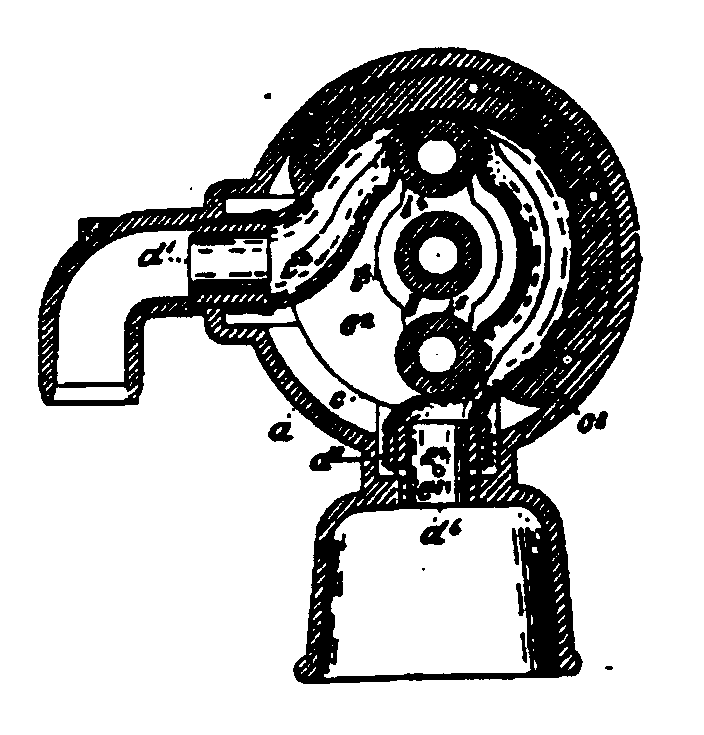
|
| | |
| 477.11 | Adjustable backing: |
| | This subclass is indented under subclass 477.9. Apparatus wherein the position of the backing member of
the flexible wall is changeable.
| | (1)
Note. The change of position of the backing member accommodates
different sizes of the flexible wall, or controls the degree of
closure of the flexible wall, or eases the insertion or removal
of the flexible wall or interposed flexible member.
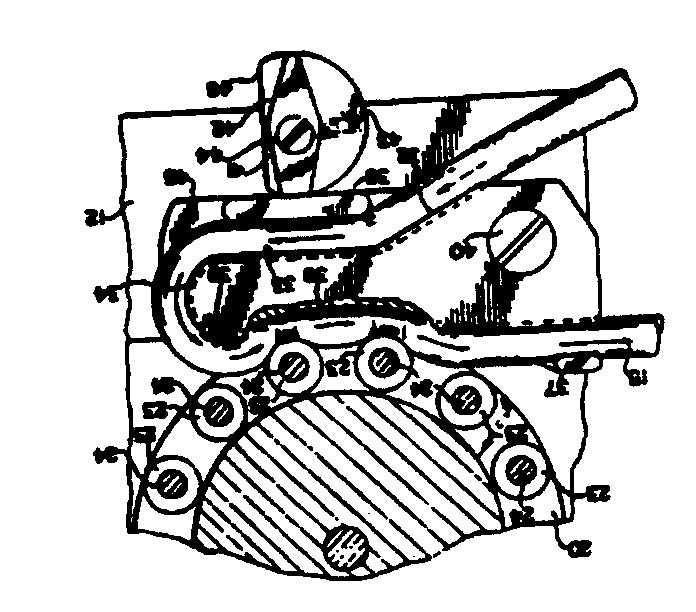
| |
| | |
| 477.12 | Specific flexible wall or interposed flexible member: |
| | This subclass is indented under subclass 477.1. Apparatus wherein significance is attributed to a shape
or material of the flexible wall or interposed flexible member.
| | (1)
Note. The interposed flexible member may include a particular
means associated with the flexible wall to reduce wear on the flexible
wall by the rolling or sliding elements.
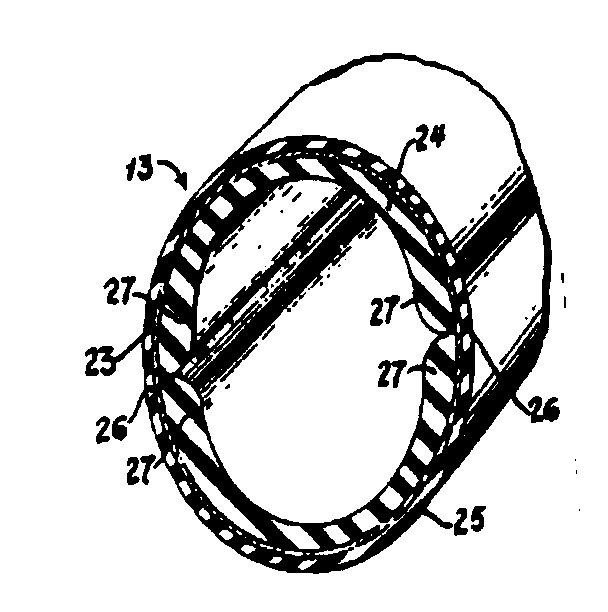
| |
| | |
| 477.2 | Cassette: |
| | This subclass is indented under subclass 477.1. Apparatus wherein the flexible wall or interposed flexible
member is contained in a housing; said housing is interchangeable
with similar housings.
| | (1)
Note. At least one housing is placed in a base unit in order
to be activated by a drive.
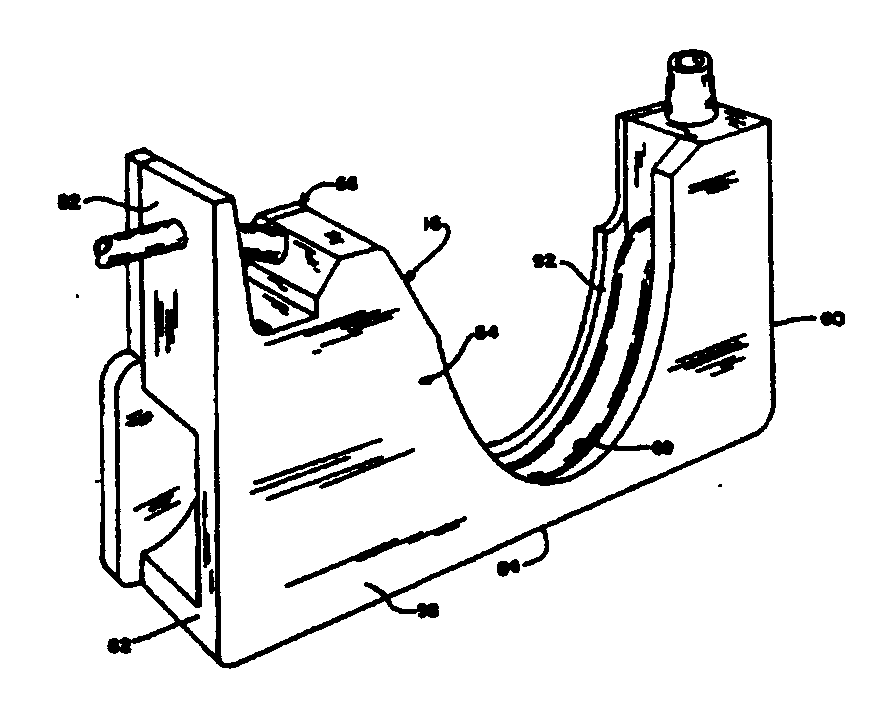
| |
| | |
| 477.5 | Roller axes or slide contact surfaces at significant angle
with drive axis: |
| | This subclass is indented under subclass 477.3. Apparatus wherein axes of rotation of the rolling elements
or contact surfaces of the slide elements are positioned at an angle
to the axis of a shaft or rotor which moves the rolling or sliding
elements.
| | (1)
Note. The angle is between 30 degrees and 90 degrees. |
| | (2)
Note. The rollers or the slides which merely return the flexible
wall or interposed flexible member to undeformed shape are also
included in this subclass. |
| | (1)
Note. The biasing can be caused by means such as a spring
or weight or fluid pressure. |
| | (2)
Note. The axes of the rolling elements or the contact surfaces
of the slide elements which have adjustable angles with respect
to the axis of the shaft or rotor are included in this subclass.
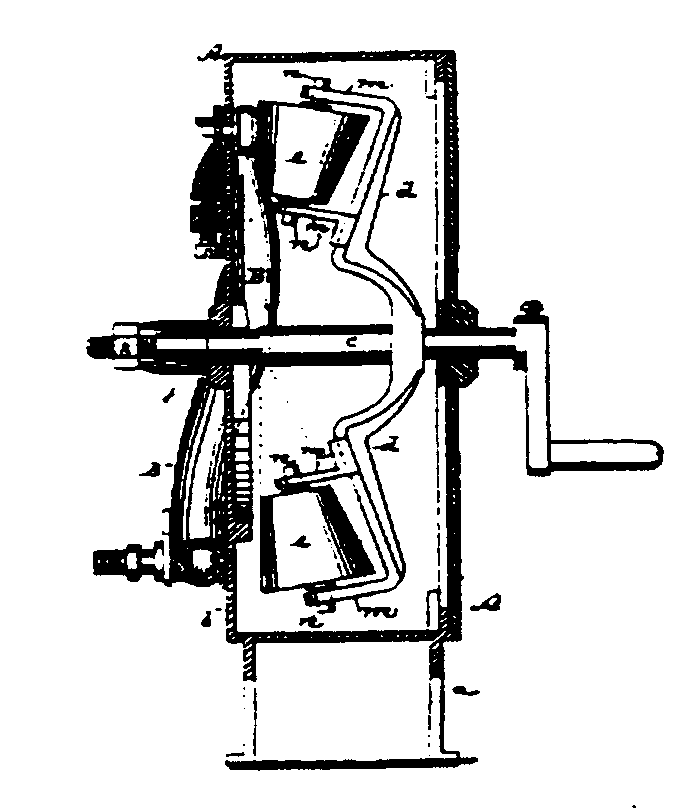
| |
| | |
| 477.6 | Positively driven rollers: |
| | This subclass is indented under subclass 477.3. Apparatus wherein the rolling members are directly driven
by a rotating drive means, such as shaft or gear for rotation.
| | (1)
Note. The drive means causes the rolling numbers to rotate
even if the flexible members were removed. |
| | (2)
Note. The arrangement can be similar to a sun gear driving
planetary gears.
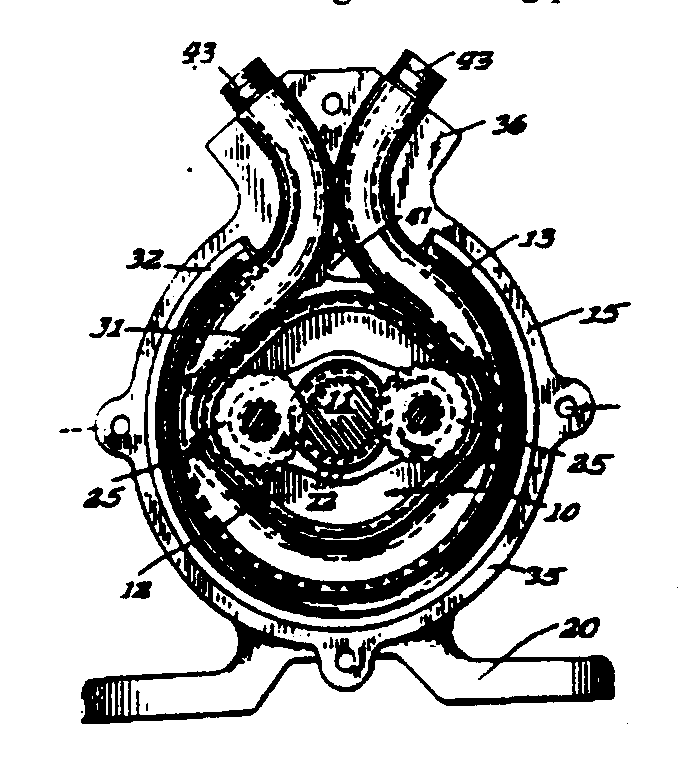
| |
| | |
| 477.7 | Biased rollers or slides: |
| | This subclass is indented under subclass 477.3. Apparatus wherein the rolling or sliding elements are biased
to engage or to disengage the flexible wall or interposed flexible
member.
| | (1)
Note. The biasing can be caused by means such as a spring
or weight or fluid pressure.
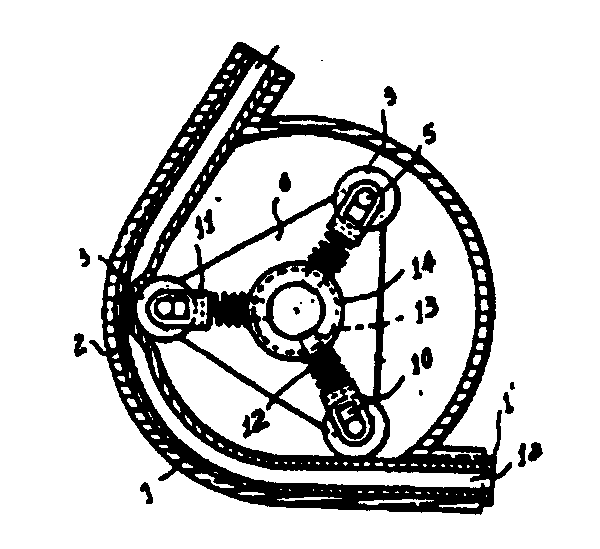
| |
| | |
| 477.8 | Adjustable rollers or slides: |
| | This subclass is indented under subclass 477.3. Apparatus wherein the position of the rolling or sliding
elements are changeable.
| | (1)
Note. The change of position of the rolling or sliding elements
accommodate different sizes of the flexible wall or interposed flexible
member, or vary wear on the elements, or vary an output of the pump,
or ease insertion or removal of the flexible member.
| |
| | |
| 480 | Valve in collapsible wall pumping member |
| | This subclass is indented under subclass 437. Apparatus in which a wall portion of the expansible chamber
is fabricated of flexible material or rigid members hinged or interfitted together
so that the members are movable relative to each other, the flexing
of the material or the relative movement of the members constituting
the movement which expands and contracts the chamber and the means
for controlling flow into or out of said chamber being located on
or supported by said wall portion.
SEE OR SEARCH THIS CLASS, SUBCLASS:
| 472+, | for bellows-type pumping members which may have
valve means supported on a movable portion thereof. |
|
| | |
| 482 | Inlet distributor in abutment wall for pumping member |
| | This subclass is indented under subclass 481. Apparatus in which the means for controlling the inlet of
fluid into the chamber comprises a distributor positioned in a stationary
wall of the chamber which lies in the path of travel of the pumping
member at the end of the stroke thereof. |
| | |
| 484 | Distributor in pumping member |
| | This subclass is indented under subclass 481. Apparatus in which the means for controlling the inlet of
fluid into the chamber or exhaust of fluid from the chamber comprises
a distributor positioned in the pumping member.
SEE OR SEARCH THIS CLASS, SUBCLASS:
| 483, | for a discharge distributor in an oscillating pumping
member combined with an inlet distributor in an abutment wall for
the pumping member. |
|
| | |
| 485 | Delivery to different ports on successive strokes |
| | This subclass is indented under subclass 437. Apparatus comprising a single pump chamber having a reciprocating
pumping member therein and a plurality discharge outlets communicating
therewith, and control means for successively establishing communication
with said plural outlets upon successive discharge strokes of said
pumping member. |
| | |
| 486 | Plural pumping members in single pump chamber |
| | This subclass is indented under subclass 437. Apparatus in which a single pump chamber includes two or
more pumping members.
| | (1)
Note. The plural pumping members may act upon the pump fluid
within the single chamber either simultaneously, successively, or
selectively. |
| | (2)
Note. For purposes of this definition, the pump chamber is
construed as including only that chamber volume formed downstream
of valve means controlling inlet of pump fluid to the chamber and upstream
of valve means controlling discharge pump fluid from the chamber. |
| | (3)
Note. The plural pumping members under this definition may
be laterally spaced, coaxial, or concentric and each must be disclosed
as positively driven to act upon fluid within the pump chamber.
However, in the case of concentric pumping members, the pumping
faces thereof must be either axially spaced or relatively movable,
e.g., a pumping member having a sealing ring or separable drive
rod portion forming a portion of the pumping face is considered
to be a single pumping member and is excluded under this definition. |
SEE OR SEARCH THIS CLASS, SUBCLASS:
| 215+, | for plural pumping members in a single chamber with
condition responsive control of a drive transmission to change the
phase relationship of the pumping members. |
SEE OR SEARCH CLASS:
| 92, | Expansible Chamber Devices,
subclass 6 for a working member having a selectively variable
end face area, and subclasses 60+ for a resiliently biased
nonworking member movable wall in constant communication with a
working chamber. |
|
| | |
| 488 | Form opposite chamber walls |
| | This subclass is indented under subclass 487. Apparatus in which the pumping members form opposing walls
of said chamber.
SEE OR SEARCH CLASS:
| 91, | Motors: Expansible Chamber Type,
subclass 501 for three or more cylinders arranged in parallel,
radial or conical relationship with a rotary transmission axis with
oppositely moving pistons in each cylinder. |
| 92, | Expansible Chamber Devices,
subclasses 69+ for an expansible chamber device having relatively
movable working members interconnected with a common rotatable shaft
and forming oppositely movable walls of a common chamber, and subclass
75, for working members forming oppositely movable walls of a common chamber. |
|
| | |
| 489 | Control by withdrawal or tilting of pump piston relative to cylinder |
| | This subclass is indented under subclass 437. Apparatus in which the expansible chamber pump comprises
a cylinder having a relatively movable piston therein, admission
or discharge of pumped fluid to or from the expansible chamber occurring
as the result of the piston being either (1) tipped or canted relative
to the cylinder to provide a fluid flow passage between adjacent
cylinder and piston sidewall portions or (2) withdrawn or extracted
from the cylinder so as to provide open communication between the
cylinder interior and the surrounding medium.
SEE OR SEARCH THIS CLASS, SUBCLASS:
| 320, | for apparatus having a pumping member which moves
unidirectionally into and out of a chamber to form serial pumping
chambers. |
|
| | |
| 490 | Pumping member position controlled port |
| | This subclass is indented under subclass 437. Apparatus in which the supply or discharge of pump fluid
to or from the pump chamber is by way of a port which is controlled
by opening or closing same upon movement (reciprocatory or rotary)
of the pumping member relative to the pump chamber; said port being
either (1) formed in a pump chamber wall (e.g., cylinder) and opened
or closed directly by the pumping member (e.g., piston) or element
integral with or movably carried thereby or, (2) formed in the pumping
member and opened or closed directly by a pump chamber wall or element integral
with or movably carried thereby.
| | (1)
Note. For purposes of this definition, an element which is
movably carried by the pumping member for controlling a chamber
wall port may be movable relative to the pumping member but must move
with the pumping member over at least a portion of the stroke thereof,
the element itself serving to directly control a chamber wall port.
However, a valve element which is mounted in a chamber wall portion
and which is shifted by abutment or frictional engagement with pumping
member is not considered to be movably carried by the pumping member
and is excluded under this definition. See subclass 520. |
SEE OR SEARCH THIS CLASS, SUBCLASS:
| 489, | for a pump having an inlet or discharge path controlled
by withdrawal or tilting of the pump piston relative to the cylinder
therefor. |
| 520, | see (1) Note above. |
|
| | |
| 491 | Common pumping member controls inlet or discharge for plural chambers |
| | This subclass is indented under subclass 490. Apparatus comprising two or more pumping chambers and in
which a single unitary element forms the pumping members for said
chambers, said element being effective to control the inlet of fluid
into or the discharge of fluid from the several chambers by either
(1) alternately covering and uncovering a port in a wall of each
of said chambers, or (2) alternately covering and uncovering a single
port which is common to and placed in communication with each of
said chambers at different positions of the pumping member stroke.
| | (1)
Note. For a definition of plural chambers see the definition
and notes of subclass 521. | |
| | |
| 493 | Including plural controlled inlet or outlet flow paths |
| | This subclass is indented under subclass 490. Apparatus comprising a single pump chamber having either
(1) an inlet flow path for pump fluid and at least two outlet flow
path which are different from each other and from said inlet flow
path or (2) an outlet flow path for pump fluid and at least two
inlet flow paths which are different from each other and from said
outlet flow path; each of said two flow paths being cyclically controlled
(i.e., controlled each time during a single pumping member movement
cycle) at different times in the pump cycle and at least one of
said two paths being controlled by a pumping member controlled part.
| | (1)
Note. The plural inlet or outlet flow paths may be supplied
from the same or different sources or deliver to the same or separate
destinations. Therefore, a bypass of pump fluid to waste or back
to supply or a vent to atmosphere is considered to be a flow path
under this definition. |
| | (2)
Note. A passage to which pumped fluid is delivered or from
which fluid is drawn into the pump is not considered to be an inlet
or outlet under this definition if the fluid is delivered to or
drawn from a portion of the pump assembly and is utilized for an
ancillary purpose of the pump such as cooling or lubricating a pump part. |
| | (3)
Note. The flow paths are considered to be different under
this definition if the pump fluid flows through one path at one
time and flows through the same path and additionally through another path
at another time. |
SEE OR SEARCH THIS CLASS, SUBCLASS:
| 485, | for a plurality of pumping member controlled outlet
ports which sequentially discharge fluid on successive strokes of
the pumping member. |
|
| | |
| 495 | Pumping member comprises valved piston |
| | This subclass is indented under subclass 493. Apparatus including a piston type pumping member provided
with a fluid passage extending from the end face thereof through
the opposite end of the piston or through a side wall portion thereof,
said passage being provided with a relatively movable valve means
to control the flow of fluid through said passage. |
| | |
| 496 | Having serial control of inlet or discharge flow path |
| | This subclass is indented under subclass 490. Apparatus in which in addition to the control of pump fluid
by a pumping member controlled port there is a separate means to
control the pump fluid in either the inlet or outlet flow path for
the pump; i.e., the pump fluid is serially controlled by both means
either going to or coming from the pump chamber.
| | (1)
Note. The separate means may be a second pumping member controlled
port. The disclosed use of many of the devices in this subclass
is that the pumping member closes and seals an inlet or discharge
port when idle to prevent leakage. | |
| | |
| 497 | Pumping member controlled end wall port |
| | This subclass is indented under subclass 490. Apparatus in which the port through which pump fluid flows
to or from the pump chamber is formed in an end wall of the pump
chamber (i.e., that portion of the pump chamber not traversed by
the pumping member), the pumping member or element carried thereby
being effective to intermittently obstruct fluid flow through said
port by alternately entering into and exiting from or abuttingly
seating on same. |
| | |
| 498 | Longitudinally spaced inlet and discharge sidewall ports |
| | This subclass is indented under subclass 490. Apparatus comprising one port for providing inlet of pump
fluid to the pump chamber and another port for providing discharge
of pump fluid therefrom, each of said ports being formed in a pump
chamber sidewall portion and longitudinally spaced from each other,
said ports individually providing the sole path for inlet and discharge
of pump fluid and being controlled by the covering or uncovering thereof
by the pumping member or element carried thereby. |
| | |
| 499 | Having means to effect control at different positions of pumping member stroke |
| | This subclass is indented under subclass 490. Apparatus including means which may be selectively moved
and held in different positions to effect opening or closing of
such port at different positions of pumping member stroke.
SEE OR SEARCH THIS CLASS, SUBCLASS:
| 494, | for a pump chamber having plural controlled inlet
or outlet flow paths, control of one of said paths being effected
by a pumping member controlled port which has means associated therewith
for effecting the control thereof at different positions of pumping
member stroke. |
|
| | |
| 500 | Control by movement of pumping member about axis |
| | This subclass is indented under subclass 490. Apparatus in which the working member rotates about its
longitudinal axis during reciprocation thereof to effect the covering
and uncovering of said port.
SEE OR SEARCH THIS CLASS, SUBCLASS:
| 492, | for an inlet or exhaust control for plural chambers
comprising a common working member movable about an axis. |
|
| | |
| 501 | Having coextensive distributor opposite pumping member end face |
| | This subclass is indented under subclass 490. Apparatus including a distributor positioned in facing relationship
with the pumping member end face, the area of the movable portion
of the distributor or the movable portion of the valve which seats
on the nonmovable portion of the valve being substantially the same
as the area of the pumping member end face. |
| | |
| 502 | Multiple cyclic outlet paths |
| | This subclass is indented under subclass 437. Apparatus comprising a single pump chamber having a plurality
of outlet passages for pumped fluid, each of said outlet passages being
individually, cyclically controlled and either (1) delivering to
separate destinations, or (2) if delivering to a common destination,
the control means having different modes of operation or operating
at different times in the pump cycle.
| | (1)
Note. For purposes of this definition, cyclic control of
the outlet passages is not limited to control which is effected during
each stroke of a reciprocating pumping member and includes control which
is effected after a predetermined number of strokes of the pumping
member. |
| | (2)
Note. A bypass of pumped fluid back to supply or to waste
is considered to be an outlet under this definition including those
in which the bypass is downstream of the cyclic outlet from the
pump chamber. However, a passage through which pumped fluid is
delivered to a portion of the pump assembly (e.g., bearing) and
is utilized for an ancillary purpose of the pump such as cooling
or lubricating of a pump such as cooling or lubricating of a pump
part is not considered to be an outlet under this definition. |
| | (3)
Note. A pump chamber having one outlet through a valve in
a piston operating therein and another outlet through a valve not
in the piston is intended to form subject matter under this definition, said
valves being considered as having different modes of operation. |
SEE OR SEARCH THIS CLASS, SUBCLASS:
| 251+, | for successive stage pumps having a pump fluid discharge
path intermediate of the pumping stages. |
| 493+, | for plural controlled inlet or outlet flow paths,
the control of at least one of said paths being effected by a pumping
member controlled port. |
|
| | |
| 503 | Multiple cyclic inlet paths |
| | This subclass is indented under subclass 437. Apparatus comprising a single pump chamber having a plurality
of inlet passages for pump fluid, each of said inlet passages being
individually, cyclically controlled and either (1) supplied from
different sources or (2) if supplied from a common source, the control
means having different modes of operation or operating at different
times in the pump cycle.
| | (1)
Note. For purposes of this definition, cyclic control of
the inlet passages is not limited to control which is effected during
each stroke of a reciprocating pumping member and includes control
which is effected after a predetermined number of strokes of the
pumping member. |
| | (2)
Note. A passage from which fluid is drawn from a portion
of the pump assembly (e.g., bearing) for enhancing the function
of said assembly portion (e.g., cooling, sealing) is not considered to
be an inlet under this definition, this subject matter forming the
basis of subclass 439. |
| | (3)
Note. A pump chamber having one inlet through a valve in
a piston operating therein and another inlet through a valve not
in the piston is intended to form subject matter under this definition,
said valve being considered as having different modes of operation. |
SEE OR SEARCH THIS CLASS, SUBCLASS:
| 242, | for a cyclically controlled bypass between plural
pump chambers which is in addition to the normal inlet flow paths
to the chamber. |
| 250+, | for successive stage pumps having a pump fluid inlet
intermediate of the pumping stages. |
| 493+, | for plural controlled inlet or outlet flow paths,
the control of at least one of said flow paths being effected by
a pumping member controlled port. |
|
| | |
| 504 | Plural outlet paths to single discharge line acting under different conditions |
| | This subclass is indented under subclass 437. Apparatus including a plurality of outlet valves or a plurality
of different outlet flow paths controlled by a single valve element
for a single expansible chamber, said outlet valves or flow paths
discharging to a common outlet line and being designed to open in
response to different conditions in the expansible chamber.
| | (1)
Note. Ordinarily one of the valves is a distributor and another
is one which opens only in response to excess pressure, e.g., when
a slug of water accumulates in an air compressor. The distributor
may be pressure responsive or mechanically actuated. In a mechanically
actuated distributor the condition is the position of the pumping
member. |
SEE OR SEARCH THIS CLASS, SUBCLASS:
| 307+, | for a pressure operated relief or bypass which vents
fluid to waste or back to supply. |
| 502, | for an expansible chamber having multiple outlets
which are each cyclically operated and operate under different conditions
or discharge to different lines. |
|
| | |
| 505 | Electrically or magnetically actuated distributor |
| | This subclass is indented under subclass 437. Apparatus in which the means for controlling the flow of
fluid into or out of the chamber comprises valve means which is
actuated by an electric current or a magnetic field.
SEE OR SEARCH CLASS:
| 91, | Motors: Expansible Chamber Type,
subclass 275 for a cyclically operable expansible chamber-type
motor having an electrically or magnetically actuated distributor. |
|
| | |
| 506 | Distributor movement adjustable |
| | This subclass is indented under subclass 437. Apparatus in which the control means comprises a distributor,
and in which the extent or movement of said distributor toward open
or closed position or the relation of the movement of the valve
with respect to the pumping member may be varied by means which
may be selectively moved and held in different positions.
SEE OR SEARCH THIS CLASS, SUBCLASS:
| 297+, | for condition responsive means to vary the operation
of a distributor for an expansible chamber pump. |
| 427, | for a plurality of pumps including means to adjust
the distributor movement of one or more of the pumps. |
| 524+, | for separate means to bias a pressure responsive
distributor to open position. |
|
| | |
| 507 | Distributor moved by separate fluid responsive surface |
| | This subclass is indented under subclass 437. Apparatus in which the means to control the flow of fluid
into or out of the chamber comprises a distributor, said distributor
being at least partially moved cyclically by a fluid reactive surface
formed on the distributor, or formed on an element adapted to contact
the distributor means.
| | (1)
Note. The reactive surface excludes the areas of the distributor
means which are subjected to pump pressures as the working fluid
is moved to and from the working chamber. | |
| | |
| 508 | Including mechanical actuation |
| | This subclass is indented under subclass 507. Apparatus in which in addition to the fluid reactive surface
for moving the distributor there is also provided means to move
said distributor which is interconnected with or abutted by the
pumping member or a drive transmission element associated therewith
in a manner which causes the distributor to be mechanically shifted
upon movement of the pumping member or transmission element through
a pumping operation cycle. |
| | |
| 509 | Distributor part forms traversed movable pump chamber wall portion |
| | This subclass is indented under subclass 437. Apparatus in which a part of the pump chamber wall which
is traversed by the pumping member is movable and forms or carries
a part forming a portion of a distributor which controls inlet or
discharge of pump fluid to or from the pump chamber.
SEE OR SEARCH CLASS:
| 91, | Motors: Expansible Chamber Type,
subclass 276 , and see the search notes therein, for cyclically
operable expansible chamber motors in which the valve means is formed
by a movable portion of the working chamber wall traversed by the
working member. |
|
| | |
| 510 | Mechanically actuated distributor |
| | This subclass is indented under subclass 437. Apparatus in which the means for controlling flow of pump
fluid into or out of the pump chamber comprises a distributor which
is interconnected with or adapted to be abutted by the pumping member
or a drive transmission element associated therewith in a manner
which causes said distributor to be mechanically shifted upon movement
of the pumping member or transmission element through a pumping operation
cycle.
| | (1)
Note. A moving cylinder having a port which cooperates with
a stationary member for controlling the flow of pump fluid to or
from the pump chamber is not considered to be a mechanically actuated distributor
under this definition, such subject matter being classified in subclasses
460+, above. |
SEE OR SEARCH THIS CLASS, SUBCLASS:
| 443+, | for means for actuating a pressure responsive distributor
to an open position responsive to pumping member position. |
| 456, | for an expansible chamber pump having relatively
movable serial distributors in which one of said distributors is
of the mechanically actuated type. |
| 460+, | for a moving cylinder which cooperates with a stationary
member for controlling inlet and discharge of pump fluid to or from
the pump chamber, and see (1) Note, above. |
| 490+, | for an inlet or discharge port formed in a pumping
member or chamber wall which is controlled by an element carried
by the other. |
| 508, | for a distributor which is moved by a separate fluid
reactive surface as well as a mechanical means. |
| 509, | for a distributor which is formed in part by a traversed
chamber wall portion, the wall portion usually being moved by interconnection
or frictional engagement with the pumping member. |
|
| | |
| 513 | Conical engagement |
| | This subclass is indented under subclass 511. Apparatus in which the valve element and piston have conical
or frustoconical seating engagement to perform the valving function. |
| | |
| 514 | Distributor in piston |
| | This subclass is indented under subclass 510. Apparatus in which the pumping member comprises a piston,
said piston or an element rigid therewith (e.g., piston rod) having
a pump fluid connecting passage formed therein, the mechanically
actuated valve element being located within or carried by the piston
and positioned in flow controlling relationship with said piston
passage for performing the valving function.
SEE OR SEARCH THIS CLASS, SUBCLASS:
| 511, | for a distributor carried by a piston in which either
the distributor or piston frictionally engages a chamber wall and
the pump drive rod is rigid with the other. |
|
| | |
| 515 | Plural pumping chambers |
| | This subclass is indented under subclass 510. Apparatus comprising two or more pumping chambers.
| | (1)
Note. A device in which fluid is moved from one side of a
pumping member to the opposite side thereof during movement of the
pumping member in one direction of its stroke and then lifted out of
the chamber during movement of the pumping member in the second
direction of its stroke is not considered plural chambers and is
excluded from this subclass. |
| | (2)
Note. A pump including a plurality of pumping members acting
upon a body of fluid, and in which the fluid acted upon by a first
pumping member is in communication with the fluid acted upon by
a second pumping member in all operative conditions of the pump,
is not considered as constituting plural chambers and is excluded
from this subclass. Such subject matter is classified below on
other features. | |
| | |
| 516 | Common element forms inlet or discharge distributor for plural chambers |
| | This subclass is indented under subclass 515. Apparatus in which the valve element comprises a single
unitarily movable member which controls either (1) the inlet of
pump fluid to two or more pump chambers or (2) the discharge or
pump fluid from two or more pump chambers.
SEE OR SEARCH THIS CLASS, SUBCLASS:
| 512, | for a single mechanically actuated distributor element
which is located within or carried by a pump piston which controls
pump fluid inlet to or discharge from plural pump chambers. |
|
| | |
| 517 | Element forms both inlet and discharge distributor |
| | This subclass is indented under subclass 516. Apparatus in which the unitarily movable valve element controls
both the inlet and discharge of pump fluid to and from two or more
pump chambers.
SEE OR SEARCH CLASS:
| 91, | Motors: Expansible Chamber Type,
subclasses 472+ for pumps or motors comprising three or more cylinders arranged
in parallel, radial, or conical relationship with a rotary transmission axis
and in which motive or pump fluid flow is usually controlled by
a single, unitary, mechanically actuated valve element. For the
line between Class 91 and Class 417 concerning this type of pump,
see the note in Class 417 subclass 269. |
|
| | |
| 520 | Distributor abutted by or frictionally engaged with pumping member |
| | This subclass is indented under subclass 510. Apparatus in which a portion of the valve element or a member
connected thereto is either (1) frictionally connected with the
pumping member or (2) is located in the path of pumping member movement
and adapted to be moved by contact therewith at some portion of the
pumping member stroke.
SEE OR SEARCH THIS CLASS, SUBCLASS:
| 443+, | for means for actuating a pressure responsive distributor
to an open position responsive to pumping member position. |
| 490+, | for an inlet or discharge port formed in a pumping
member or chamber wall which is controlled by an element carried
by the other. |
|
| | |
| 521 | Plural pumping chambers |
| | This subclass is indented under subclass 437. Apparatus comprising two or more pumping chambers.
| | (1)
Note. A device in which fluid is moved from one side of a
pumping member to the opposite side thereof during movement of the
pumping member in one direction of its stroke and then lifted out of
the chamber during movement of the pumping member in the second
direction of its stroke is not considered plural chambers and is
excluded from this subclass. |
| | (2)
Note. A pump including a plurality of pumping members acting
upon a body of fluid, and in which the fluid acted upon by a first
pumping member is in communication with the fluid acted upon by
a second pumping member in all operative conditions of the pump,
is not considered as constituting plural chambers and is excluded
from this subclass. Such subject matter is classified below on
other features. |
SEE OR SEARCH THIS CLASS, SUBCLASS:
| 244+, | for a successive stage pump. |
| 473, | for plural bellows-type pumping chambers. |
| 480, | for a pump in which the fluid is moved from one
side of a flexible wall pumping member to the other through a valved
port in said flexible wall pumping member. |
| 486+, | for plural pumping members in one chamber having
a single inlet or discharge distributor. |
| 491, | for plural pumping chambers in which the inlet or
exhaust to each chamber is controlled by a pumping member which
is common to all pumping chambers. |
| 515, | for plural pumping chambers in which the inlet or
discharge valve for the chambers is mechanically actuated. |
| 545+, | for a pump in which fluid is moved from one side
of a pumping member to the other through a valved port in the pumping
member. |
| 555.1, | for fluid serially moved to opposite sides of a
common pumping member. |
|
| | |
| 522 | Discharge conduit for first chamber communicates with nonpumping portion or second pumping member |
| | This subclass is indented under subclass 521. Apparatus in which a conduit for the discharge of fluid
from a first chamber is in direct communication with a nonpumping
chamber containing a portion of the second pumping member other
than the pumping face of said pumping member, said nonpumping chamber not
constituting the inlet or outlet flow path for pump fluid to or
from the pumping chamber containing the second pumping member so
that the fluid discharged from said first chamber contacts such
pumping member portion. |
| | |
| 523 | Including valved piston |
| | This subclass is indented under subclass 521. Apparatus in which at least one of the chambers is defined
in part by a piston, said piston or element rigid therewith (e.g.,
piston rod) having a pump fluid conducting passage formed therein
and the means for controlling fluid flow into or out of the chamber
including a movable valve member in flow controlling relationship
with said passage, said valve member being located within or carried
by said piston or element rigid therewith.
| | (1)
Note. For classification under this definition, the expansible
chamber pump must be provided with a pump fluid conducting passage
which is physically located within the piston or element rigid therewith.
A pump having relatively movable piston portions for controlling flow
from one side of the piston to the other via a flow path formed
between the piston and a cylinder sidewall (i.e., pump fluid flows
around the piston) is excluded under this definition; see subclasses
555.1+, below, and the search note therein to Class 92
for such subject matter. |
SEE OR SEARCH THIS CLASS, SUBCLASS:
| 545, | for valved piston-type pumps not involving plural
pumping chambers and see the search notes thereto for valved pistons
elsewhere classified. |
|
| | |
| 524 | Unitary or interconnected elements form inlet or discharge distributors for plural chambers |
| | This subclass is indented under subclass 523. Apparatus in which said valve means in the pumping members
comprises either (1) a single rigid unitarily movable valve member
which moves from one position to another to alternately control
the inlet to or discharge from said two or more chambers or (2)
relatively movable inlet or discharge valve members which are mechanically
interrelated in a manner such that movement of an inlet or discharge valve
member for one pump chamber necessitates movement of an inlet or
discharge valve member, respectively, for another pump chamber.
SEE OR SEARCH THIS CLASS, SUBCLASS:
| 512, | for a single mechanically actuated distributor element
located within or carried by a pump piston which controls pump fluid
inlet to or discharge from plural pump chambers. |
|
| | |
| 525 | Common piston includes valves for plural axially aligned chambers |
| | This subclass is indented under subclass 523. Apparatus in which a first pumping chamber extends in a
direction axially of a second pumping chamber, the piston for said
first and second pumping chambers comprising a rigid unitary element,
said element having valves thereon for controlling fluid to or from
each of said chambers.
SEE OR SEARCH THIS CLASS, SUBCLASS:
| 524, | for unitary or interconnected inlet or discharge
distributors in a common piston for plural pumping chambers. |
|
| | |
| 527 | Fluid conduit for one chamber extends through portion of another |
| | This subclass is indented under subclass 525. Apparatus in which the inlet or discharge conduit for the
first pumping chamber extends axially through a portion of the second
pumping chamber.
SEE OR SEARCH THIS CLASS, SUBCLASS:
| 526, | for a common pumping member having valves for aligned
pumping chambers and a conduit which forms a common inlet or discharge
for the chambers mounted on the pumping member and extending through
at least one of the chambers. |
|
| | |
| 528 | Fluid conduit for one chamber extends through portion of another |
| | This subclass is indented under subclass 523. Apparatus in which the chambers are positioned in axial
alignment and a conduit for conducting fluid to or from a first
pumping chamber extends axially through a portion of a second pumping
chamber.
SEE OR SEARCH THIS CLASS, SUBCLASS:
| 526, | and 527, for axially aligned pumping chambers and
a common pumping member having valves for both chambers and a pump
fluid conduit extending through one of the chambers. |
|
| | |
| 529 | Parallel laterally spaced relatively movable pistons |
| | This subclass is indented under subclass 523. Apparatus comprising two or more pistons which are capable
of or constrained to move relative to each other, the longitudinal
axis of one of said pistons being spaced from and parallel to the
longitudinal axis of another of said pistons, said pistons being
positioned in separate pumping chambers. |
| | |
| 531 | Unitary or interconnected elements form inlet or discharge distributors for plural chambers |
| | This subclass is indented under subclass 521. Apparatus in which the means for controlling pump fluid
flow into or out of two or more chambers comprises either (1) a
single rigid unitarily movable valve member which moves from one
position to another to alternately control the inlet to or discharge
from said two or more chambers or (2) relatively movable inlet or
discharge valve members which are mechanically interrelated in a
manner such that movement of an inlet or discharge valve member
for one pump chamber necessitates movement of an inlet or discharge
valve member, respectively, for another pump chamber.
SEE OR SEARCH THIS CLASS, SUBCLASS:
| 491+, | for plural pumping chambers having a common pumping
member, said pumping member controlling the inlet or discharge port
of two or more of said chambers. |
| 512, | for a single mechanically-actuated distributor element
located within or carried by a pump piston which controls pump fluid
inlet to or discharge from plural pump chambers. |
| 516, | for a single mechanically-actuated distributor element
which controls pump fluid inlet to or discharge from plural pump
chambers. |
| 524, | for plural pumping chambers including a valved piston
and in which a common element forms an inlet or discharge valve
for two or more chambers. |
SEE OR SEARCH CLASS:
| 91, | Motors: Expansible Chamber Type,
subclasses 178+ for an expansible chamber-type motor having a single valve
unit controlling plural working chambers. |
|
| | |
| 533 | Common discharge conduit interposed between spaced parallel chambers |
| | This subclass is indented under subclass 521. Apparatus in which two or more pumping chambers are positioned
in spaced parallel relationship including a conduit positioned between
said pumping chambers and at least partially lying within the axial
limits of the pumping chambers, said conduit being in communication
with the controlled discharge of each of said pumping chambers,
so that each of said pumping chambers discharge into and through
said conduit.
SEE OR SEARCH THIS CLASS, SUBCLASS:
| 539, | for other pumps having laterally spaced parallel
pumping chambers. |
|
| | |
| 534 | Chambers formed at opposite ends of rectilinearly moving pumping member |
| | This subclass is indented under subclass 521. Apparatus in which the plural pumping chambers are formed
at opposite ends of a common pumping member which moves to-and-fro along
a straight line (includes diaphragm), movement of said pumping member
effecting expansion of one of said pumping chambers and simultaneous
contraction of the other.
| | (1)
Note. Plural pumping chambers formed in separate cylinders
are included under this definition if the cylinders are coaxial and
contain pumping members which are rigidly interconnected. |
SEE OR SEARCH THIS CLASS, SUBCLASS:
| 404+, | for a double acting pump piston driven by a rigidly
attached double acting reciprocating fluid motor. |
| 418, | for a double acting pump piston driven by a rigidly
attached reciprocating electric motor. |
| 491+, | for a common pumping member for plural pumping chambers
in which the pumping member controls an inlet or discharge port
for the chamber. |
| 525+, | for a common pumping member for plural aligned chambers
wherein the pumping member includes valves for controlling pump
fluid to or from the chambers. |
| 528+, | for plural pumping chambers wherein a fluid conduit
for one of the chambers extends through a portion of another. |
|
| | |
| 539 | Parallel laterally spaced relatively movable pumping members |
| | This subclass is indented under subclass 521. Apparatus comprising two or more pumping members which are
capable of or constrained to move relative to each other, the longitudinal axis
of one of said pumping members being spaced from and parallel to
the longitudinal axis of another of said pumping members.
SEE OR SEARCH THIS CLASS, SUBCLASS:
| 269, | for three or more pump cylinders arranged in parallel
relationship with a rotary transmission axis. |
| 529, | for parallel laterally spaced valved pumping members. |
| 533, | for spaced parallel pumping chambers having a common
discharge conduit or chamber spaced therebetween in which the pumping
members may have relative motion. |
|
| | |
| 540 | Having pulsation dampening fluid receiving space |
| | This subclass is indented under subclass 437. Apparatus comprising a fluid receiving or confining means
positioned in open communication with the pump fluid either upstream
of the means to control the flow of fluid into the chamber or downstream
of the means to control the flow of fluid from the chamber to absorb
pulsations initiated in said fluid incident to an operation of the
pump.
SEE OR SEARCH CLASS:
| 138, | Pipes and Tubular Conduits,
subclasses 26+ for pressure compensators, per se. |
|
| | |
| 542 | Inlet and discharge spaces |
| | This subclass is indented under subclass 540. Apparatus in which a fluid receiving or confining means
is provided both upstream of the means to control the flow of fluid
into the chamber and downstream of the means to control the flow
of fluid from the chamber. |
| | |
| 543 | Direct contact with confined compressible fluid |
| | This subclass is indented under subclass 540. Apparatus in which said means comprises an enclosed space
having a compressible fluid confined therein, said compressible
fluid being in direct contact with the portion of the pump fluid
entering said space.
SEE OR SEARCH THIS CLASS, SUBCLASS:
| 541, | for a confined compressible fluid dampening chamber
carried by the pumping member. |
| 542, | for combined inlet and discharge pulsation dampening
chambers of the confined compressible fluid type. |
SEE OR SEARCH CLASS:
| 137, | Fluid Handling,
subclass 207 for a surge suppressor of the type comprising a
gas stored over a body of liquid. |
|
| | |
| 544 | Manually operated pump |
| | This subclass is indented under subclass 543. Apparatus in which the space having confined compressible
fluid is associated with a pump of the type which is manually operated,
e.g., by a handle or treadle. |
| | |
| 545 | Valved piston |
| | This subclass is indented under subclass 437. Apparatus in which the pumping chamber is defined in part
by a piston, said piston or element rigid therewith (e.g., piston
rod) having a pump fluid conducting passage formed therein and the
means for controlling fluid flow into or out of the chamber includes
a movable valve member in flow controlling relationship with said
passage, said valve member being located within or carried by said
piston or element rigid therewith.
| | (1)
Note. For classification under this definition, the expansible
chamber pump must be provided with a pump fluid conducting passage
which is physically located within the piston or element rigid therewith.
A pump having relatively movable piston portions for controlling flow
from one side of the piston to the other via a flow path formed
between the piston and a cylinder sidewall (i.e., pump fluid flows
around the piston) is excluded under this definition; see subclasses
555.1+, below, and the search note therein to Class 92
for such subject matter. |
SEE OR SEARCH THIS CLASS, SUBCLASS:
| 244+, | for successive stage pumps and particularly subclasses
259+ for those including a valved piston and see the notes
in subclass 244 for the distinction between these subclasses. |
| 467, | for a valved piston in which the valve is mechanically
actuated. |
| 484, | for a valved oscillating-type pumping member. |
| 495, | for a valved piston combined with pumping member
controlled inlet or discharge ports. |
| 511, | for a piston carried distributor in which either
the piston or distributor frictionally engages the pumping chamber
wall and the distributor or piston, respectively, is integral with the
drive rod of the pump. |
| 523+, | for a plural chamber pump having a valved pumping
member. |
|
| | |
| 546 | Piston contains inlet and outlet valves |
| | This subclass is indented under subclass 545. Apparatus in which the piston is provided with relatively
movable valve members which control flow of fluid into and out of
the expansible chamber.
SEE OR SEARCH THIS CLASS, SUBCLASS:
| 260, | for successive stage pumps having a valved piston
which contains both the inlet and the outlet valve for one of the
stages. |
| 486, | for a pumping chamber having two or more relatively
fixed pumping members and in which the inlet valve is positioned
in one working member and the discharge valve is positioned in a
second pumping member. |
| 525, | for a common valved pumping member for plural pumping
chambers in which both the inlet and discharge valves for the chambers
are disposed in the pumping member. |
|
| | |
| 547 | Fluid conduit fixed to piston |
| | This subclass is indented under subclass 545. Apparatus in which a conduit for the pump fluid is rigidly
fixed to the valved piston.
| | (1)
Note. A device of the type disclosed as a hollow piston or
plunger through which the pump fluid flows and in which such fluid
is discharged from said piston or plunger through openings therein
into a casing or space which slidably receives such piston or plunger,
and in which an end face of said piston or plunger further acts
upon said fluid to move the same from said casing or space, is excluded from
this subclass. Such device is classified below on other features.
However, when the piston is also provided with a fluid conduit
fixed thereto and the fluid is discharged by the said end face into the
conduit for ultimate discharge, said device is included under this
definition. |
SEE OR SEARCH THIS CLASS, SUBCLASS:
| 528, | for a plural chamber pump provided with a valved
pumping member having a fluid conduit secured thereto, said conduit
extending through a portion of one chamber and conducting fluid
to or from a second chamber. |
|
| | |
| 548 | Having rigidly attached imperforate wall member |
| | This subclass is indented under subclass 545. Apparatus in which the valved piston is slidable within
a tube (e.g., cylinder) and has rigidly attached thereto a wall
member which is in sealing engagement with said tube or another tube
aligned and in open communication therewith, said wall member having
a face portion in contact with the pumped fluid downstream of the
valved piston and said first tube being provided with a discharge
for pumped fluid positioned between said valved piston and wall member.
| | (1)
Note. The discharge may be an annular passage surrounding
the first or second tube. | |
| | |
| 549 | Having separate means biasing valve closed |
| | This subclass is indented under subclass 545. Apparatus including means separate from the valve element
and engageable therewith to continuously exert a force thereon in
a direction toward its seat.
SEE OR SEARCH THIS CLASS, SUBCLASS:
| 507+, | for a distributor which is moved by a separate fluid
responsive element. |
|
| | |
| 550 | Flexible |
| | This subclass is indented under subclass 545. Apparatus in which the valve or part thereof (e.g., hinge)
is formed of flexible material and in which opening and closing
of said valve is effected by the flexing of said material.
SEE OR SEARCH THIS CLASS, SUBCLASS:
| 479, | for a flexible wall-type pumping member in which
a portion of said flexible wall forms a pump fluid valve. |
|
| | |
| 551 | Hinged |
| | This subclass is indented under subclass 545. Apparatus in which the valve comprises a rigid member which
is mechanically interconnected with the piston in a manner which
constrains said member for movement about an axis.
| | (1)
Note. A movable rigid valve member which is connected to
the piston by means of a flexible element (e.g., resilient material
hinge) which flexes upon movement of the valve to constrain movement
of the valve member about an axis is not classified under this definition,
such subject matter being provided for in subclass 550, above. | |
| | |
| 552 | Reciprocating |
| | This subclass is indented under subclass 545. Apparatus in which the valve comprises a member movable
in a to-and-fro motion toward and away from its seat.
SEE OR SEARCH CLASS:
| 137, | Fluid Handling,
subclasses 528+ for a reciprocating direct responsive valve. |
|
| | |
| 553 | Annular |
| | This subclass is indented under subclass 552. Apparatus in which the valve comprises a ring like member. |
| | |
| 554 | Ball type |
| | This subclass is indented under subclass 552. Apparatus in which the valve comprises a member in the shape
of a ball or sphere.
SEE OR SEARCH CLASS:
| 137, | Fluid Handling,
subclasses 533.11+ for a ball-type reciprocating direct responsive
valve. |
|
| | |
| 555.1 | Fluid serially moved to opposite side of pumping member: |
| | This subclass is indented under subclass 437. Apparatus having a reciprocating pumping member and in which
fluid is moved from one side of the pumping member to the opposite side
thereof during one reciprocatory stroke direction and then moved
in the direction of movement of the pumping member during the other
reciprocatory stroke direction.
| | (1)
Note. A piston having a cup shaped axially extending peripheral
lip portion fabricated of flexible material and in direct contact
with pump fluid which is radially movable relative to a cylinder
sidewall responsive to pump chamber pressure to control fluid flow
around the piston is not considered in itself to be a valve and, per
se, does not form subject matter under this definition. However,
such devices when claimed in combination with a valve for controlling
fluid flow into or out of the pump chamber form subject matter under
this definition. |
SEE OR SEARCH THIS CLASS, SUBCLASS:
| 254+, | for a successive stage pump comprising pumping chambers
on opposite sides of a pumping member in which the fluid is serially
pumped from one pumping chamber to the next. |
| 545+, | for a pump in which fluid is serially moved to opposite
sides of a valved piston. |
SEE OR SEARCH CLASS:
| 92, | Expansible Chamber Devices,
subclasses 240+ for a piston having a sidewall portion including
a peripheral axially extending flexible lip which may be disclosed
as performing a valving function and see the search notes therein. |
|
| | |
| 555.2 | Well swabs: |
| | This subclass is indented under subclass 555.1. Apparatus wherein the reciprocating pumping member is located
in a well and used to force fluid from the pumping chamber. |
| | |
| 556 | Control by movable rigid piston side wall |
| | This subclass is indented under subclass 555.1. Apparatus in which the pumping member comprises a piston
formed of plural relatively movable rigid side wall forming segments,
said segments being movable to a first relative position during
movement of the piston in one reciprocatory stroke direction to
prevent fluid flow from one end of the piston to the other and movable
to a second relative position during movement of the piston in the
other reciprocatory stroke direction to permit such flow.
| | (1)
Note. For classification under this definition, the relatively
movable piston side wall segments must be fabricated of rigid material
and be relatively movable in a manner to control fluid flow either between
the segments and a cylinder side wall or between relatively engageable
segment portions. The rigid segments may include resilient portions
for sealing engagement with the cylinder side wall and such will
not serve to exclude the device from classification under this definition
provided that the relative movement of the segments themselves serve
to control fluid flow rather than the mere flexing of a resilient piston
portion responsive to relative movement of the segment. |
SEE OR SEARCH THIS CLASS, SUBCLASS:
| 59, | for a radially expansible piston for controlling
fluid flow in a drilled well free piston-type pump. |
| 489, | for a single unitary piston forming element which
is tilted relative to a cylinder in which it reciprocates for the
purpose of controlling inlet or discharge of pump fluid. |
SEE OR SEARCH CLASS:
| 92, | Expansible Chamber Devices,
subclass 247 for a pair of axially spaced relatively movable
rigid piston forming members having a radially movable element interposed
therebetween wherein said radially movable element is either (1)
flexible, or (2) has no disclosed valving function. |
|
| | |
| 557 | Pump chamber in constant communication with inlet or discharge conduit |
| | This subclass is indented under subclass 437. Apparatus in which the pumping chamber is always in communication
with the inlet or the discharge to or from said chamber during all phases
of operation of the pump.
| | (1)
Note. For classification under this definition the pump must
be disclosed as of the type in which the inlet or exhaust are never
completely closed under any condition of operation of the pump.
However, the constantly open line may be throttled so long as it
is not completely closed. |
| | (2)
Note. The subject matter in this subclass usually involves
a restricted flow path either in the inlet or exhaust conduit which
permits unimpeded flow in one direction, but restricts flow in a
reverse direction. | |
| | |
| 558 | First distributor includes passage controlled by second distributor (i.e., inlet and outlet) |
| | This subclass is indented under subclass 437. Apparatus having both a distributor to control inflow and
a distributor to control outflow of pumped fluid for said chamber,
the movable valving part of one of said distributors forming the
flow passage and seat for and carrying the movable valving part
of the other distributor.
SEE OR SEARCH THIS CLASS, SUBCLASS:
| 504, | for plural outlet valves for a single chamber in
which one of the valves controls a passage through the other. |
SEE OR SEARCH CLASS:
| 137, | Fluid Handling,
subclass 512.2 for plural check valves in which one valve carries
the head and seat for another. |
|
| | |
| 559 | Having pumping chamber pressure responsive distributor |
| | This subclass is indented under subclass 437. Apparatus in which the means for controlling the flow of
fluid into or the discharge of fluid from the chamber comprises
valve means, said valve means being of the type which moves to open
or close position responsive to a pressure differential in the pumping
chamber and the inlet or discharge conduits.
SEE OR SEARCH THIS CLASS, SUBCLASS:
| 297+, | for condition responsive means for modifying the
operation of a cyclically operated valve (e.g., check valve). |
| 427, | for plural pumps having distributors which are individually
adjusted. |
| 447, | for pumping chamber pressure responsive distributors
with separate means to bias same open. |
| 458+, | for relatively movable serial pressure responsive
distributors. |
| 479, | for a distributor formed from an integral portion
of a flexible wall pumping member. |
| 480, | for a distributor in a flexible wall pumping member. |
| 482+, | for an oscillating pumping member with an inlet
distributor in an abutment wall for the pumping member. |
| 483, | and 484, for an oscillating pumping member having
a distributor positioned therein. |
| 486+, | for a single inlet or discharge distributor for
a chamber having plural pumping members. |
| 496, | for a chamber pressure responsive distributor in
serial relationship with a pumping member controlled port. |
| 523+, | for plural pumping chambers including a valved pumping
member. |
| 531+, | for plural pumping chambers with a common element
which forms an inlet or discharge distributor. |
| 536+, | for plural pumping chambers at opposite ends of
a reciprocating pumping member with inlet and discharge distributors
positioned laterally of the pumping member path. |
| 538, | for aligned pumping chambers with inlet and discharge
distributors at adjacent ends of the aligned chambers. |
| 545+, | for valved pistons and see the search notes thereto
for other valved pistons. |
SEE OR SEARCH CLASS:
| 137, | Fluid Handling,
subclasses 511+ for direct response valves, per se, and see subclasses
512+ for plural direct response valves. The claiming of
a direct response valve mounted in a cylinder or cylinder head or
the like does not preclude classification in Class 137. Also the
claiming of both an inlet and outlet valve does not preclude classification
in Class 137 if no pumping member is claimed. |
|
| | |
| 560 | Single unitary element forms inlet and discharge distributor |
| | This subclass is indented under subclass 559. Apparatus in which a single unitary movable valve member
is so positioned relative to the conduits communicating with the
chamber inlet and discharge as to form the sole means for controlling
both the inlet of pump fluid into the chamber and the discharge
of pump fluid from the chamber.
SEE OR SEARCH THIS CLASS, SUBCLASS:
| 531, | for a single element controlling both inlet and
discharge of pump fluid to and from plural pump chambers. |
|
| | |
| 561 | Pumping member position responsive stop for distributor |
| | This subclass is indented under subclass 559. Apparatus in which means are provided to prevent movement
of said valve means, said means being effective in response to the
pumping member attaining a given position in the chamber.
SEE OR SEARCH THIS CLASS, SUBCLASS:
| 446, | for selectively operable means for holding pressure
responsive distributor open. |
|
| | |
| 562 | Having means on pumping member for accommodating distributor portion |
| | This subclass is indented under subclass 559. Apparatus in which a portion of the valve means or valve
supporting means extends into the pumping chamber from a fixed wall
thereof and in which a wall of the pumping member is provided with
a groove, recess or indentation for receiving said valve means or
valve supporting means during movement of the pumping member in
the normal operation thereof in the pumping chamber. |
| | |
| 565 | Hinged inlet and discharge distributors in aligned conduits |
| | This subclass is indented under subclass 559. Apparatus having a fluid inlet conduit and a fluid discharge
conduit, said conduits being linearly aligned and a pivoted inlet
and discharge distributor being disposed in the aligned inlet and
discharge distributors, respectively.
| | (1)
Note. The pivoting of the distributors may be accomplished
by a flexing of the material thereof. |
SEE OR SEARCH THIS CLASS, SUBCLASS:
| 567+, | for nonpivoted inlet and discharge distributors
seating in coaxial ports. |
|
| | |
| 566 | Nonmetallic inlet or discharge distributor |
| | This subclass is indented under subclass 559. Apparatus in which the valve means is fabricated of nonmetallic
material.
| | (1)
Note. A mere sealing portion of a metallic valve (e.g., o-ring)
which is fabricated of nonmetallic material is not intended to be
included under this definition. Generally, for classification under this
definition, the entire pump fluid contacting portion of the movable
valving member or seat therefor must be formed of nonmetallic material. |
SEE OR SEARCH THIS CLASS, SUBCLASS:
| 479, | for a valve formed from an integral portion of a
flexible wall pumping member. |
| 550, | for a valve piston having a valve formed of flexible
material. |
|
| | |
| 567 | Inlet and discharge distributors in coaxial ports |
| | This subclass is indented under subclass 559. Apparatus comprising an inlet and discharge valve positioned
in an inlet and discharge port, respectively, which form seats for
said valves, the central axis of the inlet seat port coinciding with
the central axis of the discharge seat port.
| | (1)
Note. Either or both of the ports may be annular so long
as the axes of the ports coincide. |
SEE OR SEARCH THIS CLASS, SUBCLASS:
| 558, | for inlet and discharge distributors in coaxial
ports in which the port (seat) for one is formed in the other; i.e.,
the one distributor is carried by and controls a passage in the
other. |
|
| | |
| 569 | Distributor positioned opposite pumping member end face |
| | This subclass is indented under subclass 559. Apparatus in which the inlet or discharge valve is positioned
in a fixed wall of the working chamber which is opposite the end
face of the pumping member when in operative position in the pumping
chamber.
SEE OR SEARCH THIS CLASS, SUBCLASS:
| 482+, | for an oscillating pumping member with a distributor
in an abutment wall for the pumping member. |
|
| | |
| 570 | Distributor coextensive with pumping member end face |
| | This subclass is indented under subclass 569. Apparatus in which the movable portion of the valve or the
movable portion of the valve which seats upon the nonmovable portion
of the valve is substantially the same area as the end face of the
pumping member.
SEE OR SEARCH THIS CLASS, SUBCLASS:
| 501, | for a coextensive distributor opposite a pumping
member end face combined with a pumping member controlled inlet
or discharge port. |
|
| | |
CROSS-REFERENCE ART COLLECTIONS
| 900 | SLURRY PUMPS (E.G., CONCRETE) |
| | Pumps which are disclosed as pumping slurries; i.e., fluids
which contain suspended solids, such as concrete. |
| | |
| 901 | CRYOGENIC PUMPS |
| | Pumps which are disclosed as pumping gases in the liquified
state at very low temperatures, e.g., liquid oxygen. This collection
is not intended to include refrigerant compressors in which the
refrigerant liquifies at a relatively high temperature when placed
under compression.
SEE OR SEARCH CLASS:
| 62, | Refrigeration,
subclasses 45.1+ for stored solidified or liquified gas handling. |
|
| | |
| 902 | HERMETICALLY SEALED MOTOR PUMP UNIT |
| | Pumps comprising a motor driving the pump, the motor and
pump being disposed within a sealed casing such that no part of
the motor-pump unit projects through the casing so as to require
a running seal. |
| | |
| 903 | TREADLE OPERATED |
| | Pumps which are operated by a treadle adapted to be operated
by the foot or feet of a human or animal.
SEE OR SEARCH THIS CLASS, SUBCLASS:
| 229, | for pumps operated by a passing vehicle. |
SEE OR SEARCH CLASS:
| 119, | Animal Husbandry,
subclass 76 for animal operated watering pumps delivering to
a watering trough. |
|
| | |
| 904 | WELL PUMP DRIVEN BY FLUID MOTOR MOUNTED ABOVE GROUND: |
| | A collection of patents disclosing a pump installed below
ground to obtain subterranean fluids, and wherein the pump member
is operated by a motor located above the ground surface, and the
said motor has a reciprocating working member which is motivated
by a fluid. |
| | |
![[Search a list of Patent Appplications for class 417]](../as.gif) CLASS 417,
CLASS 417,