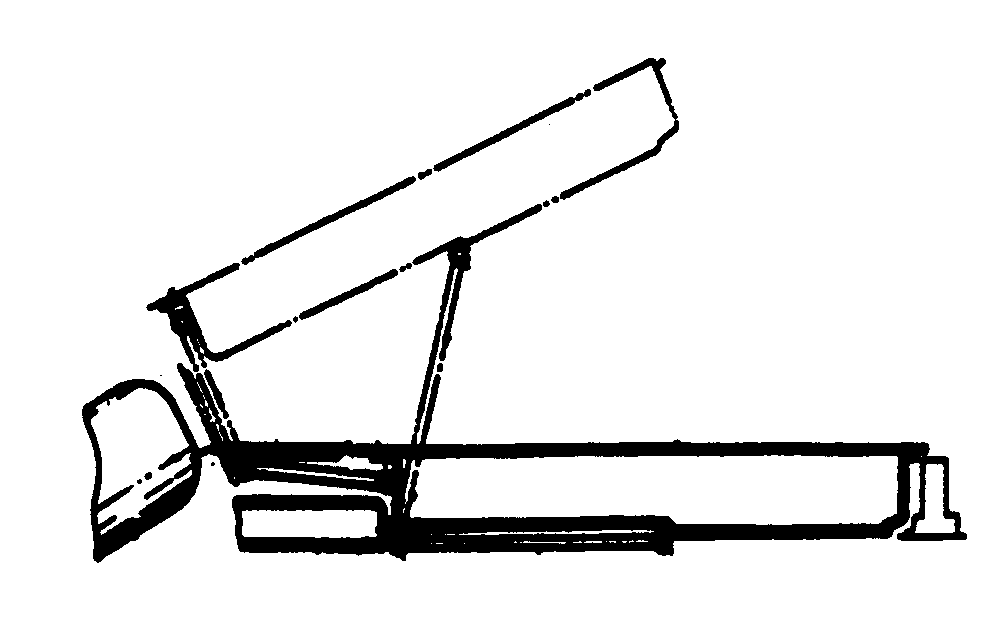
SECTION I - CLASS DEFINITION
This class includes patents relating to that portion of a land
vehicle, secured to the running gear thereof, which operates as
a receptacle or load carrier, together with the top or cover therefor.
SECTION II - LINES WITH OTHER CLASSES AND WITHIN THIS CLASS
This class is subordinate to Class 280, Land Vehicles, and
is distinguished therefrom as set forth in the above definition.
Patents for bodies or load carriers for special purposes will
be found in this class unless there exist other devices for the
same purposes, in which devices a running gear is an essential feature,
in which latter instance they have been placed in Class 280, Land
Vehicles, subclasses 4 and 8+, or unless such bodies are
for such purposes as would place them in a more specialized class, as
Classes 180, Motor Vehicles; 212, Traversing Hoists; 298, Land Vehicles:
Dumping; or 414, Material or Article Handling.
Patents for attachments for vehicles will be found in this class
only when their functions limit them for use with vehicle bodies
and tops; otherwise they will be found in Class 280, Land Vehicles,
unless they are for such purposes as would place them in a more
specialized class, as Classes 180, Motor Vehicles; 212, Traversing
Hoists; 224, Package and Article Carriers; or 414, Material or Article
Handling.
Seats in vehicles will be found in this class only when some
part of the body is modified to cooperate with the seats; otherwise
they are classified in Class 297, Chairs and Seats.
A door (access barrier or closure) in a vehicle body is found
in this class (Class 296) when an accessory (e.g., trim, armrest,
visor, etc.) or a feature correlated to a vehicle body is included.
In the absence of such defining accessory or feature, a singular
door structure is classified elsewhere. However, the feature of
plural doors in a vehicle body is provided in this class.
SECTION III - REFERENCES TO OTHER CLASSES
SEE OR SEARCH CLASS:
| 15, | Brushing, Scrubbing, and General Cleaning,
subclasses 250.001+ for an optical-member-attachable cleaner (e.g.,
windshield wiper, etc.). |
| 49, | Movable or Removable Closures, appropriate subclasses for particular car door structure when
no defining accessory or feature correlated to a vehicle body is
present. |
| 52, | Static Structures (e.g., Buildings), appropriate subclasses for enclosures and related
components of more general application. In general a box-like structure
or a related component thereof is in Class 52 even though defined
or disclosed as used in a vehicle. Also a vehicle having means,
e.g., an earth anchored brace or guy, to convert a vehicle to an
in situ structure is also in Class 52. |
| 62, | Refrigeration,
subclasses 239+ for refrigeration means combined with a vehicle
feature. |
| 105, | Railway Rolling Stock, for vehicle bodies adapted for use on railways. |
| 135, | Tent, Canopy, Umbrella, or Cane,
subclasses 88.01+ for sun and rain protectors adapted for use with
the type of vehicle indicated. Where there is a plurality of independent
supports or a bow construction hinged at each end upon the body,
such patents will be found in this class (296). |
| 160, | Flexible or Portable Closure, Partition, or Panel, for (a) panel units in which a flexible fabric or
other flexible sheet material forms the panel portion, (b) panel
units formed of plural strips, slats, or panels, interconnected
for relative motion (excluding those connected only by a common
operator or mounted only in a common frame or on a common support),
(c) panel units in the form of portable partitions, and (d) parts
(a)-(c) combined with each other or with rigid closures or other
panels. Such devices, even though disclosed as parts of land vehicle bodies
or tops have been placed in Class 160 (with only the exceptions
set forth below and in the notes to particular subclasses in Class
296). These exceptions are (a) where organized to form a vehicle
body enclosure, claimed in combination with particular additional
features of vehicle body structure (as connections between vehicle
top or bottom and sides, body bracing, etc.) or in a particular
relation to the vehicle other than merely in a vehicle opening; and
(b) claimed in combination with vehicle accessories (as windshield
wipers, seats, steps, rear view mirrors, etc.). In all cases where flexible
filled fabric frames are solely disclosed, they have been placed
in Class 160, Flexible or Portable Closure, Partition, or Panel,
whether or not the fabric has been claimed. |
| 212, | Traversing Hoists,
subclasses 180+ for a traversing hoist attachment for a vehicle
body. |
| 362, | Illumination,
subclasses 459+ for vehicles combined with illuminating means,
where the vehicle structure is altered only to the extent necessary
to provide for the vehicle lighting. |
| 428, | Stock Material or Miscellaneous Articles, appropriate subclasses for a stock material product
in the form of a single or plural layer web or sheet, which may
be used in the construction of a vehicle body or top. |
| 446, | Amusement Devices: Toys,
subclass 470 for specific body structure of toy vehicles. |
SUBCLASSES
![[List of Patents for class 296 subclass 1.01]](../ps.gif) 1.01 1.01 | BODIES: |
| | This subclass is indented under the class definition. Subject matter wherein all portions of the land vehicle
are secured to the running gear operating as a receptacle or load
carrier.
SEE OR SEARCH CLASS:
| 108, | Horizontally Supported Planar Surfaces,
subclasses 51.11 through 57.34for industrial platforms, e.g., pallets or skids. |
| 267, | Spring Devices,
subclass 120 for a fluid spring device useful in the cushioning
of (a) a vehicle body on its undercarriage or (b) structure supported
from the vehicle body frame. |
|
| | |
| 1.02 | Handle or assist grip: |
| | This subclass is indented under subclass 1.01. Subject matter including a graspable member attached
to the vehicle for occupant’s aid.
SEE OR SEARCH THIS CLASS, SUBCLASS:
| 214, | for a headliner and grip combination. |
SEE OR SEARCH CLASS:
| 16, | Miscellaneous Hardware (e.g., Bushing, Carpet
Fastener, Caster, Door Closer, Panel Hanger, Attachable or Adjunct
Handle, Hinge, Window Sash Balance, etc.),
subclasses 110.1 through 430for handles, per se. |
| 292, | Closure Fasteners,
subclass 336.3 for an operator with a knob or handle. |
|
| | |
| 1.03 | Vibration reduction: |
| | This subclass is indented under subclass 1.01. Subject matter including a means for attenuating the
amplitudes of periodic stresses of portions of the vehicle body
often associated with noise and referred to as NVH (noise, vibrations and
harshness).
SEE OR SEARCH CLASS:
| 181, | Acoustics,
subclass 141 for acoustics combined with the subject matter
of another class. |
|
| | |
| 1.04 | Safety device: |
| | This subclass is indented under subclass 1.01. Subject matter including a device which promotes safety
of the occupants or pedestrians.
SEE OR SEARCH THIS CLASS, SUBCLASS:
| 68.1, | for a vehicle mounted safety seat. |
| 187.05, | for a vehicle modified interiorly for impact. |
| 190.03, | for operator’s protection in a cab structure. |
SEE OR SEARCH CLASS:
| 280, | Land Vehicles,
subclasses 748 through 753for passenger safety guards and subclasses 728.1-743.2 for
airbags. |
| 297, | Chairs and Seats,
subclasses 216.1 through 216.2for a detail of a car seat. |
|
| | |
| 1.05 | Theft: |
| | This subclass is indented under subclass 1.01. Subject matter wherein the vehicle body is modified to
prevent stealing of the vehicle.
SEE OR SEARCH CLASS:
| 70, | Locks,
subclass 237 for an automotive lock and subclass 261 for a seat lock. |
| 340, | Communications: Electrical,
subclass 426 for a vehicle burglar alarm. |
|
| | |
| 1.06 | Plug: |
| | This subclass is indented under subclass 1.01. Subject matter including a vehicle body aperture and
a stopper or closure for the aperture.
SEE OR SEARCH THIS CLASS, SUBCLASS:
| 166, | for a docking passage means between cab and camper
structure, for example. |
SEE OR SEARCH CLASS:
| 105, | Railway Rolling Stock,
subclass 8.1 for vestibule connections between multiple bodies. |
| 174, | Electricity: Conductors and Insulators,
subclass 668 for a grommet-type hole closure for an electrical
conductor. |
|
| | |
| 1.07 | Accessories: |
| | This subclass is indented under subclass 1.01. Subject matter wherein a portion of the land vehicle
includes a supplementary member for aesthetics or the convenience
of the occupant.
SEE OR SEARCH CLASS:
| 381, | Electrical Audio Signal Processing Systems and
Devices,
subclass 86 for a vehicle speaker. |
| 455, | Telecommunications,
subclass 422 for cellular telephone systems. |
|
| | |
| 1.08 | Trim: |
| | This subclass is indented under subclass 1.07. Subject matter wherein the supplementary member includes
a structure for decoration of the vehicle.
SEE OR SEARCH CLASS:
| 52, | Static Structures (e.g., Buildings),
subclass 716.5 for an in-situ attached vehicle trim. |
| 428, | Stock Material or Miscellaneous Articles,
subclass 31 for vehicle body ornamentation. |
|
| | |
| 1.09 | Armrest: |
| | This subclass is indented under subclass 1.07. Subject matter including a member attached to the vehicle
for supporting an occupant’s arm.
SEE OR SEARCH THIS CLASS, SUBCLASS:
| 153, | for a door-mounted armrest. |
SEE OR SEARCH CLASS:
| 297, | Chairs and Seats,
subclasses 411.2 through 411.46for an armrest for a seat. |
|
| | |
| 1.11 | Mirror: |
| | This subclass is indented under subclass 1.07. Subject matter including a mirror attached to the vehicle
body.
SEE OR SEARCH CLASS:
| 248, | Supports,
subclass 446 for mirror support. |
| 359, | Optical: Systems and Elements,
subclass 838 for mirror structure and subclass 603 for an anti-glare
mirror. |
|
| | |
| 3 | Racks: |
| | This subclass is indented under subclass 1.01. Bodies in the form of a rack, usually designed to carry
special loads. |
| | |
| 4 | Barrel: |
| | This subclass is indented under subclass 3. Racks specially adapted to carry barrels or articles of
similar cylindrical shape.
SEE OR SEARCH CLASS:
| 410, | Freight Accommodation on Freight Carrier,
subclass 68 for a freight carrying vehicle having an integrally constructed
rack for transporting bulk material containers; see, too, subclass(es)
31+ wherein such a rack is constructed to accommodate a
group or article of some particular shape (e.g., regularly contoured,
under subclasses 32+). |
|
| | |
| 5 | Tobacco: |
| | This subclass is indented under subclass 3. Carrying racks designed for use in harvesting tobacco. |
| | |
| 6 | Hay: |
| | This subclass is indented under subclass 3. Carrying racks designed to convey loose hay.
SEE OR SEARCH CLASS:
| 414, | Material or Article Handling, for hay racks with special loading or unloading
features. |
|
| | |
| 7 | Extensible: |
| | This subclass is indented under subclass 6. Having means permitting lengthening or shortening of the
rack.
SEE OR SEARCH THIS CLASS, SUBCLASS:
| 26.08+, | provided with means whereby the length of the body
may be changed. |
|
| | |
| 9 | Irons: |
| | This subclass is indented under subclass 6. Irons specially adapted for use in the construction of hay
racks, such as clamps, clips, and ladder ties and pivots.
SEE OR SEARCH CLASS:
| 280, | Land Vehicles,
subclass 149 for similar clamps and clips. |
|
| | |
| 10 | Convertible box: |
| | This subclass is indented under subclass 1.01. Bodies convertible into different forms or shapes to adapt
them for use for different purposes where one of the forms is the
ordinary wagon box.
SEE OR SEARCH CLASS:
| 280, | Land Vehicles,
subclass 783 for a vehicle frame having a storage compartment. |
|
| | |
| 11 | Hay and box: |
| | This subclass is indented under subclass 10. Bodies convertible either to the form of a hay rack or to
that of the ordinary wagon box. |
| | |
| 12 | Stock: |
| | This subclass is indented under subclass 11. Where the rack, when in the form of a box, is specially
designed to carry stock (as calves, pigs, sheep, etc.). |
| | |
| 13 | Pivoted top boards: |
| | This subclass is indented under subclass 12. Where the upper parts of the sides of the box are pivoted
to position either in a plane with or at an angle to the lower part
of the sides. |
| | |
| 14 | Pivoted side boards: |
| | This subclass is indented under subclass 12. Where the sides are pivoted to position either in a vertical
plane or at an angle to a vertical plane. |
| | |
| 20 | Wheeled stretchers: |
| | This subclass is indented under subclass 19. Where the load carrier is in the form of a stretcher.
SEE OR SEARCH CLASS:
| 5, | Beds,
subclasses 83.1+ for hand-carried stretchers. |
|
| | |
| 22 | Lunch wagons: |
| | This subclass is indented under subclass 1.01. Specially adapted for the preparation and sale of food.
SEE OR SEARCH CLASS:
| 126, | Stoves and Furnaces, for wagons including cooking appliances. |
|
| | |
| 24.3 | Enclosed compartment: |
| | This subclass is indented under subclass 1.01. Subject matter including bodies formed of one or more
enclosed compartments where the invention relates to the organization
of the enclosed compartments as an entity or to a feature within
the enclosed compartment not specifically found in other subclasses
of this class.
| | (1)
Note. Elements of a vehicle, which may also be elements of
enclosed compartment vehicles as doors, windows, tops, curtains,
storm fronts, etc., are classified under such titles in other subclasses
of this class. |
SEE OR SEARCH THIS CLASS, SUBCLASS:
| 16, | through 176, for certain special purpose vehicles, which have
specific enclosed compartment detail specific to that particular
special purpose vehicle. |
|
| | |
| 24.31 | For an animal: |
| | This subclass is indented under subclass 24.3. Subject matter wherein the enclosed compartment is particularly
equipped or adapted for transporting or accommodating an animal.
SEE OR SEARCH CLASS:
| 119, | Animal Husbandry,
subclass 400 for a vehicle for transporting animals over long
distances further including caring of the animal. |
|
| | |
| 24.32 | Workshop: |
| | This subclass is indented under subclass 24.3. Subject matter wherein the enclosed compartment is particularly
equipped or adapted to enable the manufacture, treatment or modification
of an article or product. |
| | |
| 24.33 | Convertible: |
| | This subclass is indented under subclass 24.3. Subject matter wherein the enclosed compartment can be
changed or adapted to accommodate different space or usage.
SEE OR SEARCH THIS CLASS, SUBCLASS:
| 69, | for a seat including specific vehicle structure
or relationship, which is convertible to another device. |
| 190.02, | for a vehicle operator cab, which includes a convertible
feature to reveal a bed, berth or bunk. |
SEE OR SEARCH CLASS:
| 5, | Beds,
subclass 118 for details to a vehicle attached bed wherein there
is no vehicle structure or relationship claimed. |
|
| | |
| 24.34 | Console: |
| | This subclass is indented under subclass 24.3. Subject matter wherein there is detail to an accessory
for passenger convenience, which may be located on the vehicle floor
or overhead.
SEE OR SEARCH THIS CLASS, SUBCLASS:
| 37.14, | for a vehicle auxiliary compartment in or beneath
the floor, which is accessible from within the passenger compartment. |
|
| | |
| 24.35 | Refrigerated: |
| | This subclass is indented under subclass 24.3. Subject matter wherein the enclosed compartment is specifically
adapted or equipped to be kept at a lower temperature with respect
to ambient temperature.
SEE OR SEARCH THIS CLASS, SUBCLASS:
| 181.6, | for a vehicle body shell including detail to reduce
heat transfer. |
SEE OR SEARCH CLASS:
| 62, | Refrigeration,
subclass 239 for significant detail to a refrigeration system on
a vehicle. |
|
| | |
| 24.36 | Vending: |
| | This subclass is indented under subclass 24.3. Subject matter wherein the enclosed compartment is specifically
equipped or adapted to aid in the delivering or dispensing of a
sellable article or product.
SEE OR SEARCH THIS CLASS, SUBCLASS:
| 186.1, | for a wall of a cargo carrier, which permits access
to goods or merchandise inside the cargo carrier. |
|
| | |
| 24.37 | Asset depository: |
| | This subclass is indented under subclass 24.3. Subject matter wherein the enclosed compartment includes
a feature to collect, transport, deliver, or secure fiscal resources.
SEE OR SEARCH THIS CLASS, SUBCLASS:
| 186.1, | for an armored vehicle body shell protecting such
a depository vehicle. |
|
| | |
| 24.38 | Health care: |
| | This subclass is indented under subclass 24.3. Subject matter wherein the enclosed compartment is specifically
equipped or adapted to provide physical care for a person or animal
for the betterment of the state of physical well being of the person
or animal.
SEE OR SEARCH THIS CLASS, SUBCLASS:
| 19, | for a vehicle with primary function of moving or
transporting sick or wounded persons. |
|
| | |
| 24.39 | Office: |
| | This subclass is indented under subclass 24.3. Subject matter where the enclosed compartment is specifically
equipped or adapted to enable a business type task or operation
to be performed. |
| | |
| 24.4 | Partitioned: |
| | This subclass is indented under subclass 24.3. Subject matter wherein the enclosed compartment is separated
or divided into different areas or there is provided a device specifically
associated with the enclosed compartment to separate or divide the
enclosed compartment into different areas.
SEE OR SEARCH CLASS:
| 160, | Flexible or Portable Closure, Partition, or Panel, appropriate subclasses wherein there is no specific
vehicle structure or relationship claimed. |
| 410, | Freight Accommodation on Freight Carrier, appropriate subclasses for partitions for the purpose
or restraining or containing cargo during transport. |
|
| | |
| 24.41 | Thermal: |
| | This subclass is indented under subclass 24.4. Subject matter wherein the partition detail is for the
purpose of slowing or retarding movement of heated or cooled air
between areas of the enclosed compartment. |
| | |
| 24.42 | Prisoner transport: |
| | This subclass is indented under subclass 24.4. Subject matter wherein the partitioned enclosed compartment
provides a separated area for the occupancy of a criminal or dangerous
person. |
| | |
| 24.44 | Shelf: |
| | This subclass is indented under subclass 24.4. Subject matter wherein the partitioned enclosed compartment
includes a substantially horizontal partition.
SEE OR SEARCH CLASS:
| 108, | Horizontally Supported Planar Surfaces, appropriate subclasses for a rigid, planar supporting
surface without detail or specific relation to the vehicle. |
| 211, | Supports: Racks, appropriate subclasses for a built-up open framework for
supporting articles without detail or specific relation to the vehicle. |
| 248, | Supports, appropriate subclasses for a support for holding
an article against the force of gravity without detail or specific
relation to the vehicle. |
|
| | |
| 24.45 | With outer wall access: |
| | This subclass is indented under subclass 24.44. Subject matter wherein the enclosed compartment having
a shelf further includes an opening to enable the shelf to be reached
from outside the vehicle.
SEE OR SEARCH THIS CLASS, SUBCLASS:
| 24.36, | for detail including outer wall access of a vehicle,
which is further equipped or adapted to aid in the delivering
or dispensing of a sellable article or product. |
| 186.1, | for detail to wall structure of a cargo carrier
body shell. |
|
| | |
| 24.46 | Between seats: |
| | This subclass is indented under subclass 24.4. Subject matter wherein the enclosed compartment includes
seats and the partition separates or divides the seats. |
| | |
| 25 | Dropped bottom: |
| | This subclass is indented under subclass 1.01. Where the bottom of the body is on two or more different
levels.
SEE OR SEARCH CLASS:
| 280, | Land Vehicles,
subclass 2 . |
| 410, | Freight Accommodation on Freight Carrier,
subclass 45 for a dropped-center freight carrier to accommodate a
massive dimension (height) of an article of freight. |
|
| | |
| 26.01 | Variable capacity of body: |
| | This subclass is indented under subclass 1.01. Subject matter wherein the interior space or load carrying
ability of the land vehicle receptacle or load carrier is altered
by changing a physical dimension such as a length, width, or height
of the receptacle or load carrier (a) by a movement of a portion
of the body to another location relative to the remainder thereof
or (b) by adding or removing a portion of the body relative to the
receptacle or load carrier.
| | (1)
Note. An actuation and locking device, per se, is not broken
out in the variable capacity subclasses below. Vehicles collapsible
to non-use position are not considered variable capacity vehicles. |
SEE OR SEARCH THIS CLASS, SUBCLASS:
| 193.01 | through 198, for a preassembled body portion. |
SEE OR SEARCH CLASS:
| 280, | Land Vehicles,
subclasses 638+ for lengthening the running gear of a vehicle. |
|
| | |
| 26.04 | By changing height: |
| | This subclass is indented under subclass 26.01. Subject matter wherein the capacity of the body is altered
by changing the vertical extent of the receptacle or load carrier
(a) by the movement of the portion of the body to another location
relative to the remainder thereof or (b) by adding or removing the
portion of the body relative to the receptacle or load carrier. |
| | |
| 26.05 | Slidably guided: |
| | This subclass is indented under subclass 26.04. Subject matter wherein the movement of the portion of the
body is directed by a smooth continuous contact of tracks or telescoping struts
or linear guides or similar means. |
| | |
| 26.08 | By changing length: |
| | This subclass is indented under subclass 26.01. Subject matter wherein the capacity of the body is altered
by changing the longitudinal extent of the receptacle or load carrier
(a) by the movement of the portion of the body to another location
relative to the remainder thereof or (b) by adding or removing the
portion of the body relative to the receptacle or load carrier. |
| | |
| 26.09 | Slidably guided: |
| | This subclass is indented under subclass 26.08. Subject matter wherein the movement of the portion of the
body is directed by a smooth continuous contact of tracks or telescoping struts
or linear guides or similar means. |
| | |
| 26.1 | Having pivotal means: |
| | This subclass is indented under subclass 26.09. Subject matter wherein (a) the sliding engagement includes
a hinge connection or (b) one portion of the body slides and another
portion of the body pivots. |
| | |
| 26.12 | By changing width: |
| | This subclass is indented under subclass 26.01. Subject matter wherein the capacity of the body is altered
by changing the transverse extent of the receptacle or load carrier
(a) by the movement of the portion of the body to another location
relative to the remainder thereof or (b) by adding or removing the
portion of the body relative to the receptacle or load carrier. |
| | |
| 26.13 | Slidably guided: |
| | This subclass is indented under subclass 26.12. Subject matter wherein the movement of the portion of the
body is directed by a smooth continuous contact of tracks or telescoping struts
or linear guides. |
| | |
| 26.14 | Having pivotal means: |
| | This subclass is indented under subclass 26.13. Subject matter wherein (a) the smooth continuous contact
includes a hinge connection or (b) one portion of the body slides
and another portion of the body pivots. |
| | |
| 32 | Top boards: |
| | This subclass is indented under subclass 1.01. Removable boards adapted to be placed edge to edge with
the sides of a wagon box to increase the vertical height of the
sides of the box. |
| | |
| 33 | Baffle: |
| | This subclass is indented under subclass 32. Acting as a baffle or guide to direct the load into the
box, especially where articles or materials are pitched or thrown
into the box. |
| | |
| 35.3 | Removable body: |
| | This subclass is indented under subclass 35.1. Device wherein the body securing means allows the body or
passenger compartment to be removable from the running gear or chassis frame
as a unit. |
| | |
| 37.1 | Auxiliary article compartments: |
| | This subclass is indented under subclass 1.01. Apparatus wherein there is provided a compartment or receiver
formed in the body or top of a vehicle for the storage or receipt
of articles or debris, the compartment or receiver being auxiliary
to the main purpose of the vehicle.
SEE OR SEARCH CLASS:
| 224, | Package and Article Carriers,
subclasses 400+ , 311, 312, 321, and cross-reference art collection
928 for vehicle mounted litter and debris receivers attached to
vehicle structure as an "add on" rather than a "built
in" feature classifiable in this class (296). |
|
| | |
| 37.11 | With disposing: |
| | This subclass is indented under subclass 37.9. Apparatus wherein the compartment or receiver is provided
with exiting means by which the smoker"s refuse is removed. |
| | |
| 37.12 | On dash: |
| | This subclass is indented under subclass 37.8. Apparatus wherein the compartment or receiver is mounted
on or in the instrument panel of the vehicle.
SEE OR SEARCH CLASS:
| 224, | Package and Article Carriers,
subclass 483 for a device for carrying an article attached to
the dashboard of a vehicle, wherein the carrier is an add on rather
than built into the body or top of the vehicle. |
|
| | |
| 37.13 | On door or side panel: |
| | This subclass is indented under subclass 37.8. Apparatus wherein the compartment or receiver is mounted
on or in an upright side body portion of the vehicle.
SEE OR SEARCH CLASS:
| 224, | Package and Article Carriers,
subclass 482 for a vehicle mounted article carrier attached
to the window or window frame of the vehicle as an add on rather
than built into the body or top of the vehicle. |
|
| | |
| 37.15 | On or under seat: |
| | This subclass is indented under subclass 37.8. Apparatus wherein the compartment or receiver is either
situated beneath or is connected to any part of a seat of the vehicle. |
| | |
| 37.16 | At rear of seat: |
| | This subclass is indented under subclass 37.8. Apparatus wherein the compartment or receiver is positioned
at the rear of a seat, access thereto being made by either moving
the back of the seat to an alternate position or by an entrance
way in a horizontal ledge at the rear of and adjacent the top of
the seat back. |
| | |
| 37.2 | Wheel or tire type: |
| | This subclass is indented under subclass 37.1. Compartments designed or constructed to receive wheels or
tires.
SEE OR SEARCH CLASS:
| 224, | Package and Article Carriers, for wheel carriers attached to a vehicle not involving
any modification of the vehicle structure and
subclass 42.12 for vehicle attached wheel or tire carriers. |
| 280, | Land Vehicles, for modification of a vehicle mud guard, i.e., fender,
to provide a tire or wheel carrying portion; and
subclass 152.05 for fenders modified to receive and support a wheel
or tire. |
|
| | |
| 37.3 | Tire covers: |
| | This subclass is indented under subclass 37.1. Apparatus wherein the vehicle compartment or receiver comprises
a releasable or removable structure or housing to enclose or encase
a vehicle spare tire or a portion thereof.
SEE OR SEARCH THIS CLASS, SUBCLASS:
| 37.2, | for a spare tire compartment or receiving well on
a vehicle body combined with a tire cover. |
SEE OR SEARCH CLASS:
| 206, | Special Receptacle or Package,
subclasses 304+ for a receptacle for a tire. |
| 280, | Land Vehicles,
subclass 152.05 for fender wells for wheels or tires and see the
search notes thereunder. |
|
| | |
| 37.4 | On child’s vehicle body (e.g., carriage, etc.): |
| | This subclass is indented under subclass 37.1. Apparatus wherein the compartment or receiver is formed
in a baby carriage, go-cart, or like vehicle.
SEE OR SEARCH CLASS:
| 224, | Package and Article Carriers,
subclass 409 for an article carrier attached to a stroller,
wherein the carrier is an add on rather than built into the body
or top of the vehicle. |
|
| | |
| 37.5 | Having foldable parts: |
| | This subclass is indented under subclass 37.1. Apparatus wherein the compartment or receiver comprises
a plurality of relatively movable parts, the parts being movable
from a collapsed arrangement of parts to a load receiving compartment. |
| | |
| 37.6 | On trucklike vehicle: |
| | This subclass is indented under subclass 37.1. Apparatus wherein the vehicle having the compartment or
receiver thereon is a conveyance used mainly for hauling goods and
material other than people.
SEE OR SEARCH CLASS:
| 224, | Package and Article Carriers,
subclass 402 for a device for carrying an article attached to
a pickup truck, wherein the carrier is an add on rather than built
into the body or top of the vehicle. |
|
| | |
| 37.7 | At or on roof or rooflike panel: |
| | This subclass is indented under subclass 37.1. Apparatus in which the compartment or receiver is either
secured to or is formed in part by the top or other generally horizontal
covering panel spanning the width of the vehicle. |
| | |
| 37.9 | For cigarette butt or ash: |
| | This subclass is indented under subclass 37.8. Apparatus wherein the compartment or receiver is provided
especially to receive smoker"s refuse.
SEE OR SEARCH CLASS:
| 131, | Tobacco,
subclasses 329+ for vehicle mounted ash trays in which is claimed a
smoking feature (e.g., cigarette rest, snuffer, etc.) and see the
notes in the definition to subclass 231. |
|
| | |
| 38 | Drip pans: |
| | This subclass is indented under subclass 1.01. Metal pans located between the load and running gear to
catch a liquid dripping from the load.
SEE OR SEARCH CLASS:
| 220, | Receptacles,
subclasses 571+ for a drip or drain pan, per se. |
|
| | |
| 39.1 | Lining: |
| | This subclass is indented under subclass 1.01. Subject matter adapted to cover at least a portion of the
body.
| | (1)
Note. Linings included herein are generally for the purpose
of protecting components from damage, for insulating or for sealing
against leakage, etc. | |
| | |
| 40 | Ties: |
| | This subclass is indented under subclass 1.01. Devices extending from one side of a wagon box to the other
to prevent spreading of the sides.
SEE OR SEARCH THIS CLASS, SUBCLASS:
| 50, | through 62, where such devices are shown in connection with
an end gate. |
|
| | |
| 41 | Wear strips: |
| | This subclass is indented under subclass 1.01. Metal strips and cleats secured to the inner surface of
a wagon box to prevent wear.
SEE OR SEARCH CLASS:
| 280, | Land Vehicles,
subclass 161 . |
|
| | |
| 42 | Stay irons: |
| | This subclass is indented under subclass 1.01. Devices for preventing longitudinal movement of a box type
of wagon body relative to the bolster or standards of a vehicle
running gear.
SEE OR SEARCH THIS CLASS, SUBCLASS:
| 35.1+, | for patents showing devices for positively locking
this type of vehicle body to the bolsters or standards. |
|
| | |
| 43 | Stakes and sockets: |
| | This subclass is indented under subclass 1.01. Removable stakes and sockets therefor adapted to hold the
load in place and usually used with platform trucks.
SEE OR SEARCH CLASS:
| 105, | Railway Rolling Stock,
subclasses 380 through 391. |
| 280, | Land Vehicles,
subclasses 143 through 148. |
|
| | |
| 50 | End gates: |
| | This subclass is indented under subclass 1.01. Subject matter including removable or swinging boards adapted
to close the rear end of a box wagon.
SEE OR SEARCH THIS CLASS, SUBCLASS:
SEE OR SEARCH CLASS:
| 160, | Flexible or Portable Closure, Partition, or Panel, appropriate subclasses for end gates as set forth
in the line note in the main class definition in this class (296). |
|
| | |
| 51 | Combined types: |
| | This subclass is indented under subclass 50. Where in a single end gate there are combined two or more
well-known types of end gates. |
| | |
| 53 | Rearwardly removable: |
| | This subclass is indented under subclass 50. Those that are rearwardly removable.
SEE OR SEARCH CLASS:
| 160, | Flexible or Portable Closure, Partition, or Panel, particularly
subclass 216 for end gates made of slidably interconnected sections
to make them removable and subclasses 222 through 228 for the structure
of such units, per se. |
|
| | |
| 55 | Pivotally connected sections: |
| | This subclass is indented under subclass 53. Consisting of pivotally connected sections.
SEE OR SEARCH CLASS:
| 160, | Flexible or Portable Closure, Partition, or Panel, particularly
subclass 217 for pivotally interconnected sections mounted for
removal from a support and subclasses 233 and 234 for such units,
per se, with means to prevent relative pivotal motion. |
|
| | |
| 58 | Shovel, board type: |
| | This subclass is indented under subclass 57.1. Provided with side cleats and operating, when in an open
position, to hold the load and give an opening for the use of a
shovel or scoop to commence unloading. |
| | |
| 63 | Seats with body modifications: |
| | This subclass is indented under subclass 1.01. Subject matter in which there is some modification of the
body to cooperate with the seat or seats.
SEE OR SEARCH CLASS:
| 280, | Land Vehicles,
subclass 32.5 for vehicles comprising a running gear and seats
for persons engaged in manual labor adjacent the ground. |
| 297, | Chairs and Seats, appropriate subclasses for chair or seat of general utility. |
|
| | |
| 65.01 | Movable seat or backrest: |
| | This subclass is indented under subclass 63. Subject matter wherein the seat or a portion of the seat
which supports the back of an occupant is displaceable relative
to the body of the vehicle.
SEE OR SEARCH CLASS:
| 297, | Chairs and Seats,
subclasses 311+ for a movable bottom of the seat and subclasses
353+ for a movable back of the seat. |
|
| | |
| 65.02 | Resilient support: |
| | This subclass is indented under subclass 65.01. Subject matter wherein the seat or backrest is mounted to
the vehicle via a means which reduces a vibration or shock load
to the seat or backrest during a vehicle operation.
SEE OR SEARCH THIS CLASS, SUBCLASS:
| 187.01 | through 30, for body structural means deformable to absorb
the shock of an impact. |
|
| | |
| 65.03 | Seat securing device permitting seat removal and replacement: |
| | This subclass is indented under subclass 65.01. Subject matter wherein the seat is anchored to the body
of the vehicle by a means which allows a repeated assembly or disassembly
of the seat.
| | (1)
Note. Mere bolting means used as securing means is not included
in this subclass. |
SEE OR SEARCH CLASS:
| 248, | Supports,
subclass 503.1 for a seat hold-down. |
| 292, | Closure Fasteners, appropriate subclass for a closure fastener. |
|
| | |
| 65.04 | Wheelchair: |
| | This subclass is indented under subclass 65.03. Subject matter wherein the seat is mounted on wheels for
the use of the sick or disabled.
SEE OR SEARCH CLASS:
| 280, | Land Vehicles,
subclass 250.1 for wheelchairs. |
| 410, | Freight Accommodation on Freight Carrier,
subclasses 3+ for a wheelchair. |
|
| | |
| 65.05 | Hinged seat: |
| | This subclass is indented under subclass 65.01. Subject matter including a device which allows a turning
or pivoting movement of the seat relative to the body.
SEE OR SEARCH CLASS:
| 297, | Chairs and Seats,
subclasses 313+ for a tilting seat bottom and subclasses 354+ for
a tiltable seat back. |
|
| | |
| 65.06 | Movable about vertical axis: |
| | This subclass is indented under subclass 65.05. Subject matter wherein the seat rotates in a substantially
horizontal plane about an axis normal to the plane.
SEE OR SEARCH CLASS:
| 248, | Supports,
subclasses 415+ for a rotatable standard-type stand and subclass 425
for a rotatable stand with an additional horizontal movement. |
| 297, | Chairs and Seats,
subclasses 344.21+ for a seat bottom and back movable about a vertical
axis. |
|
| | |
| 65.07 | Having actuator: |
| | This subclass is indented under subclass 65.06. Subject matter wherein the movement of the seat is activated
by a device (a) which produces a force (e.g., a motor or spring)
or (b) which enhances the movement (e.g., a lever). |
| | |
| 65.08 | Having actuator: |
| | This subclass is indented under subclass 65.05. Subject matter wherein the movement of the seat is activated
by a device (a) which produces a force (e.g., a motor or spring)
or (b) which enhances the movement (e.g., a lever). |
| | |
| 65.09 | Including hinged backrest: |
| | This subclass is indented under subclass 65.05. Subject matter wherein a portion of the seat which supports
the back of an occupant includes a device which allows the turning
or pivoting movement of the portion relative to the body. |
| | |
| 65.12 | Having actuator: |
| | This subclass is indented under subclass 65.11. Subject matter wherein the lateral movement of the seat
is activated by a device (a) which produces a force (e.g., a motor
or spring) or (b) which enhances the movement (e.g., a lever). |
| | |
| 65.13 | Having rail: |
| | This subclass is indented under subclass 65.01. Subject matter wherein the movement of the seat is facilitated
by a sliding engagement of tracks or linear guides or similar means.
SEE OR SEARCH CLASS:
| 248, | Supports,
subclass 429 for a horizontal slide or guide. |
|
| | |
| 65.14 | Bearing: |
| | This subclass is indented under subclass 65.13. Subject matter wherein the rail includes a device which
reduces friction of the sliding engagement of the tracks or linear
guides or similar means.
SEE OR SEARCH CLASS:
| 248, | Supports,
subclass 430 for a ball or roller mounted horizontal slide or guide. |
|
| | |
| 65.15 | Including actuator: |
| | This subclass is indented under subclass 65.13. Subject matter wherein the sliding engagement of the tracks
or linear guides is activated by a device (a) which produces a force
(e.g., a motor or spring) or (b) which enhances the movement (e.g.,
a lever). |
| | |
| 65.16 | Hinged backrest: |
| | This subclass is indented under subclass 65.01. Subject matter wherein a portion of the seat which supports
the back of an occupant includes a device which allows turning or
pivoting movement of the portion relative to the body.
SEE OR SEARCH CLASS:
| 297, | Chairs and Seats,
subclasses 353+ for a movable seat back. |
|
| | |
| 65.17 | Having actuator: |
| | This subclass is indented under subclass 65.16. Subject matter wherein the turning or pivoting movement
of the backrest is activated by a device (a) which produces a force
(e.g., a motor or spring) or (b) which enhances the movement (e.g.,
a lever). |
| | |
| 65.18 | Having actuator: |
| | This subclass is indented under subclass 65.01. Subject matter wherein the movement of the seat is activated
by a device (a) which produces a force (e.g., a motor or spring)
or (b) which enhances the movement (e.g., a lever). |
| | |
| 67 | Attached side panels: |
| | This subclass is indented under subclass 65.01. Having attached to the shifting seat a panel or part of
the side of the body, which shifts with the seat to provide an opening
for entrance or exit of persons from the vehicle. |
| | |
| 71 | Rails and handles: |
| | This subclass is indented under subclass 70. Rails to protect the edge of the dashboards, sometimes provided
with handles; also handles, per se.
SEE OR SEARCH CLASS:
| 280, | Land Vehicles,
subclass 181 . |
|
| | |
| 73 | Pivoted: |
| | This subclass is indented under subclass 72. Where the securing device permits pivoting of the dashboard. |
| | |
| 75 | Foot rests: |
| | This subclass is indented under subclass 1.01. Devices on which to rest the feet.
SEE OR SEARCH CLASS:
| 297, | Chairs and Seats,
subclasses 423.1+ for a footrest with a chair or seat and not involving
significant vehicle body structure. |
|
| | |
| 76 | Trunk lids: |
| | This subclass is indented under subclass 1.01. Closures for that portion of a vehicle body to the rear
of the seats. |
| | |
| 77 | Lap-robe holders and locks: |
| | This subclass is indented under subclass 1.01. Devices for holding or securing a lap robe in an operative
position or against loss or theft.
SEE OR SEARCH CLASS:
| 160, | Flexible or Portable Closure, Partition, or Panel,
subclasses 23.1 through 31and subclasses 238 through 326 for lap robes wound
on rollers where neither the relation to the vehicle nor a combination
with other vehicle features is claimed. |
|
| | |
| 77.1 | Storm-front shield, apron, or robe: |
| | This subclass is indented under subclass 1.01. Subject matter for protecting the occupants of vehicles
from storm or wind coming from the direction in which the vehicle
is moving.
SEE OR SEARCH CLASS:
| 160, | Flexible or Portable Closure, Partition, or Panel, appropriate subclasses for land vehicle storm-front shields, aprons,
and robes, as set forth in the line note in the main class definition of
this class (296). Windshields not in the form of flexible or portable
panels have been placed in Class 160 (see particularly
subclasses 48 and 49 and subclasses 90 through 107) only when in
combination with a flexible or portable panel. |
|
| | |
| 80 | Combined aprons: |
| | This subclass is indented under subclass 79. Having a flexible apron secured to the lower part of the
panel and usually secured to the dashboard. |
| | |
| 81 | Robes: |
| | This subclass is indented under subclass 77.1. Flexible coverings secured to the front of the vehicle and
also forming a direct covering for the occupants thereof. |
| | |
| 82 | Aprons: |
| | This subclass is indented under subclass 77.1. Devices secured to the front of a vehicle adapted to extend
to partially protect the occupants of a vehicle. |
| | |
| 83 | Curtains: |
| | This subclass is indented under subclass 77.1. Flexible curtains adapted to entirely close the open space
at the forward end of a vehicle provided with a top. |
| | |
| 84.1 | Windshield: |
| | This subclass is indented under subclass 77.1. Subject matter comprising transparent storm or wind protecting
device secured to the body of a vehicle and in front of a vehicle
seat.
SEE OR SEARCH THIS CLASS, SUBCLASS:
| 200, | and 201, for vehicle windows positioned laterally
or to the rear of a vehicle seat. |
|
| | |
| 85 | Rear seat: |
| | This subclass is indented under subclass 84.1. Especially adapted for protecting the occupants of a rear
seat of a vehicle. |
| | |
| 87 | Edge to edge: |
| | This subclass is indented under subclass 86. Where the pivots hinge one panel to another at the edges
of the panels. |
| | |
| 88 | Link hinged: |
| | This subclass is indented under subclass 86. Two or more panels connected by a link, the link being hinged
to each of the panels. |
| | |
| 89 | Vertically movable panels: |
| | This subclass is indented under subclass 84.1. The shield may consist of a single panel which can be slid
vertically or of a plurality of panels one or more of which can
be slid vertically. |
| | |
| 91 | Deflected protecting air currents: |
| | This subclass is indented under subclass 84.1. Devices for deflecting an air current over the heads of
the occupants of the vehicle, the deflected current acting as a
protection by deflecting other currents of air. |
| | |
| 93 | Weatherstrips: |
| | This subclass is indented under subclass 84.1. Strips for closing the spaces between panels or between
the windshield and the vehicle body or top.
SEE OR SEARCH CLASS:
| 49, | Movable or Removable Closures,
subclasses 475.1+ for a closure seal, e.g., striker gasket or weather-strip, and
see the search notes thereto for the loci of other seals. |
| 160, | Flexible or Portable Closure, Partition, or Panel,
subclasses 40+ . |
| 277, | Seal for a Joint or Juncture, for a generic sealing means or process and cross-reference
art collection 921 for a closure or weatherstrip seal. |
|
| | |
| 95.1 | Auxiliary protector: |
| | This subclass is indented under subclass 84.1. Subject matter associated with a windshield and mounted
exteriorly thereto which shields at least a part of the windshield
against the accumulation of material thereon (e.g., rain, snow, frost,
insects, etc.).
SEE OR SEARCH THIS CLASS, SUBCLASS:
| 96.15+, | for devices which remove debris from a windshield
after it has accumulated thereon. |
| 96.18, | for clear vision slots in windshields. |
SEE OR SEARCH CLASS:
| 160, | Flexible or Portable Closure, Partition, or Panel, appropriate subclasses for auxiliary protectors in the
form of flexible and portable panels, as set forth in the line note
to the main class definition of this class (296). See particularly
subclasses 48+ for windshield and awning type combinations, subclasses
90+ for windshields combined with other forms of flexible
or portable panels, and subclasses 368.1+ for pivoted visors
of the flexible and portable panel type. |
|
| | |
| 96 | Pivoted panels: |
| | This subclass is indented under subclass 95.1. Where the protector is panel adjustably pivoted to the windshield
or the forward end of the top. |
| | |
| 96.11 | Auxiliary windscreen (e.g., vent window, etc.): |
| | This subclass is indented under subclass 84.1. Subject matter associated with the lateral edges of a windshield
which either further protects the vehicle occupant from storm or
wind coming from the direction in which the vehicle is moving or
allows control of incoming wind for ventilation purposes. |
| | |
| 96.12 | Full vision (i.e., wraparound): |
| | This subclass is indented under subclass 84.1. Subject matter wherein opaque members such as roof supporting
corner posts are eliminated and the transparency of the windshield
is extended laterally towards the sides of the vehicle to increase
horizontal arc of forward vision. |
| | |
| 96.13 | Movably mounted to provide access: |
| | This subclass is indented under subclass 96.12. Subject matter wherein the windshield must be displaced
from its normal operative position to allow entry and exit from
the vehicle.
SEE OR SEARCH THIS CLASS, SUBCLASS:
| 146.8, | for an access barrier or closure which extends transversely
of the vehicle front or rear in a closed position. |
|
| | |
| 96.14 | Multiple layered with airspace therebetween: |
| | This subclass is indented under subclass 84.1. Subject matter wherein the windshield itself has plural
layers, at least two layers of which are separated by a gaseous
medium.
| | (1)
Note. This is usually done to prevent frosting or fogging
of the windshield, or as a thermal insulation. | |
| | |
| 96.15 | Cleaner: |
| | This subclass is indented under subclass 84.1. Subject matter combined with a device which removes accumulated
material (e.g., ice, rain, snow, dirt, etc.) from the windshield.
SEE OR SEARCH CLASS:
| 15, | Brushing, Scrubbing, and General Cleaning,
subclasses 250.001+ for an optical-member-attachable cleaner (e.g.,
windshield wiper, etc.). |
|
| | |
| 96.16 | Rotating windshield: |
| | This subclass is indented under subclass 96.15. Subject matter wherein at least a part of the windshield
moves about an arcuate path to aid in the removal of accumulated
material therefrom.
| | (1)
Note. Windshields which spin to remove material by centrifugal
force will be found here. | |
| | |
| 96.18 | Clear vision slot: |
| | This subclass is indented under subclass 84.1. Subject matter wherein a gap is provided in the windshield
through which an occupant can view the roadway under adverse weather
conditions. |
| | |
| 96.19 | Glare reducing: |
| | This subclass is indented under subclass 84.1. Subject matter wherein at least a part of the windshield
itself is made of a material which optically screens harsh light
from either the interior or exterior of the vehicle.
SEE OR SEARCH THIS CLASS, SUBCLASS:
| 97.1+, | for glare screens which are separate and distinct
from the windshield itself. |
|
| | |
| 96.21 | With specific support structure: |
| | This subclass is indented under subclass 84.1. Subject matter wherein particular significance is attributed
to the manner in which the windshield is supported by the vehicle.
SEE OR SEARCH THIS CLASS, SUBCLASS:
| 201, | for supporting frames for a vehicle window other
than a windshield. |
|
| | |
| 96.22 | Releasable upon impact: |
| | This subclass is indented under subclass 96.21. Subject matter wherein the support structure for the windshield
is arranged so as to give way under a significant force before the
windshield itself would shatter.
SEE OR SEARCH CLASS:
| 280, | Land Vehicles,
subclasses 728.1+ for "air bags" and subclasses
748+ for other devices which are designed to protect a
vehicle occupant from injury should the vehicle sharply decelerate or
collide with another object. |
|
| | |
| 97.1 | Glare screen or visor: |
| | This subclass is indented under subclass 1.01. Subject matter comprising a means mounted, usually in combination
with a windshield to protect the driver of a vehicle from the glare
of an approaching light, usually shown in combination with a windshield.
SEE OR SEARCH THIS CLASS, SUBCLASS:
| 95.1, | for an externally mounted glare screen or visor
located outside the passenger compartment and in front of the windshield
which would inherently protect the windshield. |
| 152, | for glare screens or visors associated with side
and rear windows. |
SEE OR SEARCH CLASS:
| 160, | Flexible or Portable Closure, Partition, or Panel, appropriate subclasses for glare screens, as set
forth in the line note in the main class definition of this class
(296); and also glare screens in the form of rigid panels claimed
in combination with a flexible or portable panel, which may be an
additional glare screen, except (a) where the optical properties
of the glare screen are claimed, (b) where the specific location
of the glare screen with respect to the car or driver is claimed
(the mere recitation that it is mounted on the windshield not being
considered a specific location), and (c) where the combination with other
vehicle structure (such as the dashboard, etc.) is claimed. |
| 248, | Supports,
subclasses 200+ for mere brackets for supporting a glare screen. |
| 359, | Optical: Systems and Elements,
subclasses 603+ for glare screens combined with a mirror. |
|
| | |
| 97.2 | With specific structure or properties for diffusing or
reflecting light: |
| | This subclass is indented under subclass 97.1. Subject matter comprising means to control the light moving
toward a viewer"s eyes by changing its direction or reducing
its intensity by absorbing, transmitting away, or reflecting part of
the light.
| | (1)
Note. Mere naming of glare screen as being translucent, colored,
etc., not considered significant for placement in this subclass. | |
| | |
| 97.21 | Baby carriage or child"s wagon: |
| | This subclass is indented under subclass 1.01. Subject matter in which the vehicle body is of the baby
carriage, perambulator or child"s wagon type.
SEE OR SEARCH THIS CLASS, SUBCLASS:
| 35.4, | for body securing devices for baby carriages. |
| 37.4, | for auxiliary article compartment on child"s
vehicle. |
SEE OR SEARCH CLASS:
| 280, | Land Vehicles,
subclasses 47.38+ for hand propelled baby carriages and subclasses
647+ for foldable baby carriages. |
|
| | |
| 97.22 | Access cover for gas tank filler pipe: |
| | This subclass is indented under subclass 1.01. Subject matter in which a cover portion of the vehicle body
is provided to allow access to the gas tank filler pipe.
| | (1)
Note. Cover often includes attached license plate. |
SEE OR SEARCH CLASS:
| 40, | Card, Picture, or Sign Exhibiting,
subclasses 200+ for access cover with details of license plate
support structure. |
|
| | |
| 97.23 | Floor mat with vehicle body feature: |
| | This subclass is indented under subclass 1.01. Subject matter comprising structure for covering the floor
of a vehicle which cooperates with vehicle body structure.
SEE OR SEARCH CLASS:
| 428, | Stock Material or Miscellaneous Articles,
subclasses 138 , 166 and 167 for mats, per se. |
|
| | |
| 97.3 | Apertured: |
| | This subclass is indented under subclass 97.2. Subject matter in which perforations diffuse light passing
through the glare reducing means. |
| | |
| 97.5 | Combined or convertible: |
| | This subclass is indented under subclass 97.1. Subject matter claimed in combination with features other
than visor or glare screen; or, having means capable of structural
rearrangement or modification to provide a device of some other
description. |
| | |
| 98 | Roll-up covers: |
| | This subclass is indented under subclass 225. Consisting of a support on which a flexible cover is adapted
to be stretched and a roller on which the cover is adapted to be
rolled when not in use. The support may be either permanent in
position or removable or collapsible.
SEE OR SEARCH THIS CLASS, SUBCLASS:
| 219, | for a land vehicle roof having an opening therein
and a rollable closure therefor. |
SEE OR SEARCH CLASS:
| 160, | Flexible or Portable Closure, Partition, or Panel,
subclasses 238 through 326. |
|
| | |
| 99.1 | Extension: |
| | This subclass is indented under subclass 225. Tops provided with means for increasing the dimension of
the said tops. |
| | |
| 100.01 | Load cover: |
| | This subclass is indented under subclass 225. Subject matter wherein a member is provided for (a) protecting
the freight load or (b) enclosing the open top of the load carrier
and wherein the member functions as the cover for the freight load.
SEE OR SEARCH CLASS:
| 105, | Railway Rolling Stock,
subclasses 377.01+ for movable railway freight covers. |
|
| | |
| 100.02 | Rigid: |
| | This subclass is indented under subclass 100.01. Subject matter wherein the cover is dimensionally invariant.
| | (1)
Note. The cover is constructed of a rigid material or with
a peripheral rigid frame. | |
| | |
| 100.03 | Slidable: |
| | This subclass is indented under subclass 100.02. Subject matter wherein the cover moves by a smooth continuous
contact of tracks or telescoping struts or linear guides or similar
means.
SEE OR SEARCH CLASS:
| 105, | Railway Rolling Stock,
subclass 377.09 for sliding railway freight covers. |
|
| | |
| 100.04 | Having securing means: |
| | This subclass is indented under subclass 100.03. Subject matter including a device to fix the position of
the cover to a body of the vehicle.
SEE OR SEARCH CLASS:
| 105, | Railway Rolling Stock,
subclass 377.11 for a railway freight cover locking device. |
|
| | |
| 100.05 | Having actuator: |
| | This subclass is indented under subclass 100.03. Subject matter wherein the sliding movement of the cover
is activated by a device (a) which produces a force (e.g., a motor
or spring) or (b) which enhances the movement (e.g., a lever). |
| | |
| 100.06 | Hinged: |
| | This subclass is indented under subclass 100.02. Subject matter including a device which allows a turning
or pivoting movement of the cover relative to a body of the vehicle.
SEE OR SEARCH CLASS:
| 105, | Railway Rolling Stock,
subclass 377.05 for a hinged railway freight cover. |
|
| | |
| 100.08 | Via hinged link: |
| | This subclass is indented under subclass 100.06. Subject matter wherein the hinged connection between the
cover and the body comprises a strut or panel with multiple hinge axes. |
| | |
| 100.09 | Multiple sections hinged together: |
| | This subclass is indented under subclass 100.06. Subject matter wherein the cover is divided into more than
one section pivoted together.
SEE OR SEARCH THIS CLASS, SUBCLASS:
| 219, | for multiple hinged panel sections. |
SEE OR SEARCH CLASS:
| 105, | Railway Rolling Stock,
subclass 377.04 for multiple section railway folding freight covers. |
|
| | |
| 100.1 | Having actuator: |
| | This subclass is indented under subclass 100.06. Subject matter wherein the turning or pivoting movement
of the cover is activated by a means (a) which produces a force
(e.g., a motor or spring) or (b) which enhances the movement (e.g.,
a lever).
SEE OR SEARCH CLASS:
| 105, | Railway Rolling Stock,
subclass 377.05 for a hinged railway freight cover with an actuator. |
|
| | |
| 100.12 | Movable with rigid guidance: |
| | This subclass is indented under subclass 100.11. Subject matter wherein an accumulating movement of the cover
along a load bed is guided by a substantially inflexible means such as
a tensioned cable or track member. |
| | |
| 100.15 | Flexible having tensioning means: |
| | This subclass is indented under subclass 100.01. Subject matter wherein the load cover is made of a pliable
material in a panel or web form to allow bending or flexing of the
cover and the cover includes a device to apply a force to the cover
for stretching or making the cover taut.
SEE OR SEARCH CLASS:
| 135, | Tent, Canopy, Umbrella, or Cane,
subclass 907 for a cover stretcher. |
|
| | |
| 100.16 | Flexible with securing means: |
| | This subclass is indented under subclass 100.01. Subject matter wherein the cover is made of a pliable material
in a panel or web form to allow bending or flexing of the cover and
the cover includes a device to fix the position of the cover to
a framework or body of the vehicle.
SEE OR SEARCH CLASS:
| 160, | Flexible or Portable Closure, Partition, or Panel,
subclasses 368.1+ for a mounting, fastening or supporting means;
and subclasses 382+ for a fabric fastening means. |
|
| | |
| 100.18 | Having flexible cover: |
| | This subclass is indented under subclass 100.17. Subject matter wherein the cover is made of a pliable material
in a panel or web form to allow bending or flexing.
SEE OR SEARCH CLASS:
| 105, | Railway Rolling Stock,
subclass 377.03 for a flexible railway freight cover and removable
frame. |
|
| | |
| 101 | Refuse: |
| | This subclass is indented under subclass 100.01. Where the purpose of the vehicle is especially adapted to
transport ashes or other refuse. |
| | |
| 102 | Standing: |
| | This subclass is indented under subclass 225. Tops which when in place on the vehicle are incapable of
changing their upright or vertical position. |
| | |
| 104 | Space parallel bows: |
| | This subclass is indented under subclass 102. Where the top comprises inverted U-shaped bows, the legs
of the bows secured to the vehicle body and operating as a support
for the covering of the top. |
| | |
| 105 | Collapsible: |
| | This subclass is indented under subclass 104. Where the bows may be moved from the spaced to an adjacent
position to collapse the top, the vertical arrangement of the bows
being substantially unchanged. |
| | |
| 106 | End gate: |
| | This subclass is indented under subclass 102. A door or gate located at the rear of the top and corresponding
to the end gate of the vehicle-body.
| | (1)
Note. For end gates as set forth in the line note in the main
class definition in this class (296), see the Search Class notes
below. |
SEE OR SEARCH THIS CLASS, SUBCLASS:
SEE OR SEARCH CLASS:
| 160, | Flexible or Portable Closure, Partition, or Panel, appropriate subclasses for end gates as set forth
in the line note in the main class definition in this class (296). |
|
| | |
| 107.01 | Let-down type top: |
| | This subclass is indented under subclass 225. Subject matter including a top capable of assuming a plurality
of positions relative to the body of the vehicle and when in the
down or inoperative position the vertical dimension of the top is
changed. |
| | |
| 107.02 | For baby carriage: |
| | This subclass is indented under subclass 107.01. Subject matter wherein the let-down type top includes a
stroller used for transporting a child.
SEE OR SEARCH CLASS:
| 280, | Land Vehicles,
subclass 642 for folding of a baby carriage. |
| 296, | Land Vehicles: Bodies and Tops,
subclass 97.21 . |
|
| | |
| 107.04 | Seal: |
| | This subclass is indented under subclass 107.01. Subject matter including a member provided at the junction
of the top and the body to protect the interior of the receptacle
or load carrier from weather (e.g., rain or dust) or noise.
SEE OR SEARCH CLASS:
| 49, | Movable or Removable Closures,
subclasses 475.1+ for a closure seal. |
|
| | |
| 107.05 | Including valance: |
| | This subclass is indented under subclass 107.01. Subject matter including a structure provided at the edge
of the let-down type top of the vehicle.
SEE OR SEARCH THIS CLASS, SUBCLASS:
|
| | |
| 107.07 | Top and window combination: |
| | This subclass is indented under subclass 107.01. Subject matter wherein the let-down type top includes a
window displaced rearwardly of a windshield of the vehicle.
SEE OR SEARCH THIS CLASS, SUBCLASS:
| 145, | for a windowed curtain. |
| 146.14, | for a window interacting with a convertible top. |
|
| | |
| 107.12 | Tension device: |
| | This subclass is indented under subclass 107.09. Subject matter wherein the top includes a device for regulating
a tautness in the pliable material of the top.
SEE OR SEARCH CLASS:
| 135, | Tent, Canopy, Umbrella, or Cane,
subclass 907 for a cover stretcher. |
|
| | |
| 107.17 | Rigid: |
| | This subclass is indented under subclass 107.16. Subject matter wherein the pivoted top is made of a nonflexible
or nonbending material. |
| | |
| 107.19 | Slidable top: |
| | This subclass is indented under subclass 107.01. Subject matter wherein the positioning of the let-down type
top relative to the body of the vehicle is directed by a sliding
engagement of tracks or telescopic struts or linear guides or similar
means. |
| | |
| 107.2 | Rigid: |
| | This subclass is indented under subclass 107.19. Subject matter wherein the slidable top is made of a nonflexible
or nonbending material. |
| | |
| 108 | Pivotally connected sections: |
| | This subclass is indented under subclass 107.01. Where the top consists of sections pivoted to permit collapse
of the top to assume a down position.
SEE OR SEARCH CLASS:
| 160, | Flexible or Portable Closure, Partition, or Panel, appropriate subclasses (and particularly
subclasses 130 through 236)for interconnected sections, as set forth in the
line note in the main class definition in this class (296). |
|
| | |
| 113 | Spring: |
| | This subclass is indented under subclass 112. Where the tension of a spring is used for the purpose indicated. |
| | |
| 114 | Two bow groups: |
| | This subclass is indented under subclass 107.01. Comprising, when in up or operative position, two sets of
bow groups, the forward set being movable to a position adjacent
the rear set to permit collapse and movement to a down position
of the top. |
| | |
| 116 | Outrigger type: |
| | This subclass is indented under subclass 107.01. Comprising a supporting frame or bow group to which is trussed
a forwardly projecting frame or bow, the forwardly projecting frame
or bow being collapsible or movable with respect to the support
to permit the top as a whole to assume a down position.
SEE OR SEARCH CLASS:
| 160, | Flexible or Portable Closure, Partition, or Panel, especially
subclasses 19 , 20, 22, and 45 through 83.1 for outrigged type
devices as set forth in the line note in the main class definition
in this class (296). |
|
| | |
| 120.1 | Brace: |
| | This subclass is indented under subclass 107.01. Subject matter for holding the top in an up or operative
position by bracing. |
| | |
| 123 | Shifting rails: |
| | This subclass is indented under subclass 107.01. A rail to which the top is attached, which rail is detachably
carried by the seat back and sides. |
| | |
| 125 | Prop-block cushions: |
| | This subclass is indented under subclass 124. Where the pivot support for the prop or base of the top
is provided with a cushion to support the rear bow when the top
is down. |
| | |
| 127 | Bow spacers: |
| | This subclass is indented under subclass 124. Where the adjacent edges of the bows are provided with means
to support the bows in spaced relation when the top is down and
collapsed. |
| | |
| 128 | Clamping: |
| | This subclass is indented under subclass 124. Where the down support comprises means for clamping elements
of the top to hold it in down position. |
| | |
| 133 | Spring: |
| | This subclass is indented under subclass 132. Where the supporting means of the type indicated is a spring. |
| | |
| 134 | Spring: |
| | This subclass is indented under subclass 124. Where the support is a spring, excluding spring supports
of the type found in subclasses 126 and 133 of this class. |
| | |
| 136.01 | Cover: |
| | This subclass is indented under subclass 225. Subject matter including enclosing means adapted to protect
the land vehicle body.
SEE OR SEARCH CLASS:
| 135, | Tent, Canopy, Umbrella, or Cane,
subclass 115 for covers used in portable shelters. |
| 150, | Purses, Wallets, and Protective Covers,
subclasses 166 through 168for a vehicle cover and a cover for vehicle window. |
| 160, | Flexible or Portable Closure, Partition, or Panel,
subclasses 370.21 through 370.23for windshield weather protectors. |
|
| | |
| 136.03 | Tonneau cover: |
| | This subclass is indented under subclass 136.01. Subject matter wherein the enclosing means provides protection
for a passenger compartment.
SEE OR SEARCH THIS CLASS, SUBCLASS:
|
| | |
| 136.04 | Cover storage space: |
| | This subclass is indented under subclass 136.01. Subject matter including a distinct space where the enclosing
means is kept when not in use.
SEE OR SEARCH CLASS:
| 160, | Flexible or Portable Closure, Partition, or Panel,
subclasses 19 through 39for a hood, canopy, shield storage chamber, for
a flexible panel. |
|
| | |
| 136.07 | Conforming cover: |
| | This subclass is indented under subclass 136.01. Subject matter wherein the enclosing means having substantially
the same shape as the body of the vehicle.
SEE OR SEARCH CLASS:
| 52, | Static Structures (e.g., Buildings), digest 14 for a shelter shaped to article configuration. |
|
| | |
| 136.1 | Flexible cover: |
| | This subclass is indented under subclass 136.01. Subject matter wherein the enclosing means is made of pliant
material.
SEE OR SEARCH CLASS:
| 150, | Purses, Wallets, and Protective Covers,
subclasses 166 through 168for a vehicle cover and a cover for a vehicle window. |
| 160, | Flexible or Portable Closure, Partition, or Panel,
subclasses 370.21 through 370.23for windshield weather protectors. |
|
| | |
| 136.11 | Canopy cover: |
| | This subclass is indented under subclass 136.1. Subject matter wherein the enclosing means encloses a
roof or pillars and windowed sections of the vehicle.
SEE OR SEARCH THIS CLASS, SUBCLASS:
| 95.1, | and 96, for an auxiliary protector for a windshield. |
|
| | |
| 136.13 | Foldable: |
| | This subclass is indented under subclass 136.1. Subject matter wherein the enclosing means bends over
upon itself for bringing into a compact form.
SEE OR SEARCH CLASS:
| 160, | Flexible or Portable Closure, Partition, or Panel,
subclass 370.23 for pleating windshield weather protectors. |
|
| | |
| 138 | Curtains: |
| | This subclass is indented under subclass 225. Relating to the side and rear curtains of a top.
SEE OR SEARCH CLASS:
| 160, | Flexible or Portable Closure, Partition, or Panel, for side and rear curtains, as set forth in the
line note in the main class definition of this class (296). |
|
| | |
| 139 | Door opened: |
| | This subclass is indented under subclass 138. Where the side curtain is secured to the door or to an extension
of the door to open when the door is opened.
SEE OR SEARCH CLASS:
| 160, | Flexible or Portable Closure, Partition, or Panel,
subclass 102 . |
|
| | |
| 140 | Overhead storage: |
| | This subclass is indented under subclass 138. Stored in the roof portion of the top when not in use.
SEE OR SEARCH CLASS:
| 160, | Flexible or Portable Closure, Partition, or Panel,
subclasses 19 through 39. |
|
| | |
| 141 | Rolled or folded: |
| | This subclass is indented under subclass 140. Rolled or folded to compact form before movement to storage
position.
SEE OR SEARCH CLASS:
| 160, | Flexible or Portable Closure, Partition, or Panel,
subclasses 23.1 through 31. |
|
| | |
| 144 | Backstays: |
| | This subclass is indented under subclass 138. Strips secured to the top and vehicle body at the rear corners
of the vehicle to limit the forward movement of the top. |
| | |
| 145 | Windowed: |
| | This subclass is indented under subclass 138. Showing means for securing transparent material to an opening
in a curtain.
SEE OR SEARCH CLASS:
| 160, | Flexible or Portable Closure, Partition, or Panel,
subclasses 180 and 237. |
|
| | |
| 146.1 | Door or window with specified vehicle feature: |
| | This subclass is indented under subclass 1.01. Access barrier or closure which relates to a transparent
panel displaced rearwardly of a windshield of a vehicle, in association
with a retractable vehicle roof.
| | (1)
Note. The association is usually provided to affect a cooperative,
mating seal but is not limited thereto. |
SEE OR SEARCH THIS CLASS, SUBCLASS:
| 107.07, | for a let-down type top in combination with a window. |
SEE OR SEARCH CLASS:
| 49, | Movable or Removable Closures, appropriate subclasses for particular car door (access
barrier or closure) structure when no defining accessory or feature
correlated to a vehicle body is present. |
| 52, | Static Structures (e.g., Buildings), appropriate subclasses for a barrier or panel lacking
(a) features for providing movement or removal (e.g., hinge, closure,
etc.) or (b) a vehicle body feature. |
|
| | |
| 146.14 | Window interacting with convertible top: |
| | This subclass is indented under subclass 146.1. Access barrier or closure which relates to (a) a transparent
panel displaced rearwardly of a windshield of a vehicle, in association
with a retractable vehicle roof, or (b) a transparent panel mounted
to the retractable roof and moving therewith.
| | (1)
Note. The association is usually provided to effect a cooperative,
mating seal but is not limited thereto. | |
| | |
| 146.15 | Body mounted window: |
| | This subclass is indented under subclass 146.1. Access barrier or closure relating to a transparent panel
mounted on the vehicle body.
SEE OR SEARCH THIS CLASS, SUBCLASS:
| 84.1+, | for a transparent panel secured to a vehicle body
and in front of a vehicle seat (e.g., windshield, etc.). |
| 146.2+, | for a transparent panel mounted on an access barrier
or closure. |
| 200, | for a transparent panel arranged to provide better
viewing therethrough for the driver and/or passenger in
the vehicle. |
| 215, | for a transparent panel fixedly mounted to a roof
of a vehicle body. |
SEE OR SEARCH CLASS:
| 52, | Static Structures (e.g., Buildings),
subclasses 393+ and the search notes thereunder for mounting a
transparent panel and an adjacent member (e.g., frame, etc.). |
|
| | |
| 146.16 | Movable: |
| | This subclass is indented under subclass 146.15. Access barrier or closure including means for shifting the
panel relative to the body.
SEE OR SEARCH THIS CLASS, SUBCLASS:
| 216.01+, | for a transparent panel movably mounted to a roof
of a vehicle body (e.g., sun roof and/or moon roof, etc.). |
SEE OR SEARCH CLASS:
| 49, | Movable or Removable Closures,
subclasses 475.1+ for sealing means acting at the juncture of an
access barrier or closure and an adjacent member (e.g., frame, etc.). |
|
| | |
| 146.2 | Door includes window detail: |
| | This subclass is indented under subclass 146.1. Access barrier or closure including particulars of a transparent
panel in the barrier (e.g., mountings, window channel or support,
seal, operating mechanism, etc.).
| | (1)
Note. A nominal recitation of a door having a window, either
movable or fixed, is not sufficient to cause assignment to this
subclass in the absence of particulars of the window. |
SEE OR SEARCH CLASS:
| 49, | Movable or Removable Closures,
subclass 166 for the combination of an access barrier pivotal
about a vertical axis and carrying an associated transparent panel
wherein the transparent panel is mounted for movement distinct and
separate from the pivotal movement. |
|
| | |
| 146.3 | Flush mounted: |
| | This subclass is indented under subclass 146.2. Access barrier or closure wherein the transparent panel
is mounted at an outer surface substantially coplanar with adjoining
body structure. |
| | |
| 146.4 | Remotely actuated door: |
| | This subclass is indented under subclass 146.1. Vehicle body access barrier or closure including manually
engaged means at a separate location from that of the barrier or
closure which causes the access barrier or closure to change location
or securing means for the barrier or closure to lock or unlock. |
| | |
| 146.5 | Door frame or shell: |
| | This subclass is indented under subclass 146.1. Vehicle body access barrier or closure with specific skeletal
structure or casing.
SEE OR SEARCH THIS CLASS, SUBCLASS:
| 202, | for supporting frame means for a vehicle body door. |
|
| | |
| 146.6 | Reinforcement: |
| | This subclass is indented under subclass 146.5. Structure relating to supplemental means for strengthening
a frame or shell of the access barrier or closure.
SEE OR SEARCH THIS CLASS, SUBCLASS:
| 188, | for means provided to eliminate or reduce impact
deformation of a vehicle body structural member. |
| 189, | for means provided to absorb impact energy resulting
from impacts by a foreign body upon a vehicle body structural member.
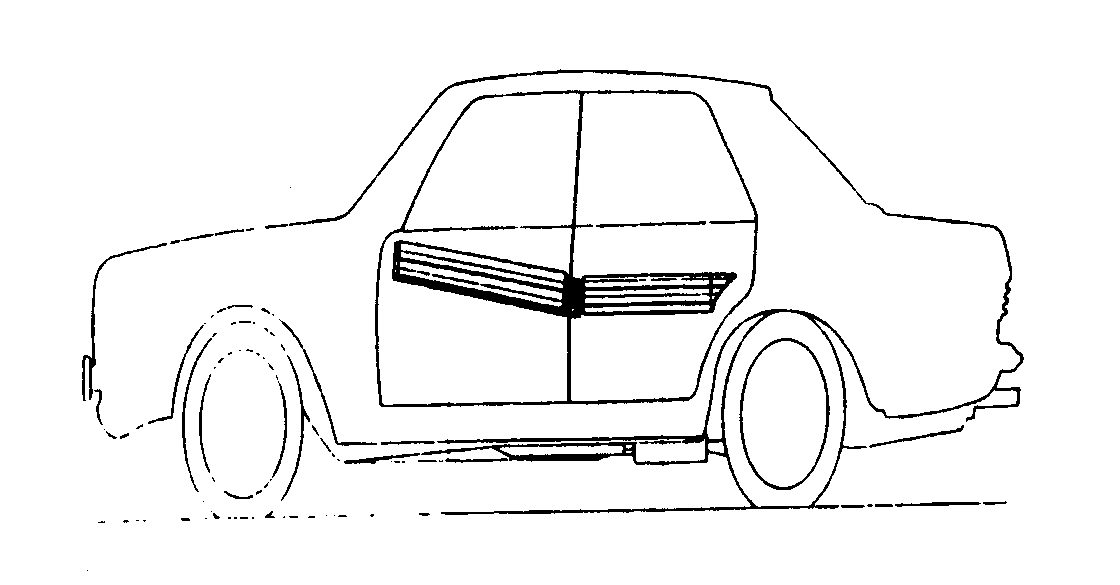
| |
| | |
| 146.8 | Door extending across front or rear of body: |
| | This subclass is indented under subclass 146.1. Access barrier or closure which in a closed position extends
transversely across the vehicle at front or rear ends (e.g., hatchback
type for the latter, etc.).
SEE OR SEARCH THIS CLASS, SUBCLASS:
| 96.13, | for a wraparound windshield movable from a normal
operative position to a position to allow entry and/or
exit from the vehicle. |
|
| | |
| 146.9 | Specific door or door opening edge feature: |
| | This subclass is indented under subclass 146.1. Access barrier or closure with structural details relating
to the intersection of (a) a barrier or closure and a vehicle body
or (b) multiple barriers or closures (e.g., interlocking arrangements,
sealing means, continuous roof/door contours, flush profiles,
etc.).
SEE OR SEARCH THIS CLASS, SUBCLASS:
| 206, | for means for securing windlace to the vehicle body
to prevent wind from entering through otherwise open spaces or cracks
around doors or windows. |
SEE OR SEARCH CLASS:
| 49, | Movable or Removable Closures,
subclass 500.1 for weatherstrip of the windlace type. |
|
| | |
| 147 | Converts body from open to closed type: |
| | This subclass is indented under subclass 146.1. Device provided with a top spaced from the body walls to
form an uninterrupted passage therebetween substantially the length
of the vehicle body, and further provided with a plurality of closures
to be shifted to and from a position occupying the passage between
the top and body.
SEE OR SEARCH CLASS:
| 105, | Railway Rolling Stock,
subclasses 332+ for railway passenger cars convertible from open-sided
summer cars to closed-sided winter cars. |
|
| | |
| 148 | Side closure panels removable: |
| | This subclass is indented under subclass 147. Device in which the closures are mounted on the sides of
the vehicle, and in which the means mounting the panels permit them
to be readily physically disassociated from the body to form a passage. |
| | |
| 149 | Closure receiving pockets on door and adjacent body section: |
| | This subclass is indented under subclass 147. Device provided with a door and a body portion on the side
of said door, each provided with a closure extensible therefrom,
and each further provided with a recess or receptacle within the
door and body portion to receive the closures when shifted from
their passage blocking position.
| | (1)
Note. The adjacent body portion may be another door. |
SEE OR SEARCH CLASS:
| 49, | Movable or Removable Closures,
subclasses 372+ for a closure of general utility stored in a housing,
and see the search notes thereto. |
|
| | |
| 150 | Displaceable pillar intermediate closures in closed position: |
| | This subclass is indented under subclass 149. Device provided with a guiding or bracing post between the
closures in their passage blocking position and further provided
with means mounting the post so as to permit shifting of the post
to a position clear of the passage.
SEE OR SEARCH CLASS:
| 49, | Movable or Removable Closures,
subclass 316 for a retractable upper support which guides a
closure from a housing and subclass 365 for an independently movable
or removable center post serving as a stop or closure mount for
adjacent closures. |
|
| | |
| 152 | Closure mounted body accessory (e.g., visor, shield, etc.): |
| | This subclass is indented under subclass 146.1. Device provided with means attached to the closure to add
to the convenience of the vehicle"s occupant or to the
effectiveness of vehicle body, e.g., armrest, visor, noise reducer,
wind hose.
SEE OR SEARCH CLASS:
| 454, | Ventilation,
subclasses 128+ for a vehicle body with accessories for ventilating
the body, e.g., wind deflectors. |
|
| | |
| 153 | Armrest or arm engaged protector pad: |
| | This subclass is indented under subclass 152. Device wherein the accessory comprises a device for supporting
an arm of an occupant of the vehicle, or for covering and protecting
the window sill from the arm of the vehicle"s occupant.
SEE OR SEARCH CLASS:
| 297, | Chairs and Seats,
subclasses 411.2+ for an armrest of general utility and see the search
notes thereto for the loci of other armrests. |
|
| | |
| 154 | Fluid drain or deflector: |
| | This subclass is indented under subclass 152. Device wherein the accessory means comprises a device to
convey or direct moisture away from the interior of the vehicle.
SEE OR SEARCH CLASS:
| 49, | Movable or Removable Closures,
subclass 476.1 for a closure face mounted deflector or a closure
seal combined with a fluid drain, and see the search notes thereto
for the loci of other drains and deflectors. |
| 454, | Ventilation,
subclasses 128+ for an air deflector for an automobile window. |
|
| | |
| 155 | Sliding closures on opposite sides of body: |
| | This subclass is indented under subclass 146.1. Device provided with a plurality of closures and further
provided with means on opposite sides of the vehicle body for mounting
the closures for sliding movement.
SEE OR SEARCH CLASS:
| 49, | Movable or Removable Closures,
subclass 94 for closures on opposite barriers interconnected
for concurrent movement and subclasses 404+ for a reciprocating
closure of general utility. |
|
| | |
| 156 | Camper: |
| | This subclass is indented under subclass 1.01. Apparatus in which the portion of the land vehicle which
operates as a receptacle or load-carrier is a body providing a living
space for people for the purpose of camping, which may include plumbing,
eating, sleeping, or other facilities to meet human needs, and which
may have means to change its configuration to increase or decrease
its living space or to reduce its outside dimensions for storage
or transporting.
SEE OR SEARCH CLASS:
| 5, | Beds, various subclasses for specific bed structure. |
| 49, | Movable or Removable Closures, various subclasses for a specific door, window,
partition, etc., structure. |
| 454, | Ventilation,
subclasses 69+ for ventilators for vehicles. |
|
| | |
| 157 | Having boat carrying means: |
| | This subclass is indented under subclass 156. Apparatus in which the body includes a means or a particularly
designed facility for supporting or handling a boat.
SEE OR SEARCH CLASS:
| 114, | Ships,
subclasses 343+ for boats, per se. |
| 224, | Package and Article Carriers,
subclasses 400+ , 311, 312, and 321 for article carrying devices
attached to vehicles. |
| 280, | Land Vehicles,
subclasses 414.1+ for boat carrying trailers. |
|
| | |
| 158 | Having vehicle carrying means: |
| | This subclass is indented under subclass 156. Apparatus in which the body includes a means or a particularly
designed facility for supporting or handling a vehicle, e.g., motorcycle,
etc.
SEE OR SEARCH CLASS:
| 224, | Package and Article Carriers,
subclasses 400+ , 311, 312, and 321 for article carrying devices
attached to vehicles. |
|
| | |
| 159 | Having tent means demountable therefrom: |
| | This subclass is indented under subclass 156. Apparatus wherein the camper body is adapted to support
all or a part of a tent structure, and wherein the tent may be removed
from said body and erected or caused to stand for its intended use
independently of any support from said body.
SEE OR SEARCH CLASS:
| 135, | Tent, Canopy, Umbrella, or Cane,
subclasses 87+ for tents, per se. |
|
| | |
| 160 | Having tent solely supported by camper body roof: |
| | This subclass is indented under subclass 156. Apparatus in which the camper body has a roof which is the
sole support for an erected tent structure, said tent either engages
said roof or extends from and is solely supported by a means adapted
to be secured only to said roof.
SEE OR SEARCH CLASS:
| 135, | Tent, Canopy, Umbrella, or Cane,
subclasses 88.14+ for tents with carriers associated with a vehicle
roof or trunk lid. |
|
| | |
| 161 | Having tent having ground engaging means: |
| | This subclass is indented under subclass 156. Apparatus in which the camper body is adapted to support
a portion of an erected tent structure, wherein another portion
of said tent is supported by means other than the camper body such
as the ground.
SEE OR SEARCH CLASS:
| 135, | Tent, Canopy, Umbrella, or Cane,
subclasses 88.13+ for tents supported by a vehicle. |
|
| | |
| 162 | Having porch means: |
| | This subclass is indented under subclass 156. Apparatus wherein the camper body has a platform means usable
as a porch attached thereto or usable therewith. |
| | |
| 164 | Supported by self-propelled vehicle unit: |
| | This subclass is indented under subclass 156. Apparatus in which the camper body is secured to and supported
by a self-propelled vehicle by means permitting removal of said
body from said vehicle.
SEE OR SEARCH CLASS:
| 224, | Package and Article Carriers,
subclass 280 for means for removing a camper body from a self-propelled vehicle. |
| 254, | Implements or Apparatus for Applying Pushing or
Pulling Force,
subclass 45 for jacks, per se, which may be attached to a camper
body. |
|
| | |
| 165 | Expansible or collapsible vehicle body: |
| | This subclass is indented under subclass 164. Apparatus wherein the camper body is provided with means
permitting enlargement of its living space or with means permitting
it to collapse to a configuration where it is not usable for its
intended purpose, but which does decrease its overall size so that
it may be transported more readily.
SEE OR SEARCH THIS CLASS, SUBCLASS:
| 26.01+, | for extensible and collapsible vehicle bodies of
general utility. |
SEE OR SEARCH CLASS:
| 52, | Static Structures (e.g., Buildings),
subclasses 64 through 72for rearrangeable building sections. |
|
| | |
| 166 | Having docking passage means between body and vehicle unit: |
| | This subclass is indented under subclass 164. Apparatus wherein the camper body and its self-propelled
supporting vehicle are connected together with a passage-way means
extending between a living space of said body and a noncamper body
passenger compartment of the vehicle.
SEE OR SEARCH CLASS:
| 49, | Movable or Removable Closures,
subclass 477.1 for inflatable seals. |
|
| | |
| 167 | Having means to tie down body to vehicle unit: |
| | This subclass is indented under subclass 164. Apparatus having a specific structure for connecting the
camper body to its support vehicle.
SEE OR SEARCH THIS CLASS, SUBCLASS:
| 35.1+, | for securing devices for vehicle bodies of general
utility. |
SEE OR SEARCH CLASS:
| 410, | Freight Accommodation on Freight Carrier,
subclass 46 for an on-and-off base (e.g., pallet) to be loaded
onto a freight carrier together with the particular article (e.g.,
household appliance) to be shipped; and subclasses 52+ for the
removable securement of an on-and-off load bearer (e.g., pallet
or container) to a freight carrier. |
|
| | |
| 169 | Body having hinged side or end sections to support a bed: |
| | This subclass is indented under subclass 168. Apparatus in which the camper body is provided with a side
or an end section which is pivotally mounted and adapted to be swung from
a vertical position, in which it forms a side or end portion of
said body, to a horizontal position for the purpose of supporting
a bed upon which a person may sleep. |
| | |
| 170 | Body having slidable bed support: |
| | This subclass is indented under subclass 168. Apparatus in which the camper body is provided with panel
or other means adapted to slide from a concealed position to one
in which it is adapted to support a bed upon which a person may
sleep. |
| | |
| 171 | Body having telescopic sections: |
| | This subclass is indented under subclass 168. Apparatus wherein the camper body is composed of relatively
movable telescopically associated sections which may be moved relatively
and telescopically for the purpose of changing the width, length,
or height of said body.
SEE OR SEARCH CLASS:
| 52, | Static Structures (e.g., Buildings),
subclass 67 for telescoping sub or main enclosures. |
|
| | |
| 173 | Body being collapsible to a configuration nonusable for
camping condition: |
| | This subclass is indented under subclass 168. Apparatus wherein the camper body is provided with means
whereby it may be collapsed from a condition in which it is usable
for camping to a condition in which it is not usable for camping
but has a configuration more convenient for transportation or storage.
SEE OR SEARCH THIS CLASS, SUBCLASS:
| 26.01+, | for collapsible vehicle bodies of general utility. |
|
| | |
| 174 | Body having hinged bed support: |
| | This subclass is indented under subclass 156. Apparatus in which the camper body is provided with a side
or an end section which is pivotally mounted and adapted to be swung from
a vertical position, in which it forms a side or end portion of
the body, to a horizontal position for the purpose of supporting
a bed upon which a person may sleep. |
| | |
| 175 | Body having telescopic sections: |
| | This subclass is indented under subclass 156. Apparatus wherein the camper body is composed of relatively
movable telescopically associated sections, which may be moved relatively
and telescopically for the purpose of changing the width, length,
or height of said body. |
| | |
| 178 | Passenger bus body: |
| | This subclass is indented under subclass 1.01. Apparatus which includes vehicle body means being particularly
designed or intended to be capable of carrying more people than
is normally considered to be the capacity of an automobile.
SEE OR SEARCH CLASS:
| 280, | Land Vehicles,
subclasses 781+ for frames for vehicles. |
|
| | |
| 180 | Wagon or horse drawn vehicle: |
| | This subclass is indented under subclass 1.01. Apparatus which includes body means designed to carry loads
of a general or specialized nature, and which is designed to be
pulled or pushed by connection with a beast of burden or substitute
therefor.
SEE OR SEARCH CLASS:
| 280, | Land Vehicles,
subclass 63 for horse drawn vehicles. |
|
| | |
| 180.1 | With distinct wind deflector: |
| | This subclass is indented under subclass 1.01. Subject matter in which the wind deflector constitutes a
distinct means for redirecting airflow around the vehicle to reduce
wind resistance thereon.
| | (1)
Note. If primary utility and function is wind deflecting
to reduce wind resistance or improve vehicle stability proper for
this subclass. If function other than wind deflecting or stability
enhancing is disclosed it goes elsewhere in this class or another
class which provides for said function, e.g., rear window cleaner. |
| | (2)
Note. Vehicles on a single chassis which exhibit airflow
characteristics similar to those of tractor-trailer combinations
will be treated as pulling and towed vehicles for purposes of placement
in this subclass and its indents. |
SEE OR SEARCH THIS CLASS, SUBCLASS:
| 91, | for wind deflectors that guide air currents to protect
windshield and other vehicle areas from accumulation of dirt, bugs,
etc. |
| 217, | for air deflectors associated with movable roof
panels above passenger area. |
|
| | |
| 180.3 | Adjustable angle: |
| | This subclass is indented under subclass 180.2. Subject matter in which the wind deflector may be pivoted
to provide different angles for redirecting airflow. |
| | |
| 180.5 | Adjustable angle: |
| | This subclass is indented under subclass 180.1. Subject matter in which the wind deflector may be pivoted
to provide different angles for redirecting airflow. |
| | |
| 181.1 | Body shell: |
| | This subclass is indented under subclass 1.01. Subject matter wherein there is particular detail to
the overall shape or form of the vehicle body or outer structure
of the vehicle body. |
| | |
| 181.2 | Plastic: |
| | This subclass is indented under subclass 181.1. Subject matter wherein the vehicle body is formed of
a resinous material. |
| | |
| 181.3 | Cargo: |
| | This subclass is indented under subclass 181.2. Subject matter wherein the plastic vehicle body is for
the purpose of transporting goods, merchandise, or freight. |
| | |
| 181.4 | Open top passenger: |
| | This subclass is indented under subclass 181.1. Subject matter wherein the body is of a passenger transporting
vehicle and is not permanently enclosed above the passenger, generally
above a beltline of the vehicle.
SEE OR SEARCH THIS CLASS, SUBCLASS:
| 225, | for vehicle roof structure alone. |
|
| | |
| 181.5 | Aerodynamic: |
| | This subclass is indented under subclass 181.1. Subject matter wherein the body has a feature for streamlining,
reducing the drag of the body or otherwise reacting with airflow
for enhancing the body to pass through the air.
SEE OR SEARCH THIS CLASS, SUBCLASS:
| 180.1, | for a distinct wind deflector attachment for a vehicle
body. |
|
| | |
| 181.7 | Knockdown or collapsible: |
| | This subclass is indented under subclass 181.1. Subject matter wherein the body includes features enabling
the disassembly or reorienting of the body or body portions for
reducing the overall size of the body, generally for storage or
shipping.
SEE OR SEARCH THIS CLASS, SUBCLASS:
| 26.01, | for a vehicle with variable capacity. |
| 165, | and 173, for a camper, which collapses, generally
for transport. |
|
| | |
| 182.1 | Cargo carrier: |
| | This subclass is indented under subclass 181.1. Subject matter wherein there is detail to the body of
a truck or trailer or other vehicle used for transporting or hauling
goods, merchandise or freight.
SEE OR SEARCH CLASS:
| 410, | Freight Accommodation on Freight Carrier, appropriate subclasses for a vehicle or device including
specific detail to accommodating freight on the vehicle. |
|
| | |
| 183.1 | Box with open top: |
| | This subclass is indented under subclass 182.1. Subject matter wherein the cargo carrier body, which
is not permanently covered at its upper extent.
| | (1)
Note. Patents to "pick-up truck" bodies are
proper for this subclass. | |
| | |
| 183.2 | Tilt or dump: |
| | This subclass is indented under subclass 183.1. Subject matter wherein the open top cargo carrier body
is intended to be inclined to deposit or remove the cargo.
SEE OR SEARCH CLASS:
| 298, | Land Vehicles: Dumping, appropriate subclasses for vehicles including details
which enable or provide for tilting of a tilt or dump body of the vehicle. |
|
| | |
| 184.1 | Floor/under frame: |
| | This subclass is indented under subclass 182.1. Subject matter wherein there is detail to the horizontal
base, bottom or underframe of the cargo carrier body.
| | (1)
Note. Patents to cargo carriers with flat bed bodies without
sidewalls are proper for this subclass. | |
| | |
| 185.1 | Roof: |
| | This subclass is indented under subclass 182.1. Subject matter wherein there is detail to the top or
uppermost portion of the cargo carrier body.
SEE OR SEARCH THIS CLASS, SUBCLASS:
| 100.01, | for a load cover top for a vehicle. |
| 210, | for roof structure for a passenger vehicle. |
SEE OR SEARCH CLASS:
| 52, | Static Structures (e.g., Buildings),
subclass 45 for railcar roof construction. |
|
| | |
| 186.1 | Wall: |
| | This subclass is indented under subclass 182.1. Subject matter wherein there is detail to a vertical
portion of the cargo carrier body. |
| | |
| 186.2 | Flexible: |
| | This subclass is indented under subclass 186.1. Subject matter wherein the vertical portion of the cargo
carrier body includes a pliable member.
SEE OR SEARCH CLASS:
| 160, | Flexible or Portable Closure, Partition, or Panel, appropriate subclasses for a flexible wall portion
of a vehicle not including vehicle body structure. |
|
| | |
| 186.3 | Rear: |
| | This subclass is indented under subclass 186.1. Subject matter wherein there is detail to a transverse
vertical wall at the back of the cargo carrier body.
SEE OR SEARCH THIS CLASS, SUBCLASS:
| 50, | for an end gate. |
| 106, | for an end gate for a top. |
| 146.8, | for a door at the front or rear of the vehicle body. |
SEE OR SEARCH CLASS:
| 49, | Movable or Removable Closures, appropriate subclasses for a vehicle door without
specific vehicle body structure. |
|
| | |
| 186.4 | Movable: |
| | This subclass is indented under subclass 186.1. Subject matter wherein the vertical portion of the cargo
carrier body is shiftable, removable or otherwise able to be repositioned.
SEE OR SEARCH THIS CLASS, SUBCLASS:
| 32, | for a removable board to increase the vertical height
of sides of a wagon box. |
| 36, | for a securing device for a top or sideboard. |
| 50, | for a moveable end gate. |
| 186.2, | for a flexible and movable wall of a vehicle body
shell. |
SEE OR SEARCH CLASS:
| 49, | Movable or Removable Closures, appropriate subclasses for a closure of a vehicle
body shell without detail to the vehicle body. |
|
| | |
| 186.5 | Removable: |
| | This subclass is indented under subclass 186.4. Subject matter wherein the vertical portion of the cargo
carrier body is adapted to be completely detached from the remainder
of the cargo carrier body.
SEE OR SEARCH THIS CLASS, SUBCLASS:
| 32, | for a removable board to increase the vertical height
of sides of a wagon box. |
| 36, | for a securing device for a top or sideboard. |
| 50, | for a moveable end gate. |
| 186.2, | for a flexible and movable wall of a vehicle body
shell. |
SEE OR SEARCH CLASS:
| 49, | Movable or Removable Closures, appropriate subclasses for a closure of a vehicle
body shell without detail to the vehicle body. |
|
| | |
| 187.01 | Structural detail: |
| | This subclass is indented under subclass 1.01. Subject matter including the material or shape of a structural
member used in the construction of the vehicle body.
SEE OR SEARCH THIS CLASS, SUBCLASS:
| 181.4, | for details of an open top body. |
| 182.1, | for details of a cargo container. |
| 203.01 | through 203.04, for details of the vehicle body frame construction. |
SEE OR SEARCH CLASS:
| 180, | Motor Vehicles,
subclasses 89.1 through 90.6for vehicle bodies constructed to perform a specific
function not provided in this class. |
|
| | |
| 187.02 | Expanded cellular material: |
| | This subclass is indented under subclass 187.01. Subject matter wherein the structural member of the vehicle
body is made of a material having voids (i.e., cellular) that increases its
volume (i.e., expands), for example, by chemical or heat activation.
| | (1)
Note. This subclass is intended for structural foam of the
vehicle body. |
SEE OR SEARCH THIS CLASS, SUBCLASS:
| 181.6, | for nonstructural insulative foam material. |
SEE OR SEARCH CLASS:
| 52, | Static Structures (e.g., Buildings),
subclasses 309.4 through 309.12for a synthetic resin component. |
|
| | |
| 187.03 | Impact: |
| | This subclass is indented under subclass 187.01. Subject matter wherein the structural member of the vehicle
body is adapted to accommodate the force transmitted to the member
by striking with external or internal objects.
SEE OR SEARCH THIS CLASS, SUBCLASS:
| 136.02, | for an impact resistant vehicle cover. |
SEE OR SEARCH CLASS:
| 188, | Brakes,
subclasses 371 through 377for plastic deformation of an object. |
| 267, | Spring Devices,
subclasses 136 through 141.7for resilient shock or vibration absorbers. |
|
| | |
| 187.05 | Interior: |
| | This subclass is indented under subclass 187.03. Subject matter wherein an impact occurs within an enclosure
of the vehicle body.
SEE OR SEARCH CLASS:
| 280, | Land Vehicles,
subclasses 748 through 753for passenger safety guards. |
|
| | |
| 187.06 | Gas expansion: |
| | This subclass is indented under subclass 187.03. Subject matter wherein the structure of the vehicle body
includes an increase in volume of a gas.
SEE OR SEARCH CLASS:
| 293, | Vehicle Fenders,
subclasses 107 through 110for a vehicle bumper with energy absorption by
fluid means. |
|
| | |
| 187.07 | Projectile: |
| | This subclass is indented under subclass 187.03. Subject matter wherein the object is a ballastic or flying
object (e.g., stones, bullets).
SEE OR SEARCH CLASS:
| 89, | Ordnance,
subclasses 36.01 through 36.17for ordinance shields. |
|
| | |
| 187.09 | Front: |
| | This subclass is indented under subclass 187.03. Subject matter wherein the force due to collision is transmitted
to a forward portion of the vehicle body.
SEE OR SEARCH THIS CLASS, SUBCLASS:
| 203.02, | for structural details of the front portion of the
vehicle body frame. |
|
| | |
| 187.1 | Offset: |
| | This subclass is indented under subclass 187.09. Subject matter wherein one side of the forward portion of
the vehicle body is impacted more or less than the other side of
the forward portion of the vehicle body. |
| | |
| 187.11 | Rear: |
| | This subclass is indented under subclass 187.03. Subject matter wherein the force due to collision is transmitted
to a hind portion of the vehicle body.
SEE OR SEARCH THIS CLASS, SUBCLASS:
| 203.04, | for structural details of the rearward portion of
the vehicle body frame. |
|
| | |
| 187.12 | Side: |
| | This subclass is indented under subclass 187.03. Subject matter wherein the force due to collision is transmitted
to a lateral portion of the vehicle body.
SEE OR SEARCH THIS CLASS, SUBCLASS:
| 203.03, | for the structural details of the side portion of
the vehicle body frame. |
|
| | |
| 187.13 | Canopy (i.e., upper section): |
| | This subclass is indented under subclass 187.03. Subject matter wherein the force due to collision is transmitted
to an uppermost roof-like portion of the vehicle body.
| | (1)
Note. The vehicle body portion generally above the beltline
or lower portion of a window of the vehicle is considered for this
subclass. | |
| | |
| 190.01 | Operator"s cab: |
| | This subclass is indented under subclass 187.01. Subject matter including means which constitutes that portion
of the vehicle body which carries or encloses a person at the location
on the body where the operation of the vehicle is controlled.
SEE OR SEARCH CLASS:
| 180, | Motor Vehicles,
subclass 89.12 for a motor vehicle of the tractor or similar type
having an enclosed operator"s station and subclasses 89.13+ for
a motor vehicle having an operator"s compartment which
is movable to a different attitude or location on the vehicle. |
|
| | |
| 190.03 | Operator"s protection: |
| | This subclass is indented under subclass 190.01. Subject matter including means associated with the cab to
prevent injury to the operator from rollover or crush protection.
SEE OR SEARCH CLASS:
| 280, | Land Vehicles,
subclass 756 for roll bars or overhead guards. |
|
| | |
| 190.04 | Movable or removable cab: |
| | This subclass is indented under subclass 190.01. Subject matter wherein the cab is displaceable relative
to the vehicle or disconnectable from the vehicle.
SEE OR SEARCH THIS CLASS, SUBCLASS:
| 35.3, | for removable body and chassis connections. |
SEE OR SEARCH CLASS:
| 180, | Motor Vehicles,
subclasses 89.13+ and 89.18 for motor vehicle cabs and portions thereof
shiftable on the vehicle. |
|
| | |
| 190.07 | Resilient support: |
| | This subclass is indented under subclass 190.04. Subject matter wherein the cab is mounted to the vehicle
via a means which reduces a vibration or shock load to the cab.
SEE OR SEARCH THIS CLASS, SUBCLASS:
| 35.1, | for body securing devices. |
SEE OR SEARCH CLASS:
| 267, | Spring Devices,
subclasses 2+ for vehicle spring devices. |
|
| | |
| 190.08 | Cab structure: |
| | This subclass is indented under subclass 190.01. Subject matter including constructional elements of the
cab such as a framework or panel or joint or such similar element.
SEE OR SEARCH THIS CLASS, SUBCLASS:
| 29+, | 191, 203+, for body frame construction
and connection details. |
SEE OR SEARCH CLASS:
| 180, | Motor Vehicles,
subclasses 89.1+ for details of motor vehicle bodies. |
|
| | |
| 190.09 | Having air handling: |
| | This subclass is indented under subclass 190.08. Subject matter wherein a portion of the cab structure is
associated with the treatment of a cab atmosphere such as heating
or cooling or ventilating the air within the cab.
SEE OR SEARCH THIS CLASS, SUBCLASS:
| 208, | for vehicle ducts or conduits to transport the air. |
SEE OR SEARCH CLASS:
| 454, | Ventilation,
subclasses 69+ for a vehicle (e.g., automobile, etc.) ventilation. |
|
| | |
| 190.1 | Window or windshield: |
| | This subclass is indented under subclass 190.08. Subject matter wherein a transparent panel is provided in
a cab perimeter for vision or light or air or protecting an occupant
from wind.
SEE OR SEARCH THIS CLASS, SUBCLASS:
| 84.1+, | for a windshield structure. |
| 146.15+, | for a body mounted window. |
| 201, | for a window support means. |
SEE OR SEARCH CLASS:
| 49, | Movable or Removable Closures,
subclasses 381+ for movable closures. |
| 52, | Static Structures (e.g., Buildings),
subclasses 204.5+ for details of window construction. |
|
| | |
| 190.11 | Closure: |
| | This subclass is indented under subclass 190.08. Subject matter wherein the cab structure includes a movable
panel for passage or access.
SEE OR SEARCH THIS CLASS, SUBCLASS:
| 37.6, | for an auxiliary article compartment on a truck
like vehicle. |
| 146.1+, | for a vehicle door. |
| 190.1, | for a movable window or windshield. |
| 202, | for a door support means. |
SEE OR SEARCH CLASS:
| 49, | Movable or Removable Closures,
subclasses 381+ for a movably mounted closure and subclasses 463+ for
a removable closure. |
|
| | |
| 192 | Cowl: |
| | This subclass is indented under subclass 187.01. Apparatus comprising that portion of the body which flares
or extends forward of the lower edge of the windshield, and which
may include a frame means for the lower portion of the windshield. |
| | |
| 193.01 | Subassembly: |
| | This subclass is indented under subclass 187.01. Subject matter including a specific element or portion of
the vehicle body.
| | (1)
Note. A subassembly may itself contain various elements assembled
together into a whole suitable for assembly to another member of
the vehicle body. | |
| | |
| 193.02 | Interior lateral support: |
| | This subclass is indented under subclass 193.01. Subject matter wherein the vehicle body construction includes
a cross member inside a vehicle enclosure extending from one side
to another.
SEE OR SEARCH THIS CLASS, SUBCLASS:
| 70, | for dashboard. |
| 72, | for dashboard securing devices in combination with
the vehicle. |
| 203.02, | for forward portion of the vehicle body frame. |
SEE OR SEARCH CLASS:
| 280, | Land Vehicles,
subclasses 779 and 780 for steering column mount or support. |
|
| | |
| 193.03 | Separable section: |
| | This subclass is indented under subclass 193.01. Subject matter wherein the specific element or portion of
the vehicle body is adapted to be separated from adjoining body portions.
SEE OR SEARCH THIS CLASS, SUBCLASS:
| 181.7, | for a knockdown vehicle body. |
|
| | |
| 193.04 | Modular: |
| | This subclass is indented under subclass 193.01. Subject matter wherein the specific element or portion of
the vehicle body is adapted to be assembled as a complete unit to the
remaining members of the vehicle body.
| | (1)
Note. Completion may involve functional testing or painting
or interior finishing or simply sub-component assembly, for example,
addition of windows, sunroof, or door hardware to the module prior
to final assembly. |
SEE OR SEARCH THIS CLASS, SUBCLASS:
| 193.03, | for a module with separable means for a joinder
with the vehicle body. |
|
| | |
| 193.05 | Body side: |
| | This subclass is indented under subclass 193.01. Subject matter wherein the specific element or portion of
the vehicle body includes a side member of the vehicle.
SEE OR SEARCH THIS CLASS, SUBCLASS:
| 203.03, | for a side frame of the vehicle body. |
|
| | |
| 193.06 | Pillar: |
| | This subclass is indented under subclass 193.01. Subject matter wherein the specific element or portion of
the vehicle body includes a column or post.
SEE OR SEARCH THIS CLASS, SUBCLASS:
| 202, | for a door support means. |
|
| | |
| 193.08 | Rear: |
| | This subclass is indented under subclass 193.01. Subject matter including a rearward portion of the vehicle
body.
SEE OR SEARCH THIS CLASS, SUBCLASS:
| 203.04, | for a rearward portion of a vehicle body frame. |
|
| | |
| 193.09 | Front: |
| | This subclass is indented under subclass 193.01. Subject matter including a forward portion of the vehicle
body.
SEE OR SEARCH THIS CLASS, SUBCLASS:
| 203.02, | for a forward portion of a vehicle body frame. |
|
| | |
| 193.1 | Grill: |
| | This subclass is indented under subclass 193.09. Subject matter wherein a section of the forward portion
of the vehicle body includes a series of apertures for airflow.
SEE OR SEARCH CLASS:
| 180, | Motor Vehicles,
subclasses 68.1 and 68.2 for means to guide air for power plant
cooling. |
|
| | |
| 193.11 | Hood: |
| | This subclass is indented under subclass 193.09. Subject matter wherein the forward portion of the vehicle
body includes a cover for the engine compartment of the vehicle. |
| | |
| 193.12 | Canopy: |
| | This subclass is indented under subclass 193.01. Subject matter wherein the specific element or portion of
the vehicle body includes a roof, pillars and windowed sections.
SEE OR SEARCH THIS CLASS, SUBCLASS:
|
| | |
| 199 | Scuff plate: |
| | This subclass is indented under subclass 187.01. Apparatus comprising a protective plate or cover for the
sill or other body structure which is located at the bottom of a
door opening in the body.
SEE OR SEARCH CLASS:
| 280, | Land Vehicles,
subclass 850 for vehicles having scuff plates. |
|
| | |
| 200 | Clear view window means: |
| | This subclass is indented under subclass 187.01. Apparatus comprising side window, back light or windshield
means and/or supports therefor arranged to provide better
viewing therethrough for the driver and/or passengers in the
vehicle.
SEE OR SEARCH THIS CLASS, SUBCLASS:
| 146.15, | for a transparent panel mounted on the vehicle body. |
|
| | |
| 201 | Window support means: |
| | This subclass is indented under subclass 187.01. Apparatus comprising supporting frame means for all or part
of a window or windshield for the vehicle body.
SEE OR SEARCH THIS CLASS, SUBCLASS:
| 96.21, | for a windshield supporting frame. |
SEE OR SEARCH CLASS:
| 49, | Movable or Removable Closures, for closures of general utility. |
|
| | |
| 203.01 | Body frame: |
| | This subclass is indented under subclass 187.01. Subject matter including a body supporting or rigidifying
means for supporting the structural members such as bottom, sides,
back or roof of the vehicle body.
SEE OR SEARCH CLASS:
| 180, | Motor Vehicles,
subclasses 311+ for a frame for a motor-propelled vehicle. |
| 280, | Land Vehicles,
subclasses 781+ for a land vehicle of the wheeled type having a
running gear and wherein a frame is provided for receiving a body. |
|
| | |
| 203.02 | Front: |
| | This subclass is indented under subclass 203.01. Subject matter wherein the supporting or rigidifying means
supports a front part of the body frame relative to the normal direction
in which the vehicle travels (e.g., a windshield frame, front pillar
and cowl forwardly).
SEE OR SEARCH THIS CLASS, SUBCLASS:
| 194+, | for a sectional body front. |
|
| | |
| 203.03 | Side: |
| | This subclass is indented under subclass 203.01. Subject matter wherein the supporting or rigidifying means
supports a side part of the body frame relative to the normal direction
in which the vehicle travels (e.g., a side pillar joint with floor
or roof structure).
SEE OR SEARCH THIS CLASS, SUBCLASS:
|
| | |
| 203.04 | Rear: |
| | This subclass is indented under subclass 203.01. Subject matter wherein the supporting or rigidifying means
supports a rear part of the body frame relative to the normal direction
in which the vehicle travels (e.g., a rear window frame or rear
door pillar rearwardly).
SEE OR SEARCH THIS CLASS, SUBCLASS:
| 195+, | for a sectional body rear. |
|
| | |
| 204 | Under frame: |
| | This subclass is indented under subclass 203.01. Apparatus which includes that body supporting or rigidifying
means which extends only beneath the body and including such means
which may extend up the sides of said body to the area of the roof
structure. |
| | |
| 206 | Wind break securing means: |
| | This subclass is indented under subclass 187.01. Apparatus comprising means to attach windlace to said body
to prevent wind from entering through otherwise open spaces or cracks
around door and windows.
SEE OR SEARCH CLASS:
| 49, | Movable or Removable Closures,
subclass 500.1 for weatherstrip of the windlace type. |
|
| | |
| 207 | Door bumper: |
| | This subclass is indented under subclass 187.01. Apparatus comprising resilient means which may be secured
to a door or door post for said body to break the shock of a door
slam. |
| | |
| 208 | Ducts or conduits: |
| | This subclass is indented under subclass 187.01. Apparatus comprising rain gutters, drainage and ventilation
conduits which are located in or on the vehicle body.
SEE OR SEARCH CLASS:
| 280, | Land Vehicles,
subclasses 781+ as explained in the reference thereto appearing
in subclass 203 above; and see especially indented subclass 782. |
| 454, | Ventilation,
subclasses 69+ for means to ventilate an automobile. |
|
| | |
| 209 | Sill: |
| | This subclass is indented under subclass 187.01. Apparatus comprising the threshold for a vehicle body door.
| | (1)
Note. A threshold may comprise a portion of the body floor
adjacent to the bottom of the door, or it may include a lower portion
of the door itself. | |
| | |
| 210 | Roof structure: |
| | This subclass is indented under subclass 225. Subject matter relating to the uppermost horizontal covering
means for the passenger compartment of a land vehicle, said covering
may be formed from rigid or flexible material and may be provided
with an aperture and a movable or removable closure for said aperture.
SEE OR SEARCH THIS CLASS, SUBCLASS:
| 98, | for roll-up covers. |
| 99.1, | for covers which increase the top dimension. |
| 100.01+, | for freight covers. |
| 102+, | for the entire vehicle top having no means whereby
its dimension may be changed. |
| 107.01+, | for let-down tops. |
|
| | |
| 213 | Having water drainage or guide means: |
| | This subclass is indented under subclass 210. Subject matter having specific means whereby rain or other
liquid coming in contact with said covering may be directed or caused
to flow in such a way as to not enter the passenger compartment. |
| | |
| 214 | Having headliner or liner support: |
| | This subclass is indented under subclass 210. Subject matter having (a) a second covering located below
and spaced from said covering means to form a covering which most
directly forms the ceiling of the passenger compartment or (b) means
for supporting said second covering in its operative position. |
| | |
| 216.01 | Roof panel movable to uncover passenger area (e.g., sun
roof or moon roof): |
| | This subclass is indented under subclass 210. Subject matter having means movable to permit free passage
of light or air between the passenger compartment and the atmosphere.
| | (1)
Note. The means may or may not be disassociable from the
covering means or from the vehicle but is movable to a closed position
to restrict the exchange of light or air between the passenger compartment
and the atmosphere. | |
| | |
| 216.02 | Pivotal panel: |
| | This subclass is indented under subclass 216.01. Subject matter wherein the movable means is a panel hinged
or tilted relative to the roof structure.
SEE OR SEARCH CLASS:
| 49, | Movable or Removable Closures,
subclasses 381+ for a pivotal closure. |
|
| | |
| 216.04 | Slidable panel: |
| | This subclass is indented under subclass 216.01. Subject matter wherein the movable means is a panel translated
along tracks or guides.
SEE OR SEARCH CLASS:
| 49, | Movable or Removable Closures,
subclasses 404+ for reciprocating closure means. |
|
| | |
| 216.06 | Specific roof panel and opening edge structure: |
| | This subclass is indented under subclass 216.01. Subject matter including distinctive constructional elements
of (a) the roof and (b) the movable roof panel at the junction of
the roof and the movable roof panel (e.g., an edge or support framing
or a seal between the roof panel and the edge of an opening for
the roof panel). |
| | |
| 216.07 | Roof opening edge structure: |
| | This subclass is indented under subclass 216.01. Subject matter including a constructional element (e.g.,
an edge or support framing or a roof edge seal) of the roof at a
periphery of the opening for the roof panel. |
| | |
| 216.08 | Having guide: |
| | This subclass is indented under subclass 216.07. Subject matter wherein the roof opening edge structure includes
a track or guide for moving the roof panel. |
| | |
| 217 | Having associated air deflector or guide: |
| | This subclass is indented under subclass 216.01. Subject matter having means either fixedly or movably related
to said movable means to redirect the natural airflow which occurs
in the vicinity of said movable means.
SEE OR SEARCH THIS CLASS, SUBCLASS:
| 1.1, | for an air deflector associated with the roof of
a vehicle and which may be located proximate an opening in said roof,
said deflector being immovably secured to the roof to affect the
vehicle"s slip stream while the closure is either in its
open or closed position. |
|
| | |
| 218 | Panel removable from roof: |
| | This subclass is indented under subclass 216.01. Subject matter wherein the movable means may be removed
from the vehicle.
SEE OR SEARCH THIS CLASS, SUBCLASS:
| 100.01+, | for a means to cover a load carried by a vehicle,
the cover may be flexible and it may be removable. |
SEE OR SEARCH CLASS:
| 105, | Railway Rolling Stock,
subclasses 377.01+ for a freight car body having a movable cover. |
|
| | |
| 219 | Panel comprises hinged sections, or rollable or foldable
material: |
| | This subclass is indented under subclass 216.01. Subject matter wherein the movable means comprises (a) a
plurality of members interconnected for relative movement or (b)
a material which may be flexed to a condition where certain portions
substantially overlap.
SEE OR SEARCH THIS CLASS, SUBCLASS:
| 98, | for a vehicle top which is flexible and a means
upon which it may be rolled when not in use. |
| 100.01+, | for means to cover a load carried by a vehicle,
the cover may be flexible and it may be removable. |
|
| | |
| 220.01 | Panels movable to overlapping or nested relation: |
| | This subclass is indented under subclass 216.01. Subject matter wherein the movable means comprises a plurality
of sections movable relatively so that one section is (a) positioned
to overlay another or (b) confined at least partially within the
boundaries of another.
SEE OR SEARCH CLASS:
| 160, | Flexible or Portable Closure, Partition, or Panel,
subclasses 130+ for plural strip, slat or panel closures. |
|
| | |
| 221 | Panel pivots upwardly to vent mode and moves downward before
sliding to fully open mode: |
| | This subclass is indented under subclass 216.01. Subject matter wherein the movable means is mounted whereby
one end thereof may swing vertically to a position above said covering
means where it will cause that air to be deflected away therefrom
which would normally freely flow into said passenger compartment
as the vehicle is moved, and said movable means is additionally
mounted to move below the level of the covering means and then be slidable
to a position where it presents no opposition to the free flow of
light or air into the passenger compartment from the atmosphere
above. |
| | |
| 224 | Panel latch means: |
| | This subclass is indented under subclass 216.01. Subject matter having means by which the movable means may
be secured against movement relative its supporting structure. |
| | |
| 225 | TOPS: |
| | This subclass is indented under the class definition. Subject matter including a member that covers or forms the
uppermost section of the land vehicle.
SEE OR SEARCH CLASS:
| 150, | Purses, Wallets, and Protective Covers,
subclasses 166+ for covering the vehicle bodies. |
|
| | |
CROSS-REFERENCE ART COLLECTIONS
| 900 | MATERIAL: |
| | Collection of art related to use of a particular material
is a vehicle body or structure. |
| | |
FOREIGN ART COLLECTIONS
The definitions below correspond to abolished subclasses
from which these collections were formed. See the Foreign Art Collection
schedule of this class for specific correspondences. [Note:
the titles and definitions for indented art collections include
all the details of the one(s) that are hierarchically superior.] |
| FOR 109 | BODIES: |
| | Foreign art collection including all portions of
the land vehicle secured to the running gear operating as a receptacle
or load carrier. |
| | |
| FOR 110 | Dust covers: |
| | Foreign art collection including inclosing or covering
means adapted to protect the top from dust when in down or inoperative
position. |
| | |
| FOR 111 | Body structural means: |
| | Foreign art collection including apparatus which
includes all or part of the structural members which are used in
the construction of a vehicle body. |
| | |
| FOR 112 | For reinforcing or resisting deformation from impact: |
| | Foreign art collection including apparatus having
means particularly provided to eliminate or reduce the probability
that the position of the vehicle body which impacts with a foreign
body will not deform. |
| | |
| FOR 113 | Deformable to absorb the shock of impact: |
| | Foreign art collection including apparatus having
means particularly constructed to change shape or position relative
to other means upon impact with a foreign body and thereby absorb
energy of the impact. |
| | |
| FOR 114 | Body section: |
| | Foreign art collection including apparatus comprising
a preassembled portion of a whole body which is ready for assembly
to another portion of the whole body. |
| | |
| FOR 115 | Body front: |
| | Foreign art collection including apparatus having
means constituting the forward part of said body relative to the
normal direction which it travels. |
| | |
| FOR 116 | Body rear: |
| | Foreign art collection including apparatus having
means constituting the after part of the body relative to the normal
direction which it travels. |
| | |
| FOR 117 | Separable section: |
| | Foreign art collection including apparatus comprising
a body portion having particular means by which it may be easily
connected to and disconnected from another body portion. |
| | |
| FOR 118 | Modular section: |
| | Foreign art collection including apparatus comprising
a body portion completely assembled with all perfecting details,
if any, and requiring the addition of no other parts once connected
to another body portion. |
| | |
![[Search a list of Patent Appplications for class 296]](../as.gif) CLASS 296,
CLASS 296,