![[Search a list of Patent Appplications for class 226]](../as.gif) CLASS 226, CLASS 226, | ADVANCING MATERIAL OF INDETERMINATE LENGTH |
| Click here for a printable version of this file | |
SECTION I - CLASS DEFINITION
In the class definition and in the subclass definitions, terms which are followed by an asterisk (*) will be found to be defined in the Glossary.
SUBJECT MATTER AND SCOPE OF THE CLASS
This is the residual class of inventions directed to a process or apparatus for handling indeterminate-length* material in one of the following ways: (1) moving such material in a direction generally along said length dimension, (2) sensing such material (which material is disclosed as moving as in (1) above) and imparting additional movement to, or otherwise controlling movement of, said material responsive to said sensing, (3) threading a new portion of such material into or through material moving apparatus of the type defined in (1) above, or (4) constraining such material through a certain path of movement relative to a disclosed material moving apparatus of the type defined in part (1) above, including insuring contact of the material with said apparatus.
Patents placed as originals in this class (226) usually disclose means to advance material to a material modifying machine or from such machine to a destination. The mere naming of the material modifying machine or of the destination, in a claim, will not serve to exclude a patent including such a claim from this class. See Lines With Other Classes, "Relationship to Specific Classes", for further notes to work treating classes which include feeding means.
This class (226) is intended as the repository for patents disclosing the feeding material to a station where an operation* is performed on the material. It is not intended as the locus for original placement of disclosures wherein the material being advanced is part of a machine, and that material will itself operate or help to operate on work.
SECTION II - LINES WITH OTHER CLASSES AND WITHIN THIS CLASS
With certain exceptions, stated in subclasses 11, 91+, and 125+, there are no means recited in the claims contacting the leading end nor the trailing end of the material, nor is the leading or trailing end of material utilized to effect movement thereof.
A. RELATIONSHIP TO SPECIFIC CLASSES
(1) The following classes (or subclasses within a class, where noted) have been screened for patents classifiable in this class (226) on the basis of the lines set out in applicable class references, in References to Other Classes, below: Class 83, Cutting; Class 140, Wireworking; Class 225, Severing by Tearing or Breaking; Class 254, Implements of Apparatus for Applying Pushing or Pulling Force); Class 312, Supports: Cabinet Structure, subclasses 34.1+; Class 400, Typewriting Machines, subclasses 611+.
Except as amplified below in this section the line between this class (226) and the above classes is as stated in the general relationships set forth in the following sections below:
Material-modifying Classes Which Include Feeding Of Indeterminate-length* Work; Other Classes Including Advancing Of Indeterminate-length* Material; Other Material Handling Classes; and Classes Which Include Subcombinations Utilizable In Advancing Indeterminate Length* Material.
Other classes listed in these sections may contain patents claiming feeder subcombinations in subclasses not investigated as of the date of this publication. Such feeder subcombination patents will remain as presently classified until screening of these subclasses has been accomplished. The lines formerly existing between this class (226) and the "other" classes referred to above have not been changed, except as noted in applicable class references under References to Other Classes, below.
(2) The relationship of Class 226 to classes that warrant specific mention are: See References To Other Classes below. Specifically see: Class 33; Class 198; Class 225; Class 242; Class 270; Class 271; Class 281; Class 312; Class 352; Class 414; Class 462; Class 474. See References to Other Classes, below.
(3) The relationship between this class (226) and other classes set out under the headings below (and their associated class references in References to Other Classes) have been arranged so that a relationship set out under the first appearing heading (Relationship to Material-Modifying Classes Which Include Feeding of Indeterminate-Length* Work) shall govern over a relationship set out in any of the later appearing headings in the event of any apparent discrepancy.
B. RELATIONSHIP TO MATERIAL-MODIFYING CLASSES WHICH INCLUDE FEEDING OF INDETERMINATE-LENGTH* WORK
The following considerations will govern the decision as to original placement of a patent in this class (226) or in one of the subject classes:
(1) This class (226) takes original patents directed to apparatus for feeding material in combination with means to modify, treat or operate on such material only if said means is recited as a named means or element, and only if said means is not claimed as moving or operating in timed or synchronous relationship to the operation of the feeding apparatus. For example, any one of the following recitations in a claim will not (in and of itself,) bar original placement in this class: "press", "cutter", "dryer", (or "drying chamber"), "recorder", "impression cylinder" "wrapping machine", or "transducer head". Claim language directed to a nominal combination expressed as an operation station (e.g., cutter, press, printer, etc.), spatially located with respect to a feeder also will not bar original placement in this class (226). However, the following recitations in a claim will be considered as details which will bar original placement in this class, and will be reason for placing a patent claiming such details in the appropriate treating class; "a rotary printing press", "a reciprocating cutter", "a heated drying chamber"; or operative structure such as "means to synchronize the operation of a cutter and a feed means", "means to stop tape feed as the recorder head is moved out of recording position". (It should be understood that the above words and phrases are exemplary, and that equivalent terms will be given the same effect where appropriate).
(2) This class does not take original patents claiming processes for feeding material in combination with any process for modifying material even though such modifying step is broadly recited (e.g., "and treating the material"). Patents reciting such combinations will be placed as originals in the appropriate class or subclass pertaining to the treating process on the basis of the material modifying step or steps.
The locus of patents disclosing web or strand feeding combinations classified in the subject classes is as follows: (These references are to be considered merely indicative of the art in the class, and should not be considered as exhaustive.)
Textile Arts -
See References to Other Classes, below. Specifically see: Class 8, Class 19, Class 26, Class 28, Class 38, Class 57, Class 66; Class 68; Class 87; Class 139; for specific class references related to this subject class.
Printing Communications and Analogous Arts -
See References to Other Classes, below. Specifically see: Class 101; Class 118; Class 178; Class 235; Class 281; Class 346; Class 360; Class 369; Class 400; Class 462.
Article Manufacturing Arts -
See References to Other Classes, below. Specifically see: Class 29, Class 53; Class 59; Class 72; Class 76; Class 131; Class 227; Class 413; Class 470; Class 493.
Material-Working or Material-Treating Arts -
See References to Other Classes, below. Specifically see: Class 19; Class 34; Class 65; Class 72; Class 83; Class 100; Class 112; Class 134; Class 140; Class 142; Class 144; Class 225; Class 261; Class 264; Class 266; Class 270; Class 408; Class 425; Class 432; Class 446; Class 451.
C. RELATIONSHIP TO OTHER CLASSES WHICH INCLUDE ADVANCING OF INDETERMINATE-LENGTH* MATERIAL
The subject classes referred to in this section include patents directed to the combination of advancing such material plus an operation other than a treatment of, or a working on, such material (i.e., the material is not changed during its movement). This class (226) will not take original patents disclosing the combination referred to above, if such material is disclosed as being an intimate part of the apparatus (or method of using the apparatus), or is claimed in combination with elements not performing a material advancing function. For example, a patent disclosing a cable, one or more sheaves, cable-moving means, and a load on the cable to be moved thereby, will be placed in an appropriate "pulling" class, listed in References to Other Classes on the basis that the cable and its mover are intimate parts of the pulling apparatus. Similarly, moving picture projecting apparatus (or method involving use of such apparatus) will be placed in one of the "viewing" classes listed in References to Other Classes on the basis of claimed projection lens plus film gate (comprising an optical system). The class lines between this class (226) and the subject classes (especially those classes listed in References to Other Classes are more fully discussed in the section, Relationship to Specific Classes, in Lines With Other Classes.
The locus of patents disclosing combinations classified in the subject classes is as follows:
Pulling or Hoisting Arts -
See References to Other Classes, below. Specifically see: Class 15; Class 37; Class 43; Class 104; Class 166; Class 187; Class 212; Class 221; Class 254; Class 294; Class 474.
Viewing or Exhibiting or Analogous Arts -
See References to Other Classes, below. Specifically see: Class 40; Class 84; Class 178; Class 352; Class 355; Class 360; Class 369; Class 399.
Other Advancing of Indeterminate Length* Material -
See References to Other Classes, below. Specifically see: Class 219; Class 242; Class 270; Class 312; Class 314.
D. RELATIONSHIP TO OTHER MATERIAL HANDLING CLASSES
The subject classes referred to in this section include original patents directed to a moving means capable, as disclosed, of moving various types of material. This class (226) is the locus of inventions whose sole disclosed use is the advancing of indeterminate-length* material. Other appropriate classes referred to in this section will take patents wherein the disclosure is vague, or is specific to handling of various types of material. It should be noted that specific exceptions to this last-mentioned line are provided for in Relationship to Specific Causes.
For the locus of patents disclosing material handling combinations, see References to Other Classes, below. Specifically see: Class 193; Class 198; Class 221; Class 222; Class 271; Class 406; Class 414; Class 453.
E. RELATIONSHIP TO CLASSES WHICH INCLUDE SUBCOMBINATIONS UTILIZABLE IN ADVANCING INDETERMINATE LENGTH* MATERIAL
This class does not take original patents directed only to subcombinations of general utility in either this class (226) or other classes, which subcombinations are specifically provided for in other classes. Specific exceptions to this line may appear in Relationship to Specific Causes above. A patent, to be placed originally in this class, should claim more than the subcombination, that is, it should recite the means for, or a step of, advancing of material as the end result, and/or the cooperation of the subcombination with the material-advancer.
The locus of patents disclosing subcombinations which are utilizable in advancing indeterminate length* material, listed below in groups pertaining to common subject matter, is as follows:
Detection of Material Breaking or Exhaustion:
See References to Other Classes, below. Specifically see: Class 19; Class 34; Class 200; Class 242.
Other Detection of Material:
See References to Other Classes, below. Specifically see: Class 26; Class 28; Class 33; Class 57; Class 66; Class 72; Class73; Class 83; Class 118; Class 139; Class 192; Class 200; Class 242; Class250; Class 318; Class 340.
Driven Feed-Roll:
See References to Other Classes, below. Specifically see: Class 19; Class 72; Class 492.
Active, but Nondriven Means (e.g., a Roll, or a Pulley) for Guiding Material:
See References to Other Classes, below. Specifically see: Class 16; Class 68; Class 72; Class 100; Class 193.
Passive Means for Guiding Material:
See References to Other Classes, below. Specifically see: Class 16; Class 34; Class 43; Class 57; Class 72; Class 83; Class 112; Class 225; Class242; Class254; Class 289; Class 396; Class 400.
Material-Movement Retarding Element (e.g., a "Tensioner"):
See References to Other Classes, below. Specifically see: Class 28; Class Class 66; Class 72; Class 87; Class 112; Class 139; 188; Class 225; Class 242.
In general, the classes listed above fall into one of two categories; (a) those combination classes having therein subclasses pertaining specifically to subcombinations which are also subcombinations for this class (or pertaining to combinations found in this class (226) excluded herefrom because of the combinational aspect of the class wherein the subclass is located), or (b) those classes which are of themselves subcombination classes, the devices of which are of general utility.
The classes referred to as falling within (a) above may be identified by their having been discussed or listed in the following sections:
Material-Modifying Classes Which Include Feeding of Indeterminate-length* Work;
Classes Which Include Advancing of Indeterminate-Length* Material; or
Other Material Handling Classes.
Thus the classes referred to as falling within (b) above may be identified by their being listed only in this section (i.e., Classes Which Include Subcombinations Utilizable in Advancing Indeterminate Length* Material).
LINE BETWEEN CLASS 26 AND CLASS 226
See Class 26, Textiles: Cloth Finishing, subclasses 71+ for structure for feeding a cloth web while simultaneously stretching or otherwise expanding the cloth. See, for example: subclass 71 (the principal subclass) for web feed means in series, each successively accelerated whereby stretchingly to tension the web (and compare this with Class 226, subclass 195); 74+ for web condition- responsive means to control the simultaneous feed and stretch operation (and compare with Class 226, subclasses 10+; particularly Class 226 subclasses 15+, since edge detection and registration control is frequently involved); and subclasses 97 and 99+ for means simultaneously to stretch and feed the cloth web by contact with orbitally traveling surface means.
LINE BETWEEN CLASS 242 AND CLASS 226
Class 226 currently provides for an "orbitally traveling material*-engaging surface(s)" in subclasses 168+ and "with means to retard material* movement (e.g., "tensioner")" in subclass 195 which conflict with Class 242 subclasses 147+, 157+, 410+, and subclasses 615+. Plans are underway to resolve this conflict by making Class 242 subclasses 147+, 157+, 410+ and 615+ the residual location for their respective features, with Class 226 subclasses 168+ and 195 being limited to their respective features combined with a material* feeder*. This has already been resolved for Class 226 subclass 196.1.)
LINE BETWEEN CLASSES 312, 226, AND 242
Class 226 will take an original patent claiming means for positively moving such indeterminate-length* strip provided that the supply roll and its mounting is not specifically recited. See the line between Class 242 and Class 226, above. A patent claiming a device wherein the strip is directly grasped to pull the strip out of the cabinet, will be placed as an original in Class 312.
LINE BETWEEN CLASS 462 AND CLASS 282
Class 462 includes patents directed to a casing having supported therein a manifold set (which is the name applied to a plurality of strips alternately interleaved with carbon strip) and a writing platen over which such material is trained. Placement of a patent in Class 282 will be on the basis of the environment, including the writing platen, or on the basis of claims directed to the manifold set.
LINE BETWEEN CLASS 474 AND CLASS 226
See particularly Lines With Other Classes and Within This Class in Class 474 for the line between Class 226 and Class 474.
SECTION III - REFERENCES TO OTHER CLASSES
SEE OR SEARCH CLASS:
| 8, | Bleaching and Dyeing; Fluid Treatment and Chemical Modification of Textiles and Fibers, subclasses 151+ . (See Material-Modifying Classes Which Include Feeding of Indeterminate-Length* Work, Textile Arts, above). |
| 15, | Brushing, Scrubbing, and General Cleaning, subclasses 104.31+ . (See above, "Pulling/Hoisting Arts", Relationship to Other Classes for Advancing Indeterminate-Length* Material.) |
| 16, | Miscellaneous Hardware (e.g., Bushing, Carpet Fastener, Caster, Door Closer, Panel Hanger, Attachable or Adjunct Handle, Hinge, Window Sash Balance, etc.), subclasses 210+ includes sash cord guide means. (See above, "Active, but Nondriven Means," Relationship to Classes with Subcombinations for Advancing Material.) |
| 16, | Miscellaneous Hardware (e.g., Bushing, Carpet Fastener, Caster, Door Closer, Panel Hanger, Attachable or Adjunct Handle, Hinge, Window Sash Balance, etc.), subclasses 2.1+ for a brushing or lining thimble for an opening or socket, or subclasses 108+ for a ferrule, ring, or thimble applied to the exterior opening of a rod, pipe, conduit, strand*, or other device. (See above, "Passive Means for Guiding Material," Relationship to Classes with Subcombinations for Advancing Material.) |
| 19, | Textiles: Fiber Preparation, subclasses .2+ , .48 and 204+. (See Material-Modifying Classes Which Include Feeding of Indeterminate-Length* Work, Textile Arts, above). |
| 19, | Textiles: Fiber Preparation, subclasses 236+ . (See above, Material-Modifying Classes Which Include Feeding of Indeterminate-Length* Work, Material-Working or -Treating). |
| 19, | Textiles: Fiber Preparation, subclasses .25+ . (See above, "Detection of Material Breaking, Exhaustion," Relationship to Classes With Subcombinations for Advancing Indeterminate Length* Material.) |
| 19, | Textiles: Fiber Preparation, subclass 143 . (See above, "Driven Feed-Roll," Relationship to Classes with Subcombinations for Advancing Material.) |
| 26, | Textiles: Cloth Finishing, subclasses 71+ for structure for feeding a cloth web while simultaneously stretching or otherwise expanding the cloth. See Lines With Other Classes, "Line Between Class 26 and Class 226" above. (Also, see Material-Modifying Classes Which Include Feeding of Indeterminate-Length* Work, Textile Arts, above). |
| 26, | Textiles: Cloth Finishing, subclasses 51.4+ includes controlled weft-adjusting, subclass 51.5 includes a photo-electric scanner, and subclasses 74+ for apparatus for expanding; e.g., stretching (or spreading in subclasses 75+, thereunder) running length webs of cloth which include cloth-condition-responsive operation control. (See above, "Other Detection of Material," Relationship to Classes with Subcombinations for Advancing Indeterminate Length* Material.) |
| 28, | Textiles: Manufacturing, subclasses 185+ and 191. (See Material-Modifying Classes Which Include Feeding of Indeterminate-Length* Work, Textile Arts, above). |
| 28, | Textiles: Manufacturing, subclasses 185 and 194 include tension control, subclass 189 includes a pivoted detector to control stopping of a fabric weaving machine. (See above, "Other Detection of Material," Relationship to Classes with Subcombinations for Advancing Indeterminate Length* Material.) |
| 28, | Textiles: Manufacturing, subclasses 185 and 194. (See above, "Material-Movement Retarding Element," Relationship to Classes with Subcombinations for Advancing Material.) |
| 29, | Metal Working, appropriate subclasses, for which see schedule. (See above, Material-Modifying Classes Which Include Feeding of Indeterminate-Length* Work, Article Manufacturing). |
| 33, | Geometrical Instruments, includes in subclasses 732+ the feeding fabric or cord through a distance measuring device. Subclasses 740+ specifically provides for a stopping of the fabric or cord in response to predetermined rotation of a roll which is in contact with the fabric or cord. Thus, this class (226) will only take, as an original patent, one claiming a device in which a measuring element is moved by contact with another part of the device and not by contact with the material. (See Lines With Other Classes and Within This Class, above, A, (2)). |
| 33, | Geometrical Instruments, subclass 133 includes work-driven means for measuring a length of material and stopping the movement of the material responsive to such measurement. (See above, "Other Detection of Material," Relationship to Classes with Subcombinations for Advancing Indeterminate Length* Material.) |
| 34, | Drying and Gas or Vapor Contact With Solids, subclasses 611+ and other appropriate subclasses. (See above, Material-Modifying Classes Which Include Feeding of Indeterminate-Length* Work, Material-Working or -Treating). |
| 34, | Drying and Gas or Vapor Contact With Solids, subclass 525 includes control of heater by material tension and/or breaking. (See above, "Detection of Material Breaking, Exhaustion," Relationship to Classes With Subcombinations for Advancing Indeterminate Length* Material.) |
| 34, | Drying and Gas or Vapor Contact With Solids, subclass 242 includes a chamber seal. (See above, "Passive Means for Guiding Material," Relationship to Classes with Subcombinations for Advancing Material.) |
| 37, | Excavating, subclasses 302 , 303, 394+, and 398. (See above, "Pulling or Hoisting Arts", Relationship to Other Classes for Advancing Indeterminate-Length* Material.) |
| 38, | Textiles: Ironing or Smoothing, subclasses 44+ . (See Material-Modifying Classes Which Include Feeding of Indeterminate-Length* Work, Textile Arts, above). |
| 40, | Card, Picture, or Sign Exhibiting, appropriate subclasses. (See above, "Viewing or Exhibiting Arts," Relationship to Other Classes for Advancing of Indeterminate-Length* Material.) |
| 43, | Fishing, Trapping, and Vermin Destroying, subclass 27.4 . (See above, "Pulling or Hoisting Arts", Relationship to Other Classes for Advancing Indeterminate-Length* Material.) |
| 43, | Fishing, Trapping, and Vermin Destroying, subclass 24 for a line guide or tip for a fishing rod. (See above, "Passive Means for Guiding Material," Relationship to Classes with Subcombinations for Advancing Material.) |
| 53, | Package Making, subclasses 64+ and 389. (See above, Material-Modifying Classes Which Include Feeding of Indeterminate-Length* Work, Article Manufacturing). |
| 57, | Textiles: Spinning, Twisting, and Twining, subclasses 90 , 91 and 326. (See Material-Modifying Classes Which Include Feeding of Indeterminate-Length* Work, Textile Arts, above). |
| 57, | Textiles: Spinning, Twisting, and Twining, subclasses 80+ . (See above, "Other Detection of Material," Relationship to Classes with Subcombinations for Advancing Indeterminate Length* Material.) |
| 57, | Textiles: Spinning, Twisting, and Twining, subclasses 352+ includes strand guarding or guiding structure. (See above, "Passive Means for Guiding Material," Relationship to Classes with Subcombinations for Advancing Material.) |
| 59, | Chain, Staple, and Horseshoe Making, subclasses 24+ . (See above, Material-Modifying Classes Which Include Feeding of Indeterminate-Length* Work, Article Manufacturing). |
| 65, | Glass Manufacturing, subclasses 90+ for process of forming sheet glass including advancing material of indeterminate length, and subclasses 193+ for glass sheet drawing apparatus including sheet advancing means. (See above, Material-Modifying Classes Which Include Feeding of Indeterminate-Length* Work, Material-Working or -Treating). |
| 66, | Textiles: Knitting, subclasses 125+ and 128+. (See Material-Modifying Classes Which Include Feeding of Indeterminate-Length* Work, Textile Arts, above). |
| 66, | Textiles: Knitting, subclasses 158+ . (See above, "Other Detection of Material," Relationship to Classes with Subcombinations for Advancing Indeterminate Length* Material.) |
| 66, | Textiles: Knitting, subclass 146 . (See above, "Material-Movement Retarding Element," Relationship to Classes with Subcombinations for Advancing Material.) |
| 68, | Textiles: Fluid Treating Apparatus, subclasses 97+ , 159+ and 244+. (See Material-Modifying Classes Which Include Feeding of Indeterminate-Length* Work, Textile Arts, above). |
| 68, | Textiles: Fluid Treating Apparatus, subclass 126 includes a roll squeezer mounting. (See above, "Active, but Nondriven Means," Relationship to Classes with Subcombinations for Advancing Material.) |
| 72, | Metal Deforming, appropriate subclasses. (See above, Material-Modifying Classes Which Include Feeding of Indeterminate-Length* Work, Article Manufacturing; and Material-Working or -Treating). |
| 72, | Metal Deforming, subclasses 10+ . (See above, "Other Detection of Material," Relationship to Classes with Subcombinations for Advancing Indeterminate Length* Material.) |
| 72, | Metal Deforming, in appropriate subclasses involving the treatment of indeterminate length material, includes work feeding or guiding or tool adjusting means. (See above, "Driven Feed-Roll," Relationship to Classes with Subcombinations for Advancing Material.) |
| 72, | Metal Deforming, as indicated in the reference to this class (72) in the reference in Class 226 "Driven Feed Roll" above. (See above, "Active, but Nondriven Means," Relationship to Classes with Subcombinations for Advancing Material.) |
| 72, | Metal Deforming, as indicated in the reference to this class (72) in reference in Class 226 to "Driven Feed Roll" above. subclasses 250+ include means to handle or guide work in the type of rolling there provided for. (See above, "Passive Means for Guiding Material," Relationship to Classes with Subcombinations for Advancing Material.) |
| 72, | Metal Deforming, subclasses 151 , 183 and 205 include a method of or means for tensioning running length work in connection with a deflecting or rolling operation thereon. (See above, "Material-Movement Retarding Element," Relationship to Classes with Subcombinations for Advancing Material.) |
| 72, | Metal Deforming, subclass 5 . (See above, "Detection of Material Breaking, Exhaustion," Relationship to Classes With Subcombinations for Advancing Indeterminate Length* Material.) |
| 73, | Measuring and Testing, subclasses 37+ includes subjecting a specimen directly to fluid pressure (positive or negative), to determine properties of the specimen, and see especially subclass 37.7 where the specimen is sheet or filament material. (See above, "Other Detection of Material," Relationship to Classes with Subcombinations for Advancing Indeterminate Length* Material.) |
| 76, | Metal Tools and Implements, Making, subclasses 22+ , 35+ and 75+. (See above, Material-Modifying Classes Which Include Feeding of Indeterminate-Length* Work, Article Manufacturing). |
| 83, | Cutting, appropriate subclasses. (See above, Material-Modifying Classes Which Include Feeding of Indeterminate-Length* Work, Material-Working or -Treating). |
| 83, | Cutting, includes material sensing to control work feed to a cutting operation, see appropriate subclasses therein. (See above, "Other Detection of Material," Relationship to Classes with Subcombinations for Advancing Indeterminate Length* Material.) |
| 83, | Cutting, subclasses 373 and 438+ include means to guide moving work. (See above, "Passive Means for Guiding Material," Relationship to Classes with Subcombinations for Advancing Material.) |
| 84, | Music, subclasses 128+ , 132 and 136+. (See above, "Viewing or Exhibiting Arts," Relationship to Other Classes for Advancing of Indeterminate-Length* Material.) |
| 87, | Textiles: Braiding, Netting, and Lace Making, subclasses 18+ and 20+. (See Material-Modifying Classes Which Include Feeding of Indeterminate-Length* Work, Textile Arts, above). |
| 87, | Textiles: Braiding, Netting, and Lace Making, subclass 61 . (See above, "Material-Movement Retarding Element," Relationship to Classes with Subcombinations for Advancing Material.) |
| 100, | Presses, subclasses 155+ . (See above, Material-Modifying Classes Which Include Feeding of Indeterminate-Length* Work, Material-Working or -Treating). |
| 100, | Presses, includes roll adjustment means in subclasses 168+ and roll pairs in subclass 176. (See above, "Active, but Nondriven Means," Relationship to Classes with Subcombinations for Advancing Material.) |
| 101, | Printing, appropriate subclasses (see Class 101 schedule). (See Material-Modifying Classes Which Include Feeding of Indeterminate-Length* Work, Printing and Communications, etc.) |
| 104, | Railways, subclasses 173+ and 202+. (See above, "Pulling or Hoisting Arts", Relationship to Other Classes for Advancing Indeterminate-Length* Material.) |
| 112, | Sewing, subclasses 47+ and 303+. (See above, Material-Modifying Classes Which Include Feeding of Indeterminate-Length* Work, Material-Working or -Treating). |
| 112, | Sewing, subclasses 136+ for a work manipulating guide combined with a specified sewing process or apparatus, or subclass 302 for a thread guiding or handling means combined with a specified sewing process or apparatus. (See above, "Passive Means for Guiding Material," Relationship to Classes with Subcombinations for Advancing Material.) |
| 112, | Sewing, subclasses 59 , 97 and 254+. (See above, "Material-Movement Retarding Element," Relationship to Classes with Subcombinations for Advancing Material.) |
| 118, | Coating Apparatus, subclasses 672+ , and other appropriate subclasses. (See Material-Modifying Classes Which Include Feeding of Indeterminate-Length* Work, Printing and Communications, etc.). |
| 118, | Coating Apparatus, subclasses 672+ includes "automatic control", hence inherently provides a detector. (See above, "Other Detection of Material," Relationship to Classes with Subcombinations for Advancing Indeterminate Length* Material.) |
| 131, | Tobacco, subclasses 60+ . (See above, Material-Modifying Classes Which Include Feeding of Indeterminate-Length* Work, Article Manufacturing). |
| 134, | Cleaning and Liquid Contact With Solids, subclasses 9 , 15, 64, and 122. (See above, Material-Modifying Classes Which Include Feeding of Indeterminate-Length* Work, Material-Working or -Treating). |
| 139, | Textiles: Weaving, subclasses 97+ . (See Material-Modifying Classes Which Include Feeding of Indeterminate-Length* Work, Textile Arts, above). |
| 139, | Textiles: Weaving, includes weft-thread feeling mechanism in subclasses 269+ and 370.1+, warp-thread detecting in subclasses 354, 355+ and 368, and tension sensing to regulate speed of takeup in subclass 311. (See above, "Other Detection of Material," Relationship to Classes with Subcombinations for Advancing Indeterminate Length* Material.) |
| 139, | Textiles: Weaving, subclasses 212+ and 256+. (See above, "Material-Movement Retarding Element," Relationship to Classes with Subcombinations for Advancing Material.) |
| 140, | Wireworking, subclasses 59+ . (See above, "Material-Working or Material-Treating Arts," Material-Modifying Classes Which Include Feeding of Indeterminate-Length* Work.) |
| 142, | Wood Turning, subclass 54 . (See above, Material-Working or Material-Treating Arts, Material-Modifying Classes Which Include Feeding of Indeterminate-Length* Work.) |
| 144, | Woodworking, subclass 245 . (See above, "Material-Working or Material-Treating Arts," in Material-Modifying Classes Which Include Feeding of Indeterminate-Length* Work.) |
| 166, | Wells, subclasses 77.1+ . (See above, "Pulling or Hoisting Arts", Relationship to Other Classes for Advancing Indeterminate-Length* Material.) |
| 178, | Telegraphy, subclass 42 . (See Material-Modifying Classes Which Include Feeding of Indeterminate-Length* Work, Printing and Communications, etc.) |
| 178, | Telegraphy, subclass 42 . (See above, "Viewing or Exhibiting Arts," Relationship to Other Classes for Advancing of Indeterminate-Length* Material.) |
| 187, | Elevator, Industrial Lift Truck, or Stationary Lift for Vehicle, subclasses 235 , 251+, and 404+. (See above, "Pulling or Hoisting Arts", Relationship to Other Classes for Advancing Indeterminate-Length* Material.) |
| 188, | Brakes, includes a strand brake in subclasses 65.1+ , a rod brake in subclass 67, and a strand-engaging, speed-responsive brake operator in subclass 188. (See above, "Material-Movement Retarding Element," Relationship to Classes with Subcombinations for Advancing Material.) |
| 192, | Clutches and Power-Stop Control, subclasses 125+ includes stop mechanism under control of material (e.g., indeterminate-length web). (See above, "Other Detection of Material," Relationship to Classes with Subcombinations for Advancing Indeterminate Length* Material.) |
| 193, | Conveyors, Chutes, Skids, Guides, and Ways, appropriate subclasses. (For the locus of patents disclosing material handling combinations.) |
| 193, | Conveyors, Chutes, Skids, Guides, and Ways, subclasses 35+ includes a roller way. (See above, "Active, but Nondriven Means," Relationship to Classes with Subcombinations for Advancing Material.) |
| 198, | Conveyors: Power-Driven, includes some structures similar to those found in this class (226). The previous line between Class 198 and the web feeding class remains unchanged. Patents disclosing the feeding of material (i.e., to an operating station), will be placed in this class (226). Patents disclosing movement of material for the purpose of transporting such material will remain in Class 198. (See Lines With Other Classes above, A, (2). |
| 198, | Conveyors: Power-Driven, appropriate subclasses. (For the locus of patents disclosing material handling combinations.) |
| 200, | Electricity: Circuit Makers and Breakers, subclass 61.18 . (See above, "Detection of Material Breaking, Exhaustion," Relationship to Classes With Subcombinations for Advancing Indeterminate Length* Material.) |
| 200, | Electricity: Circuit Makers and Breakers, subclasses 61.13+ includes electrical switch detector means actuated by running length material. (See above, "Other Detection of Material," Relationship to Classes with Subcombinations for Advancing Indeterminate Length* Material.) |
| 212, | Traversing Hoists, subclasses 76+ . (See above, "Pulling or Hoisting Arts", Relationship to Other Classes for Advancing Indeterminate-Length* Material.) |
| 219, | Electric Heating, subclasses 155 and 156. (See above, "Other Advancing of Indeterminate Length* Material," Relationship to Other Classes with Advancing of Indeterminate-Length* Material.) |
| 221, | Article Dispensing, subclasses 71+ . (See above, "Pulling or Hoisting Arts", Relationship to Other Classes for Advancing Indeterminate-Length* Material.) |
| 221, | Article Dispensing, subclasses 71+ and other appropriate subclasses. (For the locus of patents disclosing material handling combinations.) |
| 222, | Dispensing, appropriate subclasses, for the locus of patents disclosing material handling combinations. |
| 225, | Severing by Tearing or Breaking, includes the combination of material-moving or material-guiding means in combination with a tearing edge. Any recitation in a claim of such an edge is sufficient to cause placement of a patent including such a recitation originally in Class 225 and will bar placement of the patent in this class (226). (See Lines With Other Classes and Within This Class, above, A, (2)). |
| 225, | Severing by Tearing or Breaking, appropriate subclasses. (See above, "Material-Working or Material-Treating Arts," in Material-Modifying Classes Which Include Feeding of Indeterminate-Length* Work.) |
| 225, | Severing by Tearing or Breaking, subclass 88 includes a guide for running length work. (See above, "Passive Means for Guiding Material," Relationship to Classes with Subcombinations for Advancing Material.) |
| 225, | Severing by Tearing or Breaking, includes a brake or tensioner in subclasses 51+ , 73+, 79, 82+, and 106. (See above, "Material-Movement Retarding Element," Relationship to Classes with Subcombinations for Advancing Material.) |
| 227, | Elongated-Member-Driving Apparatus, subclasses 80 and 82+. (See above, Material-Modifying Classes Which Include Feeding of Indeterminate-Length* Work, Article Manufacturing). |
| 235, | Registers, subclass 60.51 . (See Material-Modifying Classes Which Include Feeding of Indeterminate-Length* Work, Printing and Communications, etc.). |
| 242, | Winding, Tensioning, or Guiding, for more than a nominal supply or take-up coil structure (e.g., a support for such a coil, a cooperative relationship between a tension or exhaust detector and reel driving or reel stopping means, etc.), subclasses 147+ a residual locus for a strand* tensioning device, subclasses 157+ a residual locus for a strand* guide, subclasses 377 for a reeling device with a spring motor having a particular guide structure, subclasses 410+ a residual locus for a tension control or brake, or 615+, a residual locus for a material* guide or guard. ((See Lines With Other Classes above, A, (2). Also see Lines With Other Classes and Within This Class, "Line Between Class 226 and Class 242" above). |
| 242, | Winding, Tensioning, or Guiding, (see above, "Other Advancing of Indeterminate Length* Material," Relationship to Other Classes with Advancing of Indeterminate-Length* Material.) |
| 242, | Winding, Tensioning, or Guiding, subclasses 473+ , 480, 485.2+, 534+, and 563+. (See above, "Detection of Material Breaking, Exhaustion," Relationship to Classes With Subcombinations for Advancing Indeterminate Length* Material.) |
| 242, | Winding, Tension, or Guiding, includes detector or stop means for a helical winding machine in subclasses 472.9+ , 479.9+, 484.8, and 484.9+ for a convolute winding machine in subclasses 534+, and in an unwinding machine in subclasses 563+. The tensioning means of subclasses 410+ tend to inherently include tension detecting means to enable the tension to be controlled. (See above, "Other Detection of Material," Relationship to Classes with Subcombinations for Advancing Indeterminate Length* Material.) |
| 242, | Winding, Tensioning, or Guiding, includes a guide or guard: in subclasses 326.4 , 346+, and 348 combined with a film or tape cartridge; in subclasses 332+ with a tape or film threading arrangement leading to or from a coil; in subclasses 273+, 377, and 397+ combined with reel structure; in subclasses 548+ combined with a convolute winding machine; in subclass 566 combined with an unwinding machine, subclasses 615+ for running material, and subclasses 157+ for a strand guide, per se. (See above, "Passive Means for Guiding Material," Relationship to Classes with Subcombinations for Advancing Material.) |
| 242, | Winding, Tensioning, or Guiding, subclasses 410+ and 147+. (See above, "Material-Movement Retarding Element," Relationship to Classes with Subcombinations for Advancing Material.) |
| 250, | Radiant Energy, subclass 548 , includes means for detecting and controlling a web, strand, strip, or sheet, subclasses 555+ and 559.01+ include a coded record, web, strand, strip, or sheet in the optical system and photocell circuitry, subclasses 566+ include the detection of a coded record, web, strand, strip, or sheet. (See above, "Other Detection of Material," Relationship to Classes with Subcombinations for Advancing Indeterminate Length* Material.) |
| 254, | Implements or Apparatus for Applying Pushing or Pulling Force, subclasses 47+ , 199+, and 264+. (See above, "Pulling or Hoisting Arts", Relationship to Other Classes for Advancing Indeterminate-Length* Material.) |
| 254, | Implements or Apparatus for Applying Pushing or Pulling Force, subclasses 389+ for devices or members for guiding load-pulling cable. (See above, "Passive Means for Guiding Material," Relationship to Classes with Subcombinations for Advancing Material.) |
| 261, | Gas and Liquid Contact Apparatus, subclass 80 . (See above, "Material-Working or Material-Treating Arts," in Material-Modifying Classes Which Include Feeding of Indeterminate-Length* Work.) |
| 264, | Plastic and Nonmetallic Article Shaping or Treating: Processes, appropriate subclasses. (See above, "Material-Working or Material-Treating Arts," in Material-Modifying Classes Which Include Feeding of Indeterminate-Length* Work.) |
| 266, | Metallurgical Apparatus, subclasses 102+ . (See above, "Material-Working or Material-Treating Arts," in Material-Modifying Classes Which Include Feeding of Indeterminate-Length* Work.) |
| 270, | Sheet-Material Associating, includes movement of web material to a claimed web associating operation, in subclass 52 . The mere naming of "an associating station", (or equivalent term) will not bar placement of an original patent in this class (226). However, claimed recitation of such station plus inherent associating structure (e.g., "turning bars", "guide bars", etc.), wherein it is clear that plural webs are directed to a common line of travel, will be reason for placing an original patent so claimed in Class 270. A patent claiming the movement of plural webs out of a common line of travel into plural lines of travel, or claiming a subcombination of plural guide bars disclosed as for the above-stated purpose, will be placed as an original in Class 270. (See Lines With Other Classes and Within This Class, above, A, (2). |
| 270, | Sheet-Material Associating, subclasses 5 , 10+, 41+, 43+, and other appropriate subclasses. (See above, "Material-Working or Material-Treating Arts," in Material-Modifying Classes Which Include Feeding of Indeterminate-Length* Work.) |
| 270, | Sheet-Material Associating, appropriate subclasses. (See above, "Other Advancing of Indeterminate Length* Material," Relationship to Other Classes with Advancing of Indeterminate-Length* Material.) |
| 271, | Sheet Feeding or Delivering, includes movement of sheets to an operation or from an operation. The line between Class 226 and Class 271 is based on disclosure of the material acted upon. Patents which clearly disclose feed or delivery of sheet-like articles only, will be placed in Class 271, even though such structure is capable of feeding web material. Original patents which clearly disclose movement of web material as well as sheets and claim means which is capable of moving either, will be placed in this class (226). (See Lines With Other Classes and Within This Class, section A (2) above.) |
| 271, | Sheet Feeding or Delivering, appropriate subclasses, for the locus of patents disclosing material handling combinations. |
| 281, | Books, Strips, and Leaves, includes patents directed to a casing having supported therein a roll of web material, and a writing platen over which such material is trained. Movement of such material may be as a result of direct contact of the operative"s hand with the material or as a result of a roller manipulated by the operative; but the environment, especially the provision of a casing and a writing platen, will be reason for placing a patent claiming such features in Class 281. (See Lines With Other Classes and Within This Class, section A (2) above.) |
| 281, | Books, Strips, and Leaves, subclasses 8 and 11. (See Material-Modifying Classes Which Include Feeding of Indeterminate-Length* Work, Printing and Communications, etc. ). |
| 289, | Knots and Knot Tying, subclass 15 includes a cord guide. (See above, "Passive Means for Guiding Material," Relationship to Classes with Subcombinations for Advancing Material.) |
| 294, | Handling: Hand and Hoist-Line Implements, subclasses 74+ and 82.1+. (See above, "Pulling or Hoisting Arts", Relationship to Other Classes for Advancing Indeterminate-Length* Material.) |
| 312, | Supports: Cabinet Structure, includes continuous strip towel dispensers in subclasses 34.1+ . See above, Lines With Other Classes, "Line Between Class 312, 226, and 242." (Also see Lines With Other Classes and Within This Class, section A (2) above.) |
| 312, | Supports: Cabinet Structure, subclasses 34.1+ . (See above, "Other Advancing of Indeterminate Length* Material," Relationship to Other Classes with Advancing of Indeterminate-Length* Material.) |
| 314, | Electric Lamp and Discharge Devices: Consumable Electrodes, subclasses 59 , 68, and other appropriate subclasses. (See above, "Other Advancing of Indeterminate Length* Material," Relationship to Other Classes with Advancing of Indeterminate-Length* Material.) |
| 318, | Electricity: Motive Power Systems, subclasses 6+ include means to control an electric motor system in response to the tension in a run of material driven by such system. (See above, "Other Detection of Material," Relationship to Classes with Subcombinations for Advancing Indeterminate Length* Material.) |
| 340, | Communications: Electrical, subclasses 675+ include electric automatic web, film, or strip responsive indicating systems. (See above, "Other Detection of Material," Relationship to Classes with Subcombinations for Advancing Indeterminate Length* Material.) |
| 346, | Recorders, subclass 136 . (See above, Material-Modifying Classes Which Include Feeding of Indeterminate-Length* Work, Printing and Communications, etc.) |
| 352, | Optics: Motion Pictures, includes the combination of material moving means and an optical system. This class (226) will take an original patent claiming a device for moving material (e.g., a film) past a named "lens", "shutter", "gate", or equivalent motion picture means. However; the recitation in a claim of mechanism for operating such named element, or a plurality of such elements recited as to establish optical or mechanical cooperation between such elements as to make an optical system, will bar original placement in this class (226). For example a patent claiming "a gate and means for moving the gate" or " a gate and a lens" will be placed originally in Class 352. (Also see Lines With Other Classes and Within This Class, section A (2) above.) |
| 352, | Optics: Motion Pictures, subclasses 166+ . (See above, "Viewing or Exhibiting Arts," Relationship to Other Classes for Advancing of Indeterminate-Length* Material.) |
| 355, | Photocopying, subclasses 97+ and 104+. (See above, "Viewing or Exhibiting Arts," Relationship to Other Classes for Advancing of Indeterminate-Length* Material.) |
| 360, | Dynamic Magnetic Information Storage or Retrieval, subclasses 88+ and other appropriate subclasses. (See above, Material-Modifying Classes Which Include Feeding of Indeterminate-Length* Work, Printing and Communications, etc.) |
| 360, | Dynamic Magnetic Information Storage or Retrieval, subclasses 88+ and other appropriate subclasses. (See above, "Viewing or Exhibiting Arts," Relationship to Other Classes for Advancing of Indeterminate-Length* Material.) |
| 369, | Dynamic Information Storage or Retrieval, subclasses 258.1 through 271.1, particularly subclass 259. (See above, Material-Modifying Classes Which Include Feeding of Indeterminate-Length* Work, Printing and Communications, etc.) |
| 369, | Dynamic Information Storage or Retrieval, subclasses 258 .1-271.1, particularly subclass 259. (See above, "Viewing or Exhibiting Arts," Relationship to Other Classes for Advancing of Indeterminate-Length* Material.) |
| 396, | Photography, subclass 646 for photographic fluid treating apparatus which includes a film guide. (See above, "Passive Means for Guiding Material," Relationship to Classes with Subcombinations for Advancing Material.) |
| 399, | Electrophotography, subclasses 16+ and 361+ for document handling. (See above, "Viewing or Exhibiting Arts," Relationship to Other Classes for Advancing of Indeterminate-Length* Material.) |
| 400, | Typewriting Machines, subclasses 223+ and 611+. (See above, Material-Modifying Classes Which Include Feeding of Indeterminate-Length* Work, Printing and Communications, etc.). |
| 400, | Typewriting Machines, subclass 248 includes an ink ribbon guide. (See above, "Passive Means for Guiding Material," Relationship to Classes with Subcombinations for Advancing Material.) |
| 406, | Conveyors: Fluid Current, appropriate subclasses. (For the locus of patents disclosing material handling combinations.) |
| 408, | Cutting by Use of Rotating Axially Moving Tool, especially subclasses 67+ and 69+ for material advancing means combined with a tool of that class type. (See above, "Material-Working or Material-Treating Arts," in Material-Modifying Classes Which Include Feeding of Indeterminate-Length* Work.) |
| 413, | Sheet Metal Container Making, subclass 42 , 45+ and 56+. (See above, Material-Modifying Classes Which Include Feeding of Indeterminate-Length* Work, Article Manufacturing). |
| 414, | Material or Article Handling, subclasses 14+ includes stock lead end pullers and stock-end face pushers. Patents disclosing lead end pulling of material have been placed in this class (226) when the purpose disclosed is for threading into a material moving means within a class definition. Where the lead end pulling is for feeding (to a work station), patents claiming such devices have been placed in Class 414. (See Lines With Other Classes and Within This Class, section A, (2), above.) |
| 414, | Material or Article Handling, appropriate subclasses. (For the locus of patents disclosing material handling combinations.) |
| 425, | Plastic Article or Earthenware Shaping or Treating: Apparatus, subclasses 66 , 71, 83.1, 113, 224, and 377. (See above, "Material-Working or Material-Treating Arts," in Material-Modifying Classes Which Include Feeding of Indeterminate-Length* Work.) |
| 432, | Heating, subclass 59 for a structure heating sheet, web or strand material by advancing it through a heating zone. (See above, "Material-Working or Material-Treating Arts," in Material-Modifying Classes Which Include Feeding of Indeterminate-Length* Work.) |
| 446, | Amusement Devices: Toys, subclass 182 for means to feed a sheet through a toy film burster. (See above, "Material-Working or Material-Treating Arts," in Material-Modifying Classes Which Include Feeding of Indeterminate-Length* Work.) |
| 451, | Abrading, subclasses 188+ , 207, and 139 for an abrading machine with a roller work feed; subclasses 331+ for a work feeder, generally, for an abrading device. (See above, "Material-Working or Material-Treating Arts," in Material-Modifying Classes Which Include Feeding of Indeterminate-Length* Work.) |
| 453, | Coin Handling, appropriate subclasses. (For the locus of patents disclosing material handling combinations.) |
| 462, | Books, Strips, and Leaves, for manifolding includes patents directed to a casing having supported therein a manifold set (which is the name applied to a plurality of strips alternately interleaved with carbon strip) and a writing platen over which such material is trained. Also see Lines To Other Classes, above, "Line Between Class 462 and Class 282." (See Lines With Other Classes and Within This Class, section A, (2), above.) |
| 462, | Books, Strips, and Leaves, for manifolding appropriate subclasses. (See above, Material-Modifying Classes Which Include Feeding of Indeterminate-Length* Work, Printing and Communications, etc.). |
| 470, | Threaded, Headed Fastener, or Washer Making: Process and Apparatus, appropriate subclasses. (See above, Material-Modifying Classes Which Include Feeding of Indeterminate-Length* Work, Article Manufacturing). |
| 474, | Endless Belt Power Transmission Systems or Components, includes power transmission systems using an endless belt, and structure for driving, guiding, tensioning, or shifting a belt. (See Lines With Other Classes for the line between Class 474 and Class 226. (See Lines With Other Classes and Within This Class, above, A, (2)). |
| 474, | Endless Belt Power Transmission Systems or Components, appropriate subclasses. (See above, "Pulling or Hoisting Arts", Relationship to Other Classes for Advancing Indeterminate-Length* Material.) |
| 492, | Roll or Roller, for a roll, per se, not elsewhere provided for, and see the notes thereunder. (See above, "Driven Feed-Roll," Relationship to Classes with Subcombinations for Advancing Material.) |
| 493, | Manufacturing Container or Tube From Paper; or Other Manufacturing From a Sheet or Web, appropriate subclass. (See above, Material-Modifying Classes Which Include Feeding of Indeterminate-Length* Work, Article Manufacturing). |
| 720, | Dynamic Optical Information Storage or Retrieval, subclasses 718 through 746for optical storage medium structure. |
SECTION IV - GLOSSARY
CARRIER
(n) As used in this class, a member on which a material engaging part is slidingly or rotatably (including pivotally) mounted, which member entirely supports the part against gravity while allowing relative movement between the member and the part. This term is applied only to that member of a device which is immediately connected to the material-engaging part. A member can be a complex of parts which move integrally together.
DISPENSER
(n) A device which moves material to an operative (e.g., a person who operates such device and who will use the material). (Compare with Feeder).
FEED
(v) To move material to an operation*.
(n) The act of moving material to an operation*.
FEEDER
(n) A device which moves material to an operation*. (Compare with Dispenser).
FEED-ROLL
A roll* which is disclosed as driven so as to impart motion to the material whereby the material is moved to an operation.
GRIPPER
(n) As used in this class, a movable device comprising a plurality of substantially opposed surface elements (commonly termed jaws) relatively movable toward and away from a common line or plane (to engage corresponding opposed areas on material) and hold such material frictionally to the elements, whereby additional movement imparted to the elements in a material advancing direction will also be imparted to the material.
INDETERMINATE LENGTH
An extent of material having the characteristic that the longitudinal dimension of the material is effectively infinite insofar as can be determined from the claimed structure for advancing such material. The term applies to an extent of material in which the distance between the ends is irrelevant to the manner of, or structure for, handling and/or moving such material. Thus, except for the lead-end threaders of subclass 91, the leading or trailing end of the material is not utilized by the claimed means for moving the material, nor recognized in a claimed method of moving. The term as used in this class also applies to material which is formed in a closed loop, (i.e., the leading end and the trailing end of definite length material have been joined together). However, the lead end may be used in stopping the material to effect intermittent advance as in subclasses 125+, and a trailing end (effected by a break or depletion of material) may be sensed to stop operation of the advancer.
LATERAL
As used in this class, the term refers to that direction simultaneously perpendicular to the longitudinal* direction of movement of a web* and parallel to the surface of the web.
LONGITUDINAL
As used in this class, the term refers to the direction along the length of the indeterminate-length* material.
MATERIAL
The work, stock, web, strand or other interconnected stuff which is being advanced.
OPERATION
(n) A performing of work or a doing of an act. Exemplary operations are: cutting, recording, viewing, dyeing.
RECESSED-ROLL
A roll* having a radially stepped periphery, the radially outward portion engaging material and the radially inward portion(s) not engaging the material.
ROLL
A shaft-mounted rotatable body, usually cylindrical, a portion of the periphery of which engages material. Although a roll is usually cylindrical, the term is used in this class to include a conical, truncated conical, or spherical body, a portion of the periphery of which engages the material to be moved.
ROLL-COUPLE
A group of at least two rolls*, material being disposed therebetween in simultaneous tangential and/or peripheral engagement with all rolls, the roll(s) on one side of the material counter-rotating relative to the roll(s) on the other side of such material. An example of a roll-couple comprising more than two elements, is a plurality of equal-diameter rolls co-axially mounted, all of which rolls are opposed by a single, parallel roll.
STRAND
Material having a cross-section (transverse of the longitudinal* dimension) of substantially similar width and depth dimensions (compare with Web). Exemplary strand materials are: rod, tube, cordage (i.e., rope, cable, etc.) chain, filaments, yarn, wire.
WEB
Material having a cross-section (transverse of the longitudinal* dimension) of relatively thin dimension perpendicular to a relatively wide dimension (compare with Strand). Thus, the material has two side edges defining its lateral* boundaries, and two surfaces defining its other cross-sectional boundaries. Exemplary web materials are: fabric, screening, strip.
SUBCLASSES
![[List of Patents for class 226 subclass 1]](../ps.gif) 1 1 | PROCESSES | ||
This subclass is indented under the class definition. Method.
| |||
| 2 | Involving registration of material | ||||||||
This subclass is indented under subclass 1. Method in which is recited the step of aligning material
with respect to a predetermined point (fixed or movable) either
(1) transversely* or (2) longitudinally* of the
direction of feed of the material.
SEE OR SEARCH THIS CLASS, SUBCLASS:
| |||||||||
| 3 | Involving lateral registration | ||
| This subclass is indented under subclass 2. Method in which the aligning is laterally* of the
direction of movement of the material.
SEE OR SEARCH THIS CLASS, SUBCLASS:
| |||
| 4 | Involving plural feeding means | ||
| This subclass is indented under subclass 1. Method in which is recited a step of feeding* by
one feeder* and another step of feeding by another feeder.
SEE OR SEARCH THIS CLASS, SUBCLASS:
| |||
| 5 | Involving stripping from conveyer | ||||||||||
This subclass is indented under subclass 1. Method in which is recited a step of removing material from
a material mover.
SEE OR SEARCH THIS CLASS, SUBCLASS:
SEE OR SEARCH CLASS:
| |||||||||||
| 6 | By engaging material modifications | ||
| This subclass is indented under subclass 1. Methods in which is recited a step of moving material having
variations in the shape, thickness or cross-section recurring therein
along its direction length, by applying the moving force to said
variations.
SEE OR SEARCH THIS CLASS, SUBCLASS:
| |||
| 7 | By fluid current | ||||||||||
| This subclass is indented under subclass 1. Method in which is recited a step of advancing material
by the use of flowing substance (e.g., gas, liquid or discrete,
finely divided particles), movement being imparted to said substance
in the desired direction of advance and thereby moving the material
by the substance impinging on the material.
SEE OR SEARCH THIS CLASS, SUBCLASS:
SEE OR SEARCH CLASS:
| |||||||||||
| 8 | Intermittently or interruptedly | ||
| This subclass is indented under subclass 1. Method in which is recited a step of moving material in
(1) a step-by-step manner or (2) a manner to move an increment of
material and stop such movement.
SEE OR SEARCH THIS CLASS, SUBCLASS:
| |||
| 9 | CONTROL MEANS RESPONSIVE TO INDICIA CARRIED BY AUXILIARY RECORD (E.G., TAPE OR CARD) | ||||||||||
This subclass is indented under the class definition. Device provided with detection means for sensing a programme,
and with mechanism, actuated by said detection means, for regulating
a part which stops, or guides, or moves the material.
SEE OR SEARCH CLASS:
| |||||||||||
| 10 | WITH MATERIAL-RESPONSIVE CONTROL MEANS | ||||||||||||||||||||||||||||||||
This subclass is indented under the class definition. Device provided with detection means for sensing a condition
of the advancing material, which condition is related to the movement
of said material, and with mechanism actuated by said detection
means (i.e., "control means") for regulating a
part which stops, or guides, or moves the material.
SEE OR SEARCH THIS CLASS, SUBCLASS:
SEE OR SEARCH CLASS:
| |||||||||||||||||||||||||||||||||
| 11 | Responsive to break or depletion | ||||||||
This subclass is indented under subclass 10. Device wherein the detector is caused to be in a first state
by reason of the material being in the device, and is caused to
be in a second state by reason of the material not being in the
device, and is responsive to a change of state, from first to second,
caused by rupture or exhaustion of the material.
SEE OR SEARCH THIS CLASS, SUBCLASS:
SEE OR SEARCH CLASS:
| |||||||||
| 12 | For threading device | ||||
| This subclass is indented under subclass 10. Device wherein the part regulated is a means to lead the
material to and through a material moving means.
SEE OR SEARCH THIS CLASS, SUBCLASS:
SEE OR SEARCH CLASS:
| |||||
| 13 | For flywheel | ||
| This subclass is indented under subclass 10. Device wherein the part regulated is a rotating body which
by its inertia moderates any tendency toward speed fluctuations
in a material-moving member.
SEE OR SEARCH THIS CLASS, SUBCLASS:
| |||
| 14 | For festooner | ||||
This subclass is indented under subclass 10. Device wherein the part regulated is a festooner or part
thereof.
SEE OR SEARCH THIS CLASS, SUBCLASS:
| |||||
| 15 | To position material laterally | ||||||||||||
This subclass is indented under subclass 10. Device wherein the control means acts to maintain the material
in a predetermined longitudinal* path by moving, or preventing
movement of, the material in a direction lateral* to the longitudinal* path
of travel.
SEE OR SEARCH THIS CLASS, SUBCLASS:
SEE OR SEARCH CLASS:
| |||||||||||||
| 16 | With control of longitudinal movement | ||||
This subclass is indented under subclass 15. Device wherein the longitudinal* travel of the material
(in the direction of its length) is also regulated.
SEE OR SEARCH THIS CLASS, SUBCLASS:
| |||||
| 17 | By roller pair engaging web margin | ||||
This subclass is indented under subclass 15. Device wherein the material which is moved is a web* and
the control means comprises a pair of rollers* placed for
engagement with longitudinal* areas of opposing web surfaces
closely adjacent the side edges of the web.
| |||||
| 18 | By shiftable material support | ||
This subclass is indented under subclass 15. Device wherein the control means comprises a machine part
which at least partially underlies and is in contact with the material;
and is movable with respect to the longitudinal* direction of
travel of the material.
| |||
| 19 | Laterally movable support |
| This subclass is indented under subclass 18. Device wherein the support is reciprocated laterally* of the material, whereby said material is shifted laterally. | |
| 20 | Responsive to photocell detection | ||
| This subclass is indented under subclass 19. Devices wherein the sensing means responds to light by varying
its electrical characteristics or by generating an electric current.
SEE OR SEARCH CLASS:
| |||
| 21 | Pivotally mounted roller | ||
This subclass is indented under subclass 18. Device wherein the support is a roll* which is oscillatable
about an axis perpendicular to the axis of rotation of the roll.
| |||
| 22 | Responsive to pneumatic detection | ||||||
| This subclass is indented under subclass 21. Device wherein the detection means senses changes in pressure
of a gaseous fluid directed against the material.
SEE OR SEARCH THIS CLASS, SUBCLASS:
SEE OR SEARCH CLASS:
| |||||||
| 23 | Responsive to material-contacting element |
| This subclass is indented under subclass 21. Device wherein the detection means comprises a machine part, other than the support, which abuts the material, whereby said part is moved if the material deviated laterally* from its desired longitudinal* direction. | |
| 24 | To regulate longitudinal movement of material | ||||||||
This subclass is indented under subclass 10. Device wherein the control means acts to initiate, or maintain,
or stop or otherwise vary the longitudinal* travel of the
material.
SEE OR SEARCH THIS CLASS, SUBCLASS:
SEE OR SEARCH CLASS:
| |||||||||
| 25 | Responsive to overload |
| This subclass is indented under subclass 24. Device, wherein the detection means senses a blocking, jamming or excessive pulling of the material. | |
| 26 | Responsive to weight of accumulation | ||||||||||
This subclass is indented under subclass 24. Device wherein the detection means senses the gravitational
pull on a mass of temporarily stored material.
SEE OR SEARCH THIS CLASS, SUBCLASS:
SEE OR SEARCH CLASS:
| |||||||||||
| 27 | Registration | ||||||||||||
This subclass is indented under subclass 24. Device wherein the regulating means acts to longitudinally* align
a particular point on the material with respect to a particular
point in space at a particular instant of time.
SEE OR SEARCH CLASS:
| |||||||||||||
| 28 | Of continuously moving material | ||
| This subclass is indented under subclass 27. Device wherein the material neither starts nor stops for
the purpose of registration, but is constantly traveling.
SEE OR SEARCH CLASS:
| |||
| 29 | By means to vary speed of material momentarily | ||||
This subclass is indented under subclass 28. Device wherein the material is aligned by changing its velocity
for a short duration of time.
SEE OR SEARCH THIS CLASS, SUBCLASS:
| |||||
| 30 | By means to vary speed of feed roll |
| This subclass is indented under subclass 29. Device wherein the material is caused to move by a feedroll*, and the velocity change of the material is effected by changing the rate of rotation of said feedroll. | |
| 31 | By ancillary power source | ||
This subclass is indented under subclass 30. Device wherein the change in the rate of rotation of the
feedroll* is effected by an auxiliary motive means for
the feedroll.
| |||
| 32 | By means to change feeding movement of intermittent feed stroke | ||||
This subclass is indented under subclass 27. Device provided with an intermittent type material moving
apparatus (as defined in subclass 120) and the regulating means
aligns the material by adjusting the length of material moved in
each increment of material movement.
SEE OR SEARCH THIS CLASS, SUBCLASS:
| |||||
| 33 | By means to discontinue movement of material | ||
| This subclass is indented under subclass 27. Device provided with means which stops the travel of the
material* in aligned position.
SEE OR SEARCH THIS CLASS, SUBCLASS:
| |||
| 34 | By means to vary engagement of feed means with material | ||||
| This subclass is indented under subclass 24. Device wherein longitudinal travel of the material (effected
by a material-moving force) is varied by adjusting the degree of
moving force on the material, or by adjusting the duration of contact
between the material and the apparatus for moving the material.
SEE OR SEARCH THIS CLASS, SUBCLASS:
SEE OR SEARCH CLASS:
| |||||
| 35 | Feed means moved out of engaging position | ||
| This subclass is indented under subclass 34. Device wherein the apparatus for moving material is shifted
to an inactive location where at contact between the material and
the apparatus is prevented.
SEE OR SEARCH CLASS:
| |||
| 36 | By ancillary feed means | ||||
| This subclass is indented under subclass 24. Device wherein the travel of the material is varied by a
secondary material moving means, which secondary means is normally
out of contact with the material and is brought into contact with
the material in response to the sensing means.
SEE OR SEARCH THIS CLASS, SUBCLASS:
SEE OR SEARCH CLASS:
| |||||
| 37 | By disconnectable connection in drive train | ||
| This subclass is indented under subclass 24. Device wherein the control means stops the material by a
separable mechanism (such as a clutch) constituting part of a power
transmission member between the material moving means and a power
source.
SEE OR SEARCH CLASS:
| |||
| 38 | By means to retard material movement | ||
| This subclass is indented under subclass 24. Device wherein the movement of material is regulated by
a member (such as a brake) which slows or stops the material travel.
SEE OR SEARCH CLASS:
| |||
| 39 | By material contact | ||
| This subclass is indented under subclass 38. Device wherein the means to retard directly engages the
material.
SEE OR SEARCH CLASS:
| |||
| 40 | By variable-ratio transmission | ||
| This subclass is indented under subclass 24. Device wherein the movement of material is regulated by
a changeable connection in a drive train between a power source
and the material moving means, which connection changes the speed
of the material moving means relative to that of the power source.
SEE OR SEARCH CLASS:
| |||
| 41 | Coaxially shiftable pulley cones |
| This subclass is indented under subclass 40. Device wherein the changeable connection comprises a shaft-mounted pulley comprising two belt engaging tapered members, which members may be adjusted along the axis of the shaft. | |
| 42 | By variable speed power source |
| This subclass is indented under subclass 24. Device wherein the movement of material is regulated by a motor, the rate of rotation of which may be adjusted. | |
| 43 | To stop and/or start movement of material |
| This subclass is indented under subclass 42. Device wherein the motor speed is either increased from zero or decreased to zero whereby the material travel is initiated or halted. | |
| 44 | Responsive to dancer detector | ||||||
| This subclass is indented under subclass 24. Device wherein the detection means is an element in continuous
contact with a surface of the material whereby any change in the
path of travel of the material will be sensed.
SEE OR SEARCH THIS CLASS, SUBCLASS:
SEE OR SEARCH CLASS:
| |||||||
| 45 | Detector means | ||||
This subclass is indented under subclass 10. Device in which the means to sense the path or position
of the material is particularly recited in the claim, and is not
otherwise classifiable.
| |||||
| 46 | WITH INTERLOCK MEANS | ||
| This subclass is indented under the class definition. Device provided with means to prevent motion of any part
of the device in any manner (except said means itself) until said
means is moved so as to allow movement of said any part.
SEE OR SEARCH CLASS:
| |||
| 47 | And means to initiate operation of part |
| This subclass is indented under subclass 46. Device provided with means to start said other part in motion simultaneously with the release of the interlock. | |
| 48 | WITH RANDOMLY ACTUATED STOPPING MEANS | ||||||
| This subclass is indented under the class definition. Device provided with means to terminate operation of any
or all parts of the device in response to a condition or signal
or impulse the time of occurrence of which cannot be precisely predicted.
SEE OR SEARCH THIS CLASS, SUBCLASS:
SEE OR SEARCH CLASS:
| |||||||
| 49 | SELECTIVELY REVERSIBLE MATERIAL MOVER | ||||||
This subclass is indented under the class definition. Device provided with means to optionally advance material
either in one longitudinal* direction or in an opposite
longitudinal* direction.
SEE OR SEARCH CLASS:
| |||||||
| 50 | By optional moving means | ||||
This subclass is indented under subclass 49. Device provided with at least two driven material-engaging
advancing elements, only one or only another of which is selected
for advancing engagement with the material at any one time.
| |||||
| 51 | By optional drive trains | ||
This subclass is indented under subclass 49. Device provided with a material-engaging advancing means
connectable to first means moving said advancing means in one direction, or
to second means moving said advancing means in a second, reverse
direction.
| |||
| 52 | MEANS TO ENGAGE LONGITUDINALLY SPACED MODIFICATIONS IN MATERIAL | ||||||||||||||||||
This subclass is indented under the class definition. Device including means (hereafter referred to, in the definitions
of the indented subclasses, as a prong) to contact variations of indeterminate
length* material, said variations recurring along the length-direction
of said material.
SEE OR SEARCH THIS CLASS, SUBCLASS:
SEE OR SEARCH CLASS:
| |||||||||||||||||||
| 53 | Such means produces the modifications | ||||
This subclass is indented under subclass 52. Device in which the prong penetrates the material surface
at points or areas of such surface which have not been previously
modified, whereby the prong makes the recurrent variations.
SEE OR SEARCH CLASS:
| |||||
| 54 | Alternately selectable prongs | ||||
This subclass is indented under subclass 52. Device, provided with at least two prongs (or sets of such
prongs) in which one or another of such prongs is optionally operable
to contact the variations and move the material.
SEE OR SEARCH THIS CLASS, SUBCLASS:
| |||||
| 55 | Prong operable intermittently to prevent longitudinal material movement (e.g., registration pins) | ||||||||
This subclass is indented under subclass 52. Device in which said prong contacts the variations periodically
to hold said material against motion in any of (1) a forward direction
or (2) a rearward direction or (3) both directions.
SEE OR SEARCH THIS CLASS, SUBCLASS:
| |||||||||
| 56 | With means to disable restraining operation of prong | ||||||
This subclass is indented under subclass 55. Device provided with means to volitionally incapacitate
the prong whereby the prong cannot hold the material against motion.
SEE OR SEARCH THIS CLASS, SUBCLASS:
| |||||||
| 57 | With positive actuator to project and to retract prong | ||
This subclass is indented under subclass 55. Device provided with means to drive the prong both into
and out of engagement with the material modifications.
| |||
| 58 | With resilient means to urge prong toward material |
| This subclass is indented under subclass 55. Device provided with spring means to bias the prong into material engaging position. | |
| 59 | With additional means to restrict material movement | ||||
| This subclass is indented under subclass 52. Device provided with (1) supplementary material-engaging
means for clamping the material, thereby to stop movement thereof,
or (2) means for otherwise restraining the material against movement.
SEE OR SEARCH THIS CLASS, SUBCLASS:
SEE OR SEARCH CLASS:
| |||||
| 60 | Fluctuation damping means |
| This subclass is indented under subclass 59. Device wherein the material retarding means operates to moderate or prevent sudden changes in the velocity of the moving material. | |
| 61 | By flywheel | ||||
| This subclass is indented under subclass 60. Device wherein the fluctuation damping means includes a
rotatable body having a high inertial mass which body resists velocity
changes.
SEE OR SEARCH THIS CLASS, SUBCLASS:
SEE OR SEARCH CLASS:
| |||||
| 62 | Reciprocating or oscillating claw or finger | ||||||||||
This subclass is indented under subclass 52. Device provided with either (1) only one prong, or (2) a
plurality of prongs, all spaced longitudinally*, all mounted
in fixed relationship with, or integral with, each other, and all acting
as a single group; the prong of (1) or the prongs of (2) as a single
group being given a compound motion involving (a) movement into contact
with a variation in the material, (b) rectilinear or arcuate movement
longitudinally* of the material while in contact therewith
to move said material, (c) movement away from contact with the variation
and (d) longitudinal movement in a reverse direction while out of engagement,
back to a starting position from which the movements are repeated.
SEE OR SEARCH THIS CLASS, SUBCLASS:
SEE OR SEARCH CLASS:
| |||||||||||
| 63 | Serial sequentially operated claws | ||
This subclass is indented under subclass 62. Device provided with at least two prongs (or sets of prongs),
each mounted separately from the other(s), in which first one prong
(or set) engages and moves the material and subsequently another
prong (or set) engages and moves the material, in successive material-feeding
movements of the separate prongs (or sets).
| |||
| 64 | With means to change path or extent of claw movement | ||||
This subclass is indented under subclass 62. Device provided with means volitionally to adjust or vary
either (1) the distance, or (2) the route, traversed by the prong
in its orbital to-and-fro movement.
| |||||
| 65 | Range changer | ||
This subclass is indented under subclass 64. Device wherein said means changes the route traversed by
the prong without varying the distance traversed.
| |||
| 66 | To stop material movement |
| This subclass is indented under subclass 65. Device in which the range of claw movement is moved so as not to intercept the path of material, whereby material movement is stopped. | |
| 67 | On longitudinally reciprocated carrier |
| This subclass is indented under subclass 62. Device provided with a carrier* movable to-and-fro in a straight line or plane parallel to the direction of movement of the material, on which carrier the prong is mounted for movement into and out of engagement with the perforations in the material. | |
| 68 | Claw pivotable on carrier | ||
| This subclass is indented under subclass 67. Device wherein the claw is oscillatable on the carrier*.
SEE OR SEARCH THIS CLASS, SUBCLASS:
| |||
| 69 | On two rotated carriers |
| This subclass is indented under subclass 62. Device provided with two carriers* on which carriers the prong (or prong set) is mounted for movement into and out of engagement with the material variations. | |
| 70 | On carrier pivoted about a fixed axis |
| This subclass is indented under subclass 62. Device provided with a carrier* oscillatable on a stationary centerline of a spindle or axle, on which carrier the prong is mounted for movement into and out of engagement with the variations in the material. | |
| 71 | Claw pivotable on carrier |
| This subclass is indented under subclass 70. Device in which the prong is oscillatable on the carrier*. | |
| 72 | Claw radially slidable on carrier | ||
This subclass is indented under subclass 70. Device in which the prong is reciprocal relative to the
carrier along a line passing through, and perpendicular to, the
axis of the spindle on which the carrier* oscillates.
| |||
| 73 | Claw slides on and pivots about fixed stud | ||
This subclass is indented under subclass 62. Device provided with a stationary rod, in which device the
prong is integral with, or fixed to, a slotted member having a compound movement
combining both (1) a reciprocation along the slot radially of said
rod and (2) oscillation about the rod.
| |||
| 74 | Pins on flexible belt or chain | ||||||
This subclass is indented under subclass 52. Device including a continuous (i.e., closed-loop) member,
which may comprise a concatenation of elemental parts which form
or make up such a continuous (i.e., closed-loop) member, which member,
in either case, is trained about a plurality of separated, noncoaxial
pulleys or sprockets, and on which member one or more prongs is
mounted for feeding movement therewith.
SEE OR SEARCH THIS CLASS, SUBCLASS:
SEE OR SEARCH CLASS:
| |||||||
| 75 | With means to effect supplementary pin movement | ||||||||
This subclass is indented under subclass 74. Device provided with means to impart motion to the prong
additional to its material-advancing movement.
SEE OR SEARCH THIS CLASS, SUBCLASS:
| |||||||||
| 76 | Rotating sprocket (e.g., pin-wheel) | ||||||
This subclass is indented under subclass 52. Device provided with a member rotatable about an axis perpendicular
to longitudinal* travel of the material, and said member
provided with a prong(s) extending radially from said axis and,
if a plurality of prongs is provided, spaced circumferentially around
said member.
SEE OR SEARCH CLASS:
| |||||||
| 77 | For concatenated material |
| This subclass is indented under subclass 76. Device wherein the rotating sprocket moves material which comprises a plurality of interlinked or articulated members, e.g., a chain. | |
| 78 | Circumferentially opposite pins engage looped material | ||
This subclass is indented under subclass 76. Device in which a first portion of material is engaged by
one or more first prongs of a sprocket, a second portion of said
material is free of [i.e., out of engagement with, and
(as disclosed) usually in a loop about, a sound or projection head] said
sprocket, and a third portion of said material is engaged by one
or more second prongs of the same sprocket, said second prong(s)
being peripherally separated (usually, as disclosed, by substantially
180° of arc) from said first prong(s) by prongs which are not
in engagement with said second portion of material.
| |||
| 79 | With laterally adjustable sprocket(s) | ||||||
This subclass is indented under subclass 76. Device wherein the sprocket(s) is (are) movable along the
axis of rotation.
SEE OR SEARCH THIS CLASS, SUBCLASS:
| |||||||
| 80 | With means to disengage material from prong(s) | ||||||
This subclass is indented under subclass 76. Device provided with means to detach the material from the
prong(s).
SEE OR SEARCH THIS CLASS, SUBCLASS:
| |||||||
| 81 | By supplementary movement of prong(s) | ||||
This subclass is indented under subclass 80. Device wherein said means imparts a motion of the prong(s)
additional to the feed movement thereof, the additional motion serving
to disengage the prong(s) from the material.
SEE OR SEARCH THIS CLASS, SUBCLASS:
| |||||
| 82 | With means to retain material on prong(s) |
| This subclass is indented under subclass 76. Device provided with means closely adjacent the prong(s) or adjacent the sprocket to ensure engagement of the material with said prong(s). | |
| 83 | Retainer and sprocket relatively displaceable | ||||
| This subclass is indented under subclass 82. Device in which said means is movable out of adjacency with
prong(s) or the sprocket (or vice versa) thereby to permit the material
to be put into, or taken out of, engagement with the prong(s).
SEE OR SEARCH THIS CLASS, SUBCLASS:
| |||||
| 84 | Roller retainer | ||
| This subclass is indented under subclass 83. Device in which said means comprises a roll*.
SEE OR SEARCH THIS CLASS, SUBCLASS:
| |||
| 85 | Roller retainer | ||
| This subclass is indented under subclass 82. Device in which said means comprises a roll*.
SEE OR SEARCH THIS CLASS, SUBCLASS:
| |||
| 86 | With additional means to support material |
| This subclass is indented under subclass 76. Device provided with means other than the sprocket periphery to hold material against the force of gravity. | |
| 87 | Including detail of prong shape or construction |
| This subclass is indented under subclass 52. Device in which the configuration or form or structure of the material engaging portion of the prong(s) or claw member is specifically recited in the claim(s). | |
| 88 | WITH MEANS TO TEMPORARILY DEFORM MATERIAL LATERALLY (E.G., FOR STIFFENING) | ||||||||||||||
This subclass is indented under the class definition. Device provided with means to bend the material laterally* within
its elastic limit to facilitate the moving thereof.
SEE OR SEARCH THIS CLASS, SUBCLASS:
SEE OR SEARCH CLASS:
| |||||||||||||||
| 89 | SHIFTABLE PART ALLOWING HAND LOADING | ||||
This subclass is indented under the class definition. Device having means movable for the purpose of permitting
the manual insertion of material into the advancing mechanism.
SEE OR SEARCH THIS CLASS, SUBCLASS:
| |||||
| 90 | With shiftable roller | ||
| This subclass is indented under subclass 89. Device provided with a roll* which is movable to
facilitate material loading.
SEE OR SEARCH THIS CLASS, SUBCLASS:
| |||
| 91 | THREADING DEVICE | ||||||||||||||
This subclass is indented under the class definition. Device characterized by means to lead or convey a lead-end
of material to or through material moving mechanism.
SEE OR SEARCH THIS CLASS, SUBCLASS:
SEE OR SEARCH CLASS:
| |||||||||||||||
| 92 | With means to pull lead-end | ||||
This subclass is indented under subclass 91. Device provided with means, usually a gripper*,
to positively drag the forward edge of new or broken material to
or through the material advancing means.
SEE OR SEARCH CLASS:
| |||||
| 93 | WITH ADHERENCE OR ATTRACTION OF MATERIAL TO ADVANCING MEANS | ||
This subclass is indented under the class definition. Device wherein a force, other than a mere frictional force,
is utilized to facilitate the grip of a material moving means on
the material, the force being exerted in some manner other than
(1) the weight of the material itself, or (2) an element opposite
the advancing means, which element urges the material against the advancing
means.
| |||
| 94 | By electrostatic force |
| This subclass is indented under subclass 93. Device wherein the force utilized is of the type created by moving a dielectric through a high potential electric field. | |
| 95 | By pneumatic pressure | ||||||
This subclass is indented under subclass 93. Device wherein the force utilized is the thrust of gaseous
fluid.
SEE OR SEARCH THIS CLASS, SUBCLASS:
SEE OR SEARCH CLASS:
| |||||||
| 96 | By adhesive nature of material |
| This subclass is indented under subclass 93. Device wherein the force utilized is the sticky or tacky nature of the material moved. | |
| 97.1 | BY FLUID CURRENT: | ||||||||||||||||||||
| This subclass is indented under the class definition. Device comprising means to impinge a gas, liquid, or other
fluent substance to move the material*.
SEE OR SEARCH THIS CLASS, SUBCLASS:
SEE OR SEARCH CLASS:
| |||||||||||||||||||||
| 97.2 | And web* storage: | ||||
| This subclass is indented under subclass 97.1. Device and means to accumulate web* material*.
SEE OR SEARCH THIS CLASS, SUBCLASS:
SEE OR SEARCH CLASS:
| |||||
| 97.3 | Floating web*: |
| This subclass is indented under subclass 97.1. Device including means to buoy or levitate the web*. | |
| 97.4 | Vacuum jet for strand*: | ||||
| This subclass is indented under subclass 97.1. Device wherein the device uses an enclosed flow path where
a high velocity fluid flow imparts energy by entraining and frictionally contacting
fluid within or adjacent to the enclosed flow path to create suction
to move the strand*.
SEE OR SEARCH CLASS:
| |||||
| 100 | WITH ALARM, SIGNAL, OR INDICATOR | ||||
| This subclass is indented under the class definition. Device including means to sense a condition in the moving
operation, and to cause the occurrence of some sign, mark, warning
noise, or other manifestation of the condition in response to said
sensing.
SEE OR SEARCH CLASS:
| |||||
| 101 | CONVERTIBLE |
| This subclass is indented under the class definition. Device having means by which an adjustment, addition, removal or reassembly of one or more of the parts of the apparatus causes the apparatus to perform (1) the function of advancing material in a different manner or (2) some function other than to advance material, not provided for in some other class. | |
| 102 | COMBINED | ||||||
This subclass is indented under the class definition. Device having means, in addition to that structure falling
within the definition of this class, (but specifically additional
means for braking or slowing material movement) which additional
means is not provided for in previous subclasses of this class.
SEE OR SEARCH THIS CLASS, SUBCLASS:
| |||||||
| 104 | BY FESTOONER | ||||||||||||||||||||||
This subclass is indented under the class definition. Device including at least one member (hereafter referred
to, in the definition of the indented subclasses as girt) having
an axis extending laterally* of the material to be moved,
in which device as disclosed, (1) a plurality of such members receive
and support a loop of indeterminate length* material, the material
depending downwardly from supporting contact with one such member
and then upwardly to supporting contact with another such member,
(2) means are provided to give translatory movement to said member(s)
in a direction simultaneously perpendicular to said axis and broadside
to said loop, and (3) the material has substantially no movement
relative to said member(s) during such translatory movement.
SEE OR SEARCH THIS CLASS, SUBCLASS:
SEE OR SEARCH CLASS:
| |||||||||||||||||||||||
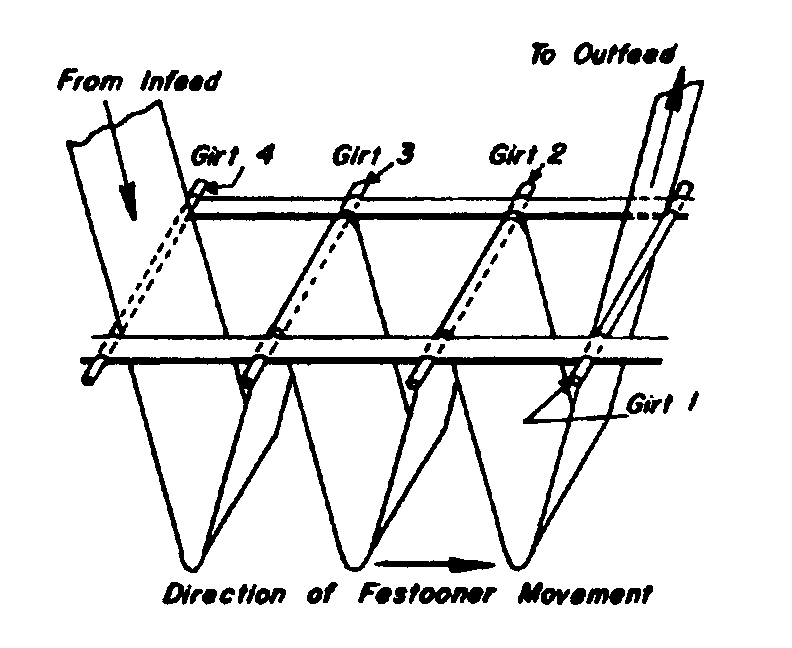
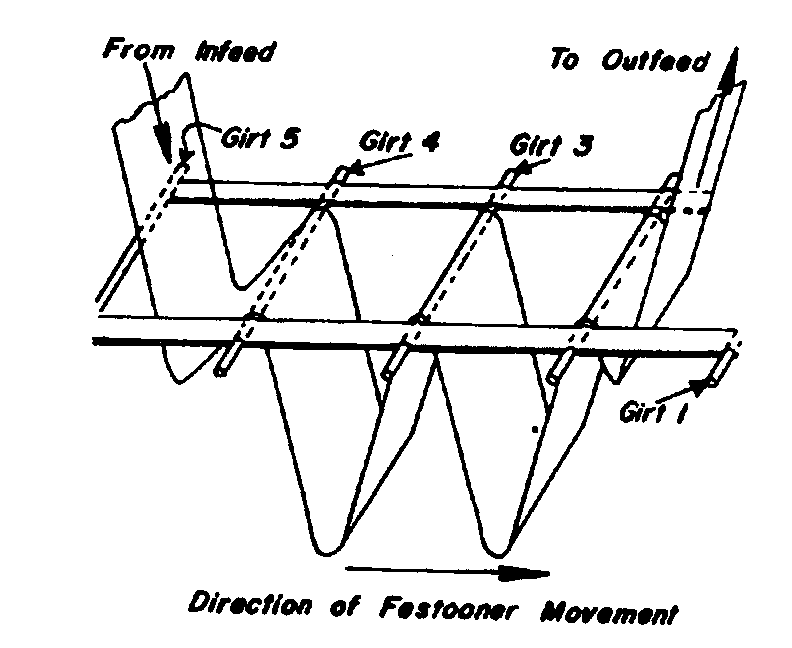
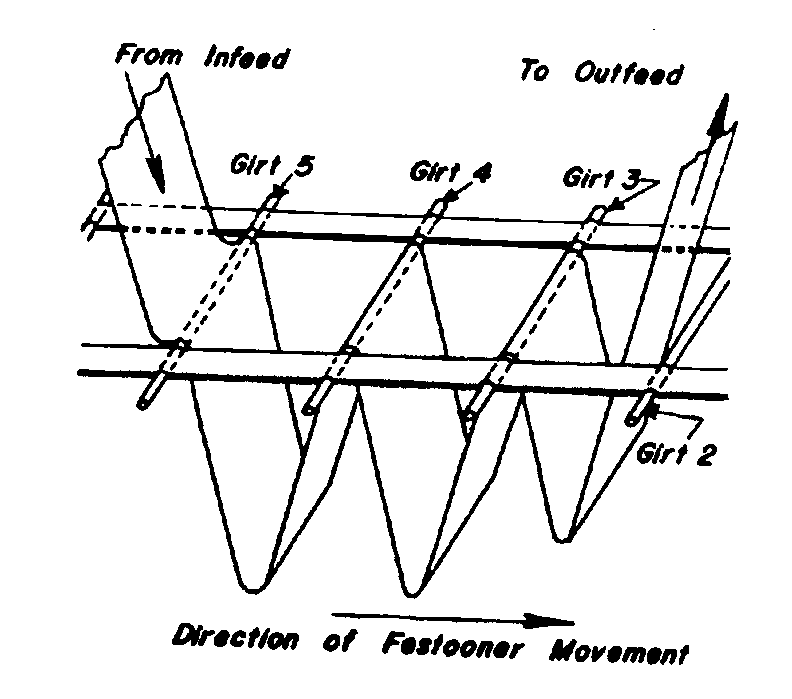
| 105 | With means to shift girt with respect to festoon and conveyer | ||||
This subclass is indented under subclass 104. Device provided with means to rotate or pivot the loop-supporting
girt about the axis of the girt or about a line parallel to said
axis, whereby the girt will contact another portion of the loop
and have another orientation in relation to the girt-translating
means.
| |||||
| 106 | With means to hold material on girt | ||
This subclass is indented under subclass 104. Device provided with clamping means to retain material on
a girt.
| |||
| 107 | With means to feed girt to conveyer | ||
This subclass is indented under subclass 104. Device provided with means to move a girt from a stored
location onto the girt-translating means.
| |||
| 108 | PLURAL MATERIAL-MOVING MEANS | ||||
This subclass is indented under the class definition. Device provided with more that one driven material-advancing
means.
| |||||
| 109 | With plural paths for material | ||
| This subclass is indented under subclass 108. Device wherein the moving means direct (1) indeterminate-length* material
along one of several different routes, or (2) several indeterminate-length
materials along several different routes.
SEE OR SEARCH CLASS:
| |||
| 110 | Alternately usable |
| This subclass is indented under subclass 109. Device wherein material is moved along only one path of the several provided, at any one time. | |
| 111 | With means to independently vary mover speed |
| This subclass is indented under subclass 108. Device provided with means to adjust the rate of motion of one of the moving means without changing the velocity of the others. | |
| 112 | Continuous feed from serial sequentially operated feeders | ||||
This subclass is indented under subclass 108. Device wherein, during any instant of time, any one of the
material moving means is moving all of the material whereby the
travel of the material is maintained without interruption.
SEE OR SEARCH THIS CLASS, SUBCLASS:
| |||||
| 113 | With bight former | ||||
| This subclass is indented under subclass 108. Device wherein one of the material moving means is a means
to push or pull material into a loop.
SEE OR SEARCH CLASS:
| |||||
| 114 | With pivotal former-support |
| This subclass is indented under subclass 113. Device provided with means to mount the bight former for movement in an arcuate path. | |
| 115 | With intermittent material-mover |
| This subclass is indented under subclass 108. Device wherein one of the material movers advances material discontinuously. | |
| 116 | Including auxiliary material-mover for starting | ||||
This subclass is indented under subclass 115. Device wherein one of the other movers advances material
to the intermittent mover so that the latter may grasp the material
and cause the material to continue to advance.
SEE OR SEARCH THIS CLASS, SUBCLASS:
| |||||
| 117 | And continuous material-mover | ||||||||
| This subclass is indented under subclass 115. Device wherein one of the other means advances material
uninterruptedly.
SEE OR SEARCH THIS CLASS, SUBCLASS:
SEE OR SEARCH CLASS:
| |||||||||
| 118.3 | Where support is upheld by the material* (e.g., dancer roller, etc.): |
| This subclass is indented under subclass 118.2. Device wherein the guide is supported by the material*. | |
| 118.4 | In a container: | ||||
| This subclass is indented under subclass 118.1. Device wherein the storage means is a receptacle having
an entrance and exit for the material*.
SEE OR SEARCH THIS CLASS, SUBCLASS:
SEE OR SEARCH CLASS:
| |||||
| 118.5 | Having conveying means within: |
| This subclass is indented under subclass 118.4. Device including means to propel the material* inside the container. | |
| 120 | BY INTERMITTENT (INTERRUPTED) MATERIAL-MOVER | ||||||||||||||||||||||||||||||
| This subclass is indented under the class definition. Device having means for advancing material in a step-by-step
manner, including advancing an increment of material and stopping
movement of the material.
SEE OR SEARCH THIS CLASS, SUBCLASS:
SEE OR SEARCH CLASS:
| |||||||||||||||||||||||||||||||
| 121 | Stored material-movement-derived energy provides moving force | ||||||
This subclass is indented under subclass 120. Device wherein power absorbed from the movement of material
itself is subsequently utilized in a later material-moving effort.
SEE OR SEARCH CLASS:
| |||||||
| 122 | With means varying the material speed during movement | ||||
This subclass is indented under subclass 120. Device including means for changing the rate of travel of
material during an increment of movement.
| |||||
| 123 | Cyclical unequal movements |
| This subclass is indented under subclass 120. Device whereby the material is advanced in recurring series of material movements, each series comprising a number of material movements which are different in extent, one from any of the others within the series. | |
| 124 | Comprising constantly rotated roll on reciprocating or oscillating carrier | ||
This subclass is indented under subclass 120. Device provided with a continuously driven roll* mounted
on a carriage, which carriage moves to and fro, (either rectilinearly
or arcuately).
| |||
| 125 | Including material abutment | ||||||
This subclass is indented under subclass 120. Device in which material movement is stopped by engagement
of an element with the leading edge of said material.
SEE OR SEARCH THIS CLASS, SUBCLASS:
SEE OR SEARCH CLASS:
| |||||||
| 126 | Movable with material |
| This subclass is indented under subclass 125. Device wherein the abutment moves with the material in the direction of material advancement before stopping movement. | |
| 127 | Manual material-mover (e.g., dispenser) |
| This subclass is indented under subclass 120. Device in which the advancing means (i.e., the mover) is powered by an operative (e.g., a person who operates the device). | |
| 128 | With means to clamp material during dwell | ||||||
This subclass is indented under subclass 127. Device having means for positively holding the advance material
when the material is not being moved by the material-mover.
SEE OR SEARCH CLASS:
| |||||||
| 129 | With means to limit increment of advance | ||
This subclass is indented under subclass 127. Device having structure restricting the extent of movement
of the material-mover.
| |||
| 130 | With means to disable operation of limit means | ||
This subclass is indented under subclass 129. Device provided with structure for moving the restricting
means to an inoperative position, thereby allowing subsequent material
advancement.
| |||
| 131 | Time-controlled |
| This subclass is indented under subclass 130. Device wherein the means to disengage the restricting means is moved after a predetermined interval of time after material-movement stops, whereby the material may be moved again only after said interval. | |
| 132 | Plural selectable limit means |
| This subclass is indented under subclass 129. Device provided with at least two separate limiting means any one of which means may be chosen by an operative to control the extent of movement of the material in any increment. | |
| 133 | With means to adjust limit means | ||||
This subclass is indented under subclass 129. Device provided with means for changing the position of
the restricting means with respect to the material advancing structure.
SEE OR SEARCH THIS CLASS, SUBCLASS:
| |||||
| 134 | Unicyclic mover | ||
| This subclass is indented under subclass 120. Device in which the material is (1) started (from a rest
position), (2) advanced through an extent of material-movement and
(3) stopped (in a rest position), and in which further advance from
said last-named position requires the intervention of a randomly
operating agency or stimulus.
SEE OR SEARCH CLASS:
| |||
| 135 | Plural means to select increments of advance | ||
This subclass is indented under subclass 134. Device provided with two or more elements, any one of which
elements may be actuated to effect a predetermined extent of material advance
different from, or additive to, the extent(s) of advance effected
by another (or other) elements(s) in the single cycle.
| |||
| 136 | With means to adjust increment | ||||
| This subclass is indented under subclass 134. Device provided with means for changing the extent of material
advance during the cycle.
SEE OR SEARCH THIS CLASS, SUBCLASS:
| |||||
| 137 | Adjustable feeder | ||
| This subclass is indented under subclass 120. Device wherein a part, or parts, of an intermittent feeder* may
be moved volitionally relative to other part(s) of the device, whereby
the direction or increment of feed may be varied.
SEE OR SEARCH THIS CLASS, SUBCLASS:
| |||
| 138 | Operative-controlled, machine-powered adjustment |
| This subclass is indented under subclass 137. Device having a moving portion of the feeder that strikes an element, which element is moved relative to the striking portion, causing actuation of the movable part one of said members (i.e., either the portion or the element), being manually movable into (or out of) a position whereat the striking engagement occurs. | |
| 139 | Adjustable feed increment |
| This subclass is indented under subclass 137. Device wherein movement of the part(s) effects a change in the extent of material advanced during each step of operation. | |
| 140 | By means to vary material-engagement of recessed roll |
| This subclass is indented under subclass 139. Device provided with a recessed-roll* and means to modify the peripheral extent of the radially outward material-engaging portion of said recessed-roll. | |
| 141 | By means to change length of feeder travel |
| This subclass is indented under subclass 139. Device provided with means to vary the extent of movement of the feeder while moving in contact with the material. | |
| 142 | Comprising variable-throw crank |
| This subclass is indented under subclass 141. Device provided with a lever which is rotated or oscillated about an axis and is provided with a pivotal connection between the lever and a link to move the feeder*, the axis and the pivotal connection being a distance apart and provided with means for changing the distance between said axis and connection. | |
| 143 | With means to effect feed and retrograde movement | ||
This subclass is indented under subclass 120. Device including means to retract at least a portion of
the material.
| |||
| 144 | With overtravel preventer | ||
This subclass is indented under subclass 120. Device having means to preclude excess advancing movement
of the material.
| |||
| 145 | Intermittently acting |
| This subclass is indented under subclass 144. Device having means acting periodically to preclude excess material movement at the end of the advancing step. | |
| 146 | And retrograde movement preventer | ||
| This subclass is indented under subclass 144. Device provided with means to preclude reverse motion of
the material.
SEE OR SEARCH THIS CLASS, SUBCLASS:
| |||
| 147 | With retrograde movement preventer | ||
This subclass is indented under subclass 120. Device provided with means to preclude reverse movement
of the material.
| |||
| 148 | Unidirectionally rotating roll | ||
| This subclass is indented under subclass 147. Device in which the preventing means comprises a roll* incapable
of turning in a reverse direction.
SEE OR SEARCH THIS CLASS, SUBCLASS:
| |||
| 149 | Positively actuated to grip |
| This subclass is indented under subclass 147. Device wherein the preventing means is driven into holding engagement by an unyielding member. | |
| 150 | By hydraulic or electrical means |
| This subclass is indented under subclass 149. Device wherein the preventing means is driven by means which derives its proximate actuating force from fluid-pressure or electricity. | |
| 151 | Yieldingly biased |
| This subclass is indented under subclass 147. Device wherein the preventing means is resiliently urged toward engagement. | |
| 152 | Comprising material-moving roll |
| This subclass is indented under subclass 120. Device wherein the material is advanced in a step-by-step manner by a roll*. | |
| 153 | Recessed roll | ||||
| This subclass is indented under subclass 152. Device provided with a recessed-roll*.
SEE OR SEARCH THIS CLASS, SUBCLASS:
SEE OR SEARCH CLASS:
| |||||
| 154 | With means to disengage roll from material | ||
| This subclass is indented under subclass 152. Device provided with means for moving the roll* and
material relatively, into and out of material-advancing engagement.
SEE OR SEARCH CLASS:
| |||
| 155 | Continuously rotating roll |
| This subclass is indented under subclass 154. Device wherein the roller* does not stop turning in the same direction. | |
| 156 | Unidirectional | ||
| This subclass is indented under subclass 152. Device wherein the roll* is incapable of turning
in a reverse direction.
SEE OR SEARCH THIS CLASS, SUBCLASS:
| |||
| 157 | Ratcheted roll | ||
| This subclass is indented under subclass 156. Device provided with a peripherally toothed disc and oscillating
pawl drivingly engaging the disc to move the roll*.
SEE OR SEARCH CLASS:
| |||
| 158 | Comprising reciprocating or oscillating material-mover | ||||
| This subclass is indented under subclass 120. Device wherein the intermittent material-mover is a material-advancing
member which moves to-and-fro (either rectilinearly or arcuately),
and engages the material at least while moving in the material-advancing
direction.
SEE OR SEARCH CLASS:
| |||||
| 159 | With means to retard movement of advancer carrier | ||
This subclass is indented under subclass 158. Device wherein the material-advancer is mounted on a reciprocating
or oscillating carrier, provided with means for resisting the movement
of said carrier.
| |||
| 160 | On pivoted carrier | ||
This subclass is indented under subclass 158. Device wherein the material-advancer is on a carrier*,
which carrier is mounted for arcuate movement about an axis.
| |||
| 161 | With means to disable material-mover |
| This subclass is indented under subclass 158. Device with volitionally actuated means to prevent the material engaging means from advancingly engaging the material. | |
| 162 | With means to move grip element into material engagement | ||||||
This subclass is indented under subclass 158. Device provided with means for driving a clamping portion
of the material-mover into contact with the material.
SEE OR SEARCH THIS CLASS, SUBCLASS:
SEE OR SEARCH CLASS:
| |||||||
| 163 | Comprising link positively connected to element | ||||
This subclass is indented under subclass 162. Device wherein the driving means includes a point on a pitman
pivotally fastened to a point on, or integral with, the grip element.
SEE OR SEARCH THIS CLASS, SUBCLASS:
| |||||
| 164 | Which link effects material-advancing movement |
| This subclass is indented under subclass 163. Device wherein the same link also causes the grip element to move in a material-forwarding direction. | |
| 165 | Comprising camlike surface | ||
This subclass is indented under subclass 162. Device wherein the driving means includes a member having
a face in sliding engagement with a surface on a sub-assembly integral
with the grip element.
| |||
| 166 | Which surface effects material-advancing movement |
| This subclass is indented under subclass 165. Device wherein the same cam-surface also causes the grip element to move in a material-forwarding direction. | |
| 167 | With spring-biased grip element | ||
| This subclass is indented under subclass 158. Device provided with means for resiliently urging a clamping
portion of the material-mover into engagement with the material.
SEE OR SEARCH THIS CLASS, SUBCLASS:
| |||
| 168 | BY ORBITALLY TRAVELING MATERIAL-ENGAGING SURFACE(S) | ||||||||||||||
This subclass is indented under the class definition. Device having a circumambulating material contacting face,
i.e., any given element of the face moves in a closed loop.
SEE OR SEARCH THIS CLASS, SUBCLASS:
SEE OR SEARCH CLASS:
| |||||||||||||||
| 169 | With start-facilitating means |
| This subclass is indented under subclass 168. Device wherein the surface is on a material-advancer, and provided with mechanism for momentarily applying power to the advance, additional to that power which normally causes movement of the advancer, in order to overcome the starting inertia of the advancer. | |
| 170 | On endless belt or chain | ||
| This subclass is indented under subclass 168. Device wherein the material-engaging surface is on, or part
of, either an integral, or concatenated band; the member, in either
case, being trained about a plurality of separated, noncoaxial pulleys
or sprockets.
SEE OR SEARCH THIS CLASS, SUBCLASS:
| |||
| 171 | With cooperating surface | ||||
This subclass is indented under subclass 170. Device provided with another material-engaging face wherein
the material is disposed between the face of the endless member
and said other face.
| |||||
| 172 | Comprising endless belt or chain |
| This subclass is indented under subclass 171. Device wherein the other face is also on, or part of, an endless member such as is defined in subclass 170, above. | |
| 173 | With gripper(s) mounted thereon | ||
| This subclass is indented under subclass 170. Device provided with a gripper* or grippers supported
on the endless member.
SEE OR SEARCH THIS CLASS, SUBCLASS:
| |||
| 174 | With control or adjustment means | ||||||
This subclass is indented under subclass 168. Device provided with means for regulating or altering the
material-advancing operation of the material-advancer.
SEE OR SEARCH THIS CLASS, SUBCLASS:
| |||||||
| 175 | To vary diameter of roll |
| This subclass is indented under subclass 174. Device wherein the regulating means radially expands or contracts a roll*. | |
| 176 | To vary bite of contacting pinch members |
| This subclass is indented under subclass 174. Device provided with at least two material-engaging surfaces, at least one of which is orbitally traveling, between which surfaces the material is disposed, and wherein the regulating means changes the space (i.e., "nip") between said surfaces. | |
| 177 | Infinitesimally variable |
| This subclass is indented under subclass 176. Device wherein the spacing between the surfaces is changeable to any distance (ranging from zero to that imposed by the limits of the device) in an unlimited number of small variations, whereby different thicknesses of material may be accommodated therebetween. | |
| 178 | To vary speed of material-advancer | ||
| This subclass is indented under subclass 174. Device wherein the control means regulates the rate of movement
of the material-advancing means.
SEE OR SEARCH THIS CLASS, SUBCLASS:
| |||
| 179 | For shifting roll(s) axially | ||
| This subclass is indented under subclass 174. Device wherein the regulating means adjusts a roll* along
its axis of rotation.
SEE OR SEARCH THIS CLASS, SUBCLASS:
| |||
| 180 | For shifting roll(s) angularly |
| This subclass is indented under subclass 174. Device wherein the regulating means pivots a roll* about an axis other than the axis of rotation of the roll. | |
| 181 | Comprising rotary pinch pair | ||
| This subclass is indented under subclass 168. Device including two instrumentalities, each having material
engaging surfaces, between which surfaces the material is disposed,
said instrumentalities, during engagement with the material, each
being rotated-about an axis-in a material-advancing direction.
SEE OR SEARCH CLASS:
| |||
| 182 | Including radial material-engaging surface |
| This subclass is indented under subclass 181. Device wherein the material-contacting face of at least one of the instrumentalities lies in a plane perpendicular to the axis of rotation of said instrumentality. | |
| 183 | Including means to ensure arcuate engagement | ||
This subclass is indented under subclass 181. Device in which one instrumentality of the pinch-pair is
a roll*, and is provided with means for retaining the material
in contact with a portion of the periphery of said roll.
| |||
| 184 | Tapered roll or bite |
| This subclass is indented under subclass 181. Device wherein either (1) at least one of the instrumentalities is a cone or truncated cone; or (2) the spacing between the material-engaging surfaces of the instrumentalities, as viewed in a plane common to both axes, varies, regularly along a line parallel to the axes and lying in said plane. | |
| 185 | Including equal-diameter coaxial rolls | ||
This subclass is indented under subclass 181. Device wherein at least one of the instrumentalities comprises
a plurality of rolls*, which rolls are all of like radius
and are all mounted on commonly aligned centers.
| |||
| 186 | Yieldable bite | ||
This subclass is indented under subclass 181. Device wherein the material-contacting surfaces of the instrumentalities
define an expansible or contractible nip or opening.
| |||
| 187 | Roll axis resiliently urged |
| This subclass is indented under subclass 186. Device wherein the axis of at least one of the instrumentalities is biased toward the other instrumentality. | |
| 188 | With drive means | ||
| This subclass is indented under subclass 168. Device provided with powered means to move the material-engaging
surface in the material-advancing direction.
SEE OR SEARCH CLASS:
| |||
| 189 | Plural spaced apart rolls (e.g., guide rolls) | ||
| This subclass is indented under subclass 168. Device provided with two or more separated rolls*.
SEE OR SEARCH THIS CLASS, SUBCLASS:
| |||
| 190 | Including details of roll or mount | ||
| This subclass is indented under subclass 168. Device which, as claimed, includes a roll* or roll-support
of specific structure.
SEE OR SEARCH CLASS:
| |||
| 191 | Roll surface radially movable |
| This subclass is indented under subclass 190. Device including a roll* whose peripheral face may move toward and away from the center of the roll in a direction perpendicular to the axis of rotation of the roll. | |
| 192 | And axially movable (e.g., centering rolls) | ||
| This subclass is indented under subclass 191. Device wherein the face of the roll* may also move
relative to the center of the roll in a direction parallel to the
axis of rotation.
SEE OR SEARCH CLASS:
| |||
| 193 | Irregular friction surface (e.g., roughened) | ||||||
| This subclass is indented under subclass 190. Device including a roll* having uneven surface characteristics
which (1) increase the coefficient of friction between the surface
and the material, or, (2) has other means on the surface to hold
and grip the material.
SEE OR SEARCH THIS CLASS, SUBCLASS:
SEE OR SEARCH CLASS:
| |||||||
| 194 | Bearing or support | ||
| This subclass is indented under subclass 190. Device including specific means for mounting the roll of
rotation.
SEE OR SEARCH CLASS:
| |||
| 195 | WITH MEANS TO RETARD MATERIAL MOVEMENT (E.G., "TENSIONER") | ||||||||||||||
This subclass is indented under the class definition. Device including means for moving material and with means
for braking or slowing the material movement.
SEE OR SEARCH THIS CLASS, SUBCLASS:
SEE OR SEARCH CLASS:
| |||||||||||||||
| 196.1 | PASSIVE GUIDE: | ||||||||||||||||||||||||||||||
This subclass is indented under the class definition. Device comprising means to direct or confine the material* acted
upon or affected only by external force.
SEE OR SEARCH THIS CLASS, SUBCLASS:
SEE OR SEARCH CLASS:
| |||||||||||||||||||||||||||||||
| 200 | MISCELLANEOUS |
| This subclass is indented under the class definition. Device not provided for elsewhere. | |