SECTION I - CLASS DEFINITION
Class 83 is the residual locus of patents directed to methods
and machines for penetrating material, without substantial reshaping
flow of such material, by means of (1) a solid tool, or fluid current,
either of which applies mechanical deforming force to the material
by direct physical contact therewith, the fluid current forcing
the material against a solid tool whose edge defines the line of
cut; (2) a heated solid tool which directly engages the material
(to effect penetration thereof by melting, or by transmission of
mechanical energy, or both); or (3) opposed, controlled fluid currents.
(A) Specifically (as well as implicitly) excluded, is a patent
to apparatus or process for cutting by the transmission of heat
to the work material from a hot gas, such as flame cutting (for
the location of which, see Lines With Other Classes, subsection
A, Relationship to Other Classes Including, per se, Cutting, Severing,
or Incising, paragraph 8, Classes related to flame or other heat-cutting).
(B) While a disclosure of the production of a reshaping flow,
in the operation of its apparatus or accomplishment of its method,
will preclude original placement of a patent in this class, a disclosure
of a flow of the material which is inherent in, or purely incidental
to, the act of cutting will not operate as such a bar. The following types
of factual situations illustrate the rule:
(1) A disclosure that the work material flows, due to melting,
will not preclude placement herein of the patent so disclosing;
but the further teach-that the flow accomplishes a significant or
definable reshaping of the work beyond that inherent in the penetration
there-of will bar such placement. Exemplary of such reshaping is
the formation of a rim or bead around a hole coincident with the
penetration which forms the hole.
(2) A patent to a cutting machine or process employing a tool
which, as disclosed, creates a flow of the material while penetrating
the material only partially (that is, it fails to reach the surface
opposite the surface of entry) will be excluded from this class
only if there is a teaching from which it can be fairly inferred
that there is no severance of the surface fibres of the work, but
rather that the material is compacted, creased, forged or otherwise
plastic worked, thus indicating that the reshaping is not an incident
of a cutting operation. A disclosure that a "cutting" tool
penetrates only partially through tacky, flowable, or green, plastic
work material (such as soft synthetic "plastics",
food dough, etc.) will be considered to supply such a teaching,
unless (by the same disclosure) the work attains its flowable or
soft condition by the action of the cutting tool (e.g., a hot tool).
If such tool is disclosed as softening or plasticizing the work,
a patent directed to same would be proper for this class (83).
SECTION II - LINES WITH OTHER CLASSES AND WITHIN THIS CLASS
SCOPE OF CLASS 83
Class 83 is an elemental or basic class. That is, its subject
matter is restricted (so far as possible) to means for, or steps
of, accomplishing the following functions: cutting something (the "work");
or cutting, and handling the work to be cut; or cutting, and handling
the product of the cutting operation. As a result, the great preponderance
of patents directed to cutting combined with some other work treatment
will be found in the respective class of the other treatment or
in some more general class of combined operations, such as Class
156 or Class 29 (particularly subclasses 33+ and 566+).
The few exceptions to this general statement are set forth explicitly
in section II, Lines With Other Classes, subsection B, Relationship
to Other Treating Classes (which appears later in this class definition).
The class does not act as the sole repository for patents directed
to cutting machines or even to cutting machines of the functional
types signalized in the subclasses of the class. Based upon past
development of the system of patent classification, such patents
are to be found in many classes, their disposition depending mainly
upon the nature of the material disclosed as constituting work for
the cutting operation. A listing of such classes is included in
Lines With Other Classes, subsection A, Relationship to Other Classes
Including, per se, Cutting, Severing, or Incising (which appears
later in this class definition). With respect to such classes,
Class 83 is residual.
As an incident of such residual nature, this class will not receive
for original placement a patent disclosing alternative embodiments
(claimed generically, or with a specific claim to each), one of
a type proper for this class and one of a type related to another
cutting class or subclass. Nor will it so receive a patent disclosing
two purposes for a claimed cutting machine, one general or related
to the art of this class (as shearing metal) and another specific
to another cutting class or subclass (as, for instance, cutting
plastic block or earthenware; or nail making). In both such cases,
the original patent will be placed in the other cutting class or
subclass.
A. RELATIONSHIP TO OTHER CLASSES INCLUDING, PER SE, CUTTING,
SEVERING, OR INCISING
The following enumeration and discussion of such classes,
although including the loci of patents relating to many and varied
types of cutting, does not purport to be exhaustive:
1. The class of cutting implements, Class 30.
Other than as governed by the exception set forth immediately
following description 4 below, a patent is deemed to be directed
to a cutting implement, and thus to be placeable originally in Class
30, if its claimed subject matter fits any one of following descriptions:
a. A cutting device which as an entirety is disclosed to be
supported or held against the force of gravity by the operator during
cutting.
b. A cutting device which as an entirety is disclosed as deriving
from the work a substantial amount of its support against gravity
(i.e., work-supported) during cutting, including a cutting device
which is disclosed as being guided and supported during cutting
by a member which is itself supported on the work (i) a cutting device
which is disclosed as having a loose, work supported tool and powered
means for driving the tool into the work, will be placed in Class
83; (ii) a cutting device which includes means to affix, hold, or
positively locate a portion of the device relative to the work,
for support of the device against gravity, and means to guide movement
of the cutter relative to the work-affixed or work-located portion,
will be placed in Class 83; (iii) a cutting device which includes
(1) means to position or positively locate a portion of the device
relative to the work in such a manner that said portion remains
in said relative position during cutting and (2) means to guide
the cutter in predetermined path with respect to said portion, will
be placed in Class 83.
c. A cutting device which is disclosed as being capable of
movement in a random path instantaneously under the control of the
operator during cutting, including a cutter suspended or supported
near the work; e.g., a cutter mounted at one end of a flexible shaft
whose other end is anchored to a table, or a cutter suspended from
a trolley, or a cutter mounted on a steerable vehicle.
d. A cutting device of the type referred to in the preceding
paragraph in combination with a work support or work holder wherein
neither the cutting tool itself nor the tool support is modified
or constructed to either constrain the motion of the cutter or to
guide it in a predetermined path with respect to the work support
or work holder.
However, a patent drawn to a device including a cutting tool
and means to support a reserve stock of the work in which the work
supply is in the form of a web or strand wrapped upon itself and
the supply is supported for rotation upon an axis will be placed
originally in this class (83) even though it fits one or more of
the above listed descriptions.
A patent for the combination of a cutting device meeting any
of the criteria set forth above and a work holder provided for in
Class 269 will be placed originally in Class 30, although a patent
for the work holder, per se, will be placed in Class 269.
A patent which only claims a cutting tool nominally, that
is, in which the claimed structure does not sufficiently define
a cutting tool substantially in its ultimate use form, or elements,
adjuncts, or materials structurally limited to such use, is regarded
as proper subject matter for original placement in Class 428, Stock
Material or Miscellaneous Articles.
2. The class of severing by tearing or breaking.
Class 225 includes patents for process or apparatus for severing
determinate portions of work material by causing failure of the
work under tension at the point or line of separation, effected
by moving one part of the work relative to another part. In such
devices or processes, the tension is applied by stretching, bending,
twisting, manually or mechanically grasping the work on one side of
a fixed edge and forcing it against the edge, or moving a breaking
or tearing tool and supported work material relative to each other.
Also included in the reference class are tearing or breaking devices
combined with any other type of severing means.
For a detailed statement of the distinction between Classes
83 and 225, see the (1) Note and (2) Note under section I, Class
Definition, subsection B, Breaking or Tearing, of Class 225.
3. The class of comminuting.
Class 241, Solid Material Comminution or Disintegration, includes
original patents for process or apparatus directed to the cutting
or severing of solid material into a number of smaller solid masses,
which smaller masses do not have imparted to them any desired or
significant shape. As between Classes 83 and 241, the provision
of means for (or steps of) retaining an original dimension of the
work in the cut up product will exclude a patent for the apparatus
(or process) from Class 241.
4. The class of selective cutting.
The art of selective cutting is collected in Class 234, Selective
Cutting (e.g., Punching). The distinction between a selective cutting
device or a method of selective cutting (either of which is proper
for Class 234) and a cutting means or method of this class (83)
is set forth in the following statement:
Class 234 is superior to Class 83, and takes or contains original
patents directed to cutting devices as defined in Class 83 which
are further distinguished by the claimed inclusion of a plurality
of cutting tool pairs and an actuating power train for each pair
(one power train may be common to all), so that power may be delivered
to any or all pairs for any cutting cycle, and wherein each and all
of the tool pairs assembled in the machine are constantly available
to be chosen for cutting or noncutting (in any desired number, from
one to the total number available) by (a) a pattern (b) combinational
coding means [defined in section III, Glossary, of the
class definition of Class 234, Selective Cutting (e.g., Punching)], or
(c) means not a part of the tool actuating power train and which
does not partake of all the movements of either tool or the pair;
which pattern or means conditions which pair so chosen to (a) enable,
or (b) prevent, a cutting operation thereby when its driving power
train is actuated.
The distinction expressed above is intended to exclude from
Class 234 patents for devices wherein, for example, (a) there is
no distinct conditioning means [see U.S. Patent No. 682,197
(subclass 225 of Class 83) to Hollerith: each punch is selected
and actuated by its individual key-connected linkage];
or (b) less than the whole number of tools is constantly available [see
U.S. Patent No. 878,775 (subclass 552 of Class 83) to Colbert:
a turret of tools]; or (c) the tool conditioning means
move bodily with their associated tools [see U.S. Patent
No. 746,625 (subclass 559 of Class 83) to Allen: manipulable locking
pins are fixed to the tools]; and is intended to include,
for example, devices wherein a tool-actuating power train common
to all tools is tripped, manually or automatically, after operation
of selected conditioning means [see U.S. Patent No. 1,110,261
(234/111) to Hollerith: initial depression of a key conditions
one punch for actuation, and further depression of the key trips
a common punch hammer or actuator], and devices wherein
a plurality of combinations of less than the total number of tools
are actuated or conditioned for actuation, by coding means (see
U.S. Patent No. 422,728 to Clark: a turret of coded interposers
is positionable to select groups of tools from an array thereof).
5. The class of mechanical manufacturing (metal working).
The class of reference (29, Metal Working) includes patents
for machines for bias cutting of tubular stock (subclasses 2.1+);
shredding metal; e.g., metal wool making (subclasses 4.51+);
spiral cutting of flat stock (subclass 20.1); and filing (subclass
76.1). Patents for files and rasps are found in subclasses 78+.
6. The class of presses.
The class of reference, (100, Presses) includes patents for
reciprocating press structures, which (as both claimed and disclosed)
may perform, alternatively, a cutting operation or some other forming
operation (such as forging, drawing, bending), as well as patents
containing such equivocal disclosures of forming devices that the
type of forming operation such devices are intended to perform cannot
be ascertained accurately.
7. The class of abrading.
With few exceptions (such as those found in Class 132, Toilet),
patents claiming a cutting means, or a step involving the use of
a cutting means, which (as disclosed) is composed of crystalline
material-removing particles, are placed originally in Class 451,
Abrading.
8. Classes related to flame or other heat-cutting.
In addition to the classes enumerated below, it will be noted
that subclasses 18.1+ of Class 33, Geometrical Instruments,
contained original patents for flame-cutting scribers, and that
Class 65, Glass Manufacturing, subclass 113, provides for glass
preform treating including flame severing, and subclasses 269+ provides
for glassworking means including flame severing means.
a. The class of metal treatment.
Subclasses 194+ of Class 148, Metal Treatment, includes
original patents for methods of flame-cutting metals.
b. The class of metallurgical apparatus.
Original patents for flame-cutting apparatus are collected
in subclasses 48+ of Class 266, Metallurgical Apparatus.
In addition, subclass 271 of Class 266 contains original patents
for devices used for drilling or cutting taphole plugs of metallurgical
furnaces.
c. The class of combustion.
Class 431, Combustion, contains original patents for a torch
comprising a fluid fuel distributor and a feature which specializes
it for producing a flame; e.g., pilot burner etc., or which depends
on the heat generated by the flame to perform its function; e.g.,
vaporize fuel.
d. The class of electric heating.
Class 219, Electric Heating, includes original patents directed
to methods or apparatus effective to sever, part, or burn or melt
away, a portion of a workpiece without using a solid tool which
engages and penetrates the work. Examples will be found in subclasses
68+.
e. The class of fluid sprinkling, spraying, and diffusing.
Class 239, Fluid Sprinkling, Spraying, and Diffusing, includes
original patents for fluid distributing nozzles or tips, per se,
even though disclosed as burners.
9. Classes related to the cutting of metal.
In addition to the classes enumerated herein, attention is invited
to the discussion of patents directed to improvements in the flame-
or heat-cutting arts, contained in paragraph H, above.
a. The class of nail making.
Patents directed to apparatus for cutting nails to shape are
found as originals in subclasses 157+ and 192+ of Class
470, Threaded, Headed Fastener, or Washer Making: Process and Apparatus.
b. The class of chain, staple, and horseshoe making.
Cutting machines disclosed as being useful in making such
products are the subject of patents in subclass 29 of Class 59,
Chain, Staple, and Horseshoe Making.
c. The class of tool making.
A patent for a cutting machine or process employed in the
manufacture of a tool will be found, as an original copy, in Class
76, Metal Tools and Implements, Making, (e.g., in subclasses 12+,
28, 29, 30, 31+, 37+, 82+).
d. The class of wireworking.
Patents for methods of, or means for, cutting wire will be
found, as original copies, in many subclasses of Class 140, Wireworking,
particularly subclasses 58+, 66, and 67.
e. The class of type casting.
Original copies of patents for machines or processes for cutting
cast type are included in subclass 59 of Class 199, Type Casting.
f. A patent directed to cutting metal (or other hard substance
whose cutting is not the subject of a subclass is some other class)
will be placed originally in one of the following classes, if not
earlier placed on the basis of product (e.g., nails) according to
the criteria expressed:
i. Class 408, Cutting by Use of Rotating Axially Moving Tool,
will take original patents to machines for making a hole, reducing
the outside of a round workpiece, trepanning, screw threading either
the outside or the inside of a tubular workpiece, as well as any
other cutting operation by use of a tool turning about an axis and
moving along that axis toward a workpiece; provided, there is no
additional motion of the operating tool. Class 408 is intended
to ultimately include all cutting in the manner provided in the
definition of that class; however, not all classes have now been
screened for art proper for Class 408. Included among the classes
likely to include patents proper for Class 408 that have not been
screened are Classes 82, 142, and 451.
ii. Class 82, Turning. Original patents for devices or processes
for severing or cutting off work, wherein the cutting movements
of tool and work relative to each other include (1) rotation of
either or both about an axis passing through the work (except as
provided for in Class 408) and (2) relative translation substantially
normal to said axis, are in Class 82 as meeting the general concepts
of "turning".
iii. Class 409, Gear Cutting, Milling, or Planing, includes
original patents for a process and apparatus for shaping material,
usually metal, by means of (1) a toothed rotary cutter to produce
an article of desired configuration or (2) a nonrotary tool for
making a series of comparatively light cuts or a series of such
tools, between which tool(s) and the workpiece there is a relative
reciprocatory movement in substantially a straight line. Generally,
Class 409 is broad enough to take any patent for shaping by means
of a toothed rotary cutter not provided for in Class 77 or Class
82. Included in Class 409, subclasses 288+, is a patent
for a single edge cutter device which shapes work (e.g., grooving,
shaving, slotting, or flash trimming) by means of relative movement
between tool and work in one or more passes. See (1) Note under
Class 409, subclass 288.
10. Classes related to the cutting of wood.
a. The class of coopering.
Patents for machines adapted to cut barrels, or staves therefor,
will be found as original copies in many subclasses of Class 147.
b. Other patents whose claimed method or apparatus is disclosed
as being directed to the cutting of wood will be placed originally
in the proper woodworking class; Class 142, Wood Turning; Class
144, Woodworking (including pencil sharpening in subclasses 28.1+);
or Class 30, Cutlery (including pencil sharpening implements in
subclasses 451+); except for patents directed to veneer-web
or -sheet clippers (including those intended to cut a layer to be
laminated) which are placed in this class (83).
11. Classes related (in whole or in part) to cutting the earth
or the fruits thereof in situ, or well tubing imbedded in the earth.
A patent directed to a machine or process for accomplishing
any one of the above enumerated purposes will be placed in the appropriate
earth exploring or exploiting, or agricultural, class. A list (not
intended as exhaustive) of such classes follows: 37, Excavating;
47, Plant Husbandry; 56, Harvesters; 111, Planting; 166, Wells;
171, Unearthing Plants or Buried Objects; 172, Earth Working (e.g.,
subclasses 13-22); 175, Boring or Penetrating the Earth; 299, Mining
or In Situ Disintegration of Hard Material.
12. Classes related to the cutting of plastic material, stone,
or hard glass.
A patent directed to apparatus for cutting plastic, green ceramic
or cementitious preformed material will be found as an original
in Class 83 unless shaping other than by cutting is involved. See
Class 65, Glass Manufacturing, appropriate subclasses for a process
of, or apparatus for, cutting or scoring glass combined with glassworking
or treating, and subclass 133 for a process of severing a stream
of molten glass and also see the collection of search notes under
subclasses 112 and 133; Class 125, Stone Working, for stone cutting;
Class 264, Plastic and Nonmetallic Article Shaping or Treating:
Processes, particularly subclasses 138+ for a process
of plastic shaping by or with cutting; and Class 425, Plastic Article
or Earthenware Shaping or Treating: Apparatus, for means shaping
or reshaping of plastic material combined with cutting means.
13. Classes related to the treatment, care, or handling of living
animal (including human) bodies.
a. The class of surgery.
A patent directed to the cutting of a live animal body will
be placed as an original copy in Class 128, Surgery.
b. The class of dentistry.
Original patents for devices for trimming plaster bases of
dental models will be found in subclass 38 of Class 433, Dentistry.
c. The class of toilet.
Patents for cutting, scraping, or filing devices, disclosed as
useful in manicure or pedicure operations, are placed originally
in subclasses 75.4+ and 75.8 of Class 132.
d. The class of farriery.
The reference class (168), in subclass 48.1+, contains original
patents to apparatus for sawing, milling, scraping, filing, or otherwise
cutting animal hooves.
e. The class of fishing, trapping, and vermin destroying.
In addition to the typical fish hook and tackle therefor, the
class of reference (43) contains patents for such cutting devices
as spears and harpoons subclass 6 and impaling traps subclasses
77+.
14. Classes related to the preparation of food.
a. The class of butchery.
A patent directed to the cutting of the dead body of a previously
living creature, preparatory to its use as food, will be found in
Class 452, Butchering. For instance, patents relating to fowl beheading,
carcass splitting, or fish cutting are found, respectively, in subclasses
12, 23, or 53+ thereof.
b. Bakery and confectionery type foods.
A manipulative process of shaping edibles combined with preform
severing is provided for in Class 99, Foods and Beverages: Apparatus,
subclasses 450.1+ and 537+, whereas comparable
apparatus is provided for in Class 425, Plastic Article or Earthenware
Shaping or Treating: Apparatus, appropriate subclasses. Cutting
of edible preforms, per se, is provided for by Class 83 whereas severing
of same by tearing or breaking is provided for by Class 225.
c. Other classes of food cutting.
A patent directed to one of the following types of food cutting
will be placed originally in the appropriate food preparation class:
Class 99, Foods and Beverages: Apparatus, for a cutting device
which is adapted to a peculiar characteristic of the food, or wherein
the cutting device separates distinguishable portions of the food,
(e.g., leafy top portion, seeds, core, skin portion, eyes, etc.).
15. Classes related to the working of leather, skins, or hides.
a. The class of leather working.
Class 69, Leather Manufactures, includes patents directed
to means and processes for splitting, skiving, defleshing, whitening,
or buffing of hides or leather, and for cutting, (per se), in the
production of certain articles typical of the class (e.g., leather
straps, the subject of patents in subclass 17 of Class 69).
b. The class of boot and shoe making.
Patents for cutting means or methods specialized or peculiarly
adapted to operation upon footgear are placed originally in Class
12, Boot and Shoe Making, particularly subclasses 27, 28, 40, 41.05,
41.7, 46, 47, 47.1, 57.5+, 62, and 85+.
16. Textile classes.
a. The class of cloth finishing.
Subclasses 7+ of Class 26, Textiles: Cloth Finishing, constitutes
the locus of original patents limited to apparatus or process for
severing threads or fibers projecting from textile fabrics. Such
patents may relate, for instance, to shearing or to the cutting
of float threads, pile loops, or weft ends.
b. The class of fiber preparation.
Patents for "tow-to-top" staplizing machines
or methods are placed originally in Class 19, Textiles: Fiber Preparation.
The type of severance therein involved is that in which a bundle
of filaments of indefinite length (termed "tow")
is subjected to a treatment which reduces the individual filaments
to staple length fibers without disrupting the continuity or integrity
of the bundle (which, when emerging from the machine or processes,
is known as "top"). In Class 83, on the other
hand, are found patents for machines or processes for the reduction
of isolated individual filaments to staple length fibers (for instance,
Beria-type cutters) or for the disruptive reduction of filament
bundles to such fibers, in both cases without further textile treatment.
c. The class of weaving.
Original copies of patents for cutting devices mounted on
loom parts (e.g., temple mounted cutters) are found in subclasses
302+ of Class 139.
d. The class of sewing machines.
Patents for cutting devices disclosed as attached to sewing
machines will be found, as original copies, in subclasses 45 and
285-301 of Class 112.
e. The class of apparel apparatus.
Means for trimming the bottoms of dresses or skirts, for trimming
hat brims, or for cutting (e.g., clipping) the nap of hats comprise
subject matter of patents in subclasses 1.1, 16, and 19 of Class
223.
f. The general class of textiles.
Subclass 144 of the class of reference (28, Textiles) contains
original patents for machines for making chenille yarn by cutting
a woven fabric.
17. Classes pertaining to the communications and information
arts.
a. The class of typewriters.
Subclasses 127+ and 135+ of Class 400, Typewriting Machines,
includes original copies of patents drawn to keyboard operated means
for cutting intelligence-bearing indicia, as, for instance, stencil
cutting, and to processes utilizing such means.
b. The class of printing.
Generally speaking, the recording of intelligence by cutting
is proper subject matter for Class 101, Printing. More particularly,
individual cases of cutting machines or method may be tested for
aptness to Class 101 by reference to the following statements:
i. A patent for a machine or process for cutting on or adjacent
the printed or written matter on a document to prevent unauthorized
or fraudulent alteration of such matter due to the proximity of
the cut surfaces to the printed or written matter (e.g., check protecting)
will be placed originally in Class 101, subclasses 3.1+.
ii. A patent for a machine or process for cutting work in the
form of a character, a design, or a pattern which will impart information
to an observer is proper for Class 101, subclasses 3.1+,
if a cut is disclosed as extending only part way through the thickness
of the work (e.g., embossing). If all of the cuts forming such character, design,
or pattern are disclosed as extending all the way through the thickness
of the work, the patent will be found in Class 83.
iii. If in addition to a cutting machine or process of this class
(83) there is claimed a means or step peculiar to Class 101, (e.g.,
the application of ink to the cutting tool to additionally outline
or mark an aperture made by the punch), such addition has been considered
sufficient to place a patent directed to such combination in Class 101,
subclasses 3.1+. This is in accordance with the general
rule that a patent for a combination of cutting with another treatment
of the work will be placed in the class of the other treatment.
(See subsection B, Relationship to Other Treating Classes, below).
iv. An original patent claiming both the process and apparatus
for the manufacture of stencils by cutting, or only such process,
will be found in Class 101, subclass 128.4.
c. The class of recorders.
A process or apparatus which would be otherwise proper for
Class 346, Recorders, will not be removed from the scope of that
class merely by virtue of the fact that the recordation, as claimed,
is accomplished by an incising or penetrating means or method step.
d. The class of registers.
Original patents directed to means for cutting or punching
a record medium, in response to the results of the operation of
a calculating machine or register, will be found in Class 235, Registers,
particularly subclasses 58+ and 60.27+ (especially
subclass 60.29).
e. The class of railway signaling.
Patents for apparatus which cuts or punches a record medium,
in response to the operation of a block-signal system or of a cab
signal or train control device, are placed originally in subclasses
107 and 185 (respectively) of Class 246, Railway Switches and Signals.
f. The class of telegraphy.
A patent for a cutting device which is actuated by means responsive
to a telegraphically transmitted signal will be placed originally
in Class 178, Telegraphy, those in subclass 92 being typical.
g. The class of binder devices releasably engaging aperture
or notch of sheet.
A sheet binder device of that class (402) (i) in combination
with a discrete sheet aperture forming device, which device perforates
a sheet prior to placing the same on the retainer, (ii) including
means to force a sheet upon the sheet retainer and (iii) including
a sheet retainer which penetrates and inserts a pliant strand through
a sheet will be found in subclasses 1, 7, and 25, respectively,
of Class 402.
18. Receptacle classes.
a. The class of deposit and collection receptacles.
Patents claiming a ticket receiving and collection receptacle,
with means to punch or cut tickets introduced into the receptacle,
will be found placed originally in Class 232, Deposit and Collection
Receptacles.
b. The class of special receptacles.
Patents for cigar- or tobacco-containing receptacles having
an attached cutter are placed originally in Class 206, Special Receptacle
or Package, subclasses 238+.
c. The class of paper receptacles.
Original patents for paper receptacles with attached means
for opening a receptacle by cutting, tearing, or ripping will be
found in subclasses 87.05, 200+, and 307 of Class 229,
Envelopes, Wrappers, and Paperboard Boxes.
d. The class of metallic receptacles.
Subclasses 265+ of Class 220, Receptacles, includes original
patents for general-utility receptacles with attached openers which
function to open the receptacle by cutting part thereof.
19. Certain other classes distinguished by the nature or identity
of work or product.
a. The class of tobacco.
Patents for machines which are disclosed as being specially
adapted to the cutting of tobacco or cigars will be found, as original
copies, in subclasses 248+ and 281 of Class 131. (Patents
for tobacco cutting machines of more general utility are placed
originally in appropriate subclasses of Classes 30 and 83).
b. The class of button making.
Patented machines or processes for cutting button blanks are
disclosed in subclasses 15 and 16 of Class 79.
c. The class of brush, broom, and mop making.
The class of reference (300) includes a subclass (17) restricted
to the, per se, trimming of articles of the class. Most of the
devices represented by patents therein operate to accomplish such
trimming by cutting.
d. The class of wheelwright machines.
Patents directed to machines and processes for lacerating
or buffing the exterior surface of vehicle tires are collected in
subclass 13 of Class 157, Wheelwright Machines, except those claiming
an abrading means or step, which latter are to be found in Class
451, Abrading.
e. The class of ships.
Patents for ships carrying means to cut or break ice are placed
originally in subclasses 40-42 of Class 114.
f. The class of chemical manufacture and adhesive bonding
of articles.
Class, 156, Adhesive Bonding and Miscellaneous Chemical Manufacture,
provides in subclasses 625+ for severing a workpiece by
the action of a reactive or solvent fluid. It also provides for
the combination of laminating and cutting in subclasses 250+ and
510+.
20. The class of geometrical instruments.
Subclasses 18.1+ of Class 33, Geometrical Instruments, include
original patents for means for scoring or indenting a reference
point, respectively.
B. RELATIONSHIP TO OTHER TREATING CLASSES
1. This class is an elementary class and generally does not
include patents claiming the combination of a cutting method or
means with a process or apparatus for other treatment(s). Certain
specific exceptions to this general rule exist, as follows:
a. Heating or cooling work and cutting same.
Subject matter of subclasses 15+ and 170.
b. Cleaning work and cutting same;
subject matter of subclass 168.
2. Means for, or steps of, performing certain other operations
whose character as treating or nontreating operations, it is recognized,
will vary with individual judgement also are included in patents
of this class in claimed combination with cutting instrumentalities
or steps, as follows:
a. Weighing the cut product in subclass 77.
b. Separating or assorting product in subclasses 102+
c. Applying a transient, nonpropellant fluid (e.g., lubricant
or coolant) to work in subclasses 22 and 169.
d. Temporarily deforming work; in subclasses 17+,
175, and 176.
e. Unwinding material from, or supporting material on, a spool,
beam, bobbin, or the like, for presentation to a cutting device
for operation thereon; note particularly subclasses 649+.
(The combination of a cutting machine and significantly claimed
means for winding the product thereof is subject matter for Class
242, Winding, Tensioning, or Guiding, as is the Combination of a
winding machine and a means to cut the tail, extending from a package
wound by such machine, from the source of material to be wound.
See Class 242, subclasses 487.1+, 521, and 522+.
3. As to methods, the claimed recitation of a step of performing
a treatment other than cutting will exclude a patent from original
placement in this class, regardless of whether such treating step
is claimed in detail.
4. In interpreting a claimed combination of cutting and noncutting
treating means, a purely nominal recitation of the other (noncutting)
treating means will not exclude an original patent from this class
if all of the following conditions are met:
a. No means or instrumentality is claimed as being synchronized
with the other treating means.
b. A single material handling means presents work to both
such treating means; or, the means which presents material (as work)
to a second treating means in line is the means which removes it
(as product) from a first treating means in line.
c. No support or guide means is claimed as orienting or redirecting
the material (work or product) between treating means.
C. RELATIONSHIP TO MATERIAL HANDLING CLASSES
1. Product handling means.
a. This class (83) receives original patents claiming significantly
both a cutting tool of the class and means to separate or assort
portions of the product resulting from the cutting operation. An
original patent claiming such separating or assorting means in structural
terms, and the cutting tool in nominal terms only, will be placed
in Class 209, Classifying, Separating, and Assorting Solids.
b. Original patents drawn to the combination of cutting means
of this class and product weighing means which does not govern the
operation of the cutting means will be placed in this class (83)
without regard to the degree of specificity with which the cutting
means is claimed therein. If the weighing means is claimed as controlling a
cutting device, which cutting device terminates feed or flow of
material to the weighing means, a patent thereto is placed originally
in Class 177, Weighing Scales.
c. As to other product handling devices (i.e., instrumentalities
which effect or affect motion of the product of a cutting machine),
the claimed combination of such device with a cutting machine constitutes
subject matter for this class (83), regardless of the degree of
specificity with which the cutting means is claimed.
2. Work handling means.
a. As between this class (83) and Classes 193, Conveyors,
Chutes, Skids, Guides, and Ways; 198, Conveyors: Power-Driven;
212, Traversing Hoists; 414, Material or Article Handling; 226,
Advancing Material of Indeterminate Length; 406, Conveyors: Fluid
Current; and 271, Sheet Feeding or Delivering; the claimed recitation in
purely nominal terms, of a cutting instrumentality with respect
to which a work handling means may move or feed work will not of
itself exclude placement of an original patent for such work handling
means in the respective material handling class listed above. However,
when such instrumentality is set forth with structural specificity,
the claimed congregation of elements is properly placed with the
work modifying instrumentality (class 83). For example: A claim
reciting a structurally defined work handling means (not claimed
as synchronized with a work modifying means), and a "work
station" (or "tool station", or "work
modifying means", or "tool", or "cutter",
or "punch", or "knife", etc.)
in so many words, is properly placed on the basis of the work handling
means. A claim reciting a work handling means and, for instance,
a work station including a "reciprocating tool element",
or a "tapered tool", or a "round cutter",
or a "rotary punch", is properly placed in the
class of the specific tool set forth. The true test for proper
placement in this class (83) is whether or not the combination of
a tool and work-feed means is a significant tool-to-work-relationship.
For further notes on this relationship see (2) Note, under subclass
703 of this class (83) referring to Class 414.
c. Further, this class (83) receives original patents claiming
a cutting tool (of the type provided for in the class) synchronized
with or in power-transmitting driving relation with, a work handling
means, regardless of whether such tool is claimed significantly
or merely nominally.
3. Tool handling means.
Class 483 provides for a Class 83 cutting process or apparatus
combined with tool changing.
D. RELATIONSHIP TO CLASS OF TOOL DRIVING OR IMPACTING
Class 173, Tool Driving or Impacting, provides for subject
matter directed to driving or impacting a tool, when such subject
matter includes combined features peculiar to tool driving, but
which does not include features limiting the subject matter to a
specific tool art such as specific shape of the work contacting
portion of a tool, related tools, or an opposed work support. Class
83 has not been cleared as to subject matter in conflict with this line.
E. RELATIONSHIP TO THE CLASS OF WORK HOLDERS
This relationship is set forth in section II, Lines With Other
Classes, of the class definition for Class 269.
F. STRUCTURE OF THE CLASS
1. A perusal of the first line or skeleton schedule of the class
will reveal that the class is composed of a relatively small number
of major subclass groups. Generally, in order of superiority, these
major subclass groups provide search fields for:
a. a method including a step of cutting (subclasses 13-56).
b. noncyclic means to halt or prevent motion of a part or all
of a cutting machine (subclasses 58-68).
c. means to monitor and control operation of a cutting machine
(subclasses 72-76).
d. means to handle the product of a cutting operation (subclasses
78-166).
e. means to cut hollow work from the inside (subclasses 178-195).
f. means to cut work while cyclically halted (subclasses 202-283).
g. a flying cutter (subclasses 284-349).
h. a cutter (of a type other than those previously enumerated)
synchronized with work moving means (subclasses 350-357).
i. a cutting machine with an appurtenance such as a clamp,
work stop or gauge, work guide; firstly, synchronized with the tool
cycle (subclasses 373-398), and secondly, not so synchronized (subclasses
438-468).
j. means to control the operation of a part (at least) of
the machine in response to means to sense the work, product, or
another part of the machine (subclasses 358-372, 399, 400).
k. a cutting machine having work moving means not claimed
as synchronized with the tool cycle; providing for tool-station-type
work moving means (subclasses 401 through 437.7).
l. a rotatable disc type cutting machine (subclasses 469-508).
m. means to produce or facilitate the cutting motion of a tool
or tools (subclasses 513-519; 523-647).
n. a cutting tool, per se, or combined with its support (subclasses
651-699.61).
o. a method of, or means for, cutting other than all the way
through the work thickness-wise, providing for scoring, skiving,
and related operations (subclasses 6-12).
2. In addition, a limited number of groupings have been established
on secondary bases of classification, to facilitate state-of-the-art
searches. These subclasses, which contain no original patents are
numbered from 901.
The following index is provided for convenience in locating
certain elements or types of cutting machines according to keywords
generally of art terminology. This index is not intended to be exhaustive.
SECTION III - SUBCLASS REFERENCES TO THE CURRENT CLASS
SEE OR SEARCH THIS CLASS, SUBCLASS:
| 72+, | for automation. |
| 278, | 391+, 401+, 467.1, for back gage. |
| 788+, | for band saw. |
| 562, | 640, for beam dinker. |
| 531+, | 561, 658+, for bed block. |
| 403, | for beria-type cutter. |
| 788+, | for chain saw. |
| 182, | 206, 262, 282, 294, 319, 325, 375+, 409,
422, 452+, for clamp. |
| 531+, | 652+, for clicker die. |
| 32, | 42+, 50, for core lamination making. |
| 288, | for crop cut. |
| 638, | 643, 644, for draw cut. |
| 425.2+, | for edge-cutter. |
| 111+, | for ejector. |
| 284+, | for flying cutter. |
| 218, | 278, for four-motion feed. |
| 572, | 573, for gag. |
| , | See back gage for gage |
| 598, | 620+, for gang punch. |
| 450, | (also see clamp and stripper), for holddown. |
| 915.3, | for ice cutting. |
| 102.1, | for kerf spreading. |
| 637, | for leader pin. |
| 305, | for miscut. |
| 746+, | for miter box. |
| 237, | 916, 917, for nibble. |
| 169, | for oiler. |
| 333, | 918, for pinkin. |
| , | See clamp and holddown for presser foot. |
| 213, | 214, 255, 256, 519, 611, 622, 636, for progressive
cutting. |
| 616, | for punch hammer. |
| 703+, | for saw-mill dog. |
| 401+, | for saw-mill feed. |
| 830+, | 835+, for saw-teeth. |
| 923, | for scrap cutter. |
| 174+, | for sharpener (tool). |
| 223+, | 582+, for spring storage (cutter, punch). |
| 111+, | for stripper. |
| 637, | for sub-press unit. |
| 477+, | 483+, for table saw. |
| 353, | 483+, 614, for traveling cutter. |
SECTION IV - GLOSSARY
ANVIL
A tool comprising a smooth-faced, imperforate member, the
smooth face having the purpose of contacting the work and providing
a reaction surface against which a relatively movable tool may abut
in its work penetrating movement.
DETECTOR
A mechanism for sensing a physical property or characteristic
of, or the presence or absence or passage of, the work or the product
or a movable element of a machine; which mechanism effects a signal
or impulse as a result of such sensing. The signal or impulse is
sent through a transmitter, (see definition of "transmitter" below)
and effects or initiates the functioning of a machine part or assembly
controlled by the detector.
FLYING
Moving with the work material. The term "flying" means
that the part so described has, at the time of cutting, a motion
component in the direction of the work as it moves to and through
the cutting station.
GUIDE
Passive means to direct the movement of something (e.g.,
work, product, machine part) in a desired path. (Note: although
a guide may be movable for the purpose of adjustment, yet it accomplishes
its directing function by presenting an obstacle to movement in
an undesired direction, rather than by causing the directed thing
or part to move with it).
NOTCHING
The cutting of a discrete product from a workpiece through
the thickness of the workpiece with the line of cut starting at
an edge of the workpiece and returning to the same edge. The edge
of the workpiece may be either an exterior edge or an interior edge.
A cut which extends solely along a single straight line is not
considered to be a notching cut.
PRODUCT
Material which has been treated by the cutting tool;
the result of a cutting operation. (Note: material which is "product" for
one cutting operation may be "work" for an ensuing
operation).
PUNCHING
The cutting of a discrete product out of the confines
of a workpiece through the thickness of the workpiece so that the
cut does not intersect any edge (exterior or interior) of the workpiece.
SHEARING
Cutting effected by the relative motion of two cutting tools
having edges which are initially on opposite sides of the work with
the cutting taking place by one tool moving towards the other tool
and the edge on the moving tool moving past and in close and overlapping
relationship to the edge of the other tool.
TOOL
The instrumentality that contacts the work for effecting directly
the operation of the class either by itself or by cooperation with
another tool.
TOOL CYCLE
The elapsed time between, and all of the motion traced by
the tool between, the time the tool leaves any particular datum
point in its approach to (or recession from) the work until it again
leaves that point in its next succeeding approach to (or recession
from) the work, the location of such datum point for a series of
recurring cycles being determined without giving significance to
mere positioning movements of the tool with respect to the work
(Note: positioning movements of the tool are considered to be part
of the cycle of motions constituting the tool cycle, and the time
they occupy is part of the span of the cycle. They are disregarded
only for the purpose of establishing the datum point of one cycle
with respect to that of a preceding or succeeding cycle).
TOOL PAIR
A plurality of tools, each having a work contacting portion,
said portions being initially separated from each other and cooperating
to effect cutting of the work when they have relative movement toward
each other.
TOOL STROKE
The motion of the tool toward and into the work to effect
a cut, and the motion of retraction of the tool from the product
to its base position.
TOOL SUPPORT
An element connected to the tool for supporting it against
gravity and that partakes of all of the movement of the tool and
has no relative movement with respect to the tool except for purposes
of adjustment.
TRANSMITTER
A system for sending the signal or impulse which has been
effected by a detector (see definition of "detector" above)
to a means for establishing (in response to receipt of such signal
or impulse) a driving connection between a source of power and a
machine part or assembly; or sending such signal or impulse to a
mart or assembly directly (as by a linkage).
WORK
Article, material, or stuff to be treated (cut). (Compare "product").
WORK-FEED MEANS
An instrumentality for advancing work to the treating (cutting)
zone.
WORK THICKNESS
In general, the least dimension along a substantially
planar outer surface of work. As to hollow workpieces, the thickness
dimension at an annular section is taken as the wall thickness;
at a solid section, it is the thickness of the entire workpiece
as though it were not hollow. The thickness dimension of a strand
is defined as follows: (a) as to those of circular, triangular
or elliptical cross-section, by any line passing through the strand
from surface point to surface point, (b) as to those of other polygonal
cross-section, by any line passing through the strand from one outer
surface to a nonintersecting outer surface. As to spheres a line
extending through the sphere from one point on the surface to another
is deemed to define the thickness dimension. As to all other shapes
of work pieces, thickness is not considered significant for the
purpose of this classification.
Throughout the definitions of subclasses herein below, the
appearance of an asterisk (*) will indicate a word or term
which has been defined in this section. However, the words "product", "tool",
and "work", defined in this section, occur so
frequently in the subclass definitions, that the use of the asterisk
in reference thereto has been omitted.
SUBCLASSES
![[List of Patents for class 83 subclass 13]](../ps.gif) 13 13 | PROCESSES: |
| | This subclass is indented under the class definition. Method which includes a step of cutting.
| | (1)
Note. A step of cutting, as herein applied, consists in moving
a tool and work into contact with and relative to each other such
that the tool moves entirely through the thickness of the work.
Once the cut through the wall thickness has been achieved, then,
an interruption of said relative movement, or of cutting contact
extending throughout said wall thickness, shall be construed as
a termination of said "step". |
| | (2)
Note. A special exception to the limitations expressed in
these definitions (i.e., the limitations which require a moving tool
and/or an edge backup member) exists in the case of wherein
sound waves (e.g., supersonic sound) cause work to be cut through
its thickness. Such a step will be proper for this class and this
subclass as a process of cutting. |
SEE OR SEARCH THIS CLASS, SUBCLASS:
| 701, | for the corresponding apparatus. |
| 861, | and 866 through 880, for methods of cutting but
generally not completely through work thickness. |
SEE OR SEARCH CLASS:
| 29, | Metal Working,
subclass 557 for process of shaping a one piece blank which
includes a step of severing. |
| 234, | Selective Cutting (e.g., Punching),
subclasses 1+ for a method of selective cutting. |
|
| | |
| 14 | With preparatory or simultaneous ancillary treatment of
work: |
| | This subclass is indented under subclass 13. Process which includes a step, either before or during the
cutting step, of performing an operation (other than a cutting operation)
which changes the shape or state of the work, which change of shape
or state facilitates the cutting.
| | (1)
Note. The operation may either facilitate the operation of
the tool upon the work or effect a necessary or desired change of
shape of the work with respect to the tool. |
| | (2)
Note. Included in this subclass (14) are processes which
recite a step of placing the work under tension or compression; however,
applying such force for the purpose of merely immobilizing the work,
as by clamping, has not been considered a treatment step to admit
the patent to this subclass. Such patents are classified below
on other steps of their method. |
SEE OR SEARCH CLASS:
| 451, | Abrading,
subclasses 35 and 54+ for a process of abrading including
ancillary treatment of work. |
|
| | |
| 15 | By heating or cooling: |
| | This subclass is indented under subclass 14. Process which includes a step of increasing or decreasing
the temperature of the work.
SEE OR SEARCH THIS CLASS, SUBCLASS:
| 170+, | for apparatus for modifying or controlling the temperature
of the tool or work. |
SEE OR SEARCH CLASS:
| 264, | Plastic and Nonmetallic Article Shaping or Treating:
Processes,
subclasses 138+ for molding or shaping processes within the class
definition when combined with a cutting or severing step. |
| 451, | Abrading,
subclasses 33 and 53 for a process of abrading including temperature
modification or control of work or abradant. |
|
| | |
| 16 | At localized area (e.g., line of separation): |
| | This subclass is indented under subclass 15. Process in which the treatment is confined to a specific
portion of the work, as by applying a heated tool on the line on
which the separation is effected.
SEE OR SEARCH CLASS:
| 219, | Electric Heating,
subclasses 260+ for a process of burning a hole by means of electrically
generated heat, and subclasses 69.1+ for a process of cutting
by means of an electric arc. |
|
| | |
| 17 | By distorting within elastic limit: |
| | This subclass is indented under subclass 14. Process which includes a step of temporarily altering the
shape or dimension of the work within the cutting zone and concurrently
with the cutting operation.
SEE OR SEARCH THIS CLASS, SUBCLASS:
| 175, | and 176, for corresponding apparatus. |
|
| | |
| 18 | By stretching: |
| | This subclass is indented under subclass 17. Process which includes a step of subjecting the work to
forces which are directed away from each other (i.e., tensile forces)
to elongate the work.
SEE OR SEARCH THIS CLASS, SUBCLASS:
| 175, | for corresponding apparatus. |
|
| | |
| 19 | By compressing: |
| | This subclass is indented under subclass 17. Process which includes a step of subjecting the work to
forces directed toward each other, which forces density, reduces
the volume, or reduces a dimension of the work. |
| | |
| 20 | By flexing around or by tool: |
| | This subclass is indented under subclass 17. Process which includes a step of bending the work by engaging
the work with a tool so as to thereby distort or deform the work.
SEE OR SEARCH THIS CLASS, SUBCLASS:
| 18, | for a process of both stretching and flexing the
work by contacting the work with a tool. |
| 19, | for a process of both compressing and flexing the
work by contacting the work with a tool. |
|
| | |
| 21 | To conform to shape of tool: |
| | This subclass is indented under subclass 20. Process which includes a step of subjecting the work to
bending forces which direct the work toward a tool so as to compel
the work to assume the shape of the tool. |
| | |
| 22 | By fluid application: |
| | This subclass is indented under subclass 14. Process in which the treatment includes contacting the work
with a fluid or gas.
| | (1)
Note. This subclass includes methods of applying a lubricant
to the tool or work. |
SEE OR SEARCH THIS CLASS, SUBCLASS:
| 15+, | for process of heating or cooling by a fluid application. |
| 17+, | for process of distorting the work by fluid pressure
before or during the cutting step. |
| 24, | for process of subsequently handling the produce
by fluid application. |
| 53, | for process of cutting by the direct application
of fluid pressure to the work. |
| 169, | for corresponding apparatus. |
| 402, | for apparatus to move work by fluid current. |
|
| | |
| 23 | With subsequent handling (i.e., of product): |
| | This subclass is indented under subclass 13. Process which includes a step of manipulating a product
resulting from the severing step.
| | (1)
Note. Moving cut work between claimed cutting steps has been
considered work-feeding rather than subsequent handling of a product;
and patents thereto have been placed below on the basis of other
steps. |
SEE OR SEARCH THIS CLASS, SUBCLASS:
| 39+, | for a method including the feeding of work from
one tool station to another; and see the Notes thereto. |
| 78+, | for corresponding apparatus. |
|
| | |
| 24 | By fluid application: |
| | This subclass is indented under subclass 23. Process in which the manipulation of the product is effected
by contacting the product with a gas or liquid.
SEE OR SEARCH THIS CLASS, SUBCLASS:
| 98+, | for corresponding apparatus. |
| 402, | for apparatus to move work by fluid current. |
SEE OR SEARCH CLASS:
| 226, | Advancing Material of Indeterminate Length, may include a nominal recitation of a supply or take-up
coil (e.g., less than a support for such a coil or a cooperative
relationship between a tension or exhaust detector* and
reel driving or reel stopping means, etc.),
subclass 7 for a process of or subclasses 97.1+ for
apparatus using fluid current to advance the material. |
|
| | |
| 25 | By retaining or reinserting product in workpiece: |
| | This subclass is indented under subclass 23. Process which includes a step of holding or replacing the
product in the workpiece from which it was separated.
| | (1)
Note. The retention or reinsertion is usually for the purpose
of conveying the product away from the cutting station by means
of the workpiece. |
| | (2)
Note. This subclass has been designated a collecting place
for disclosures of methods of, and means for, retaining a product
in position in a workpiece. |
SEE OR SEARCH THIS CLASS, SUBCLASS:
| 103, | for apparatus for removing a reinserted product
from cut work. |
| 108, | for apparatus for replacing a product in the workpiece
from which it has been cut. |
|
| | |
| 26 | By accelerating travel: |
| | This subclass is indented under subclass 23. Process wherein the speed of product being delivered is
increased with respect to that of the work being fed or with respect
to the speed of an adjacent product piece.
| | (1)
Note. Such process usually accomplishes the purpose of conveying
the product away from the following work, or out of the path of
a tool, or moving one product with respect to another product while
both are moving away from the cutting zone. | |
| | |
| 27 | By separating products from each other: |
| | This subclass is indented under subclass 23. Process which includes a step of moving one of a plurality
of products with respect to the other.
| | (1)
Note. The piece remaining in the cutting zone and unmoved
after cutting has not been considered a product for purposes of
this subclass. |
SEE OR SEARCH THIS CLASS, SUBCLASS:
| 102+, | for corresponding apparatus. |
|
| | |
| 28 | By moving work support to which a tacky product is adhered: |
| | This subclass is indented under subclass 23. Process in which the work has an adhesive on one surface,
which surface is adhered to a work holder to which the product remains
adhered subsequent to the cutting step, and which includes a step
of manipulating the support with the product adhered thereto.
SEE OR SEARCH CLASS:
| 225, | Severing by Tearing or Breaking,
subclasses 23+ , for means to move tacky work to a tool station. |
|
| | |
| 30 | Puncturing: |
| | This subclass is indented under subclass 13. Process which includes a step of shaping an opening in the
work, as by a sharp, pointed tool, so that no substantial amount
of material is removed from the work; i.e., there is only one product.
SEE OR SEARCH THIS CLASS, SUBCLASS:
| 660, | for a pointed perforating tool. |
| 866+, | for a perforating device, or method, which does
not produce, or result in, complete penetration of work. |
SEE OR SEARCH CLASS:
| 137, | Fluid Handling,
subclass 15.14 for a process of tapping a pipe or tank (e.g., gas
main, water main, keg, etc.) having an aperture forming cutter or
cutting tool. |
| 428, | Stock Material or Miscellaneous Articles,
subclasses 596+ for metallic stock material having apertures; e.g., resulting
from a puncturing operation. |
|
| | |
| 32 | Cutting of interdigitating products: |
| | This subclass is indented under subclass 13. Process which includes a step of severing a plurality of
products from a workpiece, each of which products has an interfitting
portion which lies within a recess of the other product, the product
portions which define the cooperating interfitting portions constituting
the parts of the whole of a common area of the workpiece, and at
least part of the separation being effected along the lines of the
interfitting portions.
| | (1)
Note. The mere longitudinal separation of a web of indefinite
length into two or more ribbonlike products by means of an undulant
cut, or the mere transverse separation of a product from a web of
indefinite length by means of an undulant cut, is not considered
sufficient to bring the patent within this subclass but will be found
below in subclasses 48 and 56. |
SEE OR SEARCH THIS CLASS, SUBCLASS:
| 48, | for process of transversely separating products
from the leading edge of the work by means of an undulant cut, and
see (1) Note above. |
| 56, | for process of separating the work longitudinally
by means of an undulant line of cut, and see (1) Note above. |
|
| | |
| 33 | Making and using a registration cut: |
| | This subclass is indented under subclass 13. Process which includes the steps of effecting a cut upon
the work and then utilizing that cut (as by engaging the edges thereof)
or orient, locate, or feed the work with respect to a tool, for
a subsequent cut. |
| | |
| 34 | With reorientation of tool between cuts: |
| | This subclass is indented under subclass 13. Process which includes a step of shifting the tool intermediate
successive cutting steps to rearrange or readjust the tool with
respect to the work.
| | (1)
Note. The mere movement of the tool toward and from the work
in its normal cutting cycle has not been considered reorienting.
The reorientation is superimposed upon the tool stroke, resulting in
such additional movements as a change from the previously normal
path of the tool during the tool feeding cycle, and inversion of
the tool, or an indexing of the tool. |
SEE OR SEARCH THIS CLASS, SUBCLASS:
| 35+, | for process which includes reorienting the work
between cuts. |
| 215+, | for apparatus for imparting a plurality of motions
to a tool during its cutting cycle. |
| 556+, | for tool positioning means synchronized with the
cutting stroke. |
|
| | |
| 35 | With reorientation of work between cuts: |
| | This subclass is indented under subclass 13. Process which includes a step of shifting the work intermediate
successive cutting steps to rearrange or readjust the work with
respect to a tool or a cutting station.
| | (1)
Note. The mere advancement of the work into the cutting zone
has been considered feeding rather than reorienting. The reorientation
is superimposed upon the work-feeding motion, resulting in such
additional movements as: a change in the path of an established
direction of feed, an inversion of the work, or a turning end-for-end
of the work. |
SEE OR SEARCH THIS CLASS, SUBCLASS:
| 34, | for process which includes reorienting the tool
between cuts. |
| 219+, | for apparatus for feeding the work in a plurality
of directions. |
| 249, | for apparatus to facilitate a manual repositioning
of the work between cuts. |
| 256, | for apparatus for changing the direction of work-feed
between work stations. |
| 404+, | for means to move work from one tool station to
another. |
|
| | |
| 36 | Relative to same tool: |
| | This subclass is indented under subclass 35. Process wherein the reorientation is effected with respect
to the tool which has accomplished the earlier of the successive
cutting steps. |
| | |
| 37 | During movement of work past flying cutter: |
| | This subclass is indented under subclass 13. Process which includes a step of cutting while the work
is moving through a cutting zone, which step includes moving the
tool, at the time of cutting, in the direction the work is moving.
| | (1)
Note. A method of slitting the work longitudinally of the
direction of work movement by means of a rotatable disc tool has
been excluded. Patents thereto will be found in subclass 56 below; whereas
patents for slitting apparatus will be found in subclasses 426+. |
| | (2)
Note. Apparatus used to practice this process is usually
called a flying cutter, patents to which will be found in subclasses
284+. |
SEE OR SEARCH THIS CLASS, SUBCLASS:
| 42+, | for process of sequentially separating products
from the leading edge of the work. |
| 56, | and see (1) Note above. |
| 284+, | for corresponding apparatus. |
| 426+, | and see (1) Note above. |
|
| | |
| 38 | Cyclically varying rate of tool or work movement: |
| | This subclass is indented under subclass 37. Process which includes a step of changing either the speed
of the tool during a portion of its cyclic travel, (i.e., toward,
from, or concurrent with, the moving work) or the speed of the work
as it traverses the cutting zone.
| | (1)
Note. Oscillating and reciprocating tools of necessity have
a period of nonuniform rate of travel due to the reversals of direction.
Since such tools inherently operate in this manner, patents for
methods of operating them have not been included in this subclass
and will be found in other subclasses indented under subclass 13.
However, all patents for methods of operating unidirectionally moving
rotary tools which start their cycle of movement from a position
of rest have been placed here because of the difficulty distinguishing
between rotary tools which stop and those which merely slow down. |
SEE OR SEARCH THIS CLASS, SUBCLASS:
| 238+, | for means to feed work unequally in recurring series. |
| 313, | for a flying cutter with means for cyclically varying
the work-feed speed. |
| 324, | for a flying cutter with means for cyclically varying
the tool speed of an orbitally moving tool. |
| 617, | for a tool having means to vary the force or speed
of the tool stroke. |
|
| | |
| 39 | Plural cutting steps: |
| | This subclass is indented under subclass 13. Process which includes more than one cutting step as defined
in (1) Note to subclass 13.
SEE OR SEARCH THIS CLASS, SUBCLASS:
| 34, | for process of reorienting a tool between cutting
steps. |
| 35+, | for process of reorienting the work between cutting
steps. |
| 213+, | for plural tools successively actuated at the same
cutting station. |
| 255+, | for plural tool stations of a subclass 202 type. |
| 404+, | for means to move work between plural tool stations. |
|
| | |
| 40 | Blanking and cutting: |
| | This subclass is indented under subclass 39. Process which includes a step of blanking, as defined in
(1) Note to subclass 55, below; and further includes a step of making
some other kind of cut.
SEE OR SEARCH THIS CLASS, SUBCLASS:
| 49, | for process of making a progressive cut by a series
of blanking operations. |
| 50, | for process of repetitive blanking. |
|
| | |
| 42 | Repetitive transverse severing from leading edge of work: |
| | This subclass is indented under subclass 39. Process which includes the steps of feeding the work to
and through a cutting station and making serial cuts each of which
separates a product(s) from the advancing edge of the work.
SEE OR SEARCH THIS CLASS, SUBCLASS:
| 37+, | for a process of repetitive transverse severing
from the leading edge of the work while the work is moving through
the cutting station. |
| 202+, | for an apparatus for cutting the work during a dwell
in the work-feed. |
| 284+, | for a flying cutter which may sever work transversely. |
| 350+, | for a cutter synchronized with moving work, which
may sever work transversely. |
|
| | |
| 44 | With longitudinal severing: |
| | This subclass is indented under subclass 42. Process which includes a step of cutting the work along
a line generally parallel to the direction of work-feed.
SEE OR SEARCH THIS CLASS, SUBCLASS:
| 408, | for apparatus to accomplish the same purpose. |
|
| | |
| 46 | Along zigzag or undulant line or cut: |
| | This subclass is indented under subclass 44. Process in which the longitudinal severing is along a side-to-side
or wavy line of separation.
SEE OR SEARCH THIS CLASS, SUBCLASS:
| 32, | for process of cutting transversely of the work
combined with longitudinal severing along a zigzag or wavy line where
the cuts make interdigitating products. |
| 45, | for the combination of transverse and longitudinal
severing in which a zigzag or wavy line of longitudinal separation
is effected by plural cuts. |
| 48, | for process of nonrectilinear transverse cutting
to sever a product from the leading edge of the work. |
| 56, | for process of making a zigzag or wavy line of separation. |
| 333, | for a rotatable tool having an undulant cutting
edge. |
|
| | |
| 47 | Prior to transverse severing: |
| | This subclass is indented under subclass 44. Process wherein the step of longitudinal cutting is made
before that of transverse cutting in the severance of each product
piece from the advancing edge of the work. |
| | |
| 48 | Nonrectilinear cutting: |
| | This subclass is indented under subclass 42. Process wherein the line of cutting produced by the serial
cuts does not define a straight line path.
SEE OR SEARCH THIS CLASS, SUBCLASS:
| 32, | for process of cutting interdigitating products. |
| 46, | for process of making a nonrectilinear longitudinal
cut and a transverse cut. |
| 56, | for process of making a continuing line of cut which
may be undulant. |
| 410+, | for a work carrier guided in a nonrectilinear path,
thus effecting a nonrectilinear cut. |
|
| | |
| 49 | Plural cutting steps effect progressive cut: |
| | This subclass is indented under subclass 39. Process which includes making a continuing line of cut by
a series of cutting steps.
| | (1)
Note. The successive cuts may be effected by a single tool
or by a plurality of tools mounted on a single carrier. |
| | (2)
Note. A cutting step is defined in (1) Note to subclass 13. |
SEE OR SEARCH THIS CLASS, SUBCLASS:
| 52, | for process of effecting a progressive cut in increments
during a single cutting step. |
| 56, | for process of making a continuing line of cut by
a single step. |
| 332, | for apparatus including a segmented disc slitting
or slotting tool effecting a progressive cut on moving work. |
|
| | |
| 50 | Repetitive blanking: |
| | This subclass is indented under subclass 39. Process which includes a plurality of blanking steps as
defined in (1) Note to the definition of subclass 55.
SEE OR SEARCH THIS CLASS, SUBCLASS:
| 32, | for process of cutting interdigitating products
by repetitive blanking steps. |
| 34, | for process of repetitive blanking wherein the tool
is reoriented between cuts. |
| 35+, | for process of repetitive blanking wherein the work
is reoriented between cuts. |
| 40+, | for process of blanking and cutting. |
| 41, | for process of blanking out a plurality of holes
in a workpiece and cutting to join the holes. |
| 45, | for process of progressive slotting which comprises
a series of blanking operations. |
|
| | |
| 51 | Cutting part way through from opposite sides of work: |
| | This subclass is indented under subclass 13. Process in which plural cutting tools penetrate work disposed
between them and meet in cutting engagement interiorly of the work.
| | (1)
Note. Included are patents for process of "nipping". |
SEE OR SEARCH THIS CLASS, SUBCLASS:
| 566+, | 600, and 623, for structure wherein each of two
tools of a tool pair moves toward the other |
|
| | |
| 52 | Effecting diverse or sequential cuts in same cutting step: |
| | This subclass is indented under subclass 13. Process which includes a step of making in a single cutting
step, either (a) two or more cuts differing in kind (e.g., cut,
slit, punch) or (b) similar cuts effected serially and overlapping
in time.
| | (1)
Note. See (1) Note to subclass 13 for the definition of a
cutting step. |
SEE OR SEARCH THIS CLASS, SUBCLASS:
| 40+, | for process of blanking and cutting in two or more
steps. |
| 49, | for process of making a single continuous cut progressively
through the work by a plurality of cutting steps. |
| 56, | for process of making a continuous cut by a single
cutting step. |
| 513+, | for plural tools with individually actuated tool
supports, and particularly subclass 519 for successively acting tools,
and subclass 518 for diverse tools. |
| 554+, | for means driving a tool through plural steps in
cutting strokes. |
| 688, | for a punch having spaced, successively operating,
portions. |
|
| | |
| 53 | Cutting by direct application of fluent pressure to work: |
| | This subclass is indented under subclass 13. Process which includes the step of cutting solely by contacting
the work with a pressure medium which conforms to the configuration of
a passive supporting tool, on or against which the work is supported.
| | (1)
Note. The pressure medium may be liquid, gaseous or of a
readily yieldable material such as rubber. |
SEE OR SEARCH THIS CLASS, SUBCLASS:
| 177, | for corresponding apparatus. |
| 431, | for means (which may be fluent means) to force
work upon tool. |
SEE OR SEARCH CLASS:
| 451, | Abrading,
subclasses 28+ for a process of severing by abrading. |
|
| | |
| 54 | Cutting wall of hollow work: |
| | This subclass is indented under subclass 13. Process which includes a step of severing a cup, tube or
the like.
SEE OR SEARCH THIS CLASS, SUBCLASS:
| 178+, | for cutting apparatus which includes a tool within
hollow work. |
SEE OR SEARCH CLASS:
| 82, | Turning,
subclass 47 for process of cutting hollow work while effecting relative
rotary movement about an axis passing through the work, and subclass
82 for corresponding apparatus. |
| 137, | Fluid Handling,
subclass 15.14 for a process of tapping a pipe or tank (e.g., gas
main, water main, keg, etc.) having an aperture forming cutter or
cutting tool. |
|
| | |
| 55 | Blanking: |
| | This subclass is indented under subclass 13. Process which includes a step of blanking.
| | (1)
Note. Blanking is defined as separating a product from within
the confines of the work so that not more than one of the edges
of the product is an edge of the workpiece, or so that less than
1/2 of the circumference of a curved product is a part
of the circumference of initially curved work. Mere serration does
not in itself comprise more than "one edge" of the
workpiece. |
SEE OR SEARCH THIS CLASS, SUBCLASS:
| 40+, | for the combination of blanking and cutting steps. |
| 49, | for process of progressive slotting which comprises
a series of blanking operations. |
| 50, | for process of repetitive blanking. |
SEE OR SEARCH CLASS:
| 428, | Stock Material or Miscellaneous Articles,
subclasses 577+ for metallic blanks not elsewhere provided for. |
|
| | |
| 56 | Cut advances across work surface: |
| | This subclass is indented under subclass 13. Process which includes a step of making a continuous cut
which extends through the work thickness wise and which proceeds
in a direction toward or from one edge of the work, which may be
a leading or trailing edge.
| | (1)
Note. Included are processes of "drawcutting" and "slitting". |
SEE OR SEARCH THIS CLASS, SUBCLASS:
| 44+, | for process of progressively cutting longitudinally
of the work combined with transverse severing from the leading edge
of the work. |
| 49, | for process of making a progressive cut by a plurality
of cutting steps. |
| 52, | for process of progressive cutting effected in increments
during a single cutting step. |
| 341+, | for progressive transverse "flying" cutter. |
| 425+, | for means to move work past a fixed-type slitting
cutter. |
| 483+, | for means to carry a rotatable disc-type tool across
work. |
| 611, | for a progressively cutting oscillating cutter. |
| 614, | and 636, for a progressively cutting reciprocating
cutter. |
| 642+, | for "draw-cut" mechanism. |
| 689, | for a progressively cutting punch. |
SEE OR SEARCH CLASS:
| 225, | Severing by Tearing or Breaking,
subclass 3 for process of breaking or tearing longitudinally
of the direction of work-feed. |
|
| | |
| 57 | WITH MANUALLY ACTUATED MEANS TO DISTURB CYCLIC OPERATION: |
| | This subclass is indented under the class definition. Device which comprises means, actuatable by force applied
by and at the will of an operative, to override the normal cyclic
functioning of a part(s) of the device, which part(s) returns to
normal functioning when the application of the intervening force
ceases.
| | (1)
Note. The disturbance referred to is temporary and exists
only during the application of force by an operative. (Example:
A machine, set to cut products of a given size, is controlled by
a pushbutton to cut small pieces for sampling purposes). |
| | (2)
Note. The disturbance herein contemplated does not embrace
stopping. For disclosures, of noncyclic stopping means, see subclasses
58+; and, for cyclic stopping means, see other appropriate
subclasses whose titles include the work "stopping" or
equivalent term (e.g., subclasses 202+). |
| | (3)
Note. Adjustment of a device establishes a new condition
which persists indefinitely, and is thus distinguishable from a "disturbance" which
permits the disturbed part to return to the previous condition upon
withdrawal of the intervening force. |
SEE OR SEARCH THIS CLASS, SUBCLASS:
| 68, | for manually caused stopping of a machine or a part
thereof. |
| 232+, | for tool actuating means adapted to be struck by
a mechanical part, which means might be urged manually to cause
tool operation at will. |
| 252, | for supplemental manual work-feed means. |
|
| | |
| 58 | WITH RANDOMLY ACTUATED STOPPING MEANS: |
| | This subclass is indented under the class definition. Device provided with means capable of bringing any or all
of the moving parts of the device to a halt, such means acting to
accomplish its halting effect in response to a signal or impulse
which cannot be predicted to occur during any particular one of
a number of recurring cycles of operation (either of the machine as
a whole, of the tool, or of any part of the machine which has a
cyclic law of operation).
| | (1)
Note. Such means may comprise, for example, a device effective
to disrupt the flow of power to a part or all of the machine, as
by effecting the disconnection of the parts of a clutch. |
| | (2)
Note. It is not a bar to original placement of a patent in
this subclass, that the claimed power train disrupting, braking or
other "stopping" means may be activated at a time
when the part to be halted is, purely adventitiously, at a standstill due
to its normal cyclic operation. |
| | (3)
Note. If, however, the normal and intended operation of power
disrupting, friction gripping, or other motion preventing means,
is to forestall the impending start of movement or activation of
a part of the device, then the motion preventing means is regarded
as an interlock and its claimed combination with an instrumentality
of a cutting machine is found in subclasses 399+, below. |
| | (4)
Note. If the normal and intended operation of power disrupting
means is to forestall or prevent future movement of a tool or tool
support by disrupting its power-transmitting connection to an uninterruptedly
moving tool-actuating mechanism, the claimed combination of the
power-disrupting means with the tool support and tool actuating
mechanism is found in subclasses 572+, indented under subclass
571 in this schedule. |
SEE OR SEARCH THIS CLASS, SUBCLASS:
| 57, | for manually caused disturbance (i.e., temporary
change) of cyclic operation. |
| 69, | for stopping means effective on completion of a
predetermined number of cutting cycles. |
| 70, | for delayed stopping after cessation of cyclic operation. |
| 571+, | for devices which disables a tool without bringing
to a halt any moving part other than the tool or its support; see (4)
Note above. |
SEE OR SEARCH CLASS:
| 72, | Metal Deforming,
subclasses 1+ , for a stopping feature in a metal-deforming machine. |
| 100, | Presses,
subclasses 341 through 352for a press having a safety control. |
| 192, | Clutches and Power-Stop Control, appropriate subclasses, for stopping means in general;
and
subclass 134 for a device applicable to a punch press which
is peculiarly designed to stop machine operation in response to detection
of the unauthorized presence of a part of an operative"s
body. |
| 234, | Selective Cutting (e.g., Punching),
subclasses 30+ for a selective cutting device provided with randomly
actuated stopping means. |
|
| | |
| 61 | With sensing of product or product handling means: |
| | This subclass is indented under subclass 58. Device wherein the signal or impulse is generated by a detector* for
either (a) a product of the cutting operation, or (b) means to accomplish
direct, or otherwise affect movement of such product.
SEE OR SEARCH THIS CLASS, SUBCLASS:
| 73, | for means to otherwise control a machine by monitoring
a product. |
| 78+, | for a product handling feature in a cutting machine
environment. |
| 358+, | for the control of an operation by means responsive
to product. |
SEE OR SEARCH CLASS:
| 198, | Conveyors: Power-Driven, appropriate subclasses for different types of conveyors
or systems of plural conveyors having operation control means responsive
to a condition of a conveyor or to a condition of the conveyed load. |
|
| | |
| 62 | Responsive to tool detector or work-feed-means detector: |
| | This subclass is indented under subclass 58. Device in which the signal or impulse is generated by a
detector* which directly or indirectly senses a condition
or location of the tool or of the work-moving means.
| | (1)
Note. The direct contact of the detector with the tool or
work-moving means may be that which occurs in the normal, uninterrupted
operation of the device, in which case the signal for stopping is generated
by failure of the detector to make such direct contact. | |
| | |
| 63 | Responsive to work sensing means: |
| | This subclass is indented under subclass 58. Device in which the signal or impulse is generated by a
detector* for the work.
SEE OR SEARCH THIS CLASS, SUBCLASS:
| 80, | for product handling means initiated by means responsive
to work. |
| 209+, | 211+, 286+, for operation controlled by
means responsive to work in cyclically operated cutting machines. |
| 360+, | for operation controlled by means responsive to
work, in cutting machines in general. |
SEE OR SEARCH CLASS:
| 226, | Advancing Material of Indeterminate Length,
subclass 43 for material responsive control means for stopping the
operation of feeding means. |
|
| | |
| 64 | Of buckled work: |
| | This subclass is indented under subclass 63. Device in which the detector contacts a portion of the work
moving in a bent or arcuate path. |
| | |
| 65 | Running loop: |
| | This subclass is indented under subclass 64. Device in which a portion of the work normally moves in
a predetermined bent or arcuate path, or in any one of a number
of possible bent or arcuate paths in a zone whose limits are defined
by two such paths, and the signal is generated upon departure of
the work from the predetermined path or zone. |
| | |
| 66 | Detector supported on or urged against work: |
| | This subclass is indented under subclass 63. Device in which the detector is under the influence of gravity
or any other force which tends to keep it constantly in contact
with the work.
SEE OR SEARCH THIS CLASS, SUBCLASS:
| 64+, | for a device in which the detector is supported
on or urged into contact with buckled work. |
| 360+, | for specific types of work responsive means; and
see the Notes thereto. |
|
| | |
| 68 | Manually operated: |
| | This subclass is indented under subclass 58. Device wherein the impulse or signal which brings about
or initiates the stoppage is entirely a product of the will of an
operative.
| | (1)
Note. This subclass excludes means for halting a machine
part solely by the application of braking force, or the interposition
of blocking means, in a yieldable drive train. Examples of such excluded
subject matter may be found in the patents of subclass 593. |
SEE OR SEARCH THIS CLASS, SUBCLASS:
| 57, | for manually actuated device which disturbs cyclic
operation, rather than starts of stop a cyclic cutting operation. |
| 571, | for disconnecting means between tool and tool actuator,
as for changing a machine set-up, and subclasses 572+, indented
thereunder, for means capable of connecting or disconnecting a tool,
or tool and its support, to or from an actuating element while the
latter is in motion (i.e., "gag" or "gag
block"), and see (4) Note under subclass 58, above. |
|
| | |
| 69 | WITH STOPPING MEANS EFFECTIVE ON COMPLETION OF PREDETERMINED
NUMBER OF TOOL CYCLES: |
| | This subclass is indented under the class definition. Device including means to bring one or more parts to a halt
after a tool has carried out a fixed (but not necessarily unalterable)
plurality of tool cycles*.
| | (1)
Note. Where the part stopped is a cutter, the tool cycle
of reference is the cycle of such cutter itself, not that of another
cutter operating on a different cycle. |
SEE OR SEARCH THIS CLASS, SUBCLASS:
| 61, | for a device which includes means for stopping upon
completion of formation of a stack of products of predetermined
size. |
| 203+, | for a cutting machine in which the operative relationship
between the work-feed means and tool actuating means thereof is
interrupted, once for every cutting cycle, by the stoppage of a
part or parts, so that the intervention of human will is necessary
to restore such interrelationship and bring about another cutting
cycle. |
| 524+, | for unicyclic cutting machines (other than subclass-203
type). |
SEE OR SEARCH CLASS:
| 234, | Selective Cutting (e.g., Punching),
subclass 21 for means to stop a selective cutting machine after
a given number of operations. |
|
| | |
| 70 | WITH MEANS TO ACCOMPLISH DELAYED STOPPING AFTER CESSATION
OF CYCLIC OPERATION: |
| | This subclass is indented under the class definition. Device which includes means effective to bring a part or
all of the device to a halt upon the lapse of a certain limited
period of time subsequent to the termination of feeding and cutting
operations.
| | (1)
Note. Examples are the tape "run-out" devices
on message-handling tape punches. |
SEE OR SEARCH CLASS:
| 234, | Selective Cutting (e.g., Punching),
subclasses 59+ for a pattern-controlled selective cutting machine. |
|
| | |
| 72 | WITH MEANS TO MONITOR AND CONTROL OPERATION (E.G., SELF-REGULATING
MEANS): |
| | This subclass is indented under the class definition. Apparatus, each of whose parts has a desired operating condition
according to a law of operation; such apparatus being provided with
a detector for sensing a deviation of a part(s) (or all of the apparatus)
from its or their desired operating condition; and including means
to modify - in response to a signal or impulse transmitted by said
detector - (a) the cyclical operation of such part(s) (or the entire apparatus)
to correct the deviated operating condition; and/or, (b)
the normal cyclical operation of another part(s) to compensate for
the deviated condition; whereby, in either event, the maintenance
of a normal cyclical desired operating condition of the apparatus
as a whole is achieved.
| | (1)
Note. The sensing or detecting may be direct; i.e., by determining
the operation of a component of the device (as, for example, in
U.S. Patent No. 2,175,828, wherein a driven feed roller is coupled
to a roller-speed detector); or may be indirect, i.e., by determining
the result of the operation of a component of the device (as, for
example, in U.S. Patent No. 1,961,538, wherein work is moved by feed
rollers, indicia on the work are scanned stroboscopically to detect
any variations in work speed imparted by the feed rollers, and such
speed variations are eliminated by correcting the feed roller speed). |
| | (2)
Note. Merely stopping or starting a cyclic component of the
device to effect the functioning thereof is not considered to be
modifying the operation of a component. However, a regulating means, which
accomplishes such modification of a cyclic operation, may itself
be started or stopped (to effect the cyclic operation), in response
to the detection of a deviation in the desired condition. (See,
for example, U.S. Patent No. 2,023,243, wherein the leading edge
of the work initiates the actuation of a regulating means, which
means compares the position and speed of the entering work relative
to the angular position and speed of a flying cutter and modifies
the angular position of the cutter to compensate for the entrance
timing of the work). |
| | (3)
Note. The imposition of a change upon a component by an operator
(e.g., physical relocation of a component) is not considered a deviation
within the meaning of the definition above. Thus, patents claiming
means for detecting operator-imposed changes, and means to vary
the operation of the device in response to detection of such changes,
will be found in other subclasses; e.g., subclasses 399+,
below. |
| | (4)
Note. Detection of an irregularity in the work, which irregularity
is not the result of a deviation in the desired operation, but is
a part of the work, is not considered a deviation detection within
the meaning of the definition above. Thus, devices claiming means
to detect such irregularities and means to vary the operation of
a cutting device in response to the detecting means, will be found
in other subclasses; e.g., subclasses 360+, below. |
| | (5)
Note. For Search Note relating to other Control Functions,
see the Notes in subclass 399, below. |
SEE OR SEARCH CLASS:
| 226, | Advancing Material of Indeterminate Length,
subclasses 10+ for means to sense material and control the operation
of material feeding means. |
|
| | |
| 75 | And modify another operation: |
| | This subclass is indented under subclass 74. Device in which the means to vary the cyclic operation also
effects a revision in the operating condition of a component different
from the component whose deviation is detected or sensed. |
| | |
| 76 | Including means to compensate tool speed for work-feed
variations: |
| | This subclass is indented under subclass 72. Device in which the detecting means senses the speed or
position of the work and in which the means to vary the cyclic operation
effects a revision in the speed of a cutting tool in response to
the detected speed or position of the work.
SEE OR SEARCH CLASS:
| 198, | Conveyors: Power-Driven, appropriate subclasses for different types of conveyors
or systems of plural conveyors having operation control means responsive
to a condition of a conveyor or to a condition of the conveyed load. |
|
| | |
| 76.1 | WITH CONTROL MEANS RESPONSIVE TO REPLACEABLE OR SELECTABLE INFORMATION
PROGRAM: |
| | This subclass is indented under the class definition. Device provided with memory means, i.e., a member in which
digital or analog data can be impressed for subsequent recall, and including
means to detect the data on the memory means and accordingly regulate
the operation of the device.
| | (1)
Note. The "memory" means of this subclass
may comprise permanently installed structure of the device or it
may comprise a removable tape or card. |
| | (2)
Note. A templet, per se, is not considered to be a replaceable
information supply; however, a device including a templet from which
information is retrieved and stored in the device is included in
this subclass. |
SEE OR SEARCH THIS CLASS, SUBCLASS:
| 399, | for a cutting machine with a portion thereof controlled
by a remote member and see the Search Notes thereunder for a comprehensive
listing of subclasses in this class including "control" features. |
| 565, | for a cutting machine of this class type including
means to drive or guide the tool with a templet surface following tool. |
SEE OR SEARCH CLASS:
| 72, | Metal Deforming,
subclass 7 for analogous "pattern" sensing
means which controls a metal deforming device. |
| 234, | Selective Cutting (e.g., Punching),
subclasses 59+ for a pattern controlled selective cutting machine. |
|
| | |
| 76.2 | For cutting component of animal; e.g., hair clipper: |
| | This subclass is indented under subclass 76.1. Device particularly adapted to severing a portion of an
animal, either living or dead.
| | (1)
Note. Included herein is a hair clipping (or wool shearing)
machine on which an animal is placed, having a control means responsive
to replaceable or selectable information program which guides the cutter. |
SEE OR SEARCH THIS CLASS, SUBCLASS:
| 13+, | for the method of cutting hair, or for the method
of shearing a sheep. |
SEE OR SEARCH CLASS:
| 30, | Cutlery,
subclasses 196+ for randomly manipulated hair clippers, generally. |
|
| | |
| 76.4 | Indeterminate length, web or strand: |
| | This subclass is indented under subclass 76.3. Device wherein the removable member on which replaceable
data is stored is generally elongated and wherein the device either engages
no end of the removable member or engages only the leading or trailing
end thereof.
| | (1)
Note. The replaceable member may be endless, or it may be
wound on a spool. | |
| | |
| 76.5 | Magnetic: |
| | This subclass is indented under subclass 76.4. Device wherein the magnetic characteristics of the removable
member are utilized in storing data thereon. |
| | |
| 76.7 | With condition sensor: |
| | This subclass is indented under subclass 76.6. Device including means to detect a characteristic other
than that of the "memory".
| | (1)
Note. The condition sensor of this subclass may respond to
work, product, a component of the device, or to the environment. | |
| | |
| 76.9 | With operator input means: |
| | This subclass is indented under subclass 76.6. Device also having means to alter the operation thereof
(without changing the program) at the control of the person operating
the device. |
| | |
| 77 | WITH MEANS TO WEIGH PRODUCT: |
| | This subclass is indented under the class definition. Device having means to determine the weight of a piece or
portion of the cut product.
SEE OR SEARCH CLASS:
| 177, | Weighing Scales, appropriate subclasses for the combination of a cutting
machine and a weighing scale which received material cut or to be cut
by the cutting machine, characterized by means for actuating, or
modifying the operation of, the cutting machine in response to determination of
the weight of material accumulated on the weighing scale; and
subclasses 60+ for weigh chamber responsive material control. |
| 198, | Conveyors: Power-Driven,
subclasses 504+ for a conveyor having load weighing means. |
|
| | |
| 78 | WITH PRODUCT HANDLING MEANS: |
| | This subclass is indented under the class definition. Apparatus including means to move, guide, or otherwise affect
the motion of, the product of a cutting operation - other than by the
mere provision of a receptacle or support into or onto which product
may descend at random (i.e., without necessarily assuming any regular
arrangement).
| | (1)
Note. A cutting machine including such receptacle or support
for receiving product in random arrangement constitutes subject
matter of subclass 167, below. |
| | (2)
Note. The handling given recognition by this and indented
subclasses is additional to that which inherently is accomplished by
the tool(s) in the cutting operation. A tool, qua tool, is therefore
not to be considered a product handling means. But a specific element
fixed to, or a portion integral with, a tool will be recognized
as a product handling means if there is a clear teaching, in the
disclosure of the device, that the element or portion performs a
product handling function. |
| | (3)
Note. Inasmuch as many work moving means of the cutting arts
also function to carry away the product of the cutting operation,
a patent whose only claimed means capable of product handling is
a device for moving, guiding, supporting, or stopping motion of,
work will not be placed originally in this subclass unless such
work handling device is claimed in terms of its specific product
handling function. (Of course, a patent claiming work handling means
in combination with additional means to give the work handling means
a product handling effect - such as means to tilt a work table to
effect product sliding - will be placed originally in this or an
indented subclass). |
| | (4)
Note. For the purpose of original placement in this classification,
a means to handle the product of one of a claimed series of tool
stations, while proceeding from such one station to a succeeding station,
will be considered a work handling means for the succeeding station rather
than a product handling means for the earlier station. (Disclosures
of such means may be placed as cross-reference copies in this or
indented subclasses, where deemed pertinent). |
SEE OR SEARCH THIS CLASS, SUBCLASS:
| 23+, | for method of cutting and subsequently handling
the product. |
| 77, | for a device under the class definition combined
with means to weigh the cut product. |
| 167, | for a device under the class definition combined
with a receptacle or support for the cut product; and see (1) Note, above. |
| 404+, | for a device including means to move work between
successive tool stations. |
SEE OR SEARCH CLASS:
| 198, | Conveyors: Power-Driven,
subclass 339.1 for a conveyor arranged to facilitate working on
the conveyed load at a work station, and subclasses 373+ for
a conveyor having means for changing the attitude of the conveyed load
relative to the conveying direction. |
| 242, | Winding, Tensioning, or Guiding,
subclasses 487.1+ and particularly subclasses 522+ and 911
for cutting a product which is subsequently wound classified along
this line: Patents which claim a device for cutting material and
for winding are placed in Class 242 whereas patents which claim
a device for cutting material supplied from a wound source, or in which
disclosed structure for winding a cut product is not significantly claimed
are placed in Class 83 or related Class 225 (Severing by Tearing
or Breaking). |
| 271, | Sheet Feeding or Delivering,
subclasses 278+ for a device for removing individual sheets to
some determined position (where no means to treat the sheet is claimed
specifically). |
| 414, | Material or Article Handling, appropriate subclasses, for an instrument or mechanism
for placing or displacing articles in a particular manner, as in stacks
or piles; also for a carrier or forwarding mechanism of general type
combined with special means for placing the load on the carrier
or removing it therefrom (where no means to treat the material is
claimed specifically). |
|
| | |
| 79 | Initiated by means responsive to product or work: |
| | This subclass is indented under subclass 78. Device including a detector* for sensing product
or work, a transmitter*, and means to effect or initiate
product handling or delivery as a direct or indirect result of the
receipt by said means of a detected and transmitted signal or impulse.
| | (1)
Note. As between Classes 83 and 209, patents claiming significant
assorting of the work for, or the product of, a disclosed cutting
device will be placed as an original copy in Class 209 unless the cutting
device also is claimed significantly, in which latter case the original copy
will be placed in this class (class 83). |
| | (2)
Note. Included in this subclass are patents disclosing the
sensing of product and the initiation of product handling responsive
thereto, whereas subclass 80 (indented hereunder) is the repository
for patents disclosing product handling responsive to work sensing. |
SEE OR SEARCH THIS CLASS, SUBCLASS:
| 360+, | for means to initiate an operation, other than product
handling, controlled by product sensing or work-sensing means. |
SEE OR SEARCH CLASS:
| 198, | Conveyors: Power-Driven, appropriate subclasses for different types of conveyors
or systems of plural conveyors having operation control means responsive
to a condition of a conveyor or to a condition of the conveyed load. |
|
| | |
| 81 | Initiated by means directly responsive to tool movement: |
| | This subclass is indented under subclass 78. Device including a detector* for sensing the presence
of a moving tool, or of an element partaking of all tool motions,
at a predetermined point in the path of motion of said tool or element;
and including a transmitter* and means to effect or initiate
product handling or delivery as a direct or indirect result of the receipt
by said means of a detected and transmitted signal or impulse. |
| | |
| 83 | Including means to drape the product: |
| | This subclass is indented under subclass 78. Device which comprises, as part at least of the product
handling means, or is additionally provided with, means adapted
to receive and support the cut product with the ends of the product
depending downwardly on opposite sides of the support means. |
| | |
| 84 | Including means to form or hold pile of product pieces: |
| | This subclass is indented under subclass 78. Device which includes structure for placing or retaining
product pieces in some regular order relative to, and in contact
with, one another.
| | (1)
Note. Included in this group of subclasses are patents which
disclose that elongated product pieces are arranged in substantial
parallelism or that flat product pieces are arranged sequentially
in face-to-face contact. |
| | (2)
Note. As indicated by the subclass definition, a patent claiming
a receptacle or support which is disclosed as serving to receive
and retain the product pieces in an orderly arrangement will be
included in this group of subclasses. However, where there is no
teaching that the product pieces are placed or held in the receptacle
or on the support in some regular order the patent will be placed
in subclass 167, below. |
SEE OR SEARCH CLASS:
| 414, | Material or Article Handling,
subclasses 6+ for a device adapted to arrange articles in special
relation to each other in a pile or stack. |
|
| | |
| 85 | In nested relation: |
| | This subclass is indented under subclass 84. Device which has means to place together, or retain, a plurality
of similar nonplanar cut pieces in sequential interfitting order,
with at least a portion of one piece located within, and in contact
with, a mating hollow portion of the next adjacent piece. |
| | |
| 86 | In stacked or packed relation: |
| | This subclass is indented under subclass 84. Device which has means to place together, or to receive
and retain, a multiplicity of substantially planar-faced cut pieces
in sequential face-contacting relation, supported one on another
or edgewise on a common base.
| | (1)
Note. A stack or pack is formed by superposition or juxtaposition
of the pieces thicknesswise. Herein, and in the indented subclasses,
the term "stack" will be used to designate the
concepts generally included in both the terms "stack" and "pack". |
| | (2)
Note. Such stack need not be static but may be in motion,
such as one which is continually diminished at one end and replenished
at the other end. |
| | (3)
Note. A patent disclosing a device which includes a mere
product-conforming cavity in a hollow tool or in the tool and its
support, though it inherently holds the pieces in stack formation,
is not included in this group of subclasses (86+) but is
placed on the basis of other features. However, a stack holding means
which communicates with such tool or its support, or which is incorporated
as an added element within the tool or its support, its proper subject
matter for this group. |
SEE OR SEARCH THIS CLASS, SUBCLASS:
| 164, | for a hollow tool having a product diverting conduit
within it or extending therefrom which does not include a stack
holding means within the definition of subclass 86. |
SEE OR SEARCH CLASS:
| 271, | Sheet Feeding or Delivering,
subclasses 207+ for a sheet delivery device having means for receiving and
retaining the sheets in stacked or packed relation. |
|
| | |
| 87 | Stacker sweeps along product support: |
| | This subclass is indented under subclass 86. Device including means to support product pieces, individually
or in stacks, in spaced relationship in substantially parallel planes
so that an edge of one such piece or stack is above the adjacent
edge of the next or adjacent piece or stack, and including stacking
means which moves along the support means for engaging the pieces
or stacks sequentially and moving them into superposed stacked relation
with each other. |
| | |
| 88 | Including cut pieces overlapped on delivery means: |
| | This subclass is indented under subclass 86. Device including means to arrange a series of cut pieces
on a product-moving support so that each piece of the series rests
partly in contact with the support and partly on an adjacent piece.
| | (1)
Note. Included in this subclass are patents disclosing apparatus
as above defined and further including means to place additional
cut pieces on the overlapped series. | |
| | |
| 89 | And means to separate product portions: |
| | This subclass is indented under subclass 86. Device including means to move one or more product pieces
from a stack, or to cause product pieces to proceed, or be directed
to, a stack, and other product pieces to proceed or be guided in
another direction (as, for instance, but not necessarily, to another
stack).
SEE OR SEARCH THIS CLASS, SUBCLASS:
| 102+, | for a device under the class definition which includes
means to divert one portion of product from another, but without
means to stack the product pieces. |
|
| | |
| 90 | Including means to move stack bodily: |
| | This subclass is indented under subclass 86. Device which is effective in itself to move, or is provided
with additional means for moving, a formed stack of product pieces
as a unit.
SEE OR SEARCH THIS CLASS, SUBCLASS:
| 89, | for a device including means to move a portion of
a stack of product pieces from the stack. |
|
| | |
| 91 | By movement of stack holder: |
| | This subclass is indented under subclass 90. Device in which the bodily movement of the stack is accomplished
by moving the support on which the pieces are received to form the stack. |
| | |
| 92 | By timed relocation of holder along path of stack growth: |
| | This subclass is indented under subclass 91. Device in which means is provided to move the support progressively
broadside away from the source of product pieces as product pieces
are added to the stack.
| | (1)
Note. A typical device of this kind operates to keep the
product receiving end of the stack at all times in the same position with
respect to the source of pieces for the stack. | |
| | |
| 92.1 | Interrelated adjustment of holder movement and work-feeder: |
| | This subclass is indented under subclass 92. Device including means to vary the progressive broadside
movement of the product, which means is operatively linked to the
mechanism which adjusts the extent that a work-feeding device moves
between each cutting cycle.
| | (1)
Note. Included in this subclass are devices having means
to vary the thickness of product pieces being cut, which means effects
the adjustment of the movement of the product holder to compensate
for such variance in thickness. | |
| | |
| 93 | And means to resist stack movement: |
| | This subclass is indented under subclass 86. Device which includes means to oppose broadside movement
of the stick away from the source of product pieces as product pieces
are added to the stack.
| | (1)
Note. Devices including a receptacle telescoped over a stack
holder or guide in which the receptacle is moved by the growing
stack are typical of the art of this subclass. | |
| | |
| 95 | With spindle to enter a hole or to make hole in product: |
| | This subclass is indented under subclass 94. Device in which the stack holder is provided with a rod-like
projection which is introduced into an aperture in each product
piece so as to hold the pieces in stacked relation, the aperture being
either preformed or formed by the projection upon placement of the
piece thereon.
SEE OR SEARCH CLASS:
| 402, | Binder Device Releasably Engaging Aperture or
Notch of Sheet,
subclass 1 , for a sheet binder device of that class which
includes in combination, an impaling type sheet retainer and a discrete
sheet aperture forming device, which device perforates a sheet prior
to placing the same on the retainer; subclass 7 for such device including
an impaling type sheet retainer which penetrates and inserts a pliant
strand through a sheet surface, and subclass 25, for a sheet binder device
including an impaling type sheet retainer including means to force
a sheet upon the sheet retainer. |
| 414, | Material or Article Handling,
subclasses 1+ for a device having a projection engaged in the
apertures of a series of articles for holding the articles in stacked
relation. |
|
| | |
| 96 | By face-engaging means to push product broadside into stacked
relation: |
| | This subclass is indented under subclass 94. Device which functions to engage a piece of cut work on
its surface of greatest area and move it in a direction perpendicular
to that surface into face-contacting relation with a previously
cut piece.
SEE OR SEARCH THIS CLASS, SUBCLASS:
| 97+, | for means to hold a stack of product pieces which
may be discharged broadside from within a hollow cutter but not
by means to deliver individual pieces. |
SEE OR SEARCH CLASS:
| 271, | Sheet Feeding or Delivering,
subclass 83 for oscillatory fly means to deliver a sheet to
a stack. |
|
| | |
| 97 | Upon emergence from hollow cutter: |
| | This subclass is indented under subclass 86. Device in which the stack is formed by means which receives
pieces, formed by a tool having a cavity or aperture and a continuous
cutting edge bounding the open end of said cavity or aperture, after
the pieces have left the confines of the tool.
| | (1)
Note. The stack former may be claimed in some general term
such as "a chute"; but if, as disclosed, it actually
forms a stack, a patent therefor is placed here regardless of the
breadth commonly assigned to the name applied to such stack former. |
| | (2)
Note. For the distinction between this subclass and subclass
164, below, see (3) Note under the definition of subclass 86 above. | |
| | |
| 98 | By fluid current: |
| | This subclass is indented under subclass 78. Device which effects movement of product directly by means
of one or more jets or streams of liquid or gaseous material.
| | (1)
Note. The pressure of the fluid current may be superatmospheric
or subatmospheric. |
| | (2)
Note. Fluid pressure means (blast or vacuum) which function
merely to push or pull product into contact with a mechanical product-moving
or product-braking means do not constitute subject matter for this
subclass. Original patents claiming such fluid blast devices will
be placed in the subclass based on the nature either of the mechanical
product-moving means or the mechanical product-braking means. |
| | (3)
Note. The Notes under the definition of subclass 402, below,
include a comprehensive listing of subclasses in this class and
in other classes which deal with material handling by fluid current. |
SEE OR SEARCH THIS CLASS, SUBCLASS:
| 152, | for a product-moving means with suction means for
pressing product to the moving means. |
SEE OR SEARCH CLASS:
| 198, | Conveyors: Power-Driven,
subclasses 428 , 438, and 493 for a power-driven conveyor combined
with means for impinging fluid on the conveyed load. |
| 226, | Advancing Material of Indeterminate Length,
subclasses 97.1+ for means to advance material by fluid current. |
|
| | |
| 100 | By suction means: |
| | This subclass is indented under subclass 98. Device including means to produce a zone of subatmospheric
pressure so related spatially to the cutting zone or product path
that the product will move under the influence of atmospheric pressure
toward or through said zone of subatmospheric pressure.
| | (1)
Note. See (2) Note and the search subclass note under the
definition of subclass 98 above. | |
| | |
| 101 | By brush means: |
| | This subclass is indented under subclass 78. Device in which movement of the product is effected by frictional
engagement with bristles mounted on a backing having relative motion with
respect to the product. |
| | |
| 102 | Including means to divert one portion of product from another: |
| | This subclass is indented under subclass 78. Device including means for accomplishing one of the following
functions:
- causing contiguous (either touching or
adjacent) products which have been traveling along parallel paths
to now travel in diverging directions; or preventing their paths
from merging or overlapping;
- (b) causing, or permitting, product pieces which have been proceeding
seriatim along a common path to now follow respective discrete and
individual paths;
- (c) causing, or permitting, one or more product pieces to follow
a path away from the zone of separation while restraining one or
more pieces from proceeding away from the zone of separation (i.e.,
holding one piece back while another moves away);
- (d) dividing a moving group of products into smaller groups (or
units) traveling in the same direction of general path as that before
division; or
- (e) positively moving products from the zone of separation in
different directions.
| | (1)
Note. Such separation must be additional to that inherently
accomplished by the tool(s) in the act of cutting. |
| | (2)
Note. The removal (or facilitation of removal) of one product
portion from the as-cut position, while leaving the portion from
which it has been cut in the cutting zone to serve as work for a
succeeding cut by the same tool, is not considered to be separation. |
| | (3)
Note. The separation signalized by this subclass is distinct
from that brought about by means for moving a product from contacting
engagement with a tool (such as stripping or ejecting means). So,
the movement of product out of contact with a tool, even though
it may involve a motion away from another product portion, is not
considered a separation for the purpose of patent placement in this
and indented subclasses. |
| | (4)
Note. On the other hand, a product portion which has been
subjected to the action of a stripper- or ejector-type means (as
defined in subclass 111) is not considered (for the purpose of this
classification) to be closely adjacent to other product portions
from which the stripper or ejector has moved it apart, so that a further
movement of the portions in different directions will not be deemed
to be a separation. (A positive teaching that a stripper or ejector
places a product portion in actual contact with another portion,
however, will not be ignored). For patents claiming means to strip
or eject a product portion and thereafter convey it away, see subclass
112. |
| | (5)
Note. The combination with cutting, of separation accomplished
in response to a sensing of a physical characteristic of the pieces
to be separated (such as quality separation), is provided for in
subclass 79. |
| | (6)
Note. Merely allowing pieces to fall freely from a common
height or place of departure is not considered to permit them to
travel in substantially different directions. But diverting guides
which cause certain of the so dropped pieces to travel in one path
and others to follow a different path constitute separating means. |
| | (7)
Note. Since this subclass is specific to that of produce,
(i.e., cut work) handling, which requires the operation of motion-affecting
means additional to the work-feeding means, at least one of the
separated product portions must be directed to its destination by
means other than the work moving means. |
| | (8)
Note. Although separation inherent in a cutting operation
(e.g., the removal of certain product pieces through a hollow cutter)
is not sufficient to place here a patent disclosing such, a patent
directed to product separating means carried by a cutter is proper
for this and indented subclasses. |
SEE OR SEARCH THIS CLASS, SUBCLASS:
| 27, | for a method of cutting including a step of product
separation. |
| 79+, | for means to separate product portions responsive
to detection of a product characteristic; and see (5) Note above. |
| 89, | for a cutter combined with means to divide a stack
of pieces resulting from the cutting operation. |
| 98+, | for product separating means employing a fluid current. |
| 101, | for product separating means including a product-engaging
brush. |
SEE OR SEARCH CLASS:
| 198, | Conveyors: Power-Driven,
subclasses 348+ for a system of plural conveyors having selectable
plural sources or destinations for the conveyed load, subclasses
418+ for a system of plural conveyors having means for
establishing and moving a group of items, and subclasses 434+ for
a system of plural conveyors having means for arranging or rearranging
a stream, or streams, of items. |
| 209, | Classifying, Separating, and Assorting Solids, appropriate subclasses, for a product separating means,
per se; and see (1) Note to
subclass 79 above. |
|
| | |
| 102.1 | By kerf entering guide: |
| | This subclass is indented under subclass 102. Device in which a kerf* entering means engages
the contiguous sides of the work to prevent their paths from merging
or overlapping. |
| | |
| 103 | Remaining or re-inserted product portion from base material: |
| | This subclass is indented under subclass 102. Device wherein means are provided to dislodge a severed
product from the surrounding material from which it has been cut
but with which it is still in contact; or to dislodge from such material
a severed product which has been cut, removed, and reinserted into
its original position.
SEE OR SEARCH THIS CLASS, SUBCLASS:
| 108, | for means to reinsert product in base material after
severance therefrom. |
|
| | |
| 104 | Gravity type: |
| | This subclass is indented under subclass 102. Device in which means are provided to permit the earth"s
gravitational field to act selectively on a plurality of product
portions; with the result that one portion or piece will move along a
path have a downward component, under the gravitational impetus,
while another portion or piece will move along some other path or
will be restrained from moving away from the zone of separation.
SEE OR SEARCH THIS CLASS, SUBCLASS:
| 157, | for means for tilting or withdrawing a product support
so that the product is left without support against gravity, such
means not having a product separating function. |
SEE OR SEARCH CLASS:
| 198, | Conveyors: Power-Driven,
subclasses 311 , 359+, and 523+ for a power-driven
conveyor combined with a gravity conveyor. |
| 209, | Classifying, Separating, and Assorting Solids, appropriate subclasses, for a gravity type separator,
per se. |
|
| | |
| 105 | Deflecting guide: |
| | This subclass is indented under subclass 102. Device provided with passive means for guiding a product
into a path diverging from that followed by another product.
| | (1)
Note. The deflecting guide of this subclass is effective
to direct a moving product portion into a desired path, not to hold
it from further movement. Stationary means (catchers) which prevent
a product portion from moving, while another portion continues in
motion, will be found in subclass 102 and in subclass 104 indented
thereunder. |
| | (2)
Note. The divergence effected by a guide of this type may
be either simultaneous with the passage of another product portion
through the zone of separation or may be temporarily spaced therefrom.
That is, the guide may operate on one or more product portions
traveling along parallel paths or moving seriatim along the same
path. |
SEE OR SEARCH THIS CLASS, SUBCLASS:
| 102, | for means to hold back one product portion positively
while another portion proceeds to travel past the area of such holding
back, and indented subclass 104 for such means wherein the product
portion not held back escapes from the zone of separation under
the impetus of gravity; and see (1) Note, above. |
| 373, | for a work guide whose positioning movement is synchronized
with tool actuation. |
| 438+, | for a guide for directing the travel of moving work,
rather than product. |
SEE OR SEARCH CLASS:
| 198, | Conveyors: Power-Driven,
subclasses 351+ , 367, 442, 525+, 599, and 633+ for
passive means for guiding a load from one conveying path to another
conveying path diverging therefrom. |
|
| | |
| 106 | Positionable gate in product flow path: |
| | This subclass is indented under subclass 105. Device, provided with passive means for guiding a product
portion into any one of a number of different paths, which means
may be reoriented (either at will or cyclically) with respect to
oncoming product so as to effect such selective guidance.
SEE OR SEARCH THIS CLASS, SUBCLASS:
| 104, | for a gravity type product separator, including
a tiltable or with drawable product support which functions to separate
product portions. |
| 157, | for a product deflecting means in the form of a
tiltable or with drawable support for the product, which means does
not have a separating function. |
|
| | |
| 107 | Diverging product movers: |
| | This subclass is indented under subclass 102. Device which includes plural dynamic product moving means
which function to effect separation by directly and positively moving
one product from the zone of separation in a direction or path different
from that in which another product is directly and positively moved.
| | (1)
Note. One of the product moving means may be a work moving
means, which may be claimed as such. |
| | (2)
Note. Means which move a product portion out of contact with
a tool (e.g., stripper or ejector) are not considered product moving
means for the purpose of this subclass, in accordance with (3) Note
to subclass 102. |
SEE OR SEARCH CLASS:
| 198, | Conveyors: Power-Driven,
subclasses 370.07 through 370.09,370.1, 370.11 through 370.13, 426+, 432, 433,
434+, 597+, and 601 for power-driven conveyor
means for moving a load from one conveying path to another conveying
path diverging therefrom. |
|
| | |
| 108 | Including means to replace product in base material after
cutting: |
| | This subclass is indented under subclass 78. Device wherein means is provided to re-engage the product
piece with the surrounding material, from which it was severed,
by inserting the piece into the aperture formed when the piece was
produced.
SEE OR SEARCH THIS CLASS, SUBCLASS:
| 25, | for a corresponding method. |
| 103, | for means to remove such reinserted piece from the
base material. |
|
| | |
| 109 | Means to move, guide, or permit free fall or flight of
product: |
| | This subclass is indented under subclass 78. Device having active means to propel the product or passive
means in the form of a guide* to define, limit or change
(without terminating) the path of moving product; or means which allows
or facilitates motion of unsupported product; or means, other than
the cutter or work-feed means, to cause relative motion between
the product and a member of the cutting pair.
| | (1)
Note. A mere support for product is not a guide. |
SEE OR SEARCH THIS CLASS, SUBCLASS:
| 78, | for a brake or abutment stop for product. |
SEE OR SEARCH CLASS:
| 198, | Conveyors: Power-Driven, appropriate subclasses for a power-driven conveyor
or for such a conveyor combined with a gravity conveyor. |
|
| | |
| 110 | Means to move product at speed different from work speed: |
| | This subclass is indented under subclass 109. Device including means to move the product away from the
cutting zone at a speed which is greater or less than the speed
of the work as it moves toward the cutting zone.
| | (1)
Note. For a device which includes a brake or abutment for
stopping the product completely, see subclass 78, above. |
SEE OR SEARCH THIS CLASS, SUBCLASS:
| 78+, | and see (1) Note above. |
SEE OR SEARCH CLASS:
| 198, | Conveyors: Power-Driven,
subclasses 460.1+ and 579 for a conveyor feeding the conveyed load
to another conveyor having a greater conveying speed. |
|
| | |
| 111 | Means to move product out of contact with tool: |
| | This subclass is indented under subclass 109. Device, provided with means for causing or assuring relative
motion between a product piece or portion and a cutter which has
produced for penetrated it so as to remove from contact with such
cutter a product piece or portion which tends to cling thereto.
| | (1)
Note. A device of this type may be termed a "stripper" or "ejector". |
SEE OR SEARCH CLASS:
| 72, | Metal Deforming,
subclasses 257 , 328, 344+, and 427 for a press-type metal
deforming device including a means to eject or strip a product from a
forming die. |
|
| | |
| 112 | With means to effect subsequent conveying or guiding: |
| | This subclass is indented under subclass 111. Device in which the means for removing the product from
the cutter delivers the product to means for thereafter transporting
such product away from the first product moving means, or to means
for supporting the cut product as it continues to move under the
influence of gravity. |
| | |
| 113 | Out of contact with a rotary tool: |
| | This subclass is indented under subclass 111. Device which cooperates with a tool having a cutting edge
located on the outer or arcuate periphery of a circular disc or
cylinder turning unidirectionally about an internal axis. |
| | |
| 115 | Mover mounted on rotary tool: |
| | This subclass is indented under subclass 113. Device in which the relative-motion-producing means is physically
attached to, or otherwise supported by, the stripped tool or cooperating revolving
tool.
SEE OR SEARCH THIS CLASS, SUBCLASS:
| 136+, | for a stripper mounted on a moving tool (other than
rotary) or tool support; and see the Notes thereto. |
|
| | |
| 117 | Resiliently mounted: |
| | This subclass is indented under subclass 116. Device including elastic or springlike means deformable
to urge or move the relative-motion-producing means from one position
to another.
| | (1)
Note. Springlike means may function to move a "stripper" or "ejector" to
its normal position after movement to its operative position by
a cam means, etc. |
| | (2)
Note. A typical device of this type is a coil spring, which
may directly contact the product or urge another device which directly
contacts the product. | |
| | |
| 118 | Mover is resiliently mounted: |
| | This subclass is indented under subclass 113. Device including elastic or springlike means deformable
to urge or move the relative-motion-producing means from one position
to another.
| | (1)
Note. The springlike means may be integral with the stripping
or ejecting means. | |
| | |
| 119 | Pivoted mover: |
| | This subclass is indented under subclass 113. Device including relative-motion-producing means which is
mounted to permit limited oscillatory movement thereof about an
axis while it is exerting force on the product. |
| | |
| 120 | And plural rotating tools: |
| | This subclass is indented under subclass 119. Device including means which functions to move product relative
to at least one of two cooperating tools which revolve about spaced parallel
axes. |
| | |
| 121 | Stationary mover: |
| | This subclass is indented under subclass 113. Device including a relative-motion-producing means located
in a fixed position relative to immovable parts of the machine.
SEE OR SEARCH THIS CLASS, SUBCLASS:
| 145, | and 146, for a stationary stripper in combination
with an oscillating or reciprocating tool. |
|
| | |
| 122 | And plural rotating tools: |
| | This subclass is indented under subclass 121. Device including means which functions to move product relative
to at least one of two cooperating tools which revolve about spaced parallel
axes. |
| | |
| 123 | By ejector within a hollow cutter: |
| | This subclass is indented under subclass 111. Device wherein the product lies within, and in contact with
the walls of, a cavity in a tool which has produced it, said tool
having a continuous cutting edge bounding said cavity, and in which
the relative-motion-producing means removes the product from the
cavity.
SEE OR SEARCH THIS CLASS, SUBCLASS:
| 97+, | for means to form a pack or stack of cut pieces
delivered from a hollow cutter. |
| 98+, | for means to accomplish ejection from a hollow cutter
by fluid blast or suction. |
| 116+, | for a device of this type mounted on a rotary tool
support. |
SEE OR SEARCH CLASS:
| 72, | Metal Deforming,
subclasses 344+ for means to eject a formed article from a female
die. |
| 408, | Cutting by Use of Rotating Axially Moving Tool,
subclass 68 , for a hollow drill combined with means to eject
the product therefrom. |
|
| | |
| 125 | Ejector operated with return stroke of cutter: |
| | This subclass is indented under subclass 123. Device wherein the actuation of the product-moving means
is synchronized with movement of the hollow tool in its retraction
from the work and cooperating cutter after said tool has made its
cut.
SEE OR SEARCH THIS CLASS, SUBCLASS:
| 82, | for product-moving means initiated by means directly
responsive to return movement of the tool. |
|
| | |
| 127 | By cam-operated ejector: |
| | This subclass is indented under subclass 123. Device wherein the ejector slides back and forth within
the tool cavity under the influence of a smooth surface, irregularly
shaped member rotatable or slidable operating against the ejector
or against a motion-transmitting means between said member and the
ejector.
SEE OR SEARCH THIS CLASS, SUBCLASS:
| 115+, | for a device of this type wherein the hollow cutter
is mounted on the periphery of a rotary member. |
|
| | |
| 128 | By resiliently biased ejector: |
| | This subclass is indented under subclass 123. Device wherein the ejector slides back and forth within
the tool cavity and includes, or is provided with, compressible
or extensible elastic means for urging it in one of said directions when
compressed or extended.
SEE OR SEARCH THIS CLASS, SUBCLASS:
| 115+, | for a device of this type wherein the hollow cutter
is mounted on the periphery of a rotary member. |
|
| | |
| 129 | Moving stripper timed with tool stroke: |
| | This subclass is indented under subclass 111. Means including an instrumentality for moving the means
(a stripper) which causes relative motion between the cutter and
product, such instrumentality moving stripper in a definite temporal
relationship with respect to the cutter"s movement into
and out of cutting engagement with the work.
| | (1)
Note. This and indented subclasses do not include patents
for strippers or ejectors operating upon the product of circumferentially
edged revolving tools, for which see subclasses 113+. |
| | (2)
Note. For a holddown clamp (or other form of clamp) timed
with tool stroke, see subclasses 375+. |
SEE OR SEARCH THIS CLASS, SUBCLASS:
| 113+, | for a stripper or ejector for removing a product
from a revolving cutter in timed relation with the tool"s
motion; and see (1) Note, above. |
| 123+, | for an ejector for removing a product from within
a hollow cutter, and moved in time relation to a tool stroke. |
| 375+, | and see (2) Note, above. |
|
| | |
| 131 | Latched stripper released by tool return: |
| | This subclass is indented under subclass 129. Device in which means are provided to lock the stripper
in product contacting position, and the movement of the tool out
of cutting engagement with the work actuates a mechanism to release
the lock after the tool is withdrawn from the product, so as to
permit the stripper to withdraw.
SEE OR SEARCH THIS CLASS, SUBCLASS:
| 125, | for a similar device operative with a hollow cutter. |
| 399, | for other interlock means in a cutting machine. |
|
| | |
| 134 | Spring arm stripper: |
| | This subclass is indented under subclass 129. Device in which the part of the stripper which contacts
the product comprises, or is mounted on one end of, a thin flexible
resilient element; and the other end of the element is fixedly attached
to some part of the machine. |
| | |
| 135 | Linkage actuated: |
| | This subclass is indented under subclass 129. Device wherein the stripper-moving instrumentality comprises
one or more levers which are pivoted to a part of the machine or
to each other.
SEE OR SEARCH THIS CLASS, SUBCLASS:
| 127, | for an ejector-actuating linkage which is actuated
by a cam. |
| 131, | for a linkage which latches a stripper in position
and which is released by the return movement of the tool. |
|
| | |
| 136 | Carried by moving tool element or its support: |
| | This subclass is indented under subclass 129. Device in which the stripper is mounted on a moving tool
or its support* and moves with respect to, and in timed
relation with, said tool and support.
SEE OR SEARCH THIS CLASS, SUBCLASS:
| 115+, | for a stripper or ejector mounted on a rotary tool. |
| 126, | for an ejector carried by a cutter which cooperates
with a hollow tool. |
| 218, | for a pilot or locating pin carried by a moving
tool or tool support. |
| 294, | 319, and 382, for a work gripper or clamp mounted
on a moving tool or tool support. |
| 395, | for a work-stop abutment mounted on a moving tool
or tool support. |
|
| | |
| 137 | Fluid pressure actuated stripper: |
| | This subclass is indented under subclass 136. Device in which the stripper is actuated by means applying
a force to a gas or liquid, which gas or liquid applies a moving
force (directly or indirectly) to the stripper.
SEE OR SEARCH THIS CLASS, SUBCLASS:
| 390, | and 461, for a cutting machine having a fluid pressure
actuated clamp. |
| 639, | for fluid pressure tool actuating means. |
|
| | |
| 138 | Stripper biased against product: |
| | This subclass is indented under subclass 136. Device in which (a) the stripper or its mounting includes
an elastic, resilient and/or flexible element, which element
is compressed or extended during the cycle of operation, and whose
tendency to return to its normal state urges the product away from
the tool; or in which (b) the stripper is mounted on the tool or tool
support by means of a lost-motion connection (in which gravity acts
on the stripper to urge the stripper into contact with the product as
the tool is withdrawn).
| | (1)
Note. An original patent for an elastic, rubberlike, resilient
mounting for a nonelastomeric stripper will be found in this subclass
(138). |
SEE OR SEARCH THIS CLASS, SUBCLASS:
| 128, | for a resiliently biased stripper which ejects a
product from within a hollow cutter. |
| 134, | for a tool-synchronized stripper which is carried
on an end of a spring arm. |
| 142+, | for a tool-synchronized stripper not carried by
the moving tool or its support and which is biased against the product. |
|
| | |
| 139 | Elastomeric stripper contacting product: |
| | This subclass is indented under subclass 138. Device in which that portion of the stripper which engages
the product is made of an elastic, rubberlike, resilient material.
SEE OR SEARCH THIS CLASS, SUBCLASS:
| 138+, | for an elastic, rubberlike mounting for a nonelastomeric
stripper. |
|
| | |
| 140 | By spring means: |
| | This subclass is indented under subclass 138. Device in which the compressed or extended element is an
elongated or coiled flexible and resilient metallic member (e.g.,
coil spring).
SEE OR SEARCH THIS CLASS, SUBCLASS:
| 128, | for a spring-urged means to eject product from a
hollow cutter. |
| 134, | for a device in which a tool-synchronized stripper
is carried on an end of a spring arm. |
| 143, | for a similar device which is not carried by the
moving tool or its support. |
|
| | |
| 141 | By free weight of stripper: |
| | This subclass is indented under subclass 138. Device in which the mounting of the stripper on the tool
or tool support* permits relative motion of the stripper
with respect to such tool or support, and in which the force of
gravity acts to urge the stripper against the product to separate
the product from the tool. |
| | |
| 142 | Stripper biased against product: |
| | This subclass is indented under subclass 129. Device in which (a) the stripper or its mounting includes
an elastic resilient and/or flexible element, which element
is compressed or extended during the cycle of operation, and whose
tendency to return to its normal state urges the product away from
the tool; or in which (b) the stripper is mounted on its support by
means of a lost-motion connection in which gravity acts on the stripper
to urge the product away from the tool.
SEE OR SEARCH THIS CLASS, SUBCLASS:
| 128, | for a resiliently biased means which ejects a product
from within a hollow cutter. |
| 134, | for a tool-synchronized stripper which is carried
on an end of a spring arm. |
| 138+, | for a stripper biased against the product, which
stripper is carried by the moving cutting element or its support. |
|
| | |
| 143 | Spring biased stripper: |
| | This subclass is indented under subclass 142. Device in which the compressed or extended element is an
elongated or coiled flexible and resilient metallic member (e.g.,
coil spring). |
| | |
| 144 | Manually operated stripper: |
| | This subclass is indented under subclass 111. Device wherein movement of the means (stripper) for causing
relative motion between the cutter and product is effected by hand
manipulation of the stripper itself or of a device which controls
its movement. |
| | |
| 145 | Stationary stripper: |
| | This subclass is indented under subclass 111. Device in which the means (stripper) for causing relative
motion between the cutter and product is fixed with respect to machine
parts which do not have a cyclic motion. |
| | |
| 147 | Blockable exit port: |
| | This subclass is indented under subclass 109. Device which includes a housing having a product delivery
opening, which opening is adapted to be selectively obstructed so
as to prevent egress of the product (thus also preventing entry
of undesired objects) therethrough.
| | (1)
Note. The instrumentality which effects the blocking may
be a cutting tool. | |
| | |
| 148 | Tool conforming member interposed between tool and work: |
| | This subclass is indented under subclass 109. Device in which a flexible element is located between the
tool and the work such that, in cutting, the flexible member will
take the shape of the tool, transmit the cutting force of the tool
to the work, and then urge the product away from the tool which
has produced it.
| | (1)
Note. The subject matter of this subclass is distinguished
from that of subclasses 111+, in that a tool provided with
a flexible element of the type of this subclass does not directly
engage the work or product. | |
| | |
| 149 | Including means to move, or resist movement of, cut pieces
along delivery chute: |
| | This subclass is indented under subclass 109. Device comprising a guideway, inclined to the horizontal
and vertical planes and so disposed as to receive cut pieces for
movement therealong, provided with means for engaging a cut piece
to urge it along the guideway, or to brake it, while it is disposed
on or within the confines of the guideway.
SEE OR SEARCH CLASS:
| 198, | Conveyors: Power-Driven,
subclass 534 for a power-driven conveyor combined with a chute
having means to retard movement of the conveyed load. |
|
| | |
| 151 | Product mover including gripper means: |
| | This subclass is indented under subclass 109. Device in which the means for propelling the product includes
means to engage and firmly secure the product against movement relative to
the propelling means at least during movement of the product away
from the cutting zone.
| | (1)
Note. Included within the scope of the term "gripper
means" are devices which engage and grasp two opposed surfaces of
the product as well as devices which engage one surface and retain
it against the propelling means (e.g., a magnet, clamp jaw, perforating
pin, suction gripper, etc.). |
SEE OR SEARCH CLASS:
| 198, | Conveyors: Power-Driven,
subclasses 468.2+ and 470.1+ for a conveyor having load
gripping members, subclasses 679 and 690 for a conveyor having magnetic
load holders, and subclasses 692+ for a conveyor having
load impalers. |
| 271, | Sheet Feeding or Delivering,
subclasses 204+ for sheet delivery apparatus including means to
grip the sheet. |
|
| | |
| 152 | Suction gripper: |
| | This subclass is indented under subclass 151. Device in which the securing means includes a perforated
surface and means to draw air through the surface so as to cause
the product to adhere to said surface under the influence of atmospheric
pressure.
SEE OR SEARCH CLASS:
| 198, | Conveyors: Power-Driven,
subclasses 428 , 438, 449+, and 689.1 for a conveyor having
means for applying suction to the conveyed load. |
| 271, | Sheet Feeding or Delivering,
subclasses 194+ for sheet delivery apparatus including pneumatic
means. |
|
| | |
| 153 | Reciprocating product handler: |
| | This subclass is indented under subclass 151. Device in which the propelling means moves to and from the
cutting zone in a straight line.
SEE OR SEARCH CLASS:
| 198, | Conveyors: Power-Driven,
subclasses 468.2+ and 470.1+ for a reciprocating conveyor
having load-gripping members. |
| 271, | Sheet Feeding or Delivering,
subclass 85 for sheet delivery apparatus including reciprocating
sheet gripping means. |
|
| | |
| 154 | Rotating or oscillating product handler: |
| | This subclass is indented under subclass 151. Device in which the propelling means moves in an arc of
a circle, either in the same direction or to and from the cutting
zone.
SEE OR SEARCH CLASS:
| 198, | Conveyors: Power-Driven,
subclasses 468.2+ and 470.1+ for an oscillating conveyor
having load-gripping members. |
| 271, | Sheet Feeding or Delivering,
subclass 82 for rotary sheet delivery apparatus having gripper
means. |
|
| | |
| 155 | Endless conveyor: |
| | This subclass is indented under subclass 109. Device which comprises a continuous web- or strand-like
member (e.g., a belt or chain) which moves the product while the
product is supported thereby.
| | (1)
Note. In the case wherein the product conveyor also is effective
to move the work into cutting position, a patent directed to such
device will be placed originally in this subclass only if the conveyor
is claimed in terms of its specific product handling function. |
SEE OR SEARCH THIS CLASS, SUBCLASS:
| 88, | and 91+, for a conveyor operative to move
a stack of product pieces. |
| 94+, | for a conveyor which functions to deliver product
pieces to a stack holder. |
SEE OR SEARCH CLASS:
| 198, | Conveyors: Power-Driven,
subclasses 804+ for an endless belt conveyor. |
| 271, | Sheet Feeding or Delivering,
subclasses 67 , 69 and 198+ for sheet delivery apparatus
including endless conveyor means. |
|
| | |
| 155.1 | And means to remove product therefrom: |
| | This subclass is indented under subclass 155. Device including means to remove the product from the endless
conveyor.
| | (1)
Note. In many of the devices in this subclass, the same conveyor
moves both work and product. |
SEE OR SEARCH THIS CLASS, SUBCLASS:
| 418+, | for a work conveyor means and additional means to
engage the work and orient it relative to a tool station. |
| 732, | for means to position work transversely on a moving
conveyor. |
SEE OR SEARCH CLASS:
| 198, | Conveyors: Power-Driven,
subclasses 367+ , 370.07 through 370.09, 370.1, 370.11 through 370.13,
426+, 463.1+, 497, 597+, 599, 637, and
others for means for moving an article or material off a conveyor. |
|
| | |
| 156 | Roller(s): |
| | This subclass is indented under subclass 109. Device which includes one or more cylindrical or spherical
members, each rotatable about an axis transverse to the path of
the product and supporting, guiding or moving the product in said
path.
| | (1)
Note. Patents disclosing either idling or powered rollers,
in train or in opposed pairs, are included in this subclass. |
SEE OR SEARCH CLASS:
| 193, | Conveyors, Chutes, Skids, Guides, and Ways,
subclasses 35+ for rollerways. |
| 198, | Conveyors: Power-Driven,
subclasses 385+ , 387, 501, 604, 608, 611+, 624, 779, and
780+ for rollers carrying a load, subclass 840 for rollers
guiding a load supported on an endless belt conveyor, and subclasses 359+ and
539 for a nonpowered roller conveyor combined with a power-driven
conveyor. |
| 271, | Sheet Feeding or Delivering,
subclasses 71 , 72 and 314+, for sheet delivery apparatus
including rotary conveyor means. |
|
| | |
| 157 | Tiltable or withdrawable support: |
| | This subclass is indented under subclass 109. Device which permits downward movement of the product by
either pivotal movement of a means holding the product against gravity, thereby
to provide an inclined surface down which the product may slide;
or by complete removal of such means from beneath the product, thereby
to permit free fall.
| | (1)
Note. The platform of this subclass must be moved after,
or simultaneously with, the cutting stroke which produces the product
to be handled by the platform. If a platform is, for instance,
tilted to an inclined position prior to the cutting stroke (so that
the product, instead of being supported on a platform which may
tilt to urge the product to slide, is allowed to drop onto an inclined
plane), such platform is considered an adjustable or movable chute
or plane, the search for which is in subclass 165. |
SEE OR SEARCH THIS CLASS, SUBCLASS:
| 165, | for a chute or inclined plane down which product
may slide; and see (1) Note, above. |
SEE OR SEARCH CLASS:
| 198, | Conveyors: Power-Driven,
subclasses 535+ for a chute swingable between horizontal and inclined
positions. |
|
| | |
| 158 | Means to move product laterally: |
| | This subclass is indented under subclass 109. Device provided with means to engage a product piece and
move it bodily in a straight line path in a direction which is opposite
or transverse to the direction in which (a) the piece is moving
as it leaves the tool or (b) the work is moving as it enters the
cutting zone.
SEE OR SEARCH CLASS:
| 198, | Conveyors: Power-Driven,
subclass 598 for an endless belt conveyor that shifts a load
laterally of another conveyor. |
|
| | |
| 159 | Oscillating means: |
| | This subclass is indented under subclass 158. Device in which the product moving means is pivoted and
has a to-and-fro motion about said pivot.
SEE OR SEARCH CLASS:
| 198, | Conveyors: Power-Driven,
subclasses 370.07 through 370.09, 370.1, 370.11 through 370.13, 426+, 468.1+,
598 and others for a swingable conveyor that shifts a load laterally
of another conveyor. |
|
| | |
| 160 | Reciprocating means: |
| | This subclass is indented under subclass 158. Device in which the product engaging portion of the product
moving means has a translatory to-and-fro motion in a plane.
SEE OR SEARCH CLASS:
| 198, | Conveyors: Power-Driven,
subclasses 370.07 through 370.09, 370.1, 370.11 through 370.13, 429+, 597+,
and others for a linearly reciprocating conveyor that shifts a load laterally
of another conveyor. |
|
| | |
| 162 | Guide: |
| | This subclass is indented under subclass 109. Device including passive means which is operative to define,
limit, or change the path of (without terminating), product movement
(i.e., to direct, wholly or partially, the course of moving product).
SEE OR SEARCH THIS CLASS, SUBCLASS:
| 105+, | for a guide which serves to separate moving product
portions. |
| 438+, | for means to guide moving work; and see the Notes
thereto. |
SEE OR SEARCH CLASS:
| 198, | Conveyors: Power-Driven,
subclasses 351+ , 367, 442, 525, 599, and 633+ for passive
means for changing the direction of movement of a conveyed load. |
|
| | |
| 163 | Abutment in path of product being moved by work feeder: |
| | This subclass is indented under subclass 162. Means in which the product is moved by the work or by means
that moves work to the tool station, and in which the passive means
is so disposed as to present an obstacle or obstruction to the unimpeded
passage of product being so moved; the result being initiation of,
or a change in, relative directions of motion of the product and
the work or work moving means. |
| | |
| 164 | Product-diverting conduit in or from hollow tool: |
| | This subclass is indented under subclass 162. Device in which the guide is a tubular cavity within a hollow
tool or its support, or in a member rigid with the tool or its support,
said tool having an aperture and a continuous cutting edge bounding
the open end of said aperture and together with said tubular cavity forming
a path for the product pieces, away from the cutting zone, which
does not follow only a single straight line.
| | (1)
Note. A mere passage coextensive with the cutting edge opening
and extending rectilinearly within the hollow tool is not considered
a guide for this subclass. |
SEE OR SEARCH THIS CLASS, SUBCLASS:
| 97, | for a device including means to form or hold product
pieces in stacked relation upon emergence from a hollow cutter. |
|
| | |
| 165 | Inclined conduit, chute or plane: |
| | This subclass is indented under subclass 162. Means including a supporting surface or tubular body, disclosed
as extending generally from an upper location at one end to a lower
at the other (but not extending solely straight up and down vertically)
and so positioned that product may travel therealong or therethrough.
| | (1)
Note. The traveling product on or in the chute, plane, or
conduit may be moving under the influence of gravity. If, however,
it is moved by claimed mechanical moving means, a patent claiming
such guide and moving means will be placed originally in subclass
149 or another subclass devoted to product moving means, and may
be cross-referenced in this subclass; if no product moving means
is claimed, a patent disclosing such combination (and claiming only
the cutter and guide) will be placed originally in this subclass. |
SEE OR SEARCH THIS CLASS, SUBCLASS:
| 149, | for means which moves cut pieces along a chute or
inclined plane. |
| 157, | for a device having a tiltable product support down
which the product may slide. |
SEE OR SEARCH CLASS:
| 193, | Conveyors, Chutes, Skids, Guides, and Ways, appropriate subclass for a gravity type conveyor. |
| 198, | Conveyors: Power-Driven,
subclasses 311 , 359+, 523+, and others for a
chute or other gravity conveyor combined with a power-driven conveyor. |
|
| | |
| 166 | Abutment interposed in path of free fall or flight of product: |
| | This subclass is indented under subclass 162. Means comprising an obstacle so placed as to be struck by
a product piece as the latter travels through space while unsupported
against the force of gravity.
SEE OR SEARCH THIS CLASS, SUBCLASS:
| 165, | for devices in which the abutment is an inclined
chute, plane or conduit. |
SEE OR SEARCH CLASS:
| 198, | Conveyors: Power-Driven,
subclass 599 for a guide that deflects a load after it moves
off a conveyor. |
|
| | |
| 167 | WITH RECEPTACLE OR SUPPORT FOR CUT PRODUCT: |
| | This subclass is indented under the class definition. Device provided with a container or platform to receive
and retain the product piece.
SEE OR SEARCH THIS CLASS, SUBCLASS:
| 78+, | for a device having a receptacle or support provided
with a clamp to stop and hold the product in the receptacle or on
the support. |
| 84+, | for a receptacle or support which is taught as holding
a pile (including stack) of product pieces; and see the Notes thereto. |
| 102+, | for means to direct product pieces selectively into
any one of a plurality of receptacle. |
SEE OR SEARCH CLASS:
| 232, | Deposit and Collection Receptacles,
subclass 8 for a fare box which receives a ticket and punches
it as it is introduced into the device. |
|
| | |
| 168 | WITH MEANS TO CLEAN WORK OR TOOL: |
| | This subclass is indented under the class definition. Device wherein means are provided to remove undesired foreign
matter from the work or the tool.
SEE OR SEARCH THIS CLASS, SUBCLASS:
| 15+, | 22, and 24, for a method of handling work, or product,
including application of fluid to same. |
| 98+, | for product handling device including fluid current
application means which means may also be utilized to remove waste
products of the cutting operation. |
SEE OR SEARCH CLASS:
| 15, | Brushing, Scrubbing, and General Cleaning, appropriate subclasses, for cleaning means broadly;
and see search Notes thereto. |
| 173, | Tool Driving or Impacting,
subclasses 197+ for a tool driving or impacting means having a
work cleansing feature. |
|
| | |
| 169 | WITH MEANS TO APPLY TRANSIENT NONPROPELLANT FLUENT MATERIAL
TO TOOL OR WORK: |
| | This subclass is indented under the class definition. Device that includes means to direct upon or to the tool
or work a quantity of liquid, gaseous, or pulverulent material;
which material is not intended to form a permanent coating on, and
does not effect movement of, such tool or work.
SEE OR SEARCH THIS CLASS, SUBCLASS:
| 15+, | 17, 22, and 24, for method of handling work, or
product, including application of fluid to same. |
| 53, | and 177, for means and process, respectively, for
cutting by direct application of fluent pressure. |
| 98+, | for product handling by fluid current means. |
| 168, | for means to clean work by fluid application. |
| 407, | for apparatus to move work by fluid current. |
SEE OR SEARCH CLASS:
| 30, | Cutlery,
subclasses 123.3+ , for cutting implements having means to direct
a fluid upon the tool or a guide in contact therewith. |
| 118, | Coating Apparatus,
subclass 15 and 35+ for cutter combined with means to
apply a substantially permanent coating. |
|
| | |
| 170 | WITH MEANS TO CONTROL OR MODIFY TEMPERATURE OF APPARATUS OR
WORK: |
| | This subclass is indented under the class definition. Device which includes means to maintain or alter the temperature
of the device or work.
| | (1)
Note. Heating or cooling of the work to the extent of changing
its state (e.g., from solid to liquid), other than for the purpose
of effecting a cut by means of a solid tool, has been considered
a shaping or treating operation beyond the scope of this class (83).
Patents for such treating or shaping means combined with cutting means
have been placed elsewhere; for example, on the basis of the type
of material so shaped or treated. |
| | (2)
Note. The patents of this and the indented subclass primarily
differ from related devices in Class 219, Electric Heating, in that
the tool herein disclosed maintains physical contact with, and bodily
penetrates the workpiece during the cutting operation; even though
melting of the workpiece is achieved during such tool penetration. |
SEE OR SEARCH THIS CLASS, SUBCLASS:
| 15+, | for corresponding process. |
| 169, | for apparatus for applying a transient, nonpropellant
fluid to the tool or work, which liquid may heat, cool, or maintain
the temperature of, the tool or work. |
SEE OR SEARCH CLASS:
| 62, | Refrigeration, appropriate subclasses, particularly
subclasses 56+ for methods and subclasses 320+ for apparatus,
for cutting combined with freezing or combined with cooling of the
type classified in that class (62). |
| 219, | Electric Heating,
subclasses 68+ for cutting including electrically heating metallic
work. |
| 264, | Plastic and Nonmetallic Article Shaping or Treating:
Processes,
subclasses 138+ for processes of molding and shaping within the
class definition, when combined with a cutting or severing step
and see (1) Note above. |
|
| | |
| 171 | Of tool: |
| | This subclass is indented under subclass 170. Device in which the temperature controlling means maintains
or alters the temperature of the tool.
SEE OR SEARCH THIS CLASS, SUBCLASS:
| 16, | for corresponding method. |
SEE OR SEARCH CLASS:
| 30, | Cutlery,
subclass 140 for a heated cutter including significant heating
structure. |
| 101, | Printing,
subclasses 8 , 9+, 21, 25, 27, and 31 for an embossing
or penetrating printer with heating means. |
| 128, | Surgery,
subclasses 303.14+ for a heated surgical cutter. |
| 219, | Electric Heating,
subclass 241 for means to electrically heat a cutter. |
|
| | |
| 174 | WITH TOOL SHARPENER OR SMOOTHER: |
| | This subclass is indented under the class definition. Apparatus including means to dress the tool.
| | (1)
Note. The means to dress may operate on either the active
or passive cutting element. |
SEE OR SEARCH CLASS:
| 30, | Cutlery, for a specifically recited tool of that class with
a means to sharpen same. |
| 76, | Metal Tools and Implements, Making, for a specifically recited tool of that class with
a means to sharpen same. |
| 451, | Abrading, for sharpening by abrading, generally. |
|
| | |
| 174.1 | Spatially fixed tool: |
| | This subclass is indented under subclass 174. Device wherein the dressing means acts on a tool which is
(a) immovable, or (b) rotatable or oscillatable in one plane about
a single, immovable axis.
| | (1)
Note. A tool sharpener in combination with a tool which is
rotatable about a movable axis or about two or more axes. (e.g.,
band saw) or movable into another plane, will be found in this class,
subclass 174. | |
| | |
| 175 | WITH MEANS TO STRETCH WORK TEMPORARILY: |
| | This subclass is indented under the class definition. Apparatus including means to subject the work within the
cutting zone to tensile forces to effect elongation of same within
its elastic limit.
SEE OR SEARCH THIS CLASS, SUBCLASS:
| 18, | for a related process. |
SEE OR SEARCH CLASS:
| 140, | Wireworking,
subclasses 139+ for means to stretch and cut wire. |
|
| | |
| 176 | WITH MEANS TO DEFORM WORK TEMPORARILY: |
| | This subclass is indented under the class definition. Apparatus including means to impart an impermanent change
of shape (i.e., within the elastic limit) to work material located
in the cutting zone - except apparatus in which such means comprises
a rotatable cylindrical anvil about which work is trained and which
cooperates with another cutter to produce substantially the same
cut that would be produced if the work were presented rectilinearly
to such other cutter.
| | (1)
Note. This subclass includes (but is not limited to) patents
for devices which deform the work material, as above defined, and
in whose operation such deformation is prerequisite to effect a predetermined
line of cut; that is to say, the desired cut could not be effected
in the absence of the deformation while operating the machine in
the intended manner. |
| | (2)
Note. Thus, a patent directed to means for compressing, or
stretching, a resilient workpiece and subsequently cutting same
to impart a dished product surface configuration upon release of
the deforming forces would be properly placed in this subclass. |
SEE OR SEARCH THIS CLASS, SUBCLASS:
| 17+, | for a corresponding method. |
SEE OR SEARCH CLASS:
| 226, | Advancing Material of Indeterminate Length,
subclass 88 for means to deform material of indeterminate length
to facilitate feeding of the material. |
|
| | |
| 177 | BY FLUID BLAST AND/OR SUCTION: |
| | This subclass is indented under the class definition. Apparatus wherein one tool comprises a fluent pressurized
medium which directly contacts the workpiece to effect a predetermined line
of cut by displacing the portion of work so contacted past the cutting
edge of a cooperating tool element or by coaction with a controlled directly
opposed second fluent pressurized medium.
SEE OR SEARCH THIS CLASS, SUBCLASS:
| 53, | for a method of cutting by the direct application
of fluent pressure to the work. |
| 402, | for fluid current apparatus for moving work past
a stationary cutter in a continuing movement. |
|
| | |
| 178 | BY TOOL INSIDE HOLLOW WORK: |
| | This subclass is indented under the class definition. Means in which a tool is disposed within a generally tubular
portion of a workpiece and, either alone or in cooperation with
another tool, operates on the internal surface of the piece.
| | (1)
Note. The "generally tubular portion" comprises
a wall which presents, in transverse cross-section, a substantially closed
perimeter. |
| | (2)
Note. The internal tool must be in position within the hollow
work at initiation of cutting. |
| | (3)
Note. Patents disclosing a tool oscillating about a fixed
center during the cutting stroke and its retraction therefrom will
be found in this subclass. Patents disclosing other tool motions
will be found in subclasses indented hereunder. |
SEE OR SEARCH THIS CLASS, SUBCLASS:
| 196+, | for cutting work (which may be hollow) by the misalignment
of aligned apertures. |
| 315+, | and 597+, for an oscillating tool which
does not cut from within a hollow workpiece. |
SEE OR SEARCH CLASS:
| 82, | Turning,
subclass 82 for a turning device of the severing or cutoff
type wherein the tool, or tools, lies within the work. |
| 166, | Wells,
subclasses 55+ for apparatus for cutting a well conduit in situ
and subclasses 297+ for processes of cutting a well conduit
in situ. |
| 175, | Boring or Penetrating the Earth,
subclasses 2+ for subject matter relating to a device for firing
a bullet or exploding a shaped charge within an inaccessible bore
to penetrate the earth formation or perforate or cut a casing or
other wall member in the bore. |
|
| | |
| 179 | Work pre-packed with internal tool(s): |
| | This subclass is indented under subclass 178. Apparatus wherein a tool (or tools) is inserted within a
workpiece, prior to the introduction of the workpiece into the cutting
zone, in such manner that the tool derives substantially all of its
support either directly or indirectly from the workpiece itself. |
| | |
| 180 | With expanding mandrel: |
| | This subclass is indented under subclass 178. Apparatus provided with a work support including means to
enlarge a cross-sectional portion thereof, so that such support
will frictionally engage the internal surface of the tubular work.
| | (1)
Note. The expanding mandrel may function to immobilize for
work and/or to position the internal tool for cutting. |
SEE OR SEARCH THIS CLASS, SUBCLASS:
| 623, | for means to move a cooperating cutter member. |
SEE OR SEARCH CLASS:
| 269, | Work Holders,
subclass 52 for an expanding mandrel which is not a chuck or
socket. |
| 279, | Chucks or Sockets,
subclasses 2.01+ for an expanding mandrel in the form of a chuck
or socket. |
|
| | |
| 181 | Interrelated tool feed means and means to actuate work
immobilizer: |
| | This subclass is indented under subclass 178. Apparatus wherein means to move, or render active, means
to maintain or retain work, or means to move, or render active means
presenting an obstacle or bar to work movement; is identical with
or cooperates significantly with means to move the tool in its cutting cycle.
SEE OR SEARCH THIS CLASS, SUBCLASS:
| 374+, | for means as above defined but not related to a
tool inside hollow work; and see search Notes thereto. |
|
| | |
| 182 | Actuated clamp element and work holder coact to position
work: |
| | This subclass is indented under subclass 181. Means wherein a work immobilizing element cooperates with
a work support to grip the work frictionally, to move the work into aligned
relation with the tool, and to hold it in such position.
SEE OR SEARCH THIS CLASS, SUBCLASS:
| 206, | and 465, for related clamp structure. |
| 418+, | with additional means to engage and orient work. |
|
| | |
| 183 | Synchronized tool and work feeding means: |
| | This subclass is indented under subclass 178. Apparatus including means to present work to the tool, which
means operates in timed relation with means to impart movement to
the tool during the cutting cycle.
SEE OR SEARCH THIS CLASS, SUBCLASS:
| 202+, | for tool engaging work during dwell of intermittent
work-feed. |
| 284+, | for a tool whose cutting motion has component in
direction of moving work. |
| 350, | for a tool timed with moving work, in general. |
|
| | |
| 184 | With means to position tool(s) for cutting: |
| | This subclass is indented under subclass 178. Apparatus provided with means to adjust and align tools
relative to one another in preparation for cutting.
SEE OR SEARCH THIS CLASS, SUBCLASS:
| 248, | for means to position datum plane of tool. |
| 549+, | for plural tool selectively engageable. |
| 559+, | for tool pair adjustable as a unit. |
| 561, | for relatively adjustable tool with flat surfaced
cooperating member. |
|
| | |
| 185 | One tool (either internal or external) having compound
motion: |
| | This subclass is indented under subclass 178. Apparatus wherein a cutting tool moves in a path which is
neither solely rectilinear nor solely circular during the tool stroke*.
SEE OR SEARCH THIS CLASS, SUBCLASS:
| 523, | for other forms of compound tool motion. |
| 644+, | for reciprocating tool motion combined with tilting
in plane of tool stroke. |
| 646+, | for uniplanar compound tool motion. |
|
| | |
| 186 | Annulus and disc-type tool pair: |
| | This subclass is indented under subclass 185. Apparatus wherein the cutting means comprises at least one
tool pair consisting of an internal edged tool and an external tool
provided with a peripheral cutting edge substantially completely
surrounding the work, each such tool having a surface lying in a
plane common to both tools and along which surface the cutting edge
is disposed, so that shearing of the work occurs in the common plane,
and in which the peripheral cutting edge of the external tool substantially
completely surrounds the tubular work.
| | (1)
Note. One or both of the tools may be active in the cutting
operation and the conformation of either tool to the work surface
may be modified; as, for instance, to provide relieved sections resulting
a tab portions of such surface, or to result in a progressive cutting
operation. |
SEE OR SEARCH THIS CLASS, SUBCLASS:
| 179, | for related cutting means wherein the tubular work
is prepacked with an internal tool. |
| 189+, | for an annulus and disc type tool pair having rectilinear
motion. |
|
| | |
| 187 | One tool having unidirectional rotary motion: |
| | This subclass is indented under subclass 178. Apparatus wherein a cutting tool follows a closed circular
path, in one direction only thereof, during the cutting stroke.
SEE OR SEARCH THIS CLASS, SUBCLASS:
| 331+, | for a rotary flying cutter. |
| 469+, | for a rotatable disc tool and carrier therefor,
or a rotatable disc tool pair. |
| 591+, | for revolving tool motion, generally. |
|
| | |
| 189 | Annulus and disc-type tool pair: |
| | This subclass is indented under subclass 188. Apparatus wherein the cutting means comprises at least one
tool pair consisting of an internal edged tool and an external tool
provided with a peripheral cutting edge substantially completely
surrounding the work, each such tool having a surface lying in a
plane common to both tools and along which surface the cutting edge
is disposed, so that shearing of the work occurs in the common plane,
and in which the peripheral cutting edge of the external tool substantially
completely surrounds the tubular work.
| | (1)
Note. One or both of the tools may be active in the cutting
operation and the conformation of either element to the work surface
may be modified; as for instance, to provide relieved sections resulting
in table portions of such surface, or to result in a progressive
cutting operation. |
SEE OR SEARCH THIS CLASS, SUBCLASS:
| 179, | for related cutting means wherein tubular work is
prepacked with an internal tool. |
| 186, | for annulus and disc type tool pair having compound
motion. |
|
| | |
| 191 | Internal tool is an active cutter: |
| | This subclass is indented under subclass 188. Means, wherein the tool inside the hollow work moves in
effecting the cut.
SEE OR SEARCH THIS CLASS, SUBCLASS:
| 179, | for means including internal tool(s) prepacked in
work. |
| 186, | and 189+, for annulus and disc type tool
pair, of which the internal disc tool may be active. |
|
| | |
| 192 | Multiple external active tools: |
| | This subclass is indented under subclass 188. Means wherein a plurality of tools is disposed around the
outer periphery of the tubular work and each moves, in coaction
with one or more internally disposed tools, to effect a cut.
| | (1)
Note. The external tools may be supported on a common carrier,
as in a conventional multiple punch ram means; or on separate carriers,
including structurally independent actuating means, and may each
contribute to a single combined cut line or function to effect separated
cuts on the common work piece. | |
| | |
| 193 | Tools operate in a substantially common transverse plane
of cut: |
| | This subclass is indented under subclass 192. Means wherein the active external tools move relatively
toward one another during cutting and substantially normal to the
axial extent of the tubular work.
| | (1)
Note. The tools may function either simultaneously or sequentially
to produce a cut or cuts lying in a substantially common plane. | |
| | |
| 194 | With tool actuating cams on a common support: |
| | This subclass is indented under subclass 193. Apparatus, wherein the means to move the tools to effect
the cut comprises a plurality of cams which are mounted on a single
carrier.
| | (1)
Note. The common support for the multiple cams is generally
a rotary or oscillating member. |
| | (2)
Note. For definition of a cam, see the definition of Class
74, subclasses 567+. | |
| | |
| 195 | With manually actuated means to position or facilitate
positioning of work: |
| | This subclass is indented under subclass 178. Apparatus, wherein means, responsive to an operative"s
volition, are provided to move the work relative to a tool and preparatory
to initiation of the tool stroke*, or to cooperate with
a significant feature of the work structure to restrain the moving
piece from further movement.
| | (1)
Note. This subclass includes patents for cutting machines
with means to accomplish the necessary locating of work within a
cutting zone, in order that the work may be in proper alignment
with the cutter operating thereon, as distinguished from means to
feed the work to such zone. |
SEE OR SEARCH THIS CLASS, SUBCLASS:
| 401+, | for means to move work relative to a tool station. |
| 451+, | for means to immobilize or stabilize work generally. |
|
| | |
| 196 | BY MEANS TO MISALIGN ALIGNED APERTURED TOOLS: |
| | This subclass is indented under the class definition. Means, in which two adjacent members are provided, each
with an opening, through both of which openings a workpiece extends simultaneously,
each adapted (as disclosed) to enclose a sufficient portion of the
periphery of the workpiece extending therethrough to prevent sidewise
escape of the workpiece therefrom, which device includes means to
move one member relative to the other so that the workpiece caught
between the moving members is severed by virtue of its being forced against
the edge of an opening, or against the edge of a member-carried
tool extending into such opening, or against both.
SEE OR SEARCH THIS CLASS, SUBCLASS:
| 178+, | particularly subclasses 179, 186, and 189+,
for a device wherein a tool is located inside hollow work and cooperates
with an outer, annular cutter. |
|
| | |
| 200.1 | BY INCREASED TENSIONING OF WORK-ENCLOSING WIRE: |
| | This subclass is indented under the class definition. Device wherein the cutting member is substantially one-dimensional;
i.e., the dimensions of its cross-section are negligible relative to
its length, and which member surrounds a portion of the work surface
prior to cutting, thus defining a plane; and which device includes
means to apply or increase stress in the cutting member so that
the cutting member moves into the work in the plane initially defined.
| | (1)
Note. The cutting member may or may not completely encircle
the work. In the latter case, reaction to the cutting force will
be provided by a work-stop abutment. |
SEE OR SEARCH THIS CLASS, SUBCLASS:
| 651.1+, | for a wire-type tool or a wire-type tool and support
which does not function in a work-inclosing manner. |
SEE OR SEARCH CLASS:
| 72, | Metal Deforming,
subclass 292 for a device for deforming a metal workpiece by
tightening a flexible chain or band around the work. |
| 100, | Presses,
subclasses 1+ for a process or apparatus for tightening a binder about
material to compress it. |
|
| | |
| 202 | TOOL ENGAGES WORK DURING DWELL OF INTERMITTENT WORKFEED: |
| | This subclass is indented under the class definition. An apparatus including means to sequentially stop and move,
or stop and permit movement of, the work at the tool zone; and including
tool actuating means which synchronously brings the tool into cutting
contact with the work while the latter is at rest or simultaneously
with the stopping of the work.
| | (1)
Note. The work may be brought to a halt by a device such
as a clamp jaw or an abutment stop effective to halt that portion
of the work in the tool zone while work-feed means continually urges another
portion toward the tool with consequent buckling or slippage, (see
subclass 262 indented hereunder). |
| | (2)
Note. The work may be moved simply by gravity, no work advancing
mechanism being provided, (see subclass 268 indented hereunder). |
| | (3)
Note. A portion of the work remote from the tool zone may
be continuously in motion as, for example, work unwinding from a
continuously rotating supply roll. |
SEE OR SEARCH THIS CLASS, SUBCLASS:
| 350+, | for a device wherein the work is fed constantly
to a tool zone where it is intermittently acted on by an actuated tool
having no component of motion in the direction of work-feed, and where
no provision is made for halting the work before it is engaged by the
tool. |
SEE OR SEARCH CLASS:
| 28, | Textiles: Manufacturing,
subclasses 107+ for needle felting machines having cycle of intermittent
work moving and needing. |
| 112, | Sewing, appropriate subclasses, for machines which advance
work to sewing station and hold it stationary while it is being
pierced by the needle. |
| 198, | Conveyors: Power-Driven,
subclass 339.1 for a conveyor that dwells at a work station, and
subclasses 858+ for a conveyor having indexed or intermittent
drive means. |
| 226, | Advancing Material of Indeterminate Length, appropriate subclasses for methods of, and apparatus for,
feeding material without utilizing the leading or trailing ends
to effect movement of the material, particularly
subclasses 120+ for structure for advancing material intermittently. |
| 234, | Selective Cutting (e.g., Punching), appropriate subclasses, for a selective cutting
device (usually termed a card or tape punch) of the step-by-step type. |
| 408, | Cutting by Use of Rotating Axially Moving Tool,
subclasses 70+ , for means to cut in the manner of that class during
the dwell of intermittent workfeed. |
|
| | |
| 203 | Unicyclic: |
| | This subclass is indented under subclass 202. Device in which the synchronous relationship between work
moving and tool moving means is disrupted during or after each tool
cycle in such manner that the reestablishment of such relationship
and initiation or continuation of a succeeding cycle requires the
intervention of an external force or stimulus.
| | (1)
Note. Unicyclic operation is characterized by the requirement
of two inputs: one to supply actuating power and the other to intervene
and supply an unlocking force without which the machine could not
resume operation, as distinguished from the usual machine which operates
whenever power is supplied to it. Some type of "nonrepeat" mechanism is
required as part of the invention. |
| | (2)
Note. Many patents disclosing machines capable of unicyclic
operation are to be found in following subclasses, where the means
which confers such capability is not claimed. See particularly
the stamp or ticket dispensers in subclasses 208, 210, 224, 231+,
242+. |
SEE OR SEARCH THIS CLASS, SUBCLASS:
| 69, | for stopping means effective upon completion of
predetermined number of tool cycles. |
| 252, | for supplemental manual feed required to complete
the cutting cycle. |
| 283, | for one-revolution clutch in tool actuating means. |
| 484, | for unicyclically movable carrier for rotatable
disc tool. |
| 524+, | for a device for moving a tool through one cutting
stroke only. |
|
| | |
| 204 | Convertible to and from unicyclic: |
| | This subclass is indented under subclass 203. Device which comprises means for changing the type of operation
from unicyclic to continuous operation or from continuous to unicyclic.
| | (1)
Note. Device for changing from one type of operation to another
type for which separate subclasses are provided, neither type being "unicyclic",
will be found in subclasses directed to the specific types of operations
concerned. |
SEE OR SEARCH THIS CLASS, SUBCLASS:
| 57, | for a device to alter the cyclic operation of a
cutting machine in some respect, but only as long as an intervening
force is maintained. (Example: a machine operator may hold a pushbutton
depressed to obtain short products for sampling or testing purposes). |
| 240+, | for adjustment of tool position or stroke, work
position, length of work-feed increment, etc. |
|
| | |
| 205 | Controlled by mechanical means: |
| | This subclass is indented under subclass 203. Machine wherein the tool cycle is initiated and terminated
solely by mechanical elements (to the exclusion of electrical, electronic,
or chemical means).
| | (1)
Note. The mere presence of an electric driving motor an necessary
manually or mechanically actuated switch does not exclude the combination
thereof, with the mechanical initiating and terminating means, from
this subclass. |
| | (2)
Note. Hydraulic or pneumatic devices are considered "mechanical" for
the purposes of this definition. | |
| | |
| 206 | With work-moving clamp jaw: |
| | This subclass is indented under subclass 202. Device wherein a portion of a frictional work-gripping device
as claimed exerts a centering, registering, or aligning effect on
the workpiece at a tool station.
SEE OR SEARCH THIS CLASS, SUBCLASS:
| 182, | for a clamp which aligns hollow work with respect
to a tool. |
| 262, | for a clamp used to cause a dwell in the work motion
by clamping or blocking the moving work. |
| 282, | for a work clamp cyclically actuated in a cutting
machine. |
SEE OR SEARCH CLASS:
| 198, | Conveyors: Power-Driven,
subclasses 343.1+ for a conveyor combined with means for clamping
the conveyed load in position for working at a work station. |
|
| | |
| 207 | Work moved solely by movable abutment: |
| | This subclass is indented under subclass 202. Device wherein the only work-moving means is a work stop
which is cyclically moved against the work which has been presented thereto
(by means not claimed), to position or register the work prior to
the tool stroke.
| | (1)
Note. The "stop" in this subclass serves only
to give the final location or positioning motion to work which has
been presented to the machine, manually or by unclaimed work-moving
means, and the stop is not claimed as a clamping or gripping means. |
SEE OR SEARCH THIS CLASS, SUBCLASS:
| 206, | 282+, and 452+, for an actuated
abutment or jaw which cooperates with another abutment to frictionally
grip the work. |
| 250+, | for such device combined with ordinary work-feed
means. |
| 268+, | and 391+, for abutment work stops which
do not move the work. |
| 418+, | for work moving means and an additional work positioning
means. |
|
| | |
| 208 | Operation initiated by work-driven detector means to measure
work length: |
| | This subclass is indented under subclass 202. Device including a detector* which is moved by,
and to an extent proportional to movement of the work; further including
means to effect a signal or impulse only when the extent of detector
movement reaches a predetermined amount; and further including a
transmitter* connecting said detector means to a means
to effect or initiate work deceleration, work stoppage and/or
work cutting as a direct or indirect result of the receipt by said
effective means of such detected and transmitted signal or impulse.
SEE OR SEARCH THIS CLASS, SUBCLASS:
| 369, | for similar structure in which only the work cutting
is claimed. |
|
| | |
| 209 | Work-sensing means to control work-moving or work-stopping
means: |
| | This subclass is indented under subclass 202. Device including a detector* for work, a transmitter*,
and means to stop the movement of the work, either directly, (as
by engagement of said means with the work), or indirectly, (as by stoppage
of a work-moving means) as a result of the receipt by said means
of such detected and transmitted signal or impulse.
SEE OR SEARCH THIS CLASS, SUBCLASS:
| 63, | for means, responsive to work sensing means, to
stop operation of a part or all of the machine in a random manner. |
| 367, | for similar structure for stopping work movement. |
| 370+, | for similar structure to actuate tool feed. |
| 399, | for means, responsive to condition or location of
a machine part, for controlling operation of another part; and see
the Notes thereto. |
SEE OR SEARCH CLASS:
| 198, | Conveyors: Power-Driven, appropriate subclasses for different types of conveyors
or systems of plural conveyors having operation control means responsive
to a condition of a conveyor or to a condition of the conveyed load. |
|
| | |
| 211 | Work-sensing means to initiate tool feed: |
| | This subclass is indented under subclass 202. Device including a detector* for work, a transmitter,
and means to effect actuation of a cutter through a tool cycle,
as a direct or indirect result of the receipt by said means of such detected
and transmitted signal or impulse.
SEE OR SEARCH THIS CLASS, SUBCLASS:
| 370+, | for similar structure to effect tool movement against
work in which work movement or stoppage is not recited. |
|
| | |
| 212 | With work-stopping abutment in sensing means: |
| | This subclass is indented under subclass 211. Device in which the detector includes a projection in the
path of movement of the moving work, which projection halts the
work by engagement of the work with said projection.
SEE OR SEARCH THIS CLASS, SUBCLASS:
| 262, | and 268+, for other means to effect work
stoppage by an abutment. |
|
| | |
| 212.1 | Plural tools at same station, one positioned for continuous
engagement with work: |
| | This subclass is indented under subclass 202. Device wherein at least two tools act at a cutting zone,
one of which tools is stationary and is at all times disposed to
engage the work, and the other of which tools engages the work during
the workfeed dwell and which has a cutting plane perpendicular to
the direction of work movement.
SEE OR SEARCH THIS CLASS, SUBCLASS:
| 404.1+, | for a device having means to move work from one
tool station to another, which tool stations are disposed at right
angles to one another. |
| 425+, | for a device which includes means to move the work
relative to a tool which engages the work in a continuous manner
(i.e., the cutting plane of the tool is perpendicular to the direction of
the work movement). |
|
| | |
| 213 | Plural tools successively actuated at same station: |
| | This subclass is indented under subclass 202. Apparatus in which more than one tool moves to operate on
the work, in the same general cutting zone and including means for
actuating one tool after another.
| | (1)
Note. This subclass excludes patents claiming plural tools
at different tool stations (separated by a distance equal to at least
the length of work-feed increment) for which see subclass 255. |
| | (2)
Note. This subclass includes patents for machines wherein
different tools are actuated in the same general cutting zone in
successive dwell periods of the work. |
SEE OR SEARCH THIS CLASS, SUBCLASS:
| 255+, | for a succession of tools operating on the same
workpiece or same general area of a continuous workpiece, during
different dwell periods, and see (1) Note above. |
|
| | |
| 215 | Tool has motion additional to cutting stroke during tool
cycle: |
| | This subclass is indented under subclass 202. Device in which the tool, in addition to its advance toward,
and retraction from, the work in each tool cycle*, undergoes
another motion (which may be for the purpose of relocating the tool,
feeding the work, etc.).
| | (1)
Note. The tool may be in noncutting motion while work is
being fed. |
SEE OR SEARCH THIS CLASS, SUBCLASS:
| 284+, | for a tool which moves with the work during cutting
(e.g., a flying cutter). |
|
| | |
| 216 | Tool has additional motion during work dwell: |
| | This subclass is indented under subclass 215. Device, wherein the tool is given its additional motion
during the period in which the work is stationary.
| | (1)
Note. The tool may merely be shifted to a different position
during one dwell of the work; or may be repeatedly actuated to make
a plurality of cutting strokes each effective on different positions
of the work, patents claiming the latter being found in indented
subclass 217. |
SEE OR SEARCH THIS CLASS, SUBCLASS:
| 215+, | for a device wherein some of the tool motions may
occur during movement of the work. |
| 217, | and see (1) Note above. |
|
| | |
| 217 | Included in plural cutting cycles: |
| | This subclass is indented under subclass 216. Device including means to cause the tool to perform a number
of cutting strokes while the work is at rest.
| | (1)
Note. Such device is frequently used to make a number of
cuts across a wide strip of work, with only one tool or a relatively
small number of tools. |
SEE OR SEARCH THIS CLASS, SUBCLASS:
| 219+, | for a device in which work is moved in different
directions between successive tool strokes, whereby a plurality
of cuts may be made across a strip of work during a dwell in the
forward advance of the work. |
|
| | |
| 218 | Tool has work-feeding motion: |
| | This subclass is indented under subclass 215. Device including means to cause a tool to move the work
through all or a part of the work-feed increment, by engagement
of tool and work during the additional motion of the tool.
SEE OR SEARCH THIS CLASS, SUBCLASS:
| 226+, | where the tool itself does not engage work to feed
it, but a work-feed means is actuated by the tool support during
advancing or retracting movement of the latter. |
| 284+, | for a device wherein the tool may feed the work
while cutting it (i.e., a flying cutter). |
|
| | |
| 219 | With variable direction of work-feed from cycle to cycle: |
| | This subclass is indented under subclass 202. Device including means to effect successive increments of
work-feed in different directions, (as when following a contour),
in presenting work for successive operations by the same tool.
| | (1)
Note. This subclass does not include devices where work can
be manually shifted in position between cuts while a machine-driven
work-feed means merely continues to move work in the same direction
(as in an ordinary sewing machine); see subclass 249 for disclosures
of such devices. |
SEE OR SEARCH THIS CLASS, SUBCLASS:
| 71, | for control of machine functions generally by means
responsive to indicia on tape or card (i.e., pattern control). |
| 249, | for feed means modified to facilitate shifting of
work by external agency, and see (1) Note. |
| 356, | for periodic tool actuation timed with moving work,
with periodic lateral shift of work (or tool). |
| 367, | for movement of work responsive to work-sensing
means. |
|
| | |
| 220 | In one of certain selected directions: |
| | This subclass is indented under subclass 219. Device wherein there are means to provide a limited number
of predetermined directions of work-feed and means to choose one
of said number of directions for each advance of the work.
| | (1)
Note. This subclass includes devices having means for effecting
mere reversal of work-feed direction at intervals, as well as machines
with "zigzag" or "staggered" work-feeds. | |
| | |
| 221 | Interlock between tool actuating and work feed means: |
| | This subclass is indented under subclass 202. Device including means, additional to those means which
establish the cyclically timed relationship between the tool and
work movements, which additional means is effective to block or
otherwise prevent the normal cyclic operation of either tool or
work moving means, unless the latter two means are located in a desired
relationship.
| | (1)
Note. The interlock is an additional feature provided as
a safety precaution rather than part of the work or tool feed drive. |
SEE OR SEARCH THIS CLASS, SUBCLASS:
| 222, | for a device wherein completion of work-feed motion
serves to trip a tool actuating means into action, and completion
of tool stroke serves to restart the work-feed. |
| 380, | for an interlock which prevents a tool from starting
through its stroke unless a clamp is in actuated position. |
| 399+, | for an interlock between a plurality of elements,
in general and see Notes to subclasses 399+ for other "interlock" subclasses. |
|
| | |
| 222 | Tool motion initiates work feed and vice versa: |
| | This subclass is indented under subclass 202. Device having means so associated with tool and work moving
means, that a tool upon reaching a predetermined point in its travel causes
initiation of the work-feed means, which latter at a predetermined
point in its travel will initiate the next tool stroke.
| | (1)
Note. The definition of this subclass requires successive
interactions alternately between tool moving and work moving means
(a chain reaction), as distinguished from subclass 221, which requires
merely unilateral control of one such means by the other. |
SEE OR SEARCH THIS CLASS, SUBCLASS:
| 221, | for interlock between tool actuating means and work
moving means. |
| 225+, | for work-feed controlled by means on tool or tool
support. |
| 231+, | for tool actuation effected or initiated by work-feed
element. |
| 399, | for interlock between any two elements of a machine,
and see the Search Notes thereunder, for other pertinent subclasses. |
| 400, | for interlock between two elements plus means to
initiate an operation upon release of interlock. |
|
| | |
| 223 | Stored energy means for moving work or tool, loaded by
tool or work: |
| | This subclass is indented under subclass 202. Device in which a mechanism, driven by movement of either
the tool or the work-feed means, is caused to accumulate potential energy
which is later released to actuate the other of the two means.
| | (1)
Note. This arrangement is found in many small hand-actuated
machines, wherein, for example, a tool-retracting spring is stressed
during the tool cutting stroke and part of its stored energy is
utilized, during the return of the tool, to advance the work into
position for the next cut. |
SEE OR SEARCH THIS CLASS, SUBCLASS:
| 229, | for work-feed means driven by tool or tool support
on return movement of tool. |
| 582+, | for a constantly urged tool, especially subclasses
588+ for return-stroke-biased tools. |
|
| | |
| 224 | Work feed means actuates energy storage device for tool: |
| | This subclass is indented under subclass 223. Device wherein the motion of some portion of the work-feed
means is used to accumulate potential energy which is released later
in the cycle to actuate the tool.
| | (1)
Note. The stored energy for the tool may be released by further
motion of the work-feed means or by some other agency. |
SEE OR SEARCH THIS CLASS, SUBCLASS:
| 232+, | (tool actuator struck by an element of a work-feed
means, during nonfeeding motion thereof) for some disclosures of
energy storage. |
|
| | |
| 225 | Work feed means controlled by means mounted on tool or
tool support: |
| | This subclass is indented under subclass 202. Device including means mounted on the tool or its support
and effective to initiate the establishment of a driving connection
(a) from a power source to the work moving means, or (b) from work
moving means to the work, and/or the disruption of said
connection.
| | (1)
Note. The tool-mounted means may serve to drive and/or
stop the work-feed means, or to control the transmission of power
to such means from another source. |
| | (2)
Note. This subclass is distinguished from subclass 262 (which
see) by the fact that in the latter subclass, the work is directly
halted by clamping or blocking means (which may be mounted on tool or
tool support) but the work-feed mechanism continues to move, ineffectively. |
SEE OR SEARCH THIS CLASS, SUBCLASS:
|
| | |
| 226 | Such means drives the work feed means: |
| | This subclass is indented under subclass 225. Device wherein the tool-mounted means provides the motive
power for actuating the work-feed means.
SEE OR SEARCH THIS CLASS, SUBCLASS:
| 228, | for an auxiliary work-feed means mounted on a tool
or tool support. |
| 230, | for a device wherein the motion of tool-carried
means merely effects the halting of work-feed means. |
| 262, | for work-feed dwell effected by clamping or blocking
the moving work, without stopping the motion of the feed means proper,
and see (2) Note to subclass 225. |
|
| | |
| 227 | Work feed means carried by tool or tool support: |
| | This subclass is indented under subclass 226. Device wherein the work-feeding means is itself mounted
on the tool or tool support.
SEE OR SEARCH THIS CLASS, SUBCLASS:
| 218, | for a device wherein a tool feeds the work while
still in contact therewith during a cutting stroke. |
| 228, | for supplemental work-feed means carried by a tool
or tool support. |
|
| | |
| 228 | With supplemental work feed means: |
| | This subclass is indented under subclass 226. Device which includes a plurality of work moving means acting
in succession, each such means being capable of moving the work through
a portion of the required feed increment, one of said feed means
itself mounted on or integral with the tool or tool support.
| | (1)
Note. Pilot pins which serve to correct the position of slightly
misplaced work are included, if carried by the tool support. |
| | (2)
Note. The supplemental work-feed means may be provided merely
to correct slight misplacements of the work if an when they should
occur. |
SEE OR SEARCH THIS CLASS, SUBCLASS:
| 218, | for a tool which has work-feeding motion (the tool
feeds the work after engaging it with a cutting stroke). |
|
| | |
| 229 | On return stroke of tool: |
| | This subclass is indented under subclass 226. Device wherein the tool-mounted means is brought into operation
during the tool"s motion away from the work.
SEE OR SEARCH THIS CLASS, SUBCLASS:
| 223, | for work advanced by release of potential energy
accumulated during and as a result of tool movement (such work advance
may occur during return movement of tool). |
| 257, | for the general case of work advance during return
stroke of tool. |
|
| | |
| 230 | Work feed means halted by means on tool or tool support: |
| | This subclass is indented under subclass 225. Device in which the means mounted on tool or tool support
is effective at some point in its travel to cause stopping of the
work moving means.
SEE OR SEARCH THIS CLASS, SUBCLASS:
| 221, | for interlock means to prevent movement of work-feed
means except in certain positions of tool. |
| 262, | for dwell caused by clamping or blocking the work,
where work-feed means is continuously driven. |
| 268+, | for dwell caused by blocking the work by an abutment
(which may be carried on or moved by the tool support). |
| 282, | for (broadly) clamping work during dwell. |
| 391+, | for interrelated actuation of tool and work-stopping
abutment. |
|
| | |
| 231 | Work-feed mechanism in nonfeed motion effects or initiates
tool actuation: |
| | This subclass is indented under subclass 202. Device in which the work engaging and moving element, or
a portion of the work-feed means driving train which is not common
to the latter and to the tool driving train, and which moves without
producing any corresponding motion of the work, is itself, or carries
means which is, effective to drive, or to establish a power connection
for driving, the tool feeding mechanism.
| | (1)
Note. Tool feed may be initiated substantially simultaneously
with arrival of the work-feed mechanism at the end of its feed motion,
where it appears that the tool is not intended to engage moving work. |
SEE OR SEARCH THIS CLASS, SUBCLASS:
| 221, | for interlock between work-moving and tool-moving
mechanisms. |
| 225+, | for work moving means controlled by means on tool
or tool support. |
| 273+, | for intermittent drive type of gearing for work-feed
means. |
| 399+, | for a device in which an element common to the control
or actuation of work moving and tool actuating means is arranged
to initiate or permit actuation of one means while preventing actuation
of the other means. |
|
| | |
| 232 | By striking tool actuator: |
| | This subclass is indented under subclass 231. Device in which the feeding element or driving portion delivers
an impact to an element which causes a cutter to start its cutting
stroke.
| | (1)
Note. Such organizations are common in machines for delivering
tape, which often are used to feed and cut only a single length
or strip of tape at each use, but may be used to deliver as many
lengths at a time as desired. |
| | (2)
Note. For machines having positive stop mechanisms requiring
reinitiation of the mechanism after each cutting cycle, see subclass
203 supra. |
SEE OR SEARCH THIS CLASS, SUBCLASS:
| 203, | and see (1) Note above. |
|
| | |
| 233 | Nonfeed motion is reverse to feed motion: |
| | This subclass is indented under subclass 232. Device in which the nonfeed motion is in a direction opposite
to that in which the feeding element or driving portion moves when
bringing about a feeding movement of the work.
SEE OR SEARCH THIS CLASS, SUBCLASS:
| 399+, | for interlocking relationship between work and tool
movers, some of these devices permit tool actuation only upon reversal
of position of a work-feed lever. |
|
| | |
| 234 | With means to vary number of work-feed increments between
tool strokes: |
| | This subclass is indented under subclass 202. Device having means to permit a change in the number of
stops and starts of the work-feed means between successive actuations
of the tool actuating means, without necessitating the replacement
of any machine part to bring about the change.
SEE OR SEARCH THIS CLASS, SUBCLASS:
| 57, | for manually actuated means to disturb cyclic operation. |
| 209+, | for work-sensing means to control work-moving or
work-stopping means. |
| 232+, | for a manually operated to feed more than one increment
of work for any one cutting cycle, at the discretion of the operator. |
| 238+, | for unequal work-feed increments in recurring series. |
| 241+, | for means to vary magnitude of work-feed increment. |
| 242+, | for multiple-length feed. |
| 250+, | for means to produce a plurality of work-feed increments
per tool cycle. |
|
| | |
| 235 | Dwell caused by imposing reverse motion on portion of flexible
moving work: |
| | This subclass is indented under subclass 202. Device wherein means is provided to bring a portion of the
work adjacent a tool station alternately to a halt and to a condition
of forward motion by imparting to that portion of the work a succession
of alternate backward and forward movements while the remainder
of the work is undergoing continuous forward movement.
SEE OR SEARCH THIS CLASS, SUBCLASS:
| 236, | for uninterrupted advance of work from supply source. |
| 259+, | for a device wherein constantly moving feed elements
(e.g., rotating feed rolls) are not always in effective engagement
with work. |
| 262, | for a device wherein work dwell is effected by clamping
or blocking the movement of a portion of the work without any provision
being made for halting the movement of other portions thereof. |
|
| | |
| 236 | With uninterrupted flow of work from supply source: |
| | This subclass is indented under subclass 202. Device wherein transport means moves work continuously into
or toward the machine, means being provided to cause or permit temporary
halting and/or storage of a portion of the work during
the cutting cycle.
SEE OR SEARCH THIS CLASS, SUBCLASS:
| 205, | for work-feed dwell caused by clamping or blocking
the work. |
| 235, | for work-feed dwell caused by imposing reverse motion
on portion of flexible moving work. |
| 280, | for means to transport work to work-feed means. |
| 284+, | and 350+, for tool engaging moving work. |
|
| | |
| 237 | Work feed increment shorter than longitudinal tool field: |
| | This subclass is indented under subclass 202. Device wherein the tool or an array of tools which are actuated
during one dwell period has such extent in the direction of work-feed
that cuts made during successive dwell periods overlap or intermingle.
| | (1)
Note. Devices in this subclass are frequently used to shred
or cut small pieces from a web by serrated cutters. |
SEE OR SEARCH THIS CLASS, SUBCLASS:
| 213+, | for possible overlapping cuts made by successively
actuated tools. |
| 249, | for a machine modified to facilitate manual reorientation
of workpiece, as when cutting or punching along a curved line. |
| 255+, | for possible overlapping cuts made at plural tool
stations. |
| 916, | for a nibbling machine. |
|
| | |
| 238 | Unequal work feed increments in recurring series: |
| | This subclass is indented under subclass 202. Apparatus so organized that the amount of work fed differs
from one feeding movement to another, the same amounts being fed
in later feed movements and in the same order.
SEE OR SEARCH THIS CLASS, SUBCLASS:
| 220+, | for means to feed work in certain different directions
between tool strokes. |
| 250+, | for means to produce a plurality of work-feed increments
per tool cycle (certain of said increments may be of different extent
than others). |
| 393, | for work-stopping abutment made effective in different
positions between successive tool strokes. |
|
| | |
| 239 | Work carriage carries ratchet means to determine increments: |
| | This subclass is indented under subclass 238. Device including a movable work support and an associated
series of detents, to be engaged by cooperating means to stop the
travel of the support in accordance with the location of such detents.
SEE OR SEARCH THIS CLASS, SUBCLASS:
| 241+, | for means to vary magnitude of work-feed increment
generally. |
| 396, | for interrelated tool actuation and means to release
work-mover stop. |
| 414, | for a device comprising indexing means to orient
a work carrier relative to a tool station. |
|
| | |
| 240 | Means to change tool position, or length or datum position
of work- or tool-feed increment: |
| | This subclass is indented under subclass 202. Device wherein means is provided for (a) adjusting the work-feed
means to alter the amount fed in each increment, or (b) changing the
position of the work relative to the work-feed means, or (c) changing
the position of tool or work-feed means relative to the device as
a whole, or (d) changing the location of one or both of the limits
of travel of a tool in its cutting or retracting stroke, without
necessitating replacement of any machine part to bring about such
variation.
| | (1)
Note. This does not include pattern-controlled adjustments
of tool or work-feed, for which see subclass 71, supra. |
| | (2)
Note. This does not include temporary disturbance of cycle
by manual intervention, for which see subclass 57, supra. |
SEE OR SEARCH THIS CLASS, SUBCLASS:
| 57, | and see (2) Note, above. |
| 71, | and see (1) Note, above. |
| 209+, | and 211+, for work-moving or work-stopping
means controlled by work-sensing means in a machine of subclass
202 type. |
| 234, | for means to vary number of work-feed increments
between cuts. |
| 249, | for means enabling the shift of work relative to
a work-feed means by an operator. |
| 252, | for means capable of producing an additional work-feed
increment by intervention of an operator. |
| 268+, | for work-feed increment limited or determined by
work stop. |
| 657, | 677, 696, 699.51+, for adjustable tool or
tool support. |
|
| | |
| 241 | With means to vary magnitude of work-feed increment: |
| | This subclass is indented under subclass 240. Means to vary the length or amount of work fed toward the
tool at each one of the series of stops and starts of the work which
characterize the operation of a device of the type of subclass 202,
without necessitating the replacement of any machine part to bring
about such variation.
| | (1)
Note. This subclass includes adjustment of work-feed by varying
the effective length of a link or shape of a cam, where such link
or cam is not part of the actual drive to the work-feed means, but
is only a control element. |
SEE OR SEARCH THIS CLASS, SUBCLASS:
| 69, | for machine which stops after cutting a predetermined
number of products. |
| 203+, | for unicyclic machine. |
| 208, | for work-length-determining means driven by the
work (e.g., measuring wheel). |
| 233, | for devices which inherently permit the selection
of a length of stock to be cut (within a limit) by feeding the amount
desired and then reversing the feed lever to cause cutting to occur. |
| 234, | for means to vary the number of work-feed increments
between tool strokes. |
| 268, | for feed limited by work stop. |
| 399+, | for a work-feed actuator or controller which can
be manipulated in a direction to lock the work-feed means and permit
or cause actuation of a tool. |
|
| | |
| 242 | Multi-increment type (e.g., ticket issuing): |
| | This subclass is indented under subclass 241. Device which functions so to vary the work-feed increments
that all such increments are whole number multiples of a predetermined base
length.
| | (1)
Note. Examples are ticket-issuing machines. |
SEE OR SEARCH THIS CLASS, SUBCLASS:
| 234, | for feeding of variable multiple lengths in stepwise
manner between successive tool strokes. |
| 250+, | for means to produce a plurality of work-feed increments
between tool strokes. |
|
| | |
| 243 | Length selector initiates machine operation: |
| | This subclass is indented under subclass 242. Device wherein the actuation of a work-feed-length determining
means serves either to drive the cutting device through its cycle
or to establish a connection to power means which so drives the
cutting device.
SEE OR SEARCH THIS CLASS, SUBCLASS:
| 203+, | for a unicyclic machine of this type. |
|
| | |
| 244 | By change in length of one member of feed-driving linkage: |
| | This subclass is indented under subclass 241. Device wherein the length of a work-feed increment may be
varied by altering the effective dimension of a crank, link, or
lever arm in the drive train of the work-feed mechanism.
| | (1)
Note. Included here are adjustable lost-motion drive linkages. |
SEE OR SEARCH THIS CLASS, SUBCLASS:
| 241+, | for change of work-feed increment by change in length
of a member of a control (not feed driving) linkage. |
|
| | |
| 245 | Rotating member: |
| | This subclass is indented under subclass 244. Device in which the crank, link or lever arm has a motion
of revolution in one direction only.
| | (1)
Note. An oscillatory driving link of this type will be found
in subclass 244. |
SEE OR SEARCH THIS CLASS, SUBCLASS:
| 244, | and see (1) Note above. |
|
| | |
| 246 | By change of effective shape of driving or driven surface
of element of work-feed mechanism: |
| | This subclass is indented under subclass 241. Device wherein the length of work-feed increment may be
varied by altering the contour of that portion of a moving member
which transmits or receives force to drive the work-feed mechanism.
| | (1)
Note. Typical examples of work-feed adjustments included
in this subclass are (a) changing the number of teeth used in a
mutilated drive gear, (b) removing part of the tooth of a worm gear,
(c) two cam segments in juxtaposition on a shaft may be made angularly
adjustable relative to each other. |
| | (2)
Note. The adjustable cam or gear must be in the work-feed
drive train itself, not merely in a control linkage, for which see
subclass 241, supra. |
SEE OR SEARCH THIS CLASS, SUBCLASS:
| 241+, | for changing magnitude of work-feed increment by
altering the effective shape of a cam or the like in a timing or
control mechanism (not transmitting force to drive the work-feed means),
and see (2) Note, above. |
|
| | |
| 247 | By adjustment of fixed stop: |
| | This subclass is indented under subclass 241. Device wherein a change in amount of travel of the work-feed
mechanism is effected by altering the position or location of a
normally stationary abutment which cooperates with a movable member
in the work-feed mechanism.
| | (1)
Note. This subclass does not include devices having an adjustable
positioned "stop" located on a moving element. |
SEE OR SEARCH THIS CLASS, SUBCLASS:
| 241+, | for an adjustable "stop" carried
by a moving element. |
| 244+, | for work-feed adjustment by shifting the location
of the fulcrum point of a lever in the work-feed drive train. |
|
| | |
| 248 | With means to vary magnitude or base position of tool stroke: |
| | This subclass is indented under subclass 240. Device wherein means is provided for varying the location
(in the direction of tool travel) of one or both of the limits of
travel of the tool in its cutting or retracting motion.
| | (1)
Note. Examples are machines which turn out ticket strips
- a number of incompletely severed tickets in each strip. |
| | (2)
Note. The variation may be cyclic or randomly controlled. |
SEE OR SEARCH THIS CLASS, SUBCLASS:
| 74+, | for tool adjustment by a monitoring device. |
| 215+, | for tool which has additional motion (e.g., repositioning
motion) during cycle. |
| 368, | for tool adjustment by work-responsive means. |
| 469+, | for adjustment of position or travel of carrier
for rotatable disc tool. |
| 523+, | for tool stroke or positioning adjustments, in general. |
|
| | |
| 249 | With means to facilitate manual repositioning (shift) of
work: |
| | This subclass is indented under subclass 202. Device which has certain parts modified especially to enable
an operator to shift, reoriented or reposition the work relative
to the work-feed means.
| | (1)
Note. Such machines may permit the angular repositioning
of the work about the tool cutting stroke as a center, to enable
for example a change in the direction of a row of perforations without introducing
an irregularity in spacing where the change is made. |
| | (2)
Note. Means to facilitate loading work into the work-feed
means may be included (threading means) if it is disclosed as also
usable to readjust the position of work while the machine is in operation. |
| | (3)
Note. Many nibbling machines are found in this subclass. |
SEE OR SEARCH THIS CLASS, SUBCLASS:
| 373, | for interrelated tool actuating and work guide moving
means. |
| 415, | for work carrier having additional work-locating
means thereon, which may shift the work on the carrier. |
| 455, | for guide adapted to permit maneuvering of work
at tool zone. |
| 916, | for nibbling machines. |
|
| | |
| 250 | With means to produce plurality of work-feed increments
per tool cycle: |
| | This subclass is indented under subclass 202. Device in whose operation the work is caused to undergo
more than one advancement and stoppage for each stroke of tool,
or is advanced successively by different feed means during one tool
cycle.
SEE OR SEARCH THIS CLASS, SUBCLASS:
| 111+, | for means to clear the freshly-cut edge of product
(cut work) from a tool, by moving it relative to the tool, prior
to the next work-feed increment, thereby in effect affording a plurality
of increments between successive tool strokes. |
| 206, | for a work-moving clamp, which follows and supplements
an approximate work-feed by hand or mechanical means. |
| 207, | for an actuated abutment which can move work to
a final position after a preliminary feed of work against the abutment. |
| 219+, | for a machine wherein the work may be caused to
move in different directions between successive tool strokes. |
| 228, | for supplemental work-feed means mounted on tool
or tool support. |
| 234, | for means to vary the number of work-feed increments
between strokes. |
| 280+, | for means to move work into the effective range
of work-feed means proper, and see (4) Note under subclass 251 for
the distinction between supplemental work-feed means and work transport
means. |
|
| | |
| 251 | Including supplemental work-feed means: |
| | This subclass is indented under subclass 250. Device so constructed that work may be moved by more than
one feed means acting at different times.
| | (1)
Note. This subclass includes lateral positioning means, for
instance. |
| | (2)
Note. This subclass includes work-feed means which may not
be effective in every cycle, such as manually actuated means to
correct the registry of the work, either by the provision of additional work-feed
means or by provision of additional actuating means for the existing
work-feed means. |
| | (3)
Note. The search notes under subclass 250 should be reviewed
in relation to this and indented subclasses. |
| | (4)
Note. Supplemental work-feed means, in this and indented
subclasses, is capable of and is normally utilized for the purpose
of presenting work in correct amount and proper timed relation to
the tool station, as distinguished from work transport means which
merely forwards work to a work-feed means proper and which lacks
the requisite timing or range of stroke to position the work for
operation thereon by the tool. |
SEE OR SEARCH THIS CLASS, SUBCLASS:
| 228, | for supplemental work-feed means mounted on tool
or tool support. |
|
| | |
| 252 | Manual: |
| | This subclass is indented under subclass 251. Device wherein the supplemental feed means is actuated,
or the conventional work-feed means is driven through additional
motion, by the intervention of an operator.
SEE OR SEARCH THIS CLASS, SUBCLASS:
| 203+, | for a unicyclic machine in which an operator must
intervene to pull the work through a certain distance in order to
initiate a cutting cycle. |
| 249, | for means to facilitate manual repositioning or
realignment of work. |
|
| | |
| 253 | With stop adapted to engage abutment surface on work: |
| | This subclass is indented under subclass 251. Device including a supplemental work-feed means which functions
to move the work against a work-stop located for proper placement
of the work.
| | (1)
Note. The supplemental feed increment may be in any direction,
but is limited by engagement of the work by a stop. |
SEE OR SEARCH THIS CLASS, SUBCLASS:
| 207, | for work brought into position by an actuated abutment. |
| 239, | for unequally spaced ratchet stops associates with
a work carrier to effect unequal work-feed increments in recurring
series. |
| 268+, | for work-feed against a stop or guide for positioning
thereof. |
|
| | |
| 254 | Plurality of work stops successively effective: |
| | This subclass is indented under subclass 253. Device provided with means to cause two or more stops to
become effective in serial relationship to position the work for
successive tool cycles.
| | (1)
Note. The plurality of work stops are so disposed and/or
moved that not all of such stops are brought into work-abutting
and stopping position for any one tool cycle and the identity of
stops in such position varies cyclically. |
SEE OR SEARCH THIS CLASS, SUBCLASS:
| 238+, | for means to produce unequal work-feed increments
in recurring series. |
| 278, | for some disclosures of work-moving pusher elements
which are successively effective. |
| 393, | for work stopping abutment(s) with cyclic means
to alter work-stopping position between tool strokes. |
|
| | |
| 255 | Work fed successively to plural tools: |
| | This subclass is indented under subclass 202. Device having two or more tools disposed along the path
of feed movement of work at such locations that each tool operates,
in sequence and during different dwell periods, upon the same piece
of work or the same feed-wise segments of indefinite length work.
SEE OR SEARCH THIS CLASS, SUBCLASS:
| 213+, | for plural tools successively actuated in one general
cutting zone during the same or different dwell periods. |
| 217, | for a tool arranged to engage the work a number
of times during one dwell period. |
| 237, | for a machine whose work-feed increment is less
than the dimension of a tool array indirection of work-feed, to produce
overlapping, continuous, or intermingling cuts by the same tool
or array of tools. |
| 272, | for plural work-feed paths in a cutting machine. |
| 404+, | for means to feed work from one tool station to
another. |
| 620, | for plural tools mounted on and actuated from same
support. |
|
| | |
| 256 | With change of direction between tools: |
| | This subclass is indented under subclass 255. Device in which the work is fed in different directions
to the various tools in succession.
| | (1)
Note. A "change in direction" may be a mere
reversal of direction. |
SEE OR SEARCH THIS CLASS, SUBCLASS:
| 219+, | for a machine capable of feeding work in different
directions between successive tool actuations. |
|
| | |
| 257 | Work advance occurs during return stroke of tool: |
| | This subclass is indented under subclass 202. Device wherein the work-feeding motion is timed to take
place while the tool is being withdrawn from the work after its
cutting function has been performed.
SEE OR SEARCH THIS CLASS, SUBCLASS:
| 218, | for a tool which has work-feeding motion in addition
to its cutting and retraction motion. |
| 229, | for work-feed means driven by tool or tool support
during return movement of the tool. |
|
| | |
| 258 | Dwell defined only by "dead-center" of rotating crank: |
| | This subclass is indented under subclass 202. Device wherein the work-feed means is driven from a constantly
rotating crankshaft through a Scotch yoke or connecting rod with
no provision for work dwell other than the momentary halts that
occur when the yoke or connecting rod passes through its extreme
positions.
| | (1)
Note. The yoke or rod may drive work-feed rolls through a
double pawl-and-ratchet arrangement, whereby the feed is driven
at each forward and each return stroke of the pitman (no half-revolution idle
period as in a single-ratchet drive). |
SEE OR SEARCH THIS CLASS, SUBCLASS:
| 235, | for work-feed dwell caused by imposing reverse motion
on a portion of flexible moving work, where all machine parts may
be in motion during the dwell. |
|
| | |
| 259 | Dwell initiated by disengagement of surface of moving frictional
feed means from work: |
| | This subclass is indented under subclass 202. Device which functions to move work by gripping engagement
between a surface of the work and a surface of a continuously rotating reciprocating
or oscillating member, the dwell being caused by separation of the
frictionally engaged surfaces.
| | (1)
Note. Subclass 260, indented hereunder, includes patents
disclosing mutilated feed rolls to cause the intermittent feed. |
| | (2)
Note. This subclass includes feed grippers which during their
advancing motion, release the work to effect the dwell as the grippers
continue to reciprocate or oscillate between advanced and retracted
positions. |
SEE OR SEARCH THIS CLASS, SUBCLASS:
| 259, | for dwell caused by directly clamping or blocking
the work. |
| 260, | and see (1) Note above. |
| 269, | for slippage of feed means on work, after work has
engaged a stop or abutment. |
|
| | |
| 260 | Feed means has interrupted frictional surface: |
| | This subclass is indented under subclass 259. Device wherein the continuously driven feed member has a
frictional work-engaging surface which has been modified, as by
cutting away portions thereof, to cause intermittent drive of the
work by repeated engagement and disengagement of such surface therewith.
| | (1)
Note. The dwell is caused by interruption of frictional driving
engagement between feed element and work surface. |
SEE OR SEARCH THIS CLASS, SUBCLASS:
| 246, | for work-feed adjustment by changing the effective
shape of a driving or driven element. |
| 275, | for a work-feed means whose dwell is produced by
intermittent engagement of mutilated gearing. |
|
| | |
| 261 | Feed means has rotary motion: |
| | This subclass is indented under subclass 259. Device wherein the frictional work engaging surface moves
continuously in a circular or closed oval path.
| | (1)
Note. This subclass includes patents disclosing opposed continuously
moving feed rollers or feed belts which are alternately moved toward
and away from each other to advance and to release the work. |
SEE OR SEARCH THIS CLASS, SUBCLASS:
| 235, | 262, and 269, for other continuously rotating work-feed
means in a machine of the subclass 202 type. |
| 284+, | for continuously driven work-feed means in a machine
of the flying cutter type. |
| 350+, | for continuously driven work-feed means in a machine
wherein no provision is made to stop the work. |
| 436.1+, | for a cutting device with a roller to convey work
wherein the cut is parallel to and during work movement. |
| 436.3+, | for a cutting device with a roller to convey work,
generally. |
|
| | |
| 262 | Dwell caused by clamping or blocking work during continuous
operation of feed means: |
| | This subclass is indented under subclass 202. Device wherein feed means continuously advances the work
toward a position where it is acted on by a clamp or an abutment,
which stops the movement of the portion of the work in the region
of the cutting zone, or wherein the movement of such portion is
stopped by the tool itself in its cutting stroke.
| | (1)
Note. The work usually buckles or compresses during the time
the clamp or abutment stop is effective and the tool is actuated. |
SEE OR SEARCH THIS CLASS, SUBCLASS:
| 207, | for work-stopping abutment which also moves the
work to its correct position at the tool zone. |
| 212, | for a work-stopping abutment incorporated in a work-sensing
means. |
| 230, | for clamp or work stop on tool or tool support. |
| 236, | for work continuously advanced to an intermittent
work-feed means. |
| 253+, | for work-stopping abutment cooperating with a supplemental
work-feed means. |
| 268, | for work driven against a locating stop, by work-feeding
mechanism or by the action of gravity alone, in a machine of the
subclass 202 type. |
| 269+, | for a work-stopping abutment which is effective
to halt the work while it continues to be biased forwardly by feed
means. |
| 350+, | for tool with stroke transversely of moving work
and timed therewith, no provision being made for stopping the work. |
SEE OR SEARCH CLASS:
| 198, | Conveyors: Power-Driven,
subclass 343 for a conveyor a portion of which dwells at a work
station while the conveyor continues to move along other portions
of its conveying path. |
|
| | |
| 263 | With means to control magnitude of work-feed increment
or work acceleration: |
| | This subclass is indented under subclass 202. Device which incorporates means to assure, in connection
with each starting or stopping of the work, the feeding or advancement
of a predetermined length of work or the confinement of the rate
of change of speed of the work to a desired range.
| | (1)
Note. This subclass does not include adjustment of work-feed
increment, as such, for which see subclasses 241+, supra. |
| | (2)
Note. A work-feed means as defined in this subclass is commonly
used, for example, to prevent undesired, accidental, or unauthorized
advance of the work during a dwell period, or to assure the full
extent of advance of the work at each cycle, or to avoid damage
to or inaccurate advance of the work caused by sudden starts and
stops of the work-feed means. |
SEE OR SEARCH THIS CLASS, SUBCLASS:
| 234, | 241+, 250+, for feed adjustments. |
|
| | |
| 264 | Means to prevent random or excessive work feeds: |
| | This subclass is indented under subclass 263. Device wherein means is provided to prevent the overrunning
of a work-feed means or its motion during any part of the cycle
other than while it is being driven.
| | (1)
Note. These devices may be utilized to prevent advance of
work by tampering or unauthorized use, as in ticket-issuing machines,
or may be used to handle certain kinds of workpieces with greater precision,
reduce wastage, etc. |
| | (2)
Note. If overrunning is prevented by positive drive trains
(double-acting cams, etc.), search the pertinent types of work-feeds. |
SEE OR SEARCH THIS CLASS, SUBCLASS:
| 221, | 399+, for an interlock including control
of work-feed means. |
| 242+, | for a machine characterized by multiple-unit work-feed
increments, which usually include means to prevent overrun or unauthorized
work-feed operation. |
| 274, | for positive stop during dwell. |
| 416, | for a work conveyor and means to stop same. |
|
| | |
| 265 | Full stroke required of feed means: |
| | This subclass is indented under subclass 263. Device including means to prevent reversal of direction
of work-feed means before it has completed a predetermined travel.
| | (1)
Note. The full stroke mechanism is frequently interlocked
with the tool actuating means to prevent premature tool actuation;
patents claiming the interlocking feature are originally classified
in subclass 221. |
| | (2)
Note. In addition to its primary function of preventing underfeed
of work, full stroke mechanism also prevents the advance of an excessive
amount of work by repeated actuation of the work-feed means through
partial strokes between successive tool strokes. |
SEE OR SEARCH THIS CLASS, SUBCLASS:
| 209+, | 211+, for specific operations similarly controlled
in machines of the subclass 202 type. |
| 221, | for interlock between work-feed and tool actuation,
and see (1) Note above. |
| 222, | for tool actuation tripped by completion of work-feed
and vice versa. |
| 360+, | for operation controlled by means responsive to
work. |
| 416, | for means to stop work-mover. |
SEE OR SEARCH CLASS:
| 74, | Machine Element or Mechanism,
subclass 17.5 for a full stroke compelling mechanism in general. |
| 81, | Tools,
subclass 313 for a full stroke compelling mechanism in a plier-type tool. |
|
| | |
| 266 | Work feed functions as tool support: |
| | This subclass is indented under subclass 202. Device wherein an element of the means which moves the work
to the tool zone also supports a tool (i.e., functions as a tool
support as defined in the Definitions of terms for the class).
SEE OR SEARCH THIS CLASS, SUBCLASS:
| 218, | for tool having work-feeding motion. |
| 267, | for some patents disclosing a tool mounted on a
rotary work carrier. |
| 322+, | for work-feeder mounted on support for flying cutter. |
| 566+, | for tool which moves work to and against cooperating
tool. |
|
| | |
| 267 | With rotary work-carrier: |
| | This subclass is indented under subclass 202. Device provided with means (e.g., an indexing member) to
carry the work through at least a portion of a circular path while
in engagement with holding means, the work being acted upon by a
tool while held on said means.
| | (1)
Note. The presence of work-clamping means on the rotary member
distinguishes it from a feed roll. |
SEE OR SEARCH THIS CLASS, SUBCLASS:
| 323, | for work-feed means carried by orbitally moving
tool support, in a flying cutter. |
| 325, | for work gripper on endless belt work carrier in
flying cutter machine. |
| 411+, | for work carrier guided about axis fixed relative
to tool station. |
| 439, | for means to guide work for pivotal motion about
a fixed axis in the vicinity of a tool. |
|
| | |
| 268 | With abutment to position work being fed with respect to
cutter: |
| | This subclass is indented under subclass 202. Device provided with passive means which serve as an obstacle
to limit movement of work in a given direction.
| | (1)
Note. This subclass includes machines wherein the feed means
moves the work to an inclined track, where it slides down against
a stop, or wherein the work merely drops against such stop after being
brought into the vicinity by feed means, or wherein the feed means
drives the work against the stop. |
| | (2)
Note. In some cases, the work is caused or permitted to move
back against an abutment which positions it for cutting. |
SEE OR SEARCH THIS CLASS, SUBCLASS:
| 207, | for actuated abutment which positions work prior
to tool stroke. |
| 253+, | for work moved against a stop by a supplemental
work moving means. |
| 391+, | for a work-stopping abutment actuated in timed relation
to tool stroke. |
| 396, | for work-mover stop actuated in timed relation to
tool stroke. |
| 414, | for means to stop work-mover, in general. |
| 467+, | for a work-stopping abutment not claimed as functionally
related to a tool. |
|
| | |
| 269 | With slip between positioned work and feed means: |
| | This subclass is indented under subclass 268. Device wherein the feed means continues to move (and slips
on the work), upon work contact with a stop element, the frictional
driving engagement of the feed means with the work being overcome
(interrupted) by the halting of the work in the feeding area.
| | (1)
Note. Devices found in this subclass provide for slippage
of the feed means on the blocked work rather than slippage at some
point in the drive train. |
SEE OR SEARCH THIS CLASS, SUBCLASS:
| 262, | for continuously driven feed means and work clamp
or stop, with no provision for slippage (work must buckle up or
distort). |
| 350+, | for continuously fed work acted upon by a transversely
moving tool, with no provision for slippage (work must buckle up
or distort) and work movement is checked only momentarily as an
incidental effect of contact therewith of the tool. |
|
| | |
| 270 | Work guide and feed means have open side: |
| | This subclass is indented under subclass 202. Device wherein a work guideway and feed means are located
both at one side of the work path, leaving the other side of the
path unobstructed.
| | (1)
Note. Machines thus modified are capable of operating on
a very wide object or strip, also can operate at or near the periphery
of an irregularly shaped object, such as a shoe sole. |
SEE OR SEARCH THIS CLASS, SUBCLASS:
| 219+, | for variable direction of work-feed from cycle to
cycle. |
| 249, | for machine modified to facilitate manual shift
or repositioning of work. |
| 373, | for interrelated tool actuation and work guide movement. |
| 445, | for work guide adapted to permit manual shift of
work relative to a tool station. |
| 914, | for flash trimmer. |
|
| | |
| 271 | Work feed means modified to maintain clearance from tool: |
| | This subclass is indented under subclass 202. Device wherein provision is made in the work-feed mechanism
to keep it from interfering with or being touched by the moving
tool.
| | (1)
Note. Conveyor belts with openings registering with the tool,
belts with loop at the cutting station, etc., are included in this
subclass. |
SEE OR SEARCH THIS CLASS, SUBCLASS:
| 266, | for tool supported on work-feed means. |
|
| | |
| 272 | Plurality of work feed means in separate paths: |
| | This subclass is indented under subclass 202. Device including separate feed means for advancing two or
more lines of web or stock material, or successions of workpieces
along different routes to the same tool or to different tools.
| | (1)
Note. This does not include separate rolls or belts or sectionalized
rolls on common shafts, which feed work in the same general plane
or along converging or diverging paths. |
SEE OR SEARCH THIS CLASS, SUBCLASS:
| 256, | for work being fed in different directions to and
between a plurality of tools for sequential operations by said tools
on the same general areas of the work. |
|
| | |
| 273 | Intermittent drive type of gearing for work-feed means: |
| | This subclass is indented under subclass 202. Device wherein step-by-step work-feed motion is obtained
by means of modified rotary gearing which periodically interrupts
the flow of power to the feed means during continued rotation of
a portion of the gearing.
| | (1)
Note. This subclass includes only those devices wherein a
rotary gear or element rigid therewith drives the work-feed means
intermittently. |
SEE OR SEARCH THIS CLASS, SUBCLASS:
| 241+, | for disclosures of work-feed adjustment by altering
an effective number of teeth in intermittent gearing which controls,
but does not drive, a work-feed device. |
| 246, | for an interrupted gear drive wherein the effective
number of driving gear teeth is adjustable to vary the work-feed
increment. |
|
| | |
| 274 | Gearing modified to lock the work-feed means: |
| | This subclass is indented under subclass 273. Device in which the gearing has portions which interrupt
the motion of a driven portion thereof and hold it at a standstill
for predetermined intervals during the rotation of the driving gear.
| | (1)
Note. Examples are Geneva stop mechanism, and the "Drunken
Worm". |
SEE OR SEARCH THIS CLASS, SUBCLASS:
| 264, | for means in general, to prevent random or excessive
feed movement. |
|
| | |
| 275 | Mutilated gear in mesh with gear driving work-feed means: |
| | This subclass is indented under subclass 273. Device in which the increments of work-feed correspond to
toothed portions of the periphery of a rotatable body which cooperates
with another toothed rotatable body in the driving train for the
work contacting feeding means, and the intervals of time during
which the feed means is not driven correspond to untoothed portions
of the first named rotatable body.
| | (1)
Note. In this subclass, the gearing merely periodically interrupts
the flows of power to work-feed means, but is not designed to lock
the latter in position during the dwell intervals, for which see subclass
274. |
SEE OR SEARCH THIS CLASS, SUBCLASS:
| 241+, | for adjustable gearing which controls the timing
of work-feed drive means but which does not itself drive said means. |
| 246, | for some disclosures of mutilated gearing in work-feed
drives. |
| 274, | and see (1) Note above. |
|
| | |
| 276 | Work-feed element contacts and moves with work: |
| | This subclass is indented under subclass 202. Means including a member which engages and advances bodily
with the work towards the cutter.
| | (1)
Note. The work-feed means may reciprocate; i.e., travel along
the same path on its return stroke as it traveled in its feeding
stroke; or it may return from its feeding stroke along a different
path (such as a "four motion" feed, or an endless
belt conveyor). |
| | (2)
Note. The work engaging member may undergo a return movement
after each feed increment, or after a succession of work-feed increments. |
SEE OR SEARCH THIS CLASS, SUBCLASS:
| 267, | for means to move work step-by-step in an arcuate
path said means having no distinct (e.g., reverse) return movement. |
| 409+, | for other rectilinear work-mover means including
a work-constrainer. |
| 435.11+, | for a cutting device having a rectilinearly moving
work carriage and tool adapted to cut parallel to the direction of
and during work movement. |
| 437.1+, | for a cutting device having a rectilinearly moving
work carriage and a tool, generally. |
| 730, | for a cutting device including a rectilinearly moving
work carriage and including means to cause the cutting device to
make plural passes through a diminishing workpiece, including means
to effect incremental movement toward the plane of cut. |
|
| | |
| 277 | Comprises a work-moving gripper: |
| | This subclass is indented under subclass 276. Device including opposed solid members arranged to hold
frictionally a portion of the work to draw the work with them and
thus present the work to the tool.
| | (1)
Note. A gripper is a device comprising a plurality of opposed
jaws or surface elements relatively movable to engage opposed surfaces
of a workpiece and thereby apply sufficient force to enable advancement
of the workpiece by said jaws or surfaces through their frictional engagement
with said workpiece, i.e., in a direction substantially parallel
to the surface elements or jaw faces. |
SEE OR SEARCH THIS CLASS, SUBCLASS:
| 267, | for rotary work carrier comprising work grippers
or abutments. |
| 276+, | for rectilinear or oscillatory feed device which
holds work by other than frictional gripping or positive abutting
engagement (e.g., suction or magnetic holders. |
| 294, | 319, 323, 325, for work-feeding grippers in flying-cutting
machines. |
| 409+, | for work-constraining means on workmover. |
SEE OR SEARCH CLASS:
| 198, | Conveyors: Power-Driven,
subclasses 468.2+ and 470.1+ for a conveyor having load-gripping
members. |
|
| | |
| 278 | Comprises element entering aperture in, or engaging abutment
surface on, work: |
| | This subclass is indented under subclass 276. Device in which the work-feed means comprises a member which
engages in an opening in the work or which positively pushes the work.
| | (1)
Note. Impaling points or fingers which form their own recesses
or openings in the work are included here. |
| | (2)
Note. Push bars and the like which directly engage and push
the work are included here. The "abutment surface" engaged
by such pusher may be the rear edge of the work as well as any other salient
portion. |
| | (3)
Note. A feed member having a rough toothed, or corrugated
surface to engage work, if opposed by another moving surface so
as to clamp the work, would be classified in subclass 277, but if
opposed only by a stationary work-supporting surface or work guide,
or by the mere weight of the work itself, would generally be regarded
as imbedded in the work or abutting it within the scope of the definition
of subclass 278. |
SEE OR SEARCH THIS CLASS, SUBCLASS:
| 277, | and see (1) Note above. |
| 423, | for projections on work mover (e.g., pinwheel). |
SEE OR SEARCH CLASS:
| 198, | Conveyors: Power-Driven,
subclasses 388 and 854+ for a conveyor having a holder
that contacts the interior of the conveyed load, subclasses 692+ for
a conveyor having load impalers, and subclasses 717+ and others
for a conveyor that pushes a load supported on a separate platform. |
|
| | |
| 279 | With means to guide, position, or present work to work-feed
means: |
| | This subclass is indented under subclass 202. Device including active or passive means which move or exert
control on the work (other than by merely supporting it against
gravity) before it reaches the means-to-feed it to the cutting zone.
| | (1)
Note. The first named means (guiding, positioning, or transport)
is not adequate of itself to present the work properly to the tool
zone. |
| | (2)
Note. The first named means may merely orient or "square
up" the work being presented to the work-feed means, or
it may control the timing of work presentation to the latter. |
SEE OR SEARCH THIS CLASS, SUBCLASS:
| 236, | for means to effect uninterrupted advance of work
from supply source to work-feed means. |
| 250+, | for means to produce a plurality of work-feed increments
per tool cycle. |
| 255+, | for means to feed work successively to plural tools. |
SEE OR SEARCH CLASS:
| 198, | Conveyors: Power-Driven, appropriate subclasses relating to plural conveyors
which successively carry a load. |
|
| | |
| 280 | Means to transport work to work-feed means: |
| | This subclass is indented under subclass 279. Device which comprises means to carry work from a source
of supply and transfer it to the means effective to present the
work to the cutter.
| | (1)
Note. The transport means serves to advance work to the work-feed
means proper, but is not adequate in itself to move the work in
correct amount and proper timed relationship to the tool station,
and is thus distinguishable from a work-feed means. |
SEE OR SEARCH THIS CLASS, SUBCLASS:
| 236, | for continuous advance of work to a feeding and
cutting machine having work-feed dwell. |
| 250+, | for means to produce a plurality of work-feed increments
in a tool cycle. |
|
| | |
| 281 | Including means to pick articles from pack or stack: |
| | This subclass is indented under subclass 280. Device which includes mechanism to engage articles, usually
one at a time, withdraw them from position in a magazine or stack
holder, and present them successively to a work advancing means
or to the work-feed means proper.
SEE OR SEARCH THIS CLASS, SUBCLASS:
| 417, | for such work-picking means associated with other
types of tool and work-feeding means. |
|
| | |
| 282 | With means to clamp work during dwell: |
| | This subclass is indented under subclass 202. Device including opposed solid means to contact the halted
work and maintain or retain the work frictionally in a fixed position.
SEE OR SEARCH THIS CLASS, SUBCLASS:
| 206, | for a machine of the subclass 202 type which employs
a clamp to move the work into position. |
| 259+, | 264, 277, for a disclosure of a device having a
work clamping function in addition to its primary function of feeding
work or controlling the feed of work. |
| 262, | for a machine whose work-feed dwell is caused by
clamping the work. |
| 294, | 319, 323, for a device to grip moving work in a
flying cutter type of machine. |
| 375+, | for a work clamp actuated by or in timed relation
to the motion of a tool or the tool feeding means. |
| 452+, | for a cutting device having a clamp associated therewith,
in general. |
|
| | |
| 283 | One-revolution clutch in tool drive: |
| | This subclass is indented under subclass 202. Device wherein the tool is caused to start from rest in
a retracted position and travel through its cutting cycle returning
to its initial position and to stop there, by automatic clutching
and declutching means while other machine parts continue in motion.
SEE OR SEARCH THIS CLASS, SUBCLASS:
| 58+, | for randomly actuated stopping means, which includes
many disclosures of a clutch in a tool actuating drive train, some
of these disclosures including a clutch of the one-revolution type. |
| 203+, | for unicyclic operation of a cutting machine of
the type wherein a tool engages the work during the dwell period
of an intermittent work-feed. |
| 210, | 211+, 369, 370+, for tool actuation controlled
by work-sensing means. |
| 285+, | for an intermittently initiated flying cutter action. |
| 359, | for tool actuation controlled by means responsive
to product. |
| 380, | for sequencing control of interrelated clamp and
tool means. |
| 484, | and 524+, for unicyclic tool actuation. |
|
| | |
| 284 | CUTTING MOTION OF TOOL HAS COMPONENT IN DIRECTION OF MOVING
WORK: |
| | This subclass is indented under the class definition. Device which includes means to move one or more tools into
cutting engagement with the work while the work is being moved to
and through a cutting zone to produce (a) spatially unconnected,
or (b) undulant (e.g., zigzag) cuts, and in which the tool"s
movement includes, as a necessary factor, motion in the direction
of such work movement.
| | (1)
Note. These devices are commonly known as "flying
cutters". |
| | (2)
Note. See section IV, Glossary, of the Class 83 Definition
for the definition of "flying". |
| | (3)
Note. The direction of movement of the work, to and through
the cutting zone; i.e., feed direction, is determined by the law
of operation of the disclosed machine, even though the work-feed means
is not claimed. Accordingly, this and the indented subclasses do
not require that means to feed the work be claimed. Thus, patents
for means to cut manually fed work may be included here if the other
requirements of the definition are met. |
| | (4)
Note. This and the indented subclasses are limited to devices
which engage the work so that cuts made by the same tool are spaced
from each other or produce a nonrectilinear slot or slit. Patents
for cutters which continuously engage the work, even though they
have a component of motion in the direction of work-feed which has
no affect on the resultant cut, such as band knives and rotary disc slitters,
will be found in other areas of the schedule. The test is whether
the "flying" motion has any affect on the desired
shape of cut. |
| | (5)
Note. Since indented subclasses 321+ is limited
to patents which disclose a tool having a cutting blade which moves
in an orbital path, this subclass, (284) has been chosen as the
residual repository for those patents which disclose an orbiting
anvil and a cooperating nonorbiting bladed tool, and which do not
disclose a feature set out in the schedule above subclass 321. |
SEE OR SEARCH THIS CLASS, SUBCLASS:
| 37+, | for corresponding methods of cutting. |
| 201, | for an endless flexible band knife; and see (4)
Note above. |
| 350+, | for a device in which the tool has a stroke which
is timed with respect to moving work, which stroke does not have
a component in the direction of work-feed at the time of cut. |
| 469+, | for a rotary disc cutter; and see (4) Note above. |
SEE OR SEARCH CLASS:
| 72, | Metal Deforming,
subclasses 70+ , 129+, 185+, and 203+ for
a "flying cutter" means in a moving work metal deforming
apparatus. |
| 82, | Turning,
subclass 53.1 , for a cut-off means having a motion component
in the direction of work-feed. |
| 101, | Printing, appropriate subclasses, for similar apparatus for
treating moving work, as by printing or embossing rather than by
cutting. |
| 234, | Selective Cutting (e.g., Punching),
subclass 50 , for a selective cutting device having flying cutting
tools. |
|
| | |
| 286 | Tool moved in response to work-sensing means: |
| | This subclass is indented under subclass 285. Device provided with a detector* for work, a transmitter*,
and means to initiate or effect a tool action as a direct or indirect
result of the receipt by said means of a detected and transmitted
signal or impulse.
| | (1)
Note. For convenience in terminology, in this and indented
subclasses, the compound movement of a flying tool will be referred
to in terms of two components, one being the tool "flying
movement" (defined in the Glossary for the class), and
the other being the tool "feed movement)" (defined
as that component of motion directed only toward the work, i.e.,
toward the other tool of a tool pair). The distinction between the
named components is not an arbitrary one; in the schedule, and in
the placement of patents, components are significant as to those
patents which disclose separate actuating means to give the tool
its respective flying and feed movements. Thus a patent to a rotary
cutter of the "lawnmower" type (such as is found,
per se, in subclasses 331+ below) and including work-responsive
tool actuating means, will be found in a generic subclass such as
290 rather than in a subclass characterized by the type of feed
or flying movement such as subclasses 291 or 292, respectively. |
| | (2)
Note. Included in this subclass (286) are patents disclosing
tools revolving about a fixed axis (e.g., lawnmower type), which
tools are actuated by a mechanically operating detector and transmitter.
For similar structure wherein the detector is a photocell, see
subclass 289; and wherein it is otherwise part of an electrical
circuit, see subclasses 290+, indented hereunder. |
| | (3)
Note. For other subclasses providing for work-sensing mechanism
and control means responsive thereto, see subclasses 399+ under
the heading "Search This Class, Subclass". |
SEE OR SEARCH THIS CLASS, SUBCLASS:
| 308+, | for patents in which the flying component of the
tool"s motion is derived entirely from the engagement of
the tool with the moving work. |
|
| | |
| 287 | With means to vary "length" of product: |
| | This subclass is indented under subclass 286. Device provided with means to alter the dimension of the
product in the direction of work movement.
| | (1)
Note. For the purpose of this subclass, the length of a product
is that dimension defined above regardless of the magnitude of that
dimension relative to other dimensions; thus, as to this subclass,
the length of a product may be smaller than the width thereof if
short pieces are cut from relatively wide work. |
| | (2)
Note. Examples of the means defined above are means to effect
(a) variation of the position of the work sensor relative to the
cutter and (b) variation of the time elapsed between the sensing
of work and the initiation of the tool action in response to said
sensing. |
SEE OR SEARCH THIS CLASS, SUBCLASS:
| 363, | for other product length changing apparatus responsive
to work-sensing means. |
|
| | |
| 288 | To vary an end-product "length" (e.g., "crop cut"): |
| | This subclass is indented under subclass 287. Device provided with means to alter the longitudinal dimension
of the first product cut from a workpiece with respect to the longitudinal dimension
of the remaining products cut from the same workpiece.
| | (1)
Note. The work "crop" is an art term referring
to that end portion of a workpiece which is so irregular in contour
or composition as to be considered waste material. To produce regular
sheets from a rolled slab, for instance, waste or "crop" may
be trimmed from the leading and/or trailing end of the
slab, the intermediate cuts producing the usable products which
are usually of longer dimension than the crop and of similar dimension
as between successive usable products. |
| | (2)
Note. Included herein are patents also disclosing means to
change the length of intermediate products so that a short trailing "crop" end
may be cut. | |
| | |
| 289 | With photo-electric work-sensing means: |
| | This subclass is indented under subclass 286. Device in which the detector includes a means responsive
to light to energize an electrical circuit, and the detection of
work is effected by a change in the quantity or quality of the light received
by said means either directly (as by work"s moving between
said means and the source of said light), or indirectly (as by reflection
from the work).
| | (1)
Note. Examples of the means referred to above are vacuum
tubes and other light-sensitive detectors. |
SEE OR SEARCH THIS CLASS, SUBCLASS:
| 72+, | for a photoelectric work sensor in a "self-regulating" device. |
| 365, | for other apparatus responsive to photoelectric
work-sensing means and see Notes thereto. |
SEE OR SEARCH CLASS:
| 250, | Radiant Energy,
subclasses 200+ , for photocell detector and circuit. |
|
| | |
| 290 | With trip-switch work-sensing means: |
| | This subclass is indented under subclass 286. Device in which the transmitter includes an electrical circuit
to initiate cutter action, and in which the detector includes a
make-break portion in said circuit.
| | (1)
Note. Contact of the work with the trip switch may be either
direct, or indirect, as by engagement of the work with a lever or
linkage connected to the trip switch. |
| | (2)
Note. Included in this subclass (290) are patents disclosing
rotary flying tools of the type classified in subclasses 331+, which
tools are actuated by a trip switch. |
SEE OR SEARCH THIS CLASS, SUBCLASS:
| 372, | for other operating means responsive to trip switch
work-sensing means. |
SEE OR SEARCH CLASS:
| 200, | Electricity: Circuit Makers and Breakers,
subclasses 61.13+ , 61.19+, 61.41, and 61.42+, for
a detector switch, per se. |
|
| | |
| 291 | To initiate feed movement of tool: |
| | This subclass is indented under subclass 290. Device including a cutter having a means for accomplishing
its feed movement, separate and distinct from a means for accomplishing
its flying movement, whose feed movement (at least) is started by
the work-responsive detector and transmitter.
| | (1)
Note. See (1) Note to subclass 286 for definition of the
terms "feed movement" and "flying movement". | |
| | |
| 294 | With flying work-gripper means related to tool carrier: |
| | This subclass is indented under subclass 293. Device provided with means, connected to and traveling with
the cutter and/or its support, to firmly secure the work
to the support for the period during which the work is moving and the
tool is cutting.
| | (1)
Note. Included herein are patents disclosing devices wherein
a work-responsive flying gripper is actuated to secure the flying
support to the moving work, thus effecting flying movement of the cutter.
Also included herein are patents disclosing work-responsive mechanism to
actuate concurrently a driving means for the flying movement of
the tool and a work gripping means. | |
| | |
| 296 | With means to vary frequency of initiation: |
| | This subclass is indented under subclass 285. Device provided with means for changing the number of occurrences
of tool-action-starting with respect to either a given duration
of time or to the passage of a given amount of work past the tool.
| | (1)
Note. Patents disclosing the adjustment defined above may
disclose that this adjustment is for the purpose of changing the
length of product cut from the work. |
SEE OR SEARCH THIS CLASS, SUBCLASS:
| 287+, | for work-responsive means to vary length of product
of a "flying" cutter. |
| 369, | for work-driven measuring means to cut different
product lengths, in general. |
|
| | |
| 297 | By orbitally traveling trigger pin(s): |
| | This subclass is indented under subclass 296. Device in which the means to vary the frequency of the tool-action-starting
mechanism includes at least two means, one of said means comprising
an element which, when activated, effects the initiation of the
tool action, the other of said means comprising a plurality of pin members
moving in a closed path, one or more of which pin members along
the closed path may be selectively positioned so as to describe a
second closed path (parallel to the first named path) which intersects
the location of such element at the selected position(s) along the
first named path, whereby the positioned pin member(s) will intermittently
or periodically engage and move, or otherwise activate, the element
in the desired frequency of occurrences.
| | (1)
Note. The positionable pins may be mounted on a wheel or
endless chain for movement in the first named closed path, and any
selected pin may be shifted into the second closed path either manually or
by mechanical means. | |
| | |
| 298 | Interrelated control of tool and work-feed drives: |
| | This subclass is indented under subclass 284. Device in which both the work-feed means and the means to
move the tool through a cutting action or cycle are provided with
independent power trains, each of which trains has a speed changing
means which is adjustable to vary the speed of its driven element
(tool or work respectively), and a common mechanism is provided
to interdependently regulate the several speed changers so that
an adjustment of one will be accompanied by an adjustment of the
other.
| | (1)
Note. A mere common drive does not fall within the meaning
of this subclass, and will be found below; e.g., in subclass 339. |
SEE OR SEARCH THIS CLASS, SUBCLASS:
| 311, | for a device to regulate the tool speed of flying
cutters. |
| 312+, | for a device to regulate the work-feed of flying
cutters. |
| 339, | for interconnected work-feed and cutter drives,
and see (1) Note above. |
|
| | |
| 299 | With means to concurrently adjust flying frequency and
retain flying speed of tool: |
| | This subclass is indented under subclass 284. Device wherein means is provided to change the lapse of
time between the initiation of one tool cycle and the initiation
of a subsequent tool cycle and which at the same time maintains
the flying speed of the tool the same as it was before the change
was made.
SEE OR SEARCH THIS CLASS, SUBCLASS:
| 311, | for a device which merely regulates the tool speed
of a flying cutter. |
| 324, | for means to vary the tool speed cyclically. |
|
| | |
| 300 | Plural diverse flying cutters: |
| | This subclass is indented under subclass 284. Device wherein more than one flying cutter is provided,
and one of the cutters makes a cut in the work which is different
from the cut made on the same work by the other cutter or cutters.
| | (1)
Note. The difference in tool structures is not merely one
dimensional extent. |
| | (2)
Note. Included herein, for example, are flying cutters which
sequentially punch and cut off the work. |
SEE OR SEARCH THIS CLASS, SUBCLASS:
| 303, | for plural separately mounted flying cutters which
may make similar cuts in the work. |
|
| | |
| 302 | With slitter: |
| | This subclass is indented under subclass 301. Device wherein the other cutter makes a continuous cut in
the work through its thickness in a direction which is substantially
parallel to the direction of movement of the work.
SEE OR SEARCH THIS CLASS, SUBCLASS:
| 408, | for means to move the work between a slitting station
and a transverse cutter station. |
| 425+, | for a slitter, per se. |
SEE OR SEARCH CLASS:
| 242, | Winding, Tensioning, or Guiding,
subclasses 525+ for longitudinal slitting of material being wound. |
|
| | |
| 303 | Plural separately mounted flying cutters: |
| | This subclass is indented under subclass 284. Device wherein more than one tool of the type defined in
284 is provided and the tools are independently supported for separate
operation in the device.
| | (1)
Note. Included, for example, are two rotary flying cutters,
each rotated at a different speed, and each operating on a different
portion of a web which has been slit into two portions. |
SEE OR SEARCH THIS CLASS, SUBCLASS:
| 300, | for plural diverse flying cutters. |
|
| | |
| 304 | With means to render cutter pass(es) ineffective: |
| | This subclass is indented under subclass 284. Device wherein the tool is cyclically operated, and wherein
a means is provided to permit or prohibit cutting during the cycle.
| | (1)
Note. A tool pass (as applied in the title and definition
of this and indented subclass) refers to a sweep of the tool along with
the work and including both its flying motion and whatever feed
motion is present. A pass may be rendered ineffective to cut the
work by a change in tool motion (either in its flying or feed movements),
or by a change of work-feed motion, or both. |
| | (2)
Note. Patents disclosing operator actuated means to render
a tool pass ineffective will be found here. |
SEE OR SEARCH THIS CLASS, SUBCLASS:
| 57, | for a device in which the cyclic operation of the
cutter is stopped by an intervening force and is resumed upon release
of the force. |
| 306+, | for a device in which the work is shifted laterally
into the path of the cutter to effect a cut. |
|
| | |
| 305 | With means to produce "mis-cut": |
| | This subclass is indented under subclass 304. Devices wherein means is provided to cause a cutter to make
a plurality of passes at the work in the direction of work-feed,
and the said means causes the work to be cut in certain of the passes
and not to be cut in other passes according to a predetermined pattern.
SEE OR SEARCH THIS CLASS, SUBCLASS:
| 304+, | for a flying cutter having manually operated means
to render a cutter pass ineffective. |
| 306+, | for a work shifter which deflects the work out of
a noncutting feed path into the path of the tool. |
| 528, | for a device having means to move a tool away from
the cutting plane while the tool continues to cycle. |
|
| | |
| 306 | Oscillating work shifter adjacent cutter: |
| | This subclass is indented under subclass 284. Device wherein is provided a means at or near the cutter
which bodily moves the work at an angle to the existing direction
of work-feed, into and out of the path of the cutter.
SEE OR SEARCH THIS CLASS, SUBCLASS:
| 304, | for a flying cutter combined with means which are
manually operated to render a cutter pass ineffective. |
|
| | |
| 307 | Work actuated senser initiates shifter: |
| | This subclass is indented under subclass 306. Device wherein sensing means responsive to advancing work
causes the actuation of the work shifter.
SEE OR SEARCH THIS CLASS, SUBCLASS:
| 286+, | for a device to initiate the tool action in response
to a sensing of the work. |
| 399+, | and the Notes thereunder for the loci of other patents
disclosing a device actuated by a work sensor. |
|
| | |
| 307.1 | Wire tool: |
| | This subclass is indented under subclass 284. Device wherein the flying cutter is an elongated member
having a diameter which is relatively insignificant as compared
to its length, which member enters the work in a direction perpendicular
to the axis of the member and produces a severance of the work without
any appreciable flow of material.
| | (1)
Note. Because of the "planeless" nature of
wire cutters, devices embodying such cutters have structural and
operational features peculiar only to such devices. Such features
(e.g., wire guides, tool infeed means) will be found in this subclass. |
SEE OR SEARCH THIS CLASS, SUBCLASS:
| 200.1, | for a cutting device which operates by increasing
the tension on a work-enclosing wire. |
| 651.1+, | for a wire, cutting tool, per se. |
|
| | |
| 308 | Tool flies by engagement with the work: |
| | This subclass is indented under subclass 284. Device wherein means is provided to move the tool or a member
connected to the tool into contact with or in the path of the moving
work, so that the tool or member is moved (e.g., dragged or pulled)
along by the work at the same speed as the work, and this contact
is the sole motive force which moves the tool in the direction of
work-feed at the time of cutting.
SEE OR SEARCH THIS CLASS, SUBCLASS:
| 222, | for a tool of the type there classified in which
the tool motion initiates work-feed and vice versa. |
|
| | |
| 309 | Tool merely flexes with moving work: |
| | This subclass is indented under subclass 308. Device wherein the tool is resilient, and wherein the tool
gives or bends in the direction of work-feed when it contacts the
work and springs back to a ready position when disengaged from the
work.
SEE OR SEARCH THIS CLASS, SUBCLASS:
| 542, | for means to move or permit movement of tool through
cutting cycle by deforming a resilient tool or tool support. |
|
| | |
| 310 | Flying support or guide for work: |
| | This subclass is indented under subclass 284. Device wherein there is provided adjacent the cutter a holding
or confining element for the work, and this element moves coincidentally with
the cutter in the direction of work-feed during the cutting cycle
to carry the weight of the work or steady it.
| | (1)
Note. The flying supports classified in this subclass are
often used when delicate or fragile material such as paper straw
tubes are cut. |
| | (2)
Note. The devices in this subclass are distinguished from
the devices in subclasses 319, 322, and 325 below in that the latter
not only guide or support the work against gravity, but also positively move
the work in feed direction. |
SEE OR SEARCH THIS CLASS, SUBCLASS:
| 319, | and see (2) Note above. |
| 322, | and see (2) Note above. |
| 325, | and see (2) Note above. |
| 373, | for other types of tools having interrelated tool
feed and work guide moving means. |
|
| | |
| 311 | With tool speed regulator: |
| | This subclass is indented under subclass 284. Device including means to vary the flying speed of the cutter.
| | (1)
Note. Devices which increase the flying speed of rotary cutters
by increasing the effective radius of the cutters are not here but
in subclasses 331+ below. |
SEE OR SEARCH THIS CLASS, SUBCLASS:
| 38, | for a method of cyclically varying the tool feed. |
| 295, | for means controlling flying speed dependent on
work speed. |
| 298, | for interrelated control of work-feed and tool speed. |
| 312+, | for a device having work-feed speed regulation. |
| 331+, | and see (1) Note above. |
|
| | |
| 312 | With work feed speed regulator: |
| | This subclass is indented under subclass 284. Device wherein means is provided to vary the rate at which
the work is advanced to the cutter.
SEE OR SEARCH THIS CLASS, SUBCLASS:
| 263+, | for means to control the magnitude or acceleration
of work-feed to the type of tool there classified. |
| 298, | for a device having interrelated controls for varying
both cutter and feed speed. |
| 429, | for means to effect difference between rate of work-feed
and speed of a nonflying tool in continuing contact therewith. |
|
| | |
| 313 | With means to vary cyclically speed of work: |
| | This subclass is indented under subclass 312. Device wherein means is provided to change the rate at which
the work is advanced during each cycle of the tool.
SEE OR SEARCH THIS CLASS, SUBCLASS:
| 38, | for a method of cyclically varying the work-feed. |
| 324, | for means to cyclically vary the tool speed of an
orbitally moving tool. |
|
| | |
| 314 | Spring return of tool in counterfly direction: |
| | This subclass is indented under subclass 284. Device which includes a resilient or elastic element connected
to the tool or its supporting structure to resist movement in a
work-feed direction, and which element urges the tool back to its
initial position after the work has been cut.
SEE OR SEARCH THIS CLASS, SUBCLASS:
| 582+, | for a constantly urged (e.g., spring biased) tool
or tool support. |
|
| | |
| 315 | Tool mounted on oscillating standard |
| | This subclass is indented under subclass 284. Device in which the tool or its support is mounted on a
member which is pivoted to swing back and forth, along the path
of work movement about such pivot as an axis.
SEE OR SEARCH THIS CLASS, SUBCLASS:
| 258+, | for the type of cutter there classified wherein
the feed means has an oscillatory motion. |
| 491+, | for a rotatable disc cutter on an oscillating standard. |
|
| | |
| 316 | Both tools of couple on single standard: |
| | This subclass is indented under subclass 315. Device in which two tools cooperate to produce a cut, and
the tools are mounted on the same pivoted flying member so as to
oscillate about the same point.
SEE OR SEARCH THIS CLASS, SUBCLASS:
| 320, | for plural tools mounted on the same rectilinearly
shuttling carrier. |
|
| | |
| 317 | One tool swings out of work path on return stroke: |
| | This subclass is indented under subclass 316. Device in which one of the cooperating tools is pivotally
mounted to move independently on the oscillating flying member on
the backward movement of such member so as not to engage the work
on the backward movement of the flying member. |
| | |
| 318 | Tool carrier shuttles rectilinearly parallel to direction
of work feed: |
| | This subclass is indented under subclass 284. Device which includes a means on which the tool or its support
is mounted, and which means is caused to travel back and forth in
a straight line path adjacent the path of the work-feed, and wherein
the cutting tool is caused to move cyclically into and out of engagement with
the work during its forward travel to cut the work. |
| | |
| 319 | Including means to secure work to carrier: |
| | This subclass is indented under subclass 318. Device in which there is means other than the tool to temporarily
fasten the work to the carrier during the movement of the carrier
in the work-feed direction.
| | (1)
Note. The clamping may be effected by a member which serves
as an anvil in the cutting operation or by a part of a tool other
than the cutting edge. |
SEE OR SEARCH THIS CLASS, SUBCLASS:
| 186, | for means to secure hollow work to a movable tool
support. |
| 308+, | for a flying cutter in which the flying motion of
the tool is derived solely by its contact with the work. |
| 310, | for a flying work support or guide. |
|
| | |
| 321 | Orbital motion of cutting blade: |
| | This subclass is indented under subclass 284. Device wherein the cutter blade travels in a closed loop.
SEE OR SEARCH THIS CLASS, SUBCLASS:
| 201, | for an endless flexible band knife which travels
in a closed loop and continuously engages work. |
| 331+, | for a cutter which travels in a circular path. |
|
| | |
| 322 | Work feeder mounted on tool support: |
| | This subclass is indented under subclass 321. Device wherein the cutter support, or means mounted on the
cutter support advances the work through the cutting zone or holds
the work while it is being cut.
SEE OR SEARCH THIS CLASS, SUBCLASS:
| 225+, | for work-feed controlled by means mounted on the
tool or tool support where the tool engages the work during a dwell
on intermittent work-feed. |
|
| | |
| 323 | Gripper-type feeder: |
| | This subclass is indented under subclass 322. Device in which thework-feeder includes means to grasp or
hold the work immobile with respect to the feeder. |
| | |
| 324 | Tool speed varied within each orbital cycle: |
| | This subclass is indented under subclass 321. Device including means to change the peripheral speed of
the cutter during a portion (only) of the tool cycle.
| | (1)
Note. This feature is ordinarily utilized to enable changes
in the length of the workpiece to be cut off, without necessitating
changes in speed of work-feed or other major adjustments. |
SEE OR SEARCH THIS CLASS, SUBCLASS:
| 38, | for methods of varying the tool and/or work-feed
cyclically. |
| 313, | for means to vary the work speed cyclically. |
|
| | |
| 325 | Work feed gripper carried on endless belt: |
| | This subclass is indented under subclass 321. Device in which a continuous belt includes or has cooperating
therewith a means to grasp the work and advance it.
| | (1)
Note. Included in this subclass are devices having two feed
belts clamping the work between themselves in order to advance the
work. |
SEE OR SEARCH THIS CLASS, SUBCLASS:
| 322+, | for a tool carried work-feeding clamp. |
|
| | |
| 326 | Endless belt or chain tool carrier: |
| | This subclass is indented under subclass 321. Device in which the tool or its support is mounted on a
flexible, continuous, closed loop structure.
SEE OR SEARCH THIS CLASS, SUBCLASS:
| 661, | for an endless band or belt-type tool, per se. |
| 788+, | for an endless flexible band knife machine. |
|
| | |
| 327 | Constantly oriented tool with arcuate cutting path: |
| | This subclass is indented under subclass 321. Device wherein there is provided a mechanism which moves
the cutting tool in a curved path immediately before, during and
immediately after its work cutting operation and, at all times during
this operation, maintains the tool in planes which are parallel
to each other. |
| | |
| 329 | Rotatable disc-type tool on orbiting axis: |
| | This subclass is indented under subclass 321. Device wherein the tool is a relatively thin member of generally
circular cross section mounted to rotate about an axis extending thickness-wise
therethrough, and wherein means is provided to move the axis in
an orbital path.
| | (1)
Note. Included in this subclass are tools having saw-toothed
or serrated peripheral edges. |
SEE OR SEARCH THIS CLASS, SUBCLASS:
| 425+, | for a rotary disc cutter in combination with means
to move work thereto, and whose axis does not itself have an orbital
motion. |
| 469+, | for a rotatable disc tool pair (or tool and carrier)
whose axes (or axis) do not have an orbital motion during the cutting
operation. |
|
| | |
| 330 | Idling disc: |
| | This subclass is indented under subclass 329. Device wherein the disc is journaled to rotate about its
axis, but no power means is provided to effect such rotation; any
rotation which does not take place is due solely to the engagement of
the cutter with the work. |
| | |
| 331 | Rotary tool: |
| | This subclass is indented under subclass 321. Device in which the cutter blade tool is mounted on an axis
of rotation to travel in a circle about such axis.
SEE OR SEARCH THIS CLASS, SUBCLASS:
| 315+, | for a cutter which oscillates back and forth in
an arc of a circle. |
| 321+, | for a cutter which travels in a closed loop which
is not a circle and see the Notes thereof for search references. |
SEE OR SEARCH CLASS:
| 30, | Cutlery, particularly
subclasses 205+ , 240, 276, 292, 307, and 319 for rotary cutters
of the type there classified. |
|
| | |
| 332 | Segmented disc slitting or slotting tool: |
| | This subclass is indented under subclass 331. Device in which the tool has an annular cutting edge which
extends around only a portion of the circumference of the tool support,
and which edge extends in a plane parallel to the direction of work-feed.
| | (1)
Note. Rotary punches; i.e., tools having a plurality of punches
mounted around the periphery of the tool support have not been considered
as slitters or slotters for this subclass, but have been classified in
other subclasses under 331 on the structure claimed. |
SEE OR SEARCH THIS CLASS, SUBCLASS:
| 425, | for a rotatable disc tool in combination with means
to move work thereto, which tool cuts a continuous slit or slot
in the work as the work is fed past the cutter. |
| 469+, | for a rotatable disc tool pair or tool and carrier. |
| 676, | for a rotatable disc tool, per se. |
|
| | |
| 333 | With undulant cutting edge (e.g., "pinking" tool): |
| | This subclass is indented under subclass 331. Device provided with a cutter including a cutting edge on
the periphery of said cutter, in which a development (in the sense
of the term as used in descriptive geometry) of the cutting edge
from said periphery into a plane forms a zigzag or sinuous line.
| | (1)
Note. Included herein are rotatable circular cutters known
in the art as "pinkers", "pinking wheels" and "pinking machines".
The terms are so well known that the shape of the edge as defined above
is rarely recited precisely; hence mere recitation in the claim
(s) of such art terms or similar terms is considered sufficient
for classification herein. |
| | (2)
Note. Patents in which the cut is of the form known as "scalloped" will
also be found herein. |
SEE OR SEARCH THIS CLASS, SUBCLASS:
| 428, | for a device which produces an undulant cut by reciprocating
a slitting blade laterally of the direction of work-feed. |
| 918, | for pinking digest. |
|
| | |
| 334 | Single tool action drive: |
| | This subclass is indented under subclass 331. Device in which means is provided to cause a cutter to start
from a position of rest, rotate sufficiently to cause one cutting
operation to take place, and then assume a position of rest.
SEE OR SEARCH THIS CLASS, SUBCLASS:
| 203+, | for a unicyclic operation where a tool engages work
during a dwell feed. |
| 285+, | for a device to intermittently cause a tool action
of a flying cutter to be initiated. |
| 484, | for a unicyclic operation of a rotary disc slitter. |
| 524+, | for a unicyclic cutting machine in general. |
|
| | |
| 335 | With one-revolution drive: |
| | This subclass is indented under subclass 334. Device wherein means is provided to cause the tool to rotate
substantially 360 degrees during the single cutting operation.
SEE OR SEARCH THIS CLASS, SUBCLASS:
| 69, | for a device for stopping a cutting tool after a
predetermined number of cutting cycles. |
| 283, | for a one revolution clutch drive mechanism in a
device in which the tool engages the work during a feed dwell. |
|
| | |
| 336 | With loop former preceding tool: |
| | This subclass is indented under subclass 331. Device wherein means is provided to shift or flex the work
in a direction generally normal to the direction in which it is
fed to the cutter, said means acting on the work intermediate the
supply source of the work and the cutting zone of the machine; e.g.,
so as to vary the amount of work fed to the cutter without changing
the speed of the work-feed means.
SEE OR SEARCH THIS CLASS, SUBCLASS:
| 236, | for a loop former in the type of cutting apparatus
there classified. |
| 350+, | for incidental buckling of work during cutting. |
|
| | |
| 337 | Compound movement of tool during tool cycle: |
| | This subclass is indented under subclass 331. Device including means to effect a supplemental movement
of the tool, other than that of rotation about its axis, during
the cutting cycle.
SEE OR SEARCH THIS CLASS, SUBCLASS:
| 185+, | for a tool, inside hollow work, which tool or a
second tool coacting therewith has compound motion. |
| 327+, | for a tool having compound motion, which motion
keeps the tool constantly oriented in a plane maintained by the
tool at all other times during the cutting operation. |
| 557, | for cooperating cutters having a cyclic movement
into and out of operating position in addition to their tool stroke. |
|
| | |
| 339 | Interconnected work feeder and tool driver: |
| | This subclass is indented under subclass 331. Device wherein means is provided to feed the work to the
cutting means, and said two means are connected to each other by
a power train so that they both may be driven from a single power
source.
SEE OR SEARCH THIS CLASS, SUBCLASS:
| 231+, | for a device in which the means to feed the tool
during a dwell in the work-feed is controlled by the work-feed mechanism. |
| 298, | for interrelated control of tool and work-feed drives,
and see (1) Note to that subclass (298). |
|
| | |
| 340 | Side cutting helical blade: |
| | This subclass is indented under subclass 331. Device in which the cutter is a spiral blade mounted on
an axis of rotation, which axis extends in the direction of work-feed,
so that the cut proceeds inwardly from the side of the work.
SEE OR SEARCH THIS CLASS, SUBCLASS:
| 342, | for a helically mounted cutter making a progressive
transverse cut in which the axis of the cutter is transverse to the
direction of work-feed. |
| 672, | for a helical cutter, per se. |
|
| | |
| 341 | With means to cause progressive transverse cutting: |
| | This subclass is indented under subclass 331. Device wherein means is provided to begin the cut at one
edge or point of the work and thereafter continues along the work
in a straight line, in a direction which is not parallel to the direction
of the work-feed, to a different edge or point.
SEE OR SEARCH THIS CLASS, SUBCLASS:
| 595, | for means to effect a progressive cut of a revolving
tool moving through a recess in a work holder or in a cooperating
tool. |
| 596, | for means to effect a progressive cut of a revolving
tool. |
|
| | |
| 342 | With helical cutter blade: |
| | This subclass is indented under subclass 341. Device in which the cutter is mounted spirally around its
axis of revolution.
SEE OR SEARCH THIS CLASS, SUBCLASS:
| 340, | for a helically bladed tool whose axis extends in
the direction of work-feed. |
| 672, | for a rotatable helical tool, per se. |
|
| | |
| 343 | With cooperating rotary cutter or backup: |
| | This subclass is indented under subclass 331. Device which includes a second edged cutting tool, or other
coacting surface (e.g., anvil), mounted on an axis of rotation to
travel in a circle, which axis is parallel to the axis of rotation
of the first tool, and wherein the first tool and the second tool
or other coacting surface together effect the cutting action.
SEE OR SEARCH THIS CLASS, SUBCLASS:
| 505+, | for a tool pair comprising a rotatable disc tool
and a cylindrical anvil. |
| 509+, | for a tool pair comprising a rotatable anvil and
a fixed tool. |
| 659, | for a rotatable anvil tool, per se. |
SEE OR SEARCH CLASS:
| 492, | Roll or Roller, see section III, References to
Other Classes, of the Class 492 definition, for the loci of other roll
pairs with working surfaces. |
|
| | |
| 344 | Cooperating tool axes adjustable relative to each other: |
| | This subclass is indented under subclass 343. Device having means to adjust, move or permit movement of
the axes of rotation of the cooperating tools toward or away from
each other in order to vary the distance between the tools.
SEE OR SEARCH THIS CLASS, SUBCLASS:
| 495+, | for a rotatable disc tool pair including means to
adjust there between. |
| 663+, | particularly subclass 677 for a rotary tool adjustable
with respect to their supports. |
|
| | |
| 346 | With anvil backup: |
| | This subclass is indented under subclass 343. Device in which the backup has a smooth faced surface that
is engaged by the cutter.
SEE OR SEARCH THIS CLASS, SUBCLASS:
| 659, | for a rotatable anvil, per se. |
|
| | |
| 348 | Resiliently urged cutter or anvil member: |
| | This subclass is indented under subclass 343. Device in which means is provided to continually urge, as
by a spring, one of the tools which may be a coacting surface with
respect to its mounting, or to continually urge the mounting of
such tool with respect to another tool mounting to effect cutting
cooperation.
SEE OR SEARCH THIS CLASS, SUBCLASS:
| 345, | for cooperating rotary cutters which overlap each
other during the cutting operation. |
| 506, | for a disc blade and cylindrical anvil cutting couple
resiliently urged together. |
|
| | |
| 349 | With cooperating stationary tool: |
| | This subclass is indented under subclass 331. Device wherein the rotary cutter coacts with a cutter fixed
in position to cut the work.
SEE OR SEARCH THIS CLASS, SUBCLASS:
| 355+, | for similar art where the rotary tool does not have
a component of motion in the direction of work-feed during the cutting
operation. |
| 509+, | for a tool pair comprising a rotary anvil and fixed
type cutter. |
|
| | |
| 350 | CUTTER WITH TIMED STROKE RELATIVE TO MOVING WORK: |
| | This subclass is indented under the class definition. Device including a tool which is actuated in synchronism
with advancing work, to cut such work while the latter is passing
through the tool station; the tool, during its passage through the
work, following a path which is substantially perpendicular to the
direction in which the work is moving.
| | (1)
Note. The portion of the work near the cutter may be blocked
thereby during and incidental to the cut, causing a buckling or
compression of the work. If, however, a patent contains a definite teaching
that a dwell is caused in the work motion, such patent will be placed in
subclasses 202+, particularly subclasses 262+.
Usually the tool stroke* is rapid, and the work springs
or falls back to its normal condition between tool strokes. |
| | (2)
Note. For a patent to be placed as an original copy in this
and indented subclasses, it is not necessary that a work-feed means
be claimed if it is evident (from the claimed subject matter) that work
is in motion and that a definite timed relationship exists between
the work motion and the tool actuation. |
SEE OR SEARCH THIS CLASS, SUBCLASS:
| 202+, | for a device in which a tool engages work during
the dwell period between successive increments of work-feed, and
subclass 262, indented thereunder, for a device wherein work-feed means
is operated continuously, but the work is halted during cutting
by engagement therewith by a clamp, abutment, or the tool itself,
and see (1) Note, above. |
| 284+, | for tool having motion component in direction of
moving work, and in particular subclass 349, indented thereunder
for rotary transverse cutter with axis offset from work-feed path. |
| 401+, | for a device to move work toward a tool station. |
SEE OR SEARCH CLASS:
| 234, | Selective Cutting (e.g., Punching),
subclass 49 , for a selective cutting device which operates
on moving work; and subclass 50 for such a device with flying cutters. |
|
| | |
| 351 | Work swings about progressively cutting tool during tool
stroke: |
| | This subclass is indented under subclass 350. Device in which a work-feed means acts during the tool stroke
upon a portion of the work spaced from the tool and in a direction
not intersecting the cutting zone, whereby the work is caused to
pivot about the portions thereof which are successively engaged
by the tool, to effect a generally curved or irregular line of cut.
| | (1)
Note. The action is similar to that of an operator using
a pair of scissors to cut a curved piece out of tin or cardboard. |
SEE OR SEARCH THIS CLASS, SUBCLASS:
| 71, | for a cutting machine controlled by a perforated
record. |
| 215, | for a machine of intermittent work-feed type wherein
a tool has motions additional to its cutting stroke. |
| 353, | for a tool traveling laterally across a moving web. |
| 411, | for means to guide a work carrier about a fixed
axis relative to a tool station. |
| 439, | for a work guide which permits rotation of the work
about a fixed axis. |
| 565, | for tool motion (usually other than rectilinear)
controlled by a templet. |
|
| | |
| 352 | Tool actuated by movable work support: |
| | This subclass is indented under subclass 350. Device provided with work-carrying structure which is drivingly
connected to tool-actuating means so that movement of the work-carrying structure
transmits power from itself to a tool to cause the latter to cut
the moving work.
| | (1)
Note. One tool is sometimes fixed to the work support, and
a cooperating tool moved by linkage connected thereto. |
| | (2)
Note. The concept of this subclass is distinguished from
that of a "flying cutter" by the fact that here
the work may be at rest in the cutting zone at the start of the
operation. Thus the actuated tool of this subclass may have a component of
motion in the direction of the moving work. |
| | (3)
Note. The work-carrying structure constitutes or is part
of work-moving means, hence is distinguishable from a "work-responsive" detector
or sensing means, for which see subclasses 360+. |
SEE OR SEARCH THIS CLASS, SUBCLASS:
| 284+, | for a tool which has a component of motion during
cutting in the direction in which the work enters the cutting zone. |
| 360+, | for operation controlled by means responsive to
work. |
| 409+, | for other work-carrying structure. |
|
| | |
| 353 | Traveling cutter: |
| | This subclass is indented under subclass 350. Device wherein the tool is of small dimension relative to
the dimension of the work in the direction of the tool stroke, and
the tool progresses along the moving work in an edge-to-edge direction
thereof.
| | (1)
Note. This type of movement usually produces a bevel or bias
cut. |
| | (2)
Note. The relatively narrow tool offers little resistance
to feeding movement of the work. |
SEE OR SEARCH THIS CLASS, SUBCLASS:
| 483+, | for a rotatable disc type of tool traveling from
edge to edge of work. |
| 614, | for a reciprocating tool which travels from edge
to edge of a sheet or web. |
|
| | |
| 354 | With means to vary timing of tool feed: |
| | This subclass is indented under subclass 350. Device provided with means to change the time interval between
any two successive cutting strokes with respect to the length of
work fed during such interval, without the necessity of replacing
any machine parts to effect such change.
SEE OR SEARCH THIS CLASS, SUBCLASS:
| 240+, | for adjustable tool or work-feed in machines of
the step-by-step intermittent feed type, and subclass 234 for varying
the number of work-feed increments per tool stroke. |
| 287+, | 296, 304, 305, and 313, for adjustment of work or
tool feeding flying-cutting machines. |
|
| | |
| 355 | Uniform periodic tool actuation: |
| | This subclass is indented under subclass 350. Device including means which constantly transmits power
to actuate the tool continuously through repeated strokes during
continued movement of the work.
| | (1)
Note. A cam-driven tool would satisfy the limitations of
the definition of this subclass only if no dwell period occurs during
the camming cycle. (A dwell period implies interruption in the
flow of power to the tool). |
| | (2)
Note. Examples of tool actuation to be found in this subclass
are (a) simple rotation, (b) tools driven with sample pendulum motion,
(c) reciprocating tools driven in substantially simple harmonic motion,
as by a Scotch yoke, an eccentric, or a conventional rotary crank
and connecting rod. |
SEE OR SEARCH THIS CLASS, SUBCLASS:
| 315+, | 318+, and 321+, for a tool which
is actuated in an oscillatory manner so as to operate on moving
work while periodically moving along with the work (flying cutter). |
| 331+, | for a rotary cutter arranged to travel with moving
work during the cutting operation (flying cutter). |
| 591+, | for a tool having simple rotary motion throughout
its stroke or cutting cycle. |
|
| | |
| 356 | With periodic lateral feed of tool or work: |
| | This subclass is indented under subclass 355. Device in which either the tool or the work is shifted between
cutting operations in a regularly recurring manner, and in a direction
transverse both to the tool stroke and the main direction of work-feed.
SEE OR SEARCH THIS CLASS, SUBCLASS:
| 215+, | for a machine wherein a tool has motion additional
to its tool stroke during a cutting cycle. |
| 220+, | for a machine in which the work may be advanced
in different directions between successive operations of a tool. |
| 249, | for a machine having work-feed means arranged so
as to facilitate manual shifting or reorientation of work between
successive tool strokes. |
|
| | |
| 356.1 | With plural tool stations: |
| | This subclass is indented under subclass 355. Device including a plurality of tools, which tools act successively
upon the moving work, and wherein each tool has its own support.
SEE OR SEARCH THIS CLASS, SUBCLASS:
| 356.3, | for a similar device wherein a plurality of cutting
tools share the same common support. |
| 404+, | for a cutting device which includes a plurality
of tool stations and means to move the work from one station to another. |
|
| | |
| 356.2 | Reciprocating tool: |
| | This subclass is indented under subclass 355. Device including means to to rectilinearly move the tool
toward the work on one stroke and away from the work on the other
stroke.
SEE OR SEARCH THIS CLASS, SUBCLASS:
| 613+, | for rectilinearly reciprocating tool driving means,
per se. |
|
| | |
| 356.3 | With plural tools on a single tool support: |
| | This subclass is indented under subclass 355. Device including more than one individual tool on a tool
support.
| | (1)
Note. The individual tools on the tool support may act simultaneously
or successively or some simultaneously and some successively, depending,
for example, on their relative positions on the tool support and
the manner in which the tool support moves them to the cutting zone. |
SEE OR SEARCH THIS CLASS, SUBCLASS:
| 356.1, | for a similar device having a plurality of cutting
tools, each tool being mounted upon a separate support. |
|
| | |
| 357 | With plural tool stations: |
| | This subclass is indented under subclass 350. Device which incorporates a plurality of actuated tools
operable in succession upon the moving work at locations spaced
longitudinally of the path of work-feed.
SEE OR SEARCH THIS CLASS, SUBCLASS:
| 39+, | for methods involving a plurality of cutting steps
in general. |
| 255+, | for work fed intermittently to a succession of tools. |
| 301+, | for a flying cutter combined with other type cutter. |
| 404+, | for means to move work from one tool station to
another. |
|
| | |
| 358 | OPERATION CONTROLLED BY MEANS RESPONSIVE TO PRODUCT: |
| | This subclass is indented under the class definition. Device provided with a detector* for the product,
a transmitter* and means to effect the functioning of at
least a part of the device as direct or indirect result of the receipt
by said means of a detected and transmitted signal or impulse.
| | (1)
Note. In this and the indented subclass, that part of the
device whose functioning is effected in response to the signal or impulse
will be referred to as a "controlled apparatus". |
| | (2)
Note. For patents in which the functioning of a controlled
apparatus is affected (e.g., varying the speed of the work or cutter,
or changing the working conditions of the device) in response to
deviations of an operating condition of the device or a component
thereof, as distinguished from response to product, see subclasses
72+. |
| | (3)
Note. For patents in which the controlled apparatus is a
means to handle the cut product, see subclass 79. |
SEE OR SEARCH THIS CLASS, SUBCLASS:
| 61, | for stopping of device responsive to product sensing. |
| 71, | for control means responsive to indicia bearing
tape or card. |
| 72+, | and see (2) Note above. |
| 79+, | and see (3) Note above. |
| 360+, | for similar structure responsive to work. |
SEE OR SEARCH CLASS:
| 177, | Weighing Scales,
subclasses 60+ for the combination of a cutting machine and a
weighing scale which receives material cut, or to be cut, by the
cutting machine, characterized by means to actuate, or to modify
the operation of, the cutting machine in response to determination
of the weight of material accumulated on the weighting scale. |
|
| | |
| 359 | Actuation of tool controlled: |
| | This subclass is indented under subclass 358. Device in which the controlled apparatus includes a tool* and/or
a tool driving train and the function effected is the regulation
of movement of said tool.
| | (1)
Note. Included in this subclass are devices in which the
cutter moves through a cutting cycle, and devices in which the cutter
is shifted or positioned relative to the work or product. |
SEE OR SEARCH THIS CLASS, SUBCLASS:
| 368, | for a cutter shifted relative to the work in response
to work, and see (1) Note under subclass 368 for meaning of the word "shifted". |
| 369, | and 370+, for a cutter actuated to cut responsive
to the work. |
SEE OR SEARCH CLASS:
| 234, | Selective Cutting (e.g., Punching),
subclass 64 , for a punched card reproducer operable as a gang
punch (each newly punched card serves as a pattern to control selection
of tools to punch the following card). |
|
| | |
| 360 | OPERATION CONTROLLED BY DETECTOR MEANS RESPONSIVE TO WORK: |
| | This subclass is indented under the class definition. Device provided with a detector* for the work,
a transmitter*, and means to effect the functioning of
at least a part of the device as a direct or indirect result of
the receipt by said means of a detected and transmitted signal or impulse.
| | (1)
Note. In this and the indented subclasses, that part of the
device whose functioning is effected in response to the signal or
impulse will be referred to as a "controlled apparatus". |
| | (2)
Note. For patents in which the functioning of a controlled
apparatus is affected (e.g., varying the speed of the work or cutter,
or changing the working conditions of the device) in response to
deviations of an operating condition of the device or a component
thereof, as distinguished from response to work, see subclasses
72+. |
| | (3)
Note. For patents in which the controlled apparatus is a
means to handle the product, see subclass 80. |
| | (4)
Note. For patents in which the controlled apparatus is a
means to stop work movement and a means to initiate a cutting cycle,
see subclasses 208, 209+, and 211+. |
| | (5)
Note. For patents in which the controlled apparatus is a "flying" cutter,
see subclasses 286+ and 307. |
| | (6)
Note. The combination of means to produce a mark on work
and means to detect the mark, in response to which detection, an
operation is effected, will be found in the appropriate mark-producing
class. |
SEE OR SEARCH THIS CLASS, SUBCLASS:
| 62, | and 63+, for stopping means responsive
to work. |
| 71, | for control means responsive to indicia-bearing
tape or card. |
| 72+, | and see (2) Note above. |
| 80, | and see (3) Note above. |
| 208, | 209+, and 211+, and see (4) Note above. |
| 286+, | and 307, and see (5) Note above. |
| 358+, | for similar structure responsive to product. |
SEE OR SEARCH CLASS:
| 173, | Tool Driving or Impacting,
subclasses 2+ for automatic control of a power operated tool
driving or impacting means. |
| 234, | Selective Cutting (e.g., Punching),
subclasses 25+ , for work-responsive means which controls an auxiliary operation
in a selective cutting machine; subclasses 63+ for control of
tool selection by such means. |
|
| | |
| 362 | To delay response to work-senser: |
| | This subclass is indented under subclass 361. Device in which the control or regulating means regulates
the duration of time existing between the effectuation of the signal
or impulse and the effectuation of the functioning of the apparatus. |
| | |
| 363 | To change length of product: |
| | This subclass is indented under subclass 361. Device in which the control means is effective to alter
the extent of the cut product.
| | (1)
Note. The "extent" of a cut product is defined
as that dimension parallel to the direction of work movement regardless of
the size or extent of that dimension relative to other dimensions,
(i.e., for the purpose of this subclass the length or extent of
a product may be smaller than the width thereof if short pieces
are cut from relatively wide work). |
SEE OR SEARCH THIS CLASS, SUBCLASS:
| 241+, | for other means to vary the product length in a
subclass 202 type of cutting device. |
| 287+, | for other product-length changing apparatus using
a "flying" cutter. |
| 354, | for means to vary the timing of the tool relative
to moving work, responsive to a work characteristic. |
|
| | |
| 364 | With plural work-sensing means: |
| | This subclass is indented under subclass 360. Device provided with more than one detector*.
| | (1)
Note. Included in this subclass are patents to device provided
with plural work-sensors usable one at a time alternately or selectively;
or provided with plural work-sensors usable together, in either
cooperation or opposition, to control the same function or to control
different functions in predetermined sequence. | |
| | |
| 365 | With photo-electric work-sensing means: |
| | This subclass is indented under subclass 360. Device in which the detector* includes a light-sensitive
means responsive to light impinging on said means to energize an
electrical circuit and the detection of work is effected by a change
in the quantity or quality of the light received by said means either
directly (as by work"s moving between said means and the source
of said light), or indirectly (as by reflection from the work).
| | (1)
Note. Examples of the means referred to above are vacuum
tubes and light-sensitive detectors. |
| | (2)
Note. Included herein are patents in which a beam of light
is reflected from the work or an index mark thereon to the light-sensitive-means,
as well as patents in which the work covers and uncovers the light-sensitive
means. |
SEE OR SEARCH THIS CLASS, SUBCLASS:
| 72+, | for a photo-electric work-sensor in a "self-regulating" device. |
| 289, | for a photo-electric work-sensor in a "flying" cutter
device. |
SEE OR SEARCH CLASS:
| 250, | Radiant Energy,
subclasses 200+ for photocell detector and circuit. |
|
| | |
| 366 | Release of interlock controlled: |
| | This subclass is indented under subclass 360. Device in which the controlled apparatus is a mechanism
to prevent movement of a part or element of the device or to prevent
movement of the work, said mechanism being provided with means to
disable the movement-preventing mechanism and in which the function effected
is activation of said disabling means by the work-responsive means,
whereby a subsequent operation is permitted.
SEE OR SEARCH THIS CLASS, SUBCLASS:
| 399+, | for interlock means controlled by other parts or
elements of the device, and see the "Search This Class,
Subclass" notes under subclasses 399+ for other
interlock subclasses. |
|
| | |
| 367 | Movement of work controlled: |
| | This subclass is indented under subclass 360. Device in which the controlled apparatus includes means
to move, guide, decelerate or stop the work, and the function effected
is the actuation or modification of the operation of said means.
| | (1)
Note. Included herein are patents provided with means to
effect final registry of work with respect to its cutting position
after initial work movement but prior to cutting. |
SEE OR SEARCH THIS CLASS, SUBCLASS:
| 209+, | for means to control work movement in combination
with means to initiate cutting cycle, both in response to a work-sensing
mechanism. |
SEE OR SEARCH CLASS:
| 226, | Advancing Material of Indeterminate Length,
subclasses 10+ for means to sense material and means to control the
operation of material advancing means. |
|
| | |
| 368 | Positioning of tool controlled: |
| | This subclass is indented under subclass 360. Device in which the controlled apparatus is a cutter movable
in a direction other than in the work-cutting path and the function
effected is the movement of said cutter in said other direction.
| | (1)
Note. The inclusion of the term "other" in
the above definition is not intended to exclude patents having claimed
means to impart a work-cutting movement. Patents claiming such
means (per se, classifiable in other subclasses in this schedule)
and, in addition to such means, claiming means to impart a supplemental movement
(such as for locating the cutter in, or shifting it to, a different
position relative to the work or the machine; e.g., to cut a different
part of the work, or place the cutter out of operative position) responsive
to the work-sensing means, will be placed in this subclass. |
SEE OR SEARCH THIS CLASS, SUBCLASS:
| 359, | for similar structure responsive to product. |
|
| | |
| 369 | Actuation of tool controlled by work-driven means to measure
work length: |
| | This subclass is indented under subclass 360. Device including a detector* which is moved by,
and to an extent proportional to, movement of the work; further
including means to effect a signal or impulse only when the extent
of such detector* movement reaches a predetermined amount;
and in which the controlled apparatus is a cutter, the controlled
function effected being the initiation of movement of said cutter through
a cutter cycle.
| | (1)
Note. Included in this subclass are patents provided with
means for changing the extent of work movement or detector movement
required to initiate the cutting cycle. |
SEE OR SEARCH THIS CLASS, SUBCLASS:
| 208, | for similar structure in which the work movement
is claimed as stopped prior to cutting. |
|
| | |
| 370 | Actuation of tool controlled in response to work-sensing
means: |
| | This subclass is indented under subclass 360. Device in which the controlled apparatus is a cutter and/or
a cutter driving train and function effected is the initiation of
movement of said cutter through a cutting cycle.
| | (1)
Note. Included in this subclass are patents in which the
work itself is uniformly electrically conductive, and the work completes
an electrical circuit in the detector*. |
SEE OR SEARCH THIS CLASS, SUBCLASS:
| 210, | 211+, 266+, and 369+,
for other work-sensing means to initiate the cutting cycle of a
cutter. |
| 359, | for similar structure responsive to product. |
|
| | |
| 371 | Sensing means responsive to work indicium or irregularity: |
| | This subclass is indented under subclass 370. Device in which the detector* is operative to sense
the presence of an index, or a protuberant or re-entrant portion,
in or on the work, to initiate the cutting cycle.
| | (1)
Note. Included in the terms "index", "protuberant
portion" and "re-entrant portion" are
such indicia as a hole or notch in the work, a mark (e.g., printed) on
the work surface, an electrically conductive area on the work which
completes an electrical circuit in the detector and transmitter
system, and bumps or projections on the work. Also included within
the scope of such terminology are articles, or spaces between articles,
in work which comprises spaced articles connected together by a
connected medium (e.g., tape, string, etc.), the connecting medium
of which work is to be severed between adjacent articles. |
SEE OR SEARCH THIS CLASS, SUBCLASS:
| 365, | for devices in which a mark on the work is interposed
in a light responsive (e.g., photocell) circuit. |
|
| | |
| 372 | With trip-switch in work-sensing mechanism: |
| | This subclass is indented under subclass 370. Device in which the transmitter* includes an electrical
circuit and the detector* includes a make-break portion
in said circuit for completing or interrupting the circuit to initiate
the cutting cycle.
| | (1)
Note. Contact of the work with the trip switch may be direct,
or indirect as by engagement of the work with a lever or linkage
connected to the trip switch. |
SEE OR SEARCH THIS CLASS, SUBCLASS:
| 290+, | for other trip switch sensing means in a "flying" cutter. |
SEE OR SEARCH CLASS:
| 200, | Electricity: Circuit Makers and Breakers,
subclasses 61.13+ , 61.19+, 61.41, and 61.42+, for
other detector switches. |
|
| | |
| 373 | INTERRELATED TOOL ACTUATING AND WORK GUIDE MOVING MEANS: |
| | This subclass is indented under the class definition. Device wherein means to change the location or position
of passive means to orient the moving work cooperates significantly
with means to move a tool through a tool stroke* or a part
of such stroke.
| | (1)
Note. The work guide functions merely in a passive manner
to orient or influence the direction of motion of work which is
moved by another means. |
| | (2)
Note. The generally lateral displacement of work which may
be incidentally caused by movement of work guide means is not considered
work-feeding (work moving) within the definition of this term.
A work guide is thus distinguishable from work-feed means or supplemental
work-feed means. |
| | (3)
Note. The subject matter of this subclass includes a work
guide which is carried by or moved by the tool merely as a matter
of convenience or compactness in design even though its movement
has no effect on the work. |
SEE OR SEARCH THIS CLASS, SUBCLASS:
| 162+, | for means to guide a cut product. |
| 241+, | 270, 272, 276+, 279, and for many disclosures
of a work guide in a machine of subclass 202 type. |
| 306+, | 310, for interrelated work guide and flying cutter. |
| 410+, | 412+, 418+, for work guide or
work-mover guide related to the movement of work toward a tool. |
| 438+, | for means to guide moving work, generally. |
|
| | |
| 374 | INTERRELATED TOOL ACTUATING MEANS AND MEANS TO ACTUATE WORK
IMMOBILIZER: |
| | This subclass is indented under the class definition. Device in which means to move or render active means to
maintain or retain work stationary, or means to move or render active means
presenting an obstacle or bar to work movement, cooperates significantly
with means to move a tool through a tool stroke* or a part
of such stroke.
| | (1)
Note. This subclass includes a device in which the immobilizer
is merely mounted on the tool or tool support, even though the motion
of the immobilizer may have no useful effect on the work; e.g.,
the immobilizer is movably mounted merely as a convenience or to simplify
the machine design. |
| | (2)
Note. This subclass includes work immobilizers which restrain
and hold work stationary by means of suction, magnetic attraction,
impaling pins, or locating pins, as well as immobilizers which clamp
work or provide stopping abutment therefor. |
SEE OR SEARCH THIS CLASS, SUBCLASS:
| 181+, | for interrelated tool actuating means and means
for immobilizing hollow work. |
| 202+, | for interrelated tool actuating and work moving
means, with incidental showings of work immobilizers in many subclasses
which relate to the stopping or holding of work. |
| 367, | for work movement controlled by means responsive
to work in a cutting machine. |
| 373, | for interrelated tool actuating and work guide moving
means. |
| 451+, | for work immobilizer generally associated with a
cutting machine. |
| 454+, | for a work clamp interrelated to or combined with
a tool guide. |
|
| | |
| 375 | Work clamp: |
| | This subclass is indented under subclass 374. Device in which the means cooperating with the tool moving
means comprises a plurality of opposed solid jaws or surface elements
which are made effective by movement of one or more of said jaws
or surface elements to grip the work frictionally and hold it in
desired position fixedly with respect to a tool station.
| | (1)
Note. Clamps which act to move the work, as well as hold
it in fixed position after movement ceases, are not found in this
subclass, but will be found in the appropriate subclass relating
to work moving (including those directed to the work-moving, tool-moving
relationship). |
| | (2)
Note. In this subclass are found disclosures of a clamp driven
in timed relationship to a tool as from a common drive shaft or
power train or from a separate power source and related to the tool stroke
only by timing control mechanism. |
| | (3)
Note. For device actuated in timed relationship to a tool,
and disclosed as being of utility as a "stripper" as
well as a clamp or holddown, see appropriate subclasses indented
under subclass 111. |
SEE OR SEARCH THIS CLASS, SUBCLASS:
| 282+, | for work clamping means effective during the dwell
of intermittently effective work moving means which coincides with
a tool stroke. |
| 452+, | for a cutting device including a separate, manually
or randomly controlled or actuated clamp. |
| 453+, | for combined clamp and tool guide, wherein some
clamps are actuated by or incidental to movement of tool. |
|
| | |
| 376 | Tool deflected by guide on tightened clamp: |
| | This subclass is indented under subclass 375. Device in which the clamp is slidably mounted on the tool
or tool support by means including a guide which, after the clamp
has been halted by engagement with the work, causes a change of
direction of the tool movement from that in which both it and the
clamp have been moved by the tool driving force.
| | (1)
Note. Examples are found in draw-cutting machines, wherein
inclined guide means between tool and clamp serve to force the tool
away from its initial vertical downward motion after the clamp has
settled firmly upon the work, thereby effecting a slicing or "draw
cut". | |
| | |
| 378 | Clamp driven by reaction from tool force: |
| | This subclass is indented under subclass 375. Device including means to deliver incremental clamping force
in proportion to incremental resistance exerted by the work against
the tool, so that the clamping force (additional to a predetermined
force; e.g., the weight of the clamp) is proportional to the resistance
which the tool meets in its working stroke.
SEE OR SEARCH THIS CLASS, SUBCLASS:
| 376+, | for many disclosures wherein the clamp takes some
of the reaction of the tool force, in order to deflect the tool
into an oblique, draw-cutting direction. |
|
| | |
| 379 | With means providing for plural steps in clamping stroke: |
| | This subclass is indented under subclass 375. Device wherein there are distinct phases of clamp drive,
through different drive means acting in succession or in varying
combinations.
| | (1)
Note. The subject matter of this subclass extends beyond
a mere variable force drive for a clamp. |
SEE OR SEARCH THIS CLASS, SUBCLASS:
| 376+, | for the special case of a clamp driven through the
ultimate portion of its stroke by reaction of the tool as it is deflected
from its initial direction of motion by guide means on the partially
tightened clamp. |
| 385+, | and 388+, for disclosure of a variable force
clamp drive. |
|
| | |
| 380 | With sequencing means: |
| | This subclass is indented under subclass 375. Device wherein proper timing of the tool stroke with respect
to the clamp actuation is assured by provision of means responsive
to a predetermined travel of a clamp jaw or to predetermined developed
clamping force, which means generates a signal or impulse which
causes or permits initiation of a tool stroke.
| | (1)
Note. The sequencing means, as defined in this subclass,
is a specific application of an "interlock" (for
which in general see subclasses 399+). |
| | (2)
Note. Mere timed actuation of clamp and tool in sequence,
as by properly phased cranks or cams, does not meet the definition
of "sequencing means". |
SEE OR SEARCH THIS CLASS, SUBCLASS:
| 221, | for interlock between work-feed and tool actuation
in machines of the subclass 202 type. |
| 399+, | for sequencing features in general, and see (1)
Note above. |
|
| | |
| 381 | With provision for manual control of clamp: |
| | This subclass is indented under subclass 375. Device, including means to permit voluntary manipulation
or actuation of the clamp, either in addition to or in place of
the clamp movement derived from or timed with the tool driving means.
SEE OR SEARCH THIS CLASS, SUBCLASS:
| 57, | for a cutting device having means for manually overriding
a cyclic operation of a part (or parts) and means to bring the device
back to normal cyclic operation when the manual impulse is removed. |
| 452+, | for manually or randomly controlled or actuated
clamp associated with a cutting machine. |
|
| | |
| 382 | Tool or tool support on movable clamp jaw: |
| | This subclass is indented under subclass 375. Device in which a tool is rigidly mounted on or made integral
with a displaceable surface element of the work-gripping means.
| | (1)
Note. Both tools of the cutting pair are movable. One tool
engages the work to clamp it against a work support before the other
tool engages the work in its cutting stroke. |
| | (2)
Note. This subclass includes such devices as split die blocks
which move together to clamp the work before the cutting tool engages
it. |
SEE OR SEARCH THIS CLASS, SUBCLASS:
| 266, | for a tool carried by work-feed means. |
| 319, | for means to secure work to rectilinearly movable
tool carrier, in a machine of the flying cutter type. |
| 567, | for a tool with work clamped thereto and movable
against another tool. |
|
| | |
| 383 | Clamp moved by direct impact of tool or tool support: |
| | This subclass is indented under subclass 375. Device, in which the actuated tool or its support, in some
portion of its movement approaches and drivingly engages a movable clamp
jaw or element rigid therewith, thus driving the clamp jaw in one
direction only.
| | (1)
Note. The clamp is not mounted on the tool. |
| | (2)
Note. The clamp is usually moved, by engagement with the
tool, against the force of gravity or that of a pre-loaded spring. |
SEE OR SEARCH THIS CLASS, SUBCLASS:
| 456, | for tool or tool support rigid with movable clamp
jaw, where tool stroke is not timed with or related to the clamp
stroke. |
|
| | |
| 384 | Clamp retracted by impact of tool or tool support: |
| | This subclass is indented under subclass 383. Device wherein the clamp jaw is moved away from its applied
or work-engaging position by direct engagement with cutter or element secured
thereto.
| | (1)
Note. The clamp jaw is moved against the work by other means,
such as gravity or preloaded spring, when the tool withdraws from
contact with the jaw. | |
| | |
| 385 | Clamp actuating means driven by tool or tool support: |
| | This subclass is indented under subclass 375. Device, in which a tool or an element rigid therewith, during
the tool stroke serves to impart motion to a cam, lever, linkage,
or other force-transmitting means which drives the clamp.
| | (1)
Note. The force-transmitting means in the definition of this
subclass comprehends any mechanical or fluid pressure mechanism
operatively interposed between tool or tool support and movable
clamp jaw, including for example a simple pivoted link connection,
but excluding a direct driving abutment, for which see subclasses
383+. |
| | (2)
Note. A clamp which is moved away from closed (actuated)
position by linkage driven by tool or tool support, and which is
biased or driven toward closed position by other means will not
be found here, but in subclass 375 (or subclasses 388+ for
yieldable drive). Also see (2) Note, under subclass 388. |
SEE OR SEARCH THIS CLASS, SUBCLASS:
| 375, | and 388+, and see (2) Note above. |
| 383+, | for a clamp jaw driven in one of its two directions
by direct impact of tool or tool support, and see (1) Note above. |
|
| | |
| 386 | Clamp yieldably driven by tool or tool support: |
| | This subclass is indented under subclass 385. Device in which the force transmitting means between tool
and clamp comprises a resilient, deformable or slippable element.
| | (1)
Note. See (1) Note under subclass 387. |
| | (2)
Note. The yieldable element may be included in the drive
as a mere safety feature to prevent excessive overload strains,
or it may yield during normal conditions of machine operation, within the
purview of the definition of this subclass. |
| | (3)
Note. A frangible element, such as a shear pin, constitutes
a yieldable drive element for the purposes of this subclass. |
SEE OR SEARCH THIS CLASS, SUBCLASS:
| 388+, | for other examples of a clamp driven, in synchronism
with a tool, through a resilient or slipping drive train. |
|
| | |
| 387 | With resilient drive element: |
| | This subclass is indented under subclass 386. Device in which the force-transmitting means comprises an
elastic element (solid or fluid) which exhibits the characteristics
of a spring throughout the expected range of forces applied thereto
during normal operation of the machine.
| | (1)
Note. The definition of this subclass is restricted to drive
means which function in a springlike manner during normal or expected
conditions of operation of the machine. Such means as a preloaded spring,
interposed in a clamp drive train for the purpose of yielding only
to relieve excessive strains during overload conditions, would not
be classified here but in subclasses 386 or 388 as a yieldable drive
element. |
SEE OR SEARCH THIS CLASS, SUBCLASS:
| 386, | and 388, and see (1) Note above. |
| 389, | for other examples of a clamp driven in timed relation
to a tool through a resilient drive train. |
|
| | |
| 388 | Clamp driven by yieldable means: |
| | This subclass is indented under subclass 375. Device wherein the clamp-actuating means comprises a force-responsive
(i.e., resilient or slipping) element forming part of the force-transmitting
train which moves the clamp toward its applied condition, such element serving
to limit the force which can be exerted on and by the movable clamp
jaw.
| | (1)
Note. The yieldable element may be a mere overload responsive
means, not effective during normal conditions of operation.
See (2) Note and (3) Note under subclass 386, supra. |
| | (2)
Note. A clamp which is continually biased toward closed
position, but is raised cyclically by power-driven linkage will
be found in this subclass, even though the linkage is moved by a
tool or tool support. But see subclasses 383 and 385+ for
a clamp biased toward open position and driven toward actuated position,
directly or through linkage, by the tool support. |
SEE OR SEARCH THIS CLASS, SUBCLASS:
| 383, | and 385+, and see (2) Note above. |
| 386+, | for a clamp yieldably driven from a tool or tool
support. |
|
| | |
| 389 | Drive means is resilient: |
| | This subclass is indented under subclass 388. Device wherein the force-responsive element (solid or fluid)
has the characteristics of a spring or its equivalent throughout
the expected range of forces applied thereto during normal operation
of the machine.
| | (1)
Note. The presence of a relief valve in a fluid-pressure
drive means indicates that the drive exhibits the characteristic
of yield ability under certain conditions, hence is not wholly "resilient" (see
(1) Note under subclass 390 and (1) Note under subclass 387). |
SEE OR SEARCH THIS CLASS, SUBCLASS:
| 390, | for fluid-pressure yieldable drive means for a clamp. |
|
| | |
| 390 | Fluid pressure yieldable drive means: |
| | This subclass is indented under subclass 388. Device, in which the clamp is moved by piston and cylinder
or equivalent device subjected to hydraulic or pneumatic force,
and provided with relief valve or other output limiting means.
| | (1)
Note. The disclosure of a relief valve or other out-put limiting
device in the fluid pressure drive system is evidence that the drive
is "yieldable" rather than "positive" or "resilient". | |
| | |
| 391 | Work-stop abutment: |
| | This subclass is indented under subclass 374. Device, in which the means cooperating with the tool moving
means is an obstacle or bar to work movement across the path of
the work which functions by resisting or reacting to the work"s
abutting it.
| | (1)
Note. Most of these stops are adjustable, and most of them
are actuated to release or prevent interference with cutting operation
and/or delivery of the product. |
SEE OR SEARCH THIS CLASS, SUBCLASS:
| 392, | for actuated work stops located at front and rear
of work to "stabilize" it. |
| 467+, | for a separate, manually controlled or actuated
workstop abutment. |
|
| | |
| 392 | Oppositely effective abutments: |
| | This subclass is indented under subclass 391. Device wherein a plurality of stop means are effective to
block the work against movement in two diametrically opposite directions.
| | (1)
Note. These devices do not serve as clamps, nor do they have
any positioning function if the work is not correctly placed. |
SEE OR SEARCH THIS CLASS, SUBCLASS:
| 207, | and 228, for a work aligner including stops which
are capable of correcting small misplacements of the work. |
|
| | |
| 393 | With cyclic means to alter work-stopping position: |
| | This subclass is indented under subclass 391. Device including mechanical means for positioning the stop
to different positions or to cause another differently positioned
stop to be actuated or made effective between tool strokes.
| | (1)
Note. The general purpose of the combination of this subclass
is to effect different positions of work with respect to the tool
in different cutting cycles. |
SEE OR SEARCH THIS CLASS, SUBCLASS:
| 238+, | for unequal work-feed increments in recurring series,
in a cutting machine of subclass 202 type. |
| 241+, | for means in general to change length of work-feed
increment. |
| 254, | for plurality of work stops successively effective
in association with supplemental work-feed means. |
| 268+, | for abutment to locate work at tool station, in
a machine of subclass 202 type. |
|
| | |
| 394 | Stop partakes of tool motion: |
| | This subclass is indented under subclass 391. Device in which the stop moves in unison with the tool or
tool support throughout at least a portion of the tool stroke.
| | (1)
Note. In order to move in unison with the tool or tool support,
the stop must move in the same path as the tool (or parallel thereto)
and at the same speed and simultaneously with the tool movement. |
SEE OR SEARCH THIS CLASS, SUBCLASS:
| 383+, | for work clamp moved by direct impact of tool or
tool support. |
|
| | |
| 395 | Carried by tool or tool support: |
| | This subclass is indented under subclass 394. Device wherein the stop structure is fixed rigidly to the
actuated tool.
SEE OR SEARCH THIS CLASS, SUBCLASS:
| 382, | for clamp jaw fixed to or integral with tool or
tool support. |
|
| | |
| 396 | INTERRELATED TOOL ACTUATING MEANS AND MEANS TO ACTUATE WORK-MOVER
STOP: |
| | This subclass is indented under the class definition. Device wherein means to move a tool through all or part
of a tool stroke* cooperated significantly with means to
make effective a member which serves to limit the extent of motion
of a work pusher or work carriage.
| | (1)
Note. This device is frequently employed to determine the
successive positions of a manually moved work pusher or "back
gage". |
| | (2)
Note. There may be a plurality of such members to effect
stoppage of work in different locations. |
SEE OR SEARCH THIS CLASS, SUBCLASS:
| 239, | for unequally spaced stops on work carriage in machine
of subclass 202 type. |
| 391+, | for interrelated tool moving means and means to
actuate work-stop abutment. |
| 416, | for means in general to stop a work conveyor. |
|
| | |
| 397 | INTERRELATED TOOL ACTUATING MEANS AND GUARD MEANS: |
| | This subclass is indented under the class definition. Apparatus wherein means are provided to change the location
or position of a protective obstruction for the operator tool blade
or work, which cooperates significantly with means to move a tool
through a tool stroke* or a part of such stroke.
SEE OR SEARCH THIS CLASS, SUBCLASS:
| 544+, | for guard means which does not move in cooperation
with the cutter. |
SEE OR SEARCH CLASS:
| 74, | Machine Element or Mechanism,
subclasses 613+ for a similar device for moving a guard into protective
position by some part of the machine. |
| 474, | Endless Belt Power Transmission Systems or Components,
subclasses 144+ for a guard or housing for a belt and pulley drive
system. |
|
| | |
| 398 | Cutter guide slot closer: |
| | This subclass is indented under subclass 397. Device comprising means which is caused to cover the open
guide slot below the moving tool and adjacent the work supporting
table. |
| | |
| 399 | OPERATION OF MEMBER CONTROLLED BY MEANS RESPONSIVE TO POSITION
OF ELEMENT REMOTE FROM MEMBER (E.G., INTERLOCK): |
| | This subclass is indented under the class definition. Device characterized by mechanism for detecting the presence
or absence or passage of a portion of the device, or for detecting
the characteristics of a pattern or templet, which mechanism effects
a signal or impulse as a result of such detection and includes a
component (disclosed or claimed) for transmitting such signal or
impulse; further characterized by means to permit or effect the
functioning of at least a portion of said device in response, directly
or indirectly, to the receipt by said means of said signal or impulse;
and further distinguished in that the portion sensed is other than
said part or other than a part or sub-assembly in, or driven by,
a direct drive train moving said part.
| | (1)
Note. In this and the indented subclasses, that part of the
device whose functioning is effected is termed the "member" or "assembly" or "interlock" whose
operation is controlled; the portion sensed is termed an "object" or "element";
and the meaning of the term "remote" (used in
the title) will be elaborated on in (3) Note below. |
| | (2)
Note. This and indented subclasses are the residual subclasses
for the placement of patents claiming means for controlling the
operation of a moving or movable member or assembly or interlock
in response to the sensing of an object other than the controlled,
moving member or assembly or interlock itself. Subclasses 358+,
360+, and 71 to which these subclasses (399+)
are analogous, provide for patents in which the sensed object is
the product, the work, or indicia-bearing control means, respectively. |
| | (3)
Note. Where the sensed object is an element integral with,
or driven by, a direct drive train, which train moves the controlled
assembly, with the result that movement of the assembly is always accompanied
by movement of the sensed element, then the element is part of the controlled
assembly itself, and thus the element is not "remote" therefrom
as required by the title of subclasses 399+. Patents disclosing
and claiming such features will not be placed in these subclasses,
(399+), but will be found in other subclasses of the schedule,
often under the heading "unicyclic", or other equivalent
term. |
| | (4)
Note. This and indented subclasses do not include patents
disclosing structure provided merely with a continuous train of
mechanism inherently operative to perform a plurality of operations, according
to a regular or uniform cycle. For such patents, see other subclasses appropriate
to the desired operations to be performed. |
| | (5)
Note. As a repository of patents this subclass (399) includes
patents disclosing and claiming structure in which the member or
assembly includes mechanism (i.e., an interlock) to prevent movement
of the member or assembly, said mechanism or interlock being provided with
means to disable the movement preventing mechanism, and in which
the sensed object effects the activation of the disabling means,
whereby the mechanism or interlock is released and subsequent movement
of the member or assembly is permitted. For interlock release means
controlled by the presence of the product, see subclasses 358+.
For interlock release means controlled by the presence of work,
see subclass 366. |
SEE OR SEARCH THIS CLASS, SUBCLASS:
| 59, | and 60, for random stopping of part of the device
followed by a subsequent operation. |
| 61, | 79+, and 358+, for sensing of
product to effect: (a) random stopping (61), (b) handling of the
product (79+), and (c) the operation of a part of the device
(358+) (e.g., the tool), respectively. |
| 62, | 81+, 221, 222, 225+, and 380,
for sensing of tool-feed to effect: (a) random stopping (62), (b)
handling of product (81+), (c) release of work-feed interlock
(221), (d) initiation of work-feed (222), (e) control of work movement
in a device wherein the tool cuts during work stoppage (225+),
and (f) sequencing of tool and work clamp (380), respectively. |
| 62, | 221, 231+, and 352, for sensing of work-feed
means to effect: (a) random stopping (62), (b) release of tool-feed interlock
(221), (c) control of tool-feed in a device wherein the tool cuts during
work stoppage (231+), and (d)tool actuation in a device
wherein the tool is timed with respect to moving work (352), respectively. |
| 63+, | 80, 209+, 211+, 286+,
307, and 360+, for sensing of work to effect: (a) random
stopping (63+), (b) handling of the product (80), (c) control
of work movement in a device wherein the tool cuts during work stoppage
(209+) (d) initiation of tool feed in a device wherein
the tool cuts during work stoppage (211+) (e) movement
of "flying" cutter (286+), (f) shifting
of work adjacent "flying"cutter (307), and (g)
the operation of a part of the device (360+), respectively. |
| 71, | for a tape or card bearing indicia and means responsive
to such indicia to control operation of the device. |
| 131, | for interlock between product stripper and tool-return
means. |
| 203+, | 484, and 591, for unicyclic operation of (a) a device
wherein the tool cuts during work stoppage (203+), (b)
a carrier for a rotatable disc tool (484), and (c) a carrier for
a cyclically operating tool (591), respectively. |
| 380, | for sensing of work-clamping operation to effect
tool-feed. |
SEE OR SEARCH CLASS:
| 72, | Metal Deforming,
subclasses 6+ for an analogous condition-responsive means controlling
a metal-deforming means. |
| 192, | Clutches and Power-Stop Control,
subclass 116.5 for stop mechanism, particularly subclasses 129+,
for safety device or interlock. |
|
| | |
| 400 | With means to initiate operation of member: |
| | This subclass is indented under subclass 399. Device including mechanism to start the movement of that
portion of the assembly whose operation is controlled by the sensed
object.
| | (1)
Note. The difference between patents in this subclass (400)
and patents in subclass 399 is that subclass 399 provides for structure
wherein movement of the controlled member or assembly is permitted
(e.g., by effecting release of an interlock), whereas this subclass
(400) provides for structure wherein movement of the controlled
member or assembly itself is started or accomplished as the direct
result of the detection of the sensed object (i.e., element, pattern
or other portion remote from the controlled member or assembly itself). | |
| | |
| 401 | WITH MEANS TO CONVEY WORK RELATIVE TO TOOL STATION: |
| | This subclass is indented under the class definition. Apparatus including (a) dynamic means to effect movement
of the work with respect to the zone of the claimed cutter, or (b)
a device associated and moving with the work to hold or support
the work and facilitate movement thereof with respect to such zone.
| | (0.5)
Note. An extension of a plane from the outer surface of a
cutting edge of a cutter closest to the work will be referred to
as a "plane of cut" or "cutting plane". |
| | (1)
Note. This and indented subclasses are the residual subclasses
for the placement of a patent in which a work-conveying means is
claimed or clearly inferred from the context of the claim and in which
a cutter is claimed. A patents in which work movement is effected
by an operator grasping the work itself and pushing or pulling such
work without correspondingly moving the work-associated device is
excluded from this and the indented subclasses (401+). |
| | (2)
Note. The work-moving means may comprise any structure by
which the work is moved relative to a cutting zone even though the
structure itself may be advanced manually. Examples of such structure
are a moving table, a pusher, a belt, an air-blast nozzle, etc. |
| | (3)
Note. For the relationship of this group of subclasses to
other work-handling classes, see the Class Definition of this class
(83), section II, Lines With Other Classes, subsection B, Relationship
to Material Handling Classes. |
SEE OR SEARCH THIS CLASS, SUBCLASS:
| 202+, | for a cutting apparatus in which work is moved,
stopped, and cut during the dwell in work movement. |
| 284+, | for a device which cuts moving work by a transverse
cutter moving with the work during cutting. |
| 350+, | for a cutting apparatus including a tool which approaches
the work and recedes therefrom in a cutting stroke which is otherwise
timed or synchronized with respect to work movement. |
| 469+, | and 651+, as appropriate, for a patent in
which a cutter is claimed and no work-moving means is claimed, even though
it is apparent that the work must move to be cut. |
| 471+, | for a cutting apparatus including a relatively immovable
work-supporting table, and a rotatable disc blade cutter. |
| 648+, | for a cutting apparatus in which work movement is
effected by an operator grasping the work itself and pushing or
pulling such work relative to a work support. |
SEE OR SEARCH CLASS:
| 198, | Conveyors: Power-Driven, for a power driven conveyor in which no tool is claimed
significantly, and see (3) Note above. Search
subclasses 343.1+ and 375+ for a conveyor having means for
orienting the conveyed load relative to the conveyor. |
| 226, | Advancing Material of Indeterminate Length, for means to move work, generally, without recognition
of both the leading and trailing ends thereof. |
| 269, | Work Holders, appropriate subclasses and Section II, Lines With Other
Classes, paragraph B, of that class for the line between this class and
Class 269. |
| 271, | Sheet Feeding or Delivering, for means to move a relatively thin, flat workpiece
of finite dimensions. |
| 414, | Material or Article Handling, for means to move an individually recognized workpiece,
generally. |
|
| | |
| 402 | By fluid current: |
| | This subclass is indented under subclass 401. Device provided with means to force a gas or a liquid against
the work itself, whereby the work is propelled by such gas or liquid
in a desired direction of work movement.
SEE OR SEARCH THIS CLASS, SUBCLASS:
| 22, | for method of cutting including fluid application
and an ancillary treatment. |
| 24, | for method of cutting including fluid application
for product handling. |
| 53, | for method of cutting including fluid application
for cutting. |
| 98+, | for product handling by fluid current. |
| 169, | for means to apply transient, nonpropellant fluid
to work. |
SEE OR SEARCH CLASS:
| 19, | Textiles: Fiber Preparation,
subclass 205 for a fiber preparing device including pneumatic
means to carry fibers from one location to another. |
| 226, | Advancing Material of Indeterminate Length, may include a nominal recitation of a supply or take-up
coil (e.g., less than a support for such a coil or a cooperative
relationship between a tension or exhaust detector* and
reel driving or reel stopping means, etc.),
subclasses 97.1+ for fluid current means to advance the material. |
|
| | |
| 403 | Centrifugal feed to tangential tool (e.g., "Beria" type): |
| | This subclass is indented under subclass 401. Device in which the work conveyor comprises a rotatable
disc having a work passageway starting at the center of one of its
faces and terminating in its periphery and in which the cutter has
a cutting plane substantially perpendicular to the disc radius which
defines the axis of the passageway at the moment of cutting.
| | (1)
Note. The patents included herein are commonly known as Beria-type
fiber cutters after the name of the inventor of the device of U.S.
Patent No. 1,723,998. In this and other patents of this type, filamentary
material is led axially into the center of the disc wherein the
material makes a right angled turn into a work passage, usually
radial, and flows through the passage. The rotation of the disc
effects revolution of the radially extending portion of the filament
in the plane of the rotating disc, and the centrifugal force imparted
by the rotation simultaneously effects movement of the filament
outwardly of the axis. | |
| | |
| 403.1 | With means to regulate work-feed speed: |
| | This subclass is indented under subclass 401. Device including means to vary or adjust the rate at which
the work moving means advances the work toward the cutter.
SEE OR SEARCH THIS CLASS, SUBCLASS:
| 263+, | for means to vary the rate of speed of the moving
work during a dwell of the work-feed means. |
| 298, | for means to interrelate the tool and the work-feed
means. |
| 312+, | for means to regulate the work speed relative to
a flying-cutter means. |
| 429, | for means to effect a different rate of speed between
the work and the tool. |
|
| | |
| 404 | Including means to move work from one tool station to another: |
| | This subclass is indented under subclass 401. Device provided with a plurality of separated cutting zones,
at each of which zones is located a cutter cutting in a plane acting
on a distinct portion of the same material, and including means
to effect movement of said material from a preceding cutting zone
to a succeeding cutting zone in sequence.
| | (0.5)
Note. In this subclass, a plurality of punches or dies which
act simultaneously in a single stroke or cycle of the tool actuator
will be considered as a single cutting zone or tool station: hence, means
to feed to such zone will be found elsewhere in this group of subclasses (401+).
If two punches or sets of punches are positioned at the same general
location, but do not act simultaneously, then the two punches will
be considered to define plural cutting zones and the device will
be found here (404). |
| | (1)
Note. The word "material" as used above
is inclusive of that work which is to be cut at a first cutting
zone, and of that product of the first cutting zone which is work
to be cut at a second cutting zone. |
| | (2)
Note. For further amplification of specific forms of "cutting
zone", see (1) Note of subclass 405, (1) Note of subclass
406, and (2) Note of subclass 407. |
| | (3)
Note. This and indented subclasses differ from subclasses
78+ in that these subclasses (404+) provide for
machines distinguished by a second cutter which acts upon the product
of a first cutter and, further, by structure for moving the material
(i.e., the product of the first cutter) between the sequentially
acting cutters; whereas subclasses 78+ provides for machines
having means for removal of the final product. |
| | (4)
Note. Included in this and indented subclasses are patents
disclosing means for changing the direction of the material movement,
or the path of the material, between the sequentially acting cutters or
cutting zones. |
SEE OR SEARCH THIS CLASS, SUBCLASS:
| 41, | for a method of severing including perforating and
cutting to join the holes so perforated. |
| 78+, | for delivery means for the product of a cutter and
see (1) Note above. |
| 213+, | and 255+, for plural tool stations of the
type provided for in subclass 202. |
| 300, | and 301+, for a "flying" cutter
and another type cutter operating sequentially. |
| 357, | for plural tool stations, in a device wherein a
tool is synchronized with moving work. |
| 513+, | for plural, individually actuated tools. |
SEE OR SEARCH CLASS:
| 225, | Severing by Tearing or Breaking,
subclass 97 for plural breaking tools. |
|
| | |
| 404.1 | Tool stations angularly related: |
| | This subclass is indented under subclass 404. Device wherein a cutter in a preceding zone is positioned,
or is capable of being positioned, in such a manner as to have a
cutting plane that is not parallel to the cutting plane of a cutter
in succeeding cutting zone, and wherein each said cutters make a
cut that is parallel to the direction of work movement at the time
it is being cut.
SEE OR SEARCH THIS CLASS, SUBCLASS:
| 471.3, | for a tool angularly adjustable relative to a work
support. |
| 486.1, | for means to adjust a tool angularly relative to
its previous position. |
|
| | |
| 404.2 | Work manipulated between tool stations: |
| | This subclass is indented under subclass 404.1. Device wherein the work moving means, in transporting the
work from the preceding cutting zone to the succeeding one, shifts
the work so that a different lateral edge will be cut at the succeeding
zone than that which was cut at the preceding zone.
SEE OR SEARCH THIS CLASS, SUBCLASS:
| 915.3, | for an art collection including an ice cutting machine
which may include means to manipulate the work between respective
tool stations. |
|
| | |
| 404.3 | With static tool: |
| | This subclass is indented under subclass 404.1. Device wherein the cutting tool at one of the stations remains
passive during its cutting operation.
SEE OR SEARCH THIS CLASS, SUBCLASS:
| 431, | for a stationary cutting tool, and means to press
the work to that tool during the cutting operation. |
| 856+, | for a stationary cutter, per se. |
|
| | |
| 404.4 | Tool stations staggered relative to one another: |
| | This subclass is indented under subclass 404. Device wherein the cutting zones are arranged in a spaced,
overlapping relationship such that their axis and their cutting
planes are parallel, and not coincident to one another.
SEE OR SEARCH THIS CLASS, SUBCLASS:
| 425.2+, | for a device which includes a series of laterally
spaced, axially aligned cutting tool stations. |
|
| | |
| 405 | Punch or die station: |
| | This subclass is indented under subclass 404. Device in which at least one of the cutters comprises a
tool for perforating a hole in the material or a tool for cutting
a product from within the boundaries of the material or a tool for
cutting a product from within the boundaries of the material.
SEE OR SEARCH THIS CLASS, SUBCLASS:
| 40+, | for method of blanking and cutting. |
| 55, | for method of blanking. |
| 660, | for pointed perforator, per se. |
| 667, | and 682, for punching plus nonpunching tool. |
| 684+, | and 698.91+, for punching tool, per se. |
|
| | |
| 406 | Notcher or pinker station: |
| | This subclass is indented under subclass 404. Device in which at least one of the cutters comprises a
tool having a nonlinear cutting edge acting upon the edge of the
material to remove one or more products therefrom and leave portions
of the original edge intact, or comprises a tool for severing the
material into two products by a nonlinear repetitive pattern cut
upon a portion of the material other than its edge.
| | (1)
Note. See (1) Note of subclass 405 except substitute "notching
or pinking tools" for "punches or sets of punches". |
SEE OR SEARCH THIS CLASS, SUBCLASS:
| 333, | for rotating tool having an undulant cutting edge. |
| 668, | and 683, for notching plus nonnotching tool. |
| 671, | and 692, for notching tool, per se. |
| 917, | for notching "digest". |
| 918, | for pinking "digest". |
|
| | |
| 406.1 | Work reciprocated past double-edged knife: |
| | This subclass is indented under subclass 404. Device wherein one tool defines two cutting zones separated
along the length of the work-feed, which tool cooperates with a
work-feed means to cut a slice from the work at each of the two
cutting zones, as the work is moved first in one direction and then
in the opposite direction.
SEE OR SEARCH THIS CLASS, SUBCLASS:
| 707+, | for a rectilinearly reciprocating means which passes
the work through one cutting tool station. |
|
| | |
| 407 | Slitter station: |
| | This subclass is indented under subclass 404. Device in which at least one of the tools comprises one
or more edged cutters located in the path of moving material and
whose cutting plane (as disclosed) is substantially parallel to said
path for constant cutting contact with the material thicknesswise
thereof.
| | (1)
Note. See the definition and notes to subclass 425 for further
amplification of what is considered to be a slitter. |
| | (2)
Note. A plurality of slitters transversely spaced at the
same longitudinal location, which slitters simultaneously cut moving material,
(i.e., two or more slitters spaced across the material and perpendicular
to the direction of material movement), will be considered as a
single cutting zone or tool station, whereas slitters obliquely
spaced (i.e., one slitter to the side and forward of another slitter) will
be considered as plural cutting zones or tool stations. |
SEE OR SEARCH THIS CLASS, SUBCLASS:
| 469+, | for rotatable disc tool and carrier. |
| 676, | for disc-type tool, per se. |
|
| | |
| 408 | And transverse cutter station: |
| | This subclass is indented under subclass 407. Device in which at least another of the cutting zones comprises
a cutter of the type which cuts from side edge to side edge of the
material across the direction of material movement at said other
cutting zone.
SEE OR SEARCH THIS CLASS, SUBCLASS:
| 302, | for "flying" cutter combined with "slitting" cutter. |
|
| | |
| 409 | With work-constraining means on work conveyer (i.e., "work-carrier"): |
| | This subclass is indented under subclass 401. Device in which the work-moving means includes elements
or mechanism (mounted on or integral with, and moving with, said
means) for securing the work against both forward and rearward shifting
of the work relative to the motion of said work-moving means, whereby the
work partakes of all the feeding movements of the work mover.
| | (1)
Note. In this and indented subclasses, the combined work-mover
and work-constraining means will be referred to as a "work
carrier". |
| | (2)
Note. A feed drum with radial projections thereon (commonly
known as a "pinwheel") is not considered as a
work carrier as defined above if the work enters the pinwheel chorally
or tangentially, contacts only part of the periphery of the pinwheel,
and leaves the pinwheel chordally or tangentially. For patents directed
to such feed means, see subclass 423. |
SEE OR SEARCH THIS CLASS, SUBCLASS:
| 276+, | for a cutting device including a reciprocating work-mover,
wherein the tool engages the work during dwell of intermittent workfeed. |
| 423, | and see (2) Note above. |
| 435.11+, | for a cutting device having a rectilinearly moving
work carriage and tool adapted to cut parallel to the direction of
and during work movement. |
| 437.1+, | for a cutting device having a rectilinearly moving
work carriage and a tool, generally. |
| 730, | for a cutting device including a rectilinearly moving
work carriage and including means to cause the cutting device to
make plural passes through a diminishing workpiece, including means
to effect incremental movement toward the plane of cut. |
|
| | |
| 410 | With means to guide work-carrier in nonrectilinear path: |
| | This subclass is indented under subclass 409. Device provided with a means to restrict the work carrier
to travel in a predetermined tortuous or circuitous course.
| | (1)
Note. See (1) Note of subclass 409 for definition of "work
carrier". |
| | (2)
Note. Included in this subclass are patents provided with
a pattern or templet, the pattern serving the dual function of (a)
guiding the work carrier, and (b) orienting the work carrier, both
with respect to the cutting zone. For other patterns or templets
which orient, but do not guide, the work carrier, see subclass 413. |
SEE OR SEARCH THIS CLASS, SUBCLASS:
| 413, | and see (2) Note above. |
| 443, | for curved or deflecting means to guide the work
directly. |
|
| | |
| 410.7 | About axis fixed relative to tool station: |
| | This subclass is indented under subclass 410. Device in which the work carrier is restricted to rotate
or oscillate around an axis, which axis is stationary with respect
to the cutting zone.
SEE OR SEARCH THIS CLASS, SUBCLASS:
| 267, | for rotating work-feeder for a subclass 202 type
of cutter. |
| 323, | for work-feed for flying cutter, the work-feeder
carried by the tool support. |
| 439, | for pivotal work guide. |
|
| | |
| 410.8 | Infeed: |
| | This subclass is indented under subclass 410.7. Device wherein the work carrier moves with the work through
the cutting zone to effect cutting. |
| | |
| 410.9 | About vertical axis: |
| | This subclass is indented under subclass 410.8. Device that is base mounted and wherein the work carrier
is restricted to turn about a line extending toward the center of
the earth. |
| | |
| 411.1 | Cut normal to axis: |
| | This subclass is indented under subclass 410.9. Device wherein the plane of action of the cutting instrumentality
is such that that plane passes at a right angle through the line
about which the work carrier turns.
SEE OR SEARCH THIS CLASS, SUBCLASS:
| 703+, | for means to convey a workpiece to and fro through
a cutting zone to diminish the size of the workpiece. |
|
| | |
| 411.2 | Work guide tube: |
| | This subclass is indented under subclass 411.1. Device wherein the work is directed toward the cutting zone
by passing through hollow passage and the work is then advanced
through the cutting zone by movement of the hollow passage laterally
of the extent of the hollow passage.
SEE OR SEARCH THIS CLASS, SUBCLASS:
| 409.1+, | for a cutting device including plural means on a
single conveyor to constrain plural workpieces. |
|
| | |
| 411.3 | Cut normal to axis: |
| | This subclass is indented under subclass 410.8. Device wherein the plane of action of the cutting instrumentality
is such that that plane passes at a right angle through the line
about which the work carrier turns. |
| | |
| 411.6 | Coaxial rotary cutters: |
| | This subclass is indented under subclass 411.5. Device including a first cutting instrumentality that cuts
by turning more than 360 degrees about its central axis and including
a second cutting instrumentality then cuts by turning more than
360 degrees about its central axis, wherein both central axes are
coextensive. |
| | |
| 411.7 | Work stationary during cut: |
| | This subclass is indented under subclass 410.7. Device wherein the workpiece is guided into the cutting
zone by a work carrier restricted to move about a fixed line, and
wherein the workpiece is immobile during the cutting action.
SEE OR SEARCH THIS CLASS, SUBCLASS:
| 202+, | for means to intermittently (i.e., cyclically) cause
work to advance at a tool station with provision to effect cutting during
dwell of work advance; search especially subclass 261 for a device wherein
the work is advanced about an axis and wherein advance is effected
by an interrupted fictional surface. |
|
| | |
| 413 | By pattern or templet: |
| | This subclass is indented under subclass 412. Device in which the orienting means comprises a model, prototype,
or design.
| | (1)
Note. Included within the terms "pattern" or "templet",
are models which cause the path of movement of the work to be exactly
similar or proportional to the outline or form of the model. Cams, eccentrics,
and other objects which orient the work carrier to cut a product
to a form distorted with respect to the object are not considered
as pattern or templet means. Such objects, if they effect guidance
of the work carrier, will be found in subclass 410. |
SEE OR SEARCH THIS CLASS, SUBCLASS:
| 410, | and see (1) Note above. |
| 442, | for a guide cooperating with a template or straightedge
secured to the work, but not serving to move the work. |
| 565, | for a tool which is guided by a pattern or template
for tool-positioning movement relative to the work. |
|
| | |
| 414 | By indexing means: |
| | This subclass is indented under subclass 412. Device in which the orienting means includes at least two
stop members, one of which members is fixed to a stationary part
of the device and the other of which members is movable, its movement
being directly or proportionally related to the work carrier movement,
either or both stop members comprising a plurality of successive
stopping abutments, whereby the work carrier means is halted successively
by the interengagement of one stop member with the successive abutments
of the other stop member.
| | (1)
Note. A notch or depression and a detent cooperating therewith
is considered as indexing means for the purposes of this subclass. |
SEE OR SEARCH THIS CLASS, SUBCLASS:
| 239, | for similar structure for producing work or work
carriage movements in unequal increments between tool strokes. |
|
| | |
| 415 | With additional work-locating means on work-carrier: |
| | This subclass is indented under subclass 409. Device provided with means supplemental to the work securing
means and mounted on the work carrier, which supplemental means
contacts and establishes the position of the work with respect to
the work carrier.
| | (1)
Note. See (1) Note of subclass 409 for definition of "work
carrier". |
| | (2)
Note. Included herein are patents disclosing means to adjust
the supplemental means with respect to the work carrier. |
| | (3)
Note. As disclosed in the patents placed herein, work is
located relative to the carrier and thus the work is also located relative
to the tool. For other patents claiming work conveying means and wherein,
as disclosed, work is located relative to the tool, see subclasses
418+. |
SEE OR SEARCH THIS CLASS, SUBCLASS:
| 391+, | for work-stop abutment interrelated with tool-moving
means. |
| 418+, | and see (3) Note above. |
| 467+, | for work-stop abutment. |
|
| | |
| 416 | With means to stop work conveyor: |
| | This subclass is indented under subclass 401. Device provided with means to interrupt the movement of
the work-moving means.
| | (1)
Note. Included herein are patents disclosing structure in
which work-mover stopping means regulates the extent of work movement
to the cutter. The extent of work movement may be to that dimension
which, when the work is cut through, produces a product of desired dimension,
or may be to that distance which, when the work is perforated or notched,
produces a product having holes or notches spaced apart by the desired
distance. |
SEE OR SEARCH THIS CLASS, SUBCLASS:
| 396, | for interrelated tool moving means and work-mover
stopping means. |
|
| | |
| 417 | With means to store work articles: |
| | This subclass is indented under subclass 401. Devices provided with means to collect temporarily a reserve
supply of discrete workpieces, from which supply said discrete workpieces
are to be separated and moved to a cutting zone.
| | (1)
Note. Included herein are patents disclosing hoppers, work-storage
magazines, and gravity feed chutes, serving to hold a reserve of
work which is to be cut. |
| | (2)
Note. Included herein are patents disclosing means to insure
that only one workpiece at a time is moved from the supply of workpieces. |
SEE OR SEARCH THIS CLASS, SUBCLASS:
| 281, | for means to pick an article from a pack or stack
and present such an article to a subclass 202 type of tool. |
SEE OR SEARCH CLASS:
| 221, | Article Dispensing, appropriate subclasses for hoppers and means to
dispense articles therefrom. |
| 271, | Sheet Feeding or Delivering, appropriate subclasses, for hoppers and means to
feed sheets therefrom. |
|
| | |
| 418 | With additional mans to engage work and orient it relative
to tool station: |
| | This subclass is indented under subclass 401. Device including means supplemental to the work-moving means,
which supplemental means contacts the work and positions said work
with respect to the cutting zone.
| | (1)
Note. The supplemental means may include a passive guide
fixed or adjustable with respect to the cutter and a roller inclined
to the path of movement of the work-mover, the roller urging the work
against the guide. For an adjustable guide, see subclass 421. The
supplemental means may include a pair of rollers inclined to the
path of movement to the work mover, the rollers being driven or
nondriven, but in either case urging the work laterally of the direction of
movement of the work. |
| | (2)
Note. Included herein is a patent disclosing two members
horizontally movable toward each other to clamp work therebetween,
wherein inherently one of the members will engage a workpiece (the
first-engaging member thus being a workmover) and move that workpiece toward
the other member (the other member thus being the additional means);
and in which it is claimed or clearly inferred from the content
of a claim (e.g.,by recitation of "centering" or
similar term) that the work is moved by one such member toward the
other member. See subclass 419 for structure wherein one of the
members is fixed relative to the cutting tool. See subclass 452 for
work-clamp means. |
SEE OR SEARCH THIS CLASS, SUBCLASS:
| 409+, | for a work carrier including means to orient the
work carrier relative to the tool or to locate the work relative
to the work carrier, but in either case providing means to orient
the work relative to the tool. |
| 419, | and 452, and see (2) Note above. |
| 421, | and see (1) Note above. |
| 443, | for curved or deflecting work guide. |
SEE OR SEARCH CLASS:
| 198, | Conveyors: Power-Driven,
subclasses 343.1+ and 416+ and others for a conveyor combined
with means for contacting the conveyed load to orient it relative
to the conveyor or a tool station. |
|
| | |
| 419 | By work-stopping abutment: |
| | This subclass is indented under subclass 418. Device in which the supplemental means comprises a member
in the path of movement of the work and fixed with respect to the
cutting zone to interrupt the work movement at least until the work
has been cut.
SEE OR SEARCH THIS CLASS, SUBCLASS:
| 163, | and 166, for a material-stopping abutment associated
with product handling means. |
| 207, | 253+, and 268+, for a work-stopping abutment
in a subclass 202 type of cutting device. |
| 391+, | for work stopping abutment interrelated with a tool
moving means. |
| 467+, | for work stopping abutment, per se. |
|
| | |
| 420 | By opposed lateral guide means: |
| | This subclass is indented under subclass 418. Device in which the supplemental means comprises two members,
one member located on one side of the path of work movement and
the other member located on the other side of such path, both members
contacting the work.
SEE OR SEARCH THIS CLASS, SUBCLASS:
| 448+, | for other plural guide elements. |
|
| | |
| 421 | With means to adjust additional means: |
| | This subclass is indented under subclass 418. Device including means to change the position of the supplemental
means with respect to the cutting zone.
| | (1)
Note. Patents placed herein may disclose the function of
the adjustment as effecting a variance of the distance between the
uncut side edge of the work and the cut side edge of the product.
For other patents in which the same function is achieved by shifting
the tool means laterally, see subclasses 433, 498+ and 504. |
SEE OR SEARCH THIS CLASS, SUBCLASS:
| 433, | 498+ and 504, and see (1) Note above. |
|
| | |
| 422 | With means to press work to work-carrier: |
| | This subclass is indented under subclass 401. Device including means for urging the work toward the work-moving
means.
| | (1)
Note. Where a patent discloses a pressing member cooperating
in a feeding function (as, e.g., an idler roll of a feed couple),
the patent (to be placed as an original herein) must claim the pressing member
in terms of its pressing function (as by naming it "a presser
roll") or claim additional structure effective to urge
or permit urging of the presser toward the feeding means. |
| | (2)
Note. Included in this subclass are patents in which the
pressure between the presser assembly and the work-moving means
is adjustable. Thus patents claiming a feed couple, or equivalent
term, (characterized by structure including two rolls between which,
and in tangential contact with, the work is moved by the rolls)
and also claiming means to adjust the pressure between the rolls,
will be included in this subclass. |
SEE OR SEARCH THIS CLASS, SUBCLASS:
| 475+, | for similar structure in which a member presses
work to a movable work-support, which work-support is not claimed
as the work-mover. |
|
| | |
| 423 | With projections on work-carrier (e.g., pin wheel): |
| | This subclass is indented under subclass 401. Device in which the work-moving means includes projecting
and re-entering portions (i.e., lugs or pins), mounted on or integral
with said means.
| | (1)
Note. Included herein are patents disclosing a pusher on
a work-moving belt or table, said pusher engaging the trailing end
of a work article. Also included herein are patents disclosing
a wheel having radial pins or projections engaging in perforations
in the work wherein the work enters the pinwheel chordally or tangentially,
contacts only a part of the periphery of the pinwheel, and leaves the
pinwheel chordally or tangentially, such that the work does not
partake of all the feeding movements of the work-mover. |
SEE OR SEARCH THIS CLASS, SUBCLASS:
| 278, | for other work-moving means for 202 type of tool. |
| 409, | for other work-moving means including work-constraining
projections, but in which the work partakes of all the feeding movement
of the work-mover. |
SEE OR SEARCH CLASS:
| 226, | Advancing Material of Indeterminate Length,
subclasses 52+ for pin feeders, per se. |
|
| | |
| 424 | Tool between tandem arranged work carrying means: |
| | This subclass is indented under subclass 401. Device provided with at least two means to move the work,
said means being separate in the direction of movement of the work,
and in which the cutter is located interjacent said means.
| | (1)
Note. If the means located beyond the cutter facilitates
pulling the work through the cutting zone, it is considered to be
a work-moving means for this subclass. For patents in which the
means located beyond the cutter facilitates movement of the product
away from the cutting zone, see subclasses 102+. |
SEE OR SEARCH THIS CLASS, SUBCLASS:
| 102+, | and see (1) Note above. |
| 110, | and 112+, for product-handling conveyor
beyond the cutter. |
| 155, | for endless conveyor handling product. |
|
| | |
| 425 | Cut made parallel to direction of and during work movement: |
| | This subclass is indented under subclass 401. Device in which a cutter is located at a cutting zone in
the path of moving work and whose cutting plane (as disclosed) is
substantially parallel to said path and to the direction of movement
of the work for constant cutting contact with said work, and including
claimed means for moving the work to and through said cutting zone
for constant cutting of said work.
| | (1)
Note. This subclass includes tools known generally in the
art as "slitters" as well as saws. |
| | (2)
Note. The word "constant" as used above
does not preclude the operation of means to reposition the cutter
out of (and thus, also, back into) the cutting zone in the absence
of work thereat. The cutting is constant so long as (a) the cutter remains
in its cutting position and (b) the work is moved toward and past
it. The following conclusions flow from consideration of this qualification:
| | (i)
The cutter does not have a cycle of operation known as "tool
feed"), in that it does not move to and through the work during
cutting. If the cutter has a movement, its movement is limited to:
(1) a bodily movement of the cutter into a position wherein it will
cut the work, or out of such cutting position, but in either such
case while the work is absent from the cutting zone; or (2) an internal
movement such as will present a fresh cutting edge to the work;
for example, as by rotation of a rotatable circular blade or by
reciprocation of a blade, but in either case while the cutting edge
remains in contact with the work. If the cutter is moved into the
work while the work is at the cutting zone, such movement is part of
a cutting cycle, and a patent claiming such structure is not found
herein. For such patent see subclasses 202+, 284+, and
350+. |
| | (ii)
The work may be, for instance, a succession of relatively
closely-spaced articles, each of which articles is to be cut or slit
longitudinally of the direction of article movement from the leading
end to the trailing end of each article regardless of the orientation
of the article. It also may be a web of indeterminate length, for
instance, which is to be slit longitudinally of its length. | |
SEE OR SEARCH THIS CLASS, SUBCLASS:
| 202+, | 284+, and 350+, see (2) Note
above. |
| 469+, | for a feature relating to a rotatable disc-blade
cutter, alone or cooperating with a mating cutter. |
| 651+, | for a feature relating to fixed blade type of cutter,
per se. |
| 788+, | for an endless band-knife cutter positioned for
continuous engagement with moving work. |
|
| | |
| 425.2 | Including plural, laterally spaced tools: |
| | This subclass is indented under subclass 425. Device provided with at least two distinct tools separated
one from the other laterally across the path of moving work.
| | (1)
Note. The tools of this particular subclass are distinguished
from tools of subclasses indented hereunder by the fact that each
tool is separately mounted on its own independent shaft or carrier. |
SEE OR SEARCH THIS CLASS, SUBCLASS:
| 356.3, | for a cutting device having a single tool support
for plural tools, wherein the support moves with uniformly timed
strokes relative to the moving work. |
|
| | |
| 425.4 | Tools axially shiftable on support: |
| | This subclass is indented under subclass 425.3. Device wherein at least one of the tools is movable or adjustable
along the axes of the shaft or the length of the carrier.
SEE OR SEARCH THIS CLASS, SUBCLASS:
| 504, | for a rotatable disc tool pair wherein one of the
discs of the tool pair is axially adjustable. |
|
| | |
| 426 | Interrelated work-conveying and tool-moving means: |
| | This subclass is indented under subclass 425. Device including means to move the edged cutter, and common
mechanism to drive both the cutter-moving means and the work-moving means.
| | (1)
Note. The cutter movement referred to above is limited to
a movement as restricted in paragraph A of (2) Note to subclass
425. Exemplary forms of such cutter movement are a reciprocation
of the cutter (such as is produced in a "jigsaw" type
of cutter) and a rotation of a disc blade type of cutter. | |
| | |
| 428 | With means to move tool laterally of feed direction during
cutting: |
| | This subclass is indented under subclass 426. Device in which the cutter movement is in a direction which
is simultaneously transverse to the path of the work, and substantially
perpendicular to the cutting plane of said cutter, (i.e., parallel
to a surface of the work), and occurs while the work is moving through
the cutting zone.
| | (1)
Note. Patents placed herein produce an undulant or zigzag
line of separation of cutting. For other patents producing a zigzag
line, but without lateral movement of the tool, see subclass 333. |
SEE OR SEARCH THIS CLASS, SUBCLASS:
| 333, | and see (1) Note above. |
| 353, | for cutter traveling (e.g., laterally) with respect
to moving work. |
| 356, | for cutter having periodic lateral feed with respect
to moving work. |
| 498+, | and 504, for other means to move a tool pair or
tool laterally of the direction of movement of the work. |
|
| | |
| 429 | With means to effect difference between work speed and
tool speed: |
| | This subclass is indented under subclass 426. Device in which the cutter-moving means imparts to the cutter
a component of velocity in the direction of movement of the work,
and including means to cause the velocity of the cutter to be different
in magnitude than the velocity of the work.
| | (1)
Note. Since a reciprocating cutter whose cutting edge is
at an oblique angle to the direction of work movement inherently has
a varying component of velocity in the direction of work movement
as it accelerates and decelerates in its to-and-fro movement, this
of itself is not considered a means to bring about a difference between
the speed of the tool and the speed of the work. However, if a
means is provided to vary the speed of the motion converting mechanism
(which effects the reciprocation of such a cutter) with relation
to the speed of the work, such patents have been placed in this subclass
(429). |
| | (2)
Note. A patent claiming means to rotate the cutter in a negative
direction; e.g., a direction opposed to the movement of the work,
will be found herein. | |
| | |
| 430 | Tool co-axial with work-conveying means: |
| | This subclass is indented under subclass 426. Device in which the means to move work turns about an axis
of rotation and engages work to move the work tangentially of said
means, and in which the cutter is a circular disc-blade turning
about the same axis of rotation.
| | (1)
Note. To be placed herein, a patent must include an edged
cutter and a work-moving roller or disc coaxial with each other.
A tool which is recited in the claim as both a cutting means and
a work-moving means is considered to be a coaxial cutter and work-mover
if it otherwise fits the limitations of the definition. |
| | (2)
Note. A roller serving both as work-moving means and as the
backup anvil for an edged cutter not revolving about such axis is
not itself considered to be an edged cutter. For such structure,
see subclass 434. For similar structure wherein the roller does
not function as a work-moving means, see subclasses 505+. |
SEE OR SEARCH THIS CLASS, SUBCLASS:
| 434, | and 505+, and see (1) Note above. |
| 500+, | for a roller having a cutting edge at the end thereof,
the periphery of which roller could function as a work-moving means. |
|
| | |
| 431 | With means to press work to tool: |
| | This subclass is indented under subclass 425. Device including means additional to the work-mover or a
cutter located adjacent the edged cutter and acting in a direction
which is simultaneously parallel to the plane of said edged cutter
and perpendicular to the direction of work movement to urge the
work upon the edged cutter. |
| | |
| 432 | Bevel cutting tool: |
| | This subclass is indented under subclass 425. Device in which, as disclosed, the work mover acts to move
planar work in a path parallel to the work-plane, and the cutting
plane of the cutter is simultaneously parallel to the direction of
said path and inclined to said work-plane.
SEE OR SEARCH THIS CLASS, SUBCLASS:
| 3, | and 4, for edge-trimming and skiving cutters. |
|
| | |
| 433 | Tool shiftable relative to work-conveying means: |
| | This subclass is indented under subclass 425. Device in which the cutter is mounted for movement with
relation to the means for moving the work.
| | (1)
Note. Included herein are cutter mountings providing for
adjustment of the cutter in cutting position as well as mountings
providing for movement of the cutters into and out of a position wherein
it will cut work. |
SEE OR SEARCH THIS CLASS, SUBCLASS:
| 248, | for means to adjust a tool in a subclass 202 type
of device. |
| 482, | for rotatable disc-blades movable into or out of
cutting position. |
| 498+, | and 504, for rotatable disc-blade cutters adjustable
axially. |
| 699.51+, | for adjustable mounting for fixed-type cutters. |
|
| | |
| 434 | Tool in contact with surface of work-conveying means: |
| | This subclass is indented under subclass 425. Device in which the means for moving work includes a work-contacting
face area, and in which the cutting edge of the cutter engages said
face area during cutting.
| | (1)
Note. The structure of patents placed in this subclass is
similar to that of subclasses 505+ and 509+ in
that patents in this subclass may include a rotatable disc-blade
(in subclasses 505+) or a fixed cutter (in subclasses 509+)
engaging the periphery of a cylindrical anvil. The difference is
that in this subclass the cylindrical anvil is rotated by drive means
and is claimed as a work-feed (or equivalent term) means, whereas
the anvil of subclasses 505+ and 509+ is not claimed
as moving the work. |
SEE OR SEARCH THIS CLASS, SUBCLASS:
| 176+, | for devices wherein the work is claimed as deformed
around an anvil for cutting the work. |
| 505+, | and 509+, and see (1) Note above. |
|
| | |
| 435 | Tool between laterally spaced work-conveying means: |
| | This subclass is indented under subclass 425. Device in which the means for moving work includes at least
two such means cooperating to move the same work, but separated
one from the other in a direction transverse to the direction of
work movement, and the cutter is located interjacent said two means.
| | (1)
Note. Included herein are grooved feed rolls and cutters
located at the grooves. |
SEE OR SEARCH THIS CLASS, SUBCLASS:
| 430, | for similar structure wherein the cutter is coaxial
with and moved by means common to the work-moving drive means. |
|
| | |
| 435.11 | By rectilinearly moving work carriage: |
| | This subclass is indented under subclass 425. Device wherein the work moving means is of rigid construction
and is adapted to support the work against gravity and which support
moves relative to the tool station along a fixed straight path.
| | (1)
Note. A miter gage having a portion that rides in a slot
in a cutter table is considered to be a work carriage, under the
definition of this and the indented subclasses. |
SEE OR SEARCH THIS CLASS, SUBCLASS:
| 276+, | for reciprocating work-mover, wherein the tool engages
the work during dwell of intermittent workfeed. |
| 409+, | for other rectilinear work-mover means including
a work-constrainer. |
| 437.1+, | for a cutting device having a rectilinearly moving
work carriage and a tool, generally. |
| 730, | for a cutting device including a rectilinearly moving
work carriage and including means to cause the cutting device to
make plural passes through a diminishing workpiece, including means
to effect incremental movement toward the plane of cut. |
|
| | |
| 435.14 | Having position indicating means: |
| | This subclass is indented under subclass 435.12. Device including digital provision to designate the location
of the work.
| | (1)
Note. An indicator showing the position of a work support
also shows the position of the work thereon, and is included herein. | |
| | |
| 435.15 | Pusher engaging rear surface of work: |
| | This subclass is indented under subclass 435.11. Device comprising a member acting to engage a backward facing
surface of the workpiece and shove it toward the cutter.
SEE OR SEARCH THIS CLASS, SUBCLASS:
| 431, | for similar structure including means additional
to the work-mover or a cutter located adjacent the edged cutter and
acting in a direction which is simultaneously parallel to the plane
of said edged cutter and perpendicular to the direction of work
movement to urge the work upon the edged cutter. |
| 437.2+, | for a tool opposing pusher that forces the work
toward a cutter; wherein the cut is other than parallel to the direction
of movement of the work. |
|
| | |
| 435.18 | Gear or pulley actuated pusher: |
| | This subclass is indented under subclass 435.16. Device wherein the movement is effected by the action the
peripheral surface of a rotary, cylindrical member which may include
teeth that interfit with cooperating teeth on the pusher or may
include a smooth surface that frictionally engages the pusher.
| | (1)
Note. A gear that drives chain, or a pulley that drives a
belt, which in turn, drives a pusher is included herein. |
SEE OR SEARCH THIS CLASS, SUBCLASS:
| 435.16, | for similar structure including a worm or screw
actuated pusher. |
|
| | |
| 435.2 | By work moving flexible chain or conveyor: |
| | This subclass is indented under subclass 425. Device which comprises a continuous web, strand, or series
of articulated links which move the work while the work is supported thereby.
SEE OR SEARCH THIS CLASS, SUBCLASS:
| 435, | for a work moving means comprising two endless conveyors,
laterally spaced, and wherein the cutting tool is disposed therebetween. |
|
| | |
| 435.23 | Gear or pulley: |
| | This subclass is indented under subclass 435.21. Device wherein the movement is effected by action of the
peripheral surface of a rotary, cylindrical member which may include teeth
that interfit with cooperating teeth on the work carriage or may
include a smooth surface that frictionally engages the work carriage.
| | (1)
Note. a gear that drives chain, or a pulley that drives a
belt, which in turn, drives a pusher is included herein. |
SEE OR SEARCH THIS CLASS, SUBCLASS:
| 435.21, | for similar structure including a worm or screw
actuated pusher. |
|
| | |
| 435.25 | Lever, cam, or link means: |
| | This subclass is indented under subclass 435.21. Device wherein the movement of the work carriage is effected
by the action of a swinging arm, a sliding wedge-like member which
may be rotary, or by a pivotal member attached at its end to the
carriage. |
| | |
| 435.26 | On or attached to vehicle: |
| | This subclass is indented under subclass 435.11. Device supported for movement over substantial distances,
or adapted to be secured to a carriage which, in turn is movable
over substantial distances.
| | (1)
Note. Casters under the frame of a cutting machine is not
deemed to support the machine for movement over a substantial distance. |
SEE OR SEARCH THIS CLASS, SUBCLASS:
| 928, | a cross-reference art collection, for a vehicle
mounted cutting tool, generally. |
|
| | |
| 435.27 | Supported for movement at one side of tool only: |
| | This subclass is indented under subclass 435.11. Device wherein the movable carriage is sustained against
gravity entirely on one side of a line extending through the path
of the cutter.
| | (1)
Note. A "Shingle cutter" including a horizontally
cutting blade and a work carriage there-above wherein all guide structure
for the work carriage is above the blade is included herein. | |
| | |
| 436.1 | By feed roller: |
| | This subclass is indented under subclass 425. Device in which the work-moving means itself moves in the
arc of a circle in peripheral engagement with the work, thereby
moving the work in a straight path.
SEE OR SEARCH THIS CLASS, SUBCLASS:
| 261, | for a cutting device that engages a workpiece during
dwell of intermittent workfeed with a rotary feed means. |
| 436.3+, | for a cutting device with a roller to convey work,
generally. |
|
| | |
| 436.15 | Pinch rollers: |
| | This subclass is indented under subclass 436.1. Device including another work engaging means of similar
configuration to the work-moving means adapted to engage a diametrically
opposite surface of the work from the work-moving means to grip
the work and enhance the frictional contact of the work-moving means
with the work. |
| | |
| 436.3 | Roller: |
| | This subclass is indented under subclass 401. Device in which the work-moving means itself moves in the
arc of a circle in peripheral engagement with the work, thereby
moving the work in a straight path.
SEE OR SEARCH THIS CLASS, SUBCLASS:
| 261, | for a cutting device that engages a workpiece during
dwell of intermittent workfeed with a rotary feed means. |
| 436.1+, | for a cutting device with a roller to convey work
wherein the cut is parallel to and during work movement. |
SEE OR SEARCH CLASS:
| 198, | Conveyors: Power Driven,
subclasses 780+ for a live roll used in a conveyor, generally. |
| 492, | Roll or Roller, for a roll, per se. |
|
| | |
| 436.6 | Continuous conveying during cutting; e.g., straw cutting: |
| | This subclass is indented under subclass 436.3. Device intended to continue conveying the work into the
tool station as the cutter functions.
SEE OR SEARCH THIS CLASS, SUBCLASS:
| 262, | for a cutter and feeder wherein the feeder continues
during cutting, but the work is clamped or blocked during cutting. |
SEE OR SEARCH CLASS:
| 241, | Solid Material Comminution or Disintegration, for a process or apparatus directed to the cutting
or severing of solid material into a number of smaller solid masses,
which smaller masses do not have imparted to them any desired or
significant shape. As between Classes 83 and 241, the provision
of means for (or steps of) retaining an original dimension of the work
in the cut up product will exclude a patent for the apparatus (or process)
from Class 241. |
|
| | |
| 436.7 | Supporting work at cutting station: |
| | This subclass is indented under subclass 436.3. Device wherein the roller sustains the work during cutting.
| | (1)
Note. Since the roller of this subclass supports the work
during cutting, the work must be sufficiently rigid to span the
distance from the roller to the tool station. | |
| | |
| 437.1 | Rectilinear movement only: |
| | This subclass is indented under subclass 401. Device in which the work-moving means itself moves in a
straight line while engaged with the work.
| | (1)
Note. Included herein is a feeder that moves in an orbital
path, a part of such path being rectilinear and lying in the plane
of the work whereby the feeder engages and moves with the work in such
rectilinear path, and a part of the feeder path being out of the
work plane whereby the feeder retracts for a re-engagement with
a different part of the same work. Also included herein is a pusher
member maintained in continuous engagement with the work throughout
the feed stroke, and the pusher retracts to engage another workpiece. |
SEE OR SEARCH THIS CLASS, SUBCLASS:
| 276+, | for a cutting device including a reciprocating work-mover,
wherein the tool engages the work during dwell of intermittent workfeed. |
| 409+, | for other rectilinear work-mover means including
a work-constrainer. |
| 435.11+, | for a cutting device having a rectilinearly moving
work carriage and tool adapted to cut parallel to the direction of
and during work movement. |
|
| | |
| 437.2 | Tool opposing pusher: |
| | This subclass is indented under subclass 437.1. Device comprising a member acting to engage a workpiece
and shove it toward the cutter.
| | (1)
Note. A "back gage" which pushes a stack
of sheets of paper into final position for cutting is included herein. |
SEE OR SEARCH THIS CLASS, SUBCLASS:
| 431, | for similar structure including means additional
to the work-mover or a cutter located adjacent the edged cutter and
acting in a direction which is simultaneously parallel to the plane
of said edged cutter and perpendicular to the direction of work
movement to urge the work upon the edged cutter. |
| 435.15, | for a tool opposing pusher that forces the work
toward a cutter; wherein the cut is parallel to the direction of movement
of the work. |
|
| | |
| 437.4 | Screw actuated: |
| | This subclass is indented under subclass 437.2. Device wherein the movement is effected by action of the
peripheral surface of a rotary, cylindrical member which includes
a helical ridge or groove that interfits with a mating portion of
the conveyor to effect movement thereof. |
| | |
| 437.5 | Gear or pulley actuated: |
| | This subclass is indented under subclass 437.2. Device wherein the movement is effected by action of the
peripheral surface of a rotary, cylindrical member which may include
teeth that interfit with cooperating teeth on the conveyor or may
include a smooth surface that frictionally engages the conveyor
to effect movement thereof.
| | (1)
Note. a gear that drives chain, or a pulley that drives a
belt, which in turn, drives a pusher is included herein. | |
| | |
| 437.6 | Lever, cam or link actuated: |
| | This subclass is indented under subclass 437.2. Device wherein the movement is effected by the action of
a swinging arm, a sliding wedge-like member which may be rotary,
or by a pivotal member attached at its end to the conveyor. |
| | |
| 437.7 | Spring or gravity urged: |
| | This subclass is indented under subclass 437.2. Device wherein pressure is applied to the conveyor by a
resilient member or by the action of gravity.
| | (1)
Note. Included here is a tool opposing pusher positioned
vertically above the work so that gravity would advance the pusher,
even though there is no specific disclosure of such. | |
| | |
| 438 | WITH MEANS TO GUIDE MOVING WORK: |
| | This subclass is indented under the class definition. Apparatus provided with passive means which is operative
to define or limit the path of movement (i.e., to direct, wholly
or partially, the course) or moving work, or to orient such work.
| | (1)
Note. The mere support or prevention of downward movement
of work under the influence of gravity is not significant as a guiding
function. An inclined plane or the like, (which is utilized not
for mere support of the work, but to conduct it or facilitate its
deflection to a different level) has guiding function. |
| | (2)
Note. The "passive means", in this and indented
subclasses, performs its function without the application of power thereto;
it directs, deflects, orients, etc., the moving work without furnishing
any propelling force in the general direction of work movement. |
SEE OR SEARCH THIS CLASS, SUBCLASS:
| 162+, | for passive means to guide the product of a cutting
operation. |
| 270, | for a machine of subclass 202 type with work guideway
unobstructed on one side to admit large workpieces. |
| 279+, | for machine of subclass 202 type with means to guide,
position, or present work-to-work-feed means. |
| 310, | for flying support or guide for work in a cutter
of the flying type. |
| 373, | for work guide moving means synchronized with tool
stroke. |
| 418+, | for a work guide associated with a work-mover. |
SEE OR SEARCH CLASS:
| 193, | Conveyors, Chutes, Skids, Guides, and Ways, appropriate subclasses, for a material guide of
general utility. |
| 226, | Advancing Material of Indeterminate Length, may include a nominal recitation of a supply or take-up
coil (e.g., less than a support for such a coil or a cooperative
relationship between a tension or exhaust detector* and
reel driving or reel stopping means, etc.),
subclass 196.1 for a passive guide* combined with a material
feeder. |
| 242, | Winding, Tensioning, or Guiding,
subclasses 157+ for a residual guide that directs a strand, subclasses
346+ for a particular guide or guard for an unwinding and
rewinding coil to coil machine convertible information carrier (e.g.,
magnetic tape or photographic film, etc.) cartridge system, subclass
377 for a reeling device with a spring motor having a particular guide
structure, subclass 548 for particular guide or guard for convolute winding
of material; subclass 566 for an unwinding apparatus having a particular
guide or guard, or subclasses 615+ for a residual guide
or guard that directs elongated flexible material that may be combined
with more than nominal winding structure. |
|
| | |
| 439 | In pivotal or arcuate movement: |
| | This subclass is indented under subclass 438. Device wherein means is provided to constrain the work to
movement about a fixed axis.
| | (1)
Note. For original placement in this subclass, a patent must
claim structure which limits motion of the work to a pivotal or
arcuate path by reaction directly on the work itself instead of
on a work carrier. The latter type of device will be found in patents
placed in subclass 411. |
SEE OR SEARCH THIS CLASS, SUBCLASS:
| 267, | for means to advance work step-by-step in an arcuate
path in a cutting machine. |
| 351, | for work constrained to swing about a progressively
cutting tool during tool stroke. |
| 410+, | for means to guide a work carrier in a nonrectilinear
path. |
| 411+, | and see (1) Note above. |
SEE OR SEARCH CLASS:
| 269, | Work Holders, appropriate subclasses, for a guide of the type
found in this subclass and claimed, per se (i.e., not in combination
with significant tool structure). |
|
| | |
| 440 | Guide fixed to or integral with stationary tool element: |
| | This subclass is indented under subclass 438. Device in which the work guide is constructed as a portion
of a tool which does not move through a cutting stroke, or is rigidly
attached thereto.
| | (1)
Note. Although the tool member referred to here does not
have a cutting stroke, it may be adjustable or positionable. |
SEE OR SEARCH THIS CLASS, SUBCLASS:
| 373, | for guide means movable in timed relation to a tool
stroke, as by being fixed to a moving tool. |
|
| | |
| 440.2 | With guard: |
| | This subclass is indented under subclass 438. Apparatus wherein the passive means either (a) additionally
serves, or (b) has additional means associated therewith, to protect
the operator or the tool from harm.
| | (1)
Note. Included herein is a guard which performs the dual
function of guiding and guarding. |
SEE OR SEARCH THIS CLASS, SUBCLASS:
| 860, | for guard means attached to a machine frame, and
see search notes thereto for additional guard devices. |
|
| | |
| 441 | With attachment or operative connection to tool carrier: |
| | This subclass is indented under subclass 438. Device wherein a work guide structure is fixed to, or connected
so as to move upon movement of, an element which supports a tool
for rotation or motion through a cutting stroke but which does not
itself undergo such rotation or cutting stroke motion.
| | (1)
Note. The work guide is stationary throughout cutting operations. |
| | (2)
Note. A common type of tool carrier is a support and bearing
structure for mounting a rotary-disc cutter assembly. |
SEE OR SEARCH THIS CLASS, SUBCLASS:
| 373, | for interrelated tool actuating and work guide moving
means. |
|
| | |
| 442 | Guide cooperates with template or straight edge secured
to work: |
| | This subclass is indented under subclass 438. Device which is arranged to exert a guiding function upon
one or more faces or edges of a structure which is disclosed as
being temporarily attached to and supported by the work.
| | (1)
Note. This subclass does not include a guided work carrier
or other work-holder, for which see subclasses 401+. Here,
the work holds the template or straightedge. That is to say, the
template is not a work holder or support; but is merely attached
to the work to provide one or more edges for cooperation with guide
means. |
SEE OR SEARCH THIS CLASS, SUBCLASS:
| 401+, | especially subclasses 410+ and 412+, for
means to guide or orient a work carrier relative to a tool station,
and see (1) Note above. |
| 565, | for a tool which follows the surface of a template. |
|
| | |
| 443 | Curved or deflecting guide: |
| | This subclass is indented under subclass 438. Device which facilitates or causes constraint of work movement
to a curved path, or which changes the direction of work movement
from one rectilinear direction to another.
SEE OR SEARCH THIS CLASS, SUBCLASS:
| 410+, | for means to guide a work carrier in a nonrectilinear
path. |
| 439, | for means to guide work in an arcuate path. |
| 445, | for a guide means which permits (but does not cause)
angling or reorientation of work adjacent a cutting zone. |
|
| | |
| 444 | Positively confines or otherwise determines path of work: |
| | This subclass is indented under subclass 438. Device wherein sufficient guide structure is provided to
prevent movement of the work out of a definite path.
| | (1)
Note. Three guide rails spaced apart may be sufficient to
confine a rigid workpiece such as a rod or bar, whereas a soft material,
such as cloth or fiber may require to be entirely enclosed, to meet the
definition. | |
| | |
| 445 | Adapted to permit maneuvering of work at tool zone: |
| | This subclass is indented under subclass 438. Device so constructed and arranged as to present a guiding
element of limited extent at or adjacent to a tool zone, and disclosed
as (a) enabling an operator to shift or rotate the work at will
about the guide element as a fulcrum or instantaneous axis or (b)
permitting a control mechanism to do so.
| | (1)
Note. Examples are hand-fed machines for cutting along curved
or irregular contours, or for punching decorative designs at a fixed
distance from the edges of shoe uppers or other irregular shapes. | |
| | |
| 446 | With movable or yieldable guide element: |
| | This subclass is indented under subclass 438. Device which incorporates either (a) an idler roller (or
roller-carried band) engageable with passing work, or (b) a guide
element which is biased toward a predetermined location by a counterweight
or springlike means (either solid or fluid), so that the element
may be pushed back by random lateral displacements of passing work
but tends to return toward its initial position.
| | (1)
Note. There is usually, but not necessarily, another element,
such as a guide or a work-supporting surface, opposed to the movable
or yieldable guide element. Such other element may, but need not, be
movable or yieldable. |
SEE OR SEARCH THIS CLASS, SUBCLASS:
| 422, | for yieldable means to press work to a work-mover. |
|
| | |
| 447 | Opposed to work-supporting surface: |
| | This subclass is indented under subclass 446. Device in which the movable or yieldable guide element tends
to hold moving work in contact with a work-table or other supporting element
or assemblage.
| | (1)
Note. The devices found here and in subclass 450 are frequently
called "holddowns". They differ from clamps in
that they are not actuated manually or by power means, and in that
they do not immobilize the work. |
| | (2)
Note. A holddown which is claimed as of utility in freeing
a tool from work after a cutting operation (i.e., from product)
will be found in subclass 145. |
SEE OR SEARCH THIS CLASS, SUBCLASS:
| 145+, | for means to move product out of contact with a
tool; and see (2) Note, above. |
| 450, | for a nonyieldable holddown. |
| 452+, | for work clamping means associated with a cutter. |
|
| | |
| 448 | Plural guide elements: |
| | This subclass is indented under subclass 438. Device wherein the guide structure presents two or more
elements which as disclosed are effective to restrain movement of
the work in different directions.
| | (1)
Note. Example: An angle-iron may be disclosed as arranged
to prevent deflection of the work in two directions; e.g., upward
and to the right (or left). |
| | (2)
Note. A U-shaped trough may be used to confine the work in
all directions except one. |
| | (3)
Note. The original copy of a patent directed to a cutter
and a plurality of guide elements which are effective to restrain
movement in the same direction will be placed in subclass 438. |
SEE OR SEARCH THIS CLASS, SUBCLASS:
| 438, | and see (3) Note above. |
|
| | |
| 449 | Opposed: |
| | This subclass is indented under subclass 448. Device wherein at least two of the guide elements are effective
in contrary directions.
SEE OR SEARCH THIS CLASS, SUBCLASS:
| 420, | for opposed guide means additional to work-moving
means. |
|
| | |
| 450 | Opposed to work-supporting surface: |
| | This subclass is indented under subclass 438. Device wherein a guide element is upwardly spaced from and
cooperates with a work table or equivalent work support to prevent
movement of the work upwardly off the support.
| | (1)
Note. Such devices are commonly called holddowns. They may
be adjusted to accommodate different thicknesses of work, but are
not actuated so as to clamp the work and prevent its movement along
the work support. See (1) Note under subclass 447, above. |
SEE OR SEARCH THIS CLASS, SUBCLASS:
| 111, | and particularly 145, for means to move product
of contact with a tool. |
| 447, | for yieldable or movable holddown. |
| 452+, | for a work clamp associated with a tool station. |
|
| | |
| 451 | WITH WORK IMMOBILIZER: |
| | This subclass is indented under the class definition. Apparatus provided with a device to maintain or retain the
work in fixed position relative to immovable parts of the apparatus.
| | (1)
Note. This subclass (451) includes original patents for cutting
devices characterized by such immobilizers as holding pins, magnets,
suction means, and similar devices which do not hold work by frictional
force developed between opposed movable jaws. |
SEE OR SEARCH THIS CLASS, SUBCLASS:
| 374+, | for a work immobilizer which is interrelated with
tool actuating means. |
| 409, | for a work carrier, which may be provided with a
gripper or other work-immobilizing means. |
| 446, | and 447, for guide comprising jaws with work-engaging
rollers which permit movement of the work. |
|
| | |
| 452 | Means to clamp work: |
| | This subclass is indented under subclass 451. Device which comprises a plurality of opposed solid jaws
or surface elements which are made effective, by movement of one
or more of said jaws or surface elements, to grip the work frictionally
and hold it in a desired position fixedly with respect to a tool
station.
| | (1)
Note. To be classified in this subclass, a moving cutting
tool must be claimed. If only a work holder is claimed, or a work holder
and stationary cutter in combination, the patent will be classified
in Class 269, Work Holders. |
| | (2)
Note. A clamp must be actuatable by the application of energy
either to open it or to close it. (It is not a passive yielding guide
or snubbing device). |
| | (3)
Note. A device which is described as serving as a "stripper" as
well as a clamp or hold down, will be found in subclasses 111+. |
SEE OR SEARCH THIS CLASS, SUBCLASS:
| 111+, | and see (3) Note above. |
| 277, | for a feed gripper associated with a machine which
cuts work during dwell of work-feed. |
| 375+, | for a work clamp which is interrelated with tool
actuating means. |
| 435.11+, | for a cutting device with means to convey work and
with a work gripper, wherein the cut is made parallel to and during
work movement. |
| 437.1+, | for a cutting device with means to convey work and
with a work gripper, generally. |
| 447, | and 450, for a "holddown" opposed
to a work-supporting table but not actuated positively to clamp
the work. |
| 567, | for means to bind work against a work-moving tool. |
SEE OR SEARCH CLASS:
| 269, | Work Holders, appropriate subclasses particularly
subclasses 86+ for a work holder provided with a clamp or clamps;
and see (1) Note, above. |
|
| | |
| 453 | Combined with, peculiarly related to, other element: |
| | This subclass is indented under subclass 452. Device which (a) is actuated in timed relationship with
another portion of the machine which has other than cutting or work-clamping
function, or (b) affords to or receives from such other portion
direct support (either vertical or lateral, continuous or transitory),
or (c) is structurally related to such other portion, as by having
parts in common therewith.
| | (1)
Note. A clamp combined with (i.e.,synchronized with) an actuated
tool would be found in subclasses 375+. |
SEE OR SEARCH THIS CLASS, SUBCLASS:
| 264, | for means to bind work against a moving tool while
the latter moves the work against a cooperating tool. |
| 375+, | for interrelationship between clamp and a tool during
its cutting stroke, and see (1) Note above. |
|
| | |
| 454 | With or to tool guide: |
| | This subclass is indented under subclass 453. Device wherein the other element constitutes passive means
which engages a movable tool or tool support or bearing means mounted
on either the tool or tool support, to direct, wholly or partially,
the course of movement of such tool or tool support in its cutting
stroke. |
| | |
| 455 | Guide for traveling cutter: |
| | This subclass is indented under subclass 454. Device wherein the other element functions as a guide for
a tool which moves substantially parallel to the length or width
of the work and engages the entire thickness thereof simultaneously
during at least the major portion of its cutting stroke.
SEE OR SEARCH THIS CLASS, SUBCLASS:
| 353, | and 614, for a traveling cutter, generally. |
| 483+, | for traveling cutter of the rotary-disc type. |
|
| | |
| 456 | Tool or tool support on movable clamp jaw: |
| | This subclass is indented under subclass 453. Device in which a movable clamp jaw, while in actuated or
work-clamping position, serves also as a fixed tool* or
tool support*.
SEE OR SEARCH THIS CLASS, SUBCLASS:
| 383+, | for a clamp jaw of the type of this subclass but
claimed as timed with the movement of a tool in its cutting stroke. |
|
| | |
| 457 | With means providing for plural steps in clamping stroke: |
| | This subclass is indented under subclass 452. Device including means which necessarily results in, or
whose disclosed purpose is to permit, successive applications of
force, including gravitational, to the clamp in its clamping stroke.
| | (1)
Note. Included in this subclass are disclosures of clamps
which are provided with separate actuating linkages or power trains,
one of which is intended to be utilized initially for rapidly moving
a clamp jaw to approximate position. |
SEE OR SEARCH THIS CLASS, SUBCLASS:
| 379, | for interrelated tool actuating means and means
to provide plural steps in clamping stroke. |
|
| | |
| 458 | With equalizer or self-aligning jaw: |
| | This subclass is indented under subclass 452. Device comprising, in addition to the actuating means, structure
which either tends to promote and maintain parallelism or other
definite angular relationship of the jaws, or which permits at least
one jaw to adjust itself in position as it engages the work.
| | (1)
Note. The equalizer means must be distinct from the actuating
means. Example: A torsion rod with rack-and-pinion connections
to both ends of the clamp bar. |
| | (2)
Note. A mere pivotal mounting of a clamp jaw, if it is intended
to permit self-alignment, is included. | |
| | |
| 459 | With biasing or counterbalancing means: |
| | This subclass is indented under subclass 452. Device wherein means is provided which tends to (a) maintain
the jaws in, or to return them to, a definite position; or (b) enable
the jaws to remain in their last position if not subjected to operating
force or resistance of work.
| | (1)
Note. Includes a clamp with cantilever spring jaws or jaw-carrying
arm. |
| | (2)
Note. A biased or counterbalanced clamp, if actuated manually
by direct hand pressure or through linkage, or by conventional power
means, will be classified here rather than in "manual" or "power" actuation
subclasses. | |
| | |
| 460 | Clamp driven by yieldable means: |
| | This subclass is indented under subclass 452. Devices including clamp-actuating means which comprises
a force-responsive (i.e., resilient or slipping) portion forming
part of the force-transmitting train which moves the clamp toward
its applied condition, such portion serving to limit the force which
can be exerted on and by the movable clamp jaw.
| | (1)
Note. This subclass includes disclosures of fluid actuated
clamps which have yieldable drives. Example: compressed air drive,
or hydraulic with relief valve). There must be force-limiting structure present. | |
| | |
| 461 | Liquid pressure actuating means: |
| | This subclass is indented under subclass 452. Device wherein the clamp is driven by fluid pressure means,
without specific provision for yieldability or force-limiting in
the drive train, the fluid not being resilient or yieldable, per
se.
| | (1)
Note. A plain hydraulic drive is included here. A compressed
air drive is inherently yieldable and so comprises subject matter
of subclass 460. |
SEE OR SEARCH THIS CLASS, SUBCLASS:
| 460, | and see (1) Note above. |
|
| | |
| 462 | Including means to retain clamp jaw in position: |
| | This subclass is indented under subclass 452. Device provided with structure (additional to that of the
clamp"s driving train) for the purpose of holding the clamp
in a given location (usually, that in which it is closed on the
work) when the actuating force is not present.
| | (1)
Note. A device of the type found in this subclass may comprise
(for instance) pawl-and-ratchet means, a friction brake, or a chock,
effective to retain the clamp jaw in an actuated position but not
to move it there. |
SEE OR SEARCH THIS CLASS, SUBCLASS:
| 459, | for clamp with biasing or counterbalancing means. |
| 463, | for clamp with self-binding drive (worm or wedge). |
|
| | |
| 463 | Self-locking drive means: |
| | This subclass is indented under subclass 452. Device wherein the actuating transmission becomes frictionally
held in position upon cessation of the actuating power, by the characteristics
of the transmission proper.
| | (1)
Note. Included in this subclass are patents to clamps with
worm gearing or screw-and-nut drives (sometimes called "irreversible" drives),
and drives comprising an actuating cam or wedge if of comparably
high mechanical advantage. |
| | (2)
Note. A manually-operated wedge drive for a clamp would be
classified here rather than in "manual actuation" if
it is evident from the disclosure that it is intended to be self-binding. |
SEE OR SEARCH THIS CLASS, SUBCLASS:
| 462, | for a brake, latch or lock provided to hold a clamp
in position. |
|
| | |
| 464 | Manually actuated drive means: |
| | This subclass is indented under subclass 452. Device whose clamp is actuated by human power, applied
to a force-transmitting linkage from a handle, crank, or pedal.
| | (1)
Note. This subclass includes manually actuated eccentric
cams, toggles, wedges, etc., in clamp drives, wherein it is not
taught to be a self-binding drive. Manually actuated clamps also
appear in most of the subclasses (of this group) collateral with
and superior to this one. |
SEE OR SEARCH THIS CLASS, SUBCLASS:
| 452+, | for a clamp actuated by direct hand pressure. |
| 459, | for some conventional manually-actuated clamps which
are characterized by being biased or counterbalanced. |
|
| | |
| 465 | Including clamping face of specific structure: |
| | This subclass is indented under subclass 452. Device including claimed particular conformation of work-engaging
portion.
| | (1)
Note. A clamp comprising a jaw with spaced segments, removable
or adjustable segments, curved, inclined or cushioned face, etc.,
and with no specific actuating means is classified here. |
SEE OR SEARCH CLASS:
| 81, | Tools,
subclasses 418+ for particular conformation of plier-jaw faces. |
| 269, | Work Holders,
subclasses 257+ , for patents to a jaw feature and/or a
jaw attachment for a work holder. |
|
| | |
| 466.1 | Gapped work-constrainer: |
| | This subclass is indented under subclass 451. Device which comprises means to restrain the work against
movement in at least two directions, one of which is vertical, and
wherein said means has at least one elongated opening in the surface
thereof disclosed as being for the reception of a cutting instrumentality.
| | (1)
Note. The opening may merely serve as a guide for the cutter
or it may cooperate with the cutter to produce a shearing* cut. | |
| | |
| 467.1 | Work-stop abutment: |
| | This subclass is indented under subclass 451. Device comprising a firm obstacle to block work movement
and thereby position the work for cutting.
SEE OR SEARCH THIS CLASS, SUBCLASS:
| 163, | for a cutting machine with a product handling means
comprising an abutment in the path of the product being moved by
a work-feeding means. |
| 166, | for a cutting machine with a product handling means
comprising an abutment interposed in the path of free fall or flight
of the product. |
| 212, | for a cutting machine wherein the tool engages the
work during dwell of intermittent work-feed, having a work sensing
means to initiate tool feed including a work-stop abutment. |
| 253+, | for a cutting machine wherein the tool engages the
work during dwell of intermittent work-feed including means to produce
a plurality of work-feed increments per tool cycle and including
supplemental work-feed means comprising an abutment adapted to be
engaged by a surface on the work. |
| 268+, | for a cutting machine wherein the tool engages the
work during dwell of intermittent work-feed including an abutment
used to position the work being fed with respect to the cutter. |
| 391+, | for a cutting machine including a work-stop abutment
actuated in timed relation to the tool stroke. |
| 419, | for a cutting machine including means to convey
work relative to the tool station with a work-stop abutment to engage
and orient the work relative to the tool station. |
|
| | |
| 468 | With scale or indicator: |
| | This subclass is indented under subclass 467. Device wherein means are included to determine accurately
the work positioning by means of indentations, numerals, rule markings,
etc.
| | (1)
Note. Normally said means are on or near the work support. |
SEE OR SEARCH THIS CLASS, SUBCLASS:
| 522, | for cutting device with signal, scale or indicator,
in general. |
|
| | |
| 468.1 | Normal to plane of cut: |
| | This subclass is indented under subclass 467.1. Device wherein the cutting instrumentality cuts the workpiece
to form a prescribed flat surface and the firm obstacle functions
by engagement with a workpiece on a surface at a right angle to
the flat surface, wherein the formed flat surface extends normally
to the surface at right angles thereto.
| | (1)
Note. The "obstacle" of this subclass may
extend along a line normal to the flat surface, or it may be of
limited extent but engage a portion of the workpiece that extends
along a line normal to the flat surface. |
| | (2)
Note. Neither a hole punch nor a button hole cutter (that
cuts a short slit) is included herein because the line of cut does
not extend to the edge of the work being engaged by the work-stop
abutment. |
SEE OR SEARCH THIS CLASS, SUBCLASS:
| 468.8+, | and 468.93+, for a cutting device having
a work-stop abutment extending normally (a) to a tangent of a curved cutting
edge, or (b) to one of the edges of a punch having a plurality of
cutting edges. |
|
| | |
| 468.2 | Adjustable: |
| | This subclass is indented under subclass 468.1. Device including provision to change the position of the
plane of cut with respect to the normal work-stop abutment, or with
respect to another work-stop abutment.
SEE OR SEARCH THIS CLASS, SUBCLASS:
| 468.8, | for a work-stop abutment that is adjustable with
respect to a cutting tool, wherein the tool cuts an arcuate path
through the work such that a tangent of that path is normal to the work-stop
abutment. |
| 468.93, | for a work-stop abutment combined with a cutting
tool, wherein the tool cuts an arcuate path through the work, such
that a tangent of that path is normal to the work-stop abutment. |
|
| | |
| 468.3 | Angularly relative to plane of cut; e.g., miter: |
| | This subclass is indented under subclass 468.2. Device including provision to change the angle of intersection
of the plane of cut with respect to a work-stop abutment to something
other than normal.
| | (1)
Note. In the device of this subclass, at least one work-stop
abutment is normal to the plane of cut in at least one angular adjustment. | |
| | |
| 468.4 | With traversing cutter guide; e.g., cut-off saw: |
| | This subclass is indented under subclass 468.1. Device provided with means to provide for transport of a
cutting instrumentality and its driving means across the workpiece
to effect the cutting action.
SEE OR SEARCH THIS CLASS, SUBCLASS:
| 468.3, | for a traversing rotary cutter that is adjustable
relative to the plane of cut. |
|
| | |
| 468.5 | Collapsible: |
| | This subclass is indented under subclass 467.1. Device wherein the work-stop abutment is constructed to
disable under certain conditions of the device.
| | (1)
Note. The work-stop abutment may be disabled when a press
descends to allow movement of the press against the workpiece, or
it may be disabled by excessive force on the abutment, in order
to prevent damage to the abutment or to the workpiece. | |
| | |
| 468.6 | Retractable: |
| | This subclass is indented under subclass 467.1. Device wherein the work-stop abutment is constructed to
be temporarily moved out of operative position at the will of the
operative.
| | (1)
Note. The abutment of this subclass may comprise retractable
indexing device. | |
| | |
| 468.7 | Adjustable: |
| | This subclass is indented under subclass 467.1. Device wherein the work-stop abutment is constructed to
be repositioned with respect to the plane of cut. |
| | |
| 468.8 | Having curved cutting edge to make arcuate cut, plural
nonaligned intersecting cutting edges, or spaced punches: |
| | This subclass is indented under subclass 468.7. Device including on a single tool holder (a) a cutting edge
that extends along an arcuate cutting plane when viewed normally
to the work surface, (b) a first and a second cutting edge positioned
on the same tool holder such that they cut the work along a continuous,
but not straight path, or (c) spaced, generally aligned cutting
edges that do not extend to the edge of the work.
| | (1)
Note. A device having a curved cutting edge extending in
part normal to the work-stop abutment is included in this and the
indented subclass, as is a device having a first and a second cutting
edge that serve together to cut a notch in the workpiece, wherein
one of the edges extends normal to the work-stop abutment. | |
| | |
| 468.9 | Spaced edges: |
| | This subclass is indented under subclass 468.8. Device including a first cutting edge that engages the workpiece
to effect a first cut and including a second cutting edge that engages the
workpiece to effect a second cut, wherein the first cut and the
second cut are not connected. |
| | |
| 468.93 | Having curved cutting edge to make arcuate cut, plural
nonaligned intersecting cutting edges, or spaced punches: |
| | This subclass is indented under subclass 467.1. Device including on a single tool holder, (a) a cutting
edge that extends along an arcuate cutting plane when viewed normally
to the work surface, (b) a first and a second cutting edge positioned
on the same tool holder such that they cut the work along a continuous,
but not straight path, or (c) spaced, generally aligned cutting
edges that do not extend to the edge of the work.
| | (1)
Note. A device having a curved cutting edge extending in
part normal to the work-stop abutment is included in this and the
indented subclass, as is a device having a first and a second cutting
edge that serve together to cut a notch in the workpiece, wherein
one of the edges extends normal to the work-stop abutment. | |
| | |
| 468.94 | Spaced edges: |
| | This subclass is indented under subclass 468.93. Device including a first cutting edge that engages the workpiece
to effect a first cut and including a second cutting edge that engages
the workpiece to effect a second cut, wherein the first cut and
the second cut are not connected. |
| | |
| 469 | ROTATABLE DISC TOOL PAIR OR TOOL AND CARRIER: |
| | This subclass is indented under the class definition. Device provided with a cutter comprising a circular member
mounted for rotation (unidirectional or oscillatory) about its central
axis of rotation, having a work-cutting edge on or adjacent the
periphery of said member, which edge cuts in a plane which is both
substantially co-extensive with a radial face (or a radial plane)
of said member and perpendicular to the axis of rotation of said
member, and, as disclosed, cuts in a continuous line during the
cutting operation of the cutter, and including (a) a holder for
mounting or supporting said cutter for rotation, which holder does
not partake of said rotation, or (b) a second cutter in close proximity
to and in cooperative cutting relation with said circular cutter
whereby work passed between the cutters in contact with the edge
of the circular cutter and a mating edge or surface of the second
cutter will be cut through thicknesswise in the plane of cutting.
| | (1)
Note. The individual patents directed to devices of the type
described in part (A) of the above definition are collected or filed
in this generic subclass (469). |
| | (2)
Note. With respect to part (a) of the above definition, patents
placed herein differ from the patents in Tools, subclasses 651+,
especially disc type, subclass 676, in that the claims of the patents
herein placed include the means about which the tool rotates, whereas tools
in subclass 676 include only the tool and parts partaking of all
the tool movements. For example, if the claimed disclosure includes
a shaft fixed against rotation, about which shaft a disc cutter rotates,
the patent would be placed herein; but if the claimed disclosure includes
a shaft, to which shaft a disc cutter is secured, whereby both elements may
rotate, but no fixed or bearing support for the shaft is claimed,
the patents would be placed in subclasses 651+, especially
subclass 676. |
| | (3)
Note. With respect to part (a) of the above definition, a
holder for so mounting or supporting a rotatable circular member
as defined in the main definition will, in the further description
of this and indented subclasses, henceforth be termed a "Tool
carrier". |
| | (4)
Note. With respect to part (b) of the above definition two
cooperating cutters forming one line of cutting, at least one of
which cutters is a rotatable circular member as defined will, in
the further description of this and indented subclasses, henceforth
be termed a "Tool pair". |
| | (5)
Note. With respect to part (b) of the above definition, the
second cutter may be a disc-blade similar to the circular cutter
defined, or may be a section of a circular cylinder (the disc-blade
cooperating with the peripheral surface of the cylinder, see subclass
505 for example) or may be a flat anvil surface or ledger blade
edge across which the disc-blade moves, (see subclasses 485+ for
example), or may partake of nonrotary movements or no movement (see
subclass 508 for example), or may be any other part with which the
disc-blade as defined cooperates to cut work thicknesswise. |
| | (6)
Note. With respect to part (b) of the above definition, (i.e.,
Tool pair), the definitions of the subclasses indented hereunder
are written in terms of one tool pair, that is, one disc-blade cutter cooperating
with one backup element (anvil, cylinder, other-disc-blade, etc.) whereas
as disclosed and claimed there may be a plurality of disc blades
on a common axis (or, in the case of a cylindrical anvil of subclass
505, a single anvil having a peripheral surface common to plural
discs against which surface all of the disc-blades are in cooperative
relationship). |
SEE OR SEARCH THIS CLASS, SUBCLASS:
| 284, | for a "flying" cutter and see
(4) Note in subclass 284. |
| 425+, | for a device having a disc-blade tool combined with
means to feed work to the tool. |
| 523+, | for a cutter having axially extending edges. |
SEE OR SEARCH CLASS:
| 407, | Cutters, for Shaping, for a milling cutter. |
|
| | |
| 471 | With means to support work relative to tool(s): |
| | This subclass is indented under subclass 469. Device including means adjacent the defined cutter for sustaining
the work against the force of gravity in the vicinity of the cutter
or against a radial force exerted by the cutter action on the work.
| | (1)
Note. For a patent to be placed herein, the work-supporting
function of a table or other element must be recited in the claim
or be clearly inferred from the context of the claim. For patents
in which a table is claimed as supporting a guide for a tool carrier,
see subclasses 485+. |
| | (2)
Note. For other devices including a cutter and a related
work table or work-support, see the subclasses indented under subclass
425. |
| | (3)
Note. Included in the indented subclasses are patents in
which the cutter comprises a radial face and a frusto-conical or
cylindrical surface, in which the surface is claimed as a work-supporting surface.
A disc-blade and cylindrical backup anvil, combination, wherein
the cylindrical surface is, in effect, a cutting element as well
as a work-supporting surface, is not proper for this subclass; see
subclasses 505+. |
SEE OR SEARCH THIS CLASS, SUBCLASS:
| 425+, | for other work-supports and see (1) Note above. |
| 484+, | and see (1) Note above. |
| 505+, | for tools including a cylindrical work-supporting
surface; and see (2) Note above. |
SEE OR SEARCH CLASS:
| 269, | Work Holders, appropriate subclasses, for work holders, per se. |
|
| | |
| 471.3 | Tool angularly adjustable relative to work-support: |
| | This subclass is indented under subclass 471.2. Device provided with means for adjusting the tool angularly
relative to the work-support means.
| | (1)
Note. This subclass includes a device in which the tool and/or
work-support means are angularly adjusted. It is not necessary
for the adjustment to result in the tool axis intersecting the work-support
means. |
SEE OR SEARCH THIS CLASS, SUBCLASS:
| 473, | for a device in which the tool may be angularly
adjusted relative to a previous position. |
| 477+, | for a rotary disc tool which is adjustable relative
to the work support. |
| 486.1, | for a device in which the rotary tool carrier reciprocates
rectilinearly and which the path of reciprocation can be adjusted
angularly, relative to its previous path. |
|
| | |
| 473 | Adjustable angular relationship: |
| | This subclass is indented under subclass 472. Device provided with means to change the angle between the
work-support means and the axis of the cutter.
SEE OR SEARCH THIS CLASS, SUBCLASS:
| 471.3, | for a device in which a rotary disc tool may be
angularly adjusted relative to a previous position. |
| 477+, | for a support otherwise adjustable with respect
to its cooperating tool. |
| 486.1, | for a device in which the rotary tool carrier reciprocates
rectilinearly and in which the path of reciprocation can be adjusted
angularly, relative to its previous path. |
|
| | |
| 474 | Unidirectionally movable work support: |
| | This subclass is indented under subclass 471. Device in which the means for sustaining the work is mounted
for movement in a single direction only.
SEE OR SEARCH THIS CLASS, SUBCLASS:
| 411+, | for rotatable work-holder associated with cutter. |
| 434, | for structure in which an anvil is driven to move
work in contact with the anvil, and having a disc-blade in contact
with the anvil to cut work. |
|
| | |
| 475 | With opposed work-presser: |
| | This subclass is indented under subclass 474. Device provided with means other than the cutter to urge
the work toward the work-support means.
SEE OR SEARCH THIS CLASS, SUBCLASS:
| 422+, | for means to press work to work-mover. |
| 431, | for means to press work to cutter. |
|
| | |
| 477 | Support and tool relatively adjustable: |
| | This subclass is indented under subclass 471. Device provided with means to change the positional relationship
of the work-support means and the cutter, for example, either by varying
the space between the work-sustaining means and the cutter axis,
or by oscillating the table about an axis parallel to the cutter
axis, or both.
SEE OR SEARCH THIS CLASS, SUBCLASS:
| 471.3, | for a device wherein the tool moves relative to
the work-support during cutting and may be angularly adjusted relative
to the work-support. |
| 473, | for adjustable angularity of support and tool. |
| 486.1, | for a device in which the tool may be angularly
adjusted relative to a previous position. |
|
| | |
| 478 | With guard for tool: |
| | This subclass is indented under subclass 469. Device provided with a hood or casing or other protective
member in close spaced association with a rotatable cutter to prevent
harm to the tool operator or to prevent damage to the cutter.
SEE OR SEARCH THIS CLASS, SUBCLASS:
| 398, | and 544+, for other guards. |
SEE OR SEARCH CLASS:
| 74, | Machine Element or Mechanism,
subclass 609 for other guards for rotatable members. |
| 474, | Endless Belt Power Transmission Systems or Components,
subclasses 144+ for a guard or housing for a belt and pulley drive
system. |
|
| | |
| 479 | Optional tool pairs alternatively operative: |
| | This subclass is indented under subclass 469. Device provided with a plurality of tool pairs, and including
(a) means to move one tool pair as a unit into cutting position
with respect to work and simultaneously remove one other tool pair
from cutting position; or (b) means to move at least one of the
cutters of a tool pair, along its individual path, into cooperative
cutting relation with respect to its coacting cutter and into cutting
position with respect to work, and to remove simultaneously at least
one cutter of another tool pair from cooperative cutting relation
and cutting position.
| | (1)
Note. See (4) Note of subclass 469 for definition of "Tool
pair". | |
| | |
| 481 | With means to permit replacement of tool: |
| | This subclass is indented under subclass 469. Device in which a carrier means, for mounting a cutter,
is provided with structure claimed as capable of disassembly or
removal, whereby the cutter may be inspected, removed, replaced or
substituted.
| | (1)
Note. For a patent to be placed herein, the cutter removal
function of the carrier must be recited in the claim or be clearly inferred
from the content of the claim and supported by the disclosure. |
| | (2)
Note. Since it is inherent in a device wherein the cutters
of a tool pair are separable, as exemplified by the patents of subclass
482, that one cutter may be replaced while separated from the other cutter,
further search should include subclass 482. |
SEE OR SEARCH THIS CLASS, SUBCLASS:
| 482, | and see (2) Note above. |
SEE OR SEARCH CLASS:
| 483, | Tool Changing,
subclasses 31+ for a rotary spindle machine tool combined with
means to transfer a tool having specific mounting features. |
|
| | |
| 482 | Means to separate elements of tool pair: |
| | This subclass is indented under subclass 469. Device provided with means to move at least one of the cutters
of a tool pair into and out of cooperative cutting relation with
respect to the other cutter of said tool pair.
| | (1)
Note. See (4) Note of subclass 469 for definition of "Tool
pair". |
| | (2)
Note. To be classified herein, a patent must include disclosure
of a movement of one cutter away from and out of cutting relation
with respect to the other cutter of the tool pair (this movement usually
being for the purpose of permitting the work to be threaded through
a cutting zone). A mere adjustment of one cutter relative to another
cutter while they remain in contact with or in cooperative cutting
relationship with each other will not suffice for placement in this
subclass, but will be found in subclasses 503, 504 and 507 below. |
| | (3)
Note. The separation of the cutters one from the other may
also be for the purpose of inspecting, removing, replacing or substituting
one or both of the cutters. For other such devices, see subclass
481. |
SEE OR SEARCH THIS CLASS, SUBCLASS:
| 481, | and see (2) Note above. |
| 503, | 504 and 507, and see (1) Note above. |
|
| | |
| 483 | Carrier for rotatable tool movable during cutting: |
| | This subclass is indented under subclass 469. Device (especially part (a) of the definition) provided
with means to permit movement of the tool carrier and the cutter
mounted thereon while the cut is being made.
| | (1)
Note. See (3) Note of subclass 469 for the definition of "Tool
carrier". |
SEE OR SEARCH THIS CLASS, SUBCLASS:
| 471.2+, | for a device provided with means to support work
and means to permit movement of the tool carrier and cutter while
the cut is being made. |
SEE OR SEARCH CLASS:
| 242, | Winding, Tensioning, or Guiding,
subclasses 525.1 and 525.2 for a material slitter positionally related
to a surface of a coil being wound and increasing in diameter as
material is collected. |
|
| | |
| 484 | Unicyclic movement: |
| | This subclass is indented under subclass 483. Device provided with means to prevent more than one cutting
stroke of the cutter and requiring an external means to initiate
another cutting stroke.
| | (1)
Note. Included within the meaning of the term "cutting
stroke" is the retraction of the tool carrier through its
noncutting movement to a position from which a subsequent cutting
stroke is to be initiated. |
SEE OR SEARCH THIS CLASS, SUBCLASS:
| 203+, | for a cutting device of the subclass 202 type wherein
the drive is unicyclic. |
| 524+, | for unicyclic tool moving means. |
|
| | |
| 485 | Tool carrier reciprocable rectilinearly: |
| | This subclass is indented under subclass 483. Device in which the tool carrier is movable in a straight-line
to-and-fro course of movement.
| | (1)
Note. Included herein is a tool carrier which is moved by
being grasped by the tool operator directly. |
| | (2)
Note. To fall into this subclass, the carrier must have a
guide associated therewith for restricting its movement. For tools
of similar nature, but capable of random, unrestricted movement
over a work-table, see Class 30, subclass 263. |
SEE OR SEARCH CLASS:
| 30, | Cutlery,
subclasses 263+ and see (2) Note above. |
|
| | |
| 486.1 | Angular relative to previous path: |
| | This subclass is indented under subclass 486. Device in which the course of movement can be changed to
a position angularly related to the previous course of movement.
SEE OR SEARCH THIS CLASS, SUBCLASS:
| 471.3, | for a rotary-disc tool which may be angularly adjusted
relative to a previous position. |
| 473, | for a rotary-disc tool in which the tool axis and
the work supporting surface are angularly adjustable relative to each
other. |
| 477+, | for a rotary-disc tool which is adjustable relative
to the work support. |
|
| | |
| 487 | With means to reciprocate carrier: |
| | This subclass is indented under subclass 485. Device provided with means to cause the tool carrier to
move to-and-fro in a straight line.
| | (1)
Note. A linkage for converting a motion of a limb of the
tool operator into a rectilinear movement of the carrier would be classified
here. |
| | (2)
Note. This subclass is inclusive of patents in which a cutter
(or a plurality of cutters) moves in the direction of the thickness
of the work, as well as patents in which a cutter moves broadside
of the work, parallel to the surface of the work. |
SEE OR SEARCH THIS CLASS, SUBCLASS:
| 428, | for means to move tool carrier during cutting. |
| 523+, | for other means to move a tool carrier during or
for cutting. |
|
| | |
| 488 | And means to rotate tool: |
| | This subclass is indented under subclass 487. Device also including means to effect rotation of the cutter
in its tool carrier.
SEE OR SEARCH THIS CLASS, SUBCLASS:
| 489, | for tool rotating means in which the carrier is
moved manually, and see (2) Note under subclass 491. |
|
| | |
| 489 | With means to rotate tool: |
| | This subclass is indented under subclass 485. Device provided with means to effect rotation of the cutter
in its tool carrier.
| | (1)
Note. Included herein are patents in which a limb of the
tool operator directly effects carrier reciprocation, and that reciprocation
effects cutter rotation through rack and pinion or other equivalent
linkage. |
SEE OR SEARCH THIS CLASS, SUBCLASS:
| 488, | for tool rotating means where the carrier is mechanically
moved, and see (2) Note under subclass 491. |
|
| | |
| 490 | Tool carrier oscillated or rotated: |
| | This subclass is indented under subclass 483. Device in which the cutter holder moves (or is moved) in
a path of movement which path is in the arc of a circle, either
to-and-fro, or in the same direction through 360°. |
| | |
| 491 | Means to rotate or oscillate tool: |
| | This subclass is indented under subclass 469. Device provided with means to effect rotational movement
of the cutter (either unidirectional or to-and-fro in the arc of
a circle).
| | (1)
Note. This subclass excludes patents in which one cutter
is frictionally rotated by mere contact of the cutting edge of the
cutter with the cutting edge of another cutter. For examples of
this type of patent see subclasses 485+, 486+ and 487+. |
| | (2)
Note. Other patents which include means to rotate the cutter
are to be found in subclasses 426+ in which the cutter
is driven by or with the work moving means, and in subclasses 488
and 489 in which the cutter is rotated by or with the carrier moving
means. |
SEE OR SEARCH THIS CLASS, SUBCLASS:
| 426+, | 488 and 489, and see (2) Note above. |
| 485, | 486+ and 487+, and see (1) Note above. |
|
| | |
| 495 | Tool pair comprises rotatable tools: |
| | This subclass is indented under subclass 469. Device (especially part (b) of the definition) in which
each cutter of a tool pair is mounted for rotation about its axis.
| | (1)
Note. See (4) Note of subclass 469 for the definition of
a "Tool pair". |
| | (2)
Note. Included in this and indented subclasses are patents
reciting carrier means for holding or mounting the cutters, for example,
a separate carrier for each cutter or a carrier common to both cutters. | |
| | |
| 496 | Tool pair elements angularly related: |
| | This subclass is indented under subclass 495. Device in which the axes of the cutters are not parallel.
| | (1)
Note. In the patents placed herein the angular relationship
is rarely recited precisely as exemplified below, but this relationship
usually falls into one or more of the following categories or types:
| | (a)
the cutter axes lie in a common plane, but the axes are not
parallel to each other, hence the axes converge to a common point; |
| | (b)
the cutter axes lie in planes which are separate, not in a
common plane, but are in planes which are parallel to each other; |
| | (c)
the cutter axes lie in planes which are separate, not in a
common plane and not parallel to each other. A distinguishing feature
of all the patents placed herein, or in the indented subclass, lies
in the fact that the cutter axes, if projected (in the sense of
the term as used in descriptive geometry) on to a common plane, will
intersect. | |
SEE OR SEARCH THIS CLASS, SUBCLASS:
| 472+, | for structure in which the cutter axis is oblique
relative to a work support. |
|
| | |
| 498 | Tool pair axially shiftable: |
| | This subclass is indented under subclass 495. Device in which both cutters of a tool pair are adjustable
along the axes of the cutters.
SEE OR SEARCH THIS CLASS, SUBCLASS:
| 504, | for means to adjust one cutter axially relative
to the other cutter of a tool pair. |
|
| | |
| 499 | With shifting mechanism for at least one element of tool
pair: |
| | This subclass is indented under subclass 498. Device provided with mechanism to effect the adjustment
of both of the cutters of a tool pair simultaneously, or provided
with mechanism to effect the adjustment of one of the cutters of a
tool pair and with structure which permits the axial movement of
the other cutter of the same tool pair.
SEE OR SEARCH THIS CLASS, SUBCLASS:
| 428, | for means moving tool carrier during cutting. |
|
| | |
| 500 | Tool pair comprises contacting overlapped discs: |
| | This subclass is indented under subclass 495. Device provided with two cutters, in which each of the cutters
has a peripheral cutting edge defined by the junction of a radial
plane and a circular cylinder, both the plane and the cylinder being
generated about the axis of said cutter, in which the axes of said
cutters are spaced apart a distance less than the sum of the radii
of the respective cutting edges, and the radial planes of said cutters
substantially coincide.
| | (1)
Note. A drum is equivalent to a disc if only the cutting
edge at the end thereof is claimed. |
SEE OR SEARCH THIS CLASS, SUBCLASS:
| 430, | for structure otherwise similar but in which the
periphery of a driven circular cylinder moves the work. |
|
| | |
| 504 | Tool element axially shiftable: |
| | This subclass is indented under subclass 495. Device in which one cutter of tool pair is movable or adjustable
relative to the other along the axis of said adjustable cutter.
SEE OR SEARCH THIS CLASS, SUBCLASS:
| 482+, | for means to separate the cutters axially. |
| 498+, | for means to adjust both cutters of a tool pair. |
| 501+, | for means to urge the cutter axially. |
|
| | |
| 505 | Tool pair comprises disc and cylindrical anvil: |
| | This subclass is indented under subclass 495. Device in which one of the tools is a rotatable disc-blade
cutter as defined in the definition of subclass 469 and the cooperating
tool is a rotatable circular cylinder, the peripheral surface of which
cylinder is smooth.
| | (1)
Note. Included herein are patents involving structure to
urge the disc and the anvil toward one another. |
SEE OR SEARCH THIS CLASS, SUBCLASS:
| 434, | for structure in which an anvil is driven to move
work in contact with the anvil, and having a disc-blade in contact
with the anvil to cut work. |
| 509+, | for similar structure including a smooth or peripherally
grooved anvil roll and an edged, nonrotatable, noncyclic blade,
and see (2) Note to subclass 509. |
|
| | |
| 507 | Elements of tool pair adjustably spaced: |
| | This subclass is indented under subclass 495. Device provided with means to effect a change in the spacing
between the cutters, particularly between the axis of the cutters.
SEE OR SEARCH THIS CLASS, SUBCLASS:
| 482, | for means to separate the cutters; e.g., to permit
threading of the work therebetween, and see (1) Note in subclass 482. |
| 503, | for means to adjust the spacing between cutter axes
which cutters comprise contacting, overlapped discs. Where the cutters
of a tool pair do not contact each other, even though they overlap,
the patents will be found in this subclass (507). |
|
| | |
| 508 | Tool pair comprises rotatable tool and nonrotatable tool: |
| | This subclass is indented under subclass 469. Device in which a rotatable disc-blade cutter as defined
therein cooperates with a stationary or movable backup tool.
| | (1)
Note. The backup tool may be a planar or grooved platen,
or a straight or curved ledger-blade, either fixed or movable, so long
as the movement of the tool is not in an arc. |
SEE OR SEARCH THIS CLASS, SUBCLASS:
| 485+, | for rotatable disc-blade cutter on a reciprocable
tool carrier, the cutter cooperating with a fixed ledger blade. |
|
| | |
| 508.1 | Tool element selectively operative: |
| | This subclass is indented under subclass 469. Device wherein the cutter is mounted or supported in said
holder in such manner that said cutter may be moved into or out
of a cutting relationship or zone with respect to the path normally
traversed by a work piece during cutting.
SEE OR SEARCH THIS CLASS, SUBCLASS:
| 471.1, | for a rotatable disc cutter-type machine in which
a plurality of cutters is mounted in such a manner that each cutter
moves into a cutting zone after another one of said cutters has
moved away from the same zone. |
|
| | |
| 508.2 | Tool element mounted for adjustment: |
| | This subclass is indented under subclass 469. Device wherein means are provided to effect a change in
the position of the tool relative to its tool holder, or means to
effect a change in the position of the tool carrier.
SEE OR SEARCH THIS CLASS, SUBCLASS:
| 482, | for means to separate the elements of a disc tool
pair. |
| 498+, | for a rotatable tool pair which is axially shiftable. |
| 507, | for elements of a tool pair which are adjustably
spaced. |
|
| | |
| 508.3 | Plural, axially spaced tool elements: |
| | This subclass is indented under subclass 508.2. Device wherein tools are spaced axially of one another along
a common holder or axis, and means are provided to change the position
of one or more tools relative to one another along said holder or
axis. |
| | |
| 509 | TOOL PAIR COMPRISES ROTATABLE ANVIL AND FIXED-TYPE TOOL: |
| | This subclass is indented under the class definition. Device provided with two cutter members in close proximity
to, and in cooperative cutting relation with, each other, in which
one member comprises a surface mounted for rotation about an axis
and, as disclosed, forming a contacting or backup means positioned
on one face of work and the other member comprises a blade having
a work cutting edge positioned on the opposite face of work, which
edge contacts said surface to cut work thickness-wise from face-to-face
of work.
| | (1)
Note. This subclass is similar to subclasses 505+ above,
in that both subclasses provide for patents including a rotatable
anvil and a fixed-type cutter. In subclasses 505+ the
anvil is a smooth cylinder and the cutter is a rotatable disc blade.
In this subclass (509) the anvil is a cylinder with either a smooth
or a peripherally grooved surface, and the cutter is an edged, nonrotatable,
noncyclic blade, the blade either contacting the periphery of a
smooth cylinder or in close proximity to the grooves of a grooved
cylinder. |
| | (2)
Note. For similar structure wherein the anvil is claimed
as a means to feed the work, see subclass 434. |
SEE OR SEARCH THIS CLASS, SUBCLASS:
| 434, | and see (2) Note above. |
| 505+, | and see (1) Note above. |
|
| | |
| 510 | Anvil has motion in addition to rotation (i.e., traveling
anvil): |
| | This subclass is indented under subclass 509. Device including means to move the axis of the rotatable
surface.
| | (1)
Note. Included in this and indented subclasses are patents
disclosing cigar wrapper cutters, in which a leaf of tobacco is placed
upon a contoured blade having an upstanding edge and an anvil travels across
the work, the anvil rotating about its axis as its axis moves in
a plane parallel to the edge of the blade, thus forming the work
upon the edge to cut the work. |
| | (2)
Note. For patents in which the operation is reversed, that
is, the anvil rotates about a fixed axis, and the work, held on a
movable, contoured, edged blade, is moved with the blade past the
rotatable anvil, see subclass 284. |
SEE OR SEARCH THIS CLASS, SUBCLASS:
| 284+, | and see (2) Note above. |
|
| | |
| 512 | With plural anvils: |
| | This subclass is indented under subclass 510. Device provided with at least two rotatable surfaces, each
rotatable about a separate (i.e., noncoextensive) axis.
| | (1)
Note. Included in this subclass are patents disclosing structure
in which one anvil cooperates with substantially one-half of a contoured
blade, and the other anvil cooperates with substantially the other
half of the contoured blade. | |
| | |
| 513 | TWO TOOL PAIRS, DRIVER FOR ONE PAIR MOVES RELATIVE TO DRIVER FOR
OTHER PAIR: |
| | This subclass is indented under the class definition. Apparatus having at least two tool pairs wherein for one
tool of each pair there is an actuating mechanism or member which
has a portion thereof in contact with or mechanically connected
to that tool or its support and which may be caused to move with
respect to that tool to cause motion of the tool with respect to
its guide, the arrangement being such that the actuating mechanism
for one tool is movable with respect to the actuating mechanism
for another.
SEE OR SEARCH THIS CLASS, SUBCLASS:
| 598+, | for plural tools having the same drive means and
an oscillating motion. |
| 618+, | for plural tools having the same drive means and
a rectilinear motion. |
|
| | |
| 515 | Punch and shear: |
| | This subclass is indented under subclass 514. Apparatus wherein at least one cutter is a closed aperture
forming means and at least one other cutter is a blade or knife.
SEE OR SEARCH THIS CLASS, SUBCLASS:
| 667, | and 682, for a tool (per se) which performs both
a punching and a nonpunching operation. |
|
| | |
| 516 | With variable spacing between tool pairs: |
| | This subclass is indented under subclass 513. Apparatus wherein the tool supports of one pair of tools
are mounted for movement relative to those of a second tool pair
so that the distance between the pairs of tools may be adjusted.
SEE OR SEARCH THIS CLASS, SUBCLASS:
| 664, | for spacers interposed between shaft mounted rotary
tools. |
|
| | |
| 517 | With intermediate work support: |
| | This subclass is indented under subclass 516. Apparatus wherein means are provided, between the members
of an adjacent pair of tool supports, to hold up the work piece
in cutting position or simultaneously hold it up and guide or clamp
it.
SEE OR SEARCH THIS CLASS, SUBCLASS:
| 404+, | for means to move work between tool stations. |
|
| | |
| 518 | Punch and shear: |
| | This subclass is indented under subclass 513. Apparatus wherein at least one cutter is a closed aperture
forming means and at least one other cutter is a blade or knife.
SEE OR SEARCH THIS CLASS, SUBCLASS:
| 515, | for a punch and shear arrangement in which the tool
support of one acts as driver for the others and see the Notes thereto. |
|
| | |
| 519 | Successively acting: |
| | This subclass is indented under subclass 513. Apparatus wherein the plurality of tools are so driven that
in the cutting stroke one or more of the tools comes into cutting
engagement with the work before another one or more tools. |
| | |
| 520 | WITH ILLUMINATING OR VIEWING MEANS FOR WORK: |
| | This subclass is indented under the class definition. Device including means to illuminate or to cast a shadow
on a part (or all) of the device or of the work; or means to form
a light image of a part (or all) of the device or of the work, whether
by reflection or refraction.
| | (1)
Note. Generally speaking, a patent to the combination of
a cutting machine and means for projecting an image of the work
to be cut (e.g., a motion picture film) will be placed originally
in this or indented subclass; while a patent to the combination
of means to take a picture (as by exposure of photo-sensitive material
to light) and a cutting machine will be placed originally in the
proper class relating to the graphic art involved (e.g., photography). |
SEE OR SEARCH CLASS:
| 33, | Geometrical Instruments,
subclasses 628+ , for a geometrical instrument including a cutting
or punching instrumentality and optical viewing means. |
|
| | |
| 522.11 | WITH SIGNAL, SCALE, OR INDICATOR: |
| | This subclass is indented under the class definition. Device including means to produce a perceptible (e.g., audible
or visual) manifestation, of a condition of a part (or all) of the
machine, or of a position or characteristic of the work or product.
| | (1)
Note. The means defined above may be calibrated quantitatively. |
SEE OR SEARCH THIS CLASS, SUBCLASS:
| 360+, | for a cutting machine controlled by means responsive
to the work. |
| 468, | for a cutting machine having a claimed work stop
abutment provided with a scale or indicator. |
| 520+, | for a cutting machine combined with means to illuminate
at least part of the machine and/or at least part of the work,
or with means to form an optical image of the work. |
SEE OR SEARCH CLASS:
| 33, | Geometrical Instruments,
subclasses 125+ , for a gauge, generally, which may be used in cutting. |
| 116, | Signals and Indicators, appropriate subclasses, for a nonelectrical signal or
indicator. |
| 340, | Communications: Electrical,
subclasses 500+ , for an electrical automatic condition responsive
indicating system, generally. |
|
| | |
| 522.12 | Signal; e.g., alarm: |
| | This subclass is indented under subclass 522.11. Device comprising means to produce a dynamic manifestation
upon the occurrence of a predetermined desired or undesired condition.
| | (1)
Note. A "dynamic manifestation" is considered
to be a discernible change, e.g., a lamp is illuminated, a bell
sounds, or a flag swings from one position to another. | |
| | |
| 522.13 | Indicator comprising work or product: |
| | This subclass is indented under subclass 522.11. Device wherein a change is made in the workpiece to display
that a condition has been met.
| | (1)
Note. Means to cut an admission ticket to show that adult
fare or child fare has been paid is included herein. | |
| | |
| 522.14 | Responsive to force: |
| | This subclass is indented under subclass 522.11. Device wherein a perceptible manifestation is made in reaction
to a physical load being applied to the device, or to a portion thereof. |
| | |
| 522.17 | To work-engaging member: |
| | This subclass is indented under subclass 522.16. Device wherein a perceptible manifestation is made in reaction
to the location of the cutting instrumentality with respect to a
member intended to engage a specific portion of the material to
be cut. |
| | |
| 522.21 | Dynamic indicator: |
| | This subclass is indented under subclass 522.19. Device wherein the means to produce a perceptible manifestation
is physically relocated to make such manifestation.
| | (1)
Note. A repositionable indicator is not necessarily "dynamic". | |
| | |
| 522.22 | To another tool assembly: |
| | This subclass is indented under subclass 522.16. Device including a grouping of components intended to effect
a cutting action and including a second grouping of components intended
to effect a second cutting action, wherein a perceptible manifestation
is made in reaction to the location of the first cutting grouping
with respect to the second grouping. |
| | |
| 522.23 | To cooperating tool: |
| | This subclass is indented under subclass 522.16. Device including a grouping of components intended to effect
a cutting action, wherein the perceptible manifestation is made in
reaction to the location of a cutting edge with respect to a second
cutting edge reacting therewith. |
| | |
| 522.24 | To another component of tool assembly: |
| | This subclass is indented under subclass 522.16. Device including a cutting group having a cutting edge on
a member movable relative to other portions of the group wherein
the perceptible manifestation is made in reaction to the relative
position of the cutting edge and another portion. |
| | |
| 522.26 | Indicates work characteristic: |
| | This subclass is indented under subclass 522.11. Device wherein the perceptible manifestation is made in
reaction to a condition of the material being subjected to a cutting
action.
| | (1)
Note. The material condition of this subclass may comprise
a physical position or dimension. | |
| | |
| 522.28 | Bubble level: |
| | This subclass is indented under subclass 522.11. Device wherein the means to manifest comprises a member
filled with a fluids of distinct specific gravity such that the
position of the device with respect to the earth is perceptible
by observation of the member. |
| | |
| 522.29 | Counter: |
| | This subclass is indented under subclass 522.21. Device wherein the means to manifest comprises a member
digitally recording the number of actions of the device. |
| | |
| 523 | MEANS TO DRIVE OR TO GUIDE TOOL: |
| | This subclass is indented under the class definition. Device including either a tool or tool pair and means to
apply a force to either or both tools to effect at least a part
of a cutting stroke or cycle or means to constrain a tool for motion in
a path defining a cutting stroke or cycle.
SEE OR SEARCH THIS CLASS, SUBCLASS:
| 651+, | for cutting tool claimed, per se, that is, without
means to drive or constrain a tool to move in a cutting stroke. |
SEE OR SEARCH CLASS:
| 144, | Woodworking,
subclasses 28.3+ , for a pencil-sharpening machine (i.e., one including
a cutter and a pointing-facilitating work holder or work guide) including
means to drive or guide the cutter. |
| 173, | Tool Driving or Impacting, appropriate subclass for a means to drive or impact
a tool or the like. |
|
| | |
| 524 | Unicyclic: |
| | This subclass is indented under subclass 523. Apparatus in which means are effective to disrupt the tool
moving means to stop the tool during or after each tool cycle in
such manner that the initiation or continuation of a succeeding
cutting cycle requires the intervention of a randomly operating
agency or stimulus.
SEE OR SEARCH THIS CLASS, SUBCLASS:
| 203+, | for apparatus of the unicyclic type where the tool
engages the work during a dwell in the intermittent feed of the
work. |
| 484, | for a rotatable disc tool carrier movable unicyclically. |
SEE OR SEARCH CLASS:
| 173, | Tool Driving or Impacting,
subclass 19 for a tool driving or impacting means moved through
a self acting advance and retraction cycle. |
| 234, | Selective Cutting (e.g., Punching),
subclass 51 for a nonrepeat means in the tool drive of a selective
cutting device. |
|
| | |
| 525 | With adjustable stopping point or tool: |
| | This subclass is indented under subclass 524. Device, wherein means are provided to vary the position
along the cutting path at which the tool is stopped.
| | (1)
Note. This construction permits stopping the tool closely
adjacent the work in its movement toward the work to permit aligning
the work and tool in a plane perpendicular to the tool path. | |
| | |
| 526 | With brake or blocking means: |
| | This subclass is indented under subclass 524. Device wherein tool motion is stopped, with or without interruption
of power to the tool, by imposing frictional or positive retarding
force on the tool or its drive train. |
| | |
| 527 | Means to change datum plane of tool or tool presser stroke: |
| | This subclass is indented under subclass 523. Apparatus wherein means is provided for varying the location
of one or both of the limits of travel of the tool or a planar tool-moving
member (e.g., the presser of a clicker die press) in its cutting
or retraction motion.
| | (1)
Note. Where an adjustable drive has the disclosed purpose
of varying the mechanical advantage, such device is classified in
subclasses 606 and 634 even though, in changing the mechanical advantage,
the datum plane of the tool may also be varied. |
SEE OR SEARCH THIS CLASS, SUBCLASS:
| 248, | for means to change datum plane of tool in apparatus
having a tool which engages work during dwell of intermittent work-feed. |
| 606, | see (1) Note above. |
| 634, | see (1) Note above. |
|
| | |
| 528 | For disabling of continuously actuated cutter: |
| | This subclass is indented under subclass 527. Apparatus wherein the means to change the datum plane is
effective during continued, uninterrupted cyclic operation of the
cutter and results in moving the tool support into or out of work
engaging range.
SEE OR SEARCH THIS CLASS, SUBCLASS:
| 305, | for a miscut device for flying a cutter. |
| 563+, | for apparatus wherein a tool may be displaced to
an inactive position (e.g., for work loading). |
| 572+, | for a device wherein a gag is provided for operatively
engaging a cutter member with a continuously actuated driving means. |
|
| | |
| 531 | Clicker die press: |
| | This subclass is indented under subclass 523. Device which comprises a bed (usually horizontal) and an
overlying or opposed presser head, one of these being movable toward
and away from the other, for the disclosed purpose of applying a
force to a free tool (i.e., a tool not secured to either the bed
or presser head) which as taught by the disclosure has its cutting
edge in contact with the surface of the work, the tool and work
(again as disclosed) being disposed between the bed and head to
thereby cause the tool to cut the work because of the applied force.
SEE OR SEARCH THIS CLASS, SUBCLASS:
| 561+, | for a device wherein a tool and a flat surfaced
cooperating member are relatively positionable. |
| 566+, | for a device wherein a tool is secured to a moving
part and is actuated to carry work in contact therewith through
space against a cooperating tool. |
| 652+, | for a tool, per se, of this free tool type. |
|
| | |
| 533 | With reciprocating presser: |
| | This subclass is indented under subclass 531. Device wherein the presser head, in the force-applying stroke,
has only rectilinear motion toward and from the bed.
| | (1)
Note. In addition, a lateral swinging or positioning motion
of the presser head may be provided, usually to center the presser
over the die in various positions of the latter on the work. | |
| | |
| 534 | Laterally movable to selective operative positions: |
| | This subclass is indented under subclass 533. Clicker die press wherein the presser head is capable of
movement transversely of its rectilinear path so as to permit the
head to be located over any desired area of the bed.
| | (1)
Note. The presser head may also be moved to an inactive position
out of registry with the bed, but where the head has only one operative
position and may be moved only to an inactive position the patent
is placed in subclass 533. |
SEE OR SEARCH THIS CLASS, SUBCLASS:
| 533+, | and see (1) Note. |
| 561+, | for apparatus providing for relative movement between
tool and anvil. |
| 563+, | for apparatus wherein a tool may be displaced to
an inactive position (e.g., for work bonding). |
|
| | |
| 538 | With means to mount presser for oscillation about column: |
| | This subclass is indented under subclass 535. Apparatus wherein the presser member is turnably secured
to a stationary or nonrotating post.
| | (1)
Note. The post is usually perpendicular to the bed and may
or may not be connected to the head for driving it in rectilinear
motion. |
SEE OR SEARCH THIS CLASS, SUBCLASS:
| 533, | for a device wherein the post rotates. |
|
| | |
| 539 | With adjustable bed block: |
| | This subclass is indented under subclass 533. Apparatus including means for positioning or relocating
the normally stationary cooperating anvil or work holder.
| | (1)
Note. "Normally stationary" means that the
bed block has no cyclic movement. | |
| | |
| 542 | By deforming resilient tool or tool support: |
| | This subclass is indented under subclass 523. Apparatus including means to cause a normally stationary
cutter mounted near the work to be deformed to cut the work.
| | (1)
Note. An example of the apparatus of this subclass might
be a roller running along a taut wire, forcing successive portions
of the wire through the work. |
| | (2)
Note. This subclass does not include single use cutters such
as package or box opening tear strips found in Class 229, Envelopes,
Wrappers, and Paperboard Boxes, subclasses 200+. |
SEE OR SEARCH CLASS:
| 229, | Envelopes, Wrappers, and Paperboard Boxes,
subclasses 200+ , and see (2) Note above. |
|
| | |
| 543 | With transmission yieldable on overload: |
| | This subclass is indented under subclass 523. Device wherein there is interposed in the drive train (between
power source and tool) an element which is adapted to break, compress,
slip or distort upon occurrence of excessive force.
| | (1)
Note. The term "yieldable transmission" does
not include lost motion or impact means, for which see subclass
616. |
| | (2)
Note. The device of this subclass is to be distinguished
from a yieldable power source, such as a driving spring, for which
see subclasses 582+. |
SEE OR SEARCH THIS CLASS, SUBCLASS:
| 582, | and see (2) Note above. |
| 616, | and see (1) Note above. |
|
| | |
| 544 | With guard means: |
| | This subclass is indented under subclass 523. Apparatus provided with a protective obstruction to prevent
contact of an extraneous object (such as the hand of an operator)
with a part of the machine (such as the cutting tool or blade, per
se).
SEE OR SEARCH THIS CLASS, SUBCLASS:
| 397+, | for guard means which moves in coordination or synchronism
with the movement of the tool. |
SEE OR SEARCH CLASS:
| 74, | Machine Element or Mechanism,
subclasses 612+ for guards for machine elements. |
| 192, | Clutches and Power-Stop Control,
subclasses 129+ for stop mechanisms. |
| 474, | Endless Belt Power Transmission Systems or Components,
subclasses 144+ for a guard or housing for a belt and pulley drive
system. |
|
| | |
| 545 | Static: |
| | This subclass is indented under subclass 544. Apparatus wherein the protective obstruction is secured
to the machine frame in such a manner that it has no law of motion
but serves only as a fixed obstruction. |
| | |
| 548 | Single tool with plural selective driving means: |
| | This subclass is indented under subclass 523. Apparatus including a plurality of claimed means for actuating
the tool support, which means may be used selectively or alternatively at
the will of the operator.
SEE OR SEARCH THIS CLASS, SUBCLASS:
| 549+, | for apparatus having a single drive for selectively
driving one of a plurality of tools. |
|
| | |
| 549 | Plural tools selectively engageable with single drive: |
| | This subclass is indented under subclass 523. Apparatus wherein a series or group of tools or tool pairs,
on one hand, and a common means for transmitting power from a common
source to the respective tools or tool supports, on the other hand,
are movable with respect to each other in a noncutting direction
so that different tools or tool pairs of the series or group are driven
individually by the common transmission as desired.
| | (1)
Note. The common actuating train need not be immediately
preceding or adjacent any of the tools but may be further back in
the drive train of any or all thereof, so long as there is a common power
train between the tools and the power source with respect to which
the tools or tool pairs are relatively movable. |
| | (2)
Note. The unselected tool(s) or tool pair(s) remains inactive
in the machine and available for selection. |
| | (3)
Note. For machine having plural cutting tools, each with
its own drive train (or with a common drive train), which tools are
always available for actuation in any number and in any cycle of
machine operation, see Class 234, Selective Cutting (e.g., Punching),
and see the class definition of this class (83), section II, Lines
With Other Classes, subsection A, Relationship to Other Classes
Including, per se, Cutting, Severing, or Incising. |
SEE OR SEARCH THIS CLASS, SUBCLASS:
| 561+, | for a device where a tool may be positioned over
different areas of a single flat surfaced cooperating tool. |
| 571+, | for a device for connecting or disconnecting a tool
and its drive. |
SEE OR SEARCH CLASS:
| 173, | Tool Driving or Impacting,
subclasses 50+ for power paths to plural tools from a single drive. |
| 234, | Selective Cutting (e.g., Punching), (and see (3) Note above). |
|
| | |
| 550 | Predetermined sequence of selection: |
| | This subclass is indented under subclass 549. Apparatus so constructed that the tools (or tool pairs)
must be relatively associated in driving relationship with the common
power means in a fixed order of succession. |
| | |
| 552 | Turret of tools: |
| | This subclass is indented under subclass 549. Apparatus wherein the series or group of spaced tools (or
tool pairs) are mounted for bodily simultaneous movement upon a
revolvable drum or disk.
SEE OR SEARCH CLASS:
| 29, | Metal Working,
subclasses 39+ for turret mounted tools for performing plural
diverse metal shaping operations. |
| 234, | Selective Cutting (e.g., Punching),
subclasses 99+ and 113, for a turret of interposers (i.e., gag
blocks to control the selection of a combination of tools for actuation
in a given cycle). |
| 483, | Tool Changing,
subclasses 16+ for a machine tool combined with a significantly
recited tool changer. Note that a tool changer of Class 483 bodily removes
a tool from the turret. |
|
| | |
| 554 | With means providing for plural steps in tool stroke: |
| | This subclass is indented under subclass 523. Device with means which necessarily results in, or whose
disclosed purpose is to permit, successive applications of force,
including gravitational, to the tool in its cutting motion (as contrasted
with its return motion) in two or more distinct pulses.
SEE OR SEARCH CLASS:
| 234, | Selective Cutting, (e.g., Punching),
subclasses 76+ for similar tool actuating means in a pattern-controlled
card or tape punch. |
|
| | |
| 555 | Sequential cutting motions: |
| | This subclass is indented under subclass 523. Apparatus wherein the tool, in its approach to and contact
with the work, follows two or more successive diverse type paths
or types of motion; e.g., rectilinear and pivotal.
SEE OR SEARCH THIS CLASS, SUBCLASS:
| 376, | and 377, for a tool which moves in a vertical path
with a clamp, then in a second path oblique to the first after the
clamp has tightened on the work. |
| 644+, | for tool motion involving two or more simple components
simultaneously present. |
|
| | |
| 559 | Tool pair positionable as a unit |
| | This subclass is indented under subclass 523. Apparatus wherein both members of a cutting couple are movable
(in a noncutting motion) simultaneously to various selected locations with
respect to a work holder or to the base or supporting frame of the
apparatus. |
| | |
| 561 | Tool and anvil relatively positionable: |
| | This subclass is indented under subclass 523. Apparatus wherein a cutting member performs its cutting
operation against a substantially imperforate work holder member
and wherein either member may be positioned with respect to the
other so as to bring different areas of the work holder into opposed
or cutting relationship with the cutting member.
| | (1)
Note. If the positioning movement is synchronized with the
cutting or retraction stroke, the patent would be classified in
subclasses 556+. |
SEE OR SEARCH THIS CLASS, SUBCLASS:
| 531+, | for a clicker die press to actuate a loose tool
which may be positioned at will upon different areas of the work carried
by a flat surfaced work holder. |
| 556+, | and see (1) Note. |
|
| | |
| 562 | Straight line: |
| | This subclass is indented under subclass 561. Apparatus wherein the members may be relatively positioned
along a rectilinear path. |
| | |
| 563 | Tool displaceable to inactive position (e.g., for work
loading): |
| | This subclass is indented under subclass 523. Apparatus with means for moving or permitting movement of
a cutting member from an effective cutting position to a retracted
or noncutting position, and back to cutting position again.
| | (1)
Note. The cutting member must remain attached to the apparatus;
this subclass does not take patents where the cutting member is
detached and laid aside to be again mounted at a subsequent time. |
SEE OR SEARCH CLASS:
| 483, | Tool Changing,
subclasses 16+ for a machine tool combined with a significantly
recited tool changer. The tool changer of Class 483 is intended
to detach and transfer the tool away from the machine tool. |
|
| | |
| 565 | With templet surface following tool: |
| | This subclass is indented under subclass 523. Device including means to constrain a cutting tool to follow
a path, with respect to the work, which is determined (at least
in part) by a mutually engaging and relatively movable contoured
guide or pattern and a follower associated with the tool positioning
means, so that the tool follows a line of cut which is similar (in
at least part of its extent) to the guiding surface of the guide
or pattern or produces spaced cuts lying along such a similar line.
| | (1)
Note. Search Class 33, subclasses 18.1+ and 501+ for
the guide or pattern and the follower subcombinations. |
SEE OR SEARCH CLASS:
| 33, | Geometrical Instruments,
subclasses 18.1+ and 501+, and see (1) Note above. |
|
| | |
| 566 | Tool moves work to and against cooperating tool: |
| | This subclass is indented under subclass 523. Device whose operation, in the manner taught by the disclosure,
accomplishes the bodily movement of the work, under the impetus
of one tool, through space and into contact with the other or opposing
tool of a cutting pair, which other tool is not moving toward or
away from the work-moving tool (i.e., not moving in the path of
work movement) during the cutting operation.
SEE OR SEARCH THIS CLASS, SUBCLASS:
| 431, | for means to press work on to a fixed-type cutter. |
| 531+, | for a clicker die press wherein a loose tool; i.e.,
unattached to a driven tool holder or machine part, may support the
work and be moved into contact with the presser head. |
|
| | |
| 567 | With means to clamp or bind work to moving tool: |
| | This subclass is indented under subclass 566. Device including means which acts to grip the work between
itself and the tool providing the impetus, during at least part
of the work"s movement toward the cooperating tool.
| | (1)
Note. Such binding or pressing means may also serve as a
product handling instrumentality of the type usually termed "ejector" or "stripper".
Patents directed to such means are placed originally in subclasses
111+; a few samples of such patents have been cross-referenced
into this subclass. |
SEE OR SEARCH THIS CLASS, SUBCLASS:
| 111+, | for a product-handling means which also may serve
to bind work to a moving tool; and see (1) Note, above. |
| 382, | for a machine in which work is clamped against a
tool (or its support); but in which the work is held fixed or immobile
during cutting. |
|
| | |
| 568 | One tool resiliently mounted or biased: |
| | This subclass is indented under subclass 566. Apparatus including elastic or springlike means (either
solid or fluid) supporting one or both tools against the pull of
gravity, or urging one or both tools in a particular direction.
SEE OR SEARCH THIS CLASS, SUBCLASS:
| 582+, | for a device including a tool which is resiliently-supported
or biased; the reason for, or mode of, applying the resilient force
varying from subclass to subclass. |
|
| | |
| 571 | With means to connect or disconnect tool and its drive: |
| | This subclass is indented under subclass 523. Apparatus including means for establishing or disrupting
a positive connection between the tool or tool support directly
and a power transmitting mechanism.
SEE OR SEARCH THIS CLASS, SUBCLASS:
| 58+, | for randomly actuated device which brings a tool
or other part to a halt at any point in the tool cycle by disrupting
the power train thereto. |
| 549+, | for apparatus wherein a plurality of tools and a
single power transmission means are relatively positionable to selectively
drive a single one of the tools. |
SEE OR SEARCH CLASS:
| 234, | Selective Cutting (e.g., Punching), for pertinent subclass(es) as determined by schedule
review. |
|
| | |
| 572 | Continuously moving drive means (e.g., "gag"): |
| | This subclass is indented under subclass 571. Apparatus wherein that part of the power transmitting mechanism
to or from which the tool is connected or disconnected is in a state
of uninterrupted motion.
SEE OR SEARCH CLASS:
| 234, | Selective Cutting (e.g., Punching), appropriate subclasses, particularly
subclass 119 , for similar tool control in a selective cutting
machine. |
|
| | |
| 573 | Hand actuated connecting means: |
| | This subclass is indented under subclass 572. Apparatus wherein the force required for connecting or disconnecting
the tool is supplied solely by a human operator.
| | (1)
Note. The operator may act upon the gag through a linkage
or other mechanical force modifier which introduces no other source
of power. If, however, the claimed subject matter requires that
the operator merely actuates a switch or clutch to connect some
other source of power with the gag-moving means, the patent is not
placed in this subclass, but in subclass 572. | |
| | |
| 574 | Convertible from tool path to another or from implement
to machine: |
| | This subclass is indented under subclass 523. Apparatus provided with means to change the law of operation
of the device, selectively or at will, to require the tool to follow
one of a plurality of courses of travel in its cutting stroke; or
with means to adapt a cutting implement (a claim to which alone
would be proper for Class 30) to operation as a device of this class
(83). |
| | |
| 575 | Magnet- or solenoid-actuated tool: |
| | This subclass is indented under subclass 523. Device wherein the means to move the tool includes an electromechanical
transducer in which reciprocatory or oscillatory motion between
a coiled conductor carrying electric current and a ferrous or ironlike
armature is effected by varying the instantaneous value of current
in the conductor.
| | (1)
Note. The definition of this subclass excludes an electric
motor of the usual rotary-shaft type, unless it is so connected
in the tool drive that its shaft can only oscillate, without undergoing
a full rotation. |
SEE OR SEARCH CLASS:
| 234, | Selective Cutting (e.g., Punching),
subclass 108 , for individually electrically driven tools in
a selective cutting machine. |
| 318, | Electricity: Motive Power Systems,
subclasses 119+ , for reciprocating or oscillating motors, generally,
and subclass 135, for linear-movement motors, generally. |
|
| | |
| 576 | Tool movement modifies actuating circuit: |
| | This subclass is indented under subclass 575. Apparatus wherein the tool or its support, in its cutting
cycle, actuates a switch or other current-controlling element which
is so connected in a circuit that actuation of the switch or element
causes a change in the value of current in the coiled conductor.
SEE OR SEARCH THIS CLASS, SUBCLASS:
| 62+, | for stopping means actuated in response to tool-
or work-feed means detector. |
| 524+, | for unicyclic tool actuation, generally. |
|
| | |
| 577 | Solenoid core is tool or tool support: |
| | This subclass is indented under subclass 575. Device wherein the tool or an element rigidly secured thereto
also constitutes the armature or movable portion of the electromechanical transducer.
| | (1)
Note. The coil, rather than the core or armature, may be
the tool-actuating element. | |
| | |
| 578 | Cutting tool operative in opposite directions of travel: |
| | This subclass is indented under subclass 523. Apparatus wherein the tool comprises two effective edges
or blades and may be reciprocated or oscillated so that one edge
or blade may cut during movement of the tool in one direction and
the other edge or blade may cut during movement of the tool in the
other direction. |
| | |
| 579 | Motion direction of tool influenced by resistance of work: |
| | This subclass is indented under subclass 523. Apparatus wherein the tool is guided, cammed, or positioned
during at least a portion of the cutting cycle by the opposition
or inertia of the work.
| | (1)
Note. This influence does not include a mere deceleration
of the tool upon engagement with the work, but is intended to cover
generally any change in direction of tool movement which occurs
because of tool engagement with the work. |
SEE OR SEARCH THIS CLASS, SUBCLASS:
| 378, | for tool motion affected by clamping pressure. |
|
| | |
| 580 | One tool edge of tool pair encompasses work (e.g., wire
cutter): |
| | This subclass is indented under subclass 523. Device having a pair of cutting tools, the cutting edge
of one tool being a hollow closed figure so arranged that the work
to be severed is embraced with a portion of the work protruding axially
therefrom, and the cutting edge of the other tool being arranged
for relative movement thereof in a plane usually perpendicular to
the axis of the hollow tool edge.
SEE OR SEARCH THIS CLASS, SUBCLASS:
| 200.1, | for a work-enclosing, wire cutting tool, which tool
cuts the work by increased tension being applied to the end of the
wire. |
|
| | |
| 581 | Bevel or miter cut: |
| | This subclass is indented under subclass 523. Device having a work support which holds the work in relation
to the surface described by movement of the cutting edge so that
the tool cuts the work to provide a surface at an oblique angle
to some other surface of the work.
| | (1)
Note. Included herein are patents for means to cut rods,
tubes, and similar elongated work to provide a cut surface at an
oblique angle to the longitudinal axis of such work. |
SEE OR SEARCH THIS CLASS, SUBCLASS:
| 559, | for device for positioning a tool pair relative
to a workpiece to make a bias cut. |
SEE OR SEARCH CLASS:
| 144, | Woodworking,
subclass 28.2 , for a pencil-sharpening machine including an elongated
work holder or work guide so related to the cutter as to produce
a bevelled edge, an elongated piece of attributable marking material. |
|
| | |
| 581.1 | With tool tensioning means: |
| | This subclass is indented under subclass 523. Device wherein the tool is subjected to two balancing forces
causing or tending to cause extension of the tool.
SEE OR SEARCH THIS CLASS, SUBCLASS:
| 752, | for a reciprocable-type tool (e.g., jigsaw) wherein
stored energy (e.g., spring means) furnishes drive power in one
direction. |
|
| | |
| 582 | Constantly urged tool or tool support (e.g., spring biased): |
| | This subclass is indented under subclass 523. Apparatus wherein a tool blade is continuously subjected
to a force tending to move it.
SEE OR SEARCH THIS CLASS, SUBCLASS:
| 568, | for a constantly urged tool that is embodied in
a device whose operation is such that, through the impetus of a tool,
the workpiece is moved through space into contact with a cooperating tool. |
|
| | |
| 583 | Ledger blade: |
| | This subclass is indented under subclass 582. Apparatus wherein the tool blade which is subjected to the
force tending to move it is the normally stationary member of a
cutting pair. |
| | |
| 587 | With reset: |
| | This subclass is indented under subclass 586. Apparatus wherein an additional means (other than the restraining
means) is provided for returning the tool to its restrained retracted position. |
| | |
| 591 | With simple revolving motion only: |
| | This subclass is indented under subclass 523. Apparatus wherein a tool is mounted for movement in one
direction only about a fixed axis, the cutting blade being arranged
thereon so that is will cyclically approach and recede from work
presented thereto.
SEE OR SEARCH THIS CLASS, SUBCLASS:
| 469+, | for rotatable disc cutter and carrier therefor,
and especially subclasses 491+ for means to rotate or oscillate such
a cutter. |
|
| | |
| 592 | Tool mounted on radial face of rotor: |
| | This subclass is indented under subclass 591. Device whose cutting blade derives substantially all its
support (either directly or indirectly) from its attachment to the
external surface substantially normal to the axis of a rotating
disk or disklike member. |
| | |
| 593 | Variable speed during one revolution (e.g., intermittent): |
| | This subclass is indented under subclass 591. Device provided with means to change the speed of revolution
of the tool during each revolution.
| | (1)
Note. The speed change may involve, for instance, an acceleration
of the tool in the cutting zone and deceleration elsewhere; or,
by way of further example, the stopping and restarting of the tool
at least once during each revolution. |
SEE OR SEARCH THIS CLASS, SUBCLASS:
| 69, | for a cutting machine having means to stop at least
part of the machine after a predetermined number of tool cycles. |
| 298, | 313, 311+, for a "flying" cutting machine
having means to vary the speed of a cutting tool. |
| 617, | for a machine of the simple rectilinear type having
means to vary the speed of a cutting tool. |
|
| | |
| 595 | Progressively cutting: |
| | This subclass is indented under subclass 594. Apparatus in which the moving tool and its cooperating tool
are so related to each other, or in which the moving tool working
through a recess in a work holder is so shaped or configurated,
that the work is cut with a continuing or slicing action, rather
than substantially simultaneously, as the locus of cutting contact
with the work shifts along the tool edge(s).
SEE OR SEARCH THIS CLASS, SUBCLASS:
| 596, | for other progressively cutting rotary cutters. |
| 611, | for a progressively cutting oscillating cutter of
the axially extending cutting-edge type. |
| 636, | for a progressively cutting rectilinear reciprocating
cutter. |
|
| | |
| 596 | Progressively cutting: |
| | This subclass is indented under subclass 591. Apparatus wherein the cutting blade is so formed that the
work is cut with a continuing or slicing action such that the locus
of cutting contact with the work shifts along the blade edge.
SEE OR SEARCH THIS CLASS, SUBCLASS:
| 595, | for other progressively cutting rotary cutters. |
| 611, | for progressively cutting oscillating cutters of
the axially extending cutting edge type. |
| 636, | for progressively cutting rectilinear reciprocating
cutters. |
|
| | |
| 597 | With simple oscillating motion only: |
| | This subclass is indented under subclass 523. Apparatus wherein a tool is rotatably reciprocated about
a fixed axis toward and away from work support by a work holder
or ledger blade to cut and then retract.
| | (1)
Note. For patents wherein the cutting member moves continuously
in one direction about a fixed axis see subclasses 591+. | |
| | |
| 598 | Plural tool pairs: |
| | This subclass is indented under subclass 597. Apparatus wherein there is more than one set of cooperating
cutting pairs.
SEE OR SEARCH THIS CLASS, SUBCLASS:
| 513+, | for plural cutters each having a separate driving
mechanism one of which moves relative to another. |
|
| | |
| 600 | And means to move cooperating cutter member: |
| | This subclass is indented under subclass 597. Apparatus wherein both members of a cutting pair are moved
in the cutting stroke.
SEE OR SEARCH THIS CLASS, SUBCLASS:
| 623, | for a rectilinearly reciprocating device wherein
both members of the cutting pair are moved in a cutting stroke. |
|
| | |
| 601 | Tool driver movable relative to tool support: |
| | This subclass is indented under subclass 597. Apparatus wherein the actuating means for the oscillating
tool or tool holder comprises a member which has a different path
of motion than that of the tool or tool holder.
SEE OR SEARCH THIS CLASS, SUBCLASS:
| 627+, | for tool driver movable relative to rectilinearly
reciprocating tool support. |
|
| | |
| 602 | Cam or eccentric revolving about fixed axis: |
| | This subclass is indented under subclass 601. Apparatus wherein the member which actuates the tool or
tool holder oscillates or rotates about a center and carries a surface
of fixed points of varying distance from the center, which surface
imparts motion to a follower in contact therewith which motion varies
in accordance with the varying distances of the fixed points on
the surface from the center of the member.
| | (1)
Note. The follower may be the tool or tool support. |
SEE OR SEARCH THIS CLASS, SUBCLASS:
| 628, | for cam or eccentric driver for rectilinearly reciprocating
cutter. |
|
| | |
| 603 | Gear or ratchet pawl drives toothed tool support: |
| | This subclass is indented under subclass 601. Apparatus wherein the member which actuates the tool or
tool holder is provided with one or more protuberances or grooves
which inter-engage and cooperate with mating protuberances on, or
grooves in, the tool holder to form therewith a positive force transmitting
means.
SEE OR SEARCH THIS CLASS, SUBCLASS:
| 629, | for gear driver for rectilinearly reciprocating
cutter. |
|
| | |
| 604 | Toggle links, one link pivoted to tool support: |
| | This subclass is indented under subclass 601. Apparatus wherein the tool or tool holder is actuated by
two bars pivotally joined together at their ends, the other end
of one bar being pivotally attached to the tool holder and the other
end of the second bar being pivotally mounted to an element which
is fixed with respect to the path of the tool holder motion, the
bars being so oriented that movement of the bars so as to put the
centers of the three pivots in line will actuate the tool or tool
holder in a cutting stroke.
SEE OR SEARCH THIS CLASS, SUBCLASS:
| 630, | for a toggle link driver for a rectilinearly reciprocating
cutter. |
SEE OR SEARCH CLASS:
| 81, | Tools,
subclasses 367+ for a toggle-link actuator means for a plier-type tool. |
|
| | |
| 605 | Fixed axis lever: |
| | This subclass is indented under subclass 601. Apparatus wherein the tool or tool holder is actuated by
one or more members at least one of which oscillates about a center,
which center is always in a fixed position with respect to the axis
of the tool or tool holder.
SEE OR SEARCH THIS CLASS, SUBCLASS:
| 633, | for fixed axis lever drive for rectilinearly reciprocating
cutter. |
|
| | |
| 606 | Adjustable mechanical advantage: |
| | This subclass is indented under subclass 605. Apparatus having two or more actuating levers wherein the
point of connection between two or more levers may be varied.
| | (1)
Note. For line between this subclass and subclass 527 see
(1) Note under subclass 527. |
SEE OR SEARCH THIS CLASS, SUBCLASS:
| 634, | for adjustable drive for varying the mechanical
advantage for rectilinearly reciprocating cutter. |
|
| | |
| 607 | Cutting edge in radial plane: |
| | This subclass is indented under subclass 597. Apparatus wherein the cutting edge is so disposed that in
its cutting motion it generates a surface perpendicular to the fixed
axis.
SEE OR SEARCH THIS CLASS, SUBCLASS:
| 592, | for radially mounted revolving tool. |
|
| | |
| 608 | Adjustable: |
| | This subclass is indented under subclass 607. Apparatus wherein the moving tool support on the one hand,
or the work holder or ledger blade on the other hand, may be positioned
as desired relative to each other.
| | (1)
Note. Patents for devices wherein the adjustment of the tool
blade results in the changing of the datum plane of the tool stroke
are placed in subclasses 527+. |
SEE OR SEARCH THIS CLASS, SUBCLASS:
| 527+, | and see (1) Note above. |
|
| | |
| 610 | Axially entending cutting edge: |
| | This subclass is indented under subclass 597. Apparatus wherein the cutting edge is so disposed that in
the cutting motion it generates a right cylinder or segment thereof.
SEE OR SEARCH THIS CLASS, SUBCLASS:
| 591+, | for a cutting blade moving continuously in one direction
about a fixed axis. |
|
| | |
| 611 | Axially progressing cut: |
| | This subclass is indented under subclass 610. Apparatus wherein the cutting edge is so shaped that it
coacts with the work holder or ledger blade so that the point or
area of severance of the work advances along the axis of the tool.
SEE OR SEARCH THIS CLASS, SUBCLASS:
| 596, | for progressively cutting rotary cutter. |
| 636, | for progressively cutting rectilinear reciprocating
cutter. |
|
| | |
| 612 | Adjustable: |
| | This subclass is indented under subclass 610. Apparatus wherein either the moving tool support or the
ledger blade or work holder maybe positioned as desired.
| | (1)
Note. Patents for devices wherein the adjustment of the tool
blade results in the changing of the datum plane in the tool stroke
are placed in subclasses 527+. |
SEE OR SEARCH THIS CLASS, SUBCLASS:
| 527+, | and see (1) Note above. |
|
| | |
| 613 | With simple rectilinear reciprocating motion only: |
| | This subclass is indented under subclass 523. Apparatus wherein a tool or tool holder is moved in alternate
directions in a straight line, for example, toward and away from
a co-operating ledger blade or work holder to cut and to retract
from the work placed therebetween. |
| | |
| 614 | Edge-to-edge of sheet or web (e.g., traveling cutter): |
| | This subclass is indented under subclass 613. Apparatus wherein the movable tool engages the entire thickness
of a flat workpiece and moves in a direction to traverse the workpiece from
one side boundary thereof to another.
SEE OR SEARCH THIS CLASS, SUBCLASS:
| 455, | for a traveling cutter whose guide serves as a clamp
for work. |
| 469+, | for a traveling cutter of the rotary disc type,
and especially subclasses 485+ for reciprocable tool carrier. |
|
| | |
| 616 | With lost motion in tool drive: |
| | This subclass is indented under subclass 613. Devices wherein a driving element moves idly through a portion
of its travel before contacting another element which transmits
motion to the cutter.
SEE OR SEARCH THIS CLASS, SUBCLASS:
| 531+, | for a tool of the clicker die type. |
|
| | |
| 617 | Means to vary force on, or speed of, tool during stroke: |
| | This subclass is indented under subclass 613. Apparatus wherein means are provided to accelerate or decelerate
the tool and/or change the impetus of the actuating means
on the tool during a stroke.
| | (1)
Note. To be placed in this subclass, a patent must have the
disclosed purpose of changing the force or speed of the tool. Those
devices having mechanical drives which would inherently change the
force or speed of a tool in its stroke, but which are silent as
to such change of force or speed, are placed in the respective structural
subclasses. See subclasses 624+ and 627+. |
SEE OR SEARCH THIS CLASS, SUBCLASS:
| 624+, | and see (1) Note above. |
| 627+, | and see (1) Note above. |
| 628, | for cam or eccentric actuator. |
|
| | |
| 618 | Plural tools with same drive means: |
| | This subclass is indented under subclass 613. Apparatus wherein there is more than one cutting tool, each
of which is driven by the same power transmission means.
SEE OR SEARCH THIS CLASS, SUBCLASS:
| 513+, | for plural cutters each having a separate driving
mechanism one of which moves relative to another. |
| 598+, | for plural cutters of the oscillating type. |
|
| | |
| 619 | Tools positioned by template: |
| | This subclass is indented under subclass 618. Device including two or more tools located in position by
means of a plate element provided with holes or other means which
are engageable with dowels or the like as associated with the tools
or their holders, so that a number of tools may be readily brought
into a predetermined relationship.
| | (1)
Note. The template may or may not serve as a structural part
of the machine framing, but it should remain in place as a machine
element as distinguished from a setting-up appliance. |
SEE OR SEARCH THIS CLASS, SUBCLASS:
| 565, | for a template which controls the path of movement
of a tool in its cutting stroke. |
|
| | |
| 621 | Concentrically mounted: |
| | This subclass is indented under subclass 620. Apparatus wherein the plural tools are telescopically arranged
one within another (e.g., nut and washer cutting and punching machines). |
| | |
| 622 | Successively acting: |
| | This subclass is indented under subclass 620. Apparatus wherein the plurality of tools are so arranged
on the tool support that in the cutting stroke one of the tools
comes into cutting engagement with the work ahead of another. |
| | |
| 623 | And means to move cooperating cutting member: |
| | This subclass is indented under subclass 613. Apparatus wherein during the cutting cycle, both the tool
or tool holder, on the one hand, and the cooperating ledger blade
or work holder, on the other hand, are given simple rectilinear
motion.
SEE OR SEARCH THIS CLASS, SUBCLASS:
| 600, | for a device wherein both members of a cutting pair
have motion in a cutting stroke, at least one of which is an oscillating
motion. |
|
| | |
| 625 | By relatively movable fixed axis levers: |
| | This subclass is indented under subclass 624. Apparatus wherein the force is applied by means of pivoted
oscillating arms which have different paths of motion than that
of the tool or tool support, and which are pivoted on centers which
are always in a fixed position with respect to the path of the tool
or tool support. |
| | |
| 626 | By connecting rod articulated with tool support: |
| | This subclass is indented under subclass 624. Apparatus wherein the means for applying force to the extremities
of the tool carrying member is a lever having a bearing at each
end, one bearing connecting the lever to the extremity of the tool
carrying member, for transmitting motion to the extremity by a push
and pull movement, the other bearing being connected to some force
transmitting mechanism.
SEE OR SEARCH THIS CLASS, SUBCLASS:
| 632, | for single connecting rod articulated with tool
support. |
|
| | |
| 627 | Tool driver movable relative to tool support: |
| | This subclass is indented under subclass 613. Apparatus wherein the actuating means for the reciprocating
tool or tool holder comprises a member which has a different path
of motion than that of the tool or tool holder.
SEE OR SEARCH THIS CLASS, SUBCLASS:
| 601+, | for tool drivers movable relative to oscillating
tool supports. |
|
| | |
| 628 | Cam or eccentric revolving about fixed axis: |
| | This subclass is indented under subclass 627. Apparatus wherein the member which actuates the tool or
tool holder oscillates or rotates about a center and carries a surface
of fixed points of varying distance from the center which surface
imparts motion to a follower in contact therewith which motion varies
in accordance with the varying distances of the fixed points on
the surface from the center of the member.
| | (1)
Note. The follower maybe the tool or tool support. |
SEE OR SEARCH THIS CLASS, SUBCLASS:
| 602, | for cam or eccentric drivers for oscillating tool
supports. |
|
| | |
| 629 | Gear actuated tool support: |
| | This subclass is indented under subclass 627. Apparatus wherein the member which actuates the tool or
tool holder is provided with one or more protuberances or grooves
which inter-engage and cooperate with mating protuberances on, or
grooves in, the tool holder to form therewith a positive force transmitting
means.
SEE OR SEARCH THIS CLASS, SUBCLASS:
| 603, | for gear drivers for oscillating tools. |
|
| | |
| 630 | Toggle links, one link pivoted to tool support: |
| | This subclass is indented under subclass 627. Apparatus wherein the tool or tool holder is actuated by
two bars pivotally joined together at their ends, the other end
of one bar being pivotally attached to the tool holder and the other
end of the second bar being pivotally mounted to an element which
is fixed with respect to the path of the tool holder motion, the
bars being so oriented that movement of the bars so as to put the
centers of the three pivots in line will actuate the tool or tool
holder in a cutting stroke.
SEE OR SEARCH THIS CLASS, SUBCLASS:
| 604, | for a toggle link driver for an oscillating tool. |
SEE OR SEARCH CLASS:
| 81, | Tools,
subclasses 367+ for toggle-link actuator means for plier-type tool. |
|
| | |
| 632 | Connecting rod articulated with tool support: |
| | This subclass is indented under subclass 627. Apparatus wherein the actuating means for the tool or tool
holder is an intermediate connector having a bearing at each end,
one bearing connecting it to the tool or tool holder, for transmitting
motion to the tool by a push and pull movement, the other bearing
being connected to some force transmitting mechanism.
SEE OR SEARCH THIS CLASS, SUBCLASS:
| 626, | for connecting rod articulated to opposite ends
of a tool-supporting cross-head. |
|
| | |
| 633 | Fixed axis lever: |
| | This subclass is indented under subclass 627. Apparatus wherein the tool or tool holder actuating member
oscillates about a center, which center is always in a fixed position
with respect to any point on the straight line path of tool movement.
SEE OR SEARCH THIS CLASS, SUBCLASS:
| 605+, | for fixed axis lever driver for an oscillating tool. |
|
| | |
| 634 | Adjustable mechanical advantage: |
| | This subclass is indented under subclass 633. Apparatus wherein the point of connection between two or
more of the actuating levers may be varied.
SEE OR SEARCH THIS CLASS, SUBCLASS:
| 527+, | for means to change the datum plane of a tool or
tool-presser stroke and see (1) Note thereunder for the line. |
| 606, | for adjustable driver for varying the mechanical
advantage for an oscillating cutter. |
|
| | |
| 636 | Progressively cutting: |
| | This subclass is indented under subclass 613. Apparatus wherein the direction of motion of the cutting
member is in a plane normal to the broad side of the work and the
member is so shaped that it coacts with the ledger blade or work
holder so as to shear the work in a gradually advancing manner.
SEE OR SEARCH THIS CLASS, SUBCLASS:
| 595, | and 596, for progressively cutting rotary cutters. |
| 611, | for progressively cutting oscillating cutters of
the axially extending cutting edge type. |
|
| | |
| 638 | With inclined guides: |
| | This subclass is indented under subclass 613. Rectilinearly reciprocating tool which is guided by slots,
ways, etc., which are disposed at an oblique angle to ledger blade
or work holder in the plane of movement of the tool.
| | (1)
Note. The inclination of the tool guide-means generally serves
to impart a slicing or draw-cutting action to the tool, as distinguished
from the bevel-cutting referred to in subclass 581. |
SEE OR SEARCH THIS CLASS, SUBCLASS:
| 581, | for a tool which is guided in a plane oblique to
the work table for bevel-cutting. |
|
| | |
| 639.1 | Fluid pressure actuated: |
| | This subclass is indented under subclass 613. Apparatus wherein the cutting blade is caused to move in
a cutting stroke by an expansible chamber motor.
SEE OR SEARCH THIS CLASS, SUBCLASS:
| 177, | for apparatus wherein the cutting tool itself is
a fluid blast or suction, that cooperates with a fixed reaction
tool or with a directly opposing second fluid blast. |
|
| | |
| 639.2 | Utilizing fluid amplifier: |
| | This subclass is indented under subclass 639.1. Apparatus wherein the cutting blade is caused to move in
a cutting stroke by an expansible chamber motor that utilizes the
inertia of moving fluid impinging upon a portion thereof as a source
of pressure. |
| | |
| 639.3 | Diaphragm: |
| | This subclass is indented under subclass 639.1. Apparatus wherein the cutting blade is caused to move in
a cutting stroke by an expansible chamber motor having a flexible
portion that moves to carry the cutting blade. |
| | |
| 639.4 | Explosive fluid: |
| | This subclass is indented under subclass 639.1. Apparatus wherein the cutting blade is caused to move in
a cutting stroke by an expansible chamber motor by the action of
fluid therein, that has been caused to burn and thereby expand and
drive the movable portion of the motor to carry the blade. |
| | |
| 639.5 | Plural cylinders: |
| | This subclass is indented under subclass 639.1. Apparatus wherein the cutting blade(s) is caused to move
by more than one expansible chamber motor.
| | (1)
Note. A single blade driven by plural cylinders is included
herein, as is a device including a blade driven by a first cylinder
and a second blade driven by a second cylinder. | |
| | |
| 639.7 | Offset cutter: |
| | This subclass is indented under subclass 639.1. Apparatus wherein the force of the expansible chamber device
extends along a first line and wherein the resultant force on the
cutting tool extends along a second, distinct line. |
| | |
| 640 | With means to adjust tool position on tool holder: |
| | This subclass is indented under subclass 613. Apparatus wherein a tool may be positioned with respect
to its tool holder.
SEE OR SEARCH THIS CLASS, SUBCLASS:
| 527+, | for a device wherein the means to vary the position
of the tool on its holder serves to vary the limits of travel of
the tool. |
| 556+, | for a device wherein the tool is positioned in synchronization
with the cutting stroke. |
| 560, | for a device wherein a tool pair is positioned as
a unit. |
| 561+, | for a device wherein a tool and a flat surfaced
cooperating member are relatively positionable. |
|
| | |
| 642 | Parallel draw-cut (e.g., translatory): |
| | This subclass is indented under subclass 523. Means whose tool motion is a nonlinear combination of work-approaching
and lateral components of motion in a plane, during which motion
the tool remains parallel to its initial position throughout its
stroke.
SEE OR SEARCH THIS CLASS, SUBCLASS:
| 638, | for a rectilinearly moving tool operating in inclined
guides and which may effect a draw-cut. |
|
| | |
| 643 | Link suspension: |
| | This subclass is indented under subclass 642. Device in which the tool is suspended, guided and/or
restrained in its motion by a plurality of parallel links of equal
length.
| | (1)
Note. The links may, of course, comprise portions of levers,
bell-cranks, or other elements having additional functions. | |
| | |
| 646 | Uniplanar compound motion: |
| | This subclass is indented under subclass 523. Apparatus wherein a plurality of motions are given to the
cutting member simultaneously, all of the motions being in the same
plane.
SEE OR SEARCH THIS CLASS, SUBCLASS:
| 644+, | for rectilinear motion combined with rotary tilting
motion. |
|
| | |
| 647.5 | With gyratory drive: |
| | This subclass is indented under subclass 646. Device whose cutter has a component of rotation about a
pivot, which pivot moves about a fixed center.
SEE OR SEARCH THIS CLASS, SUBCLASS:
| 644+, | for a similar device wherein the pivot moves in
a straight line. |
|
| | |
| 648 | TOOL WITH EITHER WORK HOLDER OR MEANS TO HOLD WORK SUPPLY: |
| | This subclass is indented under the class definition. Device including a tool and means to support the work during
cutting or to support a reserve stock of the work.
| | (1)
Note. For the distinctions between this subclass and Class
269 and subclasses 523+ and 651+ of this class,
see (3) Note under subclasses 651+ of this class. |
SEE OR SEARCH CLASS:
| 144, | Woodworking,
subclasses 28.1+ , for a pencil-sharpening machine; i.e., including
movably related cutter and pointing-facilitating work-holder parts. |
| 225, | Severing by Tearing or Breaking, appropriate subclasses, for similar work supply
means combined with a tool of the type classified in that class. |
| 269, | Work Holders, appropriate subclasses for a work holder, per se,
or a work holder with a tool couple element, and see (1) Note above. |
|
| | |
| 649 | Rotatable wound package supply: |
| | This subclass is indented under subclass 648. Device in which the work supply is in the form of a web
or strand wrapped upon itself and the supply is supported for rotation
upon an axis.
| | (1)
Note. This subclass is the locus of all patents including
a cutting tool and means to support a reserve supply of work in
which the work supply is in the form of a web or strand wrapped
upon itself and the supply is supported for rotation upon an axis.
Hence, the usual lines between this class (83) and Class 30, Cutlery,
do not apply in this situation (see section II, Lines With Other Classes,
subsection A, Relationship to Other Classes Including, per se, Cutting, Severing,
or Incising, paragraph 1, The class of cutting implements, Class
30). Class 225, Severing by Tearing or Breaking, includes patents
reciting a tearing edge or a breaking device and means to support
a reserve supply of work. | |
| | |
| 650 | Plural supply sources: |
| | This subclass is indented under subclass 649. Device in which two or more work supplies are associated
with the tool so as to permit selective severing from one or more
of the supplies. |
| | |
| 651 | TOOL OR TOOL WITH SUPPORT: |
| | This subclass is indented under the class definition. Device comprising a tool, or a tool and its support, or
a plurality of tools with a common support, ("tool" and "tool
support" being defined in the Glossary ).
| | (1)
Note. A patent drawn to a tool having a portion specifically
provided for in a subclass higher in this schedule will be found
in such subclass. For example, a patent claiming a tool having
a portion which has the specific purpose of guiding the product
will be found in subclasses 78+. As another example, a patent
drawn to a tool having a portion thereon whose purpose is to act
as a work-stop abutment will be found in subclasses 391+ or
subclasses 467+. |
| | (2)
Note. This and indented subclasses include a tool pair as
defined in the Glossary if the means for moving, guiding or permitting
movement of either of the tools in the pair is not claimed. However,
this subclass does not include a tool pair of the type provided
for in subclasses 284+ (particularly subclasses 343+),
subclasses 469+ or subclasses 509+. |
| | (3)
Note. For distinction between a tool for this and indented
subclasses and a work holder or work support for Class 269, see section
II, Lines With Other Classes, subsection, Work Holder in Combination
With Treating Means, paragraph B, 1, under the Class Definition
of Class 269. A patent disclosing a work holder or work support
of the type classified in Class 269 and a tool movable with respect
to the work support or work holder to effect cutting, will be found
in subclasses 648+ of this class if the tool is claimed
in combination with the work holder or work support, but no means
to move or permit movement of the tool is claimed. (The inclusion
of such named means will result in the placement of the patent in
subclasses 523+, above). |
| | (4)
Note. This and indented subclasses provide for patents claiming
a joint or connection between a tool and a tool support. However,
where the claimed joint or connection is specifically provided for
in an existing body of art and only that portion of the tool is
claimed which is necessary to modify the joint or connection, the
patent will be found in such body of art. Such bodies of art include,
Class 279, Class 285, Class 403. |
| | (5)
Note. A tool defined in terms of its composition without
the claiming of significant structure enabling the composition to
operate as a tool is placed originally in the class providing for
the composition, rather than in this class. |
SEE OR SEARCH THIS CLASS, SUBCLASS:
| 284+, | and see (2) Note, above. |
| 469+, | and see (2) Note, above. |
| 509+, | and see (2) Note, above. |
| 523+, | and see (3) Note, above. |
| 648+, | and see (3) Note, above. |
SEE OR SEARCH CLASS:
| 269, | Work Holders, appropriate subclasses and see (3) Note, above. |
| 279, | Chucks or Sockets, appropriate subclasses and see (4) Note, above. |
| 285, | Pipe Joints or Couplings, appropriate subclasses and see (4) Note, above. |
| 403, | Joints and Connections, appropriate subclasses and see (4) Note. above. |
| 407, | Cutters, for Shaping, for a cutter intended to give shape other than subdividing
the work; e.g., the cutter to be used in a milling machine or the cutter
to be used in a lathe. |
|
| | |
| 651.1 | Wire tool: |
| | This subclass is indented under subclass 651. Device wherein the tool comprises at least one wire (elongated
member having a diameter which is relatively insignificant compared
to its length).
SEE OR SEARCH THIS CLASS, SUBCLASS:
| 200.1, | for a wire-tool type cutting device which functions
by having an increased tensional stress applied to said tool after
it is placed in position to encircle or surround at least a portion
of the work. |
| 307.1+, | for a "flying" wire cutting tool. |
|
| | |
| 652 | Work supported tool (e.g., clicker die): |
| | This subclass is indented under subclass 651. Device which is disclosed as being supported against gravity
solely by resting on the work, and which is caused to cut the work
by being forced into the work by a force applying member that is
not connected thereto.
SEE OR SEARCH THIS CLASS, SUBCLASS:
| 531+, | for a clicker die press utilizing a work supported
tool. |
SEE OR SEARCH CLASS:
| 30, | Cutlery,
subclasses 314+ for a work supported cutting implement. |
|
| | |
| 653 | With product ejection facilitator: |
| | This subclass is indented under subclass 652. Device having a special provided portion which enables (that
is, permits) another element to remove the product from the tool.
| | (1)
Note. The facilitator may be simply a channel for an operator"s
finger. |
SEE OR SEARCH THIS CLASS, SUBCLASS:
| 78+, | for a tool having means for moving or guiding the
product. |
SEE OR SEARCH CLASS:
| 269, | Work Holders,
subclass 13 for a product discharge facilitator on a work holder. |
|
| | |
| 654 | With tool manipulating portion: |
| | This subclass is indented under subclass 652. Device provided with a special part or element which is
intended to be grasped to facilitate placing the tool on or removing
it from the work.
SEE OR SEARCH THIS CLASS, SUBCLASS:
| 532, | for a clicker die press with a die handling attachment. |
|
| | |
| 655 | With tool positioning abutment: |
| | This subclass is indented under subclass 652. Device having a portion thereon whose function is to engage
a particular portion of the work so as to enable the tool to be
placed on top of a desired part of the work. |
| | |
| 657 | With tool contour adjusting means: |
| | This subclass is indented under subclass 652. Device having means to change, or permit the changing of,
the relative positions of two work contacting cutting portions,
of the tool to thereby change the size and/or shape to
the cut made in the work by the tool.
SEE OR SEARCH THIS CLASS, SUBCLASS:
| 696, | for a tool having tool contour adjusting means. |
|
| | |
| 658 | Anvil: |
| | This subclass is indented under subclass 651. Device wherein the tool is an anvil as defined in the Glossary.
SEE OR SEARCH CLASS:
| 269, | Work Holders,
subclasses 289+ and section V(B) 2 of the class definition (269)
for the line. |
|
| | |
| 659 | Rotatable type: |
| | This subclass is indented under subclass 658. Device wherein the anvil, during the cutting operation,
swings in a single direction about an axis that is fixed with respect
to the anvil.
SEE OR SEARCH THIS CLASS, SUBCLASS:
| 663+, | for a rotatable type tool that is not an anvil. |
|
| | |
| 660 | Pointed perforators: |
| | This subclass is indented under subclass 651. Device wherein the portion of the tool contacting the work
has a pointed end which, in operation, penetrates the work and,
without removing any material from the work, makes a hole having
substantially the same dimension as the dimension of the portion
of the tool that penetrates the work. |
| | |
| 661 | Endless band or belt type: |
| | This subclass is indented under subclass 651. Device wherein the tool in use forms a closed loop of flexible
material wrapped about or traveling about a plurality of pulleys
or drums. |
| | |
| 662 | Tool mounted by and between spaced arms: |
| | This subclass is indented under subclass 651. Device wherein the tool has an elongated cutting edge and
is connected at or near each of the ends of its cutting edge to
a tool support, with the tool being unsecured to the support for at
least a portion of its length between said connections.
| | (1)
Note. The tool may have an additional backing member bearing
against it between the connections to the spaced arms. | |
| | |
| 663 | Rotatable type: |
| | This subclass is indented under subclass 651. Means which is intended (during cutting) to swing in a single
direction about an axis that is fixed with respect to the tool.
SEE OR SEARCH THIS CLASS, SUBCLASS:
| 343+, | for a rotatable tool pair of the flying pair. |
| 469+, | for a rotatable disc tool pair or tool and carrier,
especially subclasses 495+, for a rotatable tool combined with
means to cause or permit such rotation. |
| 591+, | for a means to cause or permit simple revolving
motion of a tool. |
| 659, | for a rotatable type anvil. |
| 698.41+, | for a rotary cutter joint or connection, or for
a nominally recited rotary cutter in combination with a joint or
connection therefor. |
|
| | |
| 664 | With spacer interposed between shaft-mounted tools: |
| | This subclass is indented under subclass 663. Device wherein a plurality of tools are mounted on an elongated
rotatable member extending through the centers of the tools or tool
supports, so that the tools rotate with such member; with at least
two tools being axially spaced along the elongated member by means of
an element positioned between facing sides of such two tools or
their supports. |
| | |
| 665 | Mounting of tool about rod-type shaft: |
| | This subclass is indented under subclass 663. Device including a tool or tool support fixedly secured
to and circumferentially encompassing an elongated member having
a length substantially greater than the dimension of the tool or tool
support along the axis of the member; and means for securing the
member to the tool or tool support.
| | (1)
Note. For the placement of a patent as an original in this
subclass, the securing means must be claimed. |
SEE OR SEARCH THIS CLASS, SUBCLASS:
| 698.11+, | for a connection between a tool and a tool support. |
SEE OR SEARCH CLASS:
| 403, | Joints and Connections, appropriate subclasses, for means for securing a collar
or like member to a shaft and see (4) Note under
subclass 651 of this class for the line. |
|
| | |
| 666 | At end of shaft: |
| | This subclass is indented under subclass 665. Device wherein the tool or tool support is secured to the
shaft at or near one extremity thereof. |
| | |
| 667 | Punching plus nonpunching tool: |
| | This subclass is indented under subclass 663. Device which is constructed to perform a punching operation
on the work as defined in the Definition or Terms and also make
a cut in the work which is not a punching cut.
SEE OR SEARCH THIS CLASS, SUBCLASS:
| 682, | for another punching plus nonpunching tool. |
|
| | |
| 668 | Notching plus nonnotching tool: |
| | This subclass is indented under subclass 663. Device which is constructed to perform a notching operation
on the work as defined in the Glossary and also make a cut in the
work which is not a notching cut.
SEE OR SEARCH THIS CLASS, SUBCLASS:
| 683, | for another notching plus nonnotching tool. |
|
| | |
| 669 | Punching tool: |
| | This subclass is indented under subclass 663. Device which is constructed to perform a punching operation
on the work as defined in the Glossary.
SEE OR SEARCH THIS CLASS, SUBCLASS:
| 684+, | for another punching tool. |
|
| | |
| 670 | Shear type: |
| | This subclass is indented under subclass 669. Device which is constructed to cut the work by a shearing
operation as defined in the Glossary.
SEE OR SEARCH THIS CLASS, SUBCLASS:
| 686+, | and 690, for another shearing type tool. |
|
| | |
| 671 | Notching tool: |
| | This subclass is indented under subclass 663. Device which is constructed to perform a notching operation
on the work as defined in the Glossary.
SEE OR SEARCH THIS CLASS, SUBCLASS:
| 692+, | for another notching tool. |
|
| | |
| 672 | Helical tool: |
| | This subclass is indented under subclass 663. Device wherein at least a portion of the work-contacting
(cutting) part of the tool follows the mathematical space curve
commonly known as a helix. |
| | |
| 673 | Shear type: |
| | This subclass is indented under subclass 663. Device which is constructed to make a shearing cut as defined
in the Glossary. |
| | |
| 676 | Disc type: |
| | This subclass is indented under subclass 663. Device which consists of a relatively thin, generally flat,
member having work-contacting (cutting) portion or portions along
its periphery, such portion or portions being symmetrically arranged
with respect to the geometric center.
| | (1)
Note. Included in this subclass are a disc-type tool having
a circular periphery, a tool having a serrated or saw toothed periphery,
and a tool having a plurality of equiangularly spaced cutting lobes. | |
| | |
| 677 | Radially adjustable tool: |
| | This subclass is indented under subclass 663. Device wherein the work-contacting (cutting) portion of
the tool is spaced from the axis of rotation and the tool is so
mounted on the tool support that the distance from said portion
of the tool to the axis of rotation may be varied. |
| | |
| 678 | Spaced cut forming tool: |
| | This subclass is indented under subclass 663. Means wherein the device is comprised of a plurality of
cutting elements, each adapted to make a separate cut in the work,
with the cuts being unconnected to each other, so that the resultant
product has an uncut portion between cut portions.
SEE OR SEARCH THIS CLASS, SUBCLASS:
| 695, | for another spaced cut forming tool. |
|
| | |
| 679 | Cutting couple type: |
| | This subclass is indented under subclass 651. Means wherein the device is intended to be initially on
one side of the work and to cause the work to be cut by the relative
movement of such device with respect to another tool located on
the opposite side of the work. |
| | |
| 681 | To punch and cut punched article: |
| | This subclass is indented under subclass 679. Device constructed to perform a punching operation as defined
in the Glossary and to make a cut in the punched-out portion produced
by the punching operation.
SEE OR SEARCH THIS CLASS, SUBCLASS:
| 656, | for a work supported tool that cuts out an article
and cuts within the article. |
| 682, | for a tool that makes both a punching and nonpunching
cut, the nonpunching cut not being within the punched out article. |
|
| | |
| 682 | Punching plus nonpunching tool: |
| | This subclass is indented under subclass 679. Device constructed to perform a punching operation as defined
in the Glossary and also to make a cut in the work which is not
a punching cut.
SEE OR SEARCH THIS CLASS, SUBCLASS:
| 667, | for a punching plus nonpunching tool of the rotatable
type. |
| 681, | for a punching tool which also makes a cut within
the punched out article. |
|
| | |
| 683 | Notching plus nonnotching tool: |
| | This subclass is indented under subclass 679. Device constructed to perform a notching operation as defined
in the Glossary and also to make a cut in the work which is not
a notching cut.
SEE OR SEARCH THIS CLASS, SUBCLASS:
| 668, | for a notching plus nonnotching tool of the rotatable
type. |
|
| | |
| 684 | Punching tool: |
| | This subclass is indented under subclass 679. Device constructed to perform a punching operation as defined
in the Glossary.
SEE OR SEARCH THIS CLASS, SUBCLASS:
| 669+, | for a punching tool of the rotatable type. |
|
| | |
| 685 | Tool pair: |
| | This subclass is indented under subclass 684. Device which, as claimed, includes both tools of the tool
pair as defined in the Glossary. |
| | |
| 686 | Shear-type male tool: |
| | This subclass is indented under subclass 684. Device whose claimed tool is constructed to cut the work
by a shearing operation, as defined in the Glossary, by penetrating
a complemental female tool. |
| | |
| 687 | Multiple punchings: |
| | This subclass is indented under subclass 686. Means wherein the device comprises a plurality of cutting
elements mounted on a common support, each of the elements being
intended to cut out a discrete product unconnected with a product
cut-out by another element.
SEE OR SEARCH THIS CLASS, SUBCLASS:
| 691, | for another punching tool that produces multiple
punchings. |
|
| | |
| 688 | Plural spaced successively operative shearing portions: |
| | This subclass is indented under subclass 686. Device, wherein the tool has at least two portions thereon
effective to cut the work by a shearing action, as defined in the
Glossary, said portions being connected by a portion of the tool
which is not effective to cut the work, one of said work cutting
portions engaging the work before the other portion.
SEE OR SEARCH CLASS:
| 407, | Cutters, for Shaping,
subclasses 13+ for a broaching tool having a series of teeth that
successively cut to enlarge an existing hole. |
|
| | |
| 689 | Progressive cutting: |
| | This subclass is indented under subclass 686. Device wherein the cutting edge of the male tool that coacts
with the female tool to effect cutting is so constructed that in
its intended operation the work will initially be engaged by a portion
only of the edge, with other edge portions then successively engaging
the work until the punching operation is completed. |
| | |
| 690 | Shear-type female tool: |
| | This subclass is indented under subclass 684. Device whose claimed tool is constructed to cut the work
by a shearing operation, as defined in the Glossary, by being penetrated
by a complemental male tool. |
| | |
| 691 | Multiple punchings: |
| | This subclass is indented under subclass 684. Means wherein the device comprises a plurality of cutting
elements mounted on a common support, each of the elements being
intended to cut out a discrete product unconnected with a product
cut out by another element.
SEE OR SEARCH THIS CLASS, SUBCLASS:
| 687, | for a shear-type male punching tool that produces
multiple punchings. |
|
| | |
| 692 | Notching tool: |
| | This subclass is indented under subclass 679. Device constructed to perform a notching operation, as defined
in the Glossary.
SEE OR SEARCH THIS CLASS, SUBCLASS:
| 671, | for a notching tool of the rotatable type. |
|
| | |
| 693 | Shear type: |
| | This subclass is indented under subclass 692. Device constructed to cut the work by a shearing operation,
as defined in the Glossary. |
| | |
| 694 | Shear type: |
| | This subclass is indented under subclass 679. Device constructed to cut the work by a shearing operation
as defined in Glossary.
SEE OR SEARCH THIS CLASS, SUBCLASS:
| 670, | and 673+, for a shearing tool of the rotatable
type. |
| 686+, | and 690, for a shear-type punching tool. |
| 693, | for a shear-type notching tool. |
|
| | |
| 695 | Spaced cut forming tool: |
| | This subclass is indented under subclass 679. Means wherein the device comprises a plurality of cutting
elements each adapted to make a separate cut in the work, with the
cuts being unconnected to each other, so that the resultant product
has an uncut portion between cut portions.
SEE OR SEARCH THIS CLASS, SUBCLASS:
| 678, | for a spaced cut forming tool of the rotatable type. |
|
| | |
| 696 | With tool contour adjusting means: |
| | This subclass is indented under subclass 679. Device having means to change, or permit the changing of,
the relative positions of two work contacting cutting portions of
the tool to thereby change the size and/or shape of the
cut made in the work by the tool.
SEE OR SEARCH THIS CLASS, SUBCLASS:
| 657, | for a work supported tool having tool contour adjusting
means. |
|
| | |
| 697 | Reciprocable type: |
| | This subclass is indented under subclass 651. Means which is intended in operation to be moved toward
and away from the work along the same path so as to effect cutting
during this movement.
| | (1)
Note. A tool that oscillates in operation or moves to-and-fro
in a sinuous path is considered to be of the reciprocable type. |
SEE OR SEARCH THIS CLASS, SUBCLASS:
| 679+, | for a reciprocable tool of the cutting couple type. |
| 698.71+, | for a reciprocable cutter joint or connection, or
for a nominally recited reciprocable cutter in combination with
a joint or connection therefor. |
|
| | |
| 698.11 | Joint or connection: |
| | This subclass is indented under subclass 651. Device wherein means are provided for (a) securing a cutting
tool to its support, (b) securing one cutting element of a tool
to another cutting element, or (c) securing one portion of a cutting
tool support to another portion of a tool support.
| | (1)
Note. Included herein are patents to connections for strippers
and guide assemblies for moving tools and tool supports. |
SEE OR SEARCH THIS CLASS, SUBCLASS:
| 129, | through 146, for a stripper to which a joint or
connection of this subclass pertains. |
| 651, | see the (4) Note for the line with existing classes
providing for joints and connections. |
|
| | |
| 698.21 | Magnetic connection: |
| | This subclass is indented under subclass 698.11. Joint or connection including means to secure a tool or
tool support in position by utilizing the force of a magnet to a
ferromagnetic member. |
| | |
| 698.41 | For rotary tool: |
| | This subclass is indented under subclass 698.11. Joint or connection wherein the tool is one carried to turn
at least 360 degrees about an axis passing therethrough comprising
means for (a) securing that tool to its support or (b) for securing
that tool to another tool.
| | (1)
Note. This subclass does not include securing one portion
of a tool support to another portion of a tool support. | |
| | |
| 698.51 | Adjustable: |
| | This subclass is indented under subclass 698.41. Joint or connection wherein means are provided which enable
the cutting element of the tool to be positioned on its support,
or in the case of a tool having multiple cutting elements, to be
positioned relative to another cutting element.
SEE OR SEARCH THIS CLASS, SUBCLASS:
| 699.51, | and see the search notes thereunder for other adjustable
joints or connections under the class definition. |
|
| | |
| 698.61 | Rectilinearly: |
| | This subclass is indented under subclass 698.51. Joint or connection wherein the position of the cutting
element is adjustable along a straight line.
| | (1)
Note. Included herein are patents to a device which move,
allow to move, or cause to move a rotary cutting tool axially with
respect to a supporting arbor, or for axially moving an arbor for
a rotary cutting tool along its bearing support. |
| | (2)
Note. This subclass is not intended to provide for a connection
to allow a rotary cutter carriage to slide along a rail. | |
| | |
| 698.71 | For rectilinearly reciprocating tool: |
| | This subclass is indented under subclass 698.11. Joint or connection wherein the tool is one intended to
move to and fro along a straight line comprising means for (a) securing that
tool to its support, or (b) for securing that tool to another tool,
or (c) for securing a tool support that reciprocates with the tool
to another reciprocating support.
| | (1)
Note. Included herein are patents to a stationary cutting
tool, as distinguished from an anvil, that cooperates with a reciprocating
tool to form a tool pair. | |
| | |
| 699.31 | Adjustable: |
| | This subclass is indented under subclass 698.71. Joint or connection wherein means are provided which enable
the cutting element of the tool to be positioned on its support,
or in the case of a tool having multiple cutting elements, to be
positioned relative to another cutting element.
SEE OR SEARCH THIS CLASS, SUBCLASS:
| 699.51, | and see the search notes thereunder for other adjustable
joints or connections under the class definition. |
|
| | |
| 699.51 | Adjustable: |
| | This subclass is indented under subclass 698.11. Joint or connection wherein means are provided which enable
the cutting element of the tool to be positioned on its support,
or in the case of a tool having multiple cutting elements, to be
positioned relative to another cutting element.
SEE OR SEARCH THIS CLASS, SUBCLASS:
| 527+, | for a device wherein the means to vary the position
of the tool on its holder serves to vary the limits of travel of
the tool. |
| 640+, | for a device of the type found in this subclass
which, as claimed, is embodied in a machine having means to drive
or guide the tool in a rectilinearly reciprocatory path. |
| 698.51+, | for a rotary cutting tool or tool support including
a joint or connection. |
| 699.31+, | for a reciprocating cutting tool or tool support
including a joint or connection. |
|
| | |
| 701 | MISCELLANEOUS: |
| | This subclass is indented under the class definition. Apparatus or method which is not in conformance with the
definition of any prior subclass in this schedule.
| | (1)
Note. A special exception to the limitations expressed in
these definitions (i.e., the limitations which require a moving tool
and/or edge backup member) exists in the case of a machine
wherein sound waves (e.g., supersonic sound) cause work to be cut
through its thickness. Such a machine will be proper for this class
and this subclass as apparatus for such cutting. |
SEE OR SEARCH THIS CLASS, SUBCLASS:
| 13+, | for the corresponding process. |
SEE OR SEARCH CLASS:
| 73, | Measuring and Testing,
subclasses 104+ for apparatus or process for testing a cutting
edge. |
|
| | |
| 703 | Plural passes of diminishing work piece through tool station: |
| | This subclass is indented under subclass 401. Device including means for sequentially moving the work
in two distinct directions, namely (a) work infeed motion along
a path parallel to the plane of cut, and (b) transverse work motion
in a direction generally perpendicular to the plane of cut; and
wherein movements (a) and (b) are repeated.
| | (1)
Note. For the purpose of this definition, the means which
permits movement of the work transverse to the plane of cut must
have structure which at least facilitates such movement, e.g., work
pusher, or a guide-like groove or track. |
SEE OR SEARCH THIS CLASS, SUBCLASS:
| 284+, | for a cutting tool which moves in two directions,
namely (a) perpendicularly toward the work, and (b) parallel to the
direction of movement of the work ("flying cutter"). |
|
| | |
| 704 | Work alternately, angularly re-oriented relative to tool
station: |
| | This subclass is indented under subclass 703. Device including means to facilitate or cause alternating
clockwise-counterwise rotational movement of the work about an axis
parallel to the cutting plane when the work is out of contact with
the cutting tool.
| | (1)
Note. This device is usually a "shingle-cutting" machine
wherein the work supported by the feed carriage is given alternate
outward cants (of each of the lead corners of the workpiece) into
the plane of cut such that the work is tilted or slanted in a step-by-step
fashion with respect to the feed carriage base or platform. |
| | (2)
Note. A device having an alternately tilting or slanting
gauge (thickness) plate, against which the lead edge of the work
contacts as the work is being fed to the cutting zone, is found
in this subclass (704). | |
| | |
| 706 | By roller or roll-like element: |
| | This subclass is indented under subclass 704. Device wherein the means to cause the clockwise-counterclockwise
rotational movement of the work is a series of elements which hold
or support the work, each element having a peripheral surface, any
point of which moves in an arc-like path. |
| | |
| 707 | Work rectilinearly reciprocated through tool station: |
| | This subclass is indented under subclass 703. Device wherein the infeed means moves the work back and
forth in a straight line path past a cutting zone, said back and
forth movement constituting a cycle of work movement, wherein one
complete cut is produced during each such cycle, and including a
cutting tool at said zone having a cutting plane which is parallel
to the direction of said work movement.
| | (1)
Note. These devices are generally known in the art as "slicers". |
| | (2)
Note. The infeed means is usually referred to as a "work-support" or
a "work-carriage". |
SEE OR SEARCH THIS CLASS, SUBCLASS:
| 717+, | for a "slicer" wherein the work
is moved perpendicularly toward the plane of cut solely by the force
of gravity upon the work. |
|
| | |
| 708 | With means to cause or permit angular re-orientation of
work about axis parallel to plane of cut: |
| | This subclass is indented under subclass 707. Device including means for turning the work through a partial
rotation about a centerline which is parallel to the straight line
path, such turning occurring only when the work is out of contact
with the tool, or including means to facilitate such a rotation
of the work.
| | (1)
Note. The work turning means may be used to rotate the work
while it is resting on the work support (carriage) or it may be
used to transfer the work from a supply means directly to and onto
the work carrier. | |
| | |
| 709 | By endless member having work-engaging teeth: |
| | This subclass is indented under subclass 708. Device wherein the work turning means comprises a closed
loop of flexible material, and wherein said means includes a plurality
of pointed, work engaging projections spaced along the outside edge
of said loop.
| | (1)
Note. This device usually is in the form of either a wheel
or endless chain having a plurality of work engaging teeth spaced
around the periphery thereof. | |
| | |
| 710 | By member having work-engaging tooth: |
| | This subclass is indented under subclass 708. Device wherein the work turning means comprises a substantially
rectangular reciprocating means which includes at least one pointed, work
engaging projection located on the periphery closest to the work.
| | (1)
Note. For the purposes of this definition, the pointed work,
engaging projection can include a pin, cog, tooth, hook, etc. |
| | (2)
Note. A work engaging hook attached to a driving or pulling
chain (nonendless) will be considered a device for this subclass. | |
| | |
| 711 | Including plural work-engaging teeth: |
| | This subclass is indented under subclass 710. Device wherein the rectangular means includes two or more
work engaging projections.
SEE OR SEARCH THIS CLASS, SUBCLASS:
| 709, | for a similar device wherein the plurality of teeth
are attached to a rotating or revolving endless member. |
|
| | |
| 712 | Fluid operated: |
| | This subclass is indented under subclass 711. Device wherein the work turning means is actuated by pneumatic
or hydraulic power means. |
| | |
| 713 | With means to cause movement of work transversely toward
plane of cut: |
| | This subclass is indented under subclass 707. Device including means for positively moving the work in
a direction toward and substantially perpendicular to the cutting
plane, such means being effective during the interval when the work
is out of engagement with the cutter.
| | (1)
Note. The means which moves the work transversely may be
advanced manually. However, if the transverse movement is caused
by the operator grasping the work itself and pushing or pulling
such work, the device will be found in subclass 707. |
| | (2)
Note. The means for shifting the work transversely may be
the force of gravity, per se, (see subclass 717 indented hereunder). | |
| | |
| 714 | By means to cause movement toward and away from plane of
cut: |
| | This subclass is indented under subclass 713. Device wherein the means for moving the work perpendicularly
toward the cutting plane retracts the work from said plane after
the cutting operation has been performed.
| | (1)
Note. The alternate to-and-fro shifting of the work is for
the purpose of aligning the work with the cutting plane prior to each
cut and then clearing the work from the plane as it is reciprocated
back to prepare for a subsequent pass or cut. |
| | (2)
Note. The means to move the work toward and away from the
cutting plane must be structural. For devices wherein the transverse
work-advancing means is moved manually, see subclass 713. |
SEE OR SEARCH THIS CLASS, SUBCLASS:
| 724, | for a similar device wherein a work retraction means
is provided in addition to the means to move the work toward the
cutting plane. |
|
| | |
| 715 | Actuated by movement of a member on reciprocating means: |
| | This subclass is indented under subclass 714. Device wherein actuation of the means to move the work perpendicularly
is effected by an element which is a movable part of the infeed means.
| | (1)
Note. The movable element is usually affixed to the wheel
or axle of the work supporting carriage (infeed means) and rotates
therewith, thus transmitting power to the transverse work-mover. | |
| | |
| 717 | By means to define increment of movement toward plane of
cut: |
| | This subclass is indented under subclass 713. Device, including means to regulate or limit the distance
that the work is moved perpendicularly toward the cutting plane.
| | (1)
Note. Such means can comprise (a) baffle structure on the
side of the cutting plane opposite the transverse work moving means
so as to provide a work-stop abutment, (b) mechanical means (e.g., ratchet,
screw) associated with the work moving means so as to regulate the
distance the work is moved toward the cutting plane for each cutting
cycle. |
| | (2)
Note. Devices relying on gravity as being the sole means
for moving the work perpendicularly toward the cutting plane are
found in this subclass (717). | |
| | |
| 718 | Interrelated with movement of reciprocating means: |
| | This subclass is indented under subclass 717. Device wherein actuation of the means to move the work perpendicularly
to the cutting plane is effected by or associated with means to
cause or permit the work infeed motion.
SEE OR SEARCH THIS CLASS, SUBCLASS:
| 725, | for a similar device having plural, work-pushing
elements, which elements are actuated to move perpendicularly toward
the cutting plane by the work infeed means. |
|
| | |
| 719 | By pusher mechanism: |
| | This subclass is indented under subclass 717. Device wherein the movement of the work perpendicular to
the cutting plane is effected by means which engages the work along
a plane farthest removed from the plane of cut, and forces the work
toward the plane of cut.
| | (1)
Note. The pusher mechanism may be manually forced toward
the cutting plane by grasping a handle associated with the pusher;
see subclass 729 indented hereunder. | |
| | |
| 720 | With additional work holding or positioning means: |
| | This subclass is indented under subclass 719. Device including means to either (a) secure the work against
relative movement with respect to the pusher element, or (b) adjust
the work relative to the pusher element.
SEE OR SEARCH THIS CLASS, SUBCLASS:
| 409+, | for a device wherein the work is moved through the
cutting tool station (infeed) by a conveyor means, said means including
a work constrainer (e.g., clamp, hook). |
| 451+, | for a work immobilizer or constrainer of general
utility. |
|
| | |
| 723 | Independently adjustable: |
| | This subclass is indented under subclass 722. Device including means for varying the position of one pusher
element relative to another.
| | (1)
Note. These devices are generally intended to accommodate
a tapered work piece in such a manner that the side presented to
the cutting plane will be parallel thereto. | |
| | |
| 724 | With additional means to retract elements: |
| | This subclass is indented under subclass 722. Device including means to effect movement of the pusher
elements away from the cutting plane.
| | (1)
Note. The retraction of the pusher elements away from the
cutting plane is generally for the purpose of preparing the devices
for the receipt of a new work piece. |
SEE OR SEARCH THIS CLASS, SUBCLASS:
| 714+, | for a similar device wherein the means which advances
the work toward the cutting plane (e.g., pusher element) physically
retracts the work from the cutting plane as well. |
|
| | |
| 727 | Movement by screw means: |
| | This subclass is indented under subclass 722. Device wherein a work engaging means includes a threaded
follower which is engaged by a threaded, rotatable shaft, the work
engaging means being urged toward the cutting plane when the shaft
is rotated. |
| | |
| 728 | Movement by rack and pinion or pawl: |
| | This subclass is indented under subclass 722. Device wherein a work engaging means includes a rectilinear,
toothed member attached to or integral with the underside thereof,
and wherein said means is advanced toward the cutting plane by either
(a) a driven, toothed gear means which engages said rectilinear member
by intermeshing teeth therewith, or (b) a driven, reciprocating
finger which engages a tooth of the rectilinear member on one stroke, and
slides over that tooth on the return stroke. |
| | |
| 729 | With handle: |
| | This subclass is indented under subclass 719. Device wherein the pusher mechanism has associated therewith
means adapted to be grasped by the hand of the user so as to impart movement
thereto. |
| | |
| 730 | By carriage: |
| | This subclass is indented under subclass 717. Device wherein the means to move the work transversely toward
the cutting plane is a member which supports the work against gravity, which
member includes means to limit the increments of said work movement.
SEE OR SEARCH THIS CLASS, SUBCLASS:
| 276+, | for a cutting device including a reciprocating work-mover,
wherein the tool engages the work during dwell of intermittent workfeed. |
| 409+, | for other rectilinear work-mover means including
a work-constrainer. |
| 425+, | for a work supporting carriage which moves the work
along a path which is parallel to the cutting plane. |
| 435.11+, | for a cutting device having a rectilinearly moving
work carriage and tool adapted to cut parallel to the direction of
and during work movement. |
| 437.1+, | for a cutting device having a rectilinearly moving
work carriage and a tool, generally. |
|
| | |
| 731 | By cable or belt drive: |
| | This subclass is indented under subclass 707. Device wherein the means for moving the work back and forth
in a straight line (infeed) is a driven, flexible member.
SEE OR SEARCH THIS CLASS, SUBCLASS:
| 713+, | for a device having such a driven, flexible member,
and including means to positively move the work toward the cutting
plane. |
|
| | |
| 743 | TOOL CARRIER OR GUIDE AFFIXED TO WORK DURING CUTTING: |
| | This subclass is indented under the class definition. Device having means which engages a tool or tool support
so as to define or limit the path (usually rectilinear) of movement
of the tool, and means for attaching an element of the apparatus
to the work to support or give additional support to the apparatus
while the tool engages the work.
| | (1)
Note. For a listing of the subclasses in this class which
include a clamping device, see section III, Subclass References
to the Current Class, of the Class Definition and search notes for
subclass 452, this class. |
SEE OR SEARCH THIS CLASS, SUBCLASS:
| 454+, | for a tool guide means combined with, or peculiarly
related to, a work clamp. |
| 761+, | and 821+, respectively, for a passive tool
guide which directly engages the tool or tool support, or a tool
guide, per se. |
SEE OR SEARCH CLASS:
| 30, | Cutlery, appropriate subclasses and particularly
subclasses 371+ , for a cutting device with a work engaging member
which remains stationary with respect to the work and which provides
support for, or movement to, the cutter, but does not guide, or
assist in guiding, the cutter. |
| 173, | Tool Driving or Impacting,
subclasses 31+ , for a tool driving device with means to engage
the work to bear the weight of the drive means or resist the reactive
force caused by the movement of the tool. |
| 269, | Work Holders, appropriate subclasses, particularly
subclasses 86+ , for a work holder provided with a clamp. |
|
| | |
| 744 | By flexible work-engaging member: |
| | This subclass is indented under subclass 743. Device in which the attaching means includes an elongated
deformable member (e.g., cable, strap, series of articulated links)
which conforms to a portion of the periphery of the work to affix
it thereto.
SEE OR SEARCH CLASS:
| 100, | Presses, appropriate subclasses and in particular
subclass 212 , for means for compressing material by rendering
a flexible member taut around the material. |
| 269, | Work Holders,
subclasses 287+ , for a holder which surrounds at least a portion
of the work and substantially conforms to the outer periphery of
the work. |
|
| | |
| 745 | Entirely work supported: |
| | This subclass is indented under subclass 743. Device in which the attaching means is so arranged that
the tool engaging means, and any member utilized to support said
engaging means are entirely supported against gravity by the work. |
| | |
| 746 | BY TOOL RECIPROCABLE ALONG ELONGATED EDGE: |
| | This subclass is indented under the class definition. Device having a cutting tool comprising a member of substantial
length having a work cutting edge extending along its length, said member
being adapted to move such that each point along the elongated cutting
edge has a component of motion to-and-fro and generally parallel
to said work cutting edge, and including a means for supporting
a means for supporting or guiding said cutter to move to and fro.
| | (1)
Note. In the definitions of the subclasses indented hereunder,
the phrase "cutting span" will be used to designate
that portion of the moving cutting edge which is transiently in
engagement with the work. |
| | (2)
Note. A device having means to guide a reciprocable-along-elongated-edge
type tool while it moves toward and/or through the work
(i.e., infeed) and which relates to a reciprocable type tool, is placed
in subclasses 746+ rather than subclasses 821+,
since these devices function to guide the tool during its basic movement
(i.e., to-and-fro reciprocations) and in addition, function to determine
the direction of tool infeed movement and/or provide support
for the tool. | |
| | |
| 748 | With dynamic balancing or shock absorbing means: |
| | This subclass is indented under subclass 746. Device provided with, (a) counterbalancing means to negate
or neutralize the kinetic effect of the tool or (b) means to dissipate,
or render less harmful, the vibrations or "jars" caused
by the to-and-fro movements of the tool. |
| | |
| 750 | With means to change to other type tool: |
| | This subclass is indented under subclass 746. Device having means by which an addition, removal, or re-assembly
of one or more of the parts of the device causes the device to become a
cutting apparatus of the class type other than a "reciprocable-along-elongated-edge
type". |
| | |
| 751 | Plural reciprocable tools: |
| | This subclass is indented under subclass 746. Device including two or more cutting tools capable of to-and-fro
movement.
| | (1)
Note. The cutting tools can be mounted on a single tool support
(e.g., "gang saws") or upon separate tool supports and
can be simultaneously usable or separately usable. | |
| | |
| 753 | With tool in-feed: |
| | This subclass is indented under subclass 746. Device in which the tool has relative motion with respect
to the device during (or between) the to-and-fro cutting movements
in a direction having a component which is perpendicular to the
cutting edge, and toward and through the work.
SEE OR SEARCH THIS CLASS, SUBCLASS:
| 202+, | for a cutting device with means to bring the tool
into cutting contact with the work during dwell of an intermittent
workfeed. |
| 284+, | for a cutting device which includes means to move
one or more tools into cutting engagement with the work while the
work is moving through a cutting zone. |
| 483+, | for a movably mounted tool carrier for a rotatable
disc-type tool. |
| 794+, | for a cutting device in which an endless flexible
band-type tool is arranged to infeed. |
|
| | |
| 754 | And auxiliary means for promoting or retarding tool in-feed: |
| | This subclass is indented under subclass 753. Device provided with means ancillary to the tool or tool
support for urging the tool to move toward and through the work
or for checking or limiting the velocity with which the tool moves toward
or through the work.
SEE OR SEARCH THIS CLASS, SUBCLASS:
| 202+, | 284+, (see "SEARCH THIS CLASS SUBCLASS" of
subclass 753). |
| 487+, | for a rotatable disc tool carrier with means to
move said carrier during cutting. |
| 523+, | for means to apply a force to a tool to effect a
cutting movement. |
| 800, | for a cutting device having an endless, flexible
band type tool and means for promoting or regulating tool infeed. |
SEE OR SEARCH CLASS:
| 173, | Tool Driving or Impacting,
subclasses 141+ , for means for causing movement of a tool into
or along the length of the work. |
|
| | |
| 755 | By yieldable means: |
| | This subclass is indented under subclass 754. Device in which the ancillary means includes or comprises
an elastically deformable member which exerts a force on the tool
or tool support.
| | (1)
Note. This subclass is not the locus for a tool guide element
that is resilient and constantly urged into contact with the tool
or tool support, unless such contact is specifically for the purpose
of retarding or promoting infeed. Constantly-urged tool-contacting
type guide structure may be found in subclasses 762+. |
SEE OR SEARCH THIS CLASS, SUBCLASS:
| 223+, | for stored energy means for moving work or tool,
which means is loaded by tool or work. |
| 314, | for a device having a resilient element which urged
the tool toward a noncutting position. |
| 348, | for a device in which a first rotary tool cooperates
with a second resiliently urged rotary tool. |
|
| | |
| 756 | And means to vary tool in-feed speed: |
| | This subclass is indented under subclass 754. Device in which the ancillary means has associated therewith
means capable of modification or adjustment for effecting an increase
or decrease in the velocity of infeed movement.
| | (1)
Note. The associated means may consist of means for varying
the impetus of the auxiliary means on the tool. |
SEE OR SEARCH THIS CLASS, SUBCLASS:
| 324, | for means to change the peripheral speed of a cutter
blade which travels in a closed loop during a portion of the tool
cycle. |
| 403.1, | for means to convey work relative to a tool station,
combined with means to regulate work speed. |
| 617, | for means to vary force on or speed of tool during
cutting stroke. |
| 800, | (see "SEARCH THIS CLASS, SUBCLASS" of
subclass 754). |
SEE OR SEARCH CLASS:
| 173, | Tool Driving or Impacting,
subclasses 141+ , for means for controlling the movement of a tool
into or along work. |
|
| | |
| 760 | And means to prevent tool in-feed: |
| | This subclass is indented under subclass 753. Device provided with means capable of stopping the motion
of the tool toward or through the work.
SEE OR SEARCH THIS CLASS, SUBCLASS:
| 563+, | for means for moving or permitting movement of a
tool, to a retracted or noncutting position. |
| 583+, | for a device wherein stored energy furnishes the
force for the return stroke. |
| 587, | for a device wherein stored energy furnishes only
the cutting force. |
SEE OR SEARCH CLASS:
| 173, | Tool Driving or Impacting,
subclass 156 , for lock or brake means to inhibit or prevent
a tool from infeeding. |
|
| | |
| 761 | With passive means to guide tool directly: |
| | This subclass is indented under subclass 753. Device provided with means operative, without application
of power thereto, to engage the tool or tool support to define or
limit the path of movement (i.e., to direct, wholly or partially the
path) of the tool during infeed motion.
SEE OR SEARCH THIS CLASS, SUBCLASS:
| 441.1, | for passive tool guide means attached or operatively
connected to means to guide moving work. |
| 454, | for tool guide means combined with or peculiarly
related to work clamp. |
| 820, | for a device having an endless, flexible band type
tool means to move said tool and special guide means for said tool. |
| 821+, | for a passive tool guide and various perfecting
features for such guide. |
SEE OR SEARCH CLASS:
| 30, | Cutlery,
subclasses 286+ , for a cutting tool provided with a guide. |
| 187, | Elevator, Industrial Lift Truck, or Stationary
Lift for Vehicle,
subclasses 406+ and 409+, for elevator guiding devices. |
| 384, | Bearings,
subclasses 7+ linear bearing; e.g., slide type, per se. |
|
| | |
| 763 | Having relative adjustment between guide surfaces: |
| | This subclass is indented under subclass 762. Device wherein the passive means is capable of permitting
at least one guide element to be moved toward and away from the
other to vary the spacing between the guide elements or the effective
space for passage of the tool.
| | (1)
Note. This subclass is not the locus for cutting devices
having tool guide elements which are resilient and constantly urged
toward one another. Such guide structure may be found in subclass
762. | |
| | |
| 765 | By or with additional movable work-support portion: |
| | This subclass is indented under subclass 764. Device provided with two or more work support portions in
which at least one portion thereof is capable of relative movement
with respect to the other portion.
| | (1)
Note. The adjustment may result from the movement of the
guide elements relative to the work support portions, or from the
movement of one portion relative to the elements and other portion. |
SEE OR SEARCH CLASS:
| 269, | Work Holders,
subclasses 9+ , for plural, selectively used work holders, and subclasses
37+, for plural holders for holding workpieces relative
to one another. |
|
| | |
| 771 | Of tool carrier on single moving pivot: |
| | This subclass is indented under subclass 753. Device wherein the tool or tool support is supported by
a to-and-fro moving carrying member including a shaft or pinlike
device connected to the tool or tool support in a manner which permits
the tool or tool support to turn freely there about.
| | (1)
Note. The tool or tool support is not supported by other
machine structure during cutting but can be and normally is supported
in part by the work or by the operator. |
| | (2)
Note. The devices found herein are often referred to as "drag
saws". |
| | (3)
Note. The tool infeed motion is usually produced by the movement
of the tool around the pivot as the cut progresses. | |
| | |
| 776 | Having uniplanar compound motion: |
| | This subclass is indented under subclass 746. Device wherein means are provided which give the cutting
tool a continuous or discontinuous reciprocating or oscillating
motion in addition to the to-and-fro motion along its cutting edge, both
the additional motion and the to-and-fro motion being in a plane
common to all the motions and to the cutting span.
| | (1)
Note. The "additional motion" referred to
above must be distinguished from the tool infeed motion of subclasses
753+. The "reciprocating motion" normally causes
the tool to backfeed to separate the cutting edge from the work
during a portion of the to-and-fro motion, and the "oscillating
motion" normally causes the tool to rock during or between
cutting strokes (for the purpose of removing waste material from
the kerf, etc.). | |
| | |
| 779 | Tool rocks cutting reciprocations: |
| | This subclass is indented under subclass 776. Device in which the reciprocating or oscillating motion
includes movement of the tool about a line perpendicular to said
plane while the tool is in cutting engagement with the work. |
| | |
| 780 | One tool reciprocates along fixed guide element: |
| | This subclass is indented under subclass 779. Device wherein the tool has a bearing portion adjacent one
extremity thereof and said device is provided with elongated guide
means supported so as to remain stationary during cutting, said
guide means extending along the path of movement of said extremity
of the tool and wherein said bearing portion engages said guide
means to constrain said extremity to said path of movement. |
| | |
| 784 | And apply drive force to both ends of tool: |
| | This subclass is indented under subclass 783. Device in which energy to move the tool to-and-fro along
its cutting edge is furnished at each of its longitudinal extremities
either (a) simultaneously at each extremity or (b) alternately,
first at one extremity and then the other.
SEE OR SEARCH THIS CLASS, SUBCLASS:
| 752, | for stored energy drive in one direction of movement
only (e.g., spring return type). |
|
| | |
| 785 | By flexible drive means: |
| | This subclass is indented under subclass 784. Device in which saidtool-moving energy is furnished by wrapping,
slipping, or passing a longitudinal extremity of the tool (or a
flexible member attached to said extremity) over a wheel-like or
circular member in such a manner that said extremity or flexible
member is temporarily deformed (under the elastic limit) during
tool movement. |
| | |
| 786 | By reciprocating rigid support: |
| | This subclass is indented under subclass 784. Device in which each of the longitudinal extremities of
the tool is connected to opposite ends of a substantially inflexible
unitary frame, which frame is moved to-and-fro in a direction generally
parallel to the cutting edge of the tool. |
| | |
| 788 | BY ENDLESS BAND OR CHAIN KNIFE: |
| | This subclass is indented under the class definition. Device wherein the tool member comprises either a plurality
of cutter elements pivotally interconnected one with another forming a
closed loop, or a continuous strip of material forming a closed
loop and having a substantially continuous cutting edge on at least
one edge thereof, and wherein said cutting loop is supported so
as to be adapted to move around the closed path defined by said
loop during the cutting operation.
SEE OR SEARCH THIS CLASS, SUBCLASS:
| 871, | for splitting by use of an endless band or chain
knife. |
SEE OR SEARCH CLASS:
| 30, | Cutlery,
subclasses 380 and 381+, respectively, for hand-manipulable band
saw and chain saw devices. |
| 474, | Endless Belt Power Transmission Systems or Components, particularly
subclasses 202+ for a positive drive belt; and subclasses 237+ for
a friction drive belt. |
|
| | |
| 789 | With programming means: |
| | This subclass is indented under subclass 788. Device including means to cause the tool member to carry
out a predetermined sequence of operations or to cut a predetermined
configuration, in response to an indicia carrying element, which
element can be modified or substituted prior to beginning operation
of the machine.
| | (1)
Note. Simple pattern-following devices are included herein. | |
| | |
| 794 | With tool in-feed: |
| | This subclass is indented under subclass 788. Device provided with means for moving or permitting movement
of the "cutting edge" in a plane in which the
cutting span lies and in a direction having a component perpendicular
to the "cutting edge" and toward and through the work.
| | (1)
Note. The term "plane" as used in this definition,
is a generalized one, inasmuch as devices are in this and the indented
subclasses in which the cutting span moves in a "plane" which
is the surface of an imaginary cylinder. | |
| | |
| 795 | Including ground-traversing vehicle: |
| | This subclass is indented under subclass 794. Device in which the cutter is mounted on a ground-traversing
carriage having wheels, skids, or crawler tracks for supporting
the weight of the apparatus for rendering its movement bodily from
one place to another expeditiously.
SEE OR SEARCH THIS CLASS, SUBCLASS:
| 928, | for a cutting device of general utility mounted
on a ground traversing vehicle. |
|
| | |
| 799 | By gravity: |
| | This subclass is indented under subclass 794. Device provided with means to permit the tool to be urged
through the work only by gravitational attraction. |
| | |
| 800 | With fluid in-feed regulating means: |
| | This subclass is indented under subclass 799. Device provided with means resisting the gravitational movement
of the tool through the work, the resisting means being controlled
by the valve-like effect of the flow of liquid or gaseous material,
which flow is caused by the movement of the tool through the work. |
| | |
| 802 | With scale or indicator: |
| | This subclass is indented under subclass 788. Device including means to produce a perceptible visual manifestation
of a condition of a part of the machine, or of a position or characteristic
of the work.
SEE OR SEARCH THIS CLASS, SUBCLASS:
| 522, | for a device having a scale or indicator. |
|
| | |
| 803 | Including plural cutting zones: |
| | This subclass is indented under subclass 788. Device wherein the cutting of work is accomplished by two
or more cutting spans.
SEE OR SEARCH THIS CLASS, SUBCLASS:
| 792, | for two contiguous cutting spans moving in directions
counter to each other. |
|
| | |
| 806 | By screw-threaded means: |
| | This subclass is indented under subclass 804. Device wherein the space varying means is a member having
a helical rib thereon that is mated with a second member so that
relative rotation between the members varies the spacing between
cutting spans. |
| | |
| 807 | Including "figure-8" band: |
| | This subclass is indented under subclass 803. Device in which a projection of the path defined by the
closed loop, on a plane perpendicular to the axes of the pulleys
(about which the loop is wrapped), has the appearance of a closed
loop which crosses itself. |
| | |
| 811 | By tilting band carrier: |
| | This subclass is indented under subclass 810. Device in which the angular re-orientation of the cutting
span is changed by rotating the band carrier relative to the work
support surface. |
| | |
| 813 | By varying distance between band and work-support surface: |
| | This subclass is indented under subclass 809. Device in which positional relationship between the plane
of the cutting span and the plane of the work support surface is
changed such that the distance between the cutting span and the
work support surface is varied while maintaining the spatial orientation
between the cutting span and the support surface. |
| | |
| 814 | With means to guard the tension: |
| | This subclass is indented under subclass 788. Device provided with (a) means to adjust or increase the
tension stress to which the closed loop tool is subjected or (b)
means to prevent harm to the tool operator by undesired contact with
the tool or to prevent damage to the tool by undesired contact with
another machine part or work piece.
| | (1)
Note. This subclass is the locus for devices with means to
intercept the band when it departs from its normal course of travel
to prevent the band from making undesired contact with some other
element. |
SEE OR SEARCH THIS CLASS, SUBCLASS:
| 544+, | for tool drive or guide means provided with guard
means. |
| 581.1, | for means to subject a tool to a force tending to
cause extension of the tool. |
| 860, | for a cutting machine frame provided with guard
means. |
|
| | |
| 819 | By fluid means: |
| | This subclass is indented under subclass 818. Device wherein the force tending to move the wheel-like
member is a fluid or gaseous means. |
| | |
| 821 | Guide: |
| | This subclass is indented under subclass 523. Device having means to constrain the motion of a tool.
SEE OR SEARCH THIS CLASS, SUBCLASS:
| 820, | for a tool and guide means. |
|
| | |
| 823 | With nonrigidly positioned member: |
| | This subclass is indented under subclass 821. Device in which at least one of the tool constraining elements
which contacts the tool or tool support is mounted in such a manner
so as to be free to move with respect to another element or with
respect to the machine frame during the cutting operation. |
| | |
| 824 | With anti-friction means: |
| | This subclass is indented under subclass 821. Device in which the tool-constraining means includes at
least one rotatable element (e.g., ball, roller, disc, etc.) which
contacts the tool or tool support to reduce the resistance to motion of
the tool, or in which at least a portion of the surface of the tool-constraining
means is made of a material having friction-reducing characteristic
(e.g., polytetrafluoroethylene plastic). |
| | |
| 825 | Roller with peripheral flange or groove: |
| | This subclass is indented under subclass 824. Device in which the rotatable element is a wheel-like member
and includes, in addition to its cylindrical surface, at least one
additional cylindrical planar or conical, circumferential surface
which also contacts the tool so as to render said element capable
of limiting tool movement in more than one direction. |
| | |
| 826 | Disc: |
| | This subclass is indented under subclass 824. Device in which the rotatable element is a wheel-like member
having at least one planar or conical surface which contacts the
tool or tool support, which element has an axis of rotation perpendicular
to the planar surface or coextensive with the axis of the conical
surface. |
| | |
| 827 | With means to vary space between opposed members: |
| | This subclass is indented under subclass 821. Device in which the tool constraining means includes two
or more elements spaced apart for passage of the tool or tool support
therebetween, wherein means are provided for permitting at least
one of said elements to be moved in a direction substantially toward
or away from the opposed element. |
| | |
| 829 | With means to adjust position: |
| | This subclass is indented under subclass 821. Device in which all tool contacting elements of the tool-constraining
means may be moved (or relocated) in unison with respect to a discrete portion
of the apparatus designed to remain stationary during cutting, e.g.
machine frame. |
| | |
| 830 | CUTTER ASSEMBLAGE OR CUTTER ELEMENT THEREFOR (E.G., CHAIN SAW
CHAIN): |
| | This subclass is indented under the class definition. Device comprising (a) a plurality of serially-connected
cutting elements joined in a manner which permits each element to
have movement relative to all other of said elements or (b) a cutting
element for use in (a).
SEE OR SEARCH THIS CLASS, SUBCLASS:
| 788+, | for a cutting device which employs an endless band
or chain knife. |
|
| | |
| 832 | Having diverse cutting elements: |
| | This subclass is indented under subclass 830. Device comprising a plurality of cutting elements of differing
size or configuration.
| | (1)
Note. "Diverse cutter elements" does not
include allochiral cutting teeth, unless combined with a tooth or
element of another type. |
| | (2)
Note. "Raker teeth" are considered to be cutting
elements. | |
| | |
| 835 | Toothed blade or tooth therefor: |
| | This subclass is indented under subclass 651. Device comprising (a) a member having a pair of relatively
closely spaced, generally oppositely facing surfaces joined by a
relatively narrow marginal surface and a cutter assemblage mounted
or formed on said marginal surface throughout a substantial portion
of its longitudinal extent, said cutter assemblage comprising a
plurality of seriately arranged cutter elements each having a cutter
edge; said device being used to produce a line of cut by movement along
the longitudinal extent of said marginal surface, or (b) a cutter
element or cutter assemblage disclosed for use in (a). |
| | |
| 837 | With additional cutting means: |
| | This subclass is indented under subclass 835. Device provided with means, in addition to the seriately
arranged cutter elements, which means performs another operation
of the class type upon the work.
| | (1)
Note. In determining whether the cutting means is additional
to, or part of the seriately arranged elements; the test is whether
the cutting means extends to the margin of the blade; if it does
it is not an additional element, but a part of the seriately arranged
elements. | |
| | |
| 839 | Tooth separable from blade: |
| | This subclass is indented under subclass 838. Device in which an individual cutter element is adapted
to be disconnected from the marginal surface.
SEE OR SEARCH THIS CLASS, SUBCLASS:
| 838, | for a device wherein the entire cutting edge is
removable from the blade in a unitary piece, or a device wherein
the tool is formed from a plurality of multi-toothed sections. |
|
| | |
| 840 | By independent connecting element: |
| | This subclass is indented under subclass 839. Device having securing means which engages both said cutter
element and said member, serving to fasten them together, and is
separable from both the cutter element and the member to which the
cutter element is attached.
SEE OR SEARCH THIS CLASS, SUBCLASS:
| 698.11+, | for joints and connections of general utility in
cutting devices. |
| 845, | for teeth which have a spring formed from the same
material as the tooth itself. |
|
| | |
| 841 | Transversely movable: |
| | This subclass is indented under subclass 840. Device in which the securing means is moved in a plane perpendicular
to the generally oppositely facing surfaces to connect or disconnect the
cutter element from the marginal surfaces. |
| | |
| 842 | Arcuately movable: |
| | This subclass is indented under subclass 840. Device in which the securing means is rotatively moved to
connect or disconnect the cutting element from the marginal surface. |
| | |
| 844 | Rectilinearly movable: |
| | This subclass is indented under subclass 840. Device in which the securing means is moved in a straight
line to connect or disconnect the cutting element from the marginal
surface. |
| | |
| 845 | By deformation: |
| | This subclass is indented under subclass 839. Device wherein the cutter element is connected or disconnected
by changing its shape or shape of the member to which it is connected.
SEE OR SEARCH THIS CLASS, SUBCLASS:
| 839, | for a device in which the tooth is connected to
the blade by an independent spring element. |
|
| | |
| 846 | Uniformly varying teeth or tooth spacing: |
| | This subclass is indented under subclass 835. Device in which; (a) the configuration or size of the individual
cutter elements, or (b) the distance between adjacent cutter elements, changes
gradually and constantly throughout a substantial portion of the
longitudinal extent of the cutter assemblage.
SEE OR SEARCH THIS CLASS, SUBCLASS:
| 847, | for a series of teeth positioned in a wave-form
pattern. |
| 851, | for a series of teeth of nonuniform variation. |
|
| | |
| 847 | Undulating tooth arrangement: |
| | This subclass is indented under subclass 835. Device wherein the cutter elements are positioned or sized
such that a projection of the points of the cutter elements most
remote from the marginal face onto a plane parallel to one of the
oppositely facing surfaces of the device produces a series of points
lying in a curvilinear, wavelike path. |
| | |
| 848 | Plural tooth groups: |
| | This subclass is indented under subclass 835. Device in which a cutter assemblage comprises two or more
sets of cutter elements, each set consisting of a plurality of equally-spaced
cutter elements identical in size and configuration to one another.
| | (1)
Note. Cutting elements which are alike in all particulars,
but are mirror images of one another are considered as being of "identical
size and configuration". | |
| | |
| 849 | Including raker tooth group: |
| | This subclass is indented under subclass 848. Device wherein at least one of the sets consists of cutter
elements having cutting edges inclined relative to the oppositely
facing surfaces and lying in a plane which is perpendicular to the
oppositely facing surfaces and parallel to the intended direction
of movement. |
| | |
| 850 | Including intermediate raker tooth: |
| | This subclass is indented under subclass 848. Device wherein at least some of the sets are separated by
a cutter element whose cutting edge is inclined relatively to the
oppositely facing surfaces and lies in a plane which is perpendicular
to the oppositely facing surfaces and parallel to the direction
of intended movement. |
| | |
| 851 | Series of dissimilar teeth: |
| | This subclass is indented under subclass 835. Device wherein each cutter element of the cutter assemblage
is of a size or configuration different than the next adjacent cutter
element.
SEE OR SEARCH THIS CLASS, SUBCLASS:
| 846, | for similar devices wherein the variation of the
teeth varies uniformly. |
|
| | |
| 852 | Series of allochiral teeth: |
| | This subclass is indented under subclass 835. Device wherein each cutter element of the assemblage is
reversely congruent (i.e., mirror-image-like) relative to the next
adjacent cutter element. |
| | |
| 853 | Teeth having transversely curved cutting edge: |
| | This subclass is indented under subclass 835. Device in which a projection upon a plane perpendicular
to the oppositely facing surfaces of a substantial extent of the
cutting edge of a tooth is a continuous line.
SEE OR SEARCH THIS CLASS, SUBCLASS:
| 830+, | for a chain saw teeth having a similar occurrence
of transversely curved cutting edge. |
|
| | |
| 854 | Teeth having cutting edge parallel to blade surface: |
| | This subclass is indented under subclass 835. Device in which the cutter elements have a substantial length
of cutting edge lying in a plane, all points of which are equidistant
from one of the oppositely facing surfaces of the blade.
SEE OR SEARCH THIS CLASS, SUBCLASS:
| 837+, | for a device in which a side-mounted cutter element
has a cutting edge extending parallel to the blade, e.g., "planar
cutters". |
|
| | |
| 855 | Teeth having cutting edge perpendicular to blade surface: |
| | This subclass is indented under subclass 835. Device wherein the cutter element has a cutting edge, a
substantial portion of which lies in a straight line which intersects
the oppositely facing surface at an angle of 90°.
SEE OR SEARCH THIS CLASS, SUBCLASS:
| 849, | for a device having a plurality of such teeth positioned
in groups of two or more. |
|
| | |
| 857 | Nonparallel cutting edges: |
| | This subclass is indented under subclass 856. Device having one cutting edge in each of two intersecting
planes or coplanar edges which intersect; e.g., scissors-type cutting
edges, or co-planar edges with tangents which intersect. |
| | |
| 859 | MACHINE FRAME: |
| | This subclass is indented under the class definition. Device including a structural unit or housing which provides
an environment for a cutting tool.
SEE OR SEARCH CLASS:
| 72, | Metal Deforming,
subclasses 455+ for similar machine frames for metal deforming
machines. |
| 248, | Supports, appropriate subclass for other machine frame structures. |
|
| | |
| 860 | Guard: |
| | This subclass is indented under subclass 859. Device wherein a portion of the housing serves to prevent
harm to the machine operator or damage to the cutting tool.
SEE OR SEARCH THIS CLASS, SUBCLASS:
| 397+, | for interrelated tool actuating means and guard
moving means. |
| 440.2, | for guards functioning as a work guide. |
| 478, | for a rotatable disc tool or tool and carrier having
a guard associated therewith. |
| 544+, | for a driven tool and guard therefore. |
|
| | |
| 861 | OTHER THAN COMPLETELY THROUGH WORK THICKNESS OR THROUGH
WORK PRESENTED: |
| | This subclass is indented under the class definition. Method or apparatus utilizing a tool which: (a) is disclosed
as limited to engage operatively only one of the nonthickness work surfaces
(and which may or may not engage operatively a thickness work surface),
or (b) has operative (i.e., cutting) engagement with only a thickness
face and which is constrained to an operative path lying between
the nonthickness faces, or (c) has a tool stroke* in a single
rectilinear path, which stroke fails to completely cut all the work
lying before it in the direction of its cutting path (even though the
resulting line of cut may extend entirely through the thickness
of the work).
| | (1)
Note. A thickness surface is one along which the "work
thickness" may be measured. See the illustration below.
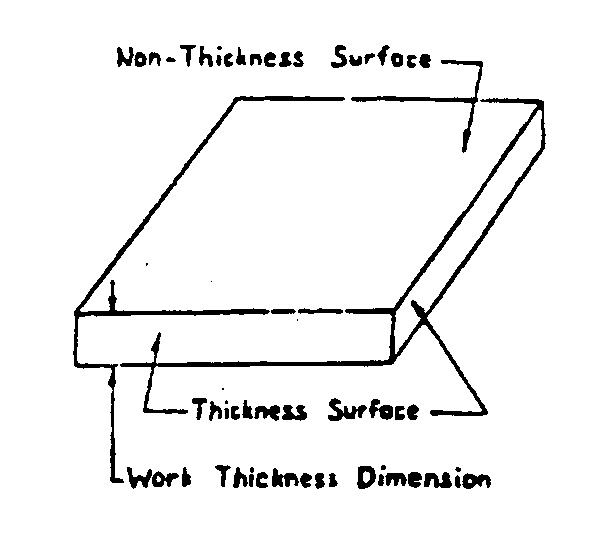
"Nonthickness Surface"; "ThicknessSurface"; "Work Thickness Dimension" |
| | (2)
Note. For a patent to be placed originally in this or indented
subclasses, it is not required that the contemplated type of cutting
be distinctly claimed. It is sufficient that the claimed means
be disclosed as functioning within the limitations above defined. |
| | (3)
Note. Where the tool operates to produce a mere indentation
or distortion of surface material (i.e., without severing the work
surface fibers), as for instance, by creasing, forging, or metal
rolling, or combines cutting with a significant material flow, as
for instance in sheet forming and in plastic working, then the patent
for such defined subject matter is excluded from this class and
will be classified in other classes according to material worked
on, type of operation performed, or machine disclosed. |
| | (4)
Note. Where the disclosed apparatus is directed to subject
matter as above defined but the claimed recitation is limited to
a cutter, per se, then the patent for such is originally placed
in a subclass of tools, per se (651+). |
| | (5)
Note. Where a tool element penetrates partially through the
thickness of a workpiece and thereafter continues to coact with
an opposed tool element, which opposed tool element completes the
severance of the workpiece in the cutting plane extended of the
first tool, then the combined cut through the work is considered
the same as the product of a single coacting tool pair and the patent directed
to such subject matter is excluded from this subclass and those indented
thereunder and will be found elsewhere in the schedule. However,
if the first said tool is withdrawn from the workpiece before the
complete severance occurs (i.e., no coaction occurs between said
elements) then the first tool element is considered to be a scorer means
and the opposed tool element a through cutter, and a patent disclosing same
is placed as an original copy in this or indented subclasses. |
| | (6)
Note. The main body of the class (subclasses 13+)
always should be included in the search for a particular process,
or apparatus, for cutting partially through the thickness of the
work, which process or apparatus additionally may be applied to
cutting entirely through the work thickness. |
SEE OR SEARCH CLASS:
| 12, | Boot and Shoe Making, appropriate subclasses for combined operations in making
footwear including cutting other than through the thickness of the material;
Class 101, Printing,
subclasses 3+ for related art in specific manufactures. |
| 69, | Leather Manufactures, for cutting and/or scoring method or means relating
to specific manufactures, particularly
subclasses 9+ and 21.5 the generic loci of patents directed to apparatus
and process, respectively, for splitting or skiving of leather. |
| 72, | Metal Deforming, appropriate die-pressing subclasses; e.g.,
subclasses 343+ for channeling, grooving, or partially penetrating
with a punchlike tool |
| 101, | Printing,
subclasses 3.1+ for related art in printing. |
| 493, | Manufacturing Container or Tube From Paper; or
Other Manufacturing From a Sheet or Web, appropriate subclasses for combined operations in making
a product from a sheet or web including cutting other than through the
thickness of the material. |
|
| | |
| 862 | Combined types of cutting: |
| | This subclass is indented under subclass 861. Method or apparatus including a first cutting action combined
with a second cutting action under the class definition wherein
the first cutting action is separately classified from the second
cutting action. |
| | |
| 863 | Including use of rotary scoring blade: |
| | This subclass is indented under subclass 862. Method or apparatus including use of a tool turning about
an axis to incise work (without removing material) by either (a)
penetration of a nonthickness surface, but to a depth insufficient
to reach an opposite nonthickness surface, or (b) penetration of
a thickness surface only to a depth insufficient to produce a lamina.
SEE OR SEARCH THIS CLASS, SUBCLASS:
| 886, | for scoring, per se, by a rotary blade. |
|
| | |
| 864 | Plural independent rotary scoring blades: |
| | This subclass is indented under subclass 863. Method or apparatus comprising use of a first cutting tool
that is generally planar and circular in shape, adapted to rotate
about an axis normal to the planar surface of the tool during cutting, including
a cutting edge extending generally about the circular perimeter;
and use of a second cutting tool that is also generally planar and
circular in shape, adapted to rotate about an axis normal to the
planar surface thereof during cutting, including a cutting edge
extending generally about the circular perimeter.
SEE OR SEARCH THIS CLASS, SUBCLASS:
| 884, | for apparatus including plural rotary scoring tools
not in combination with additional cutting means. |
|
| | |
| 865 | With infeeding of work: |
| | This subclass is indented under subclass 862. Method or apparatus including the step of or means for causing
the workpiece to move toward a tool to effect cutting of the workpiece. |
| | |
| 866 | Pricking: |
| | This subclass is indented under subclass 861. Method or apparatus wherein the tool utilized is pointed
and functions to pierce (without removing material) a single work
surface only, thus, forming a crater which generally conforms to
the shape of the tool.
SEE OR SEARCH CLASS:
| 12, | Boot and Shoe Making,
subclasses 17 and 42 for a sole or heel pricking device in a
shoe making machine. |
|
| | |
| 868 | With infeeding of tool: |
| | This subclass is indented under subclass 866. Method or apparatus including the step of or means for causing
the tool to move toward a workpiece to effect the cutting of the
workpiece. |
| | |
| 869 | Edge trimming (e.g., chamfering, etc.): |
| | This subclass is indented under subclass 861. Method or apparatus wherein the tool utilized functions
to remove a portion of work defined by the junction areas of a thickness
and a nonthickness face.
| | (1)
Note. Excluded from this subclass is a patent for a process
or apparatus for merely slitting such a junction area, as the operation
of slitting itself is not considered to entail removal of a work
portion. However, a patent may properly be placed herein where
a plurality of slitters coact to remove a portion of edge material. |
| | (2)
Note. In general, the patent of this subclass discloses removal
of a work portion planarly by a single tool. However, a patent directed
to the formation of an edge furrow or channel, by either a single
tool or multiple tools, would be admitted to this subclass. |
SEE OR SEARCH THIS CLASS, SUBCLASS:
| 875, | for a groover, broadly. |
| 879, | for a slitter, broadly. |
|
| | |
| 870 | Splitting: |
| | This subclass is indented under subclass 861. Method or apparatus wherein the tool utilized functions
to penetrate a thickness work surface only and is constrained in
its cutting stroke, or in its movement relative to the work to a
path lying between the nonthickness work surfaces so as to define
product laminae.
| | (1)
Note. It is not required that the tool proceed completely
through the work, i.e., width and/or longitudinal extent.
The requirement that laminae be produced is significant. |
| | (2)
Note. The definition of the term "splitting" may
be different in other arts; see, for instance, that relied on in
Class 69, Leather Manufactures, subclass 9 wherein a cutting path
parallel to the work surfaces is required. |
SEE OR SEARCH THIS CLASS, SUBCLASS:
| 879, | for a cutting tool which enters a thickness face
but fails to produce a lamina, as by merely cutting a groove. |
|
| | |
| 871 | By use of endless band or chain knife: |
| | This subclass is indented under subclass 870. Process or apparatus comprising use of (a) a cutting tool
that is made of a continuous strip of material forming a closed
loop and having a substantially continuous cutting edge on at least
one edge thereof wherein said continuous strip cutting tool is supported
to move along a closed path defined by said loop during cutting to
present a different portion of the cutting edge to the workpiece
without affecting the overall relationship of the cutting tool and
the workpiece; or (b) a series of pivotally interconnected, sequentially
acting cutting tools, each including a cutting edge arranged in
a closed loop so that each of the tools follows a preceding cutting
tool to cut in the manner of a continuous strip cutting tool.
SEE OR SEARCH THIS CLASS, SUBCLASS:
| 788, | for means for cutting, generally, by an endless
or chain knife. |
| 872, | for similar cutting by a circular blade having a
continuous cutting edge. |
|
| | |
| 872 | By use of rotary blade: |
| | This subclass is indented under subclass 870. Method or apparatus comprising use of a cutting tool that
is generally planar and circular in shape, adapted to rotate about
an axis normal to the planar surface of the cutting tool during cutting,
including a cutting edge extending generally about the circular
perimeter. |
| | |
| 873 | Plural independent rotary blades: |
| | This subclass is indented under subclass 872. Method or apparatus comprising use of a first cutting tool
that is generally planar and circular in shape, adapted to rotate
about an axis normal to the planar surface of the tool during cutting, including
a cutting edge extending generally about the circular perimeter;
and use of a second cutting tool that is also generally planar and
circular in shape, adapted to rotate about an axis normal to the
planar surface thereof during cutting, including a cutting edge
extending generally about the circular perimeter. |
| | |
| 874 | With infeeding of work: |
| | This subclass is indented under subclass 870. Method or apparatus including the step of or means for causing
the workpiece to move toward a tool to effect cutting of the workpiece. |
| | |
| 875 | Grooving: |
| | This subclass is indented under subclass 861. Method or apparatus including use of a tool comprising:
(a) a unitary member which includes a gouge element, the member
adapted to remove a section of the workpiece to define a furrow
or channel; or (b) coacting slitter elements (with or without a
cooperating gouge means) which coact to remove material and leave
a channel as above.
SEE OR SEARCH THIS CLASS, SUBCLASS:
| 869, | for grooving to trim an edge of a workpiece. |
| 917, | for a notching device. |
SEE OR SEARCH CLASS:
| 409, | Gear Cutting, Milling, or Planing,
subclasses 288+ for a grooving device and see the note in this
class (83) under the class definition, section II, Lines With Other
Classes, subsection A, paragraph 9, f. |
|
| | |
| 876 | By use of plural independent rotary blades |
| | This subclass is indented under subclass 875. By use of plural independent rotary blades: Method or apparatus
comprising use of a first cutting tool that is generally planar
and circular in shape, adapted to rotate about an axis normal to
the planar surface of the tool during cutting, including a cutting
edge extending generally about the circular perimeter; and use of
a second cutting tool that is also generally planar and circular
in shape, adapted to rotate about an axis normal to the planar surface
thereof during cutting, including a cutting edge extending generally
about the circular perimeter. |
| | |
| 877 | Forming common groove: |
| | This subclass is indented under subclass 876. Method or apparatus wherein the first cutting tool serves
to form a portion of the groove, the second cutting tool serves
to form a portion of the same groove, either simultaneously or sequentially. |
| | |
| 878 | Blades turning about perpendicular axes: |
| | This subclass is indented under subclass 876. Method or apparatus wherein the axes about which the cutting
tools turn are normal to each other when viewed along the direction
of relative infeed of the cutting tool and the workpiece. |
| | |
| 879 | Scoring: |
| | This subclass is indented under subclass 861. Method or apparatus including use of a tool to incise work
(without removing material) by either (a) penetration of a nonthickness
surface, but to a depth insufficient to reach an opposite nonthickness
surface, or (b) penetration of a thickness surface only to a depth
insufficient to produce a lamina.
| | (1)
Note. Annually scoring of a workpiece preparatory to breaking
a hole therethrough is included in this subclass. |
SEE OR SEARCH CLASS:
| 30, | Cutlery,
subclasses 164.9+ for a hand tool or a work supported tool for scoring
(or marking) material. |
| 33, | Geometrical Instruments,
subclasses 18.1+ for mechanically guided relatively travelling means
to mark work in a predetermined pattern, including scratching or
scoring, said subclasses have not been screened for patents fitting
the definition of this subclass. |
| 125, | Stone Working, appropriate subclass for a scoring device disclosed
as being adapted to mark natural material in or removed from the
ground. |
| 225, | Severing by Tearing or Breaking,
subclasses 96+ for an implement or machine for preliminarily weakening (as
by scoring) and subsequently breaking a workpiece. |
| 451, | Abrading, for a scoring device wherein marking is done by
the abrasive action of a natural cutting media (e.g., by the action
of a nonartificially formed diamond tipped tool). |
| 493, | Manufacturing Container or Tube From Paper; or
Other Manufacturing From a Sheet or Web,
subclasses 396+ for "scoring" of a sheet or web by
deforming rather than by cutting. |
|
| | |
| 881 | Active means to control depth of score: |
| | This subclass is indented under subclass 879. Apparatus wherein means are actuated to coact with such
tool to limit the extend of penetration thereof.
| | (1)
Note. The term "actuated means", contemplates
and requires more than a merely adjustable and otherwise fixed member. | |
| | |
| 882 | Serially: |
| | This subclass is indented under subclass 879. Apparatus wherein means are provided to score sequentially,
a single workpiece, by either the same or multiple tools.
SEE OR SEARCH THIS CLASS, SUBCLASS:
| 881, | for repetitive and alternative cutting and scoring
by the same tool. |
|
| | |
| 883 | Plural independent scoring blades: |
| | This subclass is indented under subclass 879. Apparatus including a first incising tool and a second,
separately supported, incising tool.
SEE OR SEARCH THIS CLASS, SUBCLASS:
| 869, | and 875+, for grooving by coacting plural
tools. |
| 882, | for plural scorers operated sequentially. |
|
| | |
| 884 | Rotary scoring blades: |
| | This subclass is indented under subclass 883. Apparatus comprising a first cutting tool that is generally
planar and circular in shape, adapted to rotate about an axis normal
to the planar surface of the tool during cutting, including a cutting
edge extending generally about the circular perimeter; and a second
cutting tool that is also generally planar and circular in shape,
adapted to rotate about an axis normal to the planar surface thereof
during cutting, including a cutting edge extending generally about
the circular perimeter.
SEE OR SEARCH THIS CLASS, SUBCLASS:
| 864, | for the method or apparatus for cutting by plural
rotary cutting tools combined with additional cutting of a different
type. |
|
| | |
| 885 | On opposite sides of work: |
| | This subclass is indented under subclass 884. Apparatus wherein the first cutting tool serves to incise
a first surface of the workpiece and the second cutting tool serves
to incise the workpiece from the surface thereof that is directly
across the workpiece from the first surface, so that the cutting
action of the first tool approaches the second tool and the cutting action
of the second tool approaches the first tool. |
| | |
CROSS-REFERENCE ART COLLECTIONS
The following subclasses are collections of published disclosures
pertaining to various specified aspects of the cutting art which
aspects do not form appropriate bases for subclasses in the foregoing
classification (i.e., subclasses superior hereto in the schedule),
wherein original copies of patents are placed on the basis of proximate
function of the apparatus. These subclasses assist a search based
on remote function of the apparatus and may be of further assistance
to the searcher, either as a starting point in searching this class
or as an indication of further related fields of search inside or
outside the class. Thus, there is here provided a second access for
retrieval of a limited number of types of disclosures.
| | (1)
Note. Disclosures are placed in these subclasses for their
value as references and as leads to appropriate main or secondary
fields of search, without regard to their original classification
or their claimed subject matter. |
| | (2)
Note. The disclosures found in the following subclasses are
examples, only, of the indicated subject matter, and in no instance
do they represent the entire extent of the prior art. |
| 901 | APPAREL COLLAR MAKING: |
| | Cutting blanks from web material for use as collars. |
| | |
| 902 | ATTACHMENTS FOR OTHER TYPES OF MACHINE: |
| | A cutting device mounted on and driven by or in timed relation
to a machine which is not of the cutting type.
| | (1)
Note. A disclosure of an attachment for cutting up waste
product from a cutting machine is found in subclass 923. The attachments
disclosed in publications of this subclass (902) serve other purposes, such
as performing a cutting operation on work before, during, or subsequent
to its processing in the principal machine. |
SEE OR SEARCH THIS CLASS, SUBCLASS:
| 923, | for waste product cutting; and see (1) Note, above. |
SEE OR SEARCH CLASS:
| 112, | Sewing,
subclasses 122+ , for a trimmer combined with a sewing machine;
and subclasses 285-301, for a thread cutter combined with a sewing
machine. |
|
| | |
| 903 | BATTERY GRID TRIMMING: |
| | Severing excess material (flash, etc.) from a cast grid
for a storage battery, usually in one operation by appropriately
formed shearing dies.
| | (1)
Note. Battery grid trimming is usually a typical die-cutting
operation, characterized by special facilities for handling the work
and product rapidly and efficiently by making use of projecting
lugs on the double-grid castings. |
SEE OR SEARCH THIS CLASS, SUBCLASS:
| 268, | for disclosures of machine in which work slides
by gravity against a gauge or stop in the tool zone. |
| 914, | for flash trimming in general. |
SEE OR SEARCH CLASS:
| 29, | Metal Working,
subclass 2 , for battery grid making. |
|
| | |
| 904 | BOOK INDEX CUTTING: |
| | Cutting a thumb index notch or overlapping cutout portions
of different extents in the edges of book pages.
SEE OR SEARCH THIS CLASS, SUBCLASS:
| 917, | for notching in general. |
|
| | |
| 905 | BUTTONHOLE MAKING: |
| | Cutting a closed-end slit or slot in flexible material for
use as a button hole.
SEE OR SEARCH CLASS:
| 112, | Sewing,
subclasses 65+ for buttonhole making in general. |
|
| | |
| 906 | CHIP MAKING: |
| | Cutting solid material into shreds, flakes, pellets, or
dice of fairly uniform shape and size.
| | (1)
Note. This process is often termed "pelletizing". |
SEE OR SEARCH CLASS:
| 29, | Metal Working,
subclasses 4.51+ for shredding metal; e.g., metal wool making. |
| 241, | Solid Material Comminution or Disintegration, appropriate subclasses, for comminution in general. |
|
| | |
| 907 | COILED WIRE CUTTING: |
| | Severing wire while it is in the form of a substantially
helical coil; e.g., cutting coil springs to length.
| | (1)
Note. The peculiar problems involved in feeding, gauging,
holding, and cutting the wire in coiled form tend to impart special
characteristics to these machines not found in straight wire cutters. |
SEE OR SEARCH CLASS:
| 140, | Wireworking, appropriate subclasses, for cutting coiled wire
combined with other article-manufacturing step(s). |
|
| | |
| 908 | COMB, RAKE, OR OTHER TOOTHED ARTICLE MAKING: |
| | Producing an article having salient portions, by cutting
away the waste portions therebetween.
| | (1)
Note. The articles are often produced in pairs, the waste
from one article being left intact to constitute the salient portions
of the other article. |
SEE OR SEARCH CLASS:
| 29, | Metal Working, appropriate subclasses, for manufacture of toothed metallic
articles. |
| 76, | Metal Tools and Implements, Making, appropriate subclasses, for saw blade making. |
| 409, | Gear Cutting, Milling, or Planing,
subclasses 1+ for gear cutting, generally. |
|
| | |
| 909 | CUTTING STRAND EXTENDING FROM OR LYING ON STRAND OR PACKAGE SUPPORT: |
| | Severing a filament (thread, wire, etc.) which projects
from or is attached to an article.
| | (1)
Note. Device disclosed as cutting thread to strip a bobbin
is found in Class 28, Textiles: Manufacturing subclass 295. |
SEE OR SEARCH CLASS:
| 30, | Cutlery, appropriate subclasses, for a thread or string cutter. |
| 242, | Winding, Tensioning, or Guiding,
subclasses 487.1+ for a disclosure of cutting a strand following
the operation of winding it on a holder. |
| 445, | Electric Lamp or Space Discharge Component or
Device Manufacturing,
subclasses 23+ for a disclosure of severing surplus lead wire
from the base of a lamp bulb or discharge tube, combined with other
operation(s). |
|
| | |
| 910 | EMBROIDERY TRIMMING OR CUTTING: |
| | Severing surplus base fabric extending beyond the limits
or contour of an embroidered design.
| | (1)
Note. This operation is analogous to flash trimming, for
which search subclass 914, but is often accomplished by incidental
distortion of the material, a feature not found in trimming solid objects
such as rubber heels. |
SEE OR SEARCH THIS CLASS, SUBCLASS:
| 914, | for flash trimming, generally. |
|
| | |
| 911 | ENVELOPE BLANK FORMING: |
| | Performing die cutting, or a succession of cutting and notching
operations, to produce a flat piece of paper of suitable contour
for later folding and gluing into envelope form.
SEE OR SEARCH THIS CLASS, SUBCLASS:
| 300, | and 303, for an envelope blank cutter of the flying
type. |
SEE OR SEARCH CLASS:
| 493, | Manufacturing Container or Tube From Paper; or
Other Manufacturing From a Sheet or Web,
subclasses 186+ for an envelope machine in general. |
|
| | |
| 912 | ENVELOPE OPENERS: |
| | Cutting through an envelope adjacent one edge thereof so
as to gain access to its contents without damaging them.
SEE OR SEARCH THIS CLASS, SUBCLASS:
| 418, | for an envelope opener provided with a work locator. |
SEE OR SEARCH CLASS:
| 30, | Cutlery, appropriate subclasses, for an envelope opening
device with movable cutting blade. |
|
| | |
| 913 | FILAMENT TO STAPLE FIBER CUTTING: |
| | Cutting a continuous filament or rope of filaments into
predetermined short lengths (preparatory to spinning into yarn,
or other textile operation).
| | (1)
Note. The staple length may be constant; or the machine may
be designed to produce periodically fluctuating lengths, or graduated
lengths within a predetermined range. |
SEE OR SEARCH THIS CLASS, SUBCLASS:
| 403, | for a Beria-type cutter. |
SEE OR SEARCH CLASS:
| 19, | Textiles: Fiber Preparation,
subclasses .3+ for continuous "tow-to-top" stabilizing
method or means; or for staple fiber producing method or means combined
with a mechanical textile process or apparatus. |
|
| | |
| 914 | FLASH TRIMMING: |
| | Severing the flash, fin, sprue or other excess material
from a cast, forged or molded article.
| | (1)
Note. The flash trimming operation may be carried out by "recutting" the
article in a finishing die; or the article may be manipulated or
moved in proximity to a relatively small cutting tool equipped with
a work guide to protect the finished edge of the work (for which,
see subclass 445). |
SEE OR SEARCH THIS CLASS, SUBCLASS:
| 445, | and see (1) Note above. |
SEE OR SEARCH CLASS:
| 59, | Chain, Staple, and Horseshoe Making,
subclass 29 for means for trimming flash from a chain link. |
|
| | |
| 915 | FUR CUTTING: |
| | Severing animal pelts.
| | (1)
Note. Fur cutters often are characterized by the provision
of special work-holding means, such as impaling or gripping pins,
and devices to hold the hair out of the path of the moving tool.
Frequently, the cut is made along a zigzag line (see subclass 918,
pinking). |
SEE OR SEARCH THIS CLASS, SUBCLASS:
| 333, | for a pinking wheel. |
| 374+, | and 451+, for work-immobilizer other than
a clamp (e.g., impaling pin(s), or suction gripper). |
| 918, | for pinking in general, and see (1) Note above. |
SEE OR SEARCH CLASS:
| 69, | Leather Manufactures, appropriate subclasses, for a fur working method or
apparatus, in general. |
|
| | |
| 915.3 | ICE CUTTING MACHINES: |
| | Machines for cutting larger masses of ice into smaller blocks
or cubes. |
| | |
| 915.5 | MICROTOME: |
| | Cutting thin sections, usually of organic tissue, for microscopic
examination.
SEE OR SEARCH THIS CLASS, SUBCLASS:
| 170, | for a device having means to modify the temperature
of a part of the device or the work. |
| 401, | for a device having means to move the work to and/or
against the tool. |
| 409+, | for a device having means to hold the work on a
work carrier which moves the work to and/or against the
tool. |
| 699.51, | for a device having means to adjustably hold the
tool. |
|
| | |
| 916 | NIBBLING: |
| | Severing work along a desired line of cut by means of successive
overlapping notches with relative movement between the work and
tool between each notching cut.
| | (1)
Note. Work may be severed along a desired line of cut by
means of overlapping slitting cuts, without removal of material.
Disclosures of machines for doing work of this slitting type may
be found, together with nibbling machines, in subclass 237. |
SEE OR SEARCH THIS CLASS, SUBCLASS:
| 237, | and 249, for nibbling machine of the subclass 202
type. |
| 556+, | for tool positioning means synchronized with cutting
stroke (such tool may make overlapping cuts on stationary workpiece). |
| 565, | for template-surface-following tool. |
| 917, | and associated search notes, for notching. |
|
| | |
| 917 | NOTCHING: |
| | Cutting one or more products from one edge of a workpiece,
leaving portions of the original edge intact.
| | (1)
Note. A notch is a nonlinear cut through the thickness of
a workpiece, extending inwardly from one edge of the workpiece and
returning to the same edge. |
| | (2)
Note. The notch may be cut in an exterior or an interior
edge of work. |
| | (3)
Note. The severing of work along a desired line of cut by
a succession of overlapping notches is called "nibbling", for
which see subclass 916 of this class; or, if done in the form of
a nonlinear repetitive pattern which leaves none of the original
edge intact, is called "pinking" or "scalloping",
for which see subclass 918. |
| | (4)
Note. Key cutters (notchers) are found here, rather than
in subclass 908. |
SEE OR SEARCH THIS CLASS, SUBCLASS:
| 651+, | for a notching tool, per se. |
| 904, | 908, 916, 918, for other disclosures of notching
or similar operations. |
| 911, | for notching associated with envelope blank forming. |
| 926, | for fringing or slashing (no product removed), or
corner cutting. |
SEE OR SEARCH CLASS:
| 30, | Cutlery, for a notching implement. |
| 234, | Selective Cutting (e.g., Punching),
subclasses 47+ , for a selective card-notching device. |
| 409, | Gear Cutting, Milling, or Planing,
subclasses 1+ for gear cutting, generally. |
|
| | |
| 918 | PINKING: |
| | Severing work into two products by a nonlinear, generally
zigzag, repetitive pattern cut upon a portion of the work other
than its edge.
| | (1)
Note. This subclass includes scalloping, and is not restricted
to cutting any particular work (such as textile fabric). |
| | (2)
Note. See (3) Note, in subclass 917, supra. Pinking does
not include the severance, from an edge of the work, of one or more
generally triangular pieces so as to leave a recognizable part of
the original edge. |
SEE OR SEARCH THIS CLASS, SUBCLASS:
| 333, | for a pinking wheel. |
| 904, | 915, 917, for a notching operation. |
SEE OR SEARCH CLASS:
| 30, | Cutlery, for a pinking implement (shears). |
|
| | |
| 919 | SAMPLE TAKING: |
| | Cutting a small piece, or sample, from a workpiece which
may be stationary, in motion, or undergoing treatment in some stage
of a manufacturing process.
| | (1)
Note. Some cutting machines are capable of taking samples
by modification of their normal cutting cycle, when desired, by
intervention of the operator. (See subclass 57). |
SEE OR SEARCH THIS CLASS, SUBCLASS:
| 57, | for cyclic operation disturbed by manually actuated
means; and see (1) Note, above. |
SEE OR SEARCH CLASS:
| 73, | Measuring and Testing,
subclasses 421+ for a sampler or toller in general. |
|
| | |
| 920 | SHINGLE MAKING: |
| | Cutting roofing shingles from a web of composition material.
SEE OR SEARCH THIS CLASS, SUBCLASS:
| 300, | and 303, for flying-type shingle cutter. |
| 704+, | for a wood-shingle cutting device wherein the work
is moved in two directions along a path parallel in to the plane
of cut and in a direction transverse to the plane of cut. |
|
| | |
| 921 | SLIDE FASTENER CUTTING: |
| | Means for cutting continuous slide fastener stock to desired
length and/or gapping the product, i.e., cutting away the
lugs or stringer scoops in certain areas.
| | (1)
Note. Gapping is the removal of lugs or fastener elements
from the tape throughout a desired area, to facilitate subsequent
sewing of the tape to fabric or articles of clothing. It is usually
accomplished by shearing through the lugs and brushing the remnants
loose from the tape. |
SEE OR SEARCH CLASS:
| 29, | Metal Working,
subclasses 33.2 and 408+, for slide fastener manufacturing. |
|
| | |
| 922 | TACKY WEB CUTTING: |
| | Cutting of sticky or tacky material, usually in tape form.
| | (1)
Note. The web-contacting parts of a tacky web handling machine
are usually of special design to facilitate passage of the web through
the machine, without sticking or jamming or the accumulation of
adhesive on the machine parts. |
SEE OR SEARCH THIS CLASS, SUBCLASS:
| 28, | for method of handling a tacky product after cutting. |
| 276, | for a work-feed element which contacts and moves
with work (which work may comprise tacky tape). |
SEE OR SEARCH CLASS:
| 225, | Severing by Tearing or Breaking, appropriate subclasses, particularly
subclasses 24 , 25 and 57, for a device for severing a tacky tape
by tearing or breaking. |
|
| | |
| 923 | WASTE PRODUCT CUTTING: |
| | Cutting up the scrap or undesired portion of the product
of a cutting or other treating machine as to facilitate its storage
or disposal.
| | (1)
Note. The scrap cutter may consist of a more or less complete
cutting machine attached to and driven with or by the principal
machine, or it may be merely one or more cutting elements added
to an actuated tool of the machine, to cut up the scrap simultaneously
with formation of the desired product. |
| | (2)
Note. The term "waste product" refers to
a by-product in process of being turned out by a treating machine. |
SEE OR SEARCH THIS CLASS, SUBCLASS:
| 906, | for a disclosure relating to chip or particle making. |
|
| | |
| 924 | WORK WRAPPED OR COATED AROUND A CORE (NOT PART OF THE MACHINE): |
| | Cutting work presented in the form of a coil, coating, or
layer surrounding a central element which is to be left uncut.
| | (1)
Note. Examples: wire insulation stripper, cable sheath cutter,
means to cut wire hood holder on milk bottle. |
SEE OR SEARCH THIS CLASS, SUBCLASS:
| 909, | for cutting a strand extending from a package or
support. |
SEE OR SEARCH CLASS:
| 28, | Textiles: Manufacturing,
subclasses 292+ for bobbin strippers, in general. |
| 242, | Winding, Tensioning, or Guiding, appropriate subclasses, for winding and cutting
the so wound material. |
|
| | |
| 927 | PRINTER"S RULE CUTTING: |
| | Device for cutting, scoring, or grooving a printer"s
rule in the manufacture thereof. |
| | |
| 928 | VEHICLE-MOUNTED TOOL: |
| | A cutting tool carrier which is supported on a conveyance
which is driven or traversed over the ground or other horizontal
surface to the location where the tool is to be used.
SEE OR SEARCH CLASS:
| 30, | Cutlery,
subclass 379 for a vehicle mounted saw wherein the saw support and
vehicle are moved together randomly with respect to work during cutting;
and subclass 379.5 for a vehicle mounted saw wherein the saw support
structure moves relatively to the vehicle and randomly relatively
to the work during cutting. |
| 144, | Woodworking,
subclasses 34.1+ for cutting structure that is vehicle mounted and
is combined with means such as a tree pusher to assist the cutter
operation in tree felling. |
|
| | |
| 929 | PARTICULAR NATURE OF WORK OR PRODUCT: |
| | Performing a cutting operation (1) on work which possesses
unusual or unique characteristic, or (2) producing a product having
an unusual or unique characteristic.
| | (1)
Note. A disclosure may be placed in this subclass because
of: (a) an unusual feature of the machine adapting it to handle a
particular kind of work, or (b) unusual or particular work, per
se, (e.g., a germanium wafer for transistor manufacture, or a banknote
voided by a cutting action). | |
| | |
| 929.1 | Printed circuit board: |
| | This subclass is indented under subclass 929. A collection of art relating to cutting or punching of a
generally planar sheet on which an integral electrical conductor
has been, or is intended to be, provided. |
| | |
| 930 | Radioactive: |
| | This subclass is indented under subclass 929. Performing a cutting operation, wherein the work or product
radiates alpha or beta particles.
| | (1)
Note. The material of this subclass commonly comprises spent
nuclear fuel rods. | |
| | |
| 931 | Tobacco: |
| | This subclass is indented under subclass 929. Performing a cutting operation, wherein the work or product
is tobacco or tobaccolike material. |
| | |
| 932 | Edible: |
| | This subclass is indented under subclass 929. Performing a cutting operation, wherein the work or product
is suitable for consumption by a man or an animal.
| | (1)
Note. Chewing gum is considered to be "edible". | |
| | |
| 934 | Book, being made; e.g., trimming a signature: |
| | This subclass is indented under subclass 929. Performing a cutting operation, wherein the work comprises
sheets of paper being cut, as part of assembling or otherwise forming
an assembly of the sheets for subsequent viewing.
| | (1)
Note. Cutting performed during rebinding a book is included
herein. | |
| | |
| 935 | Endless band: |
| | This subclass is indented under subclass 929. Performing a cutting operation, wherein the work or product
is doubled back on itself so that it has no beginning and no end.
| | (1)
Note. The work may comprise a tube which is cut perpendicularly
to its axial extent to form an endless band. | |
| | |
| 936 | Cloth or leather: |
| | This subclass is indented under subclass 929. Performing a cutting operation wherein the work or product
is woven from strands or is made of cured animal skin.
| | (1)
Note. Cutting a shoe heel, sole or upper is included in this
art collection and those indented hereunder, even if the heel, sole
or upper is made of material other than cloth or leather. | |
| | |
| 937 | From continuous or wound supply: |
| | This subclass is indented under subclass 936. Performing a cutting operation including means to supply
work such that there is no recognized terminal end of the work;
or including means to advance the lead end of a coil of work. |
| | |
| 938 | Moving cloth or leather: |
| | This subclass is indented under subclass 936. Performing a cutting operation including provision to allow
movement of the work during the cutting operation.
SEE OR SEARCH THIS CLASS, SUBCLASS:
| 952, | for similar structure, wherein the work is not restricted
to cloth or leather. |
|
| | |
| 939 | With work support: |
| | This subclass is indented under subclass 936. Performing a cutting operation including means to hold the
work against the force of gravity during the cutting operation.
| | (1)
Note. Cutting a shoe heel, sole or upper is included in this
art collection and those indented hereunder, even if the heel, sole
or upper is made of material other than cloth or leather. |
SEE OR SEARCH THIS CLASS, SUBCLASS:
| 953, | for similar art collection wherein the work is not
limited to cloth or leather. |
|
| | |
| 940 | Cutter moves along bar, bar moves perpendicularly: |
| | This subclass is indented under subclass 939. Performing a cutting operation including an elongated member
to support the cutting tool with provision to allow movement of
the cutting tool there along, and including means to support the
elongated member with provision to allow movement of the elongated
member at a right angle with respect to its elongated extent. |
| | |
| 941 | Work support comprising penetratable bed: |
| | This subclass is indented under subclass 940. Performing a cutting operation wherein the means to hold
the work against the force of gravity is made of material that can
be readily entered by the cutting tool, without damage to that material. |
| | |
| 942 | Contact pin of electrical component: |
| | This subclass is indented under subclass 929. Performing a cutting operation wherein the material being
cut comprises an assembly for transmission and utilization of electrical
energy which assembly has an elongated connection terminal which
is trimmed. |
| | |
| 943 | Pallet: |
| | This subclass is indented under subclass 929. Performing a cutting operation wherein the material being
cut comprises an assembly made for support of material above a subordinate
supporting surface, the cutting operation comprising severing one
component of the assembly from another. |
| | |
| 944 | Syringe needle: |
| | This subclass is indented under subclass 929. Performing a cutting operation wherein the work comprises
a tubular rod previously intended for penetration of skin to transmit fluid
there beneath. |
| | |
| 945 | Separating connected articles: |
| | This subclass is indented under subclass 929. Performing a cutting operation wherein the work comprises
a web carrying a series of distinct elements (usually similar elements)
comprising cutting the web to allow one of the elements to be moved
away from another. |
| | |
| 946 | Container: |
| | This subclass is indented under subclass 929. Performing a cutting operation wherein the work or product
includes a chamber intended for storage of material.
| | (1)
Note. A land or water vessel, or building is not considered
to be a container for placement herein. | |
| | |
| 947 | Insulation about wire: |
| | This subclass is indented under subclass 929. Performing a cutting operation wherein the work comprises
a nonconductive sheath encasing a conductive strand comprising cutting
the sheath without cutting the strand. |
| | |
| 949 | Continuous or wound supply: |
| | This subclass is indented under subclass 929. Performing a cutting operation including means to supply
work such that there is no recognized terminal end of the work,
or including means to advance the lead end of a coil of work. |
| | |
| 950 | Strandlike: |
| | This subclass is indented under subclass 949. Performing a cutting operation wherein the work or product
is generally elongated and round in cross-section. |
| | |
| 951 | Rubber tire: |
| | This subclass is indented under subclass 929. Performing a cutting operation wherein the work comprises
an annular polymeric member for fitting about a wheel and carrying
a load. |
| | |
| 952 | Moving work: |
| | This subclass is indented under subclass 929. Performing a cutting operation including provision to allow
movement of the material being cut during the cutting operation.
SEE OR SEARCH THIS CLASS, SUBCLASS:
| 938, | for a similar collection wherein the material is
cloth or leather. |
|
| | |
| 953 | With work support: |
| | This subclass is indented under subclass 929. Performing a cutting operation including means to hold the
material being cut against the force of gravity during the cutting
operation.
SEE OR SEARCH THIS CLASS, SUBCLASS:
| 939+, | for similar art collection wherein the work material
is cloth or leather. |
|
| | |
| 954 | KNIFE CHANGING: |
| | Performing a cutting operation including provision to allow
replacement of the component having a sharp cutting edge. |
| | |
| 955 | CUTTER EDGE SHIFTABLE TO PRESENT DIFFERENT PORTION OF EDGE: |
| | Performing a cutting operation including provision to allow
repositioning of the component having a sharp cutting edge to utilize
a previously unused portion thereof. |
| | |
| 956 | ULTRASONIC: |
| | A collection of art relating to cutting by use of high frequency
energy.
| | (1)
Note. These frequencies are generally considered to be greater
than the highest frequency discernible to the human ear. | |
| | |
FOREIGN ART COLLECTIONS
The definitions for FOR 100 - FOR 102 below correspond
to the definitions of the abolished subclasses under Class 83 from
which these collections were formed. See the Foreign Art Collection
schedule for specific correspondences. [Note: the
titles and definitions for indented art
collections include all the details of the one(s) that are hierarchically
superior.] |
| FOR 100 | By work moving carriage: |
| | Foreign art collection wherein the work moving means
is of rigid construction and is adapted to support the work against
gravity and which support moves relative to the tool station in
a fixed rectilinear path. |
| | |
| FOR 101 | By feed roller: |
| | Foreign art collection in which the work-moving
means itself moves in the arc of a circle in peripheral engagement
with the work, thereby moving the work in a straight path. |
| | |
| FOR 102 | Rectilinear movement only: |
| | Foreign art collection in which the work-moving
means itself moves in a straight line while in engagement with the
work. |
| | |
![[Search a list of Patent Appplications for class 83]](../as.gif) CLASS 83,
CLASS 83,