SECTION I - CLASS DEFINITION
Introductory Notes
| | (1)
Note. This is a restricted class for the art of elongated-member-driving
apparatus as defined above. For original placement of a patent
in this class, its claimed disclosure should meet the minimum requirements
of the class definition, and should fall within the boundaries expressed
in the sections "Scope of the Class", "Other
Classes With Elongated Member Driving Means", "Relationship
to Combination Classes," "Relationship to Subcombination
Classes", and "Other Class Relationships" below. |
| | (2)
Note. The term "member", appearing throughout
this class definition, is a defined term in this class (see Glossary),
denoting an elongated object to be driven; usually, but not necessarily
disclosed as a nail, stud, staple, or the like. |
| | (3)
Note. Terms followed by an asterisk (*) will be found
defined in the Glossary. Throughout this class definition, certain very
frequently appearing terms, such as work, product, member, and driver,
are accompanied by the asterisk only where the exact meaning of
the term is deemed particularly important.
Main Class Definition
This class provides for a device comprising a pushing or driving
element, disclosed as being guided for movement in a predetermined
path and as being effective (1) to engage a member, or end portion
of indeterminate length material, and (2) to impart translatory
motion to the same with respect to a workpiece, or to engage a workpiece and
to translate the same or a portion thereof with respect to a member;
said member or said end portion comprising a pointed and/or
generally elongated rod-like or tubular projection substantially
aligned with the direction of such translatory motion, said pushing
or driving element serving, in either case, to initiate and/or increase
a penetrating relationship between said workpiece and member (or
workpiece and end portion); and further comprising at least one
of the following: means to (a) modify, (b) position or (c) support,
a workpiece or member.
Scope of the Class
The subject matter of this class relates to apparatus for
applying a member (having an elongated rod-like or tubular projection) to
one or more workpieces by relative movement between the member and
the workpiece generally in the direction of a projection of the
member.
A patent claiming apparatus for driving a member may be excluded
from the class because of additional claimed subject matter, not
expressly covered in the subclass titles and definitions. See Lines
With Other Classes, below |
SECTION II - LINES WITH OTHER CLASSES AND WITHIN THIS CLASS
A patent claiming apparatus for driving a member may be excluded
from the class because of additional claimed subject matter, not
expressly covered in the subclass titles and definitions. Claimed
subject matter which bars a patent from original placement in Class 227
may be summarized as follows (see below for a more detailed discussion):
A method of applying a member, for which see Class 29, Metal
Working, subclasses 592+.
Apparatus for positively rotating a member during driving.
Apparatus for applying a clip, edge binding or hog ring (for
which see Classes 29, Metal Working, and 72, Metal Deforming),
except where there is bodily movement of the clip, etc., along a
line in extension of a pointed portion of the clip, etc., during
work penetration. A patent to the latter type of device is proper
for Class 227.
A means for performing a particular operation or for making
a special product, which is recognized as subject matter of some
other existing class, e.g., pile-driver, boot, or shoe making machine,
etc., for which see the Index to Classification under the heading
of the operation performed or product made.
Means for treating a product made by a device of this class.
RELATIONSHIP TO OTHER CLASSES CONTAINING ELONGATED MEMBER
DRIVING MEANS, PER SE
Prefatory Note
Class 227, "Main Class Definition" limits
the movement of the member or work, imparted to it directly by a driver,
to a rectilinear path but permits the member or work to turn; however,
a positive means to rotate the member or work is excluded from Class
227 (see "Other Class Relationships," below, for
loci of patents claiming positive means to rotate a member or work).
Ordnance Classes
A patent claiming a firearm is placed in the appropriate ordnance
class, unless it teaches that a barrel is intended to be in contact
with work when the device is fired to propel a member, in which
case the patent is proper for Class 227. See Class 42, Firearms,
and Class 89, Ordnance.
The Class Of Tools
Generally, a hand-wielded hammer is proper subject matter
for Class 81, Tools. However, where there is claimed means to permit
a device (e.g., hammer-head) to move relative to handle, other than
by a whipping or bending of the handle (which is subject matter
for Class 81), placement of the patent is proper in Class 227, subclass
133. See the prefatory note, above, regarding the exclusion of
member-rotating means (e.g., a screw driver) from this class.
Earthworking Or Particular-work Treating Classes
A patent claim directed to means for driving a member into
the earth or into certain specified kinds of work will be placed
in the class providing for such earthworking or for operations on
such work. See References to Other Classes below for examples of
typical subject matter.
Tool Actuation
A patent claim directed only to apparatus for causing a driver
to move a member, will be placed in Class 173, Tool Driving or Impacting.
RELATIONSHIP TO COMBINATION CLASSES
Prefatory Note
Class 227 is the locus for a patent claiming a combination
of means to drive a member (e.g., nail) with any of the following:
(1) means to perform a different operation on work prior to the
member-driving operation, except for some special combinations in
other classes, as noted below; or (2) means to treat a member or
mating-member* before, during or after a class- type operation
(e.g., clinching a driven nail) and including making or forming
of such member; or (3) means to handle or cut the product of a
class type operation; or (4) a device or feature, per se, classifiable
in another class.
Classes Of Particular Work Or Product
As stated generally in the Prefatory Note of this section, a
patent claim directed to a combination of means to assemble or treat
work, with means to drive a member, is generally in Class 227, except
where the combination is specifically provided for in another class
based on the nature of the work.
For examples of such classes (or portions of classes) which
are loci of patents to such combination, see References to Other
Classes, below.
Classes Of Assembly Apparatus
Class 227 in the locus of patents directed to the combination
of member-driving apparatus with apparatus for assembling workpieces,
with the following exceptions: (a) a patent claim directed to apparatus
for treating (other than by cutting; a product consisting of work-pieces
that have been assembled by an operation of the class type, is found,
for example, in Class 29, Metal Working, or Class 118, Coating
Apparatus; (b) a patent claim directed to apparatus for either filling
a receptacle, or for assembling workpieces or articles and bonding
or strapping the assembled workpieces or articles, combined with
apparatus for driving a member; which is proper for the appropriate
packaging or wrapping class, principally Class 53, Package Making,
and Class 100, Presses.
The following list of classes, in addition to those listed in "Classes
Of Particular Work Or Product" above, illustrates the location
of patented art involving means for driving a member, in combination
with assembly apparatus: Class 29, Metal Working, subclasses 33+; Class
53, Package Making; Class 100, Presses, subclasses 1+.
The Class Of Adhesive Bonding
Class 227 is the locus of patents directed to the combination
of apparatus for applying a cement, for securing purposes, to a
workpiece and means to drive a member into said workpiece, (or apparatus
for applying cement to a member and driving the cemented member
into a workpiece).
A patent directed to the method followed by the above apparatus
is excluded from Class 227 and is placed in Class 156, Adhesive
Bonding and Miscellaneous Chemical Manufacture.
Miscellaneous Combinations
A patent to the combination of member-driving apparatus with
manufacturing or nonmanufacturing apparatus, not provided for in
other classes (as, for instance, those classes set forth in "Classes
Of Assembly Apparatus" and "Class Of Adhesive
Bonding", above, or in preceding subclasses of this class,
will be found in this class (227), subclass 156.
RELATIONSHIP TO SUBCOMBINATION CLASSES
Classes Of Apparatus For Making A Member (e.g., Nail, Rivet,
etc.)
A patent claiming the combination of apparatus for making
a member with means to drive the member will be found in Class 227,
subclasses 33 or 82+. A patent claiming apparatus for
making a member, per se, may be found in one of the following classes:
59, Chain, Staple, and Horseshoe Making, subclasses 71-77
for making a staple
72, Metal Deforming, subclasses 324 to 341 and 343 to 378
for eyelet making
470, Threaded, Headed Fastener, or Washer Making: Process
and Apparatus, subclasses 27+ for methods of making a rivet
or nail and subclasses 110+ for machines of making a rivet
or nail.
Work Or Product Handling Classes
A patent claiming specific means to drive a member (e.g.,
nail) in combination with means to handle work or product is placed
in Class 227. However, a patent claiming a device for handling
work or product, per se, or in combination with a merely named driving
means (e.g., "stapler", "nailer"),
will be found in the proper material or article handling class.
But if there is claimed means to synchronize a work or product
handling device with a driving device (e.g., stapler), whether claimed specifically
or by name only, the patent will be placed, as an original copy,
in this class (227).
See References to Other Classes, below for a sample of classes
directed to material or article handling means.
Classes Of Heading Apparatus
A patent claiming means to drive a member (e.g., rivet) with
means to head the member will be found in this class (227), subclasses
51+. However, a patent claiming means to head a member,
in the absence of a limitation to driving means, will be found in
Class 72 if no assembly apparatus is recited, otherwise in Class
29 (see Lines With Other Classes and Within This Class for Class
72 for the line between Classes 29 and 72 in this respect).
Classes Relating To Tool Actuation
A patent claiming means to drive a member (e.g., nail) in
combination with means to guide, modify, position or support the
member or a workpiece is proper for Class 227. However, a patent
claiming mere actuating means, or means to move a nominally recited
driver (e.g., "nailer") will be placed in a class
appropriate to the power source or transmission means.
See References to Other Classes, below for a sample of classes
directed to such tool actuation subcombinations.
Classes Relating To Cutting Means
A patent claiming means to cut work, product, or a member
(e.g., nail, before or after driving), in combination with means
to drive a member, is proper for Class 227. However, a patent claiming
only means to cut may be found in one of the following classes:
Class 83, Cutting
Class 408, Cutting by Use of Rotating Axially Moving Tool.
The Class Of Pressing (Class 100)
A patent claiming means to apply a lid by pressing in combination
with means to apply a member thereto is proper for Class 227. However,
a patent claiming only means for applying a lid by pressure will
be found in Class 100, Presses, subclasses 54 to 64.
The Class of Implements or Apparatus For Applying A Pushing
Or Pulling Force (Class 254).
A patent claiming means to apply and means to withdraw a member
is proper for Class 227. However, a patent claiming only structure
to extract a nail will be found in Class 254, subclasses 18 to 27;
and to extract a staple, in Class 254, subclass 28.
A patent claiming means to stretch material and means to apply
a member thereto is proper for Class 227 (subclasses 12+),
while portable tensioning implements or apparatus for flexible material,
per se, is generally classifiable in Class 254, subclasses 199+.
OTHER CLASS RELATIONSHIPS
Classes Of Articles
Class 227 excludes a patent to an article, per se, (e.g., nail,
staple, etc.), whose placement may be proper in one of the following
classes:
Class 24, Buckles, Buttons, Clasps, etc., subclasses 713.6+,
for an eyelet used with a drawstring or laced-fastener.
Class 206, Special Receptacle or Package, subclass 338+ for
a package of fasteners.
Class 411, Expanded, Threaded, Driven, Headed, Tool-Deformed,
or Locked-Threaded Fastener, subclasses 439+ for impact
driven fasteners (e.g., nails, spikes, staples, etc.); and subclasses
500+ for rivets.
THE CLASSES OF TOOLS
Class 227 excludes patents to tools having a positive means
to rotate a member or having no claimed structure to guide a driver.
Placement thereof may be in one of the following classes:
Class 7, Compound Tools
Class 81, Tools, subclass 52 for wrenches or screwdrivers
which rotate a piece of work (e.g., nut, bolt, screw).
SECTION III - REFERENCES TO OTHER CLASSES
SEE OR SEARCH CLASS:
| 12, | Boot and Shoe Making,
subclasses 13.1 , 18.3, 33.1, 43, 43.5, 50+, 85.4+ and
108, for patents where the combination is specifically provided for
based on the nature of the work. |
| 60, | Power Plants, (tool-actuation subcombination class). |
| 74, | Machine Element or Mechanism, (tool-actuation subcombination class). |
| 91, | Motors: Expansible Chamber Type, (tool actuation subcombination class). |
| 104, | Railways,
subclass 17.1 , for a railway-car-mounted means to drive a spike
into a railway tie. (See above, "Earthworking or Particular-Work
Treating Classes"). |
| 128, | Surgery, for patents where the combination is specifically
provided for based on the nature of the work. |
| 131, | Tobacco,
subclasses 106 and 113+, for a means for tagging tobacco
products. (See above, "Earthworking or Particular-Work
Treating Classes"). |
| 147, | Coopering, for patents where the combination is specifically
provided for based on the nature of the work. |
| 173, | Tool Driving or Impacting, (tool actuation subcombination class). |
| 175, | Boring or Penetrating the Earth, for means for driving a casing, or means to drive
a pile with means to remove the pile. (See above, "Earthworking
or Particular-Work Treating Classes"). |
| 198, | Conveyors: Power-Driven, (class directed to material or article handling
means. See "Work Or Product Handling Classes" above). |
| 209, | Classifying, Separating, and Assorting Solids, (class directed to material or article handling means.
See "Work or Product Handling Classes" above). |
| 221, | Article Dispensing, (class directed to material or article handling
means. See "Work or Product Handling Classes" above). |
| 226, | Advancing Material of Indeterminate Length, (class directed to material or article handling means.
See "Work or Product Handling Classes" above). |
| 242, | Winding, Tensioning, or Guiding, (class directed to material or article handling
means. See "Work or Product Handling Classes" above). |
| 270, | Sheet-Material Associating,
subclasses 37+ and 53, for patents where the combination is specifically
provided for based on the nature of the work. |
| 271, | Sheet Feeding or Delivering, (class directed to material or article handling
means. See "Work or Product Handling Classes" above). |
| 294, | Handling: Hand and Hoist-Line Implements, (class directed to material or article handling means.
See "Work or Product Handling Classes" above). |
| 300, | Brush, Broom, and Mop Making,
subclasses 2+ , 13 and 20, for patents where the combination
is specifically provided for based on the nature of the work. |
| 405, | Hydraulic and Earth Engineering,
subclasses 232+ for means for driving a pile into the earth. (See
above, "Earthworking or Particular-Work Treating Classes"). |
| 412, | Bookbinding: Process and Apparatus, for patents where the combination is specifically
provided for based on the nature of the work. |
| 414, | Material or Article Handling, (class directed to material or article handling
means. See "Work or Product Handling Classes" above). |
| 418, | Rotary Expansible Chamber Devices, (tool actuation subcombination class). |
| 445, | Electric Lamp or Space Discharge Component or
Device Manufacturing, for patents where the combination is specifically
provided for based on the nature of the work. |
| 493, | Manufacturing Container or Tube From Paper; or
Other Manufacturing From a Sheet or Web, for patents where the combination is specifically
provided for based on the nature of the work. |
| 606, | Surgery,
subclass 187 for hair or artificial hair injectors or anchors.
(See above, "Earthworking or Particular-Work Treating
Classes"). |
SECTION IV - GLOSSARY
ANVIL
A nonactuated (fixed or adjustably positionable) tool having
a face portion designed and intended to react against a driven member
to restrict the movement of the material of said member in at least
one direction during the driving of said member.
DEFORM
In this class is used in the sense imparted by the Class Definition
and Lines With Other Classes and Within This Class in Class 72.
DRIVER
A tangible instrumentality having a surface portion which
is specifically designed and intended, upon actuation of said instrumentality,
to act upon a member (or work) with sufficient force, to impart
translatory motion there to effect an operation of the class type.
DRIVER-CARRIAGE
Structure to support the driver in a device of the class type.
DRIVING-STATION
That region of a machine wherein work must be located for
an intended driving operation of the class type to be performed
thereon.
MATING-MEMBER
A "mating-member". A. discrete element
which has as its sole disclosed function that of aiding in maintaining a
driven member in its penetrated relationship with the work, or has
such a peculiar shape as to be obviously intended to perform this
sole function; this sole function being accomplished by permanent
interassociation or interlocking of the member and the "mating-member". (Note-A "mating-member" for
the purposes of this class is considered a workpiece.)
MEMBER
An object, or the end portion of indeterminate length material,
comprising at least one pointed and/or generally elongated
rod-like or tubular projection disclosed as being intended to penetrate* work* when
the member, or the work, is engaged and bodily moved by a driver* substantially
in the directing of said projection(s).
PENETRATE
Act of inserting or imbedding (e.g., by piercing, etc.)
all or a portion of an elongated member in work material, by bodily
movement of the member or the proximate portion of the work material
(as distinguished from relative deflection or deformation of plural
portions of an exteriorly applied fastener, as in pinching, binding,
clipping, hog-ringing, etc.). The term may also refer to increasing
or advancing an already established penetrating relationship, by
bodily movement of the member relative to the work.
PRODUCT
Article or material into which a member* has
been driven.
| | (1)
Note. The member is not considered part of the product but
retains its identity as a member for any further operation to be
performed on it. |
WORK, WORKPIECE
Article or material other than the surface of the earth into
which a member* is to be driven; or an assemblage of juxtaposed
workpieces (objects and/or layers of material) into at
least one of which a member is to be driven.
SUBCLASSES
![[List of Patents for class 227 subclass 1]](../ps.gif) 1 1 | WITH RANDOMLY ACTUATED STOPPING OR DISABLING MEANS: |
| | This subclass is indented under the class definition. Device provided with means capable of bringing at least
one of the moving parts of the device to a halt or to such a condition
as to terminate its intended operation, such means acting to accomplish
its halting effect in response to a signal or impulse which cannot
be predicted to occur during any particular one of a number of recurring
cycles of operations (either of the machine as whole, or the driver, or
of any part of the machine which has a cyclic law of operation).
SEE OR SEARCH CLASS:
| 83, | Cutting,
subclasses 58+ for randomly actuated stopping means in a cutting machine. |
| 192, | Clutches and Power-Stop Control, for stopping means in general; and
subclass 134 for stopping of a machine responsive to part of
an operative"s body. |
| 226, | Advancing Material of Indeterminate Length,
subclass 48 for material moving means provided with randomly-actuated
stopping means. |
| 234, | Selective Cutting (e.g., Punching),
subclass 20 for selective cutting means provided with randomly
actuated stopping means. |
|
| | |
| 2 | WITH CONTROL MEANS RESPONSIVE TO SENSED CONDITION: |
| | This subclass is indented under the class definition. Subject matter including means for: (a) detecting any of
the following characteristics: a state or property, a change in
a state or property, or the occurrence of a predetermined event,
in any of the following: the work*, the product of a machine,
the machine itself, any part of the machine, or the environment
of the machine affecting the operation thereof; and (b) initiating
(as a direct result of such detection) a force or energy impulse
other than that generated or transmitted by the detecting means;
and (c) regulating or modifying (as a direct result of such initiation)
the operation of said machine.
| | (1)
Note. This definition requires a patent to claim at least
four instrumentalities for original placement herein. One of these must
be a member driving machine, or a device (e.g., work feeder, work-heater, product-handler)
necessary to the proximate function of member driving. The other
three are: (a) a senser (e.g., photo-cell system, trip-lever, pressure
diaphragm) to detect a condition as stated in (a) of the this subclass
definition; (b) an activator (e.g., an element to make or break
an electric circuit, a clutch, a valve) to cause a release of energy
more than, or different from, that accounted for by mere change
in condition (e.g., position or movement) of the senser while it
is functioning; and (c) a controller (e.g., a motor or driver for
said machine or device) to change or cause the operation of said
machine or device. Therefore, a cam follower (or senser) directly
linked to a controller, whereby follower movement directly effects
controller movement, is not proper subject matter for this subclass
due to lack of an activator as defined. On the other hand, disclosure
of a cam follower that makes and breaks an electrical circuit that
energizes a motor, may be placed herein. |
| | (2)
Note. A voluntary act of the person operating the machine
is not proper subject matter for this subclass. For example, disclosure
of an on-off switch manipulated by an operative to start and/or
stop the machine (even though the switch initiates a release of
energy), should be considered for subclass 1, but is not classified
herein. |
| | (3)
Note. The machine that is regulated by the control means
is not limited to a member driving machine of this class. It can
be another machine associated with the member driver if the claim
reciting the other machine and member driver is acceptable for original
placement into this class (227). |
| | (4)
Note. The control systems disclosed in the patents of this
and indented subclasses are similar in concept to control systems
of other classes, particularly Class 226, Advancing Material of
Indeterminate Length and Class 83, Cutting. The total operations
and the claimed combinations are, of course, different, but the
control systems, per se, found in Classes 83 and 226 are usually
analogous to those herein, and may be applicable to the machines
of this class (227). In the "SEARCH CLASS" notes
for the subclasses indented hereunder, reference to this (4) Note
indicates that the other class and subclass should be considered because
the control system, per se, of a patent in the other class may be
similar to a control system, per se, of this (227) class. The notes
to Class 83, subclass 399 (which see) summarize all the subclasses
in Class 83 pertaining to "control" subclasses
therein. |
SEE OR SEARCH CLASS:
| 72, | Metal Deforming,
subclasses 6+ for control means in a metal deforming machine,
wherein the control means, per se, is similar to those of this and indented
subclasses. |
| 83, | Cutting, and see (4) Note, above. |
| 226, | Advancing Material of Indeterminate Length, and see (4) Note, above. |
| 228, | Metal Fusion Bonding,
subclasses 8+ for control means in a metal fusion bonding machine,
wherein the control means, per se, is similar to those of this and
indented subclasses. |
|
| | |
| 3 | Responsive to work feed means: |
| | This subclass is indented under subclass 2. Device comprising actuated mechanism for moving or assuring
movement of work toward a driving-station*, and wherein
the detector is arranged to sense a given condition or position of
some portion of said actuated mechanism. |
| | |
| 4 | Responsive to position of work support or anvil: |
| | This subclass is indented under subclass 2. Device comprising a movable anvil* and/or movable
means adapted to hold work at a driving-station*, and wherein
the detector is arranged to sense the presence or absence of said
anvil or said work-holding means at a given location.
| | (1)
Note. An element positioned adjacent a surface which supports
work, which element presents an obstacle to movement of the work
in a desired direction, is not means to hold work but a work-stop abutment.
If this element acts as a detector for the work, patents claiming
such element will be placed in subclasses 5+. |
SEE OR SEARCH CLASS:
| 72, | Metal Deforming,
subclasses 10.1+ , 13.4+, 17.1, 17.2, and 20.1+ for
control means responsive to position of a tool (e.g., anvil) or
tool-linked part. |
| 228, | Metal Fusion Bonding,
subclass 12 for control means responsive to position of a work
holder in a fusion bonding machine. |
|
| | |
| 5 | Work-responsive: |
| | This subclass is indented under subclass 2. Device wherein the means for detecting is arranged to sense
the presence, absence, position, size, or some other property or
condition of work* associated with the device.
SEE OR SEARCH CLASS:
| 83, | Cutting,
subclasses 211 , 286+, 360+ for a control system
responsive to work in a cutting machine. Also see (4) Note under
Class 227, subclass 2. |
| 226, | Advancing Material of Indeterminate Length,
subclasses 10+ for a control system responsive to work for feeding the
work. Also see (4) Note under Class 227, subclass 2. |
| 228, | Metal Fusion Bonding,
subclasses 9+ for a control system responsive to work. |
|
| | |
| 6 | Position of work: |
| | This subclass is indented under subclass 5. Device wherein the detecting means is arranged to sense
the location of a workpiece in the device. |
| | |
| 8 | WITH INTERLOCK MEANS: |
| | This subclass is indented under the class definition. Device provided with means to prevent motion of some part
of the device in any manner (except said means itself) until said
means is moved so as to permit movement of said part.
SEE OR SEARCH CLASS:
| 83, | Cutting,
subclasses 399+ for cutting means provided with an interlock. |
| 192, | Clutches and Power-Stop Control,
subclasses 129+ for a safety device or interlock. |
|
| | |
| 9 | EXPLOSIVE-TYPE DRIVING MEANS: |
| | This subclass is indented under the class definition. Device comprising means to hold and/or guide a
member, a chamber or barrel designed to direct the force of an expanding
gas therein against such member, and means to cause a violent expansion
of gas within said chamber or barrel.
SEE OR SEARCH CLASS:
| 60, | Power Plants,
subclasses 632+ for a motor actuated by fluid pressure generated
by an explosion and see search Class notes thereunder for other
loci of explosive-type device similar to those in this and indented
subclasses. |
| 72, | Metal Deforming,
subclass 56 for means to deform metal by the direct application
of a shock wave thereto. |
|
| | |
| 10 | With plunger: |
| | This subclass is indented under subclass 9. Device including an element movable in the chamber or barrel
adapted to transmit the force from the gas to a member. |
| | |
| 11 | With protective shield: |
| | This subclass is indented under subclass 9. Device comprising means to block or deflect the flight of
chips or particles away from a given location, as for the purpose
of preventing injury to an operative. |
| | |
| 12 | STRETCHING TOOL WITH MEANS TO FASTEN FLACCID WORK TO RIGID BASE: |
| | This subclass is indented under the class definition. Device provided with means adapted to impale or grip a portion
of flexible material, and said means being movable to exert a tensile force
upon said flexible material, and wherein the driver* is
arranged to force a member through said flexible material and into
a solid supporting surface.
SEE OR SEARCH CLASS:
| 254, | Implements or Apparatus for Applying Pushing or
Pulling Force,
subclasses 199+ for portable implements or apparatus for tensioning
flexible material. |
|
| | |
| 14 | WITH MEANS TO CEMENT WORK OR MEMBER: |
| | This subclass is indented under the class definition. Device including means to apply an adhesive coating to a
work surface and means to bring said work surface into contact with another
work surface, or means to apply an adhesive coating to a member* prior
to an operation of the class type.
SEE OR SEARCH THIS CLASS, SUBCLASS:
| 38, | for means to sequentially secure layers together
by a member. |
SEE OR SEARCH CLASS:
| 156, | Adhesive Bonding and Miscellaneous Chemical Manufacture,
subclass 91 for a method followed by the above apparatus. |
|
| | |
| 15 | WITH MEANS TO POSITION "MATING-MEMBER" IN ALIGNMENT WITH DRIVER: |
| | This subclass is indented under the class definition. Device comprising means to move or guide a mating-member* to
a position in the driving path of the member* and/or
to maintain a mating-member in such position, so as to receive in
an interassociated manner the member during the driving operation.
| | (1)
Note. The positioning of the "mating-member" must
take place before completion of the driving of the member. |
| | (2)
Note. Figure 1 represents a member (lacing hook) with projections
to be driven through work and into a mating-member, which has no
disclosed function other than to aid in the securement of the driven
member. In Figure 2, the pronged member is to be driven through work
and secured in the lacing hook; the latter constitutes "work" rather
than a "mating-member" because it has a function
(i.e., to hold a lace), in addition to its function of securing
the driven member.
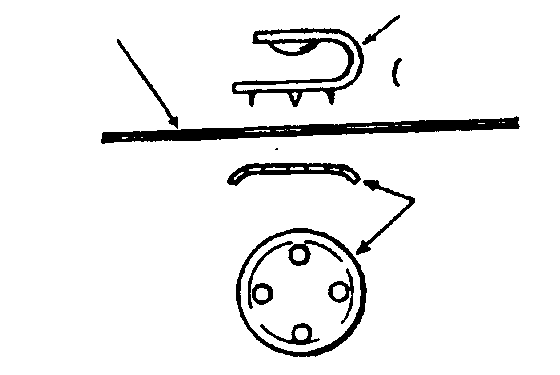
Fig. 1 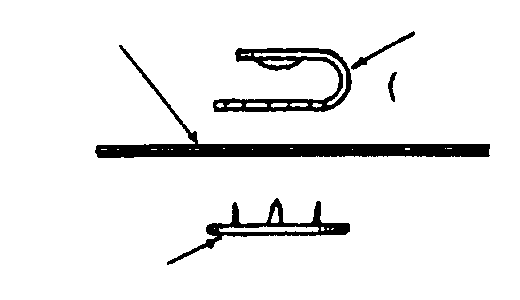
Fig. 2 | SEE OR SEARCH THIS CLASS, SUBCLASS:
| 19+, | for a disclosure of a workpiece similar to a mating-member
and assembling it with another workpiece. |
| 143+, | for a disclosure of a workpiece similar to mating-member. |
SEE OR SEARCH CLASS:
| 29, | Metal Working,
subclasses 243.521+ and 243.53+ for apparatus for securing
objects together by means which may comprise a mating-member (e.g., a
rivet and bur). |
|
| | |
| 16 | Strip-type "mating-member": |
| | This subclass is indented under subclass 15. Device wherein the positioning means is designed and intended
to coact with an elongated mating-member and into which a plurality
of members are driven in spaced relationship in the direction of
elongation.
| | (1)
Note. A member having a plurality of projections which penetrate
the work (e.g., staple) is not considered a plurality of members. | |
| | |
| 18 | Comprising feed means for "mating-member": |
| | This subclass is indented under subclass 15. Device including a positively actuated means to move or
transport a mating member into the driving path of the member.
SEE OR SEARCH THIS CLASS, SUBCLASS:
| 99+, | for means to feed a member, and see search notes
for other loci of feed means. |
|
| | |
| 19 | WITH MEANS TO ASSEMBLE PLURAL PIECES OF WORK: |
| | This subclass is indented under the class definition. Device comprising means to move or guide a workpiece* into
juxtaposition with another workpiece, and including (a) means to hold
or position a member* between said workpieces before they
are moved into juxtaposition or (b) means to hold or position said workpieces
in alignment with a driver* for application of a member
thereto.
| | (1)
Note. One or both of the workpieces being assembled may be
indeterminate-length material. |
| | (2)
Note. For placement as an original in this subclass area,
a patent must be directed to a member-inserting device with means
at least to direct or guide two workpieces or lengths of material
into contact at some point and to present such assembled work to
the action of a driver. Usually, but not necessarily, the inserted member
will serve to secure the workpieces together. |
| | (3)
Note. A work stop abutment, disclosed as being useful for
facilitating the registry, of two or more workpieces at a driving-station,
is insufficient to constitute "means to move or guide a
workpiece" under the subclass definition. |
| | (4)
Note. A fastener member is not generally regarded as "work",
for the purposes of this class. A device provided with means to
feed a member to driving position, on or near a workpiece, is not
classifiable as an assembly device but is subject matter for the
following subclasses 107+. Means for performing an operation
on the member (such as cutting, shaping, heading, etc.) is specifically
provided for in appropriate subclasses of this class (e.g., subclasses 79+,
with means to cut member after penetration). |
| | (5)
Note. For the line between this subclass (and those indented
hereunder) and classes relating to combined driving and assembly,
see section VI of this class definition and for classes relating
to assembly, see section VII of this class definition. |
SEE OR SEARCH CLASS:
| 29, | Metal Working,
subclasses 700+ for assembly apparatus, in general. |
|
| | |
| 20 | With means to deform work: |
| | This subclass is indented under subclass 19. Device comprising means to alter the form, configuration,
dimension, proportion or contour of a workpiece either with or without removal
of material.
| | (1)
Note. Means to feed a flexible, resilient or flaccid workpiece
from a coil or other source and to straighten it for assembly to
another workpiece is not considered "shaping means";
disclosures of such means will be found in subclasses 44+, Endless
conveyor. |
SEE OR SEARCH THIS CLASS, SUBCLASS:
| 12+, | for means to stretch flaccid work and fasten it
to rigid work. |
| 44+, | for a disclosure of means to straighten flexible
work before assembly to other work on an endless conveyor. |
| 64+, | for means to shape work prior to application of
a member. |
|
| | |
| 21 | Including cutting means: |
| | This subclass is indented under subclass 20. Device provided with means to sever, incise, pierce or abrade
a workpiece or some part thereof.
SEE OR SEARCH THIS CLASS, SUBCLASS:
| 27, | for a disclosure of means to punch or drill work
before assembly. |
| 47, | for a disclosure of work cutting means associated
with reel-type supply means. |
| 69, | 70+ and 76, for various disclosures of work-cutting
means associated with a device of the class type. |
SEE OR SEARCH CLASS:
| 83, | Cutting, for cutting apparatus, generally. |
|
| | |
| 22 | Including means to rotate work: |
| | This subclass is indented under subclass 20. Device including means to revolve a workpiece.
| | (1)
Note. The work may rotate about a fixed mandrel or the mandrel
rotate with the work. |
| | (2)
Note. The rotation of the work may cause an element (hoop
strip) to be coiled or wrapped around the workpiece. |
SEE OR SEARCH THIS CLASS, SUBCLASS:
| 49, | for means to rotate work, associated with magazine-type
work supply means, in a device of the class type. |
|
| | |
| 23 | With die-shaping means: |
| | This subclass is indented under subclass 22. Device comprising configured mating elements between which
the workpiece is formed to a desired configuration.
| | (1)
Note. Included here are patents to a device for forming a
basket from a blank of slatted material termed "basket
mat". |
| | (2)
Note. Means to clamp a piece of work to a mandrel and rotate
the mandrel to form the work around it is not die shaping means
for this subclass; such disclosures will be found in subclasses
22 and 24. |
SEE OR SEARCH THIS CLASS, SUBCLASS:
| 22, | and 24, for a disclosure of work-shaping means other
than dies for rotating work. |
|
| | |
| 24 | With end-inserting or clamping means: |
| | This subclass is indented under subclass 22. Device including means to position and/or hold a
workpiece within an opening of a second workpiece.
| | (1)
Note. Included here are patents to a device for inserting
and securing an end or bottom in a rotatably supported container. |
SEE OR SEARCH CLASS:
| 100, | Presses,
subclasses 54+ for presses for applying lids to portable receptacles. |
|
| | |
| 25 | Means to buckle flaccid work: |
| | This subclass is indented under subclass 20. Device wherein said means is effective, as disclosed, to
gather, or pucker a nonrigid, limber and flexible workpiece.
| | (1)
Note. The work is generally gathered and after another workpiece
is applied thereto member is driven through the gather to secure
the pieces together. |
SEE OR SEARCH THIS CLASS, SUBCLASS:
| 65, | for means to buckle a flaccid workpiece. |
|
| | |
| 27 | With drilling or punching means: |
| | This subclass is indented under subclass 19. Device including a tool that moves relative to a workpiece
while cutting material out of the confines of the workpiece so that
the cut does not intersect any edge (exterior or interior) of the
workpiece.
SEE OR SEARCH THIS CLASS, SUBCLASS:
| 69, | for a rotatable cutting tool to form an opening
in a workpiece for a member. |
SEE OR SEARCH CLASS:
| 83, | Cutting, for punching apparatus, generally. |
| 408, | Cutting by Use of Rotating Axially Moving Tool, for drilling apparatus generally. |
|
| | |
| 28 | With means to sequentially secure layers (e.g., heels,
etc.): |
| | This subclass is indented under subclass 19. Device comprising means, made effective after an actuation
of the driver, to move or guide an additional workpiece into juxtaposition
with said first-mentioned workpieces and into alignment with said
driver, and means to cause another actuation of said driver.
SEE OR SEARCH THIS CLASS, SUBCLASS:
| 14, | for means to cement work or member and apply a member
to a layer(s) of work. |
|
| | |
| 29 | With work clamp: |
| | This subclass is indented under subclass 28. Device wherein the means to move or guide successive workpieces
into juxtaposition comprises relatively movable work-engageable
elements and means to force or bias said elements into gripping
engagement with a workpiece.
| | (1)
Note. A work clamp, for the purposes of this and other subclasses
in this class, must comprise relatively movable jaws or their equivalent;
i.e., a closely fitting unitary last or form is not a "clamp". |
SEE OR SEARCH THIS CLASS, SUBCLASS:
| 40, | and 124, for a work clamp interrelated to other
mechanism in a device of the class type. |
| 152+, | for a work clamp in a device of the class type. |
SEE OR SEARCH CLASS:
| 269, | Work Holders, for a work holder (e.g., clamp), generally. |
|
| | |
| 30 | With driver acting through clamp jaw: |
| | This subclass is indented under subclass 19. Device wherein said means to hold or position the workpieces
comprises relatively movable work-engageable elements, and means
to force or bias said elements into gripping engagement with said
workpieces, one of said elements being configured to accommodate
the passage of a driver toward and from the gripped workpieces. |
| | |
| 31 | Bight attaching means (e.g., buttons, etc.): |
| | This subclass is indented under subclass 19. Device wherein, as disclosed, one of the workpieces has
a projecting loop or apertured portion, and wherein the device is
effective to secure the workpieces together by applying a member
which passes or is driven through the loop or apertured portion
of said workpiece.
SEE OR SEARCH CLASS:
| 112, | Sewing,
subclasses 104+ for a machine for attaching a button by thread. |
|
| | |
| 32 | Including means to insert member in bight: |
| | This subclass is indented under subclass 31. Device comprising means effective to pass said member through
the loop or apertured portion of said one workpiece.
SEE OR SEARCH CLASS:
| 29, | Metal Working,
subclass 241 for stringing articles, and particularly for a
device for producing threaded buttons as articles of manufacture. |
|
| | |
| 33 | With member-forming means: |
| | This subclass is indented under subclass 32. Device comprising means to shape or fashion said member
prior to the completion of its application to the workpieces.
SEE OR SEARCH THIS CLASS, SUBCLASS:
| 82+, | for means to shape or form a member prior to its
application to work. |
SEE OR SEARCH CLASS:
| 59, | Chain, Staple, and Horseshoe Making, for a machine to manufacture staples. |
| 470, | Threaded, Headed Fastener, or Washer Making:
Process and Apparatus,
subclasses 27+ for methods of making a rivet or nail and subclasses 110+ for
machines of making a rivet or nail. |
|
| | |
| 34 | After member is applied to a workpiece: |
| | This subclass is indented under subclass 32. Device comprising means effective to force said member through
the other of said workpieces prior to its passage through the loop
or apertured portion of said one workpiece. |
| | |
| 36 | With work feed means: |
| | This subclass is indented under subclass 34. Device comprising means effective to forward a workpiece
to a driving-station*.
SEE OR SEARCH THIS CLASS, SUBCLASS:
| 99+, | for means to convey work to a driving-station and
see search notes thereunder for other loci of a work conveying device. |
|
| | |
| 37 | With work feed means: |
| | This subclass is indented under subclass 31. Device comprising means effective to forward a workpiece
to a driving-station*.
| | (1)
Note. See search notes under subclass 36 for location of
other work feed means in devices of the class type. | |
| | |
| 38 | With means to actuate driver: |
| | This subclass is indented under subclass 37. Device comprising a power-transmitting linkage connected
to the driver to move same through an effective member-applying
stroke.
SEE OR SEARCH THIS CLASS, SUBCLASS:
| 129+, | 146 and 147, for various specific driver-actuating
means in a device of the class type. |
|
| | |
| 39 | Work conveyer means: |
| | This subclass is indented under subclass 19. Device comprising dynamic means to effect movement of a
workpiece with respect to the driving-station*, or a device
associated and movable with the workpiece to hold or support the
workpiece and facilitate movement thereof with respect to the driving-station.
| | (1)
Note. The work-moving means may comprise any structure by
which the work is moved relative to a driving-station even though
the structure itself may be actuated manually. Examples of such structure
are a pivoted work-support, a pusher, etc. |
| | (2)
Note. The conveyor means of this subclasses (39+)
may move one workpiece, or more than one, according to the design
and mode of operation of the particular machine. |
SEE OR SEARCH THIS CLASS, SUBCLASS:
| 99+, | for work feed means in a device of the class type
and see search notes thereunder for other loci of work conveying
or feeding devices. |
|
| | |
| 41 | Pivoted work carrier: |
| | This subclass is indented under subclass 39. Device provided with means to permit a work holder or support
to oscillate or turn about an axis.
| | (1)
Note. The pivotal movement may constitute the work-forwarding
motion of the conveyor, or may be an additional, work-orienting
or indexing motion. |
SEE OR SEARCH THIS CLASS, SUBCLASS:
| 99+, | for a pivoted work carrier, per se, in a device
of the class type. |
|
| | |
| 43 | Including means to align member-aperture with member: |
| | This subclass is indented under subclass 39. Device comprising means supplemental to said work moving
means for positioning or repositioning an apertured work-piece at
the driving-station with its opening(s) in alignment with a member
in position to be driven into or through said opening(s). |
| | |
| 44 | Endless conveyer: |
| | This subclass is indented under subclass 39. Device wherein the workpiece moving means comprises a series
of workpiece engaging portions arranged in a circular array or as
a belt-like loop of articulated portions, each such portion being
adapted to engage and move a workpiece relative to a driving-station.
| | (1)
Note. The conveyor portions usually, but not necessarily,
provide support for the work as it is being moved and while it is
at rest at one or more treating stations. | |
| | |
| 45 | Including magazine-type work supply means: |
| | This subclass is indented under subclass 44. Device including means supplemental to the work-moving means
which supplemental means temporarily stores discrete workpieces which,
as disclosed, are fed to or dispensed onto the work-moving means.
SEE OR SEARCH THIS CLASS, SUBCLASS:
| 48, | for magazine-type work supply means combined with
other than an endless conveyor, in a device of the class type. |
SEE OR SEARCH CLASS:
| 221, | Article Dispensing, appropriate subclasses for an article-storing magazine in
a dispensing device. |
|
| | |
| 47 | Including work cutting means: |
| | This subclass is indented under subclass 46. Device comprising means to sever a workpiece from the supply
of material stored on the reel or from another workpiece.
| | (1)
Note. See search notes under subclass 21 for other loci of
cutting means. | |
| | |
| 48 | Including magazine-type work supply means: |
| | This subclass is indented under subclass 39. Device having means to temporarily store a plurality of
discrete workpieces which, as disclosed, are to be fed to a driving-station.
SEE OR SEARCH THIS CLASS, SUBCLASS:
| 45, | for magazine-type work supply means combined with
an endless conveyor, in a device of the class type. |
SEE OR SEARCH CLASS:
| 221, | Article Dispensing, appropriate subclasses for an article-storing magazine combined
with a dispensing device. |
|
| | |
| 49 | With means to rotate work: |
| | This subclass is indented under subclass 48. Device including means supplemental to the magazine work
supply means which supplemental means turns the work for successive application
of members at one or more driving-stations.
| | (1)
Note. The work may be turned about its own axis at the driving-station,
or turned as it is moved from one driving-station to another. |
SEE OR SEARCH THIS CLASS, SUBCLASS:
| 22, | for means to rotate work, combined with an assembly
device, in a device of the class type. |
|
| | |
| 50 | With means to move assemblage to fastener station: |
| | This subclass is indented under subclass 48. Device including means supplemental to the magazine work
supply means which supplemental means transports, as a unit, a plurality of
workpieces which have been juxtapositioned.
| | (1)
Note. The workpieces are fed from a magazine supply to a
work holding device which holds the workpieces in an assembled position
and then the work holder is moved to a driving-station. | |
| | |
| 51 | WITH MEANS TO HEAD MEMBER: |
| | This subclass is indented under the class definition. Device including means to deform an end portion of the member
in such a manner as to increase the size, and/or to change
the form, of the cross-section of said end portion after the member
has penetrated the work.
| | (1)
Note. A simple bending or deflecting (i.e., clenching) of
a member during or after driving, is not regarded as "heading" for
this subclasses (51+). Disclosures of clenching means are
to be found in many subclasses throughout the Class 227 schedule;
patents directed to this feature are placed as originals in subclass
155. |
| | (2)
Note. For the purposes of this subclass (51), the device
must deform the member during or at the end of the driving stroke.
The shaping or forming of a member prior to its penetration into work
is effected by the machines classified in subclasses 82+. |
| | (3)
Note. Figure 3 diagrammatically illustrates various means
to head a member.
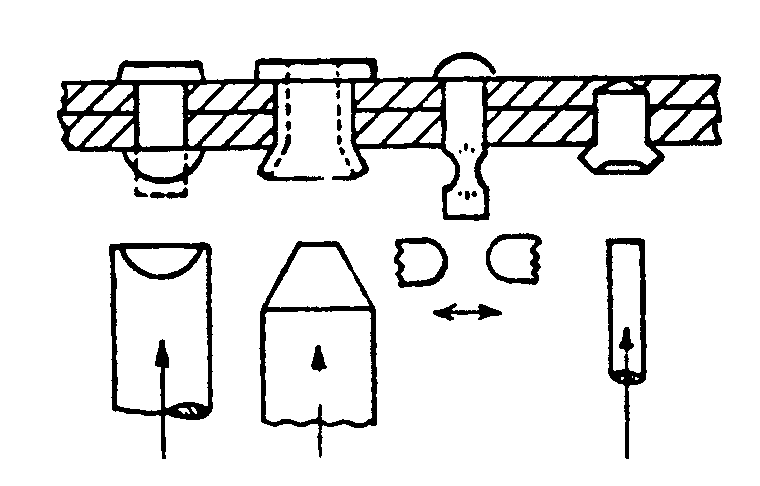
Fig. 3 | SEE OR SEARCH THIS CLASS, SUBCLASS:
| 77, | for means to bend a projecting end portion of a
driven member remote from a surface of work. |
| 82+, | for a device which shapes or forms a member prior
to its application to work. |
| 155, | for a nailing device having clenching means, and
see (1) Note, above. |
SEE OR SEARCH CLASS:
| 29, | Metal Working,
subclasses 243.521+ and 243.53+ for a device which upsets or
heads a rod, wire or other elongated work associated with an assembly device. |
| 72, | Metal Deforming, appropriate subclasses for a device which upsets
or heads a rod, wire or other elongated work. |
|
| | |
| 52 | Driver or heading means located within tubular work: |
| | This subclass is indented under subclass 51. Device wherein the member is disclosed as being driven through
the wall of a hollow elongated workpiece, with either the driver
or the "heading" means functioning within the
confines of the hollow portion of the workpiece.
| | (1)
Note. The tubular workpiece operated upon by the devices
of this subclass may have other than a cylindrical cross-section
and also may be closed on one end, but this end portion is not considered
as the "wall" of the subclass definition. | |
| | |
| 54 | Pointed or edged tool: |
| | This subclass is indented under subclass 51. Device wherein the heading means has a member engaging face
which tapers to either a point or a line such that in operation,
this point or line penetrates the member and initiates deformation
thereof. |
| | |
| 55 | Heading tool extends within hollow portion of member: |
| | This subclass is indented under subclass 51. Device wherein a portion of the heading means, before initial
contact of the means with the member, projects into a void space
within the confines of the shank of the member.
| | (1)
Note. A hollow shank member for the purposes of this subclass
includes those members that have an opening extending through their
entire length (e.g., tubular rivet) as well as those members that
have only a recess in the end portion which does not extend entirely
through the member. A simple "split" rivet is
not regarded as a hollow member within the meaning of the subclass
definition. | |
| | |
| 57 | With work feed means: |
| | This subclass is indented under subclass 55. Device including dynamic means to effect movement of the
work or product relative to the driving-station*.
SEE OR SEARCH THIS CLASS, SUBCLASS:
| 99+, | for means to convey work to a driving-station, and
see search notes thereunder for other loci of a work conveying device. |
|
| | |
| 58 | With means to form opening in work for member: |
| | This subclass is indented under subclass 55. Device including means for making an aperture in the workpiece
into which said element is driven.
SEE OR SEARCH THIS CLASS, SUBCLASS:
| 67+, | for a device of the class type having means to form
an opening in work for a member. |
|
| | |
| 60 | With pilot pin: |
| | This subclass is indented under subclass 55. Device wherein either the driver or the heading means has
an elongated projection adapted to enter the hollow portion of the
member prior to the heading of the member to hold the member in
a position to be driven and/or headed. |
| | |
| 61 | Anvil: |
| | This subclass is indented under subclass 51. Device wherein the heading means comprises a tool having
a member-engaging face which restricts the flow of the material
of the member in at least one direction during the deformation of
the end portion of the member (e.g., a flat or plane faced tool).
SEE OR SEARCH CLASS:
| 72, | Metal Deforming,
subclasses 462+ for a tool (e.g., anvil), generally. |
|
| | |
| 62 | Die: |
| | This subclass is indented under subclass 61. Device wherein the member-engaging face is so configured
as to restrict the flow of the material of the engaged end portion
of the member in at least two directions during the deformation
of the end portion of the member (e.g., concave tool face). |
| | |
| 63 | WITH MEANS TO WITHDRAW MEMBER: |
| | This subclass is indented under the class definition. Devices comprising means engageable with a member for extracting
said member from a workpiece.
| | (1)
Note. The extracting means, for the purposes of this subclass,
may be a tongue or claw to be manipulated in the manner of a claw-hammer. |
SEE OR SEARCH CLASS:
| 254, | Implements or Apparatus for Applying Pushing or
Pulling Force,
subclasses 18+ for a nail extractor. |
|
| | |
| 64 | WITH MEANS TO SHAPE WORK OR CUT PRODUCT: |
| | This subclass is indented under the class definition. Device including means (a) for altering the form, configuration,
dimension, proportion or contour of a workpiece either with or without
removal of material, or (b) for severing, incising, piercing, or
abrading work or product.
SEE OR SEARCH CLASS:
| 72, | Metal Deforming, appropriate subclasses for metal deforming means, generally. |
| 493, | Manufacturing Container or Tube From Paper; or
Other Manufacturing From a Sheet or Web,
subclasses 395+ for paper shaping, generally. |
|
| | |
| 65 | Buckling of flaccid work: |
| | This subclass is indented under subclass 64. Device including means to shape, gather or pucker a nonrigid
limber and flexible workpiece.
| | (1)
Note. The work is generally gathered and a fastener is driven
through the gather, by what is generally designated as a pinning
machine. |
SEE OR SEARCH THIS CLASS, SUBCLASS:
| 25, | for patents wherein the fastener is driven through
the gather to secure two or more workpieces together. |
SEE OR SEARCH CLASS:
| 206, | Special Receptacle or Package,
subclasses 380+ for a pin package, per se. |
|
| | |
| 67 | Means to form opening in work for member: |
| | This subclass is indented under subclass 64. Device wherein the shaping means makes an aperture(s) in
said workpiece into which a member is to be driven.
SEE OR SEARCH THIS CLASS, SUBCLASS:
| 58, | for means to form an opening for a member, in combination
with heading means for the member. |
SEE OR SEARCH CLASS:
| 402, | Binder Device Releasably Engaging Aperture or
Notch of Sheet,
subclass 1 for a sheet retainer device which includes in combination,
an impaling- type sheet retainer and a discrete sheet aperture forming
device, (i.e., paper punch) which perforates a sheet prior to placing
the same on the retainer; subclass 7 for an impaling-type sheet
retainer which penetrates and inserts a pliant strand through a sheet
surface and subclass 25 for an impaling-type sheet retainer including means
to force a sheet upon the sheet retainer. |
|
| | |
| 69 | Rotatable cutting tool: |
| | This subclass is indented under subclass 67. Device in which said shaping means comprises drilling or
boring apparatus.
SEE OR SEARCH THIS CLASS, SUBCLASS:
| 27, | for a drilling device combined with assembly means
in a device of the class type. |
|
| | |
| 71 | For dual openings: |
| | This subclass is indented under subclass 70. Device wherein said incising, piercing, or severing elements
are arranged to produce a pair of holes for the reception of a two
pronged member (e.g., staple). |
| | |
| 72 | With pivoted tool carrier: |
| | This subclass is indented under subclass 70. Device comprising a rotatably mounted holder for said incising,
piercing, or severing elements.
SEE OR SEARCH THIS CLASS, SUBCLASS:
| 75, | for a pivoted carrier for one cutting tool, in a
device of the class type. |
|
| | |
| 73 | Including work-feeding means: |
| | This subclass is indented under subclass 67. Device provided with actuated means to effect movement of
the work with respect to a driving-station*.
SEE OR SEARCH THIS CLASS, SUBCLASS:
| 99+, | for work feeding means to a driving-station, and
see search notes thereunder for loci of other work feed devices. |
|
| | |
| 74 | Cutting tool having work-feeding motion: |
| | This subclass is indented under subclass 73. Device wherein said actuated work-moving means consists,
at least in part, of a tool element of said work-shaping means,
which tool element is caused to move in the direction of work feed
motion while it is in contact with the work.
SEE OR SEARCH CLASS:
| 83, | Cutting,
subclass 218 for a cutting tool having work feed motion. |
|
| | |
| 75 | With pivoted tool carrier: |
| | This subclass is indented under subclass 74. Device provided with means to permit the holder or support
of said tool element to oscillate or turn about an axis.
SEE OR SEARCH THIS CLASS, SUBCLASS:
| 72, | for a pivoted carrier for plural tools, in a device
of the class type. |
|
| | |
| 76 | Cutting means: |
| | This subclass is indented under subclass 64. Device provided with means to sever, incise, pierce or abrade
work or product.
SEE OR SEARCH THIS CLASS, SUBCLASS:
| 21, | for cutting means combined with assembly means,
and see search notes thereunder for other loci for cutting means. |
|
| | |
| 77 | WITH MEANS TO DEFORM MEMBER REMOTE FROM THE WORK SURFACE AFTER
WORK PENETRATION: |
| | This subclass is indented under the class definition. Device having means to change the shape of a portion of
a member at a point distant from a workpiece after initiation of
work penetration by such member, said portion being spaced from
the work both before and after the change in shape is effected.
| | (1)
Note. Means to cut a driven member is not proper subject
matter for this subclass. |
| | (2)
Note. Any deformation of a driven member which increases
the size, and/or alters the form, of the cross-section
of an end portion is provided for in preceding subclasses 51+. |
| | (3)
Note. Figure 4 illustrates a member driven into work and
a portion of the member (i.e., hook) deformed at a point from the
work surface by apparatus typical of this subclass. |
| | (4)
Note. This subclass will include patents which disclose an
additional workpiece in substantial contact with the shaped portion
of the member other than a workpiece into which the member is driven.
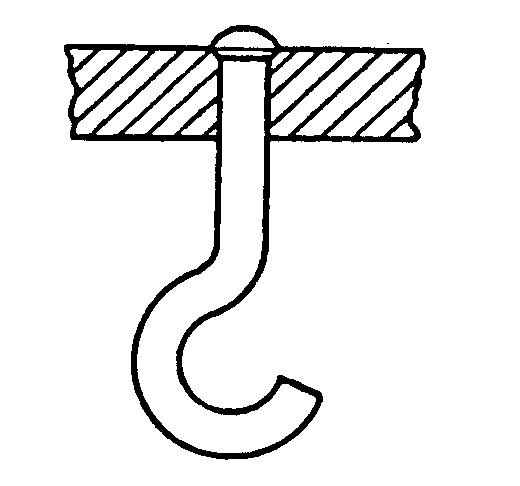
Fig. 4 | SEE OR SEARCH THIS CLASS, SUBCLASS:
| 51+, | for means to head a driven member, and see (2) Note,
above. |
| 79+, | for means to cut a driven member after the member
is driven. |
|
| | |
| 78 | SELECTIVE ALTERNATIVE APPLYING MEANS: |
| | This subclass is indented under the class definition. Device having a plurality of applying devices any one of
which is separately useable at the option of the operator. |
| | |
| 79 | WITH MEANS TO CUT MEMBER AFTER PENETRATION: |
| | This subclass is indented under the class definition. Device provided with means to sever a protruding end portion
of a driven member, or to sever a driven member from stock material. |
| | |
| 80 | From material of indefinite length: |
| | This subclass is indented under subclass 79. Device wherein said means is adapted to detach the driven
end portion of stock material.
| | (1)
Note. The machine in this subclass is sometimes known as "Wire
Inserting and Cutting Machines". |
| | (2)
Note. The material before being applied is usually in the
form of a spool or wire. | |
| | |
| 81 | DRIVING MOTION OF DRIVER HAS COMPONENT IN DIRECTION OF
MOVING WORK (I.E., FLYING DRIVER): |
| | This subclass is indented under the class definition. Device which includes means to move one or more drivers* into
driving engagement with the work while the work is being moved to
and through a driving-station* and in which the driver"s
movement includes, as a necessary factor, motion in the direction
of such work movement. |
| | |
| 82 | WITH MEANS TO FORM MEMBER PRIOR TO PENETRATION OF WORK: |
| | This subclass is indented under the class definition. Device comprising means to shape or fashion a member* before
its application to a workpiece.
SEE OR SEARCH CLASS:
| 59, | Chain, Staple, and Horseshoe Making,
subclasses 71+ for means to make staples, per se. |
| 470, | Threaded, Headed Fastener, or Washer Making:
Process and Apparatus,
subclasses 27+ for methods of making a rivet or nail and subclasses 110+ for
machines of making a rivet or nail. |
|
| | |
| 83 | Deflector: |
| | This subclass is indented under subclass 82. Device wherein the shaping means comprises an element(s)
for diverting all or part of the member away from the path in which
the member would be moved by a driver* in the absence of
said diverting element. |
| | |
| 85 | With offset tools to deform members (e.g., bending, drawing,
etc.): |
| | This subclass is indented under subclass 82. Device wherein the shaping means comprises a plurality of
elements and means to move or to guide one of said elements with
respect to another element so that at least one of said elements
is moved past the other while in contact with a web, strand or other
material to produce a member from said material.
SEE OR SEARCH THIS CLASS, SUBCLASS:
| 92, | for opposed tools to form a member. |
|
| | |
| 89 | With movable member-holder: |
| | This subclass is indented under subclass 88. Device including means to support the formed member and
means to allow said support to move away from the path of a driver
during a driving operation. |
| | |
| 90 | Pivoted: |
| | This subclass is indented under subclass 88. Device comprising means to restrain the motion of said other
shaping element to an arcuate path. |
| | |
| 92 | With opposed tools to form member (e.g., forging, swaging,
etc.): |
| | This subclass is indented under subclass 82. Device, said shaping means comprising a plurality of elements
each having a material-engaging surface portion wherein one of said elements
moves in a direction such that said surface portions of two or more
elements approach each other to form a member, such motion continuing
until said portions move (1) into contact, or (2) toward ultimate
contact but restrained therefrom by the presence of an intervening
web, strand, or other material. |
| | |
| 93 | Severing means sole member former: |
| | This subclass is indented under subclass 82. Device wherein the shaping means consists only of means
to divide or cut a web, strand or other material.
| | (1)
Note. For placement of a patent as an original in this or
indented subclasses it should contain no claimed forming operation
other than cutting or punching in making a finished member. |
| | (2)
Note. Apparatus for breaking or cutting apart fully formed
members that are glued or adhered together is not regarded as forming
means for this or indented subclasses. |
SEE OR SEARCH THIS CLASS, SUBCLASS:
| 120+, | for means to break or cut apart formed members glued
or adhered together. |
|
| | |
| 94 | Including plural diverse severing operations: |
| | This subclass is indented under subclass 93. Device comprising additional cutting means, and means, made
effective after an actuation of the first-named cutting or dividing
means, to actuate said additional cutting means to complete the
formation of a member. |
| | |
| 97 | Severing means moves member to driver: |
| | This subclass is indented under subclass 93. Device wherein the shaping (i.e., severing) means has a
motion, in addition to its severing motion, towards the path of
a driver to convey a member into said path.
SEE OR SEARCH CLASS:
| 83, | Cutting,
subclass 218 for a cutting tool having work feeding motion. |
|
| | |
| 99 | WITH MEANS TO CONVEY WORK OR PRODUCT RELATIVE TO DRIVING STATION: |
| | This subclass is indented under the class definition. Device comprising dynamic means to effect movement of work
or product with respect to the driving-station*, or a device associated
and movable with the work or product to hold or support the work
or product and facilitate movement thereof with respect to the driving-station.
| | (1)
Note. The work-moving means may comprise any structure by
which the work is moved relative to a driving-station even though
the structure itself may be actuated manually. Examples of such structure
are a movable table, a pivoted work-support, etc. |
| | (2)
Note. For the lines between this subclass (and those indented
hereunder) and classes relating to work handling, see section VII
B 1 of this class definition. |
SEE OR SEARCH THIS CLASS, SUBCLASS:
| 3, | 36, 37, 39+, 57, and 73+, for
a disclosure for means to feed work to a driving station. |
| 18, | 95+, 97, 98, and 107+, for a disclosure
for means to feed a member to a driving-station. |
SEE OR SEARCH CLASS:
| 198, | Conveyors: Power-Driven, for conveyors of general utility and see Note (2),
above. |
|
| | |
| 100 | Interrelated conveying and driver-actuating means: |
| | This subclass is indented under subclass 99. Device wherein the work or product conveying means comprises
a movable means which cooperates significantly with means to move the
driver.
SEE OR SEARCH CLASS:
| 83, | Cutting,
subclass 426 for interrelated work-conveying and a cutting tool moving
means. |
|
| | |
| 107 | WITH MEANS TO MOVE OR GUIDE MEMBER INTO DRIVING POSITION: |
| | This subclass is indented under the class definition. Device provided with means to transport a member or passive
means which is operative to define or limit the path of movement
(i.e., to direct wholly or partially, the course) of a moving member*,
or to orient such member, to a suitable zone for an operation on
said member by a claimed driver.
SEE OR SEARCH THIS CLASS, SUBCLASS:
| 99, | for means to move work, product or member relative
to a driving-station, and see search note thereunder for other related
places and classes. |
|
| | |
| 110 | With positionable driver: |
| | This subclass is indented under subclass 107. Device provided with means to adjust, position or guide
the driver with respect to a workpiece for the application of a
member thereto. |
| | |
| 112 | Fluid-contact member-feed means: |
| | This subclass is indented under subclass 107. Device wherein the means to transport the member comprises
a direct impingement of a stream of liquid or gaseous material.
| | (1)
Note. The pressure of the fluid current may be superatmospheric
or subatmospheric. | |
| | |
| 113 | Magnetic member-feed and/or holding means: |
| | This subclass is indented under subclass 107. Device which effects movement of the member or supports
the member in a position to be driven by forces exerted by a magnetic
field.
| | (1)
Note. The magnet may be part of a driver or a work carrier. |
| | (2)
Note. The magnetic field may be that of a "permanent" magnet
or that induced by an electric current. | |
| | |
| 117 | Rotary: |
| | This subclass is indented under subclass 114. Device comprising means to cause the isolating means to
move in a curved path. |
| | |
| 118 | Oscillating separator: |
| | This subclass is indented under subclass 117. Device comprising means to move the isolating means toward
and away from the compartment for storing the members. |
| | |
| 120 | Including supply magazine for constantly urged members: |
| | This subclass is indented under subclass 107. Device comprising a compartment for storing a plurality
of members in which the transporting means operates to bias the
members toward driving position.
| | (1)
Note. Included in this and indented subclasses are patents
to subcombinations in which the driver is not always claimed. | |
| | |
| 123 | With removable or resiliently urged (antijam) noseplate: |
| | This subclass is indented under subclass 120. Device comprising means to enclose a guide path of the driver
which is detachable or biased toward said guide path to allow a
deformed member to be driven or removed from the path of the driver.
SEE OR SEARCH THIS CLASS, SUBCLASS:
| 109, | for means adapted to allow oversized members to
be driven, in a device of the class type. |
|
| | |
| 124 | With interrelated driver and work clamp: |
| | This subclass is indented under subclass 120. Device comprising a plurality of opposed jaws or surface
elements adapted to engage work and means to move one or more of
said jaws or surface elements, which means cooperates with means
to actuate a driver.
SEE OR SEARCH THIS CLASS, SUBCLASS:
| 153, | for interrelated driver and work clamp. |
|
| | |
| 126 | By lock means: |
| | This subclass is indented under subclass 125. Device wherein the means to render the biasing means ineffective
comprises a securing element. |
| | |
| 127 | With magazine closure: |
| | This subclass is indented under subclass 120. Device wherein the compartment for storing the members comprises
a movable element to allow access to the interior thereof. |
| | |
| 130 | Fluid pressure means: |
| | This subclass is indented under subclass 129. Device wherein the force applying means is a liquid or gas.
SEE OR SEARCH THIS CLASS, SUBCLASS:
| 9+, | for explosive-type driving means. |
|
| | |
| 131 | Magnet or solenoid: |
| | This subclass is indented under subclass 129. Device wherein the force applying means is an electromechanical
transducer in which reciprocatory or oscillatory motion between
a coiled conductor carrying electric current and a ferrous or iron-like
armature is effected by varying the instantaneous value of current
in the conductor. |
| | |
| 132 | Spring: |
| | This subclass is indented under subclass 129. Device wherein the force applying means comprises a resilient
element, means to compress said element, and means to release the
compressed element for actuating the driver.
SEE OR SEARCH THIS CLASS, SUBCLASS:
| 146, | for a spring-type driver. |
SEE OR SEARCH CLASS:
| 173, | Tool Driving or Impacting,
subclasses 202+ for spring-actuated hammer head. |
|
| | |
| 133 | Inertia means: |
| | This subclass is indented under subclass 129. Device wherein the force applying means comprises the mass
of the driver and any parts secured thereto, which mass tends to
continue in motion when the device is swung with a hammer-like blow
against supported work, thereby projecting the driver from its initial position
with respect to other portions of the device which are brought to
a halt against the work. |
| | |
| 134 | Spring-retracting means: |
| | This subclass is indented under subclass 120. Device comprising a resilient element which opposes the
motion of the driver during the driving stroke and which returns
the driver to its initial or nondriving position. |
| | |
| 136 | With means to feed strip-type carrier: |
| | This subclass is indented under subclass 135. Device comprising means to move an elongated strip of material
carrying a plurality of members.
| | (1)
Note. The strip-type carrier is usually disposable and not
a permanent part of the device. | |
| | |
| 137 | Rotary: |
| | This subclass is indented under subclass 135. Device comprising means to cause the member transporting
means to move in a curvilinear path. |
| | |
| 138 | Driver actuates member-feed means: |
| | This subclass is indented under subclass 107. Device wherein the means to transport a member comprises
means connected to the driver so that movement of the driver transmits
power from itself to the transporting means to feed the member. |
| | |
| 139 | With means to guide member: |
| | This subclass is indented under subclass 107. Device wherein said means comprises nonactuated structure
which directs wholly or partially the course of a moving member
or which orients such member to a suitable zone for an operation
on said member by the driver. |
| | |
| 140 | WITH MEANS TO SUPPORT MEMBER AND/OR WORK RELATIVE
TO DRIVER: |
| | This subclass is indented under the class definition. Apparatus having means to hold a member* and/or
work* in a position to receive the reaction of a driver*. |
| | |
| 141 | Driver moves work, member held stationary: |
| | This subclass is indented under subclass 140. Device wherein said means is effective to hold a member
in a fixed location during the driving operation.
| | (1)
Note. In a device of this subclass type, the driver impels
the work against a fixedly held member. | |
| | |
| 142 | With means to vary the length of the tool stroke: |
| | This subclass is indented under subclass 140. Device comprising means to change the distance a tool moves
during a driving or clenching operation.
SEE OR SEARCH CLASS:
| 83, | Cutting,
subclass 530 for mechanism to change a cutting tool stroke. |
| 173, | Tool Driving or Impacting,
subclass 115 for mechanism to change a tool stroke. |
|
| | |
| 146 | Spring-actuated driver: |
| | This subclass is indented under subclass 140. Device comprising a resilient element connected to a driver,
means to compress said element, and means to release the compressed element
for actuating said driver.
SEE OR SEARCH THIS CLASS, SUBCLASS:
| 132, | for spring-type driver in combination with means
to move a member into driving position. |
SEE OR SEARCH CLASS:
| 173, | Tool Driving or Impacting,
subclasses 202+ for spring-actuated hammer head. |
|
| | |
| 147 | Impact-type driver: |
| | This subclass is indented under subclass 140. Device wherein a driver has a surface intended to receive
a blow, from a moving mass of material, (e.g., hammer head), for
actuating said driver.
SEE OR SEARCH CLASS:
| 173, | Tool Driving or Impacting,
subclasses 90+ for impact devices of general utility. |
|
| | |
| 149 | Bias-type member holder: |
| | This subclass is indented under subclass 140. Device comprising means tending to urge a portion of the
member-holder into gripping relationship with a member held therein.
| | (1)
Note. Included here are patents to a holder with means which
rely upon springs or resiliency of structural element. |
SEE OR SEARCH CLASS:
| 269, | Work Holders,
subclass 254 for a bias- type work holder. |
|
| | |
| 150 | Means to guide moving work: |
| | This subclass is indented under subclass 140. Device comprising passive means which is operative to define
or limit the path of movement (i.e., to direct, wholly or partially,
the course) of moving work, or to orient such work relative to its
path of movement.
SEE OR SEARCH THIS CLASS, SUBCLASS:
| 99+, | for means to guide moving work in combination with
means to move the work. |
SEE OR SEARCH CLASS:
| 83, | Cutting,
subclasses 438+ for a device to guide moving work at a cutting
station. |
| 193, | Conveyors, Chutes, Skids, Guides, and Ways, appropriate subclasses for a material guide of general
utility. |
| 226, | Advancing Material of Indeterminate Length, may include a nominal recitation of a supply or take-up
coil (e.g., less than a support for such a coil or a cooperative
relationship between a tension or exhaust detector and reel driving
or reel stopping means, etc.),
subclass 196.1 for a passive guide with a material feeder. |
| 242, | Winding, Tensioning, or Guiding,
subclasses 615+ for a residual guide or guard that directs elongated
flexible material that may be combined with more than nominal winding structure. |
|
| | |
| 151 | Work immobilizer: |
| | This subclass is indented under subclass 140. Device comprising structure to maintain or retain the work
in fixed position relative to immovable parts of the work-holder.
SEE OR SEARCH CLASS:
| 269, | Work Holders, appropriate subclasses for patents to hold or immobilize
work. |
|
| | |
| 152 | Means to clamp work: |
| | This subclass is indented under subclass 151. Device wherein said structure comprises a plurality of opposed
jaws or surface elements which are made effective, by movement of
one or more of said jaws or surface elements, to grip the work frictionally. |
| | |
| 153 | Interrelated with driver-actuation: |
| | This subclass is indented under subclass 152. Device comprising means to move one or more of said work
clamping jaws or surface elements, which means cooperates with means
to actuate a driver.
SEE OR SEARCH THIS CLASS, SUBCLASS:
| 124, | for interrelated driver and work clamp including
a supply magazine. |
|
| | |
| 154 | Work support: |
| | This subclass is indented under subclass 140. Device wherein the means to hold the work comprises a surface
that is positioned beneath at least a part of the work and is intended
to engage said part of the work to support the work against the
force of gravity.
SEE OR SEARCH CLASS:
| 269, | Work Holders,
subclasses 289+ for a work-underlying support of general utility. |
|
| | |
| 155 | Including clenching means: |
| | This subclass is indented under subclass 154. Device including means to deform or facilitate deformation
of a protruding end of a member*.
SEE OR SEARCH THIS CLASS, SUBCLASS:
| 120, | for clenching means including a supply magazine. |
|
| | |
| 156 | MISCELLANEOUS: |
| | This subclass is indented under the class definition. Apparatus which is not in conformance with the definition
of any prior subclass in this schedule. |
| | |
| 175.1 | SURGICAL STAPLER: |
| | This subclass is indented under the class definition. Device comprising means to drive a member into human or
animal fascia.
SEE OR SEARCH CLASS:
| 72, | Metal Deforming,
subclasses 409.02+ for a device which applies a clip or staple by
deforming the ends thereof without driving the clip or staple, and subclass
409.05 for an apparatus for similarly deforming a surgical staple to
close a wound. |
| 606, | Surgery,
subclasses 139+ for a surgical stapler for applying a wound closing
staple that does not pierce the tissue, and subclasses 219+ for
surgical staples, per se. |
|
| | |
| 175.2 | With lockout: |
| | This subclass is indented under subclass 175.1. Device provided with means to prevent motion of some part
of the device (e.g. actuating means) in any manner to prevent an
accidental stapling operation.
| | (1)
Note. A stapling operation may consist of expelling a staple
from the device to perform a securing function. |
| | (2)
Note. The lockout is to prevent accidental firing of staples. | |
| | |
| 175.3 | Responsive to a condition or position of a staple magazine: |
| | This subclass is indented under subclass 175.2. Device wherein said means to prevent motion precludes motion
of said part in response to the presence or absence of a staple
magazine, (e.g., whether the staples are properly loaded with a magazine),
or a specific condition of said magazine (e.g., the number of remaining
staples in said cartridge). |
| | |
| 176.1 | With magazine: |
| | This subclass is indented under subclass 175.1. Device comprising a compartment for storing a plurality
of member and transport means, operative within the compartment,
for moving a member into a driving position or such a compartment
with passive means which is operative to define or limit the path
of movement (i.e., to direct wholly or partially, the course) of a
moving member within the compartment.
SEE OR SEARCH THIS CLASS, SUBCLASS:
| 107+, | for means to move a guide member into driving position. |
| 120, | for magazines supply for constantly urged member. |
|
| | |
| 180.1 | With cutting means: |
| | This subclass is indented under subclass 176.1. Device provided with means to sever, pierce, or incise the
fascia.
SEE OR SEARCH THIS CLASS, SUBCLASS:
| 76, | for cutting means to make an opening in the work. |
|
| | |
| 181.1 | With means to position a mating-member in alignment with
driver: |
| | This subclass is indented under subclass 175.1. Device provided with means to move or guide a mating-member
to a position in the driving path of the member and/or
to maintain a mating-member in such position, so as to receive in
an interassociated manner the member during the driving operation.
SEE OR SEARCH THIS CLASS, SUBCLASS:
| 15+, | for means to position "mating-member" in
alignment with the driver. |
|
| | |
CROSS-REFERENCE ART COLLECTIONS
| 901 | SURGICAL CLIP APPLIERS: |
| | Devices which are adapted to apply clips to human or animal
fascia. |
| | |
| 902 | SURGICAL CLIPS OR STAPLES: |
| | Clips or staples adapted for use in surgical procedures. |
| | |
![[Search a list of Patent Appplications for class 227]](../as.gif) CLASS 227,
CLASS 227,