SECTION I - CLASS DEFINITION
CROSS-REFERENCE ART COLLECTIONS
This Nanotechnology art collection provides for disclosures
related to:
i. Nanostructure and chemical compositions of nanostructure;
ii. Device that include at least one nanostructure;
iii. Mathematical algorithms, e.g., computer software, etc.,
specifically adapted for modeling configurations or properties of
nanostructure;
iv. Methods or apparatus for making, detecting, analyzing,
or treating nanostructure; and
v. Specified particular uses of nanostructure.
As used above, the term "nanostructure" is
defined to mean an atomic, molecular, or macromolecular structure that:
(a) Has at least one physical dimension of approximately
1-100 nanometers; and
(b) Possesses a special property, provides a special function,
or produces a special effect that is uniquely attributable to the
structure s nanoscale physical size.
| | (1)
Note. It should be noted that this is a cross-reference collection
of art only and will not, therefore, take for original placement
any U.S. Patent. |
| | (2)
Note. Class 977 generally does not cover chemical
or biological structures, per se, specifically
provided for elsewhere. That is, a compound, element, or composition
of matter of nanoscale dimension is not considered to be sufficient by itself for placement in Class 977.
Compounds, elements, composites, and compositions of matter of nanoscale
dimension are placed in the U.S. Patent Classification system (USPC)
where such compounds, elements, composites, and compositions of
matter are classifiable unless they have particularly shaped configurations
(e.g., fullerenes or fullerene-like structures, etc.) formed during
manufacture which impart special properties or functions to the
nanostructural assemblage related to the altering of basic chemical or physical properties attributed to the
nanoscale. |
| | (3)
Note. Special properties and functionalities should be interpreted
broadly, and are defined as those properties and functionalities
that are significant, distinctive, non-nominal, noteworthy, or unique
as a result of the nanoscale dimension. In general, differences
in properties and functionalities that constitute mere differences
of scale are insufficient to warrant inclusion of the subject matter
in Class 977. The following non-limiting examples illustrate the
distinction between mere scaling of size attributes vs. special
attributes unique to nanoscale dimensions:
| | (a)
A conductor of nanoscale width that exhibits substantially
the same electrical properties (albeit scaled down) as when the same
conductor has a substantially larger width (and has no other special
properties) would not be classifiable in Class 977. However, a
conventional conductor that exhibits quantum confinement or superconductivity
only when formed so as to have a nanoscale width would be classifiable
in Class 977. |
| | (b)
Nanosized catalyst and solid sorbent particles or catalyst
and solid sorbents having nanosized pores are only classified in this
class if it is shown that they achieve a unique property as a result
of the nanoscale dimension. This does not include the benefits
of having a higher specific surface area or a higher porosity, which
naturally follow from a reduction in particle size or pore size. | |
| | (4)
Note. The subject matter to be found here is limited to the
stated range of nanoscale dimension solely for physical dimension.
This includes physical dimensions that may be less than 1 nanometer
(e.g., on the order of Angstroms) or slightly larger than 100 nanometers.
Non-physical nanoscale dimensions are excluded from the scope of Class
977. The following are non-limiting examples of subject matter
having non-physical nanoscale dimensions that are generally excluded
from Class 977:
| | (a)
Electromagnetic radiation with wavelengths on the order of
1– 100 nanometers (i.e., extreme UV to soft X-ray wavelengths),
as well as related materials, devices and methods for producing
or for detecting wavelengths within this range; |
| | (b)
Nanoscale effects or phenomena pertaining solely to electrical
fields, electric potentials or charge carriers when the underlying
physical structures that produce these phenomena or effects do not,
themselves, have nanoscale dimensions: e.g., charge depletion regions,
carrier energy-band bending effects, or 2-dimensional carrier gases
that exist within a region of less than a 100 nm width, but that
are produced at the junction of two layers, which in turn, each
have physical thicknesses substantially greater than 100 nm. | |
| | (5)
Note. Apparatus for manufacturing nanostructures, nanomaterials
and nanodevices under the scope of Class 977 is generally limited
to apparatus specifically adapted for creating ordered structures
on a nanometer scale, i.e., apparatus for "bottom up" manufacturing
to create larger structures from atomic and molecular constituents.
Apparatus for "top down" bulk manufacturing of nanostructures,
nanomaterials and nanodevices are generally excluded from this Class. |
| | (6)
Note. The subject matter to be found here is generally limited
to subject matter that is not specifically provided for elsewhere within
the primary classification areas of the U.S. Patent Classification
System even if this subject matter may otherwise satisfy the stated
definition of nanotechnology. The following are non-limiting examples
of subject matter that is generally excluded from coverage by Class
977 for the following reasons:
| | (a)
Quantum well, quantum barrier, and superlattice structures
not specifically provided for in this Class, and which are more specifically
provided for in Class 257- Active Solid State Devices (see Section
II below, Class 257); |
| | (b)
Molecular sieves and nanosized pores in catalysts, solid
sorbents, and supports therefor (See Section II, below, Class 502); |
| | (c)
Colloids and solid sorbents, as well as processes of making
(See Section II, below, Class 516); |
| | (d)
Devices possessing non-quantum-well or non-quantum-barrier
nanosheets (e.g., double-heterojunction p-i-n LEDs or p-i-n photodetectors
having a non-quantum well active layer with a thickness within the range
of 1–100 nm, etc.) or associated methods of making that
are not specifically provided for in the present cross-reference class, and which are more specifically provided
for elsewhere in Class 257-Active Solid-State Devices (e.g., Transistors, Solid-State
Diodes) subclasses 79+ for incoherent light emitter structures,
or subclasses 428+ responsive to electromagnetic or particle
radiation or light; or elsewhere in Class 438-Semiconductor Device
Manufacturing Process, subclasses 22+ for making device
or circuit emissive of nonelectrical signal or subclasses 57+ for making
device or circuit responsive to electromagnetic radiation; |
| | (e)
Devices possessing nanosheet buffer layers that are not specifically
provided for in the present cross-reference class, and which
are more specifically provided for elsewhere in Class 257-Active
Solid-State Devices (e.g., Transistors, Solid-State Diodes) subclass
190 heterojunction device with lattice constant mismatch (e.g.,
with buffer layer to accommodate mismatch, etc.); |
| | (f)
Nanosheets that function as refractive, reflective, antireflective
or light-shielding coatings or layers (e.g., optical waveguides and
Distributed Bragg Reflectors, etc.) or associated methods of making
that are not specifically provided for in the present cross-reference
class, and which are more specifically
provided for elsewhere in Class 257-Active Solid-State Devices (e.g.,
Transistors, Solid-State Diodes); Class 385-Optical Waveguides;
Class 372-Coherent Light Generators; or Class 438-Semiconductor
Device Manufacturing: Process subclasses; |
| | (g)
Nanosheets in heterojunction devices serving functions besides,
or in addition to, buffering lattice mismatches or enhancing optical
properties that are not specifically provided for in the present
cross-reference class, and which
are more specifically provided for elsewhere in Class 257-Active Solid-State
Devices (e.g., Transistors, Solid-State Diodes), subclasses 183+ for heterojunction
devices (e.g., HEMTs and MESFETs, etc., having a nanosheet channel
layer regardless of whether a two-dimensional carrier gas is produced); |
| | (h)
Devices possessing tunneling junctions that are not specifically
provided for in Class 977, and which
are more specifically provided for elsewhere in Class 257-Active Solid-State
Devices (e.g., Transistors, Solid-State Diodes) subclasses 104+ for tunneling
pn junction (e.g., Esaki diode, etc.) devices; |
| | (i)
Electron field emitters (e.g., pointed "Spindt emitters," etc.,
wherein the emitter tips radius of curvature is less than 100 nm)
or associated methods of making that are not specifically provided
for in Class 977, and which are
more specifically provided for elsewhere in Class 257-Active Solid-State
Devices (e.g., Transistors, Solid-State Diodes) subclasses 10+ for
low workfunction layer for electron emission (e.g., photocathode
electron emissive layer, etc.). |
| | (j)
Cells of organisms, such as prokaryotic or eukaryotic cells
or organelles thereof which are utilized generally for a function, which
is naturally occurring, are provided for elsewhere in Class 435. |
| | (k)
Enzyme or protein complexes, such as multisubunit enzymes,
which are generally utilized for their normal or natural enzymatic
function are provided for elsewhere in Classes 435 and 530. |
| | (l)
Viruses are generally provided for in Classes 424 and 435,
wherein the viruses or parts thereof have been modified so as to utilize
a function which is naturally or normally occurring as a virus function.
Such modification includes enhancement of natural function, for
example, to make a virus more virulent and also includes viral modification
to carry a genetic element or gene which is not present in naturally
occurring viruses. Bacterial viruses are generally termed bacteriophages.
A virus, however, that is utilized for a non-viral type of function,
such as being a building block for a Nanostructure would be included
in Class 977. |
| | (m)
Protein engineering is provided for elsewhere in Class 530
such as directed to synthesis of enhanced function protein via a new
amino acid sequence, for example, to induce a newly folded form
with greater biological activity. If the protein engineering, however,
adds a function to the protein which was not previously present
such as a Nanostructured protein to possess a special property,
provide a special function, or produce a special effect; it is then
considered for classification in Class 977. An example of protein
engineering that reasonably is a Nanotechnology type of invention
is modifying a protein so that it is usable as a switching element
in an otherwise electronic circuit. | |
SECTION II - REFERENCES TO OTHER CLASSES
SEE OR SEARCH CLASS:
| 73, | Measuring and Testing,
subclass 105 for atomic force microscope which scans a tip across
the surface of a sample and monitors the deflection of the tip caused
by atomic forces between the atoms in the tip and the atoms in the
sample. |
| 75, | Specialized Metallurgical Processes, Compositions
for Use Therein, Consolidated Metal Powder Compositions, and Loose
Metal Particulate Mixtures, appropriate subclasses based on metal powder composition;
subclasses 255 through 254for compositions which comprise loose particles
or a metal or alloy mixed with loose particles of a different metal
or alloy or with loose particles of a nonmetal; subclasses 331-341
for processes of producing metal or alloy particulates directly
from liquid metal; and subclasses 343-374 for processes of producing
metal or alloy powder, i.e., under 1,000 microns in its largest
dimension. |
| 117, | Single-Crystal, Oriented-Crystal, and Epitaxy Growth
Processes; Non-Coating Apparatus Therefor, particularly
subclasses 4 through 10for processes of crystal growth from solid or gel
state, and subclasses 84-109 for processes of crystal growth from
vapor state wherein the growth occurs by atomic layer deposition,
e.g., atomic layer epitaxy, etc. |
| 118, | Coating Apparatus,
subclasses 715 through 733for gas or vapor deposition apparatus, and particularly
subclass 723 for ion cluster beam deposition apparatus. |
| 128, | Surgery, all subclasses for miscellaneous methods
and respiratory devices and methods., |
| 148, | Metal Treatment,
subclasses 33 through 33.6for barrier layer stock material, including electrically
semiconductive superlattices formed via atomic layer deposition,
e.g., atomic layer epitaxy, etc.; subclasses 95-714 for processes of
modifying or maintaining the internal physical structure, i.e.,
microstructure, of metal or metal alloys such as by the creation
of nanosized precipitates via age hardening, etc.; and subclasses
400-442 for products of a Class 148 process. |
| 201, | Distillation: Processes, Thermolytic, appropriate subclasses for thermolytic distillation
processes limited to the heating of a solid carbonaceous material
(distilland) to vaporize the portion volatile under the conditions employed
and to cause a compound or compounds in the material to undergo
chemical decomposition (thermolysis) to form different chemical
substances, at least some of which are volatile under the condition
employed and an unvaporized solid carbonaceous material. |
| 250, | Radiant Energy,
subclass 216 for near-field scanning optical microscope wherein
light is directed through an aperture having a diameter less than
the wavelength of the light and the aperture is located adjacent
to a surface to be observed and scanned across the surface, and subclasses
306 and 307 for scanning tunneling microscopes and methods of using
them, respectively, wherein a potential voltage is applied across
a conductive sample and a conductive tip is scanned across the sample
without actually contacting the sample and the current of the electrons
tunneling across the gap between the sample and the tip is monitored. |
| 257, | Active Solid-State Devices (e.g., Transistors, Solid-State
Diodes),
subclasses 9 through 39for thin active physical layer which is (1) an active
potential well layer thin enough to establish discrete quantum energy
levels or (2) an active barrier layer thin enough to permit quantum
mechanical tunneling or (3) an active layer thin enough to permit
carrier transmission with substantially no scattering, e.g., superlattice quantum
well or ballistic transport device, etc.; subclasses 10 and 11 for
low workfunction layer for electron emission, e.g., photocathode electron
emissive layer, etc.; subclasses 40, 42, 43, 76-78, and 613-616
for semiconductors possessing specified organic or inorganic material
compositions; subclasses 79-103 for incoherent light emitter structures
and associated optical elements; subclasses 104-106 for tunneling
pn junction, e.g., Esaki diode, etc., devices; subclasses 183-201
for heterojunction devices including subclass 190 heterojunction device
with lattice constant mismatch, e.g., with buffer layer to accommodate
mismatch, etc.; subclass 194 for high electron mobility transistors
(HEMTs); and subclasses 428-466 for devices responsive to electromagnetic
or particle radiation or light and associated optical elements. |
| 310, | Electrical Generator or Motor Structure,
subclass 311 for piezoelectric elements and devices of the type
used to move scanning probe microscopes with nanometric resolution. |
| 313, | Electric Lamp and Discharge Devices,
subclasses 346 and 373-383 for photoemissive cathodes; and subclasses
527, 530, 541, and 542-544 for photocathodes in general. |
| 324, | Electricity: Measuring and Testing,
subclasses 244 and 260 for a scanning magnetic force microscopes;
subclasses 300-322 for scanning electron paramagnetic resonance
microscopes for using magnetic resonance with a scanning probe to
detect atomic structure in a sample surface; and subclasses 658-690
for scanning capacitance microscopes. |
| 351, | Optics: Eye Examining, Vision Testing and Correcting,
subclasses 200 through 247for eye examining or testing instruments. |
| 372, | Coherent Light Generators,
subclasses 43.01 through 50.23for semiconductor devices having (1) quantum wells
and/or barriers for producing coherent light; and (2) waveguides, Distributed
Bragg Reflector, and other optical elements. |
| 374, | Thermal Measuring and Testing,
subclasses 6 , 43, 45, and 120-135 for scanning thermal microscopes. |
| 385, | Optical Waveguides, appropriate subclasses for nanosheets that function
as refractive, reflective, antireflective or light-shielding coatings
or layers, e.g., optical waveguides and Distributed Bragg Reflectors,
etc. |
| 420, | Alloys or Metallic Composition, appropriate subclasses, particularly those subclasses
based on alloy compositions. |
| 423, | Chemistry of Inorganic Compounds,
subclass 445 for fullerenes in essentially pure form. |
| 428, | Stock Material or Miscellaneous Articles, appropriate subclasses, particularly
subclass 408 for self-sustaining carbon mass, e.g. bulk structure
or layer comprising fullerene or fullerene-like structures, etc.;
subclasses 411.1-704 for non-structural laminates and subclasses 323-331
layer containing structurally defined particles; subclass 446 and
subclass 451 for laminates comprising a layer of silicon and a layer
of silicon next to addition polymers; subclasses 544-687 for structures
of all metal or with adjacent metals; subclasses 688-703 for non-structural
laminates of inorganic materials and subclass 620 for all metal
composite where one of the layers is a semiconductor layer; and subclasses
689-703 for non-structural laminates of inorganic metal compound
containing layer, e.g. ceramics, etc. |
| 438, | Semiconductor Device Manufacturing: Process,
subclasses 22 through 47for making devices or circuits emissive of nonelectrical signal,
subclasses 29, 65, and 69-72 for making light emitters and detectors
with optical elements; and subclasses 57-98 for making devices or
circuits responsive to electromagnetic radiation. |
| 501, | Compositions: Ceramic, appropriate subclasses, particularly subclasses
based on composition of ceramic powder. |
| 502, | Catalyst, Solid Sorbent, or Support Therefor: Product
or Process of Making, appropriate subclasses for catalyst or solid sorbents
and methods of manufacture wherein nanoscale porosity is not disclosed
as imparting significant, distinctive, non-nominal, noteworthy,
or unique catalytic or sorbent properties other than derived from
the mere difference in surface area associated with nanoscale porosity. |
| 506, | Combinatorial Chemistry Technology: Method, Library,
Apparatus, for a chemical or biological library, a process
of creating said library, a process of testing involving said library,
an apparatus specially adapted for creating or testing involving
said library, or tags, labels, or linkers specially adapted for
use in combinatorial chemistry techniques. |
| 514, | Drug, Bio-Affecting and Body Treating Compositions, appropriate subclasses, particularly
subclasses 937 through 945for radionuclide-containing colloidal particulate,
e.g., microcapsule, micro-sphere, micro-aggregate, etc., compositions. |
| 516, | Colloid Systems and Wetting Agents; Subcombinations
Thereof; Processes of Making, Stabilizing, Breaking, or Inhibiting,
subclasses 9 through 97for continuous liquid phase colloid systems, also
called colloid dispersions or colloid suspensions, including aerosols,
smokes, fogs, liquid foams, emulsions, sols, gels, coagulates, or
pastes; subclasses 98-112 for colloid systems of continuous or semicontinuous
liquid phase; subclasses 198-204 for wetting agents, etc., having
nanosized dispersed phase. |
| 600, | Surgery, appropriate subclasses, particularly
subclasses 300 through 595for measuring or detecting constituent of body
liquid; subclasses 407-480 for detecting nuclear, electromagnetic, or
ultrasonic radiation, subclasses 481-528 for cardiovascular; subclasses
529-543 for respiratory; and subclasses 544 and 545 for measuring electrical
characteristic of body portion. |
| 601, | Surgery: Kinesitherapy, appropriate subclasses for kinesitherapy. |
| 602, | Surgery: Splints, Braces or Bandages, appropriate subclasses for splints, braces or bandages. |
| 604, | Surgery,
subclasses 1 through 540for means of introducing/ removing substances
to/from the body for therapy; and subclasses 890.1-892.1
for implanted pump. |
| 606, | Surgery, appropriate subclasses for surgical instruments. |
| 607, | Surgery: Light, Thermal, and Electrical Application, appropriate subclasses for light, thermal, and electrical
application for therapy. |
| 623, | Prosthesis (i.e., Artificial Body Members), Parts
Thereof, or Aids and Accessories Therefor, appropriate subclasses for prosthetics, i.e., artificial
body members, parts, and aids and accessories. |
SECTION III - GLOSSARY
2DEG (Two-Dimensional Electron Gas)
State of electrons in quantum well.
ARRAY
Arrangement of multiple units, usually ordered; array may
be organized in linear, flat, or 3-dimensional positioning of the
multiple units.
ARTIFICIAL ATOM
Quantum dot that confines a certain number or electrons producing
an electron waveform structure quantum, which is mechanically analogous
to an atom; alternatively used to describe hollow spherical fullerene,
such as buckyballs filled with a dopant, etc.
ATOMIC FORCE MICROSCOPE (AFM)
Instrument with a nanosized tip that manipulates or detects
based upon a separation dependency force between the tip and the
object being manipulated or detected.
BIOMIMETICS or BIOMIMICRY
Nanotechnology designed to mimic biological structure/processes.
BIONANOTECHNOLOGY (NANOBIOTECHNOLOGY)
Branch of nanotechnology that uses biological structures,
such as proteins, ATPs, DNA, etc., as building blocks of nanoscale
devices. Sometimes called "wet-dry" technology,
wherein the term "wet" pertains to biological
components and "dry" refers to engineered, inorganic
nanoparticles.
BOSE-EINSTEIN CONDENSATE
State of matter occurring in certain materials at low
temperature wherein particles behaving under Fermi-Dirac statistics,
such as electrons, etc., behave like particles under Bose-Einstein
statistics, such as photons, etc.; also occurs in superconducting
materials.
BOSE-EINSTEIN STATISTICS
Statistical distribution of boson particles, such as
photons (light particles), etc., occurring between energy states.
BOTTOM-UP MANUFACTURING
Manufacturing that starts with atomic or molecular particles
and builds up; term is often contrasted with top-down manufacturing
employing etching, deposition, evaporation, etc., associated with
traditional semiconductor processes in which processing involves
bulk addition or removal steps.
BROWNIAN MOTION
Stochastic motion of a particle suspended in a surrounding
gas or liquid comprised of other particles, molecules, or atoms,
which is in thermodynamic equilibrium.
BUCKMINSTERFULLERENE or BUCKYBALL
Soccer-ball-shaped form of fullerene (C60).
CHEMICAL FORCE MICROSCOPE
Scanning probe microscope with a chemically functionalized
tip.
CARBOHYDRATE
Polyhydroxy aldehydes or ketones which frequently have
the empirical formula (CH2O)n and
their derivatives, frequently termed saccharides; common forms are monosaccharides,
oligosaccharides, and polysaccharides.
COLLOID
Suspension of finely divided particles in a continuous medium,
which may be gaseous, liquid, or solid.
DE BROGLIE WAVELENGTH
Wavelength of a particle under quantum mechanical conditions
wherein the particle acts as a wave; calculated by a ratio of Planck’s
constant to the particle’s momentum.
DENDRIMER
Artificially manufactured molecule, such as a synthesized
polymer, etc.
DENSITY FUNCTIONAL THEORY (DFT)
Theory explaining and calculating the electronic structure
of molecules and solids.
DIP PEN NANOLITHOGRAPHY
Method of fabrication utilizing a scanning probe tip
to draw nanostructures on surfaces.
ENZYME
Protein that functions as a biochemical catalyst for
a biochemical reaction.
FERMI-DIRAC STATISTICS
Statistical distribution of fermionic particles, such
as electrons between energy states, etc.
FULLERENE
Any of various cage-like, hollow molecules composed of
hexagonal and pentagonal groups of atoms, and especially those formed
from carbon, that constitute the third form of carbon after diamond
and graphite; alternatively, a class of cage-like carbon compounds
composed of fused, pentagonal, or hexagonal sp2 carbon
rings.
FULLERIDE
Fullerene doped with alkali metal.
GRAETZEL CELL
Photovoltaic cell that uses nanoscale titanium dioxide and
organic dye to obtain electrical current from incident light.
GRAPHENE
Two-dimensional sheet form of fullerene.
GENE THERAPY
Treatment of a disease or disorder via insertion of a
foreign gene into a cell or cells in order to change the genetic
content thereof.
LANGMUIR-BLODGETT FILM
Film of surfactant molecules on a liquid surface forming regular
stacks (a multilayer) or can be only one molecule thick (a monolayer);
may also be formed on solid surfaces.
LIPID
Water-insoluble organic substances naturally found in cells
that are extractable by nonpolar solvents such as chloroform, ether,
or benzene. Lipids generally serve four general functions: (1) as
structural components of membranes; (2) as intracellular storage
depots of metabolic fuel; (3) as a transport form of metabolic fuel;
and (4) as protective components of cell walls of many organisms.
Some examples of natural lipids are long-chain fatty acids, fatty
acid esters, acylglycerols, phosphoglycerides, steroids, waxes,
terpenes, and fat-soluble vitamins.
LIPOSOME
Particle with a lipid-containing outer wall that has
an interior space that may contain various molecule types.
MAGNETIC FORCE MICROSCOPE
Scanning probe microscope in which a magnetic force causes
the tip to move.
MAXWELL-BOLTZMANN STATISTICS
Statistical distribution of classical (nonquantum) particles,
such as molecules in a gas, etc., between energy states.
MEMS (MICROELECTROMECHANICAL SYSTEMS)
Systems including components from 1-100 microns in size
with a movable member and an electrical input and/or output
to the movable member; refers to scanning probes and other devices
interfacing with the nanoscale; differentiated from nanotechnology
not just in size but also via top-down versus bottom-up manufacturing approach.
MOIETY
Component part of a complex molecule.
MOLECULAR ASSEMBLER or NANOASSEMBLER or ASSEMBLER
Theoretical conception of a molecular machine capable of
building other molecular structures.
MOLECULAR ELECTRONICS or MOLETRONICS
Electronic devices based on components consisting of individual
molecules.
MOLECULAR NANOTECHNOLOGY
Broadly refers to nanotechnology involving molecules. (Drexlerian)
Sometimes used to distinguish nanotechnology employing theoretical
molecular assemblers from other forms of nanotechnology.
MWNT (MULTI-WALLED NANOTUBE)
Formed of multiple layers of graphene wrapped in cylindrical
form.
NANOCLUSTER
Cluster of atoms or molecules whose characteristic dimensions
are a few nanometers; sometimes synonymous with nanocrystal or denoting
structures smaller than nanocrystals.
NANOCOMPOSITE
Composite structure whose characteristic dimensions are
found at the nanoscale.
NANOCRYSTAL
Nanoscopic particle containing a few hundred to a few tens
of thousands of atoms, and arranged in an orderly, crystalline structure;
often refers to metallic nanoparticles.
NANOPORE
Pore of nanometer dimensions.
NANOROD
Nanostructures shaped like long sticks or dowels with
a diameter in the nanoscale but having a length that is very much
longer.
NANOTUBE
Fullerene molecule having a cylindrical or toroidal shape.
NANOTWEEZERS
Element used to pick up and place individual nanosized particles,
usually including two opposing nanosized elements, such as nanotubes,
etc., that pick and place the nanosized particles.
NANOWIRE
Electrically conductive nanorod; alternatively, a wire with
a diameter of nanometer dimensions.
NANOWHISKER
Often synonymous with nanorod, nanowire, or nanotube.
NEAR FIELD SCANNING OPTICAL MICROSCOPE
Scanning probe microscope that analyzes an object by recording
light intensity focused through a pipette in the tip and scanned
across the object at a distance less than a wavelength of the light.
NUCLEIC ACID
Compounds containing three components: (1) a nitrogenous
base; (2) a five-carbon sugar; and (3) phosphoric acid; forms include
mononucleotides, oligonucleotides and polynucleotides. The most
common forms are DNA (deoxyribonucleic acid) and RNA (ribonucleic acid),
which predominantly occur in nature in polynucleotide form that
are polymers of mononucleotides.
POLYMER
Extended molecule made by bonding together subunits called
monomers; examples include polystyrene, polyethylene, and protein
(natural polymer of amino acids).
PROTEIN FOLDING
Process by which a protein assumes its functional shape; protein
folding problem involves the prediction of the protein three-dimensional
shape based on its amino acid sequence.
PROTEIN or PEPTIDE
Polymer of amino acid monomeric units linked via peptide
bonds; peptide is a short polymer of amino acid units, commonly
less than 100 such monomers therein.
QUANTUM CELL
Structure comprising four quantum dots arranged in a square,
with two diagonally opposed dots containing electron charges. One
diagonal containing charges is arbitrarily defined as representing
a value of "1", the other as "0";
in a five-dot cell, the fifth, central dot contains no charge.
QUANTUM CELL WIRE
Wire in which information is transferred by a change
in orientation of quantum cells arranged in a line as opposed to
utilizing electron flow.
QUANTUM COMPUTING
Computing scheme dependent upon wavelike properties of
elementary particles.
QUANTUM DOT
Broadly, a structure that promotes confinement of electron(s)/hole(s)
in three dimensions; alternatively, a location capable of containing
a single electron charge; synonymous with single electron transistor,
qubit, and quantum bit.
QUANTUM ENTANGLEMENT
The process of combining two separate pieces of information
so that they can be treated as a single entity; a correlation between
quantum states, e.g., spin, polarization, etc., of two or more particles.
QUANTUM TUNNELING
Effect of transferring of particles through a potential barrier
larger than the particles total energy that occurs based upon the
barrier thickness and the difference between the potential barrier
energy and the particle energy.
QUANTUM UNCERTAINTY PRINCIPLE
Principle stating that the position of a particle and
its momentum, or alternatively, energy of the particle and time
of measurement; cannot be simultaneously measured with arbitrary
precision; noted to not be a significant factor at length scales
above the level of an atom.
QUANTUM WELL
Broadly, a structure that promotes electron or hole confinement
in one dimension so that the electron or hole can only propagate
with two degrees of freedom; with respect to semiconductor physics,
a semiconductor heterostructure utilizing a narrow bandgap semiconductor sandwiched
between two layers of a larger bandgap semiconductor; alternatively,
a potential well that confines particles within a planar region
wherein the width of the region is on the order of the De Broglie
wavelength of the particles.
QUANTUM WIRE
Structure that promotes electron or hole confinement
in two dimensions so that the electron or hole can only propagate
with one degree of freedom.
SAM (SELF-ASSEMBLED MONOLAYER)
Molecule-thick, self-assembled film formed at an interface,
e.g., gas/liquid, gas/solid, etc.
SCANNING PROBE MICROSCOPE
Generic term for Scanning Tunneling Microscope (STM)
and Atomic Force Microscope (AFM) in their many forms.
SCANNING TUNNELING MICROSCOPE (STM)
Instrument with a nanosized tip that manipulates or detects
operation based on a quantum tunneling effect generating a current
between the tip and an object being manipulated or detected based
upon the size of the gap between the tip and object.
SELF-ASSEMBLY
Method of assembling molecules utilizing thermodynamic
tendency to seek the lowest energy state for a group of molecules.
SWNT (SINGLE-WALLED NANOTUBE)
Formed from one layer of graphene wrapped in cylindrical
form.
VACCINE
Suspension of attenuated or killed microorganisms or viruses
that are incapable of inducing severe infection but are capable
of producing immune memory when inoculated into a complex organism.
VIRUS
Submicroscopic organism, which may be pathogenic, composed
essentially of a core of nucleic acid enclosed by a protein coat,
able to replicate only within a living cell.
CROSS-REFERENCE ART COLLECTIONS
![[List of Patents for class 977 subclass 700]](../ps.gif) 700 700 | NANOSTRUCTURE: |
| | This subclass is indented under the class definition. Subject matter directed to the structural features, properties, or
characteristics of at least one nanosized element, component, or device. |
| | |
| 701 | Integrated with dissimilar structures on a common substrate: |
| | This subclass is indented under subclass 700. Subject matter wherein a nanostructure is integrated onto
a common substrate with one or more different structures, devices, or
systems that, in turn, may or may not constitute
or include a nanostructure.
| | (1)
Note. Classification under this subclass sequence
is appropriate when dissimilar structures, including at
least one nanostructure, are integrated on a common substrate, regardless
of whether any one of the dissimilar structures, itself, has uniqueness
independent of the integration. | |
| | |
| 703 | Cellular: |
| | This subclass is indented under subclass 702. Subject matter wherein the biological material component
is a cell or a subpart of a cell. |
| | |
| 704 | Nucleic acids (e.g., DNA
or RNA, etc.): |
| | This subclass is indented under subclass 702. Subject matter wherein the biological material component
is a nucleic acid.
| | (1)
Note. Nucleic acid, such as DNA or RNA, is
any of various acids composed of a sugar or derivative of a sugar, phosphoric
acid, and a base. | |
| | |
| 705 | Protein or peptide: |
| | This subclass is indented under subclass 702. Subject matter wherein the biological material component
is a protein or a peptide.
| | (1)
Note. Protein is any of numerous naturally occurring
complex combinations of amino acids that contain the elements carbon, hydrogen, nitrogen, oxygen, and other
elements. |
| | (2)
Note. Peptide is a derivative of two or more amino
acids by combination of the amino group of one acid with the carboxyl
group of another acid and is usually obtained by partial hydrolysis
of proteins. | |
| | |
| 706 | Carbohydrate: |
| | This subclass is indented under subclass 702. Subject matter wherein the biological material component
is a carbohydrate.
| | (1)
Note. Carbohydrate is any of various neutral compounds
of carbon, hydrogen, and oxygen, such
as sugars, starches, and celluloses, etc., most
of which are formed by green plants. | |
| | |
| 707 | Having different types of nanoscale structures or devices
on a common substrate: |
| | This subclass is indented under subclass 701. Subject matter wherein two or more different kinds of nanosized
structures or devices are integrated on the common substrate.
| | (1)
Note. A specific example of the subject matter included
in this subclass is substrate supporting one or more semiconductor
nanodots and one or more metal nanodots, but would NOT
be proper for a substrate supporting only an array of identical
nanodots. | |
| | |
| 708 | With distinct switching device: |
| | This subclass is indented under subclass 701. Subject matter including a separate switching device.
| | (1)
Note. The switching devices may or may not constitute
or include nanostructures, e.g., a
quantum-dot memory array and peripheral, carbon-nanotube-based
circuitry interconnected by a separate array of conventional selected
transistors, etc. | |
| | |
| 709 | Including molecular switching device: |
| | This subclass is indented under subclass 708. Subject matter wherein the nanosized switching device constitutes
a molecular structure that exhibits switching properties or capability, e.g., to
shift from one to another state, function, etc. |
| | |
| 710 | Biological switching: |
| | This subclass is indented under subclass 709. Subject matter wherein the switching device constitutes
a molecular structure of a living organism, e.g., a
receptor/ligand switching pair, etc. |
| | |
| 712 | Formed from plural layers of nanosized material (e.g. stacked
structures, etc.): |
| | This subclass is indented under subclass 701. Subject matter wherein identical or different nanostructures
are provided in two or more layers on a common substrate such as
plural layers, each containing vertical nanowires (or "nanovias") for
interconnecting three or more interconnected layers; or (2) quantum-dot memory
device formed on one layer and nanovias formed on one or more other
layers. |
| | |
| 713 | Including lipid layer: |
| | This subclass is indented under subclass 712. Subject matter including one or more nanosized layers that
are lipids, e.g., a layered microchip
with a lipid nanolayer for attaching component(s) thereon, etc. |
| | |
| 714 | Containing protein: |
| | This subclass is indented under subclass 713. Subject matter wherein the lipid layer contain one or more
protein molecules, e.g., protein spanning
a lipid layer structure, etc. |
| | |
| 715 | On an organic substrate: |
| | This subclass is indented under subclass 701. Subject matter wherein the common substrate consists of
a material relating to or containing carbon compounds, i.e. made
of organic material. |
| | |
| 717 | Lipid substrate: |
| | This subclass is indented under subclass 715. Subject matter wherein the organic substrate is a lipid
layer, e.g., lipid monolayer
or bilayer, etc. |
| | |
| 719 | Nucleic acid substrate: |
| | This subclass is indented under subclass 715. Subject matter wherein the substrate constitutes a nucleic
acid, e.g., substrate made of chromosomal
network material, etc. |
| | |
| 720 | On an electrically conducting, semi-conducting, or
semi-insulating substrate: |
| | This subclass is indented under subclass 701. Subject matter wherein the common substrate has an ability
to transmit or conduct electrical current; i.e., an
electrically conducting, semi-conducting, or
semi-insulating substrate.
| | (1)
Note. "Semi-insulating structures" were included
in this subsection (as opposed to being included in the
insulating substrate subsection) so that distinctions would
not have to be drawn between a semiconductor substrate that is doped with
shallow impurities, i.e., n- or
p-doped, undoped, or doped with deep-level
impurities, e.g., Fe or Au, etc. | |
| | |
| 721 | On a silicon substrate: |
| | This subclass is indented under subclass 720. Subject matter wherein the common substrate is composed
of silicon.
| | (1)
Note. This subclass includes Si substrate that may
be doped with shallow-level dopants, e.g., p-doped
with Al or Ga impurities or n-doped with P or As impurities, etc.; doped
with deep-level dopants, e.g., Au
or Pt, etc.; or undoped. | |
| | |
| 724 | Devices having flexible or movable element: |
| | This subclass is indented under subclass 700. Subject matter wherein the device includes at least one
nanosized flexible member, e.g., a cantilever
or diaphragm, etc.; or the device includes
a first member that moves, slides, or rotates
relative to a second member, in which the first member, second
member, or means to interconnect the first and second members
are composed of a nanosized structure. |
| | |
| 725 | Nanomotor/nanoactuator: |
| | This subclass is indented under subclass 724. Subject matter wherein the nanosized flexible or movable
element of a device receives a form of energy to produce motion
or to convert a form of energy into mechanical energy. |
| | |
| 727 | Formed from biological material: |
| | This subclass is indented under subclass 724. Subject matter wherein the nanosized flexible or movable
element or structure is composed of or includes a material relating
to life or a living organism. |
| | |
| 728 | Nucleic acid (e.g., DNA
or RNA, etc.): |
| | This subclass is indented under subclass 727. Subject matter wherein the biological material is a nucleic
acid, e.g., DNA, etc.
| | (1)
Note. Nucleic acid, such as DNA or RNA, etc., is
any of various acids composed of a sugar or derivative of a sugar, phosphoric
acid, and a base. | |
| | |
| 730 | For electrical purposes: |
| | This subclass is indented under subclass 727. Subject matter wherein the nanosized flexible or movable
biological material is specifically employed for electrical or electronic
purpose, e.g., used in an electrical
device, etc. |
| | |
| 731 | Formed from a single atom, molecule, or cluster: |
| | This subclass is indented under subclass 724. Subject matter wherein the nanosized flexible or movable
element or structure constitutes a single atom, molecule, or
a group of same elements, e.g., a
single atom, molecule, or a group of same elements
that is capable of moving around within a hollow cavity of a molecular chamber. |
| | |
| 732 | Nanocantilever: |
| | This subclass is indented under subclass 724. Subject matter including a nanosized structural member with
a first end fixed to a support and a second end free to move relative
to the support. |
| | |
| 733 | Nanodiaphragm: |
| | This subclass is indented under subclass 724. Subject matter including a nanosized plate, disk, or
sheet that bends or vibrates in response to pressure or sound waves.
| | (1)
Note. This subclass does not cover the alternative
definition of diaphragm commonly used in the field of optics wherein the
term refers to a ring or plate with a hole in the center which
is placed on the axis of an optical instrument, such as
a camera, and which controls the amount of light entering
the instrument. |
SEE OR SEARCH THIS CLASS, SUBCLASS:
| 781, | for structures including nanosized physical via-holes
or pores. |
|
| | |
| 734 | Fullerenes (i.e., graphene-based
structures, such as nanohorns, nanococoons, nanoscrolls, etc.) or
fullerene-like structures (e.g., WS2 or
MoS2 chalcogenide nanotubes, planar
C3N4, etc.): |
| | This subclass is indented under subclass 700. Subject matter wherein the nanostructure is formed of caged, curved, or
planar graphene or wherein the nanostructure is formed or caged, curved
or planar graphene, or hexagon ring structure which constitutes
either a non-carbon-based composition, e.g., WS2 or
MoS2, etc., or substantially
a non-carbon-based, e.g., planar
C3N4, etc.
| | (1)
Note. Graphene is the name given to a single layer
of (most commonly) carbon atoms densely packed
into a hexagon ring structure; it is widely used to describe
properties of many materials including graphite, soot, fullerenes
having a caged molecular structure, e.g., buckyballs, nanotubes, and
nanococoons, etc.; fullerenes having
a curved or partially caged molecular structure, e.g., nanohorns
and nanoscrolls, etc.; and fullerenes
having a planar molecular structure (although planar graphene itself
has been historically presumed to be unstable and typically not
existing in the free state). |
| | (2)
Note. Fullerene, also called buckminsterfullerene
or buckyball, is a large molecule comprised specifically
or primarily of carbon atoms and having shape of an empty cage, i.e., carbon
cage. |
| | (3)
Note. This subclass contains fullerene-like
structures that are not strictly carbon-based cage structures, whereas
subclass 735 and its indents contain carbon-based fullerenes. |
| | (4)
Note. A buckyball having a C60–like molecular
structure wherein roughly a quarter or a half of the atoms are
non-carbon atoms, e.g., C40X20, etc., would be
properly classified as a fullerene-like structure. |
SEE OR SEARCH THIS CLASS, SUBCLASS:
| 735, | for carbon buckyball. |
| 742, | for carbon nanotubes. |
SEE OR SEARCH CLASS:
| 428, | Stock Material or Miscellaneous Articles, appropriate subclasses, particularly
subclass 408 for self-sustaining carbon mass, e.g., bulk
structure or layer comprising fullerene or fullerene-like
structures, etc. |
|
| | |
| 735 | Carbon buckyball (C60, C70, etc., and
derivatives and modifications thereof): |
| | This subclass is indented under subclass 734. Subject matter wherein the fullerene specifically has a
spherical or quasi-spherical carbon-cage molecular
structure.
| | (1)
Note. Carbon-based fullerenes having a C60–like
molecular structure wherein several non-carbon atoms substituted
for several C atoms, e.g., C57X3, etc., are included
in this subclass. |
SEE OR SEARCH THIS CLASS, SUBCLASS:
| 734, | for fullerene or fullerene-like structures. |
| 741, | for carbon cages with compositional substitution. |
|
| | |
| 739 | Modified with an enzyme: |
| | This subclass is indented under subclass 738. Subject matter wherein the surface of the buckyball is functionalized
by an enzyme.
| | (1)
Note. An enzyme is any of numerous proteins or conjugated
proteins produced by living organisms functioning as chemical catalysts
in living organisms. | |
| | |
| 742 | Carbon nanotubes (CNTs): |
| | This subclass is indented under subclass 734. Subject matter wherein the fullerene specifically has a
cylindrical or tubular (non-spherical) carbon-cage
molecular structure. |
| | |
| 747 | Modified with an enzyme: |
| | This subclass is indented under subclass 746. Subject matter wherein the surface of the CNT is functionalized
by an enzyme.
| | (1)
Note. An enzyme is any of numerous proteins or conjugated
proteins produced by living organisms functioning as chemical catalysts
in living organisms. | |
| | |
| 751 | With specified chirality and/or electrical conductivity, (e.g., chirality
of (5,4), (5,5), (10,5), etc.): |
| | This subclass is indented under subclass 750. Subject matter wherein the single-walled CNT has
a specified chirality or bandgap.
| | (1)
Note. Chirality refers to the particular orientation
in which the planar carbon sheet, i.e., graphene, is
wrapped upon itself. This subclass groups chirality and electrical
conductivity together because each chiral species of CNTs has an
associated, inherent energy bandgap; and the CNT
may also alter the bandgap while functionalizing. |
| | (2)
Note. A bandgap is a function of or related to the
CNT s chirality. | |
| | |
| 752 | Multi-walled: |
| | This subclass is indented under subclass 742. Subject matter wherein the CNT possesses plural, concentrically
wrapped layers of graphene. |
| | |
| 753 | With polymeric or organic binder: |
| | This subclass is indented under subclass 734. Subject matter wherein a polymeric, i.e. formed
by polymer, or organic, i.e., containing carbon
atom, binder serves as a host matrix or adhesive for attaching, bonding
or connecting a fullerene structure to other structures, e.g., to other
fullerenes, nanosized structures, supporting substrates, conventional
structures, etc.
| | (1)
Note. Polymer is a high-molecular-weight
natural or synthetic compound composed of repeated linked units, usually
comprised of the same chemical elements. | |
| | |
| 754 | Dendrimer (i.e., serially
branching or "tree-like" structure): |
| | This subclass is indented under subclass 700. Subject matter wherein the nanostructure is a polymer having
a serially branching structure, i.e., including
a branching structure wherein at least one of the branches, in
turn, possesses a second branching structure.
| | (1)
Note. The "serially branching structure" requirement
of this subclass is included for the purpose of excluding from this subclass
structures that only have one or more non-repeating branches, e.g., a straight-chain
hydrocarbon molecule with one or more ethyl groups that are respectively
attached only to the hydrocarbon chain itself, etc. |
| | (2)
Note. Under this subclass, the nth-order branching
structure may be the same as, or different from, the (nth-x)-order branching
structure. | |
| | |
| 755 | Nanosheet or quantum barrier/well (i.e., layer
structure having one dimension or thickness of 100 nm or less): |
| | This subclass is indented under subclass 700. Subject matter wherein only one dimension of the nanostructure
is 100 nm or less.
| | (1)
Note. As used herein, "nanosheet," is
not only generic to the terms, "quantum well" and "quantum
barrier," but also is broader than both of these
terms combined. For a layer to be a "nanosheet," it must
merely have a physical thickness of 100 nm or less. |
| | (2)
Note. This subclass includes nanosheet or quantum
barriers/wells that are not otherwise provided for in the
U.S. Patent Classification System. |
| | (3)
Note. Class 257, subclasses 9-39
generally takes priority for the classification of quantum-well, quantum-barrier
and superlattice structures. To reduce duplication, nanostructures
that are classifiable under those subclasses are generally excluded
from cross-reference classification under subclass 755
unless some other nanosized structure, feature, or characteristic
provides an additional basis for cross-reference classification. Subclasses
758-761 of Class 977 are non-exhaustive examples
of nanosized structures, features, and characteristics that
would warrant cross-reference classification in the Class
977 schedule. |
| | (4)
Note. Class 257, subclasses 94-97
generally takes priority for the classification of double-heterojunction (non
quantum-well) light emitting diodes (LEDs) wherein
the active layer or any other layer has a sub-100 nm thickness.
To reduce duplication, such nanosized layers provided within
LEDs should be excluded from cross-reference classification
under subclass 755 unless some other nanosized structure, feature, or characteristic
provides an additional basis for cross-reference classification. |
| | (5)
Note. Class 257, subclasses 183-201 generally
takes priority for the classification of all semiconductor devices
that have nanosized heterostructure layers. To reduce
duplication, such nanosized layers should be excluded from
cross-reference classification under 977/755 unless
some other nanosized structure, feature or characteristic
provides an additional basis for cross-reference classification.
This general exclusion specifically includes: (1) nanosized
lattice-mismatch or buffer layers (Class 257/190); (2) compositionally-graded
layers (Class 257/191) unless the structure
is a superlattice with a graded effective bandgap such that classification
is proper under 977/760; and (3) nanosized layers
that are provided in heterojunction field effect transistors (Class
257/192, 257/194). | |
| | |
| 756 | Lipid layer: |
| | This subclass is indented under subclass 755. Subject matter wherein the nanosheet is a nanoscale lipid
layer, e.g., lipid monolayer
or bilayer, etc. |
| | |
| 758 | Mono-atomic layer or delta-doped sheet: |
| | This subclass is indented under subclass 755. Subject matter wherein the nanosheet specifically has a
single atomic layer thickness.
| | (1)
Note. Synonyms of "mono-atomic
layer" include "monolayer," "ML" and "delta-doped
layer/sheet." |
| | (2)
Note. One characteristic setting delta-doped
sheets apart from other nanosheets is that the impurity concentrations for
delta-doped sheets are most typically (but not
always) set forth in units of atoms/cm2 (squared) instead
of a conventional nanosheet layer’s impurity units of atoms/cm3 (cubed). | |
| | |
| 760 | Superlattice with graded effective bandgap (e.g., "CHIRP-graded" superlattice, etc.): |
| | This subclass is indented under subclass 755. Subject matter wherein a graded effective bandgap is realized
by serially altering the dimensions or compositions of quantum wells or
barriers within a superlattice.
| | (1)
Note. Such superlattices are commonly referred to
as Coherent Hetero-Interfaces for Reflection and Penetration- or CHIRP-graded
superlattices. |
| | (2)
Note. A superlattice is an active layer thin enough
to permit carrier transmission. |
SEE OR SEARCH THIS CLASS, SUBCLASS:
| 761, | for superlattice with effective bandgap that is
greater than the bulk barrier bandgap. |
|
| | |
| 761 | Superlattice with well or barrier thickness adapted for
increasing the reflection, transmission, or filtering
of carriers having energies above the bulk-form conduction
or valence band energy level of the well or barrier (i.e., well
or barrier with nintegerλcarrier/4
thickness): |
| | This subclass is indented under subclass 755. Subject matter including (1) quarter-wave superlattices
that increase the reflection of carriers of at least one energy
in the classical continuum (tbarrier,well= nintegerλcarriers/4); (2) half-wave
superlattices that increase the transmission of carriers of at least
one energy in the classical continuum (tbarrier,well= nintegerλcarriers/4= nintegerλcarriers/2); (3) superlattices
including combinations of quarter-wave-thickness
and half-wave-thickness regions for filtering
carriers of at least one energy in the classical continuum; or (4) superlattices
including distinct regions that reflect or transmit carriers of
distinct energies for providing a graded effective bandgap that
is greater than that of the bulk barrier bandgap.
| | (1)
Note. See the illustration, below, for
a graphic example of a quarter-wave-thickness
or reflection superlattice wherein the effective conduction-band barrier
height is increased above the bulk barrier height by an energy δE, thereby reflecting
electrons having energies less than that depicted by the dashed
line.
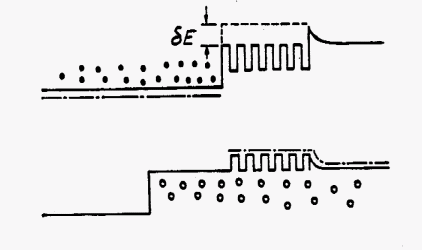
|
| | (2)
Note. It should be emphasized that the quarter-wavelength
thicknesses of the wells or barriers are set according to the wavelength
of carriers (i.e., electrons
or holes) incident upon the reflection superlattice NOT the wavelength of any photons/light
waves that might be absorbed by, or emitted
from, the superlattice or by/from any surrounding
areas. | |
| | |
| 762 | Nanowire or quantum wire (axially elongated structure
having two dimensions of 100 nm or less): |
| | This subclass is indented under subclass 700. Subject matter wherein the nanostructure has two physical
dimensions that are of 100 nm or less.
| | (1)
Note. The term, "quantum wire" refers to
an elongated structure having a carrier affinity that is larger
than that of the material or vacuum that surrounds it, and having
a diameter small enough (typically on the order of 20 nm
or less) to support discrete or quantized allowed energy
levels. |
| | (2)
Note. As used herein, the term "nanowire," is
broader than "quantum wire" because a "nanowire" must
merely have a physical diameter that is 100 nm or less.
Thus, "nanowire" also reads on various, additional
sub-100 nm wires, such as: (1) relatively
large electron affinity wires supporting/having overlapping
or non-quantized energy levels; or (2) any
other sub-100 nm-thick wire irrespective of its
carrier affinity relative to its surroundings. |
| | (3)
Note. Common synonyms for nanowire or quantum wire
include quantum or nanowhiskers, quantum, or nanolines; quantum
or nanorods, one-dimensional wires/lines/rods; and
one-dimensional wires/lines/rods. | |
| | |
| 763 | Formed along or from crystallographic ter races or ridges: |
| | This subclass is indented under subclass 762. Subject matter wherein a nanowire is formed along, atop, or
in between the supporting surface of crystallographic terraces or
ridges, or wherein these crystallographic terraces or ridges, themselves, form
the nanowire.
| | (1)
Note. Crystallographic terraces or ridges are atomic-scale, periodic
protrusions that may extend in either a straight or meandering direction
along the surface of certain crystalline planes, e.g., along the (5
5 12) plane, etc. | |
| | |
| 768 | Helical wire: |
| | This subclass is indented under subclass 766. Subject matter wherein the longitudinal axis of the nanowire
curves is in a spiral configuration. |
| | |
| 771 | Nanoring: |
| | This subclass is indented under subclass 766. Subject matter wherein the longitudinal axis of the nanowire
curves in a planar, open-ended, or close-ended
circular configuration. |
| | |
| 774 | Exhibiting three-dimensional carrier confinement (e.g., quantum
dots, etc.): |
| | This subclass is indented under subclass 773. Subject matter wherein the nanoparticle has a carrier affinity
that is larger than that of the material or vacuum that surrounds
it.
| | (1)
Note. The term "quantum dot" refers
to a substantially ball-shaped, cube-shaped, or
cluster-shaped structure having a carrier affinity that
is larger than that of the material or vacuum that surrounds it, and having
a width/diameter small enough (typically on the
order of 20 nm or less) to support discrete or quantized
allowed energy levels. |
| | (2)
Note. As used herein, the term "nanodot," is
broader than "quantum dot" because a "nanodot" must
merely have a physical diameter that is 100 nm or less. Thus, "nanodot" also
reads on various, additional sub-100 nm structures, such as: (1) clusters
of atoms which have a relatively large electron affinity but which
support non-quantized or overlapping energy levels; or (2) any
other sub-100 nm-diameter structure irrespective of
its carrier affinity relative to its surroundings. |
| | (3)
Note. This subclass is intended to include (1) true "quantum
dots" (wherein the energy levels are quantized) and
also (2) other dot structures that possess relatively
large carrier affinities or that are used for their (semi/)conducting or
electronic characteristics, even though the energy levels
supported by the dots overlap or are not quantized. |
| | (4)
Note. While this schedule distinguishes nanoparticles
from quantum dots for classification purposes, many references use
these terms interchangeably. Common synonyms for quantum
dots include: nanodots, quantum or nanoparticles, quantum
or nanoclusters, quantum or nanopowders, artificial
atoms, zero-dimensional dots, and 0-D
dots. | |
| | |
| 775 | Nanosized powder or flake (e.g., nanosized catalyst, etc.): |
| | This subclass is indented under subclass 773. Subject matter wherein the nanoparticle is composed of a
nanosized powder or flake, especially stand-alone
powders or flakes that are not further disposed, suspended, or
dissolved within a host/barrier/matrix composition, compound, or
solution.
SEE OR SEARCH CLASS:
| 75, | Specialized Metallurgical Processes, Compositions
for Use Therein, Consolidated Metal Powder Compositions, and
Loose Metal Particulate Mixtures, appropriate subclasses for subject matter based
on metal powder composition. |
| 501, | Compositions: Ceramic, appropriate subclasses for subject matter based
on metal powder composition. |
|
| | |
| 778 | Within specified host or matrix material (e.g., nanocomposite
films, etc.): |
| | This subclass is indented under subclass 700. Subject matter directed towards a specified host/barrier/matrix
composition, compound, or solution in which at
least one nanosized structure, e.g., fullerene, nanowire, etc., is
formed, disposed, suspended, or dissolved.
SEE OR SEARCH CLASS:
| 428, | Stock Material or Miscellaneous Articles, appropriate subclasses, particularly
subclasses 323 through -331for layer containing structurally defined particles
and subclasses 411.1-704 for non-structural
laminates. |
|
| | |
| 779 | Possessing nanosized particles, powders, flakes, or
clusters other than simple atomic impurity doping: |
| | This subclass is indented under subclass 778. Subject matter wherein the host/barrier/matrix composition, compound
or solution possesses a nanostructure of specified composition wherein
all three dimensions are of 100 nm or less.
| | (1)
Note. Simple atomic, impurity doping is excluded
from coverage because this would read on virtually every solid-state semiconductor
device, as they are all doped with shallow-level
impurities (i.e., n-doped
or p-doped) and/or deep-level impurities. | |
| | |
| 780 | Possessing fully enclosed nanosized voids or physical holes: |
| | This subclass is indented under subclass 778. Subject matter wherein the host/barrier/matrix composition, compound
or solution contains a fullyenclosed nanosized physical hole, void
or bubble of gas or vacuum.
| | (1)
Note. "Physical hole" as used in
this subclass is distinguished from the meaning of "hole" as
commonly employed in semiconductor physics to mean the absence of
an electron. | |
| | |
| 783 | Organic host/matrix (e.g., lipid, etc.): |
| | This subclass is indented under subclass 778. Subject matter wherein the nanosized structure is a host/barrier/matrix
composition, e.g., a lipid layer, etc., or
a compound or solution related to or derived from an organic source, such
as a living organism, which contains within the host or
layer other components which may or may not be nanomaterials, e.g., proteins
present in a lipid bilayer, etc. |
| | |
| 786 | Fluidic host/matrix containing nanomaterials: |
| | This subclass is indented under subclass 778. Subject matter wherein the host/matrix constitutes
a substance that can flow, i.e., fluidic
substance such as liquid or gas, in which nanostructures
are present, e.g., nanoparticles in
an aqueous solution, etc. |
| | |
| 788 | Of specified organic or carbon-based composition: |
| | This subclass is indented under subclass 700. Subject matter wherein either (1) a nanostructure
itself is composed of an organic carbon-based material/composition, or (2) a
substrate or host structure is composed of an organic carbon-based
material and is specifically adapted for bonding with, supporting
or containing a nanostructure.
| | (1)
Note. This subclass and its indents are intended
to broadly cover organic or carbon-based chemical structures, materials
or compositions that constitute, include, or are
specifically attached to nanosized structures. |
| | (2)
Note. This subclass and its indents exclude inorganic
carbon based structures, compositions or materials, such
as carbon-based fullerenes and CxSiyGezcompounds. |
SEE OR SEARCH THIS CLASS, SUBCLASS:
| 734, | for fullerenes. |
| 814, | for inorganic CxSiyGezcompounds. |
|
| | |
| 789 | In array format: |
| | This subclass is indented under subclass 788. Subject matter wherein the organic carbon based nanostructures
are orderly arranged in some type of pattern. |
| | |
| 791 | Molecular array: |
| | This subclass is indented under subclass 790. Subject matter wherein the organic carbon-based
nanostructures have different molecular structures. |
| | |
| 793 | Protein array: |
| | This subclass is indented under subclass 791. Subject matter wherein the organic carbon-based
nanostructures are dissimilar proteins. |
| | |
| 794 | Chemical library array: |
| | This subclass is indented under subclass 790. Subject matter wherein the organic carbon-based
nanostructures are different in chemical properties, generally
not biological in nature. |
| | |
| 796 | For electrical or electronic purpose: |
| | This subclass is indented under subclass 795. Subject matter wherein the biological material or composition
possesses a specified electrical property or is used within an electronic
device or for an electro-biological application. |
| | |
| 797 | Lipid particle: |
| | This subclass is indented under subclass 788. Subject matter wherein the organic carbon-based
nanostructures is a lipid particle type material, e.g., vesicle
or spherical lipid structure, etc. |
| | |
| 801 | Drug: |
| | This subclass is indented under subclass 799. Subject matter wherein the biological material internalized
in the lipid particle is a medicine, i.e., a
chemical substance utilized in biological disease or condition treatment. |
| | |
| 805 | Containing drug: |
| | This subclass is indented under subclass 803. Subject matter wherein the biological material is a medicine, i.e., a
chemical substance utilized in biological disease or condition treatment. |
| | |
| 809 | Organic film on silicon: |
| | This subclass is indented under subclass 788. Subject matter wherein the organic material or composition
is specifically formed on a doped or undoped silicon layer/substrate, either directly
or indirectly by means of an intermediate/buffer layer.
SEE OR SEARCH CLASS:
| 428, | Stock materials or Miscellaneous Articles, appropriate subclasses, particularly
subclass 446 and subclass 451 for laminates comprising a layer of
silicon and a layer of silicon next to addition polymers. |
|
| | |
| 810 | Of specified metal or metal alloy composition: |
| | This subclass is indented under subclass 700. Subject matter wherein the nanostructure is constituted
of or surrounded by a material that is a metal or a metal alloy.
SEE OR SEARCH CLASS:
| 420, | Alloys or Metallic Compositions, appropriate subclasses for alloy compositions. |
| 428, | Stock Materials or Miscellaneous Articles, appropriate subclasses, particularly
subclasses 544 through -687for structures of all metal or with adjacent metals. |
|
| | |
| 813 | Of specified inorganic semiconductor composition (e.g., periodic
table group IV-VI compositions, etc.): |
| | This subclass is indented under subclass 700. Subject matter wherein at least one nanostructure is composed
of, includes, or is surrounded by a material that
is specifically composed of an inorganic semiconductor material, regardless
of whether this material is degeneratively doped, moderately
doped, lightly doped or undoped.
SEE OR SEARCH CLASS:
| 428, | Stock Materials or Miscellaneous Articles, particularly
subclasses 688 through 703for non-structural laminates of inorganic
materials and subclass 620 for all metal composites where one of
the layers is a semiconductor layer. |
|
| | |
| 816 | III-N based compounds (e.g., AlxGayInzN, etc.): |
| | This subclass is indented under subclass 815. Subject matter wherein group III-V semiconductor-based
material is specifically composed of a nitride-based semiconductor
compound or alloy.
| | (1)
Note. Examples include AlxGayInzN, wherein
0 < x, y, z < 1 and x + y + z = 1. | |
| | |
| 817 | High-indium-content InGaN pooling or clusters: |
| | This subclass is indented under subclass 816. Subject matter wherein the InGaN-based semiconductor
material has an In concentration that is sufficiently high, e.g., In
concentration approximately on the order of In1Ga9N
to In4Ga6N, or
higher, etc., so as to produce an In pooling
or clustering effect, i.e., wherein
the layer separates into clusters or regions of relatively high
In concentration (quantum or potential wells) and
surrounding regions of relatively low In concentration (quantum
or potential barriers). |
| | |
| 818 | III-P based compounds (e.g., AlxGayInzP, etc.): |
| | This subclass is indented under subclass 815. Subject matter wherein group III-V semiconductor-based
material is specifically composed of a phosphide-based
semiconductor compound or alloy.
| | (1)
Note. Examples include AlxGayInzP, wherein
0 < x, y, z < 1 and x + y + z = 1. | |
| | |
| 819 | III-As based compounds (e.g., AlxGayInzAs, etc.): |
| | This subclass is indented under subclass 815. Subject matter wherein group III-V semiconductor-based
material is specifically composed of an arsenide-based
semiconductor compound or alloy.
| | (1)
Note. Examples include AlxGayInzAs,
wherein 0 < x , y , z < 1 and x + y + z = 1. | |
| | |
| 820 | III-Sb based compounds (e.g., AlxGayInzSb, etc.): |
| | This subclass is indented under subclass 815. Subject matter wherein group III-V semiconductor-based
material is specifically composed of an antimonide-based
semiconductor compound or alloy.
| | (1)
Note. Examples include AlxGayInzSb, wherein
0 < x, y, z < 1 and x + y + z = 1. | |
| | |
| 821 | Mixed group V compounds (e.g., III-NxPy, etc.): |
| | This subclass is indented under subclass 815. Subject matter wherein group III-V semiconductor-based
material is specifically composed of plural group V elements, irrespective whether
the compound includes one or plural group III elements.
| | (1)
Note. Examples include AlaGabIncNxPyAsz, wherein
0 < a, b, c < 1, a + b + c = 1; and
0 < x, y, z < 1 and x + y + z = 1. | |
| | |
| 822 | Boron-containing compounds: |
| | This subclass is indented under subclass 815. Subject matter wherein group III-V compound semiconductor
material specifically includes boron (B) as a
compositional (/non-dopant) element.
| | (1)
Note. Examples include alloys of B(Al)(Ga)N (or
BaAlbGacN, wherein
0 < a < 1; 0 < b, c < 1; and
a + b + c = 1). |
| | (2)
Note. Specifically excluded from this subclass are
semiconductor elements or compounds that have such a small amount
of boron that the boron present merely constitutes an impurity, e.g., on the
order of 1e20 atoms/cm3 or less, etc., in
a non-carbon composition, e.g., boron-doped
SiGe, etc. | |
| | |
| 823 | Tl-containing or Bi-containing compounds: |
| | This subclass is indented under subclass 815. Subject matter wherein group III-V compound semiconductor
material specifically includes thallium (Tl) and/or
bismuth (Bi) as compositional (/non-dopant) element(s).
| | (1)
Note. Specifically excluded from this subclass are
semiconductor elements or compounds that have such a small amount
of thallium or bismuth that the atoms of these elements present
merely constitute impurities, e.g., on
the order of 1e20 atoms/cm3 or less, etc., in
a non-bismuth, non-thallium composition, e.g., thallium
doped or bismuth-doped SiGe, etc. | |
| | |
| 824 | Group II-VI nonoxide compounds (e.g., Cdx Mny Te, etc.): |
| | This subclass is indented under subclass 813. Subject matter wherein the compound semiconductor is specifically
composed of group II-VI elements other than oxide-based
II-VI compounds.
SEE OR SEARCH THIS CLASS, SUBCLASS:
| 811, | for oxide-based compounds or metal oxide
nanomaterial, e.g., ITO, ZnOx, etc. |
| 812, | for Perovskites and superconducting materials, e.g., BaxSrxTiO3 etc. |
|
| | |
| 826 | Nonstoichiometric semiconductor compounds (e.g., IIIxVy; x
does not equal y, etc.): |
| | This subclass is indented under subclass 813. Subject matter wherein the compound semiconductor has a
substantially non-stoichiometric composition: i.e., wherein
the composition’s net charge is NOT substantially equal
to 0.
| | (1)
Note. Examples include IIIxVy or
IIxVIy; x does
not equal y. |
| | (2)
Note. Excluded from this subclass are substantially
stoichiometric compound semiconductors that are merely p-doped or
n-doped. | |
| | |
| 827 | Formed from hybrid organic/inorganic semiconductor
compositions: |
| | This subclass is indented under subclass 700. Subject matter wherein the nanosized structure or device
is composed of, or includes, a first structure, region
or portion that is composed of an organic material/composition (whether
biological or not), and a second structure, region or
portion that is composed of, or includes, an inorganic
semiconductor material/composition.
| | (1)
Note. The subclass is intended to generally cover
all organic materials/compositions that are interconnected
to, or functionally associated with, inorganic semiconductors
regardless of whether the organic material/composition, itself, also
possesses semiconducting properties. |
SEE OR SEARCH THIS CLASS, SUBCLASS:
| 734, | for fullerene and fullerene-like structures. |
| 738, | for buckyball nanostructure having a surface functionalized
with an organic material. |
| 746, | for carbon nanotube structure having a surface functionalized
with an organic material. |
| 753, | for carbon fullerenes having a polymeric or organic
binder. |
| 827, | for hybrid organic/inorganic semiconductor
structures in the event that the inorganic material/composition
is specifically a fullerene or fullerene-like structure. |
|
| | |
| 831 | Of specified ceramic or electrically insulating compositions: |
| | This subclass is indented under subclass 700. Subject matter wherein the nanostructure is composed of
a ceramic or other insulating materials/compounds, (e.g., a
ceramic nanopowder composed of a specified material, etc.).
SEE OR SEARCH CLASS:
| 428, | Stock Materials or Miscellaneous Articles, particularly
subclasses 689 through 703for Non-structural laminates of inorganic
metal compound containing layer, e.g. ceramics, etc. |
|
| | |
| 832 | Having specified property (e.g., lattice-constant, thermal
expansion coefficient, etc.): |
| | This subclass is indented under subclass 700. Subject matter wherein the material constituting the nanostructure
or nanodevice possesses a specified physical property.
SEE OR SEARCH THIS CLASS, SUBCLASS:
| 776, | for ceramic, e.g., electrically
insulating, etc., nanosized powder or
flake. |
| 777, | for metallic, e.g., electrically
conducting, etc., nanosized powder or
flake. |
| 796, | for organic, biological or polymeric carbon-based
composition with electrical property or for electronic purposes. |
| 810, | for metal, e.g., electrically
conducting, etc., nanomaterial. |
| 811, | for metal oxide, e.g., electrically
conducting or semiconducting, etc., nanomaterial. |
| 813, | for inorganic semiconducting nanomaterial. |
| 827, | for hybrid organic/inorganic semiconducting
nanomaterial. |
| 831, | for electrically insulating nanomaterial. |
| 784, | for electrically conducting, semi-conducting
or semi-insulating host material in which nanosized material
is disposed. |
| 785, | for electrically insulating host material in which
nanosized material is disposed. |
|
| | |
| 836 | Having biological reactive capability: |
| | This subclass is indented under subclass 835. Subject matter wherein the physical property is characterized
by its function of reacting with a living organism, e.g., reacts
with a particular biological target, such as a cancer cell, etc. |
| | |
| 837 | Piezoelectric property of nanomaterial: |
| | This subclass is indented under subclass 832. Subject matter wherein the specified physical property of
the material is its capability of generating electrical signal subjected
to a mechanical tress or capability of generating a mechanical stress
subjected to an applied voltage, i.e. piezoelectric
property. |
| | |
| 839 | MATHEMATICAL ALGORITHMS, E.G., COMPUTER
SOFTWARE, ETC., SPECIFICALLY ADAPTED
FOR MODELING CONFIGURATIONS OR PROPERTIES OF NANOSTRUCTURE: |
| | This subclass is indented under the class definition. Subject matter directed to the theoretical modeling of a
nanostructure’s configuration or associated physical properties, as
opposed to physical structures, themselves.
| | (1)
Note: Tools, aids and means specifically designed
or intended for carrying out, or assisting in, the
modeling of nanostructures are also included in this subclass. | |
| | |
| 840 | MANUFACTURE, TREATMENT, OR DETECTION
OF NANOSTRUCTURE: |
| | This subclass is indented under the class definition. Subject matter directed to a process or an apparatus for
making a nanostructure, altering a nanostructure, or
determining a characteristic of a nanostructure.
| | (1)
Note. The apparatus performing the manufacture, treatment, or
detection of the nanostructure is not limited to the nanoscale and
may include structure of macroscopic dimensions such as in a scanning
probe. |
| | (2)
Note. The detection of 840 is distinct from the detection
under 953 in that the focus of 840 is on nanostructures as the object
of detection whereas the focus of 953 is on nanostructures as the
objects doing the detecting. | |
| | |
| 841 | Environmental containment or disposal of nanostructure
material: |
| | Subject matter under 840 for the confinement of nanostructure
material so as to minimize dispersal into the environment, or
for the removal of nanostructure material from the environment.
| | (1)
Note. The disposal may be, for example, the
conversion of the nanostructure by chemical or physical means to
a less harmful form, which may be safely disposed of in
an ordinary municipal landfill. |
| | (2)
Note. This subclass does not include nanofiltration
processes for removing bacteria from air/etc |
SEE OR SEARCH CLASS:
| 588, | Hazardous or Toxic Waste Destruction or Containment, appropriate subclasses for processes for the destruction
or containment of hazardous materials. |
|
| | |
| 845 | Purification or separation of fullerenes or nanotubes: |
| | This subclass is indented under subclass 842. Subject matter wherein the process or apparatus is adapted
to extract the fullerene or nanotube from the material that accompanies
the growth process (e.g. residual catalyst, amorphous
carbon, graphite) or to sort or divide the fullerene
or nanotube based upon their physical or chemical properties (e.g. separation
by size, chirality, etc.). |
| | |
| 849 | With scanning probe: |
| | This subclass is indented under subclass 840. Subject matter including a device having at least a tip
of nanometer sized dimensions capable of performing manufacture, treatment, or detection
in the nanometer range, e.g., scanning
tunneling microscope (STM), atomic force
microscope (AFM), magnetic force microscope (MFM), and
near-field optical scanning probe etc. |
| | |
| 852 | For detection of specific nanostructure sample or nanostructure– related
property: |
| | This subclass is indented under subclass 849. Subject matter wherein the scanning probe is used to detect
a particular sample or to measure a particular nanoscale property
of the sample, e.g., shape resistivity, charge
density, etc.
SEE OR SEARCH CLASS:
| 73, | Measuring and Testing,
subclasses 649 , 774, 324-862.325
and 866.5 for structure of sensors. |
| 250, | Radiant Energy,
subclasses 227.11 , 309-311, and 341.2
for probe types used in solid or liquid sample detection. |
| 324, | Electricity: Measuring and Testing,
subclasses 72.5 , 149, 437, 445, 446, 690, 696, 715, 724, and
754.01-755.11 for probe types used in
detection processes of electrical properties of a sample. |
| 338, | Electrical Resistors,
subclasses 28 and 229 for resistor probes. |
|
| | |
| 853 | Biological sample: |
| | This subclass is indented under subclass 852. Subject matter wherein the sample is biological in nature.
SEE OR SEARCH CLASS:
| 435, | Chemistry: Molecular Biology and Microbiology,
subclasses 4 through 40.52and 287.1-288.7 for
detection of biological samples. |
| 436, | Chemistry: Analytical and Immunological
Testing,
subclasses 28 , 37, and 63 for detection of
biological samples. |
| 702, | Data Processing: Measuring, Calibrating, or
Testing,
subclasses 19 through 21for methods and apparatus utilizing a data processing
system in a measurement system directed to an environment of life
or chemical compound or process in a living system. |
|
| | |
| 854 | Semiconductor sample: |
| | This subclass is indented under subclass 852. Subject matter wherein the sample is a semiconductor material.
SEE OR SEARCH CLASS:
| 438, | Semiconductor Device Manufacturing: Process,
subclasses 14 through 18for semiconductor measuring and testing. |
|
| | |
| 856 | Including etching/cutting: |
| | This subclass is indented under subclass 855. Subject matter wherein the scanning probe tip is used for
removing material from a substrate, forming grooves or
indents in a substrate, or cutting a nanostructure.
SEE OR SEARCH CLASS:
| 216, | Etching a Substrate: Processes,
subclasses 12 through 19,39-40, 57-58, 72-81, and
96-100 for different types of substrate etching. |
|
| | |
| 857 | Including coating: |
| | This subclass is indented under subclass 855. Subject matter wherein the scanning probe tip is used for
depositing material on a substrate (such as in dip pen
nanolithography).
SEE OR SEARCH CLASS:
| 427, | Coating Processes,
subclasses 457- through 601for coating processes involving direct application
of electrical or magnetic, waves, or particulate energy. |
|
| | |
| 859 | Including substrate treatment: |
| | This subclass is indented under subclass 855. Subject matter wherein the scanning probe tip is used to
form or modify nanostructure on a substrate by modify the characteristic
of the substrate, e.g., scanning
probe tip is used to modify a chemical, thermal, electrical, magnetic, or
other property of the substrate, etc. |
| | |
| 860 | Scanning probe structure: |
| | This subclass is indented under subclass 849. Subject matter including structural details of the scanning
probe.
SEE OR SEARCH CLASS:
| 850, | Scanning-Probe Techniques or Apparatus; Applications
of Scanning-Probe Techniques, e.g., Scanning-Probe Microscopy
[SPM],
subclasses 21 through -63for scanning probe characteristics and their manufacture. |
|
| | |
| 861 | Scanning tunneling probe: |
| | This subclass is indented under subclass 860. Subject matter wherein the scanning probe is constructed
to operate based upon a quantum tunneling effect in which the probability
of electron transmission between the tip and an object being manufactured, treated, or
detected is related to a gap between the tip and the object.
SEE OR SEARCH CLASS:
| 850, | Scanning-Probe Techniques or Apparatus; Applications
of Scanning-Probe Techniques, e.g., Scanning-Probe Microscopy
[SPM],
subclasses 26 through -29for Scanning Tunnelling Microscopy (STM) or
apparatus therefor. |
|
| | |
| 862 | Near-field probe: |
| | This subclass is indented under subclass 860. Subject matter wherein the tip is formed with an integral
waveguide wherein the diameter of the waveguide is smaller than
the wavelength of the wave propagated in the waveguide.
SEE OR SEARCH CLASS:
| 850, | Scanning-Probe Techniques or Apparatus; Applications
of Scanning-Probe Techniques, e.g., Scanning-Probe Microscopy
[SPM],
subclasses 30 through -32for Scanning Near-Field Optical Microscopy
(SNOM ) or apparatus therefor. |
|
| | |
| 863 | Atomic force probe: |
| | This subclass is indented under subclass 860. Subject matter wherein the scanning probe is constructed
to operate based upon interaction forces between atoms such as Van
der Waals forces between the tip and an object being manufactured, treated, or
detected.
| | (1)
Note. Van der Waals force (aka London or
dispersion force) is an induced dipole -induced
dipole interaction that depends on the polarization ability of the
interacting molecules and is inversely proportional to the sixth
power of separation. |
SEE OR SEARCH CLASS:
| 850, | Scanning-Probe Techniques or Apparatus; Applications
of Scanning-Probe Techniques, e.g., Scanning-Probe Microscopy
[SPM],
subclasses 33 through -42for Atomic Force Microscopy (AFM) or
apparatus therefor. |
|
| | |
| 864 | Electrostatic force probe: |
| | This subclass is indented under subclass 860. Subject matter wherein the scanning probe is constructed
to operate based upon electrostatic forces between the tip and an
object being manufactured, treated, or detected.
| | (1)
Note. Electrostatic force generally results from
static charges within one material reacting with an electric field generated
by another material. |
SEE OR SEARCH CLASS:
| 324, | Electricity: Measuring and Testing,
subclasses 452 through 457and 709 for electrostatic force measurements. |
|
| | |
| 865 | Magnetic force probe: |
| | This subclass is indented under subclass 860. Subject matter wherein the scanning probe is constructed
to operate based upon magnetic forces between the tip and an object
being manufactured, treated, or detected.
| | (1)
Note. Magnetic force generally results from currents, or
moving charges, within one material reacting with an external magnetic
field generated by another material such as iron or nickel based materials
that have intrinsic magnetic properties. |
SEE OR SEARCH CLASS:
| 324, | Electricity: Measuring and Testing,
subclasses 200 through 263for magnetic measurements. |
| 850, | Scanning-Probe Techniques or Applications
of Scanning-Probe Techniques, e.g., Scanning-Probe Microscopy
[SPM],
subclasses 46 through 49for Magnetic Force Microscopy (MFM) or
apparatus therefor. |
|
| | |
| 866 | Scanning capacitance probe: |
| | This subclass is indented under subclass 860. Subject matter wherein the scanning probe is constructed
to operate based upon a capacitive effect between the tip and an
object being manufactured, treated, or detected.
| | (1)
Note. The capacitive effect is a change in capacitance
which occurs when the distance between the tip, acting
as a first electrode of a capacitor, and the object, acting
as a second electrode of a capacitor, changes as the tip
is scanned relative to the object. |
SEE OR SEARCH CLASS:
| 324, | Electricity: Measuring and Testing, appropriate subclasses for capacitive measurements. |
| 850, | Scanning-Probe Techniques or Apparatus; Applications
of Scanning-Probe Techniques, e.g., Scanning-Probe Microscopy
[SPM],
subclasses 44 through -45for Scanning Capacitance Microscopy (SCM) or
apparatus therefor. |
|
| | |
| 867 | Scanning thermal probe: |
| | This subclass is indented under subclass 860. Subject matter wherein the scanning probe is constructed
to operate based upon a thermal effect between the tip and an object
being manufactured, treated, or detected.
| | (1)
Note. The thermal effect may be a heating of the
object by the tip or a temperature detection of the object by the
tip or a combination of both heating and temperature detection between
the tip and object as the tip is scanned relative to the object. |
SEE OR SEARCH CLASS:
| 374, | Thermal Measuring and Testing,
subclasses 35 and 164 for thermal sensors including probe. |
| 850, | Scanning-Probe Techniques or Apparatus; Applications
of Scanning-Probe Techniques, e.g., Scanning-Probe Microscopy
[SPM],
subclass 50 for Scanning Thermal Microscopy (SThM) or
apparatus therefor. |
|
| | |
| 868 | With optical means: |
| | This subclass is indented under subclass 860. Subject matter including optical means to facilitate the
operation of the scanning probe.
SEE OR SEARCH CLASS:
| 356, | Optics: Measuring and Testing,
subclass 451 for spectroscopy, and subclass 501 for
an interferometer device usable with an atomic force microscope. |
| 359, | Optical: Systems and Elements,
subclasses 362 through 435for optical elements used in detecting devices. |
| 850, | Scanning-Probe Techniques or Apparatus; Applications
of Scanning-Probe Techniques, e.g., Scanning-Probe Microscopy
[SPM],
subclass 9 for optical means used in conjunction with scanning
probe microscope. |
|
| | |
| 869 | Optical microscope: |
| | This subclass is indented under subclass 868. Subject matter wherein the scanning probe is combined with
an optical microscope that examines a sample being manufactured, detected, or
treated by the scanning probe tip. |
| | |
| 871 | With environmental regulation means: |
| | This subclass is indented under subclass 860. Subject matter including means to adjust temperature, pressure, humidity, or
other environmental factors of the scanning probe.
SEE OR SEARCH CLASS:
| 850, | Scanning-Probe Techniques or Apparatus; Applications
of Scanning-Probe Techniques, e.g., Scanning-Probe Microscopy
[SPM],
subclasses 1 through 4for scanning or positioning arrangements. |
|
| | |
| 872 | Positioner: |
| | This subclass is indented under subclass 860. Subject matter including details of a mechanism such as
a piezoelectric, electrostatic, magnetic, or
other type of actuator that adjusts the position of the tip relative
to the nanostructure being manufactured, detected, or
treated.
SEE OR SEARCH CLASS:
| 310, | Electrical Generator or Motor Structure, appropriate subclasses for positioning mechanisms, and
subclasses 311 –371 for piezoelectric elements. |
|
| | |
| 873 | Tip holder: |
| | This subclass is indented under subclass 860. Subject matter including a projecting member such as a cantilever
that maintains the tip of the probe. |
| | |
| 875 | With tip detail: |
| | This subclass is indented under subclass 860. Subject matter including structural characteristics of the
tip of the scanning probe, i.e. material, shape, surface
treatment, or chemical functionalizing of the tip.
SEE OR SEARCH CLASS:
| 850, | Scanning-Probe Techniques or Apparatus; Applications
of Scanning-Probe Techniques, e.g., Scanning-Probe
Microscopy [SPM],
subclasses 52 through 61for probe characteristics and their manufacture. |
|
| | |
| 878 | Shape/taper: |
| | This subclass is indented under subclass 875. Subject matter wherein the physical form of the tip or the
degree of slope or angle of the tip is specified. |
| | |
| 879 | Material: |
| | This subclass is indented under subclass 875. Subject matter wherein the material forming the tip is specified. |
| | |
| 880 | With arrangement, process, or apparatus for
testing: |
| | This subclass is indented under subclass 840. Subject matter including process or apparatus for detecting
or testing a nanostructure.
SEE OR SEARCH THIS CLASS, SUBCLASS:
| 852, | for detection of specific sample using scanning
probe. |
SEE OR SEARCH CLASS:
| 73, | Measuring and Testing, for a method and/or apparatus for testing. |
| 324, | Electricity: Measuring and Testing, appropriate subclasses for a method and/or
apparatus for electrical testing. |
| 356, | Optics: Measuring and Testing, appropriate subclasses for optical measuring and
testing. |
| 435, | Chemistry: Molecular Biology and Microbiology, appropriate subclasses for a method and/or
apparatus for molecular biological and/or microbiological
testing. |
| 436, | Chemistry: Analytical and Immunological
Testing, appropriate subclasses for a method and/or
apparatus for chemical and immunological testing. |
|
| | |
| 881 | Microscopy or spectroscopy (e.g., SEM, TEM, etc.): |
| | This subclass is indented under subclass 880. Subject matter wherein a microscopy instrument such as an
electron microscope or a spectroscopic device is used to measure
or test the nanostructure.
SEE OR SEARCH CLASS:
| 250, | Radiant Energy,
subclass 311 for electron microscopes. |
| 356, | Optics: Measuring and Testing,
subclass 300 for a spectroscope. |
| 359, | Optical: Systems and Elements,
subclass 368 for a microscope. |
|
| | |
| 883 | Fluidic self-assembly (FSA): |
| | This subclass is indented under subclass 882. Subject matter wherein a gas or liquid, i.e., a fluid, carrying
a plurality of nanostructures is flowed over a substrate in a manner
that causes the nanostructures to be simultaneously deposited into
selected locations on the substrate s surface. |
| | |
| 884 | Assembled via biorecognition entity: |
| | This subclass is indented under subclass 882. Subject matter wherein molecular biology identification
entity i.e., biorecognition entity, is
utilized for attaching separate components together, e.g., protein/ligand
binding pair, the electrodeposition of the biorecognition
nanomodules in self-assembling, etc. |
| | |
| 885 | Via nucleic acid hybridization: |
| | This subclass is indented under subclass 884. Subject matter wherein the biorecognition utilizes nucleic
acid hybridization, e.g., nucleic acid
polymer hybridization to its complementary polymeric strand forming
double-stranded nucleic acid structure, etc. |
| | |
| 886 | Via protein recognition: |
| | This subclass is indented under subclass 884. Subject matter wherein biorecognition utilizes protein substrate
or binding site recognition for attaching separate components, e.g., protein receptor/ligand
binding or protein/enzyme substrate binding recognition, etc. |
| | |
| 888 | Shaping or removal of materials (e.g., etching, etc.): |
| | This subclass is indented under subclass 840. Subject matter including process or apparatus for forming
a nanostructure by removing material from the nanostructure.
SEE OR SEARCH CLASS:
| 204, | Chemistry: Electrical and Wave Energy,
subclass 192.32 for a process of sputter etching. |
| 216, | Etching A Substrate: Processes particularly,
subclass 63 for a process of gas phase etching of a substrate involving
the application of energy to the gaseous etchant or to the substrate being
etched. |
|
| | |
| 889 | By laser ablation: |
| | This subclass is indented under subclass 888. Subject matter wherein the material removing is done by
focusing coherent electromagnetic radiation, i.e., laser, onto
the surface of the nanostructure.
SEE OR SEARCH CLASS:
| 219, | Electric Heating,
subclasses 121.67 through 121.69for the shaping of an article by removing a portion
by electrical or wave energy, e.g., laser
ablation wherein no chemical etchant is employed, etc. |
|
| | |
| 890 | Deposition of materials (e.g., coating, CVD, or
ALD, etc.): |
| | This subclass is indented under subclass 840. Subject matter including process or apparatus for layering
or coating to form a nanostructure.
| | (1)
Note. The deposition could be performed by chemical
vapor deposition, i.e., CVD, or
atomic layer deposition, i.e., ALD. |
SEE OR SEARCH CLASS:
| 118, | Coating Apparatus,
subclasses 620 through 643for coating apparatus with means to apply electrical
or magnetic wave or particulate energy. |
| 427, | Coating Processes,
subclasses 457 through 601for coating processes with direct application of
electrical or magnetic wave or particulate energy. |
|
| | |
| 891 | Vapor phase deposition: |
| | This subclass is indented under subclass 890. Subject matter wherein the coating material is in a gaseous
state.
SEE OR SEARCH CLASS:
| 118, | Coating Apparatus,
subclasses 715 through 733for vapor phase coating apparatus. |
| 427, | Coating Processes,
subclasses 248.1 through 255.7for vapor phase coating processes. |
|
| | |
| 892 | Liquid phase deposition: |
| | This subclass is indented under subclass 890. Subject matter wherein the coating material is in a liquid
state.
SEE OR SEARCH CLASS:
| 118, | Coating Apparatus,
subclasses 29 , 73, 400, and 429 for
liquid phase coating apparatus. |
| 427, | Coating Processes,
subclasses 475 , 483, and 581 for liquid phase
coating processes. |
|
| | |
| 894 | Having step or means utilizing biological growth: |
| | This subclass is indented under subclass 840. Subject matter wherein the process or apparatus uses a living
organism growth process or growth behavior to manufacture, treat, or detect
a nanostructure.
SEE OR SEARCH CLASS:
| 435, | Chemistry: Molecular Biology and Microbiology,
subclasses 243 , 325, 440, and 283.1
for method or apparatus of propagating a microorganism. |
|
| | |
| 896 | Chemical synthesis (e.g., chemical
bonding or breaking, etc.): |
| | This subclass is indented under subclass 895. Subject matter wherein the process or apparatus uses chemical
synthesis to manufacture a nanostructure.
| | (1)
Note. The chemical synthesis is a process of uniting
chemical elements or simpler compounds, or by the degrading a
compound, i.e., process typically occurs
by bonding chemicals or by breaking up chemical compounds, combination
reaction process, or process of creating a chemical compound
involving plural chemical reactions. | |
| | |
| 897 | Polymerization: |
| | This subclass is indented under subclass 896. Subject matter wherein a nanostructure is formed via a chemical
process that links two or more monomers together to form a polymer. |
| | |
| 898 | Enzymatic: |
| | This subclass is indented under subclass 896. Subject matter wherein the chemical synthesis utilizes proteins
or conjugated proteins produced by living organisms and functioning
as catalysts in chemical reactions to manufacture nanostructure.
SEE OR SEARCH CLASS:
| 435, | Chemistry: Molecular Biology and Microbiology,
subclasses 183 through 234for an enzyme, per se. |
|
| | |
| 899 | Electrolytic: |
| | This subclass is indented under subclass 896. Subject matter wherein the process or apparatus involves
electrolysis of a chemical element to manufacture a nanostructure.
| | (1)
Note. Electrolysis is a process including conduction
of an electric current between two or more electrodes through a
substance (an electrolyte) and resulting in a
chemical change, e.g., oxidation, reduction, etc. |
SEE OR SEARCH CLASS:
| 205, | Electrolysis: Processes, Compositions
Used Therein, and Methods of Preparing the Compositions,
subclasses 80 , 334, 640, and 687 for
electrolytic process or composition. |
|
| | |
| 900 | Having step or means utilizing mechanical or thermal property (e.g., pressure, heat, etc.): |
| | This subclass is indented under subclass 840. Subject matter including process or apparatus that uses
solely mechanical means, e.g., pressing
or grinding, etc., or thermal means, e.g., heating
or curing, etc., to manufacture a nanostructure. |
| | |
| 902 | SPECIFIED USE OF NANOSTRUCTURE: |
| | This subclass is indented under the class definition. Subject matter wherein a nanostructure is a component of
a device or system or is used as part of a process with a particular
function or purpose.
| | (1)
Note. This subclass covers combination claims which
includes a nanostructure as part of a subcombination wherein subclass
this does not exit covers only the particular details of the nanostructure subcombination. |
| | (2)
Note. This subclass covers process of use claims
that include nanostructures provided to accomplish a specified functional
requirement. | |
| | |
| 905 | Specially adapted for travel through blood circulatory
system: |
| | This subclass is indented under subclass 904. Subject matter wherein the use comprises a process or device
for moving through the network for supplying blood in a body.
SEE OR SEARCH CLASS:
| 424, | Drug, Bio-Affecting and Body
Treating Compositions,
subclasses 9.3-9.37 for in vivo
diagnosis or in vivo testing. |
| 435, | Molecular Biology and Microbiology, appropriate subclasses for cell culture, general
molecular biology, etc. |
| 436, | Chemistry: Analytical and Immunological
Testing,
subclass 66 for blood testing. |
| 514, | Drug, Bio-Affecting and Body
Treating Compositions, appropriate subclasses for gene therapy, protein
therapy, etc. |
|
| | |
| 906 | Drug delivery: |
| | This subclass is indented under subclass 904. Subject matter wherein the nanostructure is adapted for
delivery of a therapeutic compound or composition to living organs, tissues, or cells. |
| | |
| 907 | Liposome: |
| | This subclass is indented under subclass 906. Subject matter wherein the nanostructure used for delivery
of the therapeutic agent includes a liposome.
| | (1)
Note. Liposomes are particles, the shells of
which include a lipid bilayer. | |
| | |
| 908 | Mechanical repair performed/surgical: |
| | This subclass is indented under subclass 904. Subject matter wherein the nanostructure is used for in vivo or in vitro repair of cells or tissue, e.g., in
surgery, etc.
SEE OR SEARCH CLASS:
| 128, | Surgery, appropriate subclasses for a surgical process. |
| 600, | Surgery, appropriate subclasses for a surgical process. |
|
| | |
| 912 | Cancer cell repair: |
| | This subclass is indented under subclass 908. Subject matter wherein the nanostructure is used for converting
cancerous cells or tissue into normal cells or tissue. |
| | |
| 914 | Protein engineering: |
| | This subclass is indented under subclass 904. Subject matter wherein the nanostructure is adapted for
use in the synthesis of polypeptides.
SEE OR SEARCH CLASS:
| 530, | Chemistry, Natural Resins or Derivatives; Peptides
or Proteins; Lignins or Reaction Products Thereof, particularly
subclasses 333 through 342for synthesis of polypeptides. |
|
| | |
| 915 | Therapeutic or pharmaceutical composition: |
| | This subclass is indented under subclass 904. Subject matter comprising a chemical compound constructed
to treat an affliction or a disease of a body.
SEE OR SEARCH CLASS:
| 424, | Drug, Bio-Affecting and Body
Treating Compositions, appropriate subclasses for a therapeutic composition, per
se. |
| 435, | Chemistry: Molecular Biology and Microbiology, appropriate subclasses for plasmids, vectors, and
cells comprising a vector. |
| 514, | Drug, Bio-Affecting and Body
Treating Compositions, appropriate subclasses for a therapeutic composition, per
se. |
|
| | |
| 916 | Gene therapy: |
| | This subclass is indented under subclass 915. Subject matter wherein the nanostructure is utilized for
the insertion, deletion, addition, or substitution
of a nucleotide or nucleotides in an already existing DNA sequence, e.g., gene, plasmid, cosmid, a
viral or phage DNA, etc., wherein the
DNA sequence is then used for treating a disease.
| | (1)
Note. Examples of processes intended for this subclass
include administering nucleic acid (DNA, RNA) into
animals by intramuscular, intraperitoneal, intravenous, oral, or
any other route. |
SEE OR SEARCH THIS CLASS, SUBCLASS:
| 906, | for nanostructure used for delivering a modified
gene into living organs, tissue, or cells. |
|
| | |
| 917 | Vaccine: |
| | This subclass is indented under subclass 915. Subject matter wherein the nanostructure is part of an adjuvant
adapted for producing an immunological response and vaccination against
a disease or infection.
| | (1)
Note. The nanostructure may increase the immunological
response of a nucleic acid or protein delivered. | |
| | |
| 918 | Immunological: |
| | This subclass is indented under subclass 904. Subject matter wherein a substance comprising a nanostructure
is used to prevent a disease in a body.
SEE OR SEARCH CLASS:
| 424, | Drug, Bio-Affecting and Body
Treating Compositions,
subclasses 130.1 through 177.1for an immunoglobulin, antiserum, or
antibody treating composition. |
| 436, | Chemistry: Analytical and Immunological
Testing, appropriate subclasses for immunological analysis and
testing. |
|
| | |
| 919 | Dental: |
| | This subclass is indented under subclass 904. Subject matter wherein the nanostructure is used in a process
or device for treating teeth.
SEE OR SEARCH CLASS:
| 433, | Dentistry, appropriate subclasses for a process and device
for treating human teeth. |
|
| | |
| 921 | Of toxic chemical: |
| | This subclass is indented under subclass 920. Subject matter wherein the nanostructure is used for the
detection of a toxic chemical or molecule. |
| | |
| 923 | Cell culture: |
| | This subclass is indented under subclass 904. Subject matter wherein the nanostructure is adapted for
providing a support surface for growing cells in culture.
SEE OR SEARCH CLASS:
| 435, | Chemistry: Molecular Biology and Microbiology,
subclasses 395 through 403for solid supports and methods of culturing cells
on solid supports. |
|
| | |
| 925 | Bioelectrical: |
| | This subclass is indented under subclass 904. Subject matter wherein the nanostrusture is used in an electrical
process or device for treating a living organism.
SEE OR SEARCH CLASS:
| 607, | Surgery: Light, Thermal, and
Electrical Application, appropriate subclasses for a process of bioelectrically treating
a human body. |
|
| | |
| 927 | Diagnostic contrast agent: |
| | This subclass is indented under subclass 904. Subject matter wherein a nanostructure is used in a diagnosis
process or to enhance image differences between body tissues in
the diagnosis process. |
| | |
| 928 | X-ray agent: |
| | This subclass is indented under subclass 927. Subject matter wherein the nanostructure is used as a contrast
agent in the x-ray process. |
| | |
| 930 | MRI contrast agent: |
| | This subclass is indented under subclass 927. Subject matter wherein the nanostructure is used as a contrast
agent in an MRI process.
SEE OR SEARCH CLASS:
| 424, | Drug, Bio-Affecting and Body
Treating Compositions,
subclass 9.3 for chemical compound or compositions used as contrast
agents in magnetic imaging devices. |
| 600, | Surgery,
subclass 407 for nuclear, electromagnetic, or
ultrasonic diagnostic devices using diagnostic contrast agents. |
|
| | |
| 932 | For electronic or optoelectronic` application: |
| | This subclass is indented under subclass 902. Subject matter wherein a nanostructure is used in an electronic
or optoelectronic device or process.
| | (1)
Note. This subclass and those indented below are
primarily intended for electronic or optoelectronic devices and applications
employing fullerenes, i.e., buckyballs, nanotubes; quantum
confinement structures, i.e., quantum
dots, quantum wires; molecular, or atomic structures
as significant components of the electronic or optoelectronic devices. |
| | (2)
Note. Solid-state semiconductor based circuits
or circuit components, e.g., MOSFETS, etc., which
recite dimensions of nanometer scale is insufficient for placement
herein. | |
| | |
| 933 | Spintronics or quantum computing: |
| | This subclass is indented under subclass 932. Subject matter wherein the device or process uses electron-spin
or nuclear-spin properties to perform functions or to
process information.
| | (1)
Note. The term "spintronics" is
also referred to as spin electronics, magnetoelectronics, or
quantum computing. |
| | (2)
Note. There are of two stable spins (up and
down). Electron spin causes magnetism on the atomic
level. | |
| | |
| 934 | Giant magnetoresistance (GMR): |
| | This subclass is indented under subclass 933. Subject matter wherein the spintronic device exhibits or
produces a large change in electrical resistance upon application
of an external magnetic field (i.e., GMR) effect.
| | (1)
Note. "Giant" refers to the very
large electrical signal of a GMR device. |
| | (2)
Note. GMR devices are widely used to sense magnetic
field, as read-head sensors in hard disk drives, and
magnetic random access memory. |
SEE OR SEARCH CLASS:
| 324, | Electricity: Measuring and Testing, appropriate subclasses for measuring magnetic property. |
| 360, | Dynamic Magnetic Information Storage or Retrieval,
subclasses 313 through 327.33for magnetoresistance heads. |
|
| | |
| 940 | In a logic circuit: |
| | This subclass is indented under subclass 932. Subject matter wherein the nanostructure is used in an electronic
circuit that performs combinational or sequential digital logic
functions.
| | (1)
Note. Included herein are circuits having nanostructures
that used for Boolean operations to form counters, shift
registers, or other devices used in digital computation. |
SEE OR SEARCH CLASS:
| 326, | Electronic Digital Logic Circuitry,
subclasses 37 through 50for combinational or sequential logic. |
|
| | |
| 943 | Information storage or retrieval using nanostructure: |
| | This subclass is indented under subclass 932. Subject matter wherein the nanostructure is used for storing
or retrieving information.
SEE OR SEARCH CLASS:
| 360, | Dynamic Magnetic Information Storage or Retrieval,
subclasses 313 and 328 for magnetostrictive head. |
| 365, | Static Information Storage or Retrieval,
subclasses 129 through 150for information storage or retrieval devices including
particular elements for writing and reading of static information, subclass
151 for information storage on the molecular or atomic level. |
| 369, | Dynamic Information Storage or Retrieval,
subclasses 271.1 through 291.1for storage medium structure. |
|
| | |
| 947 | With scanning probe instrument: |
| | Subject matter under 943 wherein a nanosized tip is used
to perform the information storage or retrieval, e.g. nanosized
tip is used to read or write information data, etc.
SEE OR SEARCH THIS CLASS, SUBCLASS:
| 849 | through 879, for scanning probes used in the manufacture, treatment, or detection
of nanostructures. |
|
| | |
| 948 | Energy storage/generating using nanostructure (e.g., fuel
cell, battery, etc.): |
| | This subclass is indented under subclass 932. Subject matter wherein the nanostructure facilitates the
storage or generation of energy such as in a capacitor or battery
fuel cell.
SEE OR SEARCH CLASS:
| 60, | Power Plants, appropriate subclasses for energy conversion to
produce power. |
| 136, | Batteries: Thermoelectric and Photoelectric,
subclasses 200 through 242for thermoelectric batteries, and 243- 265
for photoelectric batteries. |
| 429, | Chemistry: Electrical Current Producing
Apparatus, Product, and Process, for electrochemical batteries, particularly
subclasses 400 through 535for fuel cells. |
|
| | |
| 949 | Radiation emitter using nanostructure: |
| | This subclass is indented under subclass 932. Subject matter wherein the nanostructure is used to convert
electric energy into emitting radiant energy.
SEE OR SEARCH CLASS:
| 250, | Radiant Energy, appropriate subclasses for methods and apparatus
for generating radiant energy. |
|
| | |
| 950 | Electromagnetic energy: |
| | This subclass is indented under subclass 949. Subject matter wherein the radiant energy is electromagnetic
energy, i.e., radio, microwave, infrared, visible
light, ultraviolet, x-ray, gamma
ray. |
| | |
| 951 | Laser: |
| | This subclass is indented under subclass 950. Subject matter wherein the electromagnetic energy is a coherent, directional
beam of light generated by stimulating electronic, ionic, or molecular
transitions to lower energy levels.
SEE OR SEARCH CLASS:
| 372, | Coherent Light Generators,
subclasses 1 through 3,5-8, and 38.1-38.09
for laser generators. |
|
| | |
| 952 | Display: |
| | This subclass is indented under subclass 932. Subject matter wherein the nanostructure is used to convert
electric signal into images in visual form such as a cathode ray
tube, LCD, or LED display.
| | (1)
Note. This subclass includes nanostructure and refers
to more than simply the molecules found in the cell structure of liquid
crystals. |
SEE OR SEARCH CLASS:
| 345, | Computer Graphics Processing and Selective Visual
Display Systems,
subclasses 10 through 111for displays. |
| 349, | Liquid Crystal Cells, Elements and System,
subclasses 1 through 18for particular liquid crystal system. |
|
| | |
| 954 | Of radiant energy: |
| | This subclass is indented under subclass 953. Subject matter wherein the measurement is of radiation, e.g.,
electromagnetic waves, electrons, etc.
SEE OR SEARCH CLASS:
| 250, | Radiant Energy,
subclasses 251 , 253-266, and 306-311
for method or apparatus for detecting radiant energy. |
|
| | |
| 955 | Of thermal property: |
| | This subclass is indented under subclass 953. Subject matter wherein the measurement is thermal in nature, e.g., heat, temperature, cooling
rate, etc.
SEE OR SEARCH CLASS:
| 374, | Thermal Measuring and Testing, appropriate subclasses for methods and apparatus
for detecting thermal properties. |
|
| | |
| 956 | Of mechanical property: |
| | This subclass is indented under subclass 953. Subject matter wherein the measurement is mechanical in
nature, i.e., strain, stress, pressure, flow
rate, size.
SEE OR SEARCH CLASS:
| 73, | Measuring and Testing, appropriate subclasses for methods and apparatus for
detecting mechanical properties. |
|
| | |
| 957 | Of chemical property or presence: |
| | This subclass is indented under subclass 953. Subject matter wherein the measurement is chemical in nature (i.e., pH, electrochemical, DNA
sequencing, etc.).
SEE OR SEARCH CLASS:
| 436, | Chemistry: Analytical and Immunological
Testing, appropriate subclasses for methods and apparatus
for detecting chemical properties. |
| 702, | Data Processing: Measuring, Calibrating, or
Testing,
subclasses 19 through 21for methods and apparatus utilizing a data processing
system in a measurement system directed to an environment of life
or chemical compound or process in a living system. |
|
| | |
| 960 | Of magnetic property: |
| | This subclass is indented under subclass 953. Subject matter wherein the measurement is magnetic in nature, e.g., magnetic
field strength, magnetic hysteresis, magnetoresistance, etc. |
| | |
| 961 | For textile or fabric treatment: |
| | This subclass is indented under subclass 902. Subject matter wherein the nanostructure is used for altering
a condition of a fabric.
SEE OR SEARCH CLASS:
| 8, | Bleaching and Dyeing; Fluid Treatment
and Chemical Modification of Textiles and Fibers, appropriate subclasses for chemical treatment of
a textile. |
| 26, | Textiles: Cloth Finishing, appropriate subclasses for finishing of a textile. |
| 442, | Fabric (Woven, Knitted, or
Nonwoven Textile or Cloth, etc.), appropriate subclasses for a textile or fabric, per
se. |
|
| | |
| 962 | For carrying or transporting: |
| | This subclass is indented under subclass 902. Subject matter wherein the nanotructure is used for moving
or conveying an article.
SEE OR SEARCH CLASS:
| 187, | Elevator, Industrial Lift Truck, or
Stationary Lift For Vehicle, appropriate subclasses for an apparatus for vertically
moving an article. |
| 198, | Conveyors: Power-Driven, appropriate subclasses for powered conveyors. |
| 224, | Package and Article Carriers, appropriate subclasses for an apparatus for carrying
an article. |
| 414, | Material or Article Handling, appropriate subclasses for an apparatus or method
of handling an article. |
|
| | |
| 963 | MISCELLANEOUS: |
| | This subclass is indented under the class definition. Subject matter wherein the nanostructure includes details
not otherwise provided for in this schedule. |
| | |
![[Search a list of Patent Appplications for class 977]](../as.gif) CLASS 977,
CLASS 977,