In 1973, the European Patent Convention (EPC) established an international organization (the “European Patent Organization”), the aim of which is to strengthen cooperation among European states (the “Contracting States”) regarding the grant of patents. In particular, the EPC allows an applicant to obtain patents throughout most of Europe on the basis of a single European patent application subjected to a single, centralized granting procedure, rather than filing and prosecuting individual applications in each country. The EPO is the office responsible for administering this procedure. The EPO is a separate agency from that of the European Union Intellectual Property Office (EUIPO), which focuses on trademark and design rights in European countries.

A patent granted by the EPO (a “European patent”) does not in itself confer pan-European patent protection. Rather, the European patent must be validated separately in each country where the applicant wishes to obtain patent protection. Broad European protection on the basis of a European patent will be possible if the Agreement on a Unified Patent Court comes into force. Protection outside of Europe is also possible through extension or validation agreements between the European Patent Organization and partner states. See the EPO website for more information about these extension states and validation states.
Treaties that help facilitate IP filings
Paris Convention (possibility of securing “priority” for overseas IP filings)
Under certain conditions and on fulfilling certain requirements, an application for patent, trademark, or design right filed in the EPO may be entitled to the benefit of the filing date of a prior application filed in the United States. A claim for benefit of a patent application must be made within 12 months of the U.S. filing date.
Patent Cooperation Treaty (international patent applications)
The Patent Cooperation Treaty (PCT) is an international agreement, which makes it possible to request patent protection in multiple countries through the filing of a single “international” patent application. The EPC constitutes a regional patent treaty under Article 45(1) of the PCT, which makes it possible for European patents to be granted on the basis of PCT international applications filed with the EPO. For more information, see EPO's Euro-PCT Guide and the WIPO National Phase PCT Applicant's Guide for EPO.
Worksharing and other cooperative arrangements
Patent Prosecution Highway (accelerated examination)
The USPTO participates with the EPO in the IP5 Patent Prosecution Highway. When an applicant receives a final ruling from the USPTO that at least one claim is allowed, the applicant can request fast track examination of corresponding claim(s) in a corresponding patent application that is pending at EPO, and vice-versa. To request accelerated prosecution of a European patent application based on an allowable claim at the USPTO or another IP office, visit EPO's Official Journal December 2019.
Priority Document Exchange (electronic transmission of certain filing documents)
The EPO is a WIPO Digital Access Service (DAS) participating office. However, the USPTO priority document exchange with the EPO occurs through Direct Bilateral Exchange, not the WIPO DAS exchange. Similar to WIPO DAS, this allows the free, electronic transmission of certain filing documents between IP offices. It automates the provision of priority documents to offices of second filing, which is generally required to obtain the “right of priority” under the Paris Convention. For more information, see the USPTO's Electronic Priority Document Exchange (PDX) Program.
Global Dossier (display of information about patent applications in multiple countries)
Global Dossier is a tool that allows applicants to view information, at a single location, about patent “family” member applications that are pending in different IP offices. European patent application search and examination documents can be viewed through Global Dossier. See the USPTO's Global Dossier webpage for more information.
Learn more
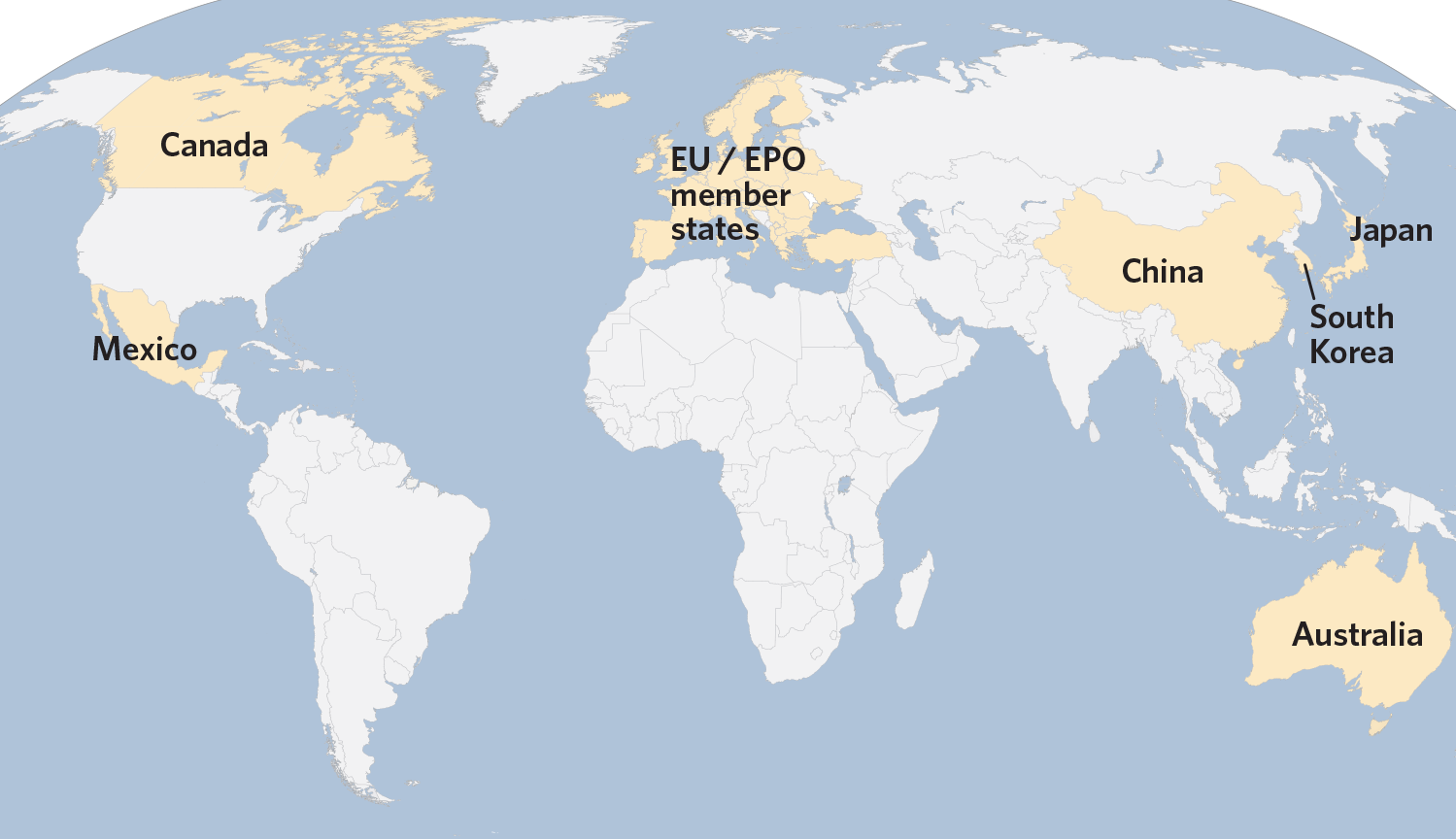
Use the below interactive map to learn more about IP protection in the highlighted countries/regions.