SECTION I - CLASS DEFINITION
This class provides the locus for all fluid impellers* not elsewhere
classifiable.
| | (1)
Note. The working fluid*, which is acted on by or
acts upon the impeller, may be a liquid or gas.
This class also takes miscellaneous subcombinations of impellers
and accessory devices when the subcombination or accessory is limited
in use to the combination or not elsewhere classifiable. |
SECTION II - LINES WITH OTHER CLASSES AND WITHIN THIS CLASS
GENERAL PLACEMENT OF PATENTS BASED ON A LINE APPLICABLE TO
AN ART GROUP
Impellers* combined with structure or art devices
are found in many classes wherein the impeller function is incidental
or ancillary to the function of the combination. In those instances
where an impeller relates to combinations in a similar manner in
more than one class, a single line has been established to determine
the placement of art.
No attempt has been made to review the classification of all
patents found in classes which may involve an impeller as an element
of the class subject matter. Thus, it is to be noted that although
the original classification of a patent may not be consistent with
a line set out below, currently issuing patents will be classified
on the basis of the stated lines and the various patents currently
classified inconsistent therewith are to be transferred when noted.
Vehicle Propulsion - This class provides for the combination
of a vehicular device and an impeller* not otherwise classified
wherein the impeller is arranged to propel the device and no more
structure of the device is claimed than is necessary to mount the
impeller inclusive of any impeller motor or drive means. Any additional
recitation of vehicle structure or any modification of the vehicular
device will require classification in the proper vehicle class.
| | (1)
Note. The structure of the vehicle is considered to be significantly
claimed in any instance wherein the impeller, its power plant, motor
or drive mechanism is mounted or located (1) in a specific
relation with respect to the vehicular device as a unit
(e.g., perpendicular to longitudinal axis) or (2) on or in a relationship
to a specific vehicle part (e.g.,wing
or keel). |
| | (2)
Note. Merely locating the impeller or drive means by broad reference to the vehicular device
is not sufficient to exclude the patent from classification in this
class (e.g., attached at side, front, rear, bow, stern, top, bottom,
right, left, within or without the vehicle or at the water line).
However, additional relationships will be sufficient for classification
in the proper vehicle class (e.g., one impeller on each side or
an impeller drive mounted within the vehicle rearwardly of the center
of gravity). |
| | (3)
Note. Terms such as deck, cabin, wing, fender, keel and gunwale
are considered to be specific vehicle parts, per se, while fore, aft,
bow, stern, hull or fuselage are not, of themselves, so considered. |
SECTION III - REFERENCES TO OTHER CLASSES
SEE OR SEARCH CLASS:
| 60, | Power Plants,
subclasses 495+ for a motor operated by the buoyancy of a fluid
or by the vertical component of tides or waves. |
| 74, | Machine Element or Mechanism, for the combination with a named impeller* which
is recited as a nominal load, i.e., no detail of the impeller or
its relationship with the gearing or transmission is recited. |
| 244, | Aeronautics, for the combination of impellers* and aircraft
structure where more aircraft details are recited than is necessary
to mount the impellers. |
| 277, | Seal for a Joint or Juncture, for the combination of a sealing means between relatively moving
parts, one of which may be an impeller* shaft, where no
specific details are recited of the impeller or other fluid reaction
surface mounted on the shaft. |
| 366, | Agitating, appropriate subclasses for (1) the combination of
an agitating impeller* and a confining means (e.g., mixing
chamber, etc.), (2) the combination of an agitating impeller and
means functionally related to confining means for a fluid being
agitated (e.g., structure which scrapes chamber walls; support specialized
for use in or on a mixing chamber or closure therefore feed or discharge
means to point of agitation; etc.), or (3) am impeller per se which
is disclosed solely for agitating viscous or particulate solids,
such as dough or sand. |
| 384, | Bearings, for the combination of a broadly recited impeller* and
a bearing element supporting the impeller shaft. The recitation
of a "blade" impeller is considered to be a detail sufficient
to exclude a claim from Class 384 and classify it in Class 416. |
| 415, | Rotary Kinetic Fluid Motors or Pumps, for a fluid reaction surface (impeller*) and a
means for guiding a fluid to, around or from the surface. The relationship
between Classes 415 and 416 is that of combination - subcombination
respectively. However, patents in Class 415,
subclass 182.1 and 208.1 through 232, which claim a nominally
recited casing and particular runner structure have been cross referenced
to Class 416. For a complete search of runner or impeller structure,
other appropriate subclasses in Class 415 should be considered.
A patent including claimed means for confining, guiding or directing
the fluid to or from an impeller* will be classified in
Class 415. A waterfall has been determined to be directed fluid
and an impeller claimed in combination therewith is classified in
Class 415. |
| 440, | Marine Propulsion, appropriate subclasses for the combination of an
impeller* and significant ship structure and see Vehicle
Propulsion above for a detailed statement of the line with vehicle
classes in general.
| | (1)
Note. As an exception to the line set out above, the collection
of portable propellers (e.g., outboard motor type) in subclasses 53+ of
Class 440 has not been cleared at this time and such disclosures
will continue to be there classified. | |
SECTION IV - GLOSSARY
The following terms or words, used throughout the
titles and definitions, are set forth with the meaning each is to have
in this class. Throughout this bulletin an asterisk(*)
following the first occurrence of the word or term in any title,
definition or note that reference should be made to this glossary
for the specific meaning thereof.
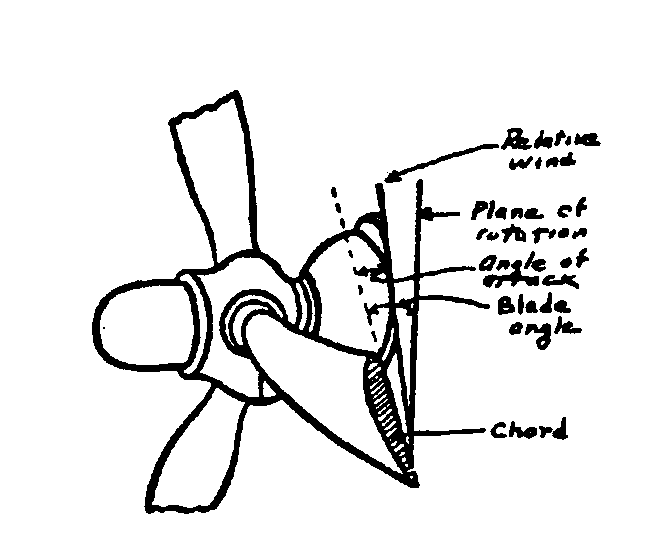
ANGLE OF ATTACK
The acute angle between the chord* of a working
member* and the velocity vector of the working fluid* flow relative
to the member. See Figure I.
BLADE
A working member* which has a thickness dimension substantially
less than its width or length, the thickness being generally uniform
from edge to edge.
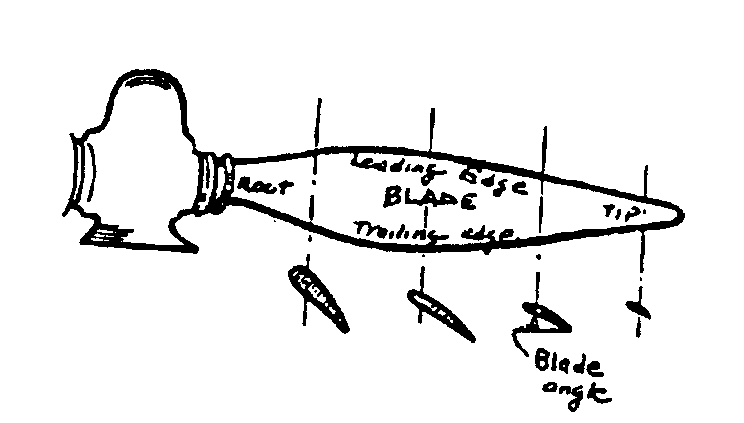
BLADE ANGLE
The acute angle between the chord* of any section
of a rotating working member* and its plane of rotation.
As the blade angle usually varies from the hub to the tip, the U.S.
custom is to designate blade angle numerically as that angle occurring
at 75% of the radial distance from the hub to the tip.
See Figures I and II.
CARRIER
A Load bearing structure (e.g., hub, etc.) which mounts one
or more working members* and which, at least in part, partakes
of the motion of the member.
CHORD
The straight line in a plane normal to the longitudinal axis
of a working member* joining the leading and trailing edges
of the member*. See Figure I.
CONTROLLABLE PITCH
Comprises means for adjusting blade angle* during impeller* operation.
COLLECTIVE PITCH CHANGE
Wherein the blade angles of all working members* of
a single impeller are adjusted simultaneously.
CYCLIC PITCH CHANGE
Wherein the blade angle of each working member of an impeller
is varied for only a predetermined limited portion of each working
cycle, each working member being similarly adjusted in sequence
as it, in turn, reaches the predetermined portion of the working
cycle. though the impeller need comprise only a single working member.
IMPELLER
A device comprising at least one working member* which
functions to react with a working fluid* such that action
movement of the member causes reaction movement of the fluid or
action movement of the fluid causes reaction movement of the working
member. In its simplest form, a single impeller is considered to
comprise a working member or members and any parts rigidly connected
therewith whereby the impeller is supported for movement. In the
case of an impeller having a working member which has relative movement
with respect to another impeller part or another working member,
the definition of impeller is considered to include those mechanical
elements which permit or cause relative motion of the working members
and at least partly partake of the motion of the working member
and are closely associated therewith to form a unitary device having
a unitary impelling function.
In view of the many embodiments an impeller may have, it is
not possible to more definitely define the concept, but in most
cases it will be apparent which elements forms part of the impeller
and which elements, on the other hand, comprise support* means
for the impeller of means for transmitting power to or from the impeller.
In those subclasses in which the precise limits of the impeller,
per se, are apt to be troublesome, an effort is made to define the
impeller concept in more detail insofar as it concerns the concept
of the particular subclass.
PITCH (GEOMETRICAL)
The distance an element of a rotating impeller* would advance
in one revolution if it were moving along a helix having an angle
equal to the impeller blade angle*.
SUPPORT
A structure which bears the weight of an impeller* to maintain
it in operative position. The support does not partake of the working
motion of the impeller (in this respect the support is different
from the carrier*) but may be adjustable to various positions
of use or have movement concurrent with the impeller movement as that
of a rotatable or oscillating fan support.
WORKING FLUID
An unconfined or undirected fluid which acts or reacts with
a working member* such that movement of the fluid causes
relative movement of the member or movement of the member causes
relative movement of the fluid. The fluid may be quiescent or flowing
and either natural (e.g., wind) or artificial (e.g., combustion
gas). A patent including claimed means for confining, guiding or
directing the fluid to or from an impeller* will be classified
elsewhere. A waterfall has been determined to be directed fluid
and an impeller claimed in combination therewith is classified elsewhere.
See References to Other Classes, above.
WORKING MEMBER
A unitary means of which at least one surface functions to
act or react with a working fluid* such that movement of
the means causes movement of the fluid or movement of the fluid
causes movement of the means. The working member is most commonly
designated as a blade, bucket or vane.
SUBCLASSES
![[List of Patents for class 416 subclass 1]](../ps.gif) 1 1 | METHOD OF OPERATION |
| | This subclass is indented under the class definition. Method including a step relating to the operation or use
of impeller* structure.
| | (1)
Note. This class does not provide for a claim relating to
apparatus for manufacture or process of manufacture of an impeller.
Where a product of manufacture (i.e., impeller) claim and either
or both an apparatus for manufacture claim or process of manufacture
claim are contained in the same patent, the patent will be classified
here in the appropriate article subclass and cross-referenced to
the appropriate fabricating class. |
SEE OR SEARCH CLASS:
| 29, | Metal Working,
subclass 23.51 and 889+ for apparatus and processes, respectively,
for making impellers methods for making impellers. |
|
| | |
| 2 | HAVING FRANGIBLE OR FUSIBLE PART OR CONNECTION |
| | This subclass is indented under the class definition. Apparatus wherein some portion of an impeller* or
the means connecting it to a support* comprises (1) a weakened
zone or connecting part whereby destruction or separation of the
apparatus due to external forces occurs in a predetermined manner
or (2) a fusible zone or connecting part whereby excessive heat effects
predetermined destruction or separation of the apparatus. |
| | |
| 3 | ACTUATION DIRECTLY RESPONSIVE TO MAGNETIC OR ELECTRICAL EFFECT |
| | This subclass is indented under the class definition. Apparatus wherein an impeller* is caused to operate
by direct response of one or more working members* to an
electrical or magnetic effect (e.g., the working member functions
like the armature of an electric motor). |
| | |
| 4 | ROTARY SKIN FRICTION TYPE (E.G., MAGNUS ROTOR, ETC.) |
| | This subclass is indented under the class definition. Apparatus comprising a rotary working member* having
a smooth substantially uninterrupted circumferentially continuous
skin surface (e.g., cylinder) which contacts the working fluid* such
that reaction between the member and the fluid occurs solely as
a result of friction contact therebetween.
| | (1)
Note. The friction contact between the working member and
the working fluid may be for the purpose of driving the member or
pumping the fluid or, in the case of a magnus rotor exerting a lateral thrust
on the apparatus by reason of the unbalanced or asymmetrical distribution of
fluid pressures about the circumference of the working member (generally
a cylinder) resulting from a layer of fluid which is more or less
adherent to the surface of the member, moving at one side of the
rotary member in a direction contrary to that of the flowing fluid
and at the opposite side of the member in the same direction as
the fluid flow. |
SEE OR SEARCH CLASS:
| 198, | Conveyors: Power-Driven,
subclass 643 for an endless belt or chain-like member adapted
to lift a viscous fluid from a body thereof as a result of the property
of the fluid to adhere to the member. |
| 244, | Aeronautics and Astronautics,
subclass 10 and 21 for cylindrical rotor sustaining means combined
with aircraft. |
| 415, | Rotary Kinetic Fluid Motors or Pumps,
subclass 90 for similar apparatus having medium fluid confining or
directing means. |
|
| | |
| 5 | WITH ILLUMINATION MEANS |
| | This subclass is indented under the class definition. Apparatus comprising an impeller* in combination
with a light producing means.
SEE OR SEARCH CLASS:
| 362, | Illumination, appropriate subclasses and the notes to the definitions
of such subclasses, for the combination of an illuminating means
with a device other than an impeller. |
|
| | |
| 6 | DRIVEN BY PULSATING OR DIVERSE WORKING FLUID |
| | This subclass is indented under the class definition. Apparatus wherein the impeller* is driven by a
working fluid in an intermittent rhythmic flow, as ocean waves,
or made up of two or more different flowing mediums, as wind and
stream flow. |
| | |
| 7 | WORKING MEMBER SUPPORTED ON ENDLESS FLEXIBLE CARRIER |
| | This subclass is indented under the class definition. Apparatus wherein the carrier* of an impeller* comprises
an endless, elongated flexible member (e.g., chain or belt, etc.), which
supports one or more working members* through a path of
operation.
| | (1)
Note. The working member, which generally comprises a bucket
or blade-like* member supported on the endless carrier, may
comprise an endless carrier having a surface configuration which
functions like a blade or bucket. | |
| | |
| 8 | Feathering blades |
| | This subclass is indented under subclass 7. Apparatus in which at least one working member is movable
during operation to a different or inoperative position relative
to support connection with the endless flexible member without intervention
of a human operator. |
| | |
| 9 | WITH MEANS POSITIONING FLUID CURRENT DRIVEN IMPELLER RELATIVE TO FLOW DIRECTION |
| | This subclass is indented under the class definition. Apparatus comprising an impeller* which is acted
upon by a flowing working fluid* to produce a mechanical
output and means for orienting the impeller, relative to the direction
of flow.
| | (1)
Note. This definition does not include a mere nominal recitation
of a tail vane or rudder. | |
| | |
| 10 | Offset relative to flow direction |
| | This subclass is indented under subclass 9. Apparatus comprising means to cause or permit deflection
of the impeller from a normal operative position aligned with the
direction of working fluid flow to a position wherein the impeller
is oriented at an angle to the direction of flow. |
| | |
| 11 | Upstream pivotal mounting |
| | This subclass is indented under subclass 10. Apparatus wherein the impeller is mounted downstream of
a vertical axis about which it swings, whereby it tends normally
to be aligned with the direction of working fluid flow. |
| | |
| 12 | Responsive to folding or feathering of flow-aligned vane |
| | This subclass is indented under subclass 10. Apparatus wherein the impeller is oriented at an angle to
the direction of working fluid flow in response to folding or feathering
of a vane or rudder which tends to maintain a position aligned with
the direction of flow.
| | (1)
Note. The vane or rudder folding or feathering includes shifting
of a substantially flat vane or rudder surface from a vertical toward
a horizontal plane or varying the extent of the effective flat surface. | |
| | |
| 13 | Horizontal deflection relative to flow-aligned vane |
| | This subclass is indented under subclass 10. Apparatus wherein the impeller is pivotally mounted to swing
in a horizontal plane, the swinging movement being caused by movement
of a vane or rudder relative to the impeller, which vane or rudder
tends to maintain a position aligned with the direction of working fluid
flow and thus urges the impeller to swing to an inoperative position. |
| | |
| 15 | And responsive to transverse vane |
| | This subclass is indented under subclass 13. Apparatus wherein the impeller deflection is effected or
controlled directly or indirectly by a reactive surface distinct
from the impeller and normally arranged substantially transverse
to the direction of working fluid flow when the impeller is headed
transverse of the flow direction. |
| | |
| 16 | Biased to position by weight of parts |
| | This subclass is indented under subclass 13. Apparatus wherein the impeller and the vane or rudder are
so connected and arranged that they tend, by virtue of the weight
of at least one of these elements, to seek one or the other of their extreme
position of adjustment (i.e., operative or inoperative). |
| | |
| 17 | Feathering cycle related to flow direction |
| | This subclass is indented under subclass 9. Apparatus wherein the impeller motion is regular and recurrent
(e.g., oscillatory, rotary, etc.) and one or more working members* thereof assume
a changed operative relationship to the flowing medium at a predetermined
point in the cycle of operation, the point at which the cyclic working
member motion occurs being maintained at a constant fixed relation
to the direction of working fluid flow. |
| | |
| 18 | WITH GYROSCOPIC REFERENCE MEANS FOR ROTOR CONTROL |
| | This subclass is indented under the class definition. Apparatus comprising a rotating inertial reference means
which tends to remain in its own plane of rotation due to gyroscopic
stability and is so linked to an impeller* or working member* which
normally rotates in a parallel plane that angular displacement of
either rotation plane relative to the other causes a corrective
force or pitch change to occur so as to return the impeller or member
to rotation in a plane parallel to that of the reference means. |
| | |
| 19 | SINGLE BLADE ROTARY IMPELLER WITH COUNTERBALANCE |
| | This subclass is indented under the class definition. Apparatus comprising an impeller consisting of a single
working member and provided with a mass arranged to counter-balance the
mass of the working member. |
| | |
| 20 | DRIVE BY FLUID REACTION JET ON WORKING MEMBER |
| | This subclass is indented under the class definition. Apparatus wherein the impelling movement of a driven impeller* is
effected in one direction by the expulsion of a working fluid from
a working member* orifice in an opposite direction.
SEE OR SEARCH CLASS:
| 60, | Power Plants,
subclasses 200.1+ for a jet reaction motors not significantly combined
with an impeller. |
| 244, | Aeronautics and Astronautics,
subclasses 73+ for aircraft propelled by a jet motor. |
|
| | |
| 22 | Air-ingestion rotor tip unit |
| | This subclass is indented under subclass 21. Apparatus comprising a rotary impeller having one or more
working members projecting radially from the rotation axis and wherein
a unitary structure open at its ends is mounted at the outer tip
of a working member, one opening admitting air and the other expelling
working fluid. |
| | |
| 23 | WITH MEANS MOVING WORKING FLUID DEFLECTING WORKING MEMBER PART DURING OPERATION (E.G., AILERON, ETC.) |
| | This subclass is indented under the class definition. Apparatus wherein a working member* comprises a
fluid reaction surface having a part or a member mounted thereon
for varying the flow of fluid to or from the working member and
including positive means to move the flow varying member relative
to the fluid reactive surface while the working member is being operated
in its intended manner.
| | (1)
Note. A working member comprised of relatively movable parts
movable merely for the purpose of increasing or decreasing the effective
operative diameter or the apparatus is not included in this definition
and is classified in subclass 88 below. | |
| | |
| 24 | Cyclic movement of member or part |
| | This subclass is indented under subclass 23. Apparatus wherein the working member impelling motion is
regular and recurrent (e.g., oscillatory, rotary, etc.) and the
working member or flowvarying member assumes a changed operative
relationship to the working fluid at a predetermined point in the
cycle of operation. |
| | |
| 25 | INTERRELATED CONTROLS FOR IMPELLER AND DRIVE MEANS |
| | This subclass is indented under the class definition. Apparatus wherein control means for operation or adjustment
of an impeller* means and control means for operation or
adjustment of means for driving or being driven by the impeller
are so correlated that actuation of one control means causes actuation
of the other or said control means comprise, at least in part, structure
common to both operations or adjustments. |
| | |
| 27 | Pitch adjustment and throttle regulation with condition sensing means |
| | This subclass is indented under subclass 25. Apparatus wherein the impeller operation or adjustment control
means comprises means for varying the blade angle* of an
impeller and the control means for the impeller driving or driven
means comprises means for varying the flow or fuel or motive fluid
to an impeller drive engine or motor, at least one of the controls being
actuated by means which senses a condition. |
| | |
| 31 | WITH CONTROL MEANS RESPONSIVE TO NON-CYCLIC CONDITION SENSING, CENTRIFUGAL ACTUATION, TORQUE OR THRUST |
| | This subclass is indented under the class definition. Apparatus comprising a means for controlling an apparatus
part without the intervention of a human attendant in response to
a condition that may or may not occur, a change in such condition,
a lack of such condition or the result of such condition, the operation
of said control means being caused or permitted by (1) a separate
means which senses the condition (2) outward radial movement of
the control means or an actuating mechanism where said means or
mechanism is mounted for rotation and the radial movement due to
centrifugal force occurs at a predetermined rate of rotation, or
(3) direct or transmitted response of the control means to a turning,
twisting or linear force on the apparatus or part thereof. |
| | |
| 33 | Plural distinct impellers having related control |
| | This subclass is indented under subclass 31. Apparatus comprising control means for two or more impellers* wherein
(1) the adjustment of one or more impellers is in response to a
condition of another impeller or (2) two or more impellers are adjusted
in response to a common condition sensing means.
| | (1)
Note. An impeller which is provided merely as an element
is the control system for another is not considered to be a "distinct" impeller
under this definition. |
SEE OR SEARCH THIS CLASS, SUBCLASS:
| 37, | for a device comprising automatic control in response
to plural condition sensing and in which one of the conditions is
atmospheric pressure (density or altitude). |
|
| | |
| 34 | Synchronizing |
| | This subclass is indented under subclass 33. Apparatus wherein at least two operatively related impellers
are caused to function in a substantially identical manner to maintain
a balanced condition.
| | (1)
Note. This subclass includes the synchronization of impellers
in which the adjustment of one or more impellers is in response
to a condition of another impeller (known as the master) or wherein plural
impellers are so adjusted in response to a master control unit. |
SEE OR SEARCH CLASS:
| 60, | Power Plants,
subclasses 700+ for synchronizing of plural motors and see (2)
Note in this class (416), subclass 120. |
| 318, | Electricity: Motive Power Systems,
subclasses 41+ and 85 for synchronizing electric motors, and see
(2) Note in subclass 120 of this class (416). |
| 361, | Electricity: Electrical Systems and Devices,
subclasses 243+ and a synchronization of rotary shafts, and see (2)
Note in subclass 120 of this class (416). |
| 370, | Multiplex Communications,
subclasses 304+ for multiplex systems which include rotary distributors
with means for synchronizing them. |
| 375, | Pulse or Digital Communications,
subclasses 354+ for synchronizing the operation of a receiving
and transmitting mechanisms. |
|
| | |
| 35 | With electrical means comparing and reducing error related to preset datum |
| | This subclass is indented under subclass 31. Apparatus comprising means to manually select and fix a
desired operating condition or characteristic or other state from
which there should be no variation and an electrical system including
(1) means to receive signals based on the desired and the actual
condition, characteristic or state, respectively and to relate the
signals to one another and (2) means to control the apparatus to
reduce the variation between the actual and the desired state.
| | (1)
Note. Included under this definition of "electrical" are
the well known electron devices, such as vacuum tubes, transistors,
semi-conductors, etc. |
SEE OR SEARCH THIS CLASS, SUBCLASS:
| 30, | for an apparatus comprising a drive motor and an
impeller driven, thereby, interrelated controls for adjusting impeller
pitch and drive motor throttle and an electrical system for sensing
a condition or for actuating the controls. |
|
| | |
| 36 | Plural diverse condition responsive |
| | This subclass is indented under subclass 31. Apparatus wherein operation of the control means for the
apparatus part is caused or permitted in response to means which
sense two different conditions.
| | (1)
Note. Examples of different conditions for this subclass
are temperature, shaft speed, vehicle speed, etc. |
| | (2)
Note. The sensing means need be nothing more than a single
element capable of responding to plural diverse conditions. |
| | (3)
Note. One control means may modify or control another control
means. | |
| | |
| 38 | Drive engine condition excluding shaft speed or torque |
| | This subclass is indented under subclass 36. Apparatus comprising a motor driving the impeller and in
which one condition sensed is an operating characteristic of the
motor, but not including rotational speed or torque developed by
the motor shaft.
| | (1)
Note. A typical condition sensed for this subclass is manifold
pressure, exhaust temperature or rate of consumption of fuel or
working fluid for the motor. | |
| | |
| 39 | Temperature or icing condition responsive |
| | This subclass is indented under subclass 31. Apparatus wherein the control means is actuated in response
to means which senses (1) a temperature state or variation or (2)
an accumulation of ice which adversely affects operation of the
apparatus.
SEE OR SEARCH THIS CLASS, SUBCLASS:
| 38, | for an apparatus having automatic control in response
to a plurality of conditions and in which one condition is temperature
of a drive engine part or of the ambient atmosphere. |
|
| | |
| 40 | Responsive to relative working fluid velocity |
| | This subclass is indented under subclass 31. Apparatus wherein the control means is operated in response
to a means which senses the speed of the working fluid* relative
to the apparatus.
| | (1)
Note. The relative working fluid speed may be the measure
of an impeller support (e.g., vehicle) movement through the medium,
as commonly determined by a Pitot tube, or may be any other measurement
of the relative working fluid flow either upstream or downstream
of the impeller apparatus. |
SEE OR SEARCH THIS CLASS, SUBCLASS:
| 37, | for a device comprising automatic control in response
to plural condition sensing and in which one of the conditions is
relative working fluid flow velocity, (relative air speed of the vehicle,
or wind force). |
|
| | |
| 41 | Natural fluid current |
| | This subclass is indented under subclass 40. Apparatus wherein the working fluid comprises natural fluid
current.
| | (1)
Note. By "natural fluid current" is meant
the flow of fluid due to atmospheric conditions or to normal water currents.
The flow of generated fluid (e.g., fan or blower forced), or of
fluid past a moving body is not considered to be "natural
fluid current" under this definition and devices having
control means responsive to such flow will be found in the preceding
subclass. | |
| | |
| 42 | Pressure or altitude responsive |
| | This subclass is indented under subclass 31. Apparatus wherein the control means is caused to operate
in response to a means which senses (1) a condition of fluid pressure
variation within the apparatus or the ambient or (2) the elevation
of the apparatus relative to sea-level or ground-level. |
| | |
| 44 | Impeller rotation speed responsive |
| | This subclass is indented under subclass 31. Apparatus comprising a rotating impeller* and control
means which is caused to operate in response to a condition proportional
to the rotational speed of the impeller. |
| | |
| 45 | Valve element directly movable by centrifugal force |
| | This subclass is indented under subclass 44. Apparatus wherein the means which initiates the control
operation comprises a valve member which is mounted so as to rotate
about an axis and assume various positions directly in accordance
with the rate of rotation, the control being initiated when the
valve member reaches a predetermined position. |
| | |
| 46 | Including pitch lock or adjustable stop |
| | This subclass is indented under subclass 44. Apparatus wherein the apparatus includes means for retaining
the impeller or working member in a selected position of adjustment.
SEE OR SEARCH THIS CLASS, SUBCLASS:
| 140, | for a mere centrifugally actuated stop means for
preventing droop beyond a predetermined point of a resiliently mounted,
articulated or self-shifting impeller, in the absence of automatic control
means under the definition of this subclass 44. |
|
| | |
| 47 | Control by means of separate motor |
| | This subclass is indented under subclass 44. Apparatus wherein the control means which acts on the apparatus
part comprises a motor solely for that purpose actuable by the means responsive
to the impeller rotation speed.
| | (1)
Note. A motor for this subclass does not include a mere spring
or weight device but must comprise an energy conversion means such
as a hydraulic, pneumatic or electric motor. | |
| | |
| 48 | Motor carried by impeller |
| | This subclass is indented under subclass 47. Apparatus wherein the motor is carried by and rotates with
the impeller*.
| | (1)
Note. The motor may be carried by the working member*,
the carrier* for the working member, the impeller shaft
or any other part so closely associated with the impeller as to
partake of the working member movement. | |
| | |
| 50 | Of centrifugal weight governor |
| | This subclass is indented under subclass 49. Apparatus wherein the means which initiates the control
operation comprises a mass mounted so as to rotate about an axis
and assume various radial positions in accordance with the rate
of rotation, the control being initiated when the mass reaches a
predetermined position. |
| | |
| 51 | Centrifugal mass moved along guided or lineal path |
| | This subclass is indented under subclass 44. Apparatus comprising a weight which rotates at a speed proportional
to that of the impeller and moves towards and away from its axis
of rotation in a straight line or is directed along a predetermined
path by some means other than a pivoted mounting. |
| | |
| 52 | Centrifugal mass coaxial with impeller |
| | This subclass is indented under subclass 44. Apparatus wherein the control means which acts on the apparatus
part comprises a mass which is caused to rotate in a varying radius dependent
upon the speed of rotation about an axis coincident with the rotation
axis of the shaft which supports and drives or is driven by the
impeller. |
| | |
| 54 | OPERATED BY ART DEVICE |
| | This subclass is indented under the class definition. Apparatus wherein an impeller* is mounted on or
proximate an "art device" and is powered by the
relative motion of the device or parts thereof, the device being
of special construction or adaptation to perform a particular function
other than that directly related to the support or operation of
the class subject matter.
| | (1)
Note. Patents in which more of the "art device" is
claimed than is necessary to operate the impeller do not come within this
definition, being properly classifiable with the art device, except
in those cases in which there is no other suitable classification
and the claim would be classifiable is subclass 146 as a "combined" apparatus
in the absence of this or other pertinent superior subclass. |
| | (2)
Note. A particular object may or may not be an "art
device" for this subclass dependent upon the impeller relationship therewith.
For example, a vehicle may be an "art device" under
the subclass definition when an attached impeller is arranged merely
to cool the occupant but would not be so considered when arranged
to propel the vehicle or to perform an essential function on some
part thereof, as to cool the engine. |
SEE OR SEARCH THIS CLASS, SUBCLASS:
| 146+, | for the combination of an impeller with an "art
device" not involving operation of the impeller by the device
and see (1) Note above for a general statement of the line with other
classes. |
|
| | |
| 56 | Runner supported rocking device |
| | This subclass is indented under subclass 54. Apparatus wherein the device comprises a contrivance which
rocks upon a supporting runner, as a cradle or rocking chair.
SEE OR SEARCH CLASS:
| 297, | Chairs and Seats,
subclass 180.16 for a seat with means heating or refrigerating
the seat or its occupant, said means being more than the mere attachment
of a fan to an ordinary chair. |
|
| | |
| 57 | Inertial actuation |
| | This subclass is indented under subclass 56. Apparatus wherein rocking of the device effects motion of
an inertial mass which in turn transmits a drive motion to the impeller. |
| | |
| 59 | Pivot supported swinging device |
| | This subclass is indented under subclass 54. Apparatus wherein the device comprises a contrivance which
swings about a supporting pivot, as a door or hammock.
| | (1)
Note. This definition does not include a swinging member
which is merely a part of an "art device", such
as a sewing machine treadle. | |
| | |
| 61 | WITH MEASURING, TESTING, SIGNALLING OR INSPECTION MEANS |
| | This subclass is indented under the class definition. Apparatus comprising means to perform quantity or condition
measurements or observations so as to determine operating or structural
characteristics of the apparatus or extent of motion or movement
of some part thereof, including means of a visual or audible nature, (other
than fixed exhibitors, e.g., signs) which give information about
or permit viewing of (e.g., inspection window) a condition of the apparatus. |
| | |
| 62 | REMOVABLE AUXILIARY ATTACHMENT TO WORK SURFACE |
| | This subclass is indented under the class definition. Apparatus wherein a working member* fluid reaction
surface has supplementary means detachably mounted thereon, the
working member being intended for operation with or without the
supplementary means as a matter of choice. |
| | |
| 63 | AMBULANT, BODY SUPPORTED OR WITH CARRYING HANDLE |
| | This subclass is indented under the class definition. Apparatus comprising (1) wheels, skids or other special
means to facilitate movement of the apparatus, (2) means which specifically adapts
the apparatus to be supported on some part of a human body or an
animal or (3) hand or body engaging means to facilitate carrying of
the apparatus.
| | (1)
Note. The movement facilitating means for this definition
must be for the purpose of facilitating movement other than that
which is essential for the device to operate as an impeller and
does not include vehicular structure when the impeller* comprises
or is ancillary to the motive means thereof, classification in such
instance being in the proper vehicle class. |
| | (2)
Note. This definition is not intended to include a handle
disclosed solely to facilitate support of the apparatus during operation.
The carrying function should be specifically disclosed for classification
here as an original. | |
| | |
| 64 | TRANSLATORY REACTION MOTION |
| | This subclass is indented under the class definition. Apparatus wherein a working member* moves in a
straight line path as a proximate result of, or to directly effect,
reaction between the member and the working fluid*.
| | (1)
Note. Included under this definition is a working member
which undergoes other movements (e.g., rotary) concurrently with
the straight line reaction motion. |
| | (2)
Note. The straight-line movement for this definition must
be that which is the immediate cause
or effect of the fluid reaction and does not include mere adjustment
(e.g., feathering) or support movement (e.g., vehicular). | |
| | |
| 65 | And concurrent rotary reaction motion |
| | This subclass is indented under subclass 64. Apparatus wherein (1) the working member rotates about an
axis simultaneously with the straight-line movement thereof, each
movement being a proximate result of, or directly effecting, reaction
between the member and the working fluid or (2) the apparatus includes
a rotary working member distinct from and operative in conjunction
with that member which moves in a straight line path.
| | (1)
Note. Included under this definition is rotary movement (other
than for mere adjustment or of support) extending through less than
360° (e.g., oscillatory). | |
| | |
| 66 | Flexible or relatively movable working member or part |
| | This subclass is indented under subclass 64. Apparatus wherein (1) the working member comprises pliable
or elastic material so that it flexes during operation of the apparatus
or (2) the working member or some portion thereof moves relative
to the member support or other member portion during operation of
the apparatus. |
| | |
| 67 | Valve type |
| | This subclass is indented under subclass 66. Apparatus wherein the movement of the working member or
parts thereof are such to permit flow of working fluid through a
defined aperture under predetermined operating conditions and to
close off such through flow during other operating conditions. |
| | |
| 68 | Complemental pivoted surfaces |
| | This subclass is indented under subclass 66. Apparatus wherein the working member comprises a plurality
of surfaces which pivotally move to or from one another in a related
manner to form a unitary device wherein the various surfaces have
a similar working fluid reactive function. |
| | |
| 69 | OPERATOR SUPPORTED MANUALLY ACTUATED TYPE |
| | This subclass is indented under the class definition. Apparatus comprising an impeller* which is hand
powered and at least partially hand supported by the operator thereof.
| | (1)
Note. For this definition, hand powered or hand supported
includes an arm or fingers. |
SEE OR SEARCH THIS CLASS, SUBCLASS:
| 64+, | for similar devices wherein the working member reaction
motion is along a straight line path. |
|
| | |
| 70 | Operation solely by direct hand manipulation |
| | This subclass is indented under subclass 69. Apparatus wherein the impeller is disclosed as being of
the type held in and moved directly by motion of a user"s
hand to cause motion of a fluid.
SEE OR SEARCH THIS CLASS, SUBCLASS:
| 63, | for apparatus comprising a means which specifically
adapts the apparatus to be supported on some part of a human body
or an animal. |
SEE OR SEARCH CLASS:
| 30, | Cutlery,
subclasses 322+ and 324+ for tools of the fork or spoon
type designed for the purpose of handling food. |
|
| | |
| 71 | Simulation or having indicia, ornamentation or combined feature |
| | This subclass is indented under subclass 70. Apparatus wherein the device (1) is so constructed as to
resemble some object or being, (2) has writing or similar distinctive
marking thereon, (3) has decorative embellishments associated therewith
or (4) is combined with features other than impeller structure,
supporting or attaching means therefor or impeller driving or driven
means.
| | (1)
Note. For a more complete definition of a "combined" feature
see notes under subclass 146. | |
| | |
| 72 | Relatively movable portions |
| | This subclass is indented under subclass 70. Apparatus in which major portions of the impeller are movable
with respect to each other while remaining connected.
| | (1)
Note. This definition does not include a mere indiscriminately
flexible member. | |
| | |
| 74 | Fulcrum support type (e.g., oar, scull, etc.) |
| | This subclass is indented under subclass 69. Apparatus wherein the impeller is (1) caused to follow a
predetermined path or operation by relatively fixed guide means
or (2) supported for movement about a pivot in the manner of an
oar.
| | (1)
Note. A claim to mere subcombination structure disclosed
for use in supporting or connecting an oar in operative relation to
a boat and not involving oar construction, blade features or feathering
means is classified in subclasses 101+ of Class 440, Marine
Propulsion. |
| | (2)
Note. Classification of a claim to an oar is in Class 440,
Marine Propulsion, regardless of impeller detail claimed, if specific
boat structure or relationship is claimed and see the Class Definition
of this Class 416 and notes thereunder for a general statement of
the line. | |
| | |
| 78 | CRANK TYPE DIPPING OR STIRRING MOTION |
| | This subclass is indented under the class definition. Apparatus wherein a working member* or a rigid
extension thereof is pivotally connected to a crank portion of a
rotary shaft or a mechanical equivalent thereof and so guided or supported
that the member has a motion resembling that of a conventional hand
manipulated canoe paddle, sculling oar, rowing oar or stirring member.
SEE OR SEARCH CLASS:
| 440, | Marine Propulsion,
subclasses 26+ for a marine vessel having crank paddle propulsion
means and see Class 416, Class Definition, for a general statement
of the line. |
|
| | |
| 79 | OSCILLATORY REACTION MOTION |
| | This subclass is indented under the class definition. Apparatus wherein a working member* moves back
and forth about an axis, or in an orbit, with an arc of movement
of not more than 360°, the movement occurring as a proximate
result of, or to directly effect, reaction between the member and
the working fluid*.
| | (1)
Note. Included under this definition is a working member
which undergoes other movements (e.g., rotary) concurrently with
the oscillatory reaction motion, the resultant working member motion
generally being undulatory or wave-like. |
| | (2)
Note. The oscillatory movement for this definition must be
that which is the immediate cause or effect of the fluid reaction
and does not include mere adjustment (e.g., feathering) or support motion. | |
| | |
| 80 | With pendulum, counterbalance or inertial weight |
| | This subclass is indented under subclass 79. Apparatus comprising a weight arranged relative to the working
member and acting as (1) a swinging member to regulate the motion
of the working member or the drive motor (e.g., clock), (2) a mass
to counterbalance the mass of the working member or (3) an inertia
mass or flywheel to smooth out the oscillatory motion of the working
member and permit it to continue its motion even after removal of
the drive means.
SEE OR SEARCH THIS CLASS, SUBCLASS:
| 19, | for an impeller consisting of a single working member
and a weight positioned to counterbalance the mass of the working
member. |
|
| | |
| 83 | Compound motion (e.g., feathering, undulating, etc.) |
| | This subclass is indented under subclass 79. Apparatus wherein the oscillatory working member concurrently
undergoes some other diverse motion during the member operation.
| | (1)
Note. The additional motion may be somewhat distinct from
the oscillatory motion such as cyclic feathering, or may be integral
therewith such as continuous rotation concurrently with oscillation
to produce a resultant wave-like motion. |
SEE OR SEARCH THIS CLASS, SUBCLASS:
| 78, | for a working member which oscillates in an elliptical
path. |
|
| | |
| 84 | BUOYANT OR INFLATABLE WORKING MEMBER |
| | This subclass is indented under the class definition. Apparatus wherein a working member* (1) is itself
so constructed as to float in or on a working fluid or (2) has collapsible
walls expandable to an operative shape by filling with a fluent
material.
SEE OR SEARCH CLASS:
| 60, | Power Plants,
subclasses 495+ for motors having a buoyant working member motivated
by the vertical rise and fall of the surface of a body of fluid. |
| 440, | Marine Propulsion,
subclasses 98+ for a marine vessel having a buoyant propeller. |
|
| | |
| 85 | FLOAT SUPPORTED |
| | This subclass is indented under the class definition. Apparatus wherein an impeller* is supported in
a working fluid by buoyant means.
SEE OR SEARCH CLASS:
| 60, | Power Plants,
subclasses 495+ for motors having a buoyant working member motivated
by the vertical rise and fall of the surface of a body of fluid. |
|
| | |
| 86 | Buoyant hub or rim |
| | This subclass is indented under subclass 85. Apparatus wherein the buoyant support means comprises a
hub or peripheral annulus to which the impeller working members
are directly attached.
SEE OR SEARCH CLASS:
| 440, | Marine Propulsion,
subclasses 98+ for a marine vessel having a buoyant propelling
device. |
|
| | |
| 87 | RADIALLY EXTENSIBLE OR RETRACTIBLE ROTOR WORKING MEMBER |
| | This subclass is indented under the class definition. Apparatus comprising a rotating working member* and
wherein the working member dimension normal to the rotation axis
may be lengthened or shortened to change the effective operative
diameter of the apparatus.
| | (1)
Note. This subclass does not include mere cyclic radial movement
of a working member wherein the overall diameter of the impeller
remains unchanged. | |
| | |
| 88 | Variable work surface or non-rigid connection |
| | This subclass is indented under subclass 87. Apparatus wherein (1) the working member surface area or
configuration is alterable, as by collapsing or by telescoping parts,
or (2) the working member is attached to a carrier or support solely
by means which cannot sustain the member in a fixed position. |
| | |
| 90 | WITH FLUID PASSAGE IN WORKING MEMBER COMMUNICATING WITH WORKING FLUID |
| | This subclass is indented under the class definition. Apparatus comprising a working member* including
conduit means for conducting a flow of fluid therethrough and wherein
either the inlet or outlet to the flow conducting means is on the
working member for the intake or discharge of fluid directly to
or from the working fluid*.
| | (1)
Note. Impellers having means for modifying the aerodynamic
action of the blades thereof by giving motion to the layer of fluid
in contact with the blades by an intake or discharge of fluid adjacent
the layer (i.e., boundary layer excitation) are here classified. |
| | (2)
Note. A mere apertured, looped or foraminous working member
wherein the medium fluid flows substantially uninterruptedly through
the member is not included under this definition, being properly
classifiable in subclasses 227+ or 231 below. | |
| | |
| 93 | AMBIENT FLUID OR EXHAUST GAS DIRECTED THROUGH HUB, FAIRING OR HOUSING |
| | This subclass is indented under the class definition. Apparatus wherein either a portion of the working fluid* encompassing
the impeller* or the exhaust gas from an impeller* drive
engine is caused to flow through (1) the impeller hub, (2) drag
or head resistance reducing means such as a smooth outline member
or covering supported on the impeller carrier* or (3) an enclosing
cover for an apparatus part, such as a drive motor or transmission. |
| | |
| 95 | WITH HEATING, COOLING OR THERMAL INSULATION MEANS |
| | This subclass is indented under the class definition. Apparatus having means associated therewith (1) to heat
or cool the apparatus or working fluid* or to minimize
the transfer of heat thereto or therefrom by shielding or structural
arrangement.
| | (1)
Note. Insofar as many arrangements, structures and materials
inherently function to heat, cool or insulate, the patent must disclose
heating, cooling or insulation as a function of the claimed subject matter
for classification in this subclass. | |
| | |
| 96 | Changing state mass within or fluid flow through working member or carrier |
| | This subclass is indented under subclass 95. Apparatus comprising a working member* or carrier* having
(1) a chamber therein containing a material which is capable of
changing its physical state from or to a solid, liquid, or gas, thereby
transferring heat between itself and the working member or carrier
or (2) passage means therein through which a heat exchange fluid
is caused to flow. |
| | |
| 97 | Flow exhausted to working fluid |
| | This subclass is indented under subclass 96. Apparatus wherein the heat exchange fluid (1) comprises
working fluid* directed into the flow passage or (2) is
exhausted into the working fluid. |
| | |
| 98 | SUSTAINED ANCILLARY MOVEMENT OF ROTARY WORKING MEMBER (E.G., CYCLIC FEATHERING, ETC.) |
| | This subclass is indented under the class definition. Apparatus comprising a working member* which rotates
about a "fixed" axis and undergoes at least one
different and distinct movement concurrently with the rotary motion.
| | (1)
Note. The different movements for purposes of this subclass
may be any combination of differing types, as rotary and oscillating,
the same type movement about different axes, as plural rotary. |
| | (2)
Note. One of the movements may be of the unitary device such
as a rotary fan supported* for oscillation, however, movement
of an art device with which an impeller* may be combined
does not comprise one of the motions for this subclass where such
motion is incidental to, or the resultant of, impeller operation such
as the motion of an impeller powered vehicle. |
| | (3)
Note. An axis is considered "fixed" even
though it may be movable for purpose of adjustment or support on
a movable art device such as a vehicle. |
SEE OR SEARCH THIS CLASS, SUBCLASS:
| 63, | for an impeller guided along a trackway or cable. |
| 131+, | for an articulated working member or shiftable impeller
movable during operation in response to dynamic forces exerted thereon. |
| 147+, | for manual or noncyclic means for adjusting an impeller
or working member. |
|
| | |
| 100 | Continuous rotor oscillation |
| | This subclass is indented under subclass 98. Apparatus comprising an impeller supported for rotation
about an axis and wherein the support structure comprising the rotation
axis is caused to partake of a continuous angular oscillating movement
across the rotation axis concurrently with the impeller rotatory
motion. |
| | |
| 101 | Cyclic radial movement |
| | This subclass is indented under subclass 98. Apparatus wherein the rotary working member is supported
or guided to move radially inward or outward with respect to the
fixed rotation axis to assume a particular operative position at a
predetermined point in each rotation cycle.
SEE OR SEARCH THIS CLASS, SUBCLASS:
| 87, | for a radially extensible or retractible working
member wherein the effective operative diameter of the apparatus
is changed. |
|
| | |
| 102 | Responsive to carrier tilt |
| | This subclass is indented under subclass 98. Apparatus wherein the rotary member is supported for movement
relative to the fixes rotation axis to assume a particular operative position
at a predetermined point in each rotation cycle in response to tilting
or inclining of the carrier*, as a unit, relative to the
fixed rotation axis of the apparatus. |
| | |
| 103 | Lead-lag type rotor blade movement |
| | This subclass is indented under subclass 98. Apparatus comprising an impeller* of the type having
one or more bladed working members which project radially outward
from a rotation axis, such as a helicopter rotor, the inner radial end
of each working member being pivotally attached to a carrier* for
movement about an axis parallel to the rotation axis such that the member
oscillates forwardly (in the direction of rotation) during a portion
of the rotation cycle (lead) and oscillated rearwardly (opposite the
direction of rotation) during another portion of the rotation cycle
(lag).
SEE OR SEARCH THIS CLASS, SUBCLASS:
| 141, | for "free blade" mountings not
involving means for causing cyclic blade movement. |
|
| | |
| 108 | By actuator eccentric to rotation axis |
| | This subclass is indented under subclass 98. Apparatus wherein the concurrent movement is effected by
an actuating means which is caused to follow an orbital path of
varying radius about the rotation axis of the working member. |
| | |
| 109 | Stationary eccentric guide or track |
| | This subclass is indented under subclass 108. Apparatus wherein the eccentric actuating means comprises
a guide surface or track which is fixedly eccentrically supported
relative to the rotatable working member. |
| | |
| 113 | Axial cam |
| | This subclass is indented under subclass 112. Apparatus wherein the movement effecting means includes
a surface axially inclined with respect to the impeller rotation
axis (e.g., a helical cam). |
| | |
| 114 | Selectively adjustable |
| | This subclass is indented under subclass 113. Apparatus wherein the axially inclined surface is movable
at will by a human attendant to various positions to change the
concurrent movement of the working member. |
| | |
| 115 | Plural impellers |
| | This subclass is indented under subclass 114. Apparatus in which the concurrent movements of a plurality
of impellers are varied at will. |
| | |
| 120 | PLURAL IMPELLERS HAVING RELATIVE MOVEMENT OR INDEPENDENT SUPPORTS |
| | This subclass is indented under the class definition. Apparatus comprising two impellers* which are independently
supported* or which move relative to one another during
use.
| | (1)
Note. Movement of one impeller relative to another comprises
(1) different impelling movement (e.g., rotation in the opposite
direction, in the same direction at variable speeds, or positive
drive of one and free rotation of another), (2) relative pitch* adjustment,
or (3) moving one impeller closer to or away from another impeller
by means other than mere adjustment of securing means for the impeller. |
| | (2)
Note. Synchronizing means for a plurality of motors driving
individual impellers is in Class 318, Electricity: Motive Power
Systems, subclasses 41+ where the motors have synchronizing
interconnections, and subclass 85 where the motors have a synchronizing
or phasing control; a synchronizer for plurality of shafts is in
361, Electricity: Electrical Systems and Devices, subclasses 243+ and
a synchronizer for a plurality of nonelectrical motors is in Class
60, Power Plants, subclasses 700+. |
SEE OR SEARCH THIS CLASS, SUBCLASS:
| 33+, | for apparatus having plural distinct impellers with
an interrelated control actuated by (1) means sensing a noncyclic
condition, (2) centrifugal force, or (3) torque or thrust. |
| 198+, | for plural impellers which are axially spaced on
the same support* and which are not relatively movable. |
SEE OR SEARCH CLASS:
| 60, | Power Plants,
subclasses 700+ for synchronizing of plural motors, and see (2)
Note above. |
| 74, | Machine Element or Mechanism,
subclasses 640+ for gearing with impellers recited by name only,
and subclasses 665+ for gear mechanisms for driving a plurality
of impellers from a single driving means, and see (2) Note above. |
| 244, | Aeronautics and Astronautics,
subclass 17.23 for plural gyroplane rotors combined with significant
vehicle structure; subclass 55 for the arrangement of two or more
power plants on an aircraft where more structure than that is necessary
to mount the power plants is claimed; and subclass 65, for two or
more impellers mounted on an aircraft where more structure than
that necessary to mount the impellers is claimed. |
| 318, | Electricity: Motive Power Systems,
subclasses 41+ and 85, and see (2) Note above. |
| 361, | Electricity: Electrical Systems and Devices,
subclasses 243+ for electrical synchronizers for rotary shafts
and see (2) Note above. |
| 440, | Marine Propulsion,
subclasses 79+ for ships having multiple screw propellers. |
| 475, | Planetary Gear Transmission Systems or Components, appropriate subclasses, for planetary gearing to
drive plural load devices. |
|
| | |
| 121 | Shiftable support |
| | This subclass is indented under subclass 120. Apparatus wherein the support for at least one of the impellers
is movable as a whole to a different operative position relative
to (1) at least one other impeller or (2) a common support for the
plural impellers (e.g., vehicle body).
| | (1)
Note. The movement does not include that relative movement
of a support which is inseparable from normal impeller operation
(e.g., reciprocating or eccentric shaft), nor is a mere mounting adjustment
or tiltable carrier* included. | |
| | |
| 122 | Intersecting or interdigitated paths of operation |
| | This subclass is indented under subclass 120. Apparatus wherein the impellers are so supported that during
operation the moving members describe intersecting or alternately overlapping
paths.
SEE OR SEARCH THIS CLASS, SUBCLASS:
| 77, | for working members having similar paths of operation
and wherein the impeller is operator supported and manually actuated. |
|
| | |
| 123 | Divergent rotation axes |
| | This subclass is indented under subclass 120. Apparatus in which the impellers have a common support and
rotate about axes which are angular on skew to one another.
SEE OR SEARCH CLASS:
| 244, | Aeronautics and Astronautics,
subclasses 17.11+ , and particularly subclass 17.21 for plural impellers
having divergent axes and combined with significant aircraft structure. |
|
| | |
| 127 | Concurrent adjustment |
| | This subclass is indented under subclass 124. Apparatus in which the coaxial impellers are arranged to
be adjusted simultaneously by positive means.
SEE OR SEARCH THIS CLASS, SUBCLASS:
| 128+, | for oppositely rotating "free blade" impellers
in which an adjustment caused by aerodynamic forces may or may not
be simultaneous. |
|
| | |
| 128 | Oppositely rotating impellers |
| | This subclass is indented under subclass 124. Apparatus in which the direction of rotation of one of the
impellers is contrary to the direction of rotation of another impeller
supported coaxially therewith.
| | (1)
Note. In this subclass may be found two oppositely rotating
coaxial impellers adjustable only by the dynamic blade forces thereon,
e.g., "free blade" type. |
SEE OR SEARCH THIS CLASS, SUBCLASS:
| 76+, | for oppositely rotating coaxial impellers which
are operator supported and manually actuated. |
| 127, | for oppositely rotating impellers concurrently adjusted
by positive means. |
|
| | |
| 129 | Engine driven |
| | This subclass is indented under subclass 128. Apparatus comprising a source of mechanical power rotating
the plural impellers. |
| | |
| 130 | Differential or independent adjustment |
| | This subclass is indented under subclass 120. Apparatus wherein one impeller is adjusted unequally or
separately with respect to another.
SEE OR SEARCH THIS CLASS, SUBCLASS:
| 127, | for plural impellers having coaxial axes of rotation
and comprising means for adjusting the impellers concurrently, but
which may be a differential adjustment. |
|
| | |
| 131 | ARTICULATED, RESILIENTLY MOUNTED OR SELF-SHIFTING IMPELLER OR WORKING MEMBER |
| | This subclass is indented under the class definition. Apparatus comprising an impeller* or working member*,
or a part thereof mounted (1) on a support by means of a joint or
a yielding or elastic connection or (2) as to be capable of self
movement due to the effect of dynamic forces thereon (e.g., rotary
motion or working fluid*).
| | (1)
Note. Mere working member composition of flexible material
is not included; however, a flexible joint or connection permitting
articulation or "controlled", shifting of a working
member or part is included. |
| | (2)
Note. This definition does not include mere direct movement
between an operative and inoperative position of an impeller or
working member. |
SEE OR SEARCH THIS CLASS, SUBCLASS:
| 87+, | for a working member which moves radially outward
relative to its rotation axis in response to dynamic forces exerted
directly thereon. |
|
| | |
| 132 | Sectional, staged or nonrigid working member |
| | This subclass is indented under subclass 131. Apparatus wherein the working member comprises (1) a plurality
of relatively movable surfaces (2) a plurality of separate or divergent surfaces
which react with the working fluid sequentially or (3) a surface
which is nonself-supporting, such as a sail. |
| | |
| 133 | Axially displaceable rotary carrier (e.g., hub, etc.) |
| | This subclass is indented under subclass 131. Apparatus in which a working member carrier* supported
on a rotary drive shaft is axially movable relative to said shaft
in response to dynamic forces exerted on the member.
SEE OR SEARCH THIS CLASS, SUBCLASS:
| 161, | for a shaft supported carrier axially displaceable
by manual or power actuating means. |
|
| | |
| 135 | Resilient bias or mount |
| | This subclass is indented under subclass 131. Apparatus wherein the impeller or working member movement
is resisted by a resilient element which tends to restore the impeller
or member to an original or predetermined position. |
| | |
| 136 | Rotary working member pivotable solely about radial axis |
| | This subclass is indented under subclass 135. Apparatus comprising a working member supported for rotation
and movable only about a radial axis in response to dynamic forces.
SEE OR SEARCH THIS CLASS, SUBCLASS:
| 89, | for an impeller comprising a rotary working member
pivotable about its radial axis concurrently with a radial inward
or outward movement of the member whereby the effective operative
diameter of the impeller is increased or decreased. |
|
| | |
| 139 | Including weight bias means |
| | This subclass is indented under subclass 131. Apparatus wherein the impeller or working member movement
is either aided or resisted by a weight other than the impeller
or working member itself. |
| | |
| 140 | Including movement limit stop or damping means |
| | This subclass is indented under subclass 131. Apparatus wherein means is provided to limit the extent
or reduce the frequency of the impeller or working member movement.
SEE OR SEARCH THIS CLASS, SUBCLASS:
| 106+, | for a rotor of the lead-lag type provided with movement
restraining means. |
|
| | |
| 141 | Plural articulation |
| | This subclass is indented under subclass 131. Apparatus wherein the impeller or working member is supported
for movement about plural pivots or for universal movement about
one pivot.
| | (1)
Note. Impellers having a ball and socket mounting enabling
the impeller to pivot about any axis of the mounting are included
in this subclass. | |
| | |
| 142 | WORKING MEMBER FOLDABLE, PIVOTABLE OR COLLAPSIBLE TO NON-USE POSITION |
| | This subclass is indented under the class definition. Apparatus wherein an impeller* is adapted to assume
a more compact form by folding, pivoting, collapsing or similar
movement of a working member* so as to render the member
inoperative or to facilitate storage.
| | (1)
Note. This definition does not include a mere adjustable
(e.g., feathering) working member wherein the inoperative position
is no more than the terminal position of a plurality or range of
operative positions. |
SEE OR SEARCH THIS CLASS, SUBCLASS:
| 85+, | for an impeller selectively moveable to or from
an operative position relative to a float support. |
| 87+, | for a rotating impeller which is adapted to assume
a more compact form by shortening the effective operative diameter
of the apparatus. |
|
| | |
| 144 | WITH WEIGHT-BALANCING MEANS |
| | This subclass is indented under the class definition. Apparatus comprising a working member* and arranged,
or formed, having means to prevent or preclude imbalance thereof
due to uneven mass distribution.
SEE OR SEARCH THIS CLASS, SUBCLASS:
| 80, | for a working member mounted for oscillatory motion
and provided with a weight mass which acts as a pendulum, a counterbalance
or an inertial mass. |
|
| | |
| 145 | Self-shifting or selectively adjustable mass |
| | This subclass is indented under subclass 144. Apparatus in which the means comprises a mass of matter
in any state and mounted so as to (1) move and assume various positions dependent
on the rotation of the impeller, without the intervention of a human
attendant or (2) be moved at will by a human attendant to various
positions. |
| | |
| 146 | COMBINED OR CONVERTIBLE |
| | This subclass is indented under the class definition. Apparatus (1) claimed in combination with features other
than impeller structure, supporting or attaching means therefor
or impeller driving or driven means and not provided for in preceding
subclasses or (2) having means or parts capable of structural rearrangement
or modification to selectively provide either an impeller organization
having some other mode of operation or a device of some other description.
| | (1)
Note. Included in this definition as impeller driving or
driven means includes transmission clutch or brake means insofar
as such apparatus is part of the driving or driven means. |
| | (2)
Note. Examples of a combined feature are: a programmer,
a timer, or check controlled apparatus to control operation, or
a cleaner for the working member. An example of a convertible feature is
an oar which is relocated or rearranged to act as a sail or a mast. |
| | (3)
Note. Excluded as combined features under this definition
are the necessary appurtenances for any relatively moving surfaces
(e.g., lubricating, sealing, bearing or packing elements, etc.). |
SEE OR SEARCH THIS CLASS, SUBCLASS:
| 54+, | for the combination of an impeller with an "art
device" wherein the device causes operation of the impeller. |
| 62, | for a device comprising an attachment attachable
and detachable to the working surface, but which does not result in
a "convertible" feature, i.e., does not result
in a different mode of operation or in a device of some other description. |
|
| | |
| 147 | HAVING POSITIVE MEANS FOR IMPELLER ADJUSTMENT |
| | This subclass is indented under the class definition. Apparatus comprising mechanism for moving an impeller* or
working member* relative to a carrier* or support* means
therefor in response to motor or manual actuation, such movement
being other than that occurring as a proximate result of, or to
directly effect, reaction between the impeller or working member and
the medium fluid.
| | (1)
Note. The term "impeller" comprises a working
member and any parts rigidly connected therewith, such as a hub
or drive shaft. For a more comprehensive definition, see the Glossary,
Main Class Definition. |
| | (2)
Note. Excluded under this definition is a mere limit stop
or lock adjustment which may only indirectly result in impeller adjustment. | |
| | |
| 149 | Shiftable carrier support |
| | This subclass is indented under subclass 147. Apparatus wherein the impeller together with the carrier* and
support means therefor is shiftable as a unit relative to a supporting
surface or device. |
| | |
| 152 | By brake application or release |
| | This subclass is indented under subclass 151. Apparatus wherein the impeller or working member movement
is effected in response to operation of an element which either
removes or applies a force resisting movement of an apparatus part.
| | (1)
Note. Included under this definition is an impeller provided
with a differential means between the adjusting means and the drive
shaft and provided with brake means to cause relative rotation of
the differential means. | |
| | |
| 153 | Having pitch lock or adjustable stop |
| | This subclass is indented under subclass 147. Apparatus wherein the apparatus includes means for retaining
the impeller or working member in a selected position of adjustment.
| | (1)
Note. The retaining means must be more than or in addition
to a mere static condition of the positioning mechanism. For example,
a pivoted hand lever is excluded, but a detent thereon is included
under this definition. |
| | (2)
Note. Excluded under this definition is a limit stop which
shuts off the motor when a predetermined position of impeller adjustment
is reached. |
SEE OR SEARCH THIS CLASS, SUBCLASS:
| 46, | for means to retain the impeller or working member
in a selected position of adjustment combined with control means
responsive to impeller speed. |
|
| | |
| 161 | Axially movable impeller |
| | This subclass is indented under subclass 159. Apparatus wherein the power or manual actuator effects an
axial movement of the impeller as a unit relative to a supporting
shaft which directly drives or is driven by the impeller. |
| | |
| 162 | Having motor |
| | This subclass is indented under subclass 159. Apparatus wherein the mechanism for moving the impeller
or working member is actuated by a motor. |
| | |
| 166 | Rack-pinion connection to working member |
| | This subclass is indented under subclass 164. Apparatus wherein the adjusting movement is effected, at
least in part, by a rack-pinion connection intermediate the reciprocating
member and the working member.
| | (1)
Note. The reciprocating member may comprise either component
of the rack-pinion connection. | |
| | |
| 168 | Link connection to working member |
| | This subclass is indented under subclass 164. Apparatus comprising link connecting means between the reciprocating
means and the movable working member.
| | (1)
Note. A mere crank arm extending between the working member
and the reciprocating member, being rigidly attached at one end
and pivotally connected at the opposite end, is not included by
this definition, classification being in subclass 164 above. | |
| | |
| 169 | HAVING CLUTCH OR BRAKE MEANS |
| | This subclass is indented under the class definition. Apparatus comprising means which selectively (1) engages
the impeller* with a driving or driven mechanism or (2)
retards or stops rotary motion of the impeller*. |
| | |
| 170 | SPECIFIC DRIVE OR TRANSMISSION MEANS |
| | This subclass is indented under the class definition. Apparatus wherein the claimed subject matter includes, by
more than name only, (1) prime mover means for driving the impeller* or
(2) driving or driven mechanism to or from the impeller*.
| | (1)
Note. Included under this definition is an articulated driving
shaft, details of an engine or motor, etc., a member clearly recited
as a crank or pedal to be actuated by an operator"s hand
or foot. The recited details of the motor or engine must be such
as to identify the prime mover; mere naming of the prime mover as
an internal combustion engine, turbine, electric motor, etc., is
not sufficient to cause classification herein. |
SEE OR SEARCH THIS CLASS, SUBCLASS:
| 3, | for motion caused by direct response of the working
member or impeller to an electrical or magnetic field or effect. |
| 120, | especially subclass 128 for specific transmission
means between an engine and a plurality of separately supported
or relatively moving impellers. |
|
| | |
| 171 | Impeller driven by fluid motor |
| | This subclass is indented under subclass 170. Apparatus wherein the prime mover means for driving the
impeller comprises a device which converts fluid energy to mechanical
energy.
| | (1)
Note. Included under this definition is an impeller which
is driven by turbine blading directly connected to a working member
of the impeller. | |
| | |
| 172 | Alternating rotation |
| | This subclass is indented under subclass 170. Apparatus wherein an impeller rotates in a reverse angular
at regular intervals, the rotation in each direction extending through
at least one complete revolution.
SEE OR SEARCH THIS CLASS, SUBCLASS:
| 69, | for operator supported manually actuated impellers
having a similar operative motion. |
|
| | |
| 173 | Manual powered means |
| | This subclass is indented under subclass 170. Apparatus wherein the impeller is operated by a motion transmitting
means which is actuated by movement of an operator"s hand
or foot.
| | (1)
Note. Included under this definition is a means actuated
by an animal"s extremity. | |
| | |
| 174 | HAVING LUBRICATING, SEALING, PACKING OR SPECIFIC BEARING MEANS BETWEEN IMPELLER OR SHAFT AND STATIC PART |
| | This subclass is indented under the class definition. Apparatus comprising a relatively fixed apparatus part against
or in which an impeller* or its supporting shaft is intended
to continuously move and (1) means to conduct to or retain between
said fixed and continuously moving parts a friction reducing material
(2) means to reduce or prevent undesired fluid flow into or out
of the space between said fixed and continuously moving parts or
(3) anti-friction fluid or solid means between said fixed and continuously
moving parts to support said parts for relative movement.
| | (1)
Note. Excluded under this definition is a mere nominal recitation
of the various means; a specific recitation of a particular* means
as defined above is necessary for classification in this subclass. | |
| | |
| 175 | DIVERSE IMPELLERS OR WORKING MEMBERS |
| | This subclass is indented under the class definition. Apparatus comprising at least two impellers* or
working members* which differ significantly in structure
other than by size or orientation.
SEE OR SEARCH THIS CLASS, SUBCLASS:
| 120+, | for a plurality of impellers mounted for relative
motion or on independent supports, which impellers may differ significantly
in structure (i.e., not mere size or orientation relative to a fixed
point). |
| 203, | for working members which are unsymmetrical relative
to a plane, i.e., they differ from each other in orientation or
size. |
|
| | |
| 176 | SPIRAL BLADE OR FLOW PASSAGE (360 DEGREE) |
| | This subclass is indented under the class definition. Apparatus wherein the impeller* comprises a blade* projecting
radially outwardly from a hub or shaft or a flow passage which wholly
confines the working fluid while in working engagement therewith,
the blade or flow passage extending circumferentially at least substantially
one complete flight around the hub or shaft and the peripheral edge
of the blade or flow passage defining a spiral path about the hub
or shaft axis.
SEE OR SEARCH CLASS:
| 198, | Conveyors: Power-Driven,
subclass 625 and 657+ for similar impellers especially
adapted for moving other- than-fluid materials. |
|
| | |
| 177 | Flow confining casing, shroud or passage |
| | This subclass is indented under subclass 176. Apparatus wherein the impeller comprises (1) a circumferentially
continuous working fluid directing surface integral with the working members
thereof or (2) a flow passage which wholly confines the working
fluid while in working engagement therewith. |
| | |
| 178 | PERIMETRIC BLADING EXTENDING AXIALLY BETWEEN ANNULAR MEMBERS (E.G., SQUIRREL CAGE TYPE, ETC.) |
| | This subclass is indented under the class definition. Apparatus wherein the impeller* comprises a plurality
of blades supported solely at their axial ends by transverse annuli
or rings. |
| | |
| 179 | ROTOR HAVING FLOW CONFINING OR DEFLECTING WEB, SHROUD OR CONTINUOUS PASSAGE |
| | This subclass is indented under the class definition. Apparatus wherein a rotary impeller* comprises
(1) a working fluid flow directing surface integral with the impeller* and
circumferentially continuous about the rotation axis or (2) a flow
passage which wholly confines the working fluid while in working
engagement therewith.
| | (1)
Note. Included under this definition is a device in which
a surface or part of the working member forms a portion of the circumferentially
continuous flow directing surface. |
| | (2)
Note. Included in this and indented subclasses is a device
which would inherently confine fluid, as defined, even though not
so specifically disclosed. | |
| | |
| 184 | Spaced intermediate ends of opposed axial flow impeller |
| | This subclass is indented under subclass 182. Apparatus in which the radially extending surface is positioned
between the ends of a working surface, the working fluid simultaneously entering
or leaving the working surface in two streams parallel to the axis
of rotation, in directions towards or away from each other on both sides
of the radially extending surface. |
| | |
| 187 | Angularly spaced, axially elongated blades (i.e., squirrel cage type) |
| | This subclass is indented under subclass 186. Apparatus in which the working member* has a dimension
along the axis of rotation which is substantially greater than the
dimensions along a radius (transverse to the axis of rotation) or across
the member (thickness), the plurality of such members arranged and
spaced around the annular surface, the member being of substantially
constant radial extent along its length and supported between the
two surfaces distally from the axis of rotation.
| | (1)
Note. Typically, the working members are parallel to and
equidistant from the rotational axis, i.e., drum type; however, included
within this definition is an arrangement wherein the blades converge
towards the axis, i.e., conical type. | |
| | |
| 188 | Conical web |
| | This subclass is indented under subclass 185. Apparatus comprising a member of conical form extending
axially from the transverse flow directing surface.
| | (1)
Note. The member need not be a cone; included under this
definition is a member which varies in diameter but whose wall is
concave from the large to the small diameter. | |
| | |
| 191 | Segmental shroud |
| | This subclass is indented under subclass 189. Apparatus wherein the flow directing surface comprises a
continuous series of connected or adjacent elements. |
| | |
| 192 | Having radial flange |
| | This subclass is indented under subclass 189. Apparatus wherein the flow directing surface includes flange
means extending transversely of the rotation axis. |
| | |
| 193 | Spaced inwardly of impeller periphery |
| | This subclass is indented under subclass 189. Apparatus wherein the flow directing surface is spaced inwardly
of the impeller periphery, as such resulting in an inner and an
outer blade or series of blades arranged with reference to the rotation
axis of the hub or shaft.
SEE OR SEARCH CLASS:
| 415, | Rotary Kinetic Fluid Motors or Pumps,
subclasses 77+ for a rotary kinetic fluid motor or pump in which the
runner has blades extending inwardly and outwardly from a rotating
annulus. |
|
| | |
| 194 | LASHING BETWEEN WORKING MEMBERS OR EXTERNAL BRACING |
| | This subclass is indented under the class definition. Apparatus wherein the impeller* includes means
supplemental to the main attaching means for (1) securing the working members* to
a hub or shaft or (2) attaching the working members to one another.
| | (1)
Note. The lashing or attaching means is usually of limited
axial extent and the flow confining function thereof is questionable.
An attaching means which extends axially so that it would confine or
direct a fluid is excluded from this subclass; see search note following. |
SEE OR SEARCH THIS CLASS, SUBCLASS:
| 179+, | for an axially extending shroud or web which confines
fluid even though not so disclosed, but is inherent in the structure. |
|
| | |
| 195 | Peripheral |
| | This subclass is indented under subclass 194. Apparatus wherein the supplemental means is connected to
the radial extremities of the working members.
SEE OR SEARCH THIS CLASS, SUBCLASS:
| 189+, | for a flow confining rim or ring which inherently
acts as lashing or connecting means between the working members;
see the search notes in subclass 179. |
SEE OR SEARCH CLASS:
| 415, | Rotary Kinetic Fluid Motors or Pumps,
subclass 91 for an annular runner having inwardly extending working
members. |
|
| | |
| 197 | CUPPED REACTION SURFACE NORMAL TO ROTATION PLANE |
| | This subclass is indented under the class definition. Apparatus wherein the blade* comprises a dished
working fluid* impact surface which is arranged normal
to the plane of rotation and to the fluid force direction. |
| | |
| 198 | MULTIPLE AXIALLY SPACED WORKING MEMBERS |
| | This subclass is indented under the class definition. Apparatus comprising a plurality of working members* spaced
longitudinally of a rotary shaft such that they rotate in different planes
transverse of the shaft.
SEE OR SEARCH THIS CLASS, SUBCLASS:
| 175, | for a device comprising a plurality of working members* which
differ from each other structurally, i.e., a characteristic other
than size or orientation, and which may be spaced longitudinally
along a shaft. |
|
| | |
| 199 | Opposed axial flow |
| | This subclass is indented under subclass 198. Apparatus wherein the working members direct the fluid from
opposed axial sides to either an axially inward or outward direction.
SEE OR SEARCH THIS CLASS, SUBCLASS:
| 184, | for an impeller comprising a radially extending
plate intermediate the ends of a working surface, the working fluid
entering or leaving the working surface on both sides of the plate
in opposed axial directions. |
SEE OR SEARCH CLASS:
| 415, | Rotary Kinetic Fluid Motors or Pumps,
subclasses 93+ for a rotary kinetic energy pump or motor comprising
means to direct the working fluid to or from the impeller in axially opposed
paths, usually for the purpose of end balancing the impeller. |
|
| | |
| 200 | Circumferentially offset |
| | This subclass is indented under subclass 198. Apparatus in which a portion on one working member is angularly
offset relative to the corresponding portion on another working
member spaced axially therefrom. |
| | |
| 201 | Differing radii |
| | This subclass is indented under subclass 198. Apparatus wherein the longitudinally spaced working members
are of unequal radial lengths. |
| | |
| 202 | PROJECTING BLADE AXIS OFFSET FROM ROTATION AXIS |
| | This subclass is indented under the class definition. Apparatus comprising one or more bladed* working
member* surfaces projecting radially outward from a rotation
axis and so arranged that the blade axis in a radially outward direction
is significantly offset from a radius to the rotation axis. |
| | |
| 203 | UNSYMMETRICAL IMPELLER OR DISSIMILAR WORKING MEMBERS |
| | This subclass is indented under the class definition. Apparatus wherein the impeller comprises (1) a fluid reactive
device which is asymmetrical relative to a plane, such as a plurality
of blades* unequally spaced about a rotary carrier* or
(2) a plurality of working members* which differ in size,
shape or orientation.
| | (1)
Note. Included under (2) above are working members merely fixed in differing operative positions
(i.e., pitch). | |
| | |
| 204 | SPECIFIC WORKING MEMBER MOUNT |
| | This subclass is indented under the class definition. Apparatus comprising means for attaching a working member
to a mounting such as a hub or shaft.
| | (1)
Note. A specific recitation of the attaching means is required
in a claim for placement in this and dependent subclasses, the mere
claiming or "means for connecting the blade to the support" or similar
broad recitation not being sufficient for original classification. |
| | (2)
Note. Packing or sealing members, per se, between the blade
and its mounting do not comprise blade attaching means. |
SEE OR SEARCH CLASS:
| 198, | Conveyors: Power-Driven,
subclass 643 , for an endless belt or chain-like member adapted
to lift a viscous fluid from a body thereof as a result of the property
of the fluid to adhere to the member. |
|
| | |
| 205 | Adjustable |
| | This subclass is indented under subclass 204. Apparatus wherein the means for attaching the blade to its
mounting permits selectively fixing the blade in one of a plurality
of different positions. |
| | |
| 206 | Spring biased detent |
| | This subclass is indented under subclass 205. Apparatus comprising an aperture or well in the mounting
into which a blade part is received and releasably secured by a
spring element. |
| | |
| 207 | Blade releasably clamped |
| | This subclass is indented under subclass 205. Apparatus wherein an impeller blade is secured to its mounting
by a pressing or wedging means which may be manually loosened permitting
repositioning of the blade in a different operative attitude or
relationship. |
| | |
| 208 | Split impeller hub |
| | This subclass is indented under subclass 207. Apparatus wherein the impeller blade is releasably secured
between the separable elements of a two-part hub. |
| | |
| 211 | Axially extending blade |
| | This subclass is indented under subclass 210. Apparatus wherein the blade projects from the carrier arm
in a direction substantially parallel to the axis of the hub or
shaft. |
| | |
| 212 | Interlocking blades |
| | This subclass is indented under subclass 204. Apparatus wherein the impeller comprises a plurality of
blades, any one blade provided with means interfitting or common
to an adjacent blade to produce rigidity in one or more directions. |
| | |
| 215 | Blade received by continuous circumferential channel |
| | This subclass is indented under subclass 204. Apparatus wherein the mounting is provided with a circumferentially
extending recess into which a portion of the blade is securely received.
| | (1)
Note. The circumferential slot may be disposed on the periphery
or end wall of the carrier*. | |
| | |
| 216 | Radially spaced ribs or grooves |
| | This subclass is indented under subclass 215. Apparatus in which the blade portion and channel wall, or
a packing or securing means therebetween, have a plurality of elongated,
radially spaced, interfitting channels and ridges. |
| | |
| 217 | Divided blade root |
| | This subclass is indented under subclass 215. Apparatus in which the portion of the blade that is received
by the mounting comprises a plurality of distinct fingers or projections extending
from the main body of the blade. |
| | |
| 218 | Having circumferentially extending binder |
| | This subclass is indented under subclass 215. Apparatus comprising a distinct and separate circumferentially
extending member which secures or fastens a plurality of blades
to each other or to the channel wall.
| | (1)
Note. The circumferentially extending member may be of rod
or sheet configuration (e.g., wire, wedge, or packing or sealing
means). | |
| | |
| 222 | Blade straddles carrier |
| | This subclass is indented under subclass 204. Apparatus in which the blade has attaching portions at the
inward extremity thereof which depend on either side of a continuous
supporting surface. |
| | |
| 223 | SPECIFIC BLADE STRUCTURE (E.G., SHAPE, MATERIAL, ETC.) |
| | This subclass is indented under the class definition. Apparatus in which the shape, composition or construction
of an impeller blade* is specifically recited in a claim.
| | (1)
Note. Patents from Class 415, Rotary Kinetic Fluid Motors
or Pumps, subclasses 182.1 and 208.1 - 232, have been cross referenced
to this and indented subclasses where particular runner blade structure
is claimed. To complete a search for blade shapes, structures,
materials, attaching means, etc., appropriate subclasses in Class
415 excepting those noted above, should be considered. |
SEE OR SEARCH CLASS:
| 428, | Stock Material or Miscellaneous Articles,
subclasses 544+ for stock materials, e.g., of indefinite length,
which are all metal or have adjacent metal components. |
|
| | |
| 224 | Having wear liner, sheathing or insert |
| | This subclass is indented under subclass 223. Apparatus wherein the blade has an abrasion resistant liner,
sheathing or insert secured to a portion thereof normally subject
to erosive deterioration.
| | (1)
Note. The abrasion resistant means must be supplemental to
basic blade forming structure and a specifically claimed blade structure
accompanied by a mere disclosure that the outer blade surface is resistant
to wear is properly classified elsewhere on the basis of the particular blade
structure defined. |
SEE OR SEARCH THIS CLASS, SUBCLASS:
| 229+, | for a laminated or encased material blade wherein
the outer layer or covering may be disclosed as resistant to abrasion. |
| 241+, | for a blade coating or composition which may be
disclosed as resistant to abrasion. |
|
| | |
| 225 | Having spanwise compression means |
| | This subclass is indented under subclass 223. Apparatus wherein the blade includes reinforcing means extending
longitudinally thereof serving to compress the blade parts and resist the
action of longitudinal forces (e.g., centrifugal) thereon. |
| | |
| 226 | Formed with main spar |
| | This subclass is indented under subclass 223. Apparatus wherein the blade is fabricated by securing portions
thereof to a main member which extends longitudinally of the blade
from the root end to the tip, said member supporting the weight
of the blade and carrying the stress forces exerted thereon. |
| | |
| 227 | Openwork (e.g., lattice, looped, etc.) |
| | This subclass is indented under subclass 223. Apparatus wherein the blade (1) comprises plural parts held
at spaced intervals, (2) is so shaped as to define or enclose an
open area, or (3) comprises a solid member discontinuous in at least
one direction.
| | (1)
Note. This definition does not include a mere apertured blade
or one comprised or permeable material, such structure being classifiable
in subclass 231 below. |
SEE OR SEARCH THIS CLASS, SUBCLASS:
| 69+, | particularly subclasses 76+ for operator
supported manually actuated impellers, many of which comprise open
work type reaction members. |
SEE OR SEARCH CLASS:
| 52, | Static Structures (e.g., Buildings),
subclasses 633+ for open work structures of general utility and
see the search notes thereunder for similar structure elsewhere
classifiable. |
|
| | |
| 228 | Tined or irregular periphery |
| | This subclass is indented under subclass 223. Apparatus wherein the impeller* (1) comprises a
plurality of elongate rod-like working members* projecting
from a common carrier* or (2) is so shaped as to define
an edge outline which markedly deviates from a smooth configuration. |
| | |
| 229 | Laminated, embedded member or encased material |
| | This subclass is indented under subclass 223. Apparatus wherein the impeller blade (1) is fabricated by
bonding or fastening together a plurality of layers of material,
(2) comprises a structural part, such as a stiffening member, set within
a constituent part of the blade as by being molded therein, or (3)
comprises blade forming material enclosed within a shell or casing. |
| | |
| 230 | Wire, fiber, strand or fabric |
| | This subclass is indented under subclass 229. Apparatus wherein the blade comprises, at least in part,
individual elongated threadlike members of metal or other matter
or such members twisted or woven together to form a rope, cable,
cloth or like structure. |
| | |
| 231 | Apertured or permeable |
| | This subclass is indented under subclass 223. Apparatus wherein the working member (1) has one or more
openings extending therethrough or (2) is made up of material which
is intended to permit the flow of fluid therethrough.
SEE OR SEARCH THIS CLASS, SUBCLASS:
| 90+, | for blades having fluid intake or discharge openings
thereon and see (2) Note thereunder. |
| 227, | for blades of open work, or lattice or loop forms. |
|
| | |
| 232 | Hollow |
| | This subclass is indented under subclass 223. Apparatus wherein the blade comprises a shell which defines
a blade cavity.
SEE OR SEARCH THIS CLASS, SUBCLASS:
| 90+, | and 96+, for blades having fluid flow conducting
passages therein. |
|
| | |
| 233 | Having brace means bridging cavity |
| | This subclass is indented under subclass 232. Apparatus wherein the shell encloses ribs or like reinforcing
means extending between opposing walls of the cavity.
SEE OR SEARCH THIS CLASS, SUBCLASS:
| 226, | for a hollow blade wherein the shell is fabricated
about a main support. |
|
| | |
| 237 | Angular or offset |
| | This subclass is indented under subclass 235. Apparatus wherein the blade comprises two or more flat surfaces
which (1) intersect in an angular relationship or (2) lie in different
but substantially parallel planes united by a blade portion normal
to the said surfaces.
SEE OR SEARCH THIS CLASS, SUBCLASS:
| 183, | for an impeller comprising a radially extending
flow directing surface and a blade having circumferentially or radially
offset parts. |
|
| | |
| 238 | Cantilever blade |
| | This subclass is indented under subclass 223. Apparatus wherein the blade axis is swept axially or circumferentially
from the juncture of the blade with the carrier*. |
| | |
| 239 | Blade cuff or shank construction |
| | This subclass is indented under subclass 223. Apparatus comprising (1) fairing structure supported adjacent
the inner end of the blade or (2) the specific shape or construction
of the lower portion of the blade intermediate the reaction surface
and the root, as in Fig. II in the Class Definition of this class.
SEE OR SEARCH THIS CLASS, SUBCLASS:
| 234, | for impeller blading integral with and smoothly
blended into the carrier or which comprises, in effect, a shaped hub. |
| 248, | for subject matter directed to blade root structure
or to a root block, the impeller blade being either nominally recited
or not claimed. |
|
| | |
| 240 | Flexible |
| | This subclass is indented under subclass 223. Apparatus wherein the impeller blade comprises pliant material
so that in its finished form it has a high degree of flexibility.
SEE OR SEARCH THIS CLASS, SUBCLASS:
| 81, | for an oscillatory working member comprised of pliant
material. |
| 84, | for a working member having collapsible walls expansible
to an operative shape by filling with a fluent material. |
|
| | |
| 241 | Coating, specific composition or characteristic |
| | This subclass is indented under subclass 223. Apparatus wherein (1) an initially fluent substance is applied
to the blade surface so as to leave a residual film, layer or continuous deposit
thereon or which penetrates the blade base material and is at least
partially retained therein or (2) the material composition of the blade
is specifically set forth or (3) a specific structural characteristic
of the blade (other than shape) is set forth, such feature not being
elsewhere classifiable.
| | (1)
Note. Under part (2) the mere recitation that the blade is
formed of metal or wood is excluded since such subject matter is extremely
common in this art. |
SEE OR SEARCH CLASS:
| 415, | Rotary kinetic Fluid Motors or Pumps,
subclass 216.1 for a working fluid* passage or distributing
means for a runner* has a specific shaft* shape
or material, subclass 217.1 for a working fluid* passage
or distributing means for a runner* has a corrosion resistant
or nonmetallic portion. |
| 420, | Alloys or Metallic Compositions, appropriate subclasses for a specific alloy. Class
75 takes a nominally claimed impeller blade formed of a specific
alloy. |
| 428, | Stock Material or Miscellaneous Articles, appropriate subclasses, for coated articles; Class 428
takes an impeller blade nominally claimed with a specific coating
on a surface thereof,
subclasses 551+ for stock material having plural adjacent metallic
components, metal particles, and an additional nonmetal component. |
|
| | |
| 242 | Reverse curve surface |
| | This subclass is indented under subclass 223. Apparatus wherein a surface of the blade is curved in two
or more directions, (e.g., sinuous).
SEE OR SEARCH THIS CLASS, SUBCLASS:
| 235+, | for an impeller blade having an undulating or rippled
surface. |
|
| | |
| 244 | SUPPORT MOUNTING, CARRIER OR FAIRING STRUCTURE |
| | This subclass is indented under the class definition. Apparatus comprising impeller* having (1) support* structure,
(2) securing means not provided for above, (3) carrier* structure
or (4) drag or head resistance reducing means such as a smooth outline
member or covering supported on the impeller carrier.
SEE OR SEARCH THIS CLASS, SUBCLASS:
| 85+, | for a float supported impeller. |
| 93+, | for hub, fairing or housing structure including
means whereby ambient fluid or exhaust gas is caused to flow therethrough. |
| 234, | for impeller blading integral with and smoothly
blended into the carrier or which comprises, in effect, a shaped hub. |
| 239, | for impeller blading having fairing structure supported
at the inner end thereof or wherein the blade shank itself is so
shaped. |
SEE OR SEARCH CLASS:
| 415, | Rotary Kinetic Fluid Motors or Pumps,
subclass 216.1 for a device comprising a runner* supported
on a shaft of specific shape or material and further comprising
working fluid* passage or distributing means for the runner,
subclass 218.1 for a device including a runner comprising a conical
hub having its small diameter portion facing upstream and further including
working fluid passage or distributing means for the runner. |
|
| | |
| 245 | Spinner or fairwater cap |
| | This subclass is indented under subclass 244. Apparatus comprising a conical member coaxially mounted
on the impeller shaft or hub proximate the blading such that the
apex of said conical member comprises either the upstream or downstream
terminus of the impeller.
SEE OR SEARCH THIS CLASS, SUBCLASS:
| 93+, | for hub, fairing or housing structure (which may
be for aircraft) including means whereby ambient fluid or exhaust
gas is caused to flow therethrough. |
|
| | |
| 246 | Selectively adjustable impeller mount |
| | This subclass is indented under subclass 244. Apparatus wherein an impeller is mounted on a support for
movement to various positions of use or to a nonuse position.
SEE OR SEARCH THIS CLASS, SUBCLASS:
| 85+, | for an impeller adjustably supported on a float. |
|
| | |
| 247 | PROTECTIVE SCREEN OR GUARD |
| | This subclass is indented under the class definition. Apparatus wherein an obstructing member or open frame structure
is located adjacent or about the impelling means to prevent contact of
the impelling means by foreign objects or by animals.
| | (1)
Note. Included under this definition of a protective screen
or guard is a device to confine spray or splash caused by motion
of the impeller and to prevent such spray or splash from impinging
on adjacent surfaces. |
SEE OR SEARCH CLASS:
| 440, | Marine Propulsion,
subclasses 71+ for screw propeller guard means limited to vessel
propulsion and see Class Definition of this class (416) for a general
statement of the line. |
|
| | |
| 248 | MISCELLANEOUS (E.G., BLADE ROOT OR ROOT BLOCK, ETC.) |
| | This subclass is indented under the class definition. Apparatus not otherwise provided for above.
| | (1)
Note. For example, this subclass includes a part of member
located intermediate the shank of an impeller blade* and
a carrier* therefor, said part of member being commonly
termed the blade root or root block and not classifiable elsewhere. | |
| | |
CROSS-REFERENCE ART COLLECTIONS
The following subclasses are collections of published disclosures
pertaining to various specified aspects of the Fluid Reaction Surfaces
(i.e., Impellers), art which aspects do not form appropriate bases
for subclasses in the foregoing classification (i.e., subclasses
superior hereto in the schedule), wherein original copies of patents
are placed on the basis of proximate function of the apparatus.
These subclasses assist a search based on remote function of the
apparatus and may be of further assistance to the searcher, either
as a starting point in searching this class or as an indication
of further related fields of search inside or outside the class.
Thus, there is here provided a second access for retrieval of a
limited number of types of disclosures.
| | (1)
Note. Disclosures are placed in these subclasses for their
value as references and as leads to appropriate main or secondary
fields of search, without regard to their original classification
or their claimed subject matter. |
| | (2)
Note. The disclosures found in the following subclasses are
examples, only, of the indicated subject matter, and in no instance
do they represent the entire extent of the prior art. |
| 500 | VIBRATION DAMPING FEATURES |
| | An impeller* or working member* which
is so designed or includes means associated therewith for the purpose
of reducing undesirable vibrational motion induced by the operation thereof.
SEE OR SEARCH THIS CLASS, SUBCLASS:
| 194+, | for means securing the working members to one another
or to a hub or shaft for purposes of reducing vibration during normal
operation. |
|
| | |
| 501 | FLY BRUSH TYPE IMPELLER |
| | An impelling member formed of loose flexible material, usually
in divided or sectional form, such that movement of the member produces
a rustling sound effect in addition to a current of air scare or
brush away flies and the like.
SEE OR SEARCH CLASS:
| 43, | Fishing, Trapping, and Vermin Destroying,
subclasses 132.1+ for insect destroying devices and processes in
general. |
| 160, | Flexible or Portable Closure, Partition, or Panel, for subject matter of that class combined with a
fly brush type impeller. |
|
| | |
![[Search a list of Patent Appplications for class 416]](../as.gif) CLASS 416,
CLASS 416,