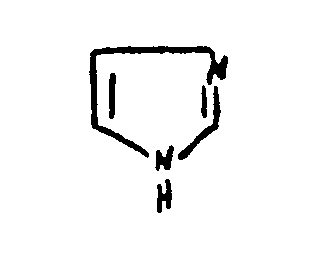
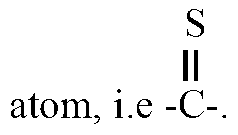
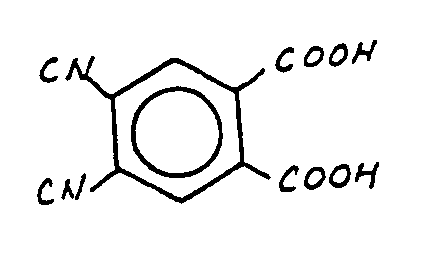
SECTION I - CLASS DEFINITION
Class 525 provides for all processes or products wherein a
solid polymer is chemically modified or admixed with an additional
solid polymer. It also provides for processes or products
involving nonsolid specified intermediate condensation products
which are admixed with an additional specified intermediate condensation
product or specified polymer forming ingredients. In addition, this
class provides for vinyl alcohol polymers or modified forms thereof
and for polyesters admixed with an ethylenic reactant.
SECTION II - LINES WITH OTHER CLASSES AND WITHIN THIS CLASS
(A) Listed below are rules to be followed
in placing patents into and in determining the appropriate subclasses to
be searched in Class 525.
(1) ETHYLENIC POLYMERS — The following
rules are applicable to subclasses 55-388.
(a) When a polymer derived from ethylenic
reactants only is not specified as a liquid or terms which are generally
regarded as indicating a liquid (e.g., wax, waxy, etc.) it
will be regarded as being a solid (e.g., polyethylene, polystyrene, etc.).
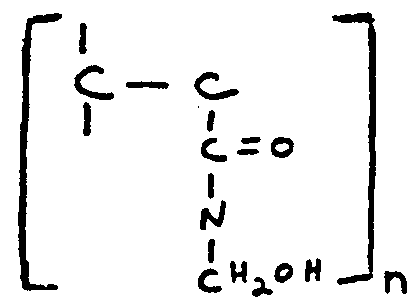
(b) Products are classified on the basis
of their preparation. A product identified by a structure
is to be placed with the process of its preparation; for
instance, a product identified, as illustrated
below, and which product from the disclosures is prepared
by the reaction of polyacryloamide and formaldehyde is classified
on the basis of polyacryloamide reacted with formaldehyde in a case involving
rubber (e.g., halogenated, etc.) classification is
on the basis of a solid polymer derived from isoprene.
(c) All subclasses are based on a process
of mixing. Products, per se, therefore
are classified on the basis of the process of mixing.
(d) All solid polymers (subclasses
191+) are classified on the basis of the initial
solid polymer derived from ethylenic reactants (e.g., a
mixture of a halogenated polybutadiene and polyethylene is classified
as an original in subclass 232 rather than as a halogen containing reactant, for
example, in subclass 213).
(e) A process of halogenating polybutadiene
and subsequently blending same with polyethylene is classified as in (D) above.
(f) In those subclasses which require the
combination of two or more reactants (e.g., subclass
165 or subclass 178, etc.) the two reactants
need not be added simultaneously to the ethylenic polymer, nor
need they be reacted together prior to addition with the ethylenic polymer. They
may be added subsequently, or there may be an intermediate
reactant which is not, per se, the type required
in these subclasses (e.g., other
than amine, polycarboxylic acid, polyol, etc.). However, if
the intermediate reactant is provided higher in the schedule (e.g., isocyanate, polyepoxide) it
is classified in the higher provided subclass, etc.
(g) Compositions which have been admixed
and are not in a reacted state are classified on the basis of the
reactants in the schedule hierarchy.
(h) The following rules apply to subclasses
100+, 107+, 123+, 132+, 153, 154+, 165+, and
178+. Each of the above subclasses provide for:
(i) The reaction of an ethylenic polymer
and a saturated reactant required by that subclass or polymer thereof (e.g., aldehyde, phenols, etc.).
(ii) The physical blend of an ethylenic
polymer and a solid polymer derived from a saturated reactant required by
that subclass.
(iii) The physical blend of an ethylenic
polymer and a solid polymer derived from at least one ethylenic
reactant required by that subclass and at least one saturated coreactant.
(iv) The mixture of an ethylenically unsaturated
polymer and a specified intermediate condensation product, specified
polymer forming ingredients, or solid polymer thereof, which
is other than solely derived from ethylenic materials and wherein
an ingredient required by that subclass is ethylenic and is part
of the specified intermediate condensation product, specified
polymer forming ingredient system, or solid polymer; or
wherein the material required by that subclass is ethylenic and
is in addition to a solid polymer, polymer forming ingredient
system, or intermediate condensation containing at least
one saturated reactant.
(v) Excluded from these subclasses are those
processes or products wherein an ethylenic polymer is admixed with
ethylenic material (e.g., polyacrolein
or acrolein) only or polymers thereof.
(vi) Included herein are those situations
wherein a treatment is effected on a polymer with part of a specified polymer
forming ingredient system and in which a later reactant is added
which forms a specified polymer-forming ingredient system
therewith. The ehtylenic reactant which is required by
that subclass can be part of the polymer-forming ingredient
system or it may be part of the specified intermediate condensation
product.
(2) CONDENSATES - PROCESSES: The
following rules are applicable to subclasses 389-540.
(a) Processes of preparing products are
classified with the product in the absence of any specified process
subclass.
(b) Processes of treating a previously treated
product are classified on the basis of the original solid polymer
originally formed, e.g., treating
a starting halogenated polyamide with an epoxy is classified as
an original in the first appearing subclass of the schedule that
provides for treating a polyamide with a halogen or epoxy, etc. If
the process of preparing the starting materials is not claimed and
the claimed step is provided in a lower subclass than the process
if claimed of preparing the starting material, then a cross-reference
into the claimed process is appropriate, e.g., Schedule
reads as follows:
Polyamide
. treating with halogen
. treating with epoxy
Claim reads:
Halogenated polyamide is treated with an epoxy. The original
is placed into the halogen subclass and should be cross-referenced
into the epoxy subclass. If, however, the
steps of halogenating and epoxidizing are claimed, the
original is placed into the halogenating subclass and a cross-reference
into the epoxy subclass is deemed to be optional.
(c) When a condensate polymer is not specified
as a solid or identified by properties which identify it as a solid
e.g., melting point, etc., then
it is considered a liquid and as such is treated as a reactant.
(d) When a condensate polymer is noted in
generic terms or is identified by a trade name or manufacturer, it is
to be regarded as follows:
polyester = reaction product of a saturated dicarboxylic acid
or derivative and ethylene glycol.
polyamide = reaction product of a saturated dicarboxylic
acid or derivative and a diamine.
polyamide = identified as a nylon 6 is the reaction
product of a caprolactam.
polyphenyleneoxide = reaction product of a monohydric phenol.
polyarylene sulfide = polyphenylene sulfide reaction product
of an alkali metal sulfide reactant and a halogenated aromatic reactant.
polyoxymethylene = formaldehyde polymer.
polycarbonate = reaction product of
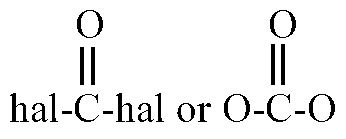
and a dihydric aromatic dialcohol.
polyurethane = reaction product of R-(N=C=X)2(X
is chalcogen) and ethylene glycol.
polyurea = reaction product of R-(N=C=X)2(X
is chalcogen) and a diamine.
novalac = reaction product of formaldehyde and a monohydric
phenol.
resole = reaction product of formaldehyde and a monohydric
phenol.
aminoplast = reaction product of formaldehyde and
an amine.
phenoplast = reaction product of formaldehyde and
a monohydric phenol.
(e) In a multistep process of treating a
polymer the first appearing step of treating in the schedule array
provides for the original placement.
Claim reads:
polyamide treated sequentially with X, Y, and
Z
Schedule reads:
polyamide
. treating with y
. treating with z
. treating with x
The original with Y, which is the first appearing
subclass in schedule
(f) In those processes wherein two reactants
are required to treat a solid polymer material (e.g., polyamide
treated with a polyol and a polycarboxylic acid, the polyol
and carboxylic acid can be added concurrently, sequentially, or
even an intermittent step of adding material between the addition
of the polyol and polycarboxylic acid may be involved).
(g)(i) In a multistep
process wherein materials are reacted together and an intermediate
solid polymer is formed which is subsequently reacted, all
of the materials recited up to the step of preparing the intermediate solid
polymer are regarded as reactants in preparing a solid polymer, and
all materials which are reacted with the intermediate solid polymer
are regarded as treating agents.


(ii) Reactants to prepare intermediate solid
polymer are A, B, and D.

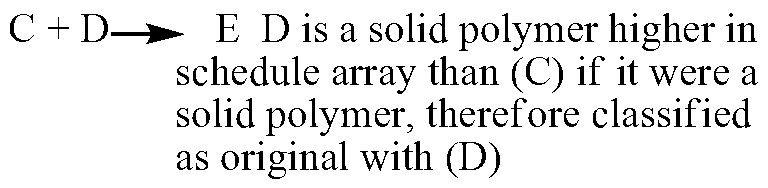


Classified as original with (D) and cross-referenced
to (C). In this situation (C) is
regarded for cross-referencing purposes as if it were a
solid.
(h) A process of preparing a reactable composition
is classified on the basis of the reactants involved in preparing
the composition.
(3) PRODUCTS - CONDENSATES
(a) All products must be classified on the
basis of their preparation as indicated by the disclosure.
(b) When products are to be classified all
rules to processes described hereinbefore are applicable.
(c) A method of preparing a polymerizable
composition is classified as a process on the basis of the reactants recited
in preparing the polymerizable composition.
(4) ETHYLENIC OR CONDENSATION POLYMERS For
purposes of classification:
(a) A solid polymer is always considered
as being a reactant.
(b) A solid polymer is always classified
on the reactants utilized in its preparation, e.g., natural
rubber is classified as based on isoprene.
(c) In this class once the solid polymer
is identified, all modifications thereof are included in
the indents thereunder "specified as mixed". For
instance, mixing a solid polyphenylene oxide with a silicon
modified polyester is classified in subclass 393. Subclass
393 provides for processes starting with or treating a solid polyphenylene oxide
with a silicon containing reactant and subsequently admixing same
with a silicon or nonsilicon containing polyester, or for
processes of admixing a solid polyphe
nylene oxide with a silicon containing polyester, or treating
a mixture of a solid polyphenylene oxide and polyester with a silicon
containing reactant.
(d) Processes wherein two or more reactants (ethylenic or
nonethylenic) are reacted at preferential conditions so that
one reactant forms a solid polymer while the other reactant is substantially
unchanged and which other reactant is then subsequentially reacted
with the formed solid polymer are classified in Class 526, 527, or
528. When, however, such a product
is admixed with an additional solid polymer, specified
polymer forming ingredients, or with a specified intermediate
condensation product it is proper for this class (525). When
the product is derived from ethylenic monomers only and is identified
as a block or graft polymer and is subsequently admixed with an
additional solid polymer, specified intermediate condensation
product, or specified polymer forming ingredients, it
is classified in this class (525) as if it were
a block or graft copolymer. When the patentee discloses
that a polymeric mixture is prepared by the interpolymerization
of two or more reactants, A + B polymer, AB + polymer
A, etc., such a product or process is
proper in Classes 526, 527, or 528.
(e) Aftertreatment of a solid inorganic
polymer with an organic compound to form an organic group containing polymer
is proper in Class 526, 527, or 528.
To be proper for this class (525) a solid organic
polymer must be chemically treated.
(f) Patents in subclasses 192-196, 337, 338, and
503-508 which recite "chemical treating agent" are
classified as follows:
(i) A "chemical treating agent" for
purposes of this class is a chemical material which is added to
the formed polymer and which causes or is present during a process wherein
a change in a bond of the polymer is effected.
(ii) These subclasses provide for all chemical
aftertreatments of a previously formed polymer derived from only
ethylenic monomers when such aftertreatments are performed in the
presence of a chemical agent, including treatments that
are performed with chemical agents that are not specific as to identity
or amount of the chemical agent, with the exception of
mere reference to cross-linking, curing, or
vulcanizing.
(iii) Claims are classified in these subclasses
on the basis of the first-appearing material utilized as
part of the chemical agent. No attempt has been made to
classify on the basis of the chemically active material and therefore
all materials in a composition are regarded equally (e.g., diluent, reactant, catalyst, etc.).
(iv) Claims to a composition or method of
preparing (e.g., polymer plus
a chemical reactive material) are classified as if they
were process claims and as if the actual process has gone to completion.
(g) This class (525) includes
processes of preparing solid polymers or resinifiable intermediate
condensation products from a mixture of reactants wherein one of
the initial reactants is used in an excessive amount with the expressed
purpose of being used in a subsequent step to form with an added
reactant a specified polymer-forming mixture. The
original reaction mixture must produce a solid polymer or resinifiable
intermediate condensation product and the process must recite the
addition of the added reactant which, together with the
excess of original reactant, forms the specified polymer-forming ingredients.
(B) Listed below are lines between particular
Clas 525 subclasses and other areas (e.g., other
Class 525 areas or other Classes).
(1) Lines relative to subclases 192+
A chemical agent is a material which can react with the polymer
to cause a modification in the polymer"s chemical structure.
Proper for this subclass would be, e.g., chemical
reactions as halogenation, sulfonation, nitration, vulcanization, etc.
Additionally, the treating agent if an ethylenic reactant, may
preferentially homo- or copolymerize with other reactants
to produce additional polymers. A patent which claims both
product and process for producing a polymeric mixture containing
a graft copolymer starting with two ethylenically derived polymers
and an ethylenic reactant, requires that the original be
classified Class 525 subclasses 192+ and should be crossed
into the graft copolymer subclasses 63+. See
Class 523, subclasses 1+ for a mixture of polymers
with nonpolymeric material whose only purpose is, e.g., to
enhance processibility of the polymers, stabilize against
deterioration or aid deterioration after a given time (prodegradant), or
act as a nucleating or crystallizing agent, etc. Search
Class 528, subclasses 480+ for the treating of
polymeric mixture in order to destroy residual catalyst or remove
or neutralizimpurities. However, the neutralization
of a polymeric salt with an acid or base is classified here. Included
here also are processes wherein one or more polymers are chemically aftertreated
and subsequently blended with themselves or with other polymers.
(2) Lines relative to subclases 242+
Subclass 242+ and indented subclasses also contain polymers
prepared from a combination of ethylenic reactants mixed with nonethylenic
reactants when reacted in the presence of ethylenically polymerized polymers, e.g., ethylene-ethylene
oxide copolymer, propylene-sulfur dioxide copolymer. However, for
the process of mixing such polymers see this class, subclass 185.
Product claims are classified on the basis of ethylenic reactants
either in the polymerized or unpolymerized state and cross-referenced
to the nonethylenic reactant as being specified materials in this
class, subclasses 244+. Process claims, of
course, are classified according to claimed specified materials
and, if lacking, then they are classified on the
basis of the product.
(3) Lines relative to subclases 267
This subclass excludes the presence of a preformed polymer
derived from ethylenic reactants only. This subclass is
to be clearly distinguished from subclass 244 wherein the solid
polymer, whether or not prepared in situ, is contacted
both by an ethylenic reactant and a specified material. In
the present subclasses the in situ prepared polymer is contacted
with an ethylenic reactant. Typically, the polymer
is not isolated or purified but is further reacted with an ethylenic
reactant. For example, styrene is contacted with
lithium butyl catalyst which results in formation of lithium terminated
polystyrene block. The in situ-prepared polymer
is then reacted with butadiene to produce polybutadiene-polystyrene
block copolymer.
(4) Lines relative to subclases 326.1
through 388
(a) The following rules apply in classifying
a claim into this area of the Class 525 schedule:
(i) For purposes of clarification in this
part of the schedule, subclasses 326.1 to 334.1
are deemed to be chemically modified product subclasses; and
subclasses 337 to 388 are deemed to be chemical modification process subclasses.
(ii) Patents that claim a chemically treated
product and process, wherein both the product and the process
are specifically provided for in the schedule, are classified in
the product area (326.1 to 334.1) and
cross referenced to the process area (337 to 388).
(iii) Patents that claim both a product (326.1
to 334.1) and a provided for process (337
to 388) and wherein the product is claimed in process terms
are classified on the basis of the product (326.1
to 334.1) and cross-referenced to the
process (337 to 388) on the basis of the chemical
treating agent first appearing in the classification hierarchy.
(iv) Patents that claim a chemically modified
product solely in process terms are classified on the basis of the product (326.1
to 334.1) and are desireably cross-referenced
to the process (337 to 388) on the basis of the chemical
treating agent first appearing in the classification hierarchy.
(v) Patents that claim nominally vulcanized, cured, or crosslinked
solid polymers from ethylenic monomers only, (or
nominal process claims directed to vulcanizing, curing
or cross-linking) are classified as polymers as
appropriate in Class 526; see also Class 526, subclass 72 (1) Note (A8).
(vi) Patents that claim vulcanized, cured
or cross-linked solid polymers from ethylenic monomers
only, wherein the vulcanizing, curing or cross-linking
agent is identified by an atom (e.g., sulfur
containing vulcanizing agent, etc.), by
an amount (e.g., cured using
2% by weight of a vulcanizing agent, etc.) or
by a significant process step (e.g., cured
by heating to a specific temperature in presence of a vulcanizing
agent, etc.) are classified as chemically
modified products (326.1 to 334.1).
(b) Claims to an aftertreated product are
classified on the basis of the initial monomers or monomers that
are polymerized; except where certain chemical modifications
or chemical treating agents are specifically provided for as an
indented subclass under a monomer. In certain cases this
determination is made from the disclosure. An example of
such a situation is a treated halogenated polyethylene wherein the
disclosure recites halogenation of a previously formed polyethylene
polymer. In this case, classification is made
on the basis of polyethylene rather than on halogenated polyethylene.
(c) Vulcanizable compositions are not subject
matter for this subclass unless prior to the vulcanization or cross-linking
step there is present a chemically modified solid polymer derived
from ethylenic monomers only.
(d) The final product need not contain an
atom of the chemical treating agent employed. For example, polyvinyl
chloride which has been treated with a dehalogenating agent, is
classified in subclass 331.5.
(e) Examples of patent placement within
this and the indented subclasses. Patentee claims:
(i) Polyethlyene which has been chlorosulfonated
by treatment with SO2 and CL2 at
elevated temperature and pressure. There are also claims
directed to this process of chlorosulfonation of polyethylene. The
original classification is in subclass 333.9 with a mandatory
cross-reference to subclass 344. This represents
an inversion of the classification rule and process versus product
in hierarchy of class 526.
(ii) A vulcanizable polyethylene composition
comprising a mixture of polyethylene and zinc oxide as vulcanizing
agent. The original classification is with the process
subclass 373 since this product claim does not encompass a chemically
modified solid polymer.
(iii) A vulcanizable chlorosulfonated polyethylene
composition comprising a mixture of chlorosulfonated polyethylene
and zinc oxide as vulcanizing agent. Disclosure states
that the chlorosulfonated polyethylene is prepared by modification
of previously formed solid polyethylene. The original classification
of this product is in subclass 333.9 since the product
claim encompasses a chemically modified solid polymer, i.e., chlorosulfonated
polyethylene.
(5) Lines relative to subclases 501.5
Class 525, subclass 501.5 provides for, e.g., mixtures
of phenol-formaldehyde resin (SICP) with
an ethylenic agent such as an unsaturated fatty acid glyceride or unsaturated
fatty acid derived therefrom, e.g., linseed
oil or linseed fatty acid, etc. However, a
phenolic SICP (not described as a solid polymer) admixed
with a saturated fatty glyceride or saturated fatty acid, e.g., coconut oil
or coconut fatty acids, etc., is classified
in Class 528, subclass 158.5, since Class
525, subclasses 50+ do not encompass an admixture
of a liquid SICP with a chemical treating agent; therefore, when
saturated fatty glycerides or saturated fatty acid derived therefrom
are reactants in the system of this subclass there must additionally
be present a complete system for Class 525, subclass 480.
(6) Lines relative to subclases 517.5
Class 525, subclass 517.5 provides for mixtures
of SICP (e.g., aminoplast resin, etc.) with
an ethylenic agent such as unsaturated fatty acid glycerides or
unsaturated fatty acids derived therefrom, e.g., linseed
oil or linseed fatty acid, etc. However, an
aminoplast SICP (not described as a solid polymer) admixed
with a saturated fatty glyceride or saturated fatty acid, e.g., coconut
oil or coconut fatty acid, etc., is placed
in Class 528, subclass 245.5 since Class 525, subclasses
50+ do not encompass an admixture of a liquid SICP with
a chemical treating agent; therefore, when saturated
fatty glycerides or saturated fatty acid derived therefrom are reactants
in the system of this subclass there must additionally be a complete
system for Class 525, subclass 509.
SUBCLASSES
![[List of Patents for class 525 subclass 7]](../ps.gif) 7 7 | ETHYLENICALLY UNSATURATED REACTANT ADMIXED WITH A PREFORMED
REACTION PRODUCT DERIVED FROM: (A) AT
LEAST ONE POLYCARBOXYLIC ACID, ESTER, OR ANHYDRIDE; (B) AT
LEAST ONE FATTY ACID GLYCEROL ESTER, A FATTY ACID OR SALT
DERIVED FROM A NATURALLY OCCURRING GLYCERIDE, TALL OIL, OR
A TALL OIL FATTY ACID: |
| | This subclass is indented under Class 520, subclass
1. Subject matter which are polyester-unsaturated
reactant mixtures wherein (a) the polyester is
prepared from a polycarboxylic acid, ester, or
anhydride, and a polyol, and at least one fatty
acid glycerol ester, a fatty acid or salt derived from
a naturally occurring gylceride, tall oil, or
a fatty acid derived from tall oil, and (b) there
is at least one unsaturated reactant other than solely fatty glyceride, an unsaturated
fatty acid or salt derived from a naturally occurring fatty glyceride, tall
oil, or an unsaturated fatty acid derived from tall oil, or
mixtures thereof.
| | (1)
Note. Dehydrated castor oil or dehydrated castor
oil fatty acids are treated as if they were unsaturated naturally
occurring glyceride or unsaturated fatty acids derived from naturally
occurring fatty glycerides. |
| | (2)
Note. A buffering agent to improve storage stability
is regarded as a catalytic agent and therefore treated as specified material. |
SEE OR SEARCH CLASS:
| 520, | Synthetic Resins or Natural Rubbers, the Glossary, for definitions of the terms "specified
material" and "fatty acid". |
|
| | |
| 8 | ETHYLENICALLY UNSATURATED REACTANT ADMIXED WITH A PREFORMED
REACTION PRODUCT DERIVED FROM: (A) AT
LEAST ONE POLYCARBOXYLIC ACID, ESTER, OR ANHYDRIDE; (B) AT
LEAST ONE POLYHYDROXY COMPOUND AND; (C) AT LEAST
ONE NATURAL RESIN, PROTEIN OR BIOLOGICALLY ACTIVE POLYPEPTIDE, OR
CARBOHYDRATE OR DERIVATIVE: |
| | This subclass is indented under Class 520, subclass
1. Subject matter wherein an ethylenically unsaturated reactant
is admixed with a preformed polyester formed from a polyol; polycarboxylic
acid, ester, or anhydride; and a natural
resin, protein, biologically active polypeptide, carbohydrate, or
derivative.
SEE OR SEARCH THIS CLASS, SUBCLASS:
| 54.1+, | for a system under Class 525, subclass 50
containing chemically combined protein or biologically active polypeptide
and a polyester or polyester forming SPFI system. |
| 54.2+, | for a preformed solid polyester (or polyester
derived from ethylenic reactants only) chemically treated
with a carbohydrate or derivative. |
| 54.3+, | for a previously formed solid polyester containing
chemically combined carbohydrate admixed with a SP, SICP, or
chemical treating agent. |
| 54.4+, | for a system under Class 525, subclass 50
containing chemically combined natural resin or derivative and a
polyester or polyester forming SPFI system. |
| 54.5+, | for a system under Class 525, subclass 50
containing chemically combined coal, bituminous material
or fatty still residue and a polyester or polyester forming SPFI
system. |
SEE OR SEARCH CLASS:
| 520, | Synthetic Resins or Natural Rubbers, the Glossary, for definitions of the terms "natural
resin derivative", "protein", "biologically
active polypeptide", and "carbohydrate
derivative". |
| 527, | Synthetic Resins or Natural Rubbers, 100+ for polyesters containing chemically
bound: cellular material derived from plants or animals; 200+ for
protein or biologically active polypeptide; 300+ for
carbohydrate or derivative; 400+ for lignin or
tannin; 500+ for coal or bituminous material; 600+ for
natural resin. |
|
| | |
| 10 | ETHYLENICALLY UNSATURATED REACTANT ADMIXED WITH EITHER (A) A
POLYMER DERIVED FROM A SATURATED DI- OR HIGHER ESTER OF A
POLYCARBOXYLIC ACID AS SOLE REACTANT, OR (B) REACTION
PRODUCT OF ONLY POLYCARBOXYLIC ACIDS OR ANHYDRIDES WITH ONLY COMPOUNDS
HAVING AT LEAST TWO HYDROXY GROUPS AT LEAST ONE OF WHICH IS SATURATED
AND WHEREIN THE REACTION PRODUCT FORMED IS NOT AFTERTREATED PRIOR
TO ADMIXTURE WITH THE UNSATURATED REACTANT EXCEPT WITH A POLYCARBOXYLIC
ACID POLYCARBOXYLIC ACID ANHYDRIDE, OR A POLYOL, AND
WHEREIN NO SOLID POLYMER DERIVED FROM ETHYLENIC REACTANTS ONLY IS
MIXED THEREWITH: |
| | This subclass is indented under Class 520, subclass
1. Subject matter under involving a polymer derived from nonethylenic
di- or higher esters of a polycarboxylic acid as sole reactant, or
the reaction product of only polycarboxylic acids or anhydrides
with only compounds having at least two hydroxy groups, at
least one of which is saturated, mixed with at least one
ethylenically unsaturated reactant and wherein the polymer or reaction
product formed from the di- or higher ester or from the
polycarboxylic acid or anhydride and polyhydroxy compound is not
aftertreated prior to mixing with the unsaturated reactant except
with a polycarboxylic acid, polycarboxylic acid anhydride, or
a polyhydroxy compound, and wherein no solid polymer derived
from ethylenic reactants only is mixed therein; processes
of preparing or reacting the above mixtures and compositions resulting
from the mixing or reacting processes.
| | (1)
Note. Included herein are all polyester-unsaturated
reactant mixtures defined above except those cases in which the document
specified that a mere diester is formed. |
| | (2)
Note. Excluded from this subclass is a mixture of
a polymer derived from an unsaturated carboxylic acid ester as sole reactant, e.g., diallyl
phthalate, diallyl maleate, etc., and
an ethylenic reactant. |
| | (3)
Note. Excluded from this and the indented subclasses
are those unsaturated reactants which have been prereacted and are
part of a specified polymer-forming system (e.g., liquid reaction
product of unsaturated diisocyanate and a polyol, etc.). |
SEE OR SEARCH THIS CLASS, SUBCLASS:
| 55+, | for a solid polymer derived from ethylenic monomers
only mixed with the polyester-unsaturated reactant mixture. |
| 242+, | for a mixture of ethylenic reactant with a polymer
formed of ethylenic reactants only. |
| 418+, | for those instances wherein the polyester is treated
with reactants other than those specified in the title of this subclass
if a solid polymer is formed. |
SEE OR SEARCH CLASS:
| 528, | Synthetic Resins or Natural Rubbers, for those instances wherein the polyester is treated
with reactants other than those specified in the title of this subclass
if the polyester is not a solid. |
|
| | |
| 11 | Mixed in presence of specified material or a polymerizable
composition contains a specified material: |
| | This subclass is indented under subclass 10. Subject matter wherein a polymer derived from a di- or
higher ester of a polycarboxylic acid as sole reactant or derived
from a polycarboxylic acid or anhydride and polyhydroxy compound is
mixed with an ethylenic reactant in the presence of a specified
material which is not a reactant or wherein the polymerizable polyester-unsaturated
reactant composition contains a specified material.
SEE OR SEARCH CLASS:
| 520, | Synthetic Resins or Natural Rubbers, the Glossary, for a definition of the term "specified
material". The term as used usually includes
solvents, catalysts, inhibitors, accelerators, etc. |
|
| | |
| 13 | Specified material contains metal atom other than from
group IA metal atom (Li, Na, K, Rb, Cs, Fr): |
| | This subclass is indented under subclass 11. Subject matter wherein the specified material contains a
metal atom other than Group IA metal atom (Li, Na, K, Rb, Cs, Fr). |
| | |
| 15 | Material contains group IIB metal atom (Zn, Cd, Hg) or
IIIA metal atom (Al, Ga, In, Tl): |
| | This subclass is indented under subclass 13. Subject matter wherein the specified material contains a
Group IIB or IIIA metal atom (Zn, Cd, Hg, Al, Ga, In, Ti). |
| | |
| 17 | Material contains group VIII metal atom (Fe, Co, Ni, Ru, Rh, Pd, Os, Ir, Pt): |
| | This subclass is indented under subclass 13. Subject matter wherein the specified material contains a
Group VIII metal atom (Fe, Co, Ni, Ru, Rh, Pd, Os, Ir, Pt). |
| | |
| 19 | Material contains group IIA metal atom (Be, Mg, Ca, Sr, Ba, Ra): |
| | This subclass is indented under subclass 13. Subject matter wherein the specified material contains a
Group IIA metal atom (Be, Mg, Ca, Sr, Ba, Ra). |
| | |
| 25
|
| | This subclass is indented under subclass 11. Specified material contains nitrogen atom: Subject
matter wherein the specified material contains a nitrogen atom. |
| | |
| 28 | Mixed with -N C=X reactant or polymer derived
therefrom (X is chalcogen): |
| | This subclass is indented under subclass 10. Subject matter wherein a polymer derived from di- or
higher ester of polycarboxylic acid as sole reactant or derived
from polycarboxylic acid or anhydride and polyhydroxy compound is
mixed with an ethylenic reactant and, additionally, is
mixed with a -N C=X reactant or polymer derived
thereof (X is chalcogen).
| | (1)
Note. The term -N C=X reactant includes
blocked or masked isocyanates. |
| | (2)
Note. Included herein are polyester unsaturated monomer
mixtures which are aftertreated with an isocyanate reactant. |
SEE OR SEARCH THIS CLASS, SUBCLASS:
| 395, | for a discussion of the term -N C=X reactant, which
includes blocked or masked isocyanates. |
| 440.01, | for those instances wherein a solid polyester is
reacted with an isocyanate prior to mixing with an unsaturated reactant. |
|
| | |
| 29 | Mixed with silicon-containing reactant or polymer
derived therefrom: |
| | This subclass is indented under subclass 10. Subject matter wherein a polymer derived from a di- or
higher ester of polycarboxylic acid as sole reactant or derived
from polycarboxylic acid or anhydride and polyhydroxy compound is
mixed with an ethylenic reactant and is additionally mixed with
a silicon-containing reactant or polymer derived therefrom. |
| | |
| 32 | Mixed with a phenolic reactant and an aldehyde or aldehyde-type
reactant or reaction product thereof: |
| | This subclass is indented under subclass 10. Subject matter wherein a polymer derived from a di- or
higher ester of a polycarboxylic acid as sole reactant or derived
from polycarboxylic acid or anhydride and polyhydroxy compound is
mixed with an ethylenic reactant and additionally is mixed with
a phenol and an aldehyde or aldehyde-type reactant or the
reaction product thereof.
SEE OR SEARCH CLASS:
| 520, | Synthetic Resins or Natural Rubbers, the Glossary, for definitions of the terms "aldehyde", "aldehyde-type", "phenolic
reactant", and the definition of "carboxylic
acid or derivative" for a discussion of "polycarboxylic". |
|
| | |
| 50 | MIXING OF TWO OR MORE SOLID POLYMERS; MIXING OF
SOLID POLYMER OR SPECIFIED INTERMEDIATE CONDENSATION PRODUCT WITH SPECIFIED
INTERMEDIATE CONDENSATION PRODUCT OR SPECIFIED POLYMER-FORMING
INGREDIENTS; MIXING OF SPECIFIED INTERMEDIATE CONDENSATION
PRODUCT WITH AN ETHYLENIC AGENT; MIXING OF SOLID POLYMER
WITH A CHEMICAL TREATING OR ETHYLENIC AGENT; OR PROCESSES
OF FORMING OR REACTING; OR THE RESULTANT PRODUCT OF ANY
OF THE ABOVE OPERATIONS: |
| | This subclass is indented under Class 520, subclass
1. Subject matter which involves the mixing of a solid polymer
with solid polymers, with a specified intermediate condensation product (SICP), with
specified polymer-forming ingredients (SPFI), with
an ethylenic reactant, or with a chemical treating agent; or
the mixing of a specified intermediate condensation product with
a diverse specified intermediate condensation product, with
specified polymer-forming ingredients, or with
an ethylenic reactant; or processes of producing, or
the resultant product of any of the above mixtures. The
above combinations may be tabulated in a more easily recognizable
form as follows in (1) Note below.
| | (1)
Note. Combinations proper for this subclass and
its indents:
| |
SICP = Specified intermediate condensation product |
| |
SPFI = Specified polymer-forming ingredients |
| |
CTA = Chemical treating agent | |
| | (2)
Note. A polymer is a solid when so stated or when
it is described in one or more of the following terms.
This list is not to be taken as limiting a solid to the enumerated
terms. Other terms in patents not noted below may be interpreted
as being solid when proper description is given therein:
|
| |
A wax is not considered to be a solid even if defined by
one or more of the above terms. |
| | (3)
Note. Specified intermediate condensation product
is limited to the following:
| | (A)
Reactants noted in categories 1-3 below either as
enumerated or with additional reactants, with the proviso
that at least one of the reactants noted in 1-3 must be
saturated, or (B) to the materials having
the formulas set forth in categories 4-6. It
must be remembered for purposes of classification that the structural formulas
noted in 4-6 below are methylol compounds or derivatives
thereof and are to be regarded as being a mixture of an aldehyde
and the appropriate other reactant or reactants, with the
proviso that at least one of the reactants used in preparing the
methylol compound be saturated. In this regard, a
methylol phenol is classified as if it were a mixture of formaldehyde
and phenol, and methylol urea is classified as if it were
a mixture of formaldehyde and urea. |
| | (1)
Reaction of an aldehyde or aldehyde derivative and/or
an amine or compound containing an N-C(=X)- or
N-S(=O)- moiety (X
is chalcogen). |
| | (2)
Reaction of an aldehyde or aldehyde derivative and a phenolic
material. |
| | (3)
Reaction of an aldehyde or aldehyde derivative and a ketone. |
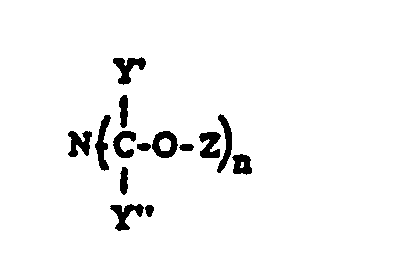
| | (4)
A compound containing
|
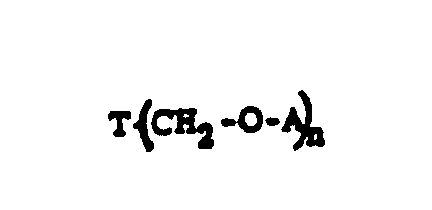
| | (5)
A compound containing a
|
| | (6)
A compound containing a
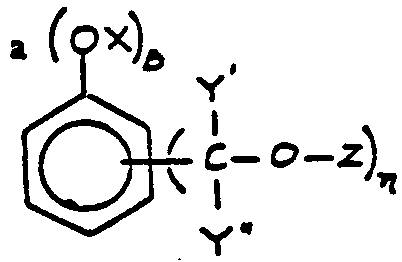
|
| |
Y" and Y" are or hydrocarbon groups. |
| |
T - is an atom other than H or carbon of a carbon-substituted
radical. |
| |
A - is a hydrogen or carbon atom and which carbon
is bonded to only H, carbon, or single-bonded
to oxygen atoms. |
| |
X - is H, part of an ether group, or
an inorganic cation. |
| |
N -is two or more, B is one or more. |
| |
Z -is a H or carbon radical. | |
| |
Compounds containing ethylenic unsaturation are not considered
to be specified intermediate condensation products (see structures
4-6 under specified intermediate condensation products
above) nor are methylol or methylol derivatives, per
se. |
| | (4)
Note. Specified Polymer-Forming Ingredients
are Limited to: Those materials listed below under fourteen (14) different
categories wherein at least one of each necessary reactants be utilized
and that at least one be saturated. The term "poly" as
noted in the specified polymer-forming ingredients area
below is meant to include only reactants which are either (1) monomeric
and in any physical state, or (2) polymeric
but in a nonsolid physical state. The term "poly" designates that
at least two of the required functional groups are present.
In the classification schedule the term "necessary ingredients" has
been utilized is some subclasses to include the combination of materials
enumerated below (1-14) which must be
present to have specified polymer-forming ingredients.
| | (1)
aldehyde or aldehyde derivative and a phenolic material |
| | (2)
aldehyde or aldehyde derivative and an organic amine. Compounds
containing ethylenic unsaturation are not considered to be specified
intermediate condensation products (see structures 4-6
above) nor are methylol or methylol derivatives, per
se. |
| | (3)
aldehyde or aldehyde derivative and a -C-N(=X) containing
moiety (X is chalcogen) |
| | (4)
aldehyde or aldehyde derivative and a hydrocarbon |
| | (5)
epoxides containing more than one 1, 2-epoxy
group per mole |
| | (6)
organic compounds containing more than one -N=C=X (X
is chalcogen atom) and an organic polyol |
| | (7)
organic compounds containing more than one -N=C=X (X
is chalcogen) and an organic polyamine |
| | (8)
organic compound containing more than one -N=C=X (X
is chalcogen) and a poly carboxylic acid or anhydride |
| | (9)
carbonic acid halocarbonate or a carbonate and a polyol |
| | (10)
hal-C(=O)-hal
and a polyol |
| | (11)
polycarboxylic acid or derivative and a polyol |
| | (12)
polycarboxylic acid or derivative and a polyamine |
| | (13)
aldehyde or aldehyde derivative and a compound containing
an organic N-S(=O)- moiety |
| | (14)
aldehyde or aldehyde derivative and a ketone |
| | (15)
Materials which, present in the composition are either
claimed or disclosed as being coreactable to form a solid polymer. | |
| | (5)
Note. An aldehyde derivative for purposes of this
subclass includes (a) Compounds having a X-CH2OH
group wherein X is other than carbon or hydrogen. Included
herein are paraformaldehyde, methylol derivatives of urea, nylon, and
polyacrylamide, etc.; (b) Heterocyclic
compounds having only carbon and oxygen as ring atoms in an alternating
manner and in equal amount, i.e., (O-)n; Included
herein is trioxane; (c) Hexamethylenetetramine
or its derivatives, as illustrated below. A derivative of
this type requires the basic ring structure of hexamethylenetetramine
but wherein the hydrogen atoms may have been replaced by other atoms.
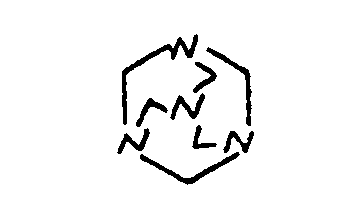
|
| | (6)
Note. Compounds having a methylol group (-CH2OH) bonded
to atoms other than carbon, oxygen, or hydrogen
are regarded for this subclass as being two compounds, one
of which is formaldehyde. For instance, a methylol
derivative of melamine is regarded as being a mixture of melamine
and formaldehyde. Methylol urea is regarded as being a mixture
of formaldehyde and urea. |
| | (7)
Note. Paraformaldehyde polymer is regarded as a formaldehyde
reactant. |
| | (8)
Note. A resole is considered to be a specified intermediate
condensation product even if the structure is recited. However, a
novolak is considered to be a solid phenolaldehyde polymer. |
| | (9)
Note. When nonpolymeric reactants A, B, and
C, none of which is a specified intermediate condensation
product, are mixed simultaneously under controlled conditions
such that in a first stage one or two (e.g., A
and/orB) of the reactants are caused to react
to form a solid intermediate condensation product and the other
reactants are caused to react later in the process, the
claim is classified on the basis of the reactants which were introduced
initially and not on the intermediate solid product unless a material is
added subsequent to the formation of the solid intermediate and
prior to the reaction of the final reactants. |
| | (10)
Note. A specified intermediate condensation product
has been limited to a condensation product of an aldehyde with at least
one of phenol, phenol either, inorganic phenolate, N-C(=X)-,
N-S(=O)- containing
reactant (X is chalcogen) or ketone wherein the
condensation product contains a plurality of methylol groups (-CH2OH) or
the partially or fully etherified product thereof (-CH2OR).
In those instances where it is unknown from the claims or disclosure
whether methylol or etherified methylol groups are present, the
document has been considered to have methylol groups and crossed
to where it would be classified if no methylol groups were present. |
| | (11)
Note. For purposes of this class all solid polymers
are regarded as being reactants. |
| | (12)
Note. Natural rubber is a solid polymer proper for
this class. A natural rubber or modified form thereof is
considered as if it were derived from a monomer containing two ethylenic
groups, i.e., isoprene. See
the Search Notes, infra. |
| | (13)
Note. In order for a patent to be proper for this
subclass and its indents, there must be a Desire or Intent
to produce a composition of two or more solid polymers. Similarly
the other mixing or forming or reacting processes of this subclass
and its indents require an ultimate Desire or Intent to produce
a mixture or reaction product. See Classes 526 to 528 for
processes of in the presence of a previously formed solid polymer
as a specified material, where there is no intent to form
a composition or reaction product therewith. |
SEE OR SEARCH THIS CLASS, SUBCLASS:
| 165+, | for natural rubber + polyol + polycarboxylic
acid or derivative. |
| 232, | for natural rubber + polybutadiene. This
composition is considered as a mixture of two polymers, each
of which is derived from ethylenic reactants only. |
| 317+, | for natural rubber + styrene reactant. |
SEE OR SEARCH CLASS:
| 528, | Synthetic Resins or Natural Rubbers,
subclasses 480+ for removing contaminants or undesirable materials from
a solid polymer and wherein the polymer is not chemically modified, and, for
example, for heating of a solid polymer by admixing with
a heated fluidized bed of another solid polymer there being no intebt
to produce a composition). |
|
| | |
| 51 | Effecting a change in a process in response to a measurement
or test: |
| | This subclass is indented under subclass 50. Subject matter wherein a process parameter is determined
and some process parameter is altered in response to the determination.
| | (1)
Note. A test or measurement performed by a human
being with a subsequent control operation is proper herein. |
| | (2)
Note. Treating a material to a certain condition
without a defined inanimate measurement, test, inspection, or
control (e.g., temperature, pH, etc.) is
not proper subject matter for this subclass. | |
| | |
| 52 | Utilizing a tubular or loop reactor: |
| | This subclass is indented under subclass 50. Subject matter wherein a reaction is effected in a loop
or tubular reactor.
| | (1)
Note. A loop reactor for purposes of this subclass
is an apparatus wherein reactant material is circulated in a continuous path
within a single or multicoiled or spiraled structure which has at
least one inlet and outlet means and at least one reaction zone. |
| | (2)
Note. A tubular reactor for purposes of this subclass
is an apparatus wherein a reactant material flows in an essentially linear
direction in a tube or series of interconnected tubes, which
tube or tubes are of small diameter in relation to their length
and wherein each tube has at least one inlet and outlet means and
one or more reaction zones. | |
| | |
| 53 | Utilizing an apparatus with two or more physically distinct
zones: |
| | This subclass is indented under subclass 50. Subject matter wherein a reaction is effected in at least
two or more physically distinct zones (e.g., regions, stages, etc.), said
zones being part of a single reactor which has a plurality of such
physically distinct zones or such zones may be part of separate
reactors which are interconnected at some point.
| | (1)
Note. For the most part, the patents herein
relate to advancement of materials from one zone to another so as
to effect progressive degree of reaction and which are usually advanced
until the degree of reaction is brought to the desired state. | |
| | |
| 54 | Removing and recycling material from one zone to another: |
| | This subclass is indented under subclass 50. Subject matter wherein a portion of material is removed
from a zone wherein material is undergoing a reaction and the removed
material either with something added to it, removed from
it, or the removed material, per se, is added
to a zone wherein a reaction is occurring. |
| | |
| 54.1 | Containing chemically combined protein or biologically
active polypeptide: |
| | This subclass is indented under subclass 50. Subject matter wherein a protein or biologically active
polypeptide is chemically combined with the polymer system.
| | (1)
Note. The proteinaceous material can be present as
a chemical constituent of a SP or SICP, as a reactant with
a SP, SICP, or SPFI system, or as an
ethylenic agent (in the case of a protein modified to have ethylenic
groups). |
SEE OR SEARCH CLASS:
| 528, | Synthetic Resins or Natural Rubbers, the Glosssry, for the definition of "protein" and "biologically
active polypeptide". |
|
| | |
| 54.21 | Cellulose or derivative as chemical reactant: |
| | This subclass is indented under subclass 54.2. Subject matter wherein cellulose or a derivative of cellulose (e.g., carboxy
methyl cellulose, etc.) is chemically
reacted with a previously formed solid polymer.
SEE OR SEARCH CLASS:
| 528, | Synthetic Resins or Natural Rubbers,
subclass 35 for the definition of cellulose or derivative. |
|
| | |
| 54.3 | Previously formed solid polymer containing chemically combined
carbohydrate admixed with a chemical treating or ethylenic agent, SPFI, SICP, or
solid polymer: |
| | This subclass is indented under subclass 50. Subject matter wherein a solid polymer having chemically
bound carbohydrate (or derivative) is treated
by admixing with any of (a) chemical treating
agent, (b) ethylenic agent, (c) solid polymer, (d) SPFI, or (e) SICP.
SEE OR SEARCH CLASS:
| 520, | Synthetic Resins or Natural Rubbers, the Glossary, for a definition of "carbohydrate
derivative". |
| 526, | Synthetic Resins or Natural Rubbers,
subclasses 238.2+ for solid polymers prepared by polymerization of
ethylenically unsaturated monomers having carbohydrate or derivative chemically
bonded thereto. |
| 527, | Synthetic Resins or Natural Rubbers,
subclasses 300+ for solid polymer prepared from carbohydrates or
derivatives wherein at least one of the reactants is saturated. |
|
| | |
| 54.4 | Containing chemically combined natural resin or derivative
thereof other than tall oil: |
| | This subclass is indented under subclass 50. Subject matter wherein there is a chemically combined natural
resin or natural resin derivative.
| | (1)
Note. Natural resins include such materials as have
customarily been employed as such in the paint, lacquer, varnish, adhesive, and
ink trades. Examples of these materials are: shellac, rosin, abietic acid, etc. |
| | (2)
Note. Rosin derivatives are materials which retain
the abietyl ring structure even though hydrogenated or substituted (e.g., zinc
resinate, abietyl alcohol, disproportionated rosin, colophony, dehydroabietic
acid, etc.). |
| | (3)
Note. The natural resin or derivative can be present
as a chemical constituent of a SP or SICP, a reactant with
a SP, SICP, or SPFI system, or as an
ethylenic agent. |
| | (4)
Note. Tall oil, per se, is not
treated herein as a natural resin unless a substantial rosin content
is specifically stated; otherwise, tall oil as
a reactant is treated as an unsaturated fatty acid in the subclasses herein
below. | |
| | |
| 54.41 | Shellac: |
| | This subclass is indented under subclass 54.4. Subject matter wherein the natural resin is shellac or a
derivative thereof. |
| | |
| 54.5 | Chemically combined coal, bituminous material, extract
or derivative thereof; oil shale; or fatty still
residue: |
| | This subclass is indented under subclass 50. Subject matter wherein the resin system has chemically bound
thereto coal, bituminous material or extract thereof or
a fatty still residue.
| | (1)
Note. Oil shale derivative similarly treated would
be placed herein. |
| | (2)
Note. The material proper for this subclass (e.g., coal, etc.) can
be present as a chemical constituent of a SP or SICP, a reactant
with a SP, SICP, or SPFI system, or as
an ethylenic agent (in the case of coal, etc., modified
to have ethylenic groups). |
SEE OR SEARCH CLASS:
| 524, | Synthetic Resins or Natural Rubbers, for
subclasses 59 and 705 for a definition of chemically combined
coal, bituminous material, extract or derivative
thereof, oil shale, or fatty still residue. |
| 526, | Synthetic Resins or Natural Rubbers,
subclass 290 for solid synthetic polymer derived from ethylenically
unsaturated coal, bituminous material, extract
or derivative thereof; or from unsaturated fatty still
residue where all monomers present are ethylenically unsaturated. |
| 527, | Synthetic Resins or Natural Rubbers,
subclass 500 for solid synthetic polymer derived from coal or
bituminous material, extract thereof or fatty still residue. |
|
| | |
| 55 | At least one solid polymer derived from ethylenic reactants
only: |
| | This subclass is indented under subclass 50. Subject matter which involves mixing of a solid polymer
derived from ethylenic reactants only with (a) a
solid polymer, (b) specified polymer-forming
ingredients or a specified intermediate condensation product, or (c) a chemical
treating agent or an ethylenic reactant; or processes of
reacting or the product formed by any of the mixing operations or
any of the reacting processes. |
| | |
| 56 | Polyvinyl alcohol: |
| | This subclass is indented under subclass 55. Subject matter involves polymeric products containing vinyl
alcohol units, processes of preparing wherein the final
desired product is a polymer containing vinyl alcohol units; composition
of a polymer containing vinyl alcohol units and a solid polymer, specified
polymer-forming ingredients, a specified intermediate condensation
product, chemically reactive material, or ethylenic
reactant; or processes of preparing such a composition; composition
of a precursor polymer and a reactive material which, under
disclosed conditions, will prepare a vinyl alcohol polymer
and processes of preparing such a composition.
| | (1)
Note. A vinyl alcohol-containing polymer
requires at least three
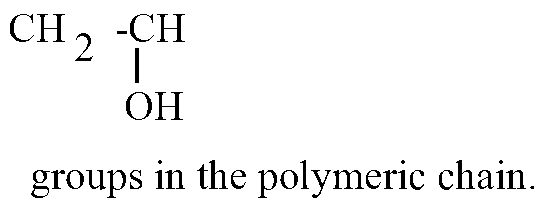
|
| | (2)
Note. Vinyl alcohol polymers for the most part herein
are prepared by the partial hydrolysis or saponification of polymers
of vinyl esters, particularly homo- or interpolymeric-vinyl
acetate. Any subsequent chemical treatment to polyvinyl
alcohol will be assumed to have left unreacted alcohol groups. For
this reason, polymers such as polyvinyl acetal, polyvinyl
butyral, etc., will be found here. |
| | (3)
Note. Claims to a polymer admixed with a chemically
reactive material or the process of preparing such a composition
are classified in this area as if the actual process has gone to
completion. As such, these types of claims are
classified in the appropriate indented process area, rather than
on the basis of the final treated product. |
SEE OR SEARCH CLASS:
| 526, | Synthetic Resins or Natural Rubbers, and in particular,
subclass 202 for a process of polymerizing an ethylenic monomer
in the presence of a vinyl alcohol polymer wherein there is no intent
to react the vinyl alcohol polymer with the polymerizable monomer or
to form a composition therewith. |
| 528, | Synthetic Resins or Natural Rubbers,
subclasses 480+ for processes involving the treatment of a vinyl
alcohol polymer-containing material, without destroying
the integrity of the polymer. |
|
| | |
| 59 | With ethylenic reactant: |
| | This subclass is indented under subclass 56. Subject matter wherein poly-vinyl alcohol is mixed
with an ethylenic reactant (e.g., acrylic acid, acrylamide, etc.). |
| | |
| 60 | Interpolymers: |
| | This subclass is indented under subclass 56. Subject matter drawn to polymeric products only, wherein
vinyl acetate has been copolymerized with at least one coreactant
and the resultant copolymer subsequently hydrolyzed to
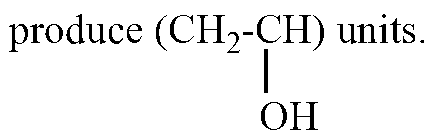
|
| | |
| 61 | Chemical modification utilizing a chemical treating agent: |
| | This subclass is indented under subclass 56. Subject matter drawn to processes of chemically modifying
homopolymers and copolymers of vinyl alcohol using a chemical treating agent, e.g., treating
polyvinyl alcohol with aldehydes to give polyacetate or with PC15 to substitute
the hydroxyl group,with chlorine atoms, etc. |
| | |
| 62 | Processes only of preparing polyvinyl alcohol: |
| | This subclass is indented under subclass 56. Subject matter wherein a nonvinyl alcohol unit precursor
polymer is modified so as to prepare a vinyl alcohol-containing
polymer therefrom.
| | (1)
Note. For the most part the patents herein relate
to subsequent aftertreatment of polymeric vinyl carboxylates. |
SEE OR SEARCH THIS CLASS, SUBCLASS:
| 61, | for processes of chemically modifying a vinyl alcohol
unit-containing polymer. |
|
| | |
| 63 | Mixing of solid graft or graft-type copolymer
with other solid polymers wherein one of said solid polymers is
not derived from ethylenic reactants only; mixing of said polymer
mixture with a chemical treating agent; or mixing of graft
or graft-type copolymer with a specified intermediate condensation
product or specified polymer-forming ingredients; or
processes of forming or reacting; or the resultant product
or any of the above operation: |
| | This subclass is indented under subclass 55. Subject matter which involves mixing of a solid graft or
graft-type copolymer with other solid polymer(s) wherein
the solid polymer, graft, or graft-type
copolymer(s) is not derived exclusively from ethylenic
reactants; or mixing of said polymeric mixture with a chemical treating
agent; or mixing of graft or graft-type copolymer
with a specified intermediate condensation product or with specified
polymer-forming ingredients, or polymer thereof; or processes
of forming or the resultant product of any of the above mixtures.
| | (1)
Note. A nonethylenically polymerized solid graft, solid
graft-type or nongraft polymer is one which was obtained
as a solid other than from ethylenic polymerization exclusively. This
would include, for example, such polymers as ethylene-carbon
monoxide copolymer, ethylene-ethylene oxide block
copolymer, caprolactam-styrene graft copolymer
and the typical poly condensation polymers (e.g., polyesters, polyamines
and polyurethanes, etc.). |
| | (2)
Note. The product derived from the reaction of a
solid polymer substrate from ethylenic reactants only and a nonethylenic
reactant to form a graft or graft-type copolymer is not
considered as being of the type derived from ethylenic reactants only. Similarly, the
product obtained obtained from graft copolymerizing an ethylenic
reactant onto a solid polymer not derived exclusively from ethylenic reactants
is also not considered as being a graft or graft-type copolymer
derived from ethylenic reactants only. For purposes of
classification a polymer is classified as: (A) A
graft copolymer when
| |
(1) The structure is given, i.e., to
a long solid polymer backbone (substrate) is attached
a pendant (nonterminal) polymer or copolymer superstrate
with at least three reactant units in length or, |
| |
(2) the copolymer is so named as a graft providing
that the disclosure is otherwise silent as to the structure or, if
structure is likewise recited, it is consistent with that required
in A.1 above or, |
| |
(3) the structure can be ascertained from the
following limiting process conditions: (a) The
disclosure states there is a reaction between a solid polymerized unsaturated
reactant and an unpolymerized unsaturated reactant in the presence of
a catalyst or, (b) the disclosure does not
state whether or not any reaction has occurred between the solid
polymerized unsaturated reactant and the unpolymerized unsaturated
reactant, but relates that a product is obtained which
is inseparable by a variety of physical techniques such as, extraction, precipitation, ion exchange, etc. In
the absence of one or more or these requirements the reaction is
considered to produce a polymeric blend. |
| |
(B) A graft-type copolymer when |
| |
(1) The structure is given, i.e., to
a long solid polymer backbone (substrate) possessing
nonterminal active sites or functional groups is attached (grafted) through
a chemical reaction with these functional groups or sites an ethylenic reactant
containing one or more functional groups or active sites.
The reaction product may or may not possess unsaturated pendant
groups depending on the mode of chemical reaction. The following
examples will illustrate this point
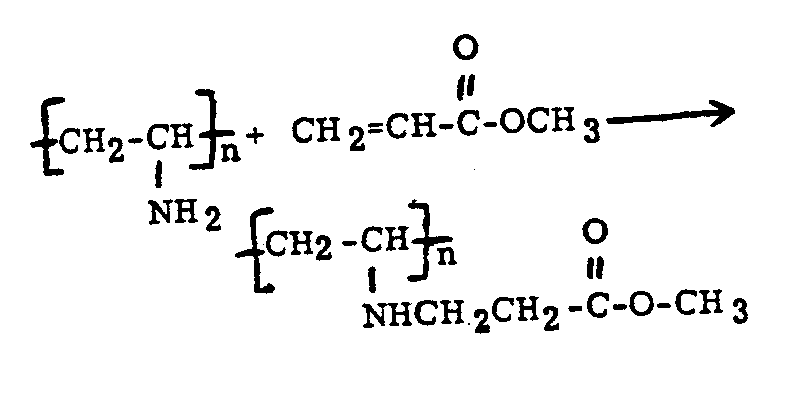

|
| | (2)
The structure can be ascertained when: |
| |
(a) There is disclosed a reaction between the
solid polymerized unsaturated reactant and the unpolymerized unsaturated reactant
which reaction uses specific art-recognized terms (e.g., esterfication, acylation, sulfonylation, cyanoethylection, addition
to, reaction or condensation with, halogenation, nitration, sulfonation, alkylation, amination, etc.). An
example of these reactions would be:
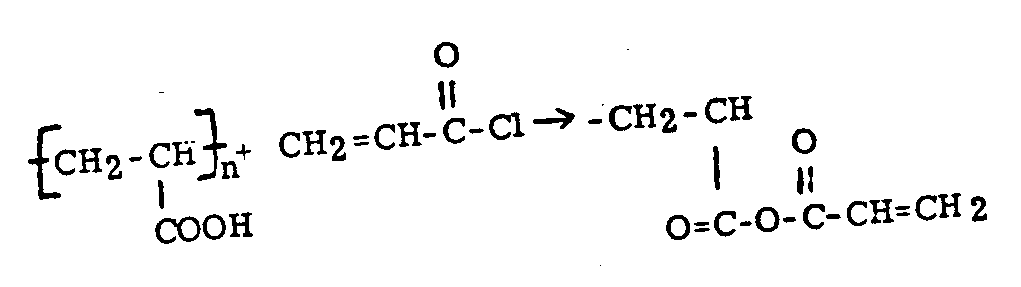
|
| |
(b) There is disclosed an interaction between
two or more solid polymers through their respective nonterminal functional
groups or through the use of an intermediate reactant or chemical agent (e.g., causing
salt, ester, amide, urea formation). Examples
of these reactions would be: (1) Contacting
polypropylene and polyethylene with benzoyl peroxide (2) Contacting
polyvinylamine and polyallylamine with glyoxal (3) Contacting
chloromethylated polystyrene with polyvinylamine (4) Contacting polyacrylic
acid with polyvinylamine In the absence of one or more of these requirements
the reaction is considered to produce a polymeric blend. | |
SEE OR SEARCH CLASS:
| 520, | Synthetic Resins or Natural Rubbers, the Glossary, for the definition of the terms "specified
intermediate condensation product" and "specified
polymer-forming ingredients". |
|
| | |
| 64 | Solid graft or graft-type copolymer derived from
ethylenic reactants only: |
| | This subclass is indented under subclass 63. Subject matter wherein the solid graft or graft-type
copolymer was derived from a solid polymer derived from only ethylenically
unsaturated reactants which was subsequently reacted with ethylenic
reactants, e.g., styrene and
acrylonitrile graft-copolymerized onto poly (butadiene-styrene), etc.
| | (1)
Note. The preparation of a graft copolymer from all
or some of its constituents in the presence of a solid polymer derived
from ethylenic reactants only would be classified elsewhere. |
| | (2)
Note. This subclass provides for all graft or graft-type
copolymers wherein a solid polymer from ethylenic reactants only
is treated with polymer-forming ingredients in any sequence.
For instance, this subclass would provide for a graft or graft-type
copolymer prepared by treating a solid polymer from ethylenic reactants
only with ethylene glycol followed by reacting with maleic anhydride; or wherein
the polymer is first reacted with maleic anhydride followed by reaction with
ethylene glycol. This subclass also provides for graft
or graft-type copolymers which are prepared by treating
a solid polymer from ethylenic reactants only concurrently with
ethylene glycol and maleic anhydride. |
SEE OR SEARCH THIS CLASS, SUBCLASS:
| 193, | for the process of grafting styrene and acrylonitrile
onto polybutadiene in the presence of polyerthylene. |
|
| | |
| 65 | With saturated 1,2-epoxy reactant containing
more than one 1,2-epoxy group per mole or polymer
derived therefrom; or with solid copolymer derived from
at least one unsaturated 1,2-epoxy reactant wherein
the epoxy reactant contains more than one 1,2-epoxy group
per mole and at least one saturated reactant: |
| | This subclass is indented under subclass 64. Subject matter wherein, in addition to the solid graft
or graft-type copolymer derived from ethylenic reactants
only, there is also present (a) a saturated
polyepoxide reactant or polymer thereof, or (b) a
solid polymer derived from at least one saturated reactant and at
least one unsaturated 1,2-epoxy reactant, e.g., a
mixture of butadiene-styrene-acrylonitrile graft
copolymer with trioxaneglycol diglycidyl ether copolymer, etc.
| | (1)
Note. A saturated polyepoxide is by definition a
specified polymer-forming ingredient; and see
Class 520 Glossary for the definition of other terms noted as specified
polymer-forming ingredients. | |
| | |
| 67 | With solid polymer derived from at least one hal-C(=O)-hal, O-C(=O)-O
or hal-C(=O)-O- reactant
wherein at least one of the reactants forming the solid polymer
is saturated; or with SPFI wherein at least one of the
necessary ingredients is a hal-C(=O)-hal, O-C(=O)-O, or
hal-C(=O)-O containing
reactant or reaction product thereof; or with a SICP containing
a hal-C(=O)- or O-C(=O)-O- group: |
| | This subclass is indented under subclass 64. Subject matter wherein, in addition to the solid graft
or graft-type, copolymer derived from ethylenic
reactants only, there is also present (a) a
solid polymer derived from a saturated hal-C(=O)-hal, O-C(=O)-O
or hal-C(=O)-O- reactant
or a solid copolymer derived from a hal-C(=O)-hal, O-C(=O)-O, or
hal-C(=O)-O- containing
reactant wherein at least one of the reactants forming the solid
copolymer is saturated, or (b) specified
polymer-forming ingredients wherein at least one of the
necessary polymer-forming ingredients contains a hal-C(=O)-hal, O-C(=O)-O, or
hal-C(=O)-O- group
and at least one of the necessary polymer-forming ingredients
is saturated or a reaction product thereof.
SEE OR SEARCH CLASS:
| 520, | Synthetic Resins or Natural Rubbers, the Glossary, for the definition of the term "specified
polymerforming ingredients". |
|
| | |
| 70 | Mixing of solid graft or graft-type copolymer
derived from ethylenic reactants only with other solid polymer derived
from ethylenic reactants only; or treating said mixture with
chemical treating agent; or processes of forming or reacting; or
the resultant product of any of the above operations: |
| | This subclass is indented under subclass 55. Subject matter which involves the mixing of a solid graft-type
copolymer derived from ethylenic reactants only with other solid
polymers derived from ethylenic reactants only; or treating
said polymer mixture with a chemical treating agent; or
process of forming or reacting; or the resultant product
of any of the above mixtures.
| | (1)
Note. This subclass does not include those reactions
which involve the preparation of a graft or graft-type
copolymer in the presence of another solid ethylenic polymer. |
| | (2)
Note. This subclass provides for the mixing of two
or more solid polymers at least one of which is a graft-type
copolymer and both being derived from ethylenic reactants only.
This subclass does not exclude the aftertreatments of ethylenic
polymers or graft or graft-type copolymers with nonethylenic
materials. However, classification in this area is
based only on ethylenic materials (e.g., halogenated
polybutadiene grafted with maleic anhydride). For
purposes of classification in this area, only polybutadiene
and maleic anhydride are to be considered in making the graft copolymer
and not the halogenated polybutadiene. |
| | (3)
Note. "Solid polymer" as used
in this subclass is generic and includes a nongraft polymer as well
as a graft or graft-type polymer all of which were produced only
from ethylenic reactants. |
SEE OR SEARCH THIS CLASS, SUBCLASS:
| 63, | for definitions of the terms "graft copolymer
and graft-type copolymers". |
| 193, | for a final product mixture of polyvinylchloride
and polybutadiene grafted to poltstyrene-acrylonitrile, obtained by
aftertreating a mixture of polyvinyl chloride and polybutadiene
with styrene and acrylonitrile. |
| 313, | for the same product when obtained from a mixture
of polyvinyl chloride and butadine, styrene, and
acrylonitrile. |
|
| | |
| 82 | Ester derived from a polyol: |
| | This subclass is indented under subclass 81. Subject matter wherein the ethylenic carboxylic acid reactant
ester is derived from a polyol (e.g., ethylene
glycol diacrylate, etc.) |
| | |
| 88 | Mixing of solid block or block-type copolymer
with other solid polymer; mixing of said polymer mixture
with a chemical treating agent; mixing of a block or block-type
copolymer with specified intermediate condensation product or with
specified polymer-forming ingredients; or processes
of forming or reacting; or the resultant product of any of
the above operations: |
| | This subclass is indented under subclass 55. Subject matter which involves the mixing of a solid block
or block-type copolymers with other solid polymer(s); mixing
of said polymer mixture with a chemical treating agent; mixing of
block or block-type copolymer with a specified intermediate
condensation product or with specified polymerforming ingredients
or their polymers; or processes of mixing or forming; or
the resultant product of any of the above mixtures.
| | (1)
Note. For purposes of classification a polymer is
classified as:
| | (A)
A block copolymer when |
| |
1. The structure is given, i.e., to
a long polymer backbone is attached or coupled to one or both of
its terminal ends one or more chemically dissimilar polymers at least
three reactant units in length or, |
| |
2. the copolymer is named as a block providing that
the disclosure is otherwise silent as to its structure or, if
the structure is likewise given, it is consistent with
that described above or, |
| |
3. the structure can be ascertained from the following
limiting process conditions: |
| | (a)
Treating a nonterminated solid polymer, that is, one
which is terminally active or "living", with
an ethylenic reactant with subsequent polymerization to form additional
blocks. The process may be continued to produce higher order
block copolymers. For example, treating dilithiated
polystyrene with butadiene to yield an ABA block copolymer. |
| | (b)
Two or more chemically dissimilar nonidentical solid polymer
chain ends are coupled directly or through the use of a chemical
agent. For example, the coupling of hydroxy-terminated
solid polybutadiene with hydroxy terminated polyethylene glycol
terephthalate using phosgene. |
| | (B)
A block-type copolymer when |
| |
1. The structure is given, i.e., to
a long solid polymer backbone possessing terminally active sites, e.g., contains
functional groups or is a "living polymer", etc., is
attached or coupled through chemical reaction with those functional groups
or sites an ethylenic reactant containing one or more functional
groups or sites, for example, contacting hydroxy terminated
polybutadiene with allyl isocyanate or, |
| |
2. two or more identical solid polymer chain ends
are coupled directly or through the use of a chemical agent.
For purposes here, identical means those polymer segments
which contain the same backbone but differ (e.g., in
stereoregularity, isotacticity syndiotacticity, atacticity, optical
activity, or degree of polymerization). Thus, coupling
lithium terminated polystyrene segments with molecular weights of
25,000 and 100,000 respectively with stannic chloride
is proper for this subclass. |
| |
Failure to meet one or more of these requirements, the
reaction is considered to produce a polymeric blend. For
example, contacting lithium terminated polystyrene with
ethylene oxide followed by blending with polyacrylic acid places
the product blend in subclass 221. | |
| | (2)
Note. Patents which describe the aftertreatment of
solid polymer from ethylenic reactants only with a nonethylenic agent
are classified according to the reactants first leading to formation
of the solid polymer. However, if the aftertreating
agent is an ethylenic reactant, it is given equal weight
with these reactants used in making the solid polymer. |
SEE OR SEARCH THIS CLASS, SUBCLASS:
| 191+, | for a product wherein the same solid polymer from
ethylenic reactants only is coupled utilizing a coupling agent and
subsequently blended with a different solid polymer derived from
ethylenic reactants only. |
SEE OR SEARCH CLASS:
| 520, | Synthetic Resins or Natural Rubbers, the Glossary, for the definitions of the terms "specified
intermediate condensation product" and "specified
polymer-forming ingredients". |
|
| | |
| 89 | Mixture contains two or more solid block or block-type
copolymers: |
| | This subclass is indented under subclass 88. Subject matter wherein the mixture contains at least two
solid block copolymers or block-type copolymers.
| | (1)
Note. There must be at least one solid polymer derived
from ethylenically unsaturated reactants only. However, the required
solid polymer from ethylenic reactants only need not be in block- or block-type
form. An example of the mixture required for this subclass
could consist of solid polyethylene and ethylene oxidebutyrolactone
block copolymer. Unless stated to the contrary, in
the absence of any disclosure, the polymer block shall
be assumed to be a solid when derived from ethylenic reactants only
and a liquid when derived other than only from ethylenic reactants. | |
| | |
| 93 | Mixture contains solid polymer derived from reactant containing
chalcogen: |
| | This subclass is indented under subclass 88. Subject matter wherein the solid polymer is derived from
or has been reacted with an ethylenic reactant containing a chalcogen
atom (O, S, Sc, and Te) (e.g., acrylic
acid, etc.)
| | (1)
Note. In this subclass and its indent(s), "solid
polymer" is generic and is meant to include an ethylenic
block, block-type, or nonblock polymer. | |
| | |
| 102 | Si-H or Si-C reactant contains an atom other
than C, H, O, or Si bonded to a carbon atom: |
| | This subclass is indented under subclass 100. Subject matter wherein the Si-H or Si-C
bond-containing reactant or polymer thereof contains an
atom other than C, H, or O bonded to carbon e.g., 3,3,3-trifluoromethyl
propyl siloxane, etc.
| | (1)
Note. Elements that are other than C, H, or
O and are incorporated into the polymer by non Si-H a Si-C
containing reactants are not considered for this subclass. The
elements required must be part of a Si-H or Si-C
reactant. | |
| | |
| 107 | With saturated 1, 2-epoxy reactant containing
more than one 1, 2-epoxy group per mole or polymer
derived therefrom; or with solid copolymer derived from
at least one saturated reactant and at least one unsaturated 1, 2-epoxy
reactant wherein the epoxy reactant contains more than one 1, 2-epoxy group
per mole: |
| | This subclass is indented under subclass 55. Subject matter wherein, in addition to the solid polymer
derived from ethylenic reactants only, there is additionally
present (a) a reactant containing more than 1, 2-epoxy
group or polymer thereof, or (b) a solid
copolymer derived from at least one saturated reactant and an unsaturated
reactant containing more than one 1, 2-epoxy groups
per mole
| | (1)
Note. The 1, 2-epoxy reactant
may be an epoxidized solid polymer. | |
| | |
| 110 | With reactant which is an aldehyde, aldehyde derivative, or
polymer thereof, and which is free of an 1, 2-epoxy
group (included herein are alkylated methylol groups): |
| | This subclass is indented under subclass 107. Subject matter wherein there is an additional reactant present
which is an aldehyde or aldehyde derivative, or polymer
thereof, and which reactant is free of any 1, 2-epoxy
groups.
SEE OR SEARCH CLASS:
| 520, | Synthetic Resins or Natural Rubbers, the Glossary, for a definition of the term "aldehyde
derivative". |
|
| | |
| 111 | With reactant which is free of an 1,2-epoxy group
and which contains a -N=C=X group or
polymer thereof (X is chalcogen); or
with a polyol and a polycarboxylic acid or reaction product thereof
which is free of an 1,2 epoxy group: |
| | This subclass is indented under subclass 107. With reactant which is free of an 1, 2-epoxy group
and which contains a -N=C=X group or polymer
thereof (X is chalcogen); or with a polyol
and a polycarboxylic acid or reaction product thereof which is free
of an 1, 2-epoxy groups:Subject matter
wherein there is an additional reactant present which is free of
any 1, 2-epoxy group and which contains more than
one -N=C=X (X is chalcogen) group
or polymer thereof; or with a polyol and a polycarboxylic acid
or derivative or with a reaction product thereof and which reactants
or polymer are free of any 1, 2-epoxy groups, e.g., polyurethanes, polyesters, etc. |
| | |
| 111.5 | With a reactant which is a fatty acid glycerol ester, a
fatty acid or salt derived from a naturally occurring glyceride, tall
oil, or a fatty acid derived from tall oil: |
| | This subclass is indented under subclass 107. Subject matter wherein there is, in addition, at least
one reactant which is a fatty acid glycerol ester, or a
fatty acid or salt thereof derived from a naturally occurring glyceride, tall
oil, or a fatty acid derived from tall oil.
| | (1)
Note. The contacting of the polymer with the fatty
acid material can be prior, concurrent, or subsequent
to contacting with the poly 1, 2-epoxide material. |
SEE OR SEARCH CLASS:
| 520, | Synthetic Resins or Natural Rubbers, the Glossary, for a definition of the term "fatty
acid" and of other materials proper for this subclass. |
|
| | |
| 123 | With saturated -N=C=X (X
is chalcogen) reactant or polymer thereof; or
with solid copolymer derived from at least one -N=C=X
reactant wherein at least one of the reactants forming the solid
copolymer is saturated; or with specified polymer-forming ingredients
wherein at least one of the necessary ingredients contains a -N=C=X
group or with a reaction product thereof; or with specified
intermediate condensation product containing a -N=C=X
group: |
| | This subclass is indented under subclass 55. Subject matter wherein, in addition to the solid polymer
derived from ethylenic reactants only, there is additionally
present (a) a saturated -N=C=X (X
is chalcogen) reactant or a polymer thereof, or (b) a
solid copolymer derived from a -N=C=X -containing
reactant wherein at least one of the reactants forming the solid copolymer
is saturated, or (c) specified polymer-forming
ingredients wherein at least one of the necessary ingredients contains
a -N=C=X group and at least
one of the necessary polymer-forming ingredients is saturated or
a reaction product or condensate thereof, or (d) a
specified intermediate condensation product which contains a -N=C=X
group.
| | (1)
Note. Included here under isocyanates are blocked
isocyantes. See, in particular, under
subclass 124. |
SEE OR SEARCH CLASS:
| 520, | Synthetic Resins or Natural Rubbers, the Glossary, for a discussion of the terms "specified
polymer-forming ingredients" and "specified
intermediate condensation product". |
|
| | |
| 124 | Blocked isocyanate reactant: |
| | This subclass is indented under subclass 123. Subject matter wherein the -N=C=X
containing reactant is blocked.
SEE OR SEARCH CLASS:
| 520, | Synthetic Resins or Natural Rubbers, Glossary for a definition of the term "blocked". |
|
| | |
| 132 | With saturated phenolic reactant or polymer thereof; or
with solid copolymer derived from at least one phenolic reactant wherein
at least one of the reactants forming the solid copolymer is saturated; or
with specified polymer-forming ingredients wherein at least
one of the necessary ingredients is a phenolic reactant or with
a reaction product thereof; or with a specified intermediate
condensation product containing a phenolic group: |
| | This subclass is indented under subclass 55. Subject matter wherein, in addition to the solid polymer
derived from ethylenic reactants only, there is additionally
present (a) a saturated phenolic reactant or a
polymer thereof, or (b) a solid copolymer
derived from a phenolic-containing reactant wherein at
least one of the reactants forming the solid copolymer is saturated, or (c) specified
polymer-forming ingredients wherein at least one of the
necessary ingredients contains a phenolic group and at least one
of the necessary ingredients is saturated or a reaction product
or condensate thereof, or (d) a specified
intermediate condensation product containing a phenolic group.
SEE OR SEARCH CLASS:
| 520, | Synthetic Resins or Natural Rubbers, the Glossary, for a definition of the terms "specified
polymer-forming ingredients", "specified
intermediate condensation product", and "phenolic reactant" |
| 528, | Synthetic Resins or Natural Rubbers,
subclass 86 for a furthur discussion of phenols. |
|
| | |
| 133.5 | With a reactant which is a fatty acid glycerol ester, a
fatty acid or salt derived from a naturally occurring glyceride, tall
oil, or a fatty acid derived from tall oil: |
| | This subclass is indented under subclass 132. Subject matter wherein there is, in addition, at least
one reactant which is a fatty acid glycerol ester, or a
fatty acid or salt thereof derived from a naturally occurring glyceride, tall
oil, or a fatty acid derived from tall oil.
SEE OR SEARCH CLASS:
| 520, | Synthetic Resins or Natural Rubbers, the Glossary, for a definition of "fatty acid" and
the materials proper for this subclass. |
|
| | |
| 138 | With nonethylenic, nonaldehyde, or nonaldehyde-type
reactant containing an atom other than C, H, or
O: |
| | This subclass is indented under subclass 134. Subject matter wherein there is present an additional reactant
which is not ethylenic, nor an aldehyde or derivative thereof, e.g., pretreating phenol
and formaldehyde with lead oxide and wherein the resulting lead
oxide-containing condensate is blended with butyl rubber, etc.
SEE OR SEARCH THIS CLASS, SUBCLASS:
| 136, | for a lead-containing phenolic used as a
reactant. |
|
| | |
| 153 | With saturated ketone reactant or polymer thereof; or
with solid copolymer derived from at least one ketone reactant wherein
at least one of the reactants forming the solid copolymer is saturated; or
with specified polymer-forming ingredients wherein at least
one of the necessary ingredients is a ketone or with a reaction
product thereof; or with a specified intermediate condensation product
containing a ketone group: |
| | This subclass is indented under subclass 55. Subject matter wherein, in addition to the solid polymer
derived from ethylenic reactants only, there is additionally
present (a) a saturated ketone reactant or a polymer
thereof, or (b) a solid copolymer derived
from a ketone-containing reactant wherein at least one
of the reactants forming the solid copolymer is saturated, or (c) specified
polymer-forming ingredients wherein at least one of the
necessary polymer-forming ingredients contains a ketone group
and at least one of the necessary polymer-forming ingredients
is saturated or a reaction product thereof, or (d) a
specified intermediate condensation product which contains a ketone
group.
SEE OR SEARCH CLASS:
| 520, | Synthetic Resins or Natural Rubbers, the Glossary, for a definition of the terms "specified
polymer-forming ingredients", "specified
intermediate condensation product", and "ketone". |
|
| | |
| 154 | With saturated aldehyde or aldehyde derivative (including
methylol ethers or condensates) reactant or solid polymer
thereof; or with solid copolymer derived from at least one
aldehyde or aldehyde derivative reactant wherein at least one of
the reactants forming the solid copolymer is saturated; or with
specified polymer-forming ingredients wherein at least
one of the necessary ingredients is an aldehyde or aldehyde derivative reactant
or with a reaction product thereof, or with specified intermediate
condensation product containing an aldehyde or aldehyde derivative: |
| | This subclass is indented under subclass 55. Subject matter wherein, in addition to the solid polymer
derived from ethylenic reactants only, there is additionally
present (a) a saturated aldehyde or aldehyde derivative (including methylol
ethers or condensates) reactant or a polymer thereof, or (b)
a solid copolymer derived from an aldehyde or aldehyde derivative
reactant wherein at least one of the reactants forming the solid
copolymer is saturated, or (c) specified
polymer-forming ingredients wherein at least one of the
necessary polymer-forming ingredients contains an aldehyde
or derivative group and at least one of the necessary polymer-forming
ingredients is saturated or a reaction product or condensate thereof, or (d) a
specified intermediate condensation product which contains an aldehyde
or aldehyde derivative group.
SEE OR SEARCH CLASS:
| 520, | Synthetic Resins or Natural Rubbers, the Glossary, for the definition of the terms "aldehyde", "aldehyde
derivative", "specified polymer-forming ingredients", and "specified
intermediate condensation product". |
|
| | |
| 156 | Contacting with a hydrocarbon and an aldehyde or aldehyde
derivative as reactants at least one of which is saturated, their
condensate or solid polymer thereof: |
| | This subclass is indented under subclass 154. Subject matter wherein the solid polymer from ethylenic
reactants only is contacted with a hydrocarbon and an aldehyde or
aldehyde derivative as reactants, aldehyde-hydrocarbon condensate
or the corresponding solid polymer thereof. The hydrocarbon
reactant may not be a solid polymer from ethylenic reactants only (e.g., polyvinyl-naphthalene) which
is then further condensed with formaldehyde. However, it
can be vinyl naphthalene condensed with formaldehyde and subsequently
contacted with a solid polymer derived from ethylenic reactants
only.
SEE OR SEARCH THIS CLASS, SUBCLASS:
| 155, | for the reaction of an aldehyde with a solid polymer
from ethylenic reactants only subsequently mixed with a chemically
dissimilar solid polymer derived from ethylenic reactants only. |
|
| | |
| 158 | Reactant, condensate, or solid polymer
contains an element other than C, H, N, or
O; or wherein a co-reactant is not an aldehyde, or aldehyde-type
reactant alcohol, amine, or reactant containing
a N-C(=O)- group: |
| | This subclass is indented under subclass 157. Subject matter wherein the condensate or corresponding solid
polymer thereof contains an element other than C, H, O, or
N; or wherein a co-reactant is not an aldehyde, aldehyde-type, alcohol, amine, or
N-C(=O)- group-containing reactant. |
| | |
| 159
|
| | This subclass is indented under subclass 157. Reactant derived from alcohol containing an aryl group or
eight or more carbon atoms: Subject matter wherein the
reactant is derived from an alcohol containing at least eight carbon atoms
or one which contains an aromatic ring other than as a phenol, e.g., polymethyl
acrylate and a condensate from n- octanol, formaldehyde
and melamine, etc. |
| | |
| 160 | Solid polymer derived from ethylenic reactants only contains
an element other than C, H, O, or N: |
| | This subclass is indented under subclass 157. Subject matter wherein the solid polymer is derived from
or is reacted with an ethylenic reactant containing an element other
than C, H, O, or N, e.g., vinyl
sulfonamide, CH2=CH-SO2NH2, etc. |
| | |
| 167 | Polycarboxylic acid or derivative or polyol contains an
atom other than C, H, or O; or wherein
a polycarboxylic acid or derivative or polyol or condensate thereof
is reacted with a reactant containing atoms other than C, H, or
O prior to blending with the solid polymer; or wherein
a coreactant with the polycarboxylic acid or derivative or polyol contains
an atom other than C, H, or O: |
| | This subclass is indented under subclass 165. Subject matter wherein the polycarboxylic acid or derivative
or polyol contains an element other than C, H, or
O; or wherein the polycarboxylic acid or derivative, polyol
or reaction product thereof is reacted with a compound containing
elements other than C, H, or O prior to blending
with the solid polymerized ethylenic reactant; or wherein
the coreactant with the polycarboxylic acid, derivative, or
polyol contains an element other than C, H, or
O. |
| | |
| 167.5 | With a reactant which is a fatty acid glycerol ester, a
fatty acid or salt derived from a naturally occurring glyceride, tall
oil , or a fatty acid derived from tall oil: |
| | This subclass is indented under subclass 165. Subject matter wherein there is at least one reactant which
is a fatty acid glycerol ester, or a fatty acid or salt
thereof derived from a naturally occurring glyceride, tall
oil, or a fatty acid derived from tall oil.
| | (1)
Note. The recited fatty material is reacted with
the solid polymer derived from ethylenic reactants only; or
with the polycarboxylic acid or derivative or polyol, or
with the condensate or solid polymer thereof. |
SEE OR SEARCH CLASS:
| 520, | Synthetic Resins or Natural Rubbers, the Glossary, for a definition of the term "fatty
acid" and of other materials proper for this subclass. |
|
| | |
| 179 | Two or more solid polymers other than prepared from a polycarboxylic
acid or derivative and a polyamine, a lactam, an aminocarboxylic
acid or derivative, or from a polyamine salt of a polycarboxylic
acid: |
| | This subclass is indented under subclass 178. Subject matter wherein there are at least two solid polymers
present which are other than derived from the reaction of a polyamine
and a polycarboxylic acid or derivative, or from a lactam, or
from an aminocarboxylic acid or derivative, or from an
amine salt of a polycarboxylic acid, e.g., in
subclass 178, e.g., an applicable
mixture would be polystyrene, poly(methyl methacrylate) and
nylon-6. |
| | |
| 191 | Polymer mixture of two or more solid polymers derived from
ethylenically unsaturated reactants only; or mixtures of
said polymer mixture with a chemical treating agent; or products
or processes of preparing any of the above mixtures: |
| | This subclass is indented under subclass 55. Subject matter which concerns mixing of two or more solid
polymers derived from ethylenically unsaturated reactants only, a
mixture of said polymer mixture with a chemical treating agent, or
processes of forming or the resultant product of any of the above
mixtures.
| | (1)
Note. Excluded from this subclass are multi-step
polymerization-postpolymerization processes which
occurs in the presence of a single preformed solid polymer from
ethylenic reactants only and an ethylenic reactant which affords
a polymeric mixture. |
| | (2)
Note. Placement of a patent in this subclass is on
the basis of the ethylenic reactants used in the preparation of
solid polymer and not on the basis of ethylenic reactants which
may be reacted with a mixture of solid polymers from ethylenic reactants
only. |
SEE OR SEARCH THIS CLASS, SUBCLASS:
| 193, | for metalation of po;ystyrene blended with
polybutadiene which is subsequently contacted with butadiene. |
| 242+, | for lithiation of styrene in the presence of polyethylene
to yield lithium. Terminated polystyrene followed by its
reaction with butadiene to produce block (polybutadiene . polystrene) in admixture. |
|
| | |
| 192 | Treating polymer or polymer mixture with a chemical treating
agent other than solid polymer: |
| | This subclass is indented under subclass 191. Subject matter drawn to processes of treating a polymer
or polymer mixture with a chemical agent.
| | (1)
Note. In the Class Definition of this class, see
Lines With Other Classes and Within This Class, section
II, B(1) for lines between this subclass
and its indents. |
SEE OR SEARCH THIS CLASS, SUBCLASS:
| 199, | through 241, for a product which is the
result of a treating process proper for this subclass and its indents. |
|
| | |
| 193 | Agent contains an ethylenic group: |
| | This subclass is indented under subclass 192. Subject matter wherein the treating agent is ethylenically
unsaturated.
| | (1)
Note. Included herein are polymers which were obtained
only from ethylenic reactants as treating agents. |
SEE OR SEARCH THIS CLASS, SUBCLASS:
| 70+, | for a polymeric mixture containing a graft copolymer
derived from ethylenic reactants only; or for a process
or product obtained by treating an ethylenic reactant which reacts
with the polymer and which resultant product is admixed with an
additional solid polymer. |
| 88+, | for a polymeric mixture containing a block copolymer
derived from ethylenic reactants only or for a process or product
obtained by treating a mixture of polymers having functional terminal
ends or with a coupling agent and subsequently contacting said product with
an additional solid polymer. |
|
| | |
| 195 | Contains a metal atom: |
| | This subclass is indented under subclass 194. Subject matter wherein the organic treating agent is one
which also contains a metal atom in an inorganic or organic compound (e.g., trialkyl
aluminum, etc.).
SEE OR SEARCH CLASS:
| 520, | Synthetic Resins or Natural Rubbers, the Glossary for the elements considered as being
metals. |
|
| | |
| 197 | Specified blending process: |
| | This subclass is indented under subclass 191. Subject matter drawn to processes which involve specified
blending operations associated with preparing the polymeric mixture.
| | (1)
Note. The blending operation must be accompanied
by some specific process limitations. Thus, if
blending is accomplished by a simple "melt or fusion" blending
then it is necessary to state a required temperature range. Similarly, if blending
is accomplished by dissolving the polymers in one or more solvents, then
it is necessary to specify at least the nature of the solvents, e.g., 2:1
solvent mixture of carbontetrachloride-benzene or 2:1
solvent mixture of halogenated hydrocarbon with aromatic hydrocarbon. In
a multistep blending operation which includes heating, it
is not necessary that the temperature be specified. Also, permissible
are blending processes wherein heating is the only step but which
do not disclosed specified temperatures when the polymers or polymer
system are required to conform to certain parameters. For
example, polymers A and B are heated above their glass
transition temperatures (Tg) and then blended; or
polymer A is heated to viscosity V1and polymer
B is heated viscosity V2 and then blended.
Terms such as ". . . blending
and heating . . "or". . . mixing
and vulcanizing . . ." are specific
enough to be classified here. Some indication as to mixing
at a given r.p.m. or vulcanizing at a
given temperature would be adequate information. |
SEE OR SEARCH THIS CLASS, SUBCLASS:
| 199, | through 241, for a product which is the
result of a specified blending process. |
|
| | |
| 198 | With subsequent physical treatment: |
| | This subclass is indented under subclass 197. Subject matter wherein the blending process is accompanied
by a subsequent physical treatment; e.g., masticating (crushing), prilling (pelletizing), evaporation
of solvent, shearing, rolling, pressing, milling, granulating, etc. |
| | |
| 201 | Solid polymer derived from metal-containing ethylenic
reactant: |
| | This subclass is indented under subclass 191. Subject matter wherein the mixture contains a solid polymer
derived from a metal-containing ethylenic reactant, e.g., sodium
acrylate, etc.
SEE OR SEARCH THIS CLASS, SUBCLASS:
| 221, | for a mixture containing a metal-containing
polymer produced by the neutralization of polyacrylic acid with metal
hydroxide. |
|
| | |
| 205 | Heterocyclic reactant is an imide or lactam: |
| | This subclass is indented under subclass 203. Subject matter wherein the nitrogen heterocycle is an imide
or a lactam, e.g., maleimide, N-vinyl
pyrrolidone, etc.
SEE OR SEARCH CLASS:
| 520, | Synthetic Resins and Natural Rubbers, Glossary for a definition of the term "carboxylic
acid or derivative" which defines "imide" and "lactam". |
|
| | |
| 207 | Heterocyclic reactant contains anhydride group: |
| | This subclass is indented under subclass 206. Subject matter wherein the chalcogen heterocycle contains
an anhydride group (e.g., maleic anhydride, etc.).
SEE OR SEARCH CLASS:
| 520, | Synthetic Resins and Natural Rubbers, the Glossary, for a definition of the term "carboxylic
acid or derivative" which defines "carboxylic
acid anhydride". |
|
| | |
| 209 | Solid polymer derived from reactant containing elements
other than C, H, O, N, S, or Cl: |
| | This subclass is indented under subclass 191. Subject matter wherein the mixture contains a solid polymer
derived from an ethylenic reactant containing elements other than
carbon, hydrogen, nitrogen, oxygen, sulfur, or
chlorine (e.g., bis(beta-chorethyl)-vinylphosphonate
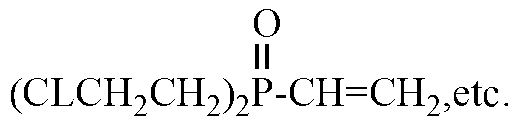
|
| | |
| 229
|
| | This subclass is indented under subclass 228. Ester derived from an unsaturated alcohol: Subject
matter wherein at least one of the solid polymers is derived from
an ester reactant containing a moiety derived from an unsaturated alcohol; e.g., a
mixture of poly(methyl methacrylate-vinyl acetate) and
poly(butyl acrylate-vinyl acetate), etc. |
| | |
| 235 | Polymer derived from halogen-containing reactant: |
| | This subclass is indented under subclass 232. Subject matter wherein a solid polymer is derived from vinyl
chloride or vinylidene chloride.
SEE OR SEARCH THIS CLASS, SUBCLASS:
| 199+, | and 213+, for a polymer derived
from a halogen-containing reactant other than vinyl or
vinylidene chloride. |
|
| | |
| 242 | Polymer derived from ethylenic reactants only mixed with
ethylenic reactant: |
| | This subclass is indented under subclass 55. Subject matter wherein a solid polymer derived from ethylenically
unsaturated reactants only is mixed with an ethylenic reactant, processes
of mixing, or the resultant product of any of the above
mixture, e.g., graft copolymerization
of poly(styrene-butadiene) with acrylonitrile
or the block copolymerization of polystyrene with butadiene, etc.
| | (1)
Note. This and indented subclasses contain as shown
above graft and block copolymers whenever prepared according to
the limitations set forth under this subclass. Thus, the
process and product of preparing a mixture of graft poly(butadiene-styrene-polystyrene-acrylonitrile) with
poly(styrene-acrylonitrile) starting
with polybutadiene and styrene and acrylonitrile, is classified here. |
| | (2)
Note. This and indented subclasses also contain polymers
prepared from a combination of ethylenic reactants mixed with nonethylenic
reactants when reacted in the presence of ethylenically polymerized
polymers, e.g., ethylene-ethylene
oxide copolymer, propylene-sulfur dioxide copolymer. In
the Class Definition of this class, see Lines With Other
Classes and Within This Class, section II. B(2) for
lines between this subclass and its indents. |
| | (3)
Note. This and indented subclasses also contain those
products and compositions derived from the contacting of solid polymers
from ethylenic reactants only with ethylenic materials wherein the
ethylenic reactant interacts with the polymer without undergoing
simultaneous or subsequent polymerization; (e.g., treating
poly(2-hydroxethyl-acrylate) with
acrylyl chloride or polyacrylic acid with allylamine, etc.). |
| | (4)
Note. Patents in the area are placed in the first
subclass that provides for the solid polymer or ethylenic monomer. No distinction
has been made as to amounts of required materials. Solid
polymers from ethylenic reactants only are classified on the basis
of the initial ethylenic reactants utilized in preparing same. No weight, for
purposes of classification, has been given to polymers
which have been post-treated chemically to introduce atoms
therein or remove atoms which were part of the original polymer prior
to introduction of the ethylenic monomer. See the Search
Note below. |
| | (5)
Note. In those subclasses indented hereinbelow which
recite "Block" in the title, the requirement
for placement of a document therein is that the required ethylenic
material as noted by the subclass title be in the block portion
of the polymer and not in the graft portion of the molecule. |
| | (6)
Note. An ethylenic reactant requires the presence
of two carbon atoms bonded together by a double or triple bond, with the
proviso that the double bond is not part of an aromatic ring, or
of a ring which shares a double bond with an aromatic ring. The
term aromatic denotes a compound which contains a benzene nucleus
whether or not it is condensed with other rings. Reactants
such as furan, thiophene and pyrrole would thus meet the
requirements for a ethylenically unsaturated compound. |
SEE OR SEARCH THIS CLASS, SUBCLASS:
| 313, | for the product obtained by halogenating polybutadiene
and subsequently mixing same with vinyl chloride where said product
is classified on the basis of butadiene. |
|
| | |
| 243 | Reactions with ethylenic reactants in two or more diverse
phases, e.g., bulk, emulsion, melt, solution, etc.: |
| | This subclass is indented under subclass 242. Subject matter wherein one or more polymerization reactions
occur in two or more distinct phases.
| | (1)
Note. This subclass typically covers those manipulative
processes involving multiphase preparation of modified polymers, notably
graft copolymers, e.g., prepolymerizing
by mass polymerization of polybutadiene dissolved in styrene and
then dispersing the mixture in an aqueous solution containing a
suspending agent and finally polymerizing the suspended prepolymer
mixture until substantially all the reactant has been polymerized
to afford the final product, etc. | |
| | |
| 245 | Specified material contains transition metal atom: |
| | This subclass is indented under subclass 244. Subject matter wherein the specified material contains a
transition metal atom (i.e., the
elements of atomic numbers 21-29, 39-47, 57-79, and
89 and higher and does not include Zn, Cd, and
Hg).
| | (1)
Note. The transition metal atom may be in elemental
or compound form. | |
| | |
| 246 | In presence of water: |
| | This subclass is indented under subclass 245. Subject matter wherein a transition metal atom, water, and
an ethylenic reactant are simultaneously in contact with a solid
polymer from ethylenic reactant only.
| | (1)
Note. The amount of water present during the polymerization
process is of no significance (e.g., diluent, catalyst, activator, etc.). The
introduction of water may not be explicitly stated but only implied, e.g., the
introduction of 37% formalin solution and 37% commercial hydrochloric
acid. Nevertheless, these materials are generally
recognized as containing water. | |
| | |
| 247 | Contains nontransition metal atom: |
| | This subclass is indented under subclass 245. Subject matter wherein a transition metal atom is in contact
with a nontransition metal atom at some time during the contacting
process.
| | (1)
Note. The term nontransition metal is intended to
include all metals other than the transition metals. |
| | (2)
Note. The transition metals are the elements of atomic
numbers 21-29, 39-47, 57-79, and
89 and higher; Zm, Ch, and Hg are not
included. |
| | (3)
Note. The nontransition metalatom may be in the same
compound as the transition metal atom or in a different compound, or
it may exist in elemental form. | |
| | |
| 249 | Metal atom is aluminum: |
| | This subclass is indented under subclass 248. Subject matter wherein the metal associated with the metal-to-carbon
or metal-to-hydrogen bond is aluminum (e.g., Al(C3H7)3, etc.). |
| | |
| 250 | Metal atom is Group IA metal atom (Li, Na, K, Rb, Cs, Fr): |
| | This subclass is indented under subclass 248. Subject matter wherein the metal associated with the metal-to-carbon
or metal-to-hydrogen bond is a Group IA (L, Na, K, Rb, Cs, Fr) metal
atom. |
| | |
| 251
|
| | This subclass is indented under subclass 244. Specified material contains a boron atom: Subject
matter wherein the specified material contains a boron atom (e.g., boron-trifluoride etherate
complex, etc.). |
| | |
| 252 | Specified material is a carbohydrate or is a solid synthetic
polymer not intended to be in the final product: |
| | This subclass is indented under subclass 244. Subject matter wherein the specified material is a carbohydrate
or is a solid synthetic polymer not intended to be in the final
product.
SEE OR SEARCH CLASS:
| 523, | Synthetic Resins or Natural Rubbers, for polymer composition containing carbohydrates
as a nonreacted material. |
| 524, | Synthetic Resins or Natural Rubbers, for polymer composition containing carbohydrates
as a nonreacted material. |
| 526, | Synthetic Resins or Natural Rubbers,
subclasses 200 through 203for polymerization processes utilizing carbohydrates
and synthetic polymers not intended to be in the final product. |
|
| | |
| 267 | Including step of preparing a polymer in the presence of
a specified material and in the absence of a preformed polymer derived from
ethylenic reactant only: |
| | This subclass is indented under subclass 242. Subject matter drawn to processes which include the step
of initially preparing a polymer in the presence of a specified
material.
| | (1)
Note. This subclass excludes the presence of a preformed
polymer derived from ethylenic reactants only. In the Class
Definition of this class, see Lines With Other Classes
and Within This Class, section II. B(3) for
lines between this subclass and its indents. |
| | (2)
Note. The specified material must present at some
time prior to the completion of the in situ polymerization of the
initial polymer and may remain during the final reaction with the
ethylenic reactant. |
SEE OR SEARCH CLASS:
| 520, | Synthetic Resins or Natural Rubbers, the Glossary, for the definition of the term "specified
material". |
|
| | |
| 269 | Transition metal is other than group IVB, VB, or
VIB metal atom: |
| | This subclass is indented under subclass 268. Subject matter wherein the transition metal atom is other
than from Groups IVB, VB, or VIB.
| | (1)
Note. Excluded from this subclass are elements Ti, Zr, Hf, V, Nb, Ta, Cr, Mo, and
W. | |
| | |
| 272 | Contains an atom other than group IA, C, or H: |
| | This subclass is indented under subclass 271. Subject matter wherein the specified material contains an
element other than from Group IA, C, or H.
| | (1)
Note. The word "contains" reads
generically on the element whether found as an integral part of
the specified material required for this subclass or in addition to
the specified material. |
| | (2)
Note. Metal borohydrides, e.g., LiBH4 are
classified as if they are hydrides of boron and of the metal atom. |
| | (3)
Note. Metal hydrides (e.g., NaAlH4) are classified
as if they are mixed hydrides of aluminum and of the other metal. | |
| | |
| 279 | Ethylenic reactant contains nitrogen heterocycle: |
| | This subclass is indented under subclass 242. Subject matter wherein the ethylenic reactant contains a
nitrogen heterocycle (e.g., 4-vinyl pyridine, etc.).
| | (1)
Note. An ethylenically unsaturated nitrogen heterocyclic
compound may contain a carbon-to-carbon double
bond outside (exo) or inside (endo) the
ring containing the nitrogen atom (s), e.g., N-vinylpyrrolidone, 1, 2-, 1, 3- and
1, 4-, diazine, pyridine, etc. |
SEE OR SEARCH THIS CLASS, SUBCLASS:
| 242, | for definitions of the terms "ethylenic reactant" and "aromatic". |
|
| | |
| 280 | Block copolymer: |
| | This subclass is indented under subclass 279. Subject matter wherein the solid polymer is a block copolymer
derived from an ethylenic reactant containing a nitrogen heterocycle, e.g., (poly-2-methyl-3-vinylpyridine-poly-styrene) block
copolymer, etc.
| | (1)
Note. Grafted poly-2-vinyl-pyridine
onto (poly-styrene-poly-butadiene) block copolymer
is not proper for this subclass but in subclass 279 since the block
portion is devoid of a nitrogen reactant. | |
| | |
| 282 | Imide: |
| | This subclass is indented under subclass 279. Subject matter wherein the nitrogen heterocycle contains
an imide group, e.g., maleimide, etc.
SEE OR SEARCH CLASS:
| 520, | Synthetic Resins or Natural Rubbers, for a definition of the "carboxylic acid or
derivative" which defines "imide". |
|
| | |
| 283 | Lactam: |
| | This subclass is indented under subclass 279. Subject matter wherein nitrogen heterocycle contains a lactam
group (e.g., N-vinyl
pyrrolidone, etc.).
SEE OR SEARCH CLASS:
| 520, | Synthetic Resins or Natural Rubbers, for a definition of the term "carboxylic
acid or derivative" which defines "lactam" |
|
| | |
| 285 | Cyclic anhydride: |
| | This subclass is indented under subclass 284. Subject matter wherein the chalcogen heterocycle contains
an anhydride group, e.g., maleic anhydride, etc. |
| | |
| 288 | Ethylenic reactant contains atoms other than C, H, O, N, S, or
CL: |
| | This subclass is indented under subclass 242. Subject matter wherein the ethylenic reactant contains an
element other than C, H, O, N, S, or
chlorine. |
| | |
| 296 | Nitrogen atom is part of an amide group: |
| | This subclass is indented under subclass 293. Subject matter wherein a nitrogen atom is part of a carboxylic
acid amide group, e.g., acrylamide, etc.
SEE OR SEARCH CLASS:
| 520, | Synthetic Resins or Natural Rubbers, for a definition of the term "carboxylic
acid amide" under "carboxylic acid or derivative". |
|
| | |
| 299 | Block copolymer derived from oxygen-containing
reactant: |
| | This subclass is indented under subclass 298. Subject matter wherein the polymer is a block copolymer
derived from an ethylenic reactant containing an oxygen atom.
| | (1)
Note. The product obtained by block copolymerizing
methyl vinyl ketone-polystyrene is classified here. To
be proper for this subclass, the block copolymer must be
derived from an unsaturated oxygen-containing reactant. |
SEE OR SEARCH THIS CLASS, SUBCLASS:
| 300, | for the product obtained by grafting polymethyl
vinyl ketone (via methyl vinyl ketone as reactant) onto
styrene-butadiene block copolymer. |
|
| | |
| 300 | Oxygen atom is part of a ketone or ketene group: |
| | This subclass is indented under subclass 298. Subject matter wherein the oxygen atom is part of a ketone
or ketene group, e.g., methyl
vinyl ketone, etc.
| | (1)
Note. Ketene readily forms a dimer known as diketene.
Chemical studies indicate that diketene is composed mainly of vinylaceto-B-lactone (I) and B-crotonalactone (II).
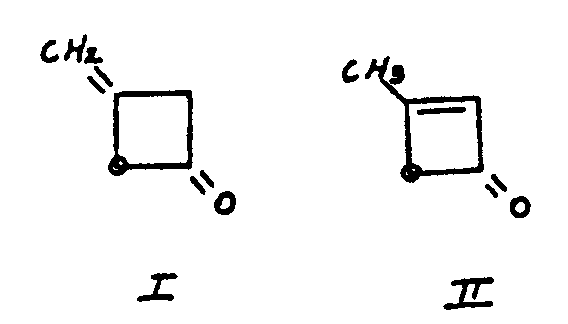
| SEE OR SEARCH THIS CLASS, SUBCLASS:
| 284, | for use of ketene dimer as a reactant. |
|
| | |
| 301.5 | Unsaturated fatty acid derived from a naturally occurring
glyceride, tall oil, or an unsaturated fatty acid
derived from tall oil: |
| | This subclass is indented under subclass 301. Subject matter wherein the carboxylic acid group containing
ethylenic reactant is an unsaturated aliphatic acyclic monocarboxylic
acid derived from a naturally occurring fatty glyceride or is derived
from tall oil or is tall oil, per se.
SEE OR SEARCH THIS CLASS, SUBCLASS:
| 302+, | for a fatty acid glycerol ester. |
| 305, | for systems wherein the ester containing at least
two carboxylic acid groups is a naturally occurring di- or
tri-glyceride, e.g., linseed
oil, castor oil, etc. |
SEE OR SEARCH CLASS:
| 520, | Synthetic Resins or Natural Rubbers, for a definition of the term "fatty acid" and
the other materials proper for this subclass. |
|
| | |
| 314 | Block copolymer derived from reactant containing at least
two unsaturated groups and is free of an aromatic group: |
| | This subclass is indented under subclass 313. Subject matter wherein the polymer is a block copolymer
derived from an ethylenic reactant containing at least two ethylenic
groups which ethylenic reactant is free of an aromatic group, e.g., block
copolymer of (polybutadiene-polypropylene).
| | (1)
Note. To be proper for this subclass the block copolymer
itself must be derived from a necessary reactant for this subclass. |
SEE OR SEARCH THIS CLASS, SUBCLASS:
| 313+, | for a block copolymer derived from styrene and acrylonitrile
with a nonaromatic plural unsaturated reactant. |
|
| | |
| 323 | Block copolymer derived from propylene: |
| | This subclass is indented under subclass 322. Subject matter wherein the polymer is a block copolymer
derived from propylene.
| | (1)
Note. To be proper for this subclass, the initial
block copolymer must be derived from propylene. | |
| | |
| 326.1 | Chemically after treated solid polymers derived from ethylenically
unsaturated monomers only: |
| | This subclass is indented under subclass 55. Product wherein a solid polymer solely derived from ethylenically
unsaturated monomers has been chemically modified by a treatment
in the presence of a chemical treating agent.
| | (1)
Note. See Lines With Other Classes and Within This
Class, section II. B(4)(a) through
II. B(4)(e) of the
Class Definition for a discussion of classifying patents into this
subclass and its indents vis-a-via other areas. |
| | (2)
Note. A material is presumed to be a rubber if it
is described as an elastomer or if Mooney viscosity is given. |
SEE OR SEARCH THIS CLASS, SUBCLASS:
| 337, | through 388, for vulcanizable or cross-linkable
compositions |
SEE OR SEARCH CLASS:
| 520, | Synthetic Resins or Natural Rubbers, the Glossary, for the definition of "chemical
treating agent". |
| 526, | Synthetic Resins or Natural Rubbers,
subclasses 78+ for process of adding material to the zone of an
ongoing polymerization of ethylenically unsaturated monomers. Such
added materials are often identified as chain stoppers, chain
terminators or chain transfer agents. |
|
| | |
| 326.3 | Vulcanized or crosslinked in presence of chemical treating
agent: |
| | This subclass is indented under subclass 326.2. Products wherein a chemical modification is described as
vulcanization or cross-linking using a chemical treating
agent.
| | (1)
Note. The terms curing or hardening are presumed
to be synonymous with vulcanizing or cross-linking in the
absence of disclosure to the contrary. For the instant subclass, any
other language will be sufficient which shows that the chemical modification
changes the system from thermoplastic (or soluble) to
thermosetting (or insoluble). The term
chain-extending is presumed not to express cross-linking
in the absence of disclosure to the contrary. |
| | (2)
Note. Vulcanizable compositions are not subject matter
for this subclass unless prior to the vulcanization or cross-linking
step there is present a chemically modified solid polymer derived
from ethylenic monomers only. |
SEE OR SEARCH THIS CLASS, SUBCLASS:
| 337, | through 388, for vulcanizable or cross-linkable
compositions. |
|
| | |
| 326.6 | Polymer derived from monomer containing atom other than:
C, H, N, O, S, halogen
or group IA or IIA carboxylate: |
| | This subclass is indented under subclass 326.1. Product wherein the solid polymer which has been chemically
modified is derived from a monomer which contains an atom other
than C, H, N, O, S, halogen, or
carboxylates of groups IA or IIA metals.
| | (1)
Note. Included herein are for example monomers which
contain phosporus, etc. |
SEE OR SEARCH CLASS:
| 525, | Synthetic Resins or Natural Rubbers,
subclass 366 for the definition of Group IA and IIA metals. |
|
| | |
| 327.4 | Polymer derived from carboxylic acid anhydride monomer: |
| | This subclass is indented under subclass 326.1. Product wherein a solid polymer which has been chemically
modified is derived from a monomer which has a carboxylic acid anhydride
group.
SEE OR SEARCH CLASS:
| 520, | Synthetic Resind or Natural Rubbers, Glossary, for the definition of the term "carboxylic
acid anhydride" under "carboxylic acid or derivative". |
|
| | |
| 327.7 | Esterified, i.e., preparation
of COOR linkage: |
| | This subclass is indented under subclass 327.4. Product wherein a chemical modification of the solid polymer
is described as esterification.
| | (1)
Note. For purposes of this subclass, esterification
denotes formation of a
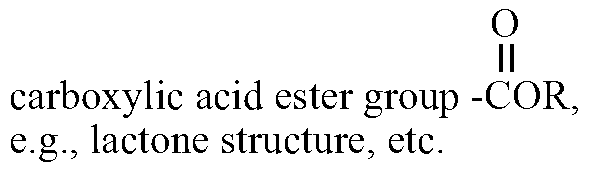
|
| | (2)
Note. Reaction of carboxylic anhydride group with
an alkylene oxide group is presumed to be esterification. | |
| | |
| 327.8 | Hydrolyzed; neutralized; or metal containing
chemical treating agent: |
| | This subclass is indented under subclass 327.4. Product wherein a chemical modification of the solid polymer
is described as hydrolysis or neutralization; or wherein
a metal containing chemical treating agent has been employed.
| | (1)
Note. For purposes of this subclass, hydrolysis
relates to addition of water to open the anhydride structure with
formation of two carboxyl groups. In the absence of disclosure
otherwise, treatment of anhydride with an aqueous system
is presumed to result in a hydrolysis of the anhydride structure. |
| | (2)
Note. For purposes of this subclass, neutralization
relates to the reaction of an acid group, e.g., carboxyl, phosphonic, etc., with
a base to form a salt. The bases include alkali, alkaline
earth, or ammonium hydroxides. |
| | (3)
Note. The metal containing chemical treating agent
need only be present during a chemical modification step; included
in this subclass, however, are systems wherein
a metal atom becomes chemically bonded to the solid polymer. The
chemical bond can be ionic or covalent in nature, or any
of the "complex" bonding mechanisms as in (ii) pi
bonding, coordination, etc. | |
| | |
| 327.9 | Polymer for unsaturated petroleum hydrocarbon fraction
as monomer: |
| | This subclass is indented under subclass 326.1. Product wherein a solid polymer which has been chemically
modified is prepared by the polymerization of a mixture of hydrocarbons derived
from a petroleum hydrocarbon fraction.
| | (1)
Note. This subclass includes chemically modified
polymers wherein added material is interpolymerized with a petroleum hydrocarbon
fraction. |
SEE OR SEARCH THIS CLASS, SUBCLASS:
| 327.2, | for chemically modified interpolymer of coumarone
and indene. |
| 332.1, | for a chemically modified polymer derived from a
diene monomer wherein at least one monomer contains a fused or bridged
ring or at least one cycloaliphatic structure. |
SEE OR SEARCH CLASS:
| 526, | Synthetic Resins or Natural Rubbers,
subclass 290 for the polymerization of a mixture of hydrocarbons
derived from a petroleum hydrocarbon fraction. |
|
| | |
| 328.2 | Polymer derived from monomer containing nitrogen other
than: unsubstituted ammonium, acrylonitrile, acrylamide, methylolacrylamide, and
the corresponding methacryl materials: |
| | This subclass is indented under subclass 326.1. Product wherein the solid polymer which has been chemically
modified is derived from a nitrogen containing monomer other than: NH4+ as
sole nitrogen, acrylonitrile, acrylamide, methylol
acrylamide, methacrylonitrile, mathacrylamide
and methylol methacrylamide.
SEE OR SEARCH THIS CLASS, SUBCLASS:
| 328.8, | for methylol acrylamide or methylol methacrylamide
polymers. |
| 329.1+, | for acrylonitrile or methacrylonitrile polymers. |
| 329.4+, | for acrylamide or methacrylamide polymers. |
| 329.5+, | and 329.9+, for polymers
derived from NH4+ containing salt
monomers. |
|
| | |
| 328.6 | Polymer derived from ketone monomer: |
| | This subclass is indented under subclass 326.1. Product wherein the chemically modified solid polymer is
derived from an ethylenically unsaturated ketone.
SEE OR SEARCH CLASS:
| 520, | Synthetic Resins or Natural Rubbers, the Glossary, for the definition of "ketone". |
|
| | |
| 328.7 | Polymer derived from aldehyde monomer: |
| | This subclass is indented under subclass 326.1. Product wherein the chemically modified solid polymer is
derived an ethylenic monomer which is an aldehyde.
SEE OR SEARCH CLASS:
| 520, | Synthetic Resins or Natural Rubbers, the Glossary, for the definition of "aldehyde". |
|
| | |
| 328.8 | Polymer derived from alcohol monomer: |
| | This subclass is indented under subclass 326.1. Product wherein the chemically modified solid polymer is
derived from an ethylenically unsaturated monomer which contains
an alcohol group.
| | (1)
Note. For purposes of this subclass, an alcohol
group is defined as -C- OH where the C is not
directly double bonded to another chalcogen atom. Included
herein are for example allyl alcohol or vinyl salicylate. | |
| | |
| 328.9 | Polymer derived from ether monomer: |
| | This subclass is indented under subclass 326.1. Product wherein the chemically modified solid polymer is
derived from an ethylenically unsaturated ether monomer.
SEE OR SEARCH CLASS:
| 520, | Synthetic Resins or Natural Rubbers, the Glossary, for the definition of "ether". |
|
| | |
| 329.2 | Interpolymers: |
| | This subclass is indented under subclass 329.1. Product wherein the solid polymer is derived from an additional
ethylenic monomer interpolymerized with the acrylonitrile or methacrylonitrile. |
| | |
| 329.5 | Polymer derived from carboxylic acid or derivative monomer
other than: vinyl acetate; or acrylic-or
methacrylic-acid, or derivatives: |
| | This subclass is indented under subclass 326.1. Product wherein the solid polymer, which has been
chemically modified, is obtained from an ethylenic monomer
which is a carboxylic acid or derivative other than: vinyl
acetate; or acrylic or methacrylic acid or derivatives.
SEE OR SEARCH THIS CLASS, SUBCLASS:
| 329.7+, | and 330.3+, for chemically
modified solid polymers based upon derivatives of acrylic or methacrylic
acid, e.g., acrylyl chloride
or ethyl acrylate, etc. and subclasses 330.3+ for
polymers derived from vinyl acetate. |
SEE OR SEARCH CLASS:
| 520, | Synthetic Resins or Natural Rubbers, the Glossary, for the definition of the term
"carboxylic acid or derivative". |
|
| | |
| 329.6 | Butene dioic acid or derivative monomer: |
| | This subclass is indented under subclass 329.5. Product wherein the carboxylic acid monomer is a butene
dioic acid or derivative.
| | (1)
Note. For purposes of this subclass, butene
dioic acid is defined as a dicarboxylic acid having only four carbon atoms
and one ethylenic unsaturation. |
SEE OR SEARCH CLASS:
| 520, | Synthetic Resins or Natural Rubbers, the Glossary, for the definition of the terms
"carboxylic acid or derivative" and "ethylenically
unsaturated". |
|
| | |
| 330.1 | Esterified, i.e., preparation
of COOR linkage: |
| | This subclass is indented under subclass 329.7. Product wherein a chemical modification of the solid polymer
is described as esterification.
| | (1)
Note. For purposes of this subclass, esterification
denotes formation of a
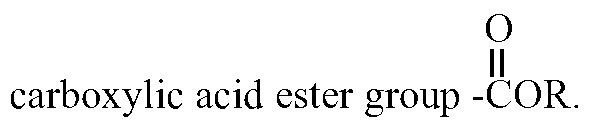
|
| | (2)
Note. Reaction of carboxylic acid group with an alkylene
oxide group is presumed to be esterification. |
| | (3)
Note. Included herein is formation of e.g., lactone
structures, etc. | |
| | |
| 330.2 | Hydrolyzed; neutralized; or metal containing
chemical treating agent: |
| | This subclass is indented under subclass 329.7. Product wherein a chemical modification of the solid polymer
is described as hydrolysis or neutralization; or wherein
a metal con+taining chemical treating agent has been employed.
| | (1)
Note. For purposes of this subclass, hydrolysis
relates to the addition of water to a carboxylic acid chloride or carboxylic
acid ester to form a free carboxyl group.
| |
Chemical treatment of acid chloride containing polymer with
an aqueous system is presumed to be hydrolysis in absence of disclosure
otherwise. |
| |
Chemical treatment of ester containing polymer with aqueous
acid or base is presumed to be hydrolysis in absence of disclosure
otherwise. | |
| | (2)
Note. For purposes of this subclass, neutralization
relates to reaction of an acid group (e.g., carboxyl, etc.) with
a base to form a salt. The bases include alkali or alkaline
earth hydroxides. |
| | (3)
Note. The metal containing chemical treating agent
need only be present during a chemical modification step; included
in this subclass however, are systems wherein a metal atom
becomes chemically bonded to the solid polymer. The chemical
bond can be ionic or covalent in nature, or any of the "complex" bonding
mechanisms as in ii (PI) bonding, coordination, etc. | |
| | |
| 330.6 | Alcoholized; transesterified; hydrolyzed; or metal
containing chemical treating agent; e.g., saponified, etc.: |
| | This subclass is indented under subclass 330.3. Product wherein a chemical modification of the solid polymer
is described as alcoholysis, transesterification, or
hydrolysis; or wherein a metal containing chemical treating
agent has been employed.
| | (1)
Note. For purposes of this subclass, alcohoysis
relates to the reaction of an alcohol with a carboxylic acid ester
to yield a new ester and alcohol. |
| | (2)
Note. For purposes of this subclass transesterification
or ester interchange relates to reaction of two esters to form two
new esters by exchange of alcohol residues. |
| | (3)
Note. For purposes of this subclass, hydrolysis
relates to addition of water to an ester to form an alcohol and
a carboxylic acid. This reaction can be either acid or
base catalysed. |
| | (4)
Note. Alkaline hydrolysis of an ester is called
saponification. | |
| | |
| 330.9 | Vulcanized or crosslinked, in the presence of a
chemical treating agent, e.g., cured, etc.: |
| | This subclass is indented under subclass 330.8. Products wherein a chemical modification is described as
vulcanization or cross-linking using a chemical treating
agent.
| | (1)
Note. The terms curing or hardening are presumed
to be synonymous with vulcanizing or cross-linking in the
absence of disclosure to the contrary. For the instant subclass, any
other language will be sufficient which shows that the chemical modification
changes the system from thermoplastic (or soluble) to
thermosetting (or insoluble). The term
chain-extending is presumed not to express cross-linking
in the absence of disclosure to the contrary. |
| | (2)
Note. Vulcanizable compositions are not subject matter
for this subclass unless prior to the vulcanization or cross-linking
step there is present a chemically modified solid polymer derived
from ethylenic monomers only. |
SEE OR SEARCH THIS CLASS, SUBCLASS:
| 337, | through 388, for vulcanizable or cross-linkable
compositions. |
|
| | |
| 331.7 | Ethylene-propylene terpolymer, e.g., EPT, EPDM, EPR, etc.: |
| | This subclass is indented under subclass 326.1. Product wherein the solid polymer which has been chemically
modified is an ethylene-propylene terpolymer.
| | (1)
Note. An ethylene-propylene terpolymer has
at least one monomer in addition to ethylene and propylene. |
| | (2)
Note. Ethylene-propylene terpolymers are
often described as ethylene-propylene terpolymer rubber (e.g., EPT
OR EPDM rubber). |
| | (3)
Note. Chemically modified material solely described
as ethylene-propylene rubber (EPR) is
placed herein as a terpolymer since a rubber is to be treated as a
diene polymer in the absence of disclosure to the contrary |
SEE OR SEARCH THIS CLASS, SUBCLASS:
| 333.1, | for material solely described as a rubber or elastomer
and presumed to be a diene rubber. |
| 333.7, | for chemically modified copolymer of ethylene with
propylene. |
|
| | |
| 331.9 | Polymer derived from monomer containing at least two ethylenic
groups or diene rubber: |
| | This subclass is indented under subclass 326.1. Product wherein the solid polymer, which has been
chemically modified, is either described as a diene rubber
or is derived from a monomer which contains at least two ethylenic
groups.
| | (1)
Note. A material is presumed to be a rubber if it
is described as an elastomer or if a Mooney viscosity is given. |
SEE OR SEARCH THIS CLASS, SUBCLASS:
| 333.1, | for material solely described as a rubber or elastomer
and presumed to be a diene rubber. |
|
| | |
| 332.1 | Monomer contains non-conjugated diene group, or
at least one fused or bridged ring or at least one cycloaliphatic
structure: |
| | This subclass is indented under subclass 331.9. Product wherein said diene monomer contains nonconjugated
ethylenic groups, or wherein at least one monomer contains
a fused or bridged ring or a cycloaliphatic structure.
| | (1)
Note. Nonconjugated ethylenic groups denotes monomers
wherein two or more ethylenically unsaturated groups are (a) separated
from each other either by an aromatic ring (e.g., divinyl
benzene) or (b) separated by at least
one carbon atom of an acyclic carbon chain which carbon atom is
not part of a methine group, e.g., -C=C-C-C=C-, etc; or (c) wherein
two ethylenically unsaturated groups share a single carbon atom, etc.,
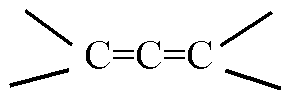
|
| | (2)
Note. Included herein are monomers containing ethylene
groups which are both conjugated an nonconjugated, e.g., myrcene:
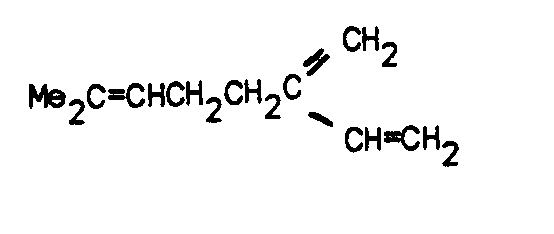
| SEE OR SEARCH THIS CLASS, SUBCLASS:
| 333.3, | for chemically after treated solid copolymers of
aromatic hydrocarbon monomers with monomers containing a fused or
bridged ring or a cycloaliphatic structure and only one ethylenic
group. |
|
| | |
| 332.2 | Divinyl benzene: |
| | This subclass is indented under subclass 332.1. Product wherein the nonconjugated ethylene monomer is divinyl
benzene.
| | (1)
Note. Divinyl benzene is often described as a cross-linking
agent for a base polymer, e.g., polystyrene
cross-linked with divinyl benzene, etc.
Such systems will be presumed to have been prepared by interpolymerization
of, e.g., styrene monomer with
monomeric divinyl benzene in absence of specific disclosure that
the divinyl benzene is reacted with the previously formed base polymer. |
SEE OR SEARCH THIS CLASS, SUBCLASS:
| 242+, | for polymers derived from ethylenic reactants only
mixed with ethylenic reactant. |
|
| | |
| 332.4 | Sulfur containing chemical treating agent: |
| | This subclass is indented under subclass 332.3. Product wherein a sulfur containing material is present
as a chemical treating agent.
| | (1)
Note. Said sulfur containing material may be either
a halogenating agent or an additional nonhalogen containing material. | |
| | |
| 332.5 | Vulcanized in the presence of a chemical treating agent, e.g., cured, crosslinked, etc.: |
| | This subclass is indented under subclass 331.9. Product wherein said solid polymer is vulcanized in the
presence of a chemical treating agent.
| | (1)
Note. The terms curing or hardening are presumed
to be synonymous with vulcanizing or cross-linking in absence
of disclosure to the contrary. For the instant subclass, any
other language will be sufficient which shows that the chemical modification
changes the system from thermoplastic (or soluble) to
thermosetting (or insoluble). The term
chain-extending is presumed not to express cross-linking
in absence of disclosure to contrary. | |
| | |
| 333.1 | Isoprene or diene rubber other than butadiene rubber: |
| | This subclass is indented under subclass 331.9. Product wherein the solid polymer which has been chemically
modified is described as a diene rubber other than butadiene or
is derived from isoprene monomer.
| | (1)
Note. For purposes of this subclass, materials
nominally described as a rubber or elastomer are presumed to be
a diene rubber other than butadiene. |
SEE OR SEARCH THIS CLASS, SUBCLASS:
| 331.9, | for a rubbery copolymer of Butadiene. |
| 333.2, | for a rubbery homopolymer of Butadiene. |
|
| | |
| 333.4 | Halogenated polymer: |
| | This subclass is indented under subclass 333.3. Product wherein the said solid polymer has been halogenated.
| | (1)
Note. The halogen is introduced subsequent to formation
of the solid polymer. |
| | (2)
Note. Halogen must be present in the final product. |
SEE OR SEARCH THIS CLASS, SUBCLASS:
| 333.6, | for quaternized polystyrene produced by reacting
an amine with post halogenated polystyrene followed by reaction
with quaternizing agent. |
|
| | |
| 334.1 | Halogenated polymer: |
| | This subclass is indented under subclass 333.7. Product wherein said solid polymer has been halogenated.
| | (1)
Note. The halogen is introduced subsequent to formation
of the solid polymer. |
SEE OR SEARCH CLASS:
| 570, | Organic Compounds,
subclasses 101+ , for acyclic halogenated hydrocarbons, e.g., halogenated
liquid polyisobutylene, etc. |
|
| | |
| 341 | Contains a sulfur atom: |
| | This subclass is indented under subclass 340. Subject matter wherein the chemical treating is performed
in the presence of a compound which contains at least one phosphorus
atom and at least one sulfur atom. |
| | |
| 345 | With peroxide, ozone, or free oxygen: |
| | This subclass is indented under subclass 343. Subject matter wherein the chemical treating is performed
in the presence of at least two materials, one of which
is a sulfur-containing material, and one of which
is free oxygen, ozone, or a compound containing
an -O-O- group.
| | (1)
Note. This subclass includes only those processes
wherein there is a desired and intentional contact between air and
the polymer to be treated. | |
| | |
| 346 | With sulfur-free organic compound: |
| | This subclass is indented under subclass 343. Subject matter wherein the chemical treating is performed
in the presence of at least two materials, one of which
is a sulfur-containing material, and one of which
is an organic compound which is devoid of sulfur atoms. |
| | |
| 348 | Sulfur-containing heterocyclic compound: |
| | This subclass is indented under subclass 343. Subject matter wherein the chemical treating is performed
in the presence of a heterocyclic compound which contains at least
one sulfur atom.
| | (1)
Note. The sulfur atom for purposes of this subclass
need not be part of the heterocyclic ring system. |
SEE OR SEARCH CLASS:
| 520, | Synthetic Resins or Natural Rubbers, the Glossary, for a definition of the term "heterocyclic". |
|
| | |
| 350 | Mercaptan or mercaptide: |
| | This subclass is indented under subclass 343. Subject matter wherein the chemical treating is performed
in the presence of a mercaptan or mercaptide thereof.
| | (1)
Note. A mercaptan denotes an organic compound having
the general structure -C-SH wherein the carbon
atom bound to the sulfur atom of the thiol group is not double bonded
to oxygen, sulfur, selenium, or tellurium, or
triple bonded to nitrogen. |
| | (2)
Note. A mercaptide denotes a salt of a mercaptan. | |
| | |
| 362 | Elemental metal or inorganic compound thereof only: |
| | This subclass is indented under subclass 361. Subject matter containing only elemental metals, or
only inorganic metal compounds, or only an elemental metal
and an inorganic metal compound.
| | (1)
Note. Compounds which are free of metal atoms are
included herein when in admixture with elemental metals or inorganic
metal compounds. |
SEE OR SEARCH THIS CLASS, SUBCLASS:
| 361, | for a mixture of a metal containing organic compound
and an elemental metal or metal containing inorganic compound. |
|
| | |
| 365 | Aluminum metal or compound thereof: |
| | This subclass is indented under subclass 364. Subject matter containing elemental aluminum or a compound
thereof.
| | (1)
Note. The aluminum atom can be in the form of a free
metal or in the form of an inorganic or organic compound. | |
| | |
| 366 | Contains group IA (Li, Na, K, Rb, Cs, Fr) or group
IIA (Be, Mg, Ca, Sr, Ba, Ra) elemental
metal or compound thereof: |
| | This subclass is indented under subclass 360. Subject matter containing a Group IA (Li, Na, K, Rb, Cs, Fr) or
Group IIA (Be, Mg, Ca, Sr, Ba, Ra) elemental
metal or compound thereof. |
| | |
| 368 | Metal oxide: |
| | This subclass is indented under subclass 367. Subject matter containing a metal oxide.
| | (1)
Note. Oxides for this subclass are binary compounds
consisting of only a metal atom and oxygen. |
SEE OR SEARCH THIS CLASS, SUBCLASS:
| 361+, | for an oxide containing two diverse metal atoms. |
|
| | |
| 370 | Contains group IB (Cu, Ag, Au), IIB (Zn, Cd, Hg,) IIIA (Al, Ga, In, Tl), IV (Ti, Zr, Hf, Ge, Sn, Pb), and
VIII (Fe, Co, Ni, Ru, Rh, Pd, Os, Ir, Pt) elemental
metal or compound thereof: |
| | This subclass is indented under subclass 360. Subject matter containing a Group IB (Cu, Ag, Au), IIB (Zn, Cd, Hg), IIIA (Al, Ga, In, Tl) IVB (Ti, Zr, Hf), IVA (Ge, Sn, Pb) or
Group VIII (Fe, Co, Ni, Ru, Rh, Pd, Os, Ir, Pt) metal atom. |
| | |
| 372 | Metal oxide: |
| | This subclass is indented under subclass 371. Subject matter containing a metal oxide.
| | (1)
Note. Oxides for this subclass are binary compounds
consisting of only a metal atom and oxygen. |
SEE OR SEARCH THIS CLASS, SUBCLASS:
| 361+, | for an oxide containing two diverse metal atoms. |
|
| | |
| 375 | Contains nitrogen atom in a heterocyclic ring: |
| | This subclass is indented under subclass 374. Subject matter wherein the chemical treating agent contains
a compound having at least one atom of nitrogen and carbon in the
same ring and wherein the other atoms of the ring may be oxygen, selenium, or
tellurium.
SEE OR SEARCH THIS CLASS, SUBCLASS:
| 343+, | for treating in the presence of a heterocyclic sulfur-containing
compound. |
|
| | |
| 379 | Organic amine: |
| | This subclass is indented under subclass 374. Treatment wherein the organic nitrogen compound contains
an amine group.
| | (1)
Note. An amine denotes an organic compound having
a nitrogen atom singly or double bonded to a carbon atom and wherein
the carbon atom bonded to the nitrogen atom is devoid of a double
bond to oxygen, sulfur, selenium, or
tellurium or triple bond to nitrogen. In addition, those
compounds wherein the same nitrogen atom is bonded to a (>C=X) group (X
is O, S, Se, or Te) and to a
carbon atom which is not double-bonded to oxygen, sulfur, selenium, or
tellurium, are not considered as being amines (e.g.,
-C-NH-C(=X)-. Although
amides may be considered chemically as amines, it has been
found expedient for these classes to exclude compounds containing
only amide nitrogen herefrom. Therefore, as used
throughout this area, the term amide is not to be confused
with an amine. A compound, however, which contains
a nitrogen atom bonded to a non carbon atom and which contains
either a nitrogen atom bonded to a (>C=X) group or
an amide group, is considered as being an amine, e.g.,
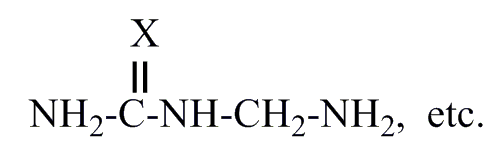
| |
| | |
| 380 | Amine contains a hydroxyl group: |
| | This subclass is indented under subclass 379. Subject matter wherein the amine compound contains a hydroxyl
group.
| | (1)
Note. A hydroxyl group herein is that of an alcohol. |
SEE OR SEARCH CLASS:
| 520, | Synthetic Resins or Natural Rubbers, the Glossary, for the definition of "alcohol". |
|
| | |
| 381 | Three or more amine groups: |
| | This subclass is indented under subclass 379. Treatment wherein the amine compound contains three or more
amine groups.
| | (1)
Note. An amine proper for this subclass requires (a) at
least three distinct nitrogen atoms bonded to at least two distinct carbon
atoms, or (b) the presence of at least
three nitrogen atoms bonded to the same carbon atom. |
SEE OR SEARCH THIS CLASS, SUBCLASS:
| 379, | (1) Note, for a discussion
of what constitutes an "amine" in this area. |
|
| | |
| 382 | Two amine groups: |
| | This subclass is indented under subclass 379. Treatment wherein the amine compound contains two amine
groups.
| | (1)
Note. An amine proper for this subclass requires (a) at
least two distinct ntirogen atoms bonded to at least two distinct
carbon atoms, or (b) the presence of
at least two nitrogen atoms bonded to the same carbon atom. |
SEE OR SEARCH THIS CLASS, SUBCLASS:
| 379, | (1) Note, for a discussion
of what constitutes an "amine" in this area. |
|
| | |
| 385 | Oxygen compound contains an ether group: |
| | Subject matter under subcalss 383 wherein the oxygen compound
is an ether.
SEE OR SEARCH CLASS:
| 520, | Synthetic Resins or Natural Rubbers, the Glossary, for a definition of the term "ether". |
|
| | |
| 386 | Oxygen compound is a carboxylic acid, ester, anhydride, or
lactone thereof: |
| | This subclass is indented under subclass 383. Subject matter wherein the oxygen-containing compound
is a carboxylic acid, ester thereof, anhydride
thereof, or a lactone thereof.
SEE OR SEARCH CLASS:
| 520, | Synthetic Resins or Natural Rubbers, the Glossary, for the definition of "carboxylic
acid or derivative", which defines the following
terms: "carboxylic acid", "carboxylic
acid ester", "anhydride", and "lactone". |
|
| | |
| 387 | Oxygen compound contains a peroxy group (-O-O-): |
| | This subclass is indented under subclass 383. Subject matter wherein the oxygen-containing compound
contains at least one oxygen atom bonded directly to another oxygen
atom, i.e., -O-O-.
SEE OR SEARCH THIS CLASS, SUBCLASS:
| 388, | for processes of treating in the presence of air, oxygen, or
ozone. |
|
| | |
| 389 | Solid polymer derived from reactant containing atoms other
than C, H, N, Si, P, chalcogen, halogen, or
an alkali or alkaline earth metal in salt form: |
| | This subclass is indented under subclass 50. Subject matter involves the process of mixing a solid polymer
derived from a reactant containing elements other than C, H, N, P, Si, chalcogen
or halogen with an additional solid polymer, with specified
polymer-forming ingredients, specfied intermediate
condensation product, chemical treating agent, or
with an ethylenic agent; processes of reacting the above
mixtures of products resulting from the mixing or reacting processes.
| | (1)
Note. Chalcogen is limited to oxygen, sulfur, selenium, or
tellurium. |
SEE OR SEARCH CLASS:
| 520, | Synthetic Resins or Natural Rubbers, the Glossary, for a definition of the terms "specified
polymer-forming ingredients" or "specified
intermediate condensation product". |
|
| | |
| 390 | Solid polymer derived solely from phenolic reactants wherein
none of the reactants contains a plurality of methylol groups or
derivatives thereof: |
| | This subclass is indented under subclass 50. Subject matter involving processes of mixing a solid polymer
derived from phenolics as sole reactants wherein none of the reactants
forming the solid polymer contains a plurality of methylol groups
or is a derivative thereof with an additional solid polymer, with
specified polymer-forming ingredients, with a
specified intermediate condensation product, chemical treating
agent, or with an elthylenic agent; or processes
of forming or reacting, or the resultant products of any
of the above mixtures.
| | (1)
Note. This subclass includes solid polymers prepared
from a multiplicity of phenolic reactants. |
| | (2)
Note. The term "phenolic reactant" is limited
to phenols, phenol ether, and phenolate salt.
| | (a)
A phenol for purposes of this subclass requires one or more -OH
groups directly bonded to a nuclear carbon atom of a substituted
or unsubstituted benzene ring, which benzene ring can be
an individual benzene ring or can be part of a polycyclic ring system. |
| | (b)
A phenol ether for purposes of this subclass requires one
or more -O-C groups wherein the oxygen atom of
the -O-C group is directly bonded to a nuclear
carbon atom of a substituted or unsubstituted benzene ring and wherein the
carbon atom of the -O-C group is not double-bonded
to oxygen, sulfur, selenium, or tellurium
or triple-bonded to nitrogen. The benzene ring
may be an individual benzene ring or may be part of a polycyclic
ring system. The following examples of phenol ether are
within the definition set out above. |
| | (1)
The -O-C group may itself be part of a cyclic
ring system, e.g.,
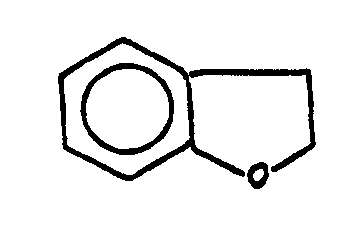
|
| | (2)
The carbon of the -O-C group may be a ring
atom of a cyclic or aromatic ring, e.g.,
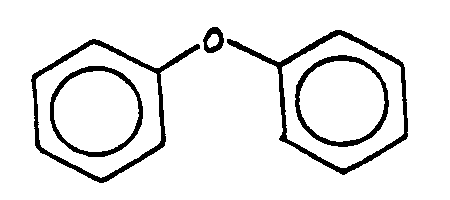
|
| | (3)
The carbon of the -O-C group may be a terminal
carbon atom, e.g., as in the first
illustration below, or may be the carbon atom of a chain, e.g., as
in the second illustration, below.
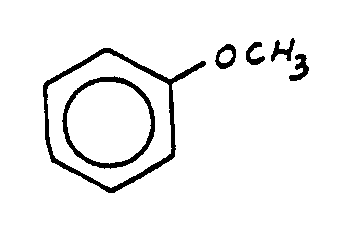
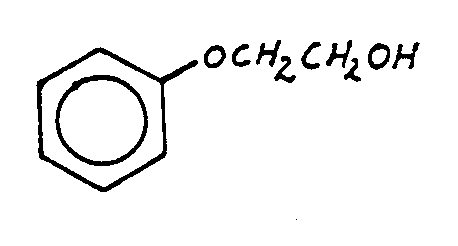
|
| | (c)
An inorganic phenolate salt is an inorganic salt of a phenol
see (phenol (1) Note) above
wherein the hydrogen atom of an -OH group is replaced by
a metal or an inorganic group. | |
SEE OR SEARCH THIS CLASS, SUBCLASS:
| 480+, | for solid polymers derived from a phenolic reactant
containing a plurality of methylol groups from a derivative thereof. |
SEE OR SEARCH CLASS:
| 520, | Synthetic Resins or Natural Rubbers, the Glossary, for definitions of the terms "specified
polymer-forming ingredients", "specified
intermediate condensation product", and "methylol
or methylol derivative". |
|
| | |
| 395 | Mixed with -N=C=X-containing
reactant or polymer therefrom (X is chalcogen): |
| | This subclass is indented under subclass 390. Subject matter wherein the solid phenolic polymer is mixed
with a -N=C=X or blocked -N=C=X-containing
reactant or polymer derived therefrom (X is a chalcogen).
| | (1)
Note. Blocking a -N=C=X (masked, hidden, etc.) is
utilized to render the -N=C=X
group inert by conversion to an inactive group. The process
of reactivation usually involves merely heating so as to revert
the blocked reactant to a C-N=C=X-containing
reactant. The usual mode of rendering the -N=C=X reactant
inert is to convert it to the form of a -NO- group. | |
| | |
| 398 | Solid polymer derived from aldehyde, aldehyde
derivative, or low molecular weight polymer thereof as
sole reactant and wherein none of the reactants contains a plurality
of methylol groups or derivatives thereof: |
| | This subclass is indented under subclass 50. Subject matter involves processes of mixing solid polymer
derived from an aldehyde, aldehyde derivative, or
low molecular weight polymers thereof as sole reactants wherein
none of the reactants contains plural methylol groups or is a derivative
thereof, with an additional solid polymer, with
specified polymer-forming ingredients, with a
specified intermediate condensation product, with a chemical
treating agent or with ethylenic agent; processes of reacting
these mixtures or products resulting from the mixing or reacting
processes.
| | (1)
Note. This subclass includes homo- or copolymers
of only aldehyde or aldehyde derivative reactants. |
| | (2)
Note. This subclass includes solid polymers prepared
from a multiplicity of aldehyde or aldehyde derivative reactants. |
| | (3)
Note. An aldehyde derivative for purposes of this
subclass includes:
| | (a)
Compounds having X-CH2OH group wherein
X is other than carbon or hydrogen. Included herein are
paraformaldehyde, methylol derivative of urea, etc. |
| | (b)
Heterocyclic compounds having only carbon and oxygen as ring
atoms in an alternating manner and in equal amount,

|
| |
(c) Hexamethylenetetramine or derivative
e.g., as illustrated below; a
derivative of this type requires the basic ring structure of hexamethylenetetramine
but wherein the hydrogen atoms may have been replaced by other atoms.
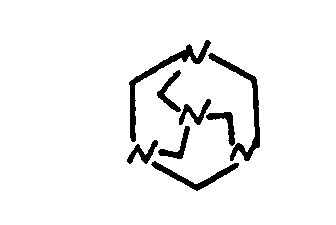
| |
| | (4)
Note. Compounds having a methylol group (-CH2OH) bonded
to atoms other than carbon, oxygen, or hydrogen
are regarded for this subclass as being a mixture of two compounds
one of which is formaldehyde. For instance, a
methylol derivative of melamine is regarded as being a mixture of
melamine and formaldehyde. Methylol urea is regarded as
being a mixture of formaldehyde and urea. |
| | (5)
Note. Solid paraformaldehyde polymers will be regarded
as monomeric formaldehyde. |
SEE OR SEARCH CLASS:
| 520, | Synthetic Resins or Natural Rubbers, the Glossary, for a definition the terms "methylol", "methylol
derivative", "aldehyde", "specified
polymer-forming ingredients", or "specified
intermediate condensation product". |
| 526, | Synthetic Resins or Natural Rubbers,
subclass 315 for a polymer derived from an ethylenically unsaturated aldehyde
as sole reactant or for an interpolymer derived from only ethylenically
unsaturated reactants wherein at least one of the ethylenically
unsaturated reactants contains an aldehyde group. |
| 528, | Synthetic Resins or Natural Rubbers,
subclass 403 for heterocyclic oxygen-containing reactants
such as dioxolane, dioxepan, etc.; and
subclasses 480+ for processes of treating a polymer not
involving a chemical modification of the polymer, by the
addition of a material thereto, and for chemically modifying
material other than the polymer. Subclasses 480+ also provide
for processes of admixing with a broadly claimed nonreactant material. |
|
| | |
| 403 | Solid polymer derived from 1,2-epoxy
compound containing only one 1,2-epoxy group as
sole reactant and wherein none of the reactants contains a plurality
of methylol groups or derivatives thereof: |
| | This subclass is indented under subclass 50. Subject matter involves processes of mixing a solid polymer
derived only from 1,2-epoxy compounds all of which
contains only a single 1,2-epoxy group and none
of which contains a plurality of methylol or methylol derivative groups
with an additional solid polymer with specified polymer-forming
ingredients, with a specified intermediate condensation
product, with a chemical treating agent or with an ethylenic
reactant; processes of reacting the above mixtures; or
products resulting from the mixing or reacting processes (e.g., polyepihalohydrin, ethylene
oxide-epihalohydrin copolymer, etc.).
| | (1)
Note. This subclass includes solid polymers prepared
from a multiplicity of reactants all of which contain a single 1,2-epoxy
group. |
| | (2)
Note. Excluded from this subclass are any 1,2-epoxy
reactants which contain a plurality of methylol or methylol derivative
groups. See the Glossary for the definition of "methylol
derivative". |
| | (3)
Note. This subclass includes homo- or co-polymers
of only 1,2-epoxy reactants containing a single
1,2-epoxy group. |
SEE OR SEARCH CLASS:
| 526, | Synthetic Resins or Natural Rubbers,
subclass 273 for homopolymers of glycidyl acrylate. |
|
| | |
| 408 | Mixed with carboxylic acid or derivative or polymer derived
therefrom: |
| | This subclass is indented under subclass 403. Subject matter wherein the solid polymer derived from 1,2-epoxy
reactants only containing a single 1,2-epoxy group
is mixed with a carboxylic acid or derivative reactant or polymer
derived therefrom.
SEE OR SEARCH CLASS:
| 526, | Synthetic Resins or Natural Rubbers, for a definition of the term "carboxylic
acid or derivative". |
|
| | |
| 410 | Solid polymer derived from hetero-O-cyclic compounds
as sole reactant wherein at least one reactant contains a hetero-O-ring
other than solely as a 1,2-epoxy or anhydride, and wherein
none of the reactants contains a plurality of methylol groups or
derivative thereof: |
| | This subclass is indented under subclass 50. Subject matter involves processes of mixing a solid polymer
derived from only hetero-O-cyclic reactants and
wherein at least one reactant thereof contains a hetero-O-ring
other than solely as a 1,2-epoxy or anhydride
and wherein none of the reactants contain a plurality of methylol
groups or is a derivative thereof with additional solid polymer, specified
polymer-forming ingredients, specified intermediate condensation
product, chemical treating agent or ethylenic agent; processes
of reacting the above mixtures; or products resulting from
the mixing or reacting processes, e.g., dioxane homopolymers, trioxane-ethylene
oxide copolymers, etc.
| | (1)
Note. Cyclic anhydrides and 1,2-epoxy groups
are not considered as being hetero-O-cyclic and
proper for this subclass. When these groups are present, however, there
must be an additional hetero-O-ring present.
This additional ring may be part of the 1,2-epoxy
or anhydride group-containing compound or it may be a separate
compound which is devoid of 1,2-epoxy or anhydride
ring. |
| | (2)
Note. This subclass includes homo- or co-polymers
of only hetero-O-cyclic compounds. | |
| | |
| 415 | Solid polymer derived from carboxylic acid cyclic ester, e.g., lactone, etc.: |
| | This subclass is indented under subclass 410. Subject matter wherein the solid polymer is derived from
only hetero-O-cyclic reactants which is derived
from a carboxylic acid ester, i.e., -(C=O)n -O- (n
is one or more and is part of a heterocyclic ring and the carbon
atom single-bonded to the oxygen atom of the -(C=O)n-O- group
is not double bonded to oxygen, sulfur, selenium, tellurium, or
triple-bonded to nitrogen). |
| | |
| 416 | Solid polymer derived from hydrocarbon or halogenated hydrocarbon
as sole reactant or mixture thereof: |
| | This subclass is indented under subclass 50. Subject matter involves processes of mixing solid polymer
derived from only hydrocarbons or halogenated hydrocarbon reactants
or mixtures thereof with additional solid polymer, with
specified polymer-forming ingredients, with specified
intermediate condensation product, with chemical treating
agent, or with ethylenic agent; processes or products
resulting from the above mixing processes.
| | (1)
Note. This subclass provides for a solid copolymer
derived from hydrocarbons and halogenated hydrocarbons (e.g., dichlorobenzene-xylene
copolymers, etc.) or for solid polymers
derived from only hydrocarbons or halogenated hydrocarbons. | |
| | |
| 417 | Solid polymer derived from heterocyclic materials as sole
reactants wherein each of the heterocyclic materials contains a
hetero ring other than solely as a lactam, 1,2-epoxy or
carboxylic acid anhydride and wherein none of the reactants contains
a plurality of methylol groups or derivatives thereof: |
| | This subclass is indented under subclass 50. Subject matter involving processes of mixing a solid polymer
derived from heterocyclic materials as sole reactants other than
solely as a lactam, 1,2-epoxy, or
carboxylic acid anhydride, with an additional solid polymer
and wherein none of the heterocyclic materials contains a plurality
of methylol groups or derivatives thereof, with specified
intermediate condensation product, with specified polymer-forming ingredients, with
chemical treating agent or with ethylenic agent; processes
or products resulting from the mixing processes (e.g., polyepisulfide, polyethylenimine, etc.).
| | (1)
Note. This subclass does not regard a lactam, 1,2-epoxy
group, or cyclic carboxylic acid anhydride as being heterocyclic
and, therefore, when these groups are present
must be part of a compound which contains a heterocyclic group proper
for this subclass. |
| | (2)
Note. Excluded from this subclass are any heterocyclic
reactants which contain a plurality of methylol groups or derivatives
thereof and see the Glossary and subclass 398 for a definition of
the terms "methylol" and "methylol derivative". |
SEE OR SEARCH THIS CLASS, SUBCLASS:
| 509+, | for methylolated melamine since this is not considered
a single reactant but a mixture of two reactants, namely, melamine
and formaldehyde. |
SEE OR SEARCH CLASS:
| 526, | Synthetic Resins or Natural Rubbers, for a definition of the term "carboxylic
acid or derivative" which defines "lactum". |
|
| | |
| 418 | Solid polymer derived from at least one carboxylic acid
or derivative: |
| | This subclass is indented under subclass 50. Subject matter involves processes of mixing a solid polymer
derived from at least one carboxylic acid or derivative with additional
solid polymer, with specified polymer-forming ingredients, with
an intermediate condensation product, chemical treating
agent or with ethylenic agent; processes of reacting the
above mixtures or products resulting from the above processes.
| | (1)
Note. A derivative of a carboxylic acid is limited
to a nitrile, ester, anhydride, salt, amide, imide, lactam, lactone, and acyl
halide. |
| | (2)
Note. In carboxylic acids and their derivatives, certain
compounds may have more than one function, e.g., a
lactone is a species of esters, a lactam is a species of
an amide. Compounds which are multifunctional are classified
on the basis of the first appearing function provided in the subclass
hierarchy. |
| | (3)
Note. A polycarboxylic acid reactant for purposes
of this subclass requires the presence of at least two carboxylic
acid groups. A polycarboxylic derivative requires at least
one carboxylic acid group and at least one carboxylic acid derivative, or
at least two identical carboxylic acid derivatives, or
at least two different carboxylic acid derivatives. |
| | (4)
Note. For purposes of this subclass an anhydride
having the general formula, -C-(C(=O)-O-C(=O))n-C-, which
may be linear or cyclic, is considered as being a polycarboxylic
acid. A compound having both an anhydride and a free carboxylic
acid is considered as being a tricarboxylic acid, e.g., as
in the first illustration below, and a compound containing
two anhydride groups is considered as being a tetracarboxylic acid, e.g., as
in the second illustration, below.
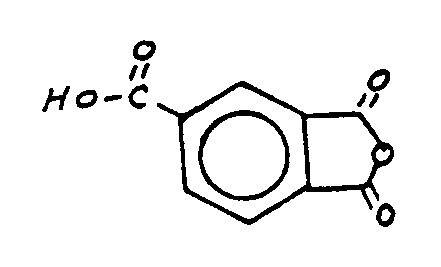
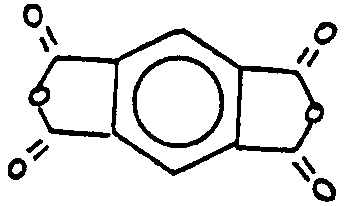
|
| | (5)
Note. An imide is considered as being a dicarboxylic
acid derivative. |
| | (6)
Note. An organic amine salt of a carboxylic acid
has been classified as if it were a mixture of an amine and a carboxylic acid. An
organic diamine salt of a dicarboxylic acid where the amine salt-forming
groups are identical is considered as being a single amine compound, whereas if
the amine groups are different then they are regarded as two amine
compounds. Where the compound contains two or more nitrogen
atoms bonded to the same or different noncarbonyl carbon atom then
they are to be regarded as polyamines. |
SEE OR SEARCH CLASS:
| 520, | Synthetic Resins or Natural Rubbers, the Glossary, for the definition of "amine" and
for a furthur elucidation of "carboxyclic acid or derivative". |
| 528, | Synthetic Resins or Natural Rubbers,
subclass 263 , for an explanation of the term "polyamine". |
|
| | |
| 420.5 | Solid polymer derived from a polycarboxylic acid which
is a dimer or trimer of an aliphatic acyclic monocarboxylic acid
having at least ten carbon atoms or adducts of unsaturated aliphatic
acyclic monocarboxylic acids, having ten carbon atoms with
an alpha, beta ethylenically unsaturated carboxylic acid
or derivative: |
| | This subclass is indented under subclass 420. Subject matter wherein the solid polymer is derived from
a polycarboxylic acid which is a dimer or trimer of an aliphatic
acyclic monocarboxylic acid having at least ten carbon atoms or
an adduct of an unsaturated aliphatic acyclic monocarboxylic acids, having
ten carbon atoms with an alpha, beta ethylenically unsaturated
carboxylic acid or derivative.
| | (1)
Note. Hydrogenated forms of the dimer and trimer
acids are included herein. |
| | (2)
Note. The solid polymer containing the dimer, trimer, or
adduct polycarboxylic acid need not be the solid polymer described
in this subclass. |
SEE OR SEARCH CLASS:
| 520, | Synthetic Resins or Natural Rubbers, for the definition of "dimer or trimer of
an aliphatic carboxylic acid". |
| 528, | Synthetic Resins or Natural Rubbers,
subclass 339.5 for polyamides from, e.g., dimer
acid, adipic acid and a polyamine, etc. |
| 562, | Organic Compounds,
subclass 509 for adducts of fatty acids with alpha, beta ethylenically
unsaturated dicarboxylic acids and for the dimer or trimer, per se. |
| 564, | Organic Compounds,
subclasses 152+ for polyamides, per se, produced
from dimer acid and polyamines. |
|
| | |
| 425 | Mixed with polycarboxylic acid or derivative and polyhydroxy
reactant or polymer therefrom: |
| | This subclass is indented under subclass 420. Subject matter wherein the solid polymer is mixed with a
polycarboxylic acid or derivative reactant and a polyhydroxy reactant
or reaction product resulting therefrom.
| | (1)
Note. It is unnecessary for the polycarboxylic acid
and polyhydroxy reactant to be added to the solid polymer simulataneously. The
only requirement is that both reactants be added to the solid polymer
sometime during the mixing and/or reacting processes. | |
| | |
| 428 | Contains amine-, N-C(=X)-, or
N-S(=O)-containing
reactant or polymer thereof (X is chalcogen): |
| | This subclass is indented under subclass 427. Subject matter which contains an amine, N-C(=X)-, N-S(=O)-containing
reactant (X is chalcogen) which is not in the
solid polymer backbone or a polymer thereof.
| | (1)
Note. The amine, N-C(=X)- or
N-S(=O)- containing
reactant can be part of, or in addition to, the
aldehyde or aldehyde derivative reactant. |
SEE OR SEARCH CLASS:
| 520, | Synthetic Resins or Natural Rubbers, the Glossary, for a definition of the term "phenolic
reactant". |
|
| | |
| 429 | Contains phenolic reactant or polymer thereof: |
| | This subclass is indented under subclass 427. Subject matter which contains a phenolic reactant (which
is not in the solid polymer backbone) or a polymer thereof.
| | (1)
Note. The phenolic reactant or polymer thereof can
be in addition to the aldehyde or aldehyde derivative or can be
in the same compound. See the Glossary for a definition
of the term "phenolic". | |
| | |
| 434 | Solid polymer derived from hydroxyl group-containing
reactant: |
| | This subclass is indented under subclass 420. Subject matter wherein the solid polymer derived from an
amino carboxylic acid, from a polyamine reactant and a
polycarboxylic acid or derivative, from at least one lactam
reactant, or from a polyamine salt of a polycarboxylic acid, is
also derived from a hydroxy-containing reactant. |
| | |
| 439 | Mixed with O-C(=O)-O-, hal-C(=O)-O-, or hal-C(=O)-hal
containing reactant or polymer derived therefrom; or wherein
solid polymer is derived from a hal-C(=O)-hal, O-C(=O)-O-, or
hal-C(=O)-O-, a
polycarboxylic acid or derivative and a polyhydroxy reactant: |
| | This subclass is indented under subclass 437. Subject matter wherein the solid polymer derived from a
polycarboxylic acid or derivative and a polyhydroxy reactant or
from a di- or higher ester of polycarboxylic acid as sole reactant
is mixed with O-C(=O)-O-, hal-C(=O)-O-, hal-C(=O)-hal-,containing
reactant or polymer thereof; or wherein the solid polymer
is derived from a polycarboxylic acid or derivative, a
polyhydroxy reactant and a O-C(=O)-O-, hal-C(=O)-O-, hal-C(=O)-hal-,containing
reactant. |
| | |
| 440.02 | Blocked isocyanate reactant or polymer derived therefrom: |
| | This subclass is indented under subclass 440.01. Subject matter wherein the solid polymer is derived from
or reacted with a group convertible to an -N=C=X
group, or an -N=C=X group previously
reacted with a blocking group.
| | (1)
Note. Blocking an – N=C=X (masked, hidden, etc) is
utilized to render the – N=C=X group
inert by conversion to an inactive group. The process of
reactivation usually merely involves merely heating the blocked
reactant to a – N=C=X reactant. The
usual mode of rendering is to convert it to the form of a NO- group. Examples
of blocking groups include, but are not limited to uretidiones, carbamates, carbodiimides, etc . | |
| | |
| 441 | Mixed with aldehyde or aldehyde derivative reactant or
polymer derived therefrom: |
| | This subclass is indented under subclass 437. Subject matter wherein the solid polymer derived from polycarboxylic
acid or derivative reactant and polyhydroxy reactant or from a di- or
higher ester of a polycarboxylic acid as sole reactant is mixed
with an aldehyde or aldehyde derivative reactant or polymer derived
therefrom.
SEE OR SEARCH CLASS:
| 520, | Synthetic Resins or Natural Rubbers, the Glossary, for definitions of the terms "aldehyde" and "aldehyde derivative". |
|
| | |
| 442 | Contains phenolic reactant or polymer thereof: |
| | This subclass is indented under subclass 441. Subject matter which contains a phenolic reactant which
is not in the solid polymer backbone or a polymer thereof.
| | (1)
Note. This subclass includes, for example, a
mixture of a solid polymer derived from a polyhydroxy reactant and
a polycarboxylic acid reactant or from a di- or higher
ester of a polycarboxylic acid as sole reactant with either a phenolic
reactant or polymer thereof and an aldehyde or aldehyde derivative
or polymer thereof or a reaction product of a phenolic reactant
and an aldehyde or aldehyde derivative or wherein the phenolic moiety
is in the same compound as is the aldehyde moiety. | |
| | |
| 443 | Contains an amine-, N-C(=X)-, or
N-S(=O)- containing
reactant or polymer thereof (X is chalcogen): |
| | This subclass is indented under subclass 441. Subject matter which contains an amine-, N-C(=X)-, or
N-S(=O)- containing
reactant (X is chalcogen) or polymer thereof.
| | (1)
Note. This subclass includes, for example, a
mixture of a solid polymer derived from a polyhydroxy reactant and
a polycarboxylic acid reactant or from a di- or higher
ester of a polycarboxylic acid as sole reactant with an amine--N=C=X, or N-S(=O)-containing
reactant or solid polymer thereof and an aldehyde or aldehyde derivative
or polymer thereof; or the reaction product of an amine-,-N=C=X, or
N-S(=O)- containing
reactant with an aldehyde or aldehyde derivative. |
SEE OR SEARCH THIS CLASS, SUBCLASS:
| 441, | for reactions with hexamethylenetetramine which
is regarded therein as an aldehyde derivative. |
|
| | |
| 444 | Mixed with polycarboxylic acid or derivative and polyhydroxy
reactant or polymer thereof: |
| | This subclass is indented under subclass 437. Subject matter wherein the solid polymer derived from a
polycarboxylic acid or derivative reactant and a polyhydroxy reactant
or from a di- or higher ester of a polycarboxylic acid
as sole reactant is mixed with an additional polycarboxylic acid
or derivative reactant and a polyhydroxy reactant or reaction product
thereof.
| | (1)
Note. This subclass provides for blends of two or
more solid polycarboxylic acid-polyhydroxy compound polyesters as
well as a solid polyester and polycarboxylic acid and a polyhydroxy
compound. | |
| | |
| 452 | Solid polymer derived from -N=C=X
reactant (X is chalcogen): |
| | This subclass is indented under subclass 50. Subject matter involving processes of mixing a solid polymer
derived from a -N=C=X of blocked -N=C=X
reactant with an additional solid polymer, with specified
polymer-forming ingredients, or with a specified
intermediate condensation product, chemical treating agent, or
with an ethylenic agent; processes or products resulting
from the above mixing processes (X is chalcogen).
SEE OR SEARCH THIS CLASS, SUBCLASS:
| 395, | for a discussion of the term "blocked". |
|
| | |
| 458 | Contains polyhydroxy reactant; or additional polymer
derived from -N=C=X and polyhydroxy reactant: |
| | This subclass is indented under subclass 457. Subject matter which contains a solid polymer derived from
a -N=C=X reactant and polyhydroxy reactant
and additional reactants at least one of which is a -N=C=X
or blocked -N=C=X or blocked -N=C=X
reactant and at least one of which is polyhydroxy reactant or a
polymer thereof.
| | (1)
Note. This subclass includes blends of solid polyurethanes, a
solid polyurethane with a nonsolid polyurethane and a solid polyurethane
with a polyisocyanate and a polyhydroxy reactant. | |
| | |
| 461 | Solid polymer derived from O-C(=O)-O- or hal-C(=O)- or
halcontaining reactant: |
| | This subclass is indented under subclass 50. Subject matter involving processes of mixing solid polymer
derived from O-C(=O)-O- or hal-C(=O)- reactant
with additional solid polymer, specified polymer-forming
ingredients, specified intermediate condensation product, chemical
treating agent, or ethylenic agent; processes
of reacting the above mixtures or products resulting from the above
processes. |
| | |
| 472 | Solid polymer derived from aldehyde or aldehyde-type
reactant and wherein none of the reactants forming the solid polymer
contains a phenol, amine-, -N=C=X, -N-S(=O)-, or
ketone group or a condensate thereof except when an amine group
appears in hexamethylenetetramine or a derivative thereof (X
is chalcogen): |
| | This subclass is indented under subclass 50. Subject matter involving processes of mixing a solid polymer
derived from an aldehyde or aldehyde-type reactant and
wherein none of the reactants forming the solid polymer contains
a phenol, amine, ketone group, or is
a polymer thereof other than wherein the amine group is hexamethylenetetramine
or a derivative thereof, with additional solid polymer, with specified
polymer-forming ingredients, with specified intermediate
condensation products, with chemical treating agent, or
with ethylenic agent; processes of reacting or forming
the above mixtures, or products resulting from the above
processes.
SEE OR SEARCH THIS CLASS, SUBCLASS:
| 398, | the Notes therein, for a discussion of "aldehyde-type". |
SEE OR SEARCH CLASS:
| 520, | Synthetic Resins or Natural Rubbers, the Glossary, for definitions of the terms "aldehyde" and "aldehyde derivative". |
|
| | |
| 473 | Solid polymer derived from aldehyde or aldehyde-type
reactant containing atoms other than C, H, or
O and, wherein when hexamethylenetetramine or derivative
is a reactant, there is additionally present a reactant
containing atoms other than C, H, or O: |
| | This subclass is indented under subclass 472. Subject matter wherein a solid polymer derived from aldehyde
or aldehyde-type reactant contains atoms other than carbon, hydrogen, an oxygen
and, when hexamethylenetetramine or derivative thereof
is a reactant, there is additionally present a reactant
containing atoms other than carbon, hydrogen, and
oxygen.
SEE OR SEARCH CLASS:
| 520, | Synthetic Resins or Natural Rubbers, the Glossary, for a definition of the term "aldehyde-type". |
|
| | |
| 474 | Solid polymer derived from silicon-containing
reactant: |
| | This subclass is indented under subclass 50. Subject matter involving processes of mixing solid polymer
derived from a silicon-containing reactant, with
additional solid polymer, with specified polymer-forming
ingredients, with specified intermediate condensation product, with
chemical treating agent, or with ethylenic agent; processes
of forming or reacting the above mixtures or products resulting
from the above processes. |
| | |
| 480 | Solid polymer or specified intermediate condensation product
derived from at least one phenolic reactant and at least one aldehyde or
aldehyde-type reactant or polymer therefrom: |
| | This subclass is indented under subclass 50. Subject matter involves processes of mixing a solid polymer
or specified intermediate condensation product derived from at least
one phenolic reactant and at least one aldehyde or aldehyde-type
reactant or polymer thereof, with an additional solid polymer, with
an additional specified intermediate condensation product, with
specified polymer-forming ingredients, or with
ethylenic agent; processes of mixing solid polymer derived
from at least one phenolic reactant and at least one aldehyde or aldehyde-type
reactant or polymer thereof with a chemical treating agent; processes
of forming or reacting the above mixtures, or products resulting
from the above processes.
| | (1)
Note. When a nonsolid specified intermediate condensation
product is involved, the chemical treating agent must be
a solid polymer, a specified intermediate condensation
product, or part of a specified polymer-forming ingredient
system or be an ethylenic agent. |
SEE OR SEARCH CLASS:
| 520, | Synthetic Resins or Natural Rubbers, the Glossary, for definitions of the terms "specified
polymer-forming ingredients", "specified
intermediate condensation product", "aldehyde-type
reactant", and "chemical treating agent". |
|
| | |
| 485 | With specified material: |
| | This subclass is indented under subclass 481. Subject matter wherein a specified material is present in
the mixture.
SEE OR SEARCH CLASS:
| 520, | Synthetic Resins or Natural Rubbers, for a definition of the term "specified material". |
|
| | |
| 487 | With silicon-containing reactant or polymer derived
therefrom: |
| | This subclass is indented under subclass 481. Subject matter wherein a solid polymer or specified intermediate
condensation product derived from at least one phenolic reactant
and at least one aldehyde or aldehyde-type reactant is
mixed with a reactant containing more than one 1,2-epoxy
group per mole or polymer derived therefrom, is also mixed
with an additional silicon-containing reactant or polymer derived
therefrom. |
| | |
| 488 | With carboxylic acid or derivative reactant or polymer
derived therefrom: |
| | This subclass is indented under subclass 481. Subject matter wherein a solid polymer or specified intermediate
condensation product derived from at least one phenolic reactant
and at least one aldehyde or aldehyde-type reactant mixed
with a reactant containing more than one 1,2-epoxy
group per mole or polymer derived therefrom is further mixed with
a carboxylic acid or derivative reactant or polymer derived therefrom. |
| | |
| 491 | Mixed with additional aldehyde or aldehyde-type
reactants which are part of a specified polymer-forming
ingredient system or polymer thereof: |
| | This subclass is indented under subclass 480. Subject matter wherein a solid polymer or specified intermediate
condensation product derived from at least one phenolic reactant
and at least one aldehyde or aldehyde-type reactant is
mixed with an additional aldehyde or aldehyde-type polymer, specified
intermediate condensation product, or aldehyde or aldehyde-type
reactants which are part of a specified polymer-forming
ingredient system.
SEE OR SEARCH THIS CLASS, SUBCLASS:
| 503, | for a mixture of a solid polymer derived from a
phenolic reactant and an aldehyde or aldehyde-type reactant with
an aldehyde treating agent which treating agent is not an aldehyde
condensate nor a mixture of specified polymer-forming ingredients, e.g., a mixture
of a solid phenol-aldehyde polymer and paraformaldehyde, etc. |
|
| | |
| 499 | Contains sulfur reactant or polymer therefrom: |
| | This subclass is indented under subclass 495. Subject matter which contains a sulfur-containing
reactant or polymer derived therefrom.
| | (1)
Note. In this subclass, the sulfur may
be present either as part of the phenolic-aldehyde or aldehyde-type
polymer or condensate, as part of the amine or -N=C=X
aldehyde or aldehyde-type polymer or condensate, or
as a separate reactant or as a chemical treating agent. | |
| | |
| 501 | Additional phenol-aldehyde- or -aldehyde-type
polymers, condensation product or reactants therefrom: |
| | This subclass is indented under subclass 491. Subject matter wherein the additional aldehyde or aldehyde-type
reactant polymer, condensate, or reactants is
a phenolic-aldehyde or an aldehyde-type polymer
condensate or reactants.
| | (1)
Note. This subclass provides, for example, for
mixtures of two solid phenol-aldehyde polymers, a
solid phenol-aldehyde polymer with either a phenol-aldehyde
specified intermediate condensation product or phenol and an aldehyde, or
a phenol-aldehyde specified intermediate condensation product
with a phenol and an aldehyde. | |
| | |
| 501.5 | Mixed with reactant which is a fatty acid glycerol ester, a
fatty acid or salt derived from a naturally occurring glyceride, tall
oil, or a fatty acid derived from tall oil; or
the reaction product of any of the above with a polycarboxylic acid
or ester forming derivative and a polyhydroxy compound: |
| | This subclass is indented under subclass 480. Subject matter wherein there is at least one reactant which
is a fatty acid glyceride, a fatty acid or salt thereof
derived from a naturally occurring glyceride, tall oil, or
a fatty acid derived from tall oil, or a reaction product
of any of these materials with a polycarboxylic acid or ester and
a polyol.
| | (1)
Note. The so-called drying or semidrying
oil modified phenolic resins are placed herein if an unsaturated
fatty acid or oil is added to a solid polymer or preformed SICP. |
| | (2)
Note. Dehydrated castor oil fatty acids are included
herein as fatty acids derived from a naturally occurring glyceride. |
| | (3)
Note. See Lines With Other Classes and Within This
Class, section II, B(5) for
a discussion of the lines between this subclass and other areas. |
SEE OR SEARCH CLASS:
| 520, | Synthetic Resins or Natural Rubbers, the Glossary, for a definition of the term "fatty
acid" and of other materials proper for this subclass. |
|
| | |
| 503 | Mixed with aldehyde or aldehyde-type chemical
treating agent: |
| | This subclass is indented under subclass 480. Subject matter wherein a solid polymer or specified intermediate
condensation product derived from at least one phenolic reactant
and at least one aldehyde or an aldehyde-type reactant
is mixed with an aldehyde or aldehyde-type treating agent.
| | (1)
Note. This subclass takes, as an example, a
mixture of a solid phenol-aldehyde polymer and a chemical
treating agent, such as a catalyst, as well as
a mixture of a resinifiable phenol-aldehyde intermediate
condensate with polymer-forming ingredients (necessary
for this subclass). |
SEE OR SEARCH CLASS:
| 528, | Synthetic Resins or Natural Rubbers,
subclasses 129+ for a mixture of a specified intermediate condensation product
of phenol and an aldehyde with a nonsolid specified treating agent
such as an aldehyde-containing material. |
|
| | |
| 504 | Mixed with nitrogen-containing chemical treating
agent: |
| | This subclass is indented under subclass 480. Subject matter wherein a solid polymer or specified intermediate
condensation product derived from at least one phenolic reactant
and an aldehyde or aldehyde-type reactant is mixed with
a nitrogen-containing chemical treating agent or polymer
derived therefrom.
SEE OR SEARCH CLASS:
| 520, | Synthetic Resins or Natural Rubbers, the Glossary, for a definition of the term "chemical
treating agent". |
|
| | |
| 505 | Mixed with sulfur-containing chemical treating
agent: |
| | This subclass is indented under subclass 480. Subject matter wherein a solid polymer or specified intermediate
condensation product with at least one phenolic reactant and at
least one aldehyde or aldehyde-type reactant is mixed with
a sulfur-containing chemical treating agent or polymer
derived therefrom.
SEE OR SEARCH CLASS:
| 520, | Synthetic Resins or Natural Rubbers, the Glossary, for a definition of the term "chemical
treating agent". |
|
| | |
| 506 | Mixed with a boron- or polyvalent metal-containing
chemical treating agent: |
| | This subclass is indented under subclass 480. Subject matter wherein a solid polymer or specified intermediate
condensation product derived from at least one phenolic reactant
and at least one aldehyde or aldehyde-type reactant is
mixed with a boron- or polyvalent metal-containing
chemical treating agent or polymer derived therefrom.
SEE OR SEARCH CLASS:
| 520, | Synthetic Resins or Natural Rubbers, the Glossary, for a definition of the term "chemical
treating agent". |
|
| | |
| 507 | Mixed with an 1,2-epoxy-containing
chemical treating agent: |
| | This subclass is indented under subclass 480. Subject matter wherein a solid polymer or specified intermediate
condensation product derived from at least one phenolic reactant
and at least one aldehyde or aldehyde-type reactant is
mixed with 1,2-epoxy-containing chemical treating
agent or polymer derived therefrom.
SEE OR SEARCH CLASS:
| 520, | Synthetic Resins or Natural Rubbers, the Glossary, for a definition of the term "chemical
treating agent". |
|
| | |
| 508 | Mixed with carboxylic acid- or derivative-containing
chemical treating agent: |
| | This subclass is indented under subclass 480. Subject matter wherein a solid polymer or specified intermediate
condensation product derived from at least one phenolic reactant
and at least one aldehyde or aldehyde-type reactant is
mixed with a carboxylic acid or derivative chemical treating agent
or polymer derived therefrom.
SEE OR SEARCH CLASS:
| 520, | Synthetic Resins or Natural Rubbers, the Glossary, for a definition of the term "chemical
treating agent". |
|
| | |
| 509 | Solid polymer or specified intermediate condensation product
derived from at least one amine-, -N-C(=X)- or -N-S(=O)- containing reactant
and at least one aldehyde or aldehyde-type reactant (X
is chalcogen): |
| | This subclass is indented under subclass 50. Subject matter involves processes of mixing a solid polymer
or specified intermediate condensation product derived from at least
one amine and -N-C(=X)- or -N-S(=O)- containing reactant
and at least one aldehyde or aldehyde-type reactant or
polymer thereof with an additional solid polymer, with
additional specified intermediate condensation product, with
specified polymer-forming ingredients or with ethylenic
agent; processes of mixing solid polymer derived from at
least one amine, -N-C(=X)- or -N-S(=O)- containing
reactant and at least one aldehyde or aldehyde-type reactant or
polymer thereof with a chemical treating agent; or products
resulting from the above mixing processes (X is chalcogen).
| | (1)
Note. In this and the indented subclasses, an
amine, -N-C(=X)- or -N-S(=O)- aldehyde, or
aldehyde-type condensate must be a solid in order for a
mixture thereof and a chemical treating agent to be classified herein. |
SEE OR SEARCH THIS CLASS, SUBCLASS:
| 480, | the Note, for furthur elucidation. |
SEE OR SEARCH CLASS:
| 528, | Synthetic Resins or Natural Rubbers, for a mixture of a nonsolid condensation product
of an amine and N-C(=X)- or -N-S(=O)- containing
reactant and an aldehyde with a chemical treating agent, e.g., a
catalyst, etc. |
|
| | |
| 511 | With specified material: |
| | This subclass is indented under subclass 510. Subject matter which further contains a specified material.
SEE OR SEARCH CLASS:
| 520, | Synthetic Resins or Natural Rubbers, the Glossary, for a definition of the term "specified
material". |
|
| | |
| 512 | Amine-, N-C(=X)- or
N-S(=O)- containing reactant (X
is chalcogen), aldehyde or aldehyde-type
condensation product or polymer thereof contains atoms other than
C, H, O, N or S: |
| | This subclass is indented under subclass 510. Subject matter wherein the amine and N-C(=X)- or
N-S(=O) containing reactant-aldehyde, -aldehyde-type
solid polymer or specified intermediate condensation product contains
an atom other than carbon, hydrogen, oxygen, nitrogen, or
sulfur. |
| | |
| 513 | With sulfur-containing reactant or polymer therefrom: |
| | This subclass is indented under subclass 510. Subject matter which also contains a sulfur-containing
reactant or polymer derived therefrom.
| | (1)
Note. In this subclass, the sulfur-containing
reactant or polymer derived therefrom must be an ingredient separate and
distinct from the two required ingredients, i.e., the
aminoplast or the 1,2-epoxy material. | |
| | |
| 517 | Amine-, N-C(=X)- or
N-S(=O)- containing reactant-aldehyde
or -aldehyde-type polymer or condensation product
contains atoms other than C, H, O, N, or
S (X is chalcogen): |
| | This subclass is indented under subclass 515. Subject matter wherein the amine-, N-C(=X)- or
N-S(=O) containing reactant
aldehyde, -aldehyde-type solid polymer
or specified intermediate condensation product contains an atom other
than carbon, hydrogen, oxygen, nitrogen, or
sulfur (X is chalcogen). |
| | |
| 517.5 | Mixed with a reactant which is a fatty acid glycerol ester, a
fatty acid or salt derived from a naturally occurring glyceride, tall
oil, or a fatty acid derived from tall oil; or
the reaction product of any of the above with a polycarboxylic acid
or ester forming derivative and a polyhydroxy compound: |
| | This subclass is indented under subclass 509. Subject matter wherein a reactant which is a fatty acid
glyceride, a fatty acid derived from a naturally occurring
glyceride, tall oil, or a fatty oil or salt thereof
or a reaction product of any of these materials with a polycarboxylic
acid or ester and a polyol.
| | (1)
Note. The so-called oil modified alkyl resins
are treated herein in the same manner as fatty glycerides or the
fatty acid derived therefrom. |
| | (2)
Note. Dehydrated castor oil fatty acids are included
herein. |
| | (3)
Note. See Lines With Other Classes and Within This
Class, section II. B(6) for
a discussion of the lines between this subclass and other areas. |
SEE OR SEARCH CLASS:
| 520, | Synthetic Resins or Natural Rubbers, the Glossary, for a definition of the term "fatty
acid" and of other materials proper for this subclass. |
|
| | |
| 518 | Mixed with unsaturated reactant or polymer derived therefrom: |
| | This subclass is indented under subclass 509. Subject matter wherein a solid polymer or specified intermediate
condensation product derived from at least one amine-, N-C(=X)- or N-S(=O) containing
reactant and at least one aldehyde or aldehyde-type reactant
is mixed with an ethylenically unsaturated reactant or polymer derived
therefrom (X is chalcogen). |
| | |
| 521 | Solid polymer or specified intermediate condensation product
derived from at least one ketone reactant and at least one aldehyde
or aldehyde derivative reactant: |
| | This subclass is indented under subclass 50. Subject matter involves processes of mixing a solid polymer
or specified intermediate condensation product derived from at least
one ketone reactant and at least one aldehyde or aldehyde derivative
or polymer thereof as reactant, with additional solid polymer, with
additional specified intermediate condensation product, with
specified polymer-forming ingredients or with ethylenic
agent; processes of mixing solid polymer derived from at
least one ketone reactant and at least one aldehyde reactant with
a chemical treating agent; or processes of forming or reacting
or products resulting from any of the above mixtures.
| | (1)
Note. In this and indented subclasses a condensate
of a ketone reactant and an aldehyde or aldehyde derivative reactant must
be a solid polymer in order for a mixture of a ketone-aldehyde
condensate and a chemical treating agent to be classified herein.
A mixture would be placed in Class 528. See the Glossary and (1) note
of subclass 480 of this class. |
SEE OR SEARCH THIS CLASS, SUBCLASS:
| 480, | the Note, for furthur elucidation. |
SEE OR SEARCH CLASS:
| 528, | Synthetic Resins or Natural Rubbers, the Glossary, for a mixture of a nonsolid
ketone-aldehyde condensate and a chemical treating agent, such
as a catalyst. |
|
| | |
| 533 | Mixed with carboxylic acid or derivative reactant or polymer
therefrom: |
| | This subclass is indented under subclass 523. Subject matter wherein a solid polymer containing more than
one 1,2-epoxy groups or derived from reactant
containing at least one 1,2-epoxy group is mixed
with a carboxylic acid or derivative reactant or polymer derived therefrom.
SEE OR SEARCH THIS CLASS, SUBCLASS:
| 403, | through 409 for solid polymer derived from 1,2-epoxy
compounds containing only one 1,2-epoxy group
as only reactant, wherein said reactants do not contain
plural methylol or plural methylol derivative groups. |
|
| | |
| 534 | Solid polymer derived from phenolic reactant: |
| | This subclass is indented under subclass 50. Subject matter involves processes of mixing a solid polymer
derived from a phenolic reactant with additional solid polymer, with
specified polymer-forming ingredients, with chemical treating
agent, or with ethylenic agent; or products resulting
from the above mixing processes. |
| | |
| 535 | Solid polymer derived from sulfur-containing reactant: |
| | This subclass is indented under subclass 50. Subject matter involves processes of mixing a solid polymer
derived from a sulfur-containing reactant with additional
solid polymer with specified polymer-forming ingredients, specified
intermediate condensation product, with chemical treating
agent, or with an ethylenic agent; or products
resulting from the above mixing processes.
SEE OR SEARCH THIS CLASS, SUBCLASS:
| 537, | for a process of mixing a solid polyphenylene sulfide
with a chemical treating agent, with an additional solid polymer, with
polymer-forming ingredients, or with an ethylenic
agent when the disclosure is silent as to the mode of preparation
of the polyphenylene sulfide or when such polymer is disclosed as
being the reaction product of an alkali metal sulfide and a halogenated
aromatic reactant. |
|
| | |
| 538 | Solid polymer derived from phosphorus-containing
reactant: |
| | This subclass is indented under subclass 50. Subject matter involves processes of mixing a solid polymer
derived from a phosphorus-containing reactant with additional
solid polymer, with specified polymer-forming
ingredients, with chemical treating agent or with ethylenic agent; processes
of reacting the above mixtures or products resulting from the above
mixing processes. |
| | |
| 540 | Solid polymer derived from nitrogen-containing
reactant: |
| | This subclass is indented under subclass 50. Subject matter involves processes of mixing a solid polymer
derived from a nitrogen-containing reactant with additional
solid polymer, with specified polymer-forming
ingredients, with chemical treating agent or with ethylenic
agent; or products resulting from the above mixing processes. |
| | |
CROSS-REFERENCE ART COLLECTIONS
| 901 | RADIAL BLOCK: |
| | This subclass is indented under the class definition. Subject matter involving a radial block copolymer. |
| | |
| 902 | CORE-SHELL: |
| | This subclass is indented under the class definition. Subject matter involving a core-shell copolymer. |
| | |
| 903 | INTERPENETRATING NETWORK: |
| | This subclass is indented under the class definition. Subject matter involving polymers consisting of an interpenetrating
network. |
| | |
| 904 | ACTIVATION OF PREFORMED POLYMER IN ABSENCE OF MONOMER, FOR SUBSEQUENT
POLYMERIZATION THEREON (E.G., TRAPPED
RADICALS): |
| | This subclass is indented under the class definition. Subject matter which involves the activation of a preformed
polymer, in the absence of a monomer, for subsequent
polymerization therein. |
| | |
| 905 | POLYPHENYLENE OXIDE: |
| | This subclass is indented under the class definition. Subject matter involving a polyphenylene oxide polymer. |
| | |
| 906 | POLYSULFONE: |
| | This subclass is indented under the class definition. Subject matter involving a polysulfone polymer. |
| | |
| 907 | POLYCARBODIIMIDE: |
| | This subclass is indented under the class definition. Subject matter involving a polycarbodiimide polymer. |
| | |
| 908 | POLYMER CONTAINING A HYDANTOIN GROUP: |
| | This subclass is indented under the class definition. Subject matter involving a polymer containing the hydantoin
group, i.e.,
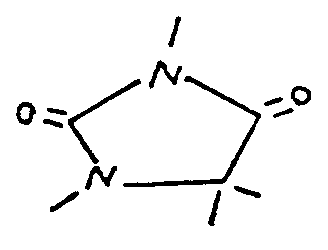
|
| | |
| 909 | POLYMER HAVING A HETEROCYCLIC RING WITH AT LEAST THREE
DIFFERENT ELEMENTS WITHIN THE RING: |
| | This subclass is indented under the class definition. Subject matter involving a polymer containing a heterocyclic
ring with at least three different elements within the ring. |
| | |
| 910 | POLYMER FROM ETHYLENIC MONOMERS ONLY, HAVING TERMINAL UNSATURATION: |
| | This subclass is indented under the class definition. Subject matter involving an ethylenically polymerized polymer
with terminal unsaturation. |
| | |
| 911 | POLYMER FROM ETHYLENIC MONOMERS ONLY, HAVING TERMINAL FUNCTIONAL
GROUP OTHER THAN UNSATURATION: |
| | This subclass is indented under the class definition. Subject matter involving a polymer derived from ethylenic
monomers only and having saturated terminal functional groups. |
| | |
| 912 | POLYMER FROM NONETHYLENIC MONOMERS ONLY, HAVING
PENDANT UNSATURATED GROUP: |
| | This subclass is indented under the class definition. Subject matter involving a polymer derived form monoethylenic
monomers only, having a pendant unsaturated group. |
| | |
| 913 | POLYMER OF ETHYLENIC MONOMERS HAVING PENDANT GLYCIDYL GROUP: |
| | This subclass is indented under the class definition. Subject matter involving a polymer derived from ethylenic
monomers having a pendant glycidyl group. |
| | |
| 914 | POLYMER FROM CONJUGATED DIENE HYDROCARBONS OR HALOHYDROCARBONS
HAVING MORE THAN 50% 1,2- MICROSTRUCTURE: |
| | This subclass is indented under the class definition. Subject matter involving a polymer derived from conjugated
diene hydrocarbon or conjugated halogenated diene hydrocarbon, said
polymer having more than 50 1,2-microstructure. |
| | |
| 915 | POLYMER FROM MONOETHYLENIC CYCLIC HYDROCARBON: |
| | This subclass is indented under the class definition. Subject matter involving a polymer derived from a monoethylenic
cyclic hydrocarbon. |
| | |
| 916 | POLYMER FROM ETHYLENIC MONOMERS ONLY, HAVING CATIONIC GROUP: |
| | This subclass is indented under the class definition. Subject matter involving a polymer derived from ethylenic
monomers only, having a cationic group. |
| | |
| 917 | POLYMER FROM AT LEAST ONE NONETHYLENIC MONOMER HAVING CATIONIC
GROUP: |
| | This subclass is indented under the class definition. Subject matter involving a polymer prepared by cationic
polymerization. |
| | |
| 918 | POLYMER PREPARED BY CATIONIC POLYMERIZATION: |
| | This subclass is indented under the class definition. Subject matter involving a polymer prepared by cationic
polymerization. |
| | |
| 919 | IONOMER RESINS (CARBOXYLATE SALT-CONTAINING
COPOLYMERS): |
| | This subclass is indented under the class definition. Subject matter involving a polymer containing a carboxylate
salt group (e.g., ionomer resins, etc.). |
| | |
| 920 | POLYURETHANE HAVING TERMINAL ETHYLENIC UNSATURATION: |
| | This subclass is indented under the class definition. Subject matter involving a polyurethane polymer with terminal
ethylenic unsaturation. |
| | |
| 921 | POLYESTER HAVING TERMINAL ETHYLENIC UNSATURATION OTHER THAN
POLYESTERURETHANES: |
| | This subclass is indented under the class definition. Subject matter involving a polyester with terminal ethylenic
unsaturation, said polymer being other than polyesterurethanes. |
| | |
| 922 | POLYEPOXIDE HAVING BEEN REACTED TO YIELD TERMINAL ETHYLENIC
UNSATURATION: |
| | This subclass is indented under the class definition. Subject matter involving a polyepoxide which has been reacted
to yield a polymer with terminal ethylenic unsaturation. |
| | |
| 923 | AMINOPLAST HAVING TERMINAL ETHYLENIC UNSATURATION: |
| | This subclass is indented under the class definition. Subject matter involving an aminoplast with terminal ethylenic
unsaturation. |
| | |
| 924 | PHENOPLAST HAVING TERMINAL ETHYLENIC UNSATURATION: |
| | This subclass is indented under the class definition. Subject matter involving a phenoplast with terminal ethylenic
unsaturation. |
| | |
| 925 | POLYMER FROM AT LEAST ONE NONETHYLENIC MONOMER HAVING TERMINAL
ETHYLENIC UNSATURATION OTHER THAN POLYURETHANES, POLYESTERS, POLYEPOXIDES, AMINOPLASTS, AND
PHENOPLASTS: |
| | This subclass is indented under the class definition. Subject matter involves a polymer derived from at least
one nonethylenic monomer and which polymer has terminal ethylenic unsaturation
and is other than a polurethane, polyester, polyepoxide, aminoplast, or
phenoplast. |
| | |
| 926 | POLYAMIDE CONTAINING A PLURALITY OF OXYALKYLENE GROUPS: |
| | This subclass is indented under the class definition. Subject matter involves a polyamide mixed with a polymer
containing oxyalkylene groups. |
| | |
| 927 | POLYAMIDE ADMIXED WITH OXYALKYLENE CONTAINING POLYMER: |
| | This subclass is indented under the class definition. Subject matter involves a polyamide mixed with a polymer
containing oxyalkylene groups. |
| | |
| 928 | POLYIMIDE OR POLYAMIDE-ACID FORMED BY CONDENSATION
OF A POLYAMINE WITH A POLYCARBOXYLIC ACID HAVING AT LEAST THREE CARBOXYL
GROUPS OR DERIVATIVES THEREOF: |
| | This subclass is indented under the class definition. Subject matter involves a polyimide- or polyamide-acid
formed by the condensation of a polyamine with a polycarboxylic
acid having at least 3 carboxyl groups, anhydride thereof, or
derivative thereof. |
| | |
| 929 | POLYIMIDE FORMED BY ADDITION OF POLYAMINE TO AN UNSATURATED BIS-IMIDE: |
| | This subclass is indented under the class definition. Subject matter involves a polyimide formed by the addition
of a polyamine to an unsaturated bis-imide. |
| | |
| 930 | REACTION PRODUCT OF A POLYHYDRIC PHENOL AND EPICHLOROHYDRIN
OR DIEPOXIDE, HAVING A MOLECULAR WEIGHT OF OVER 5,000 (E.G., PHENOXY
RESINS): |
| | This subclass is indented under the class definition. Subject matter involves a reaction product of a polyhydric
phenol and an epichlorohydrin diepoxide, which reaction
product has a molecular weight of over 5,000 (e.g., phenoxy resins, etc.). |
| | |
| 931 | BLEND OF STATED INCOMPATIBILITY: |
| | This subclass is indented under the class definition. Subject matter involves a polymeric mixture wherein the
ingredients are generally incompatible with one another. |
| | |
| 932 | BLEND OF MATCHED OPTICAL PROPERTIES: |
| | This subclass is indented under the class definition. Subject matter involves a polymeric mixture with matched
optical properties. |
| | |
| 933 | BLEND OF LIMITED GAS PERMEABILITY: |
| | This subclass is indented under the class definition. Subject matter involves a polymeric mixture with limited
gas permeability. |
| | |
| 934 | POWDERED COATING COMPOSITION: |
| | This subclass is indented under the class definition. Subject matter involves a powdered coating composition. |
| | |
| 935 | MATRIX ADMIXED WITH SYNTHETIC FIBER: |
| | This subclass is indented under the class definition. Subject matter involves a matrix mixed with a synthetic
fiber. |
| | |
| 936 | ENCAPSULATED CHEMICAL AGENT: |
| | This subclass is indented under the class definition. Subject matter involves an encapsulated chemical treating
agent. |
| | |
| 937 | UTILITY AS BODY CONTACT (IMPLANT, CONTACT
LENS, I.U.D., ETC.): |
| | This subclass is indented under the class definition. Subject matter involves a polymer which has utility as a
body contact material (e.g., inplant, contact
lens, etc.) |
| | |
| 938 | POLYMER DEGRADATION: |
| | This subclass is indented under the class definition. Subject matter involves a polymer degradation. |
| | |
| 939 | MULTIPACKAGE SYSTEM: |
| | This subclass is indented under the class definition. Subject matter involves a multipackaged system. |
| | |
| 940 | HYDROGENATION OF A POLYMER: |
| | This subclass is indented under the class definition. Subject matter involves a hydrogenated polymer. |
| | |
| 941 | POLYMER MIXTURE CONTAINING BLOCK COPOLYMER IS MIXED OR REACTED
WITH CHEMICAL TREATING AGENT: |
| | This subclass is indented under the class definition. Subject matter involves a polymeric mixture which contains
a block copolymer and which is further mixed or reacted with a chemical
treating agent. |
| | |
| 942 | POLYMER DERIVED FROM NITRILE, CONJUGATED DIENE
AND AROMATIC CO-MONOMERS: |
| | This subclass is indented under the class definition. Subject matter involving a polymer derived from ethylenic
reactants only derived from a nitrile, conjugated nonaromatic
hydrocarbon and aromatic hydrocarbon, e.g., included
herein are the "ABS" resins, grafts, blocks, and
any other combination proper for Class 525, etc.
SEE OR SEARCH CLASS:
| 526, | Synthetic Resins or Natural Rubbers,
subclasses 335+ for a polymer derived from hydrocarbon monomer containing
at least two ethylenic groups. |
|
| | |
![[Search a list of Patent Appplications for class 525]](../as.gif) CLASS 525,
CLASS 525,