![[Search a list of Patent Appplications for class 524]](../as.gif) CLASS 524, CLASS 524, | SYNTHETIC RESINS OR NATURAL RUBBERS -- PART OF THE CLASS 520 SERIES |
| Click here for a printable version of this file | |
SECTION I - CLASS DEFINITION
Class 524 is a continuation of Class 523. Class 523, subclass 1 is the parent subclass of all the Class 524 subclasses.
The Class 523 Class Definition is applicable to both Class 523 and Class 524.
SUBCLASSES
![[List of Patents for class 524 subclass 1]](../ps.gif) 1 1 | Adding a NRM to a preformed solid polymer or preformed specified intermediate condensation product, composition thereof; or process of treating or composition thereof: | ||||||
This subclass is indented under subclass 1. Subject matter under Class 523, ... wherein a nonreactant
material (NRM) is admixed with a preformed solid polymer (SP) or
preformed specified intermediate condensation product (SICP), or
the product of such an admixing process.
SEE OR SEARCH CLASS:
| |||||||
| 2 | Water settable inorganic compound as nonreactive material: | ||
This subclass is indented under subclass 1. Subject matter wherein the added nonreactant material is
an inorganic material hardenable by hydration to produce a solid
mass, e.g., Portland cement, gypsum cement, etc.
| |||
| 3 | Solid polymer or specified intermediate condensation product derived from reactant-containing atom other than C, H, O, N, or halogen and which is devoid of a fused or bridged ring system: | ||
This subclass is indented under subclass 2. Subject matter wherein a solid polymer or specified intermediate
condensation product derived from at least one reactant containing
an atom other than carbon, hydrogen, oxygen, nitrogen, or halogen,
and which reactant is devoid of fused or bridged-ring system is present.
| |||
| 4 | Solid polymer or specified intermediate condensation product derived from at least one oxygen-containing reactant and which is devoid of a fused-ring or bridged-ring system: |
| This subclass is indented under subclass 2. Subject matter wherein a solid polymer or specified intermediate condensation product is derived from at least one oxygen containing reactant and devoid of fused-or bridged-ring system is present. | |
| 5 | Derived from carboxylic acid or derivative: | ||
This subclass is indented under subclass 4. Subject matter wherein at least one of the oxygen reactants
of the solid polymer or specified intermediate product is a carboxylic
acid or derivative.
| |||
| 6 | Derived from phenolic compound or aldehyde-containing reactant: | ||
This subclass is indented under subclass 4. Subject matter wherein at least one of the oxygen reactants
of the solid polymer or specified intermediate condensation product
is an aryl-OH containing compound or a compound containing an aldehyde
group.
| |||
| 7 | Solid polymer derived from halogen-containing reactant: |
| This subclass is indented under subclass 2. Subject matter wherein a solid polymer derived from a halogen containing reactant is present. | |
| 8 | Solid polymer derived from ethylenically unsaturated hydrocarbon only: |
| This subclass is indented under subclass 2. Subject matter wherein a solid polymer derived from ethylenically unsaturated hydrocarbon monomer only is present. | |
| 9 | Cellular material derived from plant or animal source DNRM other than cotton, farinaceous meals or flours, blood, diatomaceous earth, chalk, or other fossilized matter: | ||||||||||||||||||||||||
This subclass is indented under subclass 1. Subject matter wherein a solid polymer or specified intermediate
condensation product is admixed with a designated nonreactant naturally
occurring material or chemically modified naturally occurring material
and wherein the natural or modified material still retains a certain
amount of the original tissue structure of the animal or plant.
SEE OR SEARCH THIS CLASS, SUBCLASS:
| |||||||||||||||||||||||||
| 10 | Animal derived: |
| This subclass is indented under subclass 9. Subject matter wherein the cellular DNRM is derived from a plant source. | |
| 11 | Leather: |
| This subclass is indented under subclass 10. Subject matter wherein the cellular DNRM is the hide or skin of an animal, i.e., leather. | |
| 12 | Hair removed from pelt, e.g., wool, etc.: |
| This subclass is indented under subclass 10. Subject matter wherein the cellular DNRM is hair that has been removed from the skin or pelt of an animal, e.g., wool, etc. | |
| 13 | Wood or wood cellulose fiber, or flour: | ||||
This subclass is indented under subclass 9. Subject matter wherein the cellular DNRM is wood or wood
cellulose fiber or flour derived from wood cellulose.
SEE OR SEARCH THIS CLASS, SUBCLASS:
| |||||
| 14 | At least one solid polymer or SICP derived from at least one nonethylenic reactant: |
| This subclass is indented under subclass 13. Subject matter wherein the wood or wood cellulose fiber or flour is admixed with a solid polymer or specified intermediate condensation product derived from at least one nonethylenic reactant. | |
| 15 | Vegetable shell, hull, or cob ingredient, e.g., nut shells, pits, etc.: | ||
This subclass is indented under subclass 9. Subject matter wherein the cellular DNRM is a vegetable
shell, hull, or cob ingredient.
| |||
| 16 | Bark or cork: | ||||||
This subclass is indented under subclass 9. Subject matter wherein the cellular DNRM is bark or cork.
SEE OR SEARCH THIS CLASS, SUBCLASS:
| |||||||
| 17 | Protein or biologically active polypeptide DNRM excluding wheat flour or natural cereals which may contain protein ingredient: | ||||||||||
This subclass is indented under subclass 1. Subject matter wherein a solid polymer or specified intermediate
condensation product is admixed with a designated nonreactant material
which is a protein or a biologically active polypeptide.
SEE OR SEARCH THIS CLASS, SUBCLASS:
| |||||||||||
| 18 | With natural resin or carbohydrate DNRM: | ||||
This subclass is indented under subclass 17. Subject matter wherein the protein or polypeptide DNRM is
admixed with an additional DNRM which is a natural resin or a modified form
thereof or carbohydrate.
| |||||
| 19 | Hydrocarbon material DNRM which is nonsolid polymer, e.g., wax, etc.: |
| This subclass is indented under subclass 17. Subject matter wherein the protein or polypeptide DNRM is admixed with a hydrocarbon DNRM and which hydrocarbon DNRM is other than a solid polymer, e.g., hydrocarbon wax, etc. | |
| 20 | Two or more diverse proteins or polypeptides: |
| This subclass is indented under subclass 17. Subject matter wherein the DNRM contains at least two proteins, two polypeptides, or at least one protein and at least one polypeptide NRM. | |
| 21 | Animal derived protein or polypeptide other than casein, e.g., blood, egg albumin, etc.: | ||||||
This subclass is indented under subclass 17. Subject matter wherein the protein or polypeptide DNRM is
other than casein or a derivative thereof and is derived from an
animal source.
SEE OR SEARCH THIS CLASS, SUBCLASS:
| |||||||
| 22 | Gelatin: | ||
This subclass is indented under subclass 21. Subject matter wherein the protein is gelatin or a derivative
thereof.
| |||
| 23 | Solid polymer derived from ethylenic reactants only: |
| This subclass is indented under subclass 22. Subject matter wherein the gelatin DNRM is admixed with a solid polymer derived form ethylenic reactants only. | |
| 24 | Derived from carboxylic acid or derivative: | ||
This subclass is indented under subclass 23. Subject matter wherein at least one of the ethylenic reactants
is a carboxylic acid or derivative.
| |||
| 25 | Casein or derivative or soy protein: | ||
This subclass is indented under subclass 17. Subject matter wherein the protein or polypeptide DNRM is
casein or derivative or a protein or polypeptide derived form the
soybean plant.
| |||
| 26 | Solid polymer or SICP derived from carboxylic acid or derivative: | ||
This subclass is indented under subclass 25. Subject matter wherein the casein or soy protein DNRM is
admixed with at least one solid polymer or specified intermediate
condensation derived from at least one carboxylic acid or derivative.
| |||
| 27 | Carbohydrate or derivative DNRM: | ||||||||
This subclass is indented under subclass 1. Subject matter wherein a solid polymer or specified intermediate
condensation product is admixed with a designated nonreactant material
which is a carbohydrate, or derivative.
SEE OR SEARCH THIS CLASS, SUBCLASS:
| |||||||||
| 28 | Algin or derivative: | ||
This subclass is indented under subclass 27. Subject matter wherein the carbohydrate DNRM is algin or
a derivative thereof.
| |||
| 29 | Atom other than O, H, C, S, or Group IA metal: |
| This subclass is indented under subclass 27. Subject matter wherein the carbohydrate DNRM contains an atom other than oxygen, hydrogen, carbon, sulfur, or a group IA metal atom (Li, Na, K, Rb, Cs). | |
| 30 | Atom other than N, O, H, C, S, or Group IA metal: |
| This subclass is indented under subclass 29. Subject matter wherein the carbohydrate DNRM contains an atom other than nitrogen, oxygen, sulfur, hydrogen, carbon, or a Group IA metal atom. | |
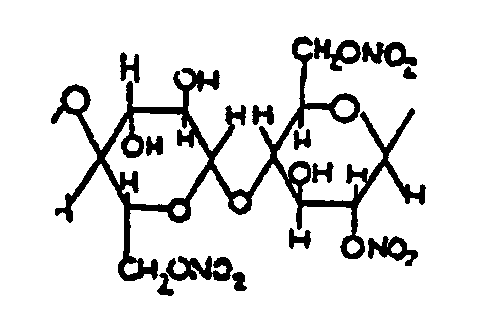
| 31 | Cellulose derivative: |
| This subclass is indented under subclass 29. Subject matter wherein the carbohydrate is a nitrogen compound
containing repeating glucose units, which repeating units have the
following structure:
| |
| 32 | Solid polymer derived from ethylenic reactants only: |
| This subclass is indented under subclass 31. Subject matter wherein the carbohydrate is mixed with a solid polymer derived from only ethylenic reactants. | |
| 33 | Solid polymer or SICP derived from at least one aldehyde or aldehyde derivative reactant: | ||
This subclass is indented under subclass 31. Subject matter wherein the carbohydrate is admixed with
a solid polymer or specified intermediate condensation product derived from
at least one aldehyde or aldehyde derivative.
| |||
| 34 | Paper plant solid waste material or cotton, e.g., white liquor, etc.: |
| This subclass is indented under subclass 27. Subject matter wherein the carbohydrate is a material in a paper making process, e.g., paper, etc., or is cotton. | |
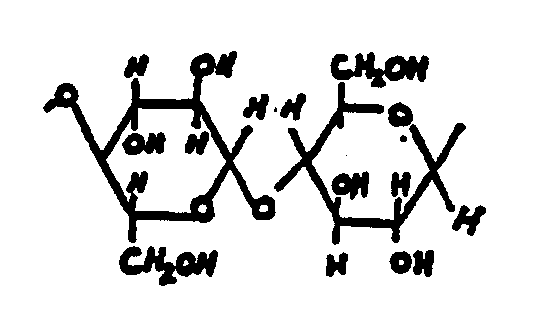
| 35 | Cellulose: | ||
| This subclass is indented under subclass 27. Subject matter wherein the carbohydrate contains repeating
glucose units, which repeating units have the following structure:
SEE OR SEARCH THIS CLASS, SUBCLASS:
| |||
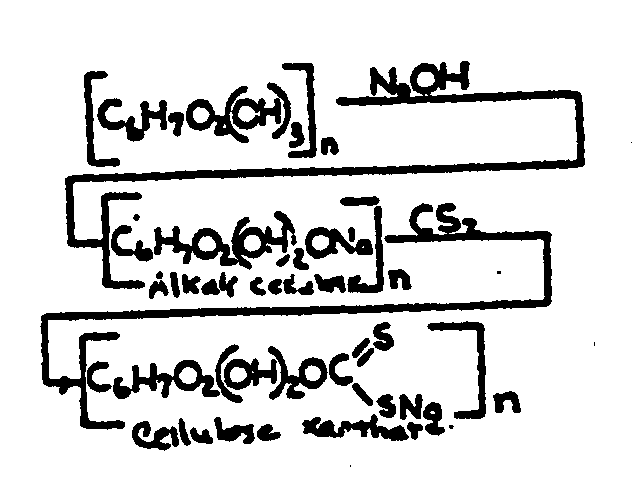
| 36 | Sulfur containing ester, e.g., viscose, xanthate, etc.: | ||||
This subclass is indented under subclass 35. Subject matter wherein the cellulose DNRM contains at least
one sulfur atom.
| |||||
| 37 | Carboxylic acid ester: | ||
This subclass is indented under subclass 35. Subject matter wherein the cellulose contains at least one
carboxylic acid ester group therein.
| |||
| 38 | Mixed carboxylate ester: | ||
This subclass is indented under subclass 37. Subject matter wherein the cellulose contains at least two
diverse carboxylic acid ester groups.
| |||
| 39 | Acetate: |
| This subclass is indented under subclass 38. Subject matter wherein at least one of the carboxylic acid ester groups of the cellulose is a -O - - CH3 group. | |
| 40 | At least one solid polymer derived from ethylenic reactants only: |
| This subclass is indented under subclass 39. Subject matter wheren the carbohydrate is mixed with a solid polymer derived from only ethylenic reactants. | |
| 41 | Acetate: |
| This subclass is indented under subclass 37. Subject matter wherein the cellulose contains at least one -O-- CH3 group. | |
| 42 | Ether group containing, other than solely linking of carbohydrate groups directly to each other: |
| This subclass is indented under subclass 35. Subject matter wherein the cellulose has the general formula R-O-R", wherein R-O- is a cellulose moiety and R" is a carbon atom of a noncarbohydrate containing organic radical. | |
| 43 | Hydroxyalkyl: |
| This subclass is indented under subclass 42. Subject matter wherein the cellulose has the general formula R-O-R"-OH wherein R-O- is a cellulose moiety and -R"-OH is a noncarbohydrate containing organic radical wherein a carbon of the R" group is directly bonded to an oxygen of the O-R group. | |
| 44 | Hydroxyethyl: |
| This subclass is indented under subclass 43. Subject matter wherein the R"-OH group of the cellulose DNRM contains the -O-C-C-OH group. | |
| 45 | Carboxyalkyl or alkali metal salt thereof: |
| This subclass is indented under subclass 42. Subject matter wherein the cellulose DNRM has the general formula R-O-R"--OH or R-O-R"- metal, wherein R-O- is a cellulose moiety and - R"--OH or -R"- metal are noncarbohydrate containing organic radicals and wherein a carbon of the R" group is directly bonded to an oxygen atom of the O-R group. | |
| 46 | Alkyl: |
| This subclass is indented under subclass 42. Subject matter wherein the cellulose DNRM has the general formula R-O-R", wherein R-O- is a cellulose moiety and R" is a carbon atom of a noncarbohydrate containing acyclic organic moiety. | |
| 47 | Starch or derivative or farinaceous meal or flour: | ||||||||||
This subclass is indented under subclass 27. Subject matter wherein the carbohydrate DNRM is a compound
containing amylose and amylopectin as its main components or derivatives
thereof; or wherein the DNRM is a farinaceous meal or flour.
| |||||||||||
| 48 | Dextrin or derivative: | ||
This subclass is indented under subclass 47. Subject matter wherein the starch is a gummy polysaccharide
produced by thermal or acid degradation of starch, and derivatives
of such compounds.
| |||
| 49 | Aldehyde reaction product: |
| This subclass is indented under subclass 47. Subject matter wherein the starch contains at least two aldehyde groups and is the product generally resulting from the reaction between starch or a derivative thereof and a reactant containing the functional group --OH and derivatives of such compounds. | |
| 50 | Ether group, other than solely linking of carbohydrate groups directly to each other: |
| This subclass is indented under subclass 47. Subject matter wherein the starch has the general formula R-O-R", wherein -R-O is a starch moiety and R" is a carbon atom of a noncarbohydrate containing organic radical and which carbon is not directly bonded to a chalcogen atom by a double bond. | |
| 51 | Ester: |
| This subclass is indented under subclass 47. Subject matter wherein the starch is a compound resulting from the reaction of a hydroxyl group of a starch and an acid. | |
| 52 | Solid polymer derived from ethylenic reactants only: |
| This subclass is indented under subclass 47. Subject matter wherein the carbohydrate is mixed with a solid polymer derived from only ethylenic reactants. | |
| 53 | At least one carboxylic acid ester: | ||
This subclass is indented under subclass 52. Subject matter wherein the solid polymer derived from ethylenic
reactants only is derived from at least one carboxylic acid ester.
| |||
| 54 | Dextran or derivative: | ||||
This subclass is indented under subclass 27. Subject matter wherein the carbohydrate is higher molecular
weight polysaccharide containing D-glucose units linked predominately as
D (1! 6).
| |||||
| 55 | Gum or derivative: |
| This subclass is indented under subclass 27. Subject matter wherein the carbohydrate is a highly branched polysaccharide composed of two or more monosaccharides and which are exudations of plants which are produced by the plant to cover wounds and to prevent attack by organisms. | |
| 56 | Disaccharide or trisaccharide, e.g., sucrose, etc.: | ||
This subclass is indented under subclass 27. Subject matter wherein the carbohydrate contains only two
or three monomeric units each of which contains at least five carbon
atoms.
| |||
| 57 | Ester: |
| This subclass is indented under subclass 56. Subject matter wherein the di or trisaccharide is a compound resulting from the reaction of a hydroxyl group of a di or trisaccharide and an acid. | |
| 58 | Monosaccharide, e.g., glucose, fructose, etc.: | ||
This subclass is indented under subclass 27. Subject matter wherein the carbohydrate contains only a
single unit containing at least five or more carbon atoms.
| |||
| 59 | Coal, bituminous additive, extract, or derivative thereof; or oil shale; or fatty still residue DNRM: | ||||||||||||||
This subclass is indented under subclass 1. Subject matter wherein a solid polymer or specified intermediate
condensation product is admixed with a designated nonreactant material
which is coal or a derivative or extract thereof; or is a bituminous
material or a derivative or extract thereof; or is a fatty still
residue.
SEE OR SEARCH THIS CLASS, SUBCLASS:
| |||||||||||||||
| 60 | With water additive DNRM: |
| This subclass is indented under subclass 59. Subject matter wherein the DNRM is in admixture with free water as a DNRM. | |
| 61 | With nitrogen containing additive DNRM: |
| This subclass is indented under subclass 60. Subject matter wherein a nitrogen containing DNRM is in admixture with the DNRM and water DNRM. | |
| 62 | With hydrocarbon DNRM additive which is nonresinous and which is nonbituminous, or noncoal derived, e.g., cutback asphalt, kerosene, paraffin wax, etc.: | ||||
This subclass is indented under subclass 59. Subject matter wherein the DNRM is admixed with a DNRM which
is a hydrocarbon material and which is other than coal or a bituminous material
or a hydrocarbon material proper for this subclass as a designated
nonreactant material.
SEE OR SEARCH THIS CLASS, SUBCLASS:
| |||||
| 63 | Coke additive: | ||
This subclass is indented under subclass 59. Subject matter wherein the DNRM is coke.
| |||
| 64 | Asphaltene or maltene additive: | ||||
This subclass is indented under subclass 59. Subject matter wherein the DNRM is asphaltene or a maltene
additive.
| |||||
| 65 | Coal derived additive, e.g., lignite, etc: | ||||||
This subclass is indented under subclass 59. Subject matter wherein the DNRM is coal or a material derived
therefrom.
SEE OR SEARCH THIS CLASS, SUBCLASS:
| |||||||
| 66 | Tar or pitch: |
| This subclass is indented under subclass 65. Subject matter wherein the DNRM is a mixed aromatic hydrocarbon product obtained by the distillation of bituminous coal. | |
| 67 | Oil shale: | ||||
This subclass is indented under subclass 59. Subject matter wherein the DNRM is oil shale rock.
| |||||
| 68 | Two or more solid polymers, or graft or graft-type, or block or block-type solid copolymer: | ||||
This subclass is indented under subclass 59. Subject matter wherein the DNRM is admixed with two or more
solid polymers, or with a block, block type, graft or graft type
solid copolymer.
| |||||
| 69 | Solid polymer derived from ethylenic reactants only at least one of which contains a carboxylic acid or derivative: | ||
This subclass is indented under subclass 59. Subject matter wherein the DNRM is admixed with a solid
polymer derived from only ethylenic reactants at least one of which
is a carboxylic acid or derivative.
| |||
| 70 | Solid polymer derived from ethylenic reactants only, at least one of which is propylene: |
| This subclass is indented under subclass 59. Subject matter wherein the DNRM is admixed with a solid polymer derived from ethylenic reactants only, at least one of which is propylene. | |
| 71 | Solid polymer derived from ethylenic reactants only, at least one of which is a hydrocarbon other than ethylene: |
| This subclass is indented under subclass 59. Subject matter wherein the DNRM is admixed with a solid polymer derived form ethylenic reactants only at least one of which is a hydrocarbon other than ethylene. | |
| 72 | Lignin or tannin or derivative DNRM: | ||||||||
This subclass is indented under subclass 1. Subject matter wherein a solid polymer or specified intermediate
condensation product is admixed with a designated nonreactant material
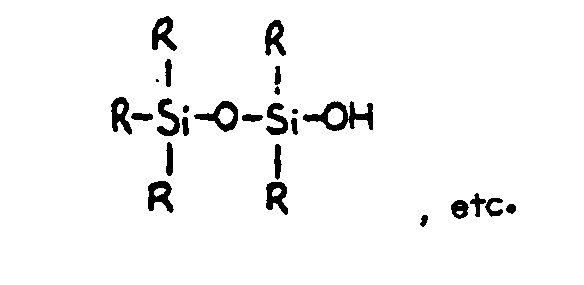
which is lignin or tannin or derivative thereof:
SEE OR SEARCH THIS CLASS, SUBCLASS:
| |||||||||
| 73 | Reaction product of lignin or tannin or derivative with an oxygen or nitrogen containing organic reactant: |
| This subclass is indented under subclass 72. Subject matter wherein the DNRM is a reaction product of a lignin or tannin or derivative and an organic reactant containing an oxygen or nitrogen atom, e.g., formaldehyde reacted lignin, etc. | |
| 74 | Solid polymer or specified intermediate condensation product derived from a phenolic compound: |
| This subclass is indented under subclass 72. Subject matter wherein a solid polymer or a specified intermediate condensation product derived from a phenolic monomer is present, e.g., resole resin, etc. | |
| 75 | Solid polymer contains halogen: | ||
This subclass is indented under subclass 72. Subject matter wherein the DNRM is admixed with a halogen-containing
solid polymer.
| |||
| 76 | Solid polymer derived from ethylenically unsaturated hydrocarbon only: |
| This subclass is indented under subclass 72. Subject matter wherein a solid polymer derived from ethylenically unsaturated hydrocarbon monomer only is present. | |
| 77 | Natural resin or modified forms thereof other than rosin or its modified forms DNRM, e.g., shellac, dammar, etc.: | ||||||||
This subclass is indented under subclass 1. Subject matter wherein a solid polymer or specified intermediate
condensation product is admixed with a designated nonreactant material
which is a natural resin and is other than a rosin or a modified
form thereof, e.g., shellac, dammar, copal, etc.
SEE OR SEARCH THIS CLASS, SUBCLASS:
| |||||||||
| 78 | Residue of undetermined constitution derived from destructive distillation of a plant or animal source or plant or animal extract of undetermined constitution DNRM: | ||||
This subclass is indented under subclass 1. Subject matter wherein a solid polymer or specified intermediate
condensation product is admixed with a designated nonreactant material,
which material is a residue of undetermined constitution and is
obtained from a destructive distillation process or from solvent extraction
of a plant or animal source, e.g., pine tar, wood tar, or pitch,
etc.
SEE OR SEARCH THIS CLASS, SUBCLASS:
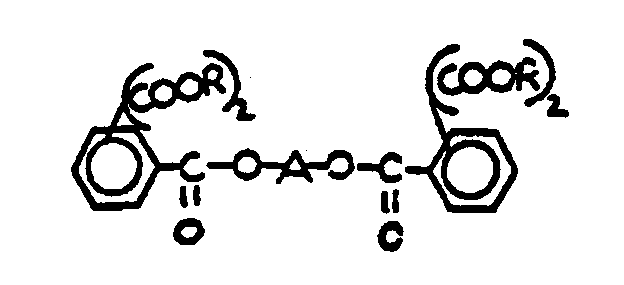
| |||||
| 79 | DNRM is derived from pyrolysis of previously formed solid synthetic polymer: |
| Subject matter or specified intermediate condensation product is admixed with a designated nonreactant material which is the product resulting from the decomposition of a solid synthetic polymer by heat. | |
| 80 | DNRM which is other than silicon dioxide, glass, titanium dioxide, water, halohydrocarbon, hydrocarbon, or elemental carbon: | ||||||||||||||||||
This subclass is indented under subclass 1. Subject matter wherein the added nonreactant material is
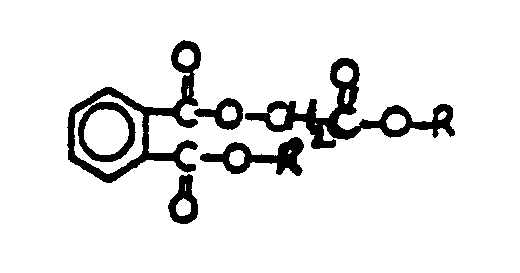
a designated nonreactant material (DNRM), and wherein the designated
nonreactant material is other than silicon dioxide, glass, hydrated
silicon dioxide, water in any of its physical states, elemental
carbon in any of its physical states, compounds containing only carbon
and hydrogen, or compounds containing only carbon, hydrogen, and
halogen, or only carbon and halogen.
SEE OR SEARCH THIS CLASS, SUBCLASS:
| |||||||||||||||||||
| 81 | Organic DNRM: | ||
This subclass is indented under subclass 80. Subject matter wherein the designated nonreactant material
is an organic material.
| |||
| 82 | Sulfur atom as part of a hetero ring DNRM: | ||||
This subclass is indented under subclass 81. Subject matter wherein the organic designated nonreactant
material is a compound containing a hetero ring with at least one
sulfur atom in the ring.
| |||||
| 83 | Hetero ring contains sulfur and at least one diverse hetero atom: |
| This subclass is indented under subclass 82. Subject matter wherein the hetero ring contains at least one hetero atom other than sulfur, i.e., oxygen, nitrogen, selenium, or tellurium. | |
| 84 | Five-membered sulfur ring: |
| This subclass is indented under subclass 82. Subject matter wherein the hetero ring is a five-membered ring. | |
| 85 | Three-memered sulfur ring: |
| This subclass is indented under subclass 82. Subject matter wherein the hetero ring is a three-membered ring. | |
| 86 | Nitrogen atom as part of a hetero ring DNRM: | ||
This subclass is indented under subclass 81. Subject matter wherein the organic designated nonreactant
material is a compound containing a hetero ring with at least one
nitrogen atom in the ring.
| |||
| 87 | Nitrogen ring directly fused or bridged to a ring system: | ||||
This subclass is indented under subclass 86. Subject matter wherein the hetero nitrogen ring is directly
fused or bridged to a ring system.
| |||||
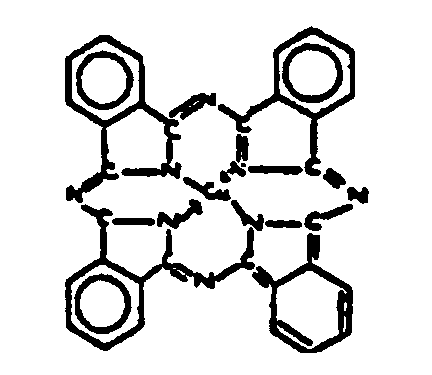
| 88 | Tetrabenzoporphyrazine nucleus containing, e.g., phthalocyanine, etc: |
| This subclass is indented under subclass 87. Subject matter wherein the fused or bridged nitrogen ring
system contains a tetrabenzoporphyrazine nucleus (four benzopyrrole
nuclel joined by four nitrogen atoms, e.g., phthalocyanine pigment
| |
| 89 | Nitrogen ring is part of a ring system having three or more rings fused or bridged together: |
| This subclass is indented under subclass 87. Subject matter wherein the fused or bridged nitrogen ring system contains at least three rings. | |
| 90 | Nitrogen ring is part of a ring system having five or more rings fused or bridged together: |
| This subclass is indented under subclass 89. Subject matter wherein the fused or bridged nitrogen ring system has at least five rings. | |
| 91 | Three or more nitrogen atoms in the fused or bridged ring system: | ||||
This subclass is indented under subclass 87. Subject matter wherein the fused or bridged hetero nitrogen
ring containing ring system contains three or more nitrogen atoms.
SEE OR SEARCH THIS CLASS, SUBCLASS:
| |||||
| 92 | Two nitrogen atoms in the fused or bridged ring system: |
| This subclass is indented under subclass 87. Subject matter wherein the fused- or bridged-hetero ring containing ring system contains only two nitrogen atoms. | |
| 93 | 1,3-diazole: |
| This subclass is indented under subclass 92. Subject matter wherein the fused- or bridged-hetero ring
containing ring system contains a 1,3-diazole ring, e.g., imidazole;
| |
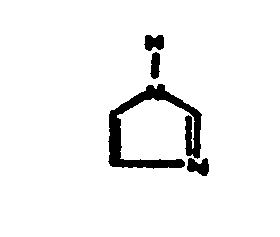
| 94 | Five-membered nitrogen containing ring: |
| This subclass is indented under subclass 87. Subject matter wherein the fused- or bridged-hetero ring is a five-membered nitrogen containing ring. | |
| 95 | At least one diverse hetero atom in same ring: |
| This subclass is indented under subclass 86. Subject matter wherein the hetero ring contains at least one hetero atom other than nitrogen, i.e., oxygen, sulfur, selenium, or tellurium. | |
| 96 | Six-membered nitrogen ring having at least one diverse hetero atom, e.g., morpholine, etc.: |
| This subclass is indented under subclass 95. Subject matter wherein the hetero ring is a six-membered nitrogen containing ring, e.g., morpholine, etc. | |
| 97 | Two or more nitrogen rings: |
| This subclass is indented under subclass 96. Subject matter wherein the heterocyclic compound contains at least one nitrogen hetero-containing ring in addition to the six-membered hetero ring. | |
| 98 | Nitrogen ring having at least seven ring members: |
| This subclass is indented under subclass 86. Subject matter wherein the nitrogen hetero ring contains at least seven ring members, e.g., caprolactam, etc. | |
| 99 | Six-membered nitrogen ring, e.g., pyridine, etc.: |
| This subclass is indented under subclass 86. Subject matter wherein the nitrogen hetero ring is a six-membered ring, e.g., pyridine, etc. | |
| 100 | Six-membered nitrogen ring having two or more ring nitrogen atoms: |
| This subclass is indented under subclass 99. Subject matter wherein the six-membered N hetero ring contains two or more ring nitrogen atoms. | |
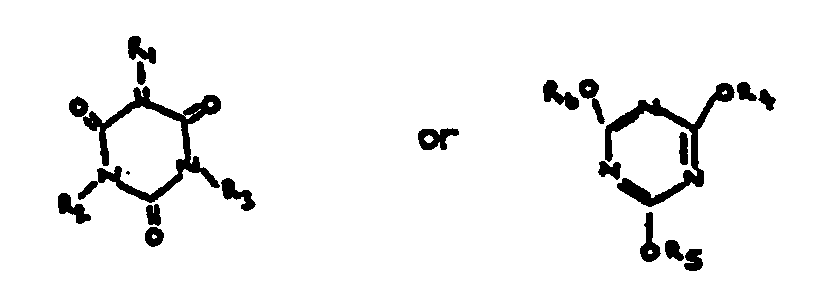
| 101 | Three oxygen atoms are directly bonded to three nuclear carbon atoms of the nitrogen ring, e.g., (iso) cyanurate, etc.: |
| This subclass is indented under subclass 100. Subject matter wherein three nuclear carbon atoms of the
six-membered hetero ring are directly bonded to three oxygen atoms,
e.g., as illustrated below, etc.
| |
| 102 | Two or more nitrogen rings: |
| This subclass is indented under subclass 99. Subject matter wherein the heterocyclic compound contains at least one hetero nitrogen containing ring in addition to the six-membered hetero ring. | |
| 103 | Nonhetero nitrogen: |
| This subclass is indented under subclass 102. Subject matter wherein the heterocyclic compound contains a nitrogen atom other than the nitrogen atom in a hetero ring. | |
| 104 | Five-membered nitrogen ring: |
| This subclass is indented under subclass 86. Subject matter wherein the nitrogen hetero ring is a five-membered ring. | |
| 105 | Two or more nitrogen rings: |
| This subclass is indented under subclass 104. Subject matter wherein the heterocyclic compound contains at least one nitrogen hetero ring in addition to the five-membered hetero ring. | |
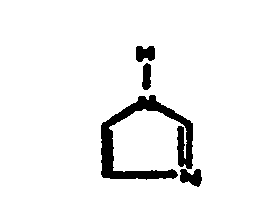
| 106 | Five-membered nitrogen ring having two or more ring nitrogen atoms: |
| This subclass is indented under subclass 104. Subject matter wherein the five-membered hetero ring contains
at least two ring nitrogen atoms, e.g., as illustrated below, etc.
| |
| 107 | At least one chalcogen atom as part of a hetero ring (chalcogen=O, Se, Te) DNRM: | ||||||
This subclass is indented under subclass 81. Subject matter wherein the organic designated nonreactant
material is a compound containing a hetero ring with at least one
chalcogen atom (i.e., oxygen, selenium, or tellurium) in the ring.
SEE OR SEARCH THIS CLASS, SUBCLASS:
| |||||||
| 108 | Two or more chalcogen atoms in the same hetero ring: |
| This subclass is indented under subclass 107. Subject matter wherein the hetero ring contains at least two chalcogen atoms therein. | |
| 109 | Two or more chalcogen rings: | ||||
This subclass is indented under subclass 107. Subject matter wherein the heterocyclic compound contains
two or more hetero rings.
| |||||
| 110 | Six-membered chalcogen ring: |
| This subclass is indented under subclass 107. Subject matter wherein the hetero ring is a six-membered ring. | |
| 111 | Five-membered chalcogen ring: |
| This subclass is indented under subclass 107. Subject matter wherein the hetero ring is a five-membered ring. | |
| 112 | Cyclic polycarboxylic acid anhydride: | ||
This subclass is indented under subclass 111. Subject matter wherein the five-membered hetero ring contains
an oxygen hetero atom as part of a cyclic polycarboxylic acid anhydride,
e.g., illustrated below, etc.
| |||
| 113 | Tetrahydrofuran per se: |
| This subclass is indented under subclass 111. Subject matter wherein the five-membered hetero ring is tetrahydrofuran, per se, i.e., C4H8O. | |
| 114 | Three-membered chalcogen ring: | ||
This subclass is indented under subclass 107. Subject matter wherein the hetero ring is a three-membered
ring.
| |||
| 115 | Phosphorus organic compound DNRM: |
| This subclass is indented under subclass 81. Subject matter wherein the organic designated nonreactant material is a compound containing a phosphorus atom. | |
| 116 | Phosphorus is part of a covalent ring: | ||||
This subclass is indented under subclass 115. Subject matter wherein the phosphorus atom is covalently
bonded in a ring system.
| |||||
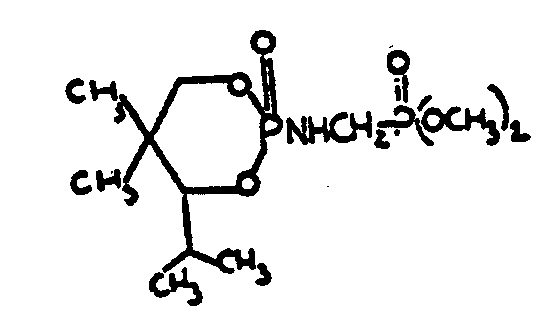
| 117 | Oxygen ring atom: |
| This subclass is indented under subclass 116. Subject matter wherein the phosphorus ring contains at least
one oxygen ring atom, e.g., as illustrated below, etc.
| |
| 118 | Halogen: |
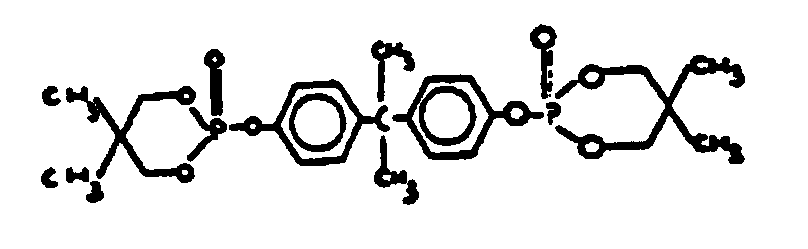
| This subclass is indented under subclass 117. Subject matter wherein the phosphorus ring compound contains a halogen atom. | |
| 119 | Two or more phosphorus rings: |
| This subclass is indented under subclass 117. Subject matter wherein the phosphorus ring compound contains
two or more phosphorus rings, e.g., as illustrated below, etc.
| |
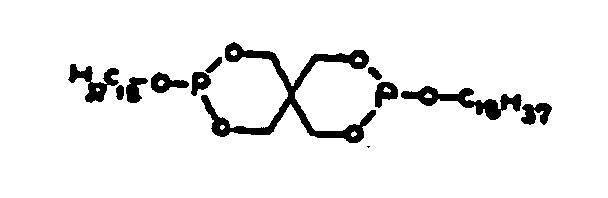
| 120 | Spiro ring: | ||
| This subclass is indented under subclass 119. Subject matter wherein the phosphorus compound contains
a spiro ring system, e.g., distearyl pentaerythritol diphosphite,
as illustrated below, etc.
| |||
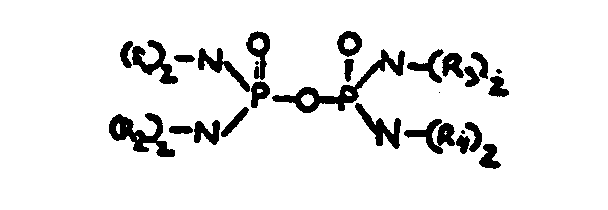
| 121 | Two or more phosphorus atoms directly or indirectly bonded together by only covalent bonds: |
| This subclass is indented under subclass 115. Subject matter wherein the phosphorus compound contains
two or more phosphorus atoms bonded directly or through other atoms
to each other by only covalent bonds, e.g., as illustrated below,
etc.
| |
| 122 | Phosphorus double bonded to an atom other than C or O: |
| This subclass is indented under subclass 121. Subject matter wherein at least one of the phosphorus atoms is double bonded to an atom other than carbon or oxygen. | |
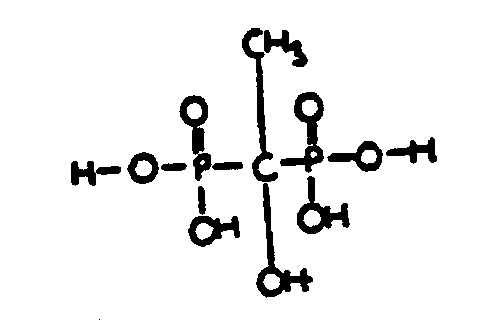
| 123 | Phosphorus bonded directly to three chalcogen atoms and having only one P-C linkage e.g., phosphonate, etc.: |
| This subclass is indented under subclass 121. Subject matter wherein the phosphorus is directly bonded
to three chalcogen atoms (i.e., oxygen, sulfur, selenium, or tellurium),
and a single carbon atoms, e.g., 1-hydroxyethane, 1,1-diphosphonic
acid, as illustrated below, etc.
| |
| 124 | Nitrogen: |
| This subclass is indented under subclass 123. Subject matter wherein the phosphorus compound contains a nitrogen atom. | |
| 125 | Aryl group: |
| This subclass is indented under subclass 123. Subject matter wherein the phosphorus compound contains an aryl group. | |
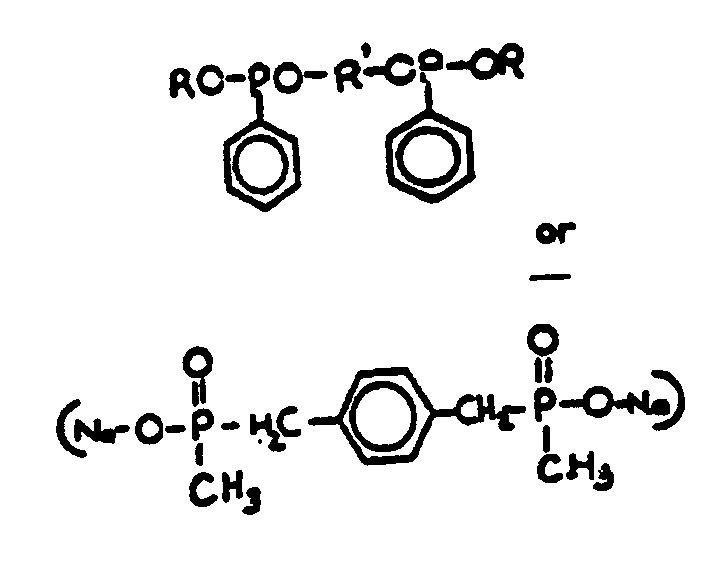
| 126 | Phosphorus bonded directly to only two chalcogen atoms and having at least one P-C linkage, e.g., phosphinate, phosphonite, etc.: |
| This subclass is indented under subclass 121. Subject matter wherein a phosphorus is directly bonded to
only two chalcogen atoms (i.e., oxygen, sulfur, selenium, or tellurium)
and at least one carbon atom, e.g., as illustrated below, etc.
| |
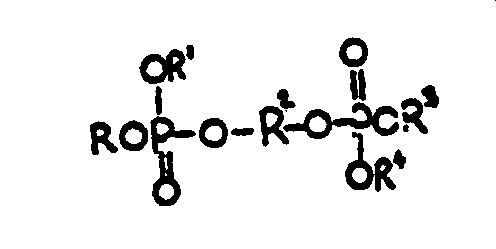
| 127 | Phosphorus bonded directly to four chalcogen atoms, e.g., phosphate, etc.: |
| This subclass is indented under subclass 121. Subject matter wherein a phosphorus is directly bonded to
four chalcogen atoms only (i.e., oxygen, sulfur, selenium or tellurium),
e.g., a bis-phosphate compound, as illustrated below, etc.
| |
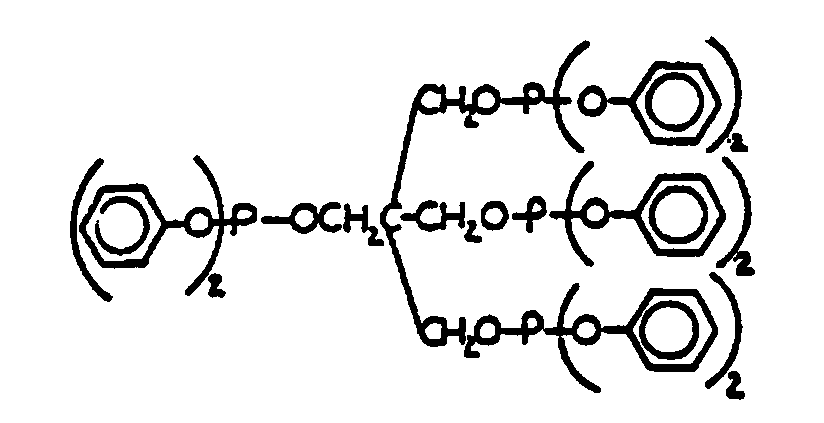
| 128 | Phosphorus bonded directly to three chalcogen atoms only, e.g., phosphite, etc.: |
| This subclass is indented under subclass 121. Subject matter wherein a phosphorus is directly bonded to
three chalcogen atoms only (i.e., oxygen, sulfur, selenium, or tellurium),
e.g., as illustrated below, etc.
| |
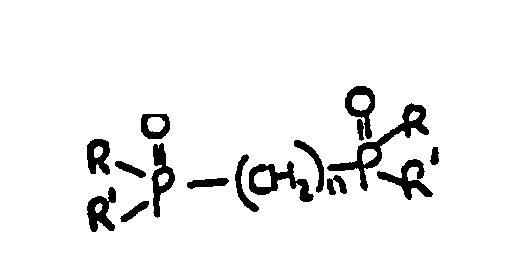
| 129 | Phosphorus directly bonded to at least one chalcogen and only H or C, e.g., phosphine oxide, etc.: |
| This subclass is indented under subclass 121. Subject matter wherein a phosphorus is directly bonded to
at least one chalcogen atom (i.e., oxygen, sulfur, selenium, or
tellurium) and only to hydrogen or carbon atom s, e.g.,
| |
| 130 | Phosphorus bonded to three chalcogen atoms and having only one P-C linkage: |
| This subclass is indented under subclass 115. Subject matter wherein the phosphorus is directly bonded to three chalcogen atoms (i.e., oxygen, sulfur, selenium, or tellurium) and a single carbon atom. | |
| 131 | Chalcogen other than directly bonded to P: |
| This subclass is indented under subclass 130. Subject matter wherein the phosphorus compound contains a chalcogen atom other than the chalcogen directly bonded to phosphorus. | |
| 132 | Aryl group: |
| This subclass is indented under subclass 130. Subject matter wherein the phosphorus compound contains an aryl group. | |
| 133 | Phosphorus bonded to only two chalcogen atoms and having at least one P-C linkage: |
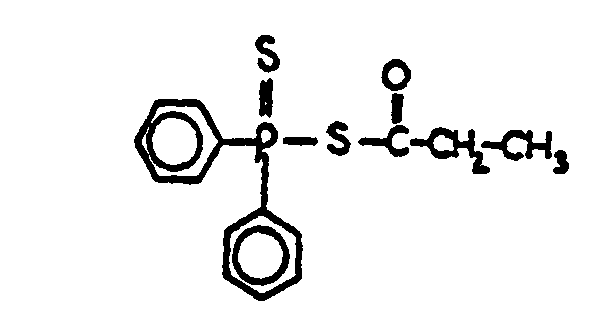
| This subclass is indented under subclass 115. Subject matter wherein the phosphorus is directly bonded to two chalcogen atoms only (i.e., oxygen, sulfur, selenium, or tellurium) and at least one carbon atom. | |
| 134 | Sulfur: |
| This subclass is indented under subclass 133. Subject matter wherein the phosphorus compound contains
a sulfur atom, e.g., as illustrated below, etc.
| |
| 135 | Aryl group: |
| This subclass is indented under subclass 133. Subject matter wherein the phosphorus compound contains an aryl group. | |
| 136 | Pentavalent phosphorus atom directly bonded to at least one oxygen atom: |
| This subclass is indented under subclass 115. Subject matter wherein the phosphorus is a pentavalent phosphorus atom directly bonded to at least one oxygen atom. | |
| 137 | P directly bonded to S: |
| This subclass is indented under subclass 136. Subject matter wherein the phosphorus is directly bonded to a sulfur atom. | |
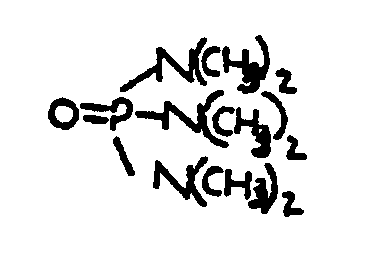
| 138 | P Directly Bonded to Two or More N: |
| This subclass is indented under subclass 136. Subject matter wherein the phosphorus is directly bonded
to two or more nitrogen atoms, e.g., as illustrated below, phosphorus
acid-tris-dimethyl amide, etc.
| |
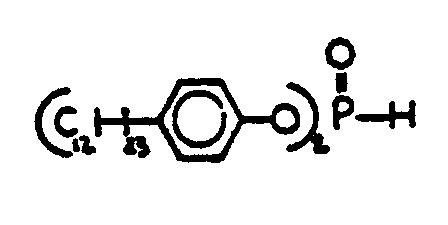
| 139 | Phoshorus directly bonded to at least one O and at least one H or C only: |
| This subclass is indented under subclass 136. Subject matter wherein the phosphorus is directly bonded
to at least one hydrogen or carbon atom and no other atom, e.g.,
as illustrated below, bis(p-dodecylphenyl) phosphite, etc.
| |
| 140 | P directly bonded to oxygen only: |
| This subclass is indented under subclass 136. Subject matter wherein the phosphorus is directly bonded to oxygen atoms only. | |
| 141 | Aryl group: |
| This subclass is indented under subclass 140. Subject matter wherein the phosphorus compound contains an aryl group. | |
| 142 | Halogen: |
| This subclass is indented under subclass 141. Subject matter wherein the phosphorus compound contains a halogen atom. | |
| 143 | Cresyl phosphate, e.g., di, etc.: |
| This subclass is indented under subclass 141. Subject matter wherein the phosphorus compound is a cresyl phosphate, e.g., dicresyl phosphate, etc. | |
| 144 | Halogen: |
| This subclass is indented under subclass 140. Subject matter wherein the phosphorus compound contains a halogen atom. | |
| 145 | -C-O-P-O-C or C-O-P-OH group, e.g., phosphate ester, lecithin, etc.: | ||
This subclass is indented under subclass 140. Subject matter wherein the phosphorus compound is a phosphorus
ester having at least two ester groups (i.e., C-O-P-O-C), or a phosphorus ester
having a single ester group (i.e., C-O-P-OH).
| |||
| 146 | Phosphorus directly bonded to sulfur: |
| This subclass is indented under subclass 115. Subject matter wherein the phosphorus atom is directly bonded to a sulfur atom, e.g., tris (octadecyl thioglycolyl) phosphite, etc. | |
| 147 | Phosphorus directly bonded to oxygen: |
| This subclass is indented under subclass 115. Subject matter wherein the phosphorus atoms is directly bonded to an oxygen atom. | |
| 148 | Atom other than C, O, H, P, or Hal: |
| This subclass is indented under subclass 147. Subject matter wherein the phosphorus compound contains an atom other than C, O, H, P, or halogen. | |
| 149 | Halogen: |
| This subclass is indented under subclass 147. Subject matter wherein the phosphorus compound contains a halogen atom. | |
| 150 | Five or more aryl groups: | ||
This subclass is indented under subclass 147. Subject matter wherein the phosphorus compound contains
five or more aryl groups.
| |||
| 151 | Two or more aryl groups: | ||
This subclass is indented under subclass 147. Subject matter wherein the phosphorus compound contains
two or more aryl groups.
| |||
| 152 | OH group: |
| This subclass is indented under subclass 151. Subject matter wherein the phosphorus compound contains a hydroxyl group (i.e., -OH). | |
| 153 | Triphenyl phosphite per se: |
| This subclass is indented under subclass 151. Subject matter wherein the phosphorus compound is triphenyl phosphite, per se (i.e., C18H15O3P). | |
| 154 | Phosphorus directly bonded to carbon atoms only: |
| This subclass is indented under subclass 115. Subject matter wherein the phosphorus atom is directly bonded to carbon atoms only. | |
| 155 | Organic compound having a sulfur bonded directly ot oxygen DNRM: | ||||
| This subclass is indented under subclass 81. Subject matter wherein the organic designated nonreactant
material is a compound containing a sulfur atom directly bonded
to at least one oxygen atom.
SEE OR SEARCH THIS CLASS, SUBCLASS:
| |||||
| 156 | Sulfur bonded directly to four oxygen atoms: |
| This subclass is indented under subclass 155. Subject matter wherein a sulfur atom is directly bonded to four oxygen atoms. | |
| 157 | Sulfur bonded directly to three oxygen atoms: |
| This subclass is indented under subclass 155. Subject matter wherein a sulfur atom is directly bonded to three oxygen atoms. | |
| 158 | Aryl group: |
| This subclass is indented under subclass 157. Subject matter wherein the sulfur compound contains an aryl group. | |
| 159 | Nitrogen: |
| This subclass is indented under subclass 158. Subject matter wherein the sulfur compound contains a nitrogen atom. | |
| 160 | Fused or bridged ring system: | ||
This subclass is indented under subclass 158. Subject matter wherein the sulfur compound contains a fused-
or bridged-ring system.
| |||
| 161 | Metal: | ||
This subclass is indented under subclass 158. Subject matter wherein the sulfur compound contains a metal
atom.
| |||
| 162 | At least two separate aryl groups: |
| This subclass is indented under subclass 161. Subject matter wherein the metal containing sulfur compound contains at least two aryl groups. | |
| 163 | Halogen: |
| This subclass is indented under subclass 162. Subject matter wherein the sulfur compound contains a halogen atom. | |
| 164 | Halogen: |
| This subclass is indented under subclass 161. Subject matter wherein the sulfur compound contains a halogen atom. | |
| 165 | Halogen: |
| This subclass is indented under subclass 157. Subject matter wherein the sulfur compound contains a halogen atom. | |
| 166 | Metal: | ||
This subclass is indented under subclass 157. Subject matter wherein the sulfur compound contains a metal
atom.
| |||
| 167 | Sulfur bonded directly to two oxygen atoms, e.g., sulfones, etc.: |
| This subclass is indented under subclass 155. Subject matter wherein a sulfur atom is directly bonded to two oxygen atoms, e.g., sulfone, etc. | |
| 168 | Sulfur bonded directly to nitrogen: |
| This subclass is indented under subclass 167. Subject matter wherein a sulfur atom is directly bonded to a nitrogen atom. | |
| 169 | Aryl group which is not fused or bridged: | ||
This subclass is indented under subclass 168. Subject matter wherein the sulfur compound contains at least
one aryl group which is not part of a fused or bridged ring system.
| |||
| 170 | Aryl group: |
| This subclass is indented under subclass 167. Subject matter wherein the sulfur compound contains an aryl group. | |
| 171 | Oxygen atom other than as part of a sulfur bonded directly to two oxygen atoms: |
| This subclass is indented under subclass 170. Subject matter wherein the aryl sulfur compound contains an oxygen atom which is other than as part of a SO2 group. | |
| 172 | Atom other than C, H, S, O, or metal: | ||
This subclass is indented under subclass 170. Subject matter wherein the aryl containing sulfur compound
contains an atom other than carbon, hydrogen, sulfur, oxygen, or
a metal.
| |||
| 173 | Sulfur directly bonded to oxygen and devoid of an aryl group, e.g., dimethyl sulfoxide, etc.: |
| This subclass is indented under subclass 155. Subject matter wherein the sulfur compound is devoid of an aryl group, e.g., dimethyl sulfoxide, etc. | |
| 174 | Organic compound having at least one metal atom directly bonded to a carbon or hydrogen atom DNRM: | ||
This subclass is indented under subclass 81. Subject matter wherein the organic designated nonreactant
material compound is a compound containing at least one metal to
hydrogen bond or at least one metal to carbon bond.
| |||
| 175 | Heavy metal directly bonded to carbon or hydrogen atom: |
| This subclass is indented under subclass 174. Subject matter wherein the heavy metal compound contains at least one heavy metal to carbon or heavy metal to hydrogen bond. | |
| 176 | Transition metal (at no. 21-29, 39-47, 57-79): | ||||
This subclass is indented under subclass 175. Subject matter wherein the heavy metal compound contains
at least one transition metal atom.
| |||||
| 177 | Group VA metal (Sb, Bi, As): | ||
This subclass is indented under subclass 175. Subject matter wherein the heavy metal compound contains
at least one Group VA metal atom (Sb, Bi, As).
| |||
| 178 | Tin atom: | ||
This subclass is indented under subclass 175. Subject matter wherein the heavy metal compound contains
at least one atom of tin.
| |||
| 179 | At least one sulfur atom: |
| This subclass is indented under subclass 178. Subject matter wherein the tin compound contains at least one sulfur atom. | |
| 180 | Sulfur directly bonded to tin: | ||
This subclass is indented under subclass 179. Subject matter wherein at least one tin atom is directly
bonded to a sulfur atom.
| |||
| 181 | With additional tin compound DNRM: |
| This subclass is indented under subclass 180. Subject matter wherein the sulfur containing tin compound is admixed with a tin compound DNRM. | |
| 182 | At least two tin atoms: |
| This subclass is indented under subclass 180. Subject matter wherein the sulfur tin compound contains at least two tin atoms. | |
| 183 | Boron organic compound DNRM: |
| This subclass is indented under subclass 81. Subject matter wherein the organic designated nonreactant material is a compound containing at least one boron atom. | |
| 184 | Atom other than B, O, H, or C: |
| This subclass is indented under subclass 183. Subject matter wherein the boron compound contains at least one atom which is other than boron, carbon, oxygen, or hydrogen. | |
| 185 | Atom is N: |
| This subclass is indented under subclass 184. Subject matter wherein the boron compound contains at least one nitrogen atom. | |
| 186 | Organo nitrogen compound other than unsubstituted ammonium salt as sole nitrogen atom DNRM: | ||
| This subclass is indented under subclass 81. Subject matter wherein the organic designated nonreactant
material is a nitrogen compound containing at least one nitrogen
atom other than as an unsubstituted ammonium (NH4+)
salt.
SEE OR SEARCH THIS CLASS, SUBCLASS:
| |||
| 187 | Contains rosin or derivative DNRM: | ||
This subclass is indented under subclass 186. Subject matter wherein the organic nitrogen DNRM contains
an abietyl moiety therein or wherein the nitrogen DNRM is admixed
with an abietyl DNRM containing compound.
| |||
| 188 | Silicon atom: |
| This subclass is indented under subclass 186. Subject matter wherein the nitrogen compound contains a silicon atom. | |
| 189 | Nitrogen to nitrogen bond: |
| This subclass is indented under subclass 186. Subject matter wherein the nitrogen compound contains at least two nitrogen atoms which are bonded directly to one another. | |
| 190 | N=N group: |
| This subclass is indented under subclass 189. Subject matter wherein the nitrogen compound contains a N=N group. | |
| 191 | X=C-N group wherein X is a chalcogen: | ||||
This subclass is indented under subclass 189. Subject matter wherein the nitrogen compound contains a
X=C-N group wherein X is a chalcogen atom.
| |||||
| 192 | Two or more N-N bonds: |
| This subclass is indented under subclass 191. Subject matter wherein the nitrogen compound contains at least two N-N groups. | |
| 193 | Aryl-OH: |
| This subclass is indented under subclass 192. Subject matter wherein the nitrogen compound contains at least one aryl ring and wherein at least one nuclear carbon atom of the aryl ring is directly bonded to an oxygen atom of the hydroxyl group. | |
| 194 | Aryl-OH: |
| This subclass is indented under subclass 191. Subject matter wherein the nitrogen compound containing a N-N group also contains at least one aryl ring; and wherein at least one nuclear carbon atom of an aryl ring is bonded to an oxygen atom of a hydroxly group. | |
| 195 | N=C=N or N=C-N group, e.g., carbodiimide, isourea, etc.: |
| This subclass is indented under subclass 186. Subject matter wherein the nitrogen compound contains at least one N=C=N or N=C-N group, e.g., carbodiimide, isoureas, etc. | |
| 196 | N=C=X group wherein X is a chalcogen, e.g., isocyanate, etc.: | ||
This subclass is indented under subclass 186. Subject matter wherein the nitrogen compound contains at
least one N=C=X group wherein X is a chalcogen
atom, e.g., isocyanate, etc.
| |||
| 197 | At least one solid polymer derived from ethylenic reactants only: |
| This subclass is indented under subclass 196. Subject matter wherein the nitrogen compound is mixed with at least one solid polymer derived from ethylenic reactants only. | |
| 198 | N-(C=O)-O-, e.g., urethane, carbamate, etc.: |
| This subclass is indented under subclass 186. Subject matter wherien the nitrogen compound contains at least one N--O- group, e.g., urethane, carbamate, etc. | |
| 199 | Oxygen other than as part of a N(C=O)-O- group: | ||
This subclass is indented under subclass 198. Subject matter wherein the nitrogen compound contains an
additional oxygen atom which is not the oxygen of a N--O- group.
| |||
| 200 | Atom other than N, H, C, or O: |
| This subclass is indented under subclass 198. Subject matter wherein the nitrogen compound contains an atom which is other than N, C, O, or H. | |
| 201 | N(C=X)X wherein X is a chalcogen, e.g., thiocarbamate, etc.: | ||||
This subclass is indented under subclass 186. Subject matter wherein the nitrogen compound contains at
least one N--X- group wherein X is a chalcogen atom, e.g., thiocarbamate,
etc.
SEE OR SEARCH THIS CLASS, SUBCLASS:
| |||||
| 202 | Metal or ammonium group: | ||
This subclass is indented under subclass 201. Subject matter wherein the nitrogen compound contains a
metal or ammonium group.
| |||
| 203 | With chalcogen nonreactive organic compound: | ||
This subclass is indented under subclass 201. Subject matter wherein the nitrogen compound containing
at least one metal or ammonium group is admixed with an additional
NRM containing a chalcogen atom.
| |||
| 204 | Heavy metal or aluminum: |
| This subclass is indented under subclass 186. Subject matter wherein the nitrogen compound contains at least one heavy metal or aluminum atom. | |
| 205 | Nitrile group: |
| This subclass is indented under subclass 186. Subject matter wherein the nitrogen compound contains at least one C=N group. | |
| 206 | Nitrogen atom other than as part of a nitrile group: |
| This subclass is indented under subclass 205. Subject matter wherein the nitrogen compound contains a nitrogen atom which is not part of the C=N group. | |
| 207 | Atom other than C, H, or N: | ||
This subclass is indented under subclass 206. Subject matter wherein the nitrogen compound contains an
atom which is other than C, H, or N.
| |||
| 208 | Atom other than C, H, or N: | ||
This subclass is indented under subclass 205. Subject matter wherein the nitrogen compound contains an
atom other than C, H, or N.
| |||
| 209 | Two or more nitrile groups: |
| This subclass is indented under subclass 205. Subject matter wherein the nitrogen compound contains two or more C=N groups. | |
| 210 | N-C=X group wherein X is a chalcogen: | ||
This subclass is indented under subclass 186. Subject matter wherein the nitrogen compound contains at
least one N-- group wherein X is a chalcogen atom.
| |||
| 211 | N-(C=X)N, e.g., Urea, etc.: | ||
This subclass is indented under subclass 210. Subject matter wherein the nitrogen compound contains at
least one N--N group.
| |||
| 212 | Two or more -N-(C=X)N groups: |
| This subclass is indented under subclass 211. Subject matter wherein the nitrogen compound contains at least two -N--N- groups. | |
| 213 | Atom other than C, N, H, or chalcogen; or contains nitrogen or chalcogen atom other than as part of a N(C=X)N group: |
| This subclass is indented under subclass 211. Subject matter whereinthe N--N compound contains an atom other than H, N, C, or chalcogen; or contains a chalcogen or nitogen atom which is not part of the -N--N group. | |
| 214 | Carboxyclic group: |
| This subclass is indented under subclass 211. Subject matter wherein the N--N compound contains a ring composed solely of carbon atoms. | |
| 215 | With water NRM: |
| This subclass is indented under subclass 211. Subject matter wherein the N--N compound is in admixture with free water as a nonreactant material. | |
| 216 | At least one solid polymer derived from ethylenic reactants only: |
| This subclass is indented under subclass 211. Subject matter wherein the N--N compound is mixed with at least one solid polymer derived from ethylenic reactants only. | |
| 217 | N atom other than as part of a N-C=X group: |
| This subclass is indented under subclass 210. Subject matter wherein the N- compound contains at least two nitrogen atoms and wherein at least one of the nitrogen atoms is not part of the N- groups. | |
| 218 | C=X group other than as part of a N-C=X group: |
| This subclass is indented under subclass 210. Subject matter wherein the N- compound contains a -- group which is not part of the -N- group. | |
| 219 | (C=X)X group: | ||||
| This subclass is indented under subclass 218. Subject matter wherein the N- compound contains a --X group.
SEE OR SEARCH THIS CLASS, SUBCLASS:
| |||||
| 220 | C-O-C group: |
| This subclass is indented under subclass 210. Subject matter wherein the N- compound contains a -C-O-C- group. | |
| 221 | C-OH group: |
| This subclass is indented under subclass 210. Subject matter wherein the N- compound contains a C-OH group. | |
| 222 | Aryl -OH group: |
| This subclass is indented under subclass 221. Subject matter wherein the N- compound contains at least one aryl ring and wherein at least one of the nuclear carbons of the aryl ring is directly bonded to the oxygen atom of a hydroxyl group. | |
| 223 | Two or more N-C=X groups or two or more C-OH groups: |
| This subclass is indented under subclass 221. Subject matter wherein the -N- compound contains two or more N- groups or two or more C-OH groups. | |
| 224 | At least one solid polymer derived from ethylenic reactants only: |
| This subclass is indented under subclass 221. Subject matter wherein the N- compound is mixed with at least one solid polymer derived form ethylenic reactants only. | |
| 225 | Atom other than N, C, H, or oxygen: |
| This subclass is indented under subclass 210. Subject matter wherein the N- compound contains at least one atom which is other than N, C, H, or oxygen. | |
| 226 | Carbocyclic group: |
| This subclass is indented under subclass 210. Subject matter wherein the N-- compound contains at least one ring composed solely of carbon atoms, e.g., aryl, etc. | |
| 227 | Two or more N-C=O groups: |
| This subclass is indented under subclass 210. Subject matter wherein the N- compound contains two or more N- groups. | |
| 228 | At least one solid polymer derived from ethylenic reactants only: |
| This subclass is indented under subclass 227. Subject matter wherein the -N- compound is mixed with at least one solid polymer derived from ethylenic reactants only. | |
| 229 | At least one solid polymer derived from acyclic monoethylenic hydrocarbon reactant: |
| This subclass is indented under subclass 228. Subject matter wherein at least one of the reactants used in the preparation of the solid polymer derived from ethylenic reactants only is an acyclic monoethylenic hydrocarbon reactant. | |
| 230 | N-(C=O)alkyl wherein alkyl group contains eight or more carbon atoms: | ||
| This subclass is indented under subclass 210. Subject matter wherein the N-- compound contains an N--R
group, wherein the R group is an alkyl radical and wherein the alkyl
radical has at least eight carbon atoms.
SEE OR SEARCH THIS CLASS, SUBCLASS:
| |||
| 231 | Two or more organo N-C=O compounds DNRM or with nonreactant organo nitrogen compound DNRM: | ||
This subclass is indented under subclass 230. Subject matter wherein the N--R compound is in admixture
with another designated nonreactant material which is organic and
contains at least one nitrogen atom.
| |||
| 232 | At least one solid polymer derived from ethylenic hydrocarbon reactants only: |
| This subclass is indented under subclass 230. Subject matter wherein the N--R compound is mixed with at least one solid polymer derived from ethylenic reactants only and at least one of the ethylenic reactants of the solid polymer is an unsaturated hydrocarbon reactant. | |
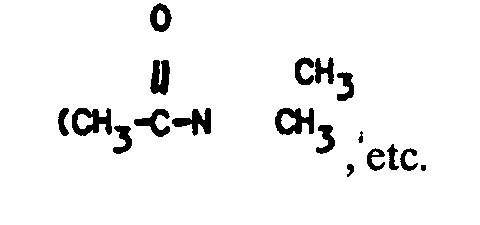
| 233 | Dialkyl amides, e.g., dimethyl formamide, dimethyl acetamide, etc.: |
| This subclass is indented under subclass 210. Subject matter wherein the N-- compound is a dialkyl amide,
e.g., dimethyl formamide, dimethyl acetaminde
| |
| 234 | Two or more N-C nitrogen nonreactant materials or with an organo oxygen or nitrogen-containing nonreactant material: | ||
This subclass is indented under subclass 233. Subject matter wherein the amide is admixed with an organo
oxygen or nitrogen containing NRM.
| |||
| 235 | At least one solid polymer derived from nitrile-containing ethylenic reactant: |
| This subclass is indented under subclass 233. Subject matter wherein the nitrogen compound is mixed with at least one solid polymer derived from ethylenic reactants only and at least one of the ethylenic reactants contains a nitrile group, i.e., C-C=N. | |
| 236 | Trivalent or tetravalent nitrogen atom other than unsubstituted ammonium: | ||
| This subclass is indented under subclass 186. Subject matter wherein the nitrogen compound contains at
least one nitrogen atom having either a valency of three or four
and is other than an unsubstituted ammonium (NH4+)
salt, e.g., dimethyl glyoxime, pyridine N-oxide, etc.
SEE OR SEARCH THIS CLASS, SUBCLASS:
| |||
| 237 | C(N)3, -C=NH, or C=N-C group: |
| This subclass is indented under subclass 236. Subject matter wherein the nitrogen compound contains at least one carbon atom bound directly to three nitrogen atoms; or contains at least one NH or NC group wherein the nitrogen atom of said group is bound to a carbon atom through a double bond. | |
| 238 | (C=X)X group wherein X is chalcogen: | ||||
This subclass is indented under subclass 236. Subject matter wherein the nitrogen compound contains at
least one-X group wherein X is a chalcogen atom.
| |||||
| 239 | Two or more (C=X)X groups: |
| This subclass is indented under subclass 238. Subject matter wherein the nitrogen compound contains at least two-X groups. | |
| 240 | Aryl group: |
| This subclass is indented under subclass 238. Subject matter wherein the nitrogen compound contains at least one aryl group. | |
| 241 | C=X group where X is chalcogen: | ||
This subclass is indented under subclass 236. Subject matter wherein the nitrogen compound contains at
least one group wherein X is chalcogen.
| |||
| 242 | Two or more C=X groups: |
| This subclass is indented under subclass 241. Subject matter wherein the nitrogen compound contains at least two groups. | |
| 243 | C-O-C group: | ||
| This subclass is indented under subclass 236. Subject matter wherein the nitrogen compound contains at
least oneC-O-C group.
SEE OR SEARCH THIS CLASS, SUBCLASS:
| |||
| 244 | C-OH: |
| This subclass is indented under subclass 243. Subject matter wherein the nitrogen compound contains both a C-O-C group and a C-OH group. | |
| 245 | Two or more C-OH groups: |
| This subclass is indented under subclass 244. Subject matter wherein the nitrogen compound contains at least two-C-OH groups. | |
| 246 | Aryl group: |
| This subclass is indented under subclass 243. Subject matter wherien the nitrogen compound contains at least one aryl group. | |
| 247 | C-OH group: | ||
| This subclass is indented under subclass 236. Subject matter wherein the nitrogen compound contains at
least oneC-OH group.
SEE OR SEARCH THIS CLASS, SUBCLASS:
| |||
| 248 | Aryl-OH group: |
| This subclass is indented under subclass 247. Subject matter wherein the nitrogen compound contains at least one aryl ring and wherein at least one of the nuclear carbons of the aryl ring is directly bonded to the oxygen atom of a hydroxyl group. | |
| 249 | Two or more nitrogen atoms or two or more C-OH groups: |
| This subclass is indented under subclass 247. Subject matter the nitrogen compound contains at least two nitrogen atoms or two or more C-OH groups. | |
| 250 | Four or more C-OH groups: |
| This subclass is indented under subclass 249. Subject matter wherein the nitrogen compound contains at least fourC-OH groups. | |
| 251 | N, C, and H atoms only: |
| This subclass is indented under subclass 236. Subject matter wherein the nitrogen compound contains only atoms of carbon, nitrogen, and hydrogen. | |
| 252 | Two or more nitrogen atoms: |
| This subclass is indented under subclass 251. Subject matter wherein the nitrogen compound contains at least two nitrogen atoms. | |
| 253 | With water NRM: |
| This subclass is indented under subclass 252. Subject matter wherein the plural nitrogen compound is admixed with free water as a nonreactant material (NRM). | |
| 254 | Aryl: |
| This subclass is indented under subclass 252. Subject matter wherein the plural nitrogen compound contains at least one aryl group. | |
| 255 | Two or more separate aryl ring systems: | ||
This subclass is indented under subclass 254. Subject matter wherein the plural nitrogen compound contains
at least two separate aryl ring systems.
| |||
| 256 | At least one aryl ring which is part of a fused or bridged ring system: | ||
This subclass is indented under subclass 255. Subject matter wherein the plural nitrogen compound contains
an aryl ring as part of a bridged- or fused-carbocyclic ring system.
| |||
| 257 | Aryl: |
| This subclass is indented under subclass 251. Subject matter wherein the nitrogen compound contains at least one aryl group. | |
| 258 | Two or more separate aryl ring systems: | ||
This subclass is indented under subclass 257. Subject matter wherein the nitrogen compound contains at
least two separate aryl ring systems.
| |||
| 259 | Nitrogen as part of a nitro group: |
| This subclass is indented under subclass 186. Subject matter wherein the nitrogen compound contains at least one nitrogen atom which has a valence of five and wherein the pentavalent nitrogen is part of a nitro group, i.e., -C-NO2. | |
| 260 | Nitro compound has an atoms other than C, H, N, or O; or has an oxygen or nitrogen atom other than as part of a nitro group: |
| This subclass is indented under subclass 259. Subject matter wherein the pentavalent compound contains at least one atom which is other than C, H, N, or oxygen; or contains an atom of oxygen or nitrogen which is not part of the pentavalent C-NO2 group. | |
| 261 | Organic silicon compound having at least one oxygen atom DNRM: | ||
| This subclass is indented under subclass 81. Subject matter wherein the organic designated nonreactant
material is a compound containing at least one silicon atom and
at least one oxygen atom.
SEE OR SEARCH THIS CLASS, SUBCLASS:
| |||
| 262 | Atom other than Si, O, C, of H: |
| This subclass is indented under subclass 261. Subject matter wherein the silicon compound contains an atom therein which is other than silicon, oxygen, carbon, or hydrogen. | |
| 263 | Halogen: |
| This subclass is indented under subclass 262. Subject matter wherein the silicon compound contains at least one halogen atom. | |
| 264 | Ethylenic group: | ||||
This subclass is indented under subclass 261. Subject matter wherein the silicon compound contains at
least one ethylenic unsaturated group.
SEE OR SEARCH CLASS:
| |||||
| 265 | Oxygen atom other than as Si-O-Si and at least one Si-C or Si-H group: | ||
Subject matter under subclas 261 wherein the silicon compound
contains at least one silicon atom bonded to a hydrogen or carbon
atom, and contains an oxygen atom other than as directly linking
two silicon atoms together.
| |||
| 266 | Silicon containing SICP or solid polymer: |
| This subclass is indented under subclass 265. Subject matter wherein a solid polymer or specified intermediate condensation product (SICP) derived from a silicon containing reactant is mixed with the silicon compound. See the Class 520 Glossary for a definition of the term "specified intermediate condensation product (SICP)". | |
| 267 | Two or more si atoms and at least one Si-C or Si-H group: |
| This subclass is indented under subclass 261. Subject matter wherein the silicon compound contains at least two silicon atoms and has at least one silicon atom bonded to a hydrogen or carbon atom. | |
| 268 | Silicon containing SICP or solid polymer: | ||
This subclass is indented under subclass 267. Subject matter wherein a solid polymer or specified intermediate
condensation product (SICP) derived from a silicon containing reactant
is mixed with the silicon compound.
| |||
| 269 | Solid polymer derived from ethylenic reactants only: |
| This subclass is indented under subclass 267. Subject matter wherein a solid polymer derived from ethylenic reactants only is mixed with the silicon compound. | |
| 270 | Rosin or tall oil or modified forms thereof as DNRM, e.g., colophony, abietic acid, ester gum, etc.: | ||||||||
This subclass is indented under subclass 81. Subject matter wherein the organic designated nonreactant
material is a compound containing an abietyl or modified abietyl
moiety, e.g., rosin ester, metal salt of rosin, colophony, etc.; or
is tall oil or a modified form thereof.
| |||||||||
| 271 | Two or more solid polymers or at least one solid polymer and at least one specified intermediate condensation product: | ||
This subclass is indented under subclass 270. Subject matter wherein the abietyl containing compound is
mixed with two or more solid polymers or specified intermediate
condensation products; or with at least one solid polymer and at
least one specified intermediate condensation product.
| |||
| 272 | Solid polymer derived from at least one ethylenic compound containing a carboxylic acid or derivative: | ||
This subclass is indented under subclass 270. Subject matter wherein the abietyl containing compound is
mixed with a solid polymer derived form at least oen ethylenic monomer which
is a carboxylic acid or a derivative thereof.
| |||
| 273 | Solid polymer contains halogen: |
| This subclass is indented under subclass 270. Subject matter wherein the abietyl containing compound or tall oil is mixed with a solid polymer derived from a halogen containing monomer or with a nonhalogen derived polymer which has been modified by a halogen-containing material so as to incorporate halogen atoms therein. | |
| 274 | Solid polymer derived from ethylenically unsaturated hydrocarbon only: |
| This subclass is indented under subclass 270. Subject matter wherein the abietyl containing compound or tall oil is mixed with a solid polymer derived from ethylenically unsaturated hydrocarbon monomers. | |
| 275 | Oxygen wax DNRM: | ||||||||||||
This subclass is indented under subclass 81. Subject matter wherein the organic designated nonreactant
material is a wax which contains an oxygen atom or an oxygen containing
component.
SEE OR SEARCH THIS CLASS, SUBCLASS:
| |||||||||||||
| 276 | With water NRM: |
| This subclass is indented under subclass 275. Subject matter wherein water as a nonreactant material is present in addition to the oxygen containing wax. | |
| 277 | Carnauba wax, beeswax, montan wax, or oxidized microcrystalline wax or modified forms thereof: | ||
This subclass is indented under subclass 275. Subject matter wherein the oxygen containing wax is carnauba
wax, beeswax, montan wax, or oxidized microcrystalline wax or chemically modified
forms thereof.
| |||
| 278 | Solid polymer contains halogen: |
| This subclass is indented under subclass 277. Subject matter wherein the wax is mixed with a solid polymer derived from a halogen containing monomer, or with a nonhalogen derived polymer which has been modified by a halogen containing material so as to incorporate halogen atoms therein. | |
| 279 | Solid polymer contains nitrogen: |
| This subclass is indented under subclass 277. Subject matter wherein the wax is mixed with a solid polymer derived from a nitrogen containing monomer, or with a nonnitrogen derived solid polymer which has been modified by a nitrogen containing material so as to incorporate nitrogen atoms therein. | |
| 280 | X(C=X)X wherein X is chalcogen DNRM, e.g., carbonate, etc.: | ||
This subclass is indented under subclass 81. Subject matter wherein the organic designated nonreactive
material is a compound containing at least one X--X group and wherein
the x atom may be the same or different chalcogen atom, i.e., oxygen,
sulfur, selenium, or tellurium.
| |||
| 281 | Aryl group: |
| This subclass is indented under subclass 280. Subject matter wherein the X--X compound contains at least one aryl group. | |
| 282 | C(C=X)X wherein at least one X is a chalcogen other than oxygen DNRM: |
| This subclass is indented under subclass 81. Subject matter wherein the organic designated nonreactant material contains at least one C--X group, wherein X is a chalcogen atom (i.e., oxygen, sulfur, selenium, or tellurium), and wherein at least one of the X atoms is other than oxygen, e.g., n-butyl dithlofumarate, etc. | |
| 283 | Oxygen atom which is not part of the -C(C=X)X group: |
| This subclass is indented under subclass 282. Subject matter wherein the DNRM having at least one C--X group contains at least one oxygen atom which is not part of the C--X group. | |
| 284 | Carboxylic acid or derivative and wherein the derivative is other than a metal salt DNRM: | ||||||||||
This subclass is indented under subclass 81. Subject matter wherein the organic designated nonreactant
material is a carboxylic acid or its derivative which is other than
a metal salt.
SEE OR SEARCH THIS CLASS, SUBCLASS:
| |||||||||||
| 285 | Cycloaliphatic group or bridged or fused ring system, e.g., camphoric acid, etc: | ||||
This subclass is indented under subclass 284. Subject matter wherein the carboxylic acid or derivative
contains a carbocyclic ring other than as aryl; or contains a bridged-
or fused-ring system, e.g., camphoric acid, etc.
SEE OR SEARCH THIS CLASS, SUBCLASS:
| |||||
| 286 | Naphthenic acid or derivative: | ||
| This subclass is indented under subclass 285. Subject matter wherein the carboxylic acid is a mixture
of monocyclic or fused or bridged monocarboxylic hydrocarbon acids
described as naphthenic acid or derivatives thereof.
SEE OR SEARCH THIS CLASS, SUBCLASS:
| |||
| 287 | Aryl group: | ||
This subclass is indented under subclass 284. Subject matter wherein the carboxylic acid or derivative
contains an aryl group, e.g., benzolc acid, etc.
| |||
| 288 | Atom other than C, H, or O: |
| This subclass is indented under subclass 287. Subject matter wherein the carboxylic acid or derivative contains an atom other than carbon, hydrogen, or oxygen, e.g., butyl benzyl tetrachlorophthalate, etc. | |
| 289 | Sulfur: |
| This subclass is indented under subclass 288. Subject matter wherein the carboxylic acid or derivative contains a sulfur atom. | |
| 290 | Oxygen atom other than as part of a carboxylic acid or ester group: | ||||
This subclass is indented under subclass 287. Subject matter wherein the carboxylic acid or derivative
contains an oxygen atom other than as part of a COOH or COOR group.
SEE OR SEARCH THIS CLASS, SUBCLASS:
| |||||
| 291 | OH group other than as part of a COOH Group, e.g., salicyclic acid, etc.: |
| This subclass is indented under subclass 290. Subject matter wherein the oxygen atom is part of a hydroxyl group which is other than the hydroxyl group of a COOH group, e.g., propyl gallate, phenyl salicylate, etc. | |
| 292 | Carbonyl of a carboxylic acid or ester group directly attached to an aryl group, e.g., dipropylene glycol dibenzoate, etc.: |
| This subclass is indented under subclass 290. Subject matter wherein a carboxylic acid or ester derivative contains a COOH or COOR group directly attached to the aryl group through the carbonyl of the COOH or COOR group, e.g., dipropylene glycol dibenzoate, etc. | |
| 293 | Carboxylic acid or ester groups each directly attached to separate aryl groups through the carbonyl of the carboxylic acid or ester group: |
| This subclass is indented under subclass 287. Subject matter wherein a carboxylic acid or ester derivative
contains two or more discrete aryl groups each aryl having one or
more COOH or COOR group directly attached thereto through the carbonyl
group of the COOH or COOR group, e.g., glycerol tribenzoate.
| |
| 294 | Two or more carboxylic acids or esters groups each directly attached to a nuclear carbon of the same aryl group through the carbonyl of the carboxylic acid or ester group: |
| This subclass is indented under subclass 287. Subject matter wherein a carboxylic acid or ester derivative contains a single aryl group having two or more COOH or COOR groups each directly attached to the aryl ring through the carbonyl group of the COOH or COOR group. | |
| 295 | A single aryl group: |
| This subclass is indented under subclass 294. Subject matter wherein the carboxylic acid or ester derivative contains only one aryl group, e.g., trilsodecyl trimellitate, etc. | |
| 296 | Only two carboxylic acid or ester groups directly attached to an aryl group, e.g., phthalic acid, etc.: |
| This subclass is indented under subclass 295. Subject matter wherein the single aryl group contains only two COOH or COOR groups each of which are directly attached through the carbon atom of the COOH or COOR group to the aryl ring, e.g., di(2-ethyl hexyl phthalate, etc.). | |
| 297 | Dioctyl or dibutyl ester, e.g., di(2-ethylhexyl) phthalate, etc: | ||
This subclass is indented under subclass 296. Subject matter wherein the ester derivative is dioctyl or
dibutyl phthalate.
| |||
| 298 | Three or more carboxylic acid or ester groups: |
| This subclass is indented under subclass 296. Subject matter wherein the carboxylic acid or ester derivative
contains three or more COOH or COOR groups, only two of which are directly
attached through the carbon atom of the COOH or COOR group to the
aryl ring, e.g., etc.
| |
| 299 | Two or more aryl groups: |
| This subclass is indented under subclass 287. Subject matter wherein the carboxylic acid or ester derivative contains two or more aryl groups, e.g., dibenzyl alkenyl succinate, etc. | |
| 300 | Two or more carbon atoms: | ||
| This subclass is indented under subclass 284. Subject matter wherein the carboxylic acid or derivative
contains at least two carbon atoms.
SEE OR SEARCH THIS CLASS, SUBCLASS:
| |||
| 301 | Metal: |
| This subclass is indented under subclass 300. Subject matter wherein the carboxylic acid or derivative contains a metal atom. | |
| 302 | Sulfur, e.g., factice, etc.: | ||||||||
This subclass is indented under subclass 300. Subject matter wherein the carboxylic acid or derivative
contains a sulfur atom, e.g., thioglycolic acid, etc.
SEE OR SEARCH THIS CLASS, SUBCLASS:
| |||||||||
| 303 | Only two carboxylic acid or ester groups, e.g., distearyl thiodipropionate, etc.: |
| This subclass is indented under subclass 302. Subject matter wherein the sulfur-containing carboxylic acid or ester contains only two COOH or COOR groups, e.g., distearyl thiodipropionate, etc. | |
| 304 | With a nonreactive material: |
| This subclass is indented under subclass 303. Subject matter wherein a nonreactive material is in addition to the sulfur-containing carboxylic acid or derivative. | |
| 305 | Nonreactive material contains atom other than C, H, or O: |
| This subclass is indented under subclass 304. Subject matter wherein the nonreactive material contains an atom other than carbon, hydrogen, or oxygen. | |
| 306 | Ester having at least two carboxylic acid ester groups: | ||
This subclass is indented under subclass 300. Subject matter wherein the carboxylic acid derivative is
a carboxylic acid ester having at least two COOR groups.
| |||
| 307 | Atom other than C, H, or O: |
| This subclass is indented under subclass 306. Subject matter wherein the carboxylic acid ester contains an atom other than carbon, hydrogen, or oxygen. | |
| 308 | Oxygen atom other than as part of a carboxylic acid ester group: |
| This subclass is indented under subclass 306. Subject matter wherein the carboxylic acid ester contains an oxygen atom other than as part of a carboxylic acid ester group, e.g., diethylene glycol dipropionate, ethoxyethyl maleate, etc. | |
| 309 | C=O Group other than as part of COO group: |
| This subclass is indented under subclass 308. Subject matter wherein the carboxylic acid ester contains a carbonyl group other than as part of a COO group, e.g., a diester of levulinic acid, etc. | |
| 310 | OH group other than as part of a COOH Group, e.g., castor oil, etc.: |
| This subclass is indented under subclass 308. Subject matter wherein the carboxylic acid ester contains a hydroxyl group which is other than part of a carboxylic acid group, e.g., ricinoleic acid, castor oil, etc. | |
| 311 | Three or more carboxylic acid ester groups: |
| This subclass is indented under subclass 306. Subject matter wherein the carboxylic acid ester contains three or more carboxylic acid ester groups. | |
| 312 | Derived from glycerol: |
| This subclass is indented under subclass 311. Subject matter wherein the carboxylic acid ester is derived from glycerol. | |
| 313 | Fatty acid triglyceride, e.g., drying oil, etc.: |
| This subclass is indented under subclass 312. Subject matter wherein the carboxylic acid ester is a fatty acid triglyceride, e.g., drying oil, linseed oil, tung oil, etc. | |
| 314 | Ester derived from dicarboxylic acid: | ||
| This subclass is indented under subclass 306. Subject matter wherein the carboxylic acid ester is an ester
of a dicarboxylic acid, e.g., dialkyl fumarate, di-n-hexyl adipate,
etc.
SEE OR SEARCH THIS CLASS, SUBCLASS:
| |||
| 315 | Carboxylic acid ester: | ||
This subclass is indented under subclass 300. Subject matter wherein the carboxylic acid derivative is
a carboxylic acid ester.
| |||
| 316 | Atom other than C, H, or O: |
| This subclass is indented under subclass 315. Subject matter wherein the carboxylic acid ester contains an atom other than carbon, hydrogen, or oxygen. | |
| 317 | Oxygen atom other than as part of a carboxylic acid group, e.g., glycolic ester, etc.: |
| This subclass is indented under subclass 315. Subject matter wherein the carboxylic acid ester contains an oxygen atom other than as part of a carboxylic acid ester group. | |
| 318 | Acyl group of the carboxylic acid has at least fifteen carbon atoms, e.g., butyl stearate, etc.: |
| This subclass is indented under subclass 315. Subject matter wherein the carboxylic acid ester is derived from a carboxylic acid having at least fifteen carbon atoms, e.g., stearic acid esters, etc. | |
| 319 | Halogen: |
| This subclass is indented under subclass 300. Subject matter wherein the carboxylic acid or derivative contains a halogen atom. | |
| 320 | Oxygen atom other than as part of a COOH or derivative group: |
| This subclass is indented under subclass 300. Subject matter wherein the carboxylic acid or derivative contains an oxygen atom other than as part of a COOH or derivative group, e.g., lactic acid, tartaric acid, etc. | |
| 321 | Two or more carboxylic acid or derivative groups: |
| This subclass is indented under subclass 300. Subject matter wherein the carboxylic acid or derivative contains two or more -COO- groups, e.g., fumaric acid, maleic acid, etc. | |
| 322 | Acyl group of the carboxylic acid or derivative has at least fifteen carbon atoms, e.g., stearic acid, etc.: |
| This subclass is indented under subclass 300. Subject matter wherein the carboxylic acid or derivative is derived from a carboxylic acid having at least fifteen carbon atoms, e.g., stearic acid, etc. | |
| 323 | Aryl-OH or salt or aryl-o-metal bond DNRM: | ||||
This subclass is indented under subclass 81. Subject matter wherein the organic designated nonreactant
material is (a) a phenolic compound containing a hydroxyl group
directly attached to the nuclear carbon of an aryl group or its
salt, or (b) a compound containing an aryl-O-M (M-metal) group,
e.g., aryl-O-Pb-O-, etc.
| |||||
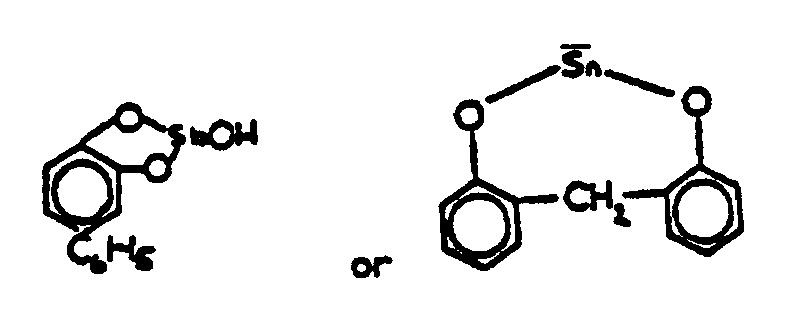
| 324 | Fused or bridged ring system: | ||||||
This subclass is indented under subclass 323. Subject matter wherein the designated nonreactant material
contains a fused- or bridged-ring system, e.g., butyl-4-methyl-6-indanyl
phenol, etc.
SEE OR SEARCH THIS CLASS, SUBCLASS:
| |||||||
| 325 | Fused or bridged ring system having at least three rings: |
| This subclass is indented under subclass 324. Subject matter wherein a fused- or bridged-ring system contains three or more rings. | |
| 326 | Cycloaliphatic group: |
| This subclass is indented under subclass 323. Subject matter wherein the designated nonreactant material contains a carbocyclic ring other than as aryl. | |
| 327 | Metal: |
| This subclass is indented under subclass 323. Subject matter wherein the designated nonreactant material contains a metal atom, e.g., triphenyl arsenite, etc. | |
| 328 | Group VIII metal (i.e., Fe, Ru, Os, Co, Rh, Ir, Ni, Pd, Pt): |
| This subclass is indented under subclass 327. Subject matter wherein the metal is a Group VIII metal atom (i.e., Co, Fe, Ru, Os, Rh, Ir, Ni, Pd, Pt). | |
| 329 | Group IVA metal (i.e., Ge, Sn, Pb): |
| This subclass is indented under subclass 327. Subject matter wherein the metal is a Group IVA metal atom (i.e., Ge, Sn, Pb), e.g., Ar-O-Pb-O--R, etc. | |
| 330 | Atom other than C, H, O, or halogen: |
| This subclass is indented under subclass 323. Subject matter wherein the designated nonreactant contains an atom other than carbon, hydrogen, oxygen, or halogen. | |
| 331 | Two or more sulfur atoms: |
| This subclass is indented under subclass 330. Subject matter wherein the designated nonreactant contains at least two sulfur atoms. | |
| 332 | S-S linkage: |
| This subclass is indented under subclass 331. Subject matter wherein the sulfur compound contains a sulfur-sulfur linkage. | |
| 333 | Two or more separate aryl-OH groups: |
| This subclass is indented under subclass 330. Subject matter wherein the designated nonreactant contains two or more separate aryl-OH groups. | |
| 334 | Oxygen other than as part of an aryl-OH group: |
| This subclass is indented under subclass 323. Subject matter wherein the designated nonreactant material contains an oxygen atom which is other than as part of an aryl-OH group. | |
| 335 | C=O group: |
| This subclass is indented under subclass 334. Subject matter wherein the designated nonreactant material contains a carbonyl group. | |
| 336 | A single C=O group: |
| This subclass is indented under subclass 335. Subject matter wherein the carbonyl compound contains only one carbonyl group, e.g., 2-hydroxy-benzophenone, etc. | |
| 337 | Aryl group having two or more OH groups directly attached to nuclear carbons thereof: |
| This subclass is indented under subclass 336. Subject matter wherein the carbonyl compound contains an aryl group having two or more hydroxyl groups directly attached to nuclear carbons of the aryl group, e.g., 2,4,5-trihydroxy-acetophenone, etc. | |
| 338 | Two or more aryl-OH groups: |
| This subclass is indented under subclass 336. Subject matter wherein the carbonyl compound contains two or more aryl-OH groups, e.g., 2,2-dihydroxybenzophenone, etc. | |
| 339 | C-O-C linkage: |
| This subclass is indented under subclass 334. Subject matter wherein the designated nonreactant material contains an ether linkage (i.e., C-O-C-). | |
| 340 | Aryl compound having only one aryl ring and having one or more oh groups directly attached to nuclear carbons of the aryl: |
| This subclass is indented under subclass 339. Subject matter wherein the ether compound contains only one aryl ring and wherein at least one of the nuclear carbons of the aryl ring is directly attached to the oxygen atom of a hydroxyl group. | |
| 341 | Halogen: |
| This subclass is indented under subclass 323. Subject matter wherein the designated nonreactant material contains a halogen atom. | |
| 342 | Two or more separate aryl-OH groups: |
| This subclass is indented under subclass 323. Subject matter wherein the designated nonreactant material contains two or more separate aryl-OH groups. | |
| 343 | Only two aryl-OH groups: |
| This subclass is indented under subclass 342. Subject matter wherein the designated nonreactant material contains only two aryl-OH groups. | |
| 344 | Aryl group other than as part of an aryl-OH: |
| This subclass is indented under subclass 343. Subject matter wherein the designated nonreactant material contains in addition to the two aryl-OH groups an aryl group which is other than as part of an aryl-OH group. | |
| 345 | Polyhydric aryl-OH compound: |
| This subclass is indented under subclass 323. Subject matter wherein the designated nonreactant material contains two or more hydroxyl groups directly attached to the nuclear carbon of the same aryl group, e.g., catechol, etc. | |
| 346 | 1,3-dihydroxy, e.g., resorcinol, etc.: |
| This subclass is indented under subclass 345. Subject matter wherein the designated nonreactant material contains only two hydroxyl groups and where the hydroxyl groups are directly attached to the 1,3 position of the same aryl group. | |
| 347 | 1,4-dihydroxy, e.g., hydroquinone, etc.: |
| This subclass is indented under subclass 345. Subject matter wherein the designated nonreactant material contains only two hydroxyl and wherein the hydroxyl groups are directly attached to the 1,4 position of the same aryl group, e.g., hydroquinone, etc. | |
| 348 | Two or more aryl-OH DNRM compounds: |
| This subclass is indented under subclass 323. Subject matter wherein two or more compounds each containing aryl-OH groups are utilized as designated nonreactant materials, e.g., a mixture of m-cresol and p-cresol, etc. | |
| 349 | Three or more substituents on the aryl-OH compound: |
| This subclass is indented under subclass 323. Subject matter wherein the designated nonreactant material contains a substituted aryl wherein three or more of the hydrogen atoms of the aryl have been substituted by other than a hydroxy group and wherein one of the hydrogen atoms of the aryl has been substituted by a hydroxy group, e.g., 2,6-di-t-p-cresol,etc. | |
| 350 | With other nonreactive material: |
| This subclass is indented under subclass 349. Subject matter wherein in addition to the substituted aryl there is also present another nonreactive material. | |
| 351 | Two substituents on the aryl-OH compound: |
| This subclass is indented under subclass 323. Subject matter wherein the designated nonreactant material contains a substituted aryl wherein two of the hydrogen atoms of the aryl have been substituted by other than a hydroxy group and wherein one of the hydrogen atoms of the aryl has been substituted by a hydroxy group. | |
| 352 | A single substituent on the aryl-OH compound: |
| This subclass is indented under subclass 323. Subject matter wherein the designated nonreactant material contains a substituted aryl wherein one of the hydrogen atoms of the aryl has been substituted by other than a hydroxy group and wherein one of the hydrogen atoms of the aryl has been substituted by a hydroxy group. | |
| 353 | With nonreactive organic material: |
| This subclass is indented under subclass 352. Subject matter wherein in addition to the substituted aryl compound there is also present a nonreactive organic material. | |
| 354 | Aldehyde DNRM, i.e., C-(C=O) H: | ||
This subclass is indented under subclass 81. Subject matter wherein the designated nonreactive material
is a compound containing at least one aldehyde group.
| |||
| 355 | Aryl: |
| This subclass is indented under subclass 354. Subject matter wherein the aldehyde compound contains at least one aryl group herein. | |
| 356 | Ketone or ketene DNRM, i.e., C(C=O) or C=C=O: | ||
This subclass is indented under subclass 81. Subject matter wherein the designated nonreactive material
contains at least one ketone or ketene group.
| |||
| 357 | Two or more C(C=O)C groups: | ||
This subclass is indented under subclass 356. Subject matter wherein the designated nonreactant compound
contains at least two ketone groups.
| |||
| 358 | Carbocyclic ring wherein at least two of the nuclear carbons thereof are double bonded directly to oxygen atoms so as to form two or C=O groups therewith, e.g., quinone, etc.: | ||
| This subclass is indented under subclass 357. Subject matter wherein the plural ketone compound contains
at least one carbocyclic ring wherein at least two of the nuclear
carbon atoms of the ring are double bonded directly to oxygen so
as to form ketone groups therewith, e.g., quinone, benzoquinone,
etc.
SEE OR SEARCH THIS CLASS, SUBCLASS:
| |||
| 359 | Carbocyclic ring, e.g., benzophenone, etc.: | ||||
This subclass is indented under subclass 356. Subject matter wherein the designated nonreactant material
contains at least one ring system composed solely of carbon atoms.
SEE OR SEARCH THIS CLASS, SUBCLASS:
| |||||
| 360 | Carbocyclic ring wherein one of the nuclear carbons thereof is double bonded directly to an oxygen atom so as to form a C=O group therewith, e.g., cyclohexanone, etc.: |
| This subclass is indented under subclass 359. Subject matter wherein the designated nonreactant material contains a carbocyclic ring wherein a single nuclear carbon atom of the carbocyclic ring is bonded directly to an oxygen atom by a double bond so as to form a C=O group therewith. | |
| 361 | Only C, H, and oxygen atoms: |
| This subclass is indented under subclass 356. Subject matter wherein the ketone or ketene is composed solely of carbon, hydrogen, and oxygen atoms. | |
| 362 | Ten or more carbon atoms: |
| This subclass is indented under subclass 361. Subject matter wherein the ketone or ketene contains at least ten carbon atoms. | |
| 363 | Two or more C=O DNRM containing compounds: |
| This subclass is indented under subclass 361. Subject matter wherein the ketone or ketene is admixed with an additional ketone or ketene nonereactive material. | |
| 364 | With water, hydrocarbon, halohydrocarbon, or organic oxygen containing nonreactive material: |
| This subclass is indented under subclass 361. Subject matter wherein the ketone or ketene is admixed with an additional nonreactant material which is water, hydrocarbon, halohydrocarbon, or an organic oxygen containing material. | |
| 365 | Solid polymer derived from ethylenic reactants only: |
| This subclass is indented under subclass 361. Subject matter wherein a solid polymer derived from ethylenic reactants only is mixed with the ketone or ketene compound. | |
| 366 | C-O-C compound DNRM: | ||||
| This subclass is indented under subclass 81. Subject matter wherein the organic designated nonreactant
material is a compound containing a C-O-C group, e.g., ether, etc.
SEE OR SEARCH THIS CLASS, SUBCLASS:
| |||||
| 367 | Fused or bridged ring system or a cycloaliphatic group: | ||
This subclass is indented under subclass 366. Subject matter wherein the C-O-C compound contains a fused
or bridged ring system or a cycloaliphatic ring.
| |||
| 368 | Atom other than C, H, O, or halogen: |
| This subclass is indented under subclass 366. Subject matter wherein the C-O-C compound contains an atom other than carbon, hydrogen, oxygen, or halogen. | |
| 369 | Aryl group other than as part of a phenoxy group: |
| This subclass is indented under subclass 366. Subject matter wherein the C-O-C compound contains an aryl
group other than the nuclear carbon of an aryl directly attached
to an oxygen atom, e.g., as illustrated below, etc.
| |
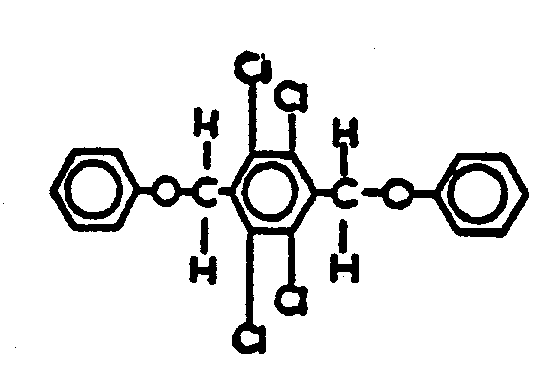
| 370 | Aryl-o-aryl: |
| This subclass is indented under subclass 366. Subject matter wherein the C-O-C compound contains an aryl-O-aryl group, e.g., diphenyl oxide, etc. | |
| 371 | Halogen: |
| This subclass is indented under subclass 370. Subject matter wherein the aryl-O-aryl compound contains a halogen atom. | |
| 372 | Two or more phenoxy groups: |
| This subclass is indented under subclass 366. Subject matter wherein the C-O-C compound contains two or more discrete aryl-O- groups. | |
| 373 | Halogen: |
| This subclass is indented under subclass 372. Subject matter wherein the C-O-C compound contains a halogen atom. | |
| 374 | At least two diverse halogen atoms: |
| This subclass is indented under subclass 373. Subject matter wherein the halogen compound contains at least two diverse halogen atoms. | |
| 375 | Phenoxy group: | ||
| This subclass is indented under subclass 366. Subject matter wherein the C-O-C compound contains an aryl-O
group.
SEE OR SEARCH THIS CLASS, SUBCLASS:
| |||
| 376 | OH group, e.g., ether-alcohol solvent, etc.: |
| This subclass is indented under subclass 366. Subject matter wherein the C-O-C compound contains a hydroxyl group. | |
| 377 | Two or more OH groups: |
| This subclass is indented under subclass 376. Subject matter wherein the hydroxyl containing compound contains two or more hydroxyl groups. | |
| 378 | Only C, H, and O atoms: |
| This subclass is indented under subclass 366. Subject matter wherein the C-O-C compound contains only carbon, hydrogen, and oxygen atoms. | |
| 379 | Carbon atom single bonded to an oxygen atom and wherein the carbon atom is not double bonded to a chalcogen atom DNRM, e.g., alcohols, etc.: | ||
This subclass is indented under subclass 81. Subject matter wherein the organic designated nonreactant
is a compound containing at least one carbon atom which is bonded
directly an oxygen atom by a single bond and wherein the carbon
atom is not double bonded to a chalcogen atom.
| |||
| 380 | Halogen or ethylenic unsaturation: |
| This subclass is indented under subclass 379. Subject matter wherein the C-O compound contains at least one halogen atom or at least one ethylenic group. | |
| 381 | Non C-OH oxygen atom, or element other than, c, o, or h, e.g., tartaric acid metal salt, etc.: |
| This subclass is indented under subclass 379. Subject matter wherein the C-O compound contains at least one oxygen atom which exist other than as part at a C-OH group, or wherein the C-O compound contains at least one element which is other than carbon, oxygen, or hydrogen. | |
| 382 | Heavy metal: |
| This subclass is indented under subclass 381. Subject matter wherein the C-O compound contains a heavy metal atom. | |
| 383 | Carbocyclic ring: |
| This subclass is indented under subclass 379. Subject matter wherein the C-O compound contains at least one ring system composed solely of carbon atoms. | |
| 384 | Aryl group: |
| This subclass is indented under subclass 383. Subject matter wherein the C-O compound contains an aryl ring system. | |
| 385 | Only a single -C-OH group and at least six carbon atoms: |
| This subclass is indented under subclass 379. Subject matter wherein the C-O compound contains only one -C-OH group and at least six carbon atoms. | |
| 386 | At least two -OH groups: |
| This subclass is indented under subclass 379. Subject matter wherein the C-O compound contains at least two -OH groups. | |
| 387 | At least four -OH groups, e.g., pentaerythritol, etc.: |
| This subclass is indented under subclass 386. Subject matter wherein the C-O compound contains at least four -OH groups, e.g., pentaerythritol, sorbitol, etc. | |
| 388 | At least one solid polymer derived from ethylenic reactants only: |
| This subclass is indented under subclass 386. Subject matter wherein a solid polymer derived from ethylenic reactants only is mixed with the -OH compound. | |
| 389 | Two or more compounds containing -OH groups or with water NRM: |
| This subclass is indented under subclass 379. Subject matter wherein there are present two or more C-O compounds or wherein the C-O compound is admixed with water as a nonreactant material. | |
| 390 | With hydrocarbon or halogenated hydrocarbon NRM: |
| This subclass is indented under subclass 379. Subject matter wherein the C-O compound is in admixture with a nonreactant hydrocarbon or halogenated hydrocarbon material. | |
| 391 | Solid polymer or SICP derived from at least one nonethylenic reactant: |
| This subclass is indented under subclass 379. Subject matter wherein a solid polymer derived from at least one nonethylenic reactant or a specified intermediate condensation product is admixed with the C-O compound. | |
| 392 | Organic chalcogen other than oxygen as DNRM: |
| This subclass is indented under subclass 81. Subject matter wherein the organic designated nonreactant material is a compound containing at least one chalcogen atom which is other than oxygen. | |
| 393 | Atom other than S, C, H, or a metal: | ||
This subclass is indented under subclass 392. Subject matter wherein the designated nonreactant material
contains at least one atom which is other than sulfur, carbon, hydrogen,
or a metal.
| |||
| 394 | Oxygen atom or metal atom DNRM, e.g., metal stearate, etc.: | ||
This subclass is indented under subclass 81. Subject matter wherein the organic designated nonreactant
material is a compound containing at least one oxygen or metal atom.
| |||
| 395 | Atom other than C, O, H, or a metal: | ||
This subclass is indented under subclass 394. Subject matter wherein the oxygen or metal compound contains
at least one atom which is other than carbon, oxygen, hydrogen,
or a metal.
| |||
| 396 | Carbocyclic group, e.g., aryl, etc.: |
| This subclass is indented under subclass 394. Subject matter wherein the oxygen or metal compound contains at least one ring system composed solely of carbon atoms. | |
| 397 | Ethylenic group, or at least two (C=O)O groups bonded to each other directly or only by carbon atoms: | ||
This subclass is indented under subclass 394. Subject matter wherein the oxygen or metal compound contains
at least one ethylenic group, or at least two O-O groups bonded
to each other directly or bonded solely by carbon atoms.
| |||
| 398 | Transition metal atom (atomic no. 21-29, 39-47, 57-79): | ||
This subclass is indented under subclass 394. Subject matter wherein the metal compound contains at least
one transition metal atom.
| |||
| 399 | Heavy metal or aluminum (atomic no. 13, 30-33, 48-51, 80-83): | ||
This subclass is indented under subclass 394. Subject matter wherein the metal compound contains at least
one heavy metal or aluminum atom.
| |||
| 400 | Group IIA metal atom (Be, Mg, Ca, Sr, Ba): |
| This subclass is indented under subclass 394. Subject matter wherein the metal compound is a Group IIA metal atom (Be, Mg, Ca, Sr, Ba). | |
| 401 | Inorganic compound devoid of a silicon atom DNRM: | ||||||||
| This subclass is indented under subclass 80. Subject matter wherein the designated nonreactant material
is an inorganic compound which is devoid of any silicon atoms.
SEE OR SEARCH THIS CLASS, SUBCLASS:
| |||||||||
| 402 | Chalcogen atom other than sulfur or oxygen DNRM: | ||
This subclass is indented under subclass 401. Subject matter wherein the inorganic nonreactant material
is a compound containing at least one chalcogen atom which is other
than sulfur or oxygen.
| |||
| 403 | At least one element of the lanthanide series (atomic no. 57-71) or contains a noble metal atom (i.e., Au, Ag, Hg, Pt, Pd, Ir, Rh, Ru, Os) DNRM: |
| This subclass is indented under subclass 401. Subject matter wherein the inorganic designated nonreactant material contains at least one lanthanide atom (at, no. 57-71) or at least noble metal atom (Au, Ag, Hg, Pt, Pd, Ir, Rh, Ru, Os). | |
| 404 | Boron atom DNRM: |
| This subclass is indented under subclass 401. Subject matter wherein the inorganic designated nonreactant material is a compound containing at least one boron atom. | |
| 405 | Boron directly bonded to oxygen: |
| This subclass is indented under subclass 404. Subject matter wherein the inorganic designated nonreactant material contains at least one boron atom directly bonded to an oxygen atom. | |
| 406 | Group VIB metal atom DNRM (i.e., Cr, Mo, W): |
| This subclass is indented under subclass 401. Subject matter wherein the inorganic designated nonreactant material is a compound containing at least one Group VIB metal (Cr, Mo, W). | |
| 407 | Chromium: |
| This subclass is indented under subclass 406. Subject matter wherein the Group VIB metal atom is chromium in a chromium compound. | |
| 408 | Group V metal atom DNRM (i.e., V, Nb, Ta, As, Bi, Sb): |
| This subclass is indented under subclass 401. Subject matter wherein the inorganic designated nonreactant material is a compound containing at least one Group V metal atom (V, Nb, Ta, As, Bi, Sb). | |
| 409 | Antimony: |
| This subclass is indented under subclass 408. Subject matter wherein the Group V metal atom is antimony in an antimony compound. | |
| 410 | Atom other than Sb and oxygen: |
| This subclass is indented under subclass 409. Subject matter wherein the antimony compound contains at least one atom which is other than oxygen and antimony. | |
| 411 | With halogenated nonreactant material: |
| This subclass is indented under subclass 409. Subject matter wherein the antimony compound is admixed with an additional halogenated nonreactant material. | |
| 412 | Halogen atom other than Cl: |
| This subclass is indented under subclass 411. Subject matter wherein the halogenated nonreactant material contains a halogen atom other than chlorine. | |
| 413 | Transition metal other than Group VIII DNRM, i.e., Sc, Ti, Mn, Cu, Y, Zr, Tc, Hf, Re): | ||||||||
This subclass is indented under subclass 401. Subject matter wherein the inorgnic designated nonreactant
material is a compound containing a transition metal other than
a Group VIII transition metal atom.
SEE OR SEARCH THIS CLASS, SUBCLASS:
| |||||||||
| 414 | Phosphorus atom DNRM: |
| This subclass is indented under subclass 401. Subject matter wherein the inorganic designated nonreactant material is a compound containing a phosphorus atom. | |
| 415 | Atom other than P, O, H, or a metal: | ||
This subclass is indented under subclass 414. Subject matter wherein the inorganic nonreactant material
contains at least one atom which is other than phosphorus, oxygen,
hydrogen, or a metal atom.
| |||
| 416 | Ammonium phosphate: | ||
| This subclass is indented under subclass 415. Subject matter wherein the phosphorus compound is ammonium
phosphate, i.e., (NH4)2HPO4.
SEE OR SEARCH THIS CLASS, SUBCLASS:
| |||
| 417 | Phosphorus atom directly bonded to four oxygen atoms, e.g., phosphoric acid, etc.: | ||
This subclass is indented under subclass 414. Subject matter wherein the phosphorus compound contains
at least four oxygen atoms directly bonded to a single phosphorus
atom.
| |||
| 418 | Sulfur atom DNRM: |
| This subclass is indented under subclass 401. Subject matter wherein the inorganic designated nonreactant material is a compound containing at least one sulfur atom. | |
| 419 | Two or more sulfur atoms, or at least one atom other than S, O, H, or a metal: | ||
This subclass is indented under subclass 418. Subject matter wherein the sulfur compound contains at least
two sulfur atoms or at least one atom which is other than sulfur,
oxygen, hydrogen, or a metal atom.
| |||
| 420 | Devoid of an oxygen atom, e.g., sulfide, etc.: |
| This subclass is indented under subclass 418. Subject matter wherein the sulfur compound is devoid of an oxygen atom. | |
| 421 | At least one hydrogen atom: |
| This subclass is indented under subclass 418. Subject matter wherein the sulfur compound contains at least one hydrogen atom. | |
| 422 | Sulfuric acid: |
| This subclass is indented under subclass 421. Subject matter wherein the sulfur compound is sulfuric acid. | |
| 423 | Sulfate group, e.g., calcium sulfate, etc.: |
| This subclass is indented under subclass 418. Subject matter wherein the sulfur compound contains at least one sulfate group, i.e., (SO4). | |
| 424 | Carbon atom DNRM: |
| This subclass is indented under subclass 401. Subject matter wherein the inorganic designated material is a compound containing at least one carbon atom. | |
| 425 | Calcium carbonate, e.g., limestone, marble, etc.: | ||
This subclass is indented under subclass 424. Subject matter wherein the carbon compound is calcium carbonate.
| |||
| 426 | Solid polymer derived from at least one diene monomer: |
| This subclass is indented under subclass 425. Subject matter wherein a solid polymer derived from at least one monomer containing at least two ethylenic groups is admixed with the calcium carbonate. | |
| 427 | Solid polymer derived from unsaturated hydrocarbon monomer: |
| This subclass is indented under subclass 425. Subject matter wherein a solid polymer derived form at least one unsaturated hydrocarbon monomer is admixed with the calcium carbonate. | |
| 428 | Nitrogen aton DNRM: |
| This subclass is indented under subclass 401. Subject matter wherein the inorganic designated nonreactant material is a compound containing at least one nitrogen atom. | |
| 429 | Nitrogen directly bonded to an oxygen atom, e.g., nitric acid, etc.: |
| This subclass is indented under subclass 428. Subject matter wherein the nitrogen atom is directly bonded to at least one oxygen atom, e.g., nitric acid, etc. | |
| 430 | A single type of metal atom and only oxygen atoms DNRM, e.g., metal oxide, etc.: | ||
This subclass is indented under subclass 401. Subject matter wherein the inorganic designated nonreactant
material is a compound solely of oxygen and a single type of metal atom.
| |||
| 431 | Transition metal atom (i.e., Fe, Co, Ni): | ||
This subclass is indented under subclass 430. Subject matter wherein the single type of metal atom is
a Group VIII transition metal atom.
| |||
| 432 | Group IIB metal atom (i.e., Zn or Cd): | ||||
This subclass is indented under subclass 430. Subject matter wherein the single type of metal atom is
a Group IIB metal atom.
SEE OR SEARCH THIS CLASS, SUBCLASS:
| |||||
| 433 | Group IIA metal atom (i.e., Be, Mg, Ca, Sr, Ba): |
| This subclass is indented under subclass 430. Subject matter wherein the single type of metal atom is a Group IIA metal atom (Be, Mg, Ca, Sr, Ba). | |
| 434 | Heavy metal atom DNRM: | ||
This subclass is indented under subclass 401. Subject matter wherein the inorganic designated nonreactant
material is a compound containing a heavy metal atom.
| |||
| 435 | Transition metal atom (i.e., Fe, Co, Ni): |
| This subclass is indented under subclass 434. Subject matter wherein the heavy metal atom is a transition metal atom (Fe, Co, Ni) containing compound. | |
| 436 | Group IIA metal DNRM (i.e., Be, Mg, Ca, Sr, Ba): |
| This subclass is indented under subclass 401. Subject matter wherein the inorganic designated nonreactant material is a compound containing a Group IIA metal atom (Be, Mg, Ca, Sr, Ba). | |
| 437 | Aluminum DNRM: |
| This subclass is indented under subclass 401. Subject matter wherein the inorganic designated nonreactant material is a compound containing an aluminum atom. | |
| 438 | Nonmetal compound DNRM: | ||
This subclass is indented under subclass 401. Subject matter wherein the inorgnaic designated nonreactant
material is a compound which is devoid of any metal atoms.
| |||
| 439 | Elemental metal DNRM: | ||||||
This subclass is indented under subclass 80. Subject matter wherein the designated nonreactant material
is an elemental metal atom.
SEE OR SEARCH THIS CLASS, SUBCLASS:
| |||||||
| 440 | Transition metal atom DNRM: | ||
This subclass is indented under subclass 439. Subject matter wherein the designated nonreactant material
is an elemental transition metal atom, e.g., brass, bronze, etc.
| |||
| 441 | Aluminum DNRM: |
| This subclass is indented under subclass 439. Subject matter wherein the designated nonreactant material is elemental aluminum. | |
| 442 | Soil or inorganic silicon DNRM (other than silicon dioxide, glass, quartz, novaculite or silicon dioxide type): | ||||||
This subclass is indented under subclass 80. Subject matter wherein a solid polymer or specified intermediate
condensation product is admixed with a designated nonreactant material
which is an inorganic compound containing silicon.
SEE OR SEARCH THIS CLASS, SUBCLASS:
| |||||||
| 443 | Atom other than Si, O, H, Al, Fe, or a Group IA or IIA metal atom DNRM, e.g., slag, mineral wool, etc.: |
| This subclass is indented under subclass 442. Subject matter wherein the inorganic silicon material is a compound containing at least one atom which is other than silicon, oxygen, hydrogen, aluminum, iron, or a Group IA (Li, Na, K, Rb, Ca) or Group IIA (Be, Mg, Ca, Sr, Ba) metal atom. | |
| 444 | Aluminum atom DNRM: |
| This subclass is indented under subclass 442. Subject matter wherein the inorganic silicon compound contains at least one aluminum atom. | |
| 445 | Clay, e.g., fullers earth, fire clay, etc.: | ||
This subclass is indented under subclass 444. Subject matter wherein the inorganic silicon-aluminum nonreactant
material is a clay.
| |||
| 446 | With water NRM: |
| This subclass is indented under subclass 445. Subject matter wherein the clay is admixed with free water as a nonreactant material (NRM). | |
| 447 | Kaolin or bentonite: | ||||
Subject matter under sublcass 445 wherein the clay DNRM
is kaolin or bentonite.
| |||||
| 448 | Diatomite or diatomaceous earth, e.g., kieselguhr, infusorial earth, etc.: | ||
This subclass is indented under subclass 444. Subject matter wherein the silicon-aluminum nonreactant
material is diatomite or diatomaceous earth.
| |||
| 449 | Mica: | ||
This subclass is indented under subclass 444. Subject matter wherein the silicon-aluminum DNRM is mica.
| |||
| 450 | Metal atom other than aluminum, e.g., zeolites, etc.: |
| This subclass is indented under subclass 444. Subject matter wherein the silicon-aluminum nonreactant material contains a nonaluminum metal atom, e.g., zeolites, etc. | |
| 451 | Talc (soapstone) DNRM: | ||
This subclass is indented under subclass 442. Subject matter wherein the inorganic silicon material is
talc.
| |||
| 452 | Asbestos DNRM: | ||||||
This subclass is indented under subclass 442. Subject matter wherein the inorganic silicon material is
asbestos.
| |||||||
| 453 | Aldehyde-nitrogen SICP or solid polymer thereof: | ||
This subclass is indented under subclass 452. Subject matter wherein an asbestos DNRM is admixed with
aldehyde-nitrogen SICP or solid polymer thereof.
| |||
| 454 | SICP or solid polymer thereof: | ||
This subclass is indented under subclass 452. Subject matter wherein an asbestos DNRM is admixed with
a SICP or solid polymer thereof.
| |||
| 455 | Halogen containing polymer: | ||
This subclass is indented under subclass 452. Subject matter wherein an asbestos DNRM is admixed with
a halogen containing solid polymer.
| |||
| 456 | Group IIA metal atom DNRM: |
| This subclass is indented under subclass 442. Subject matter wherein the inorganic silicon containing material additionally contains a Group IIA metal atom (Be, Mg, Ca, Sr, Ba). | |
| 457 | Polymerizing an ethylenic monomer in the presence of a preformed SICP or solid polymer and in the presence of a nonreactive material so as to form an aqueous dispersion, latex, suspension, or emulsion therewith; or product thereof: | ||||||||
This subclass is indented under subclass 1. Subject matter wherein a desired aqueous dispersion, latex,
suspension, or emulsion is formed by polymerization of ethylenically unsaturated
monomer only in the presence of a preformed solid polymer or SICP
and at least one nonreactive material.
SEE OR SEARCH CLASS:
| |||||||||
| 458 | Polymerizing in the presence of water and in the presence of a solid polymer derived from ethylenic reactants only: |
| This subclass is indented under subclass 457. Subject matter wherein water is a nonreactive material present during said polymerization and the said preformed solid polymer is from ethylenically unsaturated monomers only. | |
| 459 | Solid polymer utilized contains vinyl alcohol units: | ||
This subclass is indented under subclass 458. Subject matter wherein a preformed solid polymer contains
vinyl alcohol units.
| |||
| 460 | Solid polymer utilized is derived from an unsaturated carboxylic acid or salt: | ||
This subclass is indented under subclass 458. Subject matter wherein said preformed solid polymer is derived
from an ethylenically unsaturated carboxylic acid or salt.
| |||
| 461 | Polymerizing in the presence of a solid polymer derived from ethylenic reactants only: |
| This subclass is indented under subclass 457. Subject matter wherein said preformed solid polymer is from ethylenically unsaturated reactants only. | |
| 462 | Mixing with fluorine- or iodine-containing organic compound or composition; or product thereof DNRM: |
| This subclass is indented under subclass 1. Subject matter wherein the designated nonreactant material is an organic compound containing at least one fluorine or iodine atom. | |
| 463 | Contains two or more fluorine or iodine DNRM organic compounds: |
| This subclass is indented under subclass 462. Subject matter wherein the composition contains two or more DNRM organic compounds containing fluorine or iodine atoms. | |
| 464 | Mixing with chlorine- or bromine-containing organic compound-hydrocarbon mixture or composition or product thereof DNRM: |
| This subclass is indented under subclass 1. Subject matter wherein the designated nonreactant material is a composition containing nonreactive chlorine or bromine organic material admixed with at least one hydrocarbon nonreactant material. | |
| 465 | Mixing with two or more chlorine- or bromine-containing organic compounds; or with a chlorine- or bromine-containing organic compound other than carbon tetrachloride, chloroform, or methylene chloride, and having numerical limitations other than amount, e.g., included herein are m.p., b.p., m.w., structure, etc., or composition or product thereof, DNRM: | ||||||||||
This subclass is indented under subclass 1. Subject matter wherein the designated nonreactive material
is either a combination of two or more chlorine- or bromine-substituted
organic compounds; or is a single chlorine- or bromine- substituted
organic compound with numerical limitations other than amount.
SEE OR SEARCH THIS CLASS, SUBCLASS:
| |||||||||||
| 466 | Two or more chloring- or bromine-containing organic compounds: |
| This subclass is indented under subclass 465. Subject matter wherein the designated nonreactant material is a composition containing at least two chlorine- or bromine-substituted hydrocarbons or mixtures thereof, e.g., chlorinated paraffin wax mixed with chloroform, etc. | |
| 467 | Chlorine or bromine organic compound containing a bridged, fused, or cycloalphatic ring: | ||||
This subclass is indented under subclass 465. Subject matter wherein the chlorine or bromine organic compound
contains a bridged or fused or cycloaliphatic ring, e.g., chlorinated
naphthalene, etc.
SEE OR SEARCH THIS CLASS, SUBCLASS:
| |||||
| 468 | Chlorine or bromine organic compound containing ethylenic unsaturation: | ||
This subclass is indented under subclass 465. Subject matter wherein the chlorine or bromine organic compound
contains ethylenic unsaturation.
| |||
| 469 | Bromine-containing organic compound: |
| This subclass is indented under subclass 465. Subject matter wherein the organic compound contains at least one bromine atom. | |
| 470 | Chlorine-containing aromatic compound: |
| This subclass is indented under subclass 465. Subject matter wherein the organic compound contains at least one chlorine atom and at least one aryl ring, e.g., chlorobenzene, etc. | |
| 471 | Aromatic compound containing two or more aromatic rings: |
| This subclass is indented under subclass 470. Subject matter wherein the organic compound is a chlorine compound containing at least two aromatic rings. | |
| 472 | Chlorine-containing wax: | ||
This subclass is indented under subclass 465. Subject matter wherein the composition contains a chlorinated
wax.
| |||
| 473 | Organic compound containing two or more chlorine atoms: |
| This subclass is indented under subclass 465. Subject matter wherein the designated nonreactant material is a composition wherein two or more chlorine atoms are present in an organic compound, e.g., o-dichlorobenzene, etc. | |
| 474 | Mixing two or more hydrocarbons; or a hydrocarbon other than benzene, toluene, or xylene per se and having numerical limitations other than amount, e.g., included herein are m.p., b.p., viscosity, structure, m.w., etc., or composition or product thereof, DNRM: | ||||||||||
This subclass is indented under subclass 1. Subject matter wherein the composition contains two or more
designated nonreactive hydrocarbons or wherein the composition contains
a single hydrocarbon excluding benzene, toluene, or xylene with
numerical limitations other than merely an amount, etc.
SEE OR SEARCH THIS CLASS, SUBCLASS:
| |||||||||||
| 475 | With water NRM: | ||
This subclass is indented under subclass 474. Subject matter wherein the composition contains water as
a nonreactant material.
| |||
| 476 | Two or more hydrocarbons: | ||||
This subclass is indented under subclass 474. Subject matter wherein the composition contains at least
two designated nonreactive hydrocarbons, e.g., naphthalene and toluene,
etc.
SEE OR SEARCH CLASS:
| |||||
| 477 | At least two solid hydrocarbons: |
| This subclass is indented under subclass 476. Subject matter wherein at least two of the designated nonreactant hydrocarbons are solids at ambient temperature. | |
| 478 | At least one microcrystalline wax: | ||||
This subclass is indented under subclass 477. Subject matter wherein one of the solid hydrocarbons is
a microcrystalline wax.
| |||||
| 479 | Mixture contains three or more waxes: |
| This subclass is indented under subclass 478. Subject matter wherein the composition contains three or more hydrocarbon waxes. | |
| 480 | Mixture contains microcrystalline wax having specified melting point: | ||
This subclass is indented under subclass 478. Subject matter wherein the composition contains a microcrystalline
wax having a specified melting point.
| |||
| 481 | Unsaturated hydrocarbon: | ||
This subclass is indented under subclass 474. Subject matter wherein the composition contains an ethylenically
unsaturated hydrocarbon as a designated nonreactant material.
| |||
| 482 | Unsaturated hydrocarbon contains a bridged or fused ring: | ||||
This subclass is indented under subclass 481. Subject matter wherein the designated nonreactant material
is an unsaturated hydrocarbon which contains a bridged or fused
ring, e.g., indene, etc.
| |||||
| 483 | Unsaturated hydrocarbon contains plural unsaturation: |
| This subclass is indented under subclass 481. Subject matter wherein the designated nonreactant is an unsaturated hydrocarbon which contains plural unsaturation, e.g., liquid polybutadiene, etc. | |
| 484 | Aromatic hydrocarbon: | ||
| This subclass is indented under subclass 474. Subject matter wherein the designated nonreactant is an
aromatic hydrocarbon other than benzene, toluene, or xylene per
se.
SEE OR SEARCH THIS CLASS, SUBCLASS:
| |||
| 485 | Aromatic hydrocarbon contains a bridged or fused ring: |
| This subclass is indented under subclass 484. Subject matter wherein the designated nonreactant contains a bridged or fused ring, e.g., naphthalene, etc. | |
| 486 | Aromatic hydrocarbon contains two or more aromatic rings: |
| This subclass is indented under subclass 484. Subject matter wherein the designated nonreactant is a hydrocarbon containing two or more aromatic rings. e.g., biphenyl, terphenyl, etc. | |
| 487 | Hydrocarbon wax: | ||||
This subclass is indented under subclass 474. Subject matter wherein the designated nonreactant is a hydrocarbon
wax.
| |||||
| 488 | Microcrystalline wax: | ||
This subclass is indented under subclass 487. Subject matter wherein the composition contains a microcrystalline
wax.
| |||
| 489 | Wax having melting point about 120°F (40°C): |
| This subclass is indented under subclass 487. Subject matter wherein the composition contains a hydrocarbon wax with a claimed melting point above 120°F or 49°C. | |
| 490 | Hydrocarbon having a specified name molecular weight or chain length: | ||
This subclass is indented under subclass 474. Subject matter wherein the designated nonreactant material
is named a hydrocarbon, or one having either a claimed numerical
weight or a claimed specified chain length (the number may also
reflect a range or average).
| |||
| 491 | Hydrocarbon having a specified viscosity: |
| This subclass is indented under subclass 474. Subject matter wherein the designated nonreactant material is a liquid hydrocarbon having a claimed specific viscosity expressed in any of the units generally recognized in the art, e.g., centistokes, Saybolt universal seconds, etc. | |
| 492 | Mixing inorganic silicon-containing material having color or numerical limitations other than amount, e.g., included herein are m.p., chemical composition, particle size, surface area, etc., or composition or product thereof, DNRM: | ||||||
| This subclass is indented under subclass 1. Subject matter wherein the designated nonreactant material
is an inorganic silicon-containing material having claimed numerical
limitations other than amount, e.g., m.p., particle size, etc., or
wherein the claim recite a special color or composition or product
thereof.
SEE OR SEARCH THIS CLASS, SUBCLASS:
SEE OR SEARCH CLASS:
| |||||||
| 493 | Inorganic silicon-containing material having specified dimension: |
| This subclass is indented under subclass 492. Subject matter wherein the designated nonreactant material is a silicon compound having specified dimension, e.g., silicon monoxide having a particle size of from 10-100 millimicrons, etc. | |
| 494 | Material contains glass: | ||
This subclass is indented under subclass 493. Subject matter wherein the designated nonreactant inorganic
silicon-containing material having specified dimensions is glass,
e.g., fiber glass 2cm in length, etc., or it may be a glass per
se without any special limitations but admixed with at least one
inorganic silicon-containing compound which does recite a numerical
limitation proper for this subclass.
| |||
| 495 | Mixing with carbon, e.g., graphite, etc., having numerical limitations other than amount, e.g., included herein are particle size, surface area, etc., or composition or product thereof, DNRM: | ||||||
This subclass is indented under subclass 1. Subject matter wherein the designated nonreactant material
is carbon in any of its allotropic forms, having claimed numerical
limitations other than amount, e.g., carbon particles with surface
area of about 200 square millimicrons, or a tensile stength of 100,000
psi at 25°C, etc.
SEE OR SEARCH THIS CLASS, SUBCLASS:
SEE OR SEARCH CLASS:
| |||||||
| 496 | Carbon particle having specified dimension: |
| This subclass is indented under subclass 495. Subject matter wherein teh designated nonreactant material is a carbon particle having specified dimensions, e.g., carbon particles of about 1,000 millimicron is size, etc. | |
| 497 | Mixing with titanium dioxide material having numerical limitations other than amount, e.g., included herein are particle size, etc., composition or product thereof, DNRM: | ||||||||
This subclass is indented under subclass 1. Subject matter wherein the designated nonreactant is TiO2 having
claimed numerical limitations other than amount.
SEE OR SEARCH THIS CLASS, SUBCLASS:
| |||||||||
| 498 | Solid polymer or solid SICP derived from or reacted with protein or biologically active polypeptide or product thereof: | ||
This subclass is indented under subclass 1. Subject matter which involves the addition of a nonreactant
material to a solid polymer or SICP derived from a protein or polypeptide
or wherein a nonreactant material is added to a polymer which has
been modified by chemical interaction with a protein or biologically
active polypeptide.
| |||
| 499 | Solid polymer derived from monomer from unsaturated petroleum hydrocarbon fraction or product thereof: |
| This subclass is indented under subclass 1. Subject matter which involves the addition of a nonreactant material to a solid polymer derived from a mixture of hydrocarbons which have been obtained from a petroleum hydrocarbon fraction. | |
| 500 | Containing two or more solid polymers; solid polymer or SICP and a SICP, SPFI, or an ethylenic reactant or product thereof: | ||
| This subclass is indented under subclass 1. Subject matter which involves the mixing of a nonreactant
material with two or more solid polymers; or with a solid polymer
and an ethylenic reactant, specified intermediate condensation product
(SICP), or specified polymer-forming ingredients (SPFI); or with
two specified intermediate condensation products (CISP); or with
a specified intermediate condensation product and specified polymer-forming
ingredients or ethylenic reactant.
SEE OR SEARCH THIS CLASS, SUBCLASS:
| |||
| 501 | Producing an aqueous system by mixing two or more aqueous emulsions, suspensions, dispersions, or solutions, or any of the above in admixture with one another and wherein each individually contains a solid polymer or SICP: | ||||
This subclass is indented under subclass 500. Process of producing an aqueous composition by admixing
at least two aqueous systems each containing a solid polymer or
SICP, said aqueous systems being in the form of an emulsion, suspension,
dispersion, or solution.
| |||||
| 502 | At least one solid polymer derived from ethylenic reactants only: | ||
This subclass is indented under subclass 500. Subject matter which involves the mixing of a nonreactant
material with a solid polymer derived from ethylenic reactants only.
| |||
| 503 | Polyvinyl alcohol: | ||||||
This subclass is indented under subclass 502. Subject matter wherein a solid polymer containing vinyl
alcohol units and an additional solid polymer, SICP, SPFI, or ethylenic
reactant is admixed with a NRM.
SEE OR SEARCH THIS CLASS, SUBCLASS:
| |||||||
| 504 | Solid graft or solid graft-type copolymer with other solid polymer, SICP, or SPFI: | ||||
This subclass is indented under subclass 502. Subject matter wherein a NRM together with a solid graft
or solid graft-type copolymer and an additional solid polymer, SICP,
or SPFI is present.
| |||||
| 505 | Solid block or solid block-type copolymer with other solid polymer, SICP or SPFI: | ||||
This subclass is indented under subclass 502. Subject matter wherein the NRM together with a solid block
or block-type copolymer and an additional solid polymer, SICP, or
SPFI is present.
| |||||
| 506 | With solid polymer derived from at least one Si-H or Si-C reactant wherein at least one of the reactants forming the solid polymer is saturated; or with SPFI or SICP derived from a Si-H or Si-C reactant wherein at least one of the necessary reactants is saturated: |
| This subclass is indented under subclass 502. Subject matter wherein in addition to the NRM and solid polymer derived form ethylenic reactants only there is additionally present (a) a solid polymer derived from a saturated Si-H or Si-C reactant, or (b) a solid copolymer derived from a Si-C or Si-H reactant wherein at least one of the reactants forming the solid copolymer is saturated, or (c) specified polymer-forming ingredients wherein at least one of the necessary polymer-forming ingredients contains a Si-C or Si-H bond and at least one of the necessary polymer-forming ingredients is saturated or a reaction product thereof, or (d) a specified intermediate condensation product containing a Si-C or Si-H bond. | |
| 507 | With solid polymer derived from at least one -N=C=X (X is chalcogen) reactant wherein at least one of the reactants forming the solid polymer is saturated; or with SPFI or SICP derived from a -N=C=X reactant wherein at least one of the necessary reactants is saturated: |
| This subclass is indented under subclass 502. Subject matter wherein in addition to the NRM and solid polymer derived from ethylenic reactants only there is additionally present (a) a solid polymer derived from a saturated -N=C=X (X is chalcogen) reactant, or (b) a solid copolymer derived from a -N=C=X containing reactant wherein at least one of the reactants forming the solid copolymer is saturated, or (c) specified polymer-forming ingredients wherein at least one of the necessary ingredients contains a -N=C=X group and at least one of the necessary polymer-forming ingredients is saturated or a reaction product or condensate thereof, or (d) a specified intermediate condensation product which contains a -N=C=X group. | |
| 508 | With solid polymer derived from at least one reactant wherein at least one of the reactants forming the solid polymer is a phenol or inorganic phenolate; or with SPFI or SICP derived from phenol or inorganic phenolate wherein at least one of the necessary reactants is saturated: | ||
This subclass is indented under subclass 502. Subject matter wherein in addition to the NRM and solid
polymer derived from ethylenic reactants only there is additionally
present (a) a solid polymer derived form a saturated phenol or inorganic
phenolate, or (b) a solid copolymer derived from a phenolic-containing
reactant wherein at least one of the reactants forming the solid
copolymer is saturated, or (c) specified polymer-forming ingredients
wherein at least one of the necessary ingredients is a phenol or
inorganic phenolate, and at least one of the necessary polymer-forming
ingredients is saturated, or a reaction product or condensate thereof,
or (d) a specified intermediate condensation product containing
a phenolic group.
| |||
| 509 | With aldehyde or aldehyde-type reactant: | ||
This subclass is indented under subclass 508. Subject matter wherein the solid polymer or SICP derived
from a phenol or inorganic phenolate is also derived from an aldehyde
or derivative, or wherein one of the solid polymer-forming ingredients
is a phenol or inorganic phenolate and at least one of the other necessary
ingredients is an aldehyde or derivative.
| |||
| 510 | Water DNRM containing: |
| This subclass is indented under subclass 509. Subject matter wherein water is utilized as a designated nonreactant material. | |
| 511 | Ethylenic polymer derived from at least one reactant containing two or more ethylenic groups: |
| This subclass is indented under subclass 509. Subject matter wherein the solid polymer from ethylenic reactants only is derived from at least one reactant containing two or more ethylenic groups. | |
| 512 | With solid polymer derived from at least one reactant wherein at least one of the reactants forming the solid polymer is an aldehyde or derivative; or with SPFI or SICP derived from an aldehyde or derivative wherein at least one of the necessary reactants is saturated: | ||
This subclass is indented under subclass 502. Subject matter wherein in addition to the NRM and solid
polymer derived from ethylenic reactants only there is additionally
present (a) a solid polymer derived from a saturated aldehyde or
derivative (including methylol ethers or condensate thereof), or
(b) a solid copolymer derived from an aldehyde or aldehyde derivative
reactant wherein at least one of the reactants forming the solid
copolymer is saturated, or (c) specified polymer-forming ingredients
wherein at least one of the necessary polymer-forming ingredients
contains an aldehyde or derivative group and at least one of the necessary
polymer-forming ingredients is saturated or a reaction product or
condensate thereof, or (d) a specified intermediate condensation
product which contains an aldehyde or aldehyde derivative group.
| |||
| 513 | With polycarboxylic acid or derivative and a polyol at least one of which is saturated or with solid polymer thereof: | ||
This subclass is indented under subclass 502. Subject matter wherein in addition to the NRM and solid
polymer derived from ethylenic reactants only there is additionally
present (a) a solid polymer derived from at least one polycarboxylic
acid or derivative and at least one polyol and wherein at least
one of the reactants forming the solid polymer is saturated, or
(b) polymer-forming ingredients wherein at least one of the necessary
reactants is a polycarboxylic acid or derivative and at least one
of the necessary reactants is a polyol and at least one of the necessary
polymer-forming ingredients is saturated, or a reaction product
thereof.
| |||
| 514 | With polycarboxylic acid or derivative and a polyamine, or with nitrogen-containing carboxylic acid or derivative reactant at least one of which is saturated or with solid polymer thereof: | ||
This subclass is indented under subclass 502. Subject matter wherein in addition to the NRM and solid
polymer derived from ethylenic reactants only there is additionally
present (a) a solid polymer derived from a saturated imide, lactam,
aminocarboxylic acid, or amine salt of a saturated carboxylic acid,
or (b) a solid polymer derived from at least one imide, lactam, aminocarboxylic
acid, or amine salt of a polycarboxylic acid, or polycarboxylic
acid and a polyamine and wherein at least one of the reactants forming
the solid polymer is saturated, or (c) polymer-forming ingredients
wherein at least one of the necessary reactants is a polyamine and
at least one of the necessary reactants is a polycarboxylic acid
or derivative and at least one of the necessary polymer-forming
ingredients is saturated.
| |||
| 515 | Two or more solid polymers derived from ethylenic reactants only: | ||||||||||||||
This subclass is indented under subclass 502. Subject matter wherein in addition to the NRM there is additionally
present two or more solid polymers derived from ethylenic reactants only.
SEE OR SEARCH THIS CLASS, SUBCLASS:
| |||||||||||||||
| 516 | Solid polymer derived from nitrogen heterocycle monomer: | ||
This subclass is indented under subclass 515. Subject matter wherein at least one of the ethylenic polymers
is derived from an ethylenic compound containing a nitrogen heterocycle.
| |||
| 517 | Solid polymer from oxygen heterocycle monomer: | ||
This subclass is indented under subclass 515. Subject matter wherein at least one of the ethylenic polymers
is derived from an ethylenic compound containing an oxygen heterocycle.
| |||
| 518 | Solid polymer derived from fused or bridged ring monomer: | ||
This subclass is indented under subclass 515. Subject matter wherein at least one of the ethylenic polymers
is derived from an ethylenic reactant containing a fused- or bridge-ring
system.
| |||
| 519 | Solid polymer derived from halogen-containing monomer other than vinyl or vinylidene chloride: | ||
| This subclass is indented under subclass 515. Subject matter wherein at least one of the ethylenic polymers
is derived from an ethylenic reactant containing at least one halogen
atom other than as vinyl chloride or vinylidene chloride.
SEE OR SEARCH THIS CLASS, SUBCLASS:
| |||
| 520 | Fluorine containing monomer: |
| This subclass is indented under subclass 519. Subject matter wherein at least one of the ethylenic reactants contains a fluorine atom. | |
| 521 | Solid polymer derived from a monomer containing an atom other than C, O, H, or chlorine: |
| This subclass is indented under subclass 515. Subject matter wherein at least one of the ethylenic polymers is derived from an ethylenic reactant containing at least one atom other than carbon, oxygen, hydrogen, or chlorine. | |
| 522 | Solid polymer derived from carboxylic acid- containing monomer: | ||
This subclass is indented under subclass 515. Subject matter wherein at least one of the ethylenic polymers
is derived from an ethylenic reactant containing at least one carboxylic
acid group.
| |||
| 523 | Solid polymer derived from carboxylic acid ester monomer: | ||
This subclass is indented under subclass 515. Subject matter wherein at least one of the ethylenic polymers
is derived from an ethylenic reactant which contains a carboxylic
acid ester group.
| |||
| 524 | Ester derived from an unsaturated alcohol and a saturated acid, e.g., vinyl acetate, etc.: | ||
| This subclass is indented under subclass 523. Subject matter wherein the ester reactant is derived from
an unsaturated alcohol and a saturated carboxylic acid, e.g., vinyl
acetate, etc.
SEE OR SEARCH THIS CLASS, SUBCLASS:
| |||
| 525 | Solid polymer derived from monomer containing two or more ethylenic groups: |
| This subclass is indented under subclass 515. Subject matter wherein at least one of the ethylenic polymers is derived from an ethylenic reactant containing two or more ethylenic groups. | |
| 526 | Two or more polymers derived from reactant containing two or more ethylenic groups: | ||
This subclass is indented under subclass 525. Subject matter wherein at least two polymers are derived
from reactants containing two or more ethylenic groups.
| |||
| 527 | Solid polymer derived from chlorine-containing reactant: |
| This subclass is indented under subclass 515. Subject matter wherein at least one of the ethylenic polymers is derived from vinyl chloride or vinylidene chloride. | |
| 528 | Solid polymer derived from acyclic hydrocarbon: |
| This subclass is indented under subclass 515. Subject matter wherein at least one of the ethylenic polymers is derived from an ethylenic reactant containing only carbon and hydrogen atoms and which reactant is devoid of a carbocyclic ring. | |
| 529 | Solid polymer drived from ethylenic monomers only admixed with ethylenic monomer: | ||||||
This subclass is indented under subclass 502. Subject matter which involves the mixing of an NRM and a
solid polymer, which polymer has been derived from ethylenic monomers
only and has been further reacted with an ethylenic monomer; or
wherein a NRM is admixed with a solid polymer derived from ethylenic
monomers only and a separate ethylenic monomer.
| |||||||
| 530 | Ethylenic monomer contains a nitrogen heterocycle: | ||
This subclass is indented under subclass 529. Subject matter wherein the ethylenic reactant is a nitrogen
heterocycle.
| |||
| 531 | Ethylenic monomer contains a chalcogen heterocycle: | ||
This subclass is indented under subclass 529. Subject matter wherein the ethylenic reactant is a chalcogen
(S, O, Se, Te) containing heterocycle.
| |||
| 532 | Ethylenic monomer contains a fused or bridged ring system: | ||
This subclass is indented under subclass 529. Subject matter wherein the ethylenic reactant contains a
fused or bridged ring system.
| |||
| 533 | Ethylenic monomer contains at least one carboxylic acid ester group: | ||
This subclass is indented under subclass 529. Subject matter wherein the ethylenic reactant contains a
carboxylic acid ester group.
| |||
| 534 | Ethylenic monomer contains at least two ethylenic groups: |
| This subclass is indented under subclass 529. Subject matter wherein the ethylenic reactant contains at least two ethylenic groups. | |
| 535 | Ethylenic monomer contains at least one atom which is other than C, H, or O: |
| This subclass is indented under subclass 529. Subject matter wherein the ethylenic reactant contains at least one chemical atom which is other than carbon, hydrogen, or oxygen. | |
| 536 | Ethylenic monomer is an acyclic hydrocarbon: |
| This subclass is indented under subclass 529. Subject matter wherein the ethylenic reactant is a hydrocarbon which is devoid of a ring system. | |
| 537 | Solid polymer or SICP derived from an-O-(C=O)O- or hal-(C=O)-O-containing reactant: |
| This subclass is indented under subclass 500. Subject matter which involves the mixing of a NRM together with a solid polymer or SICP derived from a -O-(C=O)O- or hal-(C=O)-O containing reactant and an additional solid polymer, SICP, SPFI, or an ethylenic reactant is present. | |
| 538 | Solid polymer or SICP derived from at least one nitrogen-containing carboxylic acid or derivative reactant or from a carboxylic acid or derivative and a polyamine: | ||
This subclass is indented under subclass 500. Subject matter which involves the mixing of a NRM together
with a solid polymer or SICP derived from a nitrogen-containing
carboxylic acid or derivative or from a carboxylic acid or derivative
and a polyamine containing reactant and an additional solid polymer
SICP, SPFI, or an ethylenic reactant is present.
| |||
| 539 | Solid polymer or SICP derived from at least one carboxylic acid or derivative reactant: | ||
This subclass is indented under subclass 500. Subject matter which involves the mixing of a NRM together
with a solid polymer or SICP derived from a carboxylic or derivative
reactant and an additional solid polymer SICP, SPFI, or an ethylenic
reactant is present.
| |||
| 540 | Solid polymer or SICP derived from at least one phenol or inorganic phenolate reactant: | ||
| This subclass is indented under subclass 500. Subject matter which involves the mixing of a NRM together
with a solid polymer or SICP derived from a phenol or inorganic
phenolate containing reactant and an additional solid polymer, SICP,
SPFI, or an ethylenic reactant is present.
SEE OR SEARCH CLASS:
| |||
| 541 | Aldehyde or derivative reactant: | ||
This subclass is indented under subclass 540. Subject matter wherein the solid polymer or SICP is derived
from a phenol or inorganic phenolate and an aldehyde or aldehyde
derivative.
| |||
| 542 | Solid polymer or SICP derived from at least one aldehyde or derivative or ketone reactant: | ||
This subclass is indented under subclass 500. Subject matter which involves the mixing of a NRM with a
solid polymer or SICP derived from an aldehyde or derivative or
ketone containing reactant, and an additional solid polymer SICP,
SPFI, or an ethylenic reactant is present.
| |||
| 543 | Polymer derived from ethylenic reactants only: | ||||
This subclass is indented under subclass 1. Subject matter which involves the mixing of a NRM with a
solid polymer derived from ethylenic reactants only.
SEE OR SEARCH THIS CLASS, SUBCLASS:
| |||||
| 544 | From fluorine-containing monomer: |
| This subclass is indented under subclass 543. Subject matter wherein the solid polymer is derived from at least one fluorine-containing ethylenic monomer. | |
| 545 | Fluorine-containing monomer contains F and C only or only F, C, and H: |
| This subclass is indented under subclass 544. Subject matter wherein the fluorine monomer contains only fluorine and carbon atoms; or only fluorine, carbon, and hydrogen atoms. | |
| 546 | Four or more fluorine atoms: |
| This subclass is indented under subclass 545. Subject matter wherein the fluorine monomer containing only carbon and fluorine atoms, or only carbon, fluorine, and hydrogen only, contains at least four fluorine atoms. | |
| 547 | From reactant-containing atom other than O, N, C, halogen, or hydrogen: |
| This subclass is indented under subclass 543. Subject matter wherein the solid polymer is derived from an ethylenic monomer containing an atom other than carbon, hydrogen, halogen, nitrogen, or oxygen. | |
| 548 | From heterocyclic monomer: | ||
This subclass is indented under subclass 543. Subject matter wherein the solid polymer is derived from
an ethylenic monomer containing at least one heterocyclic ring.
| |||
| 549 | Five-membered oxygen ring, e.g., coumarone-indene, etc.: |
| This subclass is indented under subclass 548. Subject matter wherein the heterocyclic monomer contains at least one five-membered heterocyclic ring having at least one oxygen atom in the ring. | |
| 550 | From acetylenic monomer: |
| This subclass is indented under subclass 543. Subject matter wherein the solid polymer is derived from a monomer containing a carbon to carbon triple bond. | |
| 551 | From halogen-containing monomer containing three or more carbon atoms and wherein at least one halogen atom is present in other than salt form: | ||
| This subclass is indented under subclass 543. Subject matter wherein the solid polymer is derived from
an ethylenic monomer containing at least three carbon atoms and
at least one halogen atom with the proviso that at least one of
the halogen atoms present is not part of a salt.
SEE OR SEARCH THIS CLASS, SUBCLASS:
| |||
| 552 | Diene: |
| This subclass is indented under subclass 551. Subject matter wherein the halogen monomer contains at least two ethylenic groups. | |
| 553 | From cycloaliphatic or fused or bridged ring monomer: | ||
This subclass is indented under subclass 543. Subject matter wherein the solid polymer is derived from
an ethylenic monomer which contains a carbocyclic ring which is
other than as an aryl ring, or is derived from a fused- or bridged-ring
containing monomer.
| |||
| 554 | Cycloaliphatic, fused, or bridged monomer contains at least two unsaturated groups: |
| This subclass is indented under subclass 553. Subject matter wherein the cycloaliphatic, fused, or bridged monomer contains at least two ethylenic groups. | |
| 555 | From nitrogen-containing monomer other than acrylonitrile or methacrylonitrile: | ||
| This subclass is indented under subclass 543. Subject matter wherein the solid polymer is derived from
an ethylenic monomer containing at least one nitrogen atom and which
is other than acrylonitrile or methacrylonitrile.
SEE OR SEARCH THIS CLASS, SUBCLASS:
| |||
| 556 | From carboxylic acid or ester thereof monomer: | ||
This subclass is indented under subclass 543. Subject matter wherein the solid polymer is derived from
an ethylenic monomer which is a carboxylic acid or carboxylic acid
ester.
| |||
| 557 | Polyvinyl alcohol or modified forms thereof: | ||||
This subclass is indented under subclass 556. Subject matter wherein the solid polymer derived from a
carboxylic or derivative is modified so as to produce polyvinyl
alcohol.
| |||||
| 558 | Acid or ester contains an oxygen atom which is other than part of a free carboxyl group or carboxylic acid ester group: |
| This subclass is indented under subclass 556. Subject matter wherein the carboxylic acid or ester monomer contains at least one oxygen atom which is not part of a --OH or -O-R group. | |
| 559 | Ester contains two or more ester groups or at least one carboxylic ester group and at least one free acid group; or carboxylic acid contains two or more free carboxyl groups: |
| This subclass is indented under subclass 556. Subject matter wherein the monomer contains at least two carboxylic acid ester groups, two or more carboxylic acid groups, or at least one carboxylic acid group and at least one carboxylic acid ester group. | |
| 560 | From ester derived from at least one unsaturated carboxylic acid and a saturated alcohol, e.g., methyl methacrylate, etc.: |
| This subclass is indented under subclass 556. Subject matter wherein the monomer is a carboxylic acid ester derived from an unsaturated monocarboxylic acid and a saturated alcohol. | |
| 561 | Interpolymerized with diverse carboxylic acid ester: | ||
This subclass is indented under subclass 560. Subject matter wherein an ester derived from an unsaturated
monocarboxylic acid and a saturated alcohol is interpolymerized
with a diverse carboxylic acid ester.
| |||
| 562 | Interpolymerized with hydrocarbon containing a single ethylenic group: |
| This subclass is indented under subclass 560. Subject matter wherein an ester derived from an unsaturated monocarboxylic acid and a saturated alcohol is interpolymerized with a hydrocarbon monomer containing only one ethylenic group. | |
| 563 | From ester derived from ethylenically unsaturated alcohol and saturated carboxylic acid, e.g., vinyl acetate, etc.: |
| This subclass is indented under subclass 556. Subject matter wherein the monomer is a carboxylic acid ester derived from a saturated monocarboxylic acid and an unsaturated alcohol. | |
| 564 | Interpolymerized with diverse carboxylic acid ester or with carboxylic acid reactant: | ||
This subclass is indented under subclass 563. Subject matter wherein an ester derived form a saturated
carboxylic acid and an unsaturated alcohol is interpolymerized with
a monocarboxylic acid ester or with a carboxylic acid containing
monomer.
| |||
| 565 | From acrylonitrile or methacrylonitrile monomer: |
| This subclass is indented under subclass 543. Subject matter wherein the solid polymer is derived from acrylonitrile or methacrylonitrile monomer. | |
| 566 | Inorganic nonreactive material: |
| This subclass is indented under subclass 565. Subject matter wherein an inorganic NRM is admixed with the solid polymer. | |
| 567 | From halogen-containing monomer: |
| This subclass is indented under subclass 543. Subject matter wherein the solid polymer is derived from a halogen monomer containing two carbon atoms. | |
| 568 | Vinylidene chloride: |
| This subclass is indented under subclass 567. Subject matter wherein the halogen monomer is vinylidene chloride. | |
| 569 | Plasticizer additive: | ||||
This subclass is indented under subclass 567. Subject matter wherein the composition contains a plasticizer.
| |||||
| 570 | From hydrocarbon monomer: |
| This subclass is indented under subclass 543. Subject matter wherein the solid polymer is derived from at least one hydrocarbon monomer. | |
| 571 | Conjugated diene hydrocarbon monomer: |
| This subclass is indented under subclass 570. Subject matter wherein the hydrocarbon monomer contains at least two ethylenic groups and at least two of the ethylenic groups exist as -C=C-C=C- in the compound. | |
| 572 | Adding nonreactive material to chemically modified solid polymer: |
| This subclass is indented under subclass 571. Subject matter wherein a solid polymer derived from a -C=C-C=C- hydrocarbon containing monomer is chemically modified prior to admixing with the NRM. | |
| 573 | Interpolymer of two or more diene monomers: | ||
This subclass is indented under subclass 571. Subject matter wherein a -C=C-C=C-hydrocarbon
monomer has been interpolymerized with at least one hydrocarbon
containing at least two ethylenic groups.
| |||
| 574 | Interpolymer with at least one aliphatic hydrocarbon monomer, e.g., butyl rubber, etc.: |
| This subclass is indented under subclass 571. Subject matter wherein a -C=C-C=C- hydrocarbon monomer has been interpolymerized with at least a hydrocarbon monomer which is devoid of a carbocyclic ring, e.g., butyl rubber, etc. | |
| 575 | Interpolymer with at least one aromatic hydrocarbon monomer: |
| This subclass is indented under subclass 571. Subject matter wherein a -C=C-C=C- hydrocarbon monomer has been interpolymerized with at least one hydrocarbon monomer which contains an aryl ring. | |
| 575.5 | Natural rubber: |
| This subclass is indented under subclass 571. Subject matter wherein the polymer derived from a conjugated diene hydrocarbon monomer is natural rubber. | |
| 576 | Adding nonreactive material to chemically modified solid polymer: | ||
This subclass is indented under subclass 570. Subject matter wherein the solid polymer derived from at
least one hydrocarbon monomer is chemically modified prior to admixing of
the nonreactant material therewith.
| |||
| 577 | From aromatic hydrocarbon monomer: |
| This subclass is indented under subclass 570. Subject matter wherein the solid polymer is derived from an aryl containing hydrocarbon monomer. | |
| 578 | Interpolymer with at least one aliphatic hydrocarbon monomer: |
| This subclass is indented under subclass 577. Subject matter wherein an aryl containing hydrocarbon monomer has been interpolymerized with a hydrocarbon monomer which is devoid of a carbocyclic ring. | |
| 579 | From hydrocarbon containing four or more carbon atoms: |
| This subclass is indented under subclass 570. Subject matter wherein the solid polymer is derived from a hydrocarbon monomer containing at least four carbon atoms. | |
| 580 | Adding nonreactive material to solid polymer and subsequently chemically modifying the polymer or product: |
| This subclass is indented under subclass 570. Subject matter wherein the solid polymer derived from at least one hydrocarbon monomer is admixed with a nonreactant material prior to a chemical modification of the solid polymer, e.g., curing, vulcanizing, etc. | |
| 581 | Solid polymer derived from ethylene: |
| This subclass is indented under subclass 580. Subject matter wherein the solid polymer is derived from ethylene. | |
| 582 | From propylene as sole reactant monomer: |
| This subclass is indented under subclass 570. Subject matter wherein the solid polymer is solely derived from propylene. | |
| 583 | Organic NRM additive: |
| This subclass is indented under subclass 582. Subject matter wherein an organic nonreactant material is admixed with the solid polypropylene. | |
| 584 | Inorganic additive other than water or NRM: |
| This subclass is indented under subclass 582. Subject matter wherein an inorganic nonreactant material which is other than water is admixed with the solid polypropylene. | |
| 585 | From ethylene as sole reactant monomer: |
| This subclass is indented under subclass 570. Subject matter wherein the solid polymer is solely derived from ethylene. | |
| 586 | Inorganic NRM additive: |
| This subclass is indented under subclass 585. Subject matter wherein an inorganic nonreactant material is admixed with the solid polyethylene. | |
| 587 | High density polymer: | ||||
Subject matter under sublcass 585 wherein the density of
the formed polyethylene polymer is more than 0.935.
| |||||
| 588 | From silicon-containing reactant: |
| This subclass is indented under subclass 1. Subject matter which involves the mixing of a nonreactant material with a solid polymer or SICP derived from at least one silicon containing reactant. | |
| 589 | From -N=C=X reactant or blocked N=C=X reactant (X is chalcogen): | ||
This subclass is indented under subclass 1. Subject matter which involves the mixing of a nonreactant
material with a solid polymer or SICP derived from at least one
reactant containing a -N=C=X group wherein X is
a chalcogen atom.
| |||
| 590 | With reactant containing at least one C-OH, (C=O)-OH or -C-O-C- Group: |
| This subclass is indented under subclass 589. Subject matter wherein the solid polymer or SICP is derived from the -N=C=X reactant and a reactant containing at least one C-OH, -OH, or -C-O-C- group. | |
| 591 | Water DNRM: |
| This subclass is indented under subclass 590. Subject matter wherein water as a DNRM is admixed with the solid polymer or SICP. | |
| 592 | From ketone or ketene reactant: | ||||
This subclass is indented under subclass 1. Subject matter which involves the mixing of a nonreactant
material with a solid polymer or SICP derived form at least one
ketone reactant.
| |||||
| 593 | From aldehyde or derivative reactant: | ||
This subclass is indented under subclass 1. Subject matter which involves the mixing of a nonreactant
material with a solid polymer or SICP derived from at least one
aldehyde or aldehyde derivative reactant.
| |||
| 594 | With phenol or inorganic phenolate: | ||
| This subclass is indented under subclass 593. Subject matter wherein the solid polymer or SICP is derived
from the aldehyde or aldehyde derivative reactant and at least one
phenol or inorganic phenolate reactant.
SEE OR SEARCH CLASS:
| |||
| 595 | Containing reactant having atom other than C, H, or O: | ||
This subclass is indented under subclass 594. Subject matter wherein the solid polymer or SICP is derived
from at least one reactant containing an atom other than carbon,
hydrogen, or oxygen.
| |||
| 596 | Water DNRM: |
| This subclass is indented under subclass 594. Subject matter wherein water as a DNRM is admixed with the solid polymer or SICP. | |
| 597 | Nitrogen-containing reactant: |
| This subclass is indented under subclass 593. Subject matter wherein the solid polymer or SICP is derived form the aldehyde or aldehyde derivative reactant and at least one nitrogen-containing reactant. | |
| 598 | Water DNRM: |
| This subclass is indented under subclass 597. Subject matter wherein water as a DNRM is admixed with the solid polymer or SICP. | |
| 599 | From carboxylic acid or derivative reactant: | ||
This subclass is indented under subclass 1. Subject matter which involves the mixing of a nonreactant
material with a solid polymer derived from at least one carboxylic
acid or derivative.
| |||
| 600 | Carboxylic acid contains three or more acid groups or derivative thereof: |
| This subclass is indented under subclass 599. Subject matter wherein the solid polymer is derived from a carboxylic acid containing three or more --OH groups or three or more derivative groups, or a combination of -OH and derivative groups which is three or more. | |
| 601 | From dicarboxylic acid or derivative and at least one polyol; or from a diester of a polycarboxylic acid as sole reactant: |
| This subclass is indented under subclass 599. Subject matter wherein the solid polymer is derived from a polyol and from a carboxylic acid containing two carboxylic acid groups, or from a derivative containing two carboxylic acid derivative groups, or from a reactant containing a carboxylic acid group and a derivative group; or wherein the solid polymer is derived from a dicarboxylic acid diester as the sole solid polymer-forming reactant. | |
| 602 | Nitrogen-containing reactant: | ||
This subclass is indented under subclass 601. Subject matter wherein at least one of the reactant forming
the solid polymer contains a nitrogen atom.
| |||
| 603 | Reactant contains atom other than C, H, or O: | ||
This subclass is indented under subclass 601. Subject matter wherein at least one of the reactants forming
the solid polymer contains an atom other than carbon, hydrogen,
or oxygen.
| |||
| 604 | At least one polyol containing only two -C-OH groups reactant: |
| This subclass is indented under subclass 601. Subject matter wherein the polyol reactant contains only two C-OH groups. | |
| 605 | Derived from terephthalic acid or derivative: |
| This subclass is indented under subclass 604. Subject matter wherein the carboxylic acid or derivative contains two carboxylic acid or derivative groups in para-position to each other and which carboxylic acid or derivative groups are directly bonded to nuclear carbon atoms of the same aryl ring. | |
| 606 | Nitrogen-containing reactant: | ||
This subclass is indented under subclass 599. Subject matter wherein the solid polymer is derived form
at least one nitrogen-containing reactant, e.g., nylon, etc.
| |||
| 607 | Two or more carboxylic acids or derivatives, or two or more nitrogen-containing compounds: |
| This subclass is indented under subclass 605. Subject matter wherein the solid polymer is derived from at least two carboxylic acids, two carboxylic acid derivatives, or at least one carboxylic acid and at least one carboxylic acid derivative; or wherein the solid polymer is derived from at least two nitrogen-containing reactants. | |
| 608 | Water DNRM containing: |
| This subclass is indented under subclass 606. Subject matter wherein water as a DNRM is admixed with the solid polymer. | |
| 609 | From sulfur-containing reactant: |
| This subclass is indented under subclass 1. Subject matter which involves the mixing of a nonreactant material with a solid polymer derived from at least one sulfur-containing reactant. | |
| 610 | From reactant-containing atom other than N, C, H, O, or halogen: |
| This subclass is indented under subclass 1. Subject matter which involves the mixing of a nonreactant material with a solid polymer derived from at least one reactant containing an atom other than nitrogen, carbon, hydrogen, oxygen, or a halogen. | |
| 611 | From phenol reactant: | ||
| This subclass is indented under subclass 1. Subject matter which involves the mixing of a nonreactant
material with a solid polymer derived from at least one phenol reactant.
SEE OR SEARCH CLASS:
| |||
| 612 | From at least one oxygen or nitrogen-containing reactant: |
| This subclass is indented under subclass 1. Subject matter which involves the mixing of a nonreactant material with a solid polymer derived from at least one oxygen or nitrogen-containing reactant. | |
| 650 | Inorganic water settable material containing: | ||
This subclass is indented under subclass 1. Subject matter under Class 523, ... wherein an inorganic
water settable ingredient hardenable by hydration to produce a solid
mass is present during formation of at least one solid polymer or
SICP, e.g., Portland cement, gypsum cement, etc.
| |||
| 700 | Preparation of intentional or desired composition by formation of a solid polymer (SP) or SICP in presence of a designated nonreactant material (DNRM) other than solely water, hydrocarbon, silicate dioxide, glass, titanium dioxide, or elemental carbon, composition thereof; or process of treating or composition thereof: | ||||||||||||
This subclass is indented under subclass 1. Subject matter under Class 523, ... wherein the desired
or intentional composition has been produced by formation of at
least one solid polymer or SICP in the presence of a designated
nonreactant material other than solely H2O,
hydrocarbon, SiO2, glass, TiO2,
or element carbon.
SEE OR SEARCH THIS CLASS, SUBCLASS:
SEE OR SEARCH CLASS:
| |||||||||||||
| 701 | Boron-containing DNRM: |
| This subclass is indented under subclass 700. Subject matter wherein elemental boron or at least one boron compound is present as a designated nonreactant material during formation of the solid polymer or SICP. | |
| 702 | Cellular material derived from biological source as DNRM other than farinaceous flour or cotton or diatomaceous earth: | ||
| This subclass is indented under subclass 700. Subject matter wherein there is present, during formation
of a solid polymer or SICP, at least one designated nonreactant
material which is derived from a biological source and which retains
at least some cell structure, and excluding farinaceous flour, cotton,
or diatomaceous earth.
SEE OR SEARCH THIS CLASS, SUBCLASS:
| |||
| 703 | Corncob, bark, or cork: | ||
| This subclass is indented under subclass 702. Subject matter wherein the biological material which retains
cell structure is corncob, bark, or cork.
SEE OR SEARCH THIS CLASS, SUBCLASS:
| |||
| 704 | Protein or biologically active polypeptide as DNRM: | ||
This subclass is indented under subclass 700. Subject matter wherein a protein or a biologically active
polypeptide is present as a designated nonreactant material during
formation fo a solid polymer or SICP.
| |||
| 705 | Coal or bituminous material, extract or derivative thereof, oil shale, or fatty still residue thereof, as DNRM: | ||
| This subclass is indented under subclass 700. Subject matter wherein coal, bituminous material, extract
or derivative thereof, oil shale, or fatty still residue is present
as a designated nonreactant material during formation of a solid
polymer or SICP.
SEE OR SEARCH THIS CLASS, SUBCLASS:
| |||
| 706 | P-containing DNRM: |
| This subclass is indented under subclass 700. Subject matter wherein elemental phosphorus or a phosphorus containing compound is present as a designated nonreactant during formation of a solid polymer or SICP. | |
| 707 | Nitrogen: |
| This subclass is indented under subclass 706. Subject matter wherein the phosphorus compound also contains at least one nitrogen atom. | |
| 708 | Phosphorus bonded directly to nitrogen: |
| This subclass is indented under subclass 707. Subject matter wherein there is at least one phosphorus atom bonded directly to nitrogen in the DNRM compound. | |
| 709 | Tri organo phosphine or phosphonium compound: |
| This subclass is indented under subclass 706. Subject matter wherein the phosphorus compound is R--R where each R is an organic group bound to P through a carbon linkage, e.g., P(CH3)3, etc., or (PR"4)X where X is any anion and R" is H or an organic group bound to P through a + - carbon linkage, e.g., P(CH3)4 Cl, etc. | |
| 710 | Organic compound having phosphorus bonded directly to oxygen or sulfur: |
| This subclass is indented under subclass 706. Subject matter wherein there is at least one designated nonreactive organic compound which contains at least one phosphorus atom bonded directly to oxygen or sulfur, i.e., P-(O) or P-(S). | |
| 711 | Containing a metal atom DNRM: |
| This subclass is indented under subclass 710. Subject matter wherein the designated nonreactant P-(O) or P-(S) containing organic compound has at least on metal atom bonded thereto, or where there is present an additional metal atom containing DNRM. | |
| 712 | Containing halogen DNRM: |
| This subclass is indented under subclass 710. Subject matter wherein the nonreactive organic P-(O) or P-(S) compound has at least one halogen atom bonded thereto; or where there is present an additional halogen containing DNRM. | |
| 713 | Containing phenol or carboxylic acid or derivative DNRM: | ||
This subclass is indented under subclass 706. Subject matter wherein the phosphorus compound contains
an aryl-OH or salt thereof, or -OH group or derivatives; or where
there is present an additional DNRM which is an aryl-OH or salt
or carboxylic acid or derivative.
| |||
| 714 | N-containing organic compound excluding unsubstituted ammonium as sole nitrogen in DNRM: |
| This subclass is indented under subclass 700. Subject matter wherein a nitrogen containing organic compound having N other than NH4+ as the sole nitrogen is present as a designated nonreactive material during formation of a solid polymer or SICP. | |
| 715 | N=N linkage, e.g., azo dyes, etc.: |
| This subclass is indented under subclass 714. Subject matter wherein the organic compound containing nitrogen has at least one N=N linkage. | |
| 716 | Carbohydrate or derivative. e.g., nitrocellulose, etc.: |
| This subclass is indented under subclass 714. Subject matter wherein the nitrogen-containing organic compound is a nitrogen-containing carbohydrate or derivative, e.g., nitrocellulose, chitin, etc. | |
| 717 | Heterocyclic structure other than per se N-alkyl pyrrolidone: | ||||
This subclass is indented under subclass 714. Subject matter wherein the organic compound containing nitrogen
has at least one heterocyclic structure other than N-alkyl pyrrolidone.
SEE OR SEARCH THIS CLASS, SUBCLASS:
| |||||
| 718 | Hetero nitrogen: |
| This subclass is indented under subclass 717. Subject matter wherein the heterocyclic compound containing nitrogen has at least one heterocylic ring having at least one nitrogen as a heteroatom. | |
| 719 | Containing hetero chalcogen DNRM: | ||
This subclass is indented under subclass 718. Subject matter wherein the compound containing nitrogen
in a heterocyclic ring further contains at least one chalcogen atom
in a hetero ring, or wherein there is an additional heterocyclic
chalcogen compound as a DNRM.
| |||
| 720 | Plural hetero N, i.e., same or different ring: |
| This subclass is indented under subclass 718. Subject matter wherein the compound containing nitrogen in a heterocyclic ring contains more than one heterocyclic nitrogen atom as either members of one ring or in two or more rings. | |
| 721 | Containing aryl-OH or salt thereof DNRM: | ||||
This subclass is indented under subclass 714. Subject matter wherein the organic compound containing nitrogen
has an aryl-OH or salt thereof attached thereto, or where there
is present an additional DNRM which is a compound having aryl-OH
or salt thereof.
| |||||
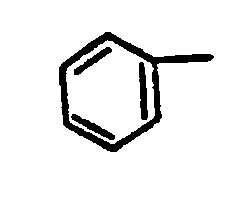
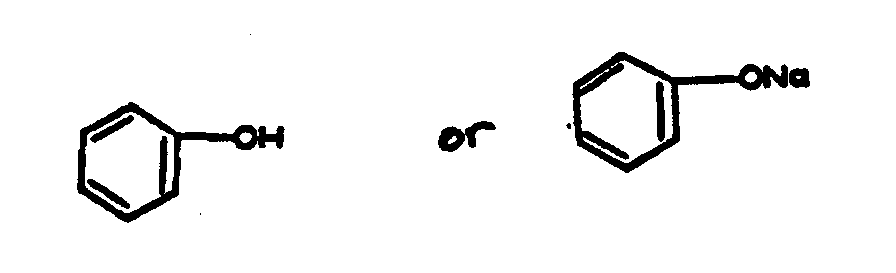
| 722 | Amine nitrogen directly bonded to aromatic ring: | ||
| This subclass is indented under subclass 714. Subject matter wherein the nitrogen containing organic compound
has an amine nitrogen directly bonded to an aromatic ring, e.g.,
as illustrated below, etc.
| |||
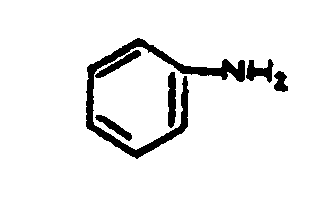
| 723 | Sulfur e.g., sulfonamides, etc.: |
| This subclass is indented under subclass 714. Subject matter wherein the nitrogen containing organic compound has at least one sulfur atom, e.g., R-SO2-N, etc. | |
| 724 | ROH or COOH or salt thereof, e.g., alkanol amine or amino acid, etc.: | ||
This subclass is indented under subclass 714. Subject matter wherein the N-containing organic compound
has at least one-OH, C-OH, or salt (e.g., alkoxide or carboxylate)
attached thereto.
| |||
| 725 | Nitrile: |
| This subclass is indented under subclass 714. Subject matter wherein the nitrogen containing organic compound has at least one -C N group. | |
| 726 | Formamide or N, N-dialkyl amide or N-alkyl pyrrolidone: |
| This subclass is indented under subclass 714. Subject matter wherein the nitrogen containing organic compound
is as illustrated below where alkyl is an aliphatic hydrocarbon
moiety.
| |
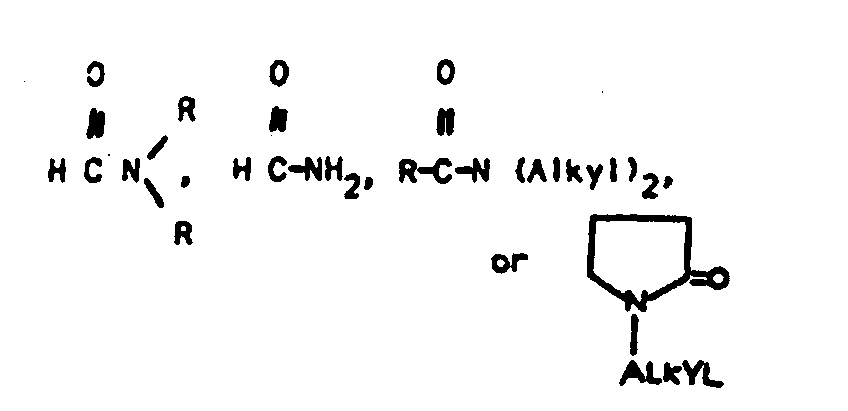
| 727 | With metal-containing material DNRM: |
| This subclass is indented under subclass 726. Subject matter wherein there is additionally present a metal containing material as a DNRM. | |
| 728 | (C=O)N: |
| This subclass is indented under subclass 714. Subject matter wherein the nitrogen containing organic compound has at least one -N group. | |
| 729 | X(C=X)X wherein X is chalcogen DNRM, e.g., carbonate, etc.: | ||
This subclass is indented under subclass 700. Subject matter wherein an organic compound having at least
one X--X group where X is chalcogen, e.g., organic carbonates, etc.,
is present as a DNRM during formation of a solid polymer or SICP.
| |||
| 730 | DNRM contains Si-C, Si-H, contains DNRM metal-C or metal-H bond or organic compound containing Si: |
| This subclass is indented under subclass 700. Subject matter wherein a compound having at least one Si-C, Si-H, metal-C or metal-H bond or an organic compound containing Si is present as DNRM during formation of a solid polymer or SICP. | |
| 731 | Diorgano siloxane contains units of -[(R)Si(R)-O-] * where * is subscript two or more: | ||
| This subclass is indented under subclass 730. Subject matter wherein the organic silicon compound contains
two or more units, e.g. polydimethyl siloxane oil, etc., as illustrated below.
| |||
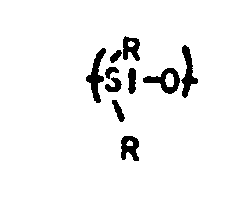
| 732 | Carbohydrate or derivative as DNRM: | ||
| This subclass is indented under subclass 700. Subject matter wherein a carbohydrate or derivative is present
as DNRM during formation of a solid polymer or SICP.
SEE OR SEARCH THIS CLASS, SUBCLASS:
| |||
| 733 | Cellulose or derivative, e.g., cotton, paper pulp, etc.: | ||
| This subclass is indented under subclass 732. Subject matter wherein the carbohydrate is cellulose or
a derivative.
SEE OR SEARCH THIS CLASS, SUBCLASS:
| |||
| 734 | Starch or derivative, farinaceous flour or meal: | ||||
| This subclass is indented under subclass 732. Subject matter wherein the carbohydrate is a starch or a
derivative, or farinaceous flour or meal.
SEE OR SEARCH THIS CLASS, SUBCLASS:
| |||||
| 735 | Lignin, tannin, or derivative as DNRM: | ||||
This subclass is indented under subclass 700. Subject matter wherein lignin, tannin, or a derivative of
these is present as DNRM during formation of a solid polymer or
SICP.
| |||||
| 736 | Aryl-OH or salt thereof as DNRM: | ||
| This subclass is indented under subclass 700. Subject matter wherein a compound having at least one -OH
group or salt thereof directly bonded to an aromatic carbocyclic
nucleus, i.e., phenol compound, is present as DNRM during formation
of a solid polymer or SICP, e.g.,
SEE OR SEARCH THIS CLASS, SUBCLASS:
| |||
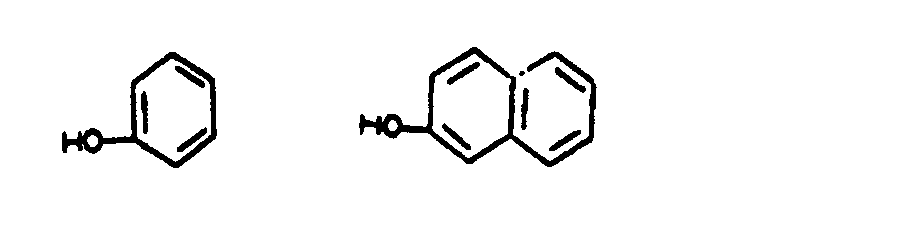
| 738 | Plural separate aryl-OH groups or polyhydric aryl-OH, or salts thereof, e.g., resorcinol, etc.: | ||
This subclass is indented under subclass 736. Subject matter wherein the phenol compound or salt thereof
contains two or more -OH groups or salts directly bonded to the
same of separate aromatic carbocyclic nucleus.
| |||
| 739 | Plural separate aryl-OH or salt groups bonded through carbon or a chalcogen-containing radical, e.g., bisphenol A, etc.: |
| This subclass is indented under subclass 738. Subject matter wherein the phenol compound or salt thereof has plural separate aryl-OH groups or salts thereof bonded together through carbon or a chalcogen containing radical. | |
| 740 | Aryl-OH or salt compound having at least one chalcogen containing substituent, e.g., hydroxy anisole, etc.: |
| This subclass is indented under subclass 736. Subject matter wherein the phenol compound or salt thereof
has at least one chalcogen containing substituent, e.g., as illustrated
below, etc.
| |
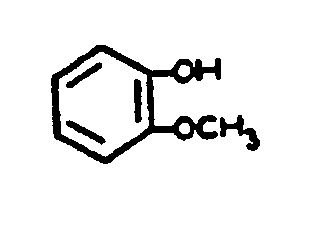
| 741 | Aryl-OH or salt compound having two or more substituents: |
| This subclass is indented under subclass 736. Subject matter wherein the phenol compound or salt has two
or more substituents bonded to the aromatic carbocyclic nucleus,
e.g.,
| |
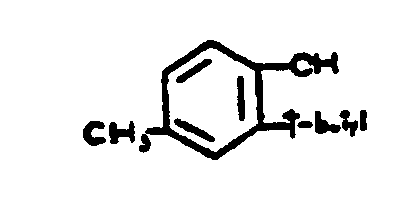
| 742 | Elemental or organic sulfur compound as DNRM: |
| This subclass is indented under subclass 700. Subject matter wherein elemental sulfur or an organic compound containing at least one sulfur atom is present as DNRM during formation of a solid polymer or SICP. | |
| 743 | Sulfone, e.g., sulfolane, etc.: |
| This subclass is indented under subclass 742. Subject matter wherein the sulfur containing organic compound
is a sulfone, e.g.,
| |
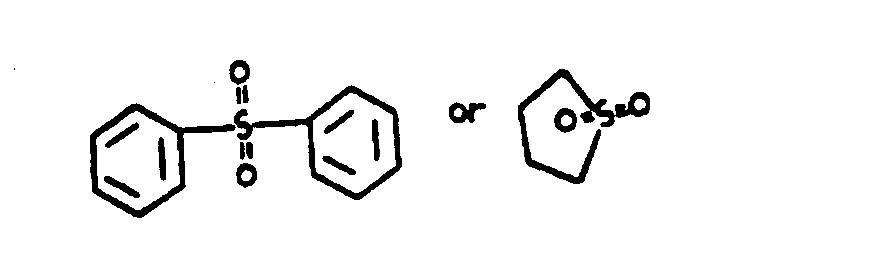
| 744 | DMSO with additional oxygen or halogen compound DNRM: |
| This subclass is indented under subclass 742. Subject matter wherein dimethyl sulfoxide is mixed with an additional oxygen or halogen containing DNRM. | |
| 745 | Sulfate, sulfonate ester, sulfonic acid, or salt thereof: |
| This subclass is indented under subclass 742. Subject matter wherein the sulfur containing organic compound is a sulfate ester, e.g., ROOR or ROH, etc., sulfonic acid or ester, e.g. R-OH, etc., or a salt of these materials. | |
| 746 | Halogenated: |
| This subclass is indented under subclass 745. Subject matter wherein the organic sulfate, sulfonic, sulfonate, or salt has at least one halogen atom. | |
| 747 | Containing ether or hydroxyl group DNRM: | ||
This subclass is indented under subclass 745. Subject matter wherein the organic sulfate, sulfonic acid,
sulfonate, or salt thereof has an ether or OH group bonded thereto;
or wherein there is present an additional DNRM which has an ether
group or hydroxyl group.
| |||
| 748 | Containing COOH or salt thereof or ester thereof DNRM: | ||
This subclass is indented under subclass 745. Subject matter wherein the sulfur containing organic
compound has a -OH, -O-+salt
or -OR group where R is an alcohol residue bonded thereto, or wherein
there is present as an additional DNRM at least one carboxylic acid,
salt, or ester.
| |||
| 750 | Mercaptan, mercaptide or thioether, e.g., aryl-SH, etc.: |
| This subclass is indented under subclass 742. Subject matter wherein the sulfur containing organic compound is R-SH, R-SX or R-S-R wherein X is a cation, e.g., metal or NH+, etc., and R is the carbon of an organic radical. | |
| 751 | Heterocyclic chalcogen compound as DNRM: | ||||
This subclass is indented under subclass 700. Subject matter wherein a heterocyclic chalcogen ring containing
material is present as DNRM during formation of a solid polymer
or SICP.
| |||||
| 752 | With organic chalcogen compound, hydrocarbon, or halogenated hydrocarbon DNRM: | ||
| This subclass is indented under subclass 751. Subject matter wherein there is present as an additional
DNRM an organic chalcogen compound, hydrocarbon, or halogenated
hydrocarbon.
SEE OR SEARCH THIS CLASS, SUBCLASS:
| |||
| 753 | Carboxylic acid ester linkage, e.g., oxyalkylated sorbitan ester, etc.: | ||
This subclass is indented under subclass 751. Subject matter wherein said heterocyclic chalcogen compound
has at least one carboxylic acid ester linkage.
| |||
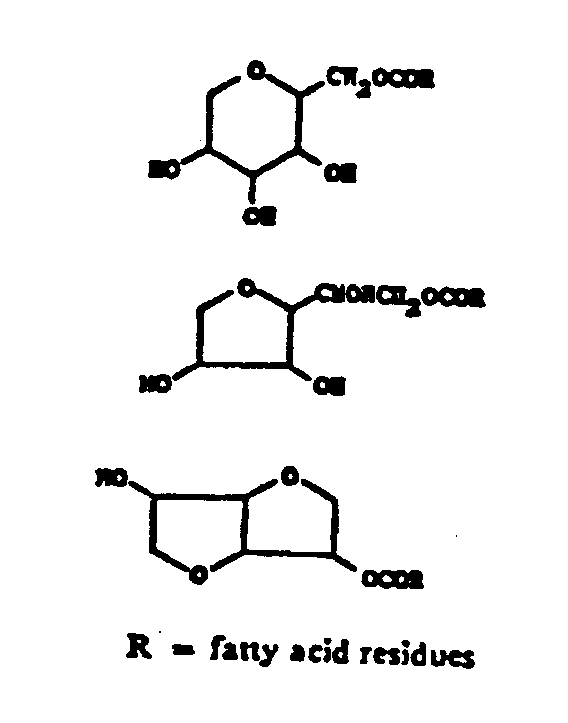
| 754 | Plural hetero oxygen: |
| This subclass is indented under subclass 751. Subject matter wherein the heterocyclic chalcogen compound contains two or more oxygen atoms in the same heterocyclic ring or two or more oxygen containing heterocyclic rings. | |
| 755 | Ether compound DNRM, e.g., aryl ether, dimethylether, etc.: |
| This subclass is indented under subclass 700. Subject matter wherein a compound having at least one C-O-C
linkage where neither carbon is doubly bonded to chalcogen, e.g.,
as illustrated below, or CH3-O-CH3,
etc., is present as DNRM during formation of a solid polymer or SICP.
| |
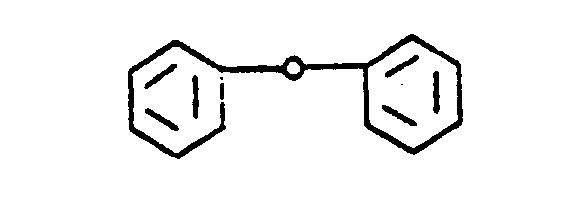
| 757 | Mixture of ether compounds; or only two ether oxygens bonded to a carbon atom, e.g., formal acetal, etc.: |
| This subclass is indented under subclass 755. Subject matter wherein there are at least two ether compounds as DNRM; or wherein the ether compound has at least one carbon atom which has only two ether linkages attached to the carbon, e.g., -C-O--O-C-, etc. | |
| 758 | Halogenated: |
| This subclass is indented under subclass 755. Subject matter wherein the ether compound has at least one halogen atom attached thereto. | |
| 759 | Containing carboxylic acid or derivative DNRM: | ||
This subclass is indented under subclass 755. Subject matter wherein the ether compound has at least one
carboxylic acid or derivative group attached thereto, or wherein
there is present an additional DNRM which is a carboxylic acid or derivative:
| |||
| 760 | Carboxylic acid or derivative has two or more ether linkages: |
| This subclass is indented under subclass 759. Subject matter wherein the carboxylic acid or derivative has at least two ether linkages attached thereto. | |
| 761 | Containing hydroxyl group DNRM: |
| This subclass is indented under subclass 755. Subject matter wherein the ether compound has at least one hydroxyl group attached thereto, or wherein there is present as an additional DNRM a hydroxyl bearing compound other than water. | |
| 762 | Two or more ether linkages in the hydroxyl group bearing molecule: |
| This subclass is indented under subclass 761. Subject matter wherein the hydroxyl group bearing molecule has two or more ether linkages, e.g., hydroxyl terminated polyether, etc. | |
| 763 | Oxygen containing wax as DNRM, e.g., carnauba, montan, ceresin, bees wax, oxidized petroleum wax, etc.: | ||
This subclass is indented under subclass 700. Subject matter wherein an oxygen containing wax is present
as DNRM during formation of a solid polymer or SICP.
| |||
| 764 | Natural resin or derivative as DNRM, e.g., rosin, shellac, etc., excluding tall oil per se: | ||||
This subclass is indented under subclass 700. Subject matter wherein a natural resin or derivative including
rosin and derivatives is present as DNRM during formation of a solid
polymer or SICP.
SEE OR SEARCH THIS CLASS, SUBCLASS:
| |||||
| 765 | Alcohol compound as DNRM, i.e., R-OH: | ||||||
This subclass is indented under subclass 700. Subject matter wherein an alcohol compound is present as
DNRM during formation of a solid polymer or SICP.
SEE OR SEARCH THIS CLASS, SUBCLASS:
| |||||||
| 766 | Two or more alcohols: |
| This subclass is indented under subclass 765. Subject matter wherein there are at least two alcohols as DNRM"s. | |
| 767 | With water NRM: |
| This subclass is indented under subclass 765. Subject matter wherein water is present as an additional NRM. | |
| 768 | With hydrocarbon or halogenated hydrocarbon NRM: |
| This subclass is indented under subclass 765. Subject matter wherein there is additionally present a hydrocarbon or halogenated hydrocarbon as a NRM. | |
| 769 | Chalcogen other than as R-OH: |
| This subclass is indented under subclass 765. Subject matter wherein the alcohol compound has a chalcogen atom in addition to the oxygen in the hydroxy group. | |
| 770 | Ketone or aldehyde as DNRM: | ||
This subclass is indented under subclass 700. Subject matter wherein a ketone or aldehyde is present as
DNRM during formation of a solid polymer or SICP.
| |||
| 771 | With hydrocarbon or halogenated hydrocarbon NRM: |
| This subclass is indented under subclass 770. Subject matter wherein there is additionally present a hydrocarbon or halogenated hydrocarbon NRM. | |
| 772 | Carboxylic acid or derivative, e.g., acetoacetic acid or ester or salt thereof, etc.: | ||
This subclass is indented under subclass 770. Subject matter wherein the ketone or aldehyde has attached
thereto a carboxylic acid group or derivative.
| |||
| 773 | Carboxylic acid or derivative not containing a heavy metal atom as DNRM, e.g., anhydride, acyl halide, ester or salt, etc.: | ||||
This subclass is indented under subclass 700. Subject matter wherein a carboxylic acid or derivative not
having a heavy metal atom attached thereto is present as DNRM during formation
of a solid polymer or SICP.
SEE OR SEARCH THIS CLASS, SUBCLASS:
| |||||
| 774 | Cycloaliphatic group, e.g., dimer acids containing thirty six carbon atoms, tall oil, etc.: | ||
This subclass is indented under subclass 773. Subject matter wherein the carboxylic acid or derivative
has attached thereto a cycloaliphatic group.
| |||
| 775 | Aryl group: |
| This subclass is indented under subclass 773. Subject matter wherein the carboxylic acid or derivative has attached thereto an aryl group. | |
| 776 | Solid polymer derived from ethylenic monomers only: |
| This subclass is indented under subclass 775. Subject matter wherein the solid polymer produced is from ethylenically unsaturated monomers only. | |
| 777 | Group IA, unsubstituted ammonium, or Group IIA salt: | ||
This subclass is indented under subclass 773. Subject matter wherein the carboxylic derivative is a Group
IA, NH4+ or Group IIA salt.
| |||
| 778 | Solid polymer or SICP derived from at least one nonethylenic monomer: |
| This subclass is indented under subclass 777. Subject matter wherein the solid polymer or SICP which is produced is derived from at least one monomer which is not ethylenically unsaturated. | |
| 779 | Elemental metal or metal compound not containing silicon DNRM: | ||||
This subclass is indented under subclass 700. Subject matter wherein an elemental metal or metal compound
which does not contain a silicon atom is present as DNRM during
formation of a solid polymer or SICP.
SEE OR SEARCH THIS CLASS, SUBCLASS:
| |||||
| 780 | Heavy metal: |
| This subclass is indented under subclass 779. Subject matter wherein the metal or metal compound is or contains a metal atom having a specific gravity greater than four. | |
| 781 | Copper: |
| This subclass is indented under subclass 780. Subject matter wherein the metal atom is copper in elemental or compound form. | |
| 783 | Group IV or Group IIB, i.e., Ge, Sn, Pb, Zr, Ti, Hf, Zn, Cd, Hg: |
| This subclass is indented under subclass 780. Subject matter wherein the metal atom is Ge, Sn, Pb, Ti, Zr, Hf, Zn, Cd, or Hg, in elemental or compound form. | |
| 784 | Tin: |
| This subclass is indented under subclass 783. Subject matter wherein the metal atom is tin in elemental or compound form. | |
| 785 | Group VIII, i.e., Fe, Ru, Os, Co, Rh, Ir, Ni, Pd, Pt: |
| This subclass is indented under subclass 780. Subject matter wherein the metal atom is Fe, Co, Ni, Ru, Rh, Pd, Os, Ir, or Pt in elemental or compound form, i.e., Group VIII. | |
| 786 | Al: |
| This subclass is indented under subclass 779. Subject matter wherein the metal atom is aluminum in elemental or compound form. | |
| 787 | Inorganic metal compound having S, C, or N, e.g., KSCN, etc.: |
| This subclass is indented under subclass 779. Subject matter wherein the metal compound is inorganic and has at least one atom of carbon, sulfur, or nitrogen. | |
| 788 | Calcium, e.g., CaCO3, etc.: |
| This subclass is indented under subclass 787. Subject matter wherein the inorganic metal compound contains calcium. | |
| 789 | Elemental silicon, soil, or inorganic silicon compound as DNRM: |
| This subclass is indented under subclass 700. Subject matter wherein elemental silicon, soil, or an inorganic silicon compound is present as DNRM during formation of a solid polymer or SICP. | |
| 790 | With reactive coupling agent: | ||
| This subclass is indented under subclass 789. Subject matter wherein the solid polymer or SICP is formed
in the additional presence of a coupling agent which has sites reactive
with both a portion of the elemental silicon, soil, or inorganic
silicon compound DNRM and with the solid polymer, or SICP-forming
system.
SEE OR SEARCH THIS CLASS, SUBCLASS:
| |||
| 791 | Alkali or alkali earth silicate: |
| This subclass is indented under subclass 789. Subject matter wherein the inorganic silicon DNRM is an alkali or alkali earth silicate. | |
| 792 | Halogenated hydrocarbon DNRM: |
| Subject matter under subclas 700 wherein a compound which contains only carbon and halogen atoms or only carbon, halogen, and hydrogen atoms is present as DNRM during formation of a solid polymer or SICP. | |
| 793 | Halogenated hydrocarbon contains ethylenic unsaturation: | ||
This subclass is indented under subclass 792. Subject matter wherein the halogen DNRM contains ethylenic
unsaturation.
| |||
| 794 | With water NRM: |
| This subclass is indented under subclass 792. Subject matter wherein in addition to the halogen DNRM there is present water as a NRM. | |
| 795 | Fluorinated: | ||
This subclass is indented under subclass 792. Subject matter wherein the DNRM contains a fluorine atom.
| |||
| 796 | Nitrogen, halogen, or compounds thereof DNRM: |
| This subclass is indented under subclass 700. Subject matter wherein nitrogen, halogen, or a compound having at least one nitrogen or halogen atom is present as DNRM during formation of a solid polymer or SICP. | |
| 797 | Solid polymer or SICP derived from protein or biologically active polypeptide and ethylenic monomer or SPFI: | ||||||
This subclass is indented under subclass 1. Subject matter wherein the desired or intentional composition
is produced by formation of a solid polymer or SICP by reaction
of protein or biologically active polypeptide with an ethylenic
monomer or SPFI in the presence of at least one nonreactant material
(NRM).
SEE OR SEARCH THIS CLASS, SUBCLASS:
| |||||||
| 798 | Solid polymer or SICP derived from natural resin or natural resin derivative and ethylenic monomer or SPFI, e.g., shellac, rosin, etc.: | ||||
This subclass is indented under subclass 1. Subject matter under Class 523, ... wherein the desired
or intentional composition is produced by formation of a solid polymer
or SICP by reaction of a natural resin or natural resin derivative
with an ethylenic monomer of SPFI in the presence of at least one
nonreactant material (NRM).
| |||||
| 799 | Solid polymer or SICP derived from lignin or tannin and ethylenic monomer or SPFI: | ||||||||
This subclass is indented under subclass 1. Subject matter under Class 523, ... wherein the desired
or intentional composition is produced by formation of a solid polymer
or SICP in the presence of at least one nonreactant material (NRM)
by reaction of lignin, tannin, or derivatives with ethylenic monomer
or specified polymer- forming ingredients (SPFI).
| |||||||||
| 800 | Preparation of intentional or desired composition by formation of solid polymer or SICP in the presence of water as a designated nonreactant material (DNRM), or products thereof: | ||
This subclass is indented under subclass 1. Subject matter under Class 523, ... wherein a desired or
intentional composition is produced by formation of a solid polymer
or SICP in the presence of water as a designated nonreactant material
or products thereof.
| |||
| 801 | Process of preparing water-in-oil emulsion or dispersion or product thereof: | ||
| This subclass is indented under subclass 800. Subject matter wherein the process of forming a solid polymer
or SICP in the presence of water results in the formation of a water-in-oil emulsion
or dispersion or products thereof.
SEE OR SEARCH CLASS:
| |||
| 802 | Aqueous carboxyl-bearing solid polymer or SICP composition chemically treated with aziridine, mono 1,2-epoxide, or cyclic sulfonium compound: |
| This subclass is indented under subclass 800. Subject matter wherein the solid polymer or SICP which has been prepared in the presence of water is a carboxyl-bearing polymer which is subsequently chemically treated with an aziridine (i.e., ) , or mono 1,2-epoxide (i.e., ) or cyclic sulfonium compound | |
| 803 | Polyvinyl alcohol or partially hydrolyzed polyvinyl acetate or chemically modified forms thereof: | ||
This subclass is indented under subclass 800. Subject matter wherein the intentional or desired composition,
which is prepared by formation of a solid polymer or SICP in the
presence of water, contains polyvinyl alcohol (PVA) or chemically
modified PVA.
| |||
| 804 | Solid polymer derived from ethylenic monomers only: | ||
This subclass is indented under subclass 800. Subject matter wherein a solid polymer from ethylenically
unsaturated monomers only is formed in the presence of water as
a designated nonreactive material.
| |||
| 805 | Fluorine containing monomer: | ||
| This subclass is indented under subclass 804. Subject matter wherein there is at least one ethylenically
unsaturated monomer containing fluorine.
SEE OR SEARCH CLASS:
| |||
| 806 | Silicon-containing monomer: | ||
| This subclass is indented under subclass 804. Subject matter wherein there is at least one ethylenically
unsaturated monomer containing silicon.
SEE OR SEARCH CLASS:
| |||
| 807 | Monomer-containing element other than C, H, O, N, S, Hal, or Group IA metal atom: | ||
This subclass is indented under subclass 804. Subject matter wherein there is at least one ethylenically
unsaturated monomer containing an atom other than S, C, O, N, H,
halogen, or Group IA metal atom (Li, Na, K, Rb, or Cs).
| |||
| 808 | Monomer contains nitrogen atom as part of a heterocyclic ring: | ||
This subclass is indented under subclass 804. Subject matter wherein there is at least one ethylenically
unsaturated monomer which contains at least one nitrogen atom as
part of a heterocyclic ring.
| |||
| 809 | Two or more nitrogen atoms in a single ring: |
| This subclass is indented under subclass 808. Subject matter wherein there are two or more nitrogen atoms in the same heterocyclic ring. | |
| 811 | Monomer contains chalcogen atom as part of heterocyclic ring: | ||
This subclass is indented under subclass 804. Subject matter wherein at least one ethylenically unsaturated
monomer contains at least one chalcogen atom as a member of a heterocyclic
ring.
| |||
| 812 | N-containing monomer other than unsubstituted ammonium as sole nitrogen, acrylamide, methylol acrylamide, acrylonitrile and the corresponding methacryl compounds or mixtures thereof: |
| This subclass is indented under subclass 804. Subject matter wherein there is at least one nitrogen containing monomer which is other than acrylamide, methylol acrylamide, acrylonitrile, methacrylamide, methylol methacrylamide, methacrylonitrile, monomer having NH4 as the sole nitrogen, or mixtures of any of these. | |
| 813 | Nitrogen-carbon-oxygen bond containing monomer, e.g., allyl isocyanate, etc.: | ||
This subclass is indented under subclass 812. Subject matter wherein there is at least one monomer containing
nitrogen directly bonded to carbon and which carbon is directly
bonded to oxygen.
| |||
| 814 | N-monomer contains S: |
| This subclass is indented under subclass 812. Subject matter wherein there is at least one monomer containing both nitrogen and sulfur atoms. | |
| 815 | Quaternary nitrogen-containing monomer, e.g., tetramethyl ammonium, etc.: |
| This subclass is indented under subclass 812. Subject matter wherein there is at least one monomer containing NR4 wherein each R is linked to the nitrogen through a carbon atom. | |
| 816 | N-monomer contains carboxylic acid or salt thereof: | ||
This subclass is indented under subclass 812. Subject matter wherein at least one nitrogen containing
monomer contains a carboxylic acid or salt thereof.
| |||
| 817 | S-containing monomer: |
| This subclass is indented under subclass 804. Subject matter wherein at least one monomer contains sulfur. | |
| 818 | Aldehyde or ketone containing monomer: | ||||
This subclass is indented under subclass 804. Subject matter wherein at least one monomer contains an
aldehyde or ketone group.
| |||||
| 819 | Hydrocarbon monomer with carboxylic acid, salt, or nonnitrogen containing derivative monomer: | ||
This subclass is indented under subclass 804. Subject matter wherein there is at least one hydrocarbon
monomer in combination with at least one monomer which has a carboxylic
acid group, salt, or is a nonnitrogen containing derivative thereof.
| |||
| 820 | With N monomer: |
| This subclass is indented under subclass 819. Subject matter wherein at least one nitrogen containing monomer is present in addition to said hydrocarbon monomer and said carboxylic acid, salt, or derivative monomer. | |
| 821 | Hydrocarbon monomer contains at least two ethylenic groups: |
| This subclass is indented under subclass 820. Subject matter wherein at least one hydrocarbon monomer contains at least two ethylenically unsaturated groups. | |
| 822 | Two or more hydrocarbon monomers: |
| This subclass is indented under subclass 819. Subject matter wherein there are at least two different ethylenically unsaturated hydrocarbon monomers. | |
| 823 | Two or more monomers-containing carboxylic acid or derivative: |
| This subclass is indented under subclass 819. Subject matter wherein there are at least two different carboxylic acid or derivative monomers. | |
| 824 | Aromatic monomer: |
| This subclass is indented under subclass 823. Subject matter wherein there is at least one aromatic ethylenically unsaturated monomer, e.g., styrene, etc. | |
| 825 | With halogenated hydrocarbon monomer: |
| This subclass is indented under subclass 819. Subject matter wherein there is additionally present at least one ethylenically unsaturated monomer containing at least one halogen atom. | |
| 827 | N-containing monomer: |
| This subclass is indented under subclass 804. Subject matter wherein there is at least one nitrogen containing ethylenically unsaturated monomer. | |
| 828 | With hydrocarbon monomer: |
| This subclass is indented under subclass 827. Subject matter wherein there is additionally present at least one ethylenically unsaturated hydrocarbon monomer. | |
| 829 | Two or more N monomers: |
| This subclass is indented under subclass 827. Subject matter wherein there are at least two different ethylenically unsaturated nitrogen containing monomers. | |
| 831 | With unsaturated carboxylic acid or ester monomer: | ||
This subclass is indented under subclass 827. Subject matter wherein there is additionally present at
least one monomer which is an ethylenically unsaturated carboxylic
acid or ester thereof.
| |||
| 832 | Monomer is carboxylic acid or derivative: | ||
This subclass is indented under subclass 804. Subject matter wherein there are at least one ethylenically
unsaturated monomer which is a carboxylic acid or derivative.
| |||
| 833 | Two or more carboxylic acids or derivatives: |
| This subclass is indented under subclass 832. Subject matter wherein there are at least two different monomers which are ethylenically unsaturated carboxylic acids or derivatives thereof. | |
| 834 | Halogenated hydrocarbon monomer: | ||
This subclass is indented under subclass 804. Subject matter wherein there is at least one ethylenically
unsaturated, halogenated hydrocarbon monomer.
| |||
| 835 | Two or more halogenated hydrocarbon monomers: |
| This subclass is indented under subclass 834. Subject matter wherein there are at least two different ethylenically unsaturated, halogenated hydrocarbon monomers. | |
| 836 | Hydrocarbon monomer only: |
| This subclass is indented under subclass 804. Subject matter wherein all monomers are ethylenically unsaturated hydrocarbons. | |
| 837 | Solid polymer or SICP derived from Si-containing reactant: |
| This subclass is indented under subclass 800. Subject matter wherein there is at least one silicon-containing reactant in the solid polymer or SICP formed in the presence of water as a DNRM: | |
| 838 | N-containing reactant: |
| This subclass is indented under subclass 837. Subject matter wherein there is at least one nitrogen-containing reactant. | |
| 839 | Solid polymer or SICP derived from -N=C=X containing reactant: | ||||
This subclass is indented under subclass 800. Subject matter wherein there is at least one N=C=X
containing reactant in the solid polymer or SICP formed in the presence
of water as a DNRM.
| |||||
| 840 | N=C=X reactant has ionic group attached thereto, e.g., carboxyl, sulfonic, etc.: | ||
This subclass is indented under subclass 839. Subject matter wherein at least one N=C=X reactant
has ionic groups attached thereto.
| |||
| 841 | Solid polymer or SICP derived from a phenolic reactant: | ||
This subclass is indented under subclass 800. Subject matter wherein there is at least one phenolic reactant
in the solid polymer or SICP formed in the presence of water as
DNRM.
| |||
| 842 | With carbohydrate reactant, e.g., starch, cellulose, or sugar, etc.: | ||
This subclass is indented under subclass 841. Subject matter where there is at least one carbohydrate
or derivative as a reactant in addition to said phenolic reactant.
| |||
| 843 | Solid polymer or SICP derived from an aldehyde or aldehyde derivative reactant: | ||
This subclass is indented under subclass 800. Subject matter wherein there is at least one aldehyde or
derivative reactant in the said solid polymer or SICP formed in
the presence of water as DNRM.
| |||
| 844 | With carbohydrate reactant, e.g., starch, cellulose, cork, etc.: | ||
This subclass is indented under subclass 843. Subject matter wherein there is at least one carbohydrate
or derivative as a reactant in addition to said aldehyde or derivative.
| |||
| 845 | Solid polymer derived from a reactant which is a carboxylic acid or derivative: | ||
This subclass is indented under subclass 800. Subject matter wherein there is at least one carboxylic
acid or derivative reactant in said solid polymer formed in the
presence of water as DNRM.
| |||
| 846 | Polymer of an ethylenic reactant with a saturated reactant: |
| This subclass is indented under subclass 800. Subject matter wherein there is at least one solid polymer of an ethylenic unsaturated reactant with a saturated reactant, said solid polymer formed in the presence of water as DNRM. | |
| 847 | Carbon, titanium dioxide, glass, or silicon dioxide having specified crystalline form or numerical limitation other than amount, e.g., included herein are particle size, shape, etc., as DNRM: | ||||
This subclass is indented under subclass 1. Subject matter under Class 523, ... wherein said desired
or intentional composition is produced by formation of a solid polymer
or SICP in the presence of a designated nonreactive material which
is carbon, TiO2, glass, or SiO2 having
specified form or numerical limitations other than amount.
SEE OR SEARCH THIS CLASS, SUBCLASS:
| |||||
| 848 | Hydrocarbon material other than solely a fused ring or cyloaliphatic hydrocarbon, benzene, toluene, or xylene or mixture thereof; said material or mixture of materials having specified numerical limitations other than amount, e.g., included herein are m.p., b.p., viscosity, particle size, etc., as DNRM: | ||||
This subclass is indented under subclass 1. Subject matter under Class 523, ... wherein said desired
or intentional composition is produced by formation of a solid polymer
or SICP in the presence of a designated nonreactive material which
is at least one hydrocarbon material having specified numerical
properties other than amount and other than benzene, toluene, xylene,
or solely a fused ring or cycloaliphatic hydrocarbon or mixtures
solely consisting of the excluded species.
SEE OR SEARCH THIS CLASS, SUBCLASS:
| |||||
| 849 | Solid polymer from ethylenic monomer only, said polymer formed in the presence of a nonreactant material: |
| This subclass is indented under subclass 1. Subject matter under Class 523, ... wherein said desired or intentional composition is produced by formation of a solid polymer from ethylenically unsaturated monomers only in the presence of at least one nonreactant material. | |
| 850 | N-containing monomer: |
| This subclass is indented under subclass 849. Subject matter wherein at least one ethylenically unsaturated monomer contains nitrogen. | |
| 851 | Halogen-containing monomer: |
| This subclass is indented under subclass 849. Subject matter wherein at least one ethylenically unsaturated monomer contains halogen. | |
| 852 | Chalcogen atom containing monomer other than ether oxygen as sole chalcogen: | ||
This subclass is indented under subclass 849. Subject matter wherein at least one ethylenically unsaturated
monomer contains a chalcogen atom other than ether oxygen as the
sole chalcogen.
| |||
| 853 | Carboxylic acid or derivative monomer: | ||
This subclass is indented under subclass 852. Subject matter wherein there is at least one ethylenically
unsaturated carboxylic acid or derivative as monomer.
| |||
| 854 | Monomer containing at least two carboxylic acid or derivative groups: |
| This subclass is indented under subclass 853. Subject matter wherein there is at least one ethylenically unsaturated monomer which has two or more carboxylic acid or derivative groups. | |
| 855 | From unsaturated hydrocarbon monomer solely: |
| This subclass is indented under subclass 849. Subject matter wherein all monomers are ethylenically unsaturated hydrocarbons. | |
| 856 | Contains two or more ethylenic unsaturated groups: |
| This subclass is indented under subclass 855. Subject matter wherein at least one monomer has two or more ethylenically unsaturated groups. | |
| 857 | Boron or metal-containing reactant forming a solid polymer or SICP in the presence of a nonreactant material: |
| This subclass is indented under subclass 1. Subject matter under Class 523, ... wherein said desired or intentional composition is produced by formation of a solid polymer or SICP from at least one boron or metal-containing reactant in the presence of a nonreactant material. | |
| 858 | Si-containing reactant forming a solid polymer or SICP in the presence of a nonreactant material: |
| This subclass is indented under subclass 1. Subject matter under Class 523, ... wherein said desired or intentional composition is produced by formation of a solid polymer or SICP from at least one silicon-containing reactant in the presence of a nonreactant material. | |
| 859 | Silicate containing compound as sole Si-containing reactant, e.g., ortho silicate esters, etc.: | ||||
This subclass is indented under subclass 858. Subject matter wherein all silicon-containing reactants
contain at least one -O--O- structure.
| |||||
| 860 | Poly (di organo siloxane) reactant, i.e., [R-Si(R)-O]-* where R is an organic radical and * is subscript two or more: |
| This subclass is indented under subclass 858. Subject matter wherein there is at least one reactant containing
the following, illustrated below, where R is an organic radical
and the subscript * is two or more.
| |
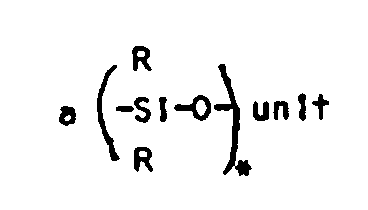
| 861 | Si-H containing reactant: |
| This subclass is indented under subclass 860. Subject matter wherein there is at least one Si-H containing reactant. | |
| 862 | With ethylenically unsaturated reactant: |
| This subclass is indented under subclass 861. Subject matter wherein at least one ethylenically unsaturated reactant is present in addition to the Si-H reactant. | |
| 863 | Poly (di organo siloxane) reactant has at least one SiO other than as Si-O-Si, e.g., Si-O-C, or SiOH group, etc.: | ||
This subclass is indented under subclass 860. Subject matter wherein said poly(di organo siloxane) reactant
has at least one Si-O-A linkage where A is an atom other than Si.
| |||
| 864 | With N-containing reactant: |
| This subclass is indented under subclass 863. Subject matter wherein at least one nitrogen-containing reactant is present in addition to the Si-O-A reactant. | |
| 865 | With ethylenic unsaturated reactant: |
| This subclass is indented under subclass 863. Subject matter wherein an ethylenically unsaturated reactant is present in addition to the Si-O-A reactant. | |
| 866 | Ethylenically unsaturated reactant: |
| This subclass is indented under subclass 860. Subject matter wherein there is at least one ethylenically unsaturated reactant. | |
| 868 | Heterocyclic reactant: | ||
This subclass is indented under subclass 858. Subject matter wherein there is at least one heterocyclic
reactant.
| |||
| 869 | N-containing reactant: |
| This subclass is indented under subclass 858. Subject matter wherein there is at least one reactant which contains nitrogen. | |
| 871 | N=C=X containing reactant forming a solid polymer or SICP in the presence of a nonreactant material (X is chalcogen): | ||||
This subclass is indented under subclass 1. Subject matter under Class 523, ... wherein said desired
or intentional composition is produced by formation of a solid polymer
or SICP from at least one N=C=X containing reactant in
the presence of a nonreactive material.
| |||||
| 872 | Two or more N=C=X containing reactants (other than conventional isomer mixtures): | ||
This subclass is indented under subclass 871. Subject matter wherein there are at least two N=C=X
containing reactants.
| |||
| 873 | Aliphatic or cycloaliphatic N=C=X compound: |
| This subclass is indented under subclass 871. Subject matter wherein there is at least one compound where the -N=C=X group is linked to a carbon which is a member of an aliphatic or cycloaliphatic group. | |
| 874 | With N-containing reactant: |
| This subclass is indented under subclass 871. Subject matter wherein there is at least one nitrogen-containing reactant present in addition to the -N=C=X reactant. | |
| 875 | With two or more alcohol hydroxyl compounds: |
| This subclass is indented under subclass 871. Subject matter wherein there are at least two C-OH compounds where the carbon is not doubly bonded to chalcogen present in addition to the -N=C=X reactant. | |
| 876 | Phenolic reactant forming a solid polymer or SICP in the presence of a nonreactant material: | ||
This subclass is indented under subclass 1. Subject matter under Class 523, ... wherein said desired
or intentional composition is produced by formation of a solid polymer
or SICP from at least one phenolic reactant in the presence of a
nonreactant material.
| |||
| 877 | Aldehyde or derivative or ketone as reactant forming a solid polymer or SICP in the presence of a nonreactant material: | ||
This subclass is indented under subclass 1. Subject matter under Class 523, ... wherein said desired
or intentional composition is produced by formation of a solid polymer
or SICP from at least one aldehyde or derivative or ketone reactant
in the presence of a nonreactant material.
| |||
| 878 | Carboxylic acid or derivative, excluding nitrile as sole derivative as reactant forming a solid polymer in the presence of a nonreactant material: | ||||
This subclass is indented under subclass 1. Subject matter under Class 523, ... wherein said desired
or intentional composition is produced by formation of a solid polymer
from at least one carboxylic acid or derivative excluding nitrile
derivative as reactant in the presence of a nonreactant material.
SEE OR SEARCH CLASS:
| |||||
| 879 | Nitrogen-containing reactant: |
| This subclass is indented under subclass 878. Subject matter wherein there is at least one nitrogen-containing reactant. | |
| 881 | Ethylenically unsaturated compound or compound containing element other than C, H, O, or N (e.g., P, S, etc.) as reactant forming a solid polymer in the presence of a NRM: | ||
This subclass is indented under subclass 1. Subject matter under Class 523, ... wherein said desired
or intentional composition is produced by formation of a solid polymer
from at least one compound containing an atom other than C, H, O,
or N in the presence of a nonreactant material or from at least
one ethylenically unsaturated compound with at least one non(ethylenically
unsaturated) compound in the presence of a nonreactant material.
| |||
CROSS-REFERENCE ART COLLECTIONS
The following subclasses are collections of published disclosure pertaining to various aspects of art relating to intentional compostions involving solid polymers or specified intermediate condensation products, and which aspects do not form an appropriate base for subclass classification in the classification schedule.
| (1) Note. Disclosures are placed for value as a search aid and in no instance do they represent the entire extent of the prior art. |
| 900 | ANTIGEN-ANTIBODY: |
| Subject matter involving polymer-protein compositions having antigen or antibody activity. | |
| 901 | ELECTRODEPOSITABLE COMPOSI- TIONS: |
| Subject matter involving compositions which are depositable upon application of an electric field. | |
| 902 | ELECTROSTATIC SPRAY: |
| This subclass is indented under subclass 901. Subject matter involving electrostatic spray compositions. | |
| 903 | AEROSOL COMPOSITIONS: | ||
| Subject matter involving compositions suitable for use as
aerosols.
SEE OR SEARCH CLASS:
| |||
| 904 | POWDER COATING COMPOSITIONS: |
| Subject matter wherein the composition is suitable for application as a powder coating, e.g., fluidized bed, etc. | |
| 905 | ETCH MASKING COMPOSITIONS: |
| Subject matter involving composition suitable as an etch mask. | |
| 906 | MULTIPACKAGE COMPOSITIONS: |
| Subject matter wherein the various components of a composition are arranged in separate packages or compartments intended for subsequent admixture. | |
| 907 | ADDITIVE OF SPECIFIED SHAPE OTHER THAN FIBER, PARTICLE, OR POWDER: |
| Subject matter wherein the composition contains an additive of specified shape. | |
| 908 | COMPOSITION HAVING SPECIFIED SHAPE, E.G., ROD, STICK, OR BALL, ETC., AND OTHER THAN SHEET, FILM, OR FIBER: |
| Subject matter wherein the overall composition has a specified shape, e.g., rod, stick, or ball, etc., and is other than a sheet, film, or powder. | |
| 909 | REVERSE OSMOSIS MEMBRANE COMPOSITIONS, E.G., DESALINIZATION, ETC.: |
| Subject matter wherein the composition is suitable for use in a reverse osmosis membrane. | |
| 910 | ANTISTATIC COMPOSITIONS: |
| Subject matter wherein the composition has antistatic property. | |
| 911 | Composition to apply to a substrate to be destaticized: |
| This subclass is indented under subclass 910. Subject matter involving compositions to apply to a substrate to be destaticized. | |
| 912 | Contains metal, boron, phosporus, or silicon: |
| This subclass is indented under subclass 910. Subject matter involving antistatic compositions containing metal, boron, phosphorus, or silicon atoms. | |
| 913 | Contains nitrogen nonreactant material: |
| This subclass is indented under subclass 910. Subject matter involving antistatic compositions containing nitrogen atoms in the nonreactant material. | |
| 914 | FLOOR COVERING COMPOSITIONS: |
| Subject matter involving compositions suitable for use as floor coverings. | |
| 915 | CARPET BACKING ADHESIVES: |
| Subject matter involving compositions suitable for use as carpet backing adhesives. | |
| 916 | HYDROGEL COMPOSITIONS: | ||
| Subject matter involving hydrogel compositions.
SEE OR SEARCH CLASS:
| |||
| 917 | OIL SPILL RECOVERY COMPOSITIONS: |
| Subject matter involving compositions suitable for use in oil spill recovery. | |
| 918 | WOOD PATCHING COMPOSITION: |
| Subject matter involving compositions suitable for patching wood, e.g., wood putty or filler, etc. | |
| 919 | METAL PATCHING COMPOSITIONS, E.G., BODY SOLDER, ETC.: |
| Subject matter involving compositions suitable for metal patching, e.g., body putty, etc. | |
| 920 | COILABLE PIPE COMPOSITIONS: |
| Subject matter involving compositions suitable for making coilable pipe, e.g., coilable pvc pipe, etc. | |
| 921 | ELASTIC MEMORY OR HEAT SHRINKABLE COMPOSITIONS: |
| Subject matter involving compositions which are heat shrinkable or have elastic memory. | |
| 922 | FLOCCULATING, CLARIFYING, OR FINING COMPOSITIONS: | ||
| Subject matter involving compositions suitable for flocculating,
clarifying, or fining.
SEE OR SEARCH CLASS:
| |||
| 923 | TREATING OR PREPARING A NONAQUEOUS DISPERSION OR EMULSION OF A SOLID POLYMER OR SPECIFIED INTERMEDIATE CONDENSATION PRODUCT: | ||
| Subject matter involving treating or preparing nonaqueous
dispersions or emulsions of solid polymer or SICP.
SEE OR SEARCH CLASS:
| |||
| 924 | TREATING OR PREPARING A NONAQUEOUS SOLUTION OF A SOLID POLYMER OR SPECIFIED INTERMEDIATE CONDENSATION PRODUCT: |
| Subject matter involving treating or preparing a nonaqueous solution of a solid polymer or SICP. | |
| 925 | NATURAL RUBBER COMPOSITIONS HAVING NONREACTIVE MATERIALS (DNRM) OTHER THAN: CARBON, SILICON DIOXIDE, GLASS TITANIUM DIOXIDE, WATER, HYDROCARBON: |
| Subject matter involving natural rubber compositions having a DNRM. | |
| 926 | With water as NRM, exemplified: |
| This subclass is indented under subclass 925. Subject matter involving rubber compositions containing water as well as a DNRM. The system is either claimed or appears in an operative embodiment. | |
| 927 | Before 1930: |
| This subclass is indented under subclass 926. Subject matter wherein the patent is before 1930. | |
| 928 | Before 1930, exemplified: |
| This subclass is indented under subclass 925. Subject matter wherein the patent is before 1930 and the system is either claimed or appears in an operative embodiment. | |
| 929 | Natural rubber broadly disclosed, nonclaimed: |
| This subclass is indented under subclass 925. Subject matter wherein there is no claim or exemplification of a natural rubber containing composition. | |