CPC Definition - Subclass G21K
This place covers:
Arrangements for handling particles or ionising radiation, e.g. focusing or moderating;
Ionising radiation filters, e.g. X-ray filters;
Conversion screens for the conversion of the spatial distribution of particles or ionising radiation into visible images, e.g. fluoroscopic screens;
Irradiation devices;
Gamma ray or X-ray microscopes.
Examples of places in relation to which this place is residual:
Adaptations of reactors to facilitate experimentation or irradiation | |
Electron-optical arrangements in cathode ray tubes or electron beam tubes | |
Discharge tubes with provision for emergence of electrons or ions from the vessel; Lenard tubes | |
Discharge tubes with provision for introducing objects or material to be exposed to the discharge, e.g. for the purpose of examination or processing thereof | |
Electron or ion microscopes with scanning beams | |
Production or acceleration of neutral particle beams, e.g. molecular or atomic beams | |
Direct voltage accelerators; accelerators using single pulses | |
Targets for producing nuclear reactions | |
Details of linear accelerators, magnetic induction accelerators, cyclotrons and magnetic resonance accelerators | |
Linear accelerators | |
Magnetic induction accelerators, e.g. betatrons | |
Magnetic resonance accelerators; Cyclotrons | |
Methods or devices for acceleration of charged particles not otherwise provided for |
Attention is drawn to the following places, which may be of interest for search:
Investigating or analysing materials by the use of wave or particle radiation, e.g. X-rays or neutrons | |
Investigating or analysing materials by investigating the ionisation of gases | |
Scanning probe techniques or apparatus; applications of scanning probe techniques, e.g. scanning probe microscopy | |
Particle spectrometers or separator tubes | |
X-ray apparatus involving X-ray tubes; circuits therefor | |
Apparatus or processes specially adapted for producing X-rays, not involving X-ray tubes, e.g. involving generation of plasma | |
Generating plasma; handling plasma |
In this place, the following terms or expressions are used with the meaning indicated:
ionising radiation | 'ionising radiation' consists of particles or electromagnetic waves that are sufficiently energetic to detach electrons from atoms or molecules, thus ionising them |
particle | 'particle' means a molecular, atomic or subatomic particle |
This place covers:
- Diaphragms, collimators for handling ionizing radiation;
- Arrangements using diffraction, refraction or reflection, e.g. monochromators, for handling ionizing radiation;
- Deviation, concentration or focusing of the beam by electric or magnetic means;
- Scattering devices;
- Absorbing devices;
- Filters for ionising radiation.
Attention is drawn to the following places, which may be of interest for search:
Moderators in nuclear reactors | |
Electric discharge tubes | |
Production or acceleration of neutrons, electrically charged particles or neutral molecular or atomic beams |
In this place, the following terms or expressions are used with the meaning indicated:
Collimator | Structure which achieves certain beam properties by absorbing those parts of the beam not having the desired properties, as opposed to structures which actively (through reflection or diffraction) change those properties. |
This place covers:
Devices selectively blocking rays according to their direction of propagation.
This place covers:
Devices selectively blocking rays according to the position on which they are incident onto the device.
This place covers:
Devices such as choppers, scanning wheels e.g. "Nipkov disk"; filter wheels modulating the beam (i.e. continuously moving).
This place does not cover:
Moving scattering grids | |
Scanning of charged particle beams |
Attention is drawn to the following places, which may be of interest for search:
Optical choppers |
For filter wheels modulating the beam (i.e. continuously moving), G21K 1/10 has to be allocated as well.
In this place, the following terms or expressions are used with the meaning indicated:
chaning time structure | changing intensity, phase, polarisation or frequency over time |
This place covers:
Diaphragms allowing a variation of the shape of the field, in a way which goes beyond changing the dimensions or the orientation or the aspect ratio of the field, e.g. by use of a plurality of individually positionable strips.
Example:
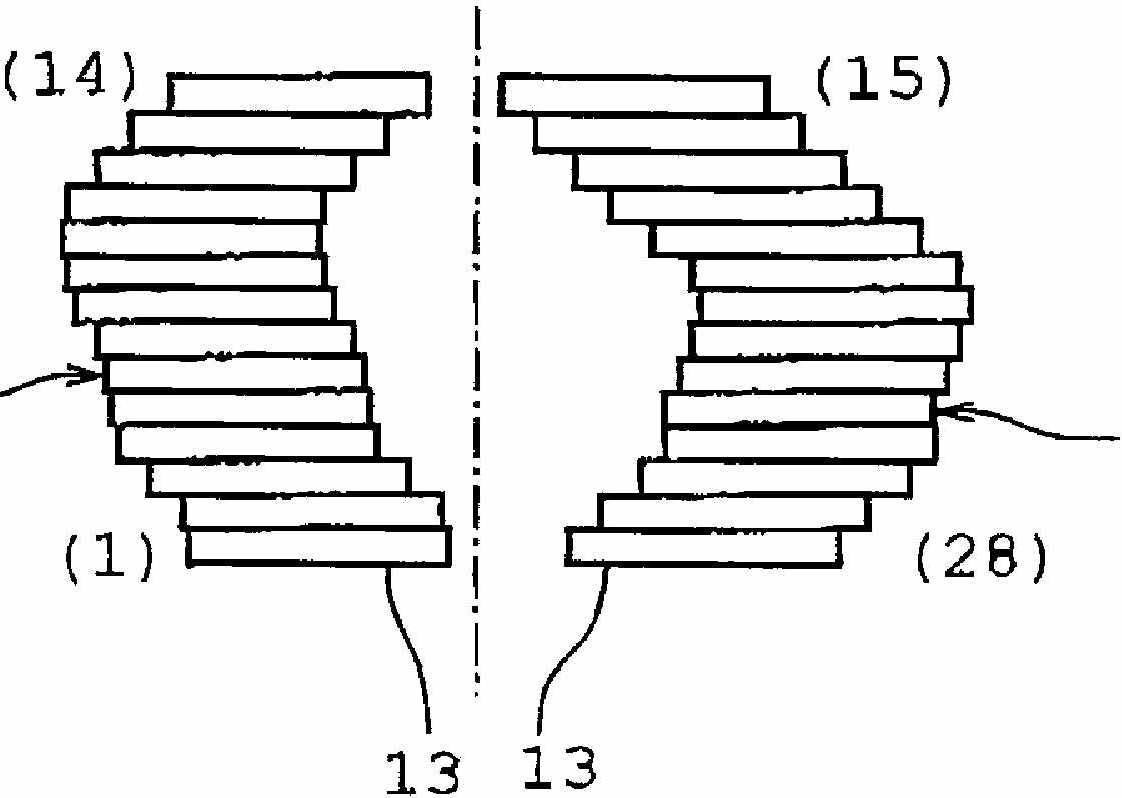
US2009080619, Fig. 3
This place does not cover:
Iris diaphragms, setups changing only size or orientation of the irradiated region e.g. rectangular diaphragms |
This place covers:
Devices such as crystals, and all other optics not covered by the definition of the subgroups.
This place does not cover:
Assignment of Indexing Codes G21K 2201/062 - G21K 2201/068 is obligatory as important information for further details.
Assignment of G21K 2201/06 - G21K 2201/068 as additional information is optional.
This place covers:
Devices having a multilayer structure such as multilayer mirrors, multilayer gratings; including multilayers used in Laue geometry.
Attention is drawn to the following places, which may be of interest for search:
Multilayer mirrors for IR or visible or UV | |
Mirrors for UV light |
Documents, which could potentially concern UV light and (soft or ultrasoft) X-rays due to the structure of the apparatus, or due to doubts if the wavelength range of intended operation is in the UV or the EUV / X-ray range, are to be classified in G21K 1/062 and as well in appropriate places in G02B 5/00.
In this place, the following terms or expressions are used with the meaning indicated:
Tomie lens | compound refractive x-ray lens |
Example:
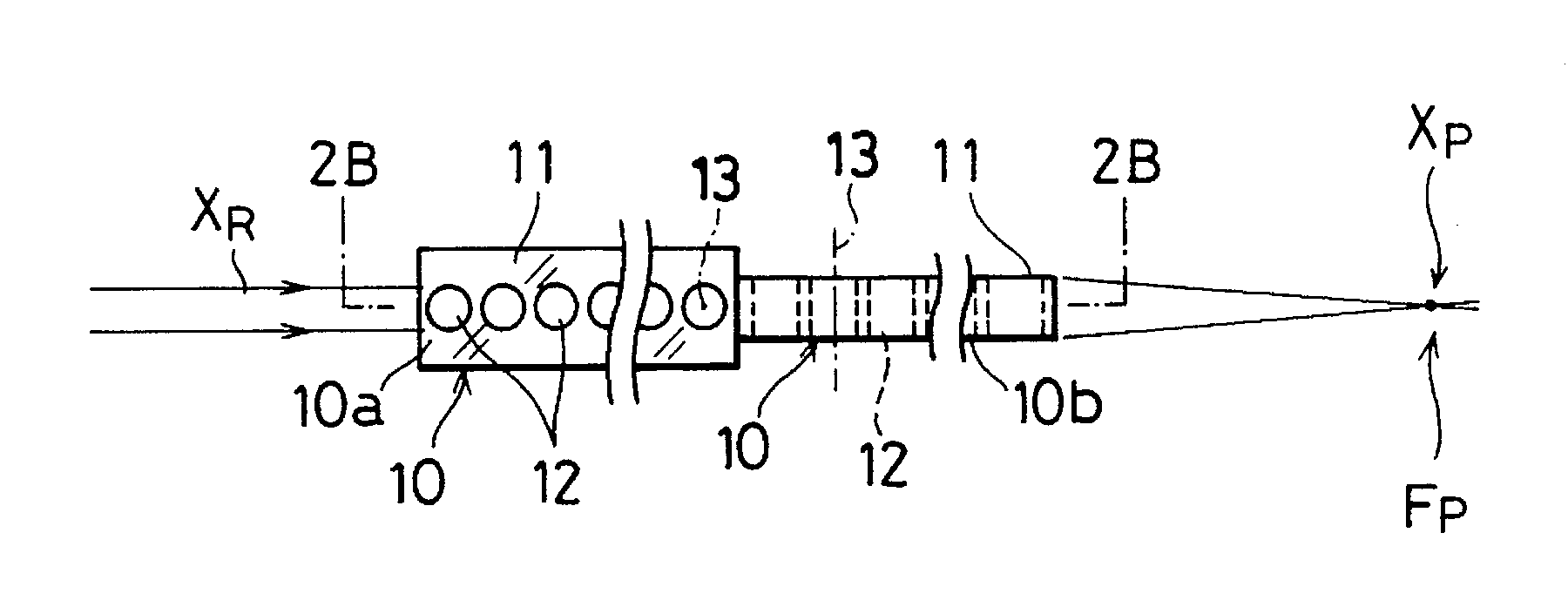
US5594773 (Tomie), Fig. 4a
This place covers:
Grazing incidence mirrors, gratings or multicapillary lenses, e.g. Khumakov lenses.
Illustrative example of subject matter classified in this place:

This place does not cover:
Multilayer mirrors |
This place does not cover:
Electron optical arrangements in electric discharge tubes in cathode ray tubes | |
Electron optical arrangements in electric discharge tubes with provision for introducing objects | |
Electron optical arrangements in electric discharge tubes in particle spectrometers | |
Details, e.g. electric or magnetic deviating means for direct voltage accelerators or in accelerators using single pulses | |
Arrangements for injecting particles into orbits | |
Arrangements for ejecting particles from orbits |
This place covers:
Deviation, concentration or focusing of the beam by electrostatic means.
This place does not cover:
Deviation, concentration or focusing of the beam by electromagnetic means |
This place covers:
Wavelength selective filter for X rays
Attention is drawn to the following places, which may be of interest for search:
Energy modification of the final beam |
This place covers:
Arrangements or techniques for confining charged particles or manipulating confined charged particles, such as ion traps. Examples of techniques for confining or manipulating of the confined charged particles are magnetic or optical levitation techniques.
This place also covers containers for antimatter.
Examples of places in relation to which this place is residual:
Physical realisations or architectures of quantum processors or components for manipulating qubits, e.g. qubit coupling or qubit control | |
Mass spectrometers or separator tubes |
In this place, the following terms or expressions are used with the meaning indicated:
radiation pressure | pressure exerted upon any surface exposed to electromagnetic radiation. If absorbed, the pressure is the power flux density divided by the speed of light. If the radiation is totally reflected, the radiation pressure is doubled. |
This place covers:
Arrangements or techniques for confining neutral particles or manipulating confined neutral particles, such as atom traps. Examples of arrangements for confining or manipulating of the confined neutral particles are magneto-optical atom traps.
This place also covers containers for antimatter.
Examples of places in relation to which this place is residual:
Manufacture or treatment of nanostructures by manipulation of individual atoms or molecules | |
Apparatus for producing preselected time intervals for use as timing standards using atomic clocks | |
Physical realisations or architectures of quantum processors or components for manipulating qubits, e.g. qubit coupling or qubit control |
This place covers:
Conversion screens for the conversion of the spatial distribution of X-rays or particle radiation into visible images, e.g. fluoroscopic screens
Attention is drawn to the following places, which may be of interest for search:
Photographic processes using X-rays; using screens to intensify X-ray images | |
In discharge tubes: screens on or from which an image or pattern is formed; luminescent screens | |
In cathode ray tubes or electron beam tubes: image conversion tubes or image amplification tubes having an X-ray input and an optical output |
This place covers:
This main group contains devices for the irradiation of an object with ionising radiation such as X-rays or electron radiation.
This place does not cover:
Conservation of food | |
Preserving, protecting, or purifying packages or package content by irradiation | |
Discharge tubes with provision for emergence of electrons or ions from the vessel | |
Discharge tubes for irradiating | |
Discharge tubes with provision for introducing objects or material to be exposed to the discharge | |
Ion implanters | |
Electron beam or ion beam lithography |
Attention is drawn to the following places, which may be of interest for search:
General disinfection or sterilisation of materials or objects by radiation |
In this place, the following terms or expressions are used with the meaning indicated:
Irradiation | Exposure of an item to radiation with the aim to achieve a certain effect in the item, as opposed to techniques aiming at obtaining information from an item e.g. by analysis, obtaining images etc. |
This place covers:
Gamma- or X-ray microscopes