SECTION I - CLASS DEFINITION
GENERAL SUMMARY OF SUBJECT MATTER WITHIN THIS CLASS
A. The following types of claimed subject matter are proper
for this class.
1. A claim drawn to a process of making a photopolymerizable
composition of reactant X plus photoiniator or photosensitizer.
2. A claim drawn to a photopolymerizable composition of reactant
X plus photoinitiator or photosensitizer.
3. A claim drawn to a process of irradiating reactant X with
or without a photoinitiator or photosensitizer being present.
4. A claim drawn to a photopolymerizable composition of reactant
X plus photoinitiator or photosensitizer and any other material
(e.g., filler, solvent, etc.).
In the types of subject matter (1-4 above), reactant X can
be a monomer, low molecular weight condensation or addition product,
or solid polymer. The sole proviso is that the final product be
a solid polymer as is required by the Class 520 Series of classes.
When a claim so expressly states, a monomer or polymer is considered
to be a photoinitiator or photosensitizer.
The recitation of a specified amount of photoinitiator or photosensitizer
is unnecessary for purposes of classification in this class.
B. To be properly classified in this class, a compound must
have a photoinitiator or photosensitizer claimed in addition to
the monomer to be polymerized or the polymer to be treated. For
example, a claim drawn to a photopolymerizable composition comprising
an ethylenically unsaturated monomer plus a photoinitiator is properly
classified herein, whereas a claim drawn to a substituted benzophenone
autopolymerizable composition is not properly classifiable in this
class. The requirement for proper classification is separateness
of monomer or polymer and photoinitiator or phtosensitizer. A material
described as being both a photoinitiator or photosenitizer and a
reactant and a separate monomer or solid polymer is a proper composition
for subclass 1 of this class. Products which are the result of a
wave energy process are normally excluded from this class and are
classified in other areas of the 520 Series of clases. An exception
to this would be a situation wherein a further wave energy step
is contemplated and the formed product is an admixture with a photoinitiator or
photosensitizer.
A claim drawn to a specific photoinitiator such as a benzophenone
with no mention in the claim of the functionality of the substance
as a photoinitiator is classified herein if the disclosure teaches
the use of benzophenone as a photoinitiator.
A combination of chemical process steps not involving wave
energy followed by a subsequent chemical reaction involving wave
energy is classified herein provided the product is proper subject
matter for the Class 520 Series.
Claims drawn to the utilization of wave energy to initiate
a chemical reaction followed by the application of heat are proper
for this class. For example, a process of partially polymerizing
a monomer of methylfluoroacrylate by wave energy followed by treatment
with heat to complete the polymerization is proper for the Class
520 Series.
The utilization of wave energy to induce a chemical reaction
which thereby proceeds without the assistance of further wave energy
is considered to be proper subject matter for this class; for example,
a claim drawn to utilizing wave energy to activate a peroxide in
order to generate free radicals, wherein the free radicals promote a
chemical reaction is classified herein.
SECTION II - LINES WITH OTHER CLASSES AND WITHIN THIS CLASS
The step in a process claim utilizing wave energy is the proper
basis for classification purposes. For example:
A. A claim drawn to processes of polymerixing ethylene in
the presence of carbon black (DNRM) by wave energy is properly classified
in subclass 71, whereas a claim drawn to polymerizing ethylene in
the presence of wave energy followed by treating the product with
carbon black (DNRM) is properly classified in subclass 189.
B. A claim drawn to treating polyacrylonitrile with vinyl
chloride in the presence of energy is properly classified in subclass
124, whereas a claim drawn to treating a graft polyacrylonitrile-vinyl
chloride copolymer with wave energy is properly classified in subclass
149.
C. A claim drawn to the process of making polyethylene by
polymerizing ethylene in the presence of wave energy followed by
chemically treating said product with halogen (with no wave energy
present) would be classified in subclass 189, whereas a claim drawn
to the process of reacting polyethylene with halogen in the presence
of wave energy following by the addition of carbon black would be
classified in subclass 133.
Classification in Class 522 is on the first solid polymer prepared.
For instance, a process of chemically modifying a solid polymer
derived from ethylene only, by sulfonating, (nonwave energy process)
and then subsequently reacting said sulfonated polymer with elemental
halogen using wave energy is proper in subclass 133, since the first
solid polymer prepared is polyethylene. Subclass 132 does provide
for a halogenated polymer which is subsequently reacted in that
the language of the subclass is "contains" rather
than "derived". In subclass 154 the language
is "derived" and therefore if a halogenated polyethylene
is treated using wave energy classification in subclass 161 is proper
since the first solid polymer is prepared from ethylene.
A process of treating a solid polymer with wave energy followed
by the addition of a chemical reactant is presumed, in the absence
to the contrary to proceed entirely by wave energy and is classified
in this class subclasses 113-147; however, a process of treating
an irradiated polymer with a chemical reactant is properly classified in
Class 525. Additionally a process of treating a reactant with wave
energy followed by adding a solid polymer and reacting therewith
is presumed in the absence of information to the contrary to proceed
entirely by wave energy and is classified in this class.
A process of treating a preirradiated polymer (no wave energy
process step recited) is properly classified in Classes 523-525
when no further wave energy step is claimed. For example, (1) a
process of a mixed preirradiated polymer with a DNRM is properly
classified in Class 524, and (2) a process for treating a preirradiated polymer
with an ethylenic monomer is properly classified in Class 525.
The combination of Class 204 wave energy step followed by
a Class 522 wave energy step is classified herein; for example,
a claim drawn to a process of utilizing wave energy to synthesize
a monomer which is subsequently polymerized in the presence of wave
energy is classified herein.
The utilization of wave energy to generate heat, whereby the
heat generates or induces a chemical reaction is not considrered
to be "a chemical reaction induced by wave energy" and
thus is not proper subject matter for Class 522. The process, however,
is proper in for the Class 520 Series if a solid polymer is produced.
Class 204, Chemistry: Electrical and Wave Energy, appropriate
subclasses provide for producing a product of the type provided
for in the Class 520 Series by other than a wave energy process.
Class 204 is superior to the Class 520 Series; therefore, a patent
claiming in the alternative a process of preparing an organic compound and
a synthetic resin or natural rubber in the presence of wave energy
is classified for original purposes in Class 204 and cross-referenced
to the Class 520 Series. In the situation where an alternative
process claim is presented along with a specific process claim to
the synthetic resin or natural rubber, there is no specific claim
to the nonsynthetic resin or nonnatural rubber species, and the process
is directed to wave energy, the same rule of original patent placement
applies. Any process step involving electrolysis, an electric current,
electro-osmosis, electrophoresis, an electrostatic field, an electrical discharge,
or a magnetic field and also involving the preparing or treating
of a synthetic resin or natural rubber is proper for Class 204,
even when the wave energy step involved is subsequent to a Class
204 step. Combinations of chemical process steps provided for by
the Class 520 Series (other than those involving wave energy) and
process steps falling within the definition of Class 204 are proper
for Class 204 when the Class 520 Series process steps are preparatory
to the Class 204 process steps and are proper for the Class 520
Series when the Class 204 process steps are preparatory to the Class
520 Series process steps.
Class 430, Radiation Imagery Chemistry: Process, Composition,
or Product Thereof, appropriate subclasses provide for radiation
sensitive compositions and elements and for processes of exposing
said composition or elements to wave energy using an imagewise exposure
technique. Class 522 provides for compositions and processes involving
use of radiation for polymerizing compositions having a photoinitiator
or photosensitizer or for modifying polymers. Class 430 provides
for compositions solely disclosed, or claimed for radiation imagery.
Compositions and processes not involving radiation imagery, or
disclosing both a radiation imagery use, and another use are placed
in Class 522 and cross-referenced to Class 430. Also, see Class 430
classification line for compositions with art claimed, especially,
multiple use (Class 430, III A 2a).
SECTION III - SUBCLASS REFERENCES TO THE CURRENT CLASS
Schedule Outline of Class 522: The schedule is divided into
a number of parts, each of which is distinct and provides for different
types of subject matter. The following SEARCH THIS CLASS, SUBCLASS
is a breakdown of the major areas and indicates the type of subject
matter provided therein.
SEE OR SEARCH THIS CLASS, SUBCLASS:
| 1, | generic subclass for the class. |
| 2, | through 5, for manipulative process areas which
provide for certain designated processes of preparing or treating
a polymer or compositions therefore. This area has no generic subclass
and therefore documents not covered under the ambit of this subclass
range are classified below on some other basis. |
| 6, | through 70, for the specified rate-affecting material
area which provides for processes of preparing or treating polymers
or compositions therefor wherein a rate-affecting material is utilized
simultaneously with the wave energy and wherein at least one rate-affecting
material is designated by at least one atom, e.g., a nitrogen-containing
photoinitiator, etc. This area is further subdiveded into the following
six subclass ranges. |
| 7, | through 30, for two or more rate-affecting materials,
only one of which need be specifically claimed. |
| 8, | through 10, for either (1) at least two rate-affecting
material containing a keto group which is not part of a ring (e.g.,
benzophenone, etc.) or (ii) the combination of one rate-affecting
material containing a keto group which is not part of a ring plus
a rate-affecting material referred to as a "photoinitiator
or photosensitizer". The basic premise of these subclasses
is that a rate-affecting material identified as a "photoinitiator
or photosensitizer" is to be equated with a rate-affecting
material containing a keto group wherein the keto group is not part
of a ring. |
| 11, | for the combination of a rate-affecting material containing
a keto group not part of a ring plus a broadly claimed rate-affecting
material, other than "photoinitiator or photosensitizer",
e.g., the combination of a benzophenone and a curing catalyst would
be proper for this subclass, etc. |
| 12, | through 23, for the combination of either (1) a rate-affecting
material containing a keto group not part of a ring plus a rate-affecting
material wherein at least one atom is designated; or (2) a rate-affecting
material referred to as a "photoinitiator or photosensitizer" plus
a rate-affecting material wherein at least one atom is designated.
The basis of classification in these subclasses is with the latter
ingredient of the aforementioned combinations (1) and (2). |
| 24, | through 30, for the combination of two or more rate-affecting
materials neither one of which contains a keto group not part of
a ring. The basis of classification in these subclasses is with
the first appearing rate-affecting material provided in the schedule
hierarchy. |
| 31, | through 70, for specified rate-affecting material. |
| 71, | through 86, for the designated nonreactant areas
provide for processes of preparing or treating polymers or compositions
therefor, wherein a designated nonreactant material is present
when the wave energy is applied. |
| 87, | through 189, for the polymer preparation or treatment
area which provides for processes or compositions therefor of the
following six categories. |
| 87, | through 108, specifically for proteins and carbohydrates
as reactants and for treating a terminally unsaturated polyurethane,
ethylenically unsaturated siloxane, polysiloxane, polyester or polypoxide
derivative. |
| 109, | and 110, for chemically modifying a blend of two
or more solid polymers by a chemical reactant. |
| 111, | and 112, for treating a blend of two or more solid
polymers. |
| 113, | through 147, for chemically modifying a solid polymer
by a chemical reactant in the presence of wave energy. |
| 148, | through 166, for treating a solid polymer in the presence
of wave energy wherein a chemical reaction occurs. |
| 167, | through 189, for the preparation of a solid polymer
by utilizing wave energy. |
SECTION IV - REFERENCES TO OTHER CLASSES
SEE OR SEARCH CLASS:
| 8, | Bleaching and Dyeing; Fluid Treatment and Chemical
Modification of Textiles and Fibers, appropriate subclasses for bleaching or dyeing; fluid treatment
and chemical modification of textiles and fibers wherein use is
made of electrical radiant or wave energy other than electrolysis,
for which see Class 205,
subclasses 689+ . |
| 128, | Surgery, appropriate subclassesfor electrical or wave energy treatment of the living
human body and apparatus specialized therefor. |
| 205, | Electrolysis: Processes, Compositions Used Therein,
Methods of Preparing the Compositions,
subclasses 689+ , for chemical modification of textiles and fibers
using electrolysis. |
| 252, | Compositions, appropriate subclassesfor electrical or wave energy methods, other than
electrolytic for the preparation of dispersions. |
| 422, | Chemical Apparatus and Process Disinfecting, Deodorizing,
Preserving, or Sterilizing,
subclasses 131+ for polymerization apparatus. |
| 427, | Coating Processes, appropriate subclassesfor processes of coating a substrate followed by curing
the coating using electrical or wave energy. Included in Class
427 are processes of producing a coating by application of wave energy
chemistry to a base material which supplies a part or all of the
coating, e.g., conversion of the surface of a polymeric material
to produce a film thereon by the application of wave energy, etc. |
| 525, | through 528, Synthetic Resins or Natural Rubbers, appropriate subclasses for processes of preparing
and treating polymers by chemical and physical means. |
SECTION V - GLOSSARY
DESIGNATED NONREACTANT MATERIAL (DNRM)
As used in this class, designated nonreactant material (DNRM)
is a material wherein at least one of the chemical atoms can be
deduced with certainty. For purposes of this class, organic material
although inherently reciting the presence of a carbon atom is considered
to be too broad. An exemplary list of materials to be regarded
as DNRM"s is as follows: metal hydrate, chalcogen, carboxylic
acid, peroxy, peroxide, latex, alkali or alkaline earth metal, transition
metal, halogen, proten donor, sulfiede, drying oil, fat, fatty acid
or ester, water, carbon black, etc. This list is by no means limited
to the above examples.
The following list is not exhaustive and merely enumerates
certain materials that will not be considered as DNRM"s,
e.g., organic compound, metal containing, inorganic compound, organometallic
compound, solvent, wax, magnetic, hydrophobic, hydrophillic, antiplasticizer,
plasticizer, filler, preservative, antioxidant, antiozonant, stablizer,
lubricant, fibrous additive, particulate additive, liquid, solid,
gas, dispersant, emulsifier, crystalline, plastic, flourescent,
phosphorescent, liminescent, deliquescent, drier, dessicant, humectant,
blue color,numerically described without providing a chemical atom,
Lewis acid or base, mineral, organic solvent, cosolvent, Ziegler
or Natta catalysts, alfin catalyst, free radical, amphoteric, anionic,
ionic, denaturant, electrostatic, dielectric, conductor, insulator,
etc. This list is to be regarded as illustrative rather than exhaustive.
WAVE ENERGY
The term "wave energy" includes radiations
as well as wave energies transmitted by various mediums and embraces
electromagnetic waves or radiations, ultrasonic and supersonic waves,
nuetrons, protons, duetron, and other corpuscular radiations.
ELECTROMAGNETIC WAVES
The term "electromagnetic waves" as
employed herein includes, for example, X-rays and gamma rays; ultraviolet,
infrared, and visible light rays, and short electric and radio waves.
Energy which produces merely a thermal effect or heat waves, per
se, is excluded. Microwave energy is considered to produce a thermal
effect unless there is a direct statement to the contrary, and is
not proper for this class.
SUBCLASSES
![[List of Patents for class 522 subclass 2]](../ps.gif) 2 2 | Processes of forming or modifying a solid polymer by laser;
or compositions therefore: |
| | This subclass is indented under subclass 1. Subject matter involving the use of light amplified by stimulated
emission of radiation, i.e., laser, or composition therefore.
| | (1)
Note. This area provides for a specific wave energy process,
i.e., laser. In order for a wave energy process to be classified
herein as an original, there must be a claim to the noted process
or the total disclosure in the patent must be directed to the specific
process. The wave energy process in the claim need not be limited to
the provided specific process if the claim specifically recites
the process of this subclass. Processes not claimed or solely disclosed
are classified below on some other aspect. |
| | (2)
Note. This subclass provides for compositions perfected so
as to be utilized with a laser. See General Rules As To Patent Placement
in the class definition. |
SEE OR SEARCH CLASS:
| 216, | Etching a Substrate: Processes,
subclass 65 for process of using a laser in combination with
chemical etchant. |
|
| | |
| 3 | Processes of forming or modifying a solid polymer wherein
specific mixing, stirring, agitating, movement of material or directional
orientation is employed; or compositions therefore: |
| | This subclass is indented under subclass 1. Subject matter involving specific mixing, stirring, agitating,
movement of material or directional orientation; or compositions
therefor.
| | (1)
Note. The steps of mixing, stirring, agitating, movement of
material or directional orientation must involve a direct relationship
with wave energy and not be ancillary to the wave energy exposure.
For instance, mixing two ingredients under specific conditions
to merely form a composition which is then exposed to a form of
wave energy is not proper for this subclass; however, mixing of
the same ingredients under the same conditions while said formed
composition is exposed to wave energy is proper herein. |
| | (2)
Note. Specified for purposes of this subclass requires the
naming of a movement imparting rotor, stirrer, impeller or any other
device in terms of its specific dimension, design, size, or shape
therefor, or requires the recitation of a reactor of a design to
facilitate movement or agitation; or requires a positive recitation
in the claims as to velocity or designated time of mixing, said
time being either continuous or intermittent. |
| | (3)
Note. Directional orientation includes adding material horizontally,
tangentially, from above or below, etc. |
| | (4)
Note. This subclass also provides for those compositions perfected
so as to be utilized is a process involving the requirements of
this subclass. | |
| | |
| 4 | Process of forming or modifying a solid polymer by wave
energy wherein at least two distinct external radiant energy sources are
utilized; or compositions therefore: |
| | This subclass is indented under subclass 1. Subject matter involving the use or at least two distinct
energy sources; or compositions therefore.
| | (1)
Note. The two sources or energy maybe utilized in any manner,
e.g., successive, or concurrent, etc. Each of the energy sources
must cause a chemical reaction of its own right or must potentiate,
accelerate, or have a synergistic affect in regard to the chemical
reaction involved. |
| | (2)
Note. This subclass also provides for those compositions
perfected so as to be utilized in a process involving the requirements
or this subclass. |
| | (3)
Note. "Distinct" as used in this subclass includes
the same type of energy either derived from one or more sources
when said energy is used at different energy levels or wave length
levels. It also includes the same type of energy derived from two
different generating sources. | |
| | |
| 6 | Compositions to be polymerized or modified by wave energy
wherein said composition contains at least one specified rate-affecting material;
or processes of preparing or treating a solid polymer utilizing
wave energy in the presence of a least one specified rate-affecting
material, e.g., nitrogen containing photosensitizer, oxygen containing
photoinitiator, etc.: |
| | This subclass is indented under subclass 1. Subject matter wherein said process or composition to be
polymerized or modified requires, in addition to the wave energy
source, at least one specified rate-affecting material.
| | (1)
Note. A rate-affecting material is a material which either
affects the rate of reaction, permits reduced amount of wave energy,
increases or decreases the degree of polymerization, cure, cross-linking,
or grafting, or scavenges or provides storage stability of reactive
materials or inhibits reaction; and includes photoinitiator, photosensitizer,
activator, dark storage stabilizer, accelerator, inhibitor, or initiator
reducing agent, retarder, photoreducible dye, sensitizing auxiliary,
electron donor, generator, or curing catalyst. |
| | (2)
Note. A curing agent is presumed to be a cross-linking agent
and is not considered to be a rate-affecting material. A curing catalyst,
on the other hand, is considered to be a rate-affecting material. |
| | (3)
Note. A specified rate-affecting material is a rate-affecting
material (see (1) Note) wherein at least one of the chemical atoms
can be deduced with certainty. The following are examples of specified rate-affecting
materials: benzophenone, oxygen containing curing catalyst, and
a metal oxide containing inhibitor. The following are examples
or rate-affecting materials which are not specified: a metal containing
rate-affecting material, an organic containing rate-affecting material,
an inorganic catalyst, an organometallic catalyst, a Lewis acid
or base catalyst, a Ziegler catalyst. |
| | (4)
Note. A compound not claimed although solely disclosed as
a rate-affecting material is considered to be a proper specified
rate-affecting material. For example, a claim drawn to a process of
preparing a solid polymer in the presence of wave energy and a metal
oxide is disclosed as functioning in a catalyst capacity. |
| | (5)
Note. Unless disclosed to the contrary, a benzophenone or
derivative thereof is presumed to be a specified rate-affecting material
though not claimed or disclosed as having catalytic activity. |
SEE OR SEARCH THIS CLASS, SUBCLASS:
| 71, | for pigmented materials which function only to change
the quantity of radiation received. These are considered to be DNRM". |
|
| | |
| 8 | At least two specified rate-affecting material containing
keto group not part of a ring; or contains nonspecified photoinitiator
or photosensitizer and a specified ketone containing material wherein
the keto group is not part of a ring: |
| | This subclass is indented under subclass 7. Subject matter wherein either (a) at least two rate-affecting
materials are specified and each of which contains at least one
organic keto group not part of a ring system, or (b) the combination
of one specified rate-affecting material containing at least one
organic keto group not part of a ring system plus a rate-affecting material
designated as either a "photosensitizer" or "photoinitiator".
| | (1)
Note. Examples of combinations of rate-affecting materials
proper for this subclass include
| |
(a)
+photosensitizer |
| | (b)
acyloin photoinitiator + benzophenone |
| | (c)
diaminobenophenone photosensitizer+ benzophenone |
| | (d)
a mixture of benzophenone and Michler"s ketone as
the photoinitiator | |
| | (2)
Note. A material having a keto group as part of a ring may
still be proper for this subclass if in fact an additional keto group
is present which is not part of a ring, e.g.,
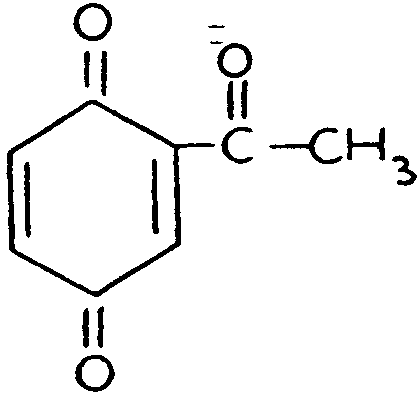
etc. |
| | (3)
Note. Ring as used in this subclass includes heterocyclic
rings, carbocyclic, or any other ring system. |
| | (4)
Note. See Class 520, the Glossary, for a definition of the
term "ketone". |
SEE OR SEARCH THIS CLASS, SUBCLASS:
| 68, | for a ketone containing a C=O group wherein
the C of the C=O is part of a carbocyclic ring and there
are no other keto moieties. |
|
| | |
| 9 | With a heterocyclic specified rate-affecting material: |
| | This subclass is indented under subclass 8. Subject matter which includes an additional specific rate-affecting
material which is heterocyclic.
| | (1)
Note. See Class 520, the Glossary, for the definition of "heterocyclic". |
| | (2)
Note. An example of a patent proper for this subclass is
one having the combination of (a) a 2,2, "-deithiobis-(benzothiazole)
sensitizer (b) aromatic ketone photosensitizer and an (c) aromatic ketone
photosensitizer. | |
| | |
| 11 | Contains compound containing keto group not part of a ring
and nonspecified rate-affecting material other than mere photoinitiator
or photosensitzer: |
| | This subclass is indented under subclass 7. Subject matter wherein one rate-affecting material containing
at least one organic keto group not part of a ring, as below at
the end of this definition, and the other rate-affecting material
is one wherein none of the chemical atoms can be deduced from the
claim with certainty and wherein the rate-affecting material which
is not chemically stated is other than a photoinitiator or phtosensitizer.
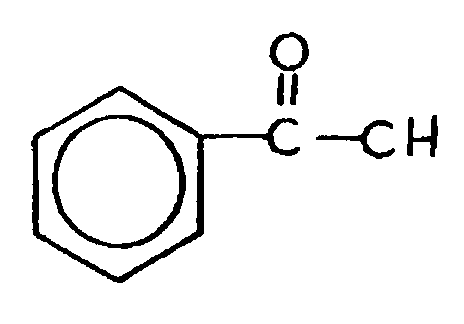
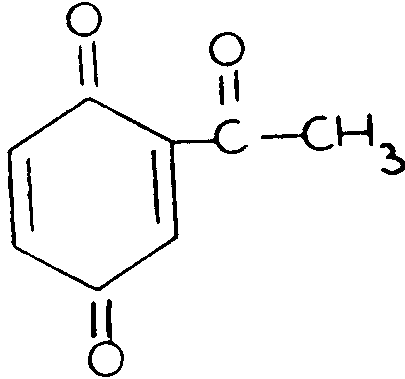
| | (1)
Note. A material having a keto group as part of a ring may
still be proper for this subclass if in fact an additional keto group
is present which is not part of a ring, e.g., as shown in the second
illustration, above. |
| | (2)
Note. Ring as used in this subclass includes heterocyclic
rings. |
| | (3)
Note. See Class 520, the Glossary, for a definition of the
term "Ketone". |
SEE OR SEARCH THIS CLASS, SUBCLASS:
| 8+, | for a system containing a specified rate-affecting
material containing at least one keto group not part of a ring in
combination with a rate-affecting material designated merely as
a "photoinitiator" or "photosensitizer". |
|
| | |
| 12 | Contains compounds containing keto group not part of ring
and a specified rate-affecting material; or contains a specified
rate-affecting material and a nonspecified photoinitiator or photosensitizer: |
| | This subclass is indented under subclass 7. Subject matter wherein either (a) one rate-affecting material
contains a keto group not part of a ring plus a specified rate-affecting material
or (b) one specified rate-affecting material plus a rate-affecting
material designated merely as a "photoinitiator" or "photosensitizer".
| | (1)
Note. Classification in the subclasses indented hereinunder
is based upon the first-appearing specified rate-affecting material. |
| | (2)
Note. A material having a keto group as part of a ring may
still be proper for this subclass if in fact an additional keto group
is present which is not part of a ring, e.g.,
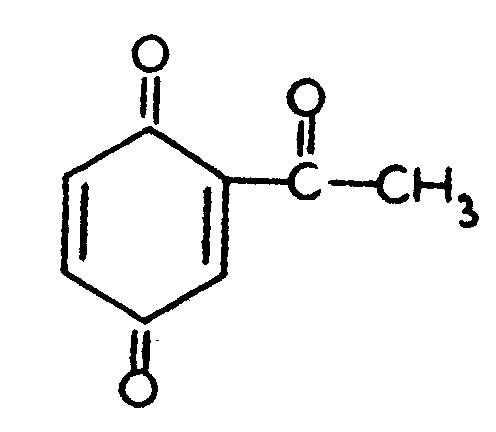
etc. |
| | (3)
Note. Ring as used in this subclass includes heterocyclic
rings, carbocyclic, or any other ring system. |
| | (4)
Note. See Class 520, the Glossary, for a definition of the
term "ketone" |
SEE OR SEARCH THIS CLASS, SUBCLASS:
| 8+, | for the combination of either two rate-affecting
materials both of which contain a keto group not part of ring or one
specified rate-affecting material containing a keto group not part
of a ring plus a rate-affecting material designated merely as a "photoinitiator" or photosensitizer". |
| 13, | for peroxide catalyst plus benzoin ethyl ether catalyst. |
| 21, | for the combination of resorcinol monobenzoate plus
photoinitiator. |
| 22, | for the combination of Mn2(CO)10plus
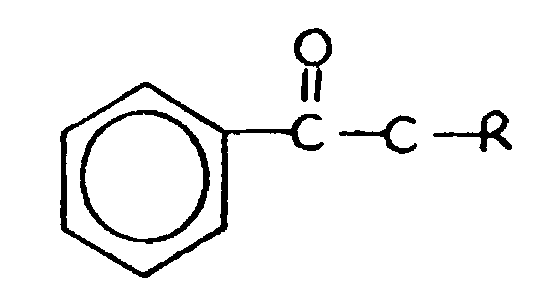
| |
| | |
| 14 | Specified rate-affecting material is an amide or tertiary
amine: |
| | This subclass is indented under subclass 12. Subject matter wherein the specified rate-affecting material
is an amide of a carboxylic acia or a nitrogen compound having a
nitrogen atom substituted by three organic radicals, i.e., R3N.
| | (1)
Note. See Class 520, the Glossary, for a definition of the
term "amine". |
| | (2)
Note. See Class 520, the Glossary, under carboxylic acid or
derivative for a definition of the term "carboxylic acid
amide". |
SEE OR SEARCH THIS CLASS, SUBCLASS:
| 15, | for nitrogen containing onium group compounds as
rate-affecting materials. |
|
| | |
| 20 | Specified rate-affecting material is a carboxylic acid
or derivative: |
| | This subclass is indented under subclass 12. Subject matter wherein the specified rate-affecting material
is a carboxylic acid or derivative.
| | (1)
Note. See Class 520, the Glossary, for a definition of the
term "carboxylic acid or derivative". By schedule
hierarchy the derivatives in this area are limited to acyclic anhydrides,
esters and salts. | |
| | |
| 33 | Specified rate-affecting material contains a ketone group
-c- (CO)n-c-, the (CO)n not
being part of a ring: |
| | This subclass is indented under subclass 6. Subject matter wherein the specified rate-affecting material
contains at least one keto group which is not part of a ring system.
| | (1)
Note. See Class 520, Glossary, for a definition of the term "ketone".
The type of ketone materials excluded from this subclass are, for
instance, those where oxygen is solely double bonded to a carbon atom
and which carbon atom is part of a carbocyclic ring, or any other
ring system. |
| | (2)
Note. Included in this subclass are those compounds which
may contain two or more ketone moieties and wherein one of the C=O
groups is part of a part of a ring system and wherein at least one C=O
group is not. | |
| | |
| 34 | Containing ethylenic unsaturation: |
| | This subclass is indented under subclass 33. Subject matter wherein the ketone compound is ethylenically
unsaturated.
| | (1)
Note. See Class 520, Glossary, for a definition of the term "ethylenically
unsaturated". | |
| | |
| 36 | Containing two or more ketone groups: |
| | This subclass is indented under subclass 33. Subject matter wherein the ketone compound contains at least
two ketone groups.
| | (1)
Note. For purposes of this class, a compound containing a
-CC group, wherein * is two or more, is considered as being
a plural ketone containing compound. Additionally, a compound containing
a -CCC- group is considered as having two ketone groups may be part
of a ring system as long as another ketone group is present which
is acyclic. | |
| | |
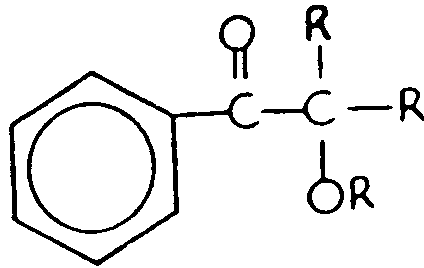
| 44 | Containing C-CO-C(R)(OR) wherein R is organic, e.g., diethyoxacetophenone,
etc.: |
| | This subclass is indented under subclass 33. Subject matter wherein the ketone compound contains the
structure, below, wherein R is organic. For an example, see the
structure following the one immediately below.
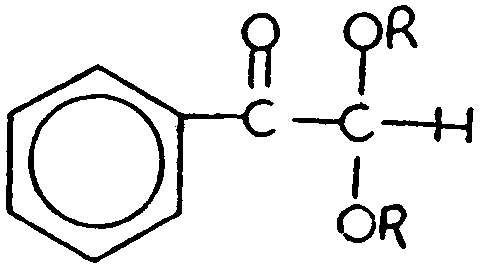
etc.
| | (1)
Note. Diethoxyacetophenone is considered proper for this
subclass unless specifically identified as to where the ether linkages
are connected and which, if specified, differ from that required
by the definition of this subclass. | |
| | |
| 50 | Hetero nitrogen ring: |
| | This subclass is indented under subclass 49. Subject matter wherein the chalcogen compound contains at
least one heterocyclic nitrogen ring.
| | (1)
Note. See Class 520, Glossary, for a definition of the term "heterocyclic". |
| | (2)
Note. The chalcogen atom can be part of the heterocyclic
nitrogen ring. | |
| | |
| 52 | Containing halogen: |
| | This subclass is indented under subclass 50. Subject matter the heterocyclic ring compound contains at
least one halogen atom.
| | (1)
Note. Halogen is limited to fluorine, cholrine, bromoine,
iodine or astatine. | |
| | |
| 53 | Hetero sulfur ring: |
| | This subclass is indented under subclass 49. Subject matter wherein sulfur is present as an atom in a
heterocyclic ring.
| | (1)
Note. See Class 520, Glossary, for a definition of the term "heterocyclic". | |
| | |
| 55 | Sulfide: |
| | This subclass is indented under subclass 49. Subject matter wherein sulfur is present as C-S-C or Me-S-Me
(Me is a monovalent metal) and wherein the carbon atoms bonded to
the sulfur are not double bonded to chalcogen. |
| | |
| 61 | Hydroperoxide: |
| | This subclass is indented under subclass 60. Subject matter wherein the specified rate-affecting compound
contains at least one -O-O-H group. |
| | |
| 62 | Specified rate-affecting material contains a C-N=N-C
group: |
| | This subclass is indented under subclass 6. Subject matter wherein the specified rate-affecting material
contains at least one -N=N- and wherein the nitrogen atoms
are directly bonded to carbon atoms of discrete organic radicals.
SEE OR SEARCH THIS CLASS, SUBCLASS:
| 63, | for compounds which contain the N=N group
bonded to atoms so that a hetercyclic ring is formed thereby. |
|
| | |
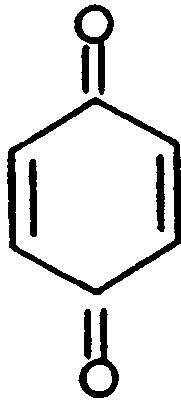
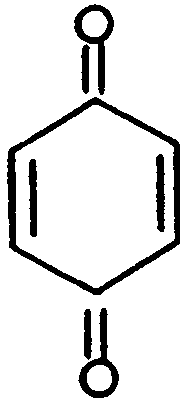
| 69 | Phenolic, e.g., hydroquinone, etc.: |
| | This subclass is indented under subclass 68. Subject matter wherein the oxygen atom is part of a phenolic
group.
| | (1)
Note. See Class 520, Glossary, under "phenolic reactant" for
a definition of the term "phenol". | |
| | |
| 71 | Processes of preparing or treating a solid polymer by wave
energy in the presence of a designated nonreactant material (DNRM); or
composition therefore: |
| | This subclass is indented under subclass 1. Subject matter involving the preparation or treatment of
a solid polymer in the presence of wave energy and in the presence
of a designated nonreactant material (DNRM); or a composition to
be polymerized to produce a solid polymer in the presence of a DNRM;
or a composition containing a solid polymer to be modified in the
presence of a designated nonreactant material (DNRM).
| | (1)
Note. See the Glossary in this class (522) for a definition
and examples of the term "designated nonreactant material" (DNRM). |
| | (2)
Note. For proper classification in this subclass, the designated
nonreactant material must be present during the wave energy treatment
and must exercise a function subsequent to the wave energy step.
A material which functions prior to the wave energy step and which
function is destroyed or not intended subsequent to the wave energy
step is not proper for this subclass. |
| | (3)
Note. By schedule exclusion the subject matter in this area
may have a nonspecified rate-affecting material included. |
| | (4)
Note. In the subclasses below which recite a designated nonreactant
material (DNRM) in the title, the indented subclasses merely pertain
to a further elaboration of the DNRM and do not relate to any other
material. |
| | (5)
Note. This subclass provides for compositions perfected as
to be utilized in a process involving wave energy and a DNRM material. |
SEE OR SEARCH THIS CLASS, SUBCLASS:
| 71, | for a process of polymerizing ethylene by wave energy
in the presence of carbon black intended as a filler. |
| 189, | for a process of mixing irradiated polyethylene
with halogen in the presence of wave energy followed by the addition
of carbon black. |
|
| | |
| 72 | Carbohydrate or derivative DNRM: |
| | This subclass is indented under subclass 71. Subject matter wherein the DNRM material is a carbohydrate
or derivative.
| | (1)
Note. See Class 520, Glossary, for a definition of the term "carbohydrate".
A derivative of a carbohydrate must retain the carbohydrate skeleton. | |
| | |
| 73 | Coal, asphaltic, or bituminous material DNRM: |
| | This subclass is indented under subclass 71. Subject matter wherein the DNRM is coal or a derivative;
or is a bituminous material or derivative or extract thereof; or
is a bituminous material or a derivative or extract thereof; or
is a fatty still residue.
| | (1)
Note. Included within the subclass are oil shale or shale
material from which oil has or has not been recovered as well as stearine
pitch, coke products, coal tar and pitches. |
| | (2)
Note. Chemical compounds which are the results of a synthesis
reaction utilizing a petroleum or coal source as a reactant are
not the type of material which will generally qualify as a DNRM
under this subclass. |
| | (3)
Note. Included within this subclass are materials generally
described as asphalt. Asphalt derived from natural deposits, e.g.,
gilsonite, etc., coal or petroleum is included herein. |
| | (4)
Note. Bituman refers to solid or semisolid materials which
are often black or dark brown and which occur naturally or are obtained
by refining petroleum or are the components of coal which are soluble
in organic solvents. The term also applies generically to include
natural and synthetic asphalts, tar and pitches; for example, natural
asphalts such as Trinidad, Bermuda, gilsonite, graphamite, and Cuban,
etc. Petroleum asphalt may be used such as these obtained from
California crudes, Smack over Arkansas crudes, Mid-Continental air-blown
oils, Mexican petroleum asphalts, tarry residues known as cracked
asphalts by-products during the cracking of gas oil, or other heavier
petroleum fractions to obtain gasoline or other lighter fractions, etc.
Further still, bituminous materials may be used as coal tar, wood
tar, petroleum pitches, and pitches obtained from various industrial
processes such as a fatty acid pitch, etc. |
| | (5)
Note. Materials which are substantially known as to chemical
constitution are excluded from this subclass and are classified
below in the schedule on the basis of chemical constitution. If
any doubt exists as to whether a material is of sufficient chemical
identity so as to be classified as a specific DNRM, then such doubt
is to be resolved by classifying the claim as an original in this
area and cross-referencing to the appropriate DNRM area. Certain
hydrocarbon materials which have been designated as not being proper
herein are hydrocarbon petroleum distillation products, petroleum,
and petroleum crude oils. |
SEE OR SEARCH THIS CLASS, SUBCLASS:
| 80, | for a hydrocarbon DNRM which is derived from coal. |
|
| | |
| 74 | Organic DNRM: |
| | This subclass is indented under subclass 71. Subject matter wherein the DNRM is an organic compound.
| | (1)
Note. See Class 520, Glossary, for the definition of the
term "organic compound". | |
| | |
| 81 | Heavy metal containing DNRM: |
| | This subclass is indented under subclass 71. Subject matter wherein the DNRM contains a heavy metal atom
in either elemental or inorganic compound form.
| | (1)
Note. Heavy metal is limited to those metal elements that
have a specific gravity greater than 4.0. | |
| | |
| 83 | Oxygen containing DNRM: |
| | This subclass is indented under subclass 71. Subject matter wherein the DNRM contains oxygen in either
elemental or inorganic compound form.
| | (1)
Note. Included herein is the stated presence of air or the
stated presence of oxygen in air. | |
| | |
| 84 | Water: |
| | This subclass is indented under subclass 83. Subject matter wherein oxygen is present as water in any
of its physical forms. |
| | |
| 87 | Processes involving protein as reactant or as solid polymer;
or compositions therefore: |
| | This subclass is indented under subclass 1. Subject matter involving the preparation of a protein containing
solid polymer; or the chemical modification of a solid polymer derived from
a protein; or the modification of a solid polymer by reaction with
a protein; or compositions therefore.
| | (1)
Note. See Class 520 (a) the Glossary for a definition of
the term "protein" and (b) Lines With Other Classes
and Within This Class, section E for the type of polymer containing
a protein that qualifies as a solid synthetic resin for the Class
520 Series. |
| | (2)
Note. This subclass provides for compositions for the processes
provided for herein. | |
| | |
| 88 | Processes involving carbohydrates as reactant or as solid
polymer; or compositions therefore: |
| | This subclass is indented under subclass 1. Subject matter involving the preparation of a carbohydrate
containing solid polymer; or the chemical modification of a solid
polymer derived from a carbohydrate; or the modification of a solid
polymer by reaction with a carbohydrate; or composition therefore.
| | (1)
Note. See Class 520 (a) the Glossary for a definition of
the term "carbohydrate" and (b) Lines With Other
Classes and Within This Class, section E for the type of polymer
containing a carbohydrate that qualifies as a synthetic resin under the
Class 520 Series. |
| | (2)
Note. This subclass provides for compositions for use in the
processes provided for herein. | |
| | |
| 90 | Processes involving a polyurethane having terminal ethylenic
unsaturation as reactant or as solid polymer; or compositions therefore: |
| | This subclass is indented under subclass 1. Subject matter involving treating a polyurethane having
at least one terminal ethylenic group to form a solid polymer therefrom;
or chemically modifying a solid polymer derived from a ployurethane
reactant having at least one terminal ethylenic group; or chemically modifying
a solid polymer by reaction with a polyurethane reactant containing
at least one terminal ethylenic group; or compositions therefore.
| | (1)
Note. Terminal ethylenic as used herein denotes a carbon atom
bonded toan adjacent carbon through eithera double or triple bond
and wherein at least one of the linked carbons is not bonded to
another carbon atom either directly or indirectly through anoncarbon
atom, with the provisothat indirect does not include the double
or triple bond (e.g., C(1)-C(2)=C(3)-N-C(4) does not contain
terminal unsaturation since carbon 2 is bonded directly to carbon
1 and since carbon 3 is indirectly bonded to carbon 4 through nitrogen. |
| | (2)
Note. HN-C=C-C3 contains a terminally unsaturated
group since carbon 1 is not bonded to any other carbon atom other than
2. |
| | (3)
Note. A polyurethane for purposes of this subclass requires
a minimum of two urethane groups, i.e., HNO- but only one of the
end units of the molecule need be terminally unsaturated. |
| | (4)
Note. This subclass provides for compositions for use in the
processes provided for herein. |
| | (5)
Note. The unsaturated polyurethane can be a solid polymer
devoid of ethylenic urethane groups which is modified to form unsaturated
terminal groups and urethane linkages, and which is subsequently
exposed to wave energy. |
| | (6)
Note. See Class 520, Glossary, for the definition of the
term "ethylenically unsaturated". |
SEE OR SEARCH THIS CLASS, SUBCLASS:
| 113+, | 134+, 150+, and 162+,
for modifying a solid polymer derived from an unsaturated polyurethane
reactant. |
|
| | |
| 91 | With a polysioxane reactant or polymer: |
| | This subclass is indented under subclass 90. Subject matter wherein the unsaturated polyurethane is reacted
with a Si-O-Si to form a solid polymer or in the presence of a solid polymer
derived from a , and wherein C is the carbon of an organic radical. |
| | |
| 92 | With a reactant containing ethylenic unsaturation derived
from poly 1,2-epoxide or polymer: |
| | This subclass is indented under subclass 90. Subject matter wherein the unsaturated polyurethane is reacted
to form a solid polymer with a material containing ethlenic unsaturation
and which ethylenic material has been derived from a plural 1,2
expoxy containing material, or is reacted in the presence of a solid polymer
containing ethylenic unsaturation and which ethylenic material has
been derived from a plural 1,2 epoxy containing material. |
| | |
| 94 | With aldehyde derivative reactant, condensate or solid
polymer thereof: |
| | This subclass is indented under subclass 90. Subject matter wherein the unsaturated polyurethane is reacted
with an aldehyde derivative or condensate thereof to form a solid
polymer therewith; or wherein a unsaturated polyurethane is reacted
in the presence of a solid polymer derived from an aldehyde or aldehyde derivative.
| | (1)
Note. See Class 520, Glossary, for a definition of the term "aldehyde" and "aldehyde
derivative". | |
| | |
| 96 | With ethylenic reactant: |
| | This subclass is indented under subclass 90. Subject matter wherein the unsaturated urethane is reacted
in the presence of an ethylenic reactant.
| | (1)
Note. Included in this subclass are as reactants which may
contain residual ethlenic unsaturation and were prepared from at
least one nonethylenic reactant. | |
| | |
| 99 | Processes involving a polysiloxane having ethylenic unsaturation
as reactant or as solid polymer; or compositions therefore: |
| | This subclass is indented under subclass 1. Subject matter involving treating a group containing material
having ethylenic unsaturation so as to form a solid polymer therefrom;
or chemically modifying a solid polymer derived from a C C Si-O-S
reactant containing ethylenic unsaturation; or chemically modifying
a solid polymer with a C C Si-O-Si reactant containing ethylenic
unsaturation; or composition therefore, and C is a carbon of an
organic radical.
| | (1)
Note. This subclass provides for compositions for use in
processes provided for herein. |
| | (2)
Note. See Class 520, Glossary, for a definition of the term "ethylenically
unsaturated". |
SEE OR SEARCH THIS CLASS, SUBCLASS:
| 148, | for a process of modifying a solid polymer derived
from a silicon containing reactant. |
|
| | |
| 100 | Processes involving an ethylenically unsaturated material
derived from poly 1,2-epoxide as reactant or a solid polymer; or compositions
therefore: |
| | This subclass is indented under subclass 1. Subject matter involving treating an ethylenically unsaturated
material derived from a poly 1,2-epoxide so as to form a solid polymer therefrom;
or chemically modifying a solid polymer derived from a reactant
containing ethylenic unsaturation and derived from a 1,2-polyepoxide;
or chemically modifying a solid polymer with a reactant containing
ethylenic unsaturation and derived from a 1,2-polyepoxide; or compositions
therefor.
| | (1)
Note. This subclass provides for compositions for use for
processes provided for herein. |
| | (2)
Note. The ethylenically unsaturated reactant need not contain
1,2-epoxide groups if in fact it were derived from an epoxide material. |
| | (3)
Note. See Class 520, Glossary, for a definition of the term "ethylenically
unsaturated". |
SEE OR SEARCH THIS CLASS, SUBCLASS:
| 113+, | 134+, 150+, and 162+,
for a process of modifying a solid polymer derived from an unsaturated
reactant derived from a 1,2-polyepoxide. |
|
| | |
| 101 | With polycarboxylic acid or derivative and a polyol, condensate
or solid polymer thereof: |
| | This subclass is indented under subclass 100. Subject matter involving the treatment of the unsaturated
1,2-polyepoxide with a polycarboxylic acid or derivative and a polyol
or condensate thereof so as to form a solid polymer therewith; or
wherein the unsaturated 1,2-polyepoxide derived material is reacted
with s solid polymer derived from a polycarboxylic acid or derivative
and a polyol.
| | (1)
Note. See Class 520, Glossary, for a definition of the term "carboxylic
acid or derivative". | |
| | |
| 103 | With ethylenic reactant: |
| | This subclass is indented under subclass 100. Subject matter wherein the unsaturated material derived
from the poly 1,2-epoxide is reacted with an ethylenically unsaturated
reactant. |
| | |
| 104 | Processes involving an ethylenically unsaturated polyester
derived from a polycarboxylic acid or derivative and polyol, condensate
or solid polymer thereof; or compositions therefore: |
| | This subclass is indented under subclass 1. Subject matter involving forming an unsaturated solid polymer
from at least one polycarboxylic acid or derivative and polyol or condensate
thereof; or chemically modifying a solid polymer containing ethylenic
unsaturation derived from at least one polycarboxylic acid or derivative
and polyol or condensate thereof; or chemically modifying a solid
polymer by treating with an unsaturated or saturated polycarboxylic
acid or derivative and with a unsaturated or saturated polyol or codensate
thereof with the proviso that at least the carboxylic acid or derivative,
or polyol is unsaturated; or compositions therefore.
| | (1)
Note. In the class definition, see section B in the General
Summary of Subject Matter Within This Class for an explanation of
the types of composition proper for this subclass. |
| | (2)
Note. The ethylenic unsaturation in the polymer need not be
introduced by the polycarboxylic acid or derivative or polyol component,
but can be in another reactant which is present during solid polymer
formation. |
| | (3)
Note. The polycarboxylic acid or derivative and polyol need
not be reacted with the solid polymer concurrently but may be added
in a sequential manner. |
| | (4)
Note. See Class 520, Glossary, for a definition of the term "carboxylic
acid or derivative". |
| | (5)
Note. A polyol contains two or more C-OH groups wherein the
carbon atom bonded to the -OH moiety is not double bonded to a chalcogen
atom. | |
| | |
| 105 | With aldehyde or aldehyde derivative reactant or polymer
thereof: |
| | This subclass is indented under subclass 104. Subject matter wherein an aldehyde or aldehye derivative
reactant is involved in the process.
| | (1)
Note. See Class 520, Glossary, for a definition of the term "aldehyde" and "aldehyde
derivative". |
| | (2)
Note. The aldehyde or derivative reactant can be part of a
solid polymer or can be a reactant with the polyol and polycarboxylic
acid before solid polymer formation or subsequent to solid polymer formation. | |
| | |
| 107 | With ethylenic reactant: |
| | This subclass is indented under subclass 104. Subject matter wherein an ethylenically unsaturated material
is reacted with the condensate or solid polymer formed from the
reactant of a polycarboxylic acid or derivative and a polyol.
| | (1)
Note. Included in this subclass are solid polymers which
contain residual unsaturation as reactants and which were prepared
from a least one nonethylenic reactant. | |
| | |
| 115 | Phosphorus: |
| | This subclass is indented under subclass 114. Subject matter wherein the ethylenically unsaturated reactant
contains at least one phosphorus atom. |
| | |
| 116 | Nitrogen: |
| | This subclass is indented under subclass 114. Subject matter wherein the ethylenically unsaturated reactant
contains at least one nitrogen atom. |
| | |
| 118 | Sulfur: |
| | This subclass is indented under subclass 114. Subject matter wherein the ethylenically unsaturated reactant
contains at least one sulfur atom. |
| | |
| 120 | Oxygen: |
| | This subclass is indented under subclass 114. Subject matter wherein the ethylenically unsaturated reactant
contains at least one oxygen atom. |
| | |
| 122 | Hetero oxygen: |
| | This subclass is indented under subclass 120. wherein the oxygen reactant contains at least one oxygen
atom which is part of a heterocyclic group.
| | (1)
Note. See Class 520, Glossary, for a definition of the term "heterocyclic". | |
| | |
| 129 | Chemical reactant contains oxygen: |
| | This subclass is indented under subclass 113. Subject matter wherein the material which reacts with the
solid polymer contains at least one oxygen atom.
| | (1)
Note. Included herein is the stated use of water in any of
its physical forms, or the stated use of oxygen in air as a reactant. | |
| | |
| 130 | Contains C=O moiety: |
| | This subclass is indented under subclass 129. Subject matter wherein the oxygen reactant contains at least
one carbon atom double bonded to oxygen, i.e., |
| | |
| 131 | Chemical reactant is elemental halogen: |
| | This subclass is indented under subclass 113. Subject matter wherein the material which reacts with the
solid polymer is elemental halogen.
| | (1)
Note. Compounds which liberate halogens are not proper for
this subclass. |
| | (2)
Note. Halogen is limited to fluorine, chlorine, iodine, bromine
and astatine. | |
| | |
| 132 | Solid polymer treated contains halogen: |
| | This subclass is indented under subclass 131. Subject matter wherein the solid polymer reacted with elemental
halogen contains at least one halogen atom.
| | (1)
Note. The solid polymer may have been derived from a halogen
containing monomer or may have been treated with a halogen containing
material so as to introduce halogen atoms therein prior to the reaction
with elemental halogen. | |
| | |
| 136 | Nitrogen: |
| | This subclass is indented under subclass 135. Subject matter wherein the ethylenically unsaturated reactant
contains at least one nitrogen atom. |
| | |
| 138 | Hetero nitrogen: |
| | This subclass is indented under subclass 136. Subject matter wherein the nitrogen reactant contains at
least one nitrogen atom which is part of a heterocyclic ring.
| | (1)
Note. See Class 520, Glossary, for a definition of the term "heterocyclic ring". | |
| | |
| 139 | N-C=O containing: |
| | This subclass is indented under subclass 136. Subject matter wherein the nitrogen reactant contains a
nitrogen atom as part of a N-C=O group. |
| | |
| 141 | Chalcogen: |
| | This subclass is indented under subclass 135. Subject matter wherein the ethylenically unsaturated reactant
contains at least one chalcogen atom.
| | (1)
Note. Chalcogen is limited to oxygen, sulfur, selenium or
tellurium. | |
| | |
| 143 | Hetero oxygen: |
| | This subclass is indented under subclass 141. Subject matter wherein the chalcogen reactant contains an
oxygen atom which is part of a heterocyclic ring.
| | (1)
Note. See Class 520, Glossary, for a definition of the term "heterocyclic ring". | |
| | |
| 144 | Carboxylic acid or derivative: |
| | This subclass is indented under subclass 141. Subject matter wherein the chalcogen reactant contains an
oxygen atom as part of a carboxylic acid or derivative and moiety.
| | (1)
Note. See Class 520, Glossary, for a definition of the term "carboxylic
acid or derivative". | |
| | |
| 146 | Chemical reactant contains chalcogen: |
| | This subclass is indented under subclass 134. Subject matter wherein the material that reacts with the
solid polymer contains at least one chalcogen atom.
| | (1)
Note. Chalcogen is limited to oxygen, sulfur, selenium and
tellurium. |
| | (2)
Note. In the absence of information to the contrary oxygen
in air is not considered to be a reactant. | |
| | |
| 147 | Chemical reactant contains halogen: |
| | This subclass is indented under subclass 134. Subject matter wherein the material that reacts with the
solid polymer contains at least one halogen atom.
| | (1)
Note. Halogen is limited to flourine, chlorine, iodine, bromine
or astatine. | |
| | |
| 150 | Processes of treating a solid polymer derived from ethylenic
monomers only; or compositions therefore: |
| | This subclass is indented under subclass 1. Subject matter wherein a solid polymer derived from ethylenically
unsaturated monomers only is chemically modified in the absence
of a material which reacts therewith; or compositions therefore.
| | (1)
Note. See the General Summary of Subject Matter Within This
Class in the class definition for the type of composition proper
for this subclass. |
| | (2)
Note. See Class 520, Glossary, for a definition of the term "ethylenically
unsaturated". |
SEE OR SEARCH THIS CLASS, SUBCLASS:
| 161, | for solid polymers which are chemically modified
(nonwave energy step) and which are treated with wave energy subsequent
to the chemical treatment are classified on the basis of the first
solid polymer. An example of this would be hallucinating polyethylene
with wave energy. |
|
| | |
| 159 | Polyisoprene or natural rubber: |
| | This subclass is indented under subclass 158. Subject matter wherein the solid polymer is derived solely
from isoprene or the product to be treated is natural rubber or
a modified form thereof, e.g., rubber hydrochloride, etc. |
| | |
| 165 | Solid polymer or SICP derived from polycarboxylic acid
or derivative and polyol: |
| | This subclass is indented under subclass 162. Subject matter wherein the solid polymer or SICP modified
is formed from at least two reactants, at least one of which is
a polycarboxylic acid or derivative and at least one of which is
a polyol.
| | (1)
Note. See Class 520, Glossary, for a definition of the term "carboxylic
acid or derivative". The term "polycarboxylic" can
also be found under the heading. |
| | (2)
Note. A polyo contains two or more C-OH groups wherein the
carbon atom bonded to the oxygen of the -OH moiety is not double
bonded to a chalcogen atom. | |
| | |
| 168 | Processes of preparing a solid polymer from a heterocyclic
chalcogen monomer; or compositions therefore: |
| | This subclass is indented under subclass 1. Subject matter wherein a monomer containing a chalcogen
atom as part of a heterocyclic ring is polymerized so as to form
a solid polymer; or compositions therefore.
| | (1)
Note. Chalcogen is limited to oxygen, sulfur, selenium or
tellurim. |
| | (2)
Note. See Class 520, Glossary, for a definition of the term "heterocyclic". |
| | (3)
Note. See General Summary of Subject Matter Within This Class
in the class definition for the type of composition proper for this
subclass. | |
| | |
| 170 | 1,2-Epoxy: |
| | This subclass is indented under subclass 168. Subject matter wherein the heterocyclic reactant contains
a 3-membered hetero ring composed of one oxygen and two carbon atoms. |
| | |
| 179 | Polycarboxylic acid or derivative and polyol, or condensate
thereof, e.g., dimethylterephthalate, etc.: |
| | This subclass is indented under subclass 178. Subject matter wherein a polycarboxylic acid or a derivative
thereof and a polyol, or a condensate thereof, are reacted so as
to form a solid polymer.
| | (1)
Note. See Class 520, Glossary, for a definition of the term "carboxylic
acid or derivative". The definition of the term "polycarboxylic" also
can be found under the above heading. |
| | (2)
Note. A polyol contains two or more C-OH groups wherein the
carbon atom bonded to the -OH moiety is not double bonded to a chalcogen
atom. | |
| | |
| 181 | Ether group: |
| | This subclass is indented under subclass 178. Subject matter wherein the oxygen atom is part of a C-O-C
group and wherein the carbon atoms bonded to the oxygen atom are
not bonded to oxygen, selenium, or tellurium. |
| | |
| 182 | Carboxylic acid or derivative: |
| | This subclass is indented under subclass 178. Subject matter wherein the oxygen atom is part of a carboxylic
acid or derivative group.
| | (1)
Note. See Class 520, Glossary, for a definition of the term "carboxylic
acid or derivative". | |
| | |
| 187 | At least one reactant contains halogen: |
| | This subclass is indented under subclass 184. Subject matter wherein an ethylenic reactant which contains
at least one halogen atom is polymerized.
| | (1)
Note. Halogen is limited to fluorine, chlorine, iodine, bromine
and astatine. | |
| | |
| 188 | Derived from aromatic hydrocarbon: |
| | This subclass is indented under subclass 184. Subject matter wherein an ethylenic reactant composed only
of carbon and hydrogen atoms and which contains an aryl ring is
polymerized.
| | (1)
Note. See Class 520, Glossary, for a definition of the term "aryl". | |
| | |
CROSS-REFERENCE ART COLLECTIONS
The following subclasses are collections of published disclosures
pertaining to various aspects of art relating to wave energy, and
which aspects do not form an appropriate base for subclass classification
in the classification schedule.
| | (1)
Note. Disclosures are placed for value as a search aid and
in no instance do they represent the entire extent of the prior art. |
| 901 | DARK STORAGE STABILIZER: |
| | Subject matter involving the use of a material that protects
in the dark a photoreactable composition from chemical change. |
| | |
| 902 | AIR INHIBITION: |
| | Subject matter involving reaction problems due to the presence
of air during a wave energy step.
SEE OR SEARCH THIS CLASS, SUBCLASS:
| 915, | for the use of an inert gas, steam, nitrogen gas,
or carbon dioxide as replacement atmospheres for air. |
|
| | |
| 903 | REMOVAL OF RESIDUAL MONOMER: |
| | Subject matter wherein polymers contaminated with monomer
are treated by a wave energy step so as to remove any residual monomer. |
| | |
| 904 | MONOMER OR POLYMER CONTAINS INITIATING GROUP: |
| | Subject matter wherein the monomer selected to be reacted
or a polymer to be treated contains functional groups which are
sensitive to wave energy and thereby assist the chemical reaction
upon exposure to wave energy to proceed. |
| | |
| 906 | PREPARING SHRINKABLE MATERIAL: |
| | Subject matter involving treating material with wave energy
so as to impart shrinkable propeerties thereto. |
| | |
| 907 | INVOLVING PRECURSOR OF AN ULTRAVIOLET ABSORBER E.G., RESORCINOL
MONOBENZOATE, ETC.: |
| | Subject matter wherein a material which is present during
a wave energy step is converted to an ultraviolet absorber, e.g.,
resorcinol monobenzoate rearranges to a phenone so as to become
an ultraviolet stabilizer, etc. |
| | |
| 908 | DENTAL UTILITY: |
| | Subject matter involving treating material for use in dentistry
(e.g., plate or bridge manufacture, tooth filling, etc.). |
| | |
| 909 | SOLVENTLESS INK: |
| | Subject matter involving an ink in which all liquid components
are reactable to wave energy. |
| | |
| 910 | TREATMENT THROUGH AN EXTERNAL FILTER OR MASK (NONPHOTOGRAPHIC
PROCESS): |
| | Subject matter relating to passing wave energy through a
nonimaging mask or filter. |
| | |
| 911 | SPECIFIED TREATMENT INVOLVING ONE MEGARAD OR LESS: |
| | Subject matter relating to specific processes of treating
materials so as to cause a chemical reaction involving wave energy
of one megarad (1 MRAD) or less.
| | (1)
Note. Specific for purposes of this subclass is limited to
examples involving 1 MRAD or less and not to generic disclosures
wherein a range is recited and one of the range can include the
subject matter of this subclass. | |
| | |
| 913 | NUMERICALLY SPECIFIED DISTINCT WAVELENGTH: |
| | Subject matter relating to reactions involving wave energy
whose wave length is specifically recited or wherein a very narrow
waveband is recited.
| | (1)
Note. Specific for purposes of this subclass is limited to
examples involving a single wavelength and does not include wave
energy that is narrowly defined by a specific band of wavelength
(e.g., visible light, microwave, near or for u.v., etc.). | |
| | |
| 915 | INVOLVING INERT GAS, STEAM, NITROGEN GAS, OR CARBON DIOXIDE: |
| | Subject matter wherein wave energy is transmitted through
a medium of an inert gas, steam, nitrogen gas, or carbon dioxide
and which medium is in direct contact with the material treated
by the wave energy.
| | (1)
Note. Nitrogen gas or carbon dioxide in air is not considered
as being nitrogen gas or carbon dioxide for this subclass. | |
| | |
![[Search a list of Patent Appplications for class 522]](../as.gif) CLASS 522,
CLASS 522,