![[Search a list of Patent Appplications for class 503]](../as.gif) CLASS 503, CLASS 503, | RECORD RECEIVER HAVING PLURAL INTERACTIVE LEAVES OR A COLORLESS COLOR FORMER, METHOD OF USE, OR DEVELOPER THEREFOR |
| Click here for a printable version of this file | |
SECTION I - CLASS DEFINITION
Material which is used to form a visible record by a reactive or interactive, usually chemical or physico-chemical, phenomenon or a method of using such a material to form a record. The formation phenomenon is one of the following: (a) The chemical decomposition of a colorless substance to form a substance having color; (b) the chemical combination of two or more colorless chemical moieties to produce a substance having color; (c) The further chemical change of (a) or (b) above, to form a color different from an original color; and (d) The chemical or physico-chemical complementarity between the bottom surface of one sheet of a record receiver and the top surface of an adjacent sheet with which the first sheet id associated.
Generally, the phenomenon in cases (a) through (d) is thought about by the application to the record receiver of heat and/or pressure in the areas to be "marked".
SECTION II - REFERENCES TO OTHER CLASSES
SEE OR SEARCH CLASS:
| 346, | Recorders, subclasses 134+ for record receivers of other type and the definitions to that subclass for the identity of other classes or subclasses where other record receivers may be placed. |
| 427, | Coating Processes, appropriate subclasses for a method of making a record receiver as herein, by coating substrate, and especially subclasses 213.3+ for a process of making a solid microcapsule by coating. |
| 428, | Stock Material or Miscellaneous Articles, subclasses 402.2+ and 402.24 for composite microcapsules; and subclasses 411.1+ for composite material in general, many of which may be used in or as record receivers; see especially subclasses 488.1+ for so-called "carbon paper", and some other paper coated with transferable material. |
| 430, | Radiation Imagery Chemistry: Process, Composition, or Product Thereof, appropriate subclass for radiation-sensitive (photos:graphic) materials in general, including those intended to be used for making a record by imagewise exposure to a radiant heat source, e.g., a laser. Where a receiver is claimed which can function due to conductive imagewise heating or radiant imagewise heating, the patent is classified in Class 430 and cross-referenced here (Class 503). |
| 462, | Books, Strips, and Leaves for Manifolding, see especially subclasses 17+ , 55+ and 66+ for plural leaf paper sets including transfers and receiving sheets. |
SUBCLASSES
![[List of Patents for class 503 subclass 200]](../ps.gif) 200 200 | HAVING A COLORLESS COLOR FORMER, DEVELOPER THEREFORE OR METHOD OF USE: | ||||||||
Material which is used to form a visible record by causing
a substance to react chemically to form a color where there was
no color, or to form a different color from the original, or a method
of using such material.
SEE OR SEARCH CLASS:
| |||||||||
| 201 | Method of use, kit or combined with marking instrument or organ: | ||||
| This subclass is indented under subclass 200. Subject matter , directed to a method of using a recording
material of the present type; such recording material in combination
with other articles which may at one time or another be used with
material; or such material in combination with an instrument or
part of the human body which can transmit the energy, for example,
heat, pressure, etc., needed to cause recording to take place.
SEE OR SEARCH CLASS:
| |||||
| 202 | Color developed by mere decomposition of color-former: |
| This subclass is indented under subclass 200. Subject matter in which the color-former is such that breaking up the color-former molecule) (e.g., by ionization, etc.) is sufficient to form a color without the need for the color-former molecule or fragment of it to react with another molecule. | |
| 203 | Duplicating master: | ||||
| This subclass is indented under subclass 200. Subject matter wherein the product is such that it can be
used to produce further copies of the record by a "printing",
that is, a nonphotos:graphic, technique.
SEE OR SEARCH CLASS:
| |||||
| 204 | Plural colors or plural diverse systems: | ||
This subclass is indented under subclass 200. Subject matter in which the final recording is in two or
more colors, other than the color of the background, or two or more
distinct shades of a single "color" or in which
the recording takes place by using two or more different color-producing
systems; e.g., a pressure responsive system plus a heat-responsive
system; a carbonless system plus a "carbon paper" type system,
etc.
| |||
| 205 | Having a color desensitizer: | ||
| This subclass is indented under subclass 200. Subject matter wherein a named substance which chemically
deactivates one or both of the reactants is employed to reduce,
extinguish or prevent the formation of a colored substance.
SEE OR SEARCH THIS CLASS, SUBCLASS:
| |||
| 206 | Component noncoextensive with substrate: | ||
This subclass is indented under subclass 200. Subject matter wherein one layer of the recording material
does not entirely cover an adjacent layer of the material.
| |||
| 207 | Having nonreactant particles or defined size: | ||
This subclass is indented under subclass 200. Subject matter in which the recording material contains
particles, other than merely color-former particles or developer
particles, which particles are designated as having a particular relative
or absolute size.
| |||
| 208 | Having constituent defined in terms of melting temperature: | ||
This subclass is indented under subclass 200. Subject matter wherein a composition which makes up part
of the recording material has, as one of its constituents, a compound
or mixture or macromolecule which is characterized by its melting
temperature.
| |||
| 209 | Having nonchromogenic liquid spread-control or transfer-improving agent or component, color modifier, stabilizer or preservative: |
| This subclass is indented under subclass 200. Subject matter which contains a substance, other than that which reacts to form a color, which can affect (a) the spreading of a liquid constituent of the recording material, (b) the transfer of a constituent from one part, or (c) the darkness, lightness, or other visual property of the final colored mark, or prevent changes in the mark in the finished record. | |
| 210 | Heavy metal reactant: | ||
This subclass is indented under subclass 200. Subject matter in which the color is developed by a chemical
change in a compound containing a metal having a specific gravity
greater than 4.0.
| |||
| 211 | Metal of atomic number 22 - 30: |
| This subclass is indented under subclass 210. Subject matter wherein the metal is titanium, vanadium, chromium, manganese, iron, cobalt, nickel, copper or zinc. | |
| 212 | Zinc: |
| This subclass is indented under subclass 211. Subject matter in which the heavy metal is zinc. | |
| 213 | Identified solvent or dispersant for color-former other than mere mineral oil: |
| This subclass is indented under subclass 200. Subject matter in which the color-former is dissolved or dispersed in a named mineral oil having an additive or in a liquid other than mineral oil named in the claims. | |
| 214 | Identified reactant isolating material or capsule wall material or binder resin: |
| This subclass is indented under subclass 200. Subject matter in which the finely-divided color-former masses and/or the developer particles are protected from contact with other materials by use of a material named in the claims; are enclosed or encapsulated by a material named in the claims or are held to each other or to 9 other substances by a material named in the claims. | |
| 215 | Synthetic resin capsule walls: |
| This subclass is indented under subclass 214. Subject matter in which the composition of a synthetic resin which serves to encapsulate a reactant is named. | |
| 216 | Identified organic electron acceptor (developer) other than phenolic resin: |
| This subclass is indented under subclass 200. Subject matter in which a claim names an organic material (other than a synthetic resin made from a mixture which includes phenol) which organic material has acid characteristics sufficient to bring out the color of a color-former contacted therewith. | |
| 217 | And identified color-former: |
| This subclass is indented under subclass 216. Subject matter in which a claim names a substance which, under the influence of contact with the developer, changes from colorless or otherwise ineffective for to a colored form or other state suitable for recording information. | |
| 218 | Identified color-former: |
| This subclass is indented under subclass 200. Subject matter wherein a substance is named in the claims which changes from a colored form or other state suitable for recording information. | |
| 219 | And identified inorganic electron acceptor (developer) other than mere clay: | ||
This subclass is indented under subclass 218. Subject matter in which a claim names an inorganic material
other than clay, which has acid characteristics sufficient to bring
out the color-former contacted therewith.
| |||
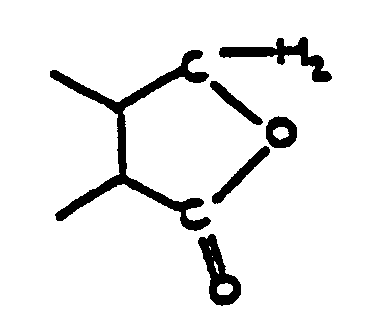
| 220 | Furanone moiety-containing: |
| This subclass is indented under subclass 218. Subject matter wherein the color-former contains the phthalide
or furanone moiety, viz.:
| |
| 221 | Fluoran or derivative: |
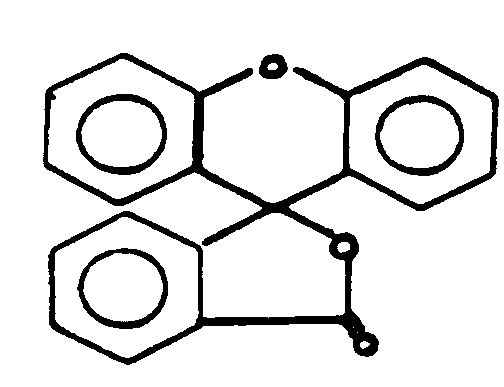
| This subclass is indented under subclass 200. Subject matter wherein the color-former is 0-phenolphthalien
anhydride (dihydroxydiphenyl phthalide anhydride) or compound derived from
it by substitution for a hydrogen.
| |
| 222 | Molecule having plural fluorans or more than three rings fused together: |
| This subclass is indented under subclass 221. Subject matter in which the color former compound has in its molecule two or more fluoran moieties, or has a polycyclo ring system in which a ring shares two of its carbon atoms with one other ring, and two more of its carbons with second other ring. | |
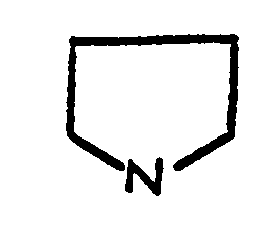
| 223 | Azole moiety-containing: |
| This subclass is indented under subclass 218. Subject matter which contain the moiety
| |
| 224 | Polyphenylmethane moiety-containing: |
| This subclass is indented under subclass 218. Subject matter in which the color-former molecule has a single acyclic carbon atom between at least two benzene rings. | |
| 225 | Identified electron acceptor (developer): |
| This subclass is indented under subclass 200. Subject matter in which a claim names a material which has acid characteristics sufficient to bring out the color of a color-former contacted therewith. | |
| 226 | Spatial relationship specified between color-former and developer: | ||
| This subclass is indented under subclass 200. Subject matter wherein the relative distance between color-former
and developer is specified; e.g., both in the same layer, on opposite sides
of the same carrier sheet, etc.
SEE OR SEARCH THIS CLASS, SUBCLASS:
| |||
| 227 | HAVING PLURAL INTERACTIVE LEAVES: | ||||
Material which is used to form a visible record comprising
plural leaves so associated that the bottom surface of a top leaf,
so as to produce a mark, usually upon the application of pressure in
a direction normal to the plane of the leaves.
SEE OR SEARCH THIS CLASS, SUBCLASS:
| |||||