| Patents > Guidance, Tools, and Manuals > Classification > USPC Glossary Page |

|
|
|
| Class Numbers & Titles | Class Numbers Only | USPC Index | International | HELP | Office of Patent Classification |
|
| USPC Consolidated Glossary |
|
| Terms Beginning with | A | B | C | D | E | F | G | H | I | J | K | L | M | N | O | P | Q | R | S | T | U | V | W | X | Y | Z |
USPC Consolidated Glossary - Class Number Sort
Glossary Terms for Class 8 BLEACHING AND DYEING; FLUID TREATMENT AND CHEMICAL MODIFICATION OF TEXTILES AND FIBERS
A dye containing organic acid groups, e.g., sulfonic, sulfamic, phosphoric, carboxylic, etc., or their salts. Acid dyes are commonly sodium salts of organic acids applied in an acid bath and used to dye wool, polyamide and silk. Acid dyes have the ability to be substantive to substrates with basic groups.
A basic or cationic dye will dye substrates having acidic properties, e.g., polyacrylonitrile, acid modified polyester, etc. They include diphenylmethane, triphenylmethane, xanthene, naphtroperinone, quinophthalone, quaternary ammonium group, etc., containing dyes.
Crepe is a general classification of fabrics characterized by a broad range of crinkled or grained surface effects.
A cross-linker dye additive is a compound added to assist in dyeing which reacts chemically with both the dye and substrate, other than due to chelate formation.
Direct dyes, also known as substantive dyes, are generally sulfonated azo compounds very similar to acid dyes in constitution, good for dyeing cellulose fibers or protein fibers.
Disazo for the purpose of this class is define d as a compound containing two or more azo (-N=N-) groups.
Disperse dyes are water-insoluble, neutral dyes applied to the substrate from a fine aqueous suspension, which were originally developed for use in dyeing of cellulose acetate and polyester materials.
A dye additive or assistant is defined to be any material added to a dye to help in dyeing and is not basically a part of the dye itself.
Is employed in this classification in its understood and accepted meaning in the art, that is to say, it denotes imparting a substantially permanent color to organic fibrous or filamentous material or other porous material by the use of substances, or preparations possessing tincorial properties and which are not dependent for their ability to become fixed to the base solely upon the presence of an adhesive of bindive vehicle or ingredient, as distinguished from the application of an insoluble pigment suspended in a bindive vehicle, e.g., paint or any colored coating composition where the coloring agent does not actually color the base.
Denotes the application of a temporary or easily removable coloration to a material for identification or like purpose.
The hetero atoms are nitrogen, oxygen, sulfur, selenium, and tellurium.
A hetero ring is a ring which contains only carbon and hetero atoms.
Methine group refers to -CH=.
Mordant dyes are dyes which require a mordant in their application and which upon combination with the mordant deposit insoluble color on the substrate, e.g., dyes with metal chelating groups.
Are substances of organic or inorganic origin which combine with the coloring matter and are used to fix the same in the production of the color. For the purpose of this class, such materials as oils and sulfonated oils, soaps, fats and higher acids, are not generally considered as mordants, but as coming within the scope of �gassistants�h in dyeing.
Oxidation dyes are dyes which produce a color by oxidation on the substrate of compounds such as arylamino, hydrxyaryl, or similar compounds to produce, e.g., aniline black or diphenyl black. Nitroaniline dyes are included.
A reactive dye reacts chemically with a substrate having reactive -H atoms thereon, e.g., ester or ether formation with cellulose.
A solvent dye is a dye which si soluble in an organic solvent and is commonly introduced in the form of a solution in an organic solvent.
Sulfur dyes contain sulfur linkages within their molecules which are produced by sulfurization, i.e., heating of organic compounds with sulfur or alkali polysulfides.
The term substrate is used here to refer to the base material being dyed.
As employed in this classification is limited to organic fibrous and filamentous materials, and mixed materials including same as a definite component part thereof and not in the popular sense to include all materials, e.g., it does not include asbestos and glass fibers adapted to be felted, woven or knitted not glass fiber fabric. In the dyeing subclasses (400-696) paper has been grouped with the textile materials.
Vat dyes are dyes which are applied to the substrate in reduced, soluble form and then oxidize to the original insoluble pigment. Common vat dyes are quinonic dyes and particularly common are anthraquinones and indigoids.
Glossary Terms for Class 12 BOOT AND SHOE MAKING
includes within its scope the upper and sole when they are secured together. In shoe making, the upper including various parts thereof, such as the vamp, toe tip, quarters, linings, etc., are assembled and secured. The thus assembled upper is generally conformed to shoe shape by a lasting operation and attached to a sole. When the upper and sole are attached the product is known as a shoe in the trade. It will be noted that this term includes within its scope, (1) partially completed shoes, (2) shoes having outsoles and heels which are ready for wear, and (3) shoes being worn by their wearers.
Glossary Terms for Class 15 BRUSHING, SCRUBBING, AND GENERAL CLEANING
Devices not classifiable elsewhere and which perform no cleaning function but which are merely ancillary to machines, implements and attachments classified in this class.
As an exception to the other GLOSSARY definitions, patents which recite that (1) a cleaning or coating means is attached to an object which is cleaned or coated thereby or (2) that any device is attached to a cleaning or coating agency, have been classified as attachments regardless of whether they are machines or not, disregarding the relative superiority of these subclasses in the classification schedule.
Defined in this class as a work contacting cleaning or coating agency subcombination which as disclosed, could be either (1) manipulated manually as a tool, (2) moved by a machine, as defined above and constituting a part thereof, or (3) held in place by support means for direct manual application of the work thereto. (Note: A hand held nozzle is not an implement as defined above and is classified elsewhere as a machine subcombination).
Defined in this class as an organization including a mechanism, which contains within itself its own guide for operation, to move either (1) a cleaning agency, or a coating agency of a type recognized in this class, relative to the work surface or (2) a means to constrain the work and said agency to some type of definite relative motion in response to manual or other actuation. (Note: A guide on a stripping brush aids in directing the brush but does not constrain it to any definite path other than that determined by the work itself).
Glossary Terms for Class 16 MISCELLANEOUS HARDWARE (E.G., BUSHING, CARPET FASTENER, CASTER, DOOR CLOSER, PANEL HANGER, ATTACHABLE OR ADJUNCT HANDLE, HINGE, WINDOW SASH BALANCE, ETC.)
Any axis about which a hinged member* rotates during operation of the hinge.
Any device or portion thereof (e.g., closure, seat back, etc.) which is adapted to be swingably connected by a hinge to another device or portion thereof (e.g., frame, box, sill, etc.).
An elongated rodlike element about which a hinged member* swings (e.g., �gpintle�h).
A rod or platelike portion by which the hinge is adapted to be secured to a hinged member*.
Glossary Terms for Class 24 BUCKLES, BUTTONS, CLASPS, ETC.
A securing means wherein either member is adapted to allow structure-to-be-secured (*) to pass therethrough, or wherein the members are adapted to allow structure-to-be-secured(*) to pass completely therebetween in a path generally parallel to the longitudinal axis of the members. Buckles are designed to adjustably secure belts, bands, or similar longitudinal articles and generally operate by having one end of the belt band, etc., fixed securely to one end of the buckle with another frictionally or resiliently securing the belt, band, etc., or by passing through a provided for aperture in the belt, band, etc., and generally also has two connected, relatively movable members.
A securing mechanism or element including two coacting members or member segments having gripping surfaces which engage portions of structure-to-be-secured* on opposite sides in a jawlike manner to thereby (a) prevent or hinder the movement of structure-to-be secured* relative to the surfaces in at least one direction, (b) prevent or hinder the separation of distinct portions of the structure-to-be-secured* from each other, or (c) perform a securement of structure-to-be-secured* by overedge engagement thereof. The gripping surfaces of the coacting members or member segments are intended to be always easily moved into and out of engagement with the structure-to-be-secured* by either direct manual or tool force thereon or actuation of an attached operator*. In addition, both of the coacting members or member segment, when engaging with or disengaging from the structure-to-be-secured*, do not exceed the elastic limit of or destroy any portion of the securing mechanism or element. If the mechanism or element is formed from either a single piece or plural fixedly attached pieces of rigid* material, then the structural shape of the gripping surfaces and the outward force of the compressed structure-to-be-secured* provide the gripping force required above.
A securing mechanism or element including a member which (1) is intended to be connected or attached to a rigid or semirigid supporting member (e.g., wall, floor, roof) or article (e.g., pen, vehicle) having an additional and usually principle function other than normally associated with this class, and (2) has a gripping surface intended to coact with the surface of the supporting member or article to engage the opposite sides of a distinct structure-to-be-secured* positioned therebetween to prevent or hinder either (a) the movement of the structure-to-be-secured* relative to the surfaces in one direction, or (b) the separation of a structure-to-be-secured* from the supporting member or article. The gripping surface of the member is intended to be always easily moved into and out of engagement with the structure-to-be-secured* by either direct manual or tool force thereon or actuation of an attached operator*. In addition, the gripping surface, when engaging with or disengaging from the structure-to-be-secured does not exceed the elastic limit of or destroy any portion of the securing mechanism or element. If the mechanism or element is formed from either a single piece or plural fixedly attached pieces of rigid* material, then the structural shape of the gripping surfaces and the outward force of the compressed structure-to-be-secured provide the gripping force required above.
A securing mechanism including both a string (i.e., a thin elongated flaccid member) and guiding means therefor (e.g., eyelet, hollow hem) located on a portion of the structure-to-be-secured* which surrounds an opening; wherein the string (a) encircles the opening, (b) draws the perimeter of the structure-to-be-secured* toward the center of the opening to close or tighten it when a portion of the string is pulled through its guiding means to shorten the effective length of the remaining portion of the string encircling the opening, and (c) secures the perimeter of the structure-to-be-secured* in its new position when the extracted portion of the string which was pulled through the guide means is prevented from moving (e.g., tied).
Structure which, when subjected to a distortion force less than or equal to earth"s gravitational force, is incapable (in at least one of its orientations) of maintaining its previous formational shape or being self-supporting over any appreciable dimension.
HAND-ACTUATED(*); HAND-OPERATED(*)
The term hand-actuated or hand-operated is used in the sense of like contact with a living being and solely applies to the use of the hand in operating a fastener (i.e., moving portions of the fastener relative to each other) of the Class 24 type.
A securing mechanism including both a string (i.e., a thin elongated flaccid* member) and guiding means (e.g., path defining eyelets) therefor located on two spaced edges of the structure-to-be-secured*; wherein the string (a) links together the guiding means on opposite sides of and traverses the gap between the edges, (b) draws the edges toward each other when a portion of the string is pulled past its guiding means to shorten the effective length of the remaining portion of the string traversing the gap, and (c) secures the edges in fixed relationship to each other when the extracted portion of the string is prevented from moving (e.g., tied).
A component having the sole function of restricting the movement between and holding in a particular position or orientation (e.g., not moving or reorienting) either (1) one portion of the fastener relative to another portion of the fastener, or (2) one fastener relative to another fastener.
A manipulable mechanical means which contacts and moves with respect to a shiftable portion of a fastener mechanism to reposition or transmit an input force to the shiftable portion. A mere spring which effects the movement of the parts of the fastener mechanism, for example, by utilizing stored energy to return its parts to a starting position, is not included in the meaning of this term.
A securing mechanism having both (a) a portion specifically shaped (e.g., pointed) to facilitate impaling of and penetration into either the structure-to-be-secured* or a supporting member therefor during its operation and (b) a remaining portion (e.g., head) not intended to penetrate either the structure-to-be-secured* or a supporting member therefor in the final securing position of the mechanism. In addition, the penetrating portion of the securing mechanism is intended to be always easily impaled into and extracted from the penetrated area of the structure-to-be-secured* or its supporting member by unaided directed manual force. Finally, the normal securing or releasing operation of the mechanism requires no portion of the mechanism to be destroyed or undergo forces in excess of those causing plastic deformation of the material from which it is constructed.
Structure which is both capable (a) of distortion when subjected to a force of the magnitude normally encountered within the disclosed environment and (b) of complete resumption of its original shape due to the energy stored within it by the distortion force after its removal.
Structure which when subjected to a distortion force normally encountered within the environment (as defined by the disclosure and associated with the securing operation of a Class 24 fastener) is capable of resisting this force if applied to the structure in any orientation and maintaining its previous formational shape thereafter.
Structure which is both (a) capable of resisting distortion (i.e., maintaining its previous formational shape or being self supporting over all appreciable dimensions) caused by a force applied to it in any of its orientations which is of a magnitude equal to or less than the earth"s gravitational force and (b) incapable of resisting distortion caused by a force applied to it which is normally encountered in its working environment (e.g., ductile or resilient* structure).
A securing mechanism including two, separate, dissociable, mating members having faces which directly or through a separate linking member (1) contact and interlock (i.e., the movement between the faces is restricted in the direction force is transmitted thereto by the structure-to-be-secured*) with each other when fastening either (a) spaced portions of the structure-to-be-secured* together, or (b) the structure-to-be-secured* to a supporting member having a principle function not associated with this class (e.g., door, wall) and (2) are intended to be always easily associated or dissociated from each other either by direct manual force or by actuation of an operator* attached to one of the members. Both of the mating members of this mechanism are intended to be attached to or formed from a section of either the structure-to-be-secured* or a supporting member therefor and neither of these members is ever structurally linked to the other by any structure other than the structure-to-be-secured* when their faces are not in their interlock position. In addition, both of the members when associated or dissociated do not exceed the elastic limit, or destroy any portion, or the material forming the faces.
Structure having a principle function other than that normally associated with this class (i.e., not a component of a Class 24 fastener) which is attached, fastened, gripped, or secured by a Class 24 fastener, either to itself or to another structure.
A securing mechanism or element which (1) is attached to the structure-to-be-secured* for subsequently mounting it on a rigid* or semirigid* member (e.g., wall, floor, roof) or article (e.g., pen, vehicle) having an additional and usually principal function other than normally associated with this class, and (2) having either (a) a gripping surface which is mounted to and intended to coact with an opposed gripping surface formed by the structure-to-be-secured* to engage the opposite sides of the rigid or semirigid member or article positioned therebetween, or (b) two coacting members or member segments having gripping surfaces which engage opposite sides of the rigid* or semirigid* member or article in a jawlike manner, and (3) having structure which hinders the movement of the gripping surfaces relative to the member or article and prevents the separation of the structure-to-be-secured* from the member or article. The gripping surfaces of the securing mechanism or element are intended to be always easily moved into and out of engagement with the rigid* or semirigid* member or article by either direct manual or tool force thereon or actuation of an operator* attached to the securing mechanism or element. In addition, the gripping surfaces of the securing mechanism or element, when engaging with or disengaging from the rigid* or semirigid* member or article, do not exceed the elastic limit of or destroy any portion of the securing mechanism or element. If the mechanism or element is formed from either a single piece or plural fixedly attached pieces of rigid* material, then the structural shape of the gripping surfaces and the outward force of the compressed structure-to-be-secured* provides the gripping force required above.
An instrument for affecting the operation of a Class 24 fastener usually operated by hand and totally separable from the fastener after affecting operation.
A mechanism for either closing an opening in structure-to-be-secured*, or connecting together separate members of structure to be secured* including (a) two, opposed, elongated, cooperating, configured surfaces which are attached to the structure-to-be-secured* by mounting means and intended to directly contact and interlock with each other (i.e., the movement between the configured surfaces is restricted in the direction force is transmitted thereto by the structure-to-be-secured*) when closing or connecting, and (b) a sliding device which is much shorter in length than the surfaces and which travels along the length of the surfaces sequentially contacting and simultaneously camming against each segments of both surfaces to forcibly shift them into or out of interlocking engagement, the direction of travel of the device generally being perpendicular to the shifting motion of the interlocking configured surfaces.
Glossary Terms for Class 29 METAL WORKING
The physical act of or means for juxtaposing, associating, integrating, joining and/or putting together, with or without securing, of machines, devices, and things (articles).
An electrical component consisting of two conductors placed either in contact with each other or separated by an interface layer to which contacts or terminals have been secured, which component has a nonlinear resistance characteristic, as a result of the electrical action of the interface between the two conductors rather than from the characteristic of the conductors.
The physical act of or means for shaping without any substantial removal of material. This term includes forging, rolling, densifying, extruding, drawing and stretching.
The physical act of or means for dissociating, disengaging, and/or taking apart of machines, devices, and things (articles).
The physical act of or means for shaping by removing material by means of a cutting edge. This term includes milling, cutting, turning, boring, drilling, abrading, broaching, filing, sawing, punching, blanking, and planing.
The physical act of or means for creating, constructing, fabricating, machining, working, shaping, assembling, disassembling, and repairing of machines, devices, and things (articles).
The physical act of or means for restoring inoperative machines, apparatus, static structures, and things (articles) when the operational limits of tolerance have become exceeded by wear, imperfections, destructive oxidation, electrolysis, or failure by (1) reshaping parts, (2) substituting a part and/or adding supplemental or additional parts or material, and/or (3) taking away sections of worn, torn, broken, distorted, eroded or otherwise unusable parts or material, and mending them by adding supplemental or additional parts or material.
The physical act of or means for permanently altering the form, configuration, dimensions, proportions, or contour of a part or stock, either with or without the removal of material. This term includes deforming, compacting, densifying, slitting, machining, and briquetting.
The physical act of or means for shaping solely by incising or severing the part or stock to form a partial separation along a plane or surface through the part or stock. When this separation is done by a true shearing operation, there is no material removed.
A tube having one end closed.
The physical act of altering the form, configuration, dimensions, proportions, or contour of a part or stock within the elastic limits of the material of which it is made without any removal of material.
A sheetlike member the thickness of which is small in relation to its area measured in a plane normal to its thickness.
An elongated member in which the transverse cross-sectional dimensions are substantially uniform and are small in relation to its length.
A pipe, hollow cylinder, or hollow rodlike member.
A self-contained active or passive element designed for and capable of utilizing electricity to produce a specified electrical characteristic property, or output other than normal conductivity associated with any electrical structure.
A body whose longitudinal dimension is much greater than any of its lateral dimensions and which is designed for the stated proximate purpose of carrying an electric current or electromagnetic energy.
An electrically conductive connective means having a portion or end designed for relatively permanent attachment to an elongated conductor and having a second portion or end designed to facilitate connection with another elongated conductor, an electrical component, or another electrically conductive connective means.
Glossary Terms for Class 37 EXCAVATING
This device is the pivotally mounted front covering for a scoop adapted to pivot to an open position when loading and unloading and to a closed position when holding and transporting material.
This is a material handling machine which includes a boom pivoted to a vehicle, a handle or dipstick pivoted to the boom, and bucket or scoop pivoted to the dipstick with the open top of the bucket facing back toward the vehicle.
This is a device comprising an elongated beam adapted to project from an excavating device for the purpose of supporting the excavating equipment and wherein the device is normally pivoted to a support.
This device is a portion of a scoop which holds and carries the excavated material during transport. The scoop portion can be adapted to be used in connection with an apron, elevator, or ejector.
This device is an excavating or handling tool having two similar jaws which close upon material for excavating and open for dumping.
This is a machine for excavating material at the bottom or the banks of a body of water.
This term is applied to the fragmental material composing part of the surface of the globe.
This term is applied to the solid surface of the earth or the floor of a body of water, especially a sea, river, or lake.
This implement comprises an excavating tool having two hemispherical jaws which close upon material for excavating and open when dumping.
In a dredge, this is an elongated member provided with a lifting tackle at the top and fused to hold or remove the dredge by contact with the earth.
Glossary Terms for Class 44 FUEL AND RELATED COMPOSITIONS
Defined as a fuel object, of a size suitable to be manipulated by a human hand, made, by consolidating, usually including pressing and shaping, smaller-sizes, loose, broken, comminuted or other divided carbonaceous powder, particles, chunks, lumps, fibers, sheets, etc.
Used in this class, it means an organic compound which consists exclusively of carbon and hydrogen.
Glossary Terms for Class 49 MOVABLE OR REMOVABLE CLOSURES
(See OPERATOR) The force input means to the closure for imparting movement thereto, e.g., an operator. The term is broader than �goperator�h since a handle which does not move relative to the closure is considered an actuator.
A construction forming an extended indefinite surface preventing or inhibiting the passage of persons or things, e.g., wall, ceiling, floor, roof or cover.
A flexible connector such as a rope, chain or the like.
A closure is an obstructive structure whose presence in or before a passage bars traffic through the passage. The character of passage varies depending on the thing or things the passage is intended to accommodate. For example, a single rod across a doorway prevents passage of a person but not a small animal; a letter slot permits passage of a letter but not a large package, a window sash permits passage of light but not air, a shutter permits passage of air but restricts the passage of light.
An elongated rigid arm which is pivoted at least one point along its length.
A type of lever which is pivoted at two or more points along its length, usually at its extremities.
A powered means such as a motor or engine utilized as the moving force or input of the operator. A mere spring is not a powered means, but a motor having a spring as the source of power is included within the meaning of the term defined.
A closure mounted to move in a regular, repetitive, predetermined path with respect to a passage so as to alternately open or close the passage.
Motion along two or more distinct lines of travel or about two or more axes of rotation or a combination thereof, in a single operation.
A manipulatable mechanical means, movable relative to the closure, for imparting movement to the closure relative to its mounting means, in its opening or closing movement. A mere spring which effects the movement of the closure, for example, by utilizing the stored energy to return the closure to starting position, is not included within the meaning of this term.
A sheet-like member which is a section of a closure structure.
Structure defining an opening through a barrier for the passage of persons or things, e.g., the framing of a door or window opening.
A closure which is mounted so as to be readily physically disassociated from its supporting structure to form a passage.
RECTILINEAR MOVEMENT OF CLOSURE
Straight line motion in opposite directions, such as up and down, right and left, to open or close a passage.
Rectilinear motion which is constrained by stationary guides on the supporting member(s).
An elongated member extending along the edge of a closure in opposition to a portal frame member, e.g., jamb, and connectable to the closure for sliding therewith.
A turning motion about a pivot to open or close a passage.
Glossary Terms for Class 52 STATIC STRUCTURES (E.G., BUILDINGS)
The finish around and extending away from a door or window opening.
Means forming an extended surface against which a settable material is cast, e.g., troweled, spread, poured etc., the material when set forming a wear surface or facing.
A construction forming an extended indefinite surface preventing or inhibiting the passage of persons or things, e.g., wall, ceiling, floor, roof or cover.
A module whose depth is substantial relative to its length and height and which in use forms a stable load-bearing member.
Generally synonymous with �groof�h but used where �groof�h in some instances may be inapt, e.g., a covering supported by an article, a canopy, a man-hole closure, etc.
An article which does not form an essential component of a building construction of plural components, but is in the nature of an adjunct having no essential load-bearing, supporting, joining or protective function.
Means surrounding an area or volume to be occupied by persons, animals or goods.
An opening for persons or things, but not for a fluid or a mass of particles having a fluid like characteristic.
An element or structure which (1) forms an exposed surface section of a barrier or (2) the panel held by a frame, a framing element or an elongated sustainer, e.g., the movable closure part of a door or window. In the latter respect it differs from a module in that it is not used in repetition to form an extended surface.
Thin sheet of material covering or extending into a joint to deflect liquid from the joint.
A construction or component which is sufficiently strong and rigid to act as the primary support for other constructions or components against gravity or to resist transverse loading (see sustainer).
A construction utilizing modules.
A component of building construction, usually designated by terms such as; brick, block, slab, panel, tile, sheet, precast monolith, etc., which when assembled in repetitious juxtaposition with other such preformed shapes (with or without interposed connecting means or material) define a surface of a construction, e.g., of a wall, ceiling or floor.
A structure erected in situ by casting a water-settable composition, e.g., plaster or concrete.
The term panel is used to denote a thin rigid sheetlike structure which may not be disclosed as used repetitiously, e.g., table top or pane.
Structure defining an opening through a barrier for the passage of light, air, persons or things, e.g., the framing for a door or a window opening.
A component of a building construction which is in completed form before its use at the job site. (Compare Module).
An art term for a concrete reinforcing rod. A rebar chair is a device for spacing a rebar from a concrete form.
A body placed within and covered by a cast material or a foraminous member wherein the holes are filled by a cast material.
The sides of a door or window opening between the faces of the barrier.
A rigid cover extending above and supported by the uppermost termini of walls or columns.
A component which is applied or formed in a fluent condition but sets or hardens in the final product, e.g., concrete, cement or plaster.
A member which has a limited closed periphery and which is greatly elongated relative to its length. It is generic to �gsustainer�h in that it may not have a load bearing function.
The subclass definition must be referred to.
Means embedded in cast material or extending between sustainers or load bearing components which act to strengthen a construction in contradistinction to acting as a primary loadbearing or bend-resisting member.
A rigid member or construction having a limited closed periphery which is (1) greatly elongated relative to any lateral dimension (2) resists transverse loading and (3) supports or retains other components of a building construction, e.g., stud, joist, beam, or column.
A tensioned strandlike component of a unit which places the principal part of the unit under compression.
A thin, relatively rigid module which when applied repetitiously in edge-to-edge relationship to a backing surface forms an exposed facing
Glossary Terms for Class 53 PACKAGE MAKING
A species of cover in which the cover material completely encircles the contents in one direction only, such as girth, leaving the contents fully exposed on two sides or ends, and which is in frictional contact with the contents so as to be retained thereon. See �gBINDING�h.
The embracing by means of a filament, strand or wire of either an accumulated bunch of articles, a series of coils, or a single encased package. It differs from banding in that no substantial area of the contents is covered, and the binder is usually tied, knotted, or twisted. Except where applied to a package for this class, (see subclass 138.6), the process of and apparatus for applying a binding is not here classified. See �gPackaging and Binding Elsewhere Classified�h of the Class Definition for binding, per se.
A species of cover in which a separate cover member completes the encasement or confinement of contents within a preformed receptacle when said member is assembled within, over or around the aperture of said receptacle.
The goods or materials which are, or are to be, confined within the space defined by the cover of the package, An insert sheet or coupon, to be packaged with other goods is considered to be a part of a group contents. See �gGROUP FORMING�h. A package resulting from a first packaging operation may become the contents of a second packaging operation.
A member, made from sheet material stock which serves to confine the contents by either a complete encasement or a partial encasement, and which fully encircles or encompasses the contents in at least one direction. A band, closure, preformed container, carton or receptacle, though said members are not �gmade from sheet material�h, are each considered covers for this class. A spindle or core which extends into or through a preformed aperture in the contents is considered to be a partial cover. See subclass 581. See �gBAND�h, �gCLOSURE�h, and �gRECEPTACLE�h.
Some accessory, device or abiding characteristic which is supplied to, or formed integral with, a cover to perform some function in addition to the mere enclosing of the contents. Such adjuncts include the addition to a cover of (1) a filament, strand, wire, stamp, label, handle, or display support, (2) a filler piece for the gap resulting between two or more folded flaps, (3) some auxiliary cover seam retaining device, including a staple, a clip, a sewn stitch, or a simultaneously integrally formed and set tab-and-slot retaining means, (4) a coating, printing, embossing or other marking, ornamenting or display feature, (5) some means to provide for opening the cover such as, e.g., a tear strip, (6) a cover attached reinforcement, article holder, or article remover, or (7) a window or window opening, (8) a contents contacting sealing spot, disc or gasket, (9) a superimposed disc which is applied to a hood or cap so as to depress said disc and a portion of the hood or cap within the aperture of a receptacle, (10) a cam actuated sealing or gripping means on the closure for fastening said closure, or (11) a protection strip placed over the contents of a receptacle (e.g., matches) and inserted between the side of the receptacle and the contents. However, the operations of slitting or notching of cover blanks and flaps preparatory to the shaping of the cover, or the application of adhesive to the cover to aid in seam retaining are not considered cover-adjuncts for this class. Nor is the addition of a transitory characteristic to a cover for the purpose of aiding in the packaging, e.g., the addition of moisture to a wrapper, considered to be a cover-adjunct.
Feed or delivery, as distinct from infeed, is transfer, conveyance, movement or translation of assembly components to or from what is established as a work position; at which position further motion of the components with respect to each other - generally a straight line movement along the major axis of either or both components - is called infeed. Thus, for example, motion of a closure element from a hopper or magazine to a superimposed position over the aperture of a receptacle is referred to as feed or delivery while the final juxtapositioning of the closure and receptacles previously aligned and oriented is considered infeed.
The step of placing a contents within a cover. It is not necessary that the contents occupy the entire space encased; i.e., the cover may be only partially filled by a filling operation.
The accumulating or gathering of an associated collection of articles, of the same or of different characteristics, by means of a plurality of feeding operations, for placement as a contents in a single cover. An insert sheet or coupon to be packaged with other goods is considered to be an article of different characteristics from the goods. On the other hand, an inner cover, or a section of plural section cover is not considered to be a part of the contents of an outer cover. See �gCONTENTS�h.
The means to either (1) hold and position, (2) hold and secure, or (3) juxtaposition and secure a separate closure element during infeed.
The wrapping of a cover around a contents to form a package is invariably done in two stages, viz.: first, the shaping of the cover about a single end or surface of the contents, and second, a further shaping of the cover by bending or folding the previously unfolded portions thereof so that the latter portions are in contact with the contents end or surface opposite to the end or surface about which the cover was previously shaped. The intermediate state of the cover at the end of the first stage is referred to as the Initial Wrap. The initial wrapping operation begins with the contact between the first end or surface of the contents with the cover and proceeds in two ways, either by (a) an unidirectional relative movement (which is not necessarily continuous) between the folding instrumentalities and the cover material-contents unit or (b) by a first relative movement between the folding instrumentalities and the cover material-contents unit, and one or more succeeding relative movements therebetween, at least the first of which is in a direction different from the first movement, and which serves to complete the shaping of the cover along the first end or surface of the contents without bending or folding the remaining unfolded portions of the cover into contact with the opposite end or surface of the contents.
A unit consisting of an assembled cover material and contents, where the contents is, or is to be, encased or encircled by the cover material. The cover need not be shaped around the contents, e.g., the unit resulting from the final positioning of a contents upon a cover blank or web, which is then handled as a unit through further packaging operations including an encasement or encirclement, is also termed a package.
A stage of cover formation in which the cover material has been fashioned into such shape as to at least partially confine the contents, as for example, against lateral displacement. A sheet of bendable or foldable cover material which has received a single preliminary fold, such as a U-fold, as well as a completely formed carton, are both considered to be receptacles.
Two or more edges of the cover material brought together with or without adhesion. Usually the seam is implemented by adhesion, folding or interfitting but a mere overlapping of two edges is sufficient to constitute a seam.
A species of flexible cover material in which the initial wrap is bent or folded about the contents as the first step in the encasement of the contents to make a package.
Glossary Terms for Class 60 POWER PLANTS
A reaction motor propellant consisting of two separate substances (usually liquid) fed into the reaction zone separately. One of the substances is a fuel (e.g., hydrazine); while the other is an oxidizer (e.g., fluorine).
The transformation of the molecules of one or more substances into other kinds of molecules.
A single substance or a mixture of substances which react with another substance (called the oxidizer) to form at least one new substance in which at least a portion of the fuel forms at least a portion of the more positive (electron donor) portion of the new substance. e.g. H2 + Cl2�¨ 2HCl Hydrogen is considered the fuel. CH4 2O2�¨ CO2 + 2H2O Methane is the fuel and oxygen in the oxidizer. BE + F2�¨ BeF2 Beryllium is the fuel and fluorine in the oxidizer.
A substance (fuel or oxidizer) which ignites spontaneously on contact with the other member of a hypergolic mixture. For example: aniline is hypergolic with nitric acid.
Forcing into the reaction zone one or more streams of material which enter into the action which produces thrust. Extruding a solid or semi-solid into the reaction zone, spraying a stream of finely divided particles into the reaction zone and jetting a liquid or gas into the reaction zone are illustrative but nonlimiting examples of the scope of the term.
The term includes a free metallic element (e.g., lithium), an alloy of two or more metals (e.g., 25% Na 75% K), and intermetallic compound (e.g., A1Ni) or a mere mixture of particles of two or more metals.
A material which contains within itself all of the components which enter into the chemical change which occurs in producing thrust in a chemical reaction motor. A monopropellant may be a pure compound, such as hydrazine, or a mixture of two or more substances which react under the conditions of the reaction chamber.
Used in this definition this term means a stream of moving particles, either gaseous or liquid, as it exists in the area in the motor where it is accelerated, pressurized or otherwise caused to become unstable up to and including the point where it exits the end of the ejecting means, e.g., nozzle, through which it is ejected into the ambient to cause thrust.
A substance (element or compound) which reacts with another substance to produce at least one new substance in which at least a portion of the oxidizer furnishes at least part of the more negative (electron acceptor) portion of the new substances. e.g. BH3 + NH3 �¨ BN + 3H2 ammonia is considered the oxidizer 2LiH + F2 �¨ 2LiF + 2HF fluorine is considered the oxidizer CH4 + 2O2 �¨ CO2 + 2H2O oxygen is the oxidizer
The generic term for any or all of the components of the supply of materials which may be converted (by expansion, combustion or other means) into motive fluid.
The space in which the propellant material undergoes chemical change to produce new substances and heat which heat raises the temperature of the new substances. The ejection of these heated substances from the reaction motor produces thrust or propulsive force.
Includes expansible or nonexpansible fluids, entrained in a system including a pump and motor, or fluents whose characteristics permit a transmission of energy or flow between a pump and motor which is not inconsistent with that of the fluents.
Comprises means actuated by the flow or pressure of the fluid or by the absence of such flow or pressure between the pump and the motor.
WORKING MEMBER POSITION RESPONSIVE MEANS
Comprises means positively actuated by the motor working member when it attains a given predetermined position in the working chamber. Such position includes a position of the working member attained after a predetermined number of strokes or revolutions of the working member.
A VARIABLE DISPLACEMENT PUMP OR MOTOR
Includes an expansible chamber and means to vary the volume of fluid admitted to or discharged from the chamber. The means which varies the volume of fluid will be generally either (1) means which physically displaces either the piston or working member or the cylinder or housing of the expansible chamber to vary the effective stroke of the piston or working member, or (2) means which alters the timing of the inlet or exhaust valve with respect to the piston or working member timing to vary the effective stroke of the piston or working member.
An expansible chamber device which provides a contracting volume to expel fluid from the chamber or to place the fluid therein under pressure. All valve means or chamber means associated with the expansible chamber device are included under this definition.
An art term applied to a unitary assembly of a master and its associated holder of a reserve supply of make-up fluid.
Fluid that acts to drive a motor. The term is generic to �gpulse�h fluid and �gpower�h fluid.
An element of the system by which driving or loading force is delivered for utilization by means other than the system itself.
An externally energized fluid that powers a pulsator system. Pulsator circuit: The combination of elements in which the pulse fluid is trapped.
An organization of which a pulsator circuit is merely a part.
The definite volume of fluid trapped in the pulsator.
An expansible chamber device which provides an expanding volume to receive pressurized fluid or a pressure transmitted through a passage connecting the slave to the master transmitter. The slave includes all valve means or chamber means associated therewith.
Glossary Terms for Class 65 GLASS MANUFACTURING
See Subclass References to the Current Class, above, for a subclass reference to the term �ganneal.�h
See Subclass References to the Current Class, above, for a subclass reference to the term �gbait.�h
A properly proportioned mixture of raw materials to be delivered to a melting apparatus.
Mechanical means for introducing a batch to a melting apparatus.
(1) A small piece of glass fused onto an electrical conductor, (2) an enlarged rounded portion on an edge of an article or stock material, (3) small discrete particles of glass.
Shaping or forming an undefined mass of glass in a soft state by introducing gas within a confined opening within the mass, i.e., by inflating.
A hollow wall generally having an air space between refractory blocks from which it is formed and providing an opening or throat adjacent its bottom used in a tank furnace to separate a working end from a fining or melting zone.
Forming a glass preform by flowing molten glass in the form of a stream into or onto molds, rolls or tables. (Teeming is synonymous to casting).
See Subclass References to the Current Class, above, for a subclass reference to the term �gcoating.�h
Shaping a layer throughout its thickness into a row of wavelike folds.
Glassware having a surface which was intentionally cracked by water immersion and partially healed by reheating.
Waste or broken glass.
A slotted floating, refractory block through which glass issues in the formation of a glass sheet during a drawing operation.
See debiteuse.
The changing of glass in the amorphous state to crystalline state generally by holding a glass melt at a temperature which favors crystal growth.
A boxlike wing on a glass furnace through which a batch or floaters, etc., are introduced into the furnace.
Forming stock, generally sheet or tube, by utilizing the self-cohesiveness of glass in a plastic condition to effect an operation similar to a �gtaffy-pull�h.
A refractory device placed in a supply of molten glass to define an area for drawing.
Baffle means isolating stock being drawn from the hot atmosphere existing above a supply of molten glass.
Altering a surface configuration only of glass by raising a boss or protuberance thereon or causing surface portions to be depressed below the plane of the glass surface.
See Subclass References to the Current Class, above, for a subclass reference to the term �gfiber.�h
See Subclass References to the Current Class, above, for a subclass reference to the term �gfilament.�h
See Subclass References to the Current Class, above, for a subclass reference to the term �gfining.�h
Heating of the outer surface of hard glass to a temperature where that surface only melts and surface tension causes smoothing thereof, the heating usually being by fire or flame contact of the glass surface.
Applying a thin layer of opaque or colored glass to the surface of clear glass, or vice versa.
Refractory blocks floating on molten glass in a tank furnace to prevent gall or scum from entering the working end.
Welding by bringing glass, while molten or softened by heating, into intimate contact with another part with subsequent cooling to solid phase whereby uniting is effected.
Means used to remove discrete charges of molten glass from a supply.
An inorganic product (a) the constituents of which generally include a �gglass former�h (e.g., As2O3, B2O3 GeO2, P2O5, SiO2, V2O5) which has an essential characteristic of creating or maintaining, singly, or in a mixture, that type of structural disorder characteristic of a glassy condition, other oxides which approach glass forming properties (e.g., A12O3, BeO, PbO, Sb2O3 TiO2, ZnO and ZrO2) as well as oxides that are practically devoid of glass forming tendencies (e.g., BaO, CaO, K2O, Li2O, MgO, Na2O and SrO), however, pure and modified silica, silicon and slag are also included; (b) formed by fusion and cooled to a rigid condition generally without crystallization; (c) having no definite melting point (whereby the mass has the characteristic of passing through a plastic state before reaching a liquid state when heated); (d) incapable in the solid state of permanent deformation; and (e) which fractures when subject to deformation tension.
Effecting a change in a physical or chemical property of glass, generally involving specific heating followed by controlled cooling.
Molding, shaping, severing of uniting of glass while in a plastic state.
A discrete portion of molten glass (a) delivered by a feeder or (b) gathered on a punty or blow pipe.
See Subclass References to the Current Class, above, for a subclass reference to the term �ghomogenize.�h
Rolling a gather of glass on a flat plate whereby it is shaped and cooled.
Surplus or waste glass which must be removed from the apparatus or a product after a glass working operation.
That portion of a segmented mold used to form a neck portion of a hollow article.
Causing movement in a regular, generally a circular or elliptical path around a fixed point.
A partially shaped article of manufacture requiring further significant shaping to arrive at the form of a completed useful article.
See Subclass References to the Current Class, above, for a subclass reference to the term �gparting layer.�h
A mold with an inner lining of a paste (generally made from resins and linseed oil, soap, etc.) which is brushed into a hot mold and kept wet so that glass within the mold rides on a steam cushion while being formed.
A dipstick used to gather charges of molten glass, punty, puntil, pontee, and ponto are local variants.
Stock material that has been given a shape (the term preform is used interchangeably with article, product, parison and blank).
See Subclass References to the Current Class, above, for a subclass reference to the term �gpress molding.�h
See Subclass References to the Current Class, above, for a subclass reference to the term �gpurify.�h
See Pontile
Changing the gross overall configuration of a glass preform by (a) confining a glass preform within a configured mold and effecting significant flow of the glass to cause it to assume the configuration of the mold or (b) distorting a glass preform by bodily moving a portion of it throughout its entire thickness relative to a second portion during which the thickness of the work piece remains substantially the same and no significant flow of the glass occurs, i.e., bending. Changing at least one dimension of a glass preform throughout its perimeter without any appreciable change in the original configuration thereof, e.g., stretching and shrinking.
The coalescence of particles into one solid mass through heating, generally with melting limited to a surface layer only of each particle.
See Subclass References to the Current Class, above, for a subclass reference to the term �gslag.�h
See Subclass References to the Current Class, above, for a subclass reference to the term �gslinger.�h
Removing surface irregularities or imperfections.
Glass that has been heated to a temperature at which it is pliable or liquid.
The temperature at which a uniform fiber, 0.5 to 1.0 mm. in diameter, elongates under its own weight at a rate of 1 mm. per minute when the upper 10 cm. of its length is heated in a prescribed furnace * at the rate of approximately 5�‹C. per minute. (*See �gA Method for Measuring The Softening Temperature of Glass�h, J.T. Littleton, J. Am. Ceramic Soc., 10(4), 259 (1927).
A reshaping operation involving only the surface of the glass preform and only partially through the thickness and wherein the overall shape of the preform throughout its breadth and width is unaltered.
See Subclass References to the Current Class, above, for a subclass reference to the term �gtemper.�h
Glossary Terms for Class 70 LOCKS
A securing element mounted on one part and having a portion or portions movable to cooperative engagement with a keeper on another part to prevent relative movement between said parts.
That key designed for operation of an individually distinct lock operating mechanism embodying a specific combination or design.
The prearranged or predetermined secret or nonpublic succession or order of movement of blocking elements, or the peculiar arrangement or scheme of fixed or movable elements designed to secure against public operation or control.
An unbiased bolt normally at rest, whether or not so held, and movable only by a positively initiated external force.
A movable blocking element, other than a tumbler, in the form of a pawl or catch, adapted to releasably detain a movable part.
A part to receive the movable portion of a bolt usually a socket, pocket, opening, ledge, abutment, seat, shoulder, etc.
A specially contrived implement for controlling or operating a lock and (1) having portions designed to pass fixed obstructions or to arrange movable impediments to allow operation of a securing device, or (2) embodying an unconventional design of predetermined secret or nonpublic origin.
One normally yieldably biased or urged by some form of constantly present potential force to seek one position and operable to another position against such force, but automatically returnable to its original position unless restrained.
One designed for control of all of a plurality or series of lock operating mechanisms, each of which has its individually distinct operating means or implement.
Manually controlled portable devices for grasping, clamping, gripping or grappling an extremity of the human anatomy and by the application of suitable force and consequent imposition of pain placing the individual to whom the device is applied under the influence and control of another, as in the case of an arrested individual.
Variation or change of a combination to produce a different combination.
A device or mechanism designed to so interfere with the normal operation or manipulation of a securing arrangement as to show by rupture, visible external injury, or other disfigurement from its original condition, any unauthorized or surreptitious tampering, attack or manipulation.Included also in exception to the above definition are:
One designed for control of all of a limited number of a plurality or series of lock operating mechanisms and subordinate to a master key.
A movable impediment to the movement of a bolt or other movable element which may respond to an operating element of corresponding complemental combination, or to a combination of movements to be so disposed as to provide an unimpeded path of movement of the bolt or other movable element.
A fixed impediment in the path of movement of a key in its normal capacity as a lock operator.
Glossary Terms for Class 72 METAL DEFORMING
An undriven tool which, as disclosed, is designed and intended to react against work with sufficient force to enable an operation of the class type to be effected in some portion of the work. Note. An undriven flat-faced tool is regarded as an �gAnvil�h, even though work of a specific shape may be deformed into flatness against it.
The act or operation of bringing into juxtaposition or contact a plurality of preforms (self-shape-sustaining objects) and/or joining said preforms, i.e., so treating one or more of them as to restrict their relative mobility. Note. The mere ordering, stacking, or piling of workpieces prior to a metal-deforming operation thereupon, or the similar handling of products, is not regarded as �gAssembly�h for the purposes of this class.
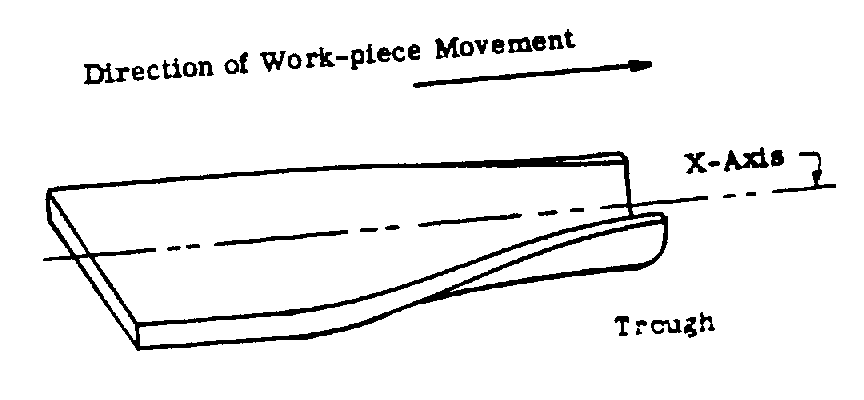
That imaginary line used as a center about which the bending of moving work occurs. For convenience in illustrating the application of the term to the deformation of planiform work, three such axes may be considered, all being related to the direction of work movement and to the disposition of a planar nonthickness surface (see Figure III-1). The three axes are defined as follows:
(A) X-Axis is a line both parallel to the direction of movement of the work and parallel to a nonthickness surface thereof.
(B) Y-Axis is a line both perpendicular to the direction of movement of the work (i.e., length) and perpendicular to a nonthickness surface thereof.
(C) Z-Axis is a line both perpendicular to the direction of movement of the work and parallel to a nonthickness surface thereof.
In the case of strand or rodlike work (i.e., wherein a cross section taken transverse to its length shows substantially equal width and thickness), corresponding or analogous axes are used for convenience.
Figure III-2 shows the product partially bent around a Z-Axis to form a transverse bend or the first convolution of a spiral coil.
Figure 111-3 shows the product bent around a Z-Axis and additionally deflected along the Z-Axis-of-Bend, to form a helical-coil from rod.
Figure III-4 shows the operation termed “levelling” wherein each successive work portion is deflected in alternation about a plurality or parallel Z-Axes, whereby each portion travels through an undulating path.
Figure III-5 shows the side margins of the work bent around the X-Axis to form a trough. Further bending of the side margins obviously form a tube.
A discrete piece of material which is intended to be subjected to an operation of the class type.
A mechanism, incorporated in a metal-deforming device, intended to grip a blank prior to and during deformation thereof. (Often arranged to permit a desired amount of slippage of said blank in response to the application of deforming force thereto, thereby modifying the effect of the metal-deforming tools). See �gClamp�h.
(DIE CAVITY) A passageway closed at one end; a chamber or blind hole having at least one work-shape-imposing portion of closed perimeter definable in a plane normal to the direction of relative motion of a co-acting tool or work forcer, or of the disclosed flow of work. See �gOrifice�h and �gPassageway�h.
(See �gWork-Gripping Clamp�h and compare �gBlank Holder�h).
To loosen, separate, or remove from the surface of metal a spot or layer of any substance generally distinguishable from the work material without intended redimensioning of said material.
A tool* which comprises a work-shape-imposing orifice*, cavity*, or passageway*. (See diagrams under subclasses 276, 327, 350, and 360 for examples of �gClosed Die�h).
The product of an operation in which work is bent so that it surrounds an Axis-Of-Bend* through more than 360 degrees of revolution. As used in this class, the operation involves moving the work and progressively deflecting successive portions thereof in the same general direction which is arcuate with respect to the direction of movement of the work. Note. To produce a SPIRAL-COIL, the work is bent by deflection and wound, one convolution on a successive convolution, to form a scroll of gradually increasing diameter. Note. To produce a HELICAL-COIL, the work if deflected as described above, but an additional deflection or diversion is imposed on successive convolutions. The additional deflection is directed along the Axis-Of-Bend*. The additional component of bend is measured in terms of pitch, which term is used here in the same sense as applied to a screw or helix.
To start, or to modify the operating condition of, any portion of a work-treating or handling device Note. �gStopping�h is ordinarily regarded as an aspect of �gControl�h, but is separately treated in this class in accordance with the class schedule. See subclasses 1+.
To separate any portion of a workpiece from any other portion of the same workpiece by a step of machining (e.g., grinding, drilling, boring, milling, planing), severing (e.g., breaking, sawing, slicing, shearing), or by intrusion of a sharp-edged or pointed tool without removal of material (e.g., stabbing, splitting, intrusive punching). See �gSever�h and �gPierce�h.
An element of instrumentality which engages successively presented portions of moving work and forces said portions from a first path of motion into a second and different path of motion. Note. The �gDeflector�h may comprise a single deflecting surface forcing all portions of work in a single direction, or a plurality of elements acting differently upon different portions of work.
A metal-deforming tool* which, as disclosed, has a shaping or reshaping function with regard to the portion(s) of work engaged by it. Note. For the purposes of this class, a �gDie�h may be regarded as a tool which leaves or impresses its characteristic mark on the engaged face portion of work. The mark may be a three-dimensional imprint of the die face (see �gTool Face�h), or may simply be the trace or track left by passage of the �gDie�h while in forcible engagement with the work, with or without accompanying deformation in other portions of the work. If the tool-engaged face of the work remains unaltered in shape or position, the tool is regarded as an anvil*; if altered in position only, the tool in question is a work-forcer*. See �gAnvil�h, �gClosed Die�h. �gTool�h, and �gWork- Forcer�h.
A tool*, other than a roller, having a tool face which, as disclosed, engages and acts upon bodily moving work while itself moving substantially in the same direction and at the same speed as such work.
Material or article of indeterminate length having exterior and interior surfaces extending in the length dimension; each surface, as viewed in a cross section normal to the length dimension, showing an unbroken periphery; the interior surface of which is intended to be treated by a metal-deforming tool of limited length.
The material subjected to an operation of the class type; an elemental metal or alloy of mixture thereof in self-shape-sustaining state (i.e., not molten, gaseous, or powdered); metal as the term is employed in Class 29, Metal Working, and Class 148, Metal Treatment.
A closed perimeter opening or aperture extending directly through the thickness of a plate or wall and constituting (1) the mouth of a chamber, or (2) an interconnection between the regions of space at either side of a plate or wall of substantial lateral extent. A passageway* of such short length that it has only one effective work-shape-imposing portion.
A conduit or path (especially for guiding and restraining the plastic flow of metal), having at least one shape-imposing portion of closed perimeter definable in a plane normal to the axis of the conduit. Note. A passageway is usually open at each end; the term may, however be applied to a blind hole which, by disclosure, does not become completely and forcibly filled with work during an operation of the class type. Note. A passageway is capable of imposing more than one shape on work; it may be regarded as a sequence of orifices, e.g., for drawing or extruding a twisted product of noncircular cross section.
To stab or penetrate by a pointed, conical, or wedgelike tool, as distinguished from punching (shearing) by coacting-edged tools.
Three or more relatively movable tools* which are effective in any combination to perform operations of the class type on one or more discrete pieces of work, of which tools less than the total number are in actual contact with the same piece of work at the same time. For example: (1) tool couples* located at spaced tool stations in a plural tool station machine, if they act on distinct workpieces, or noncurrently on portions of integrally connected work material, and (2) two movable tools alternately engaging a workpiece resting upon an anvil, each tool retracting before the other tool touches the work.
The object or material after an operation of the class type has been performed thereon. Note. The �gProduct�h of one operation is properly denoted as �gWork�h for a subsequent operation.
A deforming instrumentality having a work- engaging, work-deforming peripheral surface which is generated by a line revolving about an axis, said instrumentality being disclosed as revolving about said axis so that successive peripheral portions thereof cyclically move into and out of contact with a work surface during deformation of the work, relative movement occurring, during deformation, between said axis and the work surface along a direction parallel to the work surface, thereby producing a relative rolling motion between the roller surface and the work surface as contrasted with sliding motion (i.e., the surfaces move in the same direction at substantially the same linear speed). Note. The generating line of the peripheral surface may have any continuous profile (e.g., straight, curved, or irregular), and the line may have any desired inclination, other than at right angles, relative to the axis. Thus, to be considered a �gRoller�h, any and all cross sections taken at right angles to the axis must show a circular work-engaging periphery. Note. A hollow member wherein the interior surface is generated and used as described is also considered to be a �gRoller�h. Note. A plurality of tools rotatable about the same axis in the same direction and at the same rotational speed is considered to be a single �gRoller�h in the environment described herein.
A group of three or more rollers* disposed relatively to one another and to the work* such that the work passes between the rollers with a peripheral surface portion of each roller engaging a surface portion of the work, the engaged surface portions being substantially coextensive in the direction of movement of the work, and the rollers simultaneously deforming the work.
A group of two coacting rollers* disposed opposite one another such that work passes therebetween, the adjacent peripheral surfaces of both rollers simultaneously engaging opposite sides, or opposed surfaces portions, of the work passing between the rollers and thus deforming that work.
A deforming instrumentality having a work- engaging, work-deforming tool surface with some, but not all, of the characteristics of a roller*. Note. Usually (a) the surface is generated by a line revolving about an axis (thus the tool looks like a roller), but the relative movement of the axis and work produces a sliding motion of tool surface relative to work surface; or (b) the relative movement of the tool axis and the work produces a rolling motion of tool surface on work surface (thus the tool acts like a roller), but the surface is not formed as a roller (e.g., the tool surface is rough, or gearlike, or recessed).
To forcibly part or separate a discrete portion from a body of material. See �gCut�h.
A piece or an indeterminate length of material from which a plurality of blanks* or products* may be made (usually in linear sequence).
A tangible instrumentality having a surface portion which is designed and intended to engage or react against work with sufficient force to effect an operation of the class type. Note. A core, mandrel, anvil, or the like, which may be �gpassive�h in the sense of supplying only reaction force is included in this definition. The tool may be either transitory or enduring; it may be destroyed in a single use.
A device for holding a tool* (a) against the force of gravity, and/or (b) in cooperative relationship with another tool(s) or the work, and wherein the tool moves with respect to the device. For example, a stationary axle on which a roller* rotates is a �gTool Carrier�h because of the relative movement; however, a shaft to which a roller is keyed so that both rotate together is not a carrier, whereas the bearing in which the shaft rotates is a �gTool Carrier�h in this instance.
Three or more relatively movable tools* which are in simultaneous contact with the same work at some instant during a metal-deforming operation. Note. Typically, either all active tools are concurrently actuated, or a tool couple deforms work and remains in contact therewith while a third, fourth, etc., tool advances into deforming contact with the thus restrained work. Note. The deformation effected by a �gTool Complex�h is generally greater in degree and/or more elaborate in detail than can be accomplished by repeated operations of a tool couple*, or the successive strokes of a plural tool set*. Note. A �gTool Complex�h may accomplish two or more seemingly distinct operations (e.g., simultaneously flanging opposite edges of a sheet). In many such instances, some advantage is gained over the use of plural tool sets (e.g., balanced forces on work may permit the use of lighter clamping structure or the elimination of a work-holding device, and the simultaneous tool actions may enable closer control of dimensions).
Two tools which are so related in position and relative motion that when both are engaged with the same work they cooperate to effect an operation of the class type. See �gTool Complex�h.
The surface portion(s) of a tool body which actually engage work at some time during an operation of the class type. Note. �gTool Face�h is distinguishable from supporting, interconnecting, spacing, or surrounding surface portions which do not engage work during normal or disclosed operation. Disclosure of the tool operation is thus necessary for identification of the �gTool Face�h proper, as is consideration for placement in subclasses 380+ (offset tool faces) or subclasses 392+ (relatively receding tool faces). (See diagram under subclass 386 for example of a �gTool Face�h.)
A Device rigidly attached to a tool and effective to support and/or to transmit actuating force thereto. See �gTool Carrier�h.
A pipe, hollow cylinder, or hollow rodlike member consisting of a wall shaped in the form of a simple closed curve and extending axially, providing a conduit throughout its length. The wall may vary along its axial length in transverse dimensions and/or shape.
The object or material which is intended to be subjected to an operation of the class type. See �gBlank�h.
A driven tool which, as disclosed, has the function of forcibly moving work against the resistance of another tool. Note. If the tool also directly deforms the engaged face of the work, it is specifically a die*.
An instrumentality having a plurality of opposed solid jaws or surface elements which are made effective, by movement of one or more of said jaws or surface elements, to grip a portion of work frictionally and to hold it fixedly. Note. Some form of clamp-actuating means is required; a so-called �gself-gripping�h clamp, which closes upon work in response to initial movement of work, is included. Note. Blank holders or �gclamps�h, which are intended to allow controlled slippage of work during an operation, are excluded, as constituting �gTools�h. See �gBlank Holder�h.
Altering or actively maintaining some property, characteristic, or condition of work. (Orientation or location of work, or juxtaposition of plural pieces, is not considered to be a property, characteristic, or condition for the purpose of this definition in this class).
Glossary Terms for Class 73 MEASURING AND TESTING
The strength or energy exerted upon or brought to bear or the cause of motion or change in motion or a state of rest.
The rate at which work is done or the rate at which energy is transferred.
A turning or twisting force or a force that produces or tends to produce rotation or torsion.
The transference of energy that is produced by motion at the point of application of force which is measured by multiplying the force and the displacement of its point of application in the line of action.
The strength or energy exerted upon or brought to bear or the cause of motion or change in motion or a state of rest.
The rate at which work is done or the rate at which energy is transferred.
A turning or twisting force or a force that produces or tend to produce rotation or torsion.
The transference of energy that is produced by motion at the point of application of force which is measured by multiplying the force and the displacement of its point of application in the line of action.
That structure which physically contacts the source to separate it into sample and residue portions.
The portion of the source that remains after the sample is removed.
The material or bulk from which the sample is removed.
A portion of material which is physically separated from the source.
A complete sampling system includes a capture device, a transport or handling means, and a receiver.
Glossary Terms for Class 74 MACHINE ELEMENT OR MECHANISM
The intermittent movement along a path, first in one direction and then in the opposite along such path.
Alternating motion of less than 360 degrees along an arcuate path.
Alternating motion along a straight-line path.
The turning of a rigid body about an internal axis such that a point on the body travels through an arcuate path, about the axis, having an extent of 360 degrees or more.
Glossary Terms for Class 75 SPECIALIZED METALLURGICAL PROCESSES, COMPOSITIONS FOR USE THEREIN, CONSOLIDATED METAL POWDER COMPOSITIONS, AND LOOSE METAL PARTICULATE MIXTURES
A metal of the group Actinium (Ac), Thorium (Th), Protactinium (Pa), Uranium (U), Neptunium (Np), Plutonium (Pu), Americium (Am), Curium (Cm), Berkelium (Bk), Californium (Cf), Einsteinium (Es), Fermium (Fm), Mendelevium (Md), Nobelium (No), and Lawrencium (Lr).
A metal of the group Lithium (Li), Sodium (Na), Potassium (K), Rubidium (Rb), Cesium (Cs), and Francium (Fr).
A metal of the group Calcium (Ca), Strontium (Sr), Barium (Ba), and Radium (Ra).
A union, possessing metallic properties of two or more metallic elements or of nonmetallic element (s) and metallic elements(s) which are not pure compounds and which are miscible with each other, which at least to a certain extent when molten forms a more or less homogeneous liquid having a metallic matrix and which does not separate into distinct layers when solid. Such combinations when solidified from a melt may consist of mechanical mixtures, entectics, entectoids, solid solutions, or in part of chemical compounds one or more of which may exist at the same time. Intermetallic compounds are considered alloys for purposes of classification. Note. The term �galloy�h when used in the various definitions of Class 75 is considered to include a �gmetallic composition�h (q.v.) of the type that is found in Class 420.
The use of a liquid metal to collect, to alloy, or to adhere a desired free metal without melting the desired free metal with heat.
A metal which is present in an amount of over 50% by weight in an alloy.
A device having passages in its bottom (i.e., tuyeres) through which a gas containing gaseous Oxygen (e.g., air, etc.) is passed upwardly through molten metal or molten metalliferous material (e.g., matte, etc.) to treat the metal or material.
A type of shaft furnace specifically designed to reduce metal compounds (e.g., ore, etc.) to elemental metal using a combustible solid reductant (e.g., coke, etc.). The furnace is designed to operate continuously for a long period of time, with solid reductant, metal compound, and any other desired solid additive (e.g., flux, etc.) being continuously or periodically added at the top of the furnace and the resulting molten metal and by-product slag being continuously or periodically tapped from the bottom of the furnace. A gas containing gaseous Oxygen (e.g., air, etc.) is preheated (usually by the exhaust gas) and is injected into the furnace through tuyeres above the molten metal and slag level.
A process of recovering a free metal from solution wherein a more electropositive free metal displaces a less electropositive metal from solution as a free metal while the more electropositive metal goes into solution in ionic form.
To form into a compact mass.
A furnace in which the material to be heated is placed in a refractory container, the container is covered with a lid, and the covered container is heated in a furnace. The material is heated solely by heat conducted through the walls of the crucible.
A shaft furnace primarily designed to melt metal by use of a solid fuel charged with the metal. A gas containing gaseous Oxygen (e.g., air) is blown into the bottom of the furnace to burn the fuel and cause the metal to melt from the heat of combustion.
DISPLACEMENT REACTION FOR METALS
In the reaction A + BC = AC + B, the metal A, being more positive than the metal B, is oxidized. The displacement series or electromotive series for metals in decreasing order of their negative potentials is: (negative) Vanadium (V), Tungsten (W), Molybdenum (Mo), Gold (Au), Osmium (Os), Platinum (Pt), Iridium (Ir), Tantalum (Ta), Palladium (Pd), Ruthenium (Ru), Antimony (Sb), Bismuth(Bi), Arsenic (As), Mercury (Hg), Silver (Ag), Copper (Cu), Titanium (Ti), Tin (Sn), Lead (Pb), Germanium (Ge), Zirconium (Zr), Cerium (Ce), Nickel (Ni), Cobalt (Co), Thallium (Tl), Niobium (Nb), Cadmium (Cd), Iron (Fe), Chromium (Cr), Zinc (Zn), Manganese (Mn), Uranium (U), Gadolinium (Gd), Indium (In), Gallium (Ga), Aluminum (Al), Rare Earth Metals, Beryllium (Be), Scandium (Sc), Yttrium (Y), Magnesium (Mg), Lithium (Li), Calcium (Ca), Strontium (Sr), Barium (Ba), Sodium (Na), Potassium (K), Rubidium (Rb), Cesium (Cs) (positive).
A bed of solid particles with gas flowing upward through the particles with sufficient velocity to keep the particles suspended and in motion in the gas without blowing them bodily out of the top of the bed. The suspended particles act much like a fluid.
The suspension of solid in gas. This may be in a fluidized bed (q.v.) or in any other system (such as a conduit) where solids are suspended in a gas.
An element of the group Fluorine (F), Chlorine (Cl), Bromine (Br), Iodine (I), and Astatine (At).
A metal other than a light metal (q.v.).
A somewhat inexact term for processes involving solution in water or other liquid in which metalliferous material or metal is treated to prepare free metal, to purify, or to refine free metal, or to prepare intermediate materials more suitable for use in preparing free metal (e.g., extracting, leaching, beneficiating, etc.).
An element of the group Iron (Fe), Cobalt (Co), and Nickel (Ni).
A metal of the group Lanthanum (La), Cerium (Ce), Praseodymium (Pr), Neodymium (Nd), Promethium (Pm), Samarium (Sm), Europium (Eu), Gadolinium (Gd), Terbium (Tb), Dysprosium (Dy), Holmium (Ho), Erbium (Er), Thulium (Th), Ytterbium (Yb), and Lutetium (Lu).
A metal of the group Lithium (Li), Sodium (Na), Potassium (K), Rubidium (Rb), Cesium (Cs), Francium (Fr), Calcium (Ca), Strontium (Sr), Barium (Ba), Radium (Ra), Beryllium (Be), Magnesium (Mg), and Aluminum (Al).
Element other than nonmetal (q.v.).
A composition which contains a continuous phase of metal and no continuous phase of nonmetal.
A furnace in which the material to be heated is placed in an enclosed section (the muffle), which protects the material from the combustion products of the furnace. The material is heated by heat conducted through the walls of the muffle.
An element of the group Helium (He), Neon (Ne), Argon (Ar), Krypton (Kr), Xenon (X), and Radon (Rn).
A metal of the group Ruthenium (Ru), Rhodium (Rd), Palladium (Pd), Osmium (Os), Iridium (Ir), Platinum (Pt), Silver (Ag), and Gold (Au).
An element of the group Hydrogen (H), Boron (B), Carbon (C), Silicon (Si), Nitrogen (N), Phosphorus(P), Oxygen (O), Sulfur (S), Selenium (Se), Tellurium (Te), Fluorine (F), Chlorine (Cl), Bromine (Br), Iodine (I), Astatine (At), Helium (He), Neon (Ne), Argon (Ar), Krypton (Kr), Xenon (Xe), and Radon (Rd). (1) Note. For subclasses 228+ Silicon is considered to be a metal.
An element of the group Osmium (Os), Iridium (Ir), Platinum (Pt), Ruthenium (Ru), Rhodium (Rh), Palladium (Pd).
Synonym for Noble Metal (q.v.).
A somewhat inexact term for processes carried out at relatively high temperatures, usually in furnaces, in which metalliferous material or metal is treated to prepare free metal, to purify or to refine free metal, or to prepare intermediate materials more suitable for use in preparing free metal (e.g., smelting, bessemerizing, roasting of ores, etc.).
An element of the group Technetium (Tc), Promethium (Pm), Polonium (Po), Astatine (At), Radon (Rn), Francium (Fr), Radium (Ra), Actinium (Ac), Thorium (Th), Protactinium (Pa), Uranium (U), Neptunium (Np), Plutonium (Pu), Americium (Am), Curium (Cm), Berkelium (Bk), Californium (Cf), Einsteinium (Es), Fermium (Fm), Mendelevium (Md), Nobelium (No), Lawrencium (Lr), Unnilquadium (Unq), Unnipentium (Unp), and Unnilhexium (Unh).
An element of the group Scandium (Sc), Yttrium (Y), Lanthanum (La), Cerium (Ce), Praseodymium (Pr), Neodymium (Nd), Promethium (Pm), Samarium (Sm), Europium (Eu), Gadolinium (Gd), Terbium (Tb), Dysprosium (Dy), Holmium (Ho), Erbium (Er), Thulium (Tm), Ytterbium (Yb), and Lutetium (Lu).
A metal of the group Titanium (Ti), Zirconium (Zr), Hafnium (Hf), Vanadium (V), Niobium (Nb) or Columbium (Cb), Tantalum (Ta), Chromium (Cr), Molybdenum (Mo), and Tungsten (W).
An enclosed furnace in which the material to be heated is placed in the bottom of the furnace and gaseous fuel is burned over the top of the material or the flame or combustion products from burning solid fuel separately from the material to be heated are reflected by the top of the furnace and passed over the material. Types of reverberatory furnace are the Siemen-Martin furnace, the open hearth furnace, and the puddling furnace.
An approximately cylindrical apparatus which rotates on its axis in operation. The axis is horizontal or inclined less than 45 degrees from horizontal. Usually, the axis is slightly inclined from horizontal. In operation the kiln rotates substantially continuously in one direction.
Discarded waste metal suitable for reprocessing.
A vertical approximately cylindrical apparatus in which material to be treated is passed downwardly through the shaft while it is heated in any manner. In this class the material treated in the furnace is usually either reduced to free metal or melted or both.
See the beginning of the Glossary section for a list of synonyms of names of metal elements used in this class (mostly obsolete).
A metal of the group Scandium (Sc), Titanium (Ti), Vanadium (V), Chromium (Cr), Manganese (Mn), Iron (Fe), Cobalt (Co), Nickel (Ni), Copper (Cu), Zinc (Zn), Yttrium (Y), Zirconium (Zr), Niobium (Nb) or Columbium (Cb), Molybdenum (Mo), Technetium (Tc), Ruthenium (Ru), Rhodium (Rh), Palladium (Pd), Silver (Ag), Cadmium (Cd), Lanthanum (La), Cerium (Ce), Praseodymium (Pr), Neodymium (Nd), Promethium (Pm), Samarium (Sm), Europium (Eu), Gadolinium (Gd), Terbium (Tb), Dysprosium (Dy), Holmium (Ho), Erbium (Er), Thulium (Tm), Ytterbium (Yb), Lutetium (Lu), Hafnium (Hf), Tantalum (Ta), Tungsten (W), Rhenium (Re), Osmium (Os), Iridium (Ir), Platinum (Pt), Gold (Au), Mercury (Hg), Actinium (Ac), Thorium (Th), Protactinium (Pd), Uranium (U), Neptunium (Np), Plutonium (Pu), Americium (Am), Curium (Cm), Berkelium (Bk), Californium (Cf), Einesteinium (Es), Fermium (Fm), Mendelevium (Md), Nobelium (No), Lawrencium (Lr), Unnilquadium (Unq), Unnilpentium (Unp), and Unnilhexium (Unh).
A vertical, generally cylindrical, vessel closed at the bottom and heated externally so that the contents are heated only by heat conduced through the retort walls. Often a product is volatilized from the retort and collected in another container.
Glossary Terms for Class 81 TOOLS
The manipulation of handles relative to each other, so as to move jaws to engage work, within the limits of a predetermined range of jaw movement. (See the definition of �gRANGE�h hereunder).
The changing of structural relationships between members constituting the tool so as to vary the limits of jaw movement from one predetermined range to another. (See the definition of �gRANGE�h hereunder).
A member which is gripped by the hand of the operator to which member one of the jaws is fixedly attached at least during the actuation of the jaws.
A hand-gripped element connected to a handle-member and to a movable jaw as by pivot, link or motion-converting means, which hand-gripped element actuates the movable jaw.
The generic term for either a handle-member or a handle-lever where no distinction between the two members is necessary.
An element carrying at least one work engaging surface, two or more of such elements engaging and holding the workpiece.
First means connecting the jaws movably to each other, second means for connecting at least one of the jaws movably to the handles, and third means connecting the handles movably to each other; said first, second and third means (either singly or in combination with each other) converting handle manipulation into relative jaw motion. The joint mechanism may consist, for example, of a common first, second and third means as for example in Patent No. 2,325,035; or a common second and third means as for example in a pair of cross-handled pliers.
The extent of movement of the jaws relative to each other, unobstructed by the work to be engaged or by contact of the jaw surfaces, which movement is effected by manipulation of the handles from one extreme position of the handles to the other extreme position of the handles relative to each other. The range is predetermined by the structural relationships between the elements constituting the tool. To illustrate: assuming that the movement of the handles between extremes of handle positions effects a jaw movement of one inch, the one inch dimension equals the range, which range is the same even though the device may be adjusted so that in one instance the jaws move from a zero gap position (closed) to a one inch gap or in another instance from a one-half inch gap to an inch-and-one-half gap. The shift described is defined as adjustment; the manipulation of the handles to effect the one inch of jaw movement is defined as actuation.
A linkage including at least two links, pitmans, bars or struts, and at least three pivots, the end of one link being connected to the end of the other link by a pivot common to both links, each of said links also having a pivot at the end remote from the common pivot, which common pivot or intermediate pivot is movable from a position not in a straight line with the other two pivots, to a position substantially in line by a force applied to the intermediate pivot in a direction substantially normal to one of the links thereby moving at least one of the two pivots away from the other. At least one of said links is articulated at both ends and is not integral with either a jaw or a handle. The intermediate pivot is on the handle-lever or is connected to the handle-lever by a linkage or lever system between said intermediate pivot and the handle-lever, so that force is applied to the intermediate pivot by manipulation of the handle-lever.
Glossary Terms for Class 83 CUTTING
A tool comprising a smooth-faced, imperforate member, the smooth face having the purpose of contacting the work and providing a reaction surface against which a relatively movable tool may abut in its work penetrating movement.
A mechanism for sensing a physical property or characteristic of, or the presence or absence or passage of, the work or the product or a movable element of a machine; which mechanism effects a signal or impulse as a result of such sensing. The signal or impulse is sent through a transmitter, (see definition of �gtransmitter�h below) and effects or initiates the functioning of a machine part or assembly controlled by the detector.
Moving with the work material. The term �gflying�h means that the part so described has, at the time of cutting, a motion component in the direction of the work as it moves to and through the cutting station.
Passive means to direct the movement of something (e.g., work, product, machine part) in a desired path. (Note: although a guide may be movable for the purpose of adjustment, yet it accomplishes its directing function by presenting an obstacle to movement in an undesired direction, rather than by causing the directed thing or part to move with it).
The cutting of a discrete product from a workpiece through the thickness of the workpiece with the line of cut starting at an edge of the workpiece and returning to the same edge. The edge of the workpiece may be either an exterior edge or an interior edge. A cut which extends solely along a single straight line is not considered to be a notching cut.
Material which has been treated by the cutting tool; the result of a cutting operation. (Note: material which is �gproduct�h for one cutting operation may be �gwork�h for an ensuing operation).
The cutting of a discrete product out of the confines of a workpiece through the thickness of the workpiece so that the cut does not intersect any edge (exterior or interior) of the workpiece.
Cutting effected by the relative motion of two cutting tools having edges which are initially on opposite sides of the work with the cutting taking place by one tool moving towards the other tool and the edge on the moving tool moving past and in close and overlapping relationship to the edge of the other tool.
The instrumentality that contacts the work for effecting directly the operation of the class either by itself or by cooperation with another tool.
The elapsed time between, and all of the motion traced by the tool between, the time the tool leaves any particular datum point in its approach to (or recession from) the work until it again leaves that point in its next succeeding approach to (or recession from) the work, the location of such datum point for a series of recurring cycles being determined without giving significance to mere positioning movements of the tool with respect to the work (Note: positioning movements of the tool are considered to be part of the cycle of motions constituting the tool cycle, and the time they occupy is part of the span of the cycle. They are disregarded only for the purpose of establishing the datum point of one cycle with respect to that of a preceding or succeeding cycle).
A plurality of tools, each having a work contacting portion, said portions being initially separated from each other and cooperating to effect cutting of the work when they have relative movement toward each other.
The motion of the tool toward and into the work to effect a cut, and the motion of retraction of the tool from the product to its base position.
An element connected to the tool for supporting it against gravity and that partakes of all of the movement of the tool and has no relative movement with respect to the tool except for purposes of adjustment.
A system for sending the signal or impulse which has been effected by a detector (see definition of �gdetector�h above) to a means for establishing (in response to receipt of such signal or impulse) a driving connection between a source of power and a machine part or assembly; or sending such signal or impulse to a mart or assembly directly (as by a linkage).
Article, material, or stuff to be treated (cut). (Compare �gproduct�h).
An instrumentality for advancing work to the treating (cutting) zone.
In general, the least dimension along a substantially planar outer surface of work. As to hollow workpieces, the thickness dimension at an annular section is taken as the wall thickness; at a solid section, it is the thickness of the entire workpiece as though it were not hollow. The thickness dimension of a strand is defined as follows: (a) as to those of circular, triangular or elliptical cross-section, by any line passing through the strand from surface point to surface point, (b) as to those of other polygonal cross-section, by any line passing through the strand from one outer surface to a nonintersecting outer surface. As to spheres a line extending through the sphere from one point on the surface to another is deemed to define the thickness dimension. As to all other shapes of work pieces, thickness is not considered significant for the purpose of this classification. Throughout the definitions of subclasses herein below, the appearance of an asterisk (*) will indicate a word or term which has been defined in this section. However, the words �gproduct�h, �gtool�h, and �gwork�h, defined in this section, occur so frequently in the subclass definitions, that the use of the asterisk in reference thereto has been omitted.
Glossary Terms for Class 91 MOTORS: EXPANSIBLE CHAMBER TYPE
A rigid external member which permanently surrounds the piston, the latter constituting a relatively moving wall for the expansible chamber, the other walls of which are formed by the cylinder, and the cylinder ordinarily including the abutment or reaction surface against which the motive fluid acts or the piston forming the abutment for the cylinder when the cylinder is movable and the piston fixed. However, the abutment or reaction surface for the piston need not necessarily be formed by the cylinder, but may be formed by a second relatively movable opposed piston within the cylinder. If the piston withdraws from the cylinder merely to control the motive fluid, the piston is still considered to be permanently surrounded by the cylinder.
Means which comprises or includes a part which is movable relative to the working member of a cyclically operable motor to control a motive fluid port or passage in such a manner as to cyclically control inlet and/or exhaust flow of motive fluid to or from the motor. The distributor need not entirely cut off the motive fluid flow, but may cyclically control the amount of flow (i.e., throttling).
The fluid (expansible or inexpansible) which is introduced into or withdrawn from a working chamber of the motor to cause the working member to move. The term �gmotive fluid�h applies to the fluid from the point of origin to the point of disposal. Fluid which is withdrawn from the motive fluid supply to perform some other motor function, such as motor valve operation, is still considered to be motive fluid even though said fluid never enters the working chamber of the motor. Atmospheric air which acts upon the working member of a vacuum motor is not considered to be motive fluid unless the atmospheric air is controlled in some manner, as by valving. In a vacuum motor the fluid which is evacuated from the working chamber is considered to be exhaust motive fluid and the atmospheric air, if controlled, is considered to be inlet motive fluid.
A chamber of the motor which expands and contracts incident to movement of the working member, and which is neither expanded nor contracted to do work by fluid supplied to or evacuated from said chamber.
A chamber into which motive fluid is introduced or from which motive fluid is withdrawn (vacuum) to cause the working member to move to perform work, the chamber expanding or contracting incident to the movement of the working member. A chamber of a vacuum motor to which atmospheric air has free ingress and egress without any control thereof is not a working chamber. However, a chamber of a vacuum motor in which atmospheric air acts and some control is exercised over the atmospheric air is a working chamber.
A movable wall of the expansible chamber to which motive fluid is applied or to which atmospheric air is applied in the case of vacuum motor, said wall moving as a result of the application of the motive fluid and in so moving doing work for utilization by means other than the motor or some part thereof. In a reciprocating motor this term is generic to both a moving piston and a moving cylinder. The working member is considered to include the movable wall to which motive fluid is applied as well as all parts which are rigid therewith, e.g., piston rod, etc. However, a pair of separate movable walls disposed in separate working chambers (i.e., chambers which are not in fluid communication during at least some part of the operation of the motor), even though rigidly connected together, are considered to be plural working members if the application of motive fluid thereto urges both walls in the same direction. A working member has a single working surface which surface may have two or more relatively movable faces so long as adjacent faces are always an extension of each other, e.g., flexible diaphragm or bellows, etc.
Glossary Terms for Class 92 EXPANSIBLE CHAMBER DEVICES
A rigid external member which permanently surrounds the piston, the latter constituting a relatively moving wall for the expansible chamber, the other walls of which are formed by the cylinder, and the cylinder ordinarily including the abutment or reaction surface against which the motive fluid acts, or the piston forming the abutment for the cylinder when the cylinder is movable and the piston fixed. However, the abutment or reaction surface for the piston need not necessarily be formed by the cylinder but may be formed by a second relatively movable opposed piston within the cylinder.
The end face of the piston consists of the portion thereof which is opposite the abutment of reaction surface of the cylinder and which is adapted to contact the working fluid.
Any space within a part of an expansible chamber device which is not designed to receive working fluid for acting upon the working member, or for being acted upon by the working member.
A working member which has relative sliding sealing engagement with the encompassing wall of a cylinder type working chamber. The principal parts of a piston consist of an end face portion and a side wall portion which are defined as follows:
The side wall of the piston consists of that portion which is opposite the wall of the cylinder which slidably engages the piston.
The space in an expansible chamber device which includes the working member and which is adapted to receive working fluid for acting upon the working member, or for being acted upon by the working member.
The fluid which is admitted into or withdrawn from the expansible chamber to effect movement of the working member, or the fluid which is either drawn into or expelled from the expansible chamber responsive to movement of the working member.
The wall portion of the expansible chamber of an expansible chamber device which is acted upon by the working fluid to be moved thereby to change the volume of the chamber and produce a mechanical force output, or which, having a mechanical force applied thereto is moved to change the volume of the chamber to either draw fluid into or expel fluid from the chamber. The term includes the movable wall portion and any part which is immovably fixed thereto (e.g., piston rod).
Glossary Terms for Class 95 GAS SEPARATION: PROCESSES
The term �gdetect,�h which is used in many of the control subclasses, is used in both a quantitative and a qualitative sense. This means that a definite measurement of a process variable is made (e.g., temperature, pressure, concentration, etc.) or that the presence of a particular event is determined (e.g., presence of sparking, change in liquid level determined by position of float, etc.).
An article or mass of material made of closely spaced or intimately arranged intermeshed or unconnected fibers, elements, strands, or particles that collectively act as a barrier to physically retain at least one constituent of a fluid mixture on its surfaces or in the spaces between the fibers, elements, strands, or particles while permitting passage of the remaining constituents. A filter has no �gchemical�h affinity for a constituent of a fluid mixture. The retention of the constituent by the filter depends upon a mechanical entrapment of solid or liquid particles because of their relatively large size compared with the interstices or spaces between individual fibers, elements, strands, or particles. The retained particles can be removed by brushing, wiping, shaking, or similar mechanical action.
The phrase �gfluid mixture�h is used throughout the definitions to mean (a) a gas and solid or liquid particles entrained therein, (b) a liquid and gas entrained therein, or (c) a plurality of gases.
Matter of very low density and viscosity, relatively great expansion and contraction with changes in pressure and temperature, that is readily diffusive, with a tendency to expand indefinitely, with molecules in free movement. The term �ggas�h includes �gvapor�h (q.v.).
The phrase �ggaseous fluid mixture�h is used throughout the definitions to mean (a) a gas and solid or liquid particles entrained therein or (b) a plurality of gases.
A liquid capable of retaining part of a fluid mixture with which it is contacted. The action in most cases is that of selective retention (i.e., the sorbent removes only that part of the fluid mixture for which it has the greatest affinity).
Restoration of the separatory material to the condition it was in before the separatory process.
The entire gas separating means, which consists of all of the apparatus parts related to gas separation and includes apparatus parts that are in addition to the separator.
Liquid sorbent or means that effects the separation into constituent parts (e.g., deflector, filter, molecular sieve, sorber, etc.). (Media has been used in the singular and in the plural.)
The portion of the apparatus that consists of a separating medium and the structure supporting, retaining, or substantially confining the separating medium.
A solid sorbent is a solid material which separates a constituent (e.g., a gas, vapor, etc.) from a fluid mixture containing such constituents in a �gquasi-chemical�h manner. The action in most instances is that of selective retention (i.e., the sorbent removes only the part of the fluid mixture for which it has the greatest affinity). The retained constituent cannot be removed by shaking, brushing, or similar mechanical action, but generally can be removed by heating, pressure reduction, or use of a stripping or denuding fluid.
(a) With respect to the class subject matter, the term is restricted to reversible and nonchemical changes in physical characteristics of the fluid mixture or a separated constituent (e.g., heating, cooling, humidity control, agitating, pressure regulation, etc.). (b) With respect to the media used to perform the gas separation or to a material used to condition the fluid mixture for separation, the term may include chemical preparation, reconditioning, or reaction.
The gaseous state of matter that is liquid or solid under a temperature of 0�‹C and 760 mm Hg pressure.
Glossary Terms for Class 96 GAS SEPARATION: APPARATUS
CHARGE GAS, GAS, OR SYSTEM FLUID
(Terms used in Class 55 subclass titles and definitions). These terms are used synonymously and mean the inlet mixture of gas carrying therein solids or fluids, the mixture during separation, or a gaseous constituent after separation.
The term �gdetect,�h which is used in many of the control subclasses, is used in both a quantitative and a qualitative sense. This means that a definite measurement of a process variable is made (e.g., temperature, pressure, concentration, etc.) or that the presence of a particular event is determined (e.g., presence of sparking, change in liquid level determined by position of float, etc.).
An article or mass of material made of closely spaced or intimately arranged intermeshed or unconnected fibers, elements, strands, or particles that collectively act as a barrier to physically retain at least one constituent of a fluid mixture on its surfaces or in the spaces between the fibers, elements, strands, or particles while permitting passage of the remaining constituents. A filter has no �gchemical�h affinity for a constituent of a fluid mixture. The retention of the constituent by the filter depends upon a mechanical entrapment of solid or liquid particles because of their relatively large size compared with the interstices or spaces between individual fibers, elements, strands, or particles. The retained particles can be removed by brushing, wiping, shaking, or similar mechanical action.
The phrase �gfluid mixture�h is used throughout the definitions to mean (a) a gas and solid or liquid particles entrained therein, (b) a liquid and gas entrained therein, or (c) a plurality of gases.
Matter of very low density and viscosity, relatively great expansion and contraction, with changes in pressure and temperature, that is readily diffusive, with a tendency to expand indefinitely, with molecules in free movement. The term �ggas�h includes �gvapor�h (q.v.).
The phrase �ggaseous fluid mixture�h is used throughout the definitions to mean (a) a gas and solid or liquid particles entrained therein or (b) a plurality of gases.
A liquid capable of retaining part of a fluid mixture with which it is contacted. The action in most cases is that of selective retention (i.e., the sorbent removes only that part of the fluid mixture for which it has the greatest affinity).
Restoration of the separatory material to the condition it was in before the separatory process.
The entire gas separating means, which consists of all of the apparatus parts related to gas separation and includes apparatus parts that are in addition to the separator.
Liquid sorbent or means that effects the separation into constituent parts (e.g., deflector, filter, molecular sieve, sorber, etc.). (Media has been used in the singular and in the plural.)
The portion of the apparatus that consists of a separating medium and the structure supporting, retaining, or substantially confining the separating medium.
A solid sorbent is a solid material which separates a constituent (e.g., a gas, vapor, etc.) from a fluid mixture containing such constituents in a �gquasi-chemical�h manner. The action in most instances is that of selective retention (i.e., the sorbent removes only the part of the fluid mixture for which it has the greatest affinity). The retained constituent cannot be removed by shaking, brushing, or similar mechanical action, but generally can be removed by heating, pressure reduction, or use of a stripping or denuding fluid.
(a) With respect to the class subject matter, the term is restricted to reversible and nonchemical changes in physical characteristics of the fluid mixture or a separated constituent (e.g., heating, cooling, humidity control, agitating, pressure regulation, etc.). (b) With respect to the media used to perform the gas separation or to a material used to condition the fluid mixture for separation, the term may include chemical preparation, reconditioning, or reaction.
The gaseous state of matter that is liquid or solid under a temperature of 0�‹C and pressure of 760 mm Hg.
Glossary Terms for Class 99 FOODS AND BEVERAGES: APPARATUS
The term �gaccess�h is intended to include a cutting means which (a) makes an incision (usually at a point adjacent either the stem or tip of the food) for the purpose of allowing the same means and/or another means to separate the core-pit* from the interior of the food; or, (b) impales the food (and, the place of entry of the impaling means frequently is used for the same purpose as the incision in (a), immediately above); or, (c) halves the food (and, once the food is �ghalved�h, an easier �gaccess�h is obtained to separate the core-pit, seeds, inner membranes, etc.)
This expression relates to the surface area of food at the location of the natural attachment to the food of the flower or calyx of food such as a cherry or strawberry and may also include a small portion of adjacent skin; the expression is arbitrarily extended to include the tip or root of food such as a turnip or potato.
That portion of an article of food that is located in and around the geometrical center of the food; however, the outer periphery of the core-pit is NOT necessarily equidistant for the outer periphery of the food, (e.g., a generally ellipsoidal �gpit�h in a generally spherical peach). Further, in some varieties of food (e.g., a relatively small variety of apple) a drilling or punch-die type means which may remove a substantially right circular cylinder section, when aligned with the stem-blossom axis of the apple, will usually remove not only the seed pocket but also that portion of the apple containing matter connected to both the stem and blossom ends of the apple. Thus, the core-pit portion may include a central portion only, or a central portion plus a right-circular-cylinder section containing the central portion.
This expression usually precedes the word �gmeans�h, and is intended to comprehend a �gmechanical treatment�h which contacts all or a portion of the core-pit and then severs, tears away, separates, and/or removes the core-pit from the remaining portion of the food.
These expressions are used to indicate that one portion of a naturally occurring article of food is detached or disunited from an immediately adjacent portion of the food without necessarily being spatially separated to a significant extent. For example: rolling, with some slight pressure, a hard-boiled fowl egg will disunite at least part of the bond between the outer shell* and the interior of the egg; however, unless the shell is totally removed, the membrane between the shell and the interior egg portions keeps the shell attached. Thus, at least portions of the shell have been disjoined from the inner portions although the same, or other portions of the shell, have not been spatially separated from the inner portions.
An object that is subject to consumption by an human or animal by chewing or masticating prior to swallowing.
A man-made or naturally-occurring discrete article consumable by animals or humans for nourishment.
This term is interpreted to include those seeds to which the term is ordinarily applied, e.g., wheat, oats, cottonseed, corn, coffee beans, barley, etc., and to exclude larger vegetables such as beets, nuts, potatoes, etc.
These expressions are treated as being species of skin* disjoining*; however, an exception is recognized, as follows: Grain-hulling equates a covering of dirt or similar impurities, with the naturally occurring outer covering of grain*.
To spatially separate significantly one portion of food from another.
A discrete article, constituting a propagative part of a naturally-occurring edible food, usually found in or near the core-pit area. As to human consumption, it is frequently �gwaste�h; but, as to the reproduction of the species, it is essential.
Shell includes those outer coverings of articles of food which fracture upon impact, as distinguished from those outer coverings that yield upon impact. Prime example of foods having fractile and/or fracturable outer coverings are fowl eggs and nuts.
That portion of the outer periphery of an article of food that is dissimilar with respect to the inner portion of the food in at least one (and usually several) of the following respects: color, consistency, density, firmness, flexibility, hardness, texture (�grough�h vs. �gslick�h to the touch), and toughness (resistance or lack of resistance to �gtearing�h).
This expression relates to the surface area of food at the location of the natural attachment to the food of a stalk, stem, branch, vine or cap that supports an article of food such as a cherry or strawberry and may also include a small portion of the adjacent skin; the expression is arbitrarily extended to include the area of attachment of the sprout, leaf, stalk or foliage of food such as a potato.
This expression is arbitrarily assigned as being generic to the separation of items such as a blossom, leaf, root, tip, or similar portion of a naturally occurring food, in addition to connoting the separation of a stem.
Glossary Terms for Class 100 PRESSES
The disposing of a flexible filament, strand, or band taut and circumferentially closed about material.
The solid substance subjected to compressive force or about which a binder is applied.
Glossary Terms for Class 102 AMMUNITION AND EXPLOSIVES
The term is used to include a detonating, deflagrating, or thermic composition of the type defined in the class definition of Class 149, Explosive and Thermic Compositions or Charges.
Any object thrown, dropped, projected, or propelled for the purpose of making it damage a target.
A container for holding explosive, research, reconnaissance, or counter measure equipment, animal life, parachute, etc., which is propelled into the air by an explosive means.
Glossary Terms for Class 106 COMPOSITIONS: COATING OR PLASTIC
The glyceryl triester (triglyceride) of the same or different higher fatty acids (e.g., oleic, myristic, palmitic, stearic, linolenic, etc.) or mixtures thereof present in a single oil or fat (e.g., lard, tallow, castor oil, etc.).
Cholesterol esters of higher fatty acids.
A mixture of the diglycerides of stearic, palmitic, and oleic acids, linked to the choline ester of phosphoric acid. Lecithin has the following structure, as shown below, wherein the R’s are the same or different, and are acyclic hydrocarbon radicals of at least seven carbon atoms chain length.
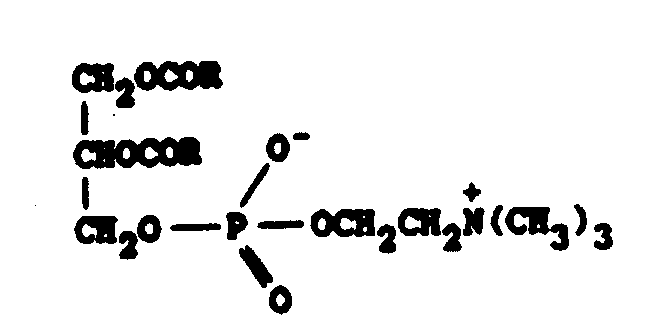
The glyceryl triester (triglyceride) of the same or different higher fatty acids (e.g., oleic, myristic, palmitic, stearic, linolenic, etc.) or mixtures thereof present in a single oil or fat (e.g., lard, tallow, castor oil, etc.).
Cholesterol esters of higher fatty acids.
The glyceryl triester (triglyceride) of the same or different higher fatty acids (e.g., oleic, myristic, palmitic, stearic, linolenic, etc.) or mixtures thereof present in a single oil or fat (e.g., lard, tallow, castor oil, etc.).
Cholesterol esters of higher fatty acids.
A mixture of the diglycerides of stearic, palmitic, and oleic acids, linked to the choline ester of phosphoric acid. Lecithin has the following structure [wherein the R"s are the same or different, and are acyclic hydrocarbon radicals of at least seven carbon atoms chain length]:
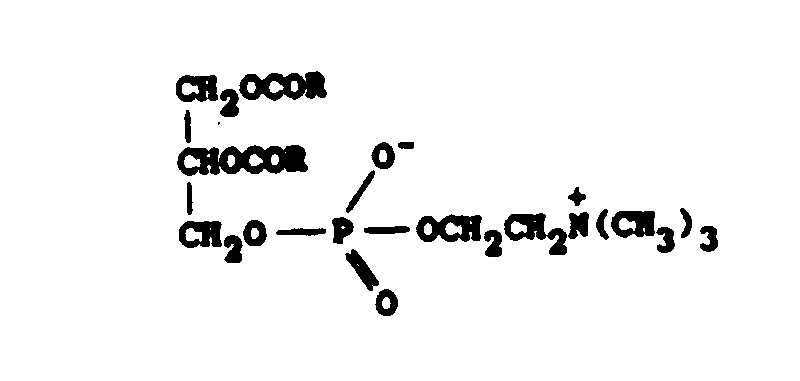
The glyceryl triester (triglyceride) of the same or different higher fatty acids (e.g., oleic, myristic, palmitic, stearic, linolenic, etc.) or mixtures thereof present in a single oil or fat (e.g., lard, tallow, castor oil, etc.).
Cholesterol esters of higher fatty acids.
A mixture of the diglycerides of stearic, palmitic, and oleic acids, linked to the choline ester of phosphoric acid. Lecithin has the following structure [wherein the R’s are the same or different, and are acyclic hydrocarbon radicals of at least seven carbon atoms chain length]:
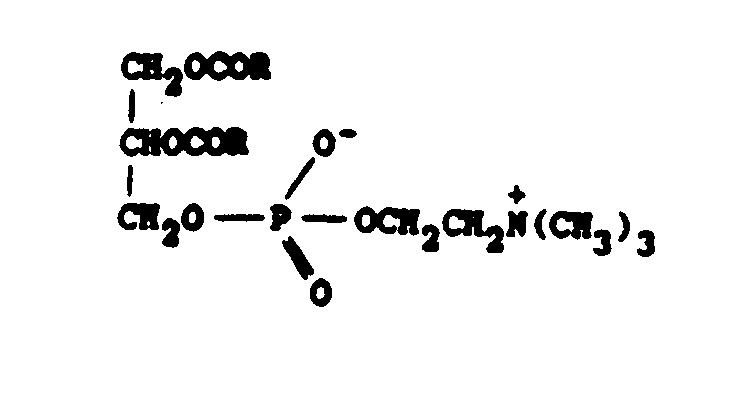
The glyceryl triester (triglyceride) of the same or different higher fatty acids (e.g., oleic, myristic, palmitic, stearic, linolenic, etc.) or mixtures thereof present in a single oil or fat (e.g., lard, tallow, castor oil, etc.).
Cholesterol esters of higher fatty acids.
The glyceryl triester (triglyceride) of the same or different higher fatty acids (e.g., oleic, myristic, palmitic, stearic, linolenic, etc.) or mixtures thereof present in a single oil or fat (e.g., lard, tallow, castor oil, etc.).
Cholesterol esters of higher fatty acids.
A mixture of the diglycerides of stearic, palmitic, and oleic acids, linked to the choline ester of phosphoric acid. Lecithin has the following structure [wherein the R’s are the same or different, and are acyclic hydrocarbon radicals of at least seven carbon atoms chain length]:
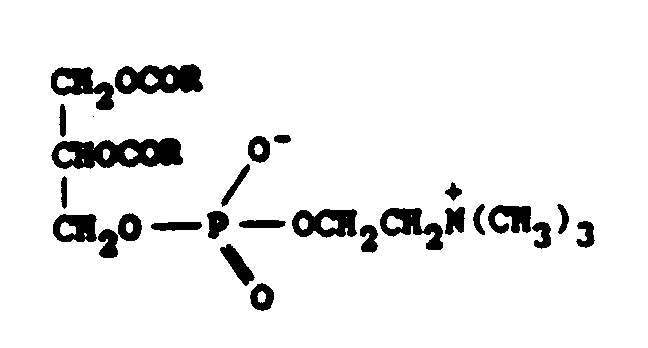
The glyceryl triester (triglyceride) of the same or different higher fatty acids (e.g., oleic, myristic, palmitic, stearic, linolenic, etc.) or mixtures thereof present in a single oil or fat (e.g., lard, tallow, castor oil, etc.).
Aliphatic monocarboxylic acid containing an unbroken chain of at least seven carbon atoms bonded to a carboxyl group (e.g., lauric, palmitic, stearic, oleic, ricinoleic, linoleic, behenolic, etc.). Where there are several unbroken chains of carbon atoms bonded to the -C(=O)O- group, one of the chains must contain at least seven carbon atoms.
The glyceryl triester (triglyceride) of the same or different higher fatty acids (e.g., oleic, myristic, palmitic, stearic, linolenic, etc.) or mixtures thereof present in a single oil or fat (e.g., lard, tallow, castor oil, etc.).
Aliphatic monocarboxylic acid containing an unbroken chain of at least seven carbon atoms bonded to a carboxyl group (e.g., lauric, palmitic, stearic, oleic, ricinoleic, linoleic, behenolic, etc.). Where there are several unbroken chains of carbon atoms bonded to the -C(=O)O- group, one of the chains must contain at least seven carbon atoms.
The glyceryl triester (triglyceride) of the same or different higher fatty acids (e.g., oleic, myristic, palmitic, stearic, linolenic, etc.) or mixtures thereof present in a single oil or fat (e.g., lard, tallow, castor oil, etc.).
Aliphatic monocarboxylic acid containing an unbroken chain of at least seven carbon atoms bonded to a carboxyl group (e.g., lauric, palmitic, stearic, oleic, ricinoleic, linoleic, behenolic, etc.). Where there are several unbroken chains of carbon atoms bonded to the -C(=O)O- group, one of the chains must contain at least seven carbon atoms.
The glyceryl triester (triglyceride) of the same or different higher fatty acids (e.g., oleic, myristic, palmitic, stearic, linolenic, etc.) or mixtures thereof present in a single oil or fat (e.g., lard, tallow, castor oil, etc.).
Cholesterol esters of higher fatty acids.
The glyceryl triester (triglyceride) of the same or different higher fatty acids (e.g., oleic, myristic, palmitic, stearic, linolenic, etc.) or mixtures thereof present in a single oil or fat (e.g., lard, tallow, castor oil, etc.).
Cholesterol esters of higher fatty acids.
The glyceryl triester (triglyceride) of the same or different higher fatty acids (e.g., oleic, myristic, palmitic, stearic, linolenic, etc.) or mixtures thereof present in a single oil or fat (e.g., lard, tallow, castor oil, etc.).
Cholesterol esters of higher fatty acids.
The glyceryl triester (triglyceride) of the same or different higher fatty acids (e.g., oleic, myristic, palmitic, stearic, linolenic, etc.) or mixtures thereof present in a single oil or fat (e.g., lard, tallow, castor oil, etc.).
Cholesterol esters of higher fatty acids.
The glyceryl triester (triglyceride) of the same or different higher fatty acids (e.g., oleic, myristic, palmitic, stearic, linolenic, etc.) or mixtures thereof present in a single oil or fat (e.g., lard, tallow, castor oil, etc.).
Cholesterol esters of higher fatty acids.
The glyceryl triester (triglyceride) of the same or different higher fatty acids (e.g., oleic, myristic, palmitic, stearic, linolenic, etc.) or mixtures thereof present in a single oil or fat (e.g., lard, tallow, castor oil, etc.).
Cholesterol esters of higher fatty acids.
Glossary Terms for Class 110 FURNACES
The chemical action resulting from the direct combination of oxygen gas, generally in air, with a combustible material accompanied by the evolution of heat and light.
The structure immediately surrounding the combustion reaction and generally above the fuel (*) or refuse (*) grate and designed to support or promote the combustion reaction.
A combustible material having good combustible properties such as a relatively low ignition temperature, a long burning time, and a minimum of impurities which hinder combustion and used primarily to produce heat.
The combustion of refuse (*) for primary purpose of disposing of that refuse rather than for producing heat.
A gas or liquid which itself does not burn but which is capable of supporting or promoting combustion (i.e., air, steam, or water).
A combustible waste material which is burned for the sole or primary purpose of disposing of that material.
Glossary Terms for Class 112 SEWING
A stitch in which the sewing thread penetrates only one nonthickness surface of a layer or component. See Figure 1.
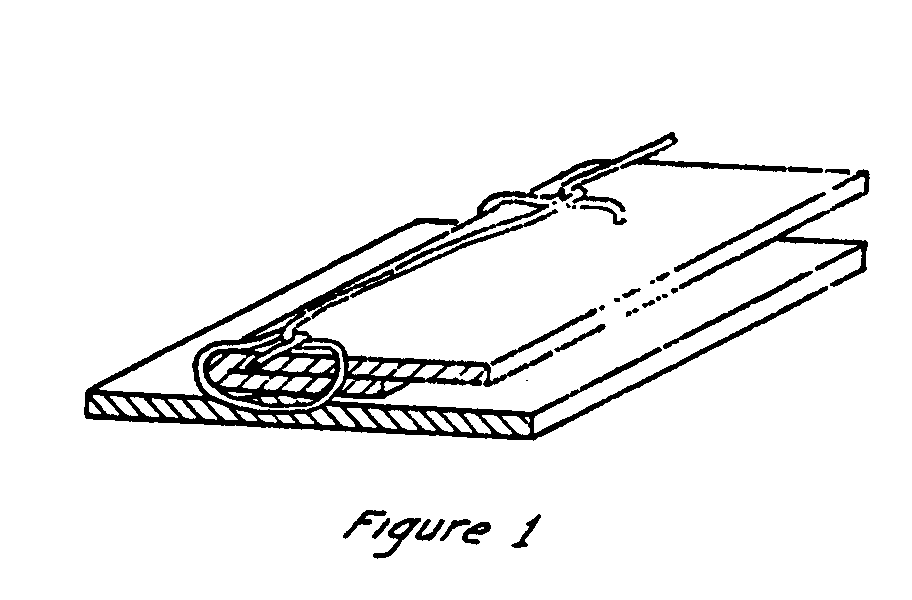
A distinct unitary element of a composite web or sheet which is longitudinally coextensive therewith and which, if separated from said multi-part web or sheet, would be recognized as a web or sheet by itself.
A component may consist of plural layers as in the folded component shown in Figure 2.
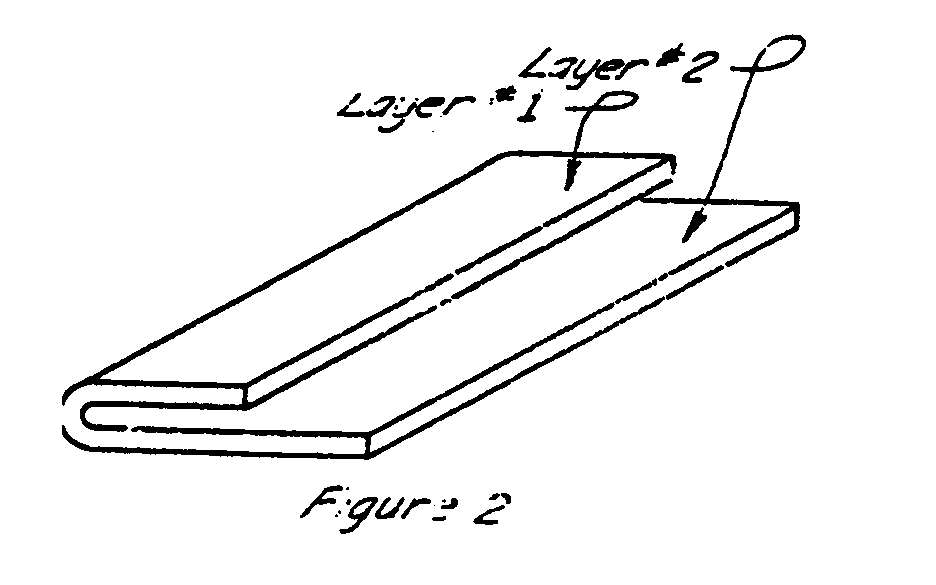
A sheet comprising a plurality of components.
A web comprising a plurality of components.
A stitch in which the sewing thread completely penetrates one or more layers of material and is hidden from view on at least one side of the assembly by a fold of material overlying the stitch. See Figure 3.
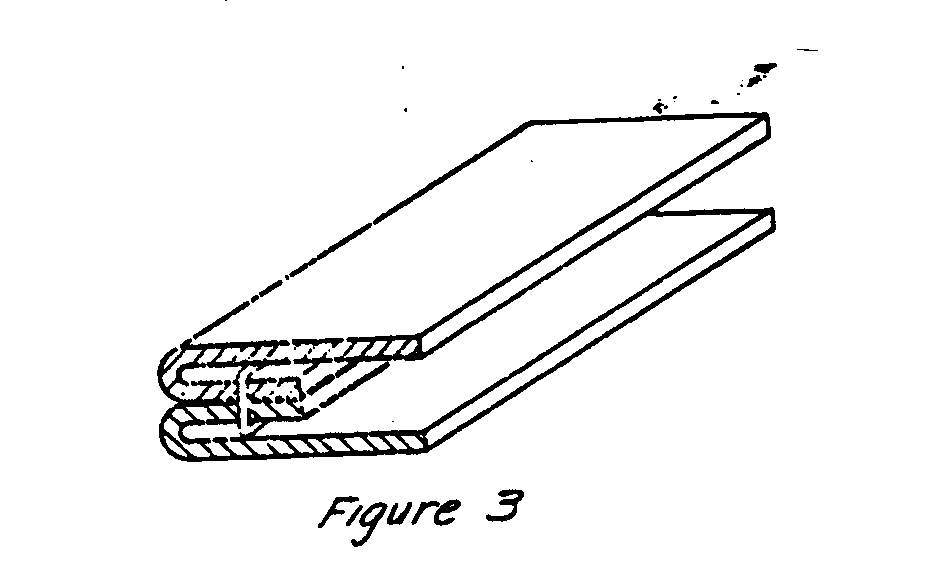
A relatively short, slender, flexible element of macroscopic size and finite length and having a width and thickness of the same order magnitude. A fiber is generally of staple length to facilitate being spun, twisted, or otherwise secured together into a composite strand but may be of shorter length requiring bonding, felting, or matting to form a strand or layer. It may be of animal (e.g., wool, rabbit hair); vegetable (e.g., cotton, jute, hemp); or mineral (e.g., asbestos, glass, metal) origin; and may be either natural, modified, or synthetic.
A single thickness of material or materials in the form of a panel, web, or sheet, or a plurality of any of these in side-by-side coplanar relation, or particulate material arranged in continuity to constitute a distinct stratum.
A layer may include a plurality of components as in Figure 4.
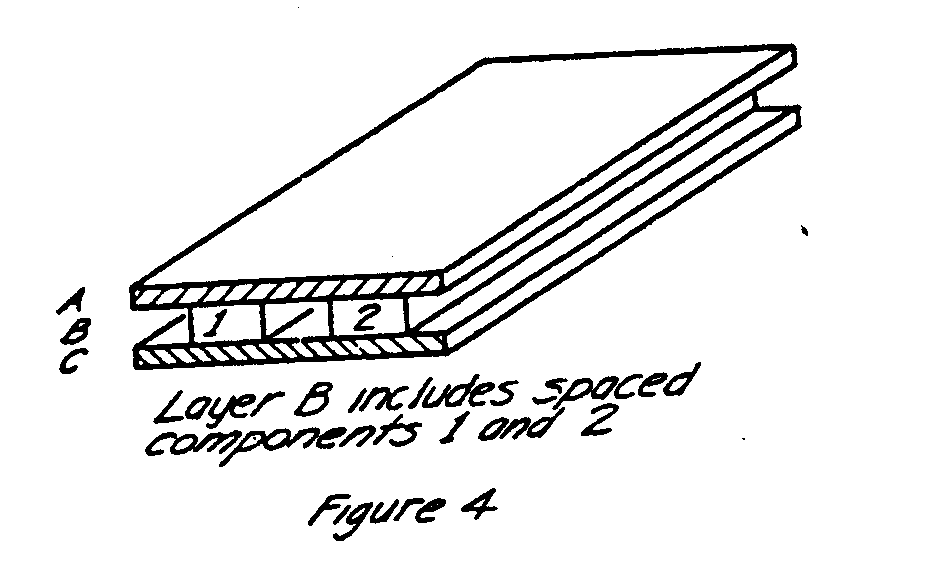
The surface of a web, sheet, layer, or component on which both its length and width may be measured. See Figure 5.
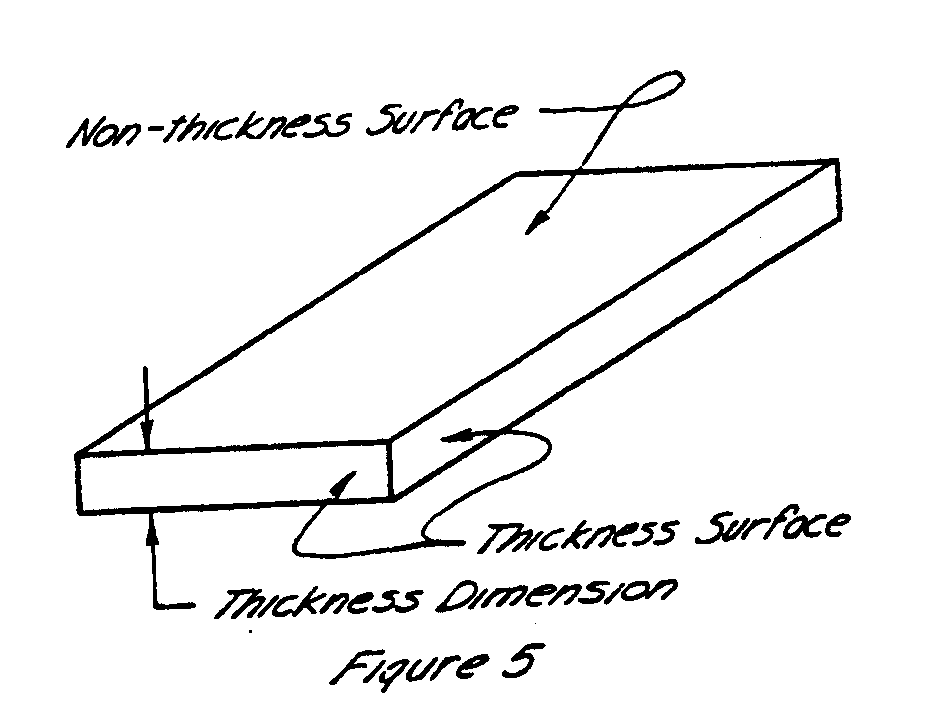
A stitch wherein the sewing thread extends thickness-wise across a marginal extremity of one or more layers of material without penetrating side extremity. See Figure 6.
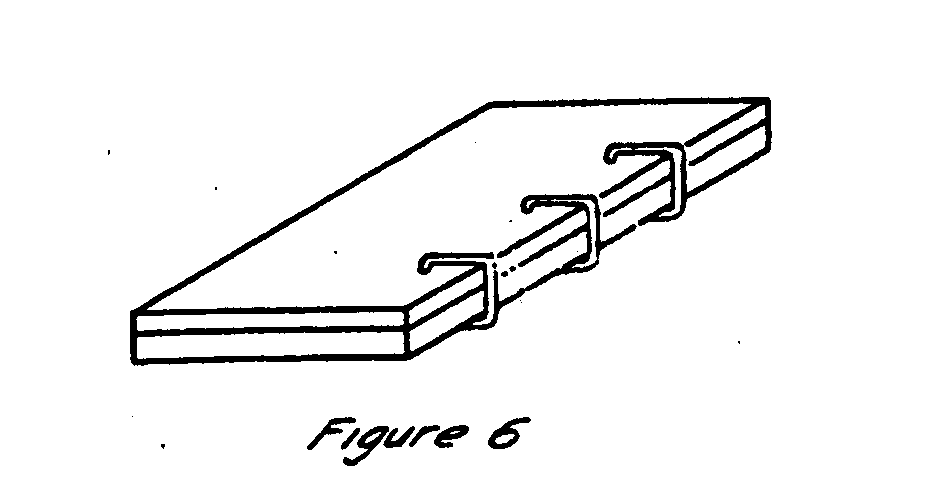
A portion of material of finite perimeter having length and width greater than thickness and (a) having a modification or embellishment of or on the entire periphery thereof or at least two nonadjacent corners, (b) being completely enclosed in an envelope which substantially conforms thereto, or (c) having a boundary shape which is other than rectangle.
A rectangular portion of material of finite length and width which are each greater than its thickness. A piece of material having a peripheral shape other than rectangular will be considered a panel.
A relatively slender and flexible element having a width and thickness of the same order of magnitude and a length which is either (a) indeterminate or (b) coextensive with the length or width of a sheet or layer. A strand may be a monofilament or it may include either a plurality of filaments or fibers disposed in parallelism (e.g., tow) or constituent fibers and/or filaments knitted, plaited, braided, twisted, interlaced, interlocked, or otherwise secured together to form a unit such as roving, thread yarn, cord, rope or cable.
A strand of finite length; or an unsevered but determinate part of a strand.
A web or sheet of relatively narrow ribbon-like material. A strip which is interwoven or intertangled with other strips or strands in the same manner as a strand will be termed a �gstrand-like strip�h.
A portion of material having length and width each greater than its thickness and with at least its longitudinal dimension undetermined. A web may comprise (a) a single thickness of material, (b) a plurality of portions of a single piece of material folded onto each other longitudinally or transversely, or (c) a plurality of individual web components joined together in longitudinally coextensive face or edge contact to form a composite web.
Glossary Terms for Class 117 SINGLE-CRYSTAL, ORIENTED-CRYSTAL, AND EPITAXY GROWTH PROCESSES; NON-COATING APPARATUS THEREFOR
Noncrystalline; having no molecular lattice structure; e.g., glass, liquid.
The surface upon which a coating is formed, except where a surface has been previously coated and a second coating is applied, in which case the initial surface is the base. Contrast with substrate*.
Beryllium aluminum silicate; Be3Al2Si6O18; 3BeO.Al2O3.6SiO2; emerald; aquamarine. Usually green.
(From French; ball) A lump of material. In this class the term applies to the raw, single-crystal* product.
Chemical Beam Epitaxy*.
Microcrystalline form of quartz; usually milky or grayish in color.
For purposes of Class 117, chemical reaction is given a broad meaning. The following are included: metathesis; changing the water of hydration; forming intermetallic compounds from constituent elements or from alloys; forming compound semiconductor material from constituent elements; forming ions (ionization) or ionized plasma. Not included are: dissolution of a compound and solidification (e.g. crystallization) of the same compound; a change of phase (e.g., amorphous to single-crystal*); change of crystal phase or form (e.g., face centered cubic to body centered cubic).
Beryllium aluminate; BeO.Al2O3; cat"s eye; alexandrite; optionally with up to about 10 wt% chromium oxide and titanium oxide.
Natural aluminum oxide; Al2O3; sometimes with intended small amounts of cobalt (green), chromium (red; i.e., ruby), iron (yellow), magnesium, or silica; synthetic emery.
A vessel for containing a molten material. The crucible may be of the same material as the molten material and may ultimately become molten.
Microscopic crystalline structure, indistinguishable to the naked eye.
The interface between a crystal and its surroundings; e.g., another crystal, air.
Coherent Superlattice.
Coherent Tilted Superlattice.
Chemical Vapor Deposition. CVD may be employed to produce single-crystal*, polycrystal, or amorphous material. See also MOCVD.
Abbreviation for Czochralski. J. Czochralski was the Polish inventor of the basic single crystal pulling method (1918) bearing his name.
Al2O3.H2O; a natural hydrous aluminum oxide; HAlO2.
A desired material intentionally present in an amount insufficient to satisfy the lattice unit cell, which may be present interstitially or by occupying crystal lattice positions substitutionally.
The process of introducing a dopant* into a material.
Edge-Defined Film-Fed Growth. Also abbreviated as EDFG and EFG.
Formation of a single-crystal* on a substrate* (which acts as a seed*) or the product of such a process. Usually, the formed crystal bears a definite crystallos:graphic relationship to the substrate*. Typically, the term applies to coating or layer formation when the width and length are substantially larger than the height and when the substrate* remains as a significant or integral part of the product in use.
MFe2O4, where M = divalent metal (or mixtures thereof) and having the cubic lattice structure.
Field Effect Transistor.
Term applied to crystals having the same complicated cubic structure as mineral garnets or beryl, but usually without the silicon; e.g., yttrium-iron, Y3Fe5O12. Other variations include substituting part of the yttrium and/or iron with valence-equivalent metals.
A process or operation that reduces or removes impurities or defects from a region either by complete removal (e.g., volatilization) or by transporting them to another region.
Gadolinium Gallium Garnet. Composite oxide compound Gd3Ga5O12. Useful as substrate in magnetic bubble domain memory and as man-made gemstones.
The precursor immediately next to the growing single-crystal* and from which the single-crystal* forms or grows. Contrast with precursor*.
The region of transition between semiconduction regions of different electrical properties, usually between p-type and n-type materials, and usually a junction exhibits asymmetric conductivity.
Usually the edge length of a unit cell.
Liquid Encapsulated Czochralski (CZ*) method.
Molecular Beam Epitaxy*.
Element other than non-metal* (see non-metal*).
See NON-SEMICONDUCTOR METAL.
Metal-Organic CVD*. CVD in which a precursor* contains an organo-metallic compound. Also sometimes OMCVD.
Metal-Organic Molecular Beam Epitaxy*. MBE in which a precursor* contains an organo-metallic compound.
Metal Oxide Semiconductor Field Effect Transistor.
The twenty-one elements: hydrogen, boron, carbon, silicon, nitrogen, phosphorus, oxygen, sulfur, selenium, tellurium, fluorine, chlorine, bromine, iodine, astatine, helium, neon, argon, krypton, xenon, and radon.
A metal* other than which has a disclosed semiconductor property or intended use. For example, a single-crystal* of germanium or indium antimonide would be inferred to be a semiconductor even though composed of a metal* because of its known semiconductor property.
The source material from which the single-crystal* deposits or grows. See also precursor*.
A material in which substantially all the crystal grains are oriented in a preferential way. Also called preferred-orientation polycrystalline material.
Metal-Organic CVD*.
Plasma Enhanced CVD*.
A thermoelectric effect wherein electric current between/through a solid/solid or a solid/liquid junction creates heating in one side and cooling in the other.
An interface formed by two semiconductor materials in which one contains a charge carrier which is an electron donor (n-type semiconductor) and the other contains a charge carrier which is an electron acceptor (p-type semiconductor).
Any part, or all, of the starting material from which a single-crystal* is grown. This may be a material which undergoes one or more chemical reactions* prior to the actual crystal growth step. Hence, the term is not limited to the compound or composition present just immediately prior to the growth of the single-crystal*. Contrast with immediate-precursor*. See also nutrient*.
SiO2; silicon dioxide; silica. Polycrystalline forms include agate, cat"s eye, chalcedony, and jasper. Crystalline forms include amethyst, catalinite, citrine, rose quartz, and smoky quartz.
Vitreous or glassy quartz.
Potassium sodium tartrate; KNaTartrate.4H2O; (KNaCO2CHOHCHOHCO2.4H2O); (KNaC4H4O6.4H2O). Seignette"s salt.
An interface formed by a semiconductor and a conductor.
A material, usually a single-crystal*, upon which a single-crystal* is grown. Seeded crystal growth proceeds by the alignment of atoms or molecules or clusters into a thermodynamically favored arrangement determined by the nature of the seed.
See Rochelle salt.
Used here to mean any article or structure comprised of semiconductor material, such as the optical waveguides of Class 385 or the electronic semiconductor devices of Class 438. The phrase is not determinative of proper classification; intended use frequently dictates proper classification.
See JUNCTION, SEMICONDUCTOR.
Solid phase material characterized by an absence of crystal boundaries and by a uniform atomic structural arrangement. However, in this class, the term includes material composed of twins*, superlattice*, epitaxy*, oriented-crystals*, or enlarged crystals (when the enlarged crystals are used as though they are a single-crystal or when the enlarged crystals are used individually as single-crystals).
Semiconductor On Insulator. A layered structure commonly found as the starting point for integrated circuit manufacture on silicon wafers.
Silicon On Sapphire.
MAl2O4; rubicelle, ruby almandine, ruby balas. Also sometimes used generically to refer to a crystal having the cubic crystal lattice form.
The surface upon which a coating is formed. In the case of single-crystal* growth, such as epitaxy*, the substrate is also a seed*. Contrast with base*.
A single-crystal*, usually composed of a semiconductor, having an internal structure of more than two layers, each layer having a composition different from the next adjacent layer. The term includes alternating layers of two compositions.
(Twin plane) A polycrystalline material in which the adjoining lattices have a mirror-image symmetrical relationship.
A. Verneuil, French inventor of the crystal growth technique (1902) used for materials with a high melting point. The Verneuil method is typified by use of a high temperature heat source, such as a gas flame or plasma torch, into which powdered material is directed, whereupon it melts as or prior to its arrival to a thin film of melt on a seed crystal which is pulled away at an appropriate rate.
Vertical Freeze Gradient. Also VGF.
Vapor Phase Epitaxy*.
A single-crystal* which is typically small diameter, elongate, and generally cylindrical.
Yttrium Aluminum Garnet.
Zone Melt Recrystallization.
Glossary Terms for Class 118 COATING APPARATUS
The term �gcoating�h is used throughout the definitions in a generic sense to mean either (1) an initially fluent film or layer of material lying on or bonded to the surface of a base, or (2) an impregnating material which penetrates the base either partially or completely and all or part of which is retained therein, either in its original form or physically or chemically combined therewith.
Any instrument acting on the coating or on the work for the purpose of spreading or removing surplus coating material. The instrument may be, for example, a solid scraper blade, a roller squeegee or as in the case of an �gair doctor�h a gaseous blast. For definitions of terms appearing in subclass titles and not mentioned in the above definitions, see the definitions to the particular subclass in which the term appears.
The base or material to which the coating is applied, either before or after coating.
Glossary Terms for Class 122 LIQUID HEATERS AND VAPORIZERS
Used as a generic term for a liquid heater. The nature of the liquid heated is immaterial. Whether the liquid heated is conducted from the boiler as liquid or vapor depends upon the amount supplied and the degree of heat attained, and for this reason generally no distinction has been noted in the classification, similar structures being classified together regardless of the ultimate effect. In the type of boilers known as �gflashers�h this distinction is of importance and provision has been made therefor.
Include both small and large tubes through which the products of combustion pass unless the term �gflue�h is used with them, in which case �gfire tubes�h would refer to the small tubes, and �gflues�h to the large tubes for the products of combustion.
To be taken in a generic sense as meaning vapor.
Designate vapor tubes whether the vapor therein be formed from water or any other liquid.
Designate tubes, both large and small, through which liquid or vapor passes.
To be taken in a generic sense as meaning liquid.
Glossary Terms for Class 123 INTERNAL-COMBUSTION ENGINES
a quantity of �gworking fluid�h intended to be ignited for a working stroke of the �gpiston�h.
that volume of a �gcylinder�h enclosed by the �ghead�h and the �gpiston�h when the piston is closest to the head.
The most common link for transmitting power from a �gpiston�h to a �gcrankshaft�h.
The most common type of �goutput shaft�h, which is journaled to turn about a fixed axis and including an offset portion for receiving energy from the piston.
a member having an internally facing surface of a shape generated by a straight line rotating a fixed distance about an axis.
the portion of a cylinder which closes off one end thereof.
Glossary Terms for Class 137 FLUID HANDLING
Those comprising a group of related patents directed toward solving a problem in one specific field of activity, which have been classified on the basis of and under a title reflecting that activity rather than on a generalized basis. Examples of special type categories are 94, Fuel controlled by boiler or water system condition; 108, Pump unloader type (indented under Self-proportioning or correlating systems).
A term applied to any apparatus of the class which comprises more than a single flow path and/or a single valve unit. It may include only an unvalved branched flow path or a single flow path having two or more valve units. In some instances subcombinations or elements having special utility in the combination and having no other classification have been included in the group of subclasses pertaining to the system, as subclasses 777-802, Expansible Chamber Devices.
The term �gvalve unit,�h as used above, is applied to either a single or multiway valve. In the multiway type plural passages are controlled by valve means having plural flow closing areas or points, but the entire means is housed in a single casing or organized as a body or unit. Valve units as such are classified in subclasses 625+. The class also provides for some valve units under the special titles. Radiator vent check valves, Reversing cokes and valves, Flush or water closet valves, Drain valves, Float valves, Temperature operated cut-off valves, Safety valves, and certain analogous types. The class also takes valves combined with other structure, as the tire inflation type combined with or adapted for connection with inflation means and/or the inflatable article. Class 251, Valves and Valve Actuation provides for valves combined with certain actuators, particularly the fluid and electric motors and the more complex mechanical movement actuators. The term �gValves�h includes variable restrictors, which frequently cannot be distinguished as claimed, and have been set apart only in certain subclasses having the term restrictor or choke in the title, as subclasses 436+, and 475+, primarily because of their special function as silencers. Closures are also frequently indistinguishable from valves, particularly as used and claimed in fluid handling systems. In some instances they have been classified with valves, as in subclasses 613+, Single flow path with plural serial valves and/or closures and Class 251, Valves and Valve Actuation, provides for restrictors or flow guides in subclasses 118.01+.
Stream or energy field, referred to in the subclass definition, (C) (1) and (C) (2) above, that causes the diversion or alteration of the output stream.
Channel or duct that surrounds and guides a stream of fluid or energy in a desired path or direction.
Stream, referred to in the subclass definition, (A), above, that flows into the devices.
Stream, referred to in in the subclass definition, (B), above, that flows out of the device;
Glossary Terms for Class 140 WIREWORKING
A wire (for the purpose of this class (140), is an elongated or attenuated metal or metal-based material, wherein all the diameters of the cross-sectional area taken at right angles to its length are of substantially the same dimension, and the cross-sectional area is small enough to allow substantial flexibility or resiliency and permit bending or flexing without substantial metal flow. A wire may be stranded, cored, coated or covered.
The term wireworking includes the shaping and deforming of wire and/or the assembly and uniting of wire with wire or nonwire material by twisting, bending, kinking, looping, etc.
Glossary Terms for Class 141 FLUENT MATERIAL HANDLING, WITH RECEIVER OR RECEIVER COACTING MEANS
The term as used in this class means some mechanically operative element or device (not gas pressure) which arrests flow of material.
This term describes a filling system in which no operator intervention is required from the time a receiver is placed in filling position at least until the receiver is filled and ready to be removed. The flow of contents material may be cut off by a movement of the receiver which occurs in the sequence of events in the machine.
A mechanism which affirmatively effects or permits separation of a portion of the contents material supply thereof and discharge in a definite direction or path.
The portion of a dispenser or source part of the system which comprises the flow outlet or flow confining terminus and other flow confining structure which may be in advance (up-stream) of it back to the supply.
A fluid handling device of increasingly restricted capacity in the direction of flow and having its free end arranged to enter into the inlet of a receiver, being ordinarily designed to collect an unconfined flow and channel it into a narrower flow path or one which is out of line with the previous path or flow direction. The material may be retained in the funnel body by valve means, and the funnel may comprise the only claimed supply means of the filling system or an intermediate or final receiver, and may be supported by either the preceding or succeeding flow confining means, or by a means external to the flow system.
In order to draw a line with the manufacturing classes which may include filling, the term is used here as meaning an operation on material, or apparatus for operating on material, to effect a permanent or irreversible change in the physical character of the material, e.g. cutting, crushing, shaping and boring, or to arrange the parts of an article of manufacture into their desired relation, i.e., assembling.
Means other than funnels to direct material from supply to receiver without forming a flow-confining connection between them. Examples of material guides in this class are: (1) A nonflow support for contents material associated with a receiver support over which the material can be pushed or moved manually into the receiver; (2) A flow directing detachable extension of a receiver inlet which may be either tubular or channel-shaped in cross-section. If tubular and tapering, it must either engage the receiver externally or be located entirely within the receiver. Cf funnel, above; or (3) An extension of a supply container which is hand held, the extension being designed to engage the receiver and direct the flow thereto.
A device which accepts the material from the dispenser and is capable of confining fluids within a predetermined or predescribed volumetric configuration, and does not therefore rely upon surface tension or molecular cohesive forces to preclude escape of material therefrom.
The contents material confining means of the dispenser.
The combination of dispenser and receiver in flow exchange relation with any or all appurtenances thereof.
With respect to the treatment classes, treatment as here construed is concerned with reversible changes in the physical characteristics of contents material such as exemplified by agitating, heating, cooling, sorting and the like.
Glossary Terms for Class 144 WOODWORKING
The peripheral natural covering of a tree*.
Fibers of wood* that extend along the length of a tree*.
A longitudinal section cut from a tree*, generally cut normal thereto at both ends.
Building material cut from a tree*, generally cut from a log*, generally without bark*.
A portion of a log* comprising a longitudinally extending section cut from the side of a log*, similar to lumber*, but with the bark* side uncut.
A plant large enough to serve as a source of lumber*.
The fibrous material of a tree*.
Glossary Terms for Class 148 METAL TREATMENT
Also termed precipitation hardening or strengthening. A process whereby the hardness/strength of a metal alloy may be increased by subjecting a supersaturated solid solution to elevated temperature to precipitate out a secondary phase containing the solute. Aging may also be manifested as a spontaneous increase in hardness at room temperature. Aging for a longer time than that corresponding to maximum hardness at the particular temperature is termed overageing. Aging after or during straining is known as strain aging. Maraging steels are a specific group of high nickel (i.e., greater than ten percent Nickel), low carbon martensitic steels which can be fabricated while in a comparatively ductile martensitic condition and later strengthened by aging treatment.
A term signifying a lack of regular crystalline order, much like the absence of long-range crystalline order in glass.
A single thermal heat treatment wherein the heating of a metal workpiece to a temperature results in improved formability.
A procedure that involves preliminary quenching of austenized metal to a temperature in the lower bainite range, usually in a molten salt bath, holding at this temperature until transformation is complete, and quenching or air cooling to room temperature. If desired, a lower hardness level may be produced by including an additional tempering step.
A process of heating to an elevated temperature within the austenitic range.
A process of forming a protective oxide coating on ferrous metal.
A process wherein a metal substrate is treated with an externally supplied source of carbon resulting in the carburization of the metal by chemical reaction or diffusion.
A term most often applied to carburizing or nitriding processes which result in a hardened surface on the workpiece.
A process applied to cast irons whereby the combined carbon in the as-cast microstructure is graphitized to form temper carbon. When combined with decarburization of the surface, the resulting product is termed white-heart malleable iron.
A process which involves preliminary quenching of austenized metal to a temperature just above the Ms temperature and holding until the temperature is equalized throughout the metal, followed by air cooling through the martensite transformation range and subsequent reheating to produce tempered martensite of the desired strength level.
A process wherein a metal substrate is treated with an externally supplied source of nitrogen resulting in an increased nitrogen content of the metal by chemical reaction or diffusion.
A process of heating the metal above it"s critical temperature range and cooling in air thereby establishing a fine uniform grain size and improving microstructural uniformity.
A continuous process consisting of heating the metal to a temperature well above the upper critical temperature, then rapidly cooling through the critical temperature at a comparatively rapid rate to a predetermined elevated temperature, the cooling step being commonly effected in a fused metallic bath.
See definition for ageing above.
A thermal treatment of previously worked metal to effect an equiaxed microstructure through the nucleation of strain free grains and the gradual consumption of the worked matrix by the growth of these grains.
A process whereby an alloy system possessing decreasing solute solidity with temperature is treated to dissolve said solute in the parent phase. Subsequent quenching results in solute supersaturation and thus places the metal alloy in a condition for age hardening. Also applied to heating a multi-phase metal alloy to an elevated temperature to dissolve one or more phases.
STRESS RELIEVING OR STRESS RELIEF ANNEALING
The heating of metal to a comparatively low temperature to relieve microstructural strain induced by working.
Involves the heating of previously quenched or normalized metal alloy to an elevated temperature, and then cooling under suitable conditions to obtain the desired mechanical properties.
Glossary Terms for Class 149 EXPLOSIVE AND THERMIC COMPOSITIONS OR CHARGES
As used herein refers to a mixture of ingredients producing a composition of this class or a definite quantity of shapeless or structureless material forming a composition of this class; or at least two compounds or compositions or any mixtures of these associated together or composited but in an unmixed condition, e.g., a primary explosive associated but not intermixed with a secondary explosive, or those compositions including only nominal structure or form.
EXPLOSIVE OR THERMIC COMPONENT
As used in this class covers (1) explosive or thermic compositions, per se, (2) the oxidant portion, (3) the fuel portion of such compositions. See also (4) Note class definition.
Are classified (a) as HIGH EXPLOSIVE, which, for the purpose of this class, is one whose rate of reaction is substantially instantaneous or detonating in character, and is either (1) an extremely sensitive or highly reactive or detonating chemical compound which is known as a PRIMARY EXPLOSIVE and is used to initiate the secondary or other explosive component of the charge; or (2) is a composition of a combination of two or more primary explosives and as such is known as a SECONDARY or other DERIVED EXPLOSIVE. Such an explosive reacts with detonating force or brisance which is sufficient to shatter the surrounding medium; (b) as LOW EXPLOSIVE, which for the purpose of this class, is controlled to some time interval, less than instantaneous, and as compared to that of high explosive, is slow or deflagrating (burning) in character. It has the property or power to displace the surrounding medium. Although it may be used for certain blasting purposes it is used principally as PROPELLANT to set in motion bullets, missiles or similar devices regardless of size.
For the purpose of this class is a material intended for reacting, or to be used in combination, with an oxidant component and includes such finely divided materials as metals (including alloys and intermetallic compounds), metalloids, metal-metalloid compounds, hydrides of metals or metalloids, carbon, sulfur, vegetable material, carbohydrates, hydrocarbons and nitrogen containing organic compounds generally. (Certain substances as gels, paraffins, sulfur, etc., need not be finely divided.)
In the armament arts refers to a charge exhibiting certain definite structural characteristics, but as used in this class the mere reference to �ggrain�h or �gpowder�h without recitation of definite structure, or with reference merely to nominal shape, will be construed as being virtually synonymous with the term �ggranule�h and with finely divided �gparticulate�h or �gpowdered�h material.
As used in this class refers to a shapeless mass resulting by solidifying at least one component from either its liquid or molten state in more or less a continuous phase and wherein there is dispersed throughout at least a second component in particulate form and in substantially a discontinuous phase.
The term �gnitrate�h is generally used as a suffix in the name of an organic compound, e.g., an ester containing the -ONO2 radical, e.g., guanidine nitrate, while �gnitro�h is generally used as a prefix to designate an organic compound having the -NO2 radical, e.g. nitro-guanidine. The art, however has not maintained this distinction in all cases and thus compounds having the -ONO2 radical which should be known, more properly, as �gnitrates�h, instead, have been known through the years as �gnitro�h compounds. No attempt is made in this class to correct this situation and the terms as applied to these compounds in this class are the same as are currently accepted and used in this and related arts. For example, the nitrates of such compounds as cellulose, glycerine and starch, among others, are commonly known as �gnitro-cellulose�h, �gnitroglycerine�h and �gnitro-starch�h respectively, and when they so appear in this class, the reference, in spite of the inconsistency, is to a compound of the -NO3 radical or -ONO2.
As used in this class, unless otherwise specified, is intended as a generic expression for compounds or substances both organic and inorganic which contain at least one of the empirical radical (s)-(ONOx)y or -(NOx)y, wherein �gx�h and �gy�h are whole numbers. Predominately, in this class �gx�h is 2 and �gy�h, where the compound permits, is 3 or more.
As used in this class relates to that portion of a composition which carries sufficient available oxygen to oxidize at least a substantial portion, if not all, of the fuel component of the composition, and includes metal oxides, and organic compounds capable of yielding metal oxide, nitrogen-oxygen or oxygen-halogen salts which are either organic or inorganic, including the oxides and acids of nitrogen-oxygen, liquefied gaseous material, and in the case of �gThermites�h only, any inorganic oxygen salt.
(See explosive component) is similar to an explosive component as defined above except that the component may not react quite with the speed or power of an explosive and includes such compositions or components thereof as �gThermite�h, pyrotechnic, incendiary, fuse, match, smoke, or those compositions or components thereof which react or are capable of reacting to yield usable quantities of heat with or without desired chemical products.
Glossary Terms for Class 156 ADHESIVE BONDING AND MISCELLANEOUS CHEMICAL MANUFACTURE
The joining of parts (a) by means of a separate glue-like material or (b) by rendering contacting surfaces tacky by means of solvent and/or heat.
Distortion of a workpiece by bodily moving a portion of it throughout its entire thickness relative to a second portion during which the thickness of the workpiece remains substantially the same and no significant plastic flow occurs.
BULK DEPOSITION OF PARTICULATE MATERIAL
The fluent delivery of a stream of separate loose pieces onto a receiving surface. The relative size of the pieces is not significant, rather it is the manner in which they are handled, as a mass or stream rather than each particle being individually manipulated.
A piece of material handled at points intermediate its ends whereby the length is immaterial to the manner of handling.
One of the component parts or layers of an adhesively bonded sandwich. Also an element which by disclosure is to be bonded to a separate element.
Glossary Terms for Class 164 METAL FOUNDING
In founding, any material, including principal alloying constituents, densifiers, fluidizers, graphitizers, grain size controllers, etc., added to the molten metal to produce specific effects in the solid metal.
Intentionally stopping the rimming action in steel after completion of teeming.
Introducing carbon into ferrometals by heating above the transformation temperature range while in contact with carbonaceous material that may be solid, liquid, or gaseous.
The formation of an article by pouring or forcing molten metal into a mold or die and permitting it to solidify.
A device for holding a core in place.
The intermediate part of a flask or mold that has more than two parts.
A piece of metal applied to the casting to hasten the solidification in that area.
Process of forming a product of indeterminate length wherein a portion of the product is removed from a forming mold or surface as a further contiguous portion is cast.
Semi-solidified product of a continuous casting process or apparatus comprising a generally molten center contained within a cooler solidified shell.
The upper or topmost section of a flask, mold, or pattern.
A separable part of a mold that is used to create openings and various shaped cavities in the casting.
A box or container in which foundry cores are made.
A special projection on a pattern for forming impressions or core seats in the mold into which the core itself is inserted. Also refers to the projection on the core itself which fits into the core seat.
The taper that is provided on otherwise verticle faces of a pattern to facilitate its removal from the sand mold.
The lower or bottom section of a flask, mold, or pattern. Also referred to as nowel.
A bar used for lifting the pattern from the sand of the mold.
The scum that forms on the surface of molten metals.
A thin film of metal formed on a casting where the metal has flowed between mating parts of the mold.
A box, usually of metal or wood, used to hold sand in which a mold is formed.
(1) A substance that, by chemical action, promotes fusion of a solid material. (2) A material capable of forming with gangue or other earthy matter, a liquid melt having the fusibility and chemical characteristics suitable to a specific furnace process. Also, protective flux to retard undesirable reactions.
A piece of metal used to support sand in deep pockets of sand molds.
The end of the runner where the molten metal enters the mold.
An insulated portion of a mold that retains metal molten in that area so that it can feed into the mold and alleviate shrinkage voids.
Particles of dirt, slag or other impurities occurring in metals that were mechanically entrapped during solidification.
An open-mold casting that is intended for remelting and recasting or reworking to form finished products. Also referred to as billet.
A heavy mold, usually of cast iron, into which molten metal is teemed, as in the casting of ingots.
A pattern of a material having a low melting point for use in processes employing special techniques such as precision casting where pattern withdrawal would be difficult.
A pattern plate with several patterns secured thereto or a plate having matching pattern portions mounted on opposite sides.
Metal that has been melted in preparation for casting.
See Drag.
A replica of an object to be cast and around which the mold is constructed.
A board to which patterns are to be attached and which extends substantially over the flask opening.
A cavity formed in metal during the solidification of the last portion of liquid metal, causing by contraction.
A self-sustaining body which is to be incorporated in the final product as a distinct part of the same (e.g., insert, etc.).
The operation of compacting sand into a sand mold and around a pattern.
A reservoir of molten metal provided for feeding into a casting as the metal in the mold solidifies thus preventing voids.
A mold made of sand and used for the making of sand castings. A green sand mold is a mold used as made without any drying operations and contains the original moisture of the mix.
Adding moisture to molding sand to make it workable.
A chemically active material added to molten metal to remove oxides, gases, or other impurities.
The occurrence of impurities, inclusions, and alloying constituents in nonuniform distribution.
A casting process utilizing a thin shell composed of resin-bonded sand for the cope and drag section of the mold.
A metallic mass that consists of a single crystallographic grain instead of the usual polycrystalline material.
The nonmetallic product of refining metal ores which results from the reaction of the flux with gangue.
Gates and risers of a mold assembly; the hole through which molten metal enters the mold; also, the waste portion attached to the product.
The separable base of an ingot mold. The base provides a surface onto which the mold is placed, and also serves as the bottom of the mold.
A small section of a regular pattern which is generally rotated in sand to provide the whole mold cavity.
Pouring metal into a mold.
Small opening in a mold to allow trapped air to escape.
Glossary Terms for Class 166 WELLS
A pipe which lines all or a portion of the wall of a well. The casing may be adjacent the wall of the well for only a part of its length and lie within another casing section for the remainder of its length. The casing usually is of metal and is used with cement between it and the well wall. The casing is intended to form the permanent lining of the well.
A generic term covering both a central conduit, as defined below, and a receptacle for bodily transport of fluid material from inside the well to the top of the well or bodily transport of material from the top of the well for discharge at a point in the well. In a well device the central chamber is considered to be the primary locus from which or to which fluid is moved. For example, the �gcentral chamber�h in a tester is the sample chamber receiving the test fluid, whether this be a receptacle or a tubing, while the �gcentral chamber�h in a liquid discharging washer is the primary place from which liquid flows, whether this be a tubing or a receptacle.
Any passage forming conduit which extends from the top of the well into the well and is positioned within another conduit. The central conduit may be, for example, a string of tubing positioned within another tubing or within the casing, or it may be a string of casing positioned within the well bore.
A material capable of flowing. A naturally occurring fluid in the earth. It includes gases, liquids, plastics, and solids which can be handled in the manner of a liquid.
A column of casing having screen forming perforations which does not extend to the top of the well and which is usually the lowest column of casing in the well. The liner is placed in position by lowering it from the top of the well through the casing sections already placed in well. The perforations may be formed before the liner is run into the well or after. The liner is sometimes surrounded by a perforated section of casing, the liner then becoming a secondary lining section of the well.
A pipe for conducting fluids which extends from the top of the well to some point below and lies within the casing or is used without a casing as a temporary structure.
Either (1) a well tubing, (2) a well casing, or (3) the earth or cementitious wall of the well.
A tubular member adapted to transmit well fluid* away from the well.
Structure for use with a submerged well intended to extend from the wellhead* toward the surface of the water generally directly above the wellhead.
Any individual portion of well structure.
The desired fluid material of the earth. The purpose of the well is to remove this fluid.
Means at the top of the well, generally extending above the surface of the earth, adapted to cap the well, support the well structure* inside a well casing, regulate the operation of the well, and/or supply well fluid* for distribution.
Equipment added to the earth in the formation or use of a well. Well structure may extend above the surface of the earth (see wellhead*) as well as laterally away from the well (see flow line*).
Glossary Terms for Class 171 UNEARTHING PLANTS OR BURIED OBJECTS
Devices which are forced into a mass of earth and are then raised to lift an object disposed in said earth and/or to lift portions of the earth itself with objects embedded therein.
Devices which comprise means to engage a portion of a buried or partially buried object and to temporarily fasten itself to said object in order to hold onto the object while it is lifted out of the ground.
The act of removing or unearthing an object at least partially imbedded in the ground by an extractor which penetrates through the surface of the object or which passes through or around a reentrant or restricted portion of the object to form a temporary connection between said object and the extractor.
A device which is provided with spaced portions having openings therebetween in which the spaced portions are adapted to retain all objects above a predetermined particle size while finer material passes through the openings.
Articles or plants which were formerly at least partially surrounded by a mass of earth and which have been separated from said mass of earth as distinct objects, substantially free from said earth and available at some identifiable time for any desired purpose which may involve either use or destruction thereof.
Diggers as defined above which comb through the earth and which are provided with interstices through which the earth sifts while the desired objects rest on the digger and are thus moved through the earth and separated from said earth.
Spaced portions of a separator which support objects larger than a certain size while smaller particles or objects pass through the spaces therebetween.
Moving of small stones and rocks resting on the surface of the earth into piles, rows or collection receptacles.
Trash, previously cut tops or foliage or other nonearth material accompanying the objects disclosed as intended to be removed from the earth and recovered.
This is the generic term for any of the various organizations for removing an object imbedded in the earth, at or near the ground surface as by digging or picking the object and separating it free from any substantial accumulation of earth, the separation being accomplished either simultaneously with or subsequent to the removal of the object from its position in situ in the ground.
An entity which includes all of the apparatus necessary to completely unearth a buried or partially buried object in its path regardless of the presence or absence of additional, similar entities in the same organization.
Glossary Terms for Class 172 EARTH WORKING
A device comprising both a means for imparting movement to an element and a means for holding the moved element against returning to a position from which it has been moved. Thus, an actuator may comprise a servomotor, a mechanical power take-off from a motor or rolling wheel, a hand operated lever and ratchet or merely a handle and a bracket for holding the element moved by the handle in position. In the case of a mere handle actuator, however, the handle must be intended to be used merely to move an element to an adjusted position where it is held in place by a holding means. If the handle is intended to be used by an attendant so as to hold an element in intermediate positions by continued application of force by the attendant then the handle is not considered an actuator. See subclasses 329+ for devices with such handles. If the handle is disclosed as usable as an actuator to merely move and hold and, alternatively, also as a guiding means to move and hold by force exerted by the attendant then the handle is considered to be both an actuator and an attendant hold means and is classified accordingly in the first appropriate subclass and cross referenced down if necessary. A device comprising merely a means for moving by direct application of draft force is not considered an actuator. For example, an implement hitched to a tractor and provided with a latch and a movable hitch whereby the draft force of the tractor on the movable hitch moves an earth working element with respect to the implement frame and the latch holds the element in different positions is not considered to be provided with an actuator, as the term is used in this class. See subclass 605 for such devices. Also, a device comprising merely a screw bolt or the like is not considered an actuator, being merely a clamping or an adjusting means.
An adjective describing the capability of two parts of being selectively held in different positions with respect to one another by some means other than an attendant. A mere clamp which cooperates with a member such that by loosening the clamp the member could be set in any desired position and reclamped (e.g., clamp and spike tooth) is not considered to be an adjusting means. However, any specific structure such as selectively usable apertures, teeth, slots, etc., for the purpose of permitting the selective change of the relative positions of two parts is included under this definition. Despite the above limitation on the meaning of �gadjustable�h if a claim emphasizes the feature of adjustability it is classifiable in an �gadjustable�h subclass even if structurally the feature comprises a mere clamp.
Synonymous with �gtool�h.
A combination of parts comprising an earth working device. It may mean merely an earth working portion or a complex combination of parts including a tractor. Usually it indicates a complete device which as an entity may be readily attached to a tractor in the field.
A direction which is transverse of the line of draft of a tool over the earth unless some other meaning is clearly indicated by the context.
A direction which is parallel to the line of draft of a tool over the earth unless some other meaning is clearly indicated.
That portion of the apparatus which actually works the earth.
Glossary Terms for Class 173 TOOL DRIVING OR IMPACTING
The forward movement of the tool into or along the work. Such movement is in addition to the drive movement (i.e., cyclic forward and backward or lateral motion of the tool). Included under this definition as apparatus functioning under the broad meaning of advance are means for causing, controlling, or selectively preventing the forward movement of the tool into or along the work.
The act of removing matter resulting from the operation of the tool on the work.
A fluid which is adapted to perform a cleansing function upon work. Such a fluid may be solely described as performing some other function, such as cooling the work, so long as it is directed in such a manner as to inherently cleanse the work.
The motion of a tool which performs a function upon work. Impact is included under the definition of this term. Also, any means to cause the drive motion of a tool such as a motor, cooperating gearing or mechanical movement elements, or an impacting device.
The striking element of an impacting device.
A means including a mass of material (i.e., hammer head) which is specifically intended to deliver a blow to a tool. The mass of material need not necessarily strike the tool directly, but may deliver the blow through an intervening element (e.g., anvil).
A type of drive function which includes striking a mass of material (e.g., tool) with another mass of material (e.g., hammer head).
Moving the tool drive from one place to another to perform a function upon work. This movement is separate from or in addition to the advance movement of the tool.
A means specifically intended to be grasped by the hand or hands of an operator to move the tool drive, of which it forms a part, to different positions with respect to the work, and to be continually grasped by the operator as the tool advances in performing a function upon work.
A fluid used to drive a motor, and including fluid taken from a stream supplying a motor, or from a stream exhausting from a motor. Fluid fuel for or fluid exhaust from a combustion motor is included under this definition.
A work contacting element which functions to effect some physical alteration in the work, such as chipping or boring, but also includes other elements which are driven in the same manner as a tool such as a nail or post.
The object or mass of material which is contacted by the tool to be physically altered thereby.
Glossary Terms for Class 175 BORING OR PENETRATING THE EARTH
The term �gAbove Ground�h denotes any point which lies outside of a hole being formed in the earth, this may be either in the open (e.g., on the surface of the earth) or a cellar, tunnel or other hole in the earth from which a hole is being formed.
Motion in a direction towards the desired depth or direction of a hole being formed.
�gBelow Ground�h denotes any point within a hole being formed in the earth from the point at which the earth is pierced by the means forming the hole.
The hole formed by the boring means. It is not limited to a vertically extending hole, but can extend at any angle into the earth.
The wall which forms the periphery of a hole in the earth. In the case of a lined hole the inside wall of the lining constitutes a borewall for purposes of classification.
A combination of parts comprising an earth boring or drilling device. It may comprise merely a tool provided with a handle for manipulating the same to form a hole in the earth, or a complex combination of parts including above ground structure for supporting, feeding and driving a tool for boring a hole in the earth.
A tube which is introduced in a preformed bore and forms a lining for the bore.
A mechanical device for receiving and carrying cuttings, for example, it may consist of a simple chute for directing cuttings away from the bore entrance, a helical screw fixed to the tool shaft, or a power-driven endless carrier type device extending between any two points within the bore or from any point within the bore to any location above ground.
Any fluid, gaseous or liquid, which is introduced into the bore for the purpose of lubricating or cleaning any part of the boring means, or to displace or assist the tool in displacing the formation, or to flush or clean the bore of cuttings.
A part of the boring means which comprises a motion generating, applying, or transmitting means which is specifically adapted to repeatedly or continuously act upon a boring tool to cause the tool to bore by cutting or penetrating into the earth. Drive is divided into the following major categories: (1) Feed. The sustained forced advance of a boring tool by means other than mere gravity, adapted to cause the tool to cut or penetrate either with or without another type of drive means; (2) Impact Drive. The actuation of a boring tool by a means adapted to deliver a series of blows upon a tool or tool shaft, said impact delivering means being adapted to move relative to said tool or tool shaft; (3) Reciprocating Drive. The actuation of a boring tool by means adapted to cause the tool to partake of to and fro axial movement, at least one direction of axial movement being caused by the drive; (4) Rotary Drive. The actuation of a boring tool by means causing the tool to continuously rotate about its own axis, and includes uniform or step by step unidirectional or oscillatory motion.
A hole or cavity in the earth which is not large enough to permit both a human operator and a boring means to be located therein. A specific disclosure that the hole or cavity is a well or borehole and that the supporting or carrying means for the boring means substantially fills said hole or cavity will be considered an inaccessible hole.
Any fluid which is derived from a pressurized stream which operates a drive motor for the boring means. Motive fluid when exhausted into the bore is also considered to be drilling fluid.
Motion in a direction away from the bottom of a hole being formed.
A part of the boring means which comprises an elongate, relatively slender structure (e.g., rod, tube, casing, strand, cable, etc., or any combination thereof), which is connected to another part of the boring means for manipulating, supporting or driving said other part. (1) Actuating Shaft. A shaft connected to another part of the boring means for modifying or controlling said other part (e.g., cutter expansion shaft). (2) Shaft Section. One of the individual elements of a multipart shaft. (3) Tool Shaft. A shaft which is connected to the boring tool and extends above ground, or to another part of the boring means (e.g., to the drive or advance means. (4) Tool Drive Shaft. A tool shaft connecting the tool to the drive means, to transmit mechanical movement from the drive to the tool.
Comprises the terminal or work applying element of the boring means including bits, nozzles, drive points, projectiles, explosives, etc., which disintegrates, dislocates, erodes or compresses the earth to form a bore. See the appropriate subclasses for the definition of particular tools, and particularly Subclass References to the Current Class, above, for the definition of �gbit�h.
Glossary Terms for Class 180 MOTOR VEHICLES
Means the arrangement of the four wheels of a vehicle so that straight lines joining the points of contact of the wheels with the road form approximately a rectangle when the steering wheels are in the straight-away position.
Used in the Class 180 subclass definitions means a road-wheel, the axis of which may be swung so as to change the course of the vehicle; however, see Subclass References in the Current Class above.
Glossary Terms for Class 184 LUBRICATION
The term �gmachine�h includes any device having bearing parts.
Glossary Terms for Class 187 ELEVATOR, INDUSTRIAL LIFT TRUCK, OR STATIONARY LIFT FOR VEHICLE
A flaccid, elongated, flexible element which can transmit force only when under tension (e.g., rope, wire, chain).
Means for regulating the operation of a separate and distinct force generating, transmitting, or retarding device (e.g., motor, drive-means*, brake) which moves or stops the movement of a relatively movable component of apparatus proper for this class (e.g., elevator car), and includes both (a) an information input component (e.g., sensor, information storage means, manual push button) and (b) a distinct component which effects the operation of the force generating, transmitting, or retarding device in a particular manner based on the input information.
Means for supplying a motive force to an element to be moved which includes both force generating means (e.g., motor) and structural linkage (e.g., gears) needed to transmit the force from the generating means to the element.
An in situ floor within a structure (e.g., building) located adjacent to an elevator shaft* and to or from which a load (e.g., passenger, cargo) transfers during the charging or discharging of the load-underlying support surface of an elevator.
A long, narrow, in situ passageway within a structure (e.g., building, ship, mine) which defines the fixed path between the vertically spaced load entrance and exit levels traveled by the load-underlying support surface of an elevator.
Glossary Terms for Class 198 CONVEYORS: POWER-DRIVEN
A structure capable of guiding a gravity induced flow of material therethrough or thereon. While a chute is more often than not an inclined passageway in the form of a trough, it occasionally takes the form of a conduit. Inasmuch as a chute with a gate, especially a chute in the form of a conduit, presents structure closely related to that of a hopper, such structures are distinguished on the basis of whether a storage concept exists (hopper) or does not exist (chute). A receptacle positioned in such manner as to impart the property of gravity induced flow to material contained therein, and, therefore, to be a source of supply to components �gdownstream�h thereof. While it is not essential that the contained material be �gstored�h for a finite period of time, there should be a concept of supporting it for an interval longer than that required for mere passage therethrough. A hopper has an inlet and an outlet, although the inlet may be merely an open side (of the receptacle). The outlet, however, will have a provision whereby passage of the contents can be controlled (e.g., possibly a conveyor). The provision of chutelike structure integral with the hopper, whereby material is guided into the inlet or out of the outlet, should not be considered as constituting a separate element. (This is in line with what appears to be a basic difference between chutes and hoppers; namely, a chute guides whereas a hopper stores and may guide). �gGravity-induced�h is not intended to be construed to exclude those nondriven conveyors which utilize mechanical means (e.g., a vibrator) to start to maintain flow (i.e., bridge breaking).
Apparatus having (1) means to sense a condition of the environment surrounding the conveyor and means responsive to said sensing means to cause a change in the operating condition of the conveyor, or (2) means to sense a particular condition which may or may not exist relative to the conveyor itself, such as speed, overload, motor temperature, etc., and means responsive to said sensing means to act to change the operating condition of the conveyor.
Glossary Terms for Class 201 DISTILLATION: PROCESSES, THERMOLYTIC
A thermolytic distillation operation in which the distilland, either by combustion of a portion of itself or by other chemical change, furnishes at least part of the heat for thermolysis and volatilization of either the inherent or the thermolized volatile matter.
Any solid material (mixture or compound) other than an inorganic carbonate which contains carbon or carbon containing compounds such as coke or wood.
The generic term applied to the carbonaceous residue from a thermolytic distillation of any carbonaceous material. It encompasses such terms as bone black, charcoal and coke.
Strictly this is the amorphous, solid residue of coal after the volatile material has been distilled off in a thermolytic distillation. The term is also applied in the art to the solid, carbonaceous residue from the thermolytic distillation of such materials as oil shale, petroleum and pitch.
See Distillate in the Class Definition section.
See thermolytic distillation.
For the purpose of this class is the carbonaceous material which is undergoing a distillation operation.
The liquid product condensed from vapor during the distillation operation.
The process of changing a solid or liquid into a vapor. This is the generic term for both sublimation and vaporization. It differs from �gdistillation�h in that distillation includes the additional step of condensing vapor produced to a liquid.
A process of vaporizing at least a portion of a liquid mixture (distilland) and condensing at least a portion of the vapor to separate the liquid mixture into distinct parts. The substances recovered as products must have preexisted in the original mixture.
A process in which a solid passes into the vapor state without liquefaction and the vapor returns to the solid state without passing through the liquid phase.
A distillation in which material found in the distilland undergoes chemical decomposition (thermolysis) to form different substances at least some of which are volatile at the temperature employed. The volatile substances are recovered by condensation or sorption.
Glossary Terms for Class 202 DISTILLATION: APPARATUS
The generic term applied to the carbonaceous residue from a thermolytic distillation of any carbonaceous material. It encompasses such terms as bone black, charcoal and coke.
Strictly this is the amorphous, solid residue of coal after the volatile material has been distilled off in a thermolytic distillation. The term is also applied in the art to the solid, carbonaceous residue from the thermolytic distillation of such materials as oil shale, petroleum and pitch.
See distillate in the Class Definition.
See thermolytic distillation.
The material which is undergoing a distillation operation.
The liquid product condensed from vapor during the distillation operation.
A separatory distillation in which a generally less volatile substance, often referred to as a solvent, is added to the distillation column to preferentially remove some components of the vapor by dissolving it. The added substance and the dissolved component are removed below the point at which the less volatile substance is added to the distillation column.
A separatory distillation operation in which distillate is collected over specific temperature intervals.
A process in which a solid passes into the vapor state without liquefaction and the vapor returns to the solid state without passing through the liquid phase.
The process of changing a solid or liquid into a vapor. This is the generic term for both sublimation and vaporization. It differs from �gdistillation�h in that distillation includes the additional step of condensing vapor produced to a liquid.
The process of changing a liquid into a vapor. See �gEvaporation�h.
Glossary Terms for Class 203 DISTILLATION: PROCESSES, SEPARATORY
A separatory distillation of a liquid in which a substance is added to the distilland mixture in order to assist separation of its components by forming with one or more of the components a mixture having a minimum boiling point. (The art has also used the term for a distillation process in which two substances in the starting material are removed by their forming a minimum boiling mixture).
See �gdistillate�h in the class definition.
A separatory distillation operation in which an inert vapor is passed through a heated liquid to reduce the partial vapor pressure of the component in the liquid desired to be recovered. It permits the separation of heat sensitive high boiling substances at temperatures below their decomposition temperature. Steam distillation is the most commonly used type of convective distillation.
For purposes of this class the liquid or liquefied material which is undergoing a distillation operation.
The liquid product condensed from vapor during the distillation operation.
The process of changing a solid or liquid into a vapor. This is the generic term for both sublumination and vaporization. It differs from �gdistillation�h in that distillation includes the additional step of condensing vapor produced to a liquid.
A separatory distillation in which a generally less volatile substance, often referred to as a solvent, is added to the distillation column to preferentially remove some component of the vapor by dissolving it. The added substance and the dissolved component are removed below the point at which the less volatile substance is added to the distillation column.
The process in which the distilland is heated under pressure high enough to prevent ebullition (usually above atmospheric pressure) and the heated distilland is then introduced into a zone of lesser pressure resulting in the volatilization of at least a position of the distilland.
A separatory distillation operation in which distillate is collected over specific temperature intervals.
A high vacuum separatory distillation process for distilling high boiling, heat sensitive substances in which the distance from the liquid surface to the condensing surface is less than the mean free path.
A process of vaporizing at least a portion of a liquid mixture (distilland) and condensing at least a portion of the vapor to separate the liquid mixture into distinct parts. The substances recovered as products must have preexisted in the original mixture.
A form of convective distillation in which the inert vapor passed through the heated liquid is steam. The adding of water or steam to a distillation column or the adding of water to a distilland is not within the meaning of this term.
A process in which a solid passes into the vapor state without liquefaction and the vapor returns to the solid state without passing through the liquid phase.
A distillation in which material found in the distilland undergoes chemical decomposition (thermolysis) to form different substances at least some of which are volatile at the temperature employed. The volatile substances are recovered by condensation or sorption.
The process of changing a liquid into a vapor. See �gEvaporation�h.
Glossary Terms for Class 204 CHEMISTRY: ELECTRICAL AND WAVE ENERGY
For the purposes of this class, �gacyclic�h refers to an organic compound which does not contain a heterocyclic, nitrocyclic, or carbocyclic nucleus.
A metal element chosen from the group consisting of the alkali metals (lithium (Li), sodium (Na), potassium (K), rubidium (Rb), cesium (Cs), and francium (Fr)), the alkaline earth metals (calcium (Ca), strontium (Sr), barium (Ba), and radium (Ra)), and magnesium (Mg) (included due to its similarity in properties to the alkaline earth metals).
DESIGNATED CHEMICAL COMPOSITION (DCC)
A composition in which at least one of the chemical atoms can either be deduced with certainty or be determined to belong to a limited select group of elements (as indicated in the exemplary lists of terms provided below); except that for the purposes of this class, �gorganic�h is considered to be too broad, eventhough inherently reciting the presence of a carbon atom. An exemplary list of terms used to describe compositions to be regarded as DCC"s is as follows: alcohol, alkali or alkaline earth metal, amine, carbon black, carboxylic acid, chalcogen, drying oil, ether, fat, fatty acid or ester, halogen, hydrocarbon, latex, metal hydrate, peroxide, peroxy-, proton donor, sulfide, water, etc. An exemplary list of terms used to describe compositions not to be regarded as DCC"s is as follows: amphoteric, anionic, antioxidant, blue, cationic, cosolvent, conductor, crystalline, curing catalyst, deliquescent, dielectric, dispersant, drier, electrophoretic, emulsifier, fibrous, filler, fluorescent, free radical, gas, humectant, hydrophillic, inorganic compound, insulator, ionic, Lewis acid or base, liquid, lubricant, luminescent, metal containing, mineral, numerically described without designating a chemical atom or a limited select group of elements, organic compound, organic solvent, organometallic, particulate, phosphorescent, pigment, plastic, plasticizer, preservative, solid, solvent, stabilizer, surface active agent, surfactant, wax, Ziegler or Natta catalysts, etc. These lists are not intended to be exhaustive.
A process which is characterized by conduction of an electric current between two or more electrodes through an electrolyte and resulting in a chemical change (e.g., oxidation, reduction, etc.) (other than that brought about by the mere heating effect of the electric current) at one or more of the electrodes (e.g., electrolytic coating or etching, etc.) or at another location in contact with the electrolyte as a direct result of the electric current passing therethrough (e.g., electrolytic material treatment, etc.), such chemical change being the process objective and not merely as a means of conducting an electric current through the electrolyte (as is the case in �gelectrophoresis�h as defined in subclass 450 of this class).
A substance which is or forms a liquid, solid, or gel containing dissociated ions to conduct an electrolytic current (usually an ionic compound is dissolved in solution or melted into a fused state to provide an electrically conductive medium).
A �gwax�h which is essentially an ester in chemical structure, (e.g., montan wax, carnauba wax, etc.).
A glyceride of a higher fatty acid, including naturally occurring mixtures thereof.
Bottoms, tars, or pitches resulting from the distillation of fats, fatty oils, and ester-type waxes, (e.g., stearine pitch, etc.).
A monocarboxylic acid containing an unbroken chain of at least seven carbon atoms bonded to a carboxyl group, (e.g., stearic acid, etc.).
A device or means which generates an electrical current by chemical action within a zone of desired electrolysis without the need for an external source of electrical current.
A chemical compound limited by the definition of a �gcarbon compound�h found under the class definition in Class 260, Chemistry of Carbon Compounds.
A coating which remains as part of a finished article as distinguished from a coating which is formed upon and removed or stripped from a base or substrate.
A metal element from the group consisting of iridium (Ir), osmium (Os), palladium (Pd), platinum (Pt), and rhenium (Re).
A metal element from the group consisting of gold (Au), platinum metals, and silver (Ag).
For purposes of this class, �gsynthesis�h includes the production of a desired element or compound by breaking down from complex forms to simpler ones as well as the building up of complex forms from simpler ones.
For the purposes of this class, �gwave energy�h includes radiation as well as wave energy transmitted by various mediums and embraces electromagnetic wave energy or radiation, sonic and supersonic waves, neutron, proton, deutron, and other types of corpuscular radiation.
Glossary Terms for Class 205 ELECTROLYSIS: PROCESSES, COMPOSITIONS USED THEREIN, AND METHODS OF PREPARING THE COMPOSITIONS
The electrolytic erosion of solid surfaces to produce bright or mirrorlike surfaces. The effect usually results from a selective electrolytic erosion of the high points of a base material surface to thus reduce surface irregularities.
An electrode, a workpiece, a tool, or an electrolyte.
A solid (including a gel) coherent object which cooperates with a workpiece and an electrolyte, either mechanically or electrically, to remove some of the material from the workpiece. Thus, for example, a tool may be an electrode, a grinding wheel, an insulating spacer, etc.
A solid coherent object which serves as an electrode and is subjected to electrolytic erosion, some of which is removed during the process and some of which remains as a product. The workpiece may be a layer of one material supported by another material.
Glossary Terms for Class 208 MINERAL OILS: PROCESSES AND PRODUCTS
A brown to black solid bituminous substance either occurring naturally or obtained as a residue from certain petroleums, coal tars, lignite tar, etc.
Mixture of aromatic hydrocarbons obtained by the distillation of bituminous coal.
A cracking type conversion in which solid, free carbon or coke as a product thereof. Additional liquid or gaseous hydrocarbon may also be obtained.
A treatment of the mineral oil which results in an alteration of the hydrocarbon molecule making up the mineral oil.
A conversion treatment in which the hydrocarbons of the mineral oil are broken down to a shorter carbon chain length, resulting in hydrocarbons having a lower boiling temperature, which may be carried out in the presence of a catalyst (catalytic cracking) or in the absence of any catalyst (thermal cracking).
The mineral oil which is subjected to treating processes provided for in this class, which in most cases, is a mixture of hydrocarbons.
The separation of one portion of the hydrocarbons of a mineral oil from another, regardless of the steps employed for affecting such separation. The separated fractions usually differ from each other in some chemical or physical property as for instance in boiling range (in the case of distillation) or solubility in a solvent (as in extraction).
Included in this term are natural petroleum, asphalt, tars, pitches and waxes which are primarily mixtures of hydrocarbons. Included also are Fischer-Tropsch crudes, that is, the liquid hydrocarbonaceous mixture resulting from the hydrogenation of a carbon oxide, wood tars and wood tar oils which are similar to coal tar in that they include an unidentified mixture, including hydrocarbons. Solid carbonaceous materials such as coal, lignite, peat, etc., (as distinguished from solid asphalts or asphalt bearing shales or sands) are not included.
In this class metals and metal compounds may be identified as belonging to a certain �gGroup�h distinguished by Roman numerals. These groups are taken from Henry D. Hubbard"s �gPeriodic chart of the Atoms�h (1956 Ed.). Note. The metals making up the various groups are as follows: IA = Li, Na, K, Rb, Cs and Fr (these metals are also identified as �galkali metals�h). IB = Cu, Ag and Au IIA = Be, Mg, Ca, Sr, Ba and Ra (Mg, Ca, Sr and Ba are also identified as �galkaline earth metals�h) IIB = Zn, Cd and Hg III = Al, Ga, In, Tl, Sc, Y, Rare Earth metals and Actinide series metals [Rare Earth Metals: La, Ce, Pr, Nd, Pm, Sm, Eu, Gd, Tb, Dy, Ho, Er, Tm, Yb and Lu; Actinide Series Metals (atomic numbers 89 and greater) Ac, Th, Pa, U, Np, Pu, Am, Cm, Bk, Cf, E, Fm and Mv] IV = Ge, Sn, Pb, Ti, Zr and Hf V = As, Sb, Bi, V, Nb and Ta VI = Po, Cr, Mo and W VII = Mn, Tc and Re VIII = Fe, Co, Ni, Ru, Rh, Pd, Os, Ir and Pt. (Ru, Rh, Pd, Os, Ir and Pf are also known as �gNoble Metals�h)
The removal of impurities or nonhydrocarbon, gums or gum forming components from a mineral oil or the conversion of such components to some less objectionable form (e.g., sweetening: conversion of mercaptans to disulfides).
A chemical conversion operation which results in a change of the hydrocarbon molecule such that the product has substantially the same boiling range but has its �gantiknock�h or �goctane�h rating improved or increased. Various types of reaction are believed to be involved including cyclization, hydrogenation, dehydrogenation, alkylation, isomerization and dealkylation. Such reactions, if applied to a mineral oil, are classified in the subclass providing for reforming.
Glossary Terms for Class 210 LIQUID PURIFICATION OR SEPARATION
See SORB.
Agent which promotes an action, but does not necessarily cause the action. An example is a catalyst as contrasted with a reactant. In subclasses 696+ and 702+ no distinction is made between an agent which promotes or one which causes and a search for a compound used as a flocculant is the same as if the compound reacted to cause precipitation.
Common term for an aerobic process of treating sewage with micro-organisms in which part of the settled sludge from the treatment is diverted and introduced into the feed of incoming sewage.
An agent added to a liquid being treated to either cause a desired result or to promote a result which would occur more slowly or incompletely without the additive. Catalysts filter aids, chemical agents, seeding agents, buffers are all additives.
See SORB.
Treating liquids, generally sewage, with micro-organisms in the presence of oxygen generally supplied as air or other source of oxygen but sometimes using residual dissolved oxygen. Best known method is �gactivated sludge�h. The micro-organisms convert noxious materials to less noxious stuff, e.g., to water, methane, nitrogen oxides, carbon dioxide.
Any material capable of inhibiting or destroying algal growth.
Treating liquids, generally sewage by micro-organisms which change noxious stuff to innocuous materials, in the absence of oxygen. Some solids are made into water and gases as methane, carbon monoxide, etc. A septic tank is an example of anaerobic digestion of sewage.
A unit of length used to measure wavelength of lights and diameters of atoms or molecules. Designated by A and equal to 10-8cm.
A liquid containing water. Generally water is the major part as in blood, brine, milk, etc., but may comprise a substantial but not major portion as in a water-alcohol mixture of various proportions. Usually trace amounts of water are not considered aqueous.
Any material capable of inhibiting or destroying bacteria.
Somewhat salty, but substantially less so than sea water.
A relatively concentrated salt water solution sometimes from wells or industrial sources and including sea water.
A process or means in which a liquid is revolved about an axis at such a number of revolutions per unit of time that the apparent weight of constituents increases to a point where the constituents tend to concentrate in strata similar to gravity-induced separation based on relative densities.
A process in which a liquid is flowed along a linear path comprising a sorbent, with which the liquid competes in affinity for a constituent of the liquid. The constituent is sorbed from the moving liquid by the relatively immobile sorbent and redissolved by a later passing portion of the liquid until an equilibrium of the sorbing-dissolving step is set up causing the constituent to concentrate in a specific volume of the sorbent and to move along the path of the liquid at a slower rate than such liquid. A comprehensive treatise on chromatography is to be found in Kirk-Othmer Encyclopedia of Chemical Technology 2nd ed. Vol. 5, pp. 413-450.
The merging together of small droplets or particles of a material or constituent dispersed in a liquid to form larger bodies of the material or constituent which may be more easily handled.
A state of very fine division of a material dispersed throughout a liquid almost to the point of a true solution and either impossible or extremely difficult to filter or cause to settle.
An extremely pure water characterized by high ohmic resistance due to very low rate of ionization. See POLISHING.
A device using centrifugal force to separate. The process is called cyclonic; see centrifuge.
The process of removing inorganic salts, most usually sodium chloride, from water.
See DIALYSIS.
A process of separating a dissolved constituent from a liquid by transport or migration from the liquid through a membrane into a second liquid. The membrane may be semipermeable or the second liquid may have greater affinity for the constituent but the net effect of the combined membrane-extracting liquid is to selectively remove a constituent from the first liquid. The process is provided for in subclasses 644+. An in-depth explanation is given in Kirk Othmer Encyclopedia of Chemical Technology 2nd ed. Vol. 7, pp. 1-20. Dialysate is the product of a dialysis method and the term is not always used for the same product, including retentate and diffusate.
The material passed through in a diffusing process.
The passing of a constituent through a membrane or septum.
Process in which material is acted upon by micro-organisms to cause a chemical change. The composting of sludge is a digestion process.
A mixture of a liquid with an insoluble material in very fine subdivision almost but not quite a true solution.
The liquids flowing out of a process, normally the mainstream, can be either a desired product or discard.
The liquid to be treated, prior to processing.
Method of and apparatus for removing solid particles from a liquid by passing the same through a medium with openings smaller than the particles. Microfiltration is filtration down to coolidal and polymeric molecular size. Ultrafiltration and hyperfiltration are more likely transport or diffusion across a membrane process but are called filtration down to molecular and ionic size. See subclasses 650 and 652.
Filter medium combined with supporting structure or having a specified shape.
Solid separating material or member for separating a constituent from the prefilt due to openings between material particles or in the member.
Liquid which has been clarified by passing it through a filter medium.
The separation of solids from a liquid or a liquid from liquids by a solid separating medium due to openings in the medium or between discrete particles.
Flocculated clumps of suspended or dispersed small particles resulting from accretion and used as sites for further accretion of suspended matter. See subclass 715.
A clumping together of finely divided particles of material dispersed in a liquid to a state where filtration or settling of the material is possible. See subclasses 702+.
Material that flows, generally gas or liquid but sometimes including mixtures of these with particulate solids such as slurry, sludge, gels, etc. Some materials are thixatropic, i.e., fluid when agitated but jellylike when at rest. Pumpable sludge is considered a liquid for treatment in this class.
The act of depositing on the membrane surface something which will impede its proper functioning. Sometimes also termed �gblinding�h.
A colloidal dispersion of a solid in a liquid with a jellylike texture. Use of a gel in chromatography is in subclass 635, and separating the constituents of a gel are in subclass 702.
A separation process depending on differences in density to separate freely movable constituents such as cream rising to the top of the milk. Draining or allowing a liquid to drip from solids held by a screen or grid is not gravity separation.
Water attractive or wettable.
Water-repellent or nonwettable.
Filtration to the ultimate degree to molecular or ionic size, but most likely membrane transport or diffusion phenomenon. See FILTER and subclass 652.
A two-story septic tank of special design to allow digestion of sludge in lower chamber with settling in upper chamber and passage of settled sludge from upper to lower chamber. Process is anaerobic and provided for in subclasses 602+.
Stuff that does not cause or promote any change in liquid or component being treated. May act as filler, support, or carrier for active material. See subclass 679.
A flowable material comprising at least one component that is a true liquid under the conditions of treatment. A slurry, wet sludge, pumpable sediment, emulsion, froth, all are considered liquid for treatment in this class.
The main body of liquid being treated as constrasted with separated constituents. The mainstream may comprise several divided streams, some of which undergo treatment and which are a substantial part of the overall feed but a relatively small stream diverted for a dosing technique in which agents are added in a concentrated amount and the diverted stream is diluted with the main body is not considered to be the mainstream, per se. A recirculated portion of the stream is not considered to be the mainstream.
A skinlike thin film which acts as a barrier or container wall; the usual form of a permeable or semipermeable septum. A semipermeable membrane is a skinlike, relatively thin film which serves to define a barrier or container wall to at least one of the constituents of a solution or colloidal suspension and allows at least one other constituent to pass through by a mechanism which may include but goes beyond mere straining and which mechanism is in part due to differences in behavior of the constituents of the solution or suspension with respect to the material of the membrane. The constituents vary in their ability to diffuse through or to wet the membrane. Membranelike includes mambrane, per se, and material which, while not strictly in a self-supporting skinlike structure, functions in an analogous manner and includes a layer of fine particulate matter or an emulsion as set out in subclass 643. A process which depends only on the relative size of pores and molecules or ions of a constituent is a filtering or straining process and is classified under separation, subclass 767.
A linear measurement equal to one millionth of a meter, one thousandth of a mm, 39 millionths of an inch.
Living plants or animals of a size normally visible only through a microscope and includes bacteria, yeast, fungi, and virus. For purposes of this class, algae are not considered micro-organisms. The scope of this term is coextensive with the organisms of Class 435, Molecular Biology and Microbiology.
See FILTER.
A sorbent with an extremely large volume of pores, each of about molecular size, capable of selectively sorbing gases and other material in molecular form; generally of Zeolite.
Organic material of slick or slippery feel including long chain hydrocarbons esters of higher fatty acid and derived from petroleum, fats, greases, and oils of animal or vegetable origin.
Oil attractive or wettable by oil.
Oil repelling.
Phenomenon in which solvent migrates or is transported across a barrier from a less concentrated solution to a more concentrated solution separated by the barrier tending to equalize the concentrations. The force driving the solvent is dependent on the materials of the liquids and the barrier or septum, and a counter force of greater magnitude will effect reverse migration or reverse osmosis causing solvent to migrate from the more concentrated to the less concentrated solution. A comprehensive treatise on osmosis and reverse osmosis is given in Kirk-Othmer Encyclopedia of Chemical Technology 2nd ed. Vol. 14, pp. 345-355.
An agent which extracts electrons from a chemical moiety and increases its positive or decreases its negative valence. Often an oxygen or halogen containing material.
Property of allowing passage or migration of other material through a barrier or septum of the material so designated. The migration phenomenon is due primarily to the chemical nature of the materials involved and may include molecular weight or size as a factor.
Material which has passed through a permeable or semipermeable membrane.
The measure of the acidity or basicity (alkalinity) of a liquid. Also determines the sweetness or sourness of a liquid. The original value was the log of the reciprocal of the hydrogen ion concentration.
An ion exchange process in which the ions released to the liquid are only H+ and OH-. A method of achieving very pure water. See CONDUCTIVITY WATER.
Material to be filtered, also known as feed, influent, intake.
Material retained by membrane, septum, filter, settling tank, etc.
Material held back by membrane or filter, not allowed to migrate or pass through.
See OSMOSIS.
Permeable to only some of materials which may be in intimate association as in a solution. Usually applied to membrane, see MEMBRANE.
Concentrate of settled colloidal suspension with a mushy or mud texture, a gel with up to more than 90 percent usually water) but quite viscous. It may contain indiscriminate solids as grits, fiber, wood chip, and emulsions. While still wet, treatment is proper for this class, but the same material when completely dry may be referred to as sludge. See ACTIVATED SLUDGE.
The attracting by a solid material of a liquid wherein the liquid permeates the body of the solid, either in pores or throughout the material itself or of a finely divided constituent, suspended or dissolved in a liquid, on the surface of or in pores of the material. Examples of the former are methods using sponges, mops, and pads and of the latter are methods using activated charcoal clays and zeolites. In this class, no distinction is made between absorption and adsorption. Processes using sorption for separation are provided for in subclasses 660+. (See Kirk-Othmer Encyclopedia of Chemical Technology 2nd ed. Vol. 1, pp. 44-75 and 421-469.)
Liquid carrying throughout its volume in extremely fine subdivision an insoluble substance (solid or another liquid) which will not settle under gravity nor can be filtered without special treatment such as addition of chemical agents. A DISPERSION. See FLOCCULATION, GEL, and MEMBRANE.
A material not found in nature, but man-made from chemical building blocks, with properties resembling naturally occurring materials. It does not include man-made duplicates of natural material or chemical modified natural materials. For example, regenerated cellulose and cellulose acetate are not included nor is zein, but polyester, vinyl, and nylon are included.
A particulate bed of designed coarseness through which liquid is gravity fed at a rate to maintain relatively thin films on the particles and enhance air liquid contact to promote aerobic treatment of the liquid. An alternate method may be programmed flooding and draining of the bed. The treatment using such a bed is in subclasses 616+.
Filtration of a solution or colloid, retaining a constituent of macromolecule dimension. See FILTRATION and MEMBRANE.
A normally liquid material in a gaseous state, e.g., steam. Separating or purifying a fluid in the gaseous state is proper for Class 55, Gas Separation, but treating a liquid with gaseous constituents is provided for in subclasses 603+, 640, 664, 707, 718, and 750.
A liquid that is to be discarded. The term includes effluent from domestic or industrial sources, e.g, sewage wash water spent processing fluids, etc., and refers to liquid to be treated and liquid which has been treated to allow discharge to the environment.
Glossary Terms for Class 212 TRAVERSING HOISTS
An elongated member protruding from a mast, crane body, trolley, or other supporting structure and from which the load is suspended.
An elongated member supported horizontally at two spaced points and which either serves as or bears a track or guide between the supporting points on which a load-supporting trolley or a traveling bridge is adapted to move.
A movable carriage adapted to shift a load laterally by moving along a track or other guiding means and which supports or guides a member from which the load is suspended.
Glossary Terms for Class 216 ETCHING A SUBSTRATE: PROCESSES
A chemical compound which yields hydrogen ions when dissolved in water, whose hydrogen can be replaced by metals or basic radicals, or which reacts with bases to form salts and water (neutralization).
Matter of very low density and viscosity, and relatively great expansion and contraction with changes in pressure and temperature, that is readily diffusive, with a tendency to expand indefinitely, with molecules or atoms in free movement. The term gas includes vapor.
Must have all of the attributes described in 1-5 below: (1) An inorganic product the constituents of which generally include a glass former (e.g., As2O3, B2O3, GeO2, P2O5, SiO2, V2O5) which has an essential characteristic of creating or maintaining, singularly, or in a mixture that type of structural disorder characteristic of a glassy condition, other oxides which approach glass forming properties (e.g., Al2O3, BeO, PbO, Sb2O3, TiO2, ZnO, and ZrO2), as well as oxides that are practically devoid of glass forming tendencies (e.g. BaO, CaO, K2O, Li2O, MgO, Na2O, and SrO). Pure and modified silica, silicon, and slag are also included. (2) Formed by fusion and cooled to a rigid condition generally without crystallization. (3) Having no definite melting point, whereby the mass has the characteristic of passing through a plastic state before reaching a liquid state when heated. (4) Incapable in the solid state of permanent deformation. (5) Fractures when subject to deformation tension.
Pertaining to compounds that do not generally contain carbon and to elements in their free form. It relates to any of the compounds not encompassed under the term Organic defined below in this Glossary.
As found in the periodic table of the elements, is any element not named in the following listing, all group VIII, VIIB, VIB elements except polonium, nitrogen, phosphorus, carbon, silicon, and boron.
Is a compound containing carbon, which is further characterized by the presence in the molecule of two carbon atoms bonded together; or one atom of carbon bonded to at least one atom of hydrogen or halogen; or one atom of carbon bonded to at least one atom of nitrogen by a single or double bond. The following compounds are specifically excluded as being Organic for classification purposes, to-wit: hydrocyanic acid, cyanogen, isocyanic acid, cyanamide, cyanogen halides, isothiocyanic acid, fulminic acid, and metal carbides.
A gas that is sufficiently ionized for its properties to depend on the ionization. It contains approximately equal numbers of positive ions and electrons, so the mixture is electrically neutral, highly conductive, and affected by magnetic fields. A thermal plasma is produced by temperatures above 20,000 degrees centigrade.
The propagation of energy through space or through a material. It may be in the form of electromagnetic waves, corpuscular emissions or sound waves. The format is usually categorized according to frequency, e.g., Hertzian, infrared, visible light, ultraviolet, X-ray, gamma ray, etc. Corpuscular emissions are categorized as alpha, beta, or cosmic rays.
The entire article or workpiece contacted by the chemical reagent, except for materials which have been applied to an article or workpiece for the sole expressed purpose of protecting at least a portion thereof from the action of the chemical material, i.e., a resist.
Glossary Terms for Class 221 ARTICLE DISPENSING
Any means (other than the weight of the article alone) which affirmatively segregates, separates or moves an article from a supply to a point of egress. All of the supply less one article may be moved to leave a segregated or separated article in discharge position or subject to further manipulation.
Any means which either (1) affirmatively segregates, separates or moves an article from a supply to a point of egress or (2) permits separation or segregation of articles by gravitational movement thereof. A discharge means may be either a discharge assistant or a releaser.
Any discharge assistant which acts directly upon an article or articles to be dispensed at any one operation to segregate or separate the same from the remainder of the supply. Followers are discharge assistants which are not included in this term since they exert force through the entire supply rather than directly on the articles to be dispensed.
A container, bin or receptacle for retaining a quantity of articles in a jumbled mass.
A means associated with the egress opening of a dispenser which obstructs, inhibits, or prevents passage of articles out of the dispenser in one position, such means being down stream of the point of separation or segregation of the articles.
A means permitting segregation or separation of articles by unassisted gravitational movement thereof, supports or restraining means being rendered inoperative as to the articles to be dispensed and operative as to those to be retained, with return to the previous state after the dispensing operation. Such means are permissive as distinguished from discharge assistants which are affirmative force applying means (compulsive).
This term as used herein includes elastic means (spring form) and spring biased means as well.
Any means for supporting or retaining a quantity of articles either in an orderly fashion or arrangement or as a jumbled mass such as provided by a magazine, hopper, stack, compartment, container, bin or receptacle.
A single, contiguous, continuous, orderly sequence or linear arrangement of articles which may constitute an article supply or result from operation on articles previously disposed as a jumbled mass.
Glossary Terms for Class 225 SEVERING BY TEARING OR BREAKING
A means for applying friction directly or indirectly to the work, the means as disclosed being intended to slow, stop or prevent work motion. Class 51 for device for feeding and severing strips utilized for manifolding.
A web, sheet, or strand (including tube, rod or bar) which is to be acted on.
A mass or quantity of work material in any regular or irregular arrangement.
Work supply in regular form such as a wound roll, a folded strip or a pack or stack of work material may include a core, a flanged core or other support to which the material is fixed
Glossary Terms for Class 226 ADVANCING MATERIAL OF INDETERMINATE LENGTH
(n) As used in this class, a member on which a material engaging part is slidingly or rotatably (including pivotally) mounted, which member entirely supports the part against gravity while allowing relative movement between the member and the part. This term is applied only to that member of a device which is immediately connected to the material-engaging part. A member can be a complex of parts which move integrally together.
(n) A device which moves material to an operative (e.g., a person who operates such device and who will use the material). (Compare with Feeder).
(v) To move material to an operation*. (n) The act of moving material to an operation*.
(n) A device which moves material to an operation*. (Compare with Dispenser).
A roll* which is disclosed as driven so as to impart motion to the material whereby the material is moved to an operation.
(n) As used in this class, a movable device comprising a plurality of substantially opposed surface elements (commonly termed jaws) relatively movable toward and away from a common line or plane (to engage corresponding opposed areas on material) and hold such material frictionally to the elements, whereby additional movement imparted to the elements in a material advancing direction will also be imparted to the material.
An extent of material having the characteristic that the longitudinal dimension of the material is effectively infinite insofar as can be determined from the claimed structure for advancing such material. The term applies to an extent of material in which the distance between the ends is irrelevant to the manner of, or structure for, handling and/or moving such material. Thus, except for the lead-end threaders of subclass 91, the leading or trailing end of the material is not utilized by the claimed means for moving the material, nor recognized in a claimed method of moving. The term as used in this class also applies to material which is formed in a closed loop, (i.e., the leading end and the trailing end of definite length material have been joined together). However, the lead end may be used in stopping the material to effect intermittent advance as in subclasses 125+, and a trailing end (effected by a break or depletion of material) may be sensed to stop operation of the advancer.
As used in this class, the term refers to that direction simultaneously perpendicular to the longitudinal* direction of movement of a web* and parallel to the surface of the web.
As used in this class, the term refers to the direction along the length of the indeterminate-length* material.
The work, stock, web, strand or other interconnected stuff which is being advanced.
(n) A performing of work or a doing of an act. Exemplary operations are: cutting, recording, viewing, dyeing.
A roll* having a radially stepped periphery, the radially outward portion engaging material and the radially inward portion(s) not engaging the material.
A shaft-mounted rotatable body, usually cylindrical, a portion of the periphery of which engages material. Although a roll is usually cylindrical, the term is used in this class to include a conical, truncated conical, or spherical body, a portion of the periphery of which engages the material to be moved.
A group of at least two rolls*, material being disposed therebetween in simultaneous tangential and/or peripheral engagement with all rolls, the roll(s) on one side of the material counter-rotating relative to the roll(s) on the other side of such material. An example of a roll-couple comprising more than two elements, is a plurality of equal-diameter rolls co-axially mounted, all of which rolls are opposed by a single, parallel roll.
Material having a cross-section (transverse of the longitudinal* dimension) of substantially similar width and depth dimensions (compare with Web). Exemplary strand materials are: rod, tube, cordage (i.e., rope, cable, etc.) chain, filaments, yarn, wire.
Material having a cross-section (transverse of the longitudinal* dimension) of relatively thin dimension perpendicular to a relatively wide dimension (compare with Strand). Thus, the material has two side edges defining its lateral* boundaries, and two surfaces defining its other cross-sectional boundaries. Exemplary web materials are: fabric, screening, strip.
Glossary Terms for Class 227 ELONGATED-MEMBER-DRIVING APPARATUS
A nonactuated (fixed or adjustably positionable) tool having a face portion designed and intended to react against a driven member to restrict the movement of the material of said member in at least one direction during the driving of said member.
In this class is used in the sense imparted by the Class Definition and Lines With Other Classes and Within This Class in Class 72.
A tangible instrumentality having a surface portion which is specifically designed and intended, upon actuation of said instrumentality, to act upon a member (or work) with sufficient force, to impart translatory motion there to effect an operation of the class type.
Structure to support the driver in a device of the class type.
That region of a machine wherein work must be located for an intended driving operation of the class type to be performed thereon.
A �gmating-member�h. A. discrete element which has as its sole disclosed function that of aiding in maintaining a driven member in its penetrated relationship with the work, or has such a peculiar shape as to be obviously intended to perform this sole function; this sole function being accomplished by permanent interassociation or interlocking of the member and the �gmating-member�h. (Note-A �gmating-member�h for the purposes of this class is considered a workpiece.)
An object, or the end portion of indeterminate length material, comprising at least one pointed and/or generally elongated rod-like or tubular projection disclosed as being intended to penetrate* work* when the member, or the work, is engaged and bodily moved by a driver* substantially in the directing of said projection(s).
Act of inserting or imbedding (e.g., by piercing, etc.) all or a portion of an elongated member in work material, by bodily movement of the member or the proximate portion of the work material (as distinguished from relative deflection or deformation of plural portions of an exteriorly applied fastener, as in pinching, binding, clipping, hog-ringing, etc.). The term may also refer to increasing or advancing an already established penetrating relationship, by bodily movement of the member relative to the work.
Article or material into which a member* has been driven. Note. The member is not considered part of the product but retains its identity as a member for any further operation to be performed on it.
Article or material other than the surface of the earth into which a member* is to be driven; or an assemblage of juxtaposed workpieces (objects and/or layers of material) into at least one of which a member is to be driven.
Glossary Terms for Class 228 METAL FUSION BONDING
A device by or through which heat, pressure, vibratory energy, flux* and/or filler* may be applied directly to the work*.
A metallic material to be applied to the work in order to join meeting face* together and become an integral part of the product*.
A nonmetallic material to be applied to the work in order to: (1) shield the work from atmospheric oxygen or other harmful gases, (2) chemically remove oxides or other films, or (3) otherwise augment bonding.
That portion of a work part* intended to abut and be fusion bonded to another similar portion of the same or another work part.
Material which may be subjected to an operation of the class type; an elemental metal or alloy of mixture of metals in self-shape-sustaining state (i.e., not molten, gaseous, or powdered).
Solid material or article after an operation of the class type has been performed thereon. Note. The product of one operation may constitute work* for a subsequent operation.
A tangible instrumentality having a peripheral surface which is generated by a line revolving about an axis, said instrumentality being disclosed as revolving about said axis so that successive peripheral portions thereof cyclically move into and out of engagement with a generally planar surface of another member, with relative movement occurring between said axis and the planar surface along a direction parallel to the planar surface, thereby producing a relative rolling motion between the roller surface and the planar surface as contrasted with a sliding motion, (i.e., the surfaces move in the same direction at substantially the same linear speed so that there is no relative linear movement between the roller surface and the planar surface at point of engagement). Note. The generating line of the peripheral surface of the roller may have any continuous profile (e.g., straight, curved, or irregular), and the line may have any desired inclination, other than at right angles, relative to the axis. Thus, to be considered a ROLLER, any and all cross-sections taken at right angles to the axis must show a circular material engaging periphery.
A tangible rotating instrumentality having a peripheral surface with some, but not all, of the characteristics of a roller*. Note. (a) In a first type of roller-like member the surface is generated by a line revolving about an axis (thus the member looks like a roller), but there is relative movement between the surface of the roller-like member and another member to produce sliding action therebetween; or; (b) In a second type of roller-like member the relative movement of the roller-like member and another member and another member produces rolling engagement between their respective surfaces (thus the roller-like member acts like a roller), but the surface is not generated by a revolving line (e.g., the roller-like member is rough, gear-like, or recessed).
Material which is intended to be subjected to a treatment of the class type.
An article to be subjected to the class type operation.
Glossary Terms for Class 234 SELECTIVE CUTTING (E.G., PUNCHING)
The application of operating energy to a mechanism to cause the latter to perform its appointed function.
A plurality of tools or sensing elements arranged to be driven as a group by a common actuator.
Any of the functions to be found in a selective cutting machine other than the selection* of tools, (e.g., tool actuation*, feed* of pattern or workpiece, change of code*, shift of control to or from a keyboard or pattern-senser*, starting or stopping of any portion of the machine, etc.).
A system of symbols arbitrarily used to represent directions, words, letters, or numerical values. In this class, the term �gcode�h wherever employed without further limitation should be regarded as meaning Combinational-Code*.
An element which is movable to and from an effective position in which position portions of said element engage tools of a plurality of tool pairs, thereby completing a drive train for the subsequent effective transmission of actuating power to the corresponding tool pairs. (Cf. Interposer).
An element which is movable to and from an effective position in which it determines the selection of a plurality of tool pairs by other mechanism. (Note. This element differs from a coded-interposer* in that (a) it does not engage the selected tools, and (b) it has only one effective position, as distinguished from the differentially positionable coded-interposer* found in subclass 98).
A system of symbols each comprising two or more marks or perforations which by their number and/or position arbitrarily represent bits of information. (Cf. one-hole- code*, defined below).
Means which is differentially responsive to distinguishable forces or input-impulses* to prepare corresponding predetermined distinct combinations of less than the total number of tool pairs for actuation. (Note. This is the subject matter of subclass 94 of this class).
A tangible object which carries or exhibits a picture, design, or record of data, for the guidance or direction of an operative or attendant of a selective cutting machine. (Cf. pattern*).
FEED (of pattern, card, web, etc.)
The progressive advancement of an object through a tool field and/or a field of pattern-sensers*, as distinguished from the mere presentation of an object to a machine.
An assemblage of elements (e.g., tools or pattern-sensers*), which covers all significant points of an area to be operated on, usually in one cycle.
A mark or configuration exhibited or carried by an object (such as a pattern* or token) intended for use in the control of a machine.
A force or stimulus applied to a machine from an external source (such as the hand of an operative, or the output mechanism of a calculator, etc.) or which originates from the sensing of a pattern* presented to the machine, and which is capable of controlling tool selection and/or auxiliary-operations*. (Cf. input-means*).
An instrumentality which is effective to exert control over the operation of tool-selecting mechanism and/or mechanism to perform an auxiliary-operation*, in response to the application of an input-impulse* to such input-means, (e.g., a keyboard, a dial, a pattern-sensing unit, etc.)
An element which is movable to and from two or more positions, in one or more of which positions it is effective to condition a tool pair for actuation by its engagement with a tool of said pair and by thus completing a drive train for transmission of actuating force to the tool pair (either by the transmission of energy to an active tool element, or by blocking an inactive tool element in effective position).
The computation or assignment of interword-spaces and/or type-widths, or symbols representative of such spaces or type-widths, in connection with the composition of a line of type or the production of an instrumentality (perforated tape, etc.) for the control of a type-setting machine, for the purpose of predetermining the exact length of a completed line of type.
The cutting of a discrete product from a workpiece through the thickness of the workpiece with the line of cut starting at an edge of the workpiece and returning to the same edge.
A system of single-hole symbols each distinguished only by its position with respect to a datum line.
Usually a misnomer, denoting merely a one-cyle delay in the actuation of selected tools. (See subclass 91 for examples; also cf. Storage*).
A tangible object, which, when temporarily presented to a suitable machine of the class type, affects the control of tool selection. (The workpiece itself may function as a pattern).
A complete pattern or any part thereof which may be chosen to supply input data for any purpose.
One or more elements which are capable of responding to certain indicia or characteristics of a pattern* presented to a machine, which response may be utilized to exert a control function on some portion of the machine.
A workpiece* which has been completely processed by a device of the Class 234 type.
A predetermined timed sequence of auxiliary-operations* of a Class 234 machine (i.e., not directly including the selection of tools, but it may include a changeover from one code* system to another; cf. Auxiliary-operation*).
The transfer of data to a storage* device.
The transfer of data from a storage device or other means, to tool selection mechanism.
The conditioning by a device of one or more of a number of available elements. (In this class, the term �gselection�h is usually employed with reference to tools; tool selection is independent of tool actuation*).
A change in the relative position of data, indicia, etc., incidental to its transfer from one record or medium to another (e.g., data in columns 1-5 of a pattern card may be caused to appear in columns 16-19 and 21 of a newly made card).
A suspension of cutting and/or pattern-sensing operations, accompanied by a predetermined amount of feed* of a workpiece or pattern, for the purpose of omitting operations on a portion thereof.
The cutting of a narrow incision by a single straight or curved cutting edge, the incision extending through the thickness of a workpiece, being of finite length, and having distinct ends (i.e., not a punched hole).
The temporary retention, in a portion of machine, of input data, after cessation of the input-impulse* and before a corresponding initiation of tool selection*.
An area embracing all the points which can be operated upon in one cycle of acutation of a given plurality of tools.
The object which is cut or punched (before, during, or after such operation is effected). Cf. Product*.
Glossary Terms for Class 239 FLUID SPRINKLING, SPRAYING, AND DIFFUSING
A solid means arranged exteriorly of the egress port or last point of confinement for dispersing or redirecting the effluent. Some deflectors may be abrupt continuations of the terminal flow conducting means unitarily formed therewith.
Any means which changes the characteristic of the fluid leaving the terminus as by whirling, deflecting, removing, or quieting turbulence, etc.
A generic term to cover all means for effecting flow modification (e.g., dispersion, broadcast, projection, or scattering, etc.) of fluid, slurries or fluent material, coming within the class definition. Means altering or adjusting the quantity of fluid being delivered through the discharge port or the character of the flow as, for example, the dispersion pattern, the droplet size, the amount of turbulence or any other control for smoothing out or disturbing the discharge. This term is used as being generic to discharge modification and to flow regulation.
Means for altering or adjusting the quantity of effluent.
Includes any material which is handled like a fluid (i.e., may be caused to flow) and meets the definition of those materials accepted by this class in the class definition.
A terminal outlet member disclosed as connected to and as discharging into a relatively large pressure chamber (e.g., an internal combustion engine or combustion turbine combustion space).
A receptacle, container, or the like for retaining material to be sprayed with or without additional mixing with or entrainment in a fluid; a vessel or retainer other than a flowing stream or flow line.
THROUGH-FLOW OR SERIES CONNECTED TYPE
A species of terminal member but of special merit and therefore placed above in the order of superiority comprising a plurality of terminal outlet members connected end-to-end so that fluid may flow through them successively or a coupling member having a side outlet means supporting and communicating with an adjacent terminal outlet means in addition to a downstream fluid connection. At this level the terminal member itself will comprise lesser fluid elements. The series connected is regarded at a level above mere individual outlets, nozzles, or unitary plural outlet means.
A means upstream of the egress means for inducing or causing turbulent flow of a swirling or turning nature.
Glossary Terms for Class 249 STATIC MOLDS
See the Class Definition, section G, above.
A construction forming an extended indefinite surface preventing or inhibiting the passage of persons or things, e.g., wall, ceiling, floor, etc.
See the Class Definition, C, and see References to the Current Class for a reference to the difference between a core and plunger.
Means for preforming a function in which motion of the means or a part thereof is essential to accomplishment of the function.
Fluent material is (1) any material, which at the normal temperature range of an apparatus, lacks ability to retain a shape but instead readily conforms in shape to the configuration of a surface upon or within which it is placed or (2) any material which is handled as a mass of no predetermined shape and in the normal operation of a shaping device takes a form which in no way corresponds in general structure or dimensions to that of the original mass.
A work containing agency which as disclosed, could be either (1) manipulated manually as a utensil, (2) a subcombination of a machine or press couple, or (3) held in place by support means for direct manual or machine application of work thereto.
The utilization of a mold at the job site wherein upon removal of mold parts the product remains in its permanent location.
Usually a power driven (e.g., motor) organization including a mechanism, which contains within itself its own guide for operation which once commenced the operator lacks control thereover except for starting and stopping the same.
A component of building construction, usually designated by terms as, brick, block, tile, sheet, etc., which with other such preformed shapes assembled in repetitious juxtaposition define a surface of construction, e.g., of a wall, ceiling or floor.
See the Class Definition, section A and B.
A generic term which denotes anyone of the structures set forth in the Class Definition, sections A - F.
See the Class Definition, section F.
See the Class Definition, section D.
A separate or distinct molding surface or a plurality of separate and distinct molding surfaces connected to form an integral molding surface.
Structure set forth under the Class Definition, section F, which divides a mold cavity into plural cavities. Note. Structure set forth in this definition which forms a hole or recess in the product is considered a core.
Stock material that has been given a shape.
See the Class Definition, subparagraphs A-C, inclusive.
A rigid member or construction having a limited closed periphery which is (1) greatly elongated relative to any lateral dimension (2) resists transverse loading and (3) supports or retains other components of a building construction; e.g., joist, beam or column.
Glossary Terms for Class 250 RADIANT ENERGY
A closed or closable conducting path through which, or along which, electric current can travel.
A material or device whose response to radiant energy is used to indicate the presence or amount of incident radiation. Also, called �gSignalling Means�h.
A liquid, gas or mass of granular solid material that does not of itself maintain its own spatial form but flows. Whether or not a granular material should be considered fluent or not is determined in each case by how it is handled. Generally if the handling means has walls to hold up the material, the material is fluent. Thus, for example, coal is necessarily fluent in a pail or bin but not necessarily fluent in a pile.
An atom or molecule with at least one more or less electrons than protons. Electrons, per se, are not considered ions.
The process of adding to or removing from an electrically neutral atom or molecule one or more of its electrons. Note: Ionization, as sometimes used to denote the process of increasing the energy level of an atom or molecule to some state short of the above, is not encompassed by this definition. Such processes in this class are considered partial or incomplete ionization.
A term implying a source of radiant energy, and/or means to irradiate an object by said source and a detector responsive to radiation from the object to provide a signal representing some characteristic of the object.
A material subjected to radiation for treatment or whose response to or effect on the radiation is used to indicate something about the material.
A detector used to sense light incident thereon and generate a signal representative of some aspect of the light such as intensity, phase, coherence, mode distribution, interference pattern characteristics, etc.
See Photocell
See Photocell
See Photocell
Energy propagated in the form of electromagnetic waves, or traveling subatomic, atomic or molecular particles.
Exhibiting spontaneous nuclear disintegration with emission of particulate or electromagnetic radiations.
SIGNALING MEANS, ELECTRIC AND NONELECTRIC
Detectors that produce in response to incident radiant energy either an increase or decrease in electric potential or current flow (Electric) or some other perceivable change (Nonelectric). The nonelectric change may be immediately perceived or may require development to be perceived, e.g., photographic changes.
Glossary Terms for Class 256 FENCES
As used herein, this term applies to any relatively rigid slat or bar member used as an element of a fence.
As used herein, this term includes not only metallic but also any nonmetallic rope, cord, or strand.
Glossary Terms for Class 257 ACTIVE SOLID-STATE DEVICES (E.G.,TRANSISTORS, SOLID-STATE DIODES)
An atom or ion different from or foreign to, but present in, a semiconductor material and which has insufficient valence electrons to complete the normal bonding arrangement in the semiconductor crystal structure. An acceptor impurity accepts an electron from an adjacent atom to create a hole. Acceptor impurities are also referred to as p-type impurities. Common acceptor impurities in silicon or germanium are boron, gallium, and indium.
Ac, Th, Pa, U, Np, Pu, Am, Cm, Bk, Cf, E, Fm, Mv, No, Lw.
Li, Na, K, Rb, Cs, Fr.
Ca, Sr, Ba, Ra.
ACTIVE solid-state ELECTRONIC DEVICE
An electronic device or component that is made up primarily of solid materials, usually semiconductors, which operates by the movement of charge carriers - electrons or holes - which undergo energy level changes within the material and can modify an input voltage to achieve rectification, amplification, or switching action. Active solid-state electronic devices include diodes, transistors, thyristors, etc., but exclude pure resistors, capacitors, inductors, or combinations solely thereof. The latter class of devices is characterized as passive.
A fused junction produced by combining one or more elemental impurity metals with a semiconductor. Typical alloyed junctions include indium- germanium and aluminum-silicon.
A transistor in which the emitter-base and collector-base junctions are alloy junctions.
A sudden change from high dynamic electrical resistance to very low dynamic resistance in a reverse biased semiconductor device, e.g., a reverse biased junction between p-type and n-type semiconductor materials, wherein current carriers are created by electrons or holes which have gained sufficient speed to dislodge valence electrons. Avalanche breakdown can cause structural damage to a semiconductor device.
A wire lead coming from the end of and along the axis of a resistor, capacitor, or other component.
The bonding of active chips to a substrate using the back of the chip opposite the side containing active solid-state devices.
A bond formed by a round, ball-shaped lead on a semiconductor device.
An active solid-state electronic device in which an active layer is present through which carriers* pass, wherein the active layer is thinner than the mean free path of the carriers* in the material in that layer, so that carriers* can pass through the layer without scattering. Carriers* are typically injected into the ballistic transport layer as �ghot�h carriers*, having an energy, in the case of electrons, substantially greater than the minimum of the conduction band*, or in the case of holes, substantially lower than the maximum of the valence band. Ballistic electron injectors include heterojunctions, tunnel barriers, and punchthrough (e.g., planar doped or camel) barriers.
The difference between the energy levels of electrons bound to their nuclei (valence electrons) and the energy levels that allow electrons to migrate freely (conduction electrons). The band gap depends on the particular semiconductor involved.
A region which extends on both sides of a semiconductor junction in which all carriers are swept away from the junction region. The region is depleted of carriers. This is also referred to as a depletion region.
Barrier injection transit time diode. A bipolar or device in which a type of breakdown known as punchthrough occurs and wherein the punchthrough structure device is operable at microwave frequencies. In bipolar transistors a direct current path is formed from emitter to collector due to the formation of a depletion region throughout the base region and charge carriers from the emitter punch through to the collector. Carriers flowing from the emitter to the collector take a controlled time to pass through the depletion layer, leading to a controlled delay in current after a voltage is applied, and effective negative impedance.
The region between the emitter and collector of a bipolar transistor into which minority carriers are injected by the emitter.
The electrical current that flows in the base terminal of a bipolar transistor.
Flat, metallic leads which extend beyond the edges of a chip component like wooden beams extend from a roof overhang. Beam leads are used to interconnect a component to film circuitry.
A direct current or voltage applied to an active solid-state device that establishes certain operating characteristics of the device.
An active solid-state electronic device that contains both bipolar and field effect transistors.
A characteristic of an active solid-state electronic device that permits it to support current flow in opposite directions.
A substance that always contains the same two elements in a fixed atomic ratio.
An active solid-state electronic device in which both positive and negative current carriers are used to support current flow.
An active solid-state electronic device with a base electrode and two or more junction electrodes in which both positive and negative current carriers are used to support current flow.
The effective wavelength of electrons in a semiconductor crystal, sometimes referred to as a wave packet or wave function. It can be an order of magnitude larger than the de broglie wavelength of electrons having the same energy.
The area, defined by the extent of a metallization land or the top surface of a terminal, to which a lead is or is to be bonded.
A metallized area to which an electrical connection is to be made. It is also called a bonding island or a controlled collapse chip connection.
Fine wire for making electrical connections in hybrid circuits between various bonding pads on the semiconductor device substrate and device terminals or substrate lands.
A sudden change from high dynamic electrical resistance to a very low dynamic resistance in a reverse biased semiconductor device, e.g., a reverse biased junction between p-type and n-type semiconductor materials, wherein reverse current increases rapidly for a small increase in reverse applied voltage, and the device behaves as if it had negative electrical resistance.
The voltage value at which breakdown occurs.
The start of current flow in a silicon controlled rectifier.
A charge transfer device in which only a portion of the charge carriers (electrons or holes) at each storage site are transferred to the next storage site.
A term used to describe, typically, solder bumps on a chip or substrate which are found on only one side of the chip or substrate as, for example, on a flip-chip.
A charge coupled device in which charge is stored and transferred below the surface of the device.
An active solid-state device made up of a semiconductor material whose electrical characteristics and electronic properties are exhibited throughout the entire body of the material, rather than in just a localized region thereof, e.g., the surface.
See BULK-CHANNEL CCD.
The collector-base junction of a bipolar transistor.
A component used in electrical and electronic circuits which stores a charge of electricity, usually for very brief periods of time, with the ability to rapidly charge and discharge. A capacitor is usually considered a passive component since it does not rectify, amplify, or switch and because charge carriers do not undergo energy level changes therein, although some active solid-state devices function as voltage variable capacitors.
A mobile free electron or hole.
The number of electrical charge carriers in a given volume, usually a cubic centimeter, of semiconductor material.
An individual integrated circuit element located on a large, or master chip of, semiconductor material.
A path for conducting current between a source and drain of a field effect transistor.
Operating characteristics of FETs which depend on the length (distance between source and drain) of the channel regions. Such effects include switching speed change and threshold voltage change with channel length change.
Operating characteristics of FETs which depend on the width (horizontal distance perpendicular to channel length and parallel to upper surface of device) of the channel. Such effects include conductance and threshold voltage change with channel width change.
Means for limiting channel formation in a semiconductor device by surrounding the affected area with a ring of highly doped, low resistivity semiconductor material. In a field effect transistor, it is a region of highly doped material of the same type as the lightly doped substrate used to prevent leakage paths along the chip surface from developing. Also referred to as �gchanstop.�h
The location in a current channel portion of a field effect transistor (FET) where the current is reduced to a minimum value due to its diameter being reduced to a minimum.
A graph showing the relationship between two or more changing parameters, e.g., current and voltage of an electronic device.
A mobile conduction electron or hole in a semiconductor.
Restriction of electrical charge carriers, e.g., electrons or holes, to specified locations, e.g., by quantum wells, gate electrode potentials, etc.
A charge transfer device in which all carriers (electrons or holes) are transferred from one storage site to the next upon application of a shifting voltage.
A field effect device in which storage sites for packets of electric charge are induced at or below the surface of an active solid-state device by an electric field applied to the device and wherein carrier potential energy per unit charge minima are established at a given storage site and such charge packets are injected into the device substrate or into a data bus. This type device differs from a charge transfer device in that, in the latter, charge is transferred to adjacent charge storage sites in a serial manner, whereas, in a charge injection device, the charge is injected in a non-serial manner to the device substrate or to a data bus.
A semiconductor device in which discrete packets of electrical charge are transferred from one location to another. Examples of charge transfer devices include charge-coupled devices (CCDs) and bucket-brigade devices (BBDs).
A single crystal substrate of semiconductor material on which one or more active or passive solid-state electronic devices are formed. A chip may contain an integrated circuit. A chip is not normally ready for use until packaged and provided with external connectors.
A package with terminals, for solid-state electronic devices, including chips which facilitates handling of the chip during assembly of the chip to other electronic elements.
A circuit element (active or passive) for use in microelectronics. Besides integrated circuits, the term includes diodes, transistors, resistors, and capacitors.
A number of devices interconnected in a one or more closed paths to perform a desired electrical or electronic function.
A higher band gap material which encases a lower band gap material that defines the walls of a quantum well.
See COMPLEMENTARY METAL OXIDE SEMICONDUCTOR.
The typical distance an electron can travel before it is scattered (e.g., by a phonon, a defect, or an impurity).
A term which encompasses both active and passive type devices, the passive type being a resistor whose resistance decreases when subjected to a high frequency signal, and the active type being a rectifier which is made up of active solid-state particles which conduct and rectify current when connected into a cohesive element but which loses that characteristic when the particles are separated (e.g., by shaking a container in which the particles are located).
That end region of a bipolar transistor which forms one of the main current regions and which is reverse biased in operation with respect to the base region.
The current which flows through the terminal of the collector region of a bipolar transistor.
COLLECTOR DIFFUSION ISOLATION (CDI)
An electrical isolation technology used for bipolar devices which employs an epitaxial layer, which forms transistor base regions, laid on a substrate of the same conductivity type (p or n) as the epitaxial layer, with an opposite conductivity type region, more heavily doped than the epitaxial base layer and located between the layer and the substrate, forming the collector and isolating the transistor from the substrate.
A bipolar transistor in which the base region is common to both the input and output circuit. This is also known as a grounded-base bipolar transistor circuit.
COMMON-COLLECTOR CONFIGURATION
A bipolar transistor in which the collector region is common to both the input and output circuit. It is also known as an emitter-follower bipolar transistor circuit.
A unipolar transistor in which the drain region is common to both the input and output circuit.
A bipolar transistor in which the emitter region is common to both the input and output circuit. It is also known as a grounded-emitter bipolar transistor circuit.
A unipolar transistor in which the gate region is common to both input and output circuits.
COMPLEMENTARY METAL OXIDE SEMICONDUCTOR (CMOS)
Both n-type and p-type metal oxide semiconductor devices, e.g., transistors, formed on the same substrate.
An electronic device - active or passive - which has distinct electrical characteristics and has terminals for connection to other components to form a circuit.
A homogeneous material which has definite proportions of chemically combined atoms or ions.
A difference in dopant concentration (p- or n-type) from one position to another in a semiconductor.
A partially filled energy band in which electrons can move freely, permitting a material to carry electric current where electrons are the current carriers.
In a conductor or n-type semiconductor, outer shell electrons that are bound so loosely that they can move freely in the conduction band of a solid material under the influence of an electric field.
The ability of a material to conduct electric current. Its converse is resistivity.
A material which offers comparatively little resistance to the flow of current.
The distance between adjacent edges (not centerline to centerline) of isolated conductive patterns in a conductor layer.
That portion of metallized conductors used for providing external electrical connections from a component to a chip or other component.
The parts of a conductor designed to touch or be touched by other such parts of an electrical conductor to carry current to or from the conductor.
An opening in an insulating layer to expose an underlying conductor to permit electrical contact thereto. It is also called a via hole.
The sharing of electrons by atoms in which each atom contributes one of a pair of electrons shared by another atom and forming a bond between those two atoms.
An active solid-state device which operates at cryogenic temperatures, i.e., at temperatures at or below 77 degrees Kelvin, by avalanche breakdown caused by impact ionization of device impurities.
A solid substance whose atoms are arranged with periodic geometric regularity, called a lattice.
Any nonuniformity in a crystal lattice. There are four categories of crystal defects: (1) point defects, (2) line defects, (3) area defects, and (4) volume defects. Point defects include any foreign atom at a regular lattice site (substitutional site) or between lattice sites (interstitial site), anti-site defects in compound semiconductors, e.g., Ga in As or As in Ga, missing lattice atoms, and host atoms located between lattice sites and adjacent to a vacant site (Frenkel defects). Line defects, also called edge dislocations, include extra planes of atoms in a lattice. Area defects include twins or twinning (a change in crystal orientation across a lattice) and grain boundaries (a transition between crystals having no particular positional orientation to one another. Volume defects include precipitates of impurity or dopant atoms caused by volume mismatch between a host lattice and precipitates.
A minimum value of voltage or current applied to an active device which stops the device from operating in a particular manner.
The wavelength of a particle, based on L.V. de Broglie"s theory that particles exhibit wavelike characteristics.
The condition in which a depletion layer formed in a MOS active device due to voltage applied to the gate electrode of the device, is deeper than the maximum depth at which inversion would normally be expected to occur at room temperature in a semiconductor device at the surface closest to the gate electrode, without formation of an inversion layer.
Electrical isolation of adjacent devices in a single monolithic semiconductor chip by grooves extending deeply into and below the surface of the chip between the devices.
Energy levels that can act as traps located in the forbidden band of a semiconductor material that are not near the conduction or valence band edges.
Doping of a semiconductor to such an extent that the Fermi level lies within the conduction band (N+ semiconductor) or within the valence band (P+ semiconductor). Also, in circuit applications, negative feedback between two or more active solid-state devices.
See DEPLETION REGION.
The operation of a field-effect transistor having appreciable channel conductivity for zero gate- source voltage and whose channel conductivity may be increased or decreased according to the polarity of the applied gate-source voltage, by changing the gate-to-source voltage from zero to a finite value, resulting in a decrease in the magnitude of the drain current.
The region extending on both sides of a reverse biased semiconductor junction in which free carriers are removed from the vicinity of the junction. It is also called a space charge region, a barrier region, or an intrinsic semiconductor region.
The physical realization of an individual electrical element in a physically independent body which cannot be further divided without destroying its stated function. Examples are transistors, pnpn structures, and tunnel diodes.
A tiny piece of semiconductor material, separated from a semiconductor slice, on which one or more active electronic components are formed. Sometimes called a chip.
Attachment of a semiconductor chip to a substrate or chip carrier or package, usually with an epoxy, eutectic, or solder alloy.
A junction between two different conductivity regions within a semiconductor and which is formed by diffusion of appropriate impurity atoms into the material.
A transistor in which the emitter and collector junctions are formed by diffusion of dopant atoms into the semiconductor material.
(1) The movement of carriers from a region of concentration to one of lower concentration; (2) a process of adding impurities to a semiconductor material to change its electrical characteristics.
An obstacle to the diffusion of charge carriers in an active solid-state device.
Current caused by charge carriers diffusing from a volume of high carrier concentration to a volume of lower carrier concentration in a solid-state material.
In a homogeneous semiconductor material, the average distance minority carriers move during their lifetime (i.e., between generation and recombination).
An electronic device which has two terminals and an asymmetrical or nonlinear voltage-current characteristic.
A technique in which a high electrical resistance between an integrated circuit element and its substrate is achieved by surrounding the element with a reverse biased pn junction.
A chip carrier or package consisting of a plastic or ceramic body with two rows of vertical leads in which a semiconductor integrated circuit is assembled and sealed. The leads are typically inserted into a circuit board and secured by soldering.
A semiconductor material in which an electron transition from the conduction to the valence band, or vice versa, does not require a change in crystal momentum for the electron. Gallium arsenide is a direct band gap semiconductor material.
A circuit which has an individual identity and which is fabricated prior to installation, or is separately packaged and is not part of an integrated circuit.
A region in a crystal in which the atoms are not arranged in a perfect lattice-like structure. See CRYSTAL DEFECT for examples of crystal defects/dislocations.
Depletion type metal oxide semiconductor field effect transistor. Such devices are normally in the on condition with no applied gate voltage.
An element which when added to a semiconductor provides unbound or free electrons to the semiconductor which may serve as current carriers. Typically, donors are atoms which have more valence electrons than the atoms of the semiconductor material into which they are introduced in small quantities as an impurity or dopant. Since such donor impurities have more valence electrons than the semiconductor, a semiconductor doped with donor impurities is an n-type semiconductor.
An impurity added to a semiconductor material to change its electrical conductivity or other characteristics. N-type (negative) dopants, such as phosphorus, for a group IV semiconductor such as silicon typically come from group V of the periodic table. When added to silicon n-type dopants create a material that contains conduction electrons. P-type (positive) dopants, such as boron, for a group IV semiconductor such as silicon, typically come from group III and result in holes.
The point to point concentration throughout a semiconductor of an impurity atom doped into the semiconductor.
A metal oxide semiconductor having diffused junctions in which successive diffusions of different impurity types are made in the same well-defined region of the semiconductor.
The electrode of a field effect transistor which receives charge carriers which pass through the transistor channel from the source electrode.
The flow of charge carriers in the drain region of a field effect transistor.
DRAIN-SOURCE SATURATION CURRENT
The maximum amount of current carried by the drain of a field-effect transistor when the gate- source voltage equals zero volts.
Current produced in a solid-state electronic device by charge carriers (e.g., holes or electrons) drifting in the direction of an applied electric field.
A type of electrical isolation of functional elements of an integrated circuit comprised of two distinct unused areas of chip surface area adjacent to the elements desired to be electrically isolated.
See DIP.
DYNAMIC RANDOM ACCESS MEMORY (DRAM)
solid-state memory in which the information decays over time and needs to be periodically refreshed.
Emitter base junction in a bipolar transistor.
The negatively charged particle in an atom that orbits the nucleus in specific energy levels.
Movement of electrons from a source of negative potential to a positive potential.
A positive charge carrier (i.e., hole) and a negative charge carrier (i.e., electron) considered together as being created or destroyed as part of one and the same event.
The region of a bipolar junction transistor from which charge carriers flow through the emitter-base junction into the base region of the device.
The amount of current flowing from the emitter across the emitter-base junction into the base region of the device.
Enhancement mode metal oxide semiconductor device. See ENHANCEMENT MODE and MOSFET.
The possible energy values that an atom or molecule or subatomic particle (e.g., an electron) can have.
The operation of a field effect transistor which has a channel formed therein between its source and drain regions and which normally does not conduct current through its channel with zero voltage applied to its gate electrode. Voltage of the correct polarity will accumulate minority carriers in the channel to permit conduction of current in the channel, thus turning on the transistor.
The growth of a crystal of one substance on the surface of a crystal of the same or another substance so that the crystal lattice of the base substance controls the orientation of the atoms in the grown crystal.
An added layer of crystal that takes on the same crystalline orientation as the substrate crystal.
A heavily doped pn junction diode where conduction occurs through the junction potential barrier due to a quantum mechanical effect even though the carriers which tunnel through the potential barrier do not have enough energy to overcome the potential barrier. Esaki tunneling involves a tunneling barrier formed by a macroscopic depletion layer between n-type and p-type regions. It does not involve a resonant tunneling barrier using controlled quantum confinement, a layer located between junctions, nor a thin superlattice layer.
Charge carriers present in a semiconductor in excess of those present in thermal equilibrium.
A semiconductor whose charge carrier concentration and, therefore, electrical properties depend on impurity, atoms introduced therein.
A chip mounting technique wherein semiconductor chips are provided with small mounting pads, turned face down, and bonded directly to conductors on a substrate.
Leads placed through a package wall at closer intervals than normal and radiated (fanned) out on the exterior of the package until a desired center-to-center lead spacing is achieved.
Acronym for field effect transistor.
A unipolar transistor in which current carriers are injected at a source terminal and pass to a drain terminal through a channel of semiconductor material whose conductivity depends largely on an electric field applied to the semiconductor from a control electrode. There are two main types of FET, a junction FET and an insulated-gate FET. In the junction FET, the gate is isolated from the channel by a pn junction. In an insulated-gate FET, the gate is isolated from the channel by an insulating layer, so that the gate and channel form a capacitor with the insulating layer as the capacitor dielectric.
A thin (on a macroscopic scale) film made up of an oxide of a material which overlies a device substrate to reduce parasitic capacitive coupling between conductors overlying the oxide and the substrate or devices below the oxide layer (e.g., in the substrate).
An integrated circuit package with leads extending from it in the same plane as that of the package. It has a low profile.
A term which describes the situation wherein a semiconductor device which has all terminations on one side thereof in the form of bump contacts, has a passivated surface and has been flipped over and attached to a matching substrate.
A region of a semiconductor device in which impurity atoms have been doped and which is electrically floating, that is, has no direct electrical connection.
A gate electrode that is electrically floating, that is, has no direct electrical connection.
Also called a land pattern. It is a combination of lands used to mount a surface mount component. Metal pads on a substrate surface are arranged in the same pattern as the leads or pads on the component itself.
FORBIDDEN ENERGY BAND/REGION/GAP
The energy band of a material which is located between a solid material"s conduction and valence bands. It is defined by the amount of energy that is needed to release an electron from its valence band to its conduction band. Electrons cannot exist in this gap. They are either below it, and bound to an atom, or above it, and able to move freely.
An external voltage applied in the conducting direction of a pn junction. A positive potential is connected to the p-type material and a negative potential to the n-type semiconductor material.
The value of positive terminal voltage at which a regenerative device (e.g., a silicon controlled rectifier), with its gate circuit open, becomes conductive.
The current which flows across a semiconductor junction when a forward bias is applied across the junction.
A semiconductor diode with three junctions and only two terminals connected to the outer layers forming the junctions. This includes two terminal pnpn thyristors.
A charge coupled device having four electrode sets and four gate voltages.
The situation wherein there are leads through all four sides of an integrated circuit package.
A charge coupled device area imager array with a separate image area, storage area, and read-out register area, the storage area being located between the image area and the readout area. This is distinguished from an interline-transfer CCD in which the sensing and storage/readout function areas are located next to each other.
An electron not bound to a particular atom, but free to circulate among the atoms of a solid material.
The ratio of the magnitude of the electrical output of a device to the magnitude of its electrical input.
A semiconducting chemical compound which is often used in active solid-state devices.
The control electrode or region of a field effect transistor, located between the source and drain electrodes, and regions thereof.
A repeating geometric arrangement of groups of active solid-state devices, each group being connectable into a logic circuit, in one integrated, monolithic semiconductor chip.
The electrical charge on a gate electrode.
A three terminal semiconductor diode with the ability to be turned on or off by a pulse applied to its gate electrode.
The amount of current needed to commence gate current flow in a four layer semiconductor device (e.g., a thyristor).
The amount of voltage needed to begin gate current flow in a four layer semiconductor device (e.g., a silicon controlled rectifier).
A semiconductor material used in active solid-state devices.
The name given to lead configurations of some surface mounted devices. Gull wings extend from the side of a component package and have an L-shaped bend at component ends, which extend down to the substrate surface and away from the component.
A diode in which electrons under the influence of sufficiently high electric fields are transferred between energy valleys of different momentum in the conduction band of the active semiconductor device material or holes under the influence of sufficiently high electric fields are transferred between energy valleys of different momentum in the valence band of the active semiconductor device material. A Gunn diode does not normally have a pn junction and cannot be used as a rectifier.
An inter valley transfer effect wherein electrons under the influence of sufficiently high electric fields are transferred between energy valleys of different momentum in the conduction band of the active semiconductor device material, or holes under the influence of sufficiently high electric fields are transferred between energy valleys of different momentum in the valence band of the active semiconductor device material.
An active solid-state device in which a current is flowing and is in a magnetic field perpendicular to the current, and in which a voltage is produced that is perpendicular to both the current flow direction and the magnetic field direction.
F, Cl, Br, I, At.
A slab-like or flat plug-in base for a package that is designed to be used with a cover or lid.
Devices used to absorb or transfer heat away from heat sensitive devices or device components.
Metals other than light metals - see LIGHT METALS.
HETEROJUNCTION /HETEROINTERFACE
An interface between two dissimilar semiconductor materials. For example, one material may by InAs and the other may be InAlAs, or one material may be GaAs and the other material may be GaAlAs.
See HETEROJUNCTION.
HIGH ELECTRON (HOLE) MOBILITY TRANSISTOR (HEMT)
A heterojunction field effect transistor with impurity ions located on the side of the hetero junction with lower affinity for the charge carriers (holes or electrons) injected at the source that pass to the drain via a channel adjacent the hetero junction.
The minimum current needed to maintain a generative type active solid-state device (e.g., a thyristor) in an �gon�h or conducting condition.
An empty energy level in the valence band of a semiconductor crystal which exhibits properties of a real particle and can act as a mobile positive charge carrier.
The current in a semiconductor material due to the movement of holes therein.
An interface between regions of opposite polarity in the same semiconductor material.
A diode in which electrons (or holes) have energies greater than those that are in thermal equilibrium with the material of at least one of the regions forming the diode. Schottky barrier diodes typically have �ghot carriers�h (hot electrons) injected into the metal from the semiconductor.
See HOT CARRIER DIODE.
A small printed circuit having miniature components, which may include passive components (resistors, capacitors, and inductors, deposited on a printed circuit board. A �ghybrid circuit�h is NOT an integrated circuit, and is not classifiable in this class.
A foreign material present in a semiconductor crystal, such as boron or arsenic in silicon, which is added to the semiconductor to produce either p-type or n-type semiconductor material, or to otherwise result in material whose electrical characteristics depend on the impurity dopant atoms.
INDIRECT BAND GAP SEMICONDUCTOR
A semiconductor material in which a change in semiconductor crystal momentum for an electron is required when it moves from the conduction band to the valence band and vice versa. Silicon is an indirect band gap semiconductor.
INSULATED-GATE FIELD EFFECT TRANSISTOR (IGFET)
A unipolar transistor with source, gate, and drain regions and electrodes, in which conduction takes place in a channel controlled by action of the voltage applied to the gate electrode of the device, in which the gate electrode is separated from the channel by an insulator layer.
A material which has a high resistance to the flow of electric current. It has such low electrical conductivity that the flow of current therethrough can usually be neglected.
See MONOLITHIC DEVICE (e.g., IC) as contrasted to HYBRID CIRCUIT.
The number of minority carriers in a semiconductor due to thermal generation of electron-hole pairs.
A pure semiconductor, i.e., one with no impurity atoms introduced therein.
A condition in a semiconductor material in which the concentration of minority carriers exceeds the concentration of majority carriers.
A region in a semiconductor material in which the concentration of minority carriers exceeds the concentration of majority carriers.
Fe, Co, Ni.
Prevention of the flow of electric current between electronic component parts of a solid-state electronic device.
A semiconductor device in which relatively thick regions of silicon dioxide, recessed into the semiconductor surface, are used to electrically isolate device areas and prevent parasitic device formation. More commonly called LOCOS CMOS.
A type of electric isolation in which relatively thick regions of silicon dioxide, recessed into the semiconductor surface, are used to electrically isolate device areas and prevent parasitic device formation. More commonly called LOCOS ISOLATION.
A rolled-under, J-shaped configuration of some surface mounted component leads.
A joining of two different semiconductors or of a semiconductor and a metal at an interface. Types of junctions include HETEROJUNCTIONS, SCHOTTKY BARRIER JUNCTIONS, and PN JUNCTIONS.
The opposition to the diffusion of majority carriers across a pn junction due to the charge of the fixed donor and acceptor ions.
The capacitance across a pn junction. It depends on the width of the depletion layer, which increases with increased reverse bias voltage across the junction.
JUNCTION GATE FIELD EFFECT TRANSISTOR (JFET)
See FIELD EFFECT TRANSISTOR.
Electrical isolation of devices on a monolithic integrated circuit chip using a reverse biased junction diode to establish a depletion layer that forms the electrical isolation between devices.
The electrical resistance across a semiconductor PN junction.
The conductive areas, normally metal patterns, on a semiconductor integrated circuit, which form part of the contacts and interconnections between components on the integrated circuit.
A combination of lands on an integrated circuit.
La, Ce, Pr, Nd, Pm, Sm, Eu, Gd, Tb, Dy, Ho,Er, Tm, Yb, Lu.
The state or condition of a regenerative feedback device, e.g., a thyristor, in which the device remains ON when the initializing signal is removed.
An abbreviation for a leadless ceramic chip carrier which is a hermetically-sealable ceramic package in which an integrated chip can be placed to create a surface mounted component. It has pads around its perimeter for connection to a substrate.
The conductor brought out from a component.
A metal frame which provides support for an integrated circuit chip or die as well as electrical leads to interconnect the integrated circuit on the die or chip to other electrical components or contacts.
Unwanted current flow.
The average time interval between the introduction of and recombination of minority charge carriers in a semiconductor.
Junction diodes which give off light when energized.
Alkali metals, alkaline-earth metals, Be, Al, Mg.
A planar crystal defect (e.g., an extra plane of atoms in a crystal). It is also called an edge dislocation.
Local oxide complementary metal oxide semiconductor structure which features oxide isolation which is recessed into the semiconductor surface.
(Local Oxidation of Silicon) Patterns of oxide isolation which are recessed into the semiconductor surface. Sometimes also called isoplanar, ROX (Recessed Oxide Isolation), or planox.
Emission of light by directly converting some other type of energy. Types include thermoluminescence, photoluminescence, cathodoluminescence, and electroluminescence. It includes fluorescence and phosphorescence. Active solid-state luminescent devices are semiconductors which operate via injection luminescence. Active devices include pn junctions (including heterojunctions), Schottky barrier junctions, metal-insulator-semiconductor (MIS) structures, and high speed traveling domains, e.g., Gunn domain and acoustoelectric wave generated domains; whereas passive solid-state electroluminescent devices (phosphors) are insulators which operate in an intrinsic luminescence phenomena, i.e., where an applied electric field generates free carriers (there being no free carriers in an insulator to be accelerated by an applied field unless the field also generates them) to initiate the light emission mechanism.
The predominant charge carrier in a semiconductor. Electrons are majority carriers in n-type semiconductors. Holes are majority carriers in p-type semiconductors.
Current caused by the flow of majority carriers.
A substrate that contains active and passive electronic components in a predetermined pattern which may be connected into different logic or analog circuits.
Active solid-state devices having metal-barrier-metal layer junctions.
METAL-OXIDE SEMICONDUCTOR FIELD EFFECT TRANSISTOR (MOSFET)
See INSULATED GATE FIELD EFFECT TRANSISTOR.
A field effect transistor having a gate conductor made of metal, rather than polycrystalline semiconductor material.
A single or multilayer film pattern of electrically conductive material deposited on a substrate to interconnect electronic components, or the metal film on the bonding area of a substrate which becomes part of the bond and performs both an electrical and a mechanical function.
Elements other than non-metals. See NON-METALS.
A junction diode with a thin insulating layer of material sandwiched between two metallic surface layers which operates as a tunneling (direct or Fowler-Nordheim type) diode.
The less predominant charge carrier in a semiconductor. In a p-type semiconductor, minority carriers are electrons, whereas in n-type semiconductor material, minority carriers are holes.
The current caused by flowing minority carriers.
Acronym for metal-insulator-semiconductor. Typically active solid-state devices with MIS technology have a silicon dioxide layer formed on a single crystal silicon substrate. A polysilicon conductor layer is formed on the oxide.
The facility with which carriers move through a semiconductor when subjected to an applied electric field. Electrons and holes typically have different mobilities in the same semiconductor.
Acronym for a modulation doped field effect transistor. A high speed semiconductor FET in which dopant atom containing semiconductor layers alternate with non-doped semiconductor layers, so that the carriers (electrons or holes) resulting from the dopant atoms can travel in the undoped material, so that there is little scattering of carriers from dopant atoms. Typically, the dopant atoms are in semiconductor material having a lower carrier affinity than the undoped layers, to facilitate carrier spill over into the undoped layers. Such a structure may typically constitute a superlattice. See also HIGH ELECTRON MOBILITY TRANSISTOR (HEMT).
Spatial modulation of dopant atoms in a semiconductor crystal.
A device in which all components are fabricated on a single chip of silicon. Interconnections among components are provided by means of metallization patterns on the surface of the chip structure, and the individual parts are not separable from the complete circuit. External connecting wires are taken out to terminal pins or leads.
Acronym for metal-semiconductor-metal semiconductors. Active solid-state semiconductor devices having a semiconductor layer sandwiched between two layers of metal.
Two or more layers of interconnecting metallization patterns in a monolithic integrated circuit separated by insulator material except in interconnection areas.
An extrinsic semiconductor in which electron density exceeds hole density.
Negative differential mobility (e.g., Gunn effect) intervalley active semiconductor devices wherein an applied electric field imparts energy to electrons or holes to permit them to jump to higher quantum electronic intervalley energy levels in which electrons have lowered electron mobility.
An operating region of an active solid-state electronic device in which an increase in applied voltage results in a decrease in output current.
NEGATIVE TEMPERATURE COEFFICIENT
The amount of reduction in a device parameter, such as capacitance or resistance, for each degree of device operating temperature.
N-channel metal oxide semiconductor devices which use electrons as majority carriers.
He, Ne, Ar, Kr, Xe, Rn.
H, B, C, Si, N, P, O, S, Se, Te, noble gases, halogens.
A transistor in which the base is made of p-type material and both source and drain are made of n-type semiconductor material.
A field effect transistor that has an n-type conduction channel.
An extrinsic semiconductor having n-type dopant atoms, e.g., atoms with one more valence electron than the host atoms.
A semiconductor compound in which the molecule is characterized by two or more carbon atoms bonded together, one atom of carbon bonded to at least one atom of hydrogen or halogen (i.e., chlorine, fluorine, bromine, iodine) or one atom of carbon bonded to at least one atom of nitrogen by a single or double bond. Note. Exceptions to this rule include HCN, CN-CN, HNCO, HNCS, cyanogen halides, cyanamide, fulminic acid, and metal carbides. These are not regarded as organic semiconductor materials. Also, note that graphite and diamond are not regarded as organic semiconductors since they are not compounds; silicon carbide is not regarded as organic.
Electrical isolation of semiconductor electronic devices in a monolithic integrated circuit by an oxide (e.g., silicon oxide).
A container, case, or enclosure for protecting a solid-state electronic device from the environment.
(1) The portion of a conductive pattern on a solid-state electronic device for making external connection thereto; (2) the portion of a conductive pattern on a chip or a printed circuit board designed for mounting or attaching a substrate or solid-state active electronic device.
Unintended current which flows between devices in an integrated circuit, or which flows between device regions and isolation regions.
Junctions forming unintended active solid-state devices which interconnect intended active solid-state devices, which unintended devices are not designed to carry current flow.
Unwanted active solid-state device formation in which four adjacent complementary doped regions not designed to act as an active solid-state device, lack sufficient isolation therebetween and act as a thyristor. Parasitic thyristor action is typically a problem encountered in CMOS integrated circuits.
Unwanted transistor formation in an integrated circuit structure.
A solid-state electronic device or component in which charge carriers do not change their energy levels and that does not provide rectification, amplification, or switching, but which does react to voltage and current. Examples are pure resistors, capacitors, and inductors.
A conduction path, made of p-type semiconductor material, located between the source and drain of a field effect device.
See BULK CHANNEL CCD.
An energy level in a conduction or valence band which a charge carrier (electron or hole) may have.
A diode in which charge carriers are created by light which illuminates the diode junction. It is a photovoltaic as well as a photoconductive device.
A transistor having no base terminal and in which charge carriers are created by light which illuminates its collector-base junction.
An active solid-state device with a pn junction that generates a voltage in response to light impinging on the junction.
A monolithic integrated circuit resistor having a layer of one conductivity type, typically a P-layer formed at the same time as integrated circuit bipolar transistor base regions, which is thinned by an inset region of opposite conductivity type, typically an N-layer formed at the same time as integrated circuit bipolar transistor emitter regions.
The condition in a depletion mode field effect transistor wherein the conducting channel is depleted of majority carriers and is thereby pinched off, no path remaining for the source-to-drain majority carrier (e.g., electron) flow.
A diode having an intrinsic semiconductor (i.e., one with no dopants) sandwiched between a p-type layer and an n-type layer. The depletion region (the intrinsic semiconductor layer) thickness can be tailored to optimize quantum efficiency for use as a photo diode or frequency response for use as a microwave diode.
A semiconductor chip package having leads in the form of pins arranged in columns and rows.
A bipolar transistor in which the emitter base and collector regions terminate at the same plane surface without indentations in or protrusions from the surface. Hence, the emitter and base regions form dish shaped portions extending into the semiconductor from the common surface.
An electronic package for an active solid-state device in which the lead pins are perpendicular to the mounting area of the substrate, as contrasted with a flat package in which the leads are in the same plane as the substrate.
A metal oxide semiconductor field effect transistor having p-type source and drain regions and a p-type conduction channel which may be formed by a p type doped region (depletion mode) or induced by a voltage on the gate (enhancement mode).
The interface and region of transition between p-type and n-type semiconductors.
A semiconductor device having two terminals connected to opposite type semiconductor materials with a junction therebetween and exhibiting a non-linear voltage-current characteristic, usually used for switching or rectification.
A bipolar transistor with a p type emitter, an n-type base and a p-type collector.
A crystal defect occurring at a point in a crystal. Examples include, (1) a foreign atom incorporated into the crystal lattice at either a substitutional (regular lattice) site or interstitial (between regular lattice sites) site, (2) a missing atom in the lattice, or (3) a host atom located between regular lattice sites and adjacent to a vacancy (called a Frenkel defect).
A material composed of more than one crystal.
A polycrystalline form of silicon.
A charge carrier which has a net positive charge (e.g., a hole).
Atoms which are missing a valence shell electron.
The difference in electrical potential across a pn junction in a semiconductor.
See POTENTIAL BARRIER.
An embedding process in which an electronic component is placed in a can, shell, or other container and buried in a liquid dielectric polymer which subsequently changes to a solid material. The container is not removed from the finished part, and a release agent is not used. This process differs from casting - which involves a removable mold.
A structure formed on one or more layers of electrically insulating material having electrical terminals and conductive material deposited thereon, in continuous paths, from terminal to terminal, to form circuits for electronic apparatus such as chips or substrates.
Electrical conductivity associated with positive charge carriers (holes) in a semiconductor material.
An extrinsic semiconductor in which the hole density exceeds the conduction electron density.
Expansion of a depletion region* from one junction to another junction in an active solid-state device.
A brittle, inter metallic electrically conductive compound which has a purplish color and is formed when aluminum and gold, used as electrical contact materials in semiconductor electronic devices, contact each other and interact. It is usually considered undesirable because it breaks easily, reduces device reliability, and lowers product yield.
Discrete energy levels due to the quantum mechanical properties of a material.
Transistors whose operation is based on the properties of electrons confined in quantum wells - semiconductor films only a hundred or so angstroms thick sandwiched between high confining walls made of a second semiconductor material.
Semiconductor films only a hundred or so angstroms thick sandwiched between high confining walls made of a second material.
Sc, Y, Lanthanides.
Gated semiconductor devices which receive and accumulate charges and make them available to an output device.
The process by which excess holes and electrons in a semiconductor crystal recombine and and no longer function as charge carriers in the semiconductor. Basic recombination processes are band-to-band recombination which occurs when an electron in the conduction band recombines with a hole in the valence band, and trapping recombination which occurs when an electron or hole is captured by a deep energy level, such as produced by a deep level dopant, before recombining with an opposite conductivity type carrier.
Ti, V, Cr, Zr, Nb, Mo, Hf, Ta, W.
A measure of the resistance of a material to electric current. Resistivity is a bulk material property, measured in ohm-cm.
A device that works on the principle of resonant electron (or hole) tunneling through a pair of matched potential barriers. This occurs when the energy of the electrons (or holes) matches that of a quantum energy level in the quantum well formed between the barriers.
A voltage applied across a semiconductor junction in the reverse direction, i.e., wherein a positive potential is connected to the n-type semiconductor and a negative potential is applied to the p-type semiconductor.
The reverse bias voltage value at which electrical resistance drops appreciably and operating current sharply increases.
The current flowing through a rectifying junction with a reverse voltage thereacross.
The current between the base and collector of a bipolar transistor when an increase in emitter to base voltage causes no further increase in the collector current.
The impurities (dopants) in semiconductors that cause electrons or holes flowing through the semiconductor to scatter. These reduce carrier mobility and represent a problem in quantum devices because they affect electron coherence length.
A metal to semiconductor interface in which the carrier affinity and doping level of the semiconductor are such that a rectifying junction is formed. Usually, minority carriers in the semiconductor do not significantly contribute to the current flowing in a device with such a barrier.
A diode with a Schottky barrier.
A material whose electrical resistivity is between that of insulators and conductors. The resistivity is commonly changed by light, heat, electric, or magnetic fields incident on the material. Current flow is achieved by transfer of positive holes as well as by movement of electrons.
A device in which current conduction takes place within a semiconductor.
A light emitting diode that uses stimulated emission of radiation to produce coherent light output.
SILICON BILATERAL SWITCH (SBS)
A silicon controlled switch that can conduct current in both directions.
SILICON CONTROLLED RECTIFIER (SCR)
A four layer pnpn device that, when in a normal state, blocks applied voltage in either direction. Application of a correct voltage to a gate terminal permits the device to conduct in a forward direction.
SILICON CONTROLLED SWITCH (SCS)
A four layer pnpn semiconductor switching device that can be triggered into conduction by applying either positive or negative pulses.
A field effect transistor which has a gate electrode made of silicon.
A semiconductor structure using an insulating substrate, instead of silicon as a substrate material, with an overlying active layer of single crystal silicon containing active solid-state devices. The substrate may typically be of the form of an insulating layer which is itself formed on a single crystal substrate.
SILICON ON SAPPHIRE (S0S) CMOS
A complementary metal oxide semiconductor device (e.g., a transistor) wherein single crystal silicon is grown on a passive insulating base of sapphire (single crystal alpha phase aluminum oxide) with complementary MOS transistors formed in the silicon in one or more island portions.
A transistor which uses silicon as the semiconductor material.
A plug-in semiconductor device package with one row of pins with specified spacings therebetween.
A body of material having atoms regularly located at periodic lattice sites throughout.
A buried electrically conductive, low resistance path in an integrated circuit which connects an electrical contact to a conductive region buried in the integrated circuit. It may be made up of a heavily doped impurity region.
An MIS structure (Metal-Insulator-Semiconductor) in which the �gmetal�h layer is made of semiconductor material, typically polycrystalline silicon.
A photovoltaic cell in the form of a semiconductor diode, usually made of silicon, that generates electricity directly from sunlight impingent on the cell.
An electronic device or component that uses current flow through solid (as opposed to liquid), gas, or vacuum materials. solid-state devices may be active or passive.
In a field effect transistor, the electrode to which the source of charge carriers is connected.
The region around a pn junction in which holes and electrons recombine to leave no mobile charge carriers and a net charge density due to the residual dopant ions.
A pn junction active solid-state device in which a forward bias voltage injects charge carriers across the junction but prior to recombination of the carriers, a reverse voltage is applied to return the charge carriers to their source as a group.
The supporting material on or in which the components of an integrated circuit are fabricated or attached.
The electric potential applied to a substrate, which typically serves as the reference potential against which other voltages are measured. Also, in a MISFET, a voltage applied to the substrate with respect to the source region.
A periodic sequence of variations in carrier potential energy in a semiconductor, of such magnitude and spacing that the current carrier wave function is spread out over many periods, so that carrier energy and other properties are determined in part by the periodic variations. The variation may be in chemical composition of the material, as in a sequence of heterojunctions, or in impurity concentration, forming a doping superlattice, or both.
A charge coupled device in which charge resides at the semiconductor surface.
Active or passive solid-state devices which are structured and configured to be mounted directly to a printed circuit board surface. This type of mounting is distinguished from �gthrough-hole�h mounting which involves the electrical and physical connection of devices to a printed circuit board using drilled and plated holes through the conductive pattern of the board.
The resistance of a material between two opposite sides of a unit square of its surface. Also called Sheet Resistance. Measured in ohms, often written as �gohms per square�h in this case.
Mechanical points of contact used for electrical measurement.
A semiconductor device whose electrical resistance varies with temperature. Its temperature coefficient of resistance is high, nonlinear, and usually negative.
Printed thin-film circuits. Silk screen printing techniques are used to make the desired circuit patterns on a ceramic substrate. Active devices may be added thereto as separate devices (see HYBRID CIRCUIT).
solid-state electronic devices which are constructed by depositing films of conducting material on the surface of electrically insulating bases.
A four layer p-n-p-n bistable switching device that changes from an off or blocking state to an on or conducting state which uses both electron and hole type carrier transport.
The voltage at which a pn junction begins to conduct current.
The electrical and physical connection of components to the surface of a conductive pattern using drilled and plated holes through the conductive and insulating layers of a printed circuit board.
See GUNN EFFECT. In such devices, advantage is taken of the negative differential mobility of electrons or holes in certain semiconducting compounds, particularly GaAs or InP.
An active solid-state semiconductor device having three or more electrodes in which the current flowing between two specified electrodes is modulated by the voltage or current applied to one or more specified electrodes, and is capable of performing switching or amplification.
Sc, Ti, V, Cr, Mn, Fe, Co, Ni, Cu, Zn, Y, Zr, Nb, Mo, Te, Ru, Rh, Pd, Ag, Cd, La, Ce, Pr, Nd, Pm, Sm, Eu, Gd, Tb, Dy, Ho, Er, Tm, Yb, Lu, Hf, Ta, W, Re, Os, Ir, Pt, Au, Hg, Ac, Th, Pa, U, Np, Pu, Am, Cm, Bk, Cf, E, Fm, Mv, No, Lw.
An acronym for trapped plasma avalanche triggered transit diodes, which are biased into avalanche condition. As the diode breaks down, a highly conducting electron-hole plasma quickly fills the entire n-type region, and the voltage across the diode drops to a low value. The plasma is then extracted from the diode by the low residual electric field, thus causing a large current flow even though the voltage is low. Once extraction of the plasma is completed, the current drops and the voltage rises.
Electrical isolation of electronic components in a monolithic integrated circuit by the use of holes or other indentations in the surface of the device filled with dielectric material.
A semiconductor diode in which the electrons penetrate a quantum barrier that is impenetrable in terms of classical physics, but which is penetrable in terms of quantum physics due to the quantum mechanical uncertainty in position of current carriers.
See TUNNEL DIODE and RESONANT TUNNELING DEVICE.
CMOS device structure in which both p-type and n-type deep wells are formed into a substrate for the n-channel and p-channel device (e.g., a transistor), respectively.
A description of the motion of electrons which are confined in only one direction, such as electrons in the conducting channel of a MOSFET. In an electron gas, the electrons move around without apparent restriction. The behavior of electrons in conducting metals (e.g., copper) is an example of a three-dimensional electron gas. In a two dimensional electron gas, motion is restricted to a single plane (two dimensions).
An active solid-state electronic device in which only one type of charge carrier, positive or negative, is used to support current flow.
A transistor in which the source to drain current involves only one type of charge carrier.
A semiconductor diode that changes capacitance with a change in applied voltage, comprising a two terminal active device using the voltage variable capacitance of a pn junction or a Schottky junction.
A term applied to both passive and active solid-state devices. A varistor is a two-electrode semiconductor device with a voltage dependent nonlinear resistance which falls significantly as the voltage is increased. In an active device, the non-linear property is due to the presence of one or more potential barriers, whereas, in a passive type varistor, it is due to electrical heating of the material due to current flow therethrough. Varistors are to be contrasted with passive variable resistors such as rheostats or potentiometers.
A junction of finite width which has a vertical axis. The materials which form it lie on either horizontal side thereof.
A metallized or plated-through hole, in an insulating layer, e.g., a substrate, chip or a printed circuit board which forms a conduction path itself and is not designed to have a wire or lead inserted therethrough.
A thin slice of semiconductor material with parallel faces used as the substrate for active solid-state devices in discrete or monolithic integrated circuit form.
Attachment of a tiny wire, as by thermocompression bonding, to a bonding pad on a semiconductor chip.
An area on an integrated circuit, such as a gate array, which is left free of active devices and in which interconnection metallization patterns are formed.
The minimum energy required to remove an electron from the Fermi level of a material and liberate it to free space outside the solid.
The current generated by a Zener diode when its reverse voltage is increased above the Zener breakdown value.
A single pn junction, two terminal semiconductor diode reversed biased into breakdown caused by the Zener effect, i.e., by field emission of charge carriers in the device"s depletion layer. NOTE: True Zener breakdown occurs in silicon at values below 6 volts. It is to be distinguished from the avalanche breakdown mechanism that occurs in reverse biased diodes at higher (about 6 volts) voltages.
Glossary Terms for Class 258 RAILWAY MAIL DELIVERY
As herein used, this term designates the device or element to which the load is delivered.
As herein used, this term designates the device or element from which the load is delivered. Note. Either �greceiver�h or �gsupport�h may be mounted on the ground or on the vehicle.
Glossary Terms for Class 260 CHEMISTRY OF CARBON COMPOUNDS
Denotes a compound which does not contain a ring.
Denotes a carbocyclic compound not containing a benzene nucleus. Thus, decahydronaphthalene is alicyclic, but 1,2,3,4-tetrahydronaphthalene is aromatic.
Denotes a compound which contains a benzene nucleus whether or not it is condensed with other rings.
Denotes the presence of a six-membered ring, all of whose members are carbons and containing three conjugated double bonds, thus:
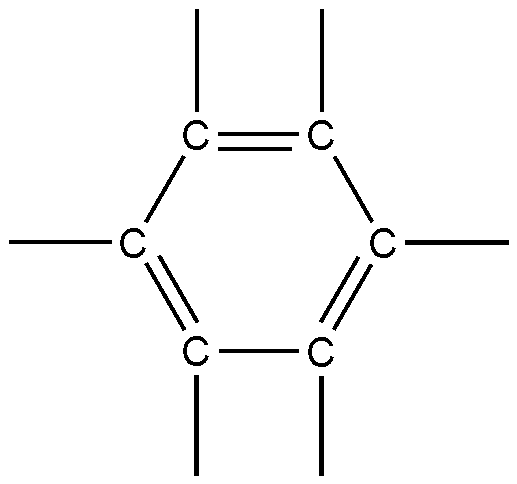
Indicates that the substituent is bonded to a carbon.
Denotes the presence of one or more rings, none of which is a heterocyclic or a nitrocyclic ring, of which the ring members of at least one ring are all carbons.
Denotes the presence of the carbonyl group, C=O.
Denotes combination between at least two or more molecules of the same or different carbon compounds between carbons thereof.
Denotes any metal having a specific gravity greater than 4 and, as employed herein, includes arsenic and antimony.
Denotes the presence of a ring whose members are composed of at least one carbon and one or more atoms of the elements taken from the group consisting of nitrogen, oxygen, sulfur, selenium, and tellurium.
Denotes the presence of a ring, all of whose ring atoms are nitrogens, e.g., azides, etc.
Denotes the presence of C=O in combination other than as found in ketone and aldehydes and is generic, for example, to carbonyl, thus:
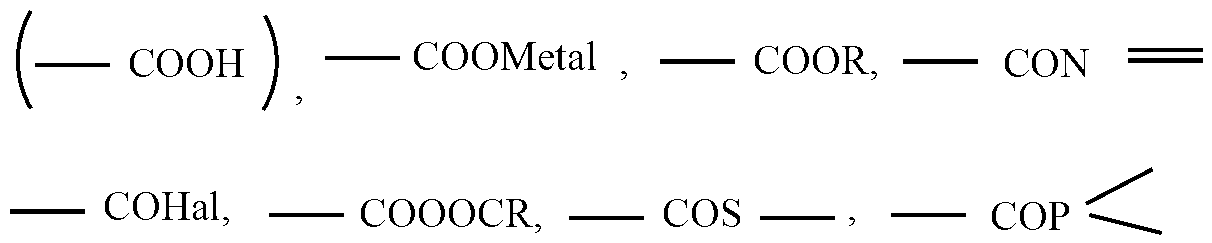
Denotes a carbon which is a ring carbon of a closed chain.
Denotes the presence of a carbonyl (C=O) bonded to hydrogen and/or carbon and is a term generic to ketones and aldehydes.
Denotes the presence of oxygen singly bonded to a carbon, which is not the carbon of a carbonyl group, and is further bonded to hydrogen, metal, or an organic radical. The term is generic to alcohols, phenols, alcoholates, phenolates, and ethers and esters thereof, but in view of the fact that, in this classification, esters take precedence over hydroxy, the term oxy, as herein employed, is generic to C-OH, C-O Metal, and C-OR (ether type).
Denotes the presence of an oxygen single-bonded to a ring carbon of a benzene nucleus.
Denotes the presence of a radical containing sulfur bonded to oxygen and includes the sulfoxide, sulfone, sulfonyl, sulfo, and sulfate groups.
Denotes the presence of a double or triple bond linking two adjacent carbon atoms, thus:

Glossary Terms for Class 264 PLASTIC AND NONMETALLIC ARTICLE SHAPING OR TREATING: PROCESSES
A term of art for a web or sheet of material generally formed by random interfelting of mass deposited discrete fibers or from tangled or matted filaments, e.g., cotton batting.
Distorting or deforming of a workpiece or self sustaining body by curving or moving a portion thereof through its entire thickness relative to another portion during which the thickness thereof remains substantially the same and no significant plastic flow occurs.
A process of molding or forming wherein impressions are made with fluent or molten materials as by pouring into a mold with hardening or setting of said material in said mold.
A shaped body of material formed by forcing a supply of said material through a confining orifice whereby the cross-sectional area of the extruded portion corresponds to the dimensions of the orifice.
A discrete particle, generally bulk or mass handled because of its small size, wherein the particle has a length considerably greater than its breadth or cross-sectional diameter.
A self sustaining body, which because of its relatively large length is handled at a point intermediate of its ends, and includes single or one piece bodies formed in a continuous manner.
An article or stock material or bland which is self sustaining and which may be subjected to a shaping or reshaping operation.
A process in which a self sustaining body or a preform is subjected to a deforming, e.g., by plastic flow, bending, stretching, twisting, corrugating, so as to alter its overall shape.
A molding operation for forming of continuous or indefinite length articles, generally filaments, by extrusion through an appropriately sized orifice. Some types of spinning are spinning into a reactive bath, melt spinning, evaporative spinning or solvent-extractive spinning.
A physical, chemical or mechanical step applied to molding material or an article or preform, (see conditioning).
Glossary Terms for Class 267 SPRING DEVICES
an element in the form of a spiral and which exhibits resilient characteristic when distorted from its original shape. May be in the form of a helix, a volute spiral or flat spiral.
an element in the form of a serial lying on the surface of a cylinder and which exhibits resilient characteristics when distorted from its original shape.
an element comprising a plate or bar or a plurality of superposed plates or bars and which exhibits resilient characteristics when a portion is deflected transversely of length of the element
Glossary Terms for Class 269 WORK HOLDERS
ACTUATION (ACTUATE, ACTUATING, ETC.)
The application of (a) a bias (resilient or gravity), or (b) a mechanical advantage, or (c) the use of a lost motion mechanism to effect the relative movement of jaws. The use of levers, inclined planes, pulleys, gears, cams, fluid systems, etc., even where such means fail to produce force multiplication, or actually provide a force reduction, is considered enough to constitute actuation means rather than adjustment* means.
ADJUSTMENT (ADJUST, ADJUSTING, ETC.)
The shift of a jaw or jaws into juxtaposition with work without the application of (a) a bias (resilient or gravity), or (b) mechanical advantage effective to press or grip work, or (c) utilizing a �glost motion mechanism�h. This shift may be (d) no more than a �gquick setting�h of a jaw of a particular device (e.g., the use of a split nut to initially position a jaw for gripping movement along a lead screw) or (e) a change of the range* limits (e.g., the use of a pawl and rack lock to initially position a jaw for gripping movement by a cam or eccentric). While the shift of (d) and (e) are both considered to be jaw adjustment only (e) represents a true variation of range limits; i.e., the full cam throw will move the jaw one inch (the range whether the pawl and rack setting provides a work accommodating span of three or ten inches).
The immobilization, or securing against movement, of structural elements constituting the means for jaw adjustment*. An adjustment-lock may be effected (a) by a shift in relative position of the structural elements being immobilized (as, for example, in subclasses 166-171.5) or (b) by positioning an additional element to effect the desired binding or securing. The immobilization, securing, or binding referred to may be only relative rather than absolute, in the sense that further movement or positioning of the structural elements requires the utilization of actuating* means. The adjustment-lock effected may in fact be limited to a one way latch or binding. For example, in some of the pawl and rack locks of subclasses 212-215, the structural elements, when said pawl and rack are engaged, cannot be further adjusted except in a direction favored by the inclination of both rack teeth and pawl; and similarly, in the simple cant type lock of subclass 166, the structural elements, when relatively askew, resist adjustment in a direction tending to further accentuate the degree of cant but are freely adjustable in the direction tending to reduce the degree of cant.
A rotatable, pivotal or rockable member having a contour, which contour is not uniformly concentric with the pivotal or rotational axis of the member, and which contour, as it moves with respect to said axis, imparts a to-and-fro movement to a follower element bearing against said contour. The movement of said follower element, as the point of mutual contact between the member and the element shifts along the contour, is thus prescribed by the configuration of said contour with respect to the axis of rotation. The contour may be a modification of a peripheral or radial surface with respect to the pivotal or rotational axis or a configured groove, ridge or slot lying in the general plane of either surface. Thus, the effective movement of a follower element, caused by pivoting or rocking the cam member, is measurable along lines normal to the member axis or parallel to the member axis. The follower element is usually mounted for sliding or pivoting movement with respect to the cam member. In some instances, the contour, referred to above, is part of the follower element. In this class, the terms �gcam�h and �geccentric�h are used interchangeably. See (3) Note under subclass 165 and (1) Note under subclass 229 for wedge adjustment and wedge actuating means.
Structure limited to one jaw* plus the means to adjust* and/or actuate* said jaw relative to a disclosed, but not claimed, coacting jaw.
The term �ghand�h (or �gmanipulate�h) is used in the sense of �gby contact with a living being�h and includes hand, foot, head, etc. Specific recital of foot, pedal, etc. is limited to such recital.
A device in which a work holder is structurally related with respect to a member on which it is supported so that the work holder may be moved to a limited extent or in a definite path(s) with respect to its supporting member. The entire holder, i.e., the structure which contacts and thus actually supports the work, must be capable of movement while work is held. In the case of a work underlying support (as in subclasses 289-314), such underlying support is considered mounted for movement even though the clamps or fastening means needed to keep work from sliding off are not claimed.
HOLDER SUPPORT, MOUNT, OR BASE
A work holder support is the structure for positioning work contacting elements, including the associated adjusting and/or operating means for said work contacting elements, with respect to a reference member (table, floor, wall, rack, bench, etc.). Such support structure may be integral or articulated with a work contacting assembly and is provided with means for maintaining position of said assembly with respect to the reference member. The position maintained may be adjustable with respect to a particular reference member by (a) relative shifting of parts or links constituting the work holder support or by (b) relative shifting of the articulated joint structure between the work contacting assembly and the work holder support. The position may also be varied by (c) temporary fastening means selectively securing the work holder support to different reference members or different portions of the same reference member. A work holder support means such as (a) or (b) above is generally disclosed as positionable either (1) preparatory to engaging work or (2) while the work is being held. Since in many instances the structure for (1) will serve for (2) and vise versa, no attempt has been made to distinguish classificationwise on this basis. Both (1) and (2) are treated, unless specifically noted otherwise, as (2) and provided for under Holder Mounted for Movement*. A work holder support means such as (c) above is not considered as a Holder Mounted for Movement* and if claimed, per se, will be found in Class 248, Supports.
see �gHAND�h
The material that is placed in, or on, or in juxtaposition to, the work holder in the condition in which such material exists after it has been treated.
The extent or span of relative jaw movement, without reference to the work to be engaged, as predetermined by the structural relationship between elements of the means to actuate* said jaws. For example, shifting a split nut on a screw to initially position a jaw carried by said nut does not involve a range change since the nut can still travel the full extent of the screw; however, changing the degree of eccentricity of a jaw actuating element does involve a range change since the operation of said actuating element will now result in a variation of the effective throw of said element and its associated jaw.
The following, only, are considered to be simple movements of a work holder: (a) A movement in which all of the work holder swings about a fixed axis except for the part lying on the axis, i.e., rotational movement. (b) A movement in which each point on the work holder moves in a single rectilinear path; i.e., rectilinear movement.
(a) One of the plural portions of a work holder couple which engages or grips a workpiece. Generally, the jaw is taken to include the work contacting surface and that part of the holder which (1) is contiguous to said surface as well as that portion which (2) if moveable, moves bodily in congruent fashion with said surface. (See subclass 271 for the definition of a jaw attachment or insert).
(b) A work holder portion with an underlying work contacting surface, for which see subclass 289, especially (2) Note, is not considered to be a jaw, unless claimed in combination as one of plural coacting work gripping elements. However, a work holder portion with an overlying work contacting surface, which portion ordinarily is incapable of functioning as a work holder in the absence of a coacting underlying support means, will be considered as a jaw even if there is no claimed reference to said coacting underlying portion. (See subclasses 37-45 for plural holders which separately hold at least two workpieces relative to each other; each such holder is considered to be more than a jaw).
(c) As an exception to (a) which states that a “jaw” must be one of a couple; a work engaging member, which as claimed (1) includes plural, abutting, nonparallel, flat work engaging surfaces; (2) each such flat surface, coacting with a different one of plural work engaging elements as one of a plurality of work engaging elements as one of a plurality of work holding couples, is considered to be a common jaw member cooperating with a plurality of jaws. (See subclass 104 for patents to a holder with plural jaws coacting with a common angle-corner jaw to hold the same workpiece). (See subclass 154 for patents to a holder with plural jaws coacting with a common flat jaw surface to hold work or workpieces).
(d) Unlike (c) above, a work engaging member which as claimed includes either (1) plural, nonabutting, work engaging surfaces or (2) plural, abutting, curved, work engaging surfaces, and which surfaces (1) or (2) each coact with a different one of plural work engaging elements, is not considered to be a “common” jaw member. Hence, such a configured work engaging member in combination with coacting plural elements does not constitute plural jaw pairs either for subclass 104 or subclass 152. (See subclasses 257-284 for specific jaw features, per se.)
The following figure is illustrative of plural, nonabutting, work engaging surfaces B1 and B2 referred to in (d)(1) above.
The following figure is illustrative of plural abutting, curved, work engaging surfaces E1, E2 and E3 referred to in (d)(2) above.
(e) Each of three mutually adjustable* and/or actuable* work contacting elements effective to hold work (as in subclass 156) is also considered to be a jaw.
In both rotational and rectilinear movement, the movement may be in steps, backwards, or forwards.
A linkage including at least two links, pitmans, bars or struts, and at least three pivots, the end of one link being connected to the end of the other link by a pivot common to both links, each of said links also having a pivot at the end remote from the common pivot, which common or intermediate pivot is movable from a position not in a straight line with the other two pivots, to a position substantially in line by a force applied to the intermediate pivot in a direction substantially normal to one of the links, thereby moving at least one of the two pivots away from the other. At least one of said links is articulated at both ends and is not integral with either a jaw or handle.
An instrumentality for effecting treatment of the work.
The portion of a work holder whose disclosed function is to (a) coact with a relatively movable work treating tool to treat the work, or (b) act as a guide for a relatively movable work treating tool to directly or indirectly constrain the tool for movement in a particular path, or (c) limit the movement of a work treating tool relative to the work so that it may contact only a portion of the work and is prevented from contacting another portion of the work. To be recognized as such, the tool couple element, if it is part of the work contacting portion of the work holder, must be of different structure than the rest of the work contacting surface, or must be a particular, definable portion of the work contacting surface such as an edge thereof.
An operation which modifies the shape or changes a characteristic of material, assembles pieces of material together, disassembles pieces of material, or applies fluid (nonpropellant) to material. See WORK HOLDER IN COMBINATION WITH TREATING MEANS and RELATIONSHIP TO PRESS MEANS, above.
The material that is placed in, or on, or in juxtaposition to the work holder for treatment in the condition in which such material exists prior to its being treated or during treatment.
(a) An element positioned adjacent a surface which supports the work against the force of gravity, and which element presents an obstacle that restrains the movement of the work across the surface in a particular direction, including the necessary supporting frame work for such element. (b) The inclusion of an opposing or coacting element engaging the work, so as to grip said work between the �gabutment�h and said element, is considered to be characteristic of a jaw* relationship and such combination, claimed or disclosed, is not a work-stop abutment.
Glossary Terms for Class 271 SHEET FEEDING OR DELIVERING
Refers to �gmeans for moving and placing the individual sheet with respect to a device for operation on the sheet.�h Thus, in the subclasses indented under �gFeeding�h, the �gConveyor�h may be modified by means for orienting, retarding or interrupting the feed relative to the operation; and in the subclasses indented under �gDelivering�h, the �gConveyor�h should be limited to a means for transporting the individual sheet from the operation or placing the individual sheet in a receiver for a stack of such sheets. In either case the conveyor of Class 271 is distinct from a conveyor of other classes, wherein material or articles are transported from an input location to an output location. Class 271 has also for many years included a device wherein a stack of sheets is moved as an article to a position at which sheets are removed from the stack by a separator, but has not included a device wherein a stack of sheets is formed by a delivery means, and subsequently the stack of sheets is moved as an article away from the formation position. See References With Other Classes, above, for the location of patents not proper for Class 271.
Refers to the �gmeans for removing the individual sheet from the operation after having been operated on or placing the individual sheet on a receiver after having been operated on.�h
Refers to the �gmeans for moving individual sheet from a stack�h and involves use of a �gseparator or a conveyor.�h
Refers to �gmeans for setting apart or individualizing a sheet relative to a stack of sheets, and moving the individual sheet from the stack, particularly for the purpose of presenting toward a position at which the sheet will be operated on.�h
Glossary Terms for Class 277 SEAL FOR A JOINT OR JUNCTURE
A liquid, gas, or particulate matter (e.g., dust, etc.) suspended in a liquid or gas.
These are component(s) that make up the seal.
These are component(s) (e.g., housing, casing, rod, shaft, etc.) of the joint or juncture.
Glossary Terms for Class 281 BOOKS, STRIPS, AND LEAVES
Consists of two or more sheets secured together (a) only at their margins or (b) only at a restricted field within the margins or (c) only at their margins and at a restricted field within the margins. A folded sheet has not been classified as a book. When a margin of one sheet is attached to a margin of another sheet to obtain in effect a single sheet of greater area, the resulting article is still regarded as a sheet rather than a book.
A sheet other than a strip.
A body having two parallel surfaces both dimensions of which are large in comparison with the third dimension of the body.
A sheet folded back and forth along at least two fold lines and unattached to anything or attached to a backing either at the ends only or in such a way that the folded portions can be successively released without mutilation, or it is a sheet rolled up. Also patents claiming fold lines or other features for so folding or rolling up sheets are classified as �gstrips�h.
Glossary Terms for Class 283 PRINTED MATTER
consists of two or more sheets secured together, in the manner recited in the class definition of Class 281.
A sheet other than a strip.
A sheet folded back and forth along at least two fold lines and unattached to anything or attached to a backing either at one or both ends only or in such a way that the folded portions can be successively released without mutilation, or it is a sheet rolled up. Also patents claiming fold lines or other features for so folding or rolling up sheets are classified as �gstrips�h.
Glossary Terms for Class 305 WHEEL SUBSTITUTES FOR LAND VEHICLES
An annular band made either of a single piece of flexible material or of a plurality of individual treads or sections movably connected together.
A unitary ground engaging block or plate made of flexible or rigid material or a combination of both and provided with securing means for connection to similar devices to form a flexible track.
The term �gwheel�h as used in connection with this class includes resilient tires, sprocket gears, rollers or any other annular members rotatable about an axis and adapted to propel a flexible track or support a portion thereof.
Glossary Terms for Class 313 ELECTRIC LAMP AND DISCHARGE DEVICES
An electrode which acts as the positive terminal of the discharge or which acts as the positive terminal of an electric field to cause a discharge or accelerate the electrons in a discharge. See the definition of cathode above, and the definition of control electrode below.
Same as �gtarget�h or anode. Used in reference to X-ray tube anodes.
An electrode designed for use in a discharge device having at least two principal discharge electrodes and the auxiliary starting electrode. The starting electrode is designed to be connected in the circuit so that the discharge is initiated between it and one of the principal electrodes, the auxiliary discharge conditioning the discharge space so that a discharge between the principal electrodes can be established. An auxiliary starting electrode does not necessarily differ in structure or material from any other electrode. Auxiliary starting electrodes are usually simple electrodes, a wire or rod, and are usually not formed from as heavy or strong material as the principal electrodes. Usually an auxiliary starting electrode is placed close to a principal electrode so that the discharge may be initiated between the auxiliary starting electrode and the main electrode at a smaller voltage than is necessary to initiate the discharge between the principal electrodes. The auxiliary starting electrode may be supplied with current only during the starting period or it may be supplied with current during the operation of the device so that a continuous discharge takes place between it an done of the principal electrodes to assure ionization in the discharge space so that the discharge between the principal electrodes may take place at the proper time. The latter type of auxiliary starting electrodes are also known as �gholding electrodes�h. Where a plurality of auxiliary starting electrodes are used, they may be spaced at intervals between the principal electrodes so that the discharge may first be established between one principal electrode and the nearer auxiliary starting electrode, then to a more remote auxiliary starting electrode and so on until the discharge is established between the principal electrodes. If a plurality of auxiliary starting electrodes are used, one may be placed close to each of a plurality of principal electrodes. In as much as the determination of whether or not an electrode is an auxiliary starting electrode depends upon the circuit connections to the discharge device, and this class includes only the structure of the discharge device, per se, only in subclasses 170+ (liquid electrode discharge devices) and subclasses 596+ and 601+ (gas or vapor-type discharge devices) is the classification based upon one of the electrodes being an auxiliary starting electrode.
A member attached to the lamp or discharge device so that it may be attached to a supporting socket or supported on a surface. The base usually includes electrical connector means for connecting the lamp or discharge device in a circuit. Where the lamp or discharge device is provided with an envelope, the base is usually attached to the envelope, as by cementing, or the envelope is formed so as to have an integral base portion.
A container or enclosure for a lamp or discharge device, or a part thereof. See Envelope above.
An electrode which acts as the negative device. In some discharge devices, such as spark gaps, there is no difference in structure between the cathode and anode. Consequently, the use of the words �gcathode�h and �ganode�h have been avoided except where there is some significance in structure between the two electrodes.
A discharge device having means for forming the electric discharge into a restricted beam or ray, usually pencil-like.
An electrode designed to serve as an anode with respect to a cathode and to be heated by the discharge so that another surface of the electrode emits electrons to a second anode. See subclass 305 for discharge devices having a cathanode.
An electrode designed to influence or control the discharge current flowing between other electrodes. It may depend for its effect on either its electro-static effect or on the current flow thereto. The most common type of control electrode is the control grid. Since, however, the grid may be used as an anode, and the anode as a grid in many types of discharge devices, the use of the expression �gcontrol electrode�h has been avoided where possible and similar structures placed together irrespective of whether the disclosure indicated that the grid electrode is to be used as an anode or control electrode. Patents relating to discharge devices having one or more grid electrodes interposed between a cathode and an anode are classified in subclasses 293+ or in the subclasses referred to in the notes to these subclasses. See subclass 308 and the subclasses referred to in the notes thereto for other discharge devices having a control electrode.
A filament designed to have its terminals connected to a source of current, the filament being heated by the current passing through it.
A device for converting electrical energy into visible light or ultraviolet light. Most lamps also generate infrared rays, but infrared ray generators are included only when they have structure analogous to electric lamps or electric space discharge devices. See the notes below. Electric lamps may be in the form of electric space discharge devices, for which see the next paragraph.
ELECTRIC SPACE DISCHARGE DEVICES
(the shorter expression �gDISCHARGE DEVICES�h is used in these definitions) Any device which is intended to have an electrical current flow between two spaced electrodes, at least part of the path followed by the discharge being constituted by a gas, vapor, or vacuum.
A filament or glower of an electric lamp or a member arranged to emit, and/or collect, and/or control the movement of electrons or ions in a discharge device.
A low work function electrode.
A gas tight enclosure for an electric lamp or discharge device. It may be evacuated or filled with a gas or vapor. In general the distinction between an envelope and a mere jacket, casing or housing is that the envelope is sealed, so as to be gas tight.
A wire, ribbon or rod conducting member. It may be made of metal or nonmetal. In this class filaments, per se, are classified in subclasses 341+ irrespective of whether the filament is to be used in a lamp or discharge device, and irrespective of whether the filament is to be heated by passing a current through the filament (directly heated cathode) or is to be heated by the discharge in a discharge device (see thermionic cathode).
FLUORESCENT OR PHOSPHORESCENT MATERIAL
A material which absorbs radiant energy of one wave length (e.g., light) and is excited thereby to cause it to emit radiant energy of another wave length (e.g., light of another wave length), or a material which is excitable by the impact of electrons, ions, or analogous energy (e.g., gamma rays) thereon to emit light energy without becoming incandescent.
GAS OR VAPOR GENERATING MATERIAL
Solid or liquid material which is placed within the envelope and generates a gas or vapor by virtue of a chemical change, by volatilization, or by giving off an absorbed gas or vapor. It may do this during normal operation or it may be caused to do so by treatment preliminary to placing the device in operation.
Materials which, when used in closed containers, reduce the gas or vapor content of the container. A getter may react with the gas or vapor in the container to form a solid nonvaporizable material, or to adsorb or absorb the gas or vapor, or may reduce the amount of the gas or vapor in the container in any other way. The material may be a getter for one gas or vapor and may not have any effect upon another gas or vapor.
Any body made of a material which when heated by the passage of an electric current therethrough emits light rays. The term glower includes filaments and also includes other bodies which are not of filamentary dimensions such as, rods and bars made of second class conductors.
An electrode having one or more apertures therein, usually formed of open-work material, such as wire mesh, perforated sheet material, or of wires or bars as of coiled wire, or other foraminous structure, and sometimes used as the control electrode in a discharge device. As pointed out in the definition of �gcontrol electrode�h above, the terms �ggrid electrode�h and �gcontrol electrode�h are not synonymous in this class.
Either a directly heated cathode or an indirectly heated cathode.
See the definition of auxiliary starting electrode above.
Lamps which are provided with a filament or glower adapted to be heated to incandescence by the passage of an electric current therethrough.
INDIRECTLY-HEATED CATHODE (Equipotential cathode)
A cathode designed to be heated to its emitting temperature by a separate heating element.
A virtual cathode formed by a discharge in a gas or vapor between two electrodes, the discharge serving to supply electrons to a third electrode. See subclass 588 for discharge devices having an ionic cathode.
Same as casing above.
The conductor used to transmit electric current or potential from the exterior of the envelope or casing into the interior of the envelope or casing. Where the envelope is made of glass it usually consists of a conductor which passes through the wall of the envelope and which is sealed to the glass by a glass-to-metal seal.
LOW WORK FUNCTION ELECTRODE (cold cathode, cathodes containing or coated with electron emissive material)
A cathode containing or coated with a material which readily emits electrons, i.e., a material which has a low work function. Examples of such materials are the alkali metals and their oxides, alkaline earth metals and their oxides, thorium, magnesium. The expression �glow work function electrode�h includes thermionic electrodes which contain or are coated with electron emissive material, photosensitive cathodes, secondary emissive cathodes as well as cathodes which emit electrons without being heated.
A device to be used in an electrical circuit which is provided with means responsive to light or analogous rays for altering the operation of the device. The only photocells included in this class are photosensitive discharge devices and photosensitive electric lamps.
A device provided with means sensitive to light or analogous rays for altering the operation of the device.
An electrode which emits electrons when subjected to the action of light or analogous rays. Discharge devices having a photosensitive cathode or other photosensitive electrode are classified in subclasses 523+ in this class. See photosensitive electrode above. See the class definition for the classification of photosensitive cathodes, per se.
An electrode which has its electrical properties changed by the action of light or analogous ray energy. The ray energy may be X-rays, ultraviolet rays, infrared rays, or any analogous radiation. See the class definition for the classification of photosensitive electrodes, per se.
An electric lamp which has as the light emitting body a material which is a second class conductor. The lamps are designed to have the pyro-electric body heated by a separate source until the pyro-electric material becomes conductive and then the current flow through the pyro-electric body maintains the second class conductor material at a temperature at which it emits light.
A material having a very high electrical resistance at ordinary temperatures and a low resistance when heated. Glowers formed of oxides, such as Th2 or the rare earth oxides, used in the pyro-electric (e.g., Nernst) type of incandescent lamp are examples of second class conductors.
A cathode designed to emit electrons by virtue of the impact by electrons upon the electron emissive surface. See the class definition for the classification of secondary emissive cathodes, per se. See cathanode below.
Structures used in lamps and discharge devices to modify the electrical characteristics thereof, or structures which are used to protect the lamp or discharge device from external influences, or structures which are used to protect parts of the device from influences, such as electron bombardment, originating in another part of the device, and other structures used for protective purposes. Shields do not include mere electrodes even though the electrode is defined as being a shielding electrode. Where an electrode of a discharge device is provided with shielding structure in addition to the structure provided for influencing the electric space discharge, such additional structure is considered to be shielding structure. Examples of such additional shielding are where an indirectly heated cathode is provided with a flange for shielding the discharge space from the influence of the cathode heater current, or where an anode, grid, or lead wire is provided with shielding means to shield the lead-in wires from the effects of electrostatic fields. Metal or conductive envelopes for discharge devices are not considered to be shields where the envelope is designed to function as an electrode of the discharge device, such as an anode. Where the metal or conductive envelope is disclosed as being provided for shielding purposes and not an electrode, the envelope is considered to be a shield.
A unitary spark gap having a plurality of insulated electrodes arranged out of contact with each other so that the space discharge is a �gjump spark�h and usually having a shell or sleeve designed to be attached to an opening in an internal combustion engine or other device, the shell or sleeve carrying one or more electrodes within it which are insulated from the shell or sleeve by an insulating bushing or other insulation. The shell or sleeve often carries an electrode which cooperates with the other insulated electrode to form the jump-spark gap. Included are the devices known as spark plugs usually used on the ordinary automotive internal combustion engine. Also included are spark plugs for other uses which are similar in structure. It does not include ignitors where the spark is made by moving the electrodes into contact and then separating them to draw the spark. It does not include ignitors which are not similar in structure to the automobile spark plug even if they are of the jump spark type. Spark plugs having only a single electrode which are designed to be used with some other device, as the cylinder head, so as to form a jump spark therewith are also excluded.
In an X-ray tube, cathode-ray tube, or other beam type discharge device, the anode or the member against which the principal electron or ion stream impinges. See the definition of anode above.
A cathode designed to operate at an elevated temperature. The expression, �gthermionic cathode�h includes directly heated cathodes, indirectly heated cathodes, and also cathodes which are designed to be heated by ionic bombardment to the electron emitting temperature.
THREE OR MORE ELECTRODE DISCHARGE DEVICES
Any discharge device having three or more electrodes whether all of the electrodes have lead-wires for connection to the supply circuit or not. In some of the three or more electrode discharge devices, the electrodes are arranged with one or more electrodes disposed in the interelectrode space or in the discharge path between two other electrodes, and have only the outer electrodes provided with lead-wires for connecting to the supply circuit, the discharge passing from the outer electrodes to the interposed electrode so that the discharge device has a plurality of series connected discharge spaces.
A discharge device designed to generate X-rays.
Glossary Terms for Class 315 ELECTRIC LAMP AND DISCHARGE DEVICES: SYSTEMS
An electrode which is connected in the circuit so that the discharge is initiated between it and one of the principal electrodes, the auxiliary discharge conditioning the discharge space between the principal electrodes so that a discharge between the principal electrodes can be established.
Any means associated with the discharge device (for example only, an electromagnet, a control grid or an auxiliary discharge electrode) intended to be used to control or influence the discharge between the principal electrodes of the discharge device.
Any electrode which is designed to influence or control the discharge between the principal electrodes. It may be a control grid or an auxiliary discharge electrode. It may depend for its effect on either its electro-static effect or on the current flow thereto.
ELECTRIC SPACE DISCHARGE DEVICES
The shorter expression �gDISCHARGE DEVICES�h is used in these definitions, are defined for the purpose of classification in this class as including any device which is intended to have an electrical current flow between two spaced electrodes, at least part of the path followed by the discharge being constituted by a gas, vapor, or vacuum.
Any type of electric space discharge which, as claimed, depends upon ionization of a gas or vapor for its operation. Discharge devices which have their discharge electrodes in an unconfined (non-enclosed) atmosphere as well as those having their discharge electrodes in a confined (enclosed) atmosphere are included in this definition.
A vacuum tube evacuated to such a degree that its electrical characteristics are essentially unaffected by gaseous ionization.
Are defined for the purpose of classification in this class as including a device designed for converting electrical energy into ray energy, regardless of whether the ray energy is within the visible or invisible part of the spectrum, but excluding (1) generators of X-rays, and (2) generators designed primarily to generate infrared rays. Lamps may be in the form of electric space discharge devices, for which see the next paragraph.
The device to which the system supplies electrical energy and which, as claimed, constitutes the final or ultimate device for utilizing the electrical energy of the system.
The �gtwo spaced electrodes�h referred to in the definition of electric space discharge devices, between which the discharge current is primarily intended to flow.
Glossary Terms for Class 318 ELECTRICITY: MOTIVE POWER SYSTEMS
Controlling the change of speed of an electric motor from zero speed to some running speed value and vice versa, or from one running speed value to another running speed value. Mere starting of the motor is not considered to be acceleration control unless the acceleration of the motor is controlled after the starting operation. Acceleration control includes deceleration control. Deceleration control differs from motor braking in that in deceleration control no means are utilized for applying an opposing torque or output force to the driving member of the motor. In deceleration control, for example, the power input to the motor is varied to decelerate the motor. See the definition of braking below. Mere stopping of the motor by opening the supply circuit is not deceleration control in the absence of any means to control the rate of stopping, but is mere stopping. For the distinction between acceleration control and running speed control, see the definition of Running Speed Control.
ALTERNATING-CURRENT COMMUTATING MOTOR
A motor having a commutator electrically connected to a winding of the motor, the motor being designed to operate on alternating current. Such motors are sometimes referred to as �gseries A-C motors�h, �guniversal motors�h. See the definition of Repulsion motor above, and the definition of self-commutated impulse or reluctance motors below.
AUTOMATIC STARTING AND STOPPING
Starting, stopping, or the combination of these two operations is treated in this class as a single motor operation. Automatic starting and stopping (i.e., starting or stopping which is initiated in response to a condition) is classified for the most part in subclass 445 or in the subclasses specified in the notes to the definition of those subclasses. If the stopping control involves motor braking, then the patent is classified in the braking control subclasses. If the stopping control involves motor deceleration control, but not motor braking, then the patent is classified in the motor acceleration control subclasses. If the starting control involves motor acceleration control, then the patent is classified in the motor acceleration subclasses. See diverse motor operations for the classification where the system has means for automatic starting or stopping of the motor and also means for performing another control operation. Where the motor is stopped and then started in the reverse direction of motion, the patent is classified in the motor reversing control subclasses. See below, for a definition of Reversing Control. Where the motor armature or primary current is controlled during the starting and/or stopping period other than for acceleration, deceleration, or braking control, see definition of Motor Load Control.
CIRCUIT MAKING AND/OR BREAKING DEVICE
A device for fully establishing and/or fully interrupting the electrical conductivity of an electrical path or circuit between two or more points in an electrical circuit by relative movement of electrically conductive elements into and/or out of physical contact with each other.
For the purpose of classification in the subclasses entitled �gplural, diverse motor operations control�h the following limitations are applied relative to the nature of the several operations: (I). Starting, stopping, or the combination of these two operations is treated as a single motor operation control. However, since mere starting or stopping is an incident to many other motor operations (such, for example, as acceleration, reversing, braking to a stop, etc. in which actual starting or stopping may take place) such mere starting and/or stopping will not be considered a motor operation control which is included in this subclass as combinable with other motor operations, unless means are provided for effecting an automatic starting and/or stopping in response to a predetermined condition. Thus, ordinary (e.g., manual) starting or stopping combined with running-speed control is not included in the plural diverse motor operations control subclasses, whereas automatic starting and stopping in response to thermal changes combined with means for causing the motor to run in either direction (reversing) is included as plural diverse motor operations control. For example; automatic opening of motor circuit at limit of travel plus simultaneously shorting the armature for dynamic braking is classified as combined braking and automatic starting and/or stopping. Likewise, automatically opening the circuit of the motor while running at an appreciable speed coupled with a braking operation simultaneously with or shortly thereafter is considered a plural operational control. The following motor operations controls are included in the plural diverse motor operations control subclasses: (a) Reversing control; (b) Acceleration control; (c) Running-speed control; (d) Braking control; (e) Motor load control, and (f) Automatic starting and/or stopping. For definitions of the various individual controls listed above see the other sections under Definitions of Motor Operation Control of this class which pertain to the several individual motor controls. The following are not included herein as combinable motor controls: (a) Phase or Power Factor Control; (b) Temperature control of the motor, including heating or cooling thereof; (c) Signalling, testing, indicating or measuring of conditions in or about the motor; (d) Ordinary or mere starting and/or stopping of the motor; (e) Phase splitting or phase conversion to adapt a motor for operation from a source of electrical supply having a different number of phases than that for which the motor is wound; and (f) Means for lubricating the motor.
A machine which transforms electric energy into mechanical energy.
A means having inductance, capacity, resistance or any combination thereof and excluding any source of electric energy.
HOMOPOLAR OR UNIFORM-FIELD MOTORS
A noncommutating motor having a magnetic field producing means combined with one or more electric conductors mounted to move relative to and in proximity to the field producing means, the field producing means being so constructed or energized that the magnetic field produced thereby is, at any instant of time, of the same polarity or direction throughout its extent with reference to the path of travel of the movable electric conductor or conductors.
IMPACT, MECHANICAL SHOCK, OR VIBRATION-PRODUCING MOTOR
An electric motor having means for moving one of the motor parts into impact or percussive contact with one or more other parts of either the motor structure or a part which is structurally combined with the motor structure, or a motor whose prime or essential function is to transmit mechanical shock or vibrations to a device or mechanism secured to the motor or upon which the motor may be mounted, (e.g., rotary motor with the rotor unbalanced to produce vibrations which are transmitted to its support.
An asynchronous alternating current motor which operates during running speed conditions as a result of electromagnetic induction and which has at least two electrical conductors which are mounted or positioned in electromagnetic relationship with each other and for movement relative to each other, and in which alternating current energy delivered to one of the conductors (�gprimary�h or �ginducing�h member) induces in the other of said conductors (�gsecondary�h or �ginduced�h member) an alternating current and the mechanical energy is obtained as a result of the electromagnetic inductive action between the magnetic field generated by the alternating current in the one conductor and the magnetic field generated by the induced current in the other conductor. The secondary or induced winding is usually short circuited or shunted by means of an impedance. An example of an induction motor is the squirrel cage motor, that is, a motor where the secondary winding consists of a plurality of short-circuited bars. See the definition of a �grepulsion motor�h.
A motor having means for causing the working element to move in a substantially linear or uni-directional path. The path may be straight, curved, tortuous, or even closed upon itself, provided the movable element is not pivoted for rotation about an axis. The motor may have means for reversing the direction of movement of the movable element. Where the reversing means includes means for periodically or repeatedly reversing the motor at predetermined intervals, the motor system is considered to be an oscillating or reciprocating motor system. See the Glossary definition of Oscillating Or Reciprocating Motor.
A motor having a magnetizable member or which has its dimensions changed as a result of changing currents in the electromagnetic field producing means which effects the magnetizable member, the physical distortion or change in dimensions producing the mechanical energy.
Includes any device or means for applying a torque or force to the power output element of the electric motor in a direction which is in opposition to the motor torque or force (resulting from electrical energization of, or the kinetic or potential energy stored in, the motor) and tending to retard, stop or prevent movement of the motor--excepting, of course, mere useful load devices actuated by the motor, or such forces that are normally inherent in the motor structure, per se, such as bearing friction, windage, eddy current reaction, etc. However, means providing for substantially increased or accentuated eddy currents in the motor structure to increase the retarding or braking effect, are classified herein. Examples of braking means included herein, include, auxiliary eddy-current disks, electric generators, fans, pumps, propellers and other motor shaft loading devices when such devices are limited in the claims to the function of braking the motor. When such shaft loading devices are not limited as claimed to the function of braking, classification is not herein, but in some other appropriate place. For the distinction between braking control and deceleration control see the definition of Acceleration Control in the Glossary. Braking of the motor to control the running speed of the motor (e.g., to maintain the speed constant) is classified in the running speed control subclasses. For the distinction between motor braking and motor reversing, see reversing control below.
See the definition of motor acceleration control in the definition of motor deceleration control.
Controlling the mechanical load actuated by the motor or controlling the motor armature or primary current during the starting and/or stopping period of the motor. Where the current is controlled to control the acceleration or deceleration of the motor, the system is classified as motor acceleration or deceleration control, see section IB4a of the class definition. Where the current is controlled to effect motor braking the system is classified as braking control see the definition acceleration control.
See the Glossary terms Acceleration Control; Automatic Starting and Stopping; Motor Braking Control, Motor Deceleration Control; Motor Load Control, Reversing Control, Running Speed Control; Starting And/Or Stopping; Diverse Motor Operations.
A motor having means other than a magnetic field producing means for producing a mechanical force. Example of nonmagnetic motors are piezo-electric crystals, thermo-electric motors.
RECIPROCATING OR OSCILLATING MOTOR
A motor which is structurally arranged or constructed so as to have a limited degree of movement, and which is provided with means for moving the movable (working element) of the motor to-and-fro repeatedly over substantially the same path or arc of movement (including rotations about an axis co-incident with the geometrical or center-or-gravity axis of the movable element of the motor). Compare this definition and the definition of �gLINEAR MOVEMENT MOTORS�h.
The several designations applied to distinguish the several types of motors such as series motors, induction motors, synchronous motors, etc., shall apply to those motors whose normal running characteristics are so described. Thus a synchronous motor is one which runs as a synchronous motor under normal running or load conditions. This is true even though the motor may be driven by some other device either (mechanical or electrical) during the starting and/or accelerating period or may operate on some other motor principle during the starting or accelerating period. Such an instance may be illustrated by a synchronous motor which is provided with means to cause it to start as an induction motor and subsequently and normally run at synchronous speed. Such a motor is considered to be a synchronous motor, since under normal running conditions, it exhibits all the characteristics of a synchronous motor.
An alternating-current or a pulsating current motor which, under running-speed conditions, operates at an average speed which is always exactly proportional to the frequency or periodicity of the source which supplies electric energy to the armature or primary circuit of the motor and which speed is independent of the voltage of the source, the magnitude of the field excitation, or the load on the motor.
An induction motor (defined in INDUCTION MOTORS above) in which the secondary or induced member is provided with a commutator, the commutator being engaged with a pair of circumferencially spaced short-circuited brushes, and in which either means (e.g., an auxiliary winding) is provided in inductive relation to the secondary to produce a magnetic field in time phase with, and displaced in relation to, the field produced by the primary or inducing member, or the brushes are displaced from the mid-position between adjacent primary (winding) pole positions whereby the motor may operate continuously under running-speed conditions. See the definition of self-commutated impulse or reluctance motors.
A motor having at least one field producing winding and at least one armature winding, all of the field-producing windings which are connected to be energized being electrically connected in series-circuit relationship with all of the armature windings which are connected to be energized.
SELF-COMMUTATED IMPULSE OR RELUCTANCE MOTORS
A rotary motor of the type in which the rotor element tends to assume a predetermined angular position when the motor is continuously energized and is provided with a commutator or circuit making and breaking device which is actuated by the motor to determine the instants of time at which the field producing windings thereof are energized and de-energized relative to the angular position of the rotary element. See the definition of a Repulsion Motor above.
Motor systems in which means are provided for operating the motor in one direction at one time and in the opposite direction at another time, or for causing the motor to operate in a direction opposite to that in which it has previously been operating. In reversing motor systems, means must be provided for causing the motor to produce a torque in both directions of operations. Where the motor current is controlled only to bring the motor to a stop or to brake the motor, there being no operation in the reverse direction, the system is classified as motor braking or as motor deceleration control, depending upon whether the motor is merely braked or whether the rate of deceleration is controlled. See the class definition for a definition of deceleration control and motor braking control in the class definition for a definition of braking control.
Motor systems in which means are provided for regulating or controlling the speed of an electric motor after it has been accelerated to some operating speed at which it is designed to run until the work or useful load device driven by the motor has performed its duty at that speed. Note. Means for controlling the speed of the motor during the starting or accelerating period of operation (i.e., means for controlling the rate of change of speed) are not classified herein even though the claims may term such control as �gspeed�h control, but are classified under �gacceleration�h. For a definition of acceleration control, see section IB4a, of the class definition. Since it is common practice to use the acceleration means for also controlling the running-speed of the motor, patents in which both acceleration and running-speed are claimed and in which both controls are effected by precisely the same means in whole or in part, classification will be on the basis of acceleration control only. Under these circumstances of control when some claims refer only to �grunning-speed�h control and/or some other claims refer only to acceleration control, classification will only be on the basis of the acceleration control. When, however, acceleration and running-speed control means are claimed in combination and any means not a part of the acceleration means are used to control the running-speed, classification will be on the basis of combined motor-operation controls including acceleration and running-speed control. Where means are employed to affect the magnitude of the running-speed of an electric motor and the magnitude of the means (e.g., resistance, reactance, voltage, etc.), or the position (e.g., angle of brush position), of the running-speed control means is not varied or changed, either inherently or otherwise, at any time during the period of acceleration, classification will be on the basis of running-speed control and not on the basis of acceleration control even though there may be some effect on the rate of acceleration. For example, a motor speed control system comprising a fixed resistor connected in the armature circuit, the magnitude of the resistance of which resistor does not vary appreciably under the conditions of use and which resistor is not varied or removed from the circuit during the acceleration period is classifiable under running speed control and not under acceleration control. Since some running-speed control means may be similar or even identical with some acceleration control means, searches for motor acceleration control should be, in appropriate instances, extended to include the running-speed control art.
Generally, the only motor systems classified as starting and stopping are those where the supply circuit to the motor is merely closed in the case of starting, or the supply circuit is opened in the case of stopping, there being no control of the rate of starting or stopping, or no auxiliary means to brake the motor. See the definition of acceleration control of the class definition for the starting and/or stopping systems which include motor acceleration and/or deceleration control means. See the definition of motor braking control of the class definition for the stopping systems which include motor braking. See the definition of motor braking control for the class definition for motor systems where the armature or primary circuit is controlled during the starting and/or stopping period for purposes other than motor acceleration, deceleration or braking control. Motor systems having only starting and/or stopping control are classified in the miscellaneous subclasses of this class. See Subclass References to the Current Class for motor systems where automatically controlled means control the starting and/or stopping and for the motor systems where the system includes a three or more position motor controller to control the starting and/or stopping.
Glossary Terms for Class 320 ELECTRICITY: BATTERY OR CAPACITOR CHARGING OR DISCHARGING
A unit source of D.C. voltage consisting of a plurality of voltaic cells electrically connected in series, parallel, or both, to increase available voltage or power from a single cell. "Plural batteries" include a combination or association of two or more structurally dependent, or independent, battery units.
An electrical energy storage device consisting essentially of two electrically conductive surfaces (e.g., plates, electrodes, etc.) separated by an insulator or dielectric (e.g., air, paper, mica glass, plastic, oil, etc.), whereby an electric charge, in the form of a direct voltage between said conductive surfaces, can be either stored on said surfaces or released therefrom to a load. "Plural capacitors" include a combination or association of two or more structurally dependent, or independent, capacitor units.
Short for, or used interchangeably with, a voltaic cell only in this class.
The act of adding electrical energy (e.g., supplying current, etc.) into a battery or cell from a diverse source of electrical energy to increase the amount of useful and available chemical energy stored in the battery or cell; or, the amount of chemical energy stored in a battery or cell that is available for useful conversion to electrical energy for supplying an electric load.
The act of applying an electric potential across the electrodes or plates of a capacitor from a diverse source of electrical energy to increase the amount of useful and available electrical energy stored in the capacitor, or the amount of energy stored in a capacitor that is available for release to usefully supply electrical energy to an electric load.
The electric circuit or path that extends from a charging source to a battery, cell, or capacitor to be charged.
The immediate source from which electric energy is derived for addition into a battery, cell, or capacitor, where the polarity of the source is such as to cause current to flow in opposition to the normal polarity of the battery, cell, or capacitor, if the latter is polarized, and may be, for example: (1) a mere charging circuit; (2) means for collecting atmospheric, parasitic, or other stray electric charge or currents; (3) means for converting electrical energy having one or more particular electrical characteristics into electrical energy having a different characteristic (e.g., electrical converters such as a combination alternating current source and rectifier, where the rectifier is considered to be the "immediate source"; (4) means for converting energy, other than electrical, into electric energy (e.g., electrical generator, fuel cell, etc.).
Any control that effects the flow of energy from a charging source, including (a) direct control of the charging source itself or (b) the flow or delivery of energy from the charging source to a load.
CIRCUIT MAKING AND/OR BREAKING
Fully establishing and/or fully interrupting the conductivity of an electrical path between two or more points in an electrical circuit by physical movement of electrically conductive elements into and out of physical contact with each other.
An obsolete or out-of-favor term for "capacitor." Although still used in the automotive field to refer to a capacitor used across ignition points to prevent arcing, it is interpreted as being synonymous with "capacitor" in this class, with no implied limitation to its use.
The process of preserving or restoring a primary cell by partially or completely removing its increased resistance (i.e., polarization) as the potential of an electrode changes during electrolysis.
The act of removing available electrical energy from storage in a battery, cell, or capacitor via flow of electric current from the battery or capacitor to a load.
An electrical device or path which allows flow of electrical current from a battery or capacitor to an electrical load, especially that path or device that controls or regulates said flow.
An electrochemical generator that uses the reaction of oxygen and a hydrocarbon fuel, or derivative thereof (e.g., hydrogen, etc.), to convert chemical energy into electricity. It is distinguishable from a voltaic cell because of its use of a hydrocarbon for fuel, and because it can operate continuously without a voltaic cell"s inherent chemical degradation of electrodes, as long as fuel and oxygen are available or supplied.
LOAD, LOAD DEVICE, OR LOAD CIRCUIT
Any electrical device for usefully converting or consuming electrical energy other than those devices which are merely accessory, auxiliary, or appurtenant to the source and/or the circuit which supplies electric energy. [An accessory or auxiliary device is a device used to affect operation, control, or care of a source and/or supply circuit and may, for example, comprise a device employed: (i) to test, indicate, or measure a condition of or in a source or supply circuit, or (ii) to regulate or control the flow of electric energy from or through the source or supply circuit.]
A cell or battery that cannot have its available charge usefully increased (i.e., recharged like a secondary cell) by an electric current passing through it after having been discharged from a usefully charged condition (i.e., the chemical reaction is not reversible). (See the definition of Depolarization, above).
Control of one or more characteristics or conditions whereby said characteristics or conditions can be maintained at some predetermined value, or can be varied over a plurality of values.
A cell or battery that may have its available charge usefully increased (i.e., recharged) by an electric current passing through it after having been discharged from a usefully charged condition (i.e., the chemical reaction is reversible).
An elementary unit source of electrical energy stored as chemical energy, comprising two separated dissimilar electrodes bridged by an electrolyte, wherein said unit source produces a potential difference across said electrodes in a chemical reaction involving said electrodes and electrolyte that converts chemical energy into electrical energy. [Synonymous with cell, but distinguished from a fuel cell, in which the electrodes are not required to be chemically involved in the primary reaction.]
Glossary Terms for Class 322 ELECTRICITY: SINGLE GENERATOR SYSTEMS
As used herein are devices and apparatus for converting any character of nonelectric energy to electric energy.
As used herein involves the conversion of any character of nonelectric energy to electric energy.
Includes the system into which the electric energy from the electric generator is supplied, and may include a load device recited broadly or by name only (such as a welding load) in some cases. See Lines With Other Classes and Within This Class, above.
Glossary Terms for Class 323 ELECTRICITY: POWER SUPPLY OR REGULATION SYSTEMS
Includes means for sensing the existence of, the magnitude or level of, or a deviation of a predetermined condition (e.g., the existence, magnitude of change of temperature, voltage, etc.) combined with means for initiating the operation of a control means to perform a control function on the system upon the occurrence of the predetermined condition.
Includes either the maintenance of a condition at a predetermined value or the variation of a condition from one value to another.
The input terminals which are to be connected to a source of electrical energy.
An apparatus which is intended to have an electric current flow between two spaced electrodes, at least part of the current path being constituted by a gas, vapor, or vacuum, �gElectronic Tube�h is used as the name for an electric space discharge device in this class. Included are discharge devices which operate in the open, i.e., not in an enclosed envelope.
That element or group of elements which ultimately produces the controlled output of a system. This excludes any condition sensors or control signal processing circuitry.
Includes an inductance, a capacitance, or a resistance or any combination thereof and excluding any source of electric energy. Inductances are usually grouped with transformers in the subclasses that follow.
Is the same as electrical source circuit.
The output terminals which are to be connected to a device which is to be supplied with electrical energy.
Includes controlling either the amplitude of the current or voltage or controlling the average or effective value of the current or voltage, even through the amplitude is not controlled.
Is the same as load circuit.
Includes the maintenance of a predetermined value of or the predetermined variation of the value of the phase angle between the current and voltage of a circuit or of the phase angle of the current or voltage of a circuit with respect to itself or to the current or voltage of another circuit.
THREE OR MORE TERMINAL SEMICONDUCTIVE DEVICES
A transistor, semiconductor-controlled rectifier or other such controllable solid-state device.
An electrical device which transfers electric energy from one circuit to another circuit at the same frequency solely by electromagnetic induction.
Glossary Terms for Class 326 ELECTRONIC DIGITAL LOGIC CIRCUITRY
A circuit which operates at two or more discrete welldefined logic levels or states, in the manner of a switch, such as either �gon�h or �goff�h or �ghigh�h or �glow�h (i.e., high voltage or low voltage).
An electrical signal with discrete, well-defined logic levels or states. Digital normally means binary or two-state.
Pertaining to that branch of science which deals with the motion, emission, and behavior of currents of free electrons, especially in vacuum, gas, or phototubes and special conductors or semiconductors. The term electronic is contrasted with electric, which pertains to the flow of large currents in metal conductors.
A device in which conduction is principally by the movement of electrons through a vacuum, gas, or semiconductor. This definition excludes inductors, capacitors, resistors, and similar components.
The science dealing with the basic principles and applications of truth tables, Boolean algebra, etc.
(a) Technology utilizing solid semiconductors in place of vacuum tubes for amplification, rectification, or switching. (b) Pertaining to circuits and components using semiconductors.
An electronic device which operates by virtue of the movement of electrons within a solid piece of semiconductor material.
Glossary Terms for Class 329 DEMODULATORS
Indicates having a future value which is not predictable from past values. (Arbitrary is the opposite of repetitious).
An electrical or electromagnetic repetitious sinusoidal wave.
An attribute associated with the size or shape of a wave or signal. Examples are amplitude, frequency, or phase of a sine wave and repetition rate, position, amplitude, or width of a nonsine wave.
A device which extracts an arbitrarily varying modulating signal from an electrical or electromagnetic modulated signal of less than infrared frequency.
A repetitious wave which has had a characteristic thereof varied by a modulating signal.
An information carrying signal whose informational content is to be impressed on a carrier or pulse wave.
A device which varies a characteristic of a repetitious electrical or electromagnetic wave of less than infrared frequency in accordance with a characteristic of an arbitrarily varying modulating signal.
An electrical or electromagnetic repetitious nonsinusoidal wave. Examples are square wave, saw-tooth wave, or trapezoidal wave.
A cyclic wave whose individual component cycles are substantially identical. Examples of repetitious waves are sine waves, square waves, saw-tooth waves and trapezoidal waves.
Glossary Terms for Class 330 AMPLIFIERS
A material which when added to a semiconductor material in minute quantities, as an impurity, induces hole conduction, generally causing the semiconductor to be one of �gP-type conductivity�h.
A network containing a source of energy, or a sink of energy (i.e., a device for absorbing or dissipating energy other than that accounted for by the resistance of the components of the networks). Merely dissipating the heat generated by a resistance will not cause the resistance to be an active element. See Amplifying Device.
Electric circuit means wherein a variable electrical current or voltage input signal is applied to an electrical amplifying device to control a source of electrical energy applied to the same device and from which is derived an output signal of substantially the same wave form as the input signal and substantially linearly related thereto.
A part of an amplifier system in which a single signal path may be traced from a source to a load, and which path includes an amplifier as defined above. Such channel may be a cascade amplifier.
An electrical transducer of the active type wherein the electrical energy supplied by one system (power supply) is controlled by the electrical energy supplied by another system (signal source) limited to the active transducer device element itself such as a vacuum tube, transistor, controllable gas tube, saturable reactor, variable resistive element, etc.. See Active Elements.
A means in a circuit to limit the amplitude of the electrical voltage across it or the current in it to a value below or above a fixed predetermined value, particularly the former.
An electrode which acts as the positive terminal of an electric discharge or which acts as the positive terminal of an electric field to cause a discharge or accelerate the electrons in an electric discharge.
Devices and networks consisting of one or more elements which exhibit only a positive resistance effect and which reduce the intensity of the energy passing through the device by dissipation, (1) the elements being proportioned to permit a change in their value to control the energy loss while maintaining substantially constant input and/or output impedance of the device, and/or (2) the elements being proportioned to permit the device to be inserted in the circuit to provide an energy loss without introducing any reflections in the circuit, and/or (3) the elements being combined with a long line or long line element, and/or (4) the device or network having an impedance equal to the impedance of a specified long line, and/or (5) the device or network is claimed as being particularly modified for use over a frequency band so that its characteristics are particularly related to frequency.
Any grid, of an electronic tube other than the signal input grid.
A circuit having its conductors electrically symmetrical with respect to a reference potential plane (e.g., ground). The potential between the two sides and ground are equal and of opposite sign. For example, a horizontal two-wire line may be a balanced line. See Push-Pull Stage.
See the definition of point contact or junction transistor above.
BIAS, BIAS VOLTAGE, BIAS CURRENT
In an amplifying device, usually, a steady D.C.. voltage or current applied between two electrodes usually referred to the input electrodes to form an electric reference means for the control means, which influences the current flow of an electronic tube or semiconductor device or the flux relationships of a magnetic saturable reactor. See also Bias Control and Power Supply.
Control, as defined above applied to control of bias voltage or current of an amplifying device. This is distinguished from signal feedback in that the bias control voltage or current has a smoothed average value which adds to or subtracts from the bias voltage or current and is unlike the signal feedback voltage which varies instantaneously with the signal at the point from which it is derived. See also, Bias, Bias Voltage or Bias Current.
A series of amplifiers wherein the input for each amplifier except the first (to which the electric signal source is connected) is coupled from the output of the prior amplifier.
The negative electrode of the two electrodes of an electronic tube between which an electric discharge occurs (for negative charge carrier particles); in a vacuum tube the electrode which emits the electrons and is negatively charged with respect to the electrode which collects the electrons.
A filament in proximity to an indirectly heated cathode with terminals designed to receive a source of power to heat the cathode to its electron emitting temperature.
The impedance from the cathode of an electronic tube to ground or a reference potential.
A charged particle of matter involved in a flow of space current (electric discharge) and by means of which such current flows (current flow other than an electromagnetic wave propagated in open or confined space). Such charge carrier particles may be ions of a gas or charged atomic particles such as electrons.
See the definition of point contact or junction type transistor below.
COMPRESSOR OR VOLUME COMPRESSOR
A device that compresses the volume range, as in recording sound, radio-telephone transmission, etc.. In compressing the signal volume range the amplification of large signals is reduced and of small signals is increased.
The arrangement of electrodes of a transistor as input and output electrodes, e.g., common base configuration, where the base is included in both the input and output circuits of a transistor amplifier.
A selective adjustment of an element of an amplifier to vary the operation of the amplifier in a desired manner, or the characteristic of a part of the amplifier whereby in response directly to signal, or by means of a developed voltage or current in response to the signal, or by a voltage from some outside source, the impedance characteristics of a circuit element, or the electrical characteristics (bias or energizing voltage) of an amplifying device are automatically altered to change the operation of the amplifier in a predetermined manner. Such control may be by a nonlinear impedance element alone in a biasing or power supply circuit. The term control has not been applied in this class, when a nonlinear impedance element is in the signal path and affects the signal only, without any control from a separate path being applied to vary such impedance.
An electrode designed to influence or control the discharge current flowing between other electrodes. It may depend for its effect on either its electrostatic effect or on the current flow thereto. The most common types of control electrodes are the signal control grid, or the gain control electrode or grid.
A transmission line in which one conductor extends within a second hollow conductor.
A control electrode having grid construction.
A signal coupling network including a D.C.. conductive path. In a four terminal network such paths must be traced between terminals on the circuits to and from which the coupling is made which vary in voltage with the signal (this excludes D.C.. paths limited to ground leads or D.C.. shunt paths).
D.C. PATH OR D.C. CONDUCTIVE PATH
A path for current in a network which can conduct D.C.. current.
Networks including significant structure for retarding wave energy a predetermined period of time over a range of frequencies.
Refers to any electronic tube, solid element, semiconductor, barrier layer device or other current carrier means limited to two electrodes and without additional magnetic or electrostatic means to influence the current flow, and which has marked unidirectional current characteristics.
DIRECTLY HEATED CATHODE OR FILAMENTARY CATHODE
A filament designed to have its terminals connected to a source of current, the filament being heated by the current passing through it and effective to emit electrons, designed to serve as a cathode of an electronic tube as defined above.
The path of the free electrical charge carrier particles between the electrodes of an electronic tube.
DISTRIBUTED PARAMETER CHARACTERISTICS
A conductor or conductive means designed to operate at microwave or other high frequencies, so that the conductive means exhibits both distributed capacitance and distributed inductance at such frequencies.
When the impedance of a transmission device or line at the operating frequency or band of frequencies is due primarily to the parameters of the device or line itself, and in considering the inductance, capacitance and resistance of the device or line they must be considered as mixed together and spread out along the device or line rather than being considered as in separate discrete lumps or devices as in the case of simple series and parallel circuits, the transmission device or line may be said to have distributed parameters. Examples of circuits with distributed parameters include telephone, telegraph and power lines for high frequency energy.
A material which when added to a semiconductor in minute quantities, as an impurity, induces electron conduction, generally causing the semiconductor to become one of �gN-type conductivity�h.
ELECTRIC CARRIERS OF A TRANSISTOR
Current flow in a transistor may be by negative carriers (electrons) or positive carriers (holes).
The flow of current between two spaced electrodes at different potentials or the charge carrier particles conveying the current from one spaced electrode to the other.
ELECTRIC SIGNAL SOURCE OR SIGNAL SOURCE
The source of electrical signal energy to be amplified or the source of electrical signal energy which controls the electric power supply applied to the amplifying device.
An electrical network providing one or more closed paths.
An arrangement of electrically connected electrical elements and/or devices which are capable of carrying electric A.C. or D.C. current. Note. A network does not define the structure in space of the network elements or their arrangement in space relative to each other; it merely defines the elements or devices broadly by type as to the electrical function they perform and the electrical connections which will carry current between such elements and/or devices.
(1) In a vacuum tube, electronic tube or in any discharge device, the conductive elements between which the electric discharge takes place, and to which the power supply is applied; any additional conductive means placed in proximity to the electric discharge and/or other electrodes to affect electrostatically the discharge or the potentials of the electrodes with which they are in proximity. (2) In a magnetic amplifying device or in a resistive amplifying device, (including semiconductive devices) the terminals of windings which influence the operation of the magnetic device or the resistor or semiconductor terminals by means of which electric current may flow in or out of the resistor or semiconductor or by means of which a potential may be applied to the resistor or semiconductor.
Means to convert the electric signal to mechanical vibrations and means further to convert the mechanical vibrations back to electric signals, such means generally serving as either time or phase delay means or means to determine the transmission frequency of the coupling network.
An electric space discharge device, that is, a device in which electricity flows from one electrode to another by means of free electrical charge carrier particles traveling in a vacuum, gas or vapor; included are electric space discharge devices (also called electronic tubes) which operate in the open, i.e., not in an enclosed envelope. The electrical charge carrier particles may be of any type, usually electrons for vacuum tubes or charged ions for gas or vapor tubes.
See the definition of point contact or junction type transistor in this Glossary.
Networks with attenuation or attenuation and phase distortion characteristics which vary over a frequency range for use in a wave transmission system for modifying the attenuation or attenuation and phase characteristics of the wave energy as a function of frequency.
A device that expands the volume range, as in recording sound, radio-telephone transmission, etc. In expanding the signal volume range, the amplification of large signals is increased, and the amplification of small signals is reduced. Expanders are used generally to restore a signal after compression.
Is used in the conventional sense referring to the intended use and structure of the element in an electronic tube, particularly in a vacuum tube.
A wire, ribbon, or rod conductive member.
A frequency selective means.
Circuit means which acts on the signal to affect some frequency component of the signal differently from any other frequency components of the signal, for example, a tuned circuit or filter circuit which eliminates a frequency component, or an equalizer which emphasizes the signal amplitude of some frequency or frequency range of the signal with respect to others (e.g., tone control). See also, Frequency Selective Means, below.
Network means composed of some reactive elements which permit the passage of certain frequency components or a frequency component and block others. See also, Frequency Responsive Means.
The ratio of the amplifier output power, voltage, or current to the amplifier input power, voltage or current.
An electrode designed, together with the electron tube in which it is incorporated, to receive a D.C.. control voltage (other than the signal but which is usually derived from the signal), whereby changes in the control voltage change the gain of the tube.
An electric discharge device which depends, for its operation, at least in part, upon ionization of a gas or vapor.
An electrode having one or more apertures therein, usually formed of open-work material such as wire mesh, etc.., and usually used as the signal or control electrode, or auxiliary electrode of an electron tube.
Coupling networks which include one or more impedance elements construed or proportioned to substantially eliminate the reflected wave energy between the network and at least one of the connected circuits caused by impedance differences.
INDIRECTLY HEATED CATHODE (equiptential cathode)
A cathode designed to be heated to its emitting temperature by a separate heating element.
The circuit or network of an amplifier extending from the source of electrical signal to the input electrodes of the amplifier, which may include the source of electrical signal.
The capacitive reactance for signal flow between any two electrodes of a vacuum tube, transistor or similar device inherent in their relationship to each other electrostatically and which for certain frequencies and voltages forms a path for the signal current usually detrimental to the operation of the circuit.
An impedance between electrodes of a vacuum tube, transistor, or similar device inherent in its structure, and manner and frequency of operation. This term is generic to inter-electrode capacitance above; and includes also input conductance caused by the transit time of electrons, etc.
INTERSTAGE CIRCUIT OR COUPLING
The electrical circuit or network by means of which the output signal from the output electrodes of the amplifying device of one stage of a cascaded amplifier is conveyed to the input electrodes of the amplifying device of the following stage of the cascade amplifier.
Refers to a semiconductor material which for a certain range of conditions has its free electron carriers and free hole carriers in approximate balance, so that the semiconductor material is neither N- nor P-type. Sufficient change in temperature or sufficient radiant energy impinging upon such a body will upset this equilibrium.
JUNCTION IN A TRANSISTOR OR SEMI-CONDUCTOR
The boundary of P-type and N-type semiconductor material.
A transistor comprising two P-N Junctions back-to-back wherein a region of P- or N-type semiconductor material is common to both junctions (thus determining an NPN or a PNP junction transistor, respectively); an emitter electrode connected to one of the conductivity regions not common to the two junctions, normally forwardly biased (positive terminal of bias means to emitter for PNP type and negative terminal for NPN type); a collector electrode connected to the other conductivity region but common to the two junctions, reversely biased (negative terminal of bias means for the PNP type and positive terminal for the NPN type; and a base electrode connected to the region common to both junctions. See definition of Point Contact Transistor, which operates similarly in many respects.
A parallel transmission line with means to tune the parallel line.
The electric device or circuit which utilizes the output signal derived from the amplifier after the input signal has controlled the electric power supply by means of the amplifying device to yield a signal which is a replica of the input signal but usually of greater amplitude.
A wave transmission device or line having distributed parameters and especially designed to propagate electrical wave energy where the wave length of the transmitted energy is relatively short when compared with the length of the transmission line or device. The impedance of a long line is practically fixed by the constants of the line itself. The length of the transmission line or device may be a multiple or a fraction of a wave length, e.g., 1/4, 1/2, etc., or otherwise have its length proportioned to the wave length of the energy with which it is to be used.
A circuit element having distributed parameters, such as a resonator, or a wave guide. A long line element may be a part of a long line wave transmission device or used in a network with other circuit elements of the lumped parameter type, for example, as in the case of delay networks, impedance matching networks, wave filters.
In an amplifier having signal feedback, the path of the signal from the input point where the signal feedback is applied forward through the amplifier to the point in the circuit from which the signal feedback is derived through the signal feedback path to the aforesaid input point.
See the definition of N- or P-type conductivity below.
See the definition of N- or P-type conductivity below.
Signal feedback having at least some component thereof in opposite phase with the signal at the point where the signal feedback is applied.
The characteristic of a semiconductor material, usually imparted by the addition of impurities of the �gdonor�h type, of an excess of free electrons over holes (free positive charges) at any time at room temperature, such negative charge carriers or electrons being referred to as majority carriers for current flow in such material, and holes as minority carriers for such current flow.
Circuit means to eliminate, mitigate, or lessen undesirable effects of inter-electrode capacitance or inter-electrode impedance and which may include the input and/or output impedance of the amplifying device involved (such input or output impedance includes the inter-electrode impedance of the input or output electrodes).
An impedance or device, which may be reactive or resistive or a combination of both and having the characteristic that for changes in voltage or current, the relationship of the voltage drop across the impedance or device, or the voltage applied across the impedance or device to the current flowing through it, is nonlinear.
The circuit or network of an amplifier extending from the output electrodes of the amplifier to the load device, which may include the load.
PARASITIC REACTANCE, IMPEDANCE, CAPACITANCE, OR INDUCTANCE
Impedance characteristics of capacitive or inductive nature which are exhibited by conductive elements or conductive parts of a circuit at only high frequencies in a circuit designed for operation over a wide band and are inherent in the construction of such element or part. The presence of such reactances is undesirable and generally detrimental to the proper operation of the circuit. When a parasitic reactance is used as though it were a predetermined lumped reactance as in the case of the distributed capacitance of a coil being used to resonate therewith at a particular frequency; the distributed capacitance or other parasitic reactance is treated, for classification purposes, as though it were a predetermined lumped reactance in the circuit. Inter-electrode capacitances similarly involved in amplifiers as part of a tuned circuit are similarly treated.
A network containing no source of energy and in which no energy is dissipated other than that accounted for by the resistance of the components of the network.
Used to designate the change in phase relation between voltage and current of the same wave energy, or between the voltages or the currents of different wave energy of the same frequency.
Signal feedback having at least some component thereof in phase with the signal at the point in the amplifier circuit where the signal feedback is applied.
A network which permits the division of a voltage applied across it, including adjustable means to select a particular division of the voltage applied across the network.
The source of electrical energy applied to an amplifying device which is controlled by the electric input signal. The term is used herein generically to include also a cathode heater supply, and bias voltage or current supply.
An amplifier system having at least two signal channels each containing separate amplifiers as defined above (wherein each amplifier may be a cascade amplifier), such amplifier channels may be completely separate from each other having separate and independent sources or loads; usually with some common control or they may be in parallel, having a common source and a common load; or the plural channels may be in branched circuits from separate sources or to separate loads.
A transistor comprising a body of P- or N-type semiconductor material to which are attached two closely spaced electrodes connected at sharply defined points to the semiconductor material and a third electrode, the base relatively remote from the other electrodes and having a relatively large contact area (low resistance) for connection to the semiconductor. In this type of transistor the emitter is forwardly biased having, in N-type semiconductor material, the positive terminal of the biasing means connected to the emitter electrode, and for P-type semiconductor material the negative terminal of the biasing means connected to the emitter relative to the base, to inject minority carriers for the conductivity type semiconductor material (holes for N-type and electrons for the P-type) and the collector is biased reversely (having the negative terminal of the biasing means connected to the collector for N-type material and the positive terminal for P-type material), relative to the base so that minority carriers are collected there.
The characteristic of a semiconductor material, usually imparted by �gacceptor�h type impurities therein, of an excess of free positive carriers (holes) over free negative carriers (electrons), such positive carriers or holes being referred to as majority carriers for current flow in such material and the electrons as minority carriers for such current flow.
Includes two amplifiers each as defined above under �gAMPLIFIER�h, the input electrodes of each of the amplifying devices of the two amplifiers being balanced to ground or some other convenient electrical reference plane, the source of electrical signal being such, and so coupled to the input electrodes, that at any instant the signal on each input electrode is substantially equal and opposite in sign to the signal on the other input electrode; and wherein the signal on the output electrodes of each of the amplifying devices is similarly balanced to a convenient electrical reference plane. Note. A balanced signal circuit is treated in this class as a special case of a single source or a single load. See Balanced Circuit. Note. A push-pull amplifier is treated in this class as a single channel, having a single source and a single load.
A coupling network including reactive means which may be inductive or capacitive.
A device with a unilateral current characteristic which permits the passage of only D.C. current therethrough, and which is used to convert A.C. current applied thereto to D.C. current.
A circuit containing both inductive and capacitive reactance and in which the inductive reactance equals the capacitive reactance for a particular frequency. The resonant circuit may be series resonant, where the reactive elements are in series; or parallel (anti-resonant), where the inductive and capacitive elements are in parallel. See also, Resonator.
Devices comprising conductive enclosures, cavities, or wave transmission line sections of the two terminal type, and having distributed inductance and capacitance, the line sections being terminated in other than the characteristic impedance of the line sections, the devices presenting resonant characteristics to the existing source of wave energy. See also Resonant Circuit.
An inductive device having a core and at least one winding thereon in which the inductance is variable in accordance with magnetomotive force applied, up to a limiting value beyond which increased magnetomotive force does not change the inductance.
A grid electrode placed between the control grid and the anode of a vacuum tube to reduce inter-electrode capacitance.
SECONDARY EMISSION ELECTRONIC OR VACUUM TUBE
A tube which depends for its operation, at least in part, upon the emission of electrons from a body due to collision of higher energy electrons with the body.
An electrode which emits electrons upon collision with higher energy electrons. Since all electrodes have this characteristic, the term applies only to those electrodes designed to have an electron stream or beam impinge thereon to emit a stream or beam of secondary electrons.
A material having a specific resistance value of the order of that of germanium, silicon, selenium, etc.; or insulators whose specific resistance is reduced in value to the aforesaid range in operation, by alpha particle or electron bombardment or other means, so that the insulators operate broadly as semiconductors in an electrical circuit.
SEMICONDUCTOR AMPLIFYING DEVICE
An amplifying device constructed of a semiconductor with suitable electrodes for the application of signal current, power supply energy, and for the derivation of output signal current.
A variable electrical current or voltage having characteristic variations in time, which characteristic variations are transmitted through an electrical network from a source in which the signal originates to a load where the signal is utilized.
SIGNAL ELECTRODE OR SIGNAL GRID
The electrode to which the signal is applied; in the case where such electrode is a grid electrode, the signal grid.
The application of a signal derived from an output electrode, to an input electrode of an amplifier or a prior stage of an amplifier. The input and output electrodes of the feedback may be the same or a common electrode as where vacuum tube space current flows through an unbypassed cathode impedance to change the potential on the cathode with respect to the control grid in accordance with the signal output. (For the distinction between signal feedback and bias control see the definition thereof, above).
Circuit means to apply a portion of the electrical signal output of an amplifier to the input of the amplifier involving a shared impedance for the input and output circuits.
In an amplifier having a tendency to depart from a predetermined condition of operation, any circuit means used to maintain such predetermined condition of operation of the amplifier. See the definition of Control above.
Refers to any details of a circuit element as to the nature or composition of the material or materials of which it is made, the form or shape of the element or its parts or the relationship in space of such elements or parts or such characteristics of the elements relative to each other.
A device or means for opening or closing an electric circuit.
THERMALLY RESPONSIVE IMPEDANCE
An impedance element whose impedance value is responsive to the temperature changes therein by reason of the heat generated by the current flow therethrough, or the ambient temperature of the impedance element, or whose impedance value may be changed by separate electrical control means or other heat control means.
An amplifying device comprising a semiconductor material to which contact is made by three or more electrodes.
A circuit having its conductors electrically unsymmetrical with reference to a potential plane. For example, a concentric line is ordinarily unbalanced, the outer conductor being ordinarily connected to ground.
An enclosed space evacuated of most of its gas wherein an electric discharge takes place between two electrodes one of which emits electrically charged atomic particles, generally electrons and the other electrode collects such particles. The vacuum tube has at least one additional electrode or other means to control the flow of charged atomic particles between the emitter electrode and the collector electrode. The electric discharge of a vacuum tube is normally an electron discharge and any discharge of ionized particles is normally fortuitous and unintended. A vacuum tube is usually involved in a four terminal network, the input signal being supplied to two input electrodes usually the grid (control) and cathode (electron emitting electrode) and the output circuit normally being comprised of the power supply, the anode load impedance, the anode, the electron discharge, the cathode impedance, the load and the output coupling means. Thus the cathode which is normally present in the output and input circuits is normally the common electrode. Other alternative configurations where the input and output electrodes are not as above, as for example, where the anode is a common electrode and the cathode is the output electrode, are known and provided for in the schedule of this class. The terms for the grid, cathode and anode electrodes or auxiliary electrodes (as defined below) are referred to according to the predetermined use usually assigned for them regardless of the alternative circuit arrangements involved. The terms input, output, and common electrodes are used as in these definitions.
An undulatory disturbance propagated through a medium, (usually periodic in nature), its displacement varying periodically with respect to time or distance or both. The wave may be manifested in electrical, mechanical or acoustical form. However, in this class the term �gwave energy�h refers only to electrical wave energy.
A transmission device designed to propagate electrical waves having an electric or magnetic field component extending in the direction of propagation. The wave guide may be a hollow dielectric or metal tube, or a solid dielectric rod, the wave energy being propagated along the interior of the tube or rod and confined by the walls of the tube or rod.
Any device which is used to guide or constrain electrical wave energy and to convey the energy from one place to another. Included are conductors, wave guides, resonant structures (e.g., cavities, etc.).
Glossary Terms for Class 331 OSCILLATORS
A control device for exerting a control on a source of energy proportional to an applied control signal. A conventional triode, having cathode, control grid on anode, connected as a conventional amplifier, is an example of an active network, a control potential applied to the grid causing a flow of anode current, supplied by the anode biasing source, proportional to the magnitude of the control potential.
The correction for, prevention of, or compensation for an undesired change in amplitude of the generated waves of the oscillator from a desired value.
AUTOMATIC FREQUENCY STABILIZATION
The restoration of the generated frequency of the oscillator to a desired value by sensing the deviation in frequency, in direction and amount, from the desired value and instituting a corrective action proportional to sensed deviation to adjust the frequency determining element of the oscillator in such direction and amount so as to return the oscillator frequency to the desired value.
An active element comprising a source of charged particles, means for concentrating the particles into a directed beam, means for exerting a control on the beam (e.g., beam accelerating electrode, control grid, deflecting means, slow wave structure, buncher type resonator, reflector electrode, etc.) and means for deriving output energy from the controlled beam.
The resulting difference (or sum) frequency wave, among other waves, produced when two waves of different frequencies are combined in a nonlinear device.
DISTRIBUTED PARAMETER RESONATOR
A resonator of the distributed network type, the capacitance, inductance and resistance of which cannot be isolated into separate lumped capacitors, inductors or resistors and wherein the time factor of propagation of wave energy in the network is appreciable.
ELECTRICAL NOISE OR RANDOM WAVE GENERATOR
A wave generator system wherein the frequency determining element consists of a material medium including electrically charged, chargeable or ionizable particles, the application of electrical energy to the medium by the driving means causing random translatory motion of the charged or ionizable particles resulting in the generation of an infinite number of waves of different frequencies which are fortuitously related, having no definite phase relationship, period, amplitude or shape.
A resonator comprising an electrically driven material body wherein the mass and compliance parameters of the body determine the mechanical period of vibration of the body and wherein the driving electrical circuit for the body exhibits electrical resonance characteristics which are determined by the mechanical period of vibration of the body.
An oscillator wherein the driving system continuously supplies the losses of the frequency determining means so as to produce sustained oscillations.
Means for setting or controlling the generated frequency of the oscillator by varying a frequency determining element of the oscillator.
A passive network or device of the resonant or time constant type, which network or device forms the element of the oscillator which sets or determines the frequency or periodicity of the generated oscillations.
The correction for, prevention of, or compensation for an undesired drift or change in the frequency of the generated waves of the oscillator from a desired value.
GASEOUS SPACE DISCHARGE DEVICE
A space discharge device having at least two electrodes in a gaseous or vapor medium, conduction between the electrodes taking place by ionization of the medium.
HARMONIC OR SINE WAVE OSCILLATOR
A free running oscillator for generating sinusoidal or nearly sinusoidal waves. They usually utilize a resonator of the lumped LC or the distributed parameter type as the frequency determining element.
Beat frequency (which see).
A beam tube including at least two apertured cavity resonators, the beam of charged particles passing through the apertures of the resonators in succession, and a collector electrode being provided to intercept the beam after passing through the resonators. The first resonator causes bunching of the particles passing therethrough, the bunched particles then travel in a field-free region where further bunching occurs and then the bunched particles enter the second resonator giving up their energy to excite it into oscillations.
A resonant circuit comprising separate inductance and capacitance elements, i.e., lumped inductor and capacitor elements.
MAGNETICALLY CONTROLLED SPACE DISCHARGE DEVICE
An active element comprising means for producing a space discharge of charged particles and having further means for subjecting the space discharge to the direct control of a magnetic field and an electric field.
A magnetically controlled space discharge device comprising a linear cathode, an anode, usually cylindrical, coaxial therewith, the magnetic field being parallel to longitudinal axis of the cathode, while the electric field is transverse thereto.
MOLECULAR OR PARTICLE RESONANT OSCILLATOR
An oscillator wherein the frequency determining element consists of a material medium comprising particles, molecules or atoms, the application of electrical energy by the driving means to the medium setting the particles, molecules or atoms into a state of vibration or oscillation, the vibration or oscillation being that of the particle, molecule or atom itself and not the vibration or oscillation caused by the translational motion of the particle, molecule or atom as a whole.
A resonator comprising a material medium and wherein the vibration or oscillation of the molecules of the medium determines the resonant frequency of the resonator. The vibration or oscillation is of the molecule itself and not that due to the translational motion of the molecule as a whole. See, also, above, the definition of a molecular or particle resonant oscillator.
NEGATIVE RESISTANCE OR NEGATIVE TRANSCONDUCTANCE DEVICE
An active element of the two terminal type having a volt-ampere characteristic with negative slope over the range of voltages or currents wherein it is operative, that is, an increase in voltage results in a decrease in current, or vice versa.
A system for initiating and maintaining oscillations whose frequency or period is fixed or determined by the physical parameters of the system. The fundamental elements required by an oscillator system are: (1) a frequency or period determining element, such as a resonator or timing means, (2) a driving system for the frequency or period determining element, and (3) means for deriving a useful output from the oscillator system. This class is restricted to oscillators for generating electrical oscillations or waves and specifically excludes alternating current generators of the mechanically driven dynamo-electric machine type.
RC OR RL FREQUENCY DETERMINING NETWORK
A network of the nonresonant type comprising either resistive and capacitive or resistive and inductive components. The network, by way of example, may be employed: (1) as a frequency determining phase shift network in a sine wave oscillator of the phase shift type, (2) as a frequency determining bridge network in sine wave bridge oscillators, such as the Wien bridge type of the double-T type or (3) as a time constant network in a relaxation oscillator to determine the period of the generated relaxation oscillations.
A klystron utilizing only a single apertured cavity resonator through which the beam of charged particles passes in one direction, a repeller electrode being provided to repel or redirect the beam after passage through the resonator back through the resonator in the other direction and in proper phase to reinforce the oscillations set up in the resonator.
A free running oscillator for generating decidedly non sinusoidal waves. They usually utilize a time constant network of the RC or RL type as the frequency determining element.
A frequency determining means comprised of substantially pure reactances of opposite signs (i.e., mass and compliance in a mechanical resonator or inductive and capacitive reactance in an electrical resonator) wherein the phenomenon of resonance (i.e., when the positive and negative reactances are equal) is relied upon to determine the frequency of the generated waves.
A tube having at least three electrodes, i.e., a source of electrons (cathode), control electrode (grid) and anode or plate electrode, the control electrode being biased positively with respect to the other electrodes. The electrode bias potentials are so chosen that the electrons attracted from the cathode by the positive grid pass through the grid and are slowed down by the repelling effect of the less positive (or negative) anode field and are returned back to or through the grid. This phenomenon is repeated again and again so that a cloud of electrons are caused to sweep back and forth through the grip, giving up energy to the grid at a frequency which is a function of the transit time of the cloud of electrons. The Barkhausen Kurz, Gill-Morrell and the reflex klystron are examples of oscillators utilizing a retarding field tube.
A solid state active element comprised of a solid material having a conductivity intermediate that of a good insulator and a good conductor.
SHOCK EXCITED RESONATOR OSCILLATOR
An oscillator of the nonself-sustaining type wherein the driving system applies an electrical impulse to the frequency determining element (i.e., resonator), which element is then permitted to oscillate freely at its natural frequency.
A two-terminal or fourterminal active element of electrically conductive, semi-conductive, ferromagnetic or ferroelectric material in the solid state. Examples are: The Hall effect plate, semi-conductor (transistor), magnetic type and dielectric type amplifiers or negative resistance devices.
A device comprising at least two spaced electrodes and wherein conduction by charged particles, e.g., electrons, or ions, takes place between the electrodes.
The maintenance of a desired condition or state of the oscillator which condition or state may be subject to change.
A semi-conductive active element having at least three electrodes so arranged that the application of electrical energy to one electrode controls the flow of current between two other electrodes.
An oscillator system wherein the time of flight or transit angle of charged particles between electrodes of a space discharge device is an appreciable part of the cycle of the generated oscillations, the energy derived from the moving particles being continuously supplied to the frequency determining network of the oscillator in proper phase to sustain oscillations. Transit time effects are utilized in magnetron, beam tube and retarding field type oscillators.
An active element of the space discharge device type. See: active element; space discharge device.
Glossary Terms for Class 332 MODULATORS
Indicates having a future value which is not predictable from past values. (Arbitrary is the opposite of repetitious).
Is an electrical or electromagnetic repetitious sinusoidal wave.
Is an attribute associated with the size or shape of a wave or signal. Examples are amplitude, frequency, or phase of a sine wave and repetition rate, position, amplitude or width of a nonsine wave.
Is an information carrying signal whose informational content is to be impressed on a carrier or pulse wave.
Is a device which varies a characteristic of a repetitious electrical or electromagnetic wave of less than infrared frequency in accordance with a characteristic of an arbitrarily varying modulating signal.
Is an electrical or electromagnetic repetitious nonsinusoidal wave. Examples are square wave, saw-tooth wave, or trapezoidal wave.
Is a cyclic wave whose individual component cycles are substantially identical. Examples of repetitious waves are sine waves, square waves, saw-tooth waves, and trapezoidal waves.
Glossary Terms for Class 333 WAVE TRANSMISSION LINES AND NETWORKS
A network containing a source of energy, or a sink of energy (i.e., a device for absorbing or dissipating energy other than that accounted for by the resistance of the components of the networks). Merely dissipating the heat generated by a resistance will not cause the resistance to be an active element.
The ratio of the highest amplitude to the lowest amplitude of an undulating wave.
A nonlinear device having an input and an output, the amplitude range of the output wave being less than the amplitude range of the input wave.
A nonlinear device having an input and an output, the amplitude range of the output wave being larger than the amplitude range of the input wave.
Networks for simulating impedance characteristics of a smooth or loaded electrically long transmission line over a frequency range.
Devices and networks consisting of one or more elements which exhibit only a positive resistance effect and which reduce the intensity of the energy passing through the device by dissipation, (a) the elements being proportioned to permit a change in their value to control the energy loss while maintaining substantially constant input and/or output impedance of the device, and/or (b) the elements being proportioned to permit the device to be inserted in the circuit to provide an energy loss without introducing any reflections in the circuit, and/or (c) the elements being combined with a long line or long line element, and/or (d) the device or network having an impedance equal to the impedance of a specified long line, and/or (e) the device or network is claimed as being particularly modified for use over a frequency band so that its characteristics are particularly related to frequency.
A circuit having its conductors electrically symmetrical with respect to a reference potential plane (e.g., ground). The potentials between the two sides and ground are equal and of opposite sign. For example, a horizontal two wire line may be a balanced line.
The impedance which a long line or a long line element would have if it were infinitely long. A long line which is terminated in its characteristic impedance is not resonant.
An amplitude range compressor connected to an amplitude range expander with or without an intervening transmission line so that the amplitude range of the input wave is first decreased in the compressor and then increased in the expander.
(a) Networks including significant reactive structure for effecting the transfer of oscillatory energy from one circuit to another circuit and having attenuation and/or delay characteristics over a frequency range for attenuating and/or delaying in a predetermined manner wave energy passing therethrough, and/or providing an impedance match between the network and at least one of the circuits; (b) smoothing type wave filters having shunt capacitance, or series inductance, or both usually designed to pass direct current and to reduce the effect of any undesired alternating or pulsating current, or to pass direct current and low frequency alternating current or pulsating current and to reduce the effect of any undesired higher frequency alternating or pulsating current.
Includes phase distortion and also includes the retardation of a single pulse with respect to time.
Networks including significant structure for retarding wave energy a predetermined period of time over a range of frequencies.
DISSIPATING TERMINATIONS: (FOR LONG LINES)
Networks specialized for use with and designed for connection to the end of a long line transmission line and including a resistive component for dissipating the wave energy propagated along the line and presenting an essentially resistive impedance to the line.
When the impedance of a transmission device or line at the operating frequency or band of frequencies is due primarily to the parameters of the device or line itself, and in considering the inductance, capacitance and resistance of the device or line they must be considered as mixed together and spread out along the device or line rather than being considered as in separate discrete lumps or devices as in the case of simple series and parallel circuits, the transmission device or line ay be said to have distributed parameters. Examples of circuits with distributed parameters include telephone, telegraph and power lines for high frequency energy.
Networks with attenuation or attenuation and phase distortion characteristics which vary over a frequency range for use in a wave transmission system for modifying the attenuation or attenuation and phase characteristics of the wave energy as a function of frequency.
As the frequency of the applied energy changes over a band, the impedance of the network varies as a function of the frequency. Frequency responsive networks and devices are designed to obtain desired characteristics where a band of frequencies or different frequencies are involved.
A network for coupling one wave transmission line to two or more wave transmission lines in such manner that there is a conjugate relation between at least two of these coupled transmission lines to prevent any interchange of energy between the conjugately related lines.
Coupling networks which include one or more impedance elements construed or proportioned to substantially eliminate the reflected wave energy between the network and at least one of the connected circuits caused by impedance differences.
A long line to which lumped impedance elements, usually capacitors or inductors, are added at regularly spaced points along the length thereof, or to which an added impedance is applied in a continuous manner, as for example, by wrapping a strip of magnetic material about the line or device to increase the inductance of the line or device.
A wave transmission device or line having distributed parameters and especially designed to propagate electrical wave energy where the wave length of the transmitted energy is relatively short when compared with the length of the transmission line or device. The impedance of a long line is practically fixed by the constants of the line itself. The length of the transmission line or device may be a multiple or a fraction of a wave length, e.g., 1/4, 1/2, etc., or otherwise have its length proportioned to the wave length of the energy with which it is to be used.
A circuit element having distributed parameters, such as a resonator, or a wave guide. A long line element may be a part of a long line wave transmission device or used in a network with other circuit elements of the lumped parameter type, for example, as in the case of delay networks, impedance matching networks, wave filters.
LUMPED PARAMETERS OR IMPEDANCES
When the impedance of a transmission line or device at the operating frequency may be considered as equivalent to devices concentrated at one point, and the parameters of the system including the line or device is not substantially independent of the load devices connected thereto, the transmission line or device may be said to have lumped parameters. Lumped impedances is also used to include devices such as capacitors, inductors, and resistors which have their impedance concentrated at the terminals thereof.
A network is made up of two or more resistances, inductances, capacities or mutual inductances connected together in some manner.
A network containing no source of energy and in which no energy is dissipated other than that accounted for the resistance of the components of the network.
Results from different frequencies travelling with different velocities such that their relative arrival times differ from their relative starting times.
PHASE DISTORTION CHARACTERISTIC
Used to designate the change in displacement of different frequency components of a band of frequencies transmitted by a transmission device or network. For example, certain frequencies of the band will be retarded or advanced a different amount than other frequencies.
Used to designate the change in phase relation between voltage and current of the same wave energy, or between the voltages or the currents of different wave energy of the same frequency.
Devices comprising conductive enclosures, cavities, or wave transmission line sections of the two terminal type, and having distributed inductance and capacitance, the line sections being terminated in other than the characteristic impedance of the line sections, the devices presenting resonant characteristics to the existing source of wave energy.
A long line having a physical dimension which changes progressively in the direction of wave propagation along the line.
As used in the subclass definitions is synonymous with wave transmission devices.
A circuit having its conductors electrically unsymmetrical with reference to a potential plane. For example, a concentric line is ordinarily unbalanced, the outer conductor being ordinarily connected to ground.
An undulatory disturbance propagated through a medium, (usually periodic in nature), its displacement varying periodically with respect to time or distance or both. The wave may be manifested in electrical, mechanical or acoustical form. However, in this class the term �gwave energy�h refers only to electrical wave energy.
Coupling networks which include significant structure permitting free transmission of electric waves of a single frequency or band of frequencies (which may include zero frequency) while attenuating substantially electric waves having other frequencies, or attenuating substantially electric waves of a single frequency or band of frequencies (which may include zero frequency) while permitting free transmission of electric waves having other frequencies.
A transmission device designed to propagate electrical waves having an electric or magnetic field component extending in the direction of propagation. The wave guide may be a hollow dielectric or metal tube, or a solid dielectric rod, the wave energy being propagated along the interior of the tube or rod and confined by the walls of the tube or rod.
WAVE PROPAGATION CHARACTERISTIC
Effect of the impedance characteristic of the transmission device upon the wave energy propagated by the transmission device, (e.g., the effect of transmission device or network to change the amplitude, phase of or delay in transmission as a function of frequency). Changes in the impedance parameters of the transmission device or in impedances associated therewith change the wave propagation characteristics of the transmission device.
Passive networks for modifying an electrical wave passing therethrough so that the amplitude-time characteristic of the output wave is different from that of the input wave and which have no function classified in other classes.
Any device which is used to guide or constrain electrical wave energy and to convey the energy from one place to another. Included are conductors, wave guides, resonant structures (e.g., cavities, etc.).
One of more wave transmission devices with or without appropriate coupling networks or transmission line characteristic modifying means arranged to convey electrical energy from one or more places to one or more other physically separated places. The system may be arranged so that different electrical energies may be conveyed in different directions at the same or different times over the system.
A resonant circuit designed to exclude the energy of one particular frequency. It is analogous to a filter which is used to block one frequency and to pass other frequencies. It usually has circuit components equivalent to a filter, but may be used only to exclude energy of a particular frequency from a circuit.
Glossary Terms for Class 334 TUNERS
That property of a system of conductors and dielectrics used to secure an appreciable capacitance by allowing the storage of electricity when a potential difference exists between the conductors. There must be at least two or more conductors separated by a dielectric.
The property of a capacitor to store and hold an electric charge and which is equivalent to the ratio of the equivalent charge stored in the capacitor to the resultant change of potential.
A machine or device which is capable of exerting a force upon the control or actuator of an element or circuit to thus move or control the element or circuit, the machine or device being operated by the interaction of the magnetic effect of an electrical current and/or magnetic field. An example, of this type of machine or device is a relay, solenoid or electric motor connected to the shaft of a variable capacitor, the machines or devices responding to a flow of current and/or voltage through them to thus drive or move the shaft of the variable capacitor.
The number of complete alternations or cycles made by an alternating signal per unit of time. The frequency unit most used is cycles per second.
A plurality of different frequency channels which are grouped together into a particular bunch or group of channels all designated or used for the same purpose. An example of this is the broadcast band which consists of a plurality of frequency channels whose center frequencies are separated by a specified amount, each frequency being used for the same purpose, namely the transmission of speech. A second example of a band of frequencies is the use of certain channels of frequencies for the transmission of television. Here the common purpose of the plural channels of frequencies making up the band is the transmission of a video signal plus an audio signal.
An element or device which is particularly adapted to point out or show, usually visually, the position and/or condition to which a given element or elements are adjusted as, for example, a scale and pointer, one of which is held stationary while the other is connected to a rotatable or movable shaft such as the shaft of a variable capacitor. A second example would be the use of a meter to indicate the amount of current and/or voltage flowing in a given circuit.
That property of an electrical circuit, or of two or more neighboring circuits, by which a varying current produces or induces an electromotive force in the circuit or neighboring circuits. If an electromotive force is induced in the neighboring circuit or circuits, the term mutual inductance is used.
An impedance device comprising a coil means, with or without core means, for introducing inductance into an electric circuit. Both transformers and inductive reactors are included within the meaning of �ginductor�h.
The point in the adjustment of a tuned circuit to a particular channel or signal frequency at which the inductive reactance equals the capacitive reactance. The resonance frequency may also be described as the point where the oscillation or vibration present in the circuit may be maintained with the least amount of external excitation with the excitation producing a relatively large amplitude of oscillation or vibration.
A device for tuning which consists of an inductor and capacitor or an inductor, capacitor and resistor so connected and resistor so connected as to form a resonance circuit, the mean frequency or channel to which the tuner is resonant being variable. The resistance may be in the form of the inherent resistance of the circuit or a lumped resistance element connected in the circuit. For a lumped resistor element connected in a tuned circuit, see Subclass References to the Current Class, above.
The step or steps by which a tuner is adjusted in relation to a signal frequency or channel in order to obtain optimum or maximum resonance of the tuner circuit or system at some selected operating point or signal frequency.
A passive inductor wherein the inductor device includes a movable element which may be adjusted to different positions or adjusted to vary its physical dimensions to change the effective inductance from one value to another. Examples of such movable elements are: a tap changing switch, a distortable coil or core, or movable coupled coils. Inductor devices designed to change inductance (1) as a function of the current and/or voltage flowing through the inductor winding, or (2) in accordance with a magnetic field or bias applied to the core or coil of the device, or (3) as a function of the ambient temperature or some external condition applied to the device, and wherein no physical element of the inductor is moved to effect such change in inductance, are not considered adjustable under the above definition. For such variable inductors, see Subclass References to the Current Class, above for for magnetic field responsive tuners, for condition responsive tuners, and for saturable core type tuners.
Glossary Terms for Class 336 INDUCTOR DEVICES
A passive inductor wherein the inductor device includes a movable element which may be adjusted to different positions or adjusted to vary its physical dimensions to change the effective inductance from one value to another. Examples of such movable elements are: a tap changing switch, a distortable coil or core, coil length varying means, a movable core and movable coupled coils. Inductor devices designed to change inductance (1) as a function of the current flowing through the inductor winding, or (2) in accordance with a magnetic bias applied to the core of the device, or (3) as a function of the ambient temperature of the device, and wherein no physical elements of the inductor are moved to effect such change in inductance, are not considered adjustable under the above definition. Such variable inductors will be found in subclasses 155+ of this class for magnetically saturable or high leakage reactance type devices and subclass 179 of this class for devices responsive to changes in ambient temperature.
is a coil which is not designed to be connected to an external source or to a circuit, but which has the ends of the coil connected together so that a magnetic field can induce current therein which current flows in the closed path formed by the closed coil and generates a magnetic field in opposition to the current inducing field.
A conductor which creates a magnetic field due to the flow of current therein. It may be formed into one or more convolutions or turns, or have only a partial turn, or be straight.
That path along which a unit magnetic pole would experience a maximum force when a current is caused to flow in the coil conductor. For example, in a long, uniform, single layer cylindrical coil, the coil axis corresponds to the geometrical axis of the coil.
A body designed to have an electric current flowing therein. For the purpose of classification, a magnetic core is distinguished from a conductor. A conductor is designed to be connected to a source of electromotive force, or to have induced therein a voltage by inductive coupling from a current carrying conductor. A conductor, when used as a coil, and connected either directly or by mutual inductance to a source of electromotive force, creates a magnetic field due to the flow of current in the conductor. See the definition of core.
A magnetic or magnetizable body having a magnetic permeability greater than one. The proximate purpose of a core is to increase the inductance of an associated coil by increasing the number of magnetic flux interlinkages of the coil. Although the material of the core is electrically conductive such electrical conductivity is usually minimized by using magnetic material of high resistivity in the form of bundles of fine wires, stacks of thin laminations insulated from each other or a suspension of iron powder in an electrically insulating binder.
The coupling between separate coils or windings due to the electromagnetic induction between the coils or windings.
An impedance device comprising a coil means with or without core means for introducing inductance into an electric circuit and wherein the inherent capacitive reactance thereof does not resonate with the inductance of the coil within the frequency range of the electric current adapted to flow therethrough. Both transformers and inductive reactors are included within the meaning of "inductor". Excluded are inductor devices that are designed to do more than introduce inductance into a circuit. Examples are: inductor devices particularly designed to produce a magnetic field which radiates energy which is not returned to the device, or devices designed to produce external mechanical work by electromagnetic action.
Same as "CORE" above.
An inductor device which contains no source or sink of energy (i.e., an active element). A "sink of energy" as used in this definition is an element or network which is designed to absorb energy, by converting electrical energy into another form of energy. Excluded, therefore, are variable or adjustable inductance devices in which the change in inductance is effected, at least in part, by an active element such as, by way of example, continuously rotating machinery (i.e., synchronous or asynchronous phase modifier or phase advancer machines) or reactance tube systems having space discharge devices with electrode biasing potential sources.
An inductor having a plurality of coils or windings in mutually inductive relation.
A coil or plurality of coils which are interconnected, or designed to be interconnected, having terminal means adapted to be connected to an external source of current, to an output or load circuit, or to some other circuit.
Glossary Terms for Class 338 ELECTRICAL RESISTORS
Unless otherwise indicated an element along which the resistance element extends to impart a rigidity or reinforcement to the resistance element not otherwise present.
A body which is essentially a carrier of electric current with a minimum of loss as by heating.
Resistance element unless otherwise indicated.
A body of such low conductivity that the flow of current therethrough can usually be neglected.
A resistor wherein the derivative of the voltage across the resistor with respect to the current passing through is negative over a portion of the current range.
The property of a mass of material to impede the flow of a steady or fluctuating current passing through the mass by conversion of electrical energy into heat.
The part of the resistor which actually possesses the resistance characteristic, and which may be a homogeneous mass of material having a resistance characteristic.
Ordinarily one of the spaced conductors in physical contact with the resistance element, and being appreciably more conductive (less resistive) than the resistance element. The terminals are for the purpose of connecting the resistance element in an external electric circuit. Since all resistors must include terminals in the sense that some structure is necessary to permit energization of the resistance element, the term �gterminal�h is sufficiently broad to include one of the free ends of the resistance element.
An apparatus or device exhibiting only and significantly a resistance characteristic as above defined to the current flowing therethrough, the inductive or capacitive effects being negligible. A resistor includes essentially a resistance element and spaced terminals.
A body of solid material whose conductivity is considerably more than insulators, yet considerably less than metals.
One of the resistance terminals unless otherwise indicated.
Glossary Terms for Class 342 COMMUNICATIONS: DIRECTIVE RADIO WAVE SYSTEMS AND DEVICES (E.G., RADAR, RADIO NAVIGATION)
Part of the antenna which is directly coupled to free space and radiates electromagnetic energy into, or collects electromagnetic energy from, free space and is also directly coupled to a transmitter or receiver.
The conveying or transferring or information; specifically a system, as a radio, television, telephone for conveying or transferring information.
The space between two points, which may be immediately juxtaposed or widely spaced.
ELECTROMAGNETIC WAVE POLARIZATION CONVERTER
Structure which acts directly on the electromagnetic wave energy to modify the polarization pattern of the wave, for example, to change a plane polarized wave into a circularly polarized wave.
The space beyond the near field of an antenna in which radiation is essentially confined to a fixed pattern falls off inversely with the square of the distance.
Space where the movement of energy in any direction is substantially unimpeded, such as the atmosphere, the ocean or the earth.
A signal used to convey intelligence, such as telephone signals (e.g., speech). �gMessage�h is used in a more limited sense than �gsignal�h for the purpose of classification in this class, in that �gsignal�h includes the transmission of control impulses for operating mechanisms other than mere signal reproducers.
The electromagnetic field within a distance of 1 wavelength from a transmitting antenna.
Changing the beam direction of an antenna with respect to some reference point.
Acronym for radio detecting and ranging. A system that measures distance (and usually the direction) to an object by determining the amount of time required by electromagnetic energy to travel to and return from an object. Called primary radar when signals are returned by reflection. Called secondary radar when the incident signal triggers a responder beacon and causes it to transmit a second signal.
The energy (partially kinetic, partially potential) associated with waves produced in free space by a source of energy, such as light wave, electromagnetic radiation (including radio waves), or neutron and similar radiation, subsonic, supersonic and sonic waves.
The emanation of energy into free space.
An electromagnetic wave whose frequency spectrum extends over a range from somewhat above the frequency of audible sound waves to somewhat below the frequency of heat and light waves. Values of 10 kilocycles and 30,000 megacycles have been given as the lower the upper limits of the range for radio waves, although values exist beyond these limits. Radio waves as defined here exclude compressional waves, light waves, heat waves, infrared waves, ultraviolet waves, X-ray, cathode rays, gamma rays, and ion beams. The radio waves are produced by oscillations of electric change in an antenna.
Control impulse, wave energy, intelligence or message, such as sing, or a noise indication agreed upon, under stood and used to convey information at a distance.
The transmission to a distance of signals, unlimited with respect to the extent of the message communicated, by the utilization of energy, the elements of the message being selected or composed at will according to a prearranged code.
The conversion of spoken or sound waves into energy which is transmitted a distance and reconverted into sound waves for reproduction of the speech or sounds.
The transmission of signal energy for the control of apparatus or mechanisms, at a distance.
Glossary Terms for Class 343 COMMUNICATIONS: RADIO WAVE ANTENNAS
An element or network whose energy output is modified due to the presence of a source of energy in the element or network (other than the mere signal energy which passes through the network) or an element or network in which the energy output from a source of energy is controlled by the signal input.
A plurality of active antennas coupled to a common source or load to produce a directive radiation pattern. Usually the spatial relationship also contributes to the directivity of the antenna.
A portion of the antenna performing a distinct function and limited for use in an antenna, as for example, a reflector, director or active antenna.
Structure of conductive material most closely associated with ground but insulated from or capacitively coupled to the natural ground, and aiding in the function of the natural ground, particularly where variations or limitations of the characteristics of the natural ground interfere with its proper function, and such structure being connected to the terminal of the signal receiver or source opposing the active antenna terminal.
A passive network (which may be resistive, inductive or capacitive or any combination thereof) for transmitting the signal energy between the active antenna and a source or receiver of such signal energy.
Ground, or structure most closely associated with or simulating ground which is connected to the terminal of the signal receiver or source opposing the active antenna terminal, (i.e., the signal receiver or source is interposed between the active antenna and this structure), for establishing a reference potential level for operating the active antenna.
This includes not only the distributed reactance of the active antenna but also the natural reactance due to its location and surroundings, as for example, the capacity relation inherent in the position of the active antenna relative to ground.
A conductive means (transmission line, feed line) for conveying the signal energy between the active antenna and the signal source or receiver, and extending directly from the active antenna towards the source or receiver.
A conductive or low reluctance structure, such as a wire, plate or grid which is adapted to be placed in the vicinity of an active antenna to reduce, as by dissipation through a resistance or by conduction to ground, undesired electromagnetic radiation, or electric or magnetic fields, which are directed toward the active antenna from an external source or which emanate from the active antenna.
Adjusting an inductance or capacity combined with the active antenna but distinct and separate therefrom, the inductance or capacity providing a reactance which combines with the inherent reactance of the active antenna to establish a resonance in a circuit including the active antenna, this resonance being at a frequency other than the natural electrical resonant frequency of the active antenna, adjustment of the inductance or capacity changing this resonance; or adjusting the length of an electrically long linear antenna to alter the electrical resonance of the antenna.
The conveying or transferring of information; specifically a system, as radio, telephone, telegraph for conveying or transferring information. For a general statement of the classes which include communication devices, apparatus and systems,see section V below.
A conductive (usually metallic) structure (e.g., a rod) which reradiates into free space impinging electromagnetic radiation (waves) coming from or going to the active antenna, the velocity of the reradiated wave having a component in the direction of velocity of the impinging wave, thereby to modify the radiation pattern of the active antenna, there being no significant potential relationship between the active antenna and the conductive structure.
The space between two points, which may be immediately juxtaposed or widely spaced.
ELECTROMAGNETIC WAVE POLARIZATION FILTER
Structure which acts directly on the electromagnetic wave to filter out wave energy of an undesired polarization and to pass wave energy of a desired polarization.
ELECTROMAGNETIC WAVE REFRACTOR
Structure which is shaped or positioned to delay or accelerate transmitted electromagnetic waves, passing through such structure, an amount which varies over the wave front, to alter the direction of propagation of the waves emitted from the structure with respect to the waves impinging on the structure, or to bring the wave to a focus, or to alter the wave front (such as to convert a spherical wave front to a planar wave front or vice versa).
Space where the movement of energy in any direction is substantially unimpeded, such as interplanetary space, the atmosphere, the ocean and other large bodies of water or the earth.
An active antenna having an elongated portion of appreciable electrical length and having additional inductance or capacity directly in series or shunt with the elongated portion so as to modify the standing wave pattern existing along the portion or to change the effective electrical length of the portion.
A signal used to convey intelligence, such as telegraph signals or telephone signals (e.g., speech). Message is used in more limited sense than signal for the purpose of classification in this class in that signal includes the transmission of control impulses for operation mechanism other than mere signal reproducers.
Changing the direction of the antenna beam.
A conductive (usually metallic) structure (e.g., rod) which reradiates into free space impinging electromagnetic radiation (waves) coming from or going to the active antenna, the velocity of the reradiated wave having a component which is in the same direction (director) as, or in the opposite direction (reflector) to, that of the velocity of the impinging wave.
The energy (partially kinetic, partially potential) associated with waves produced in free space by a space by a source of energy, as light waves, electromagnetic radiations (including radio wave), neutron and similar radiation, subsonic, supersonic and sonic waves.
The emanation of energy into free space.
An electromagnetic wave whose frequency spectrum extends over a range from somewhat above the frequency of audible sound waves to somewhat below the frequency of heat and light waves. Values of 10 kilocyles and 30,000 megacyles have been given as the lower an upper limits of the range for radio waves, although values exist beyond these limits. Radio waves as here defined exclude compressional waves, light waves, heat waves, infrared waves, ultraviolet waves, X-rays, cathode rays, gamma rays, and ion beams. The radio waves are produced by oscillations of electric change in an antenna.
A conductive structure, usually metallic (e.g., screen, rod or plate) which reradiates back into free space impinging electromagnetic radiation (waves) coming from or going to the active antenna, the velocity of the returned wave having a component in a direction opposite to the direction of velocity of the impinging wave, thereby to modify the radiation of the active antenna, there being no significant potential relationship between the active antenna and the conductive structure.
A space or medium which tends to confine the energy within specified boundaries along a predetermined path, as wave guides, hollow resonators, conductive wires.
Repeatedly moving the antenna beam over an area in space.
Control impulse, wave energy, intelligence or message conveyed, such as a sign, noise indication agreed upon, understood and used to convey intelligence at a distance.
Moving the antenna beam repeatedly along a single line (which may be straight or curved) in space.
The transmission to a distance of signals, unlimited with respect to the extent of the message communicated, by the utilization of energy, the elements of the message being selected or composed at will according to a prearranged code.
The conversion of spoken or sound waves into energy which is transmitted a distance and reconverted into sound waves for reproduction of the speech or sounds.
Glossary Terms for Class 345 COMPUTER GRAPHICS PROCESSING AND SELECTIVE VISUAL DISPLAY SYSTEMS
Data that represent or identify a source or destination. (also see: Data)
Any symbol found in the ASCII character set.
A conductor used for transferring data, signals, or power.
A machine that inputs data, processes data, stores data, and outputs data.
Representation of information in a coded manner suitable for communication, interpretation, or processing. Also see: Address Data; Instruction Data; Status Data; User Data.
See PROCESSING, below.
An electrical circuit which actuates a display device* in accordance with received image data*.
DIGITAL DATA PROCESSING SYSTEM
An arrangement of processor(s) in combination with either memory or peripherals, or both, performing data processing.
A communication device which converts image data* into a visual image*.
Means for producing a visual effect in a display device* comprised of a plurality (e.g., matrix) of such means.
A system which comprises one or more display termnals* or one or more display devices*.
A unit which comprises at least one display device* and user interface control means (e.g., mouse).
The information provided to form the visual image*.
Meaning that a human being assigns to data by means of the conventions applied to that data.
Data that represent an operation and identify its operands, if any. (also see: Data)
A functional unit to which data can be stored and from which data can be retrieved.
A functional unit that transmits data to or receives data from a computer to which it is coupled.
Methods or apparatus performing systematic operations upon data or information exemplified by functions such as data or information transferring, merging, sorting, and computing (i.e., arithmetic operations or logical operations). Note. In this class, the glossary term data is used to modify processing in the term data processing; whereas the term digital data processing system refers to a machine performing data processing. Note. In an effort to avoid redundant constructions, in this class, where appropriate, the term address data processing is used in place of address data data processing.
A functional unit that interprets and executes instruction data.
Data that represent conditions of data, digital data processing systems, computers, peripherals, memory, etc. (also see: Data)
Data other than address data, instruction data, or status data. (also see: Data)
The smallest constituent part of a composite visual image*. A visual element* may be the visual effect produced by a display element*.
The resultant image shown by the display device*.
Glossary Terms for Class 347 INCREMENTAL PRINTING OF SYMBOLIC INFORMATION
Means connected with the marking* device for adapting the device to a particular marking* purpose.
Means to regulate the operation of the head*, the medium, and the other parts of the marking* device so that the device will operate in the intended manner.
The mechanism which projects the fluid* onto the medium*.
The flowable substance which is projected from the ejector* mechanism or which is used to enhance the transport or generation of charged particles.
The section of the marking device which produces the visibly distinguishable or latent symbol or mark on the medium in accordance with an information signal.
A discrete area on the medium which contains the plurality of portions*. Unless otherwise indicated, �gmark�h and �gsymbol�h are used synonymously in the subclass definitions of this class.
The specific manner by which the mark* is formed; e.g., ink jet, impact, thermal, electric (e.g., toner applied to a latent image), or radiation.
A substrate on which the visibly distinguishable or latent symbol or mark is formed.
Elemental sections of a symbol* or mark*. An elemental section is not, itself, a symbol* or mark* as, for example, is an alphanumeric typeface used to create a picture or an image.
A mark* which conveys intelligent information. Unless otherwise indicated, �gmark�h and �gsymbol�h are used synonymously in the subclass definitions of this class.
The part of the head* which converts an input signal into the force for producing the mark*.
Glossary Terms for Class 348 TELEVISION
A receiver for converting incoming electric signals into television pictures and the associated sound.
Also called reference burst, the portion of the composite or noncomposite color-picture signal, comprising a few cycles of a sine wave of chrominance subcarrier frequency, that is used to establish a reference for demodulating the chrominance signal.
A color picture signal with all blanking and synchronizing signals. Including luminance and chrominance components; vertical- and horizontal-sync pulses; vertical- and horizontal-blanking pulses; and the color burst signal, with or without accompanying audio.
A signal in television that conveys all of the intelligence present in the image together with the synchronizing information (e.g., vertical and horizontal pulses) with or without audio information.
A portion of the spectrum assigned for the standard operation of a specific carrier and the minimum number of sidebands necessary to convey intelligence.
The particular method for combining the time variable video signal with a synchronizing signal to allow reconstruction of an image from the originating video signal.
A way of looking at the frequency of waveform components.
A generic name for both cathode-ray tube and solid-state imaging devices which converts an optical image of an object into an electrical signal representative of the object image.
A distorted scanning pattern, with a top wider than the bottom or vice versa, produced when the electron beam in the television camera tube is at angle with the principal axis of the tube.
A television camera tube consists of a cathode-ray tube which includes vidicon, orthocon, iconoscope, or plumbicon (i.e., vidicon with lead-oxide target, trademark of N. V. Philips of Holland).
The smallest distinguishable and resolvable area in an image.
The successive analyzing or synthesizing, according to a predetermined method, the light values or equivalent characteristics of elements constituting a picture area.
A device that uses a mosaic of tiny light-sensitive semiconductors (photo-transistors) to produce individual outputs which are then converted into a coherent video signal.
The content of a single video image.
The content of the image is changed with respect to time.
A signal in television derived from optical image (e.g., active video).
Glossary Terms for Class 349 LIQUID CRYSTAL CELLS, ELEMENTS AND SYSTEMS
For the purpose of this class, a cell is the minimum combination of elements necessary to physically contain an entire liquid crystal layer given a stimulus or excitation. In a matrix addressed liquid crystal device, a single pixel is not a cell.
For the purpose of this class, excitation is a force or energy which selects the state of the liquid crystal material.
For the purpose of this class, a layer is a periodic discontinuous material or materials within a single plane having a single function, or a continuous material having one or more functions.
For the purpose of this class, substrate is a flexible or rigid member which provides structural support in a cell.
Glossary Terms for Class 351 OPTICS: EYE EXAMINING, VISION TESTING AND CORRECTING
The inequality in shape and size between the two ocular images seen in binocular vision.
Defect of vision caused by unequal curvature of the refracting surfaces of the eye.
Fusion of the sight responses of both eyes, or correct space perception.
A relatively long and slender temple supporting arm or arc substantially identical to the shape of the upper contour edge of a lens.
The connecting part between the lens supporting members of spectacles or eyeglasses.
A lens, usually with cylindrical correction, to optically compensate for diminution of vision or opacity of the lens of the eye.
A light reflecting or transmitting panel with symbols or pictures of varying size for testing the refraction of the eye.
Determination of the visual sensitivity or adaptation to color.
Component part of an optical instrument unless otherwise indicated.
Spectacles, pince-nez or other mountings with lenses to correct defects of vision of the human eye.
Opthalmic lenses that fit over the cornea of the eye and which float on the tear of the eye or are held in place by the eyelids.
Mechanical parts, not including lenses, which serve to surround or support or which serve to interconnect elements of the frame.
The distance between the centers of rotation of a pair of human eyes.
Ophthalmic lens or transparent material in goggles unless otherwise indicated.
Structure embracing the broken portion of a lens by a metal or plastic strip so that the lens can be restored to the mounting.
Lenses comprising a polarizing element which reduces light losses due to reflection.
A frame structure completely or partially surrounding a lens or utilizing a bridge and nose pads for supporting vision-aids in front of the eyes of a user. This term is broader than "frame", in that it includes the pince-nez type.
Fused or onepiece lenses having areas of different refracting powers, usually one area part being intended for distant vision and the other for close work.
Abnormal eye muscle functioning, tending the eyes to cross or diverge.
Lenses usually mounted in spectacle frames, in eyeglass mountings or in trial frames having cylindrical, spherical or prismatic power for testing or correcting visual deficiencies of the eye. These lenses cooperate with the refracting medium of the eye to form on the retina a clear image of the object viewed, or in strabismus to modify the imbalanced visual axis of the eye to make the eye gradually resume normal status to correctly superimpose deviated images. The lenses may be spherical (plus or minus) to correct for fairly simple defective near or far sightedness, or they may be cylindrical to correct for astigmatism, or they may be prismatic to correct for strabismus, or they may be any of these in combination. The magnification or minification power of these lenses serves primarily to produce clear images on the retina of an eye with poor vision rather than to produce any telescopic, microscopic or pictorial effects.
The science of light and vision and the construction of optical instruments.
Imaginary lines passing on the principal and secondary axes from the center of the retina to the object viewed.
The art of investigating vision defects such as refraction and ocular muscle function-defects and correcting or aiding them by optical means such as opthalmic lenses, prisms, muscle training and other optical measures.
A light-deflecting medium which diverges or converges the lightrays entering the eyes.
A grooved-optical element made from metal or plastic material for framing lenses.
Instruments for aiding vision consisting of lenses and supports therefor.
The ability to perceive distance and the three dimensional properties of a viewed object.
The parts of a spectacle which are secured to the end of lenses or the frame and maintain the glasses on the user"s head.
Adjustable lens holding frames for supporting lenses interchangeably during vision testing.
Remedying vision defects by means of sight correcting lenses, eye muscle training devices, etc.
Glossary Terms for Class 352 OPTICS: MOTION PICTURES
A portion of the gate which confines the recorded image to a single frame in a motion picture camera gate or confines the projected light beam to a single frame in a motion picture projector.
A device for photographically recording periodically a series of images of an object upon a single actuation.
The vehicle for the individual pictures of a motion picture series, generally a flexible strip.
The gradual diminishing of the intensity of an image until it is no longer recognizable.
The space or area on a motion picture carrier normally occupied by one picture of a motion picture series.
A portion of a motion picture device which positions the motion picture carrier in the plane of focus of the optical system of the motion picture device.
A slack portion of a motion picture film strip useful to isolate tensionally derived speed variations.
A pictorial representation of objects which change position with time comprising a plurality of pictures in which objects are incrementally displaced in successive pictures corresponding to a displacement in time, the plurality of pictures being displayed sequentially at such a rate that they create, due to the persistence of vision, an illusion of motion to the viewer.
Instruments and machines for use in recording or reproducing motion pictures, and includes cameras, projectors, and carriers.
A plurality of individual pictures presented at such a rate as to produce a motion picture.
The path taken by a central ray of a light beam as it passes into the motion picture camera or from the motion picture.
A device which forms a real optical image of successive elements of a motion picture sequence at such a rate that an illusion of motion is produced due to the persistence of vision.
An element of a motion picture device which interrupts the light to provide the sequential recording or presentation of the motion picture image.
A device which converts one form of energy to another. The term generally used in this class in the recording or reproducing of sound accompaniment and denotes such devices as a magnetic pick up or electro-mechanical phonograph pick up.
A fault of a motion picture projection caused by presentation of the individual picture in a motion picture sequence before the picture has come to rest. In projector systems this superfluous image is of a lesser light intensity.
Glossary Terms for Class 353 OPTICS: IMAGE PROJECTORS
The source of illumination for the projector. It may be either a projection lamp or a lens and mirror system utilizing sunlight.
A lens which parallels the light from the light source for uniform distribution over the object to be projected and makes the light impinge on the object at right angles to the plane of the object.
An indeterminate length of film having a plurality of images thereon.
The optical counterpart of an object produced by a lens or other optical system. In an image projection system an image of an object is formed on a screen or other viewing surface. A photographic camera forms an image of an object on a photosensitive film. After the film is developed, a picture of the original object appears on the film. A picture of this type is generally employed as the object in image projectors.
Optical elements for directing the light from the concentrated light source so that it impinges on the object perpendicular to the plane of the object and uniformly illuminates the object to be projected.
The object is the subject, the image of which is to be projected (see definition of image).
Structure for holding the object in the projecting position, as well as for moving the object in and out of such position. Examples are slide transfer mechanisms and film holders.
PROJECTION OBJECTIVE OR PROJECTION LENS SYSTEMS
Forms an image of the object on the viewing surface, and is located between the object and viewing surface.
A device for projecting an image of an object by passing light through or around the object or reflecting light from the object on a viewing screen for the purpose of more conveniently viewing the image of the object. The image is usually enlarged or reduced in size with reference to the object; and the image is also usually in a more convenient position for viewing or recording. Since projection is a common property of lenses and mirrors, the projectors in this class involve some structure for facilitating or enhancing the projection over what incidentally occurs in these optical elements. A projector generally includes (1) a concentrated light source from either an artificially or natural emanation, (2) a light paralleling element (e.g., condensing lens), (3) a holding or positioning device for the object to be projected, (4) a projection objective or projection lens system comprising one or more optical elements for directing the light after it passes through or is reflected from the object to form an image, and (5) a screen for receiving the image and making the image formed by this light available for use. The projectors in this class utilize natural or artificial (usually) light within the visible spectrum. The object to be projected is usually planar in natural with the plane extending transverse to the direction of projection, and may be transparent (e.g., slide or transparency) or reflective (e.g., opaque sheet). The projection may be limited to the outline of an opaque object such as a shadow, and in this case the object need not be planar. The term projector as used in this class designates the above structure either with or without the screen. In operation the object is positioned outside one focal plane of the projection lens system and the image is formed on a viewing surface outside the opposite focal plane of the projection lens system. The closer the object is to the one focal plane the farther the image will be from the other focal plane, and the bigger the image will be. In the projector the relative positioning of the object is usually obtained by moving the projection lens system and adjusting its focal length rather than by changing the position of the object. As indicated in FACSIMILE, TELEVISION, AND TELEGRAPHIC PRINTING, above, the projectors including or adapted for use with recording surfaces are classified elsewhere.
This is a planar (usually) light diffusing surface positioned with its plane surface substantially transverse to the projector light for presenting the image in viewable form.
A piece of transparent film having a single image thereon, and also having a frame or two glass plates to help keep the piece of film from bending.
See Projector.
Glossary Terms for Class 355 PHOTOCOPYING
(a) The element that contains the original image to be imaged onto a receiver. The carrier is commonly a photographic negative, but may be a positive, a document, a book page, etc.; and (b) a substance in electrophotos:graphic developer which conveys a toner material to a copy substrate but which does not, itself, become a part of the developed copy.
The source of illumination for the copier. It is usually a projection lamp but may be a lens or mirror system utilizing sunlight.
A lens or combination of lenses used to gather light from a source and converge (condense) it onto an image plane.
COPYING CAMERA OR PROJECTION PRINTER
Apparatus for projecting an image of an original, by passing light through or around the original or reflecting light from the original, onto a photosensitive recording surface for the purpose of making a copy of the original. The image is usually enlarged or reduced in size with reference to the original. A copying camera or projection printer generally includes (1) a concentrated light source from either an artificial or natural emanation, (2) a condensing lens or other light paralleling element, (3) a holding or positioning device for the original, (4) a projection objective or projection lens system for directing light after it passes through or is reflected from the original to form an image, (5) a holder for the photosensitive medium which receives the image, and (6) opaque structure to keep unwanted light from reaching the photosensitive medium. The cameras or projectors in this class utilize artificial or natural light within the visible spectrum. The original to be projected is planar in nature with the plane extending transverse to the direction of projection, and may be transparent or opaque. The planar original is usually in the form of flexible film and may be caused to take a curved form in the original holder or film gate. In operation the original is positioned outside one focal plane of the projection lens system and an image is formed on a photosensitive medium outside the opposite focal plane of the projection lens system. The closer the original is to one focal plane the farther the image will be from the other focal plane, and the bigger the image will be. In the camera or projector, the relative positioning of the object is usually obtained by moving the projection lens system and adjusting its focal length rather than by changing the position of the original.
An indeterminate length of film having either a plurality of images thereon or enough space for a plurality of images.
The representation of an object (original or carrier) produced by the transmission or reflection of light incident upon the original or carrier.
The invisible image produced by the action of light alone or with other electrostatic charge producing means on, or in, a photoreceptor. A latent image may be made visible by development.
The source of illumination for the copier. It includes filters, reflectors, screens and other light modifiers used to affect the spectral distribution, spatial distribution and intensity of the illumination.
A complete unit in itself for imaging an original or carrier onto a receiver. It may also include means for developing, transferring and fixing the image, as well as means for handling the record carrier on which the image is fixed.
(a) The negative or positive original from which reproductions are made; (b) a microform copy which is used for the production of copies; or (c) a copy from which additional reproductions are made.
A visible image on a copy material in which the dark portions of an original appear light and the light portions appear dark.
Any object from which a copy is made by forming an image thereof on a photoreceptor.
A medium which changes its chemical or mechanical properties when exposed to light. This term includes photosensitive members, etc.
A flat or curved piece of rigid material on or against which an original is placed for imaging the original onto a photoreceptor.
PROJECTION OBJECTIVE OR PROJECTION LENS SYSTEM
A lens or lens systems used to optically form an image of an original onto a sensitized surface, viewing screen, or other image plane with or without magnification or reduction of the original in the image plane.
See Copying Camera, defined herein.
The light sensitive element onto which the image from the carrier is recorded.
A material, e.g., finely divided (usually thermoplastic) powder, or pigmented polymer particles, an ink, or magnetic particles, used in electrostatic processes to make visible a latent image and which is treated, e.g., fused, dried, etc., to render the image permanent. It may include or exclude a carrier element.
Glossary Terms for Class 356 OPTICS: MEASURING AND TESTING
The bending of a light ray in passing the edge formed by contiguous opaque and transparent edges.
Pertaining to the scattering or random deviation of transmitted or reflected light.
The effect in which charged particles suspended in a liquid are moved under the influence of an electrostatic field.
A reference direction formed as by a light ray, level, compass, or scale from which another direction is measured or compared.
Visible light is radiation, which stimulates the optical receptors of the eye, and has a wavelength from 3850 to 7600 Angstrom units. The term light in these definitions refers to radiation in the above mentioned range, and when qualified by the terms ultraviolet and infrared refers to the corresponding radiation ranges adjacent the visible range.
Measuring usually involves a more precise and quantitative determination of the characteristic or property in question. Testing may be a mere indication of the presence or absence of the characteristic or property, and may involve only a mere inspection or viewing of the phenomenon or specimen. It should be recognized that the two terms overlap to some extent in meaning.
Measurement of lengths, areas, or volumes.
An instrument for producing a narrow band of the spectrum by dispersing a radiation beam into its components or colors, and isolating the narrow band desired as by passing the components or colors through a narrow slit.
A structure which performs a basic optical function. See Class 359 for a more specific definition.
A combination of two or more similar or diverse optical elements which are optically related, or an optical element combined with nonoptical structure where the overall function performed is optical in nature. The optical systems in this class are for measuring or testing purposes.
The science of light and vision and the construction of optical instruments.
The return of light striking a surface back into the medium from which it came.
The deviation of light which results when a ray of light passes obliquely from a medium of one density to a medium of another density.
The band of colors produced by separating white light into its component frequencies. The term also denotes radiation arrayed over a frequency range where the frequency of the radiation continuously increases or decreases over the range.
Glossary Terms for Class 359 OPTICAL: SYSTEMS AND ELEMENTS
Pertaining to the use of both eyes in the act of viewing.
Certain crystalline materials have their outer electrons bound more strongly in one direction than another resulting in the material having two refractive indices depending on the direction of the oscillation. Such materials are termed birefringent and, if an unpolarized light ray enters such a material obliquely, it will be refracted into two different linearly polarized rays having directions of polarization which are normal to one another.
As used in one sense, the term dichroic refers to (1) the property of some materials to absorb to a greater degree one or the other of the two orthogonal component vectors which can be considered as constituting ordinary light. This results in producing light polarized to a degree depending upon the relative absorption of the two components. The term dichroic is also used to refer to (2) an optical element which will transmit light of one color and reflect other colors with little light being absorbed. These elements are usually composed of superimposed strata of dielectric materials.
A phenomenon resulting from the wave nature of light, e.g., light passing through a slit of decreasing width, forms a narrower and narrower beam until the slit width approaches the wavelength of light, after which further decreasing of the slit width results in a beam having a larger and larger divergence.
The intensity profile of a light beam after having passed by a diffracting aperture or object.
Pertaining to the scattering or random deviation of transmitted or reflected light.
The optical recording of an object wave formed by the resulting interference pattern of two (or more) mutually coherent, component light beams. Generally, a coherent beam is first split into two component beams, one of which irradiates an object, the second of which irradiates a recording medium. The diffraction or scattering of the first wave by the object forms an object wave which proceeds to and interferes with a second coherent beam (i.e., reference beam) at the medium. The resulting pattern is a two-dimensional (thin) or three-dimensional (thick) hologram of the object wave, depending on the thickness of the recording medium.
An optical device capable of producing an image from light rays proceeding from an object.
The interaction of two light waves which, as a result of their relative phases, produce a cancellation or reinforcement of wave energy.
Visible light is radiation which stimulates the optical receptors of the eye and has a wavelength from 3850 to 7600 Angstrom units. The term light is used to refer to wavelengths in the above mentioned range and, often, also to refer to the ranges immediately adjacent, i.e., the ultra violet and infrared ranges which are nonvisible.
The conveyance of information from one location to another via at least one optical transmitter and one optical receiver. These are used to transfer the information with an optical beam and this beam can be used in various communication schemes to enable the most effective or desired method of moving the information, including optical multiplexing when plural information signals or plural transmitters and receivers are utilized.
A structure which performs a basic optical function, i.e., the structure, when exposed to or placed in the path of a light beam, will cause refraction, diffraction, attenuation, or blocking of the light or a modification in the character or properties of the light. In lenses, the complete lens is considered an optical element, while the individual masses of a plural element lens are considered as lens elements or lens components.
The change of some characteristic of an optical beam in direct relation to a varying signal applied thereto. The change may be temporal (e.g., amplitude, frequency, or phase) or directional.
A combination of two or more similar or diverse optical elements which are optically related.
The science of light and vision and the construction of optical instruments.
In a beam of polarized electromagnetic radiation, the polarization direction is the direction of the electric field vector (with no distinction between positive and negative as the field oscillates back and forth). The electric field vector is always in the plane which is normal to the beam propagation direction. At a given stationary point in space, the electric field vector of a beam can vary with time at random (unpolarized beam), can remain constant (plane-polarized beam), or can rotate. In the latter two cases, the beam is said to be �gpolarized�h and can be thought of as the resultant vector of two orthogonal component vectors having equal amplitudes. If the phase difference of the two component vectors is 0 degrees, the light is plane polarized; if 90 degrees, the light is circularly polarized; and if it is between 0 and 90 degrees, the light is elliptically polarized. Elliptical and plane polarized light can be converted into each other by means of birefringent optical systems which retard one of the orthogonal component vectors relative to the other.
Light striking a surface and returning back into the medium from which it came, at an angle equal but opposite to the angle of incidence.
The deviation of light which results when a ray of light passes obliquely from a medium of one refractive index to a medium of another refractive index.
Light striking a surface and returning back into the medium in the reverse direction (i.e., a 180 degree change from its original path).
The band of colors produced by separating a beam of white light into its component frequencies.
The last image formed by a compound system.
Electromagnetic radiation immediately above and below the optical visible frequency spectrum is termed ultraviolet and infrared, respectively. This entire range of frequencies is encompassed by the term �glight.�h
Glossary Terms for Class 362 ILLUMINATION
A type of transparent or translucent selected wavelength modifier which absorbs light of at least one wavelength (i.e., color) and transmits light of another wavelength.
Basic subject matter of the class or subcombinations thereof.
An element (e.g., filament) or material (e.g., neon) which converts energy into visible radiant energy and/or the essential container of such an element or material, i.e., a light source envelope including the envelope base (e.g., light bulb, fluorescent tube). Unless otherwise specified, a light source is assumed to be a point source. For purposes of classification within this class, nominal recitations such as "light unit," "lamp," "headlight," etc., are assumed to denote only a light source.
A recited element or combination of elements whose proximate function in the claimed combination is, according to the claim or the claimed disclosure, to alter the distribution or composition of light emitted from a light source by reflecting, refracting, or partially or completely absorbing the light. Note. Certain terms such as "lens," "shield," "screen," etc., are used in the art in some instances to denote modifiers and in other instances to denote structure whose proximate function is other than to modify light. For example, the term "lens" is used in some instances to denote means whose proximate function is to refract light and in other instances to denote merely a transparent window in a light housing whose proximate function is to protect the light source. Whether or not a means recited in a claim in such ambiguous terms is to be considered a modifier for placement within this class must be determined by the proximate function (according to the claim or the claimed disclosure) of the means in the claimed combination. Note. Certain terms such as "shade," "bowl," etc., are used in the art in some instances to denote recited modifiers which, according to the claim or claimed disclosure, function to modify light in two or more ways provided for separately in this class. A recited "bowl," for example, may, according to the claim or claimed disclosure, function in the claimed combination to diffuse light by internal scattering within the material of which the bowl is made (viz., translucent bowls) and reflect light from one of its surfaces. Such a modifier is classifiable in the first-occurring subclass providing for modifiers which perform at least one of its modifying functions.
A light modifying device having a surface which redirects incident light back into the medium from which it came. Reflectors are more commonly opaque but may be transparent. Light incident on the redirecting surface of a transparent reflector may arrive from the transparent material of the reflector itself in which case it is redirected back into the transparent material of the reflector, or it may arrive at the redirecting surface from some other material (e.g., air) in which case it is redirected back into the other material. Whether a recited transparent modifier is a reflector or some other type of modifier or both depends, for purposes of classification within this class, on its proximate function according to the claim or claimed disclosure.
A light modifier whose proximate function is to redirect light comprising a light pervious material having a pair of opposed surfaces, at least one of which is, at least in part, so angularly related to the other surface that the path of a light ray incident on one opposed surface of the material and the path of the same ray after it emerges from the material through the other opposed surface are not parallel. A nominally recited "lens" is considered a refractor for purposes of classification within this class only if the structural and functional characteristics of a refractor can be imputed to it from the claim or claimed disclosure. (See (1) Note to the definition of "Modifier," above).
A type of modifier which modifies light of at least one wavelength (color) differently from light of another wavelength. Such modifiers may reflect, refract or filter light.
Having the property of certain light pervious materials which results in the random internal scattering of light rays passing through the material.
Having the property of certain light pervious materials which permits light rays to pass through the material in straight lines. Transparent illuminating means may or may not be light modifiers.
Glossary Terms for Class 363 ELECTRIC POWER CONVERSION SYSTEMS
Alternating current includes pulsating current which is of such a character as to have the characteristics of alternating current (e.g., such as to be applied to the primary of a transformer to produce alternating current in the secondary).
Includes means for sensing the existence of, the magnitude of, or a deviation of a predetermined condition, e.g., the existence, magnitude or change of temperature voltage, etc., combined with means for initiating the operation of a controlled means to perform a controlling operation.
A device for interrupting current at regular intervals.
Includes either the maintenance of a condition at a predetermined value or the variation of a condition from one value to another.
This class (363), includes only the following: (1) Changing alternating current to direct current (rectification); (2) Changing direct current to alternating current (inverting); (3) Systems having means for performing a combination of the conversions of (1) and (2) above so that the input and output current are of the same character, but the system includes intermediate means to convert the current to a different character (e.g., A.C. to D.C. to A.C.); (4) Changing the frequency of alternating current from one frequency to a different frequency; (5) Changing electrical energy having one number phases to a different number of phases; (6) Combination of any of the above.
The transformation of electrical energy from alternating current to direct current or the transformation of direct current to alternating current.
CURRENT OR VOLTAGE MAGNITUDE CONTROL
Includes controlling either the amplitude of the current or voltage, or controlling the average or effective value of the current or voltage, even though the amplitude is not controlled.
Direct current includes pulsating current which is of such character as to have the characteristics of direct current (e.g., such as the output of half-wave rectifier which may be smoothed by filters to produce a substantially nonpulsating current).
A device for converting electrical energy into mechanical energy or mechanical energy into electrical energy or combinations thereof which involve electromagnetic induction. (Also see particular type).
Also called a rotary converter or synchronous inverter. A rotating device for changing a D.C. voltage to another value. It is a combination electric motor and D.C. generator with two or more armature windings and a common set of field poles. One armature winding receives the direct current and rotates (thus operating as a motor), while the others generate the required voltage (and thus operate as dynamos or generators).
ELECTRICAL SPACE DISCHARGE DEVICE
An apparatus which is intended to have an electrical current flow between two spaced electrodes, at least part of the current path being constituted by a gas vapor or vacuum. �gElectronic tube�h is used as the name for an electric space discharge device in this class. Included are discharge devices which operate in the open, i.e., not in an enclosed envelope.
An electrical space discharge device.
The circuit designed to be connected to a source of electric energy.
The transformation of electrical energy having a first frequency to electrical energy having a second frequency.
Includes an inductance, or a capitance, or a resistance, or any combination thereof, and excludes any source of electrical energy.
The main power path between the source and the load.
The transformation of electrical energy having one number of phases to electrical energy having another number of phases.
A nonuniform electron flow which varies periodically but does not reverse its direction.
A solid or liquid electronic conductor, with resistivity between that of metals and that of insulators in which the electrical charge carrier concentration increases with increasing temperature over some temperature range. Over most of the practical temperature range, the resistance has a negative temperature coefficient. Certain semiconductors possess two types of carriers, negative electrons and positive holes. The charge carriers are usually electrons, but there may be also some ionic conductivity.
A bistable device comprising three or more junctions. At least one of the junctions can switch between reverse and forward-voltage polarity within a single quadrant of the anode-to-cathode voltage-current characteristics. Used in a generic sense to include silicon controlled rectifiers and gate-control switches as well as multilayer two- terminal devices.
An electrical device which transfers electrical energy from one circuit to another circuit at the same frequency solely by electrical induction.
An active semiconductor device usually made of silicon or germanium, having three or more electrodes. The three main electrodes used are the emitter, base, and collector. Conduction is by means of electrons (elementary particles having the smallest negative electrical charge that can exist) and holes (mobile electron vacancies equivalent to a positive charge).
A circuit interrupter that has a movable conducting member which moves between contacts for converting D.C. to A.C. or A.C. to D.C.
Glossary Terms for Class 366 AGITATING
A stirrer or a deflector.
(1) An element or device secured within and in fixed relation to the mixing chamber, or (2) a stationary device in a movable mixing chamber for diverting or separating portions of material and then permitting them to recombine so as to commingle, thus causing or assisting in agitation of the material.
A mass of fluid, viscous, particulate, or plastic substance which is to be agitated.
A space bounded on at least three sides by well structure within which agitation takes place. The chamber may be in the form of a trough, a conduit, or a container of any shape. A supply reservoir or a conveyor for feeding material to a mixing chamber and which includes means for agitating the material prior to its entry into the mixing chamber will not be considered a mixing chamber.
Rotating alternately in opposite directions about an axis.
Moving bodily back and forth in a straight line in the same path so that at any instant, all parts of the moving body move in the same direction at the same rate.
Moving back and forth as a result of a back and forth motion of a curved surface on a flat surface.
Turning in but one direction about an axis.
A device which is movable by an applied force and which in its movement causes agitation of material. The force may be applied manually, by movement of the material, by relative motion of the chamber, or by a power source, either directly or through a drive train.
Two or more devices or elements which are movable bodily by an applied force and which move bodily relative to each other an in such movement cause agitation of material. Where a plurality of like or diverse stirrer elements are in fixed relation to each other and move together as a unit they will be considered a single stirrer even if the elements are adjustable relative to each other prior to agitation or are flexible so that portions thereof move relative to each other during agitation.
Glossary Terms for Class 369 DYNAMIC INFORMATION STORAGE OR RETRIEVAL
INFORMATION OR INFORMATION SIGNAL
A time varying physical quantity representing desired intelligence, often an audible sound or an electrical signal.
Production or reproduction of a stored information signal from the storage medium characteristics.
(1) (noun) The pattern of modulation by the information signal of the variable storage medium characteristic. (2) (verb) To effect storage of an information signal. As these terms have the same spelling the terms �gstore�h, �gstorage medium�h, and variants thereof will be preferred usage in the schedule and definitions in order to avoid confusion.
A tangible object upon which an information signal is stored, synonymous with storage medium.
Retention of information in a permanent or semipermanent form, or establishing such retention.
An object having a characteristic which is, or may be, modified at positional increments in accordance with the time variation of information which is stored thereon.
A continuous path of an intelligence varied characteristic on the storage medium.
Following a storage track by a transducer assembly or a component thereof.
The combination of an energy conversion device (transducer) and device coupling the energy conversion device to a storage medium so as to sense or to cause a variation of a characteristic therein.
Glossary Terms for Class 370 MULTIPLEX COMMUNICATIONS
The width of a communications channel.
A relatively short distance data communication network linking computers and other devices utilizing some type of standard control.
The simultaneous transmission of two or more information signals in either or both directions over a common (same) transmission medium in such a manner that the information signals may be discretely recovered.
A specific set of rules about data format and data transmission timing between two devices.
Glossary Terms for Class 372 COHERENT LIGHT GENERATORS
The effect, on the properties of a beam of light, by sound energy, interacting with the light within a volume of matter.
The material, in which most of the atoms can be placed in an excited state (i.e., population inversion state), so that an electromagnetic wave of the proper frequency passing through it can stimulate a cascade of photons.
The property of dividing a ray of light into two polarized rays (known as the ordinary and extraordinary rays), the directions of polarization of the rays being at right angles to each other.
A single frequency of light. A light beam in which the electric vector at any point in it is related to that at any other point by a definite, continuous sinusoidal function.
The bending of a light ray in passing the edge formed by contiguous opaque and transparent areas.
The effect, on the properties of a beam of light, by an electrical field, interacting with the light within a volume of matter.
A type of discharge in which a uniform glow is created through the entire volume of a gaseous active media rather than a channel or spark discharge through a restricted portion of the active media.
The interaction of two light waves which, as a result of their relative phases, produce a cancellation or reinforcement of wave energy.
A device for generating a very narrow, intense beam of coherent light. The name is derived from the initial letters of "Light Amplification by Stimulated Emission of Radiation". In the emission of ordinary light the molecules or atoms of the source emit their radiation independently of each other, and consequently there is no definite phase relationship among the vibrations in the resultant beam. The light is incoherent. The laser, by means of an optical resonator, forces the atoms of the material within the resonator to radiate in phase. The emitted radiation is stimulated by the excitation of atoms to a higher energy level by means of energy supplied to the device.
In this class, light includes not only optical wavelengths, i.e., that part of the spectrum extending from the near infrared, through the visible, to the ultraviolet, but also includes those portions of the spectrum which extends from the near infrared through the long wavelength, far infrared, and from the ultraviolet to X-rays and gamma rays at the shortest wavelengths.
Visible light is radiation which stimulates the optical receptors of the eye, and having a wavelength from 3850 to 7600 Angstrom units. The term light is used to refer to wavelengths in the above-mentioned range and, often, also to refer to the ranges immediately adjacent, i.e., the ultraviolet and infrared ranges which are nonvisible.
One of several states of electromagnetic wave oscillation that may be sustained in a given resonant system. Each type of vibration is designated as a particular mode, and has its own particular frequency and electric and magnetic field configurations.
The science of light and vision and the construction of optical instruments.
A structure which performs a basic optical function, i.e., the structure when exposed to or placed in the path of a group of light rays will cause a deviation of the rays in accordance with a regular pattern, a blocking of the rays, or a modification in the character or properties of the light.
A light guidance system that is cylindrical in shape. The fiber relies upon modal transmission to transmit light along its axial length. Light enters one end of the fiber and emerges from the opposite end with only minimal loss.
A combination of two or more similar or diverse optical elements which are optically related.
Light striking a surface and returning back into the medium from which it came.
The deviation of light which results when a ray of light passes obliquely from a medium of one density to a medium of another density.
A mode-selecting low-loss optical structure in which the laser action takes place by the build-up of electromagnetic field intensity upon multiple reflection.
An electronic conductor, with resistivity between that of metals and that of insulators, in which the electrical charge carrier concentration increases with increasing temperature over some temperature range. Over most of the practical temperature range, the resistance has a negative temperature coefficient. Certain semiconductors possess two types of carriers, negative electrons and positive holes. The charge carriers are usually electrons, but there may be also some ionic conductivity.
A light-emitting diode that uses stimulated emission to produce a coherent light output.
The band of colors produced by separating a beam of white light into its component frequencies.
A film of optically transparent material, usually deposited by sputtering or evaporation, that may be made in a pattern on a substrate or used as insulation between successive layers of components, and generally on the order of a few wavelengths thick.
A thin dielectric guide film of high refractive index formed adjacent to a substrate or support region of lower refractive index. The thin film relies upon modal transmission to transmit light along its length. Light enters one end of the thin film where it is processed (e.g., modulated or switched) and emerges from the opposite end.
A system of material boundaries capable of guiding electromagnetic wave. A transmission line comprising a hollow conducting tube within which electromagnetic waves are propagated on a solid dielectric or dielectric-filled conductor.
Glossary Terms for Class 373 INDUSTRIAL ELECTRIC HEATING FURNACES
A prolonged electrical discharge, or series of prolonged discharges between two electrodes, or between an electrode and a current carrying material.
A hollow loop, or ring which will contain material to be heated, and which permits the insertion of a core of iron to improve the coupling between a primary coil and a secondary in the loop, or ring.
The material heated by the furnace.
The function of supplying a charge to a furnace.
A component of the furnace which holds, or otherwise contains the charge.
The function of removing a charge from a furnace.
An electrical conducting element that emits, or collects electrons, or ions, or controls their movement by means of an electric field on it.
A narrow stream of electrons moving in the same direction under the influence of an electric, or magnetic field.
Apparatus enabling one, or more electrodes to be immersed in a slag layer which floats on top of the melt.
A slender thread of material.
A chamber, enclosure, or other holding means for heating materials therein.
The phenomenon of electrical conduction in gasses shown by a slight luminosity, without great hissing, or noise, and without appreciable heating, or volatilization of the electrode, when the electrostatic pressure exceeds a certain value.
The part of the furnace upon which the charge is placed and melted down, or refined.
The method of producing heat in a charge by placing it in a electromagnetic relationship with an inducing winding, the charge forming the secondary.
The casting obtained when molten metal is poured into a mold with the expectation that it be further processed.
A wholly, or partially ionized gas in which the positive ions and the negative electrons are roughly equal in number.
A cover, or lid for the furnace.
A more, or less completely fused and vitrified material separated during the reduction of a metal from its ore which generally floats on top of the molten metal during the heat reduction processes found in this class.
A process where a selected area of a charge is heated in liquification.
Glossary Terms for Class 374 THERMAL MEASURING AND TESTING
Kinetic energy of macroscopically non-observable random modes of motion of atoms and molecules.
A quantitative measure of the ability of a substance to transmit or receive heat energy.
Related to heat or temperature.
A property of matter related to heat or temperature.
Heat, temperature, or a thermodynamic quantity related thereto.
A determination of a thermal quantity, or a determination of a quantity made under a controlled thermal condition.
Glossary Terms for Class 375 PULSE OR DIGITAL COMMUNICATIONS
The transmission of information from one point to another.
Of or pertaining to the class of devices or circuits in which the output varies in discrete steps (i.e., pulses or "on-off" operation).
A variation of a voltage or current normally having a constant value. This variation is characterized by a rise and a decay approaching infinitesimal duration.
Glossary Terms for Class 376 INDUCED NUCLEAR REACTIONS: PROCESSES, SYSTEMS, AND ELEMENTS
See Neutron Absorbing Material.
See Reactor Core.
See Subcritical Reactor.
A layer of fertile material placed external to core of the fission reactor. See Fertile Material.
See (a) Blanket Material and (b) Fertile Material.
A substance with high neutron capture cross section which has a capture reaction product of low capture cross section and which is purposely put in a fission reactor to influence the long term reactivity variations.
Are nuclear reaction products (except special nuclear fuel material (see Nuclear Fuel) including gases yielded in or made radioactive by exposure to the radiation incident to the process of producing or utilizing special nuclear fuel in the nuclear reaction.
For the purpose of this class, relates to any of the functional segments or parts comprising, when properly associated together, a nuclear reactor, e.g., fuel, moderator, coolant (fluid or solid), control rod, reflector, shield, etc.
For the purpose of this class, is either the containment or restraint force or the means (structure) for producing such force placed upon the charged particles or plasma, e.g., by electric or magnetic fields, so as to restrict said particles or plasma within a given volume.
For the purpose of this class, is rods, tubes, plates, etc., of a reactivity affecting material used to hold a fission reactor at a given power level or to vary the rate of reaction. Control elements can be given three names corresponding to three different functions, namely: (a) power control, regulating or fine control (affecting only a small change in reactivity); (b) safety or scram (capable or reducing the reactivity below critical and used general when some emergency condition exists, such as power level to high); and (c) shim (affecting a relatively large change in reactivity of a reactor, i.e., it is used for coarse control or reactivity).
See Control Element.
For the purpose of this class, is the process of artificially bringing about a change or transformation in the nucleus of an atom. Nuclear conversion is generally caused by subjecting a material to particle bombardment, usually by neutron irradiation as happens in a fission reactor. See also Transmutation.
A fluid (liquid, gaseous, or particulate) whose function is to absorb heat from the reactor core and to deliver this absorbed heat to a heat exchanger or other utilization means exterior to the reactor core.
See Reactor Core.
For the purpose of this class, is the term used to describe the condition in which a chain reaction is being maintained at a constant level, i.e., it is just self-sustaining. In order for this state to exist a sufficient quantity of fissile material (critical mass) must be assembled in the proper shape and concentration.
See Thermal Neutrons.
A nuclear reactor in which most of the fissions are caused by neutrons moving with substantially the high speeds they possess at the time of their birth in fission. Such reactors contain little or no moderator.
An element (isotope) capable of being readily transformed or converted into a fissionable substance by capture of a neutron, examples include, U238 and Th232.
See Fissionable Material.
The splitting of a heavy nucleus into two (or, very rarely, more) fragments (fission products) of more or less equal mass accompanied by the emission of neutrons and the release of energy. It can be spontaneous or it can be caused by the impact or a neutron, a fast charged particle or a photon. See Fissionable Material. Cf. Spallation.
Any element or isotope the nucleus of which can be caused by nuclear bombardment to undergo nuclear fission and to produce a fission chain reaction U233, U235, and Pu239, are examples. Unless a patent refers to a distinction, �gfissionable�h and �gfissile�h are considered synonymous for the purpose of this class.
FLUIDIZED BED (FISSION) REACTOR
A reactor in which the fuel in the form of particles is maintained in a fluidized state by a fluid medium. (The fuel and the fluid are general moving in opposite directions). See subclass 355. (Includes also support of fuel in pellet form in a liquid bath by an upwardly flowing liquid).
FUEL, FUEL ELEMENT, or FUEL COMPONENT
See Nuclear Fuel.
For the purpose of this class, is state in which atoms are entirely stripped of their orbital electrons for atoms of low mass number, this occurs at kinetic temperatures in the region of 1 Kev or more. In other words, matter is in a state of complete ionization; it consists of a gas composed of positively charged nuclei and an equivalent number of negative electrons with no neutral particles. See also Plasma.
For the purpose of this class, is a nuclear reaction in which light nuclei combine to form a nucleus of a heavier mass number. See also Thermonuclear Fusion Reaction.
See Homogeneous Fission Reactor.
A reactor in which the fuel and moderator are intimately mixed or dispersed (e.g., the fuel may be a uranium salt dissolved in heavy water) as a solution or slurry.
See section I, (1) Note.
See Thermal Neutrons.
See (a) Fully Ionized and (b) Plasma.
See Mirror Field.
For confinement of plasma, a system has been devised whereby a longitudinal magnetic field is applied to the plasma, but instead of being uniform, the field strength is increased at spaced points. The region of enhanced magnetic field is referred to as a mirror field or magnetic mirror. Substantially all of the charged particles moving from the region of lower to that of the higher field strength, will be reflected back into the former region. This field thus acts as a sort of potential well which inhibits escape of many of the charged particles (and consequent loss of energy).
For the purpose of this class, is a substance used within a fission reactor core in special relationship with the fuel to reduce the energy, and hence speed, of fast neutrons (so far as possible) emanating from the fuel by means of collisions without capturing them. Graphite and heavy water are examples.
See Thermal Neutrons.
As it relates to nuclear reactors, a substance that poses a high neutron absorption ability.
See Subcritical Reactor.
(a) Light elements such as hydrogen, deuterium tritium, lithium, boron beryllium, etc., which are capable of fusing or combining to form a nucleus of higher mass number, (b) fissionable fissile, or special nuclear material such as U233, U235, or uranium enriched with either of these Pu239, etc., capable of sustaining a chain reaction.
For the purpose of this class, a change in the composition or physical characteristics of an atomic nucleus produced (a) directly or indirectly, by its irradiation or bombardment by high energy alpha particles, protons, deuterons, slow or fast neutrons or high energy radiations (gamma rays) or (b) by fusing or combining nuclei of low atomic number to produce a nucleus of higher mass number. See also class definition, section I, and (1) Note.
For the purpose of this class, a structure inside which an induced nuclear reaction is confined, manipulated, or controlled. A nuclear fission reactor is a structure in which a fission chain reaction is a fissionable material can be maintained and controlled. Besides the fuel, it generally contains control apparatus, moderator, coolant, etc., and is often surrounded by a biological shield. A nuclear fusion reactor is a structure in which a fusion reaction in a nuclear fuel capable of fusing is controlled or manipulated. Although it is implied that the rate of such reactions increases as the relative velocities of such particles at the time of collision, nothing is implied about the means by which such precollision velocities are attained. The same reaction may and usually does produce one or more other particles such as neutrons or protons, in accordance with well-known reactions.
The self-constriction that occurs in a plasma as a result of the passage of a unindirectional current, which current produces an azimuthal self-magnetic field that tends to constrict (or pinch) the plasma; or the equivalent effect which is produced when a plasma is contained between parallel circuits carrying current in the same direction attracting each other.
For the purpose of this class is a very hot, at least partially, ionized gaseous system consisting of equivalent (substantially so) numbers of positive ions and electrons, irrespective of whether neutral particles are present or not. It is nearly neutral electrically and highly conducting. See also Fully Ionized and subclasses 100+.
See By-Product Materials.
A measure of the amount of the possible departure of a reactor from the critical condition where the reaction is just self- supporting. At any steady state of operation the reactivity is zero. Addition of positive reactivity causes divergence; addition of negative reactivity causes the reaction to die down.
As it relates to fission nuclear reactors, this is a material which affects the criticality of the reactor and can be (a) a neutron absorbing material (which for the purpose of this class is a material which can absorb neutrons without reproducing them, e.g., boron, or a fertile material such a uranium (U238 or thorium) thus providing a decrease in reactivity, (b) a fissionable material such as U235, Pu239, U233 (thus providing an increase in reactivity), and (c) a reflector (moderator) material such as graphite or water (thus providing an increase in reactivity).
REACTOR CORE (FISSION REACTOR)
The central or heart of a nuclear reactor containing as its main constituent the nuclear fuel (e.g., enriched uranium, Pu239, etc.), and the moderator, if any. Also known as the active volume of the reactor.
REACTOR GEOMETRY (FISSION REACTOR)
See subclasses 347+.
A volume of material placed around the active volume (core) or other neutron yielding source serving to scatter back into the active volume some of the neutrons which would otherwise be lost to the chain reaction thus permitting a reduction in the critical size of the active volume.
See Control Element.
See Control Element.
For the purpose of this class, generally a mass or armor of concrete, lead or other heavy material or other neutron absorbing material erected around a reactor or other radioactive source to shield operating staff by absorbing and reducing dangerous radiations (especially neutrons and gamma rays) to permissible levels. See also Neutron Absorbing Material.
See Control Element.
See Homogeneous Reactor.
A nuclear reaction induced by high energy bombardment and involving the ejection of two or more small particles or fragments leaving only one large residual nucleus.
See Nuclear Fuel (b).
See Fission.
See Fully Ionized.
All particles of less than atomic mass, i.e., the elementary particles (proton, neutron, electron, positron, neutrino, meson, etc.) as well as the alpha particles and deutrons, the charge and mass of which indicates them to be composite particles.
For the purpose of this class, is a reactor which has (a) an active volume (core) containing less than the necessary amount of fissionable material (fuel) to become critical, and (b) an auxiliary neutron source combined therewith in such a way as to trigger fissioning with the active volume and with proper amplification of neutrons whereby a steady state chain reaction results, i.e., it becomes critical.
The substance which is subjected bombardment by particles of photons of high energy in order to produce nuclear reactions therein.
As the energy of any substance has a temperature factor, that of the prevailing temperature is termed thermal energy, and when neutrons reach equilibrium with the moderator they are called thermal neutrons. Their most probable energy is about 0.025 ev; or the speed of a gas molecule at room temperature. It is this type of neutron that can best enter the nucleus of a fissionable atom and remain there long enough to excite the atom to the breaking point, attaining fission. Two other categories of neutrons are intermediate and fast. Fast neutrons are those resulting from fission that have lost relatively little of their energy by collision, etc.; having energies exceeding 0.1 Mev. Intermediate neutrons have energies lying between thermal and fast neutrons.
See Nuclear Fuel.
THERMONUCLEAR (FUSION) REACTORS
Apparatus in which fusion reactions occur primarily as the result of random collisions within the apparatus between gas particles having a Maxwellian distribution of velocities about some average temperature. It is implied that such reactions are not the result of accelerating one particle into another. While it is also implied that a high average gas temperature is sought for to attain a high thermonuclear reaction rate, nothing is implied as to the attainment of any minimum temperature.
The bombardment of a nucleus by particle or photon so as to bring about a change in the nucleus resulting in a different isotope of the original nucleus or resulting in different element(s).
Glossary Terms for Class 378 X-RAY OR GAMMA RAY SYSTEMS OR DEVICES
A material or device whose response to X-ray energy is used to indicate the presence or amount of incident radiation.
In this class the term "gamma ray" is considered to be synonymous with the term "X-ray". Gamma rays are usually considered to be produced by some natural phenomenon such as the decay of an atomic nucleus whereas X-rays are usually considered to be produced by an electronic tube or other manufactured device.
A term implying a source of X-ray energy, and/or means to irradiate an object by said source and a detector responsive to X-radiation from the object to provide an indication representing some characteristic of the object.
A material subjected to X-radiation for treatment or whose response to or effect on the X-radiation is used to indicate something about the material.
Electromagnetic radiation lying in a range between "cosmic rays" and "ultraviolet rays". This range is defined as lying between 0.001 and 100 angstrom units or 10-11 and 10-6 centimeters in wavelength.
Glossary Terms for Class 379 TELEPHONIC COMMUNICATIONS
Capable of use, particularly in transmitting information in two opposite directions. Additionally, when used to describe an audio transducer, capable of conversion of sound both to and from electrical signal variations.
An electrical representation of a called terminal designation (i.e., telephone number) which controls switching apparatus to establish a connection from a calling terminal.
Generating a call address signal. Although a dial is a rotary pulse generating switch, the term dialing is sometimes used generically as in the terms "tone dialing" and "resistance dialing".
Telephone user or service location.
Telephone circuitry or instruments at subscriber location.
An instrument, known as a user terminal set, containing an audio reproducer, and a speech-to-electricity transducer. An obsolete usage of this term (telephone) is broad enough to include a microphone or reproducer; however, a microphone or reproducer, per se, is classified in Class 381.
Glossary Terms for Class 380 CRYPTOGRAPHY
Information concealed by substitution or interchange of text characters for those in the original message.
Information concealed by substitution of words or symbols for words of the concealed message.
The study of secret information storage or communication.
Determination of encryption code of encrypted message (i.e., codebreaking).
A process of extracting concealed information from an intentionally obscured form and changing it into a form intelligible to a recipient with proper authorization or equipment.
A process of obscuring information by intentionally changing it to a form unintelligible to a casual or unauthorized observer.
A formula, word or signal used to define the code in encryption or decryption of the information. Such a signal is often a digital signal having a predetermined or pseudorandom content.
Glossary Terms for Class 382 IMAGE ANALYSIS
For the purpose of this class, image analysis* is defined as a systematic operation or series of operations performed on data representative of an observed image with the aim of measuring a characteristic of the image, detecting variations and structure in the image, or transforming the image in a way that facilitates its interpretation.
For the purpose of this class, an imaging system is any means which acquires an image. For example, it includes video cameras, CCD arrays, scanners, etc.
For the purpose of this class, a pattern* is any form in an image having discernable characteristics that provide a distinctive identity when contrasted with other forms. For example, the character "A" has a distinctive identity when contrasted with all other letters of the alphabet.
For the purpose of this class, pattern* recognition* is defined as any procedure for ascertaining differences, as well as similarities, between pattern*s under observation and partitioning the pattern*s into appropriate categories based on these perceived differences and similarities; or any procedure for correctly identifying a discrete pattern*, such as an alphanumeric character, as a member of a predefined pattern* category.
The smallest distinguishable and resolvable area in an image.
Glossary Terms for Class 385 OPTICAL WAVEGUIDES
The physical or mechanical joining of optical waveguiding structures to provide a stable region of light transfer therebetween. The waveguiding structures which are joined together are characterized by terminal ends which are mechanically prepared. This includes ferrule type housings for demountable as well as permanent connections, mechanical sleeves which partially or wholly surround and secure the ends of the structures or the light transfer regions, and "assistance-type" structures which serve to align and guide the ends of waveguiding structures into an effective light transfer relationship. The waveguiding structures which can be connected (as defined herein) include optical fibers, optical fiber bundles, nonfiber-like optical waveguides, and electro-optical transmitting or receiving devices (e.g., semiconductor laser diodes).
The interchange of light radiation among or between waveguiding structures,wherein the mechanical interconnection between the structures is of little or no importance. The radiation interchange may be accomplished through any of a number of physical phenomena, including the evanescent wave coupling phenomenon, various modal coupling phenomena, refraction, reflection, as well as through induced changes in structure parameters which govern light transmission (for example, electro-optically or electromagnetically induced refractive index changes in an "interaction" or coupling region). However, devices for input/output of a light wave to/from an optical confinement area, or devices for manipulating an optical wave within or adjacent to an optical confinement area, which employ holography, are classified in the holography area of the Class 359 schedule.
The introduction of electromagnetic light radiation into an optical waveguiding structure from a source which is external to the structure, or the extraction of electromagnetic light radiation from an optical waveguiding structure to a detecting device at its exterior. This term ("input-output coupling") is specifically defined to include only the coupling of light from a source (e.g., a laser) into an optical waveguide or the coupling of light from an optical waveguide to a detector (e.g., a photodiode), and thus excludes the coupling of light between optical waveguides.
Any optically transparent elongated structure used to transmit light from one end to the other end by other than modal transmission (e.g., in a random fashion).
A light transmitting (optical) waveguide formed in a generally cylindrical form, often of extremely small diameter and of great length, which confines the transmitted radiation therewithin by means of the principle of total internal reflection. Optical fibers are usually comprised of a central light transmitting core of relatively high refractive index, surrounded by a concentric cladding of relatively low refractive index.
An optical waveguide is a waveguide which guides radiation in the visible and near-visible portions of the spectrum by means of total internal reflection.
A principle based upon Snell"s Law, which defines the relationship between incident and refracted light rays at a boundary between two media of different refractive indices: n1 sin Q1 = n2 sin Q2 where n1 = refractive index of first medium; n2 = refractive index of second medium; Q1 = angle of incident ray at boundary; Q2 = angle of refracted ray at boundary; For Q2 = 90 degrees, the critical angle of incidence is given by Qc = sin-1 (n2/n1). At angles of incidence greater than Qc, the light is reflected from the boundary.
The state of an optical element having all of its inward facing lateral surfaces made reflectors, as for example by the coating thereof with a reflective metal.
A waveguide is defined as any structure capable of guiding electromagnetic radiation in a direction parallel to its axis, while substantially confining the radiation to a region within and adjacent to its surfaces.
Glossary Terms for Class 388 ELECTRICITY: MOTOR CONTROL SYSTEMS
Of or pertaining to the general class of devices or circuits in which the output varies as a continuous function of the input (cf., �gdigital�h below).
A control circuit utilizing analog, as opposed to digital, signals.
The moving element in an electromechanical device such as the rotating part of a generator or motor, the movable part of a relay, or the spring mounted portion of a bell or buzzer.
A piece of conductive material, usually carbon or graphite, which rides on the commutator of a motor and forms the electrical connection between the motor and a power source.
A method of control in which the power input of a motor is adjusted by a control circuit which compares a reference signal with a feedback signal proportional to an output parameter (e.g., speed) of the motor to modify the power input of the motor so as to achieve or maintain some desired operating condition of the motor (e.g., constant running speed).
The part of a motor armature to which the armature windings are connected. It consists of a set of conductors arranged about the rotation axis of the armature and insulated from the axis and from one another. A set of stationary contacts, called �gbrushes�h ride on the outer face of the conductors and thereby connect the armature windings to a power source.
A voltage developed in an inductive circuit (e.g., in an armature winding) by an alternating or pulsating current. The polarity of this voltage is at every instant opposite that of the applied voltage.
Of or pertaining to the general class of devices or circuits in which the output varies in discrete steps (cf., �ganalog�h above).
A control circuit utilizing digital, as opposed to analog, signals.
A machine which transforms electrical energy into mechanical work. Note: For a description of each of the several types of electric motor, see section IA above.
The return of energy from the output of a motor to the input for the purpose of controlling the input so as to achieve or maintain a desired output condition.
A coil of insulated wire which produces a magnetic field in the space occupied by the motor armature.
That device, or system, which is the recipient of the mechanical work output of an electric motor.
A circuit which can be programmed with stored instructions to perform a variety of functions, which functions may include, for example, one or more modes of motor control.
A system or device (usually an electrical circuit) which causes one or more of the operating parameters of a motor to be held constant or to be changed in a predetermined way. Note: For a description of each of the several modes of motor control, see the class definition above.
A method of control in which the power input to a motor is varied so as to achieve a desired running condition (e.g., constant running speed) without the use of feedback.
A closed loop circuit in which the output signal is compared to a reference signal and any phase difference between the two signals is used to adjust the output signal to �glock�h it to the phase of the reference signal.
Glossary Terms for Class 396 PHOTOGRAPHY
An aperture is an opening in the camera through which light passes in order to expose a photographic medium.
Aperture value is a logarithmic number indicative of aperture size.
A camera is a device which, when actuated, uses light to record an image of an object which may be chemically developable to become visible. It generally includes (a) a light-tight enclosure, (b) a lens for forming an image of an object at an image plane, (c) a holder for a photographic medium at the image plane, (d) a device to control the light flux reaching the photographic medium, and (e) an opaque device selectively operable to pass light to a photographic medium for a period of time. See References to Other Classes, above (e.g., Classes 250 and 378), for information regarding picture-making devices of diverse energy spectra.
Camera structure is that subcombination of a camera not otherwise provided for in another class.
Developing apparatus is that which makes a photographic image visible.
A diaphragm is a device to change the light flux passing through the aperture.
Exposure is the act of allowing light to reach the photographic medium.
An exposure control circuit is an electronic circuit to control the exposure.
An exposure objective is an objective that focuses light from the object onto a photographic medium.
An exposure system is one that has means to regulate or adjust an amount of light reaching the photographic medium.
Exposure time is the length of time an exposure occurs.
Exposure time value is a logarithmic number indicative of exposure time.
Exposure value is the sum of the aperture value and exposure time value.
A flash device is a means to produce one or more bursts of light to provide scene illumination for exposure.
Focusing is the act of obtaining a sharp image of a subject by adjusting a lens system.
A frame is the space or area on a photographic medium normally occupied by one picture.
An in-focus condition occurs when an object image attains its sharpness.
Light flux is the rate of light flow across a surface.
An object or a subject refers to a person or thing within the scene to be recorded on a photographic medium.
An objective is a lens that normally faces the object. See Class 359 for a more specific definition.
A photographic medium is a material coated with a chemical that is photosensitive to actinic light.
Rangefinding is the act of measuring the distance from a subject to the camera.
A scene is the view to be recorded on a photographic medium.
A shutter is a device for blocking or unblocking the passage of light for controlling the exposure time.
Glossary Terms for Class 399 ELECTROPHOTOGRAPHY
The formation and utilization of latent electrostatic charge patterns for recording or reproducing patterns in viewable form, for example: reproducing information from an original or carrier by selectively exposing a photoconductive member to an electrical or magnetic condition that produces a latent image whereby the image is developed to a visible image, then transferred and fixed from the photoconductive member to a medium.
The source of illumination for the copier. The light source includes filters, reflectors, screens, and other light modifiers used to affect the spectral distribution, spatial distribution, and intensity of the illumination.
The representation of an object (e.g.,original, carrier) produced by the transmission or reflection of light incident upon the original.
A substrate for holding an electrostatic charge pattern or a toner image.
The invisible image produced by the action of light alone or with other electrostatic charge-producing means on, or in, a photoreceptor. A latent image may be made visible by development.
Forming an image that is a reproduction of an original.
A complete unit, in itself, for imaging an original or carrier onto a receiver. It may also include means for developing, transferring, and fixing the image, as well as means for handling the record carrier on which the image is fixed.
(a) The negative or positive original from which reproductions are made, (b) a microform copy used for the production of copies, or (c) a copy from which additional reproductions are made.
A visible image on a copy material in which the dark portions of an original appear light and the light portions appear dark.
Any object (generally two-dimensional) from which a copy is made by forming an image thereof on a photoconductor.
A material that is an insulator in the dark and conducts electricity in proportion to the amount of impinging light or actinic radiation. This is usually provided as a layer of electrically conductive material on a conductive support. During use, the electrical conductor is charged (sensitized) in the dark, and light (in image configuration) allows or causes the electrically conductive layer to conduct so that the charge leaks through to the conductive layer leaving a charge pattern corresponding to the original image (electrostatic latent image).
A medium whose electrical conductivity, electrical charge, magnetic condition, or electrical emissivity is selectively altered by the action of electromagnetic radiation during imaging.
A flat or curved piece of rigid material on or against which an original is placed for imaging the original onto a photoconductive member.
Charged material (e.g., finely divided powder; i.e., usually thermoplastic or pigmented polymer particles), ink, or magnetic particles used in electrostatic processes to make visible a latent image and which may be treated (e.g., fused, dried, etc.) to render the image permanent. Toner can be charged by triboelectric action, by the direct application of charge (e.g., corona), or by inducing the charge through the action of the electrostatic latent image. The material may include or exclude a carrier element and may also be called �gmarking particles�h or �gdeveloper material.�h
Glossary Terms for Class 400 TYPEWRITING MACHINES
A member closely adjacent to the cylindrical platen* of a typewriter that serves to guide a record-medium* into close contact with the platen. It is usually a thin sheet of relatively rigid material having a length dimension approximating the length of the platen and is arcuately shaped to approximately the radius of the platen whereby it conforms to part of the periphery of the platen. It is usually located underneath the platen and closely adjacent thereto so that the record-medium is guided between the apron and the platen to be partially wrapped around the platen. The apron may also serve as a mounting for feed-rollers* that cooperate with the platen to move the record-medium in a line-space* direction.
A set of instructions used in a programmed-control-system* of a typewriter, which set of instructions may be readily removed from the typewriter so that another set of instructions may be inserted into the typewriter to perform a different or a modified sequence of typing functions.
A mechanism for supporting a record-medium* or for supporting a type-head-carrier*, which mechanism is provided with means to effect relative movement between the record-medium and a type-head-carrier that is at the print-point*, the movement occurring along a line that is parallel to the print-line*. A �gcarriage-feed�h means effects carriage movement in the direction that causes character* symbols to be imprinted in succession, thus �gcarriage feed�h also effects character-space* and word-space* distances. In most typewriters used for typing a European language said direction is from left to right, but there are some typewriters capable of imprinting successive characters from right to left even though the words will be read from left to right, and there are other typewriters intended to imprint successive characters from right to left because the words will be read from right to left. In any event, the carriage-feed direction is always the direction that causes characters to be imprinted in succession. In some typewriters the record-medium is held to a platen that is mounted on a carriage, and the �gplaten carriage�h (together with the record-medium) is moved relative to the main frame of the typewriter. Each successively actuated type-member* is impressed at a print-point that is stationary relative to the main frame. The platen-carriage (e.g., right to left) is opposite to the direction in which successive characters are imprinted and read (e.g., left to right). (The directions mentioned apply except as noted above.) In some typewriters the record-medium is held to a platen that does not move during the imprinting of a print-line. The type-member is on a type-head* that is on a type-head-carrier that is mounted on a carriage, and the type-head carriage is moved relative to the main frame of the typewriter. Each successively actuated type-member is impressed at a print-point that is moved relative to the main frame. The �gtype-head carriage�h movement (e.g., left to right) is in the direction in which successive characters are imprinted and read (e.g., left to right). In both forms of typewriter noted above, the term carriage feed is applied to movement of the carriage in the direction that effects imprinting of successive characters and words*. Thus, for a platen-carriage typewriter, carriage feed is usually from right to left (but note the exception above), whereas for a type-head-carriage typewriter, carriage feed is usually from left to right. Either typewriter is also capable of carriage reversal, which is in the direction opposite to carriage feed, and is used for �gcarriage return�h (e.g., to start a new print-line) or is used for carriage backspace (e.g., to move a carriage a distance equivalent of one or more character-spaces in a reverse direction).
A bar having teeth or notches along one of its sides, which bar is affixed to a carriage*, and which teeth or notches cooperate with a pawl* or a pinion gear to enable or cause movement of the bar and the carriage to which it is affixed. There may be provision for adjustment of the bar relative to the carriage, but the adjustment is usually made at the time of manufacture of the typewriter, or may be made subsequently during a period of time when the typewriter is not being used for typing. When a carriage-rack cooperates with a pawl, it acts as a ratchet*, and for a discussion of how a pawl and ratchet operates as a carriage-feed mechanism, see the definition of pawl in this Glossary,
Case-shift is the relative movement between a record-medium* and a type-face* or a type-die* that is at the print-point*, which movement is effected by pressing a case-shift key* concurrently with the pressing of a character* key. In most typewriters, selection of which character is to be imprinted in sequence is made by selection of the character keys. In a typewriter with a case-shift, a choice of upper-case* (i.e., �gCAPITAL�h letter) or lower-case* (i.e., �gsmall�h letter) form of the selected letter is possible by concurrently pressing or not pressing the case-shift key. Analogous choice of other characters that appear on the various character keys is also possible with the case-shift key. In some typewriters case-shift is effected by moving into one of two positions (or in other typewriters one of three positions) any of (a) a type-bar-segment*, or (b) a platen, or (c) a type-head* that carries at least two fixedly related type-face elements; in all of these the movement occurs in a plane substantially parallel to the plane occupied by the type-face at the print-point. In some typewriters a type-head is on a type-head-carrier* and includes a type-set-assemblage* thereon, and in such typewriters case-shift is effected by moving the type-head so that the chosen type-face (i.e., upper-case or lower-case) will be impacted against the record-medium. In some typewriters, case-shift may also be used to imprint a character in a different font* or a character in a different language for specialized uses.
A single symbol imprinted on a record-medium* by a type-member* and intended to be read by the human eye, or intended to be �gread�h by a mechanical or electrical scanner, for the purpose of conveying intelligence to the reader (i.e., human reader or mechanical �greader�h). It forms one of the elements needed to form a word*. In most typewriters a character is formed by impressing a single type-member against a record-medium, usually via an inking means. However, a single character may also be formed by impressing a plurality of different type-members either simultaneously or successively in the same zone or area of the record-medium. A character may be (a) one of the letters in an alphabet, either upper-case* (i.e., �gCAPITAL�h letter), or lower-case* (i.e., �gsmall�h letter), or (b) one of the numeral digits (i.e., �g0�h through �g9�h), or (c) a punctuation mark [e.g., comma (,), colon (:), etc.], or (d) one of a variety of signs and symbols incorporated into a typewriter intended for general usage [e.g., dollar sign ($), ampersand symbol (&), etc.]. The number or variety of characters that a particular typewriter may imprint is limited only by the size of the typewriter and the area allotted to the key-board* and the type-members of that typewriter.
Character-space is the distance that the carriage* or the record-medium* is moved to effect the separation of one imprinted character* from a subsequently imprinted character of the same word*. In most alphabets the width of one character (i.e., the distance that it extends along the print-line*) differs from the width of another character. In many typewriters the character-space distances are in equal increments of carriage feed. Due to the fact that successively imprinted characters have different widths, the spaces between the successive characters are unequal. To compensate for different widths, some typewriters are provided with mechanism to vary the carriage feed. This mechanism causes the carriage feed to be proportional to the width of the character imprinted by a type-face*. The unequal increments of carriage feed produced by this mechanism results in equal spaces between successively imprinted characters, thereby improving the uniformity and appearance of the typing.
A platform or support used while a plurality of sheets or webs are arranged or assembled according to an orderly system. The sheets or webs may include record-medium* pieces or transfer-medium* pieces in any desired order or sequence and the assemblage of pieces comprises that which is to be typed on. The term �gcollating�h as used in this class (400) is used to describe a simple structure that is used for collating, usually manually. It differs somewhat from the term collating as applied to a machine that accomplishes a similar result of arranging or assembling plural sheets or webs.
A term used in the typewriter industry for the production of a condensed or summary record of a succession of typed documents (e.g., bills or numerical data). The operation includes the typing of plural copies (e.g., an �goriginal copy�h and one or more �gcarbon copies�h, or duplicate �goriginal copies�h) simultaneously on plural record-medium* pieces. At least one of the pieces is intended to be complete as to heading, address, and other information that is to be sent to one user. At least another piece is to be retained by the typist, and is not required to be complete; that is, it may omit much of the information, but may be a composite or summary or condensed record of the information that is to be sent. The record-medium on which the condensed-billing is typed is therefore moved in line-space* distances that differ from the line-space distances of the complete record medium.
A component of the carriage* mechanism that causes stopping of the carriage in any of selected denominational column positions. In a denominational column a sequence of numerical digits is imprinted on one print-line* and further sequences of numeral digits are imprinted in successive print-lines, one print-line below the previous print-line. The distinguishing characteristic of a denominational column is that the decimal point of successive print-lines of numeral digits is in vertical array, or in the instance where the decimal point of successive numbers is not actually imprinted, the �gunits�h digit of the successive numbers is in vertical array. Thus the position where the carriage will be stopped to imprint each of a succession of numbers will depend on whether the first digit of a sequence of numeral digits is to be a �ghundreds�h digit, or a �gtens�h digit, etc. A denominational-stop is usually a �gcounter stop�h (see the discussion under the definition of tab-rack* in this Glossary).
A rotatable element having a cylindrical or cylindroidal periphery that contacts a surface of a sheet or web of record-medium* material or transfer-medium* material and enables or causes movement of the sheet or web. Usually a feed-roller cooperates with a second element and the sheet or web lies between the feed-roller and the second element, the opposite surfaces of the sheet or web being closely adjacent to the corresponding surfaces of the feed-roller and the second element and in nonsliding contact therewith. When the second element is a platen* the feed-roller serves as a �gpressure roller�h to urge the sheet or web toward the platen, and the platen is rotated to cause feed movement of the sheet or web. When the second element is another feed-roller either or both of the feed-rollers may be driven for rotation, the rollers being rotated in opposite rotational directions to cause feed movement, and the two feed-rollers cooperate to form a feed-roller couple.
A complete assortment of type in the same style and size to imprint character* symbols having a substantially uniform appearance. Examples of font include elite and pica (both refer to size of type), italic (i.e., having slope to the right), and cursive (i.e., having flowing lines connecting individual characters in a style resembling handwriting), these being only a few of the fonts used in various typewriters.
In general, an operation performed on or by a typewriter during use of the typewriter for typing. As used by the typewriter industry, however, the term �gfunction�h is limited to an operation other than (a) impressing a type-member* against a record-medium* to imprint a character* (which thereby concurrently effects a character-space*), or (b) effecting a word-space*. Examples of typewriter operations considered by the industry to be functions are: backspace, carriage return, case-shift*, tabular stopping, line-space* (i.e., for record-medium feed), ribbon feed, and similar typewriter movements.
A substance (usually fluid, may be viscous or solid) that is applied to the surface of a record-medium* in the configuration of a typed character* symbol to make the character visible to a reader of the typed text. An important property of ink is its ability to form a �gpermanent�h symbol, that is, a symbol that is not easily erased (or erased only with great difficulty), and it is this property that aids the production of an original copy of the typed text. (See the definition of transfer-medium* in this Glossary, section III, for a discussion of the difference between original copy and carbon copy.) A fluid ink may be applied directly to a type-face*, from which type-face the ink is directly imprinted onto a record-medium. A viscous ink may be applied to the record-medium via an ink-impregnated ribbon*, and the ink therein will �gflow�h by capillary action from unused portions of the ribbon into the used portions of the ribbon. A solid ink may be applied via a so-called �gcarbon-ink�h ribbon, which is often a single-use or one-use ribbon because all or most of the coating of the ribbon is imprinted onto the record-medium when a type-face is impacted thereagainst. A �ghecto-graphic�h ink is a particular form of ink that is soluble and is used to form a �gmaster�h plate used in a �gspirit duplicating�h copying process.
An element on a typewriter, located on a key-board*, which element is pressed to cause either (a) the actuation of a type-member* to imprint a character* that corresponds to the selected key, or (b) the actuation of a selected function* of the typewriter. In a manual typewriter a key is usually pressed by a finger of a user, and the movement of the selected key is transmitted via a system of levers and links into movement of a corresponding type-member actuator or function actuator. In some typewriters and external power source assists the actuation. In other typewriters keys are pressed successively in response to signals to the typewriter by a human or mechanical operator. The key referred to in (a) above (i.e., a character key) also causes a character-space* movement of the carriage* as well as actuation of the type-member.
That portion of a typewriter which is located so as to face and be adjacent to the user of a typewriter, and containing the key* elements that are to be pressed in succession to produce a text that is being typed, or pressed as needed to actuate a particular function* of the typewriter.
The distance caused by relative movement between a record-medium* and a print-point* of a type-member* against the record-medium, which movement effects separation of one print-line* of typed text from a subsequently imprinted line of typed text on the same page* of text. It is effected by incremental relative movement that occurs in a direction perpendicular to the direction in which a print-line is formed. In most typewriters the type- member is impressed in substantially the same area of the typewriter and the record-medium is effectively held to a platen* which moves incrementally between successive print-lines, but in some typewriters the type-member and its actuating mechanism moves in a corresponding direction in incremental movements between successive print-lines. Thus, in most typewriters, line-space movement is a specific form of record-medium movement, but line-space movement is a determinate, incremental movement in selected units of distance or in multiples or fractions thereof. If a unit of distance is considered as one line-space, the multiples would include two or three line-spaces and the fractions would include one-half, one and one-half, or two and one-half line-spaces, all these distances being selected by the user of a typewriter according to the needs of the user. The most significant aspect of line-space movement is that it is related to a preceding or succeeding print-line on the record-medium as distinguished from record-medium movement which is not related to a print-line, but rather is an indeterminate movement.
A �gsmall�h letter, similar in appearance to this text, as opposed to upper-case*. The names lower-case and upper-case are derived from the printing art during the period when type-faces* were handpicked and handset, the type being picked from a tray in which the capital or upper-case type were held in compartments physically located above the compartments for the small or lower-case type.
A property of nature resulting in attraction or orientation of a ferrous material relative to a body having such a property. Examples of such a body include the earth, a loadstone, and a coil of wire in an electrical circuit, all of which have, or can generate, a magnetic field. Magnetism is used to produce a force, as in a magnetic solenoid, or to transmit a force, as in a magnetic clutch. Magnetic also describes a property inherent in an auxiliary-record-program* containing ferrous particles capable of being oriented or reoriented relative to the auxiliary record, the orientation of the particles being sensed to effect a typing operation in response to the sensing.
The distance from an edge of the record-medium* to the closest character* symbol of a print-line* to that edge. The term is most usually used when a plurality of print-lines are typed and the first imprinted characters of each of the print-lines are all equally spaced from the edge. When typing any language that is read from left to right, the left margin is the distance from the left edge to these first characters and will usually be parallel to that edge, whereas the right margin is the distance of the right edge to the last characters of the successive print-lines. However, because the number of characters in a print-line is subject to chance, the right margin will usually not be equally spaced from the right edge unless �gjustification�h is performed. For a discussion of justification, see (1) Note to the definition of subclass 1 below.
A member that is used to stop the movement of a carriage* when the carriage reaches the margin* of the record-medium*. The margin-stop of a platen* carriage (see the definition of carriage in this Glossary) is usually mounted on the platen carriage for movement therewith and cooperates with a stop fixed to the frame of the typewriter, whereas the margin-stop of a �gtypehead-carriage�h (see the definition of carriage in this Glossary) is usually mounted on the frame of the typewriter and cooperates with a stop mounted on the type-head carriage for movement therewith, but in either typewriter one margin-stop may be set for various margin distances for the left margin and another margin-stop may be set for various margin distances for the right margin.
A unit of printed text corresponding to that which would appear on one leaf or sheet of a book, newspaper, or document. It usually refers to a sheet of text, but in the instance where text is imprinted on a web (i.e., of indeterminate-length material), it refers to that length of web which will subsequently be cut to form a sheet of determinate length.
A member that is in substantial contact with a platen* or with a record-medium* that is supported or backed by the platen, which member thereby ensures contact of a record-medium with the platen. It is usually an elongated element, and in those typewriters wherein the platen is cylindrical the paper-finger is arcuate and conforms to the periphery of the platen for a substantial length of the paper-finger in order to hold the record-medium to the platen.
A moveable member having a protruding portion that engages a notch between two adjacent teeth of a ratchet* to cause or enable intermittent movement of the ratchet. The movement of a pawl is usually two-way, that is, oscillation or reciprocation, and the protruding portion of the pawl engages a notch between two adjacent teeth of the ratchet and moves relative to the ratchet over or around one of the teeth to engage a notch between the next two adjacent teeth. In one form of pawl and ratchet mechanism, the pawl is driven while engaged in a notch between the teeth to thereby drive the ratchet, and then is retracted to reengage a notch between the next teeth. In another form of pawl and ratchet mechanism, the ratchet is urged to be moved, but its movement is restrained by the pawl; movement of the pawl momentarily releases the ratchet for movement of the ratchet, and return of the pawl to a notch between the next teeth again restrains the ratchet. In either mechanism a plurality of pawls, or a pawl with a plurality of protruding portions may be used alternately.
The term �gpitch�h in the typewriter art derives from its usage in mechanics or machinery, where it refers to the distance between two things in series, e.g., two adjacent threads of a screw or two adjacent teeth of a toothed wheel or rack, etc. As used in the typewriter art, �gpitch�h refers to a line-space* distance or to a character-space* distance, as such distances are caused by mechanical elements in the typewriter. Some typewriters are capable of imprinting different character* sizes due to easily replaceable type-head* elements. In order to maintain a proper or pleasing appearance to the type text, it is necessary, when such a change in character size is made, also to change the character-space and line-space distances in proper proportion to that of the character size. Such a typewriter is therefore also capable of having the pitch changed when character size is changed.
An element that serves as a support or backing for a record-medium* while a type-member* is impressed against the record-medium and thereby prevents movement of the record-medium during impression; or an element that serves as a support or backing for a record-medium and also moves the record-medium toward the type-member for impression of the type-member against the record-medium. Although from the derivation of the word �gplaten�h it should comprise a flat or planar plate, in the typewriter art it is not so limited. In most typewriters the platen is a cylinder having a generally smooth surface, and the record-medium is partially wrapped around the periphery of the cylinder. In use the cylinder is rotated until the location of the record-medium corresponds to the desired location of the print-line* to be imprinted thereon, and after the desired line has been imprinted, the cylinder is rotated an increment corresponding to a desired line-space*, thereby moving the record-medium. Some typewriters do include a flat platen, which may be a plate having dimensions corresponding to the record-medium (i.e., sheet), or may be a bar platen having dimensions corresponding to the height of a character* and the length of a print-line, or may be an anvil having dimensions corresponding to the height and width of a single character.
A single row of imprinted, spaced character* symbols and word* groups that is part of the text being typed. It is usually a straight row, but particular characters of the line may be offset therefrom, as, for example, to imprint subscript (i.e., slightly below the line) or superscript (i.e., slightly above the line), or to imprint a mathematical or chemical formula without negating its characteristics as a line. It is usually formed and read across a page, either from left to right as in European languages, or from right to left, as in Semitic languages, but may also be formed and read parallel to one of the side margins* of a page* (i.e., �gup�h or �gdown�h), as in some Oriental languages.
Print-point is the typewriter industry term for the area or spot on the record-medium* that a type-member* is impressed against to imprint a character* on the record-medium. The print-point may be fixed or movable relative to a typewriter main frame as discussed in the definition of carriage* in this Glossary.
Means for regulating the operation of a typewriter to perform a predetermined sequence of operations for typing, which means include a set of instructions which may be replaced or modified at will, to which instructions the typewriter mechanism responds by performing the sequence of operations. The instructions may be in the form of a tangible article such as a tape or card or disc with visible or invisible indicia thereon, or may be in the form of an intangible �gcomputer program�h including a �gmemory�h and related circuitry, but in any event, must be related to the operation of a typewriter to be considered for this class.
A movable member having teeth thereon and at least one notch between the teeth, which notch is engaged by a protruding portion of a pawl* to cause or enable intermittent movement of the ratchet. The manner in which a pawl and ratchet mechanism is used in a typewriter is discussed under the definition of pawl in this Glossary, section III. Ratchet teeth may be part of a �gratchet wheel�h or of a �gratchet rack�h, and the action of the pawl is similar in both instances. However, since a ratchet wheel is circular, its motion will be a one-way rotational intermittent motion; and since a ratchet rack is linear, its motion will be a one-way rectilinear intermittent motion.
A piece of material, usually paper but not limited to paper, on which material is recorded an imprint of a type-member* that is impressed against the material to form a character* to be read. The material may be a relatively thin �gsheet�h having a determinate width and a determinate length, or may be a �gweb�h having a determinate width and an indeterminate length. The recording is usually by way of an ink* that coats the material in the form of a line representing a character; but other kinds of recording may be done, as, for example, embossing, which deforms the surface of the material to raise or lower the surface into a line representing the character, or perforating, which punches a plurality of holes in the material that taken together form a representation of a character.
A piece of elongated and relatively thin transfer-medium* material impregnated with, or carrying, ink* that is to be applied to a record-medium*, which material is interposed between the record-medium and a type-face* that is at the print-point*. When the type-face is impressed against the record-medium (with the ribbon therebetween) a portion of the ink on the ribbon will be transferred to the record-medium to form a readable character* symbol corresponding to the symbol on the type-face that was impressed against the record-medium. Although in most typewriters the ribbon is an elongated relatively narrow strip of material, these dimensions are not critical in its usage as a ribbon. (For example, a ribbon may be narrow and sufficiently short to be held in the hand of a typist while being temporarily positioned adjacent to the print-point, or a ribbon may be elongated and as wide as the record-medium to be typed on.) What is critical in its usage as a ribbon for making an original copy is (a) its location directly between the record-medium and the type-face that is at the print-point, and (b) the use of a �gpermanent�h or not easily erasable ink; the combination forms an original copy of the typed text, in contrast to a carbon copy. (See the definitions of transfer-medium and ink in this Glossary for a discussion of carbon copy). Among the various forms of ribbon used in a typewriter are: (a) a fabric ribbon coated or impregnated with �gpermanent�h ink, the ribbon being reusable many times or until the ink therein is depleted, and producing an original copy; (b) a carbon-ink ribbon coated with permanent ink, the ribbon being usually a single-use ribbon due to the operation wherein all or most of the coating is deposited on the record-medium during the impact of a type-face thereagainst, and producing an original copy (see the definition of transfer-medium in this Glossary, for a discussion of the difference between the permanent ink used in a carbon-ink ribbon, and the carbon coating of a �gcarbon-paper�h transfer-medium); (c) a �ghectographic�h ribbon that uses a soluble ink and produces a �gmaster�h plate subsequently used in a spirit duplicating copy process; (d) a carbon-paper ribbon coated with a substance containing carbon or other pigment to produce a carbon copy that is easily erasable; (e) a �gcorrection�h ribbon that is used to correct an error in typing as discussed in the definition of subclass 697 below. It should be noted that in early typewriter technology the term �gribbon�h usually referred only to a fabric ribbon mentioned above; therefore, unless a disclosure particularly describes a ribbon by an intended function or specific coating, it should be assumed that a fabric ribbon is disclosed.
An element on a typewriter, located on a keyboard*, which element is pressed to cause a carriage-feed movement of the carriage* without an imprint of a character*, thereby to separate one word* from another word on a print-line*.
A tab is an abbreviated form of the term �gtabular�h, which term refers to a columnar arrangement of character* symbols on a page* of text. A �gcolumn�h of text is formed by imprinting a particular symbol on one print-line* and subsequently imprinting the same or another particular symbol on another print-line directly below the first print-line (i.e., equally spaced from one of the side edges of the record-medium*), and repeating the typing until a plurality of print-lines have been formed, all of which are in vertical array. The particular symbol may be the first letter of the first word* in each of the successively imprinted print-lines, and two or more columns are usually arranged in such a �gcolumn-set�h arrangement, each of the columns being arrayed at a preset distance from an edge of the record-medium. The particular symbol may be the decimal point or the �gunits�h digit of a set of numeral digits representing a number; this arrangement is termed �gdenominational�h. The terms �gcolumn�h and �gtabular�h are also discussed in (1) Note and (2) Note to subclass 284, the term �gdenominational�h is also discussed in (1) Note to subclass 285, and the term column set is discussed in (3) Note to subclass 284 and defined in subclass 285.1. It should also be noted that, in some disclosures, the term �gtab�h has been used as an abbreviation of an element which is better known as a �gtab-stop�h element and is discussed in this Glossary under tab-rack*.
A component of the carriage* mechanism that causes stopping of the carriage in any of selected tabular (see tab* in this Glossary) positions. A tab-rack is an elongated member extending parallel to the direction of carriage movement and having a length substantially the same as the extent of carriage movement. On the tab-rack a plurality of �gtab-stop�h elements are mounted, each of said elements being movable transversely of the length of the tab-rack form a �gclear�h position at which the element is passive to a �gset�h position at which the element is able to cooperate with a �gcounter-stop�h element. In operation, relative movement between the tab-rack and the counter stop is effected in the lengthwise direction of the tab-rack until a set tab stop abuts against the counter stop. Usually the tab-rack is connected to the carriage and its tab stop abuts a stationary counter stop, thereby stopping the carriage. The same result may be achieved by mounting the counter stop on the carriage and abutting the counter stop against a set tab stop on a stationary tab-rack, thereby stopping the carriage. A plurality of counter stops may be provided, one of which counter stops may be set to stop the carriage in a preset column or denominational position. A typewriter capable of tabular operation is provided with at least three key* elements for regulating the operation. One of the keys, labelled �gset�h (or a variant thereof) is depressed by the typist to move a selected tab-stop element from its passive position to its set position on the tab-rack. Another key, labelled �gtab�h (or a variant thereof), or unlabeled but having a distinctive shape, is depressed by the typist to concurrently (a) release the carriage from its normal carriage-feed mechanism to enable unrestrained movement of the carriage, and (b) set a counter stop into a position where it will abut against the set tab stop when the counter stop and tab stop engage one another, whereby the movement of the carriage will be stopped in the tabular position. A third key, labelled �gclear�h (or a variant thereof), is depressed by the typist to move any of the previously set tab stops back to its passive position on the type-rack.
An assemblage of at least two links, pitmans, bars, or struts and at least three pivots, an end of one link being connected to an end of the other link by a pivot that is common to both links. Each of the links also has a pivot at the end remote from the common pivot, which common or intermediate pivot is movable from a first (or �gbroken�h) position at which the common pivot is not in line with the other two pivots to a second (or �gstraightened�h) position at which the common pivot is substantially in line with the other two pivots, or which common pivot is movable from said second position to said first position. Such movement is accomplished by a force applied to the common pivot in a direction approximately at right angles to either link, thereby moving the remote pivots relatively away from each other (i.e., when the common pivot moves to the second position) or relatively toward each other (i.e., when the common pivot moves to the first position).
A piece of material, relatively thin as compared to its other dimensions, and flexible so as to conform to various configurations as required in a typewriter, which material is impregnated or coated on one or both of its opposite surfaces with a preparation of ink* or gelatin or other substance-containing carbon or other pigment that is capable of being transplaced from a surface of said material onto a surface of an adjacent record-medium*. Among the various forms of transfer-medium used in a typewriter are: (a) a �gpermanent�h ink transfer-medium in the form of an elongated, narrow ribbon*, a wide ribbon, a disc, etc., all of which have the property that the character* symbol imprinted with the use of this transfer-medium is not easily erased, thereby producing an �goriginal copy�h text; (b) a �gcarbon-paper�h transfer-medium, so called because one of its surfaces is coated with a substance containing carbon or other pigment having the property that the character imprinted with this transfer-medium is easily erased, thereby producing a �gcarbon copy�h text; (c) a �ghectos:graphic�h ink transfer-medium, using an ink that is soluble in a particular solvent and is used to form a �gmaster�h plate that is subsequently used in a �gspirit duplicating�h copying process, and (d) a �gcorrection�h transfer-medium that is coated with a substance containing a pigment of the same color as that of the record-medium, and is used to correct an error in typing (as discussed in the definition of subclass 697 below).
An elongated member having at one end a type-member* (i.e., a type-die* or a type-face*) element and at its other end a connection to one or more key* elements. In most manual type-writers, the number of type-bars corresponds to the number of keys provided, and the type-bars are pivoted to a type-bar-segment* so that the various type-faces are all impressed at approximately the same print-point*, but many variations of the construction are to be found. The type-bars may be pivoted to individual linkages, or may be slidable to print position. In some typewriters a single key may actuate a plurality of type-bars; in others, a plurality of keys may be depressed simultaneously to actuate a single type-bar; and in others (e.g., stenographic typewriters), there may be a plurality of character* symbols simultaneously imprinted.
A type-bar-segment is an arcuate member that serves to support all the type-bar* members for pivotal motion so that each of the type-member* elements carried by the type-bar members will be impressed onto the record-medium* at approximately the same print-point*. In some manual typewriters the type-bar-segment is moved to effect case-shift*. (This occurs because the type-member (i.e., type-face* or type-die*) that is at the print-point has been moved as a result of moving the type-bar-segment, so that an upper-case* or a lower-case* form of character* symbol is imprinted on the record-medium according to the choice of the typist.) The difference between a type-bar-segment and a type-face-carrier* (which also permits a type-bar to move relative thereto) is that a type-face-carrier moves both for selection of a character and for choice of upper-case of lower-case, whereas a type-bar-segment moves only for choice of upper-case or lower-case.
An element that is impressed against a record-medium* to deform or pierce the surface of the record-medium into a representation of a character*. It is that portion of a type-member* that projects from the body of the type-member and contacts the surface of the record-medium to raise or lower the contacted surface relative to the uncontracted surface into a line representing a character, or to form one or more perforations in the contacted surface, which perforations taken together represent a character.
An element that is impressed against a record-medium* to imprint a line representing a character*. It is that portion of a type-member* that projects from the body of the type-member, and contacts the surface of the record-medium to form the character by ink* applied to the type-face and transferred to the record-medium, or by ink applied via an ink ribbon* or similar transfer material that lies between the type-face and the surface of the record-medium.
A type-face-carrier is a mechanism on which is mounted a plurality of type-member* elements (i.e., type-face* or type-die*) for movement of any one type-member relative to the remainder of the type-members mounted thereon. Usually a group of type-faces comprising a type-set-assemblage* is mounted on a type-face-carrier, face-carrier, and the type-face-carrier is capable of various kinds of movement. A typist will select one key* element from among the many key elements available, causing the type-face-carrier to move to a position at which the selected type-face will impact against a record-medium* to imprint the selected character* symbol (e.g., a particular letter, or a particular number, etc.) on the record-medium. A typist may choose to effect case-shift* or not effect case-shift, thereby to choose from the character symbols available on one key element the one symbol (e.g., the upper-case* or the lower-case* form of the same letter, etc.) thereby causing the type-face-carrier to move to a position at which the chosen type-face will imprint the chosen symbol. The mechanism also causes or enables relative movement between the type-face and the record-medium (e.g., movement of the type-face toward the print-point*) to imprint the selected or the chosen character or symbol on the record-medium. (See this Glossary, section III, under the definitions of the terms type-bar-segment* and type-head-carrier* for the differences between those mechanisms and a type-face-carrier).
A type-head is an element comprising one or more type-member* elements integral one with the other(s). In most manually powered type-writers a type-set-assemblage* is distributed among a plurality of type-heads, each of which as two type-face* elements. Some of these type-heads include a type-face for imprinting a particular letter in lower-case* and a type-face for imprinting the same letter in upper-case*, the choice being made by a case-shift* mechanism. Other type-heads in these manually powered type-writers include a type-face for imprinting a number and a type-face for imprinting a symbol (see the definition of character* in this Glossary for examples of a symbol), the choice of which is to be imprinted also being made by the case-shift mechanism. In some electrically powered typewriters a single type-head includes a complete type-set-assemblage, and said type-head is mounted on a type-head-carrier*. In such typewriters the single type-head is moved for selection of the type-face to be imprinted, or for the choice of the case to be used. In the definitions of the subclasses that follow, the term �gtype-head�h has usually been reserved for the element that includes a type-set-assemblage on an electrically powered typewriter, and the element on the type end of a type-bar* has usually been referred to as a type-face.
A type-head-carrier is a mechanism on which is mounted at least one type-head* that includes a type-set-assemblage* (e.g., a group of type-face* elements) thereon for movement of the type-head relative to the type-head-carrier. Usually a type-head-carrier and the type-head mounted thereon are capable of various kinds of movement. A typist will select one key* element from among the many key elements available, causing the type-head to move (e.g., by oscillating and/or tilting) to a position at which the selected type-face will impact against a record-medium* to imprint the selected character* symbol (e.g., a particular letter, or a particular number, etc.) on the record-medium. A typist may choose to effect case-shift* or not effect case-shift, thereby to choose from the character symbols available on one key element the one symbol (e.g., the upper-case* or the lower-case* form of the same letter, etc.) that is to be imprinted, thereby causing the type-head to move to a position at which the chosen type-face will imprint the chosen symbol. The mechanism also causes or enables movement of the type-head (i.e., by movement of the type-head-carrier) between the type-face and the record-medium (e.g., movement of the type-face toward the print-point*) to imprint the selected or the chosen character or symbol on the record-medium. The difference between a type-head-carrier and a type-face-carrier* (which also carries a type-set-assemblage that moves both for selection of a character and for choice of upper-case or lower-case) is that a type-face-carrier supports individually movable type-face elements, whereas a type-head-carrier supports a type-head wherein all the type-face elements are integral therewith. In some typewriters that use a type-head-carrier a single type-head includes a complete type-set-assemblage, and this type-head may be removed from its carrier and be replaced with a different type-head having a different font* (e.g., the style, character size, alphabet, or symbols that the typewriter can produce). In some typewriters that use a type-head-carrier plural type-heads may be provided, each including a complete type-set-assemblage (e.g., in different fonts, etc.) or each including only part of a complete type-set-assemblage (e.g., one-half of an assemblage on one type-head and the other half of that assemblage on the other type-head).
An element having on a surface thereof a type-die* or a type-face* which is impressed against a record-medium* to imprint a character* in or on the surface of the record-medium. In most typewriters there is only one type-member corresponding to each character* that is to be typed, and the user of the typewriter selects from the assortment of type-members provided in the apparatus one type-member at a time to be imprinted, and serially imprints the selected type-members to form the characters representing the text to be typed.
A group of type-face* elements including a multiplicity of type-faces for imprinting the different character* symbols that a typewriter is capable of imprinting in the same font* of type. In many typewriters a type-set-assemblage is carried on a plurality of type-bar* members that include all the type-faces that the typewriter can imprint, either in upper-case* or in lower-case*, or in the various character symbols. In other typewriters a single type-head* includes all type-faces that the typewriter can imprint in the same font, and that type-head can be removed from the typewriter to be replaced by a type-head for another type-set-assemblage of a different font. In still other typewriters two or more type-heads are provided to comprise one type-set-assemblage, or to comprise two or more type-set-assemblages in different fonts.
Typewriter-actuated-control is intended to refer to a mechanism wherein a first part of a typewriter moves to accomplish its intended first-part function, and during said movement the first part engages a second part to move the second part, thereby accomplishing a second function as the second part is moved. A simple example of a typewriter-actuated-control exists in the instance of a typewriter wherein the ribbon* vibrator has means for opening the guide means of the vibrator for the purpose of facilitating insertion of a new ribbon. When the vibrator is next lifted or raised to enable the ribbon to cover the print-point* to imprint the next character*, the upward movement of the vibrator for typing causes engagement of elements that �gautomatically�h causes closing of the vibrator guide to its normal position without special intervention of the typist to accomplish the guide-closing function.
A member that is part of a drive train of a typewriter, which member is driven by any of a multiplicity of elements and which member serves to drive any of a different multiplicity of elements. A universal-bar may be driven, for example, by a space-bar*, or by a character* key* element that causes imprint of a character and also drives the universal-bar either directly or via a type-bar* member or associated linkage. The universal-bar may then serve to drive a carriage-feed mechanism or a ribbon-feed mechanism or a character-counter mechanism or all these exemplary mechanisms concurrently.
A capital letter, similar in appearance to this text, as opposed to lower-case*. The derivation of the terms upper-case* and lower-case is discussed in the definition of lower-case in this Glossary. See the definitions of character* and case-shift* in this Glossary for the forms of symbols that are imprinted when the case-shift mechanism is in the upper-case mode.
Vibrator is the typewriter industry term for an element or an assemblage of elements that (a) guides a ribbon* or constrains the ribbon for movement along its elongated dimension, and (b) is located on the typewriter adjacent to the print-point*, and (c) moves at least a portion of the ribbon that is so guided transversely to its elongated dimension from a first position adjacent to but not covering the print-point to a second position covering the print-point. The first position is a normal, or �grest�h position that permits the print-line* to be seen by a typist, and the second position places the ribbon over the print-point so that a type-face* will be impressed against the ribbon to imprint a character* on a record-medium*. The vibrator movement may be controlled so as to move different zones of the ribbon to the print-point, each of which zones extends longitudinally and is spaced transversely to the others, whereby different colored characters may be imprinted.
For purposes of this class, a word is one or more imprinted character* symbols that are grouped together and separated from other groups of characters to convey intelligence or information to a reader. Usually a word consists of one or more letter characters that taken together as a group may also be spoken by people of a national or ethnic folk, but especially for purposes of this class, a word may consist of more number characters as well as letter characters, the words then conveying information in a cryptos:graphic �glanguage�h.
The distance that separates the last character* of one word* of imprinted text from the first character of a subsequent word of the same text on the same line of text.
Glossary Terms for Class 401 COATING IMPLEMENTS WITH MATERIAL SUPPLY
A coating tool or such a tool combined with a manually manipulable holder.
Means to guide fluent coating material from a reservoir to or through a coating tool or to a work surface.
Means (e.g., valve), including a part which is movable, to open, close, or restrict a passage for coating material or for gas, and thus to control movement of coating material in the implement. A removable closure, however, will not be considered to be a flow-regulator.
A liquid or solid substance which is intended to be applied to a work surface as a coating.
A container or retainer for storing fluent coating material.
A reservoir or a feeder for fluent coating material.
An instrumentality having a portion which is designed and intended to apply or spread coating material on a work surface by contact therewith. The tool may be spaced from the work surface only by the thickness of material deposited by the tool.
A member attached to a piece of solid coating material so as to be movable therewith in a guide#.
A holder# for a piece of solid coating material which is adapted or required to have a portion thereof, adjacent the tool*, removed so as to expose the coating material as it is attrited in use. See HOLDER.
A member movable in a guide# and adapted to contact a piece of solid coating material therein to advance it to and through the opening in response to an applied force.
That part of an implement which defines a path of travel for a piece of solid coating material to and through an opening in the implement to a use position of the tool* end of the piece.
That part of an implement which retains a piece of solid coating material, or which retains a unit consisting of a piece and an expendable sheath, in such a manner as to expose the tool* end of the piece and to be manipulable therewith as a single entity (e.g., sleeve, wrapper). The holder and the piece, or the holder and the unit, may be relatively adjustable manually, but not by advancing means (as defined in subclass 55).
All the parts of an implement, collectively, which retain the piece. It may be a holder# or it may include a carrier,# or follower, and a guide# as well as a housing for enclosing the entire organization of parts.
Glossary Terms for Class 402 BINDER DEVICE RELEASABLY ENGAGING APERTURE OR NOTCH OF SHEET
An article adapted to include a sheet retainer*, of this class, for the retention of apertured sheets* and intended to receive both (1) the nonthickness surface (See Fig. 1) and (2) the thickness surface (See Fig. 1) of the sheet or either (1) or (2) above.
An element or mechanism which cooperates with a sheet retainer to releasably secure a sheet* thereon.
A three dimensional body having all opposed surfaces thereof disposed in substantially parallel relation each nonthickness surface (See Figure 1 below) of which has a greater surface area than the area of any one surface of the two remaining pairs of opposed surfaces.
Note. A composite sheet including means such as an apertured or notched tab or strip attached thereto for cooperation with a sheet retention means is considered the equivalent of a one piece sheet likewise notched or apertured. Note particularly subclass 500 for a device of this class employed to releasably retain such composite sheet.
Note. A sheet-like body (e.g., “divider”, “follower”, “sheet lifter”, etc.) serving as a component of a device (e.g., container, depository, etc.) will not be considered a sheet as defined above. Such body is a component of the device rather than a sheet intended for temporary storage on or within the device.
an elongated element which passes through the thickness dimension (See Figure 1 of the Glossary) of a sheet* or a group of sheets to secure the same and cooperates with structure (e.g., hole, peripheral incised opening, etc.) of the sheet(s) to releasably retain such sheet(s) and may further cooperate with (1) another elongated element or (2) a keeper*, to so retain such sheet.
Glossary Terms for Class 403 JOINTS AND CONNECTIONS
An element or a characteristic of a member used in effecting a connection.
A retainer which serves to hold the members against separation.
A retainer which serves to hold the members or one or more components against separation.
Structure, which when subjected to a distortion force less than or equal to earth"s gravitational force, is incapable (in at least one of its orientations) of maintaining its previous formational shape or being self supporting over any appreciable dimension.
A connection between two or more members which utilizes an intrinsic property of at least one of the members or wherein the members are related to each other in a particular manner.
One of a plurality of structures which are connected. See (1) Note.
A component comprising a discrete element which serves either to hold the members against separation or to hold another component in its proper position.
Structure which when subjected to a distortion force normally encountered within the environment (as defined by the disclosure), is capable of resisting this force if applied to the structure in any orientation and maintaining its previous formational shape thereafter.
Structure which is both (a) capable of resisting distortion (i.e., maintaining its previous formational shape or being self-supporting over all appreciable dimensions) caused by a force applied to it in any of its orientation which is of a magnitude equal to or less than the earth"s gravitational force, and (b) incapable of resisting distortion caused by a force applied to it which is normally encountered in its working environment (e.g., ductile or resilient structure).
Glossary Terms for Class 404 ROAD STRUCTURE, PROCESS, OR APPARATUS
Brisk shaking, regular or motion, or to-and-fro movement of material or device to effect any one or several of many different purposes during road building, (e.g., vibration imparted to road aggregate for compaction, agitation of uncured road slab to provide a smooth upper surface or agitation of material to mix constituents). Individual subclass definitions must be checked for possible special limitations imposed upon the use of this term - e.g., subclasses 113 and 133.
Rod or bar reinforcement-often relatively movable with respect to road, pavement or joint components-which reinforcement bridges, links or joins adjacent components so that load, stress or movement of one component is both inhibited by, and transmitted to, another component.
Treatment or working of material to either (1) modify the internal orientation of constituents of a mass of material (usually a mixture of road aggregate) or (2) provide a desired surface characteristic for such massed material. The terms �gfinishing�h has been loosely used in patent literature to cover many different processes and devices so long as the desired result is achieved. For this reason the term has not been used in subclass titles.
(1) Structure linking or uniting adjacent components, or (2) a gap between adjacent components or (3) a parting member or spacer between adjacent components.
Stratum, course, lamina, coating or sheet which is sufficiently recognizable as such regardless of the constituent material involved. Interface blending of otherwise distinct layers still leaves plural layers.
Monolithic component such as brick, block, slab, panel, tile, sheet, precast or preformed member, etc. which may be utilized (1) in repetitious juxtaposition with similar components, (2) with nonmodular components or (3) alone to constitute road structure.
Hardened, treated or �gfinished�h surface of a roadway-or an upper �glayer�h thereof-exposed to the wear of traffic. This roadway portion may constitute either (1) the entire roadway with respect to untreated or unworked earth or (2) no more than an upper course of a multilayer structure. In many instances, the �gpavement�h itself is made up of more than one distinct stratum.
Material modifying or treating instrumentality actually contacting material (e.g., a roller or screed component of a road making machine) or the most proximate instrumentality guiding or directing modifying or treating energy against material (e.g., a nozzle of a soil stabilization device or a heating means of a road repair machine.
Glossary Terms for Class 406 CONVEYORS: FLUID CURRENT
An auxiliary device for use in a fluid current conveyor comprising a container for carrying material or articles while being conveyed through the fluid current conveyor.
Structure which guides or supports the load from the fluid conveyor inlet* to the fluid conveyor outlet* and wherein the fluid current acts upon the load from the inlet* to the outlet*.
The point at which the load is first guided or supported and is acted upon by the fluid current. The inlet must also be subsequent to any structure (e.g., terminal, receptacle) for statically supporting the load at the entrance to the conveyor.
The point at which the load is either no longer guided or supported, or is no longer acted upon by the fluid current. The outlet must also be prior to any structure (e.g., terminal, receptacle) for statically supporting the load at the exit from the conveyor.
A hopper or similar container for holding a quantity of load material or articles and having a discharge or intake opening therein.
Structure at or adjacent the outlet or inlet of a fluid current conveyor for either (a) effecting intake or discharge or load articles individually into or from the conveyor, or (b) for accepting load articles as they are discharged individually from the conveyor.
Glossary Terms for Class 407 CUTTERS, FOR SHAPING
See Tool*.
A distinct unitary piece of material or plurality of unitary pieces of material permanently affixed together having a sharp edge or point for penetrating work and thereby directly effecting the operation of this class either by itself or by cooperation with another tool. A tool may have a plurality of edges or points for penetrating the work either concurrently, sequentially, or selectively and is adapted to be separably attached either directly or via a tool holder* to a machine*.
A device consisting of a single element or a plurality of elements having means to removably carry a tool* and adapted to be separably attached to a machine* for supporting the tool against gravity and against the reaction of working force.
That part of the tool holder* that is in direct contact with the tool. The tool seat may be integral with the remainder of the support of may be separably carried thereby.
An assembly of components adapted to support work and a tool* and bring them together to perform a shaping operation by piercing the work with the tool and removing a chip therefrom. Specifically, a machine for use with the cutter of this class will be a �gmilling, gear cutting, or planing�h machine or a lathe.
Material which is intended to be subjected to an operation of this class.
An object which is intended to be subjected to an operation of this class.
Glossary Terms for Class 408 CUTTING BY USE OF ROTATING AXIALLY MOVING TOOL
A marginal portion of a tool comprising a line or point on the surface of the tool formed by the intersection of a plurality of planar surfaces, specifically adapted to perform a cutting function.
The relative movement of the tool and work along the tool-axis* during the cutting operation. (Compare work-infeed* and tool-infeed*).
Structure relative to which a tool moves during operation, which structure is of particular utility due to its physical configuration for supporting the weight of a tool or for counteracting the thrust of the tool, wherein the tool to be supported or the force of which is to be counteracted is adapted to perform an operation of this class type.
Material which has been treated by the cutting tool; the result of a cutting operation. (Note: Material which is �gproduct�h for one cutting operation may be �gwork�h for an ensuing operation).
The instrumentality that contacts the work for effecting directly the operation of the class, either by itself or by cooperation with another tool.
The elapsed time between and all of the motions traced by the tool between the time the tool leaves any particular datum point in its approach to (or recession from) the work until it again leaves that point in its next succeeding approach to (or recession from) the work, the location of such datum point for a series of recurring cycles being determined without giving significance to mere positioning movements of the tool with respect to the work. (Note: Positioning movements of the tool are considered to be part of the cycle of motions constituting the tool-cycle, and the time they occupy is part of the span of the cycle. They are disregarded only for the purpose of establishing the datum point of one cycle with respect to that of a preceding or succeeding cycle).
the motion of a tool relative to work and relative to the base of the cutting machine along the tool-axis toward the work during the cutting operation.
An element connected to the tool for supporting it against gravity and that partakes of all the movement of the tool and has no relative movement with respect to the tool except for purpose of adjustment.
The longitudinal center about which the cutting tool of this class rotates relative to the work and relative to the machine-frame structure during the cutting operation.
Article, material, or stuff to be treated (cut). (Compare �gproduct�h).
The motion of work relative to the tool and relative to the base of the cutting machine along the tool-axis toward the tool during the cutting operation.
Glossary Terms for Class 410 FREIGHT ACCOMMODATION ON FREIGHT CARRIER
Fore-and-aft slide cushioning means - Load unit protection means supplementing load accommodation. The effect of inadvertently inertial forces which could cause damage to the load unit is mitigated by means so supplementing accommodation as to permit such an extent of reactive movement of the load unit or the accommodating means, or both as to be adequate to prevent damage that could occur were the load rigidly fixed to the freight carrier. When the forces guarded against and the reactive movement acts in the direction along the longitudinal axis of the freight carrier, this is recognized as fore-and- aft direction slide cushioning. The effect of only mere compression-relaxation of a resilient block is not intended to be included in the cushioning concept.
Retainer which includes flaccid material accommodating means, the virtue of the flaccidity being in its infinite deflective capacity so that the means can (inter alia) (a) closely conform to exterior configurations of load units, (b) extend in guided changes in direction from the locus of securement to the freight carrier to that of the retentive engagement with the load unit, and (c) most particularly, under subjection to force multiplying means, be so tightly engaged with the load unit, and over such critical configurations of the load unit surface that the engagement of this nature constitutes load unit retention. A load lashing retainer may consist of a combination of rigid material and flaccid material elements provided that the flaccid material element (or member) is significant in the combination. Significance is present when the flaccid material element member is used (a) to attach the load lashing retainer to the freight carrier or retentively to connect with the load unit, or (b) to extend between the freight carrier attachment member and load unit securement member (one or both of which members are rigid) to impart to the load lashing retainer made up of these members unique advantages of flaccidity described in the preceding paragraph. Not all flaccid load unit accommodating relationships are, in fact, retentive. Tight encirclement of the load (i.e., wraparound lashing) tautened engagement with the load under the effect of force multiplying means, and a tiedown (defined hereinbelow) do, however, invariably accomplish load lashing retention.
The anchor part which directly engages the end of a flaccid material member to secure that end at an anchor location whereby to define the point from which the member diverges from the freight carrier surface. The term is used in the context of bi-partite construction in that the tie piece is an add-on (e.g., welded on) part, the other part of the anchor being the mounting for freight carrier attachment. Commonly, the mounting is a one-piece member shaped or otherwise so constructed or arranged on a freight carrier as to define an array of anchor locations, at one or more of which the add-on tie piece is attached. See Subclass References To The Current Class, above.
A load lashing retainer which diverges from the freight carrier surface whereat it is attached and extends and terminates at the point or localized area of attachment to the load units.
Glossary Terms for Class 412 BOOKBINDING: PROCESS AND APPARATUS
A book consists of two or more sheets(*) secured together either: (a) only at their margins; or (b) only at a restricted field within the margins; or (c) only at their margins and at a restricted field within the margins. When a margin of one sheet is attached to a margin of another sheet(*) to obtain in effect a single sheet(*) or greater area, the resulting article is still regarded as a sheet(*) rather than a book. A folded sheet is not considered to be a book. Book and bound book are synonomous terms and in both, a covering member has not yet been applied. See this Glossary for the definition of the term completed book(*).
The back is that portion of a book formed where and when the sections of it are united by sewing, stitching(*), or stapling. The term back is sometimes erroneously used to describe the portion of the outer covering member which encloses the back, but the term spine(*) is preferred for this portion of the covering member.
The book making operation referring to the step for making the back(*) of the book(*), wherein the back(*) has been previously sewn and glued, whereby the back edge of the sheets(*), signatures(*), quires(*), etc., which make up the book(*) are splayed outwards from the center of the book(*) and gives the back(*) a convex shape. This adds to the permanence of the back and provides an abutment for the boards in the book(*) covering member. Rounding and backing(*) are considered synonymous for purposes of the terms of this Glossary.
A book(*) which has had its covering member attached.
A loose weave binding cloth which is generally applied with adhesive to the back(*) of a bound book(*) as a reinforcing material prior to the application of the book(*) covering member.
The sheet(*) of paper at the front(*) and end of a book(*) overlaying the inner sides of the boards of the covering member serving with the linings(*) to secure the book(*) to its associated covering member.
The first page or first sheet(*) of a book(*).
The edge or edges of the bound book(*) which are not involved with the fastening together of the sheets(*), etc., into the book(*). The free edge is opposite the back(*) e.g., where the binding, stitching(*), sewing, etc. is located; the other edges are known as the head, i.e., the top edge and foot or bottom edge also known as the tail.
A protective structure, e.g., dust cover, assembled to but not fastened to a completed book(*).
The material used for or process of reinforcing the back(*) of a bound book(*) by gluing a strip of the material to the back(*) of the book.
A side of a sheet(*).
A term of art meaning 24 sheets(*) of paper.
A body, usually paper, having two parallel surfaces both dimensions of which are large in comparison with the third dimension of the body. Sheets can be printed on or blank.
A book(*) section, composed of a plurality of sheets having a common fold; thus, the term signature is usually used synonymously in this class with sheets(*) and quires(*) to indicate printed or unprinted matter which is being fastened together at the edges to form a bound book(*).
The hollow or portion of the covering member which connects the boards.
The process of fastening together sheets(*), signatures(*), or quires(*) at one edge thereof to form a bound book(*). Usually this is done by sewing with needle and thread, but this may be done by a similar fastening operation.
Glossary Terms for Class 413 SHEET METAL CONTAINER MAKING
A lid, bottle cap, the top of a can.
For purposes of this class is a closed can (e.g., soft drink, beer), full or empty.
A member operated by the users fingers and used to open the container.
A tube closed at one end (e.g., drinking cup).
The metal torn when the pull tab is activated.
Glossary Terms for Class 414 MATERIAL OR ARTICLE HANDLING
A series of equal (i.e., coplanar) articles having their bases located in a plane which extends across a stack* in a horizontal direction relative to the support surface of the stack*.
An article within a single article wide stack* or a tier* having its base located entirely within a plane which extends in a horizontal direction relative to the support surface of the stack* or tier*.
A freestanding or orderly assemblage of superposed or imbricated articles.
A column of articles, a single article wide, located within a wider stack* and extending in a vertical direction relative to the support surface of the stack*.
Glossary Terms for Class 415 ROTARY KINETIC FLUID MOTORS OR PUMPS
A working member on the runner which contacts the working fluid. This member may variously be called a bucket, vane, pocket or float in the art literature.
A member which cooperates with a runner member and provides a flow path for the working fluid. This member may also be called a curb in the art literature.
At least one member positioned in the working fluid flow path and proximate to the runner to convey, guide, distribute or direct the fluid immediately prior or subsequent to its contact with the runner. Encompassed within this term is a pipe, nozzle or vane.
Generally, an apparatus in which one form of energy is changed so that mechanical power is obtained. Specifically for this class, an apparatus for obtaining mechanical power from the kinetic or potential energy in a fluid material contacting a rotary member of the apparatus, as further defined and limited herein.
An apparatus used for adding energy to fluid material (gas or liquid).
A member which is or which supports a means contacting a working fluid, the member being mounted or supported so as to be capable of unidirectional rotational or orbital movement for at least one revolution or orbit (in the absence of control means for limiting movement to part of a revolution or orbit), the member being (1) caused to so move by the kinetic or potential energy of the working fluid, or (2) caused to move by some external force to increase the energy (velocity, pressure or potential) in the working fluid by transfer of kinetic energy from the member to the fluid. This member may also variously be called a rotor, wheel, piston or bucket wheel in the art literature.
A member which supports or mounts the runner for unidirectional rotational or orbital movement, the member being itself supported in bearings for rotational motion and is connected to a work producing element when the runner is caused to rotate by working fluid impinging thereon or to a driving force so as to cause the runner to rotate and add energy to work fluid.
A static partition member (which however may be selectively adjustable to various positions) in the working fluid flow path and shaped (often as an airfoil) to guide or direct fluid flow. This vane member may also variously be called a nozzle, intermediate, diffuser or diaphragm in the art literature.
A fluid material (gas or liquid) which contacts the runner and causes it to move, or has energy added thereto by a driven runner.
Glossary Terms for Class 416 FLUID REACTION SURFACES (I.E., IMPELLERS)
The acute angle between the chord* of a working member* and the velocity vector of the working fluid* flow relative to the member. See Figure I.
A working member* which has a thickness dimension substantially less than its width or length, the thickness being generally uniform from edge to edge.
The acute angle between the chord* of any section of a rotating working member* and its plane of rotation. As the blade angle usually varies from the hub to the tip, the U.S. custom is to designate blade angle numerically as that angle occurring at 75% of the radial distance from the hub to the tip. See Figures I and II.
A Load bearing structure (e.g., hub, etc.) which mounts one or more working members* and which, at least in part, partakes of the motion of the member.
The straight line in a plane normal to the longitudinal axis of a working member* joining the leading and trailing edges of the member*. See Figure I.
Comprises means for adjusting blade angle* during impeller* operation.
Wherein the blade angles of all working members* of a single impeller are adjusted simultaneously.
Wherein the blade angle of each working member of an impeller is varied for only a predetermined limited portion of each working cycle, each working member being similarly adjusted in sequence as it, in turn, reaches the predetermined portion of the working cycle. though the impeller need comprise only a single working member.
A device comprising at least one working member* which functions to react with a working fluid* such that action movement of the member causes reaction movement of the fluid or action movement of the fluid causes reaction movement of the working member. In its simplest form, a single impeller is considered to comprise a working member or members and any parts rigidly connected therewith whereby the impeller is supported for movement. In the case of an impeller having a working member which has relative movement with respect to another impeller part or another working member, the definition of impeller is considered to include those mechanical elements which permit or cause relative motion of the working members and at least partly partake of the motion of the working member and are closely associated therewith to form a unitary device having a unitary impelling function. In view of the many embodiments an impeller may have, it is not possible to more definitely define the concept, but in most cases it will be apparent which elements forms part of the impeller and which elements, on the other hand, comprise support* means for the impeller of means for transmitting power to or from the impeller. In those subclasses in which the precise limits of the impeller, per se, are apt to be troublesome, an effort is made to define the impeller concept in more detail insofar as it concerns the concept of the particular subclass.
The distance an element of a rotating impeller* would advance in one revolution if it were moving along a helix having an angle equal to the impeller blade angle*.
A structure which bears the weight of an impeller* to maintain it in operative position. The support does not partake of the working motion of the impeller (in this respect the support is different from the carrier*) but may be adjustable to various positions of use or have movement concurrent with the impeller movement as that of a rotatable or oscillating fan support.
An unconfined or undirected fluid which acts or reacts with a working member* such that movement of the fluid causes relative movement of the member or movement of the member causes relative movement of the fluid. The fluid may be quiescent or flowing and either natural (e.g., wind) or artificial (e.g., combustion gas). A patent including claimed means for confining, guiding or directing the fluid to or from an impeller* will be classified elsewhere. A waterfall has been determined to be directed fluid and an impeller claimed in combination therewith is classified elsewhere. See References to Other Classes, above.
A unitary means of which at least one surface functions to act or react with a working fluid* such that movement of the means causes movement of the fluid or movement of the fluid causes movement of the means. The working member is most commonly designated as a blade, bucket or vane.
Glossary Terms for Class 418 ROTARY EXPANSIBLE CHAMBER DEVICES
A partition member having relative movement with a cylinder or reaction member of which it is a part and moving incident to the expansion and contraction of the working chamber, the cylinder or reaction member not constituting the working member in this case.
An external member having wall or surface portions forming part of the working chamber of the rotary expansible chamber device, the member being either fixed or movable and may surround a fixed reaction member to move or be moved by the working fluid and may also include an abutment or reaction surface against which working fluid acts. However, the abutment or reaction surface for the rotary expansible chamber device need not necessarily be formed by the cylinder but may be formed by relatively movable opposed rotating members within the cylinder at least one of which is a working member.
A member either fixed or movable on either the cylinder working member or other reaction member having a surface portion forming part of the working chamber to either (1) separate the working chamber into a plurality of working fluid compartments or (2) separate the inlet from the outlet of the rotary expansible chamber device.
A partition member which generally moves with the working member but also has movement relative to the working member incident to the expansion and contraction of the chamber. The vane may be on the cylinder if the cylinder is the working member.
The space in an expansible chamber device which includes the working member and which is adapted to receive working fluid for acting upon the working member or for being acted upon by the working member, the chamber expanding and contracting incident to movement of the working member.
The fluid (expansible or inexpansible) which is introduced into and withdrawn from the working chamber of the rotary expansible chamber device either to act upon or be acted upon by the working member. Fluid which is withdrawn from the working fluid supply for perfecting the operation of the device is considered to be working fluid even though it never enters the working chamber of the device. A fluid combined with working fluid introduced into and exhausted with the working fluid from the working chamber of the device used merely to perfect the operation of the device (i.e., cooling, sealing, lubricating, etc.), is considered to be a nonworking fluid.
A movable member in a rotary expansible chamber device having a surface portion disposed to either receive the energy of a working fluid directed thereagainst for moving the member to thereby produce a mechanical force output, or which, may move a working fluid by the application of a mechanical force to the movable member whereby fluid is admitted into and exhausted from the expansible chamber. The working member may include a movable vane thereon having a surface portion for either receiving energy from or energizing a working fluid passing through the expansible chamber.
Glossary Terms for Class 419 POWDER METALLURGY PROCESSES
Forming of particulate material into a body or shape by the application of pressure to the particulate material without heating.
Forming of particulate material into a unitary body without heating. This may or may not include the application of pressure to the particulate material (e.g., slip casting).
The term sintering includes the union of finely divided material or powder by the action of heat with or without pressure. The heat must result from a positive application of heat at some point in the process. Heat resulting from the application of pressure alone is not considered to be a positive application of heat in these subclasses. Some, but not all, of the ingredients may melt. A chemical reaction such as reduction may occur during sintering.
A material which is incorporated in the powder admixture which is wholly destroyed or separated from the other materials in a subsequent step prior to or during the consolidation or sintering operation.
Glossary Terms for Class 420 ALLOYS OR METALLIC COMPOSITIONS
A metal of the groups Lithium, Sodium, Potassium, Rubidium, Cesium and Francium.
A metal of the group Calcium, Strontium, Barium and Radium.
A union, possessing metallic properties of two or more metallic elements, or of nonmetallic element(s) and metallic element(s) which are not pure compounds and which are miscible with each other, at least to a certain extent when molten, to form a more, or less homogeneous liquid having a metallic matrix and which do not separate into distinct layers when solid. Such combinations when solidified from a melt may consist of mechanical mixtures, entectics, entectoids, solid solutions, or in part of chemical compounds one, or more of which may exist at the same time. Intermetallic compounds are considered alloys for purposes of classification.
A metal which is present in an amount of over 50 percent by weight in an alloy, or metallic composition.
An element of atomic number 57 to 71 inclusive.
Element other than nonmetal (q.v.)
A composition which contains a continuous phase of metal and no continuous phase of nonmetal.
A metal of the group Ruthenium, Rhodium, Palladium, Osmium, Iridium, Platinum, Gold and Silver.
An element of the group, Hydrogen, Boron, Carbon, Silicon, Nitrogen, Phosphorus, Oxygen, Sulfur, Selenium, Tellurium, Fluorine, Chlorine, Bromine, Iodine, Astatine, Helium, Neon, Argon, Krypton, Xenon and Radon.
Synonym for Noble Metal*
An element of the group Scandium, Yttrium and the Lanthanides*.
A metal of the group Titanium, Zirconium, Hafnium, Vanadium, Niobium, Tantalum, Chromium, Molybdenum and Tungsten.
An element of atomic number 21-30, 39-48 or 57-80.
Glossary Terms for Class 423 CHEMISTRY OF INORGANIC COMPOUNDS
The ability of a substance to retain or concentrate gases, liquids or dissolved substance (absorbate) within its bodies.
The ability of a substance (usually a solid) to retain or concentrate gases, liquids or dissolved substances (adsorbate) upon its surface.
The metal elements of the first group of the periodic system, consisting of Li, Na, K, Rb, Cs.
The metal elements in Group II A of the periodic system, consisting of Mg, Ca, Sr, Ba.
A chemical compound consisting of 2 elements only with 2 or more atoms; e.g., NaC1, FeC13, Fe304, etc.
Also known as chalcogenide(s), the elements oxygen, sulfur, selenium, tellurium and polonium.
A substance which either increases or decreases the speed of a chemical reaction without itself undergoing a permanent change.
A chemical combination of two or more compounds or ions; e.g., 4 KCN and Fe (Cn)2 give the complex compound K4Fe (Cn)6; 2 HF and Si F4give the complex acid H2 Si F6. An electrically charged radical or group of atoms, e.g., Cu (NH3) 2+, is a complex ion.
The elements or compounds comprising a material or produced from it by analysis.
A substance whose molecules consist of unlike atoms, whose constituents cannot be separated by physical means, whose properties are entirely different from those of its constituent elements and which contains definite proportions of its constituent elements, depending on their atomic weights.
A process for the concentration of selective separation of components of ores by grinding the ores with a frothing agent, floating them on water and agitating the mixture with compressed air, causing the wet gangue (earthy portion of the ore) to settle and permitting the concentrated ore to be skimmed off.
A mass of solid particles maintained in a state of constant turbulent motion in a gas stream, resulting in a suspension of finely divided particles in a stream of gas thus increasing the surface area and therefor surface activity of the particles.
Also known as halogenides, the nonmetallic elements of the seventh group of the periodic system and consisting of F, C1, Br, I, At.
The noble gases of the zero group of the periodic system, consisting of He, Ne, Ar, Kr, Xe, Rn, which have no valency and combine only with great difficulty, if at all, with other elements.
A process in which ions are chemically transferred from a material to a liquid or solid separatory substance or exchanger which, because of its chemical structure of loosely bound ions, has an affinity for certain ions and gives up some of its own ions to the material. The exchange occurs between ions of like charge; the exchanger substance can usually be regenerated by passing another material through it to elute the previously sorbed ions and replace them with the original kind of loosely bound ions. These ion exchange substances are usually resins or zeolites or chelates.
Those metals in the central part of the third period of the periodic system consisting of Fe, Co and Ni, all of which form colored salts and 2 or more series of compounds.
The process of extracting or dissolving a soluble component from a mixture by contacting the mixture with a solvent, resulting in dissolution or solution of the solubles and leaving an insoluble material. (Note. Solution of a substance in a normally solid, molten material is not considered to be �gleaching�h as defined above.)
The process of transferring a substance (fluid or solid) from one liquid phase in which it is dispersed or dissolved to a second liquid phase which is immiscible with the first liquid.
The electronegative elements on the right of the periodic system, which generally exist in several stages of oxidation and whose oxides form acids. See main class definition for list of nonmetals for this class.
A compound as defined in the definition of Class 260, Chemistry of Carbon Compounds as qualified by (34) Note.
A group of noble metals that occur together in nature and form 2 groups in the periodic system, i.e., Ru, Rh, Pd, Os, Ir and Pt.
A substance which stimulates or aids the effect of a catalyst.
Able to give off rays by spontaneous disintegration. The radioactive elements are usually those having an atomic number of 84 or greater and the phenomenon of radioactivity is not affected by chemical or physical influences.
The oxides of the rare earth metals consisting of the elements having atomic numbers 21, 39, 57-71, inclusive.
The extraction or removal of a valuable constituent from a raw material, by-product or waste product.
Those metals in Group IV B, V B and VIB of the periodic system, consisting of Ti, Zr, Hf, V, Nb, Ta, Cr, Mo and W, some of which are used in making bricks or cement which resist heat and are slow to soften.
A chemical compound consisting of 3 elements only, such as NaOH, H2SO4, KCN, etc.
Converting a normally solid or liquid material into a gas or vapor state; mere volatization of water or a solvent is excluded under this definition.
Glossary Terms for Class 424 DRUG, BIO-AFFECTING AND BODY TREATING COMPOSITIONS
Denotes a physiological, pharmacological, or biological affect. AMINE Denotes a compound in which one or more of the valences of a nitrogen atom have been satisfied by a covalently bonded carbon atom.
Denotes a compound which contains a benzene nucleus whether or not it is condensed with other rings.
Denotes the presence of a moiety.
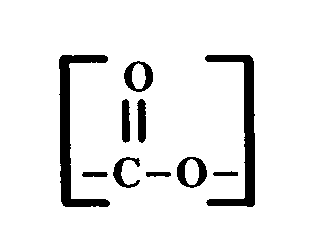
Denotes the final chemical compound, or compounds, that are produced by a fermentation process and includes compounds which are of known as well as unknown structure.
Denotes any metal having a specific gravity greater than 4 and as employed herein includes arsenic and antimony.
Denotes the presence of one or more carbon atoms covalently bonded in a closed ring with at least one atom of oxygen, nitrogen, sulfur, selenium or tellurium and having no other atoms in the ring.
Denotes compounds containing carbon, which are further characterized by the presence in a molecule thereof of two carbon atoms bonded together; or one atom of carbon bonded to at least one atom of hydrogen or halogen; or one atom of carbon bonded to at least one atom of nitrogen by a single or double bond. Note. Compounds included within this definition, but not considered organic are hydrocyanic acid, cyanogen, isocyanic acid, cyanamide, dicyanamide, cyanogen halides, isothiocyanic acid, fulminic acid, and metal carbides.
Denotes the presence of a carbonyl (C=O) bonded to hydrogen and/or carbon and is a term limited to ketones and aldehydes.
Denotes the presence of oxygen singly bonded to a carbon, which is not the carbon of a carbonyl group, and is further bonded to hydrogen, metal or an organic radical. The term is generic to alcohols, phenols, alcoholates, phenolates, ethers and esters thereof.
Denotes an agent (A) which will cooperatively act with an active ingredient for this class (B) to the extent that the total effect (A+B) will be greater than the sum of the two effects taken independently.
Denotes that form of medication supplied in a manner requiring no further weighing or measuring to provide the dosage; e.g., tablet, capsule, etc. Medicines in bulk form; e.g., powder, syrup, etc., are not included.
Glossary Terms for Class 425 PLASTIC ARTICLE OR EARTHENWARE SHAPING OR TREATING: APPARATUS
When used in a subclass title indicates plural basic subject matter of this class. And/or has not been used; see �gOR�h.
Forming a plastic mass or preform by introducing gas under pressure within the mass or preform.
Uniting by adhesive means or fusion (a mechanical interlock is excluded).
A baker"s kneading machine. In bread making �gbraking�h is kneading.
A mass or pile of stock material lacking any shape that contributes to a final shape after molding. Bulk material may have a definite shape but it must not contribute its shape to a final desired form.
Forming a preform by pouring fluent stock onto or into a shaping surface. Synonym: Teeming.
Plural fluid containing elements in fluid tight relation when under pressure.
A preform or product made of diverse materials, each of which is identifiable, at least in part, in the final product.
Material derived by a change in physical state from a vapor to a liquid.
To twist or to coil with one part of a preform overlapping another part.
A separable static male shaping surface providing a hollow portion in a casting. A core is differentiated from a plunger in that a plunger moves during a shaping operation.
To shape a layer into parallel rows of wavelike folds extending along its width or length and transverse to the thickness.
Waste or broken plastic.
A chemical or physical treatment to obtain a stable state of a preform or product, (e.g., by vulcanizing, drying, etc.).
A sequence of manipulative steps governed by a mechanism such as a cam, timer, program means, etc.
An apparatus part having a work contacting part for shaping or reshaping the work.
An independent entity.
Differing from one another.
A soft semi-solid mass capable of being kneaded or of being shaped into a self-sustaining form, (e.g., clay bread dough, etc.).
A hollow cylinder, substantially circular in cross-section, which has a surface used as a shaping or working surface.
Apparatus in which motion of a part is essential to accomplish a desired function, (e.g., shaping, cutting, etc.).
A product made of (1) slightly porous opaque clay fired at low heat; (2) inorganic settable ingredient containing, (e.g., Portland cement type, etc.), (3) powdered metal (4) ceramics other than glass or slag; (5) alkali metal silicate containing.
Means to release or remove a product from a shaping surface.
Altering a surface configuration only.
A closed loop, such as the peripheral surface of a roll, a cylinder or a drum.
A shaped body of material formed by forcing the material through a confining, shaping orifice.
A receptacle having structure for imparting a desired configuration to a removable product formed therein from stock material.
Reshaping a tubular portion by spreading a portion outwardly.
A material which lacks ability to retain a shape at working temperatures, but instead readily conforms in shape to the configuration of a surface upon or within which it is placed.
A single mold having plural shaping compartments in which plural articles are formed by one operation.
Self-sustaining but not permanently set or cured, (e.g., unvulcanized rubber, etc.).
A self-sustaining body having a longitudinal dimension which is effectively infinite.
Remaining in the same place.
Cohesion among common boundaries of particles material without a mechanical interlock.
Working a material by intermittent squeezing and relieving a semi-solid material such as dough, rubber, etc. Synonym: BRAKING
A form for shaping a shoe.
Control of sequential operations of machine parts by electrical or mechanical program means with operator control reduced to mere starting or stopping of operation of the machine.
A shaping form over or around which material is shaped or a preform is resized.
A joint made by random lapping of discrete pieces, (e.g., as in a bale of paper, etc.).
A naturally occurring mineral which can be formed into a stone-like product by grinding, wetting, shaping and burning.
The portion of a segmented mold which forms the neck portion of a hollow article.
This conjunction is used in this class to indicate either the combination of two subcombinations or either one of the subcombinations.
A supporting surface used as a mold bottom or as a green material handling device.
An intermediate hollow preform from which a bottle or the like is made.
Minute separate particles which are handled as bulk and not as individual pieces.
A material that prevents adhesion or sticking of work to the apparatus.
PLASTIC ARTICLE OR EARTHENWARE
This generic title embraces the types of material, which have the common property of plasticity under the working conditions of the apparatus and are shaped or reshaped by apparatus within the scope of the class. These materials include the following: (1) natural or synthetic resins or gums; (2) green ceramic compositions, (e.g., clay, etc.); (3) particulate material or powder including powdered metal; (4) melts of solids or softened solids except of glass or of metal where a shaping surface is used; (5) slurries except of paper pulp; (6) dough or paste, including edible types.
The property of a material to flow either in a fluent or conditioned solid state, whereby it may be shaped or reshaped into a self-sustaining preform or product.
Means providing a press-type shaping surface.
A self-sustaining intermediate object having a configuration that contributes in part to the shape or structure of a final product.
The material or article which has been shaped, reshaped or treated by the apparatus; the result of a shaping, reshaping or treating operation. (Note: material which may be �gproduct�h for one shaping operation may be �gwork�h for an ensuing operation).
Representation of an object in outline, (e.g., a shape obtain by sculpturing, etc.).
Restoring a bead or rim on a product, usually a tire.
Restoring the wear surface on a tire casing.
Providing an exact fit of mating parts.
Changing the configuration of a preform to a desired shape (deformation involving a surface rather than an entire layer is included).
Changing a dimension but not the overall configuration.
An endless shaping surface which has a substantially circular cross-section.
An implement used to scrape off or smooth a surface of material which is being molded.
The capacity to retain an imparted shape.
A group of shaping couples each of which generally comprises plural coacting means.
To separate a portion from a body by cutting or breaking or perforating.
The coalescence of parts into one solid mass through heating, generally with melting limited to a surface layer only of each particle.
Means providing a shaping orifice of a size to produce pliable filaments.
Extrusion molding of indefinite length filaments.
Apparatus having no relatively moving parts during the forming or shaping operation.
A material being worked on or treated by apparatus. Synonym: WORK
A workpiece to which a layer or coating of material is applied. Synonym: BASE
A reshaping operation involving only a surface of a preform, i.e., partially through the thickness of a layer.
To compact by a series of blows and thereby eliminate air pockets or other voids.
See Casting.
A pattern used as a guide to the form of a piece being made.
A compartment having means for providing a measured charge of material passing therethrough.
A movement to or from a station, (e.g., shaping, feeding or ejecting station, etc.), as opposed to movement at a station essential to an operation, (e.g., mere mold opening or closing, etc.).
Altering or actively maintaining some property or a product or preform.
A fluid, generally a liquid, employed to carry stock material to a molding surface.
As used in a subclass title indicates the combination of basic subject matter of this class and that of a diverse class.
The material being shaped, reshaped or treated by the apparatus. Synonym: STOCK
Glossary Terms for Class 426 FOOD OR EDIBLE MATERIAL: PROCESSES, COMPOSITIONS, AND PRODUCTS
Substance or a mixture of substances used primarily for purposes other than its nutritive value and added to a food in relatively small amounts to (1) impart or improve desirable properties (2) or suppress undesirable properties, and (3) may become a part of the food or be transitory in nature. (Compare ingredient below which in some instance may be an additive).
Principal constituent (except added water) of a composition considered to be the fundamental part and by which the composition is (usually) identified. Usually the basic ingredient constitutes the major portion of the composition, e.g., chocolate milk-milk is the basic ingredient. In those instances wherein a plurality of percentages of the ingredients are given that ingredient which constitutes 50 of the total composition (excluding added water) is considered to be the basic ingredient. The 50% may be determined by summing like ingredients, e.g., lactose, whey and butter fat are all lacteal derived.
Compound, the monomeric units of which contain at least five carbon atoms, and their reaction products wherein the carbon skeleton of carbohydrate unit is not destroyed. Alcohols and acids corresponding to carbohydrates, such as, sorbitol ascorbic acid, or mannonic acid are not considered as being carbohydrates.
Products which are as a complete product free or relatively free from water and under normal ambient conditions involve such characteristics, but not necessarily each and every one, as free flowing, dry to the touch, nontacky or sticky, nonadhesive, granular, powder, tablet, flake, flour, meal, particulate, pellet, finely divided, etc.
Any enzyme or any living organism that is capable of causing or modifying a fermentation.
Class that includes the treatment of an edible, per se.
Component part (usually a major one) of mixture that goes to make a food. (Compare additive above which in some instance may be an ingredient).
ISOLATED TRIGLYCERIDIC FAT OR OIL
Fat or oil (as defined below) that is free of any of the plant or animal tissue from which it is derived.
Mercantile combination of an edible material fully encased, encompassed, or completely surrounded by a solid material.
Class that does not include the treatment of an edible, per se.
Material containing a certain amount of the original animal or plant as against an extract which is considered to be devoid of original cellular structure. Included within the term are materials which are chopped, cut, comminuted, pulverized, milled, slice, etc.
Esters of glycerol and a higher fatty acid (i.e., a monocarboxylic acid containing an unbroken chain of at least 7 carbon atoms bonded to a carbonyl group) wherein the three available hydroxyl functions of the glycerol are esterified by a same or different fatty monocarboxylic acid. Triglycerides are the chief constituents of the naturally occurring fats and oils.
Glossary Terms for Class 428 STOCK MATERIAL OR MISCELLANEOUS ARTICLES
ADDITION POLYMER FROM UNSATURATED MONOMERS
Any multiunit chain which is the product of the reaction of unsaturated bonds in the units. The product may be the result of interaction of molecules of the same compound (as polyethylene) or of different compounds (as acryronitrile-styrene). Vinyl acetate and methyl methacrylate are included within the scope of the term because the monomeric units are linked through the reacted unsaturated bonds and the ester groups are pendant - i.e., the units are not linked through the ester groups. (Nonstructural or Composition)
ALDEHYDE OR KETONE CONDENSATION PRODUCT
A resin resulting from the reaction of an aldehyde or a ketone and a polyfunctional active hydrogen containing compound, which, with the elimination of water, produces a chain of alkylidene units alternating with the residue of the hydrogen supplying compound. Phenol formaldehyde, urea formaldehyde and polyamino (e.g., melamine) aldehyde or furfural resins are within the scope of the term. (Nonstructural or Composition)
Material derived from an animal and found there originally in film or layer form, e.g., bladder,skin or scale. Glue or gelatin in a film form is not included here because neither exists in the animal as a layer or foil. (Nonstructural or Composition)
Antiferromagnetism occurs when the exchange interaction between neighboring atoms cancel each other, so the net magnetic moment is zero. Examples of antiferromagnetic materials are (Pt, Ir, Cr , and Pd) Mn alloys, and select transition metal oxides.
A native magnesium calcium silicate. Asbestos is not considered to be included in the term �gmetal compound�h for purposes of this class, but is included in silicon containing, unless specifically stated otherwise in a title or definition. (Nonstructural or Composition)
A discrete determinate three dimensional thing substantially in its ultimate use form, as distinguished from stock material (e.g., sheet, etc.) from which such articles may be manufactured. These articles are limited to subclasses 2 through 34.1, part of subclass 542 and subclass 576. (Structural)
That substance or material which has been covered or saturated or permeated, either partially or completely by another material. This term is synonymous with Substrate. (Structural)
A composition or compound having the characteristics of a tar or pitch no matter what the origin. This term includes all asphalts, bitumens, pitches and tars from coal, mineral oil, cotton seed pitch and the residue from the destructive distillation of wood, and natural oil distillations. Carbohydrate 1) polyhydroxy mono-aldehydes and polyhydroxy mono-ketones, generally having the formula Cn(H2O)m and substances which are hydrolized to these. The term includes cellulose, starch dextran, dextrin, sugar, and lignin. (Nonstructural or Composition) Note. Wheat paste, which contains gluten, is considered polyamide.
See definition of intermediate-article*. (Structural)
A relatively large piece of material whose thickness is many times that of a web* or sheet* compared with its width. (Structural)
Inorganic material. (Nonstructural or Composition)
A carbohydrate material derived from the structural matter of plant life, usually from the stems. The term includes lignocellulose (e.g., wood and bark) relatively pure cellulose (e.g., cotton and linen) and chemically modified forms of cellulose as cellophane, pyroxylin, viscose and rayon. While pyroxylin may be plasticized with minor amounts of camphor and/or castor oil, for purposes of classification, pyroxylin is considered cellulosic. (Nonstructural or Composition)
Clay containing, therefore silicon containing. (Nonstructural or Composition)
The outer bark of cork oak. The cork may be in the form of slabs or may be used as a filler in finely divided form. (Nonstructural or Composition)
A hole or a hollow place in a body. (Structural)
A closed cavity (which may be empty or full) in a component*. (Structural)
A fabric* which for purposes of this class is considered to be made of mechanically intertwined, interlooped, interwoven, or intertangled strands*, strand-portions* or strand like strips*. See Class 442, class definition. (Structural)
A distinct unitary element of a composite stock material* which is longitudinally coextensive therewith and which, if separated from the remainder of such stock material*, would be recognized as a web*, sheet*, rod*, strand*, tube or block by itself. A component may consist of plural layers* as in the folded component shown in Figure 1. See also (2) Note under A, above. (Structural)
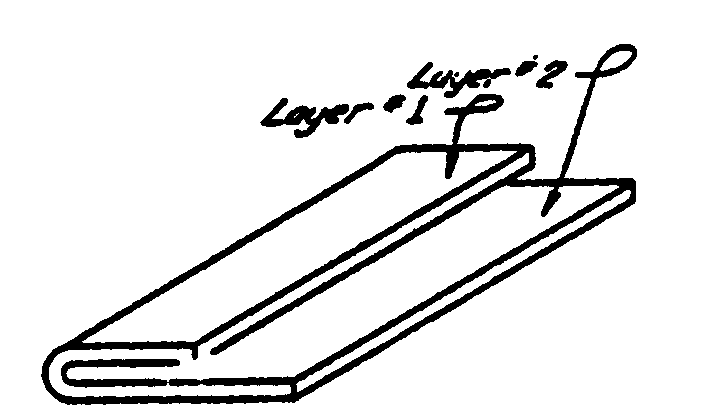
A stock-material* comprising a plurality of components*. (Structural)
A product having a plurality of constituents* or elements, none of which are in a defined spatial or ordered relationship to each other or to the surface or shape of the body in which they are contained, that is, a random mixture of elements. (Structural)
A discrete element* (e.g., strand*, fiber*, particle*, etc.) of a component* or product.
intermediate portion of a composite* product. In a composite web* or sheet*, a core lies between two other components*; in a rod* or strand* or filament*, a core is the inner portion covered with another layer. If a core is claimed, per se, it is to be assumed for purposes of this class that the other layer(s)* or component(s)* are included. (Structural)
See definition of constituent*. (Structural)
A compound which is identical to that obtained by the replacing of a hydroxy hydrogen of an alcohol or a phenol with an acid radical. (Nonstructural or Composition)
The chemical grouping obtained by replacing the hydroxy hydrogen of an alcohol or a phenol with an acid radical. (Nonstructural or Composition)
A web*, sheet* or film disclosed as used in the manufacture of household furnishings (e.g., draperies, upholstery, etc) shoes, etc., roofing, clothing, tires, etc. and is claimed as a textile*, cloth* or fabric. See Class 442, class definition. (Structural)
Ferrimagnetic materials exhibit exchange interaction between neighboring atoms leading to adjacent moments; however, the magnetic moments are unequal and opposite in direction. The magnetic properties of ferrimagnetic materials are strongly temperature dependent and are characterized by their Curie temperature. Examples of ferrimagnetic materials are rare earth-transition metal amorphous alloys, such as GdFeCo, TbFeCo, and select granular transition-metal alloys.
Ferromagnetic materials exhibit exchange interaction between neighboring atoms leading to adjacent moments. Ferromagnetism is temperature dependent and field strength dependent. Typical ferromagnetic materials include transition metals such as Fe, Ni, and Co and their alloys.
A relatively short, slender, flexible element of macroscopic size and finite length and having a width and thickness of the same order of magnitude. A fiber is generally of staple length to facilitate its being spun, twisted or otherwise secured together into a composite strand but may be of shorter length requiring bonding, felting or matting to form a strand or layer. It may be of animal (e.g., wool, rabbit hair), vegetable (e.g., cotton, jute, hemp), or mineral (e.g., asbestos, glass, metal) origin and may be either natural, modified or synthetic. See also Filament. (Structural)
A fine threadlike body or structure whose width and thickness are of the same order of magnitude. See also fiber. (Structural)
A small thin mass having a width or length greater than its thickness. The term flake is considered to denote structure and is classified accordingly. (Structural)
An amorphous, hard, brittle, often transparent material comprising a fused mixture of the silicates of the alkali and alkaline earth, or heavy metals. Glass is not considered to be included in the term �gmetal compound�h for purposes of this class, unless specifically included in a title or definition. (Nonstructural or Composition)
Inorganic material as is carbon. (Nonstructural or Composition)
See natural oil, gum, rosin or lac below. (Nonstructural or Composition)
A fully shaped article, all three dimensions of which are definite, even though one or more of these dimensions may be negligible. The article is not suitable for functional use in the claimed condition, but must be subjected to one or more further significant shaping steps to do more than merely occupy space. The following operations have been regarded as not involving a further significant shaping: (a) Assembling or uniting the article with other parts. (b) Distorting the article during an assembly operation to cause the article to conform to discrepancies in the size or shape of a coacting part. (c) Bonding or distorting those portions of the article which are to function as means for fastening the article to a coacting part, as, for example, the bending of ears or tabs. (Structural)
See natural oil, gum, rosin or lac below. (Nonstructural or Composition)
A single thickness of material(s) in the form of web* or sheet*, or a plurality of any of these in side-by-side coplanar relation; or particulate material arranged in continuity to constitute a distinct stratum. A layer may include a plurality of components* as in Figure 2. See also (2) Note under A, above. (Structural)
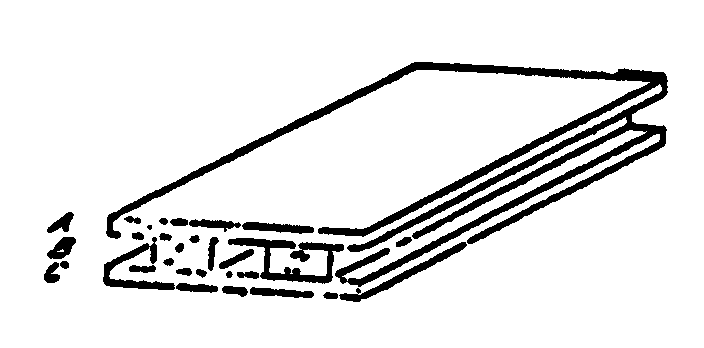
A material exhibiting the inherent property of magnetism, which is dependent on the electronic configuration of the atom, crystalline and molecular structure, and coupling between electrons arising from the orbital and spin magnetic moments of the nucleus and electrons. A material is considered magnetic for the purposes of this class if it exhibits a nonzero magnetic moment, such as in paramagnetism, ferromagnetism, and ferrimagnetism.
A body of material of indefinite or indeterminate shape. (Structural)
A material having a continuous phase of any element of the periodic table except hydrogen, a noble gas, a halogen, a chalcogen (oxygen, sulfur, selenium, tellurium), nitrogen, phosphorus, carbon and boron. Elemental silicon is considered to be a metal, but a silicon compound is not considered to be a metal compound on the basis of silicon content. The term �gmetal compound�h in a subclass title does not include glass or asbestos, unless specifically included by title or definition. The metal may be a pure metal or an alloy as defined in Class 75, Specialized Metallurgical Processes, Compositions for Use Therein, Consolidated Metal Powder Compositions, and Loose Metal Particulate Mixtures, subclass 122, (1) Note. An intermetallic compound of two or more metals, e.g., a metal silicide, aluminide, etc., is considered to be an alloy. (Nonstructural or Composition)
Composed entirely of metal* or having adjacent metal components. Since autogenous bonding of two metallic parts is thought to involve inherently either a diffusion or alloying between constituents of the two parts, this diffusion or alloy layer, even though of appreciable thickness, does not prevent the undiffused or unalloyed regions from being considered. (Structural)
NATURAL OIL OR GUM, ROSIN OR LAC
Any oil, gum or resin that occurs in nature, as cottonseed, linseed and castor oils, rosin, mineral oil and the exudation of insects known as lac. These three classes of oil; drying, semidrying and nondrying oil are included within the scope of the term. (Nonstructural or Composition)
Containing the natural gum, know as caoutchouc, gutta percha, or balata obtained from the latex or sap of �grubber�h trees. The word �grubber�h standing alone is considered to denote natural rubber. (Nonstructural or Composition)
Those metals not readily oxidized, i.e., silver, gold, platinum, polladium, mercury, iridium, rhodium, ruthenium, osmium. (Nonstructural or Composition)
The surface of a web, sheet, layer or component on which both its length and width may be measured. See Figure 3. (Structural)
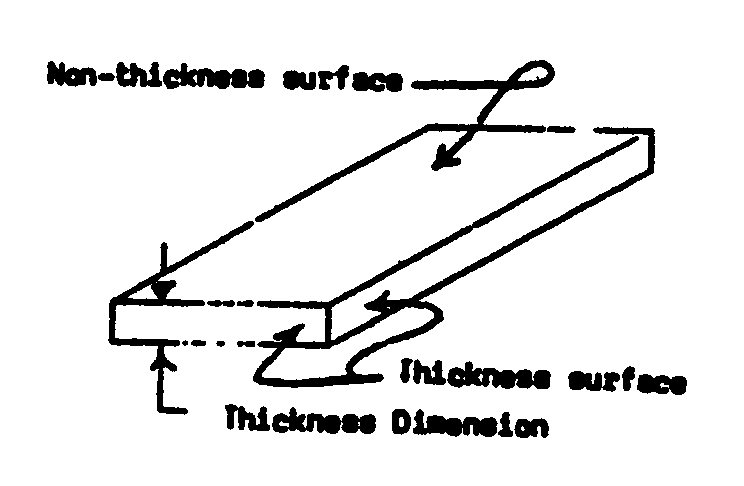
See natural oil, gum, rosin or lac, above. (Nonstructural or Composition)
Unless otherwise specified, is a sheet or web of waterlaid felted cellulosic fibers. May also be made of asbestos, mineral or synthetic fibers or blends of fibers, but must be so disclosed solely, or must be so claimed for placement in a subclass other than cellulosic or paper. (Nonstructural or Composition)
Paramagnetic materials have magnetic moments not completely canceled because of electronic configuration and exhibit a resultant moment. Paramagnetic susceptibility is strongly temperature dependent. Examples of paramagnetic materials are CoCr alloys at specific Cr concentrations and materials exhibiting specific size ranges of either the magnetic grains or particle dimensions.
A very small quantity of matter, so small as to be considered without magnitude although possessing inertia and the force of attraction. (Structural)
A polymeric compound containing amide groups through which the monomers are linearly linked, except urea-aldehyde (for which see alddhyde or ketone condensation product). The term includes 1, the reaction products of polyamines and polybasic acids or 2, the polymer of amino acids (e.g., nylon, peptides and proteins). The manner in which the amide groups linearly link the monomers or moieties, of which the chain is built is graphically indicated by the below: (Nonstructural or Composition)
Note. Wheat paste, which contains gluten, is considered to be a polyamide.
Note. Polyamide also includes polyimide.
Note. Urea-aldehyde condensation product is not included within the definition of polyamide since the product is significantly different from other polyamide resins and are similar to phenol-aldehyde resins. Hence, urea-aldehyde products are placed in the subclass providing for aldehyde-ketone condensation products.
A compound which is a polymer of linearly recurring amide and ester linkages. The monomers do not have to have an equivalent number of amide and ester groups and they do not have to occur in a regular pattern. The products of (1) a) polybasic acids b) polyhydric alcohols and c) polyamines or, (2) a mixture of hydroxy acids and amino acids or (3) polybasic acids and hydroxy amines are within the scope of the term. (Polyurethane is exemplary): The manner in which the ester and amide groups linearly link the monomers or moieties, of which the chain is built, is graphically indicated by the below structure. The ester groups need not be carboxylic esters but may be, e.g., sulfate ester groups. (Nonstructural or Composition)
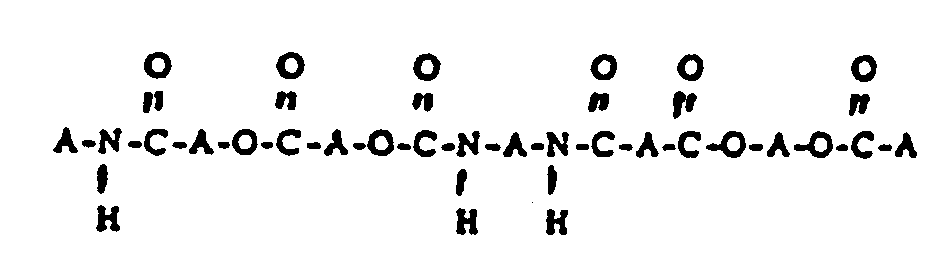
A polymeric compound containing ester groups through which the monomers are linearly linked to each other. The manner in which the ester groups linearly link the monomers or moieties, of which the chain is built, is s:graphically indicated by the below structure. The ester groups need not be carboxylic esters but may also be, e.g., sulfate ester groups. (Nonstructural or Composition)
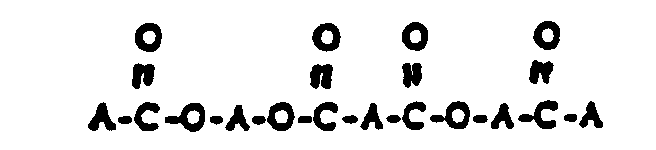
Included within the term polyamide. (Nonstructural or Composition)
A tiny opening, usually microscopic, through which certain fluids may pass. Generally, the pore opening is of such irregular direction that light will not pass through it. (Structural)
A mass of particles, that is, portions of matter so small that they are not ordinarily handled as individual units. According to Metals Handbook, 8th Edition, 1961, volume 1, page 28, powders currently used in powder metallurgy had a particle size within the range of 0.1 to 1000 microns in their largest dimension, as determined by screens or other suitable instruments. Powder particles generally are distinguished from filamentary particles in that their shape and length-to-diameter ratio are such that in the dry state the particles will not hold together as a massive article without the application of pressure or heat. (Structural)
A fused silicon dioxide (silica). (Nonstructural or Composition)
Various materials, but usually clays or other cementitious or silicon containing. Consider to be silicon unless clearly disclosed otherwise, as for example alumina. The refractory metals are those in Groups IVB, VB and VIB of the Periodic System. (Nonstructural or Composition)
See natural oil, gum, rosin or lac. (Nonstructural or Composition)
A relatively rigid and slender element having a width and thickness of the same order of magnitude, a length which may be either indeterminate or finite, and a cross-section which may be of any shape. (Structural)
A portion of web* material of finite length, whose width is greater than its thickness, and which may be of any perimetric shape (e.g., triangle, circle, etc.). (Structural)
A sheet*, web*, rod*, strand*, tube or block, mass or layer. (Structural)
A relatively slender and flexible element* having a width and thickness of the same order of magnitude and a length which is either (a) indeterminate or (b) coextensive with the length or width of a sheet* or layer* with which it may be associated. A strand may be a monofilament or it may include either a plurality of filaments* or fibers* disposed in parallelism (e.g., tow) or constituent fibers* and/or filaments* knitted, plaited, braided, twisted, interlaced, interlocked or otherwise secured together to form a unit such as roving, thread, yarn, cord, rope or cable. (Structural)
A strand* of finite length; or an unsevered but determinate length of a strand. (Structural)
A web* or sheet* or relatively narrow ribbon-like material. A strip which is interwoven or intertangled with other strips or with strands, in the same manner as a strand, will be termed a �gstrand-like strip�h. (Structural)
See Base*. (Structural)
A fabric* which, for purposes of the class is considered to be cloth*. See Class 442, class definition. (Structural)
A compound described as a wax (e.g., beeswax) or having the physical characteristics of a wax or is a recognized wax (as carnauba). (Nonstructural or Composition)
A portion of material having length and width each greater than its thickness and with at least its longitudinal dimension indeterminate. A web may comprise (a) a single thickness of material or (b) a plurality of portions of a single piece of material folded on each other longitudinally or transversely, or (c) a plurality of individual web components* joined together in longitudinally coextensive face or edge contact to form a composite web. (Structural) Note. Unless clearly disclosed or claimed otherwise (e.g., as a rod*, mass*, filament*, etc.) a product will be placed in the appropriate web* or sheet* subclass. Note. Included under the definition of component* or layer are the following: (a) The skin formed on a porous layer* by curing (e.g., a foam, etc.). (b) The �glayer*�h formed by impregnating a substrate to a defined depth which must be recited either relatively to the entire thickness or as an absolute dimension. (c) Either of a pair of layers* of the same material cohered or adhered together by their own forces, if disclosed as plural separate layers*. Note. For purposes of this class, paper* is limited to a waterlaid web* of interfelted cellulose* (natural) fibers*. A waterlaid web* of resin, polymer or modified cellulose* (e.g., cellulose acetate) fibers is excluded from the paper* subclasses and will be classified on other features (e.g., composition, etc.). Note. Where a subclass title includes a �gcoating�h or �gcoat�h or �gcoated layer*�h, a bonded or adhered component or layer* is intended to be included within the scope thereof. Thus, a product formed by laminating or adhering two separate and distinct layers* is considered to be the equivalent of a product made by applying a coating of a material onto a base* or substrate*.
The material of trunks and branches of trees or bushes, excluding bark. This term includes lumber and finely divided wood chips, fibers or flour. �gFiber board�h from wood fibers or pulp will be considered wood or paper depending on the disclosure of the document in which this expression occurs. Fiber board formed by compression of wood fibers with or without a binder (and utilized as wood) is considered wood. Fiber board which is water laid (and, used as cardboard or paste board) is considered paper. (Nonstructural or Composition).
A stock-material* not suitable for functional use in the claimed condition, but requiring one or more further significant shaping steps to do more than occupy space. Usually it is the cross-sectional configuration which is to be further shaped. See the definition of intermediate-article* for a list of operations not considered to be significant shaping.
Glossary Terms for Class 429 CHEMISTRY: ELECTRICAL CURRENT PRODUCING APPARATUS, PRODUCT, AND PROCESS
The element, chemical compound, or composition which chemically reacts to produce a transfer of electrons through an external circuit.
Two spaced electrodes provided with means to transfer an ionic current therebetween.
The electron current carrying material or structure at which the current producing chemical reaction takes place
A material capable of passing an ionic current.
A device used to produce an electrical current wherein one of the reactants is fed to the cell.
The material which includes an active material as one of its components.
A material used to space or maintain a pair of electrodes out of contact. This includes material which function only to stop dendritic growth (treeing) between the electrodes.A cell or group of cells.
Glossary Terms for Class 430 RADIATION IMAGERY CHEMISTRY: PROCESS, COMPOSITION, OR PRODUCT THEREOF
color (red, green, blue) when added to the other two additive colors produce white.
polyhydroxy mono-aldehyde and a polyhydroxy mono-ketone, generally having the formula C (H2O) and substances which are hydrolyzed to these. The term includes cellulose, starch, dextran, and sugar.
process involving a chemical reaction or the recitation of chemical composition, compound, etc., in the claims which are involved in a chemical reaction during the process.
COLOR IMAGE IN OR ON AN IMAGE RECORD
At least a portion of the image record absorbs only part of the light in the visible electromagnetic spectrum, excludes black image on white background, or vice versa, includes black image on green background.
Particulate material which develops an electrostatic, magnetic, or electrical image by attraction of the particulate material to the image.
Application of radiation to form or perfect an image.
Organic compound containing a ring composed of carbon and at least one element from the group consisting of nitrogen, sulfur, selenium, tellurium, and oxygen.
A substance, layer, or product is considered identified when it is claimed in terms of its chemical constitution instead of merely its function. The terms �gorganic�h and �ginorganic�h are not considered identified, but any other positive chemical identification is considered sufficient even if generic, e.g., heterocyclic, synthetic resin, hydrocarbon, etc. Negative definition, per se, e.g., nonaqueous, etc., is not considered identification, but if combined with sufficient other material, e.g., nonaqueous alcohol. The term acid or base or their equivalents are considered identification. The identification of any ingredient of a layer is sufficient to make the layer identified.
The likeness or reproduction of (a) an object, or (b) an instrumented or discernible phenomenon.
The application of radiation to form an image.
A record, made using an imaging process, where the image is located, e.g., the image may be in or on a radiation conductor containing element or may be in or on receptor element, etc.
An image which absorbs only part of the light in the visible electromagnetic spectrum.
The propagation of energy through space or through a material. It may be in the form of electromagnetic waves, corpuscular emissions, or sound waves. The format is usually categorized according to frequency, e.g., Hertzian, infrared, (visible) light, ultraviolet, X-rays, gamma rays, etc., corpuscular emissions are categorized as alpha, beta, or cosmic.
An element which receives a transferred image from another element.
Defined in terms of: (a) numerical or relative dimension; e.g., 5 microns thick, twice as long as wide, etc. As applied to products or layers, it is the overall exterior dimension of either the completed product or an individual layer; (b) plural, non-coextensive layers, e.g., leader strip, etc., however, nonuniform or non-coextensive images are not considered structure; (c) overall mechanical shape, except mere rectangular or planar, e.g., roll of film sprocket holes, etc.
A layer or layers which are part of a combination of plural layers which layer or layers are strippable from a layer immediately adjacent to it or are capable of separating by internal cohesive failure.
A color (cyan, magenta, and yellow) which when combined with another subtractive color produces an additive color (red, green, blue).
Glossary Terms for Class 431 COMBUSTION
Term generic to �gburner assembly�h, �gburner head�h and �gflame holder�h.
A unitary device or fixture including a flame holder and associated feeding or supporting elements.
A device by which fluent fuel is passed to a combustion space where it forms a flame projecting from the device.
The dislodging of extraneous matter or incrustations.
The direct combination of oxygen gas and a burnable substance.
Generic term for the part of a combustion device confining the flame or supporting the base of a flame. It includes burner heads, the flame supporting portion of wicks, the pots of pot type burners, etc.
The spread of flame from a combustion area into a feed passage of a burner head.
A body of material that produces igniting sparks when struck. It is generally made of an alloy of iron and cerium.
A small auxiliary unit used to ignite a principal flame holder.
The removal of unwanted material.
A device that provides for the delay of completion of performance of an operation after its initiating signal has been given, e.g., dashpot, time delay switch, etc.
The flushing out of unwanted gas or gas mixture by another gas or gas mixture.
The term is used in this class to indicate that a combustion device has been stopped and that it cannot be made to operate except by manual intervention.
Glossary Terms for Class 435 CHEMISTRY: MOLECULAR BIOLOGY AND MICROBIOLOGY
Rate of metabolic or anabolic action, speed or efficiency. Mere suppression of competing strains is not viewed as increasing the activity.
By means of a bacteria, yeast, animal or plant cell, or virus, or the parts thereof.
Bridged or fused.
For purposes of this class derivatives included with the production of a named compound are only the inorganic anion or inorganic cation salts thereof, e.g., metal, ammonium, halogen, carbonate, etc.
For purposes of this class classified as an amylase.
The use of a microorganism or enzyme to carry a molecular transformation.
Material that when present in the environment produces for man and other living organisms a dangerous, risky, or perilous environmental situation in so for as the physiological well being of the organism is concerned (e.g., all caustic chemicals, irritants, cancer causing agents, and other tumor producing materials).
Containing only O, N, S, Se, or Te in addition to carbon in a ring.
Material which supports or sustains growth of microorganisms which material may contain substances which will not support or may inhibit the growth of selected microorganisms.
For purposes of this class, bacteria, actinomycetales, cyanobacteria (unicellular algae), fungi, protozoa, animal cells or plant cells or virus.
A polynucleotide or more than two nucleotides.
Distinguished from (propagation) media by the presence of an indicator, e.g., chromophore, etc.
Materials that are direct physiological poisons to living organisms (e.g., pesticides, heavy metal ion solutions, and other materials that are poisonous to life.
The compound or composition to be measured.
SPECIFIC LIGAND-RECEPTOR BINDING ASSAY
The interaction between a ligand material and a receptor which is specific to a class of compounds or a single compound.
A single antigenic determinant portion of the antigen which combines with the antibody site.
A member of a signal producing system which is usually bound to or incorporated in the ligand. Measurement of the label activity is an indication of the amount of unknown in the sample.
Any organic compound for which a receptor naturally exists or can be prepared; a linking or binding molecule.
Any compound or composition capable of recognizing a particular spatial and polar organization of a molecule, i.e., epitopic site on an antigen. The receptor material can be isolated from a cellular material from a living body such as a membrane or organ and exhibits great specificity to the species to be tested for. A cell surface molecule which binds specifically to particular proteins or peptides in the fluid phase.
Glossary Terms for Class 436 CHEMISTRY: ANALYTICAL AND IMMUNOLOGICAL TESTING
A protein of the globulin in type that is formed in an animal organism in response to the administration of an antigen and that is capable of combining specifically with that antigen. Abbr Ab. See also immunoglobulin.
A substance, frequently a protein that can stimulate an animal organism to produce antibodies and that can combine specifically with the antibodies thus produced; called also complete antigen as distinct from a hapten. Abbr Ag.
The generally insoluble molecular aggregate that is formed by the specific interaction of antigens and antibodies. It is also referred to as the immune complex.
A substance that can react selectively with antibodies of the appropriate specificity but stimulates the production of these antibodies in an animal only when it is coupled to a carrier.
An insoluble material that is used for the purification of antibodies by adsorbing them from a serum; a gel for trapping antibodies, or an inert solid to which either antigens or haptens have been covalently linked are two examples.
An assay that utilizes antigen antibody reactions for the determination of chemical substances.
A technique for identifying antigens in complex mixtures by first separating the antigens in one dimension by means of gel electrophoresis, and then allowing them to react with antibodies by means of two dimensional double diffusion through the gel; a pattern of precipitin arcs is thereby produced. Abbr IE.
1. A protein of animal origin that has a known antibody activity. 2. A protein that is closely related to an antibody by its chemical structure and by its antigenic specificity.
Glossary Terms for Class 438 SEMICONDUCTOR DEVICE MANUFACTURING: PROCESS
Amorphous silicon
Acoustic charge transport
Analog-to-digital converter
Auger electron spectroscopy
Atomic layer epitaxy
Angle-lapping edge profilometry
Active matrix display
Alternative-metal, virtual-ground (metallization)
Atmospheric-pressure CVD
Avalanche photodiode
antireflective coating
Arsenosilicate glass
Barium bismuth copper oxide (a HTSC)
Bucket brigade device
Buried bit-line
Band edge discontinuity
Buried heterostructure
Buffered hydrofluoric acid
Breakdown of insulator for conduction
Bipolar inversion channel FET
Integrated bipolar and CMOS
Integrated bipolar and MOSFET
Bipolar junction transistor
Barium potassium bismuth oxide (a HTSC)
Ball limiting metallization
Bulk micro defect
Buffered oxide etch
Buried oxide
Buried oxide with etch stop
Borophosphosilica glass
borophosphoTEOS
Back side damage
buried storage electrode
Borosilica glass
Bias sputter quartz
Barium strontium titanate
Chemically assisted ion beam etching
Complementary bipolar IC
Cross bridge Kelvin resistor (test structure)
Controlled collapse bonding
Corrugated capacitor cell
Charge coupled device
Chemical dry etching
Collector diffusion isolation
Contrast enhancement layer
Contact end resistor (test structure)
ceramic DIP
channel stop isolation structure
Chemically sensitive FET
Current hugging logic
Charge injection device
Confined lateral SEG
Current mode logic (i.e., ECL)
Complementary (NMOS and PMOS) FETs
chemical-mechanical polishing/planarization
(a) chip-on-board or (b) capacitor over bit-line
Catastrophic optical damage
Chip-on-glass
Conductivity modulation FET (i.e., IGBT)
Channeled substrate buried heterostructure
Coherent superlattice
Charge transfer device
Coherent tilted superlattice
Chemical vapor deposition
Czoshralski (melt pulling)
diacetoxyditertiarybutoxysilane
diacetoxydiisopropoxysilane
distributed Bragg reflector
dichromated gelatin
direct-coupled FET logic
dichlorosilane
double diffused epitaxy
deep dielectric isolation
dual electron injection structure
diethylzinc
distributed feedback (laser)
double-hetero
double-hetero bipolar transistor
dilute hydrofluoric acid
dielectric isolation
drain induced barrier lowering
dielectrically encapsulated trench capacitor
dual-in-line package
double layer polysilicon
deep level transient spectroscopy
dimethylaluminumhydride
(a) depletion mode device (also D-mode or D-type) or (b) deformable mirror device
double diffused MOS
dilute magnetic semiconductor
doublehetero optoelectronic switch
dynamic random-access memory
double stacked capacitor
diode-transistor logic
diffusion under film
device under test
deep ultraviolet
denuded zone -E-
electrically alterable read-only memory
(a) extrinsic base or (b) electron beam
electron beam exposure system
electron beam induced current
electron beam lithography
emitter coupled logic
electron cyclotron resonance
ethylene-diamine-pyrocatechol etchant
ethylenediaminotetraacetic acid
electron energy loss spectroscopy
electrically erasable programmable read-only memory
edge-defined film-fed growth (also EDFFG or EDFG)
extrinsic gettering
electronic-grade silicon
electroluminescent
epitaxial lateral overgrowth
enhancement mode device (also E-mode or E-type)
electromagnetic interference
electron microprobe
epoxidated polybutadiene (an EB resist)
etch pit density
epitaxial (single crystalline) layer
ethylene-piperidine-pyrocatechol etchant
electron paramagnetic resonance
erasable programmable read-only memory
effective punchthrough stopper
etchant mix of ethylenediamine, pyrocatechol, and water
electron spectroscopy for chemical analysis
electrostatic discharge
(a) equivalent series resistance or (b) electron spin resonance
floating-gate avalanche-injection MOS
folded bit-line adaptive sidewall isol. capacitor cell
field controlled thyristor
floating electrode capacitor
field emission device
field effect transistor
focused ion beam
full isolation by porous oxidized silicon
floating gate tunnel oxide
field oxide
field programmable device
field programmable gate array
Fourier transform infrared spectroscopy
fully recessed oxide isolation
glow discharge mass spectroscopy
gas immersion laser doping
graded index separate confinement heterostructure
gate turn-off
heterojunction bipolar transistor
high dielectric constant
high density interconnects
high density multilayer interconnects
high electron mobility transistor (Hetero MESFET)
hot electron transistor (bipolar)
high capacitance
hybrid integrated circuit
(see COMFET)
high pressure oxidation
hexamethyldisilizane
hetchant mix of hydrofluoric, nitric, and acetic acids
half-Vccsheath plate capacitor
high temperature oxide
high temperature superconductor
(a) intrinsic base or (b) ion beam
ion beam deposition
integrated circuit
inductively coupled plasma
intrinsic gettering
insulated gate bipolar transistor (e.g., COMFET, HIMOS)
insulated gate field effect transistor
impurity induced disordering
integrated injection logic
ink jet printhead
inner lead bonding
interlayer dielectric
ion microprobe mass analysis
impact ionization avalanche transist time (diode)
intrinsic nondoped semiconductor
infrared
ion sensitive FET (i.e., CHEMFET)
indium tin oxide (a TCO)
isolation vertical capacitor cell
junction field effect transistor (junction gate)
Josephson junction field effect transistor
junction termination extension
Kodak metal etch resist
Kodak photo resist
Kodak thin film resist
low-angle grain boundary
large angle tilt implant drain
(a) Langmuir-Blodgett or (b) laser beam
leadless ceramic chip carrier
liquid crystal display
leaded ceramic chip carrier
lightly doped drain
liquid encapsulated Czoshralski
light emitting diode
low-energy electron diffraction
liquid encapsulated Kyropoulus
local oxidation of silicon
lift-off using edge detection
low-pressure chemical vapor deposition
liquid phase epitaxy
limited reaction processing
large scale integration
lateral surface superlattice
logic service terminal
low temperature co-fired ceramic
low temperature growth
low temperature oxidation
molecular beam epitaxy
magnetic Czoshralski
multichip module
(a) MOS controlled thyristor or (b) HgCdTe
micro-electromechanical
metal semiconductor FET (Schottky gate)
modified fully-framed fully-recessed isolation
metallurgical-grade silicon
metal-insulator-metal
metal insulator semiconductor IGFET
magnetic LEC
multilayer ceramic
multilayer oxide
multilayer resist
methyl methacrylate
monolithic microwave integrated circuit
metal nitride/oxide IGFET
metal organic chemical vapor deposition
modulation doped MESFET (i.e., HEMT)
metal-oxide-metal (tunnelling device)
metal oxide semiconductor IGFET
multiquantum well
mean time to failure
merged transistor logic (i.e., I2L)
negative differential conductivity
negative electron affinity (e-emitter)
N-methyl-acetamide
n-channel MOSFET
n-methyl-pyrrolidone
Thermoplastic phenol-formaldehyde used as photoresist
(bipolar transistor)
nitridation retarded diffusion
nonself-aligned gate
neutron transmutation doping
nonvolatile RAM
optical band gap
orientation dependent etching
oxidation enhanced diffusion
optoelectronic integrated circuit
orientation flat
oxidation induced stacking fault
organometallic CVD
octamethylcyclotetrasiloxane
organometallic VPE
oxidation retarded diffusion
optical return loss
optical subassembly
(see OISF)
over-the-cell routing
one-time programmable
oxygen-doped silicon epitaxial film
photoactive compound
peel apart
photonic band gap
polybuffered LOCOS
planarization blocking mask
pyrolytic boron nitride
permeable base transistor
printed circuit board
photoconductive element
postexposure baking
plasma enhanced chemical vapor deposition
photo-engraving process
peeled film technology
(a) pin-grid array or (b) programmable gate array
poly(glycidyl methacrylate) (an EB resist)
plated heat sink
photonic integrated circuit
programmable interconnect device (fuse/antifuse)
P-type layer, intrinsic layer, N-type layer
thermosetting polyimide resin
programmable logic array
plastic leaded chip carrier
profiled LDD
pad limiting metallurgy
lead lanthanate zirconate titanate
polymethylmethacrylate
p-channel MOSFET
(bipolar transistor)
polycrystalline silicide
polycrystalline silicon
poly pad LOCOS
photoresist
programmable read only memory
planarization with resist/oxide and polysilicon
photosensitive diode or dielectric
phosphosilica glass
positive temperature coefficient
plated through-hole
programmable unijunction transistor
physical vapor deposition
printed wiring board
lead zirconate titanate
quantum efficiency
quad flat package
quad-in-line package
quantum well
quantum well infrared photodetector
random access memory
Rutherford backscattering
resonant tunneling bipolar transistor
reverse conducting thyristor
radiation enhanced diffusion
reduced surface field
resonant electron transfer triode
radiofrequency
reflected high energy electron diffraction
resonant tunneling hot electron transistor (bipolar)
reactive ion beam etching
reactive ion etching
reduced instruction set computing
refined metallurgical silicon
recessed oxide isolation
read only memory
recessed oxide
rapid thermal anneal
rapid thermal processing
self-aligned silicide
self-aligned gate
surface acoustic wave (pressure sensitive device)
Schottky barrier diode
Schottky barrier height
silicon bilateral switch
standard cubic centimeter per minute
single chip module
silicon controlled rectifier
Schottky diode FET logic
selectively doped heterostructure transistor (e.g., HEMT)
shrink DIP
self-enhanced electro-optical devices
selective epitaxial growth
(a)surface emitting laser or (b)state excitation by light
selective epitaxial layer field oxidation
scanning electron microscopy
self-aligned epitaxy over trench
selective polysilicon oxidation
soft error rate
superconducting flux flow transistor
surrounding gate transistor
silicon
semi-insulating
sidewall base contact structure
sealed interface local oxidation
separation by implanted oxygen
secondary ion mass spectrometry
single-in-line package
semi-insulating polycrystalline oxygen-doped silicon
(a)static induct. thyristor or (b)static induct. trans.
spatial light modulator
strained layer superlattice
solid logic technology
surface mount technology
spin-on glass
silicon on insulator
small outline IC package
small outline J-lead package
silicon on sapphire
solid phase epitaxy
self-aligned planar oxidation technology
substrate plate trench capacitor
superconductive quantum interference device
static random access memory
stress relief oxide
simultaneous single/polycrystalline deposition
small scale integration
(a)super self-alignment tech. or (b)sealed sidewall tech.
stacked transistor capacitor cell
superconducting base hot electron transistor
superconducting base semiconductor isolated transistor
sidewall masked isolation
tape automated bonding
turn around time
tritertiarybutoxyethoxysilane
thallium bismuth copper oxide (a HTSC)
trichloroethylene
thermal conduction module
transparent conductive oxide
time dependent dielectric breakdown
thermoelectric cooler
transient enhanced diffusion
(a) triethylgallium or (b) test element group
transmission electron spectroscopy
tetraethylorthosilane
thin film resistor
thin film transistor
temperature gradient zone melting
through-hole
triisobutylaluminum
transmission line tap resistor (test structure)
(a) trimethylaluminum or (b) trimethylantimony
tetramethyl ammoniumhydroxide
tetramethylamidotitanium
tetramethylborate
tetramethylcyclotetrasiloxane
trimethylgallium
tetramethyloxysilane
trimethylphosphine
tetramethylsilane
tetramethyltin
topos:graphic feature enhancement by RIE
thermoplastic film
trapped plasma avalanche tunnel transit (diode)
temperature sensing diode
thin small outline package
transistor-transistor logic
ultrahigh vacuum
ultraviolet
voltage controlled negative resistance
vertical gradient freeze (also VFG)
very high speed integrated circuit
vapor levitation epitaxy
very large scale integration
vertical MOS
vapor phase epitaxy
V-channel substrate inner stripe
wafer scale integration
x-ray diffraction
yttria barium copper oxide (a HTSC)
yttria stabilized zirconia
zero drain overlap
zigzag-in-line package
zone melt recrystallization
microcrystalline
high resistivity intrinsic semiconductor
An atom or ion different from or foreign to, but present in, a semiconductor material and which has insufficient valence electrons to complete the normal bonding arrangement in the semiconductor crystal structure. An acceptor impurity (also referred to as p-type) accepts an electron from an adjacent atom to create a positive charge carrier (i.e., a hole). A donor impurity (also referred to as n-type) provides an electron to the conduction band of the semiconductor.
An electronic device or component that is primarily made up of solid materials, usually semiconductors, which operates by the movement of charge carriers - electrons or holes - which undergo energy level changes within the material and can modify an input voltage to achieve rectification, amplification, or switching action. Active solid-state electronic devices include diodes, transistors, thyristors, etc., but exclude pure resistors, capacitors, inductors, or combinations solely thereof. The latter category is characterized as passive.
A fused junction produced by combining one or more elemental impurity metals with a semiconductor. Typical alloyed junctions include indium-germanium and aluminum-silicon.
The introduction via the vapor phase of impurities from an existing substrate region (and adjacent supports, e.g., susceptors, etc.) into another substrate region, typically during growth of the same.
A sudden change from high dynamic electrical resistance to very low dynamic resistance in a reverse biased semiconductor device (e.g., a reverse biased junction between p-type and n-type semiconductor materials) wherein current carriers are created by electrons or holes which have gained sufficient speed to dislodge valence electrons. Avalanche breakdown can cause structural damage to a semiconductor device.
The difference between the energy levels of electrons bound to their nuclei (valence electrons) and the energy levels that allow electrons to migrate freely (conduction electrons). The band gap depends on the particular semiconductor involved.
A region which extends on both sides of a semiconductor junction in which all carriers are swept away from the junction region. The region is depleted of carriers. This is also referred to as a depletion region. Not to be confused with diffusion barrier layers associated with metallization schemes for active solid state devices.
A substance that always contains the same two elements in a fixed atomic ratio.
An active solid-state electronic device in which both positive and negative current carriers are used to support current flow.
An active solid-state electronic device with a base electrode and two or more junction electrodes in which both positive and negative current carriers are used to support current flow.
The lateral encroachment of the localized oxidation region associated with a recessed oxide isolation structure.
A metallized area to which an external electrical connection is to be made.
A sudden change from high dynamic electrical resistance to a very low dynamic resistance in a reverse biased semiconductor device (e.g., a reverse biased junction between p-type and n-type semiconductor materials) wherein reverse current increases rapidly for a small increase in reverse applied voltage, and the device behaves as if it had negative electrical resistance.
A component used in electrical and electronic circuits which stores a charge of electricity, usually for very brief periods of time, with the ability to rapidly charge and discharge. A capacitor is usually considered a passive component since it does not rectify, amplify, or switch and because charge carriers do not undergo energy level changes therein, although some active solid state devices function as voltage variable capacitors.
A path for conducting current between a source and drain of a field effect transistor.
Means for limiting channel formation in a semiconductor device by surrounding the affected area with a ring of highly doped, low resistivity semiconductor material. In a field effect transistor, it is a region of highly doped material of the same type as the lightly doped substrate used to prevent leakage paths along the chip surface from developing. Also referred to as �gchanstop.�h
The location in a current channel portion of a field effect transistor (FET) where the current is reduced to a minimum value due to its diameter being reduced to a minimum.
A mobile conduction electron or hole in a semiconductor.
Restriction of electrical charge carriers (e.g., electrons or holes) to specified locations (e.g., by quantum wells, gate electrode potentials, etc.).
A field effect device in which storage sites for packets of electric charge are induced at or below the surface of an active solid-state device by an electric field applied to the device and wherein carrier potential energy per unit charge minima are established at a given storage site and such charge packets are injected into the device substrate or into a data bus. This type device differs from a charge transfer device in that, in the latter, charge is transferred to adjacent charge storage sites in a serial manner, whereas, in a charge injection device, the charge is injected in a nonserial manner to the device substrate or to a data bus.
A single crystal substrate of semiconductor material on which one or more active or passive solid-state electronic devices are formed. A chip may contain an integrated circuit. A chip is not normally ready for use until packaged and provided with external connectors.
A package with terminals, for solid-state electronic devices, including chips which facilitates handling of the chip during assembly of the chip to other electronic elements.
A higher band gap material which encases a lower band gap material that defines the walls of a quantum well.
The typical distance an electron can travel before it is scattered (e.g., by a phonon, a defect, or an impurity, etc.).
A term which encompasses both active and passive type devices, the passive type being a resistor whose resistance decreases when subjected to a high frequency signal, and the active type being a rectifier which is made up of active solid-state particles which conduct and rectify current when connected into a cohesive element but which loses that characteristic when the particles are separated (e.g., by shaking a container in which the particles are located, etc.).
COLLECTOR DIFFUSION ISOLATION (CDI)
An electrical isolation technology used for bipolar devices which employs an epitaxial layer, which forms transistor base regions, laid on a substrate of the same conductivity type (p or n) as the epitaxial layer, with an opposite conductivity type region, more heavily doped than the epitaxial base layer and located between the layer and the substrate, forming the collector and isolating the transistor from the substrate.
A semiconductor composed of a chemical compound formed of elements from two or more different groups of the chemical periodic chart (e.g., Group III (B, Al, Ga, In) and Group V (N, P, As, Sb) for the following compounds: AlP, AlAs, AlSb, GaP, GaAs, GaSb, InP, InAs, and InSb, or a compound of silicon and carbon (SiC)).
A partially filled energy band in which electrons can move freely, permitting a material to carry electric current where electrons are the current carriers.
In a conductor or n-type semiconductor, outer shell electrons that are bound so loosely that they can move freely in the conduction band of a solid material under the influence of an electric field.
That portion of the electrical conductors (e.g., bonding pad, die bond, etc.) used for providing external electrical connections from a component to a chip or other component.
The point or part of a conductor which touches another electrical conductor or electrical component to carry electrical current to or from the conductor or electrical component.
Any nonuniformity in a crystal lattice. There are four categories of crystal defects: (a) point defects, (b) line defects, (c) area defects, and (d) volume defects. Point defects include any foreign atom at a regular lattice site (i.e., substitutional site) or between lattice sites (i.e., interstitial site), antisite defects in compound semiconductors (e.g., Ga in As or As in Ga), missing lattice atoms, and host atoms located between lattice sites and adjacent to a vacant site (i.e., Frenkel defects). Line defects, also called edge or screw dislocations, include extra planes of atoms in a lattice. Area defects include twins or twinning (i.e., a change in crystal orientation across a lattice) and grain boundaries (i.e., a transition between crystals having no particular positional orientation to one another). Volume defects include precipitates of impurity or dopant atoms caused by volume mismatch between a host lattice and precipitates.
The condition in which a depletion layer formed in a MOS active device due to voltage applied to the gate electrode of the device is deeper than the maximum depth at which inversion would normally be expected to occur at room temperature in a semiconductor device at the surface closest to the gate electrode, without formation of an inversion layer.
Energy levels that can act as traps located in the forbidden band of a semiconductor material that are not near the conduction or valence band edges.
Doping of a semiconductor to such an extent that the Fermi level lies within the conduction band (i.e., N+ semiconductor) or within the valence band (i.e., P+ semiconductor). Also, in circuit applications, negative feedback between two or more active solid-state devices.
The operation of a field effect transistor having appreciable channel conductivity for zero gate-source voltage and whose channel conductivity may be increased or decreased according to the polarity of the applied gate-source voltage, by changing the gate-to-source voltage from zero to a finite value, resulting in a decrease in the magnitude of the drain current.
The region extending on both sides of a reverse biased semiconductor junction in which free carriers are removed from the vicinity of the junction. It is also called a space charge region, a barrier region, or an intrinsic semiconductor region.
The physical realization of an individual electrical element in a physically independent body which cannot be further divided without destroying its stated function. Examples are transistors, pnpn structures, and tunnel diodes.
A tiny piece of semiconductor material, separated from a semiconductor slice, on which one or more active electronic components are formed. Sometimes called a chip.
Attachment of a semiconductor chip to a substrate or chip carrier or package, usually with an epoxy, eutectic, or solder alloy.
A junction between two different conductivity regions within a semiconductor and which is formed by diffusion of appropriate impurity atoms into the material.
An obstacle to the diffusion of atoms in a metallization scheme for an active solid-state device.
A technique in which a high electrical resistance between an integrated circuit element and its substrate is achieved by surrounding the element with a reverse biased pn junction.
A chip carrier or package consisting of a plastic or ceramic body with two rows of vertical leads in which a semiconductor integrated circuit is assembled and sealed. The leads are typically inserted into a circuit board and secured by soldering.
A semiconductor in which an electron transition from the conduction to the valence band, or vice versa, does not require a change in crystal momentum for electrons. Gallium arsenide is an example of a direct band gap semiconductor.
Crystalline arrangement in which the different constituent atoms of a compound semiconductor randomly occupy lattice sites.
A line defect in a crystal, either of the edge type or screw type, in which the atoms are not arranged in a perfect latticelike structure. See CRYSTAL DEFECT for other examples of crystalline defects.
Depletion-type metal oxide semiconductor field effect transistor. Such devices are normally in the on condition with no applied gate voltage.
An element which when added to a semiconductor provides unbound or free electrons to the semiconductor which may serve as current carriers. Typically, donors are atoms which have more valence electrons than the atoms of the semiconductor material into which they are introduced in small quantities as an impurity or dopant. Since such donor impurities have more valence electrons than the semiconductor, a semiconductor doped with donor impurities is an n-type semiconductor.
An impurity added from an external source to a material by diffusion, coating, or implanting into a substrate, such as changing the properties thereof. In semiconductor technology, an impurity may be added to a semiconductor to modify its electrical properties or to a material to produce a semiconductor having desired electrical properties. N-type (negative) dopants (e.g., such as phosphorus for a group IV semiconductor) typically come from group V of the periodic table. When added to a semiconductor, n-type dopants create a material that contains conduction electrons. P-type (positive) dopants (e.g., such as boron for a group IV semiconductor) typically come from group III and result in conduction holes (i.e., vacancies in the electron shells).
Adding controlled amounts of conductivity modifying material, referred to as electrically active dopant or impurity, to a semiconductor material or to a material to produce a semiconductor having desired electrical properties for this class.
The point to point concentration throughout a semiconductor of an impurity atom doped into the semiconductor.
A metal oxide semiconductor having diffused junctions in which successive diffusions of different impurity types are made in the same well-defined region of the semiconductor.
The electrode of a field effect transistor which receives charge carriers which pass through the transistor channel from the source electrode.
A type of electrical isolation of functional elements of an integrated circuit comprised of two distinct unused areas of chip surface area adjacent to the elements desired to be electrically isolated.
DYNAMIC RANDOM ACCESS MEMORY (DRAM)
Solid-state memory in which the information decays over time and needs to be periodically refreshed.
Mass transport of ions (i.e., usually metal) in a material as a response to the passage of current through the material by momentum exchange between thermally activated ions and conduction electrons.
A positive charge carrier (i.e., hole) and a negative charge carrier (i.e., electron) considered together as being created or destroyed as part of one and the same event.
The operation of a field effect transistor which has a channel formed therein between its source and drain regions and which normally does not conduct current through its channel with zero voltage applied to its gate electrode. Voltage of the correct polarity will accumulate minority carriers in the channel to permit conduction of current in the channel, thus turning on the transistor.
Process of epitaxial deposition through an exposed opening in an insulating layer with deposition continuing epitaxially over the insulating layer laterally from the opening.
The controlled growth of a single crystal of one material on the surface of a crystal of the material (i.e., homo) or onto another substance (i.e., hetero) so that the crystal lattice of the base material controls the orientation of the atoms in the grown single crystal layer.
A heavily doped pn-junction diode where conduction occurs through the junction potential barrier due to a quantum mechanical effect even though the carriers which tunnel through the potential barrier do not have enough energy to overcome the potential barrier. Esaki tunneling involves a tunneling barrier formed by a macroscopic depletion layer between n-type and p-type regions. It does not involve a resonant tunneling barrier using controlled quantum confinement, a layer located between junctions, nor a thin superlattice layer.
A semiconductor whose charge carrier concentration and, therefore, electrical properties depend on impurity atoms introduced therein.
A chip mounting technique wherein semiconductor chips are provided with small mounting pads, turned face down, and bonded directly to conductors on a substrate.
A unipolar transistor in which current carriers are injected at a source terminal and pass to a drain terminal through a channel of semiconductor material whose conductivity depends largely on an electric field applied to the semiconductor from a control electrode. There are two main types of FETs, a junction FET and an insulated-gate FET. In the junction FET, the gate is isolated from the channel by a pn-junction. In an insulated-gate FET, the gate is isolated from the channel by an insulating layer so that the gate and channel form a capacitor with the insulating layer as the capacitor dielectric.
A thin (on a macroscopic scale) film made of an oxide of a material which overlies a device substrate to reduce parasitic capacitive coupling between conductors overlying the oxide and the substrate or devices below the oxide layer (e.g., in the substrate). See bird"s beak.
A term which describes the situation wherein a semiconductor device which has all terminations on one side thereof in the form of bump contacts, has a passivated surface, and has been flipped over and attached to a matching substrate.
A region of a semiconductor device in which impurity atoms have been doped and which is electrically floating, that is, has no direct electrical connection.
A gate electrode that is electrically floating, that is, has no direct electrical connection.
The energy band of a material which is located between a solid material"s conduction and valence bands. It is defined by the amount of energy that is needed to release an electron from its valence band to its conduction band. Electrons cannot exist in this gap. They are either below it, and bound to an atom, or above it, and able to move freely.
A charge coupled device area imager array with a separate image area, storage area, and read-out register area, the storage area being located between the image area and the readout area. This is distinguished from an interline- transfer CCD in which the sensing and storage/readout function areas are located next to each other.
The control electrode or control region that exerts an effect on a semiconductive region directly associated therewith, such that the conductivity characteristic of the semiconductor region is altered in a temporary manner, often resulting in an on-off type switching action. The control electrode or control region of a field effect transistor is located between the source and drain electrodes, and regions thereof.
A repeating geometric arrangement of groups of active solid-state devices, each group being connectable into a logic circuit, in one integrated, monolithic semiconductor chip.
A three terminal semiconductor diode with the ability to be turned on or off by a pulse applied to its gate electrode.
The elimination or reduction of unwanted constituents (i.e., impurities) or defects from a substrate.
The growth of a single crystalline layer across the surface of a nonsingle crystalline substrate by commencing growth at a seeding portion/region thereof.
A diode in which electrons under the influence of sufficiently high electric fields are transferred between energy valleys of different momentum in the conduction band of the active semiconductor device material or holes under the influence of sufficiently high electric fields are transferred between energy valleys of different momentum in the valence band of the active semiconductor device material. A Gunn diode does not normally have a pn junction and cannot be used as a rectifier.
An intervalley transfer effect wherein electrons under the influence of sufficiently high electric fields are transferred between energy valleys of different momentum in the conduction band of the active semiconductor device material, or holes under the influence of sufficiently high electric fields are transferred between energy valleys of different momentum in the valence band of the active semiconductor device material.
An active solid-state device in which a current is flowing and is in a magnetic field perpendicular to the current, and in which a voltage is produced that is perpendicular to both the current flow direction and the magnetic field direction.
HETEROJUNCTION/HETEROINTERFACE
An interface between two dissimilar semiconductor materials. For example, one material may by InAs and the other may be InAlAs, or one material may be GaAs and the other material may be GaAlAs.
HIGH ELECTRON MOBILITY TRANSISTOR (HEMT)
A heterojunction field effect transistor with impurity ions located on the side of the heterojunction with lower affinity for the charge carriers (holes or electrons) injected at the source that pass to the drain via a channel adjacent the heterojunction.
An empty energy level in the valence band of a semiconductor crystal which exhibits properties of a real particle and can act as a mobile positive-charge carrier.
An interface between regions of opposite polarity in the same semiconductor material.
A diode in which electrons (or holes) have energies greater than those that are in thermal equilibrium with the material of at least one of the regions forming the diode. Schottky barrier diodes typically have �ghot carriers�h (hot electrons) injected into the metal from the semiconductor.
A small printed circuit having miniature components which may include passive components (resistors, capacitors, and inductors) deposited on a printed circuit board.
A foreign material present in a semiconductor crystal, such as boron or arsenic in silicon, which is added to the semiconductor to produce either p-type or n-type semiconductor material, or to otherwise result in material whose electrical characteristics depend on the impurity dopant atoms.
INDIRECT BAND GAP SEMICONDUCTOR
A semiconductor material in which a change in semiconductor crystal momentum for an electron is required when it moves from the conduction band to the valence band and vice versa. Silicon and aluminum arsenide are examples of indirect band gap semiconductors.
INSULATED-GATE FIELD EFFECT TRANSISTOR (IGFET)
A unipolar transistor with source, gate, and drain regions and electrodes, in which conduction takes place in a channel controlled by action of the voltage applied to the gate electrode of the device, in which the gate electrode is separated from the channel by an insulator layer.
A material which has a high resistance to the flow of electric current. It has such low electrical conductivity that the flow of current therethrough can usually be neglected.
The number of minority carriers in a semiconductor due to thermal generation of electron-hole pairs.
A condition in a semiconductor material in which the concentration of minority carriers exceeds the concentration of majority carriers.
A region in a semiconductor material in which the concentration of minority carriers exceeds the concentration of majority carriers.
A condition in which two constituents have the same number of valence electrons.
The separation or surrounding of active semiconductor regions or components with electrically insulative regions to prevent the flow of electrical current between the active semiconductor regions or between electronic component parts of a solid-state electronic device.
A semiconductor device in which relatively thick regions of silicon dioxide, recessed into the semiconductor surface, are used to electrically isolate device areas and prevent parasitic device formation. More commonly called LOCOS CMOS.
A type of electric isolation in which relatively thick regions of silicon dioxide, recessed into the semiconductor surface, are used to electrically isolate device areas and prevent parasitic device formation. More commonly called LOCOS ISOLATION.
The opposition to the diffusion of majority carriers across a pn junction due to the charge of the fixed donor and acceptor ions.
The capacitance across a pn junction. It depends on the width of the depletion layer, which increases with increased reverse bias voltage across the junction.
Electrical isolation of devices on a monolithic integrated circuit chip using a reverse biased junction diode to establish a depletion layer that forms the electrical isolation between devices.
The electrical resistance across a semiconductor PN junction.
The conductive areas, normally metal patterns, on a semiconductor integrated circuit, which form part of the contacts and interconnections between components on the integrated circuit. See bonding pad, die bond.
Process for the removal of unwanted deposited material from a substrate (and thus patterning the same) by the dissolution of an intermediate layer and the commitant physical separation of the overlying deposited material.
The emission of visible or invisible radiation unaccompanied by high temperature by any substance as a result of absorption of exciting energy in the form of photons, charged particles, or chemical change. It is a general term which includes fluorescence and phosphorescence. Types include hemiluminescence, bioluminescence, photoluminescence, electroluminescence, photoluminescence, and triboluminescence. Active solid-state luminescent devices are semiconductors which operate via injection luminescence. Active devices include pn junctions (including heterojunctions), Schottky barrier junctions, metal-insulator-semiconductor (MIS) structures, and high speed traveling domains (e.g., Gunn domain and acoustoelectric wave generated domains). Passive solid-state electroluminescent devices (phosphors) are insulators which operate in an intrinsic luminescence phenomena (i.e., where an applied electric field generates free carriers) to initiate the light emission mechanism, there being no free carriers in an insulator to be accelerated by an applied field unless the field also generates them.
The predominant charge carrier in a semiconductor. Electrons are majority carriers in n-type semiconductors. Holes are majority carriers in p-type semiconductors.
A substrate that contains active and passive electronic components in a predetermined pattern which may be connected into different logic or analog circuits.
Active solid-state devices having metal-barrier-metal layer junctions.
METAL-OXIDE SEMICONDUCTOR FIELD EFFECT TRANSISTOR (MOSFET)
See Insulated-gate Field Effect Transistor.
Process of coating (a) metal or (b) other material which is identified as having the conductive characteristic of a metal onto a semiconductor or a substrate containing semiconductor regions to form electrodes, contacts, interconnects, bonding pads, or heat sinks and also including formation of conductive material by doping of nonconductive material.
A junction diode with a thin insulating layer of material sandwiched between two metallic surface layers which operates as a tunneling (direct or Fowler-Nordheim type) diode.
The less predominant charge carrier in a semiconductor. In a p-type semiconductor, minority carriers are electrons, whereas in n-type semiconductor material, minority carriers are holes.
Acronym for metal-insulator-semiconductor. Typically active solid-state devices with MIS technology have a silicon dioxide layer formed on a single crystal silicon substrate. A polysilicon conductor layer is formed on the oxide.
The facility with which carriers move through a semiconductor when subjected to an applied electric field. Electrons and holes typically have different mobilities in the same semiconductor.
Acronym for a modulation doped field effect transistor. A high speed semiconductor FET in which dopant atoms containing semiconductor layers alternate with nondoped semiconductor layers, so that the carriers (electrons or holes) resulting from the dopant atoms can travel in the undoped material, so that there is little scattering of carriers from dopant atoms. Typically, the dopant atoms are in semiconductor material having a lower carrier affinity than the undoped layers to facilitate carrier spill over into the undoped layers. Such a structure may typically constitute a superlattice. See also High Electron Mobility Transistor.
MONOLITHIC DEVICE (E.G., IC, ETC.)
A device in which all components are fabricated on a single chip of silicon. Interconnections among components are provided by means of metallization patterns on the surface of the chip structure, and the individual parts are not separable from the complete circuit. External connecting wires are taken out to terminal pins or leads.
Acronym for metal-semiconductor-metal semiconductor device. Active solid-state semiconductor devices having a semiconductor layer sandwiched between two layers of metal and forming back-to-back Schottky diodes.
An operating region of an active solid-state electronic device in which an increase in applied voltage results in a decrease in output current.
NEGATIVE TEMPERATURE COEFFICIENT
The amount of reduction in a device parameter, such as capacitance or resistance, for each degree of device operating temperature.
N-channel metal oxide semiconductor devices which use electrons as majority carriers.
An impurity added from an external source which does not modify the electrical properties of a semiconductor.
A bipolar transistor with n-type emitter and collector regions separated by a p-type base.
A field effect transistor that has an n-type conduction channel.
An extrinsic semiconductor having n-type dopant atoms (e.g., atoms with one or more valence electron than the host atoms). Electron density exceeds hole density.
Crystalline arrangement in which different constituent atoms of a compound semiconductor occupy specific lattice sites resulting in long range regularity of the resultant structure.
The solid-state diffusion of impurities from the underlying substrate into a deposited layer during the growth thereof.
A container, case, or enclosure utilized in the context of semiconductor art for protecting a solid-state electronic device from the environment and which is considered a part of a manufacture product (i.e., as opposed to a package utilized for passage of a product through the channels of trade in a safe, convenient, and attractive condition).
A. The portion of a conductive pattern on a solid-state electronic device for making external connection thereto. B. The portion of a conductive pattern on a chip or a printed circuit board designed for mounting or attaching a substrate or solid-state active electronic device. See also bonding pad, die bond, etc.
A. Junctions forming unintended interconnection of intended active solid-state devices. B. Devices which were not designed to carry current flow and which result from unintended interconnection of intended active solid-state devices.
A solid-state electronic device or component in which charge carriers do not change their energy levels and that does not provide rectification, amplification, or switching, but which does react to voltage and current. Examples are pure resistors, capacitors, and inductors.
A conduction path, made of p-type semiconductor material, located between source and drain of a field effect device.
A diode in which charge carriers are created by light which illuminates the diode junction. It is a photovoltaic as well as a photoconductive device.
A monolithic integrated circuit resistor having a layer of one conductivity type, typically a P-layer formed at the same time as integrated circuit bipolar transistor base regions, which is thinned by an inset region of opposite conductivity type, typically an N-layer formed at the same time as integrated circuit bipolar transistor emitter regions.
A diode having an intrinsic semiconductor (i.e., one with no dopants) sandwiched between a p-type layer and an n-type layer. The depletion region (the intrinsic semiconductor layer) thickness can be tailored to optimize quantum efficiency for use as a photo diode or frequency response for use as a microwave diode.
A semiconductor chip package having leads in the form of pins arranged in columns and rows.
A bipolar transistor in which the emitter base and collector regions terminate at the same plane surface without indentations in or protrusions from the surface. Hence, the emitter and base regions form dish-shaped portions extending into the semiconductor from the common surface.
The interface and region of transition between p-type and n-type semiconductors. See also barrier layer.
A semiconductor device having two terminals connected to opposite-type semiconductor materials with a junction therebetween and exhibiting a nonlinear voltage-current characteristic, usually used for switching or rectification.
A bipolar transistor with p-type emitter and collector regions separated by an n-type base.
A crystal defect occurring at a point in a crystal. Examples include (a) a foreign atom incorporated into the crystal lattice at either a substitutional (regular lattice) site or interstitial (between regular lattice sites) site, (b) a missing atom in the lattice, or (c) a host atom located between regular lattice sites and adjacent to a vacancy (called a Frenkel defect). See CRYSTAL DEFECT for other examples of crystalline defects.
A polycrystalline form of silicon.
The difference in electrical potential across a pn junction in a semiconductor. See also barrier layer.
An embedding process in which an electronic component is placed in a can, shell, or other container and buried in a fluid dielectric which subsequently is hardened material. Even though the container is not removed from the finished part, this is considered a molding operation since the fluid is confined to a definite shape during hardening.
A structure formed on one or more layers of electrically insulating material having electrical terminals and conductive material deposited thereon, in continuous paths, from terminal to terminal, to form circuits for electronic apparatus such as chips or substrates.
An extrinsic semiconductor in which the hole density exceeds the conduction electron density.
Expansion of a depletion region* from one junction to another junction in an active solid-state device.
Transistors whose operation is based on the properties of electrons confined in quantum wells - semiconductor films only a hundred or so angstroms thick sandwiched between high confining walls made of a second semiconductor material.
Semiconductor films only a hundred or so angstroms thick sandwiched between high confining walls made of a second material.
The process by which excess holes and electrons in a semiconductor crystal recombine and no longer function as charge carriers in the semiconductor. Basic recombination processes are band-to-band recombination which occurs when an electron in the conduction band recombines with a hole in the valence band, and trapping recombination which occurs when an electron or hole is captured by a deep energy level, such as produced by a deep level dopant, before recombining with an opposite conductivity-type carrier.
A measure of the resistance of a material to electric current. Resistivity is a bulk material property measured in ohm-cm.
A device that works on the principle of resonant electron (or hole) tunneling through a pair of matched potential barriers. This occurs when the energy of the electrons (or holes) matches that of a quantum energy level in the quantum well formed between the barriers.
A. A generic term for (1) a substance or material whose electronic conductivity at ordinary temperature is intermediate between that of a metal and an insulator and whose conductivity is capable of being modified by the addition of a dopant or (2) an electronic device the main functioning parts are made from semiconductor materials. B. For the purposes of Class 438, a semiconductor material (1) must have resistivity between that of an insulator and a conductor and (2) be intended for use in a solid state device for at least one of the following purposes: (a) conducting or modifying an electrical current, (b) storing electrical energy for subsequent discharge,or (c) converting electromagnetic wave energy to electrical energy or electrical energy to electromagnetic energy. The resistivity is commonly changed by light, heat, or electric or magnetic fields incident on the material.
The region of transition, which usually exhibits asymmetric conductivity, between two joined semiconductors of different electrical properties or of joined semiconductor and conductor (e.g., metal, etc.) and which is also referred to in the art as a barrier layer. Types of junctions include heterojunctions, Schottky barrier junctions, and PN junctions.
A semiconductor structure using an insulating substrate, instead of silicon as a substrate material, with an overlying active layer of single crystal silicon containing active solid state devices. The substrate may typically be of the form of an insulating layer which is itself formed on a single crystal substrate.
SILICON ON SAPPHIRE (SOS) CMOS
A complementary metal oxide semiconductor device (e.g., a transistor) wherein single crystal silicon is grown on a passive insulating base of sapphire (single crystal alpha phase aluminum oxide) with complementary MOS transistors formed in the silicon in one or more island portions.
A body of material having atoms regularly located at periodic lattice sites throughout.
A buried electrically conductive, low resistance path in an integrated circuit which connects an electrical contact to a conductive region buried in the integrated circuit. It may be made up of a heavily doped impurity region.
An electronic device or component that uses current flow through solid (as opposed to liquid), gas, or vacuum materials. Solid-state devices may be active or passive.
In a field effect transistor, the active region/electrode to which the source of charge carriers is connected.
The region around a pn junction in which holes and electrons recombine to leave no mobile charge carriers and a net charge density due to the residual dopant ions.
Phenomena associated with electromigration wherein a fingerlike protrusion of a metallization layer is allowed to grow through a dielectric layer and eventually contact a further layer.
A. A base upon which a coating is formed. See the class definition for the requirements for coating, per se, or etching, per se, when a base of semiconductor or containing a semiconductive region is the substrate. B. The supporting material on or in which the components of an integrated circuit are fabricated or attached.
A periodic sequence of variations in carrier potential energy in a semiconductor, of such magnitude and spacing that the current carrier wave function is spread out over many periods, so that carrier energy and other properties are determined in part by the periodic variations. The variation may be in chemical composition of the material, as in a sequence of heterojunctions, or in impurity concentration, forming a doping superlattice, or both.
Active or passive solid-state devices which are structured and configured to be mounted directly to a printed circuit board surface. This type of mounting is distinguished from �gthrough-hole�h mounting which involves the electrical and physical connection of devices to a printed circuit board using drilled and plated holes through the conductive pattern of the board.
The resistance of a material between two opposite sides of a unit square of its surface. Also called Sheet Resistance. Measured in ohms, often written as �gohms per square�h in this case.
A thermoelectric device whose electrical resistance varies with temperature. Its temperature coefficient of resistance is high, nonlinear, and usually negative.
A material on a substrate with a thickness not greater than 10 microns and uniformity within 20% of it"s average value (Grant and Hackh"s Chemical Dictionary, 5th Edition, edited by Roger & Claire Grant, McGraw-Hill, Inc., 1987, page 235).
Printed thin-film circuits. Silk screen printing techniques are used to make the desired circuit patterns on a ceramic substrate. Active devices may be added thereto as separate devices (see HYBRID CIRCUIT).
Solid-state electronic devices which are constructed by depositing films of conducting material on the surface of electrically insulating bases.
A four layer p-n-p-n bistable switching device that changes from an off or blocking state to an on or conducting state which uses both electron and hole-type carrier transport.
See GUNN EFFECT. In such devices, advantage is taken of the negative differential mobility of electrons or holes in certain semiconducting compounds, particularly GaAs or InP.
An active solid-state semiconductor device having three or more electrodes in which the current flowing between two specified electrodes is modulated by the voltage or current applied to one or more specified electrodes, and is capable of performing switching or amplification. May be of unipolar type (i.e., field effect transistor) or bipolar type.
An acronym for trapped plasma avalanche triggered transit diodes, which are biased into avalanche condition. As the diode breaks down, a highly conducting electron-hole plasma quickly fills the entire n-type region, and the voltage across the diode drops to a low value. The plasma is then extracted from the diode by the low residual electric field, thus causing a large current flow even though the voltage is low. Once extraction of the plasma is completed, the current drops and the voltage rises.
Electrical isolation of electronic components in a monolithic integrated circuit by the use of grooves or other indentations in the surface of the substrate, which may or may not be filled with electrically insulative (i.e., dielectric) material.
A semiconductor diode in which the electrons penetrate a quantum barrier that is impenetrable in terms of classical physics, but which is penetrable in terms of quantum physics due to the quantum mechanical uncertainty in position of current carriers.
A description of the motion of electrons which are confined in only one direction, such as electrons in the conducting channel of a MOSFET. In an electron gas, the electrons move around without apparent restriction. The behavior of electrons in conducting metals (e.g., copper) is an example of a three-dimensional electron gas. In a two dimensional electron gas, motion is restricted to a single plane (two dimensions). See also MODFET.
An active solid-state electronic device in which only one type of charge carrier (i.e., positive holes or negative electrons) is used to support current flow.
A semiconductor diode comprising a two terminal active device using the voltage variable capacitance of a pn junction or a Schottky junction that changes capacitance with a change in applied voltage.
A varistor is a two-electrode active or passive semiconductor device with a voltage dependent nonlinear resistance which falls significantly as the voltage is increased. In an active device, the nonlinear property is due to the presence of one or more potential barriers. In a passive-type varistor, it is due to electrical heating of the material due to current flow therethrough. Varistors are to be contrasted with passive variable resistors such as rheostats or potentiometers.
A metallized or plated-through hole in an insulating layer, a semiconductor containing substrate or chip, or a printed circuit board which forms a conduction path itself without having a wire or lead inserted therethrough.
A thin slice of semiconductor material with parallel faces used as the substrate for active solid-state devices in discrete or monolithic integrated circuit form.
An area on an integrated circuit, such as a gate array, which is left free of active devices and in which interconnection metallization patterns are formed.
The minimum energy required to remove an electron from the Fermi level of a material and liberate it to free space outside the solid.
A single pn junction, two terminal semiconductor diode reversed biased into breakdown caused by the Zener effect (i.e., by field emission of charge carriers in the device"s depletion layer). NOTE: True Zener breakdown occurs in silicon at values below 6 volts. It is to be distinguished from the avalanche breakdown mechanism that occurs in reverse biased diodes at higher (about 6 volts) voltages.
Glossary Terms for Class 439 ELECTRICAL CONNECTORS
An elongated, flexible assembly of two or more elongated conductors intended to transmit electricity from one end to the other, the conductors being electrically insulated from one another but physically held together in association with one another. Note. The two or more physically associated but mutually insulated conductors are usually further enclosed within an outer protective or insulating covering or sheath. Note. A stranded, wire-type conductor is considered to be a single conductor.
A member intended to transmit electricity from one portion or end thereof to another portion or end thereof, and to which electricity-transmitting member the electricity-conducting part of an electrical connector is intended to be electrically joined or attached. Note. A conductor may include such diverse members as an electrical cable, a wire (either stranded or solid), a grounding plate, an inductive shield, a bus bar, or an electricity-transmitting path formed of a conductive film deposited on an insulating plate or panel, etc.
A device for forming an electricity-conducting joint between conductors of electricity, wherein the device either (1) consists solely of an electricity-conducting element having a contact surface for forming the joint or (2) comprises an assembly which includes an electricity-conducting element having a contact surface for forming the joint and further includes any structure necessary to support, carry, or encase the conductive element; and wherein the joint is of a type which may be readily made and broken, repeatedly, either (a) by engaging or disengaging the conductive element or (b) by engaging or disengaging the conductive element with a conductor.
An electricity-conducting component of an electrical connector, including a contact surface intended to form a readily made and broken electricity-conducting joint by directly engaging either a conductor or a corresponding surface of a cooperating joint-forming conductive component, so as to permit the passage of electricity through the joint from one component to the other.
An electrical connector comprising a contact and additional supporting structure specially adapted to mate with a specific complementary electrical connector. Note. A �gspecific complementary electrical connector�h is also a �gcoupling part�h in this class, but may be referred to as a �gmating part�h in order to distinguish it from the first mentioned coupling part. Also, such a �gcounterpart�h and the complementary contact thereof may be referred to as the �gcounter-contact�h. Note. A relatively short, generally stationary rodlike connector is not considered to be a �gcoupling part�h even though it otherwise meets the limitations of this definition, because such structure has not been so considered in the past. Similarly, a connector for interfitting with such a short rodlike connector is not considered to be a �gcoupling part�h. Such a connector may commonly be used on an automobile electrical energy battery. Note further that this restriction does not apply to a generally fixed socket and a cooperating short rodlike connector. Note. A bare wire (or cable) making electrical contact is not a coupling part; nor is a connector for making direct engagement with such a wire. Also, neither a threaded stud nor a ring for fitting over such a stud is considered to be a coupling part.
A coupling part for electrically connecting with a specific coupling part. Actually a coupling part and a mating part are structurally the same, the distinct terminology is used in this class as an aid to expression.
A relatively thin, flat insulating sheet, panel, or plate having two or more circuit elements or conductors deposited, adhered, or otherwise formed on a planar surface thereof, the circuit elements or conductors being electrically insulated from one another or being, during use, at electrical potentials different from one another.
Glossary Terms for Class 440 MARINE PROPULSION
A device which converts thermal energy into mechanical energy or power to produce force or motion.
A device which receives and modifies electrical energy or energy from some natural source in order to produce force or motion.
Any force used to impart motion.
A device used to propel a vessel in the water consisting of a broad fairly flat blade that is dipped vertically or near vertically into the water.
The element of the propulsion unit which acts upon the surrounding fluid (air or water) to cause the vessel to move.
The total combination of all elements including the engine, the propelling means, the casing, etc., involved in moving a vessel.
The area or face of the propelling means which directly displaces the surrounding fluid.
Glossary Terms for Class 451 ABRADING
A distinct unitary element of a composite tool in the form of a layer* or a constituent of a layer.
A relatively short, slender, flexible element of macroscopic size and finite length and having a width and thickness of the same order of magnitude. A fiber is generally of staple length to facilitate its being spun, twisted, or otherwise secured together into a composite strand but may be shorter length requiring bonding, felting, or matting to form a strand or layer. It may be of animal (e.g., wool, rabbit hair), vegetable (e.g., cotton, jute, hemp), or mineral (e.g., asbestos, glass, metal) origin and may be either natural, modified, or synthetic.
A single thickness of material(s) in the form of a sheet(s) in side-by-side, coplanar relation; or particulate material arranged in continuity to constitute a distinct stratum.
A rectangular portion of material of finite length, whose width is greater than its thickness.
Glossary Terms for Class 452 BUTCHERING
Includes the dead body of either a land or marine animal.
Includes the preparation of animals (land or marine) for eatable consumption.
Glossary Terms for Class 455 TELECOMMUNICATIONS
A wave resulting when the necessary characteristics of an intelligence or information signal are impressed on a carrier wave.
A system for establishing a voice communication link between a base and a mobile transceiver via a wireless carrier wave channel that is allocated for use during a communication link, and wherein the mobile transceiver has a specific assigned call address number.
All types of communications systems in which electric or electromagnetic signals are used to transmit modulated carrier wave information between points. The transmission media is via radio wave generally of a frequency above human speech, yet at a frequency lower than infrared frequencies. Radiotelephonic communication via wireless link is included in this class.
Glossary Terms for Class 460 CROP THRESHING OR SEPARATING
A rotary device mounted behind or in front of the cylinder on a combine which strikes the grains.
These are seed coverings and small stem pieces which are separated from seed and threshed grain during threshing or processing operation.
A moving device having lips, loovers or similar means that separates the chaff from threshed grain or seed.
A machine in which six major operations are performed during harvesting; cutting the standing grain (cutting unit); feeding the cut grain to the threshing unit (feeding unit); threshing and rethreshing the grain or seed from the heads; separating the grain from the straw and chaff; cleaning the threshed grain; collecting the threshed grain for convenient handling (grain handling unit).
A device consisting of a series of bars that are held together by rods or straps and is curved to match the cylinder. It is sometimes adjustable up and down to allow the operator to change the cylinder to concave clearance.
The radial distance between the concave and the cylinder on a combine.
A device consisting of bars mounted on two hubs that are supported on a shaft that run the length of the threshing unit. There are three types of cylinders; rasp-bar cylinder, spike-tooth cylinder, and angle-bar cylinder.
The article usually consists of grain bearing spike of a cereal plant such as an ear of corn.
The component of a grain thresher that transports the crop from the cutter or crop pickup apparatus to the threshing system. Apparatuses prior to approximately 1950 included bundle handling and a band cutter.
An implement consisting of a free-swinging stick tied to the end of another stick or a plurality of swinging knives or blades which are mounted on a rotating shaft, used to thresh grains.
This term is interpreted to include those seeds to which the term is ordinarily applied, e.g., wheat, oats, cotton seeds, corn, coffee, bean, barley, etc., and to exclude larger vegetables such as beets, nuts, potatoes, etc.
A separating device to separate the grain from the straw after threshing.
The material consisting of the dry outer covering of the ear of corn.
A machine equipped with rotor or cylinder designed so that the crop stays in contact with the cylinder for several complete revolutions.
A device consisting of suitably mounted wirecloth, grate bars, or perforated sheet iron which removes particles smaller than the grain being threshed, such as weed seeds, sand, and other foreign matter.
The operation which removes the threshed grain from the mixture of plant parts that comes from the threshing section. The separation usually occurs at three places: (a) concave grate, (b) finger grate beneath beater and (c) straw walker.
The operation in which the kernels of corn are removed or separated from the ear of corn.
A meshed or perforated device which is usually located under the chaffer on a combine that separates larger particles from the grain or seed.
This expression is arbitrarily assigned as being generic to the separation of the corn ears from the corn stalks. As the stalks are pulled downward between the cylindrical members, the ears, being too large to pass through the available space are snapped off.
The article usually consists of the stem or main axis of a plant or any lengthened support on which an organ grows such as a corn ear stalk.
This expression is arbitrarily assigned as being generic to the separation of items such as a blossom, leaf, root, tip, or similar portion of a naturally-occurring crop product in addition to connoting the separation of a stem.
The material usually consisting of grain stalks mixed with leaves and chaff that is left after the threshing operation.
A mechanism that imparts a fluffing, pitching motion to the material other than grain before it �gwalks�h out of the rear of the combine.
The material consisting of unthreshed heads and all trash that is too coarse to fall through the sieves. Unthreshed heads are sometimes returned to the threshing section for second threshing.
The operation in which the grain is removed from the straw, the seed is removed from the seed head, the kernel is removed from the corn cob, or the bean is removed from the pod by a cylinder or rotor usually working against a curved, grated concave.
Glossary Terms for Class 462 BOOKS, STRIPS, AND LEAVES FOR MANIFOLDING
A sheet* in the form of a strip*, leaf*, or book* or any other article to be subjected to a process or apparatus of this class.
Two or more sheets* secured together only at their margins or at a portion thereof, in particular, the outside limit or edge and adjoining surface of the sheets. A single folded sheet is not considered to be a book; however, a stack of two or more folded sheets becomes a book when bonded together along the fold lines.
A discontinuity in a surface resulting from applying pressure, usually mechanical, against a surface to mark it such as to produce indicia thereon.
A sheet* other than a strip*.
The process of simultaneously producing indicia on an under-body* such as a flexible sheet+ or strip* by impression* of such indicia on an upper-body*.
A body* having two parallel surfaces, both dimensions of which are very large in comparison with the third dimension (thickness) of the body.
A sheet* in the form of a roll or a sheet folded back and forth along at least two folded lines.
Glossary Terms for Class 474 ENDLESS BELT POWER TRANSMISSION SYSTEMS OR COMPONENTS
A power transferring member forming an endless loop and constructed of flexible material or of articulated rigid links to permit the member to conform to a radius of curvature of a pulley* drive face and intended, in use, to be driven in an endless path; and, by contact with the pulley drive face, to transmit power to or extract power from the pulley.
A device rotatable about an axis and having a drive face radially spaced from the axis of rotation for intended power transferring engagement with a belt* to drive the belt on its endless path or to extract power from the belt to drive an output load device.
A device rotatable about an axis and having a belt*-contacting face radially spaced from the axis of rotation for intended engagement with the belt to aid in directing the belt along an intended path of travel. A guide roll, as distinguished from a pulley*, is not intended to provide driving power to, or extract power from, a belt.
Glossary Terms for Class 475 PLANETARY GEAR TRANSMISSION SYSTEMS OR COMPONENTS
A gear having radial teeth extending in the same general direction as the rotational axis of the gear, but inclined with respect to the rotational axis of the gear.
Mechanism to selectively or automatically stop a moving part with respect to a stationary part.
Mechanism to selectively or automatically couple two relatively moving parts together for common movement or to uncouple such parts.
Mechanism to sense a condition or change of condition in the environment of a planetary gear transmission; and, in response to such sensing, effect a control function on the transmission or on a drive train* to or from such transmission.
Mechanism having separate outputs driven simultaneously from a different member of a planetary gear transmission; the arrangement being such that a change in speed of one of the outputs, in at least one mode of operation, has a direct effect on the speed of the other output.
Mechanism including a group of interconnected elements which transfers rotational power from a power source* to a load device*.
Mechanism which receives rotational power from a power source*, and transfers such rotational power to a planetary gear transmission.
Mechanism which receives rotational power from an output member* to put such rotational power to useful work.
A brake* which automatically engages to stop a rotating part when the rotating part attempts to rotate in a first direction, but which permits rotation of the rotating part in a direction opposite to said first direction.
A clutch* which automatically couples two rotatable parts together for joint rotation when a first of said parts rotates in a first direction, but which automatically uncouples said parts when the first of said parts rotates in a direction opposite to said first direction, or uncouples said parts when the second part rotates faster than the first part.
A gear mounted for rotation about the same axis as a planet carrier* and having a drive face contacting a drive face of a planet pinion* at a location radially outward from the rotational axis of the planet pinion*.
Mechanism which receives rotational power from a planetary gear transmission and transfers such rotational power to a load device*.
Mechanism wherein an output member* is driven at a greater rotational velocity than the rotational velocity of an input member*.
A device mounted for rotation about a first axis, and carrying a planet pinion*, the planet pinion having a second rotational axis.
A gear mounted on a planet carrier*, said carrier rotatable about a first axis, and said gear rotatable about a second axis.
Agency for supplying rotational power to an input member* of a planetary gear transmission.
Rotational velocity of an output member* divided by the rotational velocity of an input member*.
A gear having radially extending teeth on the rim, wherein the edges of the teeth extend in a direction generally parallel with rotational axis of the gear.
A gear mounted for rotation about the same axis as the rotational axis of a planet carrier* and having a drive face contacting a drive face of a planet pinion* between the axis of the planet pinion and the axis of the planet carrier.
Mechanism wherein an output member* is driven at a slower rotational velocity than the rotational velocity of an input member*.
Mechanism wherein an output member is driven at the same rotational velocity as an input member.
A gear having radial teeth on the rim with the edges of the teeth arranged as a helix extending around the rotational axis of the gear.
Glossary Terms for Class 477 INTERRELATED POWER DELIVERY CONTROLS, INCLUDING ENGINE CONTROL
Mechanism operable to stop a rotatable part with respect to a stationary part. If a brake is used as a part of transmission (i.e., in a planetary transmission to change gear ratio or direction), such a brake is classified with transmission control rather than brake control.
Mechanism operable to couple two relatively rotatable parts together for common rotation or to uncouple such parts. The clutch* as used in the definition of this class or subclasses is a clutch* that may be used without a gear transmission* or in advance of or behind a gear transmission* in a power train. If a clutch is used as a part of transmission (i.e., in a planetary transmission to change gear ratio or direction), such a clutch is classified with transmission control rather than clutch control.
A primary source of rotational energy.
Mechanism including relatively rotatable bodies having engaging surfaces or which are drivingly connected by a belt or chain whereby a rotatable body will impart to or receive rotary motion or power from another rotary body by rolling contact.
Mechanism including at least one gearing power path*, said mechanism being capable of changing the speed ratio* or rotational direction between a mechanical output of an engine* and a load*.
Mechanism that receives rotational motion from an engine* and transfers such motion to a gear transmission* or to a clutch*.
Mechanism that receives rotational motion from a gear transmission* or clutch* to do useful work.
Mechanism that receives rotational motion from a gear transmission* or clutch* and transfers such motion to a load*.
Rotational velocity of an output shaft* divided by the rotational velocity of an input shaft.*
Glossary Terms for Class 494 IMPERFORATE BOWL: CENTRIFUGAL SEPARATORS
A receptacle-like member having generally-imperforate sidewalls and constituting that portion of a SEPARATOR within which the subdividing of material into two or more components takes place, or, at least, commences. Ordinarily considered as part of the member are such devices or structure as are either affixed thereto or integral therewith. The art term, rotor, is sometimes used to mean approximately the same as BOWL. (See the Class Definition, (2) Note and (3) Note, above, and see Subclass References to the Current Class, above, for a discussion of the phrase �ggenerally closed.�h)
The combination of a BOWL plus such other devices or structure not clearly a part of the BOWL as are necessary to constitute apparatus of the kind capable of subdividing material by subjecting it to centrifugal force within the BOWL. The art terms, centrifuge and centrifugal, are sometimes used to mean approximately the same as SEPARATOR.
Glossary Terms for Class 501 COMPOSITIONS: CERAMIC
Alkaline Earth Metal is considered to be generic to calcium, strontium, and barium. In this class (501), magnesium is not considered to be an alkaline earth metal and compositions containing magnesium compounds are generally provided for apart from those of alkaline earth metals.
Inorganic compositions which are heat treated to harden them during their manufacture or subsequent use by firing, calcining, sintering, or fusion of at least a portion of the inorganic material, including glass compositions, fired clay compositions which form, e.g., porcelain or brick, and refractories. Such materials typically, but not necessarily, include earthy materials, such as metal (and especially mixed metal) silicates.
The naturally occurring earthy materials (or artificial compositions having generally equivalent chemical and physical properties) containing a substantial proportion (30 percent or more) of colloidal particles (under .002mm.), and which becomes plastic when mixed with water and which plastic material is capable of being hardened when fired and containing a major proportion of hydrated aluminum silicates which are derived by the weathering or decomposition of granite or other feldspathic rock. Note. Many natural materials are considered to be clays, e.g., kaolin, fire clays, ball clays, china clays, bentonite, fuller"s earth, bauxite, montmorillonite, halloysite, and argillaceous earths. Note. Typical clay containing ceramic compositions or articles are, e.g., common or face brick, structural blocks, porcelain bricks, pottery, china, terra cotta, tile, sewer pipe, and some coating and filling compositions.
These terms designate fine grained or fully vitreous, high fired white or translucent ceramic materials, frequently, but not always containing clay or similar plastic components. Among many terms used to designate somewhat similar materials are stoneware, earthenware, porcelain, pottery, china, whiteware, tile, crockery, sanitaryware, terra cotta, bisque, rakuware, and slip cast ware. They are not intended for use in the high temperature or corrosive environments where materials referred to as refractories are typically employed.
A slender, elongated structure of relatively small, uniform diameter having a much greater length, which may have a relatively short finite length or an indeterminate length.
A glass composition in a powdered or granulated state prepared by fusing the glass and quenching it in a cold liquid. Frits form an important part of the batches used in compounding glazes and enamels.
Inorganic compositions which solidify from the molten state without crystallizing, to have that molecular disorder characteristic of the glass state, which have no definite melting point, are incapable in the solid state of permanent deformation, which fracture when subjected to deformation tension and include as components at least one �gglass former�h material. Note. Typical glass formers are, e.g., oxides of silicon, beryllium, boron, germanium, phosphorus, vanadium, lead, tin, zinc, zirconium, and titanium, as well as such nonoxide compounds as GeS, metal fluorides, or iodides, and some metallic selenides, tellurides, arsenides, and phosphides. These compositions may also include other oxides devoid of glass forming tendencies, e.g., oxides of alkali metals, alkaline earth metals, and magnesium. Note. Many ceramic compositions containing primarily slag, the by product of metal refining and smelting are considered to be glasses. Note. Neither transparency to light nor the absence of color are necessary for a composition to be considered as a glass for the purpose of this class. Note. Water glass, clear synthetic resin compounds, and isinglass are not considered to be glass for the purpose of classification in Class 501. Note. Organic, noncrystalline solid materials, such as synthetic resins which may be referred to as organic glasses, are not considered to be glass for the purpose of classification in Class 501.
PORE FORMING (POROUS, MULTICELLULAR)
These terms embrace porous compositions, compositions intended to be further treated to make them porous or processes for effecting the porosity or multicellularity. A positive step for causing porosity must be recited and porosity which is the result of including a naturally porous material in the composition is not classified in the pore-forming subclasses of this class (501).
As used in this class (501), this term encompasses those elements having atomic numbers from 57 through 71 inclusive, and 89+. Thus, the following elements are herein treated as rare earth elements: lanthanum, cerium, praesodymium, neodymium, promethium, samarium, europium, gadolmium, terbium, dysprosium, holmium, erbium, thulium, ytterbium, lutecium, actinium, thorium, protoactinium, uranium, neptunium, and plutonium.
Compositions which are specifically formulated to be resistant to abrasion, corrosion and physical or chemical disintegration when subjected to high temperatures, chemically corrosive environments and/or rapid temperature changes. Note. Refractory materials are typically used to produce furnace and kiln linings, fire brick, kiln furniture and saggers, and pyroceramic cones. Note. Among naturally occurring materials widely used in making refractory products are, e.g., magnesite, dolomite, and chrome- magnesite.
Vitrification is the progressive fusion of the particles in a ceramic body. As vitrification progresses, the proportion of glassy bond increases and the apparent porosity of the substance decreases. Glass in a massive form (rather than in a frit or powder) and porcelain are considered to be fully vitrified.
Glossary Terms for Class 502 CATALYST, SOLID SORBENT, OR SUPPORT THEREFOR: PRODUCT OR PROCESS OF MAKING
The state or condition of a material which has been treated or acted upon to enable it to function as intended. In general a change is effected which is discernible often only in the ability to perform such function. For instance, activated charcoal.
Sorbent form compressing carbon with either additive or porous structure enhancing sorbability.
See Bone Black
Solid residue from chafing bones - @10%carbon, 80% Ca3(PO4), used particularly in decolorizing sugar solutions.
An agent which affects or effects a chemical reaction by its presence in the reaction mass (other than by dissolving or dispersing the reactants) generally being recoverable from the products as if it did not enter into the reaction and merely provided the impetus for reaction of other materials. While it was originally thought that a catalyst did not enter the reaction and instead provided sites at which the reactants, per se, interacted, it is understood now that at least some transitory intermediates may involve the catalyst. The catalyst, however does not contribute substance to the desired final product even though it may remain inseparable from such product.
Affecting, effecting, promoting, or initiating a reaction by being present-generally by presenting a contact surface and usually recoverable from the product in essentially unchanged form and operating other than by merely acting as a solvent. The strict classical concept of a catalyst is not rigidly adhered to now and the catalyst may disappear, change or be included as an incidental moiety in the final product. A catalyst may inhibit one reaction while promoting or allowing another reaction but an agent strictly preventing or retarding a reaction is a preservative for Class 252 Compositions, subclasses 380+. Examples of these retardants or inhibitors are anti-oxidant and anti-knock compositions. An agent that encourages a reaction by dispersing the reactants such as a more effective solvent is not a catalyst. A catalyst may be gaseous, liquid or solid.
Carbonaceous reside from pyrolysis of organic material generally of a hard burned pitch appearance.
A naturally occurring hydrated aluminum silicate originally derived from the earth, having physical properties due at least in part to the size and distribution of colloidal particles, and properties including plasticity. Thirty or more percent of the particles are under 0.002 mm in diameter. Note. The use of the term clay in a document is considered to meet the above definition. Note. Terms recognized as clay: attapulgite, bentonite, fuller"s earth, halloysite, illite kaolin, montmorillonite, mullite. Note. Some earthy silicon compounds that are not clay or zeolite include Asbestos, Diaspore, Diatomaceous earth, Diatomite, Feldspar, Guhr, Kieselgahr, Mica, Quartz, Sand, and Silica.
An element that is not designated a nonmetal as listed infra. Nonmetals are H, B, C, Si, N, P, O, S, Se, Te, Halogens (F, Cl, Br, I, At,) and noble gases (He, Ne, Ar, Kr, Xe, Rn). The various types or groups of metals are as set out at the beginning of the schedule.
A compound in which carbon is bonded to (1) a second carbon; (2) at least one atom of hydrogen or halogen; or (3) nitrogen by a single or double bond; except cyanic and (HOCN) cyanogen (NCCN), cyanamide (H2NCN), cyanogen halide (HalCN), hydrocyanic acid (HCN) isocyanic acid (HNCO) fulminic acid (HCNO) and metal carbides (MeCCMe). See class definition of Class 260.
The attracting and holding of a constituent of a contacting fluid, on the surface, within pores, or throughout its mass by a material of solid character. The sorbing is often selective, preferentially attracting a component and not attracting another but it may apply to a complete fluid. The sorbent may comprise a solid impregnated with a normally liquid material in which the mixture has a solid property but does not encompass a solution of a solid in a liquid.
Having shape or size designed or calculated to increase the catalysis or sorbency of a material, generally by presenting a greater surface area per unit volume or a pore size of critical dimensions. Examples of specifically structured single materials are Raney nickel and activated carbon. Since porosity and specific pore size are inherent in zeolites, critical dimensions of the pores of a Zeolite alone are not considered to constitute specific structure.
A hydrous alumino silicate characterized by a three dimensional framework of Si04 and Al04 tetrahedra, cross-linked by the sharing of oxygen atoms being chemically balanced by a cation, usually sodium or calcium and of crystalline structure such that openings or pores allow access to a relatively large absorption area inside the crystal. The cation may be ion exchanged for other metal ions, ammonia, an amine or hydrogen. Zeolites may be activated for sorption by driving off the water of hydration. Note. Terms Recognized as being Zeolite include Analcite, Cancrinite, Chabazite, Clinotilolite, Cordierite, Edingtonite, Erionite, Faujasite, Ferrierite, Gmelinite, Heulandite, Laumontite, Levynite, Mesolite, Mordenite, Natrolite, Offretite, Paulingite, Phillipsite, Ptilolite, Scolecite, Thomsonite, ZSM, and ZK. Note. See the list in (3) Note of the definition of Clay, supra, for some silicon compounds not treated as clays or zeolites in this class (502).
Glossary Terms for Class 504 PLANT PROTECTING AND REGULATING COMPOSITIONS
The expression active as used herein denotes a plant growth regulating effect.
The term denotes a compound or composition which adversely affects the growth or the life span of a plant.
The term organic denotes compounds containing carbon, which are further characterized by the presence in a molecule thereof of two carbon atoms bonded together; or one atom of carbon bonded to at least one atom of hydrogen or halogen; or one atom of carbon bonded to at least one atom of nitrogen by a single or double bond.
The term plant refers to all physical parts of a plant, including seeds, seedlings, saplings, roots, tubers, stems, stalks, foliage, and fruits.
Plant growth includes all phases of development from seed germination to natural or induced cessation of life.
The terms denote an agent (A) which will cooperatively act with an active ingredient for this class (B) to the extent that the total effect (A+B) will be greater than the sum of the two effects taken independently.
Glossary Terms for Class 505 SUPERCONDUCTOR TECHNOLOGY: APPARATUS, MATERIAL, PROCESS
The passage of paired electrons (Cooper pairs) through a weak connection (Josephson junction) between superconductors as in the tunnel passage of paired electrons through a thin dielectric layer separating two superconductors.
A weak connection between superconductors through which the Josephson effect is realized.
Superconducting QUantum Interference Device
The state of a superconductor in which it exhibits superconductivity.
of or pertaining to a material or device which is capable of exhibiting superconductivity.
A property of a material that is characterized by zero electrical resistivity and, ideally, zero permeability.
Glossary Terms for Class 506 COMBINATORIAL, CHEMISTRY TECHNOLOGY: METHOD, LIBRARY, APPARATUS
Set of compounds maintained in a specified spatial distribution (e.g., in the wells of a 96-well plate, in pins held in a rack, or at the tip of optical fibers arranged in a bunch, etc.).
Process involving the use of micro-organisms, enzymes, vectors, or antibodies.
Process using in vitro selection systems that evolve to enrich mixtures of chemical compounds in those components having selected properties. The terminology �gdirected molecular evolution�h is commonly employed when the process is applied to mixtures of macromolecules (e.g., RNA aptamers, etc.). Selected compounds are then amplified (�gcopied�h) using biochemical methods (e.g., enzymatic reverse transcription of RNA aptamers to DNA, PCR amplification, and finally retranscription to RNA, etc.). This concept has been adapted to organic chemistry and opened a new branch of combinatorial chemistry named �gdynamic combinatorial chemistry�h wherein the enrichment in the (usually low-molecular weight) compounds having a selected property results from the equilibration process that carries out a preferential destruction and recycling of unselected compounds.
Strategy whereby a surrogate analyte is associated with each member of a library in order to record its structure or the reaction sequence used for its preparation. This is usually achieved by the use of tags or labels attached to particles or solid supports on which the library members are assembled.
A set of compounds (a library) prepared by combinatorial synthesis. This set may consist of a collection of pools or sublibraries.
Combinatorial synthesis is the preparation of sets of diverse entities by the combination of sets of chemical building blocks (e.g., reagents, etc.).
A library �gcontained in�h a micro-organism, a cell, or a vector is a library in which the members are present in the respective biological entity (e.g., in a plasmid, etc.).
Method enabling the determination of the structure of a library member or the reaction sequence leading to its preparation, which method involves �greading�h (e.g., determining the structure of, etc.) a surrogate analyte (e.g., code, tag, label, etc.) associated with said library member.
Process of fractionating (normally by resynthesis or by elaborating a partial library) a pool with some level of the desired activity to give a set of smaller pools. See also iterative deconvolution.
Directed molecular evolution is a process for enriching a library in members having a property or activity of interest. Directed molecular evolution involves cycles of taking a library, subjecting it to a screen to select for the desired property or activity, and amplifying the �ghits�h to provide the starting library for the subsequent cycle. �gMutations�h may be introduced at the amplification stage in order to increase the diversity of the library. This subject matter involves aspects of creating and screening libraries.
A library �gdisplayed by�h a micro-organism is a library present at the surface of such a micro-organism (e.g., of a bacteria, etc.).
Collection of compounds, in solution, in dynamic equilibrium (i.e., constantly changing). If the composition of the library is altered by the presence of a target which selectively binds certain library members, then shifting of the equilibrium will lead to an increase in the amount of those components which bind to the target with relatively high affinity. A dynamic library contains all the potentially possible combinations of the components undergoing dynamic random connection, whether these combinations are or are not actually present in the conditions used. It is a virtual library. A real entity is generated in the presence of the target.
Approach for solution-phase synthesis which takes advantage of the ability of highly fluorinated groups to partition out of aqueous and most organic solutions into a third phase comprising a fluorinated solvent. The fluorinated side chain can act as a soluble support for synthesis.
Determining the exact nature (e.g., chemical structure or sequence listing, etc.) of a particular library member or of a particular subset of library members.
A library which has no physical existence, being constructed solely in electronic form or on paper. An in silico library is one type of virtual library. The building blocks required for such a library may not exist, and the chemical steps for creating such a library may not have been tested. These libraries are used in the design and evaluation of possible libraries.
Apparatus specifically designed for performing at least two different operations (e.g., synthesis and screening, etc.).
Method for the identification of active library members which involves epeating the deconvolution strategy a certain number of times. Usually the initial library is divided into nonoverlapping subsets. The subsets are tested or screened separately, and the one with the greatest activity is identified. This subset is re-synthesized as a collection of simpler subsets which are tested for activity. The process is repeated until a unique library-member with a high level of activity is identified.
A library is a created collection of a plurality of compounds, micro-organisms, or other substances. The collection is useful as a test vehicle for determining which of its members or its subsets of members possess activities or properties of interest. A library might, for example, exist as (a) a solution, (b) a physical admixture, (c) an ordered or unordered array, or (d) a plurality of members present on a support and affixed thereto (e.g., by chemical bonding, physical attractive forces, coating, etc.).
This terminology covers both solution-phase syntheses (i.e., reactions involving only one liquid phase) as well as syntheses in multiple liquid-phase systems (i.e., involving more than one liquid phase). The latter is concerned with syntheses performed on a liquid macromolecular compound such as polyethylene glycol (PEG), on dendrimers, or wherein a fluorocarbon phase is present in the system (fluorous synthesis).
Bacteria; actinomycetales; single-celled fungi (e.g., yeast, etc.); virus, human, animal, or plant cells; tissues; protozoa; or unicellular algae.
Specific method of attachment focusing on the way molecules are bound to the solid or liquid support (e.g., by means of electrostatic interactions, formation of covalent bonds by cycloaddition reactions, or by irradiation, etc.).
Method involving contacting the reaction medium with a solid support after a reaction is performed in solution in order to attach the reaction product to the resin and thus collect the reaction product easily.
A linker which is cleaved by performing two different reactions instead of only one, thus providing greater control over the timing of compound release. In practice, the resin is �gactivated�h before the actual cleavage takes place (e.g., cleavage by nucleophilic displacement of a previously alkylated sulfonamide resin, etc.).
Determining whether a library contains a member or members which have a particular property or activity of interest.
Synthetic process wherein the reactions are performed on a solid support, usually in the presence of a solvent (i.e., wherein one or more library building blocks are bound to a solid support, e.g., polymer, resin, glass beads, etc.) during library creation.
Insoluble, functionalized, polymeric material to which library members or other reagents may be attached (often via a linker) allowing library members to be readily separated (by filtration, centrifugation, etc.) from excess reagents, soluble reaction by-products, or solvents.
Synthesis performed in solution (i.e., wherein the reactants and reagents are all soluble in the reaction medium, irrespective of the fact that, for instance, a supported catalyst is used during the reaction). Solution-phase synthesis is also known as �gsynthesis in solution.�h
Linker which does not leave any residue on the cleaved compound (i.e., which is replaced by a hydrogen atom).
A library which has no physical existence. This terminology encompasses two different types of libraries: in silico libraries and dynamic libraries.
Glossary Terms for Class 507 EARTH BORING, WELL TREATING, AND OIL FIELD CHEMISTRY
Means waxes which are essentially esters in chemical structure, e.g., beeswax, montan wax, carnauba wax, spermaceti, etc.
Means the glycerides of higher fatty acids, including naturally occurring mixtures thereof present in a single oil or fat.
By this term it is intended to include the bottoms, tars, or pitches resulting from distillation of fats, oils, and waxes.
Means an alcohol containing an unbroken chain of at least 7 carbon atoms bonded to a hydroxy group.
Means a monocarboxylic acid containing an unbroken chain of at least 7 carbon atoms bonded to a carboxyl group, e.g., lauric, palmitic, stearic, oleic, ricinoleic, linoleic, and behenolic, etc. Where there are several unbroken chains of carbon atoms bonded to the carboxyl group, one of the chains must contain at least 7 carbon atoms.
Waxes which are essentially esters in chemical structure (e.g., beeswax, montan wax, carnauba wax, spermaceti, etc.).
Intended to include the bottoms, tars, or pitches resulting from distillation of fats, oils, and waxes.
The glycerides of higher fatty acids, including naturally occurring mixtures thereof present in a single oil or fat.
An alcohol containing an unbroken chain of at least seven carbon atoms bonded to a hydroxy group.
A monocarboxylic acid containing an unbroken chain of at least seven carbon atoms bonded to a carboxyl group (e.g., lauric, palmitic, stearic, oleic, ricinoleic, linoleic, and behenolic, etc.). Where there are several unbroken chains of carbon atoms bonded to the carboxyl group, one of the chains must contain at least seven carbon atoms.
Glossary Terms for Class 510 CLEANING COMPOSITIONS FOR SOLID SURFACES, AUXILIARY COMPOSITIONS THEREFOR, OR PROCESSES OF PREPARING THE COMPOSITIONS
Denotes that portion of an organic compound which is negatively charged in an aqueous solution at a neutral pH (i.e., pH=7) and is attached to the portion of the molecule of higher molecular weight by covalent bonding. Examples of common anionic substituents include carboxyl, sulfate, or phosphate monoester or sulfonate groups, as well as their salts, including betaines.
Denotes a substituent wherein a trivalent nitrogen atom is single bonded to a carbonyl (-C(=O)-) group.
Denotes the presence of a -C(=O)OH group.
Denotes that portion of an organic compound which is positively charged in an aqueous solution at a neutral pH (i.e., pH=7) and is attached to the portion of the molecule of higher molecular weight by covalent bonding. Examples of common cationic substituents include primary, secondary, or tertiary amino groups, as well as quaternary ammonium substituents.
CORROSION (See METAL CORROSION)
Denotes a thick, usually opaque, emulsion having little or no tendency to flow.
Denotes a colloidal solution of liquid in solid having a thick consistency with little or no tendency to flow.
Denotes an organic compound wherein one or more carbon atoms are covalently bonded in a ring system with at least one hetero atom of oxygen, sulfur, nitrogen, selenium, or tellurium and having no other atoms in the ring.
Denotes a monocarboxylic acid having an acyclic chain of at least seven uninterrupted carbons attached directly to the carboxyl carbon by covalent bonding.
Denotes a material usually derived during paper pulp manufacture by separation of the cellulose from wood. Lignin is considered to be the binder for cellulose in wood. Lignin includes crude mixtures of lignose, lignone, and lignin. Lignin, per se, is a complex structure having some aromatic rings and phenolic groups.
Denotes a shapeless, fluid composition of high incompressibility. Included herein are pumpable or flowable slurries or suspensions.
Denotes a shape discernible by the naked eye.
For purposes of this class, the term denotes impairment or deterioration of a metal surface, such as erosion, embrittlement, tarnishing, or discoloration, usually by chemical action.
Denotes an organic compound devoid of cationic or anionic substituents and thus lacking any ionic charge at a neutral pH (i.e., pH=7).
Denotes compounds containing carbon which are further characterized by the presence in a molecule thereof of two carbon atoms bonded together, or one atom of carbon bonded to at least one atom of hydrogen or halogen, or one atom of carbon bonded to at least one atom of nitrogen by a single or double bond. Note. Compounds included within this definition, but not considered organic for purposes of this class are hydrocyanic acid, cyanogen, isocyanic acid, cyanamide, dicyanamide, cyanogen halides, isothiocyanic acid, fulminic acid, and metal carbides.
Denotes a water-soluble alkali metal (Li, Na, K, Rb, or Cs), ammonium or organic base salt (e.g., phosphonium, substituted ammonium, etc.) of an unsubstituted or hydroxy-substituted, saturated or unsaturated, higher fatty acid, or of rosin (abietic) acid, or of mixtures of any of these acids.
Denotes a substituent having at least one oxygen atom double bonded to a tetravalent or hexavalent sulfur atom.
SURFACE-ACTIVE AGENT (Surfactant)
Denotes an organic compound which alters (usually reduces) the surface tension of a liquid, thus facilitating cleaning. Surface-active agents are commonly referred to as surfactants, emulsifiers, wetting agents, or simply detergents, as distinct from detergent compositions which include additional components, such as detergency builders or other cleaning auxiliaries. A surfactant molecule contains a hydrophobic (water-repelling) portion which is frequently an alkyl radical having a straight chain of eight or more carbons, and a hydrophilic (water-attracting) portion. For purposes of this class, the broad categories of surfactants are based on the nature of the hydrophilic portion of the molecule. Note. An anionic (anion-active) surfactant, referred to in the schedule as �ganionically substituted,�h includes a hydrophilic portion which is most commonly a water-soluble salt of a carboxylic or sulfonic acid, or of a long-chain alcohol ester of sulfuric, phosphoric, or phosphonic acid (e.g., sodium higher alkyl sulfonate, etc.). Note. A cationic (cation-active) surfactant includes a hydrophilic portion which is a cation (i.e., positively charged ion), such as an ammonium or quaternary ammonium salt, having a long-chain alkyl substituent (e.g., higher-alkyl quaternary ammonium salts, etc.). Note. A nonionic surfactant includes a hydrophilic portion which commonly is a poly(ethylene oxide) moiety (i.e., polyether chain) attached to a hydrophobic portion which may be nonpolar or have a lower degree of polarity than the hydrophilic part, such as poly(propylene oxide), higher alkyl, etc. Note. A zwitterionic, amphoteric, or ampholytic surfactant includes both an anionic and a cationic portion connected by a covalent bond, usually indirect (e.g., betaines, amino acids, etc.). Note. Semipolar nonionic surfactants include water-soluble amine and phosphine oxides and sulfoxides. Note. Soap, for purposes of this class, is an alkali metal, ammonium or organic base salt of an unsubstituted or hydroxy-substituted, saturated or unsaturated higher fatty acid, or of rosin (abietic) acid, or of mixtures of any of these acids. These salts are water-soluble and are considered to be anionic surfactants.
Glossary Terms for Class 514 DRUG, BIO-AFFECTING AND BODY TREATING COMPOSITIONS
Denotes a compound devoid of any ring-containing moiety. Thus an acyclic chain may contain any atom as long as it is not a member of a ring.
Denotes an organic compound having the general structure C-OH wherein the carbon atom bound to the oxygen atom of the hydroxyl group cannot be doubled bonded to oxygen, sulfur, selenium, or tellurium or triple bonded to nitrogen. The terms as used herein includes phenols.
Denotes an organic compound having the general structure -C-[C(=O)]n -H or H-[C(=O)]n-H (n is 1 or more and wherein the carbon atom bonded to the-[C(=O)]-n group is not double bonded to oxygen, sulfur, selenium, or tellurium, or triple bonded to nitrogen.
This term denotes a carbocyclic ring which is not a benzene ring or a polycyclo carbocyclic ring system which does not have a benzene ring as one of the cyclos.
Denotes an organic compound having a nitrogen atom single or double bonded to a carbon atom and wherein the carbon atom bonded to the nitrogen atom is devoid of a double bond to oxygen, sulfur, selenium, or tellurium or triple bonded to nitrogen. In addition, those compounds wherein the same nitrogen atom is bonded to a -C(=X)- group (X is O, S, Se, or Te) and to a carbon atom which is not double bonded to oxygen, sulfur, selenium, or tellurium, are not considered as being amines, e.g., -C-NH-C(X=)- Although amides may be considered chemically as amines, it has been found expedient for this class to exclude compounds containing only amide nitrogen herefrom. Therefore, as used throughout this area, the term amide is not to be confused as being an amine. A compound, however, which contains a nitrogen atom bonded to a non -C(=X)- carbon atom and which contains either a nitrogen atom bonded to a -C(=X)- group or an amide group, is considered as being an amine.
Denotes any nitrogen in an organic compound other than a nitrogen in an inorganic ion of an addition salt, a nitro (-NO2) or nitroso (-NO). Component parts of an �gadduct�h will be considered to be attached to each other ionically except if it is clear that the mode of attachment is nonionic.
This term denotes a benzene ring or a polycyclo carbocyclic ring system having a benzene ring as one of the cyclos.
ATTACHED DIRECTLY OR BONDED DIRECTLY
These terms are used to show that specified moieties are connected by bonds only.
This term denotes that at least one atom, as well as bond, connects specified moieties.
This term includes in all cases except where there are explicit limitations to the contrary, substituted benzene rings, including substitution in the form of an additional fused or bridged ring or ring system.
This term denotes a polycyclo ring system which contains exactly two rings.
This term denotes a ring or ring system where all ring members are carbons.
This term denotes a plurality of atoms which connect specified groups or atoms. The atoms of the chain must be nonionically attached to each other and to the specified groups or atoms. If the chain may not include any ring members it will be designated as acyclic. When the chain may include ring members the title will state that the chain may include a ring. The chain ends where it attaches to the specified groups or atoms and does not include any part of them. The chain may have substituents but the substituents are not part of the chain.
DESIGNATED ELEMENTAL NONACTIVE INGREDIENT
Denotes an elemental material either metallic or nonmetallic and which is identified by its chemical nature, e.g., iron, silver, etc., or is identified in a generic manner, e.g., alkali metal atom, etc. The term nonactive as used herein denotes the absence of any physiological, pharmacological or biological affect attributed to the elemental material.
DESIGNATED INORGANIC NONACTIVE INGREDIENT
Denotes an inorganic compound which is identified by at least one chemical atom, e.g., sodium-containing, etc., or is identified as a generic type of inorganic chemical compound, e.g., alkali metal-containing, etc. The term nonactive as used herein denotes the absence of any physiological, pharmacological or biological affect attributed to the inorganic material.
DESIGNATED ORGANIC ACTIVE INGREDIENT (DOAI) DENOTES
(1) The active ingredient is identified by at least one chemical atom, e.g., organic phosphorus compound, etc., or (2) The active ingredient is identified as a generic type of chemical atom, e.g., alcohol, ether, etc. The term active denotes the presence of a physiological, pharmacological or biological affect.
DESIGNATED ORGANIC NONACTIVE INGREDIENT DENOTES
(1) A nonactive ingredient is identified by at least one chemical atom or (2) the nonactive ingredient is identified as a generic type of chemical compound, e.g., starch, etc. The term nonactive denotes the absence of any physiological, pharmacological or biological affect attributed to the organic material.
Denotes an organic compound having oxygen bonded directly to two carbon atoms, which carbons cannot be double bonded to oxygen, sulfur, selenium, or tellurium, or triple bonded to nitrogen.
Denotes an aliphatic monocarboxylic acid having an unbroken chain of at least seven carbon atoms bonded to the carboxyl group.
Denotes a ring system having at least two rings which (a) share with each other two adjacent ring atoms, or (b) share with each other three or more ring atoms and wherein each ring having shared atoms is either a heterocyclic ring or a carbocyclic ring.
Denotes a compound containing only carbon, hydrogen, and halogen, or only carbon and halogen.
Denotes the presence of one or more carbon atoms covalently bonded in a closed ring with at least one atom of oxygen, nitrogen, sulfur, selenium or tellurium and having no other atoms in the ring.
Denotes that a ring system which by definition has ring unsaturation possesses a degree of saturation which may be different than the ring system definition would normally indicate.
Denotes an organic compound having the general structure -C-[C(=O)]n -C- (n is 1 or more) and wherein the carbon atoms bonded to the-[C(=O)]n group are not double bonded to oxygen, sulfur, selenium, or tellurium. Ketone as used throughout includes ketene.
As used in regard to bonding or attachment of specified moieties denotes the absence of ionic bonding between the moieties. If the moieties are attached directly, the bonds between them must be covalent or coordinate. If the moieties are attached indirectly, each atom of the connecting chain must be attached by covalent or coordinate bonding to another atom of the connecting chain or to one of the moieties. However, the connecting chain may have substituents thereon which include ionic bonding. Some examples will be given of compounds which could be classified in a subclass having the following titles: “Oxygen attached indirectly to the six-membered hetero ring by nonionic bonding”.
Two typical compounds which would be classified in such a subclass are:
The following three compounds would also be classified in such a subclass but they are not typical.
The three atypical examples are considered to meet the title since there is a chain of atoms between the hetero ring and the oxygen in which each atom is connected to the hetero ring, the oxygen, or another atom of the chain by nonionic bonding. The ionic bonding between the ring nitrogen and the oxygen in the two betaine inner salts is additional and does not keep the betaines out of such a subclass. However, a structure, such as
is excluded since no oxygen is attached to the six-membered hetero ring by nonionic bonding. The oxygen of an N—oxide, for example,
is considered attached to the ring by nonionic bonding (coordinated bonding).
This term denotes a compound which contains fused or bridged rings. The polycyclo ring system must contain at least two rings and each ring of the system must share two or more of its atoms with another ring of the system. All ring members must be attached to each other by nonionic bonding. The polycyclo ring system is usually only a moiety within a compound. Indents such as bicyclo and tricyclo are meant to limit the number of rings or cyclos in the polycyclo ring system to exactly two rings and three rings, respectively.
For polycyclo systems having bridges it should be remembered that the system is regarded as composed only of the smallest number of smallest rings that will account for all atoms and valences. This is in accord with the nomenclature employed by The Ring Index. Second Edition, (1960).
An example of the use of this system of nomenclature is as follows. The compound (Ia)
can also be written as (Ib)
Said compound should also be considered as a (C
4 N—C4 N—C2 O) tricyclo system as in (Ia), rather than as a (C4 N—C4 NO—C2 O) tricyclo system as possibly seen in (Ib). The former interpretationis the one with smallest number of smallest rings that accounts for all atoms and valences. Some additional illustrative examples of the principle set forth above are: (II)Compound II is considered as a bicyclo system composed of a C
2 N2 O ring and a C4 O ring; it isnot considered a diazine ring for classification. Further, 3—aza—bicyclo [3.1.0] hexaneis classified with pyrrolidines considering the structure a five-membered ring and a three-membered ring rather than with piperidines which would require considering it a six-membered ring. However, see page XI of The Ring Index for an explanation of “valence bridges”.
Similarly, the structure is considered to be a pentacyclo ring system have three six-membered carbocyclic rings, one five-membered hetero ring consisting of one ring oxygen and four ring carbons, and one six-membered ring consisting of one ring nitrogen and five ring carbons.
Betaine inner salts are sometimes shown as ring structures, etc.,
However, this is not a polycyclo ring system because nonionic bonding does not exist between the N and O atoms. The bonding between them is ionic and such as compound is classified as:
Additionally, a structure of the type:
is considered to be a polycyclo ring system composed of five rings:
C
4 N—C4 O—C4 N—C4 O—C12 N2 O2 .These terms denote the sharing of one common ring member only by exactly two rings. The following two structures are illustrative:
A structure such as:
is excluded because the carbon atom shared by two rings is also shared by a third ring.
The common ring member must be attached to two ring members of each of the rings by nonionic bonding. Therefore, stuctures such as:
are also excluded from consideration as “spiro ring systems” because ionic bonding exists between the hetero ring atom and an acyclic atom (an oxygen atom in both of these cases) in the formation of these betaine inner salts. These structures will be considered and classified as:
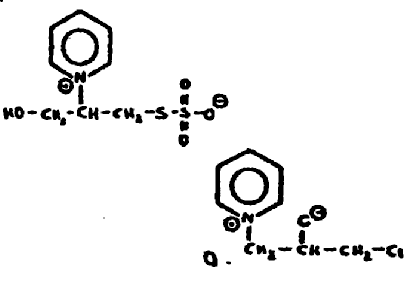
This term denotes a polycyclo ring system which contains exactly three rings.
Glossary Terms for Class 516 COLLOID SYSTEMS AND WETTING AGENTS; SUBCOMBINATIONS THEREOF; PROCESSES OF MAKING, STABILIZING, BREAKING, OR INHIBITING
C 19H 29COOH. Contains a hydrogenated phenanthrene ring system. See also rosin*.
A material* which assists the action of another material*, especially an agent*.
A dispersion* of a gas in a liquid or solid. A common example is silica-gel which is a light fluffy silica particle having a porous amorphous matrix. Cf. aerosol*.
A colloid system of a discontinuous solid or a liquid phase (dispersand*) in a gas or vapor continuous phase (dispersant*). See smoke* and fog*.
Refers to the effective material*, energy, or means which acts in the given context. A colloid system making or stabilizing agent acts to form or stabilize a colloid system; usually characterized by its tendency to collect at the interface between two immiscible phases and not to be confused with the material which constitutes the continuous or discontinuous phases, particularly noting that gas propellants for aerosols and foams are NOT colloid system making agents. A colloid system breaking, resolving, or inhibiting agent acts to dissipate the interface between two immiscible phases. The term agent also includes subcombinations of an agent composition, such as adjuvants*. (Thus, the term agent may apply to a compound or composition which may not be fully functional for its stated context, or its functionality may be greatly enhanced by another component which is not present.) Note that although a compound can be an agent, this class does not provide for compounds, per se. An agent may be physical or energy.
See flocculation*.
A colloid system of a dispersand* (discontinuous phase), in a liquid alcohol dispersant* (continuous phase). Examples are metal oxides such as silica or rare earth oxides dispersed in lower and higher liquid alcohols. See sol*.
See hydrosol*.
Type of emulsion wherein the aqueous or polar phase and the oily or non-polar phases are characterized as both being continuous. Commonly associated with emulsion polymerization.
See syneresis.
Fatty acid treated to oxidize, commonly by passing (blowing) air, oxygen, ozonized air, or ozone through the material under mildly elevated temperatures. The process forms ketones from hydroxy groups and hydroxy groups at unsaturation sites. Process conditions also control the degree of polymerization and esterification reactions.
Oil treated to oxidize, commonly by passing (blowing) air, oxygen, ozonized air, or ozone through the material under mildly elevated temperatures. The process forms ketones from hydroxy groups and hydroxy groups at unsaturation sites.
BREAKER, COLLOID SYSTEM; BREAKING, COLLOID SYSTEM
The effective material*, energy, or means used for accomplishing the act of breaking or resolving (i.e., destroying) a colloid system, such as agent* compositions specialized and designed for or peculiar to use in colloid system breaking. See emulsion breaker.
A compound based on carbamic acid, NH 2COOH, in the form of its salts and derivatives.
CARBOHYDRATE; CARBOHYDRATE-DERIVATIVE
Carbohydrates are compounds which are saccharides whose monomeric units are polyhydroxy mono-aldehydes or polyhydroxy mono-ketones, having the formula Cn(H2O)n, where n is five or six, or the corresponding cyclic hemiacetals thereof. Carbohydrate-derivatives maintain the carbon skeleton and the carbonyl function or hemi-acetal function of the saccharide. See section LINES WITH OTHER CLASSES AND WITHIN THIS CLASS, subsection Glossary References, for additional information concerning this definition.
Structure comprised of a carbonyl group (C=O) with a hydroxyl group (OH) attached to the carbonyl carbon.
The product of coagulation; the irreversible combination of semisolid particles (e.g., fats, proteins, oils) to form a mass. Often brought about by the addition of a coagulant. See flocculate.
The phenomenon of the merging of two or more drops of liquid (e.g., oil or water droplets in emulsions) or particles (e.g., solid particles in sols* and dispersions*) resulting in a larger drop or particle having a lower interfacial surface area and a generally less stable condition.
Also called colloid dispersions* or colloid suspensions. Sometimes simply colloid, but this is not preferred because this may also be used to refer to colloid-sized particles, per se. A colloid system is a multi-phase combination of matter in which one or more constituents has one or more dimensions below about five microns, however systems having particles of 20 to 50 microns have been described. Nobel prize winning research chemist, Wolfgang Ostwald (1853-1932), reportedly said "There are not sharp differences between mechanical suspensions, colloidal solutions, and molecular solutions. There is a gradual and continuous transition from the first through the second to the third." With respect to particles in suspension, in colloid systems the particles are governed by surface forces and therefore act as individual flow units, as contrasted to non-colloid mixtures which are governed by gravity or body (e.g. drag) forces. Macromolecules may form either true solutions or colloid systems and categorization properly depends upon the properties relevant to the intended use. Foams are colloid systems because they contain two phases and the liquid film has a thickness which is colloid-sized. Most common colloid systems are composed of particles of a colloid-sized dispersed phase (the subdivided or discontinuous phase) surrounded by a continuous phase. See also sol*.
See Rosin*.
See LINES WITH OTHER CLASSES AND WITHIN THIS CLASS, above.
A compound and/or composition characterized by the ability to remove unwanted materials from a solid surface by physicochemical means, i.e., emulsifying, dispersing, suspending, dissolving, etc.
Diatomite, Kieselguhr. Siliceous material composed of the skeletal remains of small, prehistoric organisms (diatoms). About 88% silica.
The property of a material wherein when subjected to shear the rate of increase of strain decreases with increasing shear. Examples are pastry doughs and highly concentrated solid colloid-sized particle suspensions.
The suspended colloid-sized particles in a dispers ant*. Often referred to as the discontinuous phase.
The dispersing medium or continuous phase.
The suspended particles in a dispersion.
A suspension of particles in a solid, liquid, or gas to form a biphasic or polyphasic composition. Colloid-sized particles form colloid dispersions. See also colloid system.
A liquid fat which readily absorbs oxygen from air, polymerizes, becomes resinous, and which can thereby form a hard film. The property of drying is due to the presence of unsaturation in the hydrocarbon length of fatty acid oil, usually the glycerides of linoleic* and linolenic* acids. Common sources include linseed, tung, perilla, soybean, fish and dehydrated castor oils. Drying oils have high iodine number; nondrying oils, low.
A colloid system of two or more immiscible liquid phases. Examples are water-in-oil (w/o), oil-in-water (o/w), water-in-oil-in-water (w/o/w). Also includes immiscible oils/solvents.
The effective material*, energy, or means used for accomplishing the act of destroying an emulsion colloid system, such as agent* compositions specialized and designed for or peculiar to use in emulsion breaking.
The effective material*, energy, or means used for accomplishing the act of making an emulsion colloid system, such as agent* compositions specialized and designed for or peculiar to use in emulsion making. Typically, this is a surfactant added to aid in the emulsification of two immiscible liquids. Characteristically resides at the interface in a stable emulsion.
Volatile component of plants which imparts the characteristic odor to flowers, leaves, stems, or twigs, or wood, or derivable from plant constituents. Various methods are used to derive including distillation, pressing, solvent extraction, and fat extraction. Distinguished from fatty oils by usually being terpenes*, fairly volatile, non-greasy, and non-saponifiable (except those with esters). Most essential oils are mixtures, an exception being oil of wintergreen which is essentially pure methyl salicylate.
Naturally occurring glycerides. Natural fats are the natural oils which oils which are solid at room temperature.
Organic* compounds comprising a hydrocarbon chain with a carboxylic acid at one end. The term usually implies an unbroken hydrocarbon chain of seven or more carbon atoms. Saturated, unsaturated, and polyunsaturated occur naturally. The most common fatty acids in natural fats or oils are palmitic, stearic, oleic, lauric, and myristic.
FLOCCULATE; FLOCCULATING AGENT*�f FLOCCULANT
Flocculate is the aggregation or combination of suspended colloid-sized particles to form small clumps or short clusters of elongated strands. Flocculating agent* is the effective material*, energy, or means used for accomplishing the act of flocculating an colloid system, such as agent* compositions specialized and designed for or peculiar to use in flocculation. Typical flocculating agents*: alum, ferric chloride, lime and polyelectrolytic polymer such as polyacrylamide. See coagulate*.
A colloid system characterized as a gas suspended in a liquid; wherein the gas is the dispersand* (discontinuous) phase and the liquid is the dispersant* (continuous) phase.
A colloid system characterized as a suspension of colloid-sized liquid droplets in a gas; wherein the liquid is the dispersand* (discontinuous) phase and the gas is the dispersant* (continuous) phase. See aerosol*.
Particles of solids or liquids suspended in a gas, e.g., smoke from combustion. Also the vapors evolved from concentrated sulfuric or nitric acids, or from solvents.
The colloid-sized form of silica formed by the vapor phase hydrolysis of silanes or halosilanes in a Hydrogen-oxygen flame. Generally characterized by high purity, amorphous crystallinity, and colloid-sized particle.
A solid or semisolid colloid system formed of a continuous or semicontinuous solid phase and a liquid phase (either discontinuous or continuous or mixed), often identified by its outward gelatinous appearance, and which exhibits properties of a solid such as plasticity, elasticity, or rigidity. Gels are typically characterized by a physical property of the system, such as the yield point (defined as the shearing force required to result in the flow of said gel), which is a measure of the gel strength. A variety of compositions can form gels, including but not limited to; solubilized polymers, cross-linked polymers, concentrated surfactant solutions having crystalline-like properties (e.g., liquid crystal phases), organically modified and unmodified hydrous metal oxides (e.g., silica, silicates, alumina, iron, etc.), and organically modified and unmodified hydrous mixed metal oxides (e.g., clays, bentonites, synthetic aluminosilicates). See Thixotropic*.
An ester of glycerol and fatty acid(s) in which one or more of the hydroxyl groups of the glycerol have been replaced by any combination of acid radicals. Mono-glyceride has one fatty acid ester, di-glyceride two, and triglyceride has three. Naturally occurring fats and oils are mainly triglycerides of fatty acids, most commonly are palmitic, stearic, and oleic.
1,2,3-propanetriol.
The oil insoluble sulfonic acid products of sulfonation of petroleum*. Also called sludge acids. C.f. mahogany* acids.
Hydrophile Lipophile Balance. The most commonly used HLB system was developed by W.C. Griffin (1949). The system employs certain empirical formulas to calculate the HLB number between 0 and 20; high numbers correspond to hydrophilic surfactants with high water solubility and functionally good solubilizing agents*, detergents, and o/w stabilizers; low numbers correspond to hydrophobic (or lipophilic) surfactants with low water solubility, which solubilize water into oils and stabilize w/o emulsions.
A colloid system of a dispersand* (discontinuous phase), in an aqueous liquid dispersant* (continuous phase). Examples are metal oxides such as silica or rare earth oxides dispersed in an aqueous phase. See sol*.
Any compound that is not organic*.
Term of the textile industry referring to a wetting agent* used to aid in the uniform dispersal of a dye in a dye bath and generally have wetting properties.
A diunsaturated fatty acid, the glyceride of which is present in drying oils such as linseed oil. CH3(CH2) 4CH=CHCH2CH=CH(CH2)7COOH.
A triunsaturated fatty acid, the glyceride of which is present in drying oils such as linseed oil. CH3CH 2CH=CHCH2CH=CHCH2CH=CH(CH2)7COOH.
The oil soluble sulfonic acid products of sulfonation of petroleum oils. Cf. green* acids. Mahogany soaps are the saponified acids.
Material is given its broadest meaning and includes mixtures (petroleum, alloys, cement, etc.) and substances*.
The part of a monomer which is present in the reaction product of a reaction involving what is commonly referred to as a monomer (e.g., dimer, trimer, tetramer, oligomer).
Included by this term are (1) materials exploited from the Earth which are liquid, primarily petroleum oil or relatively crude fractions thereof, which are primarily mixtures of hydrocarbons, (2) liquid or semi-solid derivatives of solid materials exploited from the Earth, including asphalts (from petroleum, shale, or sand sources), tars (including coal tar), pitches, or waxes, which are primarily mixtures of hydrocarbons, (3) materials which are Fischer-Tropsch crudes, that is, the liquid hydrocarbonaceous mixture resulting from the hydrogenation of a carbon oxide, (4) wood tars or wood tar oils, which are similar to coal tar in that they include an unidentified mixture including hydrocarbons. Note: excluded are (1) substantially purified hydrocarbon compounds, (2) solid carbonaceous materials such as coal, lignite, or peat (as distinguished from semi-solid petroleum-derived asphalts or asphalt derived from shales or sands). See section LINES WITH OTHER CLASSES AND WITHIN THIS CLASS, subsection Glossary References, for additional information concerning this definition.
Emulsion having more liquid phases than one discontinuous and one continuous phase. Types are water-in-oil-in-water (w/o/w), oil-in-water-in-oil o/w/o, water-in-oil-in-water-in-oil (w/o/w/o), etc. See emulsion.
Oil-in-water emulsion. Cf. w/o, w/o/w.
(1) Naturally occurring oils are glycerides*. Natural fats are the natural oils which are solid at room temperature. (2) Mineral-oils* are exploited from the earth, or derived from processing woody materials, generally comprising hydrocarbons. See definition, hereinabove, of mineral-oil used for this Class.
CH3(CH2)7CH:CH(CH2)7COOH. Mono-unsaturated fatty acid found in most natural fats and oils. Glycerol monooleate is the monoglyceride formed from the esterification reaction between glycerol and oleic acid.
ORGANIC; ORGANIC COMPOUND; ORGANIC GROUP
When the expression "organic" or "organic compound" or "organic group" is used in this class, it means a compound or group which meets the requirements wherein the molecule (or group) is characterized by two carbons bonded together, one atom of carbon bonded to at least one atom of hydrogen or halogen, or one atom of carbon bonded to at least one atom of nitrogen by a single or double bond; certain compounds are exceptions to this rule, i.e., HCN, CN-CN, HNCO, HNCS, cyanogen halides, cyanamide, fulminic acid, and metal carbides. Said exceptions and all other chemical compounds shall be regarded as inorganic*. See section LINES WITH OTHER CLASSES AND WITHIN THIS CLASS, subsection Glossary References, for additional information concerning this definition.
The prefix organo indicates a requirement that the term meet the definition of organic*, organic group * or organic compound *.
A colloid system of a dispersand* (discontinuous phase) in an organic* liquid dispersant* (continuous phase). Examples are metal oxides such as silica or rare earth oxides dispersed in liquid alcohols, or in non-polar organic* solvents. See sol*; cf. hydrosol*.
CH3(CH2)14COOH. Hexadecanoic acid, cetylic acid, palmic acid, ethalic acid. Saturated fatty acid found in most natural oils and fats. Glycerol monopalmitate is the monoglyceride formed from the esterification reaction between glycerol and palmitic acid.
Crude oil. Mixture of hydrocarbons, with small amounts of compounds containing nitrogen, Phosphorus, Sulfur, and oxygen, obtained from underground deposits. Often the terms are applied to fractions derived from the basic yield, including distillation and cracking fractions.
Compounds composed of amino acids bound together by amide linkages. Proteins are polypeptides.
Commercial grade of oleic acid containing about 15% each of linoleic and stearic acids.
Compound or mixtures of compounds produced from simpler compounds by polymerization or condensation reactions.
A broad term covering a variety of naturally derived products usually obtained by secretion or disintegration (extraction). Vegetative sources are usually mixtures of carboxylic acids or their esters, essential* oils (these are usually non-saponifiable, non-glyceride), and terpenes; mostly insoluble in water and soluble in alcohols, ethers, and carbon disulfide. Examples include balsam and rosin* which are obtained from coniferous trees. Used in varnish, printing inks, and adhesives. Shellac resin is obtained from the secretion of an insect indigenous to India. Amber resin is a polymerized vegetative resin that occurs as a fossil. Amorphous sulfur is considered an inorganic natural resin. Cf. drying oil. See section LINES WITH OTHER CLASSES AND WITHIN THIS CLASS, subsection Glossary References, for additional information concerning this definition.
Thermosetting resin or resin like material which becomes solid and infusible upon heating. Linseed oil and other drying-oils* and partially condensed phenol-formaldehyde are examples.
See Breaker*.
Colophony. Abietic-acid* (80-90%) types and remnants from derivation. Usually designated according to its source, e.g., gum rosin (from exudate of incisions on living trees); wood rosin (from Southern pine stumps); and tall oil rosin (from by-products of the wood pulp industry). The principal constituents isolated from rosin are carboxylic acids with a hydrophenanthrene nucleus, comprising abietic acid and its isomers, such as pimaric acid. The acids may exist in rosin as acid anhydrides. The mixed acids are known in the trade as rosin acids or resin acids, the two expressions sometimes being used interchangeably. Gum rosin is obtained from the residue left after distillation of turpentine from the exudate from live trees. Wood rosin is obtained by extracting the wood or stumps with naphtha and removing the volatile portion. Tall oil rosin is obtained by fractionation of tall-oil*. See section LINES WITH OTHER CLASSES AND WITHIN THIS CLASS, subsection Glossary References, for additional information concerning this definition.
A colloid system of a solid dispersand* (discontinuous phase), in a gas dispersant* (continuous phase), as an aerosol*. Cf. fog*.
Usually refers to a colloid system of a dispersand* (gas, solid, or liquid discontinuous phase), in a liquid dispersant* (continuous phase). However, aerosol* refers to a colloid system of colloid-sized particles in a gas continuous phase. Sol may also refer to just the liquid phase of a colloid system. Examples are metal oxides such as silica or rare earth oxides dispersed in an aqueous phase (aquasols*), or in liquid lower and higher alcohols (alcosols*), or in organic solvents (organosols*). Sol is generic to organosol*, alcosol*, aquasol*, and hydrosol*, where in each instance the prefix refers to the continuous phase.
Cyclic ether tetrahydric alcohols derivable from sorbitol by removal of one molecule of water.
Mixtures of partial esters of sorbitol and sorbitol anhydrides with fatty acids.
C6H8(OH)6, 1,2,3,4,5,6-hexanehexol. Reduction product of glucose, found in nature in small quantities.
A material*, energy, or means used for affecting the spreading and displacement of one material* for another material*. In a type of wetting known as spreading wetting, a first liquid in contact with a solid is displaced by a second liquid. See also wetting* agents. See section LINES WITH OTHER CLASSES AND WITHIN THIS CLASS, subsection Glossary References, for additional information concerning this definition.
CH3(CH2)16COOH. The most common fatty acid in natural oils and fats. Glycerol monostearate is the monoglyceride formed from the esterification reaction between glycerol and stearic acid.
A substance is a chemical compound or element. Substance is characterized as being homogeneous, particulary down to the molecular level. See The Condensed Chemical Dictionary, (tenth edition, 1981) Van Nostrand Reinhold Company Inc. CF. material*. Note: this definition may not be followed in other Classes; often the term is used loosely as a synonym to material*.
A radical containing a Sulfur-oxygen double bond. Examples of sulfoxy containing compounds include; sulfate, sulfonate, and sulfone compounds.
A compound which reduces the surface tension of a liquid when dissolved therein or reduces the interfacial tension between two liquids. A surface active agent* compound is typically characterized by at least one hydrophobic portion and at least one hydrophilic portion. Also referred to as surfactant.
The force exerted at an interface by the molecules below the interface. For example, in a gas-liquid interface, the surface tension is due to the high concentration of the liquid molecules relative to the lower concentration of the gas molecules. The strength depends on the characteristics of the liquid, and to a lessor extent, the gas.
See surface active agent*.
The contraction of a gel* composition on standing, accompanied by the exudation of liquid.
A mixture of rosin* acids (35-40%) and fatty acids (50-60%) and other remnants of derivation. Obtained from the spent black liquor (alkaline) of the pulping (digesting) process of pine wood (sulfate or kraft paper processes) by concentrating until the sodium salts of the various acids separate, followed by acidification (e.g., by sulfuric acid). See section LINES WITH OTHER CLASSES AND WITHIN THIS CLASS, subsection Glossary References, for additional information concerning this definition.
A term widely employed in Europe which means surface active agents*.
C10H16. Unsaturated hydrocarbon based upon isoprene unit (C5H8), acyclic or cyclic, with or without benzene moiety. Dipentene is monocyclic, pinene is dicyclic, and myrcene is acyclic. Being non-glyceride oils, they are not saponifiable. Examples include tall and pine oils. Cf. oil, essential oil, glyceride.
The property of materials, such as some gels*, to liquefy when subjected to shear, such as by agitation or other mechanical energy and to return to gel* upon rest. CF. dilatancy*.
Tri-sodium Phosphate; sodium phosphate, tribasic; Na 3PO4 12H2O. Commodity product used alone or compounded with other materials* for use in multitudes of applications including; water softening, boiler water treating, detergency, textile treating, laundering, industrial cleaning, dietary supplements, pH buffering, emulsifying.
Sulfonated castor oil or soluble castor oil. Sulfonated fats or oils obtained by the treatment of a variety of hydroxylated or unsaturated natural fats and oils, usually castor oil, with sulfuric or chlorosulfonic acids, and washing. Also known as alizarin oil or alizarin assistant when used as a dyeing aid with alizarin dye(s).
Splitting of fats to glycerol and fatty acids by acid hydrolysis, in the presence of steam and catalytic amount of Twitchell Reagent*.
Catalyst for the Twitchell-process*. The sulfonation product of reacting sulfuric acid with oleic acid and naphthalene (naphthalenestearosulfonic acid).
Water-in-oil emulsion and water-in-oil-in-water emulsion. Cf. o/w.
The effective material*, energy, or means used for accomplishing the act of wetting a surface. Wetting most generally is the process of displacing from a surface (solid or liquid) one fluid, such as air, with another, such as water. See section LINES WITH OTHER CLASSES AND WITHIN THIS CLASS, subsection Glossary References, for additional information concerning this definition.
A hydrated silicate of aluminum and sodium and/or calcium. Natural and synthetic. Typical: Na2O.Al2O 3.xSiO2.yH2O.
Glossary Terms for Class 520 SYNTHETIC RESINS OR NATURAL RUBBERS -- PART OF THE CLASS 520 SERIES
Denotes a compound devoid of any ring-containing moiety.
Denotes an organic compound having the general structure C-OH wherein the carbon atom bound to the oxygen atom of the hydroxyl group cannot be double bonded to oxygen, sulfur, selenium, or tellurium, or triple bonded to nitrogen. The terms as used herein include phenols.
Denotes an organic compound having the group -C(=O)H [i.e., -CHO] bonded directly to hydrogen or to an additional carbon,which carbon is not double bonded to chalcogen (i.e., oxygen, sulfur, selenium, or tellurium), or triple bonded to nitrogen.
Denotes the following: A. Compounds having a X-CH
2 -OH group where X is other than carbon or hydrogen (e.g., paraformaldehyde, methyol derivatives of urea, etc.); B. Heterocyclic compounds having only carbon and oxygen as alternating ring members (the number of ring carbon atoms must equal the number of ring oxygen atoms). An example is trioxane, which is shown as Figure 1 at the end of the “Aldehyde Derivative” definition; C. Hexamethylene tetramine (i.e., urotropine) or derivatives thereof. Hexamethylene tetramine per se is shown as Figure 2 at the end of the “Aldehyde Derivative” definition. A derivative, for purposes of this definition, requires the basic hexamethylene tetramine ring structure, where substitution has been made for the hydrogens bonded to the ring carbons. Compounds having a -CH2 OH bonded to atoms other than C, H, or oxygen are regarded as being two compounds; for instance, a methylol derivative of melamine is regarded as a mixture of melamine and formaldehyde, and methylol urea is regarded as being a mixture of urea and formaldehyde. A structurally unspecified novolak is proper for this area in that it is considered as a mixture of a phenol and an aldehyde. If a novolak of specified structure is claimed as prepared from specific reactants, then classification is proper on the basis of the specific reactants.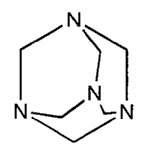
An aldehyde-type reactant is limited to an aldehyde derivative or methylol derivative.
Denotes an organic compound having a nitrogen atom single or double bonded to a carbon atom and wherein the carbon atom bonded to the nitrogen atom is devoid of a double bond to oxygen, sulfur, selenium, or tellurium or triple bonded to nitrogen. In addition, those compounds wherein the same nitrogen atom is bonded to a -C(=X)- group (X is O, S, Se, or Te) and to a carbon atom which is not double bonded to oxygen, sulfur, selenium, or tellurium, are not considered as being amines, e.g., -C(=X)NH-CH3, etc. Although amides may be considered chemically as amines, it has been found expedient for these classes to exclude compounds containing only amide nitrogen herefrom. Therefore, as used throughout this area, the term amide is not to be confused as being an amine. A compound, however, which contains a nitrogen atom bonded to a non -C(=X)- carbon atom and which contains either a nitrogen atom bonded to a -C(=X)- group of an amide group, is considered as being an amine. An organic amine salt of a carboxylic acid has been classified as if it were a mixture of an amine and a carboxylic acid. An organic diamine salt of a dicarboxylic acid where the amine salt-forming groups are identical is considered as being a single amine compound, whereas, if the amine groups are different then they are regarded as two amine compounds. Where the amine groups contain two or more nitrogen atoms bonded to the same or different noncarbonyl carbon atom then they are to be regarded as polyamines.
Denotes a benzene ring or a carboxylic ring system having a benzene ring as part of the system.
BIOLOGICALLY ACTIVE POLYPEPTIDE
Denotes polypeptide chains which have been built up primarily from alpha- or beta-amino carboxylic acids and which exhibit biological activity similar to naturally occurring proteins or polypeptides; such activity may be, for example, hormone activity (e.g., insulin, etc.), immuno-activity (e.g., antigen or antibody, etc.), antibiotic activity (e.g., bacitracin or bleomycin, etc.), or antiviral activity (e.g., interferon, etc.). Mere statements that a material demonstrates any of these activities is sufficient to create a presumption that a biologically active polypeptide is present. On the other hand, a material merely disclosed as a polypeptide which has been built-up from amino acids will not be presumed to have biological activity, and will be placed in Class 520 according to the disclosed structure and function as appropriate.
A. The structure is given, i.e., a long polymer backbone has attached or coupled to one or both of its terminal ends one or more polymers at least three reactant units in length or; B. The copolymer is named as a block providing that the disclosure is otherwise silent as to its structure or if the structure is likewise given, it is consistent with that described above or; C. The structure can be ascertained from the following limiting process conditions (a) Treating a nonterminated solid polymer, that is, one which is terminally active or �gliving�h, with an ethylenic reactant with subsequent polymerization to form additional blocks. The process may be continued to produce higher order block copolymers. For example, treating dilithiated polystyrene with butadiene to yield an ABA block copolymer; and (b) two or more nonidentical solid polymer chain ends are coupled directly or through the use of a chemical agent. For example, the coupling of hydroxy terminated solid polybutadiene with hydroxy terminated polyethylene glycol terephthalate with phosgene.
The structure is given, i.e., to a long solid polymer backbone possessing terminally active sites (i.e., functional groups), or that is a �gliving polymer�h is attached or coupled, through chemical reaction with those functional groups or sites, an ethylenic reactant containing one or more functional groups or sites; an example is to contact hydroxy terminated polybutadiene glycol with allyl isocyanate, or two or more identical solid polymer chain ends are coupled directly or through the use of a chemical agent. For purposes here, identical means those polymer segments which contain the same carbon backbone but differ in stereo regularity (e.g., isotactic, syndiotactic, atactic) optical activity, or degree of polymerization. Thus, coupling lithium terminated polystyrene segments with molecular weights of 25,000 and 100,000, respectively, with stannic chloride is proper for this area.
Denotes polyhydroxy aldehydes (i.e., aldoses) and polyhydroxy ketones (i.e., ketoses) of the empirical formula Cx(H2O)x where x is five or more; and substances hydrolyzable to said polyhydroxy (aldehydes or ketones). Included herein for example are the following: (a) monosaccharide sugars such as pentoses (e.g., arabinose, arabinulose, etc.) hexoses (e.g., glucose, levulose, etc.) and the heptoses (e.g., mannoheptose, etc.); (b) disaccharides (e.g., lactose, maltose, sucrose, cellobiose, etc.); (c) trisaccharides (e.g., raffinose, etc.); (d) polysaccharides (e.g., starches, celluloses, dextrins, hemicelluloses, glycogen, insulin, etc.); (e) complex polysaccharides (e.g., gum arabic, pectins, etc.). Excluded herefrom are lignin, tannin, and derivatives thereof. Also excluded are the simple �gtriose�h (i.e., glyceradehyde di-hydroxy acetone) or �gtetrose�h (i.e., erythrose, threose and keto tetroses) sugars since these sugars have less than five carbons; such materials are treated as polyhydroxy (aldehydes or ketones).
Denotes reaction products of carbohydrates wherein the carbon skeleton of the carbohydrate is not destroyed. Included herein are cellulose nitrate, cellulose acetate, cellulose ethers, viscose, cellulose xanthate, chitin, etc.
A. A carboxylic acid denotes the carboxyl group, represented as -COOH or -C(=O)OH, bonded to: (1) a carbon atom that is not double-bonded to sulfur, selenium, or tellurium, or triple bonded to nitrogen; (2) hydrogen; or (3) [-C(O=)-]
n , where n is an integer (e.g., oxalic acid, etc.). A carboxylic acid derivative is limited to: 1. nitride; 2. carboxylic acid ester; 3. carboxylic acid anhydride; 4. carboxylic acid salt; 5. carboxylic acid amide; 6. carboxylic acid imide; 7. carboxylic acid lactam; 8. carboxylic acid halide; and 9. lactone. B. A carboxylic acid anhydride denotes the basic structure -C(=O)-O-C(=O)-, the carbons of which may independently be bonded to: (1) hydrogen; (2) a carbon atom that is not double bonded to sulfur, selenium, or tellurium; or (3) [-C(=O)-]n , where n is an integer. In either of (2) or (3), supra, the -C(=O)-O-C(=O)- group may be part of a ring. C. A carboxylic acid ester denotes the structure -C(=O)-O-C-, where the carbon atom bonded to the -O- of the -C(=O)-O- group may not be double bonded to chalcogen (i.e., oxygen, sulfur, selenium, or tellurium), or triple bonded to nitrogen, and the carbonyl carbon of the -C(=O)-O-C- group may be bonded to (1) hydrogen; (2) a carbon atom that is not double bonded to sulfur, selenium, or tellurium, or triple bonded to nitrogen; or (3) [-C(=O)-]n , where n is an integer. D. A nitride denotes the structure -CbN bonded to carbon, which carbon may not be double bonded to chalcogen (i.e., oxygen, sulfur, selenium, or tellurium), or triple bonded to nitrogen. E. A carboxylic acid amide denotes the structure -C(=O)-NH2 , where substitution may be made for the hydrogens, and the carbonyl carbon may be bonded to (1) hydrogen; (2) a carbon atom that is not double bonded to sulfur, selenium, or tellurium, or triple bonded to nitrogen; or (3) [-C(=O)-]n , where n is an integer. F. A carboxylic acid halide denotes the structure -C(=O)-hal, where hal is halogen and the carbonyl carbon may be bonded to (1) hydrogen; (2) [-C(=O)-]n , where n is an integer; or (3) a carbon atom that is not double bonded to sulfur, selenium, or tellurium, or triple bonded to carbon. G. The imide of a dicarboxylic acid is a heterocyclic ring having as ring members the group -C(=O)-NH-C(=O)-, where substitution may be made for hydrogen; all remaining ring members are carbon atoms. H. The lactam of a carboxylic acid is a heterocyclic ring having as ring members the group -NH-C(=O)-, where substitution may be made for hydrogen; all remaining ring members are carbon atoms. I. The lactone of a carboxylic acid is a heterocyclic ring having as ring members the group -C(=O)-O-; all remaining ring members are carbon atoms, and the carbon atoms bonded to either the carbon or oxygen or the -C(=O)O- group may not themselves be double bonded to chalcogen (i.e., oxygen, sulfur, selenium, or tellurium). J. A carboxylic acid salt denotes the structure -C(=O)-O-⊖ X⊕ , where X is a cation and ionic bonding exists between the cation, X, and the -C(=O)O- group. The carbon of the -C(=O)O- group may be bonded to: (1) hydrogen; (2) a carbon atom that is not double bonded to sulfur, selenium, or tellurium, or triple bonded to nitrogen; or (3) [-C(=O)-]n , where n is an integer. In the above definitions of carboxylic acids and their derivations, certain derivations may technically fit into more than one derivative grouping. A lactone, for example, is a species of an ester, and a lactam is a species of an amide. Compounds that are themselves multifunctional (i.e., possess more than one functional group) are classified on the basis of the first appearing functional group in the hierarchy. A polycarboxylic reactant requires the presence of at least two carboxylic acid groups, or of at least one carboxylic acid group and at least one carboxylic acid derivative, or at least two identical carboxylic acid derivatives, or at least two different carboxylic acid derivatives.A cyclic carboxylic anhydride having the group -C(=O)-O-C(=O)- as members of a ring is considered as a polycarboxylic acid. Compounds having both a cyclic anhydride group and a free carboxyl (-COOH) group are considered as tricarboxylic acids. An example is trimellitic anhydride, which is shown as Figure 1 at the end of the “Carboxylic Acid or Derivative” definition. A compound containing two cyclic anhydride groups is considered a tetracarboxylic acid. An example is pyromellitic dianhydride, which is shown in Figure 2 at the end of the “Carboxylic Acid or Derivative” definition.
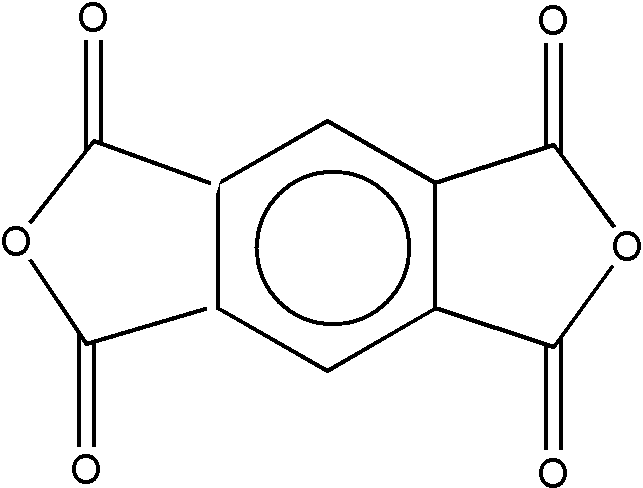
Denotes a chemical material which is added to the formed solid polymer and which causes or is present during a process wherein a change in a bond of the polymer is effected. Claims reciting a �gchemical treating agent�h are classified on the basis of the first-appearing material utilized as part of the chemical agent. No attempt has been made to classify on the basis of functionality of the chemically active material and therefore all materials in a composition are regarded equally (e.g., diluent, reactant, catalyst, etc.). Processes and products which refer to mere cross-linking, curing, or vulcanizing will be classified on the basis of the product treated.
DIMER OR TRIMER OF AN ALIPHATIC MONOCARBOXYLIC ACID
Denotes dimeric or trimeric fatty acids prepared, e.g., by free radical, ionic, thermal polymerization, etc., of a monomeric fatty acid which can be saturated or unsaturated monocarboxylic acid having at least eight carbon atoms. So-called �gpolymeric fatty�h acids in the absence of other disclosure are presumed to be a mixture of dimers and trimers of aliphatic monocarboxylic acids. Included herein are reaction products of dimers or trimers wherein the dimer or trimer structure is not destroyed. Dimers or trimers of ethylenically unsaturated aliphatic monocarboxylic acids are presumed to be unsaturated in the absence of disclosure to the contrary.
Denotes an organic compound characterized by the presence of an oxygen atom bonded directly to two carbon atoms, where the carbon atoms may not be double bonded to chalcogen (i.e., oxygen, sulfur, selenium, or tellurium), or triple bonded to nitrogen. An example is dimethyl ether, CH3-O-CH3.
Requires the presence of two carbon atoms bonded to each other by a double or triple bond, provided that the double bond is not part of a benzene ring. Indane (Fig. 1) is not within the scope of olefinically unsaturated; coumarone (Fig. 2) and indene (Fig. 3) are within said scope.
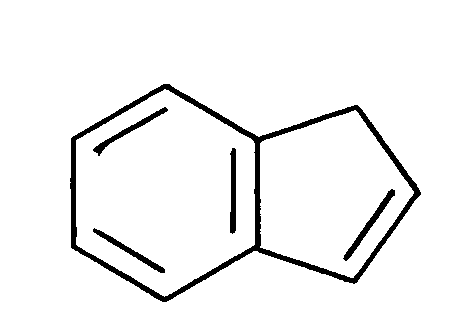
Denotes an aliphatic monocarboxylic acid having an unbroken chain of at least seven acyclic carbon atoms bonded to the carboxyl group. Fatty acid glycerol ester denotes a mono-, di-, or tri-ester of a fatty acid with glycerol. The so-called drying or semidrying oils are naturally occurring fatty acid glycerol esters (i.e., glycerides). The drying or semidrying property relates to the degree of ethylenic unsaturation. Naturally occurring fatty acid glycerides (i.e., fats and fatty oils) include but are not limited to linseed oil, perilla oil, olive oil, oititica oil, soybean oil, fish oil, castor oil, tallow, and other natural glycerides: alfalfa, apricot kernel, beechnut, bontio, Brazil nut, candlenut, cedar nut, chaulmoogra, cherry kernel, coconut, corn, cottonseed, croton seed, grapefruit seed, grapeseed, hempseed, isano, ivory wood seed, jute seed, mustard seed, oat, orange seed, plum kernel, poppyseed, poyok, rice, rye, safflower, sesame, stillingia, sunflower, teaseed, thistle seed, tobacco seed, tomato seed, walnut, wheat, wild rose seed. Naturally occurring fats and fatty oils are treated in this Class 520 Series as fatty acid glycerol esters. A fatty acid derived from naturally occurring glyceride denotes the carboxylic acids normally obtained by saponification of the naturally occurring glycerides (i.e., oleic, linoleic, linolenic, licanic, eleostearic, ricinoleic, arachidic, stearic, palmitic, lauric, erucic, palmitoleic, capric, caprylic, myristic and clupanodonic acids). Carboxylic acids specifically enumerated above will be treated as fatty acids derived from naturally occurring glycerides only where there is specific disclosure that the acid is derived from a naturally occurring glyceride source. Tall oil denotes the mixture of fatty acids, rosin, and unsaponifiable material obtained by treatment of Kraft (or sulfite) process black liquor. In this Class 520 Series, tall oil is usually treated as if it were a mixture of fatty acids derived from naturally occurring glycerides unless otherwise specifically stated; see appropriate subclass definitions for exceptions. Fatty acid derived from tall oil denotes the fatty acid portion of tall oil In this series, derivatives or modifications of the fatty acid glycerol ester, fatty acid derived from a naturally occurring glyceride, tall oil, or fatty acids derived from tall oil are excluded, except as specifically provided for in the following list: salts of the fatty acid moiety, blown oils, refined oils and acids, stand oils, boiled oils, bodied oils, hydrogenated oils or acids, dehydrogenated oils or acids, dehydrated castor oil or dehydrated castor oil fatty acids. Synthetically produced fatty acids having the same structure as fatty acids derived from naturally occurring glycerides are included herein. Dimerized or trimerized or �gpolymeric�h fatty acids are excluded as �gfatty acids�h for purposes of this Class 520 Series; similarly, adducts of fatty acids or fatty acid glycerol esters with alpha, beta ethylenically unsaturated carboxylic acids are excluded as �gfatty acids�h.
Denotes a ring system having at least two rings which (a) share with each other two adjacent ring atoms, or (b) share with each other three or more ring atoms and wherein each ring having shared atoms is either a heterocyclic ring or a carbocyclic ring.
An amorphous, hard, brittle, often transparent material comprising a fused mixture of the silicates of the alkali alkaline earth, or heavy metals.
The structure is given, i.e., a long solid polymer backbone (substrate) is attached to a pendant (nonterminal) polymer or copolymer (superstrate) having at least three reactant units in length or; The copolymer is so named as a graft providing that the disclosure is otherwise silent as to the structure or, if structure is likewise recited, it is consistent with that required in A. above, or the structure can be ascertained from the following limiting process conditions: (a) the disclosure states there is a reaction between a solid polymerized unsaturated reactant and an unpolymerized unsaturated reactant in the presence of a catalyst or; (b) the disclosure does not state whether or not any reaction has occurred between the solid polymerized unsaturated reactant and the unpolymerized unsaturated reactant, but relates that a product is obtained which is inseparable by a variety of physical techniques such as, extraction, precipitation, ion exchange, etc. In the absence of one or more of these requirements the reaction is considered to produce a polymeric blend.
The structure is given, i.e., a long solid polymer backbone (substrate) possessing nonterminal active sites or functional groups is attached (grafted) through a chemical reaction of these functional groups or sites to an ethylenic reactant containing one or more functional groups or active sites. The reaction product may or may not possess unsaturated pendant groups depending on the mode of chemical reaction. The following examples will illustrate this point:
The structure can be ascertained when:
There is disclosed a reaction between the solid polymerized unsaturated reactant and the unpolymerized unsaturated reactant which reaction uses specific art-recognized terms, e.g., “esterification, acylation, sulfonylation, cyanoethylation, addition to, reaction or condensation with, halogenation, nitration, sulfonation, alkylation, amination, etc.”. Examples of these reactions would be:
There is disclosed an interaction between two or more solid polymers through their respective nonterminal functional groups or through the use of an intermediate reactant or chemical agent, e.g., causing salt, ester, amide, urea formation. Examples of these reactions would be (a) Contacting polypropylene and polyethylene with benzoyl peroxide. (b) Contacting polyvinylamine and polyallylamine with glyoxal. (c) Contacting chloromethylated polystyrene with polyvinylamine. (d) Contacting polyacrylic acid with polyvinylamine.
In the absence of one or more of these requirements the reaction is considered to produce a polymeric blend. See the Glossary for the definition of the terms “specified intermediate condensation product” (SICP) and “specified polymer-forming intermediates” (SPFI).
Denotes a compound containing only carbon, hydrogen, and halogen, or only carbon and halogen.
Denotes an organic compound wherein one or more carbon atoms are covalently bonded in a ring system with at least one hetero atom of oxygen, sulfur, nitrogen, selenium, or tellurium and there are no other different atoms in the ring.
Denotes an organic compound having the general structure n (n is 1 or more) and wherein the carbon atoms bonded to the n group are not double bonded to oxygen, sulfur, selenium, or tellurium. Ketone as used throughout includes ketene, i.e., CH2=C=O
Denotes a material usually derived during paper pulp manufacture by separation of the cellulose from wood. Lignin is considered to be the binder for cellulose in wood. Lignin includes crude mixtures of lignose, lignone and lignin. Lignin per se is a complex structure having some aromatic rings and phenolic groups.
Denotes materials not otherwise provided for, derived from lignin or from sulfite or soda paper pulping processes, e.g., sodium lignosulfonate, waste sulfite liquor, black liquor, etc.
Are limited to elements of atomic numbers 3, 4, 11-13, 19-33, 37-51, 55-84, 87, and higher. Note. The Group IA metals are Li, Na, K, Rb, Cs, Fr. Note. The Group IIA metals are Be, Mg, Ca, Sr, Ba, Ra. Note. The Group IIIA metals are Ai, Ga, In, Ti. Note. The Group IVA metals are Ge, Sn, Pb. Note. The Group VA metals are As, Sb, Bi. Note. The Group VIA metal is Po. Note. The Group IB metals are Cu, Ag, Au. Note. The Group IIB metals are Zn, Cd, Hg. Note. The Group IIIB metals are Sc, Y, La, Ac. Note. The Group IVB metals are Ti, Zr, Hf. Note. The Group VB metals are V, Nb, Ta. Note. The Group VIB metals are Cr, Mo, W. Note. The Group VIIB metals are Mn, Tc, Re. Note. The Group VIII metals are Fe, Ru, Os, Co, Rh, Ir, Nb, Pd, Pt. Note. �gTransition metal�h is limited to elements of atomic numbers 21-29, 39-47, 57-79, 89, and higher and does not include Zn, Cd, and Hg.
METHYLOL OR METHYLOL DERIVATIVE
Methylol or methylol derivative is limited to
(a) A compound containing a
(b) A compound containing a T-(-O-A)
n (c) A compound containing a
Y" and Y” are H or hydrocarbon groups; Z is H or a carbon atom. T - is an atom other than C or H. A - is a hydrogen or a carbon atom and which carbon atom is bonded to only H, carbon, or single bonded oxygen atoms. X - is H, part of an ether group, or an inorganic salt. n - is two or more, B is one or more.
Denotes the following: Those materials which have been customarily employed as such in the paint, lacquer, varnish, adhesive, and ink trades. Thus, �gnatural resin�h is a term of art. Natural resins include but are not limited to shellac, copals from various sources, e.g., Congo, manila, etc.; amber, dammar, dead dammar, rosin (colophony), gum rosin, wood rosin, burgundy pitch, gurjun balsam, Canada balsam, sandarac, mastic, accroides, benzoin, elemi, gamboge, gum thus, venice turpentine, bordeaux turpentine, abietic acid, pimaric acid, etc. Tall oil, per se, is not treated as a natural resin unless the rosin content is specifically stated. In the event the rosin content is not stated, tall oil is treated as an unsaturated fatty acid derived from naturally occurring glycerides. Unless indicated to the contrary, �grosin�h is presumed to be primarily abietic acid.
Denotes the following: A. Heat decomposition products of natural resins which contain a hydroaromatic nucleus and which are unprovided for elsewhere. B. Materials described by patentee as natural resins. C. Modifications of natural resins wherein the carbon structure of the abietyl nucleus is retained, including but not limited to: abietyl amine, dehydroabietyl amine, abietyl alcohol, zinc abietate, hydrogenated rosin, dehydroabietic acid, disproportioned rosin, rosin esters, ester gum (i.e., triglyceride of rosin), polymerized ester gum, hydrogenated ester gum, oxidized ester gum, etc. D. Other modified natural resins; for example, aceto- and butyro-copal, copal ester, etc.
Denotes boron, oxygen, carbon, selenium, tellurium, nitrogen, sulfur, phosphorous, silicon, hydrogen, fluorine, chlorine, bromine, iodine, astatine, helium, neon, argon, krypton, xenon, and radon.
Denotes all compounds having carbon therein and which are further characterized by the presence of (a) two carbon atoms bonded together, or (b) one atom of carbon bonded to at least one atom of hydrogen or halogen, or (c) one atom of carbon bonded to at least one atom of nitrogen by a single or double bond, with the proviso that hydrocyanic acid, cyanogen, isocyanic acid, cyanamide, cyanogen halides, isothiocyanic acid, and metal carbides are excluded from being organic compounds.
The term phenolic reactant as used is intended to include the subject matter enumerated below:
A phenol for purposes of this subclass requires one or more -OH groups directly bonded to a nuclear carbon atom of a substituted or unsubstituted benzene ring, which benzene ring can be an individual benzene ring or can be part of a polycyclic ring system.
A phenol ether for purposes of this subclass requires one or more -O-C groups wherein the oxygen atom of the -O-C group is directly bonded to a nuclear carbon atom of a substituted or unsubstituted benzene ring and wherein the carbon atom of the -O-C group is not double bonded to oxygen, sulfur, selenium, or tellurium or triple bonded to nitrogen. The benzene ring may be an individual benzene ring or may be part of a polycyclic ring system. The following examples of phenol ether are within the definition set out above:
(a) The -O-C group may itself be part of a cyclic ring system, e.g., see Fig. 1 below, etc.
(b) The carbon of the -O-C group may be a ring atom of a cyclic or aromatic ring, e.g., see Fig. 2 below, etc.
(c) An inorganic phenolate is an inorganic salt of a phenol (see phenol 1 above) wherein the hydrogen atom of a -OH group is replaced by a metal or an inorganic group. Tannin or tannic acid is considered to be a polyhydroxy polycyclic carboxy-containing phenol. Crysylic acid is considered to be cresol. Coal tar extracts are considered to be an indefinable mixture of ingredients some of which are phenolic in nature. Cardanol and anacardic acids are phenolic derivatives.
(d) The carbon of the -O-C group may be a terminal carbon atom, e.g., Figure 3 below; or may be the carbon atom of a chain, e.g., Figure 4 below, etc.
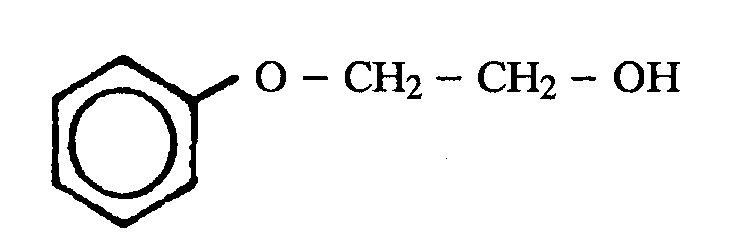
Denotes a material having more than one 1,2-epoxy group per molecule.
Denotes polypeptides composed of more than 100 amino acids or having molecular weights greater than 10,000. Included herein are, for example: (a) The so-called simple proteins which yield alpha-amino acids upon hydrolysis (e.g., albumins, globulins, glutelins, prolamines, histones, sceleroproteins, etc.). (b) The conjugated proteins wherein protein is bound to some other molecule or group (e.g., nucleoproteins, glucoproteins, etc.). (c) Derived proteins which are the cleaved products of proteins, excluding the monomeric alpha-amino acids themselves (e.g., proteins, metaproteins, coagulated proteins, proteoses, peptones, peptides, etc.). (d) Reaction products wherein the protein has been reacted and wherein the final reaction product retains peptide linkages.
Denotes nonethylenically unsaturated; thus, for purposes of this class, materials containing an aryl structure (e.g., benzene, naphthalene, etc.) are treated as saturated materials unless otherwise excluded either specifically or hierarchically. Compare ethylenically unsaturated.
SPECIFIED INTERMEDIATE CONDENSATION PRODUCT (SICP)
Specified intermediate condensation product is limited to:
(a) Reaction of an aldehyde or derivative and an amine or compound containing a N- or N group where R is hydrogen or hydrocarbon radical.
(b) Reaction of an aldehyde or derivative and a phenolic material.
(c) Reaction of an aldehyde or derivative and a ketone.
(d) A compound containing a
N-(-C-O-Z)
n group.(e) A compound containing a T-(-O-A)
n group.(f) A compound containing a group.
Y" and Y” are H or hydrocarbon groups, Z is H or a carbon radical.
T - is an atom other than H or C.
A - is a hydrogen or carbon atom and which carbon atom is bonded to only H, carbon, or single bonded oxygen atoms.
X - is H, part of an ether group, or an inorganic cation.
n - is two or more, a is one or more.
Denotes the intentional and deliberate presence of a material (other than as a reactant monomer) during the polymerization reaction, which material may be removed subsequent to the polymerization, or which may remain with or in the final desired polymeric product. The term �gspecified material�h is limited to an amount of a material (e.g., 2 percent of a material, etc.). A recitation of at least one specified element in a compound or in elemental form (e.g., oxygen-liberating compound, peroxy compound, chlorine-containing, etc.) Groups of elements which can be identified from the periodic table, other than metal or nonmetal (e.g., Group IA, transition metal, halogen-containing, etc.) Compounds which have identified art meaning (e.g., alcohol, ethers, esters, etc.) Examples of material, which are described in mere functional terms and are thereby excluded as being a �gspecified material�h since they do not meet the parameters set out above, are terms such as free radical catalyst, redox catalyst, emulsifier, dispersant, base, acid, organic medium, etc. Water in any of its physical forms: inert gases (Group VIIIA), hydrocarbons, and chlorinated hydrocarbons are specifically excluded from this area as being specified material even if specifically recited as to name (e.g., chloroform, etc.) or as to amount (e.g., 2 percent of chloroform, etc.). A search for these materials requires a search of the appropriate product area. However, specific provision has been made in Class 526, subclass 208 for a mixture of a chlorinated hydrocarbon and water, and in Class 526, subclass 207 for a mixture of hydrocarbon and water. Terms such as complex, coordination complex, chelate, sequestered, or adduct, and terms which are exemplary of these but which are not limited to the enumerated examples, such as sequestered complex, chelated compound, etc., are classified as are compounds, per se, when they are products of a metal or metal compound and a nonmetal organic compound. These materials are classified as separate compounds or elements when (a) the product is the reaction product of at least two or more metals, metal-containing compounds, or mixtures thereof (e.g., alloy, etc.) or (b) when the product is the reaction of at least a metal or metal compound and an inorganic material. Patents in this area are to be classified on the basis of the claimed final compound or composition that is introduced into the reaction zone and is in direct contact with any of the monomers therein. If it is not possible to so classify the introduced material, classification is then made on the basis of the individual reactants used in the preparation of the unknown material. In the event that the claims recite both the individual reactants and identify the product formed therefrom, then the original classification should be made in the subclass that provides for the known product and a cross-reference should be placed in the appropriate subclass that provides for the reactants. Patents which claim an �gin situ�h preparation of �gspecified material�h in the presence of the monomer are originally classified on the basis of the introduced reactants and cross-referenced to the prepared �gspecified material�h.
SPECIFIED POLYMER-FORMING INGREDIENTS (SPFI)
Specified polymer-forming ingredients are limited to: (a) Aldehyde or derivative and a phenolic material. (b) Aldehyde or derivative and an amine. (c) Aldehyde or derivative and a compound containing N-. (d) Aldehyde or derivative and a hydrocarbon. (e) Polyepoxides. (f) Polyisocyanates and a polyol. (g) Polyisocyanates and a polyamine. (h) Polyisocyanates and a polycarbocyclic acid or anhydride. (i) Carbonic acid or carbonate and a polyol. (j) Hal--hal and a polyol. (k) Polycarboxlic acid or derivative and a polyol. (l) Polycarboxylic acid or derivative and a polyamine. (m) Aldehyde or derivative and a compound containing N group.
Denotes elements of atomic numbers 21-29, 39-47, 57-79, 89, and higher and does not include Zn, Cd, and Hg.
Glossary Terms for Class 522 SYNTHETIC RESINS OR NATURAL RUBBERS -- PART OF THE CLASS 520 SERIES
DESIGNATED NONREACTANT MATERIAL (DNRM)
As used in this class, designated nonreactant material (DNRM) is a material wherein at least one of the chemical atoms can be deduced with certainty. For purposes of this class, organic material although inherently reciting the presence of a carbon atom is considered to be too broad. An exemplary list of materials to be regarded as DNRM"s is as follows: metal hydrate, chalcogen, carboxylic acid, peroxy, peroxide, latex, alkali or alkaline earth metal, transition metal, halogen, proten donor, sulfiede, drying oil, fat, fatty acid or ester, water, carbon black, etc. This list is by no means limited to the above examples. The following list is not exhaustive and merely enumerates certain materials that will not be considered as DNRM"s, e.g., organic compound, metal containing, inorganic compound, organometallic compound, solvent, wax, magnetic, hydrophobic, hydrophillic, antiplasticizer, plasticizer, filler, preservative, antioxidant, antiozonant, stablizer, lubricant, fibrous additive, particulate additive, liquid, solid, gas, dispersant, emulsifier, crystalline, plastic, flourescent, phosphorescent, liminescent, deliquescent, drier, dessicant, humectant, blue color,numerically described without providing a chemical atom, Lewis acid or base, mineral, organic solvent, cosolvent, Ziegler or Natta catalysts, alfin catalyst, free radical, amphoteric, anionic, ionic, denaturant, electrostatic, dielectric, conductor, insulator, etc. This list is to be regarded as illustrative rather than exhaustive.
The term �gwave energy�h includes radiations as well as wave energies transmitted by various mediums and embraces electromagnetic waves or radiations, ultrasonic and supersonic waves, nuetrons, protons, duetron, and other corpuscular radiations.
The term �gelectromagnetic waves�h as employed herein includes, for example, X-rays and gamma rays; ultraviolet, infrared, and visible light rays, and short electric and radio waves. Energy which produces merely a thermal effect or heat waves, per se, is excluded. Microwave energy is considered to produce a thermal effect unless there is a direct statement to the contrary, and is not proper for this class.
Glossary Terms for Class 523 SYNTHETIC RESINS OR NATURAL RUBBERS -- PART OF THE CLASS 520 SERIES
Designated nonreactant material (as discussed in this class definition)
Nonreactant material (as discussed in this class definition)
Specified intermediate condensation product (consistent with Class 520 Glossary)
Solid polymer (consistent with Class 520 class definition)
Specified polymer-forming ingredients (consistent with Class 520 Glossary)
Glossary Terms for Class 528 SYNTHETIC RESINS OR NATURAL RUBBERS -- PART OF THE CLASS 520 SERIES
A reactant for purposes of this Class is a material which occurs in a polymer as a repeating unit and is present in at least three units. As used herein, reactant is meant to exclude catalyst residues, chain transfer agents, etc.
For purposes of this class, the term �gwith�h under a specific reactant subclass requires the presence of the specific reactant with a different reactant which meets the parameters set forth by the �gwith�h definition.
For purposes of this class, the term �gcontains�h under a specific reactant subclass includes the term �gwith�h and merely requires the presence of the �gcontains�h material. The required moiety, element, etc., may be in the specific reactant or in an additional reactant.
Glossary Terms for Class 532 ORGANIC COMPOUNDS -- PART OF THE CLASS 532 - 570 SERIES
This term denotes a compound which does not contain a ring.
This term denotes an atom which is not a ring member. Figure 1 contains acyclic nitrogen while Figure 2 does not contain acyclic nitrogen
As used in regard to bonding or attachment of specified moieties, this term denotes that the moieties are connected to each other exclusively by atoms and bonds which are not part of a ring. The compounds in Figure 3 show oxygen attached to a hetero ring by acyclic bonding. Note that the sulfur-containing compound also has nitrogen and sulfur attached to the hetero ring by acyclic bonding.
The compounds in Figure 4 would be excluded from a subclass requiring oxygen attached to a hetero ring by acyclic bonding since a carbocyclic ring is between the oxygen and the hetero ring in each structure.
This term denotes a carbocyclic ring which is not a benzene ring or a polycyclo carbocyclic ring system which does not have a benzene ring as one of the cyclos.
This term denotes an acyclic carbon chain which contains a carbon-to-carbon double bond and is represented by the formula -CnH2n-1.
This term denotes an acyclic carbon chain which contains a carbon-to-carbon double bond and is represented by the formula -(CnH2n-2)-.
This term denotes an acyclic carbon or a saturated acyclic carbon chain represented by the formula -CnH2n+1.
This term denotes an acyclic carbon or a saturated acyclic carbon chain represented by the formula CnH2n-.
This term denotes an acyclic carbon chain which contains a carbon-to-carbon triple bond and is represented by the formula -(CnH2n-3)-.
This term denotes an acyclic carbon chain which contains a carbon-to-carbon triple bond and is represented by the formula -(CnH2n-4).
Denotes any nitrogen in an organic compound other than a nitrogen in an inorganic ion of an addition salt, a nitro (-NO2) or nitroso (-NO). Component parts of an �gadduct�h will be considered to be attached to each other ionically except if it is clear that the mode of attachment is nonionic.
This term denotes a benzene ring or a polycyclo carbocyclic ring system having a benzene ring as one of the cyclos.
ATTACHED DIRECTLY OR BONDED DIRECTLY
These terms are used to show that specified moieties are connected by bonds only.
This term denotes that at least one atom, as well as bonds, connects specified moieties.
This term includes, in all cases except where there are explicit limitations to the contrary, substituted benzene rings, including substitution in the form of an additional fused or bridged ring or ring system. Thus, for example, if a subclass reads: �gBenzene ring bonded directly to the five-membered hetero ring�h, the moiety bonded directly to the hetero ring may be phenyl, chlorophenyl, dinitrophenyl, naphthyl, etc. All that is necessary to satisfy the terminology of the subclass is that a substituted or unsubstituted benzene ring be bonded directly to the hetero ring.
This term denotes a ring or ring system where all ring members are carbons.
This term denotes a plurality of atoms which connect specified groups or atoms. The atoms of the chain must be nonionically attached to each other and to the specified groups or atoms. If the chain may not include any ring members it will be designated as acyclic. When the chain may include ring members the title will state that the chain may include a ring. The chain ends where it attaches to the specified groups or atoms and does not include any part of them. The chain may have substituents but the substituents are not part of the chain.
CLATHRATES AND INTERCALATES (INCLUSION COMPOUNDS)
Clathrates and intercalates (inclusion compounds), per se, are classified hierarchically and subject to the limitations set forth in the compound (element) classes based both on the encapsulant and encapsulate. For example, a clathrate of urea and hydrogen peroxide is classified in Class 564, subclass 32, urea and an organic compound in Class 564, subclass 1.5, dextran and iodine in Class 536, subclass 112, etc. Where a patent does not state that a material is either a clathrate or an intercalate, the assumption is made that the material is either a coated or encapsulated product classified in Class 428, subclasses 402+.
This term is to be interpreted broadly. In a subclass which specifies halogen containing, for example, the halogen may be attached to other parts of the compound by ionic bonding or nonionic bonding. Further, the element contained in a material may be in any form. In a subclass such as-- Heavy metal containing catalyst (or material) utilized--, the metal may be in elemental or compound form.
This term refers to a ring of a polycyclo ring system.
This term denotes any metal having a specific gravity greater than four and includes arsenic.
This term denotes a ring having carbon and at least one atom from the group consisting of nitrogen, oxygen, sulfur, selenium and tellurium as ring members; and contains no other element as a ring member.
To qualify as a hetero ring, nonionic bonding must exist between all ring members. Inner salt compounds such as betaines, sulfobetaines, etc., wherein two ring members are attached to each other by ionic bonding, are not regarded as hetero rings.
This term, as a parenthetical expression, is used following the name of a heterocyclic ring or ring system which is unsaturated, e.g., oxazoles, etc. For example, if a subclass is entitled �g1, 3-Oxazoles (including hydrogenated)�h, the parenthetical expression �g(including hydrogenated)�h means that the subclass is generic to fully unsaturated 1,3-oxazoles and to 1,3-oxazoles wherein one or two of the ring double bonds have been replaced by a single bond; i.e., the subclass is generic to oxazoles, oxazolines and oxazolidines. When the name of such a heterocyclic ring is used in indents where no degree of ring saturation or unsaturation is specified, the name of the heterocyclic ring will again be construed as generic to all possible degrees of ring saturation and unsaturation. If, for example, a subclass entitled �gNitrogen bonded directly to ring carbon of the oxazole ring were indented under �g1, 3-Oxazoles (including hydrogenated�h the nitrogen subclass be construed as embracing nitrogen bonded directly to the ring carbon of an oxazole, of an oxazoline, or of an oxazolidine. When used following the name of a heterocyclic ring system, such as quinoline, the parenthetical expression indicates that the subclass is generic to compounds having the fully unsaturated form of the ring system, as well as to compounds wherein any number of ring double bonds of the ring system have been replaced by single bonds. The statement made above, re indents, is also applicable to heterocyclic ring systems.
See CLATHRATES AND INTERCALATES (INCLUSION COMPOUNDS).
See CLATHRATES AND INTERCALATES (INCLUSION COMPOUNDS).
This term denotes any metal having a specific gravity less than four.
Hydrogen, boron, carbon, silicon, nitrogen, phosphorous, oxygen, sulfur, selenium, tellurium, the noble gases and the halogens, including astatine, are considered to be nonmetals. All other elements, including arsenic, are considered metals.
This term denotes a ring which is not part of a polycyclo ring system.
This term denotes a ring or ring system where all ring members are nitrogens.
As used in regard to bonding or attachment of specified moieties denotes the absence of ionic bonding between the moieties. If the moieties are attached directly, the bonds between them must be covalent or coordinate. If the moities are attached indirectly, each atom of the connecting chain must be attached by covalent or coordinate bonding to another atom of the connecting chain or to one of the moieties. However, the connecting chain may have substituents thereon which include ionic bonding. Some examples will be given of compounds which could be classified in a subclass having the following title: “Oxygen attached indirectly to the six-membered hetero ring by nonionic bonding”. Two typical compounds which would be classified in such a subclass are shown in Figure 5.
The three compounds shown in Figure 6 would also be classified in such a subclass but they are not typical.
The three atypical examples in Figure 6 are considered to meet the title since there is a chain of atoms between the hetero ring and the oxygen in which each atom is connected to the hetero ring, the oxygen, or another atom of the chain by nonionic bonding. The ionic bonding between the ring nitrogen and the oxygen in the two betaine inner salts is additional and does not keep the betaines out of such a subclass.
However, a structure such as that shown in Figure 7 is excluded since no oxygen is attached indirectly (or directly) to the six-membered hetero ring by nonionic bonding.
The oxygen of an N-oxide, as shown in Figure 8, is considered attached to the ring by nonionic bonding (coordinate bonding).
This term denotes a compound which contains fused or bridged rings. The polycyclo ring system must contain at least two rings and each ring of the system must share two or more of its atoms with another ring of the system. All ring members must be attached to each other by nonionic bonding. The polycyclo ring system is usually only a moiety within a compound. Indents such as bicyclo and tricyclo limit the number of rings or cyclos in the polycyclo ring system to exactly two rings and three rings, respectively. For polycyclo systems having bridges, the system is regarded as composed only of the smallest number of smallest rings that will account for all atoms and valences. This is in accord with the nomenclature employed by The Ring Index, Second Edition, (1960). An example of the use of this system of nomenclature is shown in Figures 9 and 10, which show two different possible methods of representing the same compound.
The represented compound should be considered as a (C
4 N-C4 N-C2 O) tricyclo system as in Figure 9, rather than as a (C4 N-C4 NO-C2 O) tricyclo system as possibly seen in Figure 10. The former interpretation is the one with the smallest number of smallest rings that accounts for all atoms and valences.A further example of the principle set forth above is illustrated by the compound of Figure 11, which is considered as a bicyclo system composed of a C
2 N2 O ring and a C4 O ring; it is not considered a diazine ring for classification.Another example is 3-azabicyclo [3.1.0] hexane, shown in Figure 12, which is classified with pyrrolidines by considering the structure a five-membered ring and a three-membered ring rather than with piperidines which would require considering it a six-membered ring.
Similarly, the structure shown in Figure 13 is considered to be a pentacyclo ring system having three six-membered carbocyclic rings, one five-membered hetero ring consisting of one ring oxygen and four ring carbons, and one six-membered ring consisting of one ring nitrogen and five ring carbons.
Betaine salts are sometimes shown as ring structures, e.g., as shown in Figure 14.
However, Figure 14 is not a polycyclo ring system because nonionic bonding does not exist between the N and O atoms. To be regarded as a hetero ring, nonionic bonding must exist between all members of a ring. The bonding between the N and O atoms in Figure 14 is ionic and such a compound is classified as represented by Figure 15.
A structure of the type shown in Figure 16 is considered to be a polycyclo ring system composed of five rings: C
4 N-C4 O-C4 N-C4 N-C4 O-C12 N2 O2 .
This term denotes nitrogen, oxygen, sulfur, selenium or tellurium as a ring member, i.e., as one of the members which forms a hetero ring.
This term denotes that nitrogen is one of the members which form a ring. Nitrogen bonded directly to a ring is not a ring nitrogen. Terms such as ring sulfur and ring oxygen are used similarly.
These terms denote the sharing of one common ring member only by exactly two rings. The following two structures shown in Figure 17 are illustrative of spiro systems:
A structure such as that of Figure 18 is not spiro because the “C” shared by the two rings is also shared by a third ring.
The common ring member must be attached to two ring members of each of the rings by nonionic bonding, and nonionic bonding must exist between all members of a ring in order for the ring to be regarded as a hetero ring. Thus, the structures shown in Figures 19 and 20 are excluded from the category of “spiro ring systems” because ionic bonding exists between the nitrogen hetero ring atom and an acyclic atom (an oxygen atom in each case) in the formation of these betaine inner salts.
These two structures will be considered and classified in the forms depicted, respectively, as Figures 21 and 22.
Glossary Terms for Class 588 HAZARDOUS OR TOXIC WASTE DESTRUCTION OR CONTAINMENT
The metal elements in group I of the periodic system consisting of Li, Na, K, Rb, and Cs.
The metal elements in group II of the periodic system consisting of Mg, Ca, Sr, and Ba.
A substance which either increases or decreases the speed of a chemical reaction.
Also known as chalcogenides, specifically O, S, Se, or Te.
A mixture of material(s) such as elements, compounds, etc. which materials are not present in a ratio of small whole numbers based on molar ratios, i.e., mixtures.
A substance whose molecules consist of unlike atoms, whose constituents cannot be separated by physical means, whose properties are entirely different from those of its constituent elements, and which contains definite proportions of its constituent elements, depending on their atomic weights.
To hold or enclose totally to prevent any leaching or leaking of the hazardous or toxic material into the environment, and any use of a container that is destroyed with the waste.
To make a first substance impure (hazardous or toxic) by contact with or by the addition of a second or more substances.
To convert the hazardous or toxic waste to an environmentally safe substance to include the steps used to prepare the waste for destruction as well as the actual destruction.
To immobilize hazardous or toxic waste materials by any means to include vitrification, combining with organoclay and mixing, adding a cement material, or enclosing in a container the hazardous or toxic waste material. The hazardous or toxic waste material is held in place and is not permitted to be leached or leaked out into the environment.
ENVIRONMENTALLY SAFE SUBSTANCE
Is any material that in any of its chemical or physical interactions with the environment results in no measurable adverse effects or degradations on the environment.
The elements (F, Cl,Br, I, or At).
Harmful chemical substances are chemical waste substances which are too hazardous or toxic to be discarded in an ordinary municipal landfill.
Materials that when present in the environment produce for man and other living organisms an acute and/or cumulative effect that is a dangerous, risky, or perilous environmental situation in so far as the physiological well being of the organism is concerned (e.g., caustic chemicals, irritants, cancer causing agents, and other tumor producing materials).
A metal other than the following (light) metals, lithium (Li), sodium (Na), Potassium (K), Rubidium (Rb), Cesium (Cs), Francium (Fr), Calcium (Ca), Strontium (Sr), Barium (Ba), Beryllium (Be), Magnesium (Mg), and Aluminum (Al).
To contain the hazardous or toxic waste by any means that keeps the hazardous or toxic waste in a matrix or container such as cement, organoclay, glass, or in an actual physical container.
The elements of the periodic table that consist of He, Ar, Kr, Xe, and Rn which have no valency and combine only with great difficulty, if at all, with other elements.
To burn to highly oxidized ashes. The oxidation is chemically near completion.
The processes of extracting or dissolving a soluble component from a mixture by contacting the mixture with a solvent, resulting in dissolution or solution of the solubles and leaving an insoluble material. Note. Solution of a substance in a normally solid, molten material is not considered to be leaching as defined above.
A compound as defined in the definition of Class 260, Chemistry of Carbon Compounds as qualified by (34) Note.
ORGANIC METAL CONTAINING COMPOUND
Any carbon containing compound as defined by the definition of Class 260, in which the carbon compound contains a metal.
Any element capable of giving off rays or subatomic particles by spontaneous disintegration. The radioactive elements are usually those having an atomic number of 84 or greater and the phenomenon of radioactivity is not affected by chemical or physical influences or matter adulterated by radioactivity.
The compounds of the elements found on the periodic chart at atomic numbers 21, 39, or 57-71 inclusive.
The ability of a substance to undergo a surface reaction that causes that substance to be able to retain other substances, these other substances are generally gases, liquids, or dissolved materials.
Residue (usually viscous) from an industrial, home, or agricultural process which may contain a harmful chemical substance. Examples of harmful chemical substances are: heavy metals, sulfur compounds, phosphorus compounds, nitrogen compounds, and halogenated compounds any of which may be organic.
Materials that are direct physiological poisons to living organisms (e.g., pesticides, heavy metal ion solutions, and other organic and inorganic materials) that are poisonous to life.
Converting a normally solid or liquid material into a gas or vapor state; mere evaporation of water or other solvents is included under this definition.
Glossary Terms for Class 700 DATA PROCESSING: GENERIC CONTROL SYSTEMS OR SPECIFIC APPLICATIONS
Arithmetic and or some limited logic operations performed upon or with signals representing numbers or values.
A machine that inputs data, processes data, stores data, and outputs data.
Representation of information in a coded manner suitable for communication, interpretation, or processing.
DATA PROCESSING (for the purpose of this class):
A systematic operation on data in accordance with a set of rules which results in a significant change in the data.
A terminal on a robot arm that carries a hand, welding gun, painting nozzle, or other tool.
Glossary Terms for Class 701 DATA PROCESSING: VEHICLES, NAVIGATION, AND RELATIVE LOCATION
A process of controlling a vehicle to enhance the braking performance during deceleration of the vehicle by manipulating the brake pressure.
A process of controlling a vehicle to enhance the driveability of the vehicle during starting or acceleration of the vehicle by manipulating at least one of (1) brake pressure, (2) engine torque, and (3) transmission torque.
Computer emulation of aspects of human intelligence such as speech recognition, deduction, inference, creative response, the ability to learn from past experience, and the ability to make reasonable inferences from incomplete information. Examples of AI include expert systems, neural networks, and fuzzy logic.
Orientation of a vehicle with respect to a reference plane. An example in an automobile would be orientation of the vehicle body relative to the road surface whereas in aeronautics it may define the orientation of the aircraft relative to the earth.
The slippage of a wheel caused by the braking operation during deceleration of the vehicle.
Arithmetic and/or some limited logic operations performed upon or with signals representing numbers or values.
For the purpose of this class, data processing is defined as a systematic operation on data in accordance with a set of rules which results in a significant change in the data.
The slippage of a wheel caused by the driving condition during acceleration of the vehicle.
A form of AI in which variables can have degrees of truthfulness or falsehood represented by a range of values between 1 (true) and 0 (false). The outcome of an operation using fuzzy logic can be expressed as a probability rather than as a certainty (e.g., inexact reasoning).
The determination of a course, position, or distance traveled.
Loss of adhesion or friction between an object and a surface. An example in a vehicle would be the reduction of friction between a wheel and a road surface (e.g., wheel slippage).
Any means in or by which someone or something is carried or conveyed. This term includes, but is not limited to, automobiles, aircraft, spacecraft, blimps, trains, motorcycles, bicycles, watercraft, and submarines.
Glossary Terms for Class 702 DATA PROCESSING: MEASURING, CALIBRATING, OR TESTING
Arithmetic or some limited logic operations performed upon or with signals representing numbers or values.
For the purpose of this class, data processing is defined as a systematic operation on data in accordance with a set of rules which results in a significant change in the data.
Glossary Terms for Class 704 DATA PROCESSING: SPEECH SIGNAL PROCESSING, LINGUISTICS, LANGUAGE TRANSLATION, AND AUDIO COMPRESSION/DECOMPRESSION
A statistical measurement of the interdependence or association between two variables that are quantitative or qualitative in nature. A typical calculation would be performed by multiplying a signal by either another signal (cross-correlation) or by a delayed version of itself (autocorrelation).
A statistical measurement for comparing elements defined by variables or vectors using scalar or vector subtraction of those elements. Examples: distance=a-b, |a-b|, (a-b).5 or two vectors may be treated as objects such that the straight line distance is measured between them.
Stimulation of the vocal tract by vibratory action of the vocal cords or by a turbulent air flow. In a digital system, the vocal tract is typically modelled with a filter and excitation of the filter is performed using time representations of pitch (voiced excitation) and noise (unvoiced excitation).
A systematic means of communicating ideas or feelings by the use of conventionalized sounds, gestures, or marks having understood meanings.
The study of human speech including the units, nature, structure, and modification of language.
1. The interference with the perception of one sound (the signal) with another sound (the masker). 2. The number of decibels by which a masking sound will raise (or change) a listener"s threshold of audibility of other sounds.
Bandwidths of the hearing process, as measured by the masking effect of a white, random noise in which a person detects a pure tone.
The width of one critical band.
A subjective measure of pitch based upon a signal of 1000 Hz. being defined as "1000 mels" where a perceived frequency twice as high is defined as 2000 mels and half as high as 500 mels.
Any sound which is undesirable and interferes with one"s hearing or with a system"s analysis of desired sound.
The loudness level of any other sound based upon the SPL (sound pressure level measured in decibels) of a 1 kHz tone. For example, if we judge a certain waveform to sound as loud as a 1 kHz tone at 70 dB, then this waveform has a loudness level of 70 phons.
The measurable frequency or period at which the glottis vibrates.
A statistical measurement which is inversely proportional to distance. For example, if two patterns are compared yielding a small distance, then the patterns would exhibit a large (or high degree of) similarity.
A measure of loudness as a function of frequency and sound pressure. A pure tone of 1 kHz. at 40 db above a normal listener"s threshold produces a loudness of 1 sone.
The communication or expression of thoughts in spoken words.
Speech sounds produced by a turbulent flow of air created at some point of stricture in the vocal tract and usually lacking pitch.
Speech sounds produced by vibratory action of the vocal cords and usually having pitch.
Glossary Terms for Class 705 DATA PROCESSING: FINANCIAL, BUSINESS PRACTICE, MANAGEMENT, OR COST/PRICE DETERMINATION
Either a device or a method of use of a device for performing the indicated process.
Arithmetic or some limited logic operations performed upon or with signals representing numbers or values.
A machine that inputs data, processes data, stores data, and outputs data.
Secret information storage or communication. This includes equipment or process which (a) conceals or obscures intelligible information by transforming such information so as to make the information unintelligible to a casual or unauthorized recipient, or (b) extracts intelligible information from such a concealed representation, including breaking of unknown codes and messages.
Representation of information in a coded manner suitable for communication, interpretation, or processing.
(For the purpose of this class) A systematic operation on data in accordance with a set of rules which results in a significant change in the data.
An assemblage of components at a single location or which may have its several components at geos:graphically distinct locations, i.e., a network.
A conventional business organization, a governmental organization or a nonprofit organization.
A formula, word or signal used to define a code in encryption or decryption of the information. Such a signal is often a digital signal having a predetermined or pseudorandom content
A function directly related to the commercial activity of an enterprise (e.g. the exchange, buying or selling of commodities). This class additionally provides for subject matter described in the two paragraphs above in combination with cryptographic apparatus or method.
Glossary Terms for Class 706 DATA PROCESSING - ARTIFICIAL INTELLIGENCE
A machine that inputs data, processes data,stores data and outputs data.
An algorithm and data structures constituting a set of instructions in some computer language, intended to be executed on a computer to perform a useful task.
COMPUTER-READABLE STORAGE MEDIA
Physical material on which data bits are read and written by a computer; excluding paper and other non-computer written media.
Representation of information in a coded manner suitable for communication, interpretation or processing.
See PROCESSING, below
GENERAL PURPOSE DIGITAL COMPUTER
Digital computer having a single central processing unit, primarily storage, at least one input device, and a display media.
Meaning that a human being assigns to data by means of conventions applied to that data.
A functional unit to which data can be stored and which data can be retrieved.
A system of plural neural networks, often of heterogeneous types; e.g., self-organizing network connected to a feedforward network.
Neural Network Topology and functions computed by the neuron processors.
Interconnection pattern between neuron processors.
A functional unit that transmits data to or receives data from a computer to which it is coupled
Methods or apparatus performing systematic operations upon data or information exemplified by functions such as data or information transferring, merging, sorting and computing (i.e., arithmetic operations or logical operations). Note. In this class, the glossary term data is used to modify processing in the term data processing; whereas the term digital data processing system refers to a machine performing data processing.
A functional unit that interprets and executes instruction data.
Glossary Terms for Class 707 DATA PROCESSING: DATABASE AND FILE MANAGEMENT OR DATA STRUCTURES
Data that represent or identify a source or destination. (Also see Data)
A machine that inputs data, processes data, stores data, and outputs data.
Representation of information in a coded manner suitable for communication, interpretation, or processing. See Address Data, Instruction Data, Status Data, and User Data in this Glossary.
A collection of data arranged for ease of storage, retrieval, updating, searching and sorting by computerized means.
See Processing, below.
DIGITAL DATA PROCESSING SYSTEM:
An arrangement of processor(s) in combination with either memory or peripherals, or both, performing data processing.
A named collection of data.
Meaning that a human being assigns to data by means of the conventions applied to that data.
Data that represent an operation and identify its operands, if any. (Also see Data)
A functional unit to which data can be stored and from which data can be retrieved.
A functional unit that transmits data to or receives data from a computer to which it is coupled.
Methods or apparatus performing systematic operations upon data or information exemplified by functions such as data or information transferring, merging, sorting, and calculating (i.e., arithmetic operations or logical operations). Note. In this class, the glossary term data is used to modify processing in the term data processing; whereas the term digital data processing system refers to a machine performing data processing. Note. In an effort to avoid redundant constructions, in this class, where appropriate, the term address data processing is used in place of address data data processing.
A functional unit that interprets and executes instruction data.
Data that represent conditions of data, computers, peripherals, memory, etc. (Also see Data)
Data other than address data, instruction data, or status data. (Also see Data)
Glossary Terms for Class 708 ELECTRICAL COMPUTERS: ARITHMETIC PROCESSING AND CALCULATING
Arithmetic or some limited logic operations performed upon or with signals representing numbers or values. These include arithmetic and related logic operations. A related logic operation is one that is associated with arithmetic computations.
Discontinuous signals which can assume only a finite number of states.
Symbols that represent a specific quantity or amount of units.
Glossary Terms for Class 709 ELECTRICAL COMPUTERS AND DIGITAL PROCESSING SYSTEMS: MULTICOMPUTER DATA TRANSFERRING
To obtain entry to, or to locate, read into memory, and make ready for, some operation, for example, regarding disks, files, records, and network entry procedures.
A computer program designed to perform a certain type of work, such as an application to manipulate text, numbers, graphics, or a combination of these elements. An application differs from an operating system (which runs a computer), a utility (which performs maintenance or general-purpose chores), and a language (with which computer programs are created).
A conductor used for transferring data, signals, or power.
A machine that inputs data, processes data, stores data, and outputs data.
Representation of information in a coded manner suitable for communication, interpretation, or processing.
Address data: data that represent or identify a source or destination.
Instruction data: data that represent an operation and identify its operands, if any.
Status data: data that represent conditions of data, digital data processing systems, computers, peripherals, memory, etc.
Streamed data: data consisting of a more-or-less continuous series of bits, bytes, or other small, structurally uniform units.
User data: data other than address data, instruction data, or status data.
See PROCESSING, below.
DIGITAL DATA PROCESSING SYSTEM
An arrangement of processor(s) in combination with either memory or peripherals, or both, performing data processing.
A computer or process that can be treated as a unit and, often, as a member of a particular category or type.
A set of resources made available to the user of a system which defines specifications such as the command path (where to look for files), the system prompt and, sometimes, the location of resources or working files.
Meaning that a human being assigns to data by means of the conventions applied to that data.
A connection between two elements so that they can work with one another.
A functional unit to which data can be stored and from which data can be retrieved.
A mode of operation in which a computer works on more than one task at a time.
A group of computers and associated devices that are connected by communications facilities which exists to provide computer users with the means of communicating and transferring information electronically. Some types of communication are simple user-to-user messages; others, of the type known as distributed processes, can involve several computers and the sharing of workloads or cooperative efforts in performing a task.
A variable comprising routines and data that is treated as a discrete entity.
Software responsible for controlling the allocation and usage of hardware resources such as memory, central processing unit (CPU) time, disk space, and peripheral devices. The operating system is the foundation on which applications programs (e.g., word processing, spreadsheets) are built.
A functional unit that transmits data to or receives data from a computer to which it is coupled.
A coherent sequence of steps undertaken by a program to manipulate data such as an internal or external data-transfer operation, handling an interrupt, or evaluation of a function.
Methods or apparatus performing systematic operations upon data or information exemplified by functions such as data or information transferring, merging, sorting, and computing (e.g., arithmetic operations or logical operations). Note. In this class, the glossary term data is used to modify processing in the term data processing; whereas the term digital data processing system refers to a machine performing data processing. Note. In an effort to avoid redundant constructions, in this class, where appropriate, the term address data processing is used in place of address data data processing.
A functional unit that interprets and executes instruction data.
A set of rules or processes which enable computers to exchange information with as little error as possible.
Any part of computer system or a network, such as a disk drive, printer, or memory, that can be allotted to a program or process while it is running. In programming, a resource can be used by more than one program or in more than one place in a program; for example, dialog boxes, bitmaps, and fonts are resources in many windowing programs.
Receiving transmitted messages within a network and forwarding them to their correct destinations over a available route selected according to a predetermined criteria.
A computer running administrative software that controls access to all or part of a network and its resources (such as disk drives and printers). A computer acting as a server makes resources available to computers acting as workstations on the network.
Matching of timing between separate computers or among the components of a system so that all are coordinated.
A standalone application or a subprogram that is run as an independent entity.
A path of processing execution within a larger process or program.
The movement of data from one location to another or the passing of program control from one portion of a program to another.
Glossary Terms for Class 710 ELECTRICAL COMPUTERS AND DIGITAL DATA PROCESSING SYSTEMS: INPUT/OUTPUT
A conductor used for transferring data, signals, or power.
A machine that inputs data, processes data, stores data, and outputs data.
Representation of information in a coded manner suitable for communication, interpretation, or processing.
Address data - Data that represent or identify a source or destination.
Instruction data - Data that represent an operation and identify its operands, if any.
Status data - Data that represent conditions of data, computers, peripherals, memory, etc.
User data - Data other than address data, instruction data, or status data.
See PROCESSING, below.
DIGITAL DATA PROCESSING SYSTEM
An arrangement of processor(s) in combination with either memory or peripherals, or both, performing data processing.
Manifestation of a fault as an undesired event that occurs when actual behavior deviates from the behavior that is required by initial specifications.
Manifestation of an error as a nonperformance of an expected system service as required by the initial specifications.
A flaw in a functional unit (hardware or software).
Meaning that a human being assigns to data by means of the conventions applied to that data.
A functional unit to which data can be stored and from which data can be retrieved.
A functional unit that transmits data to or receives data from a computer to which it is coupled.
Methods or apparatus performing systematic operations upon data or information exemplified by functions such as data or information transferring, merging, sorting, and calculating (i.e., arithmetic operations or logical operations). Note. In this class, the glossary term data is used to modify processing in the term data processing; whereas the term digital data processing system refers to a machine performing data processing. Note. In an effort to avoid redundant constructions, in this class, where appropriate, the term address data processing is used in place of address data data processing.
A functional unit that interprets and executes instruction data.
Responding to a fault in a system by either returning a system to a previous level of correct operation, achieving a degraded level of correct operation, or safely shutting down the system.
Extent of protection for system hardware, software, or data from maliciously caused destruction, unauthorized modification, or unauthorized disclosure.
Glossary Terms for Class 711 ELECTRICAL COMPUTERS AND DIGITAL PROCESSING SYSTEMS: MEMORY
Data that specify a location in a memory.
A conductor used for transferring data, signals, or power.
A machine that inputs data, processes data, stores data, and outputs data.
Representation of information in a coded manner suitable for communication, interpretation, or processing. See ADDRESS DATA, INSTRUCTION DATA, STATUS DATA, and USER DATA in this glossary,
See PROCESSING below.
DIGITAL DATA PROCESSING SYSTEM
An arrangement of processor(s) in combination with either memory or peripherals, or both, performing data processing.
Meaning that a human being assigns to data by means of the conventions applied to that data.
Data that represent an operation and identify its operands, if any.
A functional unit to which data can be stored and from which data can be retrieved.
A functional unit that transmits data to or receives data from a computer to which it is coupled (e.g., modems, keyboards, monitors, touch tablet, printers, joy stick, disk and tape drives, etc.).
Methods or apparatus performing systematic operations upon data or information exemplified by functions such as data or information transferring, merging, sorting, and calculating (i.e., arithmetic operations or logical operations). Note: In an effort to avoid redundant constructions, in this class, where appropriate, the term address data processing is used in place of address data data processing.
A functional unit that interprets and executes instruction data.
Data that represent conditions of data, computers, peripherals, memory, etc.
Data other than address data, instruction data, or status data.
Glossary Terms for Class 712 ELECTRICAL COMPUTERS AND DIGITAL DATA PROCESSING SYSTEMS: PROCESSING ARCHITECTURES AND INSTRUCTION PROCESSING (E.G., PROCESSORS)
A conductor used for transferring data, signals, or power.
A machine that inputs data, processes data, stores data, and outputs data.
Representation of information in a coded manner suitable for communication, interpretation, or processing.
Address data-Data that represent or identify a source or destination.
Instruction data-Data that represent an operation and identify its operands, if any.
Status data-Data that represent conditions of data, digital data processing systems, computers, peripherals, memory, etc.
User data-Data other than address data, instruction data, or status data.
See PROCESSING, below.
DIGITAL DATA PROCESSING SYSTEM
An arrangement of processor(s) in combination with either memory or peripherals, or both, performing data processing.
Manifestation of a fault as an undesired event that occurs when actual behavior deviates from the behavior that is required by initial specifications.
Manifestation of an error as a nonperformance of an expected system service as required by the initial specifications.
A flaw in a functional unit (hardware or software).
Meaning that a human being assigns to data by means of the conventions applied to that data.
A functional unit to which data can be stored and from which data can be retrieved.
A functional unit that transmits data to or receives data from a computer to which it is coupled.
Methods or apparatus performing systematic operations upon data or information exemplified by functions such as data or information transferring, merging, sorting, and computing (i.e., arithmetic operations or logical operations). Note.In this class, the glossary term data is used to modify processing in the term data processing; whereas the term digital data processing system refers to a machine performing data processing. Note.In an effort to avoid redundant constructions, in this class, where appropriate, the term address data processing is used in place of address data data processing.
A functional unit that interprets and executes instruction data.
Responding to a fault in a system by either returning a system to a previous level of correct operation, achieving a degraded level of correct operation, or safely shutting down the system.
Extent of protection for system hardware, software, or data from maliciously caused destruction, unauthorized modification, or unauthorized disclosure.
Glossary Terms for Class 713 ELECTRICAL COMPUTERS AND DIGITAL PROCESSING SYSTEMS: SUPPORT
A computer program designed to perform a certain type of work, such as an application to manipulate text, numbers, graphics or a combination of these elements. An application differs from an operating system (which runs a computer), a utility (which performs maintenance or general-purpose chores), and a language (with which computer programs are created).
To start up a computer or the process of starting or resetting a computer.
A conductor used for transferring data, signals, or power.
A machine that inputs data, processes data, stores data, and outputs data.
Representation of information in a coded manner suitable for communication, interpretation, or processing.
Address data - Data that represent or identify a source or destination.
Instruction data - Data that represent an operation and identify its operands, if any.
Status data - Data that represent conditions of data, computers, peripherals, memory, etc.
User data - Data other than address data, instruction data, or status data.
See PROCESSING, below.
DIGITAL DATA PROCESSING SYSTEM
An arrangement of processor(s) in combination with either memory or peripherals, or both, performing data processing.
Manifestation of a fault as an undesired event that occurs when actual behavior deviates from the behavior that is required by initial specifications.
Manifestation of an error as a nonperformance of an expected system service as required by the initial specifications.
A flaw in a functional unit (hardware or software).
Meaning that a human being assigns to data by means of the conventions applied to that data.
A functional unit to which data can be stored and from which data can be retrieved.
Software responsible for controlling the allocation and usage of hardware resources such as memory, central processing unit (CPU) time, disk space, and peripheral devices. The operating system is the foundation on which application programs are built.
A functional unit that transmits data to or receives data from a computer to which it is coupled.
Methods or apparatus performing systematic operations upon data or information exemplified by functions such as data or information transferring, merging, sorting, and calculating (i.e., arithmetic operations or logical operations). Note. In this class, the glossary term data is used to modify processing in the term data processing; whereas the term digital data processing system refers to a machine performing data processing. Note. In an effort to avoid redundant constructions, in this class, where appropriate, the term address data processing is used in place of address data data processing.
A functional unit that interprets and executes instruction data.
A sequence of instructions that can be executed by a computer. The term can refer to the original source code or to the executable (machine language) version.
Responding to a fault in a system by either returning a system to a previous level of correct operation, achieving a degraded level of correct operation, or safely shutting down the system.
Extent of protection for system hardware, software, or data from maliciously caused destruction, unauthorized modification, or unauthorized disclosure.
Glossary Terms for Class 714 ERROR DETECTION/CORRECTION AND FAULT DETECTION/RECOVERY
A conductor used for transferring data, signals or power.
A machine that inputs data, processes data, stores data, and outputs data.
Representation of information in a coded manner suitable for communication, interpretation, or processing.
Data that represent or identify a source or destination.
Data that represent an operation and identify its operands, if any.
Data that represent conditions of data, digital data processing systems, computers, peripherals, memory, etc.
Data other than address data, instruction data, or status data.
See PROCESSING, below.
DIGITAL DATA PROCESSING SYSTEM
An arrangement of processor(s) in combination with either memory or peripherals, or both, performing data processing.
Manifestation of a fault as an undesired event that occurs when actual behavior deviates from the behavior that is required by initial specification. This includes a change in information content of pulse or pulse coded data to a state or value other than the normal state or value of a properly operating device or system.
A flaw in a functional unit (hardware or software).
Meaning that a human being assigns to data by means of the conventions applied to that data.
A functional unit to which data can be stored and from which data can be retrieved.
A functional unit that transmits data to or receives data from a computer to which it is coupled.
Methods or apparatus performing systematic operations upon data or information exemplified by functions such as data or information transferring, merging, sorting, and computing (i.e., arithmetic operations or logical operations). Note. In this class, the glossary term data is used to modify processing in the term data processing; whereas the term digital data processing system refers to a machine performing data processing.
A functional unit that interprets and executes instruction data.
Responding to a fault in a system by either returning a system to a previous level of correct operation, achieving a degraded level of correct operation, or safely shutting down the system.
Extent of protection for system hardware, software, or data from maliciously caused destruction, unauthorized modification, or unauthorized disclosure.
Glossary Terms for Class 715 DATA PROCESSING: PRESENTATION PROCESSING OF DOCUMENT, OPERATOR INTERFACE PROCESSING, AND SCREEN SAVER DISPLAY PROCESSING
Any symbol found in the ASCII character
The intersection of a row and a column of DATA*.
A machine that inputs DATA*, processes data, stores data, and outputs data.
Representation of information in a coded manner suitable for communication, interpretation, or processing.
See PROCESSING*, below.
DIGITAL DATA PROCESSING SYSTEMS
An arrangement of processor(s) in combination with either memory or peripherals, or both, performing data PROCESSING*.
A value or code that determines how its representative element is presented.
An electrical circuit which actuates a DISPLAY DEVICE* in accordance with received IMAGE DATA*.
A communication device which converts IMAGE DATA* into a VISUAL IMAGE*.
An electronic FILE*.
A block of stored INFORMATION*.
An embedded link including code directing process flow to an alternate or additional DOCUMENT* or location in a document.
See VISUAL IMAGE below.
DATA* representing a VISUAL IMAGE*.
Meaning that a human being assigns to DATA* by means of the conventions applied to that data.
Any language that provides ways to indicate attributes in TEXT*.
A way of presenting information, including TEXT, audio, video or image.
The visually perceptible display of IMAGE DATA*. This term is synonymous with VISUAL IMAGE (see below).
The manipulation of IMAGE DATA* for display.
Method or apparatus performing systematic operations upon DATA* or INFORMATION* exemplified by functions such as data or information transferring, merging, sorting, and calculating, i.e., arithmetic operations or logical operations.
A functional unit that interprets and executes instruction DATA*.
A file of DISPLAY ATTRIBUTES* to be applied to a document.
DATA* including ALPHANUMERIC* characters representing words and symbols. Usually text characters are coded using a standard such as ASCII, which assigns numeric values to each character, number, or symbol.
The image shown by a DISPLAY DEVICE*.
Glossary Terms for Class 718 ELECTRICAL COMPUTERS AND DIGITAL PROCESSING SYSTEMS: VIRTUAL MACHINE TASK OR PROCESS MANAGEMENT OR TASK MANAGEMENT/CONTROL
To obtain entry to, or to locate, read into memory, and make ready for, some operation, for example, regarding disks, files, records, and network entry procedures.
A computer program designed to perform a certain type of work, such as an application to manipulate text, numbers, graphics, or a combination of these elements. An application differs from an operating system (which runs a computer), a utility (which performs maintenance or general-purpose chores), and a language (with which computer programs are created).
A conductor used for transferring data, signals, or power.
A machine that inputs data, processes data, stores data, and outputs data.
A representation of information in a coded manner suitable for communication, interpretation, or processing. Address data: data that represent or identify a source or destination. Instruction data: data that represent an operation and identify its operands, if any. Status data: data that represent conditions of data, digital data processing systems, computers, peripherals, memory, etc. Streamed data: data consisting of a more-or-less continuous series of bits, bytes, or other small, structurally uniform units. User data: data other than address data, instruction data, or status data.
See PROCESSING, below.
digital data processing system
An arrangement of processor(s) in combination with either memory or peripherals, or both, performing data processing.
A computer or process that can be treated as a unit and, often, as a member of a particular category or type.
A set of resources made available to the user of a system which defines specifications such as the command path (where to look for files), the system prompt and, sometimes, the location of resources or working files.
Meaning that a human being assigns to data by means of the conventions applied to that data.
A connection between two elements so that they can work with one another.
A functional unit to which data can be stored and from which data can be retrieved.
A mode of operation in which a computer works on more than one task at a time.
A group of computers and associated devices that are connected by communications facilities which exists to provide computer users with the means of communicating and transferring information electronically. Some types of communication are simple user-to-user messages; others, of the type known as distributed processes, can involve several computers and the sharing of workloads or cooperative efforts in performing a task.
A variable comprising routines and data that is treated as a discrete entity.
Software responsible for controlling the allocation and usage of hardware resources such as memory, central processing unit (CPU) time, disk space, and peripheral devices. The operating system is the foundation on which applications programs (e.g., word processing, spreadsheets) are built.
A functional unit that transmits data to or receives data from a computer to which it is coupled.
A coherent sequence of steps undertaken by a program to manipulate data such as an internal or external data-transfer operation, handling an interrupt, or evaluation of a function.
Methods or apparatus performing systematic operations upon data or information exemplified by functions such as data or information transferring, merging, sorting, and computing (e.g., arithmetic operations or logical operations). Note. In this class, the glossary term data is used to modify processing in the term data processing; whereas the term digital data processing system refers to a machine performing data processing. Note. In an effort to avoid redundant constructions, in this class, where appropriate, the term address data processing is used in place of address data data processing.
A functional unit that interprets and executes instruction data.
A set of rules or processes which enable computers to exchange information with as little error as possible.
Any part of computer system or a network, such as a disk drive, printer, or memory, that can be allotted to a program or process while it is running. In programming, a resource can be used by more than one program or in more than one place in a program. For example, dialog boxes, bitmaps, and fonts are resources in many windowing programs.
Receiving transmitted messages within a network and forwarding them to their correct destinations over a available route selected according to a predetermined criteria.
A computer running administrative software that controls access to all or part of a network and its resources (such as disk drives and printers). A computer acting as a server makes resources available to computers acting as workstations on the network.
Matching of timing between separate computers or among the components of a system so that all are coordinated.
A standalone application or a subprogram that is run as an independent entity.
A path of processing execution within a larger process or program.
The movement of data from one location to another or the passing of program control from one portion of a program to another.
Glossary Terms for Class 719 ELECTRICAL COMPUTERS AND DIGITAL PROCESSING SYSTEMS: INTERPROGRAM COMMUNICATION OR INTERPROCESS COMMUNICATION (IPC)
To obtain entry to, or to locate, read into memory, and make ready for, some operation, for example, regarding disks, files, records, and network entry procedures.
A computer program designed to perform a certain type of work, such as an application to manipulate text, numbers, graphics, or a combination of these elements. An application differs from an operating system (which runs a computer), a utility (which performs maintenance or general-purpose chores), and a language (with which computer programs are created).
A conductor used for transferring data, signals, or power.
A machine that inputs data, processes data, stores data, and outputs data.
A representation of information in a coded manner suitable for communication, interpretation, or processing.
Address data: data that represent or identify a source or destination.
Instruction data: data that represent an operation and identify its operands, if any.
Status data: data that represent conditions of data, digital data processing systems, computers, peripherals, memory, etc.
Streamed data: data consisting of a more-or-less continuous series of bits, bytes, or other small, structurally uniform units.
User data: data other than address data, instruction data, or status data.
See PROCESSING, below.
DIGITAL DATA PROCESSING SYSTEM
An arrangement of processor(s) in combination with either memory or peripherals, or both, performing data processing.
A computer or process that can be treated as a unit and, often, as a member of a particular category or type.
A set of resources made available to the user of a system which defines specifications such as the command path (where to look for files), the system prompt and, sometimes, the location of resources or working files.
Meaning that a human being assigns to data by means of the conventions applied to that data.
A connection between two elements so that they can work with one another.
A functional unit to which data can be stored and from which data can be retrieved.
A mode of operation in which a computer works on more than one task at a time.
A group of computers and associated devices that are connected by communications facilities which exists to provide computer users with the means of communicating and transferring information electronically. Some types of communication are simple user-to-user messages; others, of the type known as distributed processes, can involve several computers and the sharing of workloads or cooperative efforts in performing a task.
A variable comprising routines and data that is treated as a discrete entity.
Software responsible for controlling the allocation and usage of hardware resources such as memory, central processing unit (CPU) time, disk space, and peripheral devices. The operating system is the foundation on which applications programs (e.g., word processing, spreadsheets) are built.
A functional unit that transmits data to or receives data from a computer to which it is coupled.
A coherent sequence of steps undertaken by a program to manipulate data such as an internal or external data-transfer operation, handling an interrupt, or evaluation of a function.
Methods or apparatus performing systematic operations upon data or information exemplified by functions such as data or information transferring, merging, sorting, and computing (e.g., arithmetic operations or logical operations). Note. In this class, the glossary term data is used to modify processing in the term data processing; whereas the term digital data processing system refers to a machine performing data processing. Note. In an effort to avoid redundant constructions, in this class, where appropriate, the term address data processing is used in place of address data data processing.
A functional unit that interprets and executes instruction data.
A set of rules or processes which enable computers to exchange information with as little error as possible.
Any part of computer system or a network, such as a disk drive, printer, or memory, that can be allotted to a program or process while it is running. In programming, a resource can be used by more than one program or in more than one place in a program. For example, dialog boxes, bitmaps, and fonts are resources in many windowing programs.
Receiving transmitted messages within a network and forwarding them to their correct destinations over a available route selected according to a predetermined criteria.
A computer running administrative software that controls access to all or part of a network and its resources (such as disk drives and printers). A computer acting as a server makes resources available to computers acting as workstations on the network.
Matching of timing between separate computers or among the components of a system so that all are coordinated.
A standalone application or a subprogram that is run as an independent entity.
A path of processing execution within a larger process or program.
The movement of data from one location to another or the passing of program control from one portion of a program to another.
Glossary Terms for Class 725 INTERACTIVE VIDEO DISTRIBUTION SYSTEMS
Any means of establishing logical or physical communication with a computer or communications system. Also, any means of obtaining the use of such a system or any actions that result in a flow of information involving such a system.
A unidirectional device that is capable of delivering an enlargement of the waveform of the electric current, voltage, or power supplied to it.
That part of a transmitting or receiving system that is designed to radiate or to receive electromagnetic waves, such as radio waves.
Pertaining to frequencies corresponding to a normally audible sound wave. Note: These frequencies range roughly from 15 Hz to 20,000 Hz.
The range of frequencies within which performance, with respect to some characteristic, falls within specific limits. For example, the specified frequency range over which the amplitude response does not vary more than a defined amount. Bandwidth is commonly defined at the points where the response is 3 dB less than the reference value (0.707 root-mean-square voltage ratio). In broadband networks, the frequency range that a component, circuit, or system passes or uses. Also, the range of frequencies, expressed in hertz, that can pass over a given channel. For example, a television channel typically occupies a bandwidth of 6,000,000 Hz (6 MHz), and cable systems typically occupy 5-300 MHz or higher of the electromagnetic spectrum.
In television systems, the range of a composite picture signal containing either vertical or horizontal synchronizing information. This range is separate from the range containing picture information.
To restrict the passage, progress, or exchange of data.
A device in which data are stored temporarily, in the course of transmission from one point to another and used to compensate for a difference in the flow of data or time of occurrence of events when transmitting data from one device to another. Also, the act of such temporary storage of data.
A transmission line or group of transmission lines mechanically assembled into a complex flexible form. Note: The conductors are insulated and are closely spaced and usually have a common outer cover which may be an electric portion of the cable. In communication cables, an insulated conductor or combination of electric conductors that are insulated from each other. A shield is usually provided. Further, an assembly of one or more conductors within an enveloping protective sheath, constructed to allow use of the conductors separately or in groups, such as a coaxial cable or optical cable.
Any of several fundamental and distinct classes to which entities or concepts belong. Also, a division within a system of classification.
Of, relating to, or consisting of cells. In a radio frequency system, that which characterizes a system in which a geographical area is divided into small sections, each served by a transmitter of limited range so that any available radio frequency channel can be used in different parts of the area simultaneously.
A single path for transmitting electric signals, usually in distinction from other parallel paths. A band of frequencies. Note: The word �gpath�h is to be interpreted in a broad sense to include separation by frequency division or time division. The term �gchannel�h may signify either a one-way path, providing transmission in one direction only, or a two-way path, providing transmission in two directions.
The requesting device in a communications network. In a client-server network, for example, a user interface could reside in the client workstation while the storage and retrieval functions could reside in the server database.
A portion of motion video material consisting of plural fields or frames of video data.
A two-conductor (center conductor, shield system), concentric, constant impedance transmission line used as the trunk medium in the baseband system. In broadband networks, a cable with two conductors where one completely surrounds the other. Coax cables are unbalanced transmission lines that have an outer conductor that shields the center conductor from electrostatic interference. The two conductors are spaced by an insulating dielectric that, depending on the mechanical and material configuration, affects the speed, attenuation, and impedance of transmission.
An advertisement provided within broadcast or point-to-point networks.
To regulate the passage, progress, or exchange of data.
Any representation of a digital or analog quantity to which meaning has been assigned. A representation of facts, concepts, or instructions, in a manner suitable for communication, interpretation, or processing by humans or by automatic means.
The act of sending something, such as motion video data, to an intended destination.
The statistical characteristics of human populations, such as age or income, used especially to identify markets.
A filter having a low pass and a high pass filter that divide the frequency spectrum into two separate frequency bands that do not overlap. The diplex filter allows the placement of duplex signals onto a cable by the use of frequency division multiplexing.
A general term used, by reason of specific physical or electrical characteristics, to denote application or restriction of the modified term, or both, to that part of an electrical system used for conveying energy to the point of utilization from a source or from one or more main receiving stations.
ELECTRONIC PROGRAM GUIDE (EPG)
A display interface which allows user s interaction with a program grid having intersecting row(s) and column(s) of video program information.
The process of encoding data to prevent unauthorized access, especially during transmission. Encryption is usually based on a key that is essential for decoding.
Fiber: any filament or fiber, made of dielectric materials, that guides light, whether or not it is used to transmit signals. Optical cable: a fiber, multiple fibers, or fiber bundle in a structure fabricated to meet optical, mechanical, and environmental specifications which is used for the transmission of signals.
A category of video composition characterized by a particular style, form, or content.
Belonging to or characteristic of a particular region.
In broadband networks, the central location that has access to signals traveling in both inbound and outbound directions. The logical root of the broadband coaxial cable system.
A frequency to which a signal wave is shifted locally as an intermediate step in transmission or reception.
An oscillator in a superheterodyne circuit whose output is mixed with the received signal to produce a sum or difference frequency equal to the intermediate frequency of the receiver.
In telecommunications, a combination of characters and symbols transferred from one point to another.
Pertaining to the portion of the radio frequency spectrum above 1 GHz.
A contraction of MOdulator-DEModulator, an equipment that connects data terminal equipment to a communication line. In broadband networks, a modulator-demodulator device. The modulator encodes digital information onto an analog carrier signal by varying the amplitude, frequency, or phase of that carrier. The demodulator extracts digital information from a similarly modified carrier. A modem transforms digital signals into a form suitable for transmission over an analog medium.
In communications, the process of observing or tracking system activities.
A programming event that is provided upon request, in which the event is broadcast on plural channels in time-staggered intervals. These events are distributed to all subscribers, but enabled on an individual basis through an interactive process. Due to the mode of distribution, requests can be processed �gnear on-demand�h, with a delay which is inversely proportional to the broadcast interval.
A series of points interconnected by communication channels. Also, any set of devices or subsystems connected by links joining (directly or indirectly) a set of terminal nodes. Also, an arrangement of components or nodes and interconnecting branches.
In data transmissions, generally, an undesired disturbance within the useful frequency band. Note : undesired disturbances within the useful frequency band produced by other services may be called interference. In broadband networks, an unwanted signal in a communications system. White noise (or random noise) is random energy (e.g., shot noise and thermal noise) that has a uniform distribution of energy across the bandpass. The analogy for white noise is white light. Johnson noise (thermal) is the noise generated by electron movement (current through a resistor) above absolute zero. The noise level is proportional to temperature. Shot noise is the type of unrandom noise generated when current flows across an abrupt junction. Shot noise is characteristic of semiconductor devices.
A programming event that is provided upon request, in which the event is broadcast on a particular channel at a particular time. These events are distributed to all subscribers, but enabled on an individual basis through an interactive process.
A system, containing a host and a limited number of peripherals designed to be used in the home or in small offices, that enables individuals to perform a variety of computing or word-processing functions or both, and that typically is of a size permitting it and its peripherals to be located on a table surface. Note: Other definitions given in product standards or applicable regulations may take precedence. Alternatively, a single-user microcomputer designed for personally controllable applications.
PERSONAL IDENTIFICATION NUMBER (PIN)
A unique code number assigned, as with automatic teller machine cards, to the authorized user.
That property of a radiated electromagnetic wave describing the time-varying direction and amplitude of the electric field vector; specifically, the figure traced as a function of time by the extremity of the vector at a fixed location in space, as observed along the direction of propagation. Note: In general, the figure is elliptical and it is traced in a clockwise or counterclockwise sense. The commonly referenced circular and linear polarizations are obtained when the ellipse becomes a circle or a straight line, respectively. Clockwise sense rotation of the electric vector is designated right-hand polarization and counterclockwise sense rotation is designated left-hand polarization.
In data transmission, a flexible, systematic method, centrally controlled for permitting stations on a multipoint circuit to transmit without contending for the line. Also, a method for presenting questions to users in order to obtain information for analysis.
For an individual, a concise biographical sketch, a measure of the extent to which one exhibits traits or abilities, or a measure of one s likes and dislikes (perhaps based on historical data).
A sequence of signals transmitted for entertainment or information.
The apparatus employed to accept data from a communications system.
A combination of apparatus for receiving either one-way or two-way communication signals and delivering corresponding signals which are either amplified, reshaped, or both. A repeater for one-way communication signals is termed a �gone-way repeater�h and one for two-way communication signals a �gtwo-way repeater�h .
A manufactured object or vehicle intended to orbit the earth and to engage in the reception and transmission of communication signals.
To disarrange the elements of a transmission in order to make it unintelligible to interception.
In a network, a device or computer system that is dedicated to providing specific facilities to other devices attached to the network. Contrast: Client.
A device that converts a cable television signal to an input signal to the television set. In some cases, set-top boxes can be used to access the World Wide Web.
Splitters divide or combine power. The power division causes an insertion loss and a small amount of internal loss that contributes to the attenuation of the signals passing through the device. The splitter has a common port and split port(s).
A portion of motion video material consisting of a single field or frame of video data.
One who uses a communication or signaling service. Equipment is typically installed at a subscriber s premises to enable the reception, and perhaps the transmission, of communication signals.
To establish communication channels among two or more switch interfaces at customers demand.
In television, signals employed for synchronizing scanning that occur at rates related to the line and field frequencies. In a television receiver, sync pulses are used to synchronize the deflection generators.
In broadband networks, a passive device in the feeder system that provides a connection between the drop cable and the feeder. The tap is the principle means of access to the cable system by the user. It removes a portion of the signal power from the distribution line and delivers it to the drop line. The amount of power tapped off the main line depends on the input power to the tap and the attenuation value of the tap. Only the information signal (and not 60 Hz power) goes to the outlet ports.
A form of videotex that allows users to receive textual or pictorial material via broadcast signals interpreted by a spatial decoder attached to a television set. Contrast: Viewdata.
A subject or topic of artistic representation.
The electrical transfer of a signal, message, or other form of intelligence from one location to another.
A device or circuit that generates high-frequency electric energy, controlled or modulated, which can be radiated by an antenna.
UNIFORM RESOURCE LOCATOR (URL)
An address for a resource on the Internet. URLs are used by Web browsers to locate Internet resources. A URL specifies the protocol to be used in accessing the resource (such as http: for a World Wide Web page or ftp: for an FTP site), the name of the server on which the resource resides (such as //www.uspto.gov), and, optionally, the path to a resource (such as an HTML document or a file on that server).
VERTICAL BLANKING INTERVAL (VBI)
The time required for the electron beam in a raster-scan display to perform a vertical retrace.
A programming event that is provided upon request, in which the event is delivered �gon-demand�h (with negligible delay). These events are delivered to individual subscribers through an interactive process.
The signal sent from a source to a display. The signal can include horizontal and vertical synchronization signals, as well as image information.
A videotape recorder that uses videocassettes.
Of, pertaining to, or characteristic of communications that take place without the use of interconnecting wires or cables, such as by radio, microwave, or infrared.
Glossary Terms for Class 726 INFORMATION SECURITY
The prevention of unauthorized access to resources of a system or information system, including the prevention of their use in an unauthorized manner.
Data with meaning concerning a particular act or circumstance in general. Note: May include or consist of graphics or text or numerical or non-numerical values.
Subject matter includes means of watching, tracking, inspecting, analyzing of system or user activity. This includes the auditing of system vulnerabilities and system configuration, assessing the integrity of files within a system, identifying and recognizing patterns that dictate known attacks, analysis of abnormal activity patterns, recognizing user activity in regards to policy violations and operating system audit trail management.
Rules for protecting information, services and other data processing resources.
Subject matter includes means placing restrictions on computer and/or user use of applications
Subject matter includes means for ensuring the state or integrity of information or data associated with a user.
Glossary Terms for Class 800 MULTICELLULAR LIVING ORGANISMS AND UNMODIFIED PARTS THEREOF AND RELATED PROCESSES
An approach for inhibiting functions of endogenous cellular genes which targets the gene"s messenger RNA rather than the gene itself. An RNA or single-stranded DNA molecule that is complementary (antisense) to the mRNA of the target gene is introduced into cells. This antisense molecule can base-pair with the mRNA preventing translation of the mRNA into protein.
Element is a cis-acting sequence that increases the utilization of (some) eukaryotic promoters and can function in either orientation and in any location (upstream or downstream) relative to the promoter.
A continuous coding segment of a eukaryotic gene. Many eukaryotic genes are "split" and have exons interspersed with nonsense DNA called introns. Thus, it is a part of the gene which encodes protein.
DNA sequences in eukaryotes that lie within genes, but do not code for protein. In most instances, introns have no apparent function. Their presence "splits" the coding region of the gene into segments called exons. In the synthesis of messenger RNA, introns are copied into RNA, but they are removed by splicing, which restores the continuity of the coding sequence.
Site on DNA where RNA polymerase binds and initiates transcription.
Codes for an RNA or protein product whose function is to control the expression of other genes.
Codes for any RNA or protein product other than a regulator.
A sequence of DNA, located at the end of the transcript, that causes RNA polymerase to terminate transcription.
The region between the sites of initiation and termination by RNA polymerase.
Mobile genetic element that can change its position within or between cellular genomes.
Glossary Terms for Class 901 ROBOTS
The appendage emanating from the base* of the robot and running to, but not including the end effector*.
The supporting structure for the arm*.
Each linear or rotary movement along or about a given axis.
A device connected to the distal end of the robots arm* which carries out the robots intended function.
Glossary Terms for Class 902 ELECTRONIC FUNDS TRANSFER
A device within a data processing system* designed to process data (e.g., encrypting, modulating, transmitting, receiving, comparing, performing arithmetical calculations, etc.) after it has been entered by a user* (i.e., input) in order to formulate a response to the user (i.e., output) or to protect the data. Within the context of this collection, system components generally include a central data processor, a communication processor and network, and terminals at points distant from the central data processor and communicating with it through the communication components.
A data bearing record intended to identify either an account or the record"s bearer, whereby authorization for a transaction* can be obtained.
A device associated with a terminal*, either as a subcombination adapted to enhance input or output of data (e.g., a printer for output, a voice recognizer for input, etc.), or in combination with the terminal to add a disparate function (e.g., means to identify counterfeit money, a sheet feeder, etc.).
A plurality of electronic devices (components*) functionally integrated to process data in order to perform a transaction*.
A component* of a system* designed for interaction with a user*, having both input means for receiving data from the user and output means for transmitting data to the user. A terminal is often combined with one or more peripheral* devices to form a structural unit.
An act between a user* and a monetary fiduciary party (e.g., a financial institution) whereby monetary value is exchanged.
A person interacting with the system* to perform a transaction* with a monetary fiduciary party. The user initiates the transaction by operating the terminal*.
Glossary Terms for Class 930 PEPTIDE OR PROTEIN SEQUENCE
Compounds in which at least one amino group and at least one carboxyl group are bound to the same carbon skeleton and the nitrogen atom of the amino group may form part of a ring.
Exists between an alpha-amino group of an amino acid and the carboxyl group - in position 1 - of another alpha amino acid.
Exists between a nonalpha-amino group of an amino acid and the carboxyl group - in position 1 - of an alpha-amino acid, or between an alpha-amino group of one amino acid and the carboxyl group - not in position 1 - of another amino acid.
Compounds containing a sequence of 4 to 100 amino acid units, which are bound through at least one normal peptide link.
Compounds containing an amino acid sequence of more than 100 amino acids, at least two of which are different, bound mostly through normal peptide links.
Glossary Terms for Class 977 NANOTECHNOLOGY
2DEG (Two-Dimensional Electron Gas)
State of electrons in quantum well.
Arrangement of multiple units, usually ordered; array may be organized in linear, flat, or 3-dimensional positioning of the multiple units.
Quantum dot that confines a certain number or electrons producing an electron waveform structure quantum, which is mechanically analogous to an atom; alternatively used to describe hollow spherical fullerene, such as buckyballs filled with a dopant, etc.
Instrument with a nanosized tip that manipulates or detects based upon a separation dependency force between the tip and the object being manipulated or detected.
Nanotechnology designed to mimic biological structure/processes.
BIONANOTECHNOLOGY (NANOBIOTECHNOLOGY)
Branch of nanotechnology that uses biological structures, such as proteins, ATPs, DNA, etc., as building blocks of nanoscale devices. Sometimes called �gwet-dry�h technology, wherein the term �gwet�h pertains to biological components and �gdry�h refers to engineered, inorganic nanoparticles.
State of matter occurring in certain materials at low temperature wherein particles behaving under Fermi-Dirac statistics, such as electrons, etc., behave like particles under Bose-Einstein statistics, such as photons, etc.; also occurs in superconducting materials.
Statistical distribution of boson particles, such as photons (light particles), etc., occurring between energy states.
Manufacturing that starts with atomic or molecular particles and builds up; term is often contrasted with top-down manufacturing employing etching, deposition, evaporation, etc., associated with traditional semiconductor processes in which processing involves bulk addition or removal steps.
Stochastic motion of a particle suspended in a surrounding gas or liquid comprised of other particles, molecules, or atoms, which is in thermodynamic equilibrium.
BUCKMINSTERFULLERENE or BUCKYBALL
Soccer-ball-shaped form of fullerene (C60).
Scanning probe microscope with a chemically functionalized tip.
Polyhydroxy aldehydes or ketones which frequently have the empirical formula (CH2O)n and their derivatives, frequently termed saccharides; common forms are monosaccharides, oligosaccharides, and polysaccharides.
Suspension of finely divided particles in a continuous medium, which may be gaseous, liquid, or solid.
Wavelength of a particle under quantum mechanical conditions wherein the particle acts as a wave; calculated by a ratio of Planck�fs constant to the particle�fs momentum.
Artificially manufactured molecule, such as a synthesized polymer, etc.
DENSITY FUNCTIONAL THEORY (DFT)
Theory explaining and calculating the electronic structure of molecules and solids.
Method of fabrication utilizing a scanning probe tip to draw nanostructures on surfaces.
Protein that functions as a biochemical catalyst for a biochemical reaction.
Statistical distribution of fermionic particles, such as electrons between energy states, etc.
Any of various cage-like, hollow molecules composed of hexagonal and pentagonal groups of atoms, and especially those formed from carbon, that constitute the third form of carbon after diamond and graphite; alternatively, a class of cage-like carbon compounds composed of fused, pentagonal, or hexagonal sp2 carbon rings.
Fullerene doped with alkali metal.
Photovoltaic cell that uses nanoscale titanium dioxide and organic dye to obtain electrical current from incident light.
Two-dimensional sheet form of fullerene.
Treatment of a disease or disorder via insertion of a foreign gene into a cell or cells in order to change the genetic content thereof.
Film of surfactant molecules on a liquid surface forming regular stacks (a multilayer) or can be only one molecule thick (a monolayer); may also be formed on solid surfaces.
Water-insoluble organic substances naturally found in cells that are extractable by nonpolar solvents such as chloroform, ether, or benzene. Lipids generally serve four general functions: (1) as structural components of membranes; (2) as intracellular storage depots of metabolic fuel; (3) as a transport form of metabolic fuel; and (4) as protective components of cell walls of many organisms. Some examples of natural lipids are long-chain fatty acids, fatty acid esters, acylglycerols, phosphoglycerides, steroids, waxes, terpenes, and fat-soluble vitamins.
Particle with a lipid-containing outer wall that has an interior space that may contain various molecule types.
Scanning probe microscope in which a magnetic force causes the tip to move.
Statistical distribution of classical (nonquantum) particles, such as molecules in a gas, etc., between energy states.
MEMS (MICROELECTROMECHANICAL SYSTEMS)
Systems including components from 1-100 microns in size with a movable member and an electrical input and/or output to the movable member; refers to scanning probes and other devices interfacing with the nanoscale; differentiated from nanotechnology not just in size but also via top-down versus bottom-up manufacturing approach.
Component part of a complex molecule.
MOLECULAR ASSEMBLER or NANOASSEMBLER or ASSEMBLER
Theoretical conception of a molecular machine capable of building other molecular structures.
MOLECULAR ELECTRONICS or MOLETRONICS
Electronic devices based on components consisting of individual molecules.
Broadly refers to nanotechnology involving molecules. (Drexlerian) Sometimes used to distinguish nanotechnology employing theoretical molecular assemblers from other forms of nanotechnology.
Formed of multiple layers of graphene wrapped in cylindrical form.
Cluster of atoms or molecules whose characteristic dimensions are a few nanometers; sometimes synonymous with nanocrystal or denoting structures smaller than nanocrystals.
Composite structure whose characteristic dimensions are found at the nanoscale.
Nanoscopic particle containing a few hundred to a few tens of thousands of atoms, and arranged in an orderly, crystalline structure; often refers to metallic nanoparticles.
Pore of nanometer dimensions.
Nanostructures shaped like long sticks or dowels with a diameter in the nanoscale but having a length that is very much longer.
Fullerene molecule having a cylindrical or toroidal shape.
Element used to pick up and place individual nanosized particles, usually including two opposing nanosized elements, such as nanotubes, etc., that pick and place the nanosized particles.
Electrically conductive nanorod; alternatively, a wire with a diameter of nanometer dimensions.
Often synonymous with nanorod, nanowire, or nanotube.
NEAR FIELD SCANNING OPTICAL MICROSCOPE
Scanning probe microscope that analyzes an object by recording light intensity focused through a pipette in the tip and scanned across the object at a distance less than a wavelength of the light.
Compounds containing three components: (1) a nitrogenous base; (2) a five-carbon sugar; and (3) phosphoric acid; forms include mononucleotides, oligonucleotides and polynucleotides. The most common forms are DNA (deoxyribonucleic acid) and RNA (ribonucleic acid), which predominantly occur in nature in polynucleotide form that are polymers of mononucleotides.
Extended molecule made by bonding together subunits called monomers; examples include polystyrene, polyethylene, and protein (natural polymer of amino acids).
Process by which a protein assumes its functional shape; protein folding problem involves the prediction of the protein three-dimensional shape based on its amino acid sequence.
Polymer of amino acid monomeric units linked via peptide bonds; peptide is a short polymer of amino acid units, commonly less than 100 such monomers therein.
Structure comprising four quantum dots arranged in a square, with two diagonally opposed dots containing electron charges. One diagonal containing charges is arbitrarily defined as representing a value of �g1�h, the other as �g0�h; in a five-dot cell, the fifth, central dot contains no charge.
Wire in which information is transferred by a change in orientation of quantum cells arranged in a line as opposed to utilizing electron flow.
Computing scheme dependent upon wavelike properties of elementary particles.
Broadly, a structure that promotes confinement of electron(s)/hole(s) in three dimensions; alternatively, a location capable of containing a single electron charge; synonymous with single electron transistor, qubit, and quantum bit.
The process of combining two separate pieces of information so that they can be treated as a single entity; a correlation between quantum states, e.g., spin, polarization, etc., of two or more particles.
Effect of transferring of particles through a potential barrier larger than the particles total energy that occurs based upon the barrier thickness and the difference between the potential barrier energy and the particle energy.
Principle stating that the position of a particle and its momentum, or alternatively, energy of the particle and time of measurement; cannot be simultaneously measured with arbitrary precision; noted to not be a significant factor at length scales above the level of an atom.
Broadly, a structure that promotes electron or hole confinement in one dimension so that the electron or hole can only propagate with two degrees of freedom; with respect to semiconductor physics, a semiconductor heterostructure utilizing a narrow bandgap semiconductor sandwiched between two layers of a larger bandgap semiconductor; alternatively, a potential well that confines particles within a planar region wherein the width of the region is on the order of the De Broglie wavelength of the particles.
Structure that promotes electron or hole confinement in two dimensions so that the electron or hole can only propagate with one degree of freedom.
SAM (SELF-ASSEMBLED MONOLAYER)
Molecule-thick, self-assembled film formed at an interface, e.g., gas/liquid, gas/solid, etc.
Generic term for Scanning Tunneling Microscope (STM) and Atomic Force Microscope (AFM) in their many forms.
SCANNING TUNNELING MICROSCOPE (STM)
Instrument with a nanosized tip that manipulates or detects operation based on a quantum tunneling effect generating a current between the tip and an object being manipulated or detected based upon the size of the gap between the tip and object.
Method of assembling molecules utilizing thermodynamic tendency to seek the lowest energy state for a group of molecules.
Formed from one layer of graphene wrapped in cylindrical form.
Suspension of attenuated or killed microorganisms or viruses that are incapable of inducing severe infection but are capable of producing immune memory when inoculated into a complex organism.
Submicroscopic organism, which may be pathogenic, composed essentially of a core of nucleic acid enclosed by a protein coat, able to replicate only within a living cell.
Glossary Terms for Class 987 ORGANIC COMPOUNDS CONTAINING A Bi, Sb, As, OR P ATOM OR CONTAINING A METAL ATOM OF THE 6TH TO 8TH GROUP OF THE PERIODIC SYSTEM
Denotes an independent benzene ring or a benzene ring which is part of a fused or bridged ring system.
Limited to oxygen (O), sulfur (S), selenium (Se), or tellurium (Te).
Denotes a triple bond between an adjacent carbon and nitrogen atom. As used in this class, cyano is always bonded directly to a phosphorus atom through the carbon atom.
Denotes a ring composed solely of a carbon atom and includes aryl.
Denotes a double bond or triple between adjacent acyclic carbon atoms.

The Inventors Assistance Center is available to help you on patent matters.Send questions about USPTO programs and services to the USPTO Contact Center (UCC). You can suggest USPTO webpages or material you would like featured on this section by E-mail to the webmaster@uspto.gov. While we cannot promise to accommodate all requests, your suggestions will be considered and may lead to other improvements on the website. |
|
|
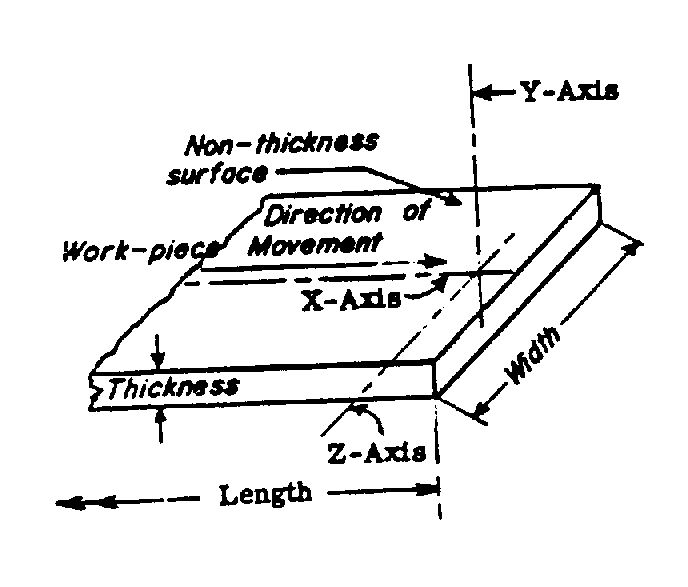
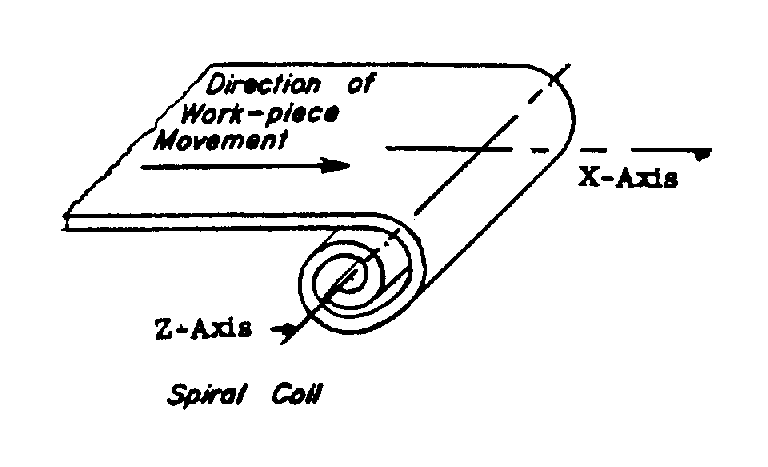
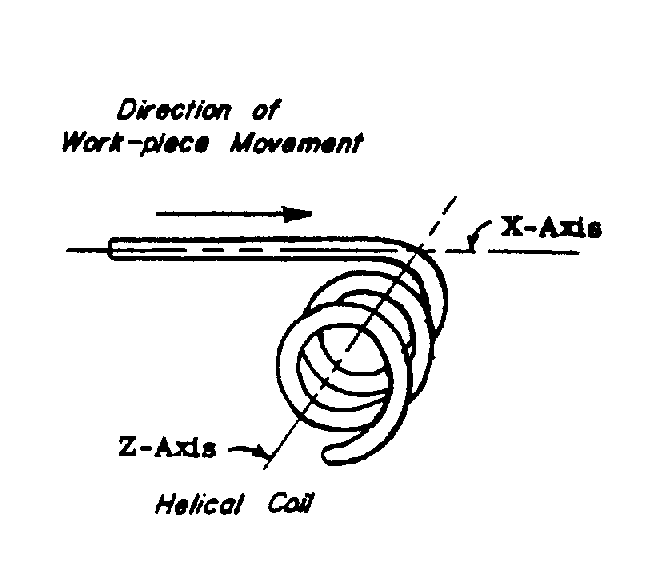
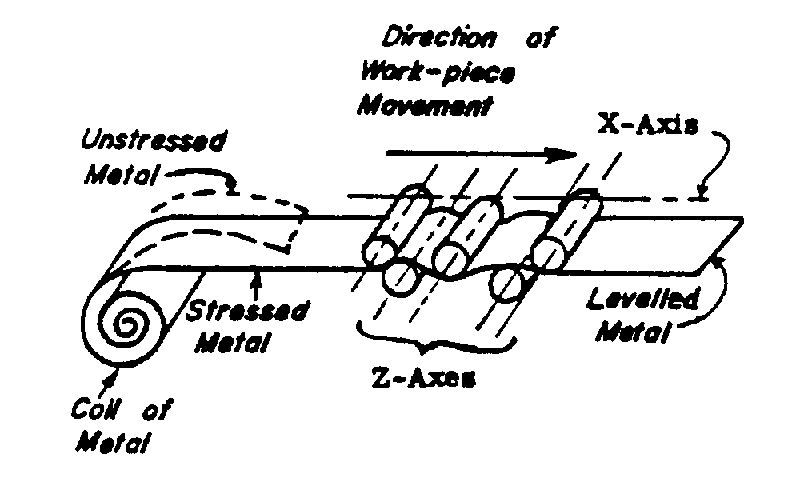
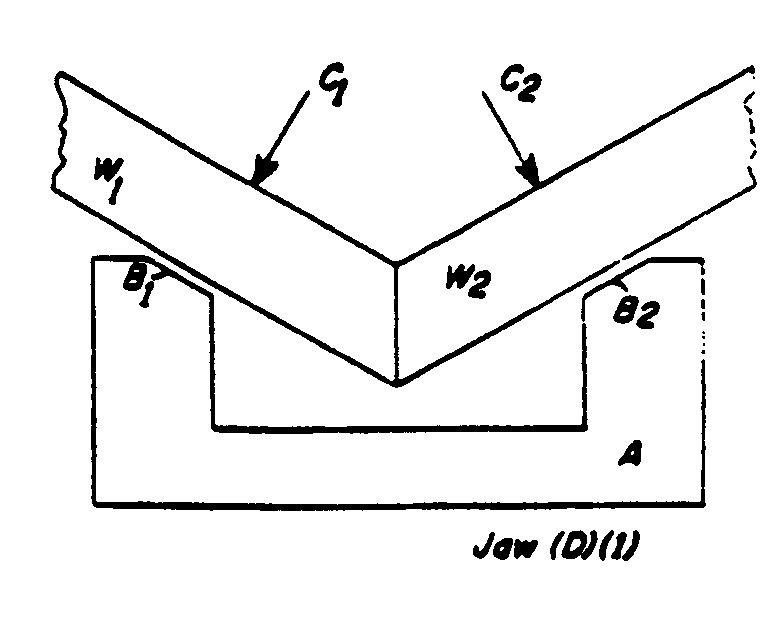
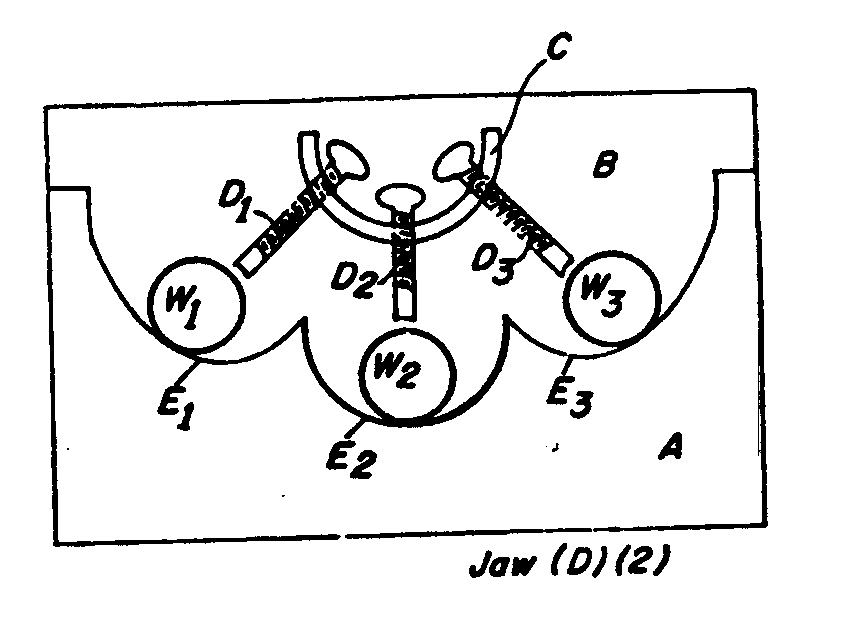
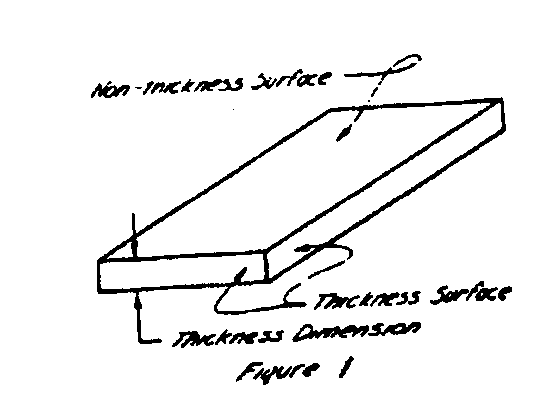
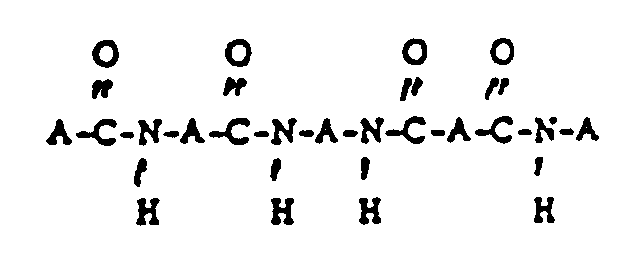
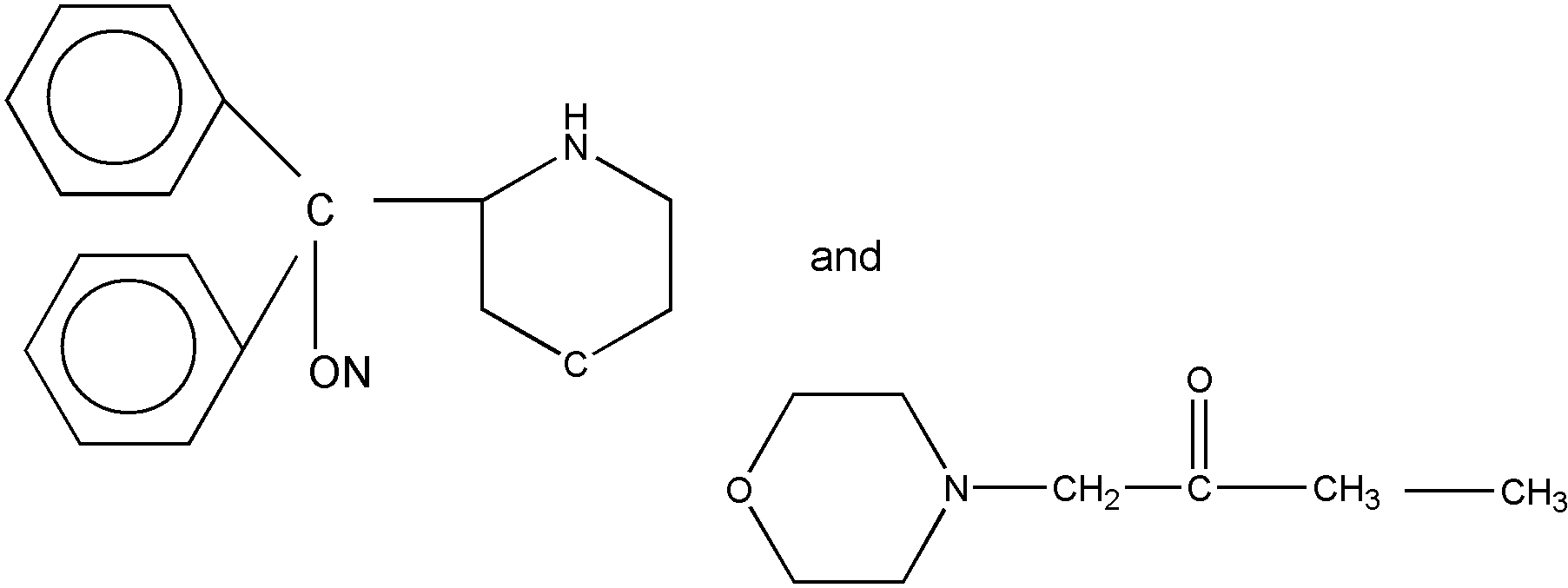
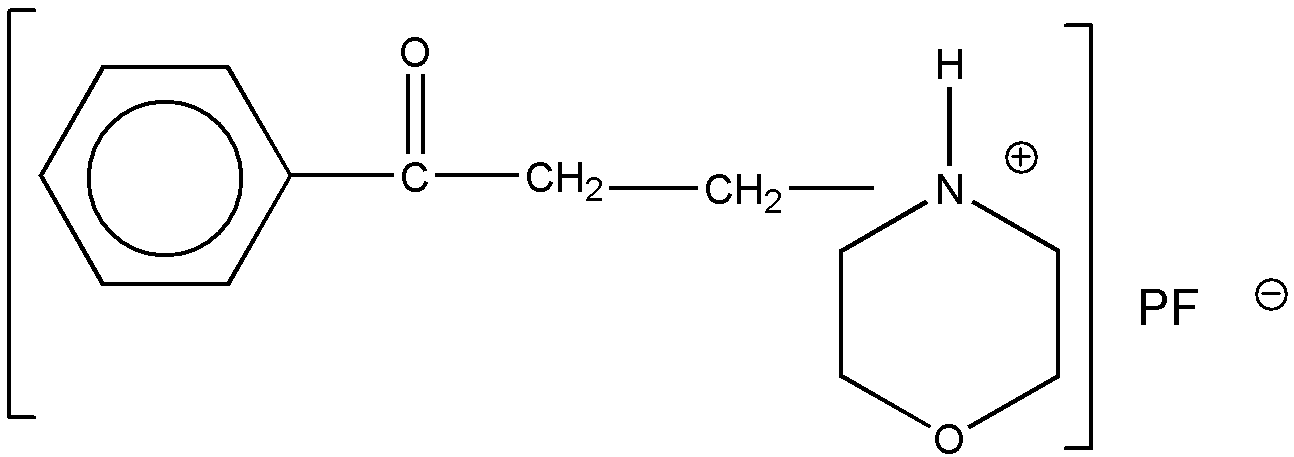
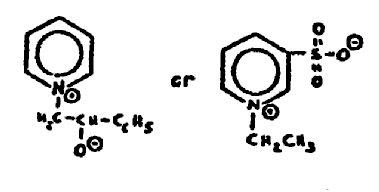
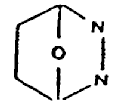
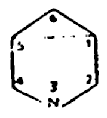
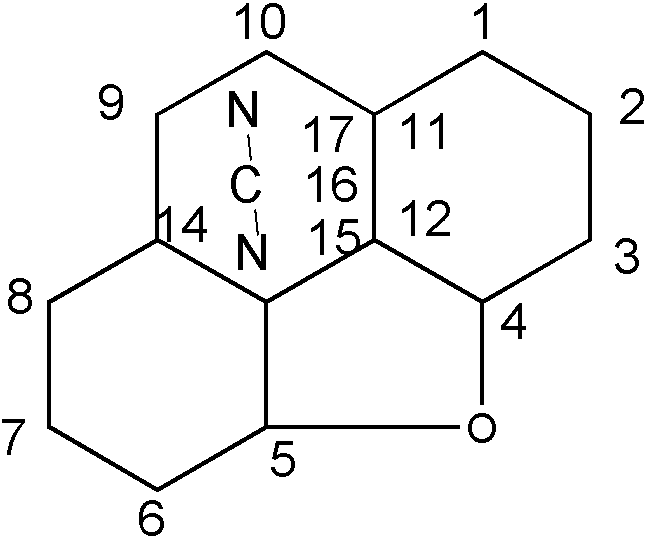
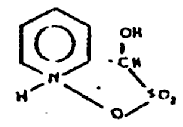
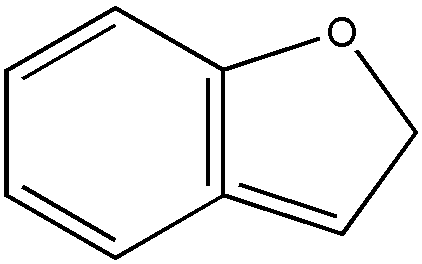
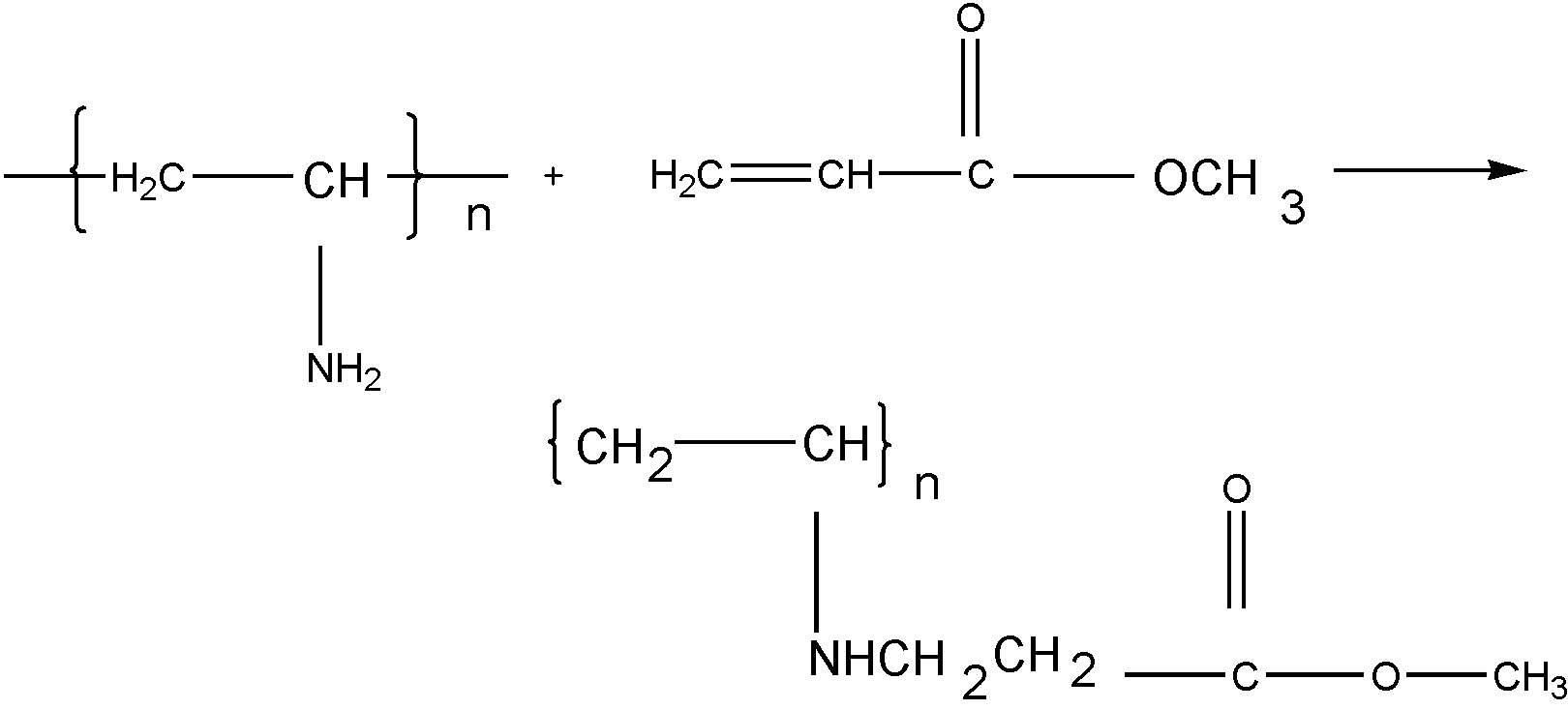
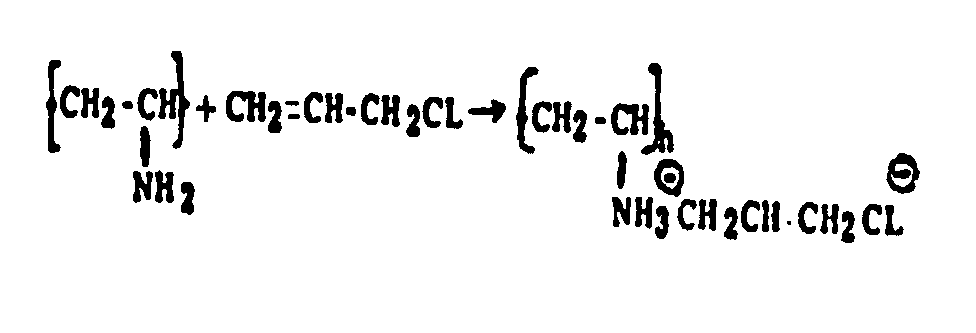
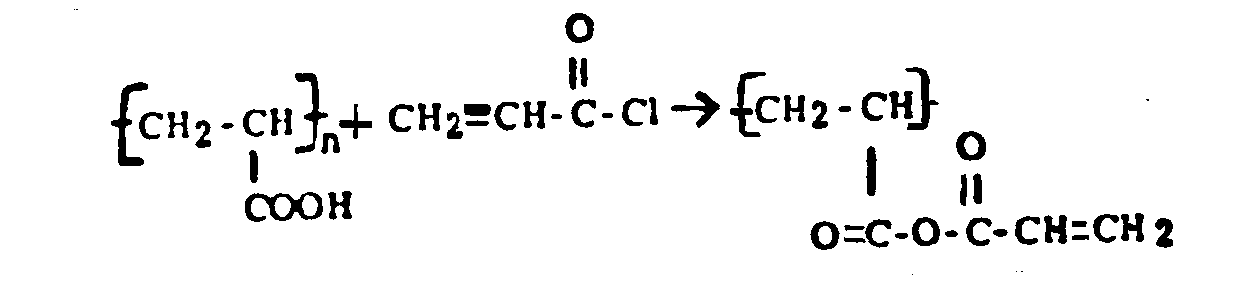
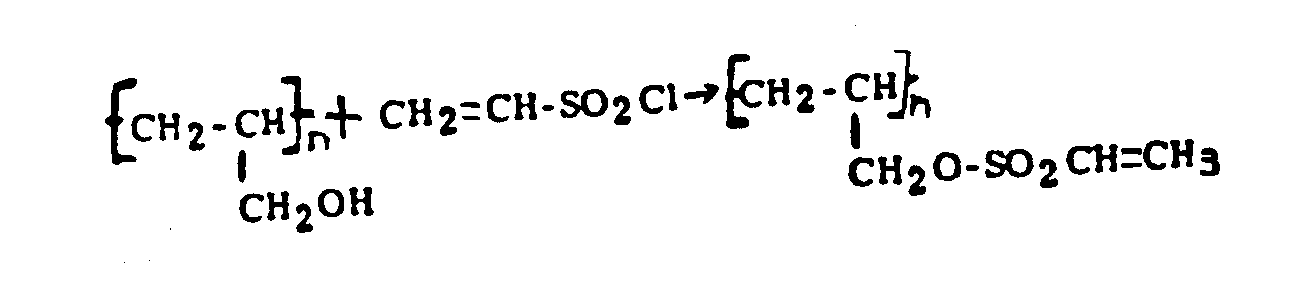
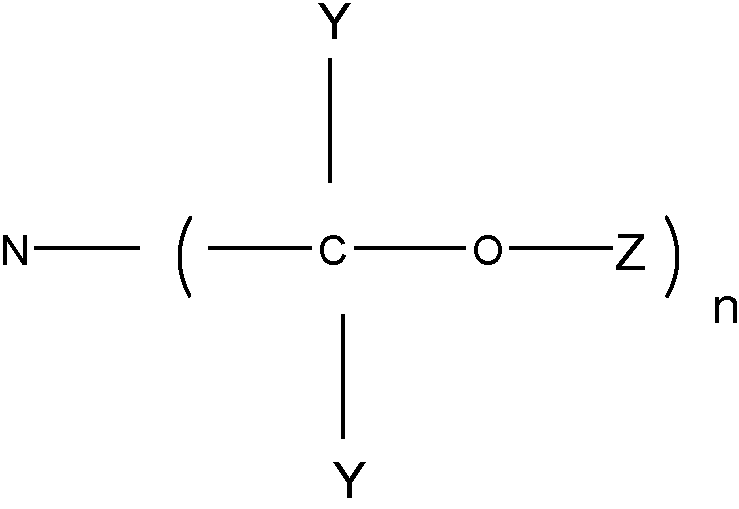
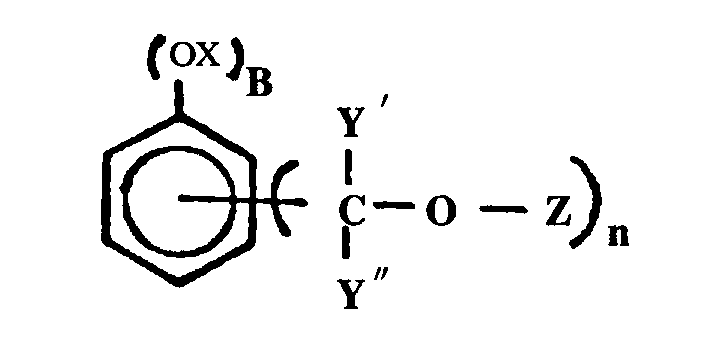
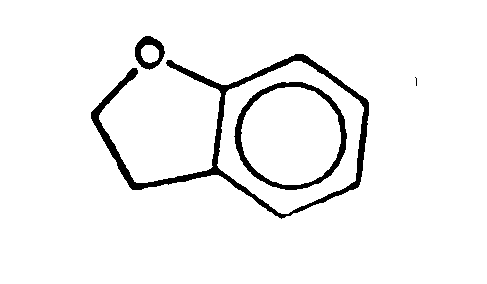
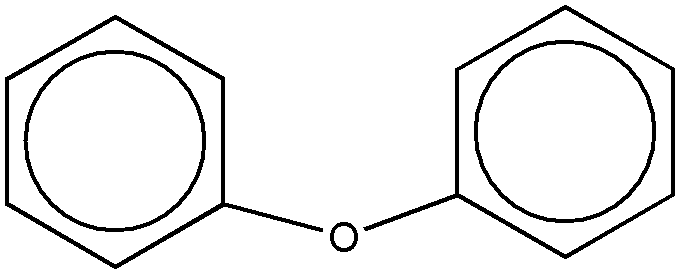
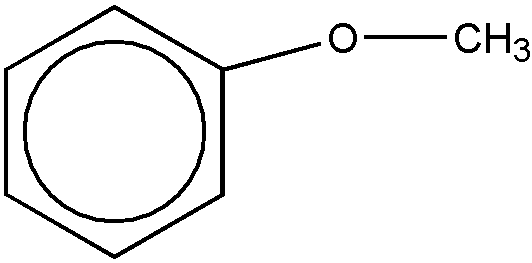
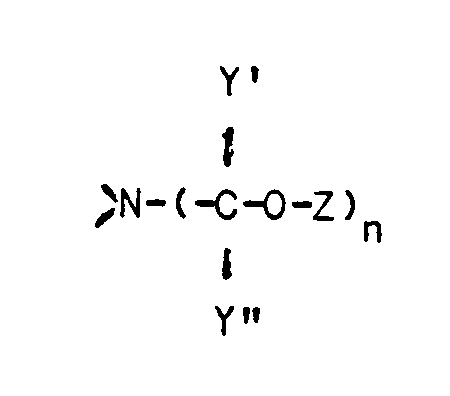
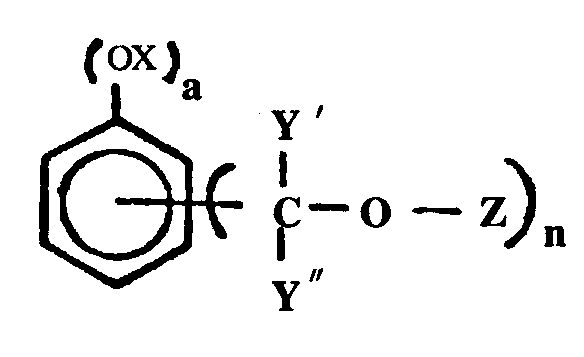
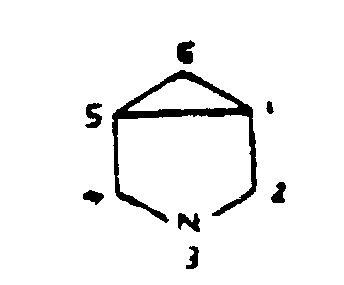
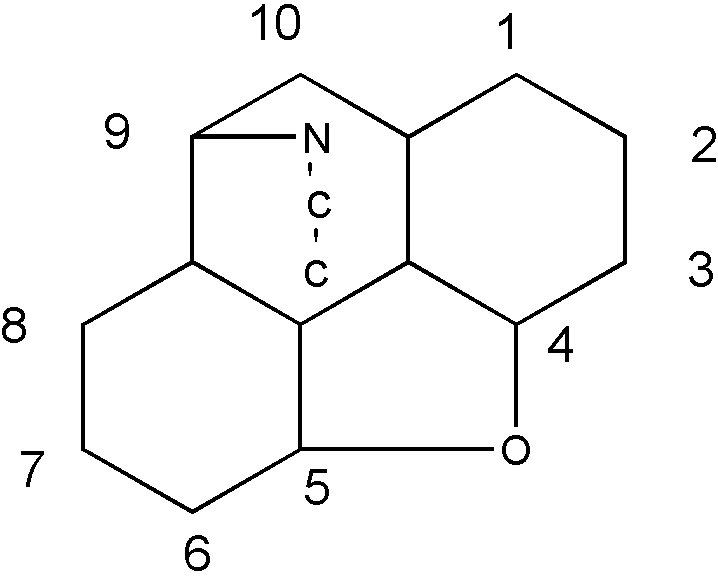
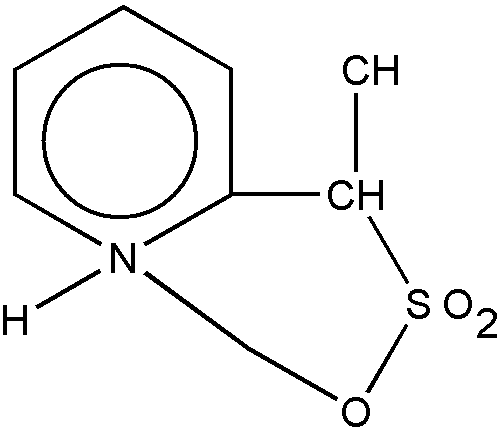
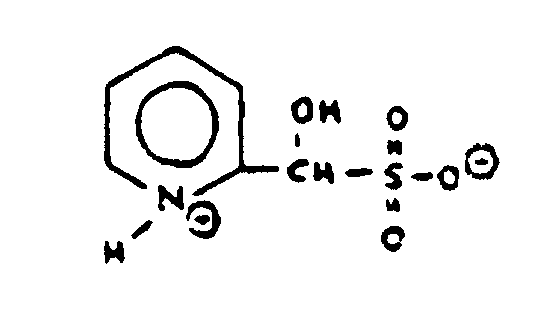
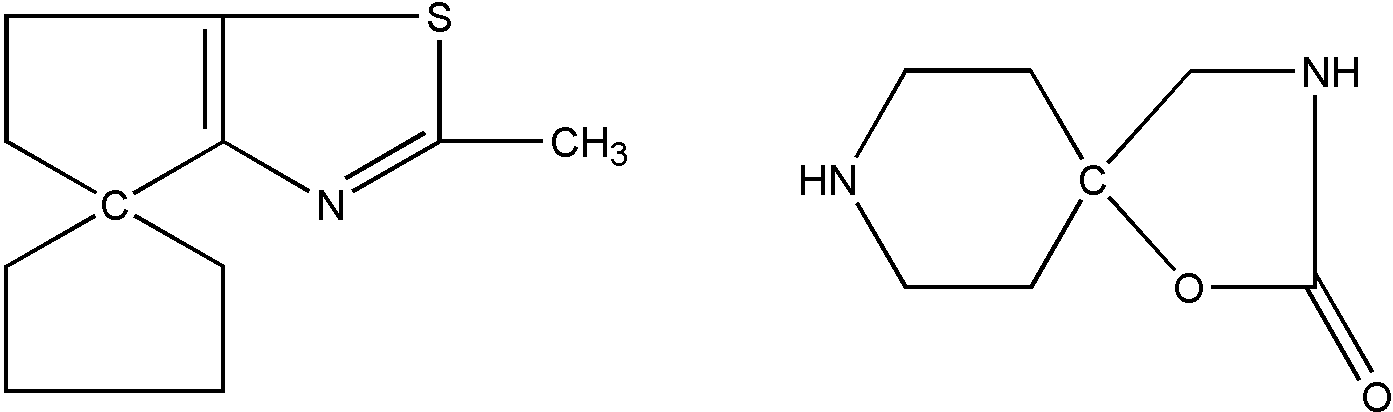
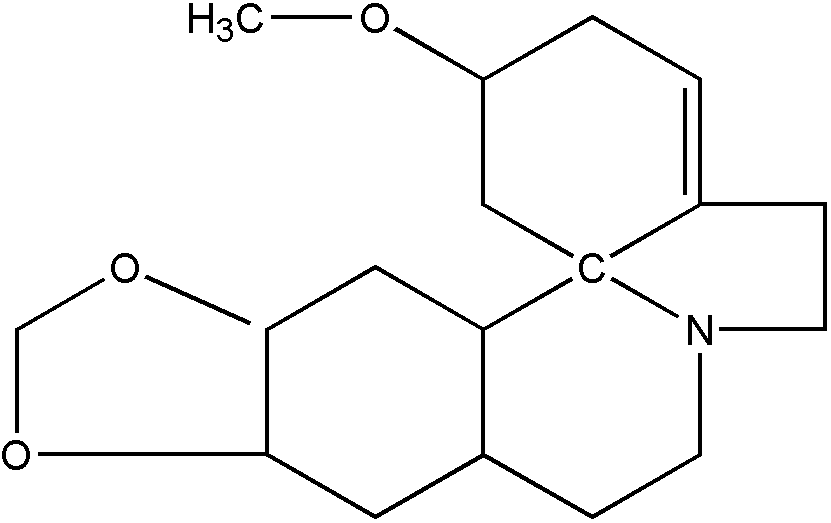
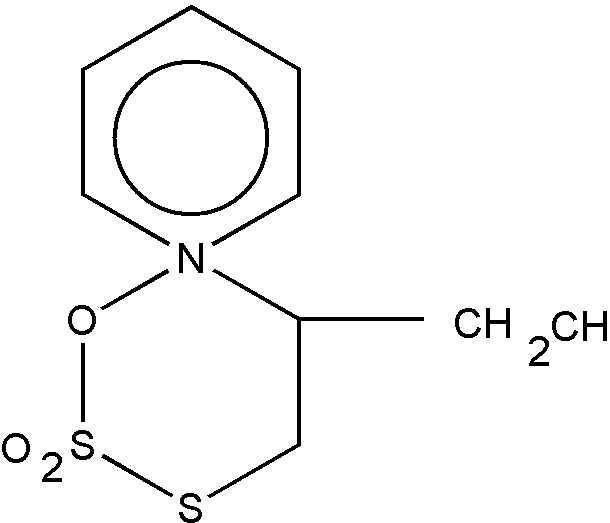
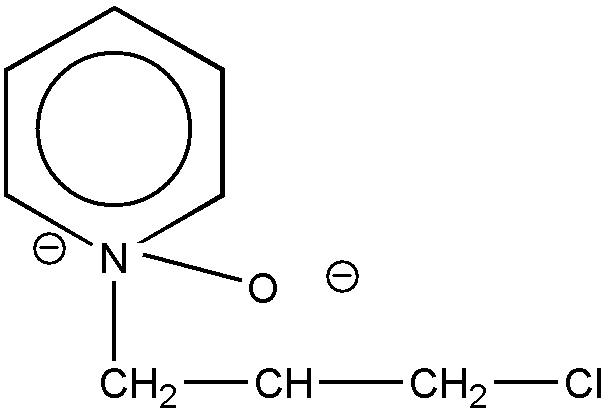
 =online
business system
=online
business system  =fees
=fees  =forms
 =help
=help  =laws/regulations
  =definition
(glossary)
=definition
(glossary)